S H O R T R E P O R T
Open Access
Learning contexts at Two UK medical schools: A
comparative study using mixed methods
Andrew Grant
1,3*, Paul Kinnersley
1and Max Field
2Abstract
Introduction:The context in which learning takes place exerts a powerful effect on the approach learners take to their work. In some instances learners will be forced by the nature of a task to adopt a less-favoured approach. In this study, we used a combination of qualitative and quantitative methods to compare the effect of context on learning at different UK medical schools. We compared schools with conventional, and problem-based curricula. Method:We had collected data from 30 interviews with third year medical students in one UK medical school with a conventional, lecture-based curriculum in relation to a previous study. The interview guide had explored effects of context and approach to learning. We used the same guide to interview 6 students in another UK medical school with a problem-based curriculum.
We then put together a pack of validated questionnaires, which measured the phenomena that had emerged in the interviews. In particular we selected questionnaires which measured the criteria on which students from the different schools appeared to demonstrate greatest variance.
Results:There were two areas where students from schools with differing curricula differed - basic learning activity and assessment. Students at the lecture-based school attended lectures where they received information while students at the Problem-based school attended tutorials where they stimulated prior knowledge and identified new learning objectives. Progress -testing at the problem-based school helped students gain a sense of
accumulating a body of knowledge needed for their life in medicine while students’ at the lecture-based school directed their learning towards passing the next set of exams.
The findings from quantitative, questionnaire data correlated with the interview findings. They showed that students at a school with a PBL curriculum scored significantly higher for reflection in learning, efficacy in self-directed learning and for deep approach to learning.
Conclusion:We set out to determine whether students at different medical schools approach their learning differently. We have succeeded in demonstrating that this is the case.
The differences that we detected in learning context and approaches to learning in medical students at the two schools predict that learning at the non PBL school is likely to be via a surface approach and not integrated. These differences have major implications for the outcomes of medical student learning at the two schools in terms of accessibility and sustainability of learning.
Introduction
Effect of context on learning
The context in which learning takes place exerts a powerful effect on both the process and the outcomes of learning [1]. It can influence students’interest in and motivation towards their studies [2]. Research shows that students’interest, attitudes to studying and learning
approach are influenced by experience [2]. Research also shows that learners concept of knowledge and learning are acquired through experience and that this becomes more sophisticated over time [3].
Learning environments where students perceive that teaching is good and where they enjoy freedom in their learning foster a deep approach to learning. Learning environments characterised by a“heavy workload” and “lack of freedom”conversely lead to students adopting a surface approach [4]. A task that demands that the * Correspondence: [email protected]
1Dept of Primary Care & Public Health, Cardiff University, Cardiff, UK Full list of author information is available at the end of the article
learner absorbs an overwhelming volume of knowledge will steer them towards a surface approach [5].
Learning styles and approaches are not fixed charac-teristics. The same student will take a different approach to consecutive learning tasks if that is what those tasks demand. Lindblom-Ylänne & Lonka [6] in their study with senior medical students describe“Dissonant Study Orchestration”. This is where students have a desire to understand rather than memorise course material but feel forced by content volume and assessments to take a surface approach. Dissonant study orchestration is asso-ciated with disillusionment and de-motivation.
In order that they guide their students towards a deep approach to learning curriculum leaders are advised to plan the learning environment for their students sepa-rately from course content and assessments [1].
Hidden curriculum
As well as from their course materials and learning activities, students gain a great deal of information about their course, the approach required and how to survive from other students. They are most likely to gain this information from their peers and students in years above [7]. The term “Hidden curriculum” has been used to describe this unofficial, handed down information, which is defined the as “The set of influ-ences that function at the level of organisational struc-ture and culstruc-ture including, for example, implicit rules to survive the institution such as customs, rituals, and taken for granted aspects.” [7]. It is easy to see that this set of influences might affect the approach students take to their learning.
Background
When analysing data for a previous study [8] it became clear that the learning context at the school where the study was being carried out was exerting a major influ-ence on students’ learning practice and whether they engaged with reflective learning activities. They described the effect of the volume of material to be learned and the form of assessments on their learning. They also described clearly the effects of the hidden cur-riculum [8,9]. During analysis of the data and discussion of the emerging thematic framework the question was raised whether students at different medical schools would have responded in the same way to interviews based on the same schedule (see Appendix).
Research question
This study, therefore, used a combination of qualitative and quantitative methods to examine the following hypotheses.
1. Students at different UK medical schools will respond differently to interviews exploring contextual
effects on their learning and their conceptualisation of learning”.
2. Students at different UK medical schools with dif-ferent curricula will score difdif-ferently on psychometric instruments measuring reflection in learning, self-effi-cacy in self-directed learning and in approach to learning.
Method
Mixed method study
This study was carried out in two stages using different methodologies. Firstly in the qualitative phase interview data from students at two UK medical schools with dif-ferent curricula were compared with a particular focus on approaches to learning and conceptual understanding of learning. In the second, quantitative phase we tested our findings from the qualitative phase with much larger numbers of respondents using a pack of validated questionnaires.
Ethical approval
At the time that this research was carried out no official mechanism was in place covering research involving medical students. The Local Research Ethics committee were consulted and we were informed that this study did not need their approval. The study proposal was submitted to the student representative body and their approval was given.
Qualitative phase
Qualitative phase; interviews
We had already collected data from one to one inter-views with 30 third-year medical students at one UK medical school with a lecture-based curriculum (School 1) [8]. The interview guide asked for information on the effect of context on students’learning in general and on their choice whether or not to participate in a reflective learning study (see Appendix).
We interviewed students at a second UK medical school using the portion of the interview schedule that related directly to curriculum, hidden curriculum and other institutional factors. We omitted the parts of the schedule relating to the original reflective learning study as these were not relevant to this study [8].
We selected the second school (School 2) because; by being problem-based its curriculum was demonstrably dif-ferent and had a difdif-ferent theoretical basis to the curricu-lum at school 1. Assessment at school 2 included the use of progress testing. In progress testing, students in the third, fourth and fifth years all sit the same multiple-choice paper twice a year. The pass mark increases for each year.
Qualitative phase; subjects
compared our findings from these interviews with data collected from one to one interviews with 30 partici-pants in the reflective learning study at school 1. All participants consented to take part in the study.
Data analysis
Interviews were carried out using the interview guide (see Appendix). They were audio recorded and record-ings were transcribed. N6 software was used to support data coding [10]. Two researchers carried out initial coding independently. They then met to discuss and compare the emerging thematic framework and the N6 software was used to develop themes (nodes) and sub-themes. This framework was then used to further code the data. The note facility of N6 was utilised to make timed records within the framework for future reference.
Qualitative phase; validation of analysis
An independent expert in qualitative research methodol-ogy examined six interview transcripts (approximately one sixth) developing an independent list of themes. No themes were revealed that were not already included in the framework but some themes were missing from her list. We undertook participant validation by sending a summary of findings to a sample of the study partici-pants who were asked to validate whether our findings were, in their view representative of their learning and the effects of context upon it. None of the five students who replied contested any part of the précis of findings that was circulated.
Quantitative phase
Quantitative phase; subjects
It did not prove possible to include students in school 2 in the quantitative phase of this study. We were able, however, to involve students in a third UK medical school (school 3) in this phase. Like school 2, school 3 has a problem-based curriculum, demonstrably different from the curriculum in school 1.
All final-year students at schools 1 and 3 were invited to participate in this phase. Final-year students were chosen as those who had longest exposure to the respective learning strategies at each of the two schools. All participants were given written information about the study and the questionnaire and all gave consent to participate.
Validated instruments
The questionnaire pack was designed to test the princi-pal themes that came out of the analysis of the qualita-tive data. It was based on three validated instruments.
•The reflective learning scale is designed specifically to measure reflective activity in medical students [11,12]. •The approaches to learning and studying inventory (ALSI) measures approach to learning on a number of subscales [13,14]. Unlike the Short Inventory of approaches to learning used by Coles it specifically
measures deep and surface approaches to learning. Both are, however, based on the same body of theoretical knowledge.
•The self-efficacy in self-directed learning scale [15] was adapted to measure self-directedness of learning in medical students.
Quantitative phase; response and respondents
The questionnaire was completed by 154 of 241 (64%) students at the lecture-based school and by 237 out of 253 (94%) at the problem-based school. We asked them, opportunistically, to complete and return the question-naire when the whole cohort was gathered for lectures.
There were no statistically significant differences in mean age (p = 0.10, Independent samples t test) or gen-der (p = 0.246, Chi-squared test). A higher number of problem-based students (9% compare to 3%) had acquired a university degree prior to admission. Conver-sely greater number of lecture-based students had taken a gap year (23% compared to 8%).
Results
Qualitative results
Key to participants
RLSn = student from School 1. Mn = student from School 2.
Two themes emerged which represented areas of influence on students’learning. These were;
1. Basic learning mechanisms and 2. Assessment.
Volume of material to be learned was an issue for stu-dents at both schools although viewed quite differently.
Basic learning mechanisms
The basic learning activity at two schools was different comprising lectures at school 1 and Problem-Based Learning (PBL) tutorials at school 2.
Students’perception of the purpose of these activities was quite different. School 1 students perceived that the most important function of the lecture was the transfer of information from lecturer to student.
A lecture is obviously the easiest way to get it across to you but you just write because, there is a lot of written information that you have to get down and quite often it goes in this ear and straight out onto the paper rather than actually going into your head at all.
RLS 20
It depends on the style of the lecture. I can’t do a
thing if all you’re doing is hurting your hand to write
as much as you can from the slides, you can’t, you
just have to, write, I just find those completely
use-less, and there’s just too much of an information
overload.
I remember from lectures I’ve found interesting, but on a Monday when you’ve got five or six lectures and it’s one after the other and it’s the same topic you tend to switch off, sitting down taking notes, so no, I
don’t remember much about them.
RLS 3
Some school 1 students described good lecturers who helped them to understand underlying concepts.
So just somebody who sits down and says these are the five essential points that I want them to take
away from this lecture and these are the ones I’m
going to focus on... Somebody who has thought about the topic they are going to talk about and has thought this is the essential information that they
need to know.
RLS 19
Students from school 2 described quite a different process when they discussed the week’s“case”in a small group, thinking about and sharing what they new about the subject matter. Each case was discussed twice (open-ing and clos(open-ing).
... I think from both the opening and the closing in the discussion which when I read the opening there will be 20 things that I don’t know anything about, but there maybe one thing that I do know about and you just sit there and even talking almost like the blind leading the blind there will always be some-thing someone knows a bit about and somebody else knows someone who had something, and by the end of the opening I understand a whole lot more about the case. Without going away and reading one thing about it, you raise questions just by talking about it and people will be able to answer it, and so I can learn a huge amount by just opening it, and then you go away obviously and study it and then come back. And then coming back you close, almost raising
as many questions as opening...
M1
Workload & assessment
Students at both institutions perceived themselves as having a vast amount to learn. However methods of assessment were quite different and this framed the learning requirements differently. At school 1 students perceived the need to learn the content of all their lec-tures so that they could reproduce this at the next exam.
We’ve got an exam in a fortnight I think it is and
that’s got something like 83 lectures worth of material
in it.
RLS 18
Interviewer: How much of your learning is in response to the prospect of exams?
Student: Most of it (laughs) I don’t think it should be that way. I think you should be learning, sort of to gain knowledge on the wards and for the clinical
experience but at the end of the day it’s the exams
which make me work I think.
RLS 18
Yeah, thinking beyond qualifying and also I suppose
thinking exams, there’s nothing like an exam to make
you have to learn about something, but it’s not a particularly satisfying way of learning... but at the end of the day if you’ve got to pass an exam and
there’s going to be an exam you need to know about.
RLS 14
The format of assessments also was seen as driving rote memorisation.
This kind of EMQ1 thing where you don’t really get
to show what you understand about a topic, it’s
more what random facts you can remember, you’re
going to get a big list, and you’re going to have to put
the right box next to the right thing, so a lot of it was
just learning lists.
RLS1
In contrast to this students in school 2 (where knowl-edge was assessed using a twice-yearly Progress Test) students, while being aware of the large volume of mate-rial to be learned, orientated their learning towards the goal of becoming a doctor as well as passing medical school exams.
There’s such a huge amount that at some point you
need to cover, but because you can’t cover it all in
such a short space of time for the exam at the end of the year, you have to cover it all by the end of your 5 years...
M1
... emphasis is on what is important from the
learn-ing has changed from ‘I need to pass an exam in
May’to ‘this is what I need for the rest of my life. I
have to know this for good’.
M3
For some school 2 students revision was seen as mar-ginal or unnecessary but was at the heart of school 1 students’learning practice where they described techni-ques of rehearsal and memorisation.
who is not fantastic at remembering things I have to sit down and read it again, and to do that I have to revise
M2
When I’m revising, I take my lecture notes, which I write in pencil. The aim is to write them up
some-time before I start revising but usually it’s part of my
revision process, go to my lecture notes and write them up neatly. Then I might, I quite like making
revision cards and it’s not so much I have to go back
to revision cards and learn them, it’s another way of
writing things out. Sometimes I might just use a note-book and each page in a notenote-book is a lecture or something like that so a lot of my learning process is
by writing.
RLS 17
I try to make separate notes, the notes that we take down during lectures are a bit haphazard and untidy, so I’ve tried to make separate notes and
maybe integrate some stuff that I’ve read up in books.
RLS 3
I use recall method where I read, I study what we’ve
done before and I try to recall it by putting the book
aside and seeing if I can recall the facts.
RLS 12
Culture and hidden curriculum
In carrying out the interviews and examining the data a difference emerged in students’ self-confidence as lear-ners and in their confidence in their undergraduate pro-gramme. The way in which students described third year to students junior to them varied between the two schools.
Yes, most of them said that you’re going to like 3 rd
year because it’s not like your 1st and 2nd year and
you’ll enjoy it very much.
M6
I think if someone from 2nd year were to ask me yes I would say that 3 rd year has been wonderful
M6
In contrast exams appeared to cast a shadow over enjoyment of third year students in school 1.
If every student was able to do the end of year exams or had the feeling that they would pass then the third year would become the best year in medicine.
It’s the end of year exams that makes people say
that, [it is hard] not the content of the work.
RLS 12
In describing their Problem-based learning tutorials students described how they freely shared what they
knew with their peers and felt that they gained from this. In contrast students at the lecture-based school were wary about admitting to how much study they had done.
Everyone seems not to like someone who works hard and shuns [them] and calls them brilliant whereas you know the person might just be working hard and
that’s why he’s producing results and there’s a lot of
lying that ‘we didn’t do any work’ when they did
work.
RLS 12
Differences also existed in how students perceived their course and its ability to prepare them for life as a doctor.
I think the way the our course is run I think it’s good
for the future because it’s making me think on my
feet and rather than just sitting in lectures and being
quite passive, it’s making me go away and work
things out for yourself and find ways in which to learn, like going to clinic and things and so I think
it’s making you into a more well-rounded doctor for
the future.
M4
The first study in school 1 was set up to examine the effects of reflective learning techniques in undergraduate medical students. For some students at least this revealed a version of dissonant study orchestration whereby they were pushed, by their assessments, towards a surface learning approach.
... You’d have to change the way we’re
examined-[which] is not conducive to people who learn
reflec-tively, because it’s not about learning lists, it’s about
learning concepts, it’s about learning ideas, and It’s
about learning general principles, it’s not about long
lists, as I understand it.
RLS1
Confidence
School 2 students demonstrated an air of confidence in their learning. This appeared, at least in part, to result from a confidence that they knew what they needed to know and knew that they knew it. This resulted in dif-fering stress levels at exam times.
When I did [the] OSCE in July usually immediately
before my exams I’m so stressed out and panicking
it came to the OSCE for the week before, you think ‘it’s a week before the exam I’m going to focus and
practise’and after 2 or 3 days you got to the stage
where I was sitting there and we were in groups with people and you’re practising and you’re thinking well
I can do this, I know this, I understand this, I’ve been
doing this all year. I don’t need to sit and memorise
this and learn this now until it actually got to the stage on the day of the OSCE and I was sitting in my first station, (a rest station,) so I was just sitting there, which normally you would think could be quite an intense experience just making everything worse and I said there’s nothing they can throw at
me today that I can’t do. I know that I can do it.
M1
Quantitative results
Internal consistency
The internal consistency between all questionnaire items was 0.881 (Cronbach’s alpha). The Internal consistency of individual questionnaire components were RLS 0.905, Self-efficacy for self-directed learning 0.855 and LSQ 0.793 (Cronbach’s alpha).
Comparison of means
Mean scores for items on all three instruments were compared between final year students at schools 1 and 3 using t test for independent means.
Quantitative phase; findings
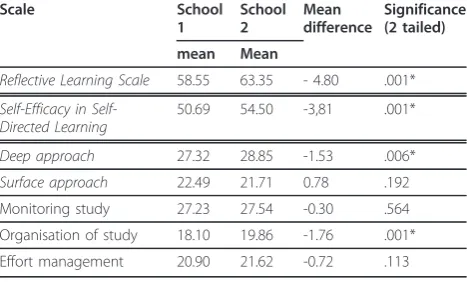
Students from school 3 scored significantly higher on the reflective learning scale than students from school 1. Students from School 3 also scored higher on the self-efficacy in self-reflective learning scale. Although there was no significant difference on scores for the ALSI stu-dents from school 3 scored higher on the deep learning and organisation of study subscales (see Table 1).
Discussion
By combining in-depth interviews with validated ques-tionnaires it has been possible to triangulate findings to address the two hypotheses.
1. Students at different UK medical schools will respond differently to interviews exploring contextual effects on their learning and their conceptualisation of learning.
2. Students at different UK medical schools with dif-ferent curricula will score difdif-ferently on psychometric instruments measuring reflection in learning, self-effi-cacy in self-directed learning and in approach to learning.
Quantitative methods in the second part of this study allowed a larger number of medical students to provide opinions. However, data from student interviews in the qualitative phase, have clarified some of the reasons that
students attribute to the differing learning practices. The combination of the two approaches, support suggestions that students in problem-based curricula are more likely to be self-directed in their learning, to have a more hol-istic approach to learning and a greater sense of self-efficacy.
Contrasting approaches to learning and assessment The qualitative data demonstrate a difference in learning practice, learning orientation and in perceived aims of learning. In school 1, students attend lectures, which they perceived as the main source of information. They then sought to learn that information, often by rote using rehearsal techniques. This learning activity was designed to prepare the student for their next set of exams. Some students voiced the wish that their learning was for understanding or for preparation for medical practice but the need to pass the next exam was more immediate, demonstrating dissonant study orchestration [6].
Compared to this, school 2 students’process of learn-ing was quite different. Attendlearn-ing PBL tutorials was seen as being about stimulating what they already knew in relation to the case of the week then determining what needed to be learned. Although they helped each other through discussion, the tutorial was not, primarily, a source of information. It was where they decided what they needed to learn and find out elsewhere to enhance their understanding.
[image:6.595.305.539.124.265.2]Assessment at the two schools also exerted different influences on learning. The progress test gave the mes-sage to students at school 2 that a gradual acquisition of knowledge was occurring in preparation for their future in medicine. Students were aware that this did involve learning a significant amount but that it could be done gradually, building on prior experience. Students at school 1 on the other hand, saw their exams as requir-ing the reproduction of isolated facts, which, in turn,
Table 1 Comparison of mean scores on the Reflective Learning Scale, Self-Efficacy in Self-directed learning scale and ALSI
Scale School
1
School 2
Mean difference
Significance (2 tailed)
mean Mean
Reflective Learning Scale 58.55 63.35 - 4.80 .001*
Efficacy in Self-Directed Learning
50.69 54.50 -3,81 .001*
Deep approach 27.32 28.85 -1.53 .006*
Surface approach 22.49 21.71 0.78 .192 Monitoring study 27.23 27.54 -0.30 .564 Organisation of study 18.10 19.86 -1.76 .001* Effort management 20.90 21.62 -0.72 .113
rewarded rote learning rather than acquisition of understanding.
The quantitative data support these differences in approach. Students at the problem-based school were more reflective in their learning. In qualitative analysis, these students discuss thinking about what they know already, developing their own learning objectives along with the PBL group, so it is perhaps not surprising that their learning practice involves more reflection.
Similarly, the student’s descriptions of their learning processes imply that PBL students’decide for themselves what they need to learn as well as what approach they will take. Hence, it is not difficult to see that they might become more self-efficacious as self-directed learners. This in comparison to students who write down what their lecturers say then try to learn it by rote.
Students who determine learning outcomes for them-selves and then take responsibility for finding informa-tion they need to learn are also more likely to take a deep approach to learning. Using curiosity aroused by PBL cases and discussion with their peer group, these students perceive that they were more likely to have in interest in understanding and not merely having to learn to reproduce subject matter. In addition, school 3 students scored significantly higher for organisation of study, which is recognised as a marker for strategic learning (the ability to learn by surface or deep approach depending on the demands of a particular task). Students in school 1 described a less flexible pat-tern where they learned in preparation for exams while students in school 3 showed an understanding that they were learning for their future in medicine rather than any one set of exams. Students also demonstrated an aptitude for identifying for themselves what they needed to learn. In school 3, students described themselves as more strategic, organised learners than those in school 1. These findings predict that school 1 students were more likely to adopt a surface approach to their learn-ing, had a lower sense of self-efficacy as learners and were less likely to engage in reflective learning techni-ques. These parameters predict that they will probably learn in a way that is less likely to result in a deeper level of understanding and will be less likely to integrate their learning [1,8,16]. As well as these stark contrasts in learning practice the students written comments also highlight different levels of confidence in themselves as learners and in the learning strategies at the two schools.
Limitations
The qualitative study was carried out alongside another larger study [8,9]. It is possible that the six students from school 2 may have been a self-selected group of students. Their observations are, however, consistent
with those in another study where 44 year-two students on a problem-based undergraduate medical course were interviewed [17]. Hence it is unlikely that they are unre-presentative of their cohort.
The findings have concentrated on learning style as a cause of difference in approach to study at the two schools as attributed by the respondents (students at the two schools). Clearly these will not be the only differ-ences, but it was beyond the scope of this study to determine all the areas of difference between the two schools and the contribution those areas of difference made to variations in approach to learning.
In addition, both phases of the study could not be undertaken with students from the same medical schools for administrative reasons. Hence, other UK medical schools with a problem based curricula were approached to continue that part of the study. While this means that data do not reflect a direct comparison, it has resulted in being able to show complementary data from three UK medical schools collected using dif-ferent methodologies demonstrating that students at medical schools with different curricula do take a differ-ent basic approach to their learning, This has implica-tions for curriculum design in the future.
Summary
Data from qualitative and quantitative analysis show that students at different medical schools adopt different approaches to their learning during undergraduate train-ing. Students attribute these differences to the curricu-lum design and examination style at their school, and suggest that this could have implications for life long learning.
End Notes 1
Extended matching question 2
This will have formed part of a larger interview guide for students participating in the reflective learning study in school 1
Appendix Interview guide2
1.Introductionand explanation of study (brief) 2. Reassure about confidentiality & lack of need to please the interviewer
3.Confirmconsent to record the interview. 4.General learning and background
How they set about their learning?(How had they set
about their learning i.e. before the 3rdyear or at the
beginning of the third year before the study started? You are trying to get them to describe their approach to learning at some point before the study)
The college culture
How do they think other students approach learning? If differently why? How helpful have they found other stu-dents to be?
Had they themselves changed the way they learned since being in the college?
How helpful have they found the staff in advising how to learn rather than what to learn?
What motivates them to learn?
The workload in the 3rdyear?
How do they find the workload in the 3rdyear compared
to yrs.1&2? What exactly is the problem, if any? Ask for
examples.
Effect of exams on learning
How much of their learning is in response to exams? What is the effect of exams on their learning? What
would happen to their learning if they didn’t have
exams?
Have they done really well in any exam/assessment? What was the effect of this on their learning?
The ward learning environment
Ask them to describe the good parts and the drawbacks.
Probe teaching by SHOs and PRHOs. Is what they
learn on the wards easier to remember? Does the fact that it is in context help? How?
The informal peer group
Do they undertake any unofficial leaning with groups of friends? If so what form does it take? Is it helpful? How?
Acknowledgements
The authors would like to thank the students who willingly took part in this study. They would also like to thank Professor Kerry Hood for help with statistical analysis and Dr Lynn Monrouxe for advice about formatting of the manuscripts.
Author details
1
Dept of Primary Care & Public Health, Cardiff University, Cardiff, UK.2School of Medicine, Glasgow University, Glasgow, UK.3Institute of Medical Education, Cardiff University, UGT 162A, University Hospital for Wales, Cardiff, CF14 4XN.
Authors’contributions
AG designed the study, put together the questionnaire pack, and analysed the data. PK supervised the study design. MF supervised data collection. All authors read and approved the final manuscript.
Competing interests
The authors declare that they have no competing interests.
Received: 4 October 2011 Accepted: 19 March 2012 Published: 19 March 2012
References
1. Entwistle N, Peterson E:Conceptions of learning and knowledge in higher education: Relationships with study behaviour and influences of learning environments.Int J Educ Res2004,41:407-428.
2. Ramsden P:The context of learning in academic departments.InThe experience of learning: implications for teaching and studying in higher educaiton..Secondth edition. Edited by: Marton F, Housell D, Entwistle N. Edinburgh: Scottish Academic Press; 1997:.
3. Perry W:Forms of Intellectual and Academic Developments in the College YearsNew York: Holt, Rhinehart and Winston; 1970.
4. Entwistle N:Contrasting Perspectives on Learning.InThe Experience of Learning: Implications for Teaching and Studying in Higher Education.Edited by: Marton F, Hounsell D, Entwistle N. Edinburgh: Scottish Academic Press; 1983.
5. Meyer J:Study orchestration: The manifestation, interpretation and consequences of contextualised approaches to studying.High Educ1991, 22:297-316.
6. Lindblom-Ylanne S, Lonka K:Individual ways of interacting with the learning environment-are they related to study success?Learn Instruct
1999,9:1-18.
7. Lempp H, Seale C:The hidden curriculum in undergraduate medical education:qualitative study of medical students’perceptions of teaching.
Br Med J2004,329:770-773.
8. Grant A, Kinnersley P, Metcalf E, Pill R, Houston H:Students’views of reflective learning techniques: an efficacy study at a UK medical school.
Med Educ2006,40:379-388.
9. Grant A:How Can Reflective Learning Benefit Medical Stuidents? A Study Combining Qualitative and Quantitative MethodologiesPhD Thesis Cardiff University; 2005.
10. Richards L:Using N6 in Qualitative ResearchDoncaster, Victoria, Australia: QSR International Pty Ltd; 2002.
11. Sobral D:An appraisal of medical students’reflection-in-learning.Med Educ2000,34(3):182-187.
12. Sobral D:Medical students’reflection in relation to approaches to study and academic achievement.Med Teach2001,23(5):508-513.
13. Entwistle N, McCune V, Hounsell J:Approaches to Studying and Perceptions of University Teaching-Learing Environments: Concepts, Measures and Preliminary FindingsEdinburgh: ETL project (TLRP/ESRC); 2002. 14. Learning and Studying Questionnaire.[http://www.ed.ac.uk/etl]. 15. Zimmerman BJ, Bandura A, Martinez-Pons M:Self-Motivation for Academic
Attainment: the Role of Self-Efficacy Beliefs and Personal Goal Setting.
Am Educ Res J1992,29(Fall):663-676.
16. Bandura A:Self-Efficacy: The Exercise of ControlNew York: W.H. Freeman and Co; 1997.
17. Mattick K, Knight L:High Quality Learning: Harder to Achieve than we Think?Med Educ2007,41(7):638-644.
doi:10.1186/1756-0500-5-153
Cite this article as:Grantet al.:Learning contexts at Two UK medical schools: A comparative study using mixed methods.BMC Research Notes 20125:153.
Submit your next manuscript to BioMed Central and take full advantage of:
• Convenient online submission
• Thorough peer review
• No space constraints or color figure charges
• Immediate publication on acceptance
• Inclusion in PubMed, CAS, Scopus and Google Scholar
• Research which is freely available for redistribution