Rochester Institute of Technology
RIT Scholar Works
Theses Thesis/Dissertation Collections
11-1-2011
Puffery
Whitney Warne
Follow this and additional works at:http://scholarworks.rit.edu/theses
This Thesis is brought to you for free and open access by the Thesis/Dissertation Collections at RIT Scholar Works. It has been accepted for inclusion in Theses by an authorized administrator of RIT Scholar Works. For more information, please [email protected].
Recommended Citation
R
I
T
by
WHITNEY EMMA WARNE
A Thesis Submitted in Partial Fulfillment of the Requirements For the Degree of Master of Fine Arts
in Imaging Arts
School of Photographic Arts and Sciences College of Imaging Arts and Sciences
Rochester Institute of Technology Rochester, NY
November 2011
Approval:
Patricia Ambrogi Date
Committee Chair
Christine Shank Date
Committee Member
Carla Williams Date
ACKNOWLEDGMENTS
“Puffery” could not have been made without the dedication and inspiration of a few truly amazing people.
To my committee, Patti Ambrogi, Christine Shank and Carla Williams: Thank you for your honesty, unwavering support and occasional kick in the skirt. I treasure the immeasurable knowledge you’ve shared.
To my parents: Thank you for never letting me settle, for telling me I could do and be anything, and for knowing that “things” always works out for the best. Your love keeps me sane.
To Ali Sable: Thank you for your amazing design work. Your dedication to perfection enables my work to shine and your steadfast friendship makes Rochester home.
To, Jim, Marc Hamilton and Larry Knapp: Thank you for going above and beyond in every aspect of your jobs. This show would not be possible without your generosity and attention to detail.
To my peers: Matt Chung, Emily Zeller, Sarah Newman and especially Erika Heffernan and Megan Mette. This work would still be trapped inside my head without all those drinks and dinners, long days in the grad lab and impromptu coffee breaks.
ABSTRACT
by
Whitney Emma Warne
B.F.A., Photography and B.A., Journalism, University of Iowa, 2009 M.F.A., Imaging Arts, Rochester Institute of Technology, 2011
The external body is a place to perform a version of ourselves, rather than
CONTENTS
ACKNOWLEDGMENTS : ii
ABSTRACT : iii
LIST OF FIGURES : v
INTRODUCTION : 1
TRAINING THE DOCILE BODY: 3
DISPLAY RULES : 9
SELF CONTROL : 15
POWER AS PROTECTION : 18
LANGUAGE AND THE BODY : 21
AN EXHIBITION : 24
HER STORY : 27
PERFORMANCE AS PRACTICE : 30
LIST OF FIGURES
Figure 1: Jump Rope (Video still), 2010.
Figure 2: Posturing (Video still), 2011.
Figure 3: Self Control: Form One, Two and Three, 2011. Inkjet prints.
24x32 in.
Figure 4: 25 Wings in 12 Minutes (Video still), 2011.
Figure 5: Finger Trap (Video still), 2011.
Figure 6: Frigid.Tease.Prude. (Video still), 2011.
Figure 7: Puffery (Postcard), 2011.
Figure 8: Puffery (Logo), 2011.
Figure 9: Puffery (Refreshment table), 2011.
INTRODUCTION
Within a language that rests on univocal signification, the female sex
constitutes the unconstrainable and undesignatable. In this sense, women
are the sex which is not ‘one,’ but multiple. –– Judith Butler1
I am an American, upper-middle-class, straight, white, highly feminized
female in her early twenties receiving my Masters of Fine Arts in Imaging
Arts from a private institution. My experience is not common. I am not
average. I am not “every woman.”
I was born into a specific set of demographics: my country of origin, class,
sexual orientation, race, and education level combine and create
identity, complicating my personhood and taking me further away from a
generalized experience of “woman.” It would be reductive to say that as
a woman, I can speak on behalf of all women. In reality, my upbringing
limits my perspective.
My graduate thesis, Puffery, explores the culturally constructed and
expected behaviors of the upper-middle-class female. Through
video-documented performance and photography, the audience witnesses a
questions external expectations, often struggling to locate internal
motivations and desires in habitual actions.
She borrows my body and builds off my personal experiences to perform
durational performances of physical and cultural rituals. My character
acts out, acknowledging and negotiating her position within the action.
The physical body is the site of my investigation. My character presents
herself to be viewed. She explores the intricacies of ordinary actions,
challenging bodily boundaries and examining the emotional
repercussions betrayed by the reactive flesh. John Berger spoke on seeing
women:
She has to survey everything she is and everything she does because how she appears to others, and ultimately how she appears to men, is of crucial importance for what is normally
thought of as the success of her life. Her own sense of being herself is supplanted by a sense of being appreciated as herself by
another.2
The pleasure and pain of being bound to my body, of deriving self-worth
from my physical embodiment, connects me to other women. I am a
person who walks into the room to be surveyed. The style of my hair and
dress, the way I shake a hand, the amount of control I wield over my
movements, and the structure of my speech are just a few of the ways I
explicitly taught and others are absorbed. Over time the regulations of
parental and institutional discipline become self-discipline: the internal
conviction and embodiment of a cultural ritual or ideal.
Obedience to cultural standards of the upper-middle class is my
character’s second nature. As I unpack her physical and mental
attributes, we see that these actions are authentic to her upbringing, but
not always consistent with her real and spontaneous desires. She explores
her internalized expectations and well-rehearsed actions through
performance, negotiating her own agency, power and control over the
rituals she engages in. By simultaneously embodying an action and
critiquing it, my character shows the façade, examines it and breaks it
down. Revealing that superficiality lies not only in the clothes and the act,
but in the denial that propensity exists to some degree, in all of us.
TRAINING THE DOCILE BODY
A body is docile that may be subjected, used, transformed, and
improved. –– Michael Foucault3
The lines and motions of the body are rehearsed. Learned actions
unnatural act becomes innate. Teachers, coaches, friends, and parents
nurture patterns in speech and rhythms in the body. Eventually the
spontaneity and freedom of childish manners are traded for class and
gender-appropriate social etiquette and puffery: exaggerated actions
designed to mask the self behind optimism and grandeur. The body and
mind easily succumb to training and eventually internalized self-discipline
takes over. We carry the lessons of our instructors––the perfect machines
of culture’s making.
**********
The screen fades in to reveal a young woman framed close to the head
and shoulders, standing on a stage. Her hair curls in ringlets around her
face, swooped up in the front by a sparkly tiara. Purple eye shadow
covers her lids. Her face is caked in foundation and too much blush. Her
neck is noticeably lighter in tone. A double-looped strand of translucent
beads hangs around her exposed neck and chest. The floppy fuchsia
straps of her dress hug the middle of her upper arm and the material is
gathered at the bodice. She stands primped and prepared, ready with a
hopeful demeanor.
The motion starts. She begins jumping up and down, athletic and
purposeful. A slight blur occurs on the edges of the frame. Initially, we are
frame. The crack and swish of the rope circling her head and smacking
the floor underscore her arduous activity. She jumps continuously with no
more then a few breaths between cycles. We hear the rope hitting the
floor, then wrapping around her feet and coming to an abrupt halt. Every
failure is followed by another series of jumps. Occasionally, the rope twists
around her neck, tangling with the beads. Her breathing quickly becomes
heavy and forced. Sweat forms on her forehead and drips down the side
of her temples. Her face reddens from the stress. Thirty-one minutes later,
she drops the rope and breathes. She is visibly wrecked, exhausted from
the effort and surrendered to the exhaustion. Her shoulders slope in
defeat. The screen fades to black.
Figure 1. Jump Rope (Video still), 2010.
Little girls step-jump through jump ropes one foot at a time, moving in a
Olympians jump rope to improve cardiovascular stamina. Boxers jump
rope to build footwork. Wrestlers sweat off those last three pounds,
jumping until they’re lean. The adulthood activity transitions the fun
childhood pastime into a practice of extreme physical exertion designed
to train the body.
My character did not physically train for “Jump Rope,” but mentally she’d
been training her whole life. Nancy Friday presents an in-depth look at
feminine training and beauty in her 1996 book, The Power of Beauty, in
which she quotes psychologist Paul Ekman:
‘Within the first years of life children learn to control some of these facial expressions, concealing true feelings and falsifying expressions of emotions not felt. Parents teach their children to control their expression by example and, more directly, with such statements such as: “Don’t give me that angry look.”’4
These corrections in daily behavior construct character. “Jump Rope,” set
the tone for the resulting work and provoked my identification of the
problem: This character is a pawn and a product, a person constructed to
perform perfection since a very young age. Perseverance is a symptom of
perfection––but so is failure.
The experience of growing up within certain parameters can be likened
essay “Docile Bodies.” He introduces us to seventeenth-century France
where soldiers were chosen based on natural ability and innate mental
propensities. By the mid-eighteenth century it was thought that any male
bodycould be trained and coerced into becoming a soldier. Natural
talents no longer mattered.5
This generalized selection process mirrors the adjustment and
augmentation of the female body. Training in childhood and
adolescence can make women physically, mentally, and culturally
“docile.” Simone de Beauvoir also wrote of the trained, docile, female
body in her 1949 book, The Second Sex:
To be feminine is to appear weak, futile, docile. The young girl is supposed, not only to deck herself out, to make herself ready, but also to repress her spontaneity and replace it with the studied grace and charm taught by her elders. Any self-assertion will diminish her femininity and attraction.6
The adolescent female body, docile in nature, moldable by design,
internalizes feminized discipline to whatever degree it is taught. As a result
of this training, bodies become separate from desire. The external is a
place to perform a version of ourselves, rather then be ourselves. Foucault
writes:
My character searches for power and agency in her prescribed actions,
but relying on rules from external sources leaves large cognitive gaps in
the understanding of a “true self.” As Judith Butler writes in Gender
Troubles, the “truth” of my sex “is produced precisely through the
regulatory practices that generate coherent identities through the matrix
of coherent gender norms.”8 In my work I explore these “regulatory
practices” within my own cultural “matrix of coherent gender norms,”
sourcing my material from a range of historical applications of etiquette
and contemporary pop culture, such as the act of placing books on one’s
head and the Brazilian wax.
“Jump Rope” examines the ritual of exercise and beautification and how
these repetitive behaviors become internalized expectations in women’s
psyche. Armed with the tools and belief in her aptitude and the cultural
standard of physical beauty, my character jumps continuously for
thirty-one minutes––a feat in which any competitive athlete would take pride.
She jumps in spite of pain and continues regardless of her own desire. Her
physical body may change but her docile nature and allegiance to the
DISPLAY RULES
One is not born a woman, but rather becomes a woman. ––Simone de
Beauvoir9
The “Jump Rope” character is an innocent young woman in fuchsia
taffeta, exhausted and blindly allegiant to imposed cultural standards.
She builds off this initial experience, continuing the struggle to negotiate
her power and control within layers of learned behaviors. De Beauvoir
wrote at length about social conditioning of females. Akin to Foucault’s
description of soldier training, feminization of young girls also requires
docility. A young girl learns the importance of beauty and the
advantages of preening for a man. She adopts his language, becoming
his opposite in every way. This language and posturing extracts
spontaneous movements from her bones and muscles until her flesh and
words become controlled, tight, reformed, and timid. Her voice is
restricted, speaking only when thoughts are clearly in line with desired
paradigms. She speaks to please.
The need for a female to please has not disappeared with the advent of
women’s rights and economic freedom. In ThePower of Beauty, Friday
I believe we all, men and women, give up far more then necessary to fit the rigid standards of adolescence…. Reining [the
pre-adolescent girl] in, forcing her to obey the restricting rules by which all girls had to live made me acutely self-conscious, overly cautious, unsure of myself, second-guessing everything for the rest of my life. And angry, don’t leave out anger at abandoning myself, teeth-grinding anger that I dutifully swallowed and ‘forgot.’10
Men and women navigate society using rules to construct daily
interactions. These rules come in the form of manners and etiquette, both
formally taught and silently transferred. Most social situations set rules for
optimum engagement. Consider playing golf or an online video game, or
dining in an upscale restaurant. Modern femininity is no exception.
As with any social class or gender, understanding and internalizing rules
depends on the intensity of teaching and absorption during childhood.
Maintaining etiquette and social civility becomes a lifestyle choice as we
break free from the homogeneous nest. Even when demographics
become diverse, training is hard to break. In Choosing a Self, Shelley
Budgeon analyzes the formation of identity. She writes:
Choices are engaged with via an understanding of the self as being a particular kind of person. This understanding is influenced by ascribed statuses, but not determined by them. Indeed, there is a tension between the self that is chosen and the self that is
The training of a person resonates in the most basic of their movements. In
his book Class, Paul Fussell researches the behavioral distinction in the
American hierarchy. He quotes John T. Molloy:
‘Upper middle class people and lower middle class people not only stand and sit differently, they move differently. Upper middle class people tend to have controlled precise movements. The way they use their arms and where their feet fall is dramatically different from lower-middle-class people, who tend to swing their arms out rather then hold them close to the body.’12
I explore the expectation of the upper-middle class’s controlled actions
[image:17.612.205.446.374.504.2]through the historical practice of a woman balancing books on her head.
Figure 2. Posturing (Video still), 2011.
“Posturing” opens on a young woman positioned against a vibrant yellow
background that accentuates the red of her modest, feminine dress. A
strand of pearls wraps around her neck and she wears shiny pearl
earrings. Her hair lays neat and straight, hanging long down her back. She
focuses on keeping the tall stack of books neatly balanced on her head.
been balancing those books, but doggedly concealing the armature that
allowed her precarious position. Without adequate support the books
begin to fall, one by one.
What To Say To Get Your Way topples first. How To Be A Lady goes next,
followed by Leadership and Self Deception and then The Definitive Book
on Body Language. Each time she uses both hands to correct herself and
then removes the supports, hoping her posture will steady their weight. The
tower is too tall. The 48 Laws of Power and Emily Post’s Etiquette remain on
her head unsupported for a few moments, working in tandem with her
posture to balance the weight. The books fall simultaneously toward the
camera but are caught. “Power” faces the camera straight on. She
re-adjusts. Then Power falls. Left with Etiquette, a heavy, historical book
originally by Emily Post but now carried on by her daughter Peggy Post in
its 17th edition, she breathes steadily and calmly. She flinches; Etiquette
falls with a loud thud. Relieved of the weight, her posture does not relax.
In 48 Laws of Power Robert Greene examines the historical foundations
and implementations of power:
reason, and if you cannot see the situation clearly you cannot prepare for and respond to it with any degree of control.13
Modern etiquette books boast about women’s equal power but also
acknowledge that this power comes partially from keeping up pleasing
appearances. One example, 2009’s On Being a Lady, states, "A lady
knows that her posture is as important as any article of clothing on her
back."14 From this perspective, power and control are negotiated through
posture and appearance. The message clearly states: Equality is possible
as long as perfect appearance is performed.
Much of our modern etiquette and value system stems from the Victorian
era, a time of prudish politeness and sexual secrecy. Scandal was
underground and manners were a codified language denoting social
hierarchies. As the Victorians moved towards cities and lived closer
together they developed behaviors that allowed them to remain more
emotionally detached in public. Marjorie Morgan is quoted in the essay
“The Sociogenesis of Emotion,” stating that, “the ‘emotion-curbing
conventions’ of etiquette were gradually diffused [from royalty] amongst
the developed middle classes of urban-industrial English society.”15
Psychologist Paul Ekman calls these codes of behavior “display rules” and
believes that once a specific type of emotional management has
Etiquette, or “display rules,” is a structure designed to quell the masses
and stop free flowing ideas and movements. The genre of etiquette books
emerged in the 1830s separating manners from morals.17 A person could
be uncouth and generally despicable, but attention to external detail
and niceties maintained their status as a respectable high-class person.
Following the rules created a society of disciplined, docile bodies.
“Posturing” speaks directly to the Victorian practice of women balancing
books on their heads to obtain perfect, controlled posture. The titles my
character balances refer to modern and traditional ways we mold
ourselves into someone who is outwardly likable and pleasing to the
public. Titles such as What to Say to Get Your Way and Leadership and
Self Deception speak to how people can manipulate and inflate
themselves to resemble cultural ideals. But without adequate support,
books begin to fall. The illusion of success is maintained only as long as the
SELF CONTROL
Power requires the ability to play with appearances. To this end you must learn to wear many masks and keep a full bag of deceptive tricks. Deception and masquerade should not be seen as ugly or immoral. All human interaction requires deception on many levels, and in some ways what separates humans from animals is our ability to lie and deceive. –– RobertGreene18
The methods and expectations used to contain and realign a body have
strong implications for the emotional core. We cover ourselves in layers,
coating our bodies in external puffery. Women slip themselves into
stretchy, “shaping” materials designed to squeeze, tuck and control the
“imperfect” body. Perhaps, the woman appears sleeker—the lines of her
body are smoother and her belly button doesn’t show through the shirt.
The refining nature of the “shaper” renders the spontaneous flesh solid
and structured. She appears closer to perfect.
As Butler writes, “Gender is a repeated stylization of the body, a set of
repeated acts within a highly rigid regulatory frame that congeal over
time to produce the appearance of substance, of a natural sort of
Figure 3. Self Control: Form One, Two and Three, 2011. Inkjet prints. 24x32 in.
The photos in the series “Self Control” were taken to reveal the controlled
nature of these contemporary corsets. The male gaze might imagine her
barriers to be flimsier, perhaps a pair of panties and a bra with a fickle
clasp. In reality, she is encased and squished, her secrets exposed. People
experience the last layer of defense before the flesh.
Control and improvement are touchstones in the pursuit of feminine
beauty. In Choosing a Self, Susan Bordo is quoted as saying, “ ‘Female
bodies become docile bodies...whose forces and energies are
habituated to exacting and normalizing disciplines of diet, make-up, and
dress.’”20 In vain search of improvement, women force their bodies
towards rigidity to match their flawless, well-mannered interactions. If
working out and eating healthy fail to produce perfect results then
stretchy, structured elastic holds in undisciplined flesh. This stretchy
flesh becomes a metaphor for things unsaid, spontaneity covered in
fakery.
*******
Consumption articulates identities and communities, but according to influential models for talking about it, the girl market describes a demographic wrapped up in negotiating their own power and powerlessness through consumption. –– Catherine Driscoll21
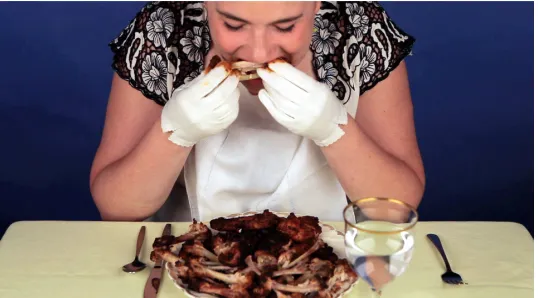
In “25 Chicken Wings in 12 Minutes,” my character sits down at a beautiful
table, complete with a yellow tablecloth, white napkin, bone china plate,
gold-rimmed goblet and silverware. On the plate lies a massive pile of
chicken wings. The woman sits poised and ready for the meal, pulling on
delicate white gloves to shield her hands from the task before her. She
removes the fork from its place on top of the napkin and tucks the corners
of the white cloth into her black and white lace top. She is dressed and
ready to consume.
The woman eats the large chicken wings quickly and aggressively,
enjoying the meat and cleaning the bones. The sound of the flesh tearing
compounds with chewing noises and nose sniffles. Her gloves redden with
every wing. Her mouth becomes inflamed from the spicy sauce. The pile
of bones grows, her pace slowing with five or six wings to go. Pauses
between wings start to widen. She drinks water and pants, looking pained
marathon. After twelve minutes of constant consumption the screen
[image:24.612.191.460.153.302.2]fades out with her hunched over, facing the plate of cleaned bones.
Figure 4. 25 Wings in 12 Minutes (Video still), 2011.
“25 Chicken Wings in 12 Minutes” explores the feelings of lust and disgust
in relation to consumption. For twelve minutes she battles desire, wanting
the full plate of meat and consuming it. Tiring and growing disgusted, she
continues, unable to rest until every last shred of meat is ingested. The lack
of pleasure in this excessive consumption and the compulsion to finish this
sickening activity signifies her loss of power and self control. The bones on
the plate speak to the guilt of the act––the remnants of regret.
POWER AS PROTECTION
Power is a game…and in games you do not judge your opponents by
In order to display good manners, to appear successful, to look attractive,
there must be an audience. While it is true that some standards of
etiquette are relaxing, I argue that codes of dress and sexualized
behavior for women are becoming stricter and more aggressively
[image:25.612.161.490.219.403.2]codified.
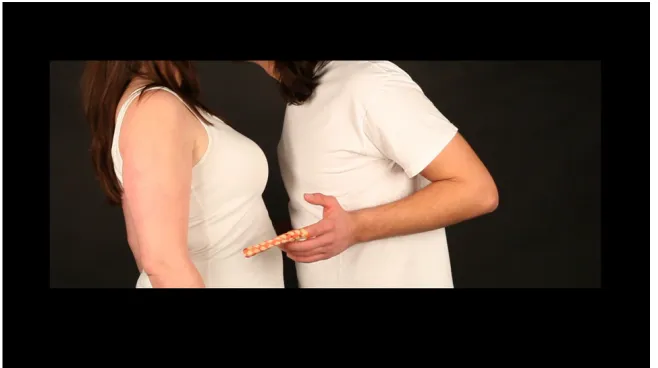
Figure 5. Finger Trap (Video still), 2011.
In “Finger Trap” the scene opens to a woman making out with a man. The
couple appears against a dark grey backdrop, each wearing white
undershirts. Her long brown hair falls down her back and his long brown
hair brushes his shoulders. They are bound at the index finger, connected
by a Chinese finger trap. The couple engages equally in the game of
control and patience, pulling back and forth, connected and negotiating
their inter-dependent bond. The kissing continues and the intensity
increases but the female begins to meddle with the trap. If working
meet in the middle, enlarging the openings and freeing the fingers. My
character does not want this battle to end mutually. Distracting her
partner with heightened affection, she uses another finger to slowly free
herself from the confines of the trap. The kissing continues as her finger
slips away unnoticed. She pulls her lips from him and he leans towards her
to continue the kiss. Realizing that she is no longer interested, he
straightens up. His finger remains erect in the trap long after her escape.
My character remains distant, civil, and emotionally commanding,
exemplifying a current strategy for feminine power and emotional control.
Her chances of getting hurt are slimmer and her power over her partner
strengthens with every deception. The act of sexuality, rather then the
authentic emotion of feeling sensual, removes her from her partner. This
sexual etiquette allows people to deny their true selves and emotions,
using power to shield them from pain. The person who loses emotional
control stands a greater risk of losing the game. Douglas states:
The modern media message transforms sexuality into the “act of
sexuality,” “the act of enticement” and “the act of love.” TV, magazines
and the Internet saturate viewers with images and examples of how to
“act” appropriately in relationships, though this acting is often far from
authentic.
In The History of Sexuality, Foucault talks about the “speaker’s benefit,”
wherein if “sex is repressed, that is, condemned to prohibition,
nonexistence, and silence, then the mere fact that one is speaking about
it has the appearance of deliberate transgression.”24 He goes on to
explain that those who speak about sex are seen to have power over the
action and as a consequence, themselves.
LANGUAGE AND THE BODY
She simultaneously longs for and dreads the shameful passivity of the willing prey. The thought of appearing nude before a man overwhelms her with excitement; but she feels also that she will then be helpless under his gaze. –– Simone de Beauvior25
Sexual currency in the name of self-interest now gives women a powerful
position from which to negotiate in a man’s world. Take the terms “Tease,”
“Prude” and “Frigid:” These derogatory linguistic marks are most
commonly employed by men to the sexualized but not sexually loose
their bodily appearance advertised. If a woman misrepresents herself or
represents herself accurately but not to the liking of the male, his
language becomes the mark on the flesh––a qualifier of the exterior.
Women are asked to examine their own behaviors and bodies in relation
to words like “slut,” “virgin,” “bad girl,” “good girl.” These sobriquets
become part of the exterior presentation, a linguistic mark for the sexual
nature of the recipient.
Figure 6. Frigid.Tease.Prude. (Video still), 2011.
In “Frigid.Tease.Prude” the scene opens on a young, bare necked
woman. Her head cranes upward, stretching the skin tightly over her
throat. She begins to rub herself, running her hands over her neck,
massaging and scratching. Tiny black flecks appear on her skin. The scene
cuts to a woman’s back. A large red spot is apparent right above the
black bra closure. Her hands rake across her skin. We cut to the image of
repeats the same gesture, aggressively caressing black flecks onto her
bosom. The three scenes weave in and out, moving from one body part
to another. Eventually letters begin to appear on the body. The scene
fades out before words fully appear, her hands rubbing the flecks onto her
reddened neck. The audience is left with the remnants of the action,
wondering what words could say that the body could not.
Butler speaks to the ability of language to construct gender, believing that
since the origination and perpetuation of language is male dominated,
women are automatically subjects under the laws of speech. She writes,
“The juridical structures of language and politics constitute the
contemporary field of power: hence, there is no position outside this
field.”26
According to Butler, gender is a constructed identity, a performative
accomplishment that the mundane social audience, including the actors
themselves, come to believe and to perform. Acts, words, gestures, and
desire affect the internal core of a person but they are manifested
externally on the surface of the body as marks of gender. These
performative fabrications appear as truth. We attempt the illusion of
concrete gender because we assume that our actions are a result of the
AN EXHIBITION
The scene opens to a woman wearing a royal blue dress with a modest
neckline and hem length. Pearls dangle from her ears and hang in a
strand around her neck. Her hair falls neatly down her back and her
modest make-up matches her skin tone. Her glossed lips are poised and
prepared to speak.
The woman extends her hand to everyone who approaches. A firm grip
cements her sincerity with physical confirmation. She smiles and nods,
thanking her attendees for their gracious presence and support,
courteously responding to inquires as to how she’s doing and what she’ll
do next. She strolls around the room, back straight and stomach tucked,
aware of her audience’s gaze. Her heels tap the floor with every step––
her body announces her presence.
In these moments, the woman becomes both more and less herself. These
are the events for which she’s prepared. Times of high profile call for the
appearance of a controlled hand and collected mind. How she performs
on this evening is of critical importance and she acts accordingly. Aware
Those of you who attended my opening will realize that I just described
my performance at Puffery. It was important to the integrity of the work
that I follow through with my characters actions in this public
performance. Every last detail of the presentation was carefully planned
and executed. The individually addressed show cards and posters printed
on fine paper became pieces in their own right, the perfect invitation to
an elegant party. The pictured cake was tasteful and beautiful, iced in
flowery puffery. The gloved hands present the viewer with the cake;
offering an enticing view of something just beyond the surface.
Figure 7. Puffery(Postcard), 2011.
My letter pressed business and comment cards were designed to
incorporate the silhouette of my “Posturing” piece, by far the most prim of
my title cards and artist statement. And as they exited the show,
attendees were kindly asked to share a thought or comment on an
individual comment card and then slip their thoughts into the privacy of
[image:32.612.176.469.210.294.2]the envelope.
Figure 8. Puffery (Logo), 2011.
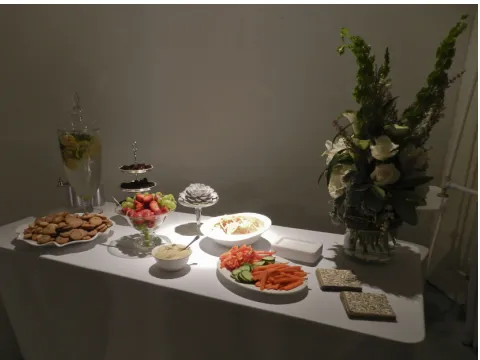
The refreshments were carefully arranged. Elegant white platters and glass
bowls were filled with fresh fruit, French truffles and cookies. A flower
arrangement balanced out the glass pitcher containing water flavored
with mint, lemon and lime.
[image:32.612.205.445.476.656.2]A familiar cake sat at the entrance table, enticing the audience who
were unable to partake. The confection performed, wilting and withering
as the night carried on, melting under the bright spot lights.
HER STORY
The visual exploration of the body reaches back to antiquity. The
technology of the camera enabled artists to record a moment in time––
an action or event. Performance art emerged from this new freedom,
allowing time-contingent creations to become a solidified, documented
image––a record of an idea that moved.
As practiced models and daily performers, many women artists found
their voice through their bodies during the feminist movement. No longer
only muse for a man, women were allowed to express their frustration, joys
and individual struggles to an audience hungry for a different perspective.
This opening of ideas, time and space allowed women to be in front and
behind the lens, creating by themselves, for themselves.
A few women predated the Feminist movement of the 1970s, quietly
paving the way for later successes. Claude Cahun emerged in the 1920s
the struggles of a female gendered person in a man’s world. Cahun’s
dual ability to be complicit and critical of culturally constructed behaviors
was fundamental to my character development. In her photograph,
“Don’t Kiss Me. I’m in Training,” made in 1927, Cahun speaks directly to
how women were trained to be one type of person. In this image Cahun
gazes calmly towards the camera, relaxing in a chair and holding two
large weights. Her buzzed hair and boyish body evade normal stereotypes
of femininity. Small hearts painted on her cheeks and circles painted over
her small breasts call attention to her lack of female endowment.
Foundational to my exploration of durational performances was the work
of Marina Abramovic. Her work of that period centers on durational,
exhaustion pieces exploring the thresholds of pain and the human body.
“Art Must Be Beautiful,” created in 1975, shows her running a brush through
her thick, brown hair, violent and quick, repeating, “Art must be beautiful.
The artist must be beautiful.” The audience watches her scrape her scalp,
aggressively attacking her own body for the sake of beauty. Mimicking
life, Abramovic’s endurance performances often last as long as is
needed, letting exhaustion and bodily limitations decide the finale.
*********
one gender could not exist without its counterpart, solidifying male and
females roles in opposition to one another. And Berger observed that
women are subjects of a male gaze, their counterpart and measure of
oppositional success. This differentiation exists within the female gender as
well, dividing the sex into dual roles of “good girls” and “bad girls.”
The definitions of “good girl” and “bad girl” are as abstract as the legal
definition of obscene. The contemporary performance artist Kate Gilmore
falls safely within the realm of “good,” examining women’s struggle in
two-piece sweater sets, A-line skirts and demure heels. Often depicted kicking
holes in dry wall or building mountains out of chairs, she reaches for the
metaphorical glass ceiling but never succeeds. Often her foundation is
knocked out from underneath her feet, leaving her teetering and trying to
maintain her feminine composure.
Laurel Nakadate wields a different sort of control, exerted through sexual
prowess and an exhibitionist’s confidence. This “bad girl” often engages
men to perform with her, exploring the power relationship between the
young, beautiful woman and the older, horny man. In her 2006 video
“Don’t You Want Somebody to Love You?” she engages in mutual twirling
sessions, where both she and her male partner dress in their underpants.
Similar to my character, Nakadate and Gilmore physically embody their
pieces, exploring the boundaries of good and bad, and the gendered
female’s relationship to the performed action.
PERFORMANCE AS PRACTICE
In time, our faces become maps of our lives. ––Nancy Friday28
To perform is to begin and complete an activity in accordance with the
requirements set forth. It is to actively participate in a narrative or task with
an end goal in mind. It is to be a part of something, which can be
self-motivated but is more often self-motivated by others. An active performer
engages with his or her task, becoming both physical author and agent of
prescribed information. To perform is to strike a balance between the self
and the rules, between the individual action, gesture and the script––
between what you know and what other people tell you to know. In
Gender Troubles, Butler states:
As in other ritual social dramas, the action of gender requires a performance that is repeated. This repetition is at once a
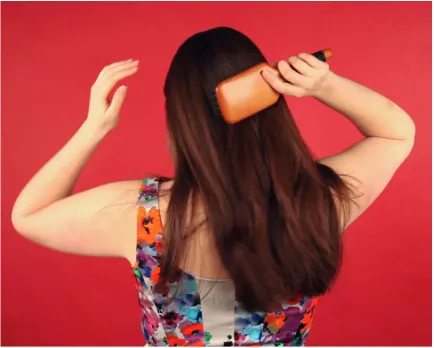
In “Grooming,” my character is the performer and recipient of a culturally
prescribed action she embodies. The scene opens to a young woman
with her back to us. Her long, luxurious hair hangs down. She wears a
feminine, flower-printed dress, juxtaposed against a backdrop of deep
red.
Figure 10. Grooming (Video still), 2011.
She begins counting as she runs the brush through her hair, one
methodical stroke at a time: “One, two, three, four…….” At this point
another audio layer enters and another female voice speaks. “Ok, take it
all up to your waist.” The overlaid audio is a conversation between a
pubic hair stylist and the voice of the woman brushing her hair. At first it is
not clear what they are speaking about, but the dialogue points towards
the grooming technique known as the Brazilian wax where most or all hair
is removed from the woman’s pubic area. The video runs for six minutes
[image:37.612.216.433.238.412.2]experiences the pain of the woman being waxed, and watches the
beauty of a head of hair being brushed one hundred times.
In this piece, the character brushes her hair and the customer, who is the
same, receives a waxing. Most women can relate with some familiarity to
an overarching concern for grooming, cleanliness, and attention to hair
and personal hygiene. The way we maintain our pubis can signal our
sexual feelings and desires to sexual partners. Strict standards of
cleanliness and grooming also apply to head hair but the standards are
very different. While no-hair is the current waxing style, long healthy head
hair has always been considered a feminine signature of beauty and
desire. Both areas are subjected to their own set of standards that women
maintain to varying degrees.
In Ways of Seeing, Berger explains our methods of “looking,” devoting a
whole chapter on the way society looks at women as objects: “Menact
and womenappear.”30 In this way, most women grow up as unintended
performers, playing parts ingrained through rules and expectations,
practice and perfection, discipline and self-discipline. As the initiator of
the performance, my character participates in and critiques the actions
that meet cultural expectations. The woman cries out in pain,
internalized daily performances preparing our bodies for another. The
character may have been acting the part at one point, but repetition
and ritual can turn any act into an inherent part of being. Berger states:
A woman’s presence expresses her own attitude to herself, and defines what can and cannot be done to her. Her presence is manifest in her gestures, voice, opinions, expressions, clothes, chosen surroundings, taste––indeed there is nothing she can do which does not contribute to her presence.31
My personal experience is crucial to informing and constructing the
character in my works. By putting myself in front of the camera and
scrutinizing my internalized habits, I make public my most private struggles
and innate assumptions. Situated in the studio, my character does not
confront reality but she is aware of it. Budgeon writes:
To construct a narrative of oneself is to locate oneself along a trajectory that gives a coherent shape to past, present, and
future... This trajectory is the product of a process in which the past is mined for experiences and events that can account for the
present... One’s self-narrative is never complete or stable.32
While I play a character based on real events from my life, the woman on
the screen is not myself. I influence her and lend her my body, but when
the camera is rolling she performs based on the lines she was given and
BIBLIOGRAPHY
Berger, John. Ways of Seeing. London: Penguin Books, 1972.
Budgeon, Shelley. Choosing a Self. Westport: Greenwood, 2003.
Butler, Judith. Gender Troubles: Feminism and the Subversion of Identity.
New York: Routledge, 1990.
De Beauvoir, Simone. The Second Sex. New York: Knopf, 1952.
Douglas, Susan J. Enlighted Sexism. New York: Henry Holt and Company, LLC, 2010.
Driscoll, Catherine. Girls. New York: Columbia University, 2002.
Foucault, Michael. The Foucault Reader. Edited by Paul Rabinow. New York: Random House, 2010.
Foucault, Michael. The History of Sexuality. New York: Random House, 1978.
Friday, Nancy. The Power of Beauty. New York: HarperCollins, 1994.
Fussell, Paul. Class: A Guide Through the American Status System. New York: Touchstone, 1983.
Greene, Robert. The 48 Laws of Power. New York: Penguin Books, 2000.
Newton, Tim. “The Sociogenesis of Emotion,” in Emotions in Social Life: Critical Themes and Contemporary Issues, edited byGillian Bendelow and Simon J. Williams. 60-80,New York: Routledge, 1998.
Post, Peggy. Etiquette. 17th ed. New York: HarperCollins: 2004.
NOTES
1Judith Butler, Gender Troubles: Feminism and the Subversion of Identity (New York:
Routledge, 1990), 9.
2 John Berger. Ways of Seeing. (London: Penguin Books, 1972), 46.
3 Michael, Foucault. The Foucault Reader, ed. Paul Rabinow (New York: Random
House, 2010), 181.
4 Paul Eckman, quoted in Nancy Friday. The Power of Beauty. (New York: HarperCollins,
1994), 139.
5Foucault, 179.
6 Simone De Beauvoir. The Second Sex. (New York: Knopf, 1952), 336. 7 Foucault, 182.-0
8 Butler, 33.
9 De Beauvoir, 267. 10 Friday,174.
11 Shelley Budgeon. Choosing a Self. (Westport: Greenwood, 2003), 57.
12 Paul Fussell. Class: A Guide Through the American Status System. (New York:
Touchstone, 1983), 35.
13Greene, Robert. The 48 Laws of Power. (New York: Penguin Books, 2000), xix. 14 Candace Simpson-Giles. How To Be A Lady. (Nashville: Thomas Nelson, 2001), 32. 15Newton, Tim. “The Sociogenesis of Emotion,” in Emotions in Social Life: Critical Themes
and Contemporary Issues, edited byGillian Bendelow and Simon J. Williams. 60-80,(New York: Routledge, 1998), 71.
16Friday, 139. 17Newton, 70. 18Greene, xx. 19Butler, 33.
20Budgeon, 83.
21 Catherine Driscoll. Girls. (New York: Columbia University, 2002), 269.
22Greene, xxi.
23Susan J Douglas. Enlighted Sexism. (New York: Henry Holt and Company, 2010),156. 24Foucault, Michael. The History of Sexuality. (New York: Random House, 1978),6.
25 De Beauvoir, 321.
26Butler, 5. 27
Butler, 25.