PITT, R; DE LOS ARCOS, B;
FARROW, R & WELLER, M.
OER HUB
2. Ethics in the Open 20
3. Open Dissemination 43
4. ReQecting in the Open 58
5. Final Thoughts 66
The OER Hub team in Krakow, Poland (l-r: Natalie Eggleston, Rob Farrow, Beck Pitt, Martin Weller & Bea de los Arcos) (CC BY 4.0 International, OER Hub)
Welcome to the open textbook version of Open Researchbased on the two iterations of the award winning open course by the same name which was facilitated by the Hewlett Foundation funded Open Education Research (OER) Hub during 2014 and 2015. Thank you to everyone who participated in the facilitated versions of the course, and for your contributions and suggestions. We have retained the original feel of the original 4-week course but have revised and updated material for this Pressbook version. In addition, we have included many of the insightful contributions from participants and also suggest group activities so that you can use the textbook to facilitate discussions with students, colleagues or friends.
Who is this resource aimed at?
If you have an interest in openness, open education, research skills or want to Ynd out more about the impact of Open Educational Resources (OER), then this resource is for you. You could be:
• Using an OER with students and interested in assessing its impact • Facilitating sessions on open practice with students or colleagues
and looking for inspiration
• Working on a research project and wanting to Ynd out more about incorporating open research techniques into your own practice • Curious about the beneYts and challenges of open research • Looking to use open tools in your research
• Wanting increased impact for your research • Interested in open research on OER
This resource will help you explore what open research is, how you can ethically and openly share your Yndings so others can reuse or develop your work, and the role of reZection and open dissemination. Whilst many challenges and issues apply to all aspects of research (for example choosing an appropriate methodology), open research brings a range of di\erent opportunities and challenges; it’s these that we are speciYcally interested in exploring. What can openness add to the research process?
Learning Objectives
By the end of this Pressbook, you will be able to:
• Understand what it means to conduct research openly and the benePts of doing so
• Understand the key challenges that can arise when researching in the open and how to address these
• Use open resources that will assist with planning your research project (however large or small!)
• Learn about best practice for sharing your research and how you can contribute to an international understanding of the impact of OER
“Open, Open, Open” (CC-BY 4.0 International, Beck Pitt)
How to use this Pressbook
structured so that you can use your preferred method of tracking your progress through material. You might want to blog your reZections as you progress through the course. Or perhaps you’d prefer to use an online or hardcopy notebook. If you’re working as a group, maybe you’d prefer to brainstorm your ideas collectively and take photos of what you produce as a record. The choice is yours!
Following most of the activities you will Ynd a commentary which includes topics you might want to consider and a selection of example responses mainly drawn from participant contributions. These can be used with their accompanying activity to stimulate individual and group reZection or to structure and facilitate group discussion. We would love to hear how you reuse and develop the course material, and share this with others so the community beneYts. If you’d like to participate,please get in touch.
About the authors
The 2014 and 2015 iterations of Open Researchand this Pressbook were written by OER Hub team membersBea de los Arcos,Rob Farrow, Beck Pittand Martin Weller. The OER (Open Education Research) Hub are leaders in researching the impact of open educational resources (OER) on learning and teaching. We are based in the Institute of Educational Technology at the Open University (OU) in the United Kingdom.The Open University has an open admissions policy and is Europe’s largest provider of online distance education.
You can Ynd out more about the OER Research Hub team here. If you’re interested in Ynding out more about the kind of open research we do, you can visit our homepage or follow us on Twitter (@OER_Hub).
ways does open research di\er from traditional research? What kind of beneYts could open research bring? What kind of challenges might an open researcher encounter? You’ll also have the option to explore open tools you could use to help conduct your research.
Learning Objectives
By the end of this chapter you will be able to:
1. Understand what it means, and how, you can conduct open research
2. Be able to structure your own open research project
3. Understand some of the challenges and benePts of diSerent aspects of open research
1.1 What does openness mean to you?
public domain and are usually openly licensed. The Hewlett Foundation describes OER as:
OER are teaching, learning, and research resources that reside in the public domain or have been released under an intellectual property license that permits their free use and repurposing by others. Open Educational Resources include full courses, course materials, modules, textbooks, streaming videos, tests, software, and any other tools, materials, or techniques used to support access to knowledge.(Source)
Activity 1: Openness (10 minutes)
Openness is not just applicable to research. You can practice openness in lots of diSerent contexts. As you can imagine there are lots of diSerent ways to dePne openness. Take a moment to think about what you think ‘openness’ means.
If you are interested in Ynding our more about debates around the meaning of openness, check out another School of Open course Why Open?
“Is Licensing really the most important question for OER?” (CC BY-SA 2.0 Generic, opensource.com)
Commentary
There was a wide range of responses from course participants which reQected a range of interconnected ideas about the meaning of “open.” In summary:
• Sharing was highlighted as an important aspect of openness and can be linked to the idea of openness as a practice. Releasing your material into the open, making it available for comment and reuse and letting people know how you would like it to be used and attributed (e.g. through open licensing) were all highlighted as important aspects of this
• Openness was associated with increased visibility and usability through there being “no barriers” to reuse and minimal or no technical barriers
• There was some discussion around whether releasing material in the open entailed loss of ownership of that resource. A distinction between “authorship” and “ownership” was noted to highlight that open licensing requires you to attribute the creator of a resource, for example
the open you are enabling others to comment on your material and inviting feedback
• Openness was also highlighted as a potential “social justice enabler” by removing the cost to access resources, for example • Openness was associated with a loss of control as the impact and
reuse of materials cannot be controlled. However this was also viewed as exciting as it could lead to serendipitous outcomes and exchanges
• Other types of open were also highlighted in discussion, e.g. open access or open licensing
Selected participant contributions which explore one or more of these ideas:
Openness, In the Prst instance, for me, is about ‘being open‘; that is, being open as opposed to simply making open resources …openness requires the ability to be vulnerable, indeed super-vulnerable; either learning or making, it is after all in the open. Cameron Neylon makes this point that it’s also about humility, in that the author of open resources, despite being supremely knowledgeable about their work or resource, can’t predict the use and application to which your work might be put (for better or worse)”
For me, openness means an honesty about the messiness of research and transparency in methods and process that helps both the researcher and the audience. It helps the researcher by allowing others to comment and get involved in the research earlier if they spot Qaws in the methodology or process, and the audience by showing (especially junior or Prst-time researchers) that research is rarely a clean progression from simply-dePned
goals to a Pnal research output, and instead involves reworking and change as certain aspects of the originally-scoped research may become untenable or new areas prove to be more interesting or researchable”
For me openness is a way if thinking and a way of being in one’s professional capacity. It has both ‘negative’ and ‘positive’ aspects – ‘negative’ in that it is about removing barriers to knowledge or resources e.g. removing paywalls thus giving access to research, knowledge, data, or ideas, while the ‘positive’ is that openness is an enabler and actively giving permission to be able to use, revise and repurpose through say CC licences – which is then remixed and reshared thus perpetuating a constant state of openness.”
1.2 What is open research?
Activity 2: Thinking about open research (15 minutes)
We’ll be exploring openness in research in more detail as the course progresses, so don’t spend too long creating a deYnition, the aim is to just to get you considering open research.
Resources:
• Why openness beneYts research (blogpost) • “The Impact of Impact”
• Right to Research Coalition: Open Research Glossary • The Open Science Project
• Wikipedia DeYnition of “Open Research” • Open Science Framework (OSF)
• Open Research Exchange • Open Data for Development
Additional Questions to Consider
How do you think openness might change the way in which you research? Think about the kind of research interests you have and the research you conduct. When could open research be important in this context?
Commentary
Openness in the research process can occur at any point and is often ongoing through the duration. Some thoughts and ideas about open research:
• Open research is the sharing not just of outputs at the end of a project, but also throughout the duration of a piece of research. It can include the sharing of methodologies, data and other tools • By publishing methods, Pndings and other aspects of your
research as you go along, there is the opportunity for others to comment, advise and engage with your research as you go along, and not just at the point of publication. Open research could therefore be described as enabling collaboration
• There is an ethical obligation to conduct open research, especially in instances where research has been publicly funded
1.3 What does open research mean to others?
Activity 3: What open research means to others (30 minutes) Explore the three sets of short video clips below. Write down your thoughts and responses to the following questions:
1. What do you think the key points are?
2. Where do you think openness made a diSerence to the research process?
3. Which examples (if any) seem most compelling to you? Why?
You can read more about the contributors and their work by clicking on their name.
These videos are subtitled and you can alsodownload a transcript of all
the videos in this section or =nd the transcriptions in the Appendix.
Do you see a diDerence between open research and traditional research?
Chris Pegler
https://youtu.be/IjyaKUhrbNE Patrick McAndrew
https://www.youtube.com/watch?v=3JFgZqP6rBc Cheryl Hodgkinson-Williams
https://www.youtube.com/watch?v=hwoFwLZsXdE Martin Weller
https://www.youtube.com/watch?v=oxOM4zJeBQM
Where do you think open has made a diDerence to your own research practice?
Patrick McAndrew
https://www.youtube.com/watch?v=cFt-uVe14Sw Chris Pegler
https://youtu.be/xSucgg_xqWA Martin Weller
https://www.youtube.com/watch?v=u7hbH11bYS4
In your experience, are there any disadvantages to embracing a more open approach to research?
Martin Weller
https://www.youtube.com/watch?v=RQlQwVyg_MY
Commentary
The most compelling examples to me were from Cheryl Hodgkinson-Williams and Martin Weller, about what ‘opening up the research process’ really means – it means having your proposal, your literature review, your conceptual frameworks and why you chose them, your methodologies, your research instruments and your data all fully (or partially?) available. Is this a bit risky / too time consuming for a newbie researcher or a perfectly achievable PhD goal, with the right planning? These are the thoughts that occupy me at this stage, learning from everyone else :-)”
… The ability to have feedback early on can really strengthen your research because you get the chance to see whether or not your research stands up to criticism early rather than later. If your statistical analysis methods aren’t good, someone may notice and tell you about it before you’ve sent it for publishing. Each person has biases and blind spots, and the ability to open the research allows others to point those out before you go down the wrong road.An additional point: open research has the ability to greatly transform what would be considered “negative” research: research where you don’t get the intended result or you get a bad result (for example, pharmaceutical tests). Without the requirement of publication in a journal, you can access what didn’t work.”
The importance of research ethics and the doubts about whether there is a danger of being plagiarised appears to be the main concern. At the same time, there are dePnite and measurable advantages to researching in the open. Mainly I picked up on three advantages: Prst the peer review that is ongoing during the research; second the additions to the project from other interested parties, notably the addition of unrecognised benePts to a project ; and Pnally the time saving ultimately due to the development of much larger networks that is not possible otherwise. It is important to note that open research does not preclude publishing if that is the Pnal objective of the
research project. The advantages of open research seem to outweigh the disadvantages.”
…Open research enables small-scale research, often with novice researchers, to happen more easily.” To Pnd out more about Guerrilla Research (Weller, 2013) see: http://bit.ly/2eeVycK
1.4 Setting up a Research Project
Now that we’ve talked a bit about what open research means, let’s delve a little deeper and look at the research process itself. Here’s a list (by no means exhaustive!) of di\erent things you need to consider when you’re setting up a research project:
PlanningPlanning // MethodologiesMethodologies // LicensingLicensing // EthicsEthics // ToolsTools // DataData // EvaluationEvaluation // Dissemination & Communication
Dissemination & Communication
Activity 4: Advantages and Challenges of Open Research (20 minutes)
For each of the diSerent activities/considerations you need to think about when conducting research, in what ways (if any) do you think you can be ‘open’?
you write? Or will you make the data available once it’s been collected and analysed?
Choose two stages in the research process and answer the following questions in relation to your chosen activity/ consideration:
• Do you think you can be ‘open’ at this stage in the research process?
• In what ways do you think you can be ‘open’?
• What are the advantages of being ‘open’ at this stage in the research process?
• What are the challenges of being ‘open’ at this stage in the research process?
• How could you resolve any challenges? • Any further thoughts/comments?
You can also review some of theresponses to this activity from previous participants.
“Common Good” on Gra[ti Wall at OKFest14, Berlin (CC BY 4.0 International, Beck Pitt)
1.5 Why conduct research in the open?
Now that we’ve explored how openness might impact on di\erent research processes and practices, let’s explore why you might consider incorporating open practices into your research. For example, if you publically report on the progress of your research and your Yndings as the work progresses, your research might be exposed to a wider audience than if you waited to publish a Ynal paper after you had Ynished your research project. Your work could also receive useful feedback and comments from others that help you develop your ideas and research plan.
more than before (Clue: the Internet and the massive increase in the cost of research publications). The video is available here.
As EIFL, who work with librarians in the developing world to promote digital literacy and who have a sub-project that promotes open access, succinctly describes it:
For researchers, open access brings increased visibility, usage and impact for their work. A number of studies have now been carried out on the e?ect of open access on citations to articles, showing the increased citation impact that open access can bring. Open access repositories also provide an excellent means for researchers to boost their online presence and raise their pro=le. (Source)
EIFL have a full list of FAQ relating to open access available here.
Sharing and moving toward a more open model of research potentially has beneYts for everyone. Open Economics have produced an article “The BeneYts of Open Data…” which has wonderful examples of the way in which openness helps those in developing countries. In another article, which focuses on research in economics, Guo Xu presents “hard evidence” of the ways in which open research practices have helped those in developing countries, particularly in relation “…to reducing corruption and lowering the cost of information.”
Further Reading
• Researchers Sharing Data was Supposed to Change Science Forever. Did it?
• The Battle for Open: How openness won and why it doesn’t feel like victory
• To what are we opening Science? Reform of the publishing system is only a step in a much broader re-evaluation
• ODDC: Exploring the emerging impacts of open data in developing countries
CHAPTER 2.
ETHICS IN THE OPEN
Are there speciYc ethical considerations arising from researching ‘in the open’? This part of the book will encourage open researchers to reZect on the wider implications of being open as well as approaches to ethical research.
As part of their training, all researchers learn about how to collect, manage, analyse and disseminate data. This section covers the some of things they typically learn about ethics. It is not intended to replace formal training in research ethics although some training modules like these are available openly and will be referred to later. We’ll work through the process in stages.
Our focus here will be on the di\erences openness can make to these research practices. As we will see, openness can raise problematic cases for traditional approaches to research ethics but also o\ers novel research possibilities.
Learning Objectives
• An overview of ethics and its role in research
• Applying these frameworks in traditional and open approaches across the life of a research project
• ReQection on the process of institutional approval for research and legal compliance
• Creating tools for evaluating ethical risks in a research project and identifying appropriate action(s)
“Moral Compass Pin” (CC BY 2.0 Generic, Paul Downey)
2.1 Why are Research Ethics important?
Most of the interesting questions in life are about people, and as a result a lot of research is done into people: how they behave, what they think, and how they learn and communicate. As a subject for research, human beings are of course quite di\erent to a chemical in a test tube or a rock sample. The moral value of human life requires us to treat others with respect for their wellbeing.
Activity 5: Thinking about research ethics (20 minutes)
What kind of research do you want to do? What might the impact on human subjects be? Think of three ethical issues that might be raised by the research you want to carry out.
Commentary
There are lots of diSerent potential reasons that research ethics are important. Some of the reasons people gave when we ran the moderated version of the course included:
• Understanding the ultimate impact of our work on humans, and especially the capacity to cause physical or psychological harm through experiment
• Ethical use of time, especially if working with others • Trying to get the best “impact” from research activity
• Aspiring to professionalism in research practice: protecting participants; improving skills; promoting reliability and validity • Understanding what kinds of open and public data can be used
ethically in research
• Responding to the evolving ethical and practical challenges
presented by new technologies: open data; social networking; privacy; anonymity; etc.
These are all good answers, some more pragmatic in focus than others. At the practical end of the spectrum we’ll be looking at speciPc guidance shortly. But for now it might be good to reQect on the idea that research ethics is a very recent Peld – and one that was founded in recognition of the profound importance of the way that human beings treat one another. Most of the time educational research involves people as sources of data. Whenever people are involved we need to take care to ensure that they do not undergo any signiPcant harm. We can understand research ethics as a set of principles (e.g. “do no harm”) or as a set of speciPc rules that can guide us in speciPc situations.
“A Moral Compass” (CC BY-SA 2.0 Generic, John LeMasney)
2.2 Institutional Research
Usually ethics is addressed in institutional research by adhering to the ethical guidelines set out by one of the advisory bodies that exists for almost every public entity that might be conducting research at some point (e.g. the guidance published by BERAor NIH). These bodies in turn are typically informed by medical ethics as expressed in the Helsinki Declaration (composed in 1964, partly as a response to the unethical research practices that surfaced in the aftermath of World War II). Institutional Review Boards – the term used to describe institutional research ethics approval committees in the USA – are a direct descendent of this declaration.
Central to most institutional research ethics are guidelines relating to all stages of the research process and what can and can’t be done. There are institutional rules, but there are also various forms of guidance o\ered by research governance bodies.
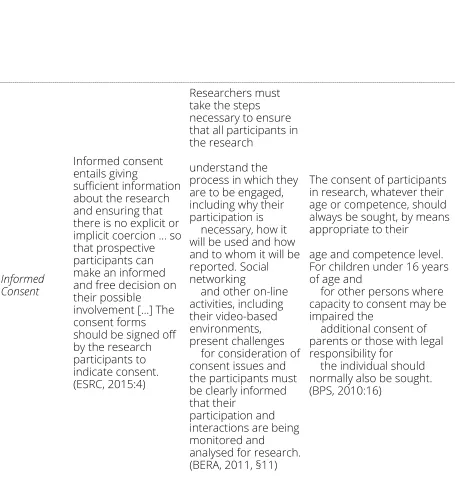
The following table (adapted from Farrow, 2016) highlights the principles underlying the guidance o\ered by three major UK research governance bodies: the Economic and Social Research Council (ESRC); the British Educational Research Association (BERA); and the British Psychological Society. While the wording can vary, most of the advice given is quite consistent. This is because most research ethics guidelines can trace a common origin back to the aftermath of World War II.
Principle ESRC (2015) BERA (2011) BPS (2010)
Respect for participant autonomy
Research participants should take part voluntarily, free from any coercion or undue inQuence, and their rights, dignity and (when possible) autonomy should be respected and appropriately protected. (ESRC, 2015:4)
Individuals should be treated fairly,
sensitively, with dignity, and within an ethic of respect and freedom from prejudice regardless of age, gender, sexuality, race, ethnicity, class, nationality, cultural identity, partnership status, faith, disability, political belief or any other signiPcant diSerence. (BERA, 2011, §9)
Adherence to the concept of moral rights is an essential component of respect for the dignity of persons. Rights to privacy, self-determination, personal liberty and natural justice are of particular importance to psychologists, and they have a responsibility to protect and promote these rights in their research activities. (BPS, 2010:8)
Avoid harm / minimize risk
Research should be worthwhile and provide value that outweighs any risk or harm. Researchers should aim to
maximise the benePt of the research and minimise potential risk of harm to participants and researchers. All potential risk and harm should be mitigated by robust precautions. (ESRC, 2015:4)
Researchers must recognize that participants may experience distress or discomfort
in the research process and must take all necessary steps to reduce the sense of
intrusion and to put them at their ease. They must desist immediately from any
actions, ensuing from the research process, that cause emotional or other harm. (BERA, 2011, §20)
Harm to research participants must be avoided. Where risks arise as an unavoidable and integral element of the research, robust risk assessment and
management protocols should be developed and complied with. Normally, the risk of harm must be no greater than that
Full disclosure
Research staS and participants should be given appropriate information about the
purpose, methods and intended uses of the research, what their participation in the
research entails and what risks and benePts, if any, are involved. (ESRC, 2015:4)
Researchers who judge that the eSect of the agreements they have made with participants,
on conPdentiality and anonymity, will allow the continuation of illegal behaviour,
which has come to light in the course of the research, must carefully consider making disclosure to the appropriate authorities. (BERA, 2011, §29)
This Code expects all psychologists to seek to supply as full information as possible to those taking part in their research,
recognising that if providing all of that information at the start of a person’s
participation may not be possible for methodological
reasons […] If a proposed research study involves deception, it should be designed in such a way that it protects the dignity and autonomy of
the participants. (BPS, 2010:24) Privacy & Data Security Individual research participant and group preferences regarding anonymity should be respected and participant requirements concerning the conPdential nature of information and personal data should be respected. (ESRC, 2015:4)
The conPdential and anonymous
treatment of
participants’ data is considered the norm
for the conduct of research.
[…] Researchers must comply with the legal requirements in relation to the storage and use of personal data as set down by the Data Protection Act (1998) and any subsequent similar acts. (BERA, 2011, §26)
All records of consent, including audio-recordings, should be stored in the same secure conditions as research data, with due regard to the conPdentiality and anonymity protocols of the research which will often involve the storage of
personal identity data in a location separate from the linked data. (BPS, 2010:20)
Integrity
Research should be designed, reviewed and undertaken to ensure recognised standards of integrity are met, and quality and transparency are assured. (ESRC, 2015:4)
Subject to any limitations imposed by agreements to protect conPdentiality and anonymity, researchers must make their data and methods amenable to reasonable external scrutiny. The
assessment of the quality of the
evidence supporting any inferences is an especially important feature of any
research and must be open to scrutiny. (BERA, 2011, §46)
Research should be designed, reviewed and conducted in a way that ensures its quality, integrity and contribution to the development of knowledge and understanding.
Research that is judged within a research
community to be poorly designed or conducted wastes resources and devalues the contribution of the participants. At worst it can lead to misleading information being
promulgated and can have the potential to cause harm. (BPS, 2010:9)
Independence
The independence of research should be clear, and any conQicts of interest or partiality should be explicit. (ESRC, 2015:4)
The right of researchers independently to publish the Pndings of their research [is] linked to the obligation on
researchers to ensure that their Pndings are placed in the public domain and within reasonable reach of educational practitioners and policy makers, parents, pupils and the wider public. (BERA, 2011, §40)
The ethics review process should be independent of the research itself […] this principle highlights the need to avoid conQicts
of interest between researchers and those reviewing the ethics
protocol, and between reviewers and organisational governance
Informed Consent
Informed consent entails giving
suRcient information about the research and ensuring that there is no explicit or implicit coercion … so that prospective participants can make an informed and free decision on their possible
involvement […] The consent forms should be signed oS by the research participants to indicate consent. (ESRC, 2015:4)
Researchers must take the steps necessary to ensure that all participants in the research
understand the process in which they are to be engaged, including why their participation is
necessary, how it will be used and how and to whom it will be reported. Social networking
and other on-line activities, including their video-based environments, present challenges
for consideration of consent issues and the participants must be clearly informed that their
participation and interactions are being monitored and
analysed for research. (BERA, 2011, §11)
The consent of participants in research, whatever their age or competence, should always be sought, by means appropriate to their
age and competence level. For children under 16 years of age and
for other persons where capacity to consent may be impaired the
additional consent of parents or those with legal responsibility for
[image:32.595.70.525.99.584.2]the individual should normally also be sought. (BPS, 2010:16)
Table 1. Comparison of ethical research advice, UK professional bodies (categorized according to underlying principle)
Download a PDF,Word or RTF version of the above table.
Activity 6A: Institutional Approval of Research (1 hour)
Find a copy of your own institutions ethical review procedure (sometimes called ‘Institutional Review Board’ or ‘IRB’). You could then compare this with review procedures at other institutions, or just read it to see what strikes you as noteworthy. Here are some key questions to guide this activity:
• Are procedures more or less the same across institutions? • What kinds of things seem to be the main concerns?
• How do institutional reviews try to assess the risk of a particular activity?
• What kind of strategies for managing risk are proposed/possible? • Are there diSerence across institutions?
• Are there diSerences across subject areas / disciplines?
If you’re not at an institution then you could Pnd one that might apply to you in the future or one from an institution that is near to you.
Commentary
It’s somewhat rare to Pnd a research institution that does not have a code of institutional ethics (at least in the Global North). But this is not to say that there is much diversity: most institutional research ethics codes are the same everywhere around the world, even where they aren’t written down formally. This is partly because there’s a shared family tree – all the diSerent institutional codes express very similar principles.
One diSerence is legal compliance, which obviously varies according to country. Institutional review should ensure that any research carried out is legal, but it should also go beyond this, asking whether the work can be ethically justiPed. So, what’s the diSerence? Many things are legal but arguably unethical, such as adultery, sharing private correspondence, failing to keep promises, jumping queues, and so on. Institutional review is intended to maintain the highest ethical standards, not just compliance with the law.
What happens when you’re not aRliated to an institution that has an ethical review panel? You might be working with open data with no-one to supervise the project in this way. Does this entail that everything you do is ethical as long as it is legal? We’ll consider this in more detail in the next section.
Activity 6B – Protecting Human Subject Research Participants (Optional, 3 Hours)
One common expectation made of researchers in the USA is that they will have completed the online training module ‘Protecting Human Research Participants’ provided by NIH ORce of Extramural Research.
The training module is a great overview of research ethics and completion also enables you to produce a certiPcate of completion which is often needed for institutional ethics review.
You can Pnd the training athttps://phrp.nihtraining.com. It’s free and takes about three hours to complete. Completion of this training module is required by many institutions in order to receive ethical approval to conduct research.
2.3 Research in the Institution and Beyond
As an open researcher you will need to ensure that you have any required institutional permissions in place for the work that you want to carry out. Once these permissions are in place then the rules of the institution should be followed. They will normally deYne the kinds of behaviours that are acceptable. However, it should not be assumed that any behaviours not speciYcally mentioned (or forbidden) in institutional guidance are acceptable.
every precaution to make sure that your research adheres to the principles of ethical research. Generally speaking, it’s not enough to simply get institutional ethical approval at the start of a project.
• Institutional approvals typically focus on protection of individuals rather than groups
• Research activities can change signiYcantly over the course of a project
• Open projects can have many variables beyond the control of the researcher
It’s important to continue to think about the ethical implications of research as a project evolves. Similarly, if you’re doing research with informal learners (e.g. a survey of MOOC users) and no institutional approval is required you should still strive to consistently apply the same basic principles that underlie standard modern research ethics:
• Avoiding harm
• Ensuring that consent is informed • Respecting privacy and persons
Next we’ll think about how we might observe these principles if we are working completely outside of institutions and have no requirement to gain permissions for a research project.
Activity 7: Ethical Implications of Openness (1 hour)
Consider the following text from Wikipedia on the dePnition of ‘open research’:
Open research is research conducted in the spirit of free and open source software. Much like open source schemes that are built around a source code that is made public, the central theme of open research is to make clear accounts of the methodology freely available via the internet, along with any data or results extracted or derived from them. This permits a massively distributed collaboration, and one in which anyone may participate at any level of the project.” (Source)
Now consider the suggestions for an open research process availablehere.
Commentary
Networked, digital and open technologies present us with new possibilities for thought and action. It’s become much easier to do make decisions that can aSect a lot of people, as we saw in the Facebook example.
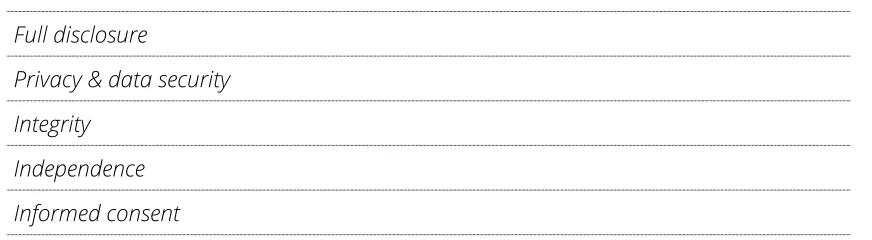
It is essential that the open researcher understands how to evaluate the ethical signiPcance of their work. The simplest way to do this is to understand the principles of research ethics. A simple list of these principles is provided in Farrow (2016)[1] as:
• Respect for participant autonomy • Avoid harm / minimize risk
• Full disclosure
• Privacy & data security • Integrity
• Independence • Informed consent
How ethical principles are applied is context sensitive, so it’s important to keep reQecting on how these inform your work. An important element of ethical judgment is familiarity with ethical issues and how they are usually dealt with. Sharing your experiences with other researchers can be helpful. If you’re working without formal support you will need to strike a balance between the exciting
possibilities of ‘guerilla research’ and the need to exercise good ethical judgement throughout the research process.
Sometimes the impulse to be open can be in tension with our ethical expectations. One course participant raised the example of making research data available openly while protecting the right to privacy of participants. The more raw data is released, the greater the risk to privacy. But as more data is redacted the reuse value is reduced. Because the full implications of being open are often not known until the future, it’s necessary to keep reQecting throughout the research process and into dissemination.
In essence, working outside institutions means that researchers must e\ectively function as their own review panel. It becomes even more important to engage in ethical reZection and develop a working knowledge of ethical risk management and strategies for amelioration. Most of the rules concerning how research is conducted in institutions are based on several key assumptions. These include:
• The researcher has some degree of control over the research
process, and thus has a responsibility for what happens – but can’t necessarily anticipate every possible outcome
• There is an expectation that all reasonable e\orts will be taken to minimise potential harm to participants
• The responsibilities of the researcher don’t end with the study since there is an ongoing requirement to manage collected data at most institutions (typically a matter of legal compliance)
“Citation Needed” (CC BY 2.0 Generic, by Dan4th Nicholas) Openness can make a di\erence across the entire research cycle:
• Building a research community through blogging and social media to generate and share ideas for research activities
• Using openly published papers to perform a literature review and context for a study
• Sharing proposed methodologies for peer comment (e.g. on a blog) • Collaborating with other researchers to collect data
• Dissemination through open access publication; sharing data sets; publication under a Creative Commons licence
• Improving the visibility of work through repositories, search engine optimisation and sharing on social media
• Inviting quick and responsive feedback
• Using metrics to establish the impact of a piece of research
When it comes to
releasing research data openly it’s important to reZect carefully. Both
qualitative data
(interviews, observations, etc.) and quantitative data (survey results, statistics, etc.) can be released in this way but arguably qualitative data might be less meaningful when
considered outside of its original context. There’s no way to anticipate
what might happen to data that is released openly because it can used by anyone for whatever reason they see Yt.
If you’re planning on releasing data openly that should be made very clear in your consent forms so that people can know what they are agreeing to.
References References
[1] Farrow, R. (2016). A Framework for the Ethics of Open Education.Open Praxis, 8(2), 93-109. doi:10.5944/openpraxis.8.2.291 2.4 ‘Good’ Open Research
Given that we can’t always fully anticipate the speciYcs of future situations it’s especially important for open researchers to be aware of future possibilities. There is a real need for using one’s own judgment and reZecting on the ethical dimensions of research for oneself. When working in the open – potentially beyond institutional reach – an awareness of ethical principles and how they should be applied is essential.
Activity 8: What qualities does a ‘good’ open researcher have?
What other kind of qualities, skills or attributes might a ‘good’ open researcher have? Are they the same qualities that we would expect of a non-open researcher? What does ‘good’ open research look like? What might be the benePts? Either think it through yourself, research online, or discuss with friends or colleagues.
Commentary
This was probably the exercise that learners on the moderated presentation of the course found hardest. It possible to interpret the question of what makes a good open researcher in two diSerent ways. A more abstract approach might involve identifying the characteristics and personal qualities of such people. There are several examples of where researchers have tried to identify these. For instance, Pring (2002)[1] frames the virtues of educational researchers in terms of: positive interdependence; individual accountability; promoting success; trusting relationships. Toledo-Pereyra (2012)[2] suggests the following qualities: interest, motivation, inquisitiveness, commitment, sacriPce, excelling, knowledge, recognition, scholarly approach, and integration.
The report Responsible Conduct in the Global Research Enterprise [3]
suggests that there are seven overlapping values for researchers: • Honesty
• Fairness • Objectivity • Reliability • Skepticism • Accountability • Openness
It’s noteworthy that openness can be seen as a distinct consideration in this way, even if one has no interest in openness as a speciPc concern. The need to have a certain transparency about the research process and any Pndings is a long-standing scholarly virtue.
References
[1] Pring, R. (2002). The virtues and vices of an educational researcher. In M. NcNamee & D. Bridges (Eds.), The ethics of educational research (pp. 111-127). Oxford, UK: Blackwell Publishing.
[2] http://www.ncbi.nlm.nih.gov/pubmed/22853811
2.5. Open Research Summary
So far we have looked at institutional processes governing research and ways in which the same principles might be applied outside of institutional requirements. We also considered the ethical implications of being open and the kinds of virtues we might expect open researchers to have.
It’s not enough to simply know about good research methods: it’s also important to practice them consistently.
The real point to take away from this part of the course is that open researchers need to be bound by the same ethical codes as traditional research. There is even a case for saying that open researchers need a stronger ethical code because they don’t have the same support as institutional researchers. So it’s crucial that as an open researcher you develop your own moral compass.
A tool that might be useful for this is A Framework for the Ethics of Open Education. Both the principles of research ethics mentioned in 2.2 as well as resources from philosophical ethics are combined in a tool designed to help people think more clearly about the ethical signiYcance of their activities. (For the full paper including a discussion of the complexities that openness introduces into research, seeFarrow (2016).
Duties &
Responsibilities (deontological)
Outcomes
(consequentialist)
Personal Development
(virtue)
Respect for participant autonomy
Avoid harm / minimise risk
Full disclosure
Privacy & data security Integrity
Independence Informed consent
Table 2 – (Uncompleted) Framework Table 2 – (Uncompleted) Framework
Download a PDF,Word or RTF version of the above table.
Another resource that might be useful is the OER Research Hub Ethics Manual, which was written for an open research project team to facilitate reZection on ethical issues.
Activity 9: Your values and ethical decision-making
Use the materials referred to in Section 2 to help you think about your own values and ethical decision-making processes. Do you act from judgement, or emotion? How do you account for the perspectives of others? Are your approaches to ethics consistent? Philosophical ethics can help us to arrive at answers to these questions.
[image:45.595.64.500.176.296.2]Further Reading
• OERRH Ethics Manual
• Introduction to Research Ethics
• Frequently asked questions about human research (The Open University)
• BERA Ethical guidelines for educational research
• Introduction to research ethics (University of Leicester) • ‘Ethics’, Internet Encyclopedia of Philosophy
• Peter Singer’s MOOC on ‘Practical Ethics’
• A short introduction to philosophical ethics for research
general interpretation of, but it is useful to consider a formal deYnition Yrst. The European Union deYnes dissemination as:
the process of making the results and deliverables of a project available to the stakeholders and to a wider audience.” (Source)
How can we make dissemination more in the open?
Learning Objectives
In this chapter you will gain an understanding of:
• how open dissemination diSers from traditional dissemination • the role that technology plays in open dissemination
3.1. Open Access Publishing
One traditional aspect of dissemination that varies with open dissemination is the publication of research articles that may arise from a project. Over the past decade Open Access publishing has increased in uptake, with many research funders now mandating that any articles arising from their funding must be made openly available. Open Access is usually interpreted to mean “free online access to scholarly works”, although the Budapest Open Access Initiative(2012) gives a more formal deYnition, which encompasses not only free access in terms of cost, but also freedom from copyright constraints:
By ‘open access’ to this literature, we mean its free availability on the public internet, permitting any users to read, download, copy, distribute, print, search, or link to the full texts of these articles, crawl them for indexing, pass them as data to software, or use them for any other lawful purpose, without Ynancial, legal, or technical barriers other than those inseparable from gaining access to the internet itself. The only constraint on reproduction and distribution, and the only role for copyright in this domain, should be to give authors control over the integrity of their work and the right to be properly acknowledged and cited.(Source)
Why Open Access?
Think about why we do research. Whether it is for public enrichment, scientiYc discovery, improving education or a country’s economy, “research can only advance by sharing the results, and the value of an investment in research is only maximized through wide use of its results.” (Source) Unrestricted access and unrestricted reuse of research results, including research data, are thus paramount to the advancement of our lives.
A project may decide from the outset that any publications will be published under an open access agreement, but this in turn may restrict the number of journals that can be considered. ‘How Open Is it?’, also available in anumber of other languages, is a guide to help you determine how open is a journal and make informed decisions on where to publish. If you would rather have someone else do the work for you, then search The Directory of Open Access Journals.
Publishing open access may also have implications for the budget; many publishers charge Article Processing Charges (APC) to o\set costs incurred in peer review management, journal production, online hosting and archiving, etc.
Activity 10: Advantages and Challenges of Publishing Open Access (20 minutes)
Commentary
SPARC Europe write about the benePts and challenges of open access, which we reproduce here:
Bene=ts Bene=ts
DiSerent stakeholders in the system of scholarly communications can and will benePt from no restricted access to research and data:
• Researchers as authors: immediate visibility for research output and thus increased visibility and usage of their results. Open Access may even lead to an increase of impact
• Researchers looking for information: access to literature everywhere, not only from a campus but also from any site with wiP access
• Funding agencies: increased return on investment (ROI), increased visibility
• Universities & research institutes: greater visibility, clearer management information
• Libraries: increased access for target audience, Pnancially a more attractive model than the current subscription model
• Teachers & students: unrestricted access to material, enriched education, allowing equality of learning in poor as well as in rich nations
• Science: enhanced and accelerated research cycle
• Citizens & society: access to knowledge / access to the results of publicly funded research
• Enterprises: access to critical information
• Publishers: transparent business model, ultimate online article distribution, ultimate visibility for articles
Collective challenges in the system of scholarly communications Collective challenges in the system of scholarly communications
• The need for researchers to maximise the dissemination and impact of their research
• The need for readers to have access to the full corpus of relevant research literature
• The possibility of creating a continuum of integrated scholarly information, from raw data to peer-reviewed publications
• The development of open access models
• The emerging technical standards to facilitate open archiving
• The need for organisational structures to ensure access to digital archives
• The complexities of intellectual property rights and copyright issues
• Restrictive license conditions
• The concentration of a signiPcant part of scholarly output in the hands of a small but highly inQuential number of commercial publishers
• A widespread reluctance to cancel print until electronic archiving arrangements are secure
3.2 Impacts of Open Dissemination
Having looked at open access publishing in particular, we will now consider open dissemination more broadly. In the case of the OER Research Hub, our research has been supported and facilitated by ‘open’ dissemination. This open dissemination approach was an integral part of the initial project bid and has helped us meet and deliver our project goals.
We have deliberately:
• Created a project identity on various tools including Twitter, Scoop.It, YouTubeand Slideshare
• Made the project blog the core part of our project identity
• Shared our research progress, outputs and methods on a regular basis, via our website/blogs and other media
• Created and used our OER Impact Mapto encourage contribution and feedback from the rest of the OER community
• Shared our data openly, including survey results
• Shared our methodology and research instruments under a CC-BY license
But it is not always about choice. As we mentioned earlier, many funders now make it compulsory that research outcomes are openly archived. For example, the Research Data Policy of the Economic and Social Research Council (ESRC) in the UK stipulates that “All data created or repurposed during the lifetime of an ESRC grant must be made available for re-use or archiving within three months of the end of the grant.” (REF) The US government announced in 2013 that the results of federally funded research should be made freely available to the public generally within one year of publication. (REF)
Can this be detrimental to the impact of your research? An article by Y. Niyazov and colleagues, published in PLOS One in early 2016, argues that publishing open access improves the number of citations. (Source)
Activity 11: Can Open Dissemination make a diDerence? (15 minutes)
“Openness and Collaboration” (CC BY 2.0 Generic, Paul Downey via Wikimedia Commons)
Commentary
Here are some of the benePts of open dissemination highlighted by participants in the facilitated version of the course:
Working in the open potentially ensures more careful outputs”
… the possibility of building live, collaborative networks even after the initial research has been scoped and planned”
… the ability to connect with key stakeholders who are likely to be interested and impacted, and who may feel involved and invested to become part of the project”
Increased public engagement as “research is made relevant and accessible to the public and society”
The latter, however, can also be considered a limitation:
An open approach to research (…) may invite many distracting requests and
queries. I’ve seen this happen in a project where there was so much interest to deal with that the museum had to formalise and somewhat restrict what had been an open door policy to their research project”
3.3. Facilitating Open Dissemination
With the advent of technology and the growing inZuence of social media communities, we now have a wider interpretation of ‘openness’. The concept of sharing outputs is no longer just viewed in a formal sense (e.g. a journal publication), but outputs can include informal ideas, suggestions and presentations.
Here are some examples of how technology has been supporting openness to a wider community:
1. Stephen Downes curates blogs on a wide range of topics relating to educational technology, and publishes a daily and weekly digest.
2. True Stories of Open Sharing is compiled by Alan Levine and
“…shares moving, personal stories that would not have been previously possible, enabled by open licensed materials and personal networks.”
3. Ten things you need to know about ORCID right now highlights the
Activity 12: Tools that support Open Dissemination (30 minutes)
Think about some technologies that support and facilitate open dissemination (e.g. Facebook, Twitter, blogging platforms, Flickr, SlideShare, Scoop.it, etc.). Select which of these tools you would use to disseminate your research and reQect on why.
In selecting a channel, think about your project’s audience and what they could easily gain access to. For example, does your community have ready access to internet? Is your community active on a particular social network? Does your community regularly engage with blogs?
Commentary
Here are some thoughts and ideas for tools to disseminate research from previous course participants:
It depends heavily on what you’re doing. From where I’m sitting, Flickr would be entirely inappropriate, mostly because my audience isn’t there, but partially because Flickr isn’t set up for science. Figshare is pretty awesome, partially because you do get a DOI for your work, which makes it citable,
and DataDryad is becoming more popular. SlideShare seems to be the location of choice for presentations, though some people host their own. (…) You’d want to make sure your location of choice supports the metadata that your Peld expects (or would like to see) to ensure your information actually can be viewed, read, and reused.”
My next project could be based on a guerilla research approach, and I would use blogging as the main media/genre (with WordPress as the platform) for dissemination during the research process, as blogging gives the possibility to present coherent thought of some length with the room for commenting and having people follow. At the same time blogging is a way of disseminating that is well accepted in the communities that could be interested in the project and that I could be interested in dialogue with. (…) And then as a media/genre, a blog gives the possibility to embed videos, SlideShares, Tweets and link to other kinds of social media, and thus a blog can be a kind of repository for the diSerent outputs of a project. To spread the news, Twitter is a must. And if it does end up with an article, an open repository would be an option.”
3.4. Open Licensing
For dissemination to be considered as ‘open’, reuse of a project’s outputs, be it data, presentations, video or articles, would be explicitly encouraged. One way of retaining ownership of the copyright for your content while showing other people that it is “open” and can be reused in speciYc ways is to openly license them. One popular range of open licenses is provided by Creative Commons (CC).
The following image explains what each of the licenses allow you to do:
How to Attribute Creative Commons Photos, by FOTER, CC BY-SA 3.0
These licenses can be combined. For example, the image reproduced right above this paragraph has been released under a CC BY-SA license, which means that it can be reused as long as it is attributed and shared under the same terms. The resource creator has not added any restrictions with regard to adapting the resource (note that we have cropped it fromthe original) or using it for commercial purposes. The same applies to research outputs. For example, the survey data that OER Research Hub collected is available on Figshare under a CC BY license: this means that anyone can access the data Yle, download it, add more data to it, carry out a di\erent analysis, etc. as long as OER Research Hub are cited as the original provider of the data.
You can also read more about how to license di\erent types of
research outputs (for example data or databases) in the guidelines available via the Creative Commons wiki.
Activity 13: Choosing the most appropriate Creative Commons license for your needs (30 minutes)
Read Claire Redhead’s blogpostWhy CC-BY?and reQect on which CC license you would choose to release your research outputs.
Gra[ti Wall at OKFest14, Berlin (CC BY 4.0 International, Beck Pitt)
Commentary
As Clare Redhead notes there are a number of arguments for and against using more or less restrictive Creative Commons licenses. Here are some of the reasons previous course participants gave for their use of speciPc Creative Commons licenses:
other researchers and data enthusiasts can read and use my stuS, so my concerns are very diSerent from, say, an artist’s concerns. If someone does something cool with my data and cites me, that’s a good thing. If someone takes an artist’s awesome image and sells it on journal covers without telling anyone, that’s not okay. (…) Because reputation is important in research, my answer is kind of based on the zeitgeist in the Peld. I’d tend towards the least restrictive license I can get away with given institutional and publication guidelines, and it looks like it’s possible in many cases to go straight for CC-BY.”
Well, I’m still researching this and considering options. I’ve seen a couple of artists who also make moving image who have some clips on their website which are protected and some which are freely available to download and use under a creative commons license. (…) I think that in my own work I am still confused about what might be research which could be openly available to others, and what is my core work and creative capital. There are so many overlapping layers and edges. And since research is not my core activity, but part of my art practice, there are additional formatting and time issues which need to be considered. However, open research is surely about establishing conversations about ideas, and that’s a good place to start from.”
3.5 Planning Your Own Research Project
To end this section of the course we would like you to think about your own research interests and plan your own mini-research project. This activity should bring together all of the ideas we have discussed so far.
Activity 14: Mini-Research Project (45 minutes)
Think of all the diSerent things you would need to consider when planning a research project (you can look back at Chapter One if you need a reminder). In what ways could you incorporate open research practices (such as sharing your data or being open about your progress) into your research project?
Download the Planning your own Research Project pro forma (PDF,
Word, RTF) and use it to help organise your thoughts. In what ways (if any) could openness make a diSerence to your research process?
Further reading
• Martin Weller, The openness-creativity cycle in education: a perspective
• Martin Weller, The Virtues of Blogging as Scholarly Activity
• David Wiley and Cable Green, Why Openness in Education?
CHAPTER 4.
REFLECTING IN THE
OPEN
Working through the sections of this Pressbook, you have had a chance to understand what it means to do open research, what are some of the ethical issues that may arise from doing research in the open, and to discuss the beneYts and shortcomings of public dissemination. In this chapter we invite you to reZect on your own experience of being an open researcher.
Learning Objectives
You will gain an understanding of:
1. Why open researchers reQect in the open
2. When to reQect and who is involved in open reQection 3. Some tools to help open reQection
4.1. Researchers ReCect on ReCection
react to events and what are the next steps to take. In research, we tend to record these thoughts as a way of evaluating our progress.
In these three short audio podcasts some researchers talk about their take on reZection in research and how reZection can happen openly.
You can =nd transcripts of all the audio in the Appendix.
Leigh-Anne Perryman (Academic StaD Tutor and OER Research Hub Open Fellow) on the role of reCection in research.
https://openresearch.pressbooks.com/wp-content/uploads/sites/ 52383/2016/06/leighanne_roleofreZectioninresearch.mp3
Tita Beaven (Head of Department and Senior Lecturer, The Open University) on the role of reCection in research.
https://openresearch.pressbooks.com/wp-content/uploads/sites/ 52383/2016/07/titabeaven_roleofreZection.mp3
Tita Beaven (Head of Department and Senior Lecturer, The Open University) on conducting research in the open.
Turrell’s The Light Inside at The Museum of Fine Arts, Houston (CC BY 4.0 International,
Beck Pitt)
4.2. Blogging and ReCection
ReZection in research is closely linked to evaluation: it is about making sense of what we have done, what we are doing and how we are going to evolve. What do we gain or lose when we share this evaluation publicly? Why reZect in the open?
Activity 16: Catherine and Megan (45 minutes)
We invite you to read two blog posts: in the Prst one, Catherine Cronin, a lecturer in Information Technology at the National University of Ireland, Galway, reQects on her topic of research: digital identity practices in open education. The second blog post is a reQection by Megan Beckett, Project Manager at Siyavula, on her experiences of sharing.
Read both blog posts and think about the following questions: • Why do Catherine and Megan blog?
• Do you think they achieve what they set out to do?
• Would you be comfortable sharing as they do? If not, why not?
Here are some other examples of blogs where reZection serves di\erent purposes:
• Gráinne Conole’s e4innovation blog (see for instance Introduction to
Designing for learning in an open world book), where she shares some
of her book chapters ahead of publication, an ‘open approach’ to writing a book
• Steve Wheeler’s blog,especially his post Goodbyeand the follow up
Seriously… on the rewards and challenges of having your ideas “out
there”
• Academic blogging and collaboration make demonstrating
pathways to impact an easier matter; Peter Mathewsdetails the beneYts he has achieved by publishing his impact funding
“Blogging 201:PodCamp Pittsburgh 6” (CC BY 2.0 Generic, Jonny Goldstein)
Commentary
Read below the reQections of two participants in the facilitated runs of the course:
Community and participation culture are the key words common to the two blogs by Catherine Cronin and Megan Beckett, but the bloggers use their blogs for diSerent purposes:
The one establishes a starting point for her PhD work in the open and invites the community she is a part of via her followers to take part in her thoughts on the project. The focus is on the project and on the impact of the project on the life-work balance. From the number of comments to the blog post, you can tell, that here is already a scholarly community to share and be in dialogue with.
The other is about seeking a platform to share ideas and thoughts from and trying out a voice to go public with in a much more essayistic mode of writing on the process of becoming a scholarly blogger. (And by the way I’m a fan of ‘Brain Pickings’, too.)
The two blogposts are both very good reads with interesting content and lots of links. I have been using both modes of blogging – the content centered and the more essayistic – but I am most comfortable with the Prst. It has to do with the fact, that online sharing is like broadcasting, and as the internet takes your words anywhere, they might also be misunderstood or misused, so I prefer not to expose my private thoughts too much. They might come
back to me like a boomerang in a way I wouldn’t like. The danger of someone stealing my ideas is less of a concern for me, as the blog is licenced (…) and I think that blogs antd ideas are more expected to be attributed in research communities today (- and that being said while I know some might think this is a naive point of view!).”
Megan’s purpose in blogging appears to be to develop her own research skills while also contributing to the development of a shared scientiPc community that shares openly and through doing so co-develop their skills and research competences. Catherine’s way of using her blog seems to be part reQexive-practitioner, part as a means to share her initial thinking about her current research which allows for the possibility of feedback from interested scholars. Both of them are engaging in a form of open research by discussing their roles or methodologies as researchers and inviting commentary and critique.
I’m not sure if I would be that comfortable sharing as they do just yet, as I still feel I need more experience and knowledge as a researcher to build up my own competence. Nevertheless, I applaud the eSort!”
4.3 ReCection and Evaluation
Who is involved in reZection in the context of evaluating an open project? Do we have to reZect in isolation? Can reZection also be collaboration? Is the value of reZection only important at the end of a project? How important is it to reZect in a structured manner?
These videos are subtitled and you can also =nd transcripts of the audio in the Appendix.
Who should be involved in doing open reCection?
https://www.youtube.com/watch?v=gd2kPjpgxOk
When should reCection happen?
https://www.youtube.com/watch?v=P-P3gsor-DY
4.4. Tools for ReCection
Blogging is probably one of the easiest platforms to share your thoughts publicly, but reZecting doesn’t necessarily mean having to write a long piece. You can record a video or audio podcast, publish a series of tweets, draw some pictures, keep a photo journal, etc. What follows are examples of open reZection in di\erent formats.
• Chrissi Nerantzi uses a visual diary to help her rework the Literature Review section of her PhD
• Diana Samson uses Storify to collect tweets in MOOC MOOC Learning Re>ections
• Susan Spellman Cann videos her reZections in Becoming an open educator
• Wells for Zoë, a small humanitarian organization in Malawi, keep a Photo journal
• Beck Pitt sketch notes Catherine Cronin’s plenary at OER16
• Matt Might uses pictures to describe what a PhD is in The Illustrated Guide to a PhD
4.5 ReCecting on your own research
In this last section we invite you to reZect about how open you have been when conducting research in the past, how open you are now and how open you can be in the future. If you’d like, be creative about the tool you use and about who you do your reZection with.
Here are some questions to help your reQection:
• How open were you when conducting research before you started working through these materials?
• What parts of your research, if any, did you share openly?
• What do you think works well for you about doing open research? • What do you think might not work so well for you?
• What are you going to do to be a (more) open researcher in the future?