City, University of London Institutional Repository
Citation
: Dodd, S. J., Chalashkanov, N. M. and Fothergill, J. (2008). Statistical analysis of
partial discharges from electrical trees grown in a flexible epoxy resin. Annual Report
Conference on Electrical Insulation and Dielectric Phenomena, 2008. CEIDP 2008., pp.
666-669. doi: 10.1109/CEIDP.2008.4772838
This is the accepted version of the paper.
This version of the publication may differ from the final published
version.
Permanent repository link:
http://openaccess.city.ac.uk/13246/
Link to published version
: http://dx.doi.org/10.1109/CEIDP.2008.4772838
Copyright and reuse:
City Research Online aims to make research
outputs of City, University of London available to a wider audience.
Copyright and Moral Rights remain with the author(s) and/or copyright
holders. URLs from City Research Online may be freely distributed and
linked to.
City Research Online:
http://openaccess.city.ac.uk/
[email protected]
Statistical Analysis of Partial Discharges from
Electrical Trees Grown in a Flexible Epoxy Resin
S. J. Dodd, N. Chalashkanov and J.C. Fothergill
Department of Engineering University of Leicester
University Road, Leicester, LE1 7RH, UK
Abstract- Electrical treeing is a long-term degradation mechanism in polymeric insulation, which can lead to electrical failure of HV insulation systems. The rate at which trees grow across the insulation depends on the PD activity occurring within them and hence the detection of the onset of electrical treeing could be established by PD monitoring. In this paper, a statistical analysis of the partial discharges detected during the growth of trees in an epoxy resin will be reported. The aim of this work was to provide additional insight into the physical mechanisms that lead to the observed fluctuations in the partial discharge activity. The results demonstrate interesting correlations between a number of statistical parameters, such as average discharge magnitude and standard deviation in the partial discharge amplitudes. These correlations could also be related to physical parameters such as the applied voltage magnitude and the measured power dissipation due to the partial discharges occurring during tree growth. The implications of this work for deterministic methodologies for the simulation of tree growth as well as for condition monitoring using feature recognition strategies for the early detection of tree growth will be discussed.
I. INTRODUCTION
Electrical trees grow in polymers in regions of high electrical stress [1]. They can propagate through the dielectric by means of partial discharge (PD) activity occurring within the existing structure [2]. Therefore, PD activity is a valuable indicator for the extent of the electrical tree growth. Previous work [3, 4] on electrical tree growth in a flexible epoxy resin had shown that PD events were determined by a deterministic mechanism with chaotic behaviour rather than initiating randomly via a purely stochastic mechanism. Intriguingly, it was also shown that the time scale over which fluctuations in the observed partial discharges occur was related to the applied voltage and the branch density of the resultant tree growth.
The aim of this paper is to study the relationships between some of the statistical parameters traditionally used for PD pattern recognition and to relate these interrelations to the physical processes that occur within the electrical tree structure during growth. Correlations between them were determined, which have to be taken into account when PD pattern recognition is considered. The importance in identifying and removing the redundancy in the input feature vector for reliable PD recognition was demonstrated in [10].
II. EXPERIMENTAL
Experimental data were gathered from pin-plane electrode samples. Pins made of tungsten and having a shank diameter
of 1mm and pin-tip radius of 2 μm were cast into slabs of flexible epoxy resin CY 1322GB. The pin-to-plane distance was adjusted to be approximately 2mm. This particular epoxy resin has a glass transition temperature of 0C and therefore in a flexible state under the test temperature of 20C and supports the growth of non-conducting electrical trees [12]. Therefore, the PD amplitudes measured during the tree growth were in the range between 10pC and 10nC depending on the length of the electrical tree. In total six samples were tested at voltage levels 9, 10, 11, 12, 13.5, and 15 kV rms. As reported previously for electrical trees grown in this resin, the fractal dimension (or branch density) increased with increasing applied voltage amplitude. Trees grown at voltages between 9 and 11kV were found to possess a branch type structure (fractal dimension <2). Trees grown at voltages above 13.5 kV had bush structure (fractal dimension >2), and that at 12 kV forming a composite bush-branch type structure (fractal dimension approximately equal to 2). More details about the experimental set-up can be found in [5], where similar equipment was used.
III. DATA ANALYSIS
For each sample at a different test voltage, the phase-resolved (q~φ) partial discharge activity was recorded over a 1s time interval with measurements repeated every 10s throughout the growth of the tree. The measured PD amplitudes were used to construct pulse magnitude distributions Hn(q) for each time interval. Several statistical parameters were calculated for each distribution, namely mean, standard deviation, skewness and kurtosis. These statistical parameters are considered to describe comprehensively the shape of the corresponding distribution and are widely used in PD pattern recognition [6-9]. Four different pulse height distributions Hn(q) can be considered taking into account the polarity of partial discharge amplitudes:
• distribution of the positive PD amplitudes • distribution of the negative PD amplitudes
• distribution of positive and negative PD amplitudes (total distribution)
• distribution of absolute PD magnitudes.
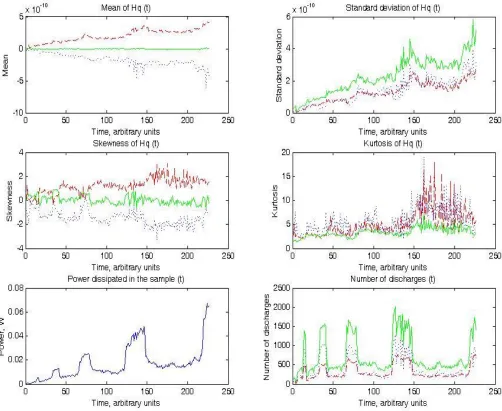
Several features characterizing the tree growth can be observed in Fig.1. The mean values of the positive and negative PD magnitudes increase in absolute values during the tree propagation. The mean and skewness (odd moments) of the positive and negative PD distributions are symmetrical with respect to the x-axis. On the other hand, the standard deviation and kurtosis (even moments) have approximately equal values for both distributions. Consequently, the mean of the total distribution is approximately equal to zero and the skewness fluctuates around zero value throughout the tree propagation. A mean value of zero throughout the tree growth time implies that there was no build-up of net charge within the tree structure and the symmetry between the two distributions (positive and negative) also implies that a relationship exists between the mechanisms governing the occurrence of PDs of both polarities during each half cycle of the applied voltage.
[image:3.612.55.557.271.682.2]Values of the skewness and kurtosis for positive and negative PD distributions demonstrate that these two distributions are skewed. Also, correlation analysis was performed on the statistical parameters obtained from the positive discharge distribution as shown in Table 1 and similar results were obtained from the negative discharge distribution and absolute discharge magnitude distribution (not shown). A strong correlation was found between the mean and standard deviation and between the average PD power and standard deviation but less so between skewness and kurtosis. Further investigation showed that the relationship between the skewness and kurtosis is quadratic. In Fig. 2 the square of the skewness is plotted against kurtosis, calculated for 1s acquisition period and the corresponding linear fits are plotted for the six samples tested. The lines in Fig. 2 are approximately parallel, and values of the slopes are between 1.1 and 1.7. In order to investigate further this relationship, we
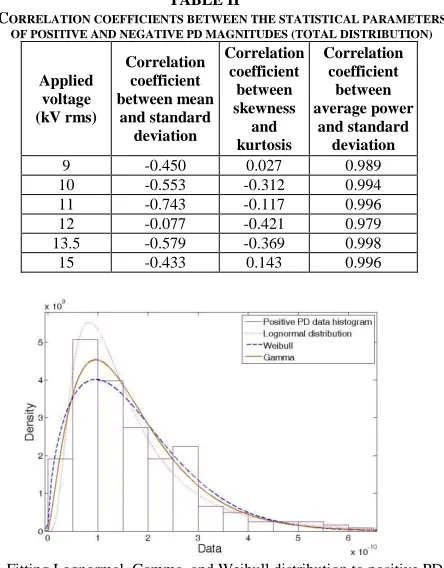
have fitted 3 asymmetric distributions to the PD distributions, namely Gamma, Lognormal and Weibull. The corresponding fits and data histogram are shown in Fig. 3 for typical 1s acquisition interval during the tree growth at voltage 12 kV rms. All three distributions resemble relatively well the experimental data and statistically it was not possible to estimate the “best fit” to the data. Therefore, we can assume that any asymmetric distribution having shape similar to the above mentioned distributions could be used to describe PD distributions obtained during tree propagation.
In this paper, Gamma distribution has been chosen to illustrate the theoretical relationships between the statistical parameters of a skewed distribution. The probability density function (pdf) of Gamma distribution is given by [11]:
b x aa
x
e
a
b
b
a
x
f
1)
(
1
)
,
(
(1)
where a is the shape parameter and bis the scale parameter of the distribution. Mean (), standard deviation (
), skewness and kurtosis excess of Gamma distribution are:b
a
.
(2)a
b
(3) aSkewness 2 (4)
a
Excess6 (5)
[image:4.612.341.562.55.195.2]From Eq. (4-5) it can be seen that a quadratic relationship exists between the skewness and the kurtosis excess and from Eq. (2-3) a linear relationship exists between the mean and the standard deviation, provided a is constant. These theoretical relationships are with close agreement with the experimental data, where linear correlations were found to exist - between the mean and standard deviation, and quadratic one between standard deviation and kurtosis excess.
Fig. 2. Plot of skewness^2 vs. kurtosis excess of the positive discharge distribution during the tree growth; from the bottom to the top are represented
linear fits of the data for voltages 9, 10, 11, 12, 13.5, and 15 kV rms, respectively. Except for the bottom line, all lines are vertically shifted at
values +5, 10, 15, 20, and 25, respectively.
TABLE I
CORRELATION COEFFICIENTS BETWEEN THE STATISTICAL PARAMETERS OF POSITIVE PD MAGNITUDES
Applied voltage (kV rms) Correlation coefficient between mean and standard deviation Correlation coefficient between skewness and kurtosis Correlation coefficient between average power and standard deviation
9 0.932 0.851 0.919
10 0.954 0.843 0.945 11 0.956 0.948 0.964 12 0.963 0.890 0.949 13.5 0.967 0.870 0.981 15 0.980 0.910 0.986
When the total distribution of PD amplitudes is considered, the only correlation that still holds is the one between the standard deviation and the average power per discharge. This is due to the fact that this distribution is symmetrical about zero and the above relationships between the statistical parameters of skewed distributions are no longer valid (see Fig.1 and Table2).
TABLE II
CORRELATION COEFFICIENTS BETWEEN THE STATISTICAL PARAMETERS OF POSITIVE AND NEGATIVE PD MAGNITUDES (TOTAL DISTRIBUTION)
Applied voltage (kV rms) Correlation coefficient between mean and standard deviation Correlation coefficient between skewness and kurtosis Correlation coefficient between average power and standard deviation 9 -0.450 0.027 0.989 10 -0.553 -0.312 0.994 11 -0.743 -0.117 0.996 12 -0.077 -0.421 0.979 13.5 -0.579 -0.369 0.998 15 -0.433 0.143 0.996
[image:4.612.339.561.299.583.2]
Fig 3. Fitting Lognormal, Gamma, and Weibull distribution to positive PD data, acquisition time 1s
[image:4.612.57.298.485.658.2]values for the statistical parameters. For example, in Fig.1 values calculated for the mean and standard deviation increase during the growth of the tree. The power dissipated (P) in the sample as a result of the partial discharges is calculated by the following expression:
N i i i N i ii
q
V
q
V
t
P
1 11
(6)since the acquisition time
t
is 1s,i
V- instantaneous voltage at the occurrence of the i-th PD pulse, qi- magnitude of the i-th PD pulse, N- number of PD pulses per second. The ratio of the dissipated power and the number of discharge per second gives the average power per discharge, Pav:
N i i iav Vq
N N P P 1 1
/ (7)
It was stated above that the average power is correlated to the standard deviation
qof the total distribution of PD amplitudes.q av
P
(8)If we introduce coefficient of proportionality A, then we can re-write (3) as:
q av A
P
(9)Where the standard deviation is calculated by:
2 2 2 ) ( q N q N qqi i
q
(10)However, the total distribution of PD magnitudes is a symmetrical distribution around zero, so the mean charge is approximately equal to zero,
q
0
(see Fig. 1). Therefore, we can neglect the second term to the right in (4), which reduces the expression for the standard deviation to:N qi
q
2
(11)
Substituting (7) and (11) into (9) and rearranging the two sides, we can obtain the following expression relating
V
i,q
i andN
:const q N q V i i i
2 (7)The above expression was found to be valid for the whole set of applied voltages. The value of the constant in (7) is determined by the magnitude of applied test voltage.
IV. CONCLUSIONS
The statistical parameters (mean, standard deviation, skewness and kurtosis) are non-stationary and change their values in the course of the tree growth.
Symmetry exists between the positive PD and negative PD amplitude distributions, which implies that a relation exists between the mechanisms governing the occurrence of PDs of
both polarities. The mean of the total distribution is approximately equal to zero during the entire propagation of the tree, which implies that there is no build-up of net charge in the tree structure over time.
Skewness and kurtosis, as well as mean and standard deviation of the skewed distributions were found to be correlated. The implication of this fact is that they should not be used simultaneously in a pattern recognition algorithm, because the inputs of a successful classifier should be independent.
A correlation was also obtained between the standard deviation of the total distribution and the average power per discharge, which gives a quantitative relation between the instantaneous voltage, discharge magnitude and number of discharges. This relation was found to be valid for the whole set of applied voltages and therefore holds for both bush-type and branch type trees. This fact implies that during the course of tree growth at a given applied voltage, the average power per discharge and hence the energy dissipated per cycle increases with the mean value during the progression of tree growth with time. However, information concerning the dynamical characteristics of the partial discharge activity (burst type characteristic that have been shown in the past to be related to the fractal dimension of the tree) was not reflected in any of the statistical parameters.
REFERENCES
[1] L.A. Dissado, J.C. Fothergill, Electrical Degradation and Breakdown in Polymers. IEE Materials and devices series, London: Peter Peregrinus Ltd. on behalf of the IEE. 601. 1992
[2] K. Wu, Y.S., T. Mizutani, H.K. Xie, “Model for Partial Discharges Associated with Treeing Breakdown II: Tree Growth Affected by PD”,
J. Phys. D: Appl. Phys., Vol. 33, pp. 1202-1208, 2000.
[3] S.J. Dodd, L.A.Dissado., J.V. Champion, J.M. Alison, “Evidence for deterministic chaos as the origin of electrical tree breakdown structures in polymeric insulation”, Physical Review B, Vol. 52(24), pp. R16 985-R16 988, 1995.
[4] L.A. Dissado, J.C. Fothergill, N. Wise, A. Willby, J. Cooper, “A deterministic model for branched structures in the electrical breakdown of solid polymeric dielectrics”, J. Phys. D: Appl. Phys., Vol. 33, pp. L109-L112, 2000.
[5] M.A. Brown, J.V. Champion, S.J. Dodd, P. Mudge, “An investigation of partial discharge energy dissipation and electrical tree growth in an epoxy resin”, Proc. of the 2004 IEEE International Conference on ICSD 2004. Volume 1, 5-9 July 2004, pp. 288 - 291
[6] R.E. James, B.T.P., “Development of Computer-based Measurements and their Application to PD Pattern Analysis”, IEEE Trans. Dielectrics and Electrical Insulation, Vol. 2(5), pp. 838-856, 1995.
[7] E. Gulski, P.H.F.M., F.H. Kreuger, “Automized Recognition of Partial Discharges in Cavities”, Japanese Journal of Applied Physics, Vol. 29(7), pp. 1329-1335, 1990.
[8] Gulski, E., Computer-aided recognition of partial discharges using statistical tools. Delft University Press, 1991.
[9] N.C. Sahoo, M.M.A.S., R. Bartnikas, “Trends in Partial Discharge Pattern Classification: A Survey”, IEEE Trans. Dielectrics and Electrical Insulation, Vol. 12(2), pp. 248-264, 2005.
[10] N. Chalashkanov, N. Kolev, S. Dodd, J.C. Fothergill, “PD Pattern Recognition Using ANFIS”, accepted for publishing Proc. CEIDP 2008 [11] J.K. Patel, C.H. Kapadia, D.B. Owen, Handbook of statistical
distributions. Marcel Dekker Inc. New York and Basel, 1976, pp. 30-31 [12] J.V. Champion, S.J. Dodd, “Simulation of partial discharges in