Energy Procedia 63 ( 2014 ) 504 – 510
ScienceDirect
1876-6102 © 2014 The Authors. Published by Elsevier Ltd. This is an open access article under the CC BY-NC-ND license (http://creativecommons.org/licenses/by-nc-nd/3.0/).
Peer-review under responsibility of the Organizing Committee of GHGT-12 doi: 10.1016/j.egypro.2014.11.055
GHGT-12
OxyCAP UK:
Oxyfuel Combustion - Academic Programme for the UK
H. Chalmers
c, M. Al-Jeboori
d, B. Anthony
b, S. Balusamy
a, S. Black
f, F. Cavallo
Marincola
d, A. Clements
f, H. Darabkhani
b, J. Dennis
a, T. Farrow
g, P. Fennell
d, B.
Franchetti
d, L. Gao
e, J. Gibbins
c, S. Hochgreb
a, M. Hossain
e, N. Jurado
b, A. Kempf
d,h, H.
Liu
g, G. Lu
e, L. Ma
f, S. Navarro-Martinez
d, W. Nimmo
f, J. Oakey
b, A. Pranzitelli
f, S.
Scott
a, C. Snape
g, C-G. Sun
g, D. Sun
e, J. Szuhánszki
f, I. Trabadela
c, F. Wigley
d, Y. Yan
e,
M. Pourkashanian
f*
aUniversity of Cambridge, Cambridge, UK bCranfield University, Cranfield, Bedford, UK
cUniversity of Edinburgh, Edinburgh, UK dImperial College London, London, UK eUniversity of Kent, Canterbury, Kent, UK
fUniversity of Leeds, Leeds, UK gUniverity of Nottingham, Nottingham, UK
hUniversität Duisberg-Essen, Germany
Abstract
The OxyCAP-UK (Oxyfuel Combustion - Academic Programme for the UK) programme was a £2M collaboration involving researchers from seven UK universities, supported by E.On and the Engineering and Physical Sciences Research Council. The programme, which ran from November 2009 to July 2014, has successfully completed a broad range of activities related to development of oxyfuel power plants. This paper provides an overview of key findings arising from the programme. It covers development of UK research pilot test facilities for oxyfuel applications; 2-D and 3-D flame imaging systems for monitoring, analysis and diagnostics; fuel characterisation of biomass and coal for oxyfuel combustion applications; ash
transformation/deposition in oxyfuel combustion systems; materials and corrosion in oxyfuel combustion systems; and development of advanced simulation based on CFD modelling.
© 2013 The Authors. Published by Elsevier Ltd.
* Corresponding author. Tel.: +44-113-343-2512; fax: +44-113-246-7310. E-mail address: [email protected]
© 2014 The Authors. Published by Elsevier Ltd. This is an open access article under the CC BY-NC-ND license (http://creativecommons.org/licenses/by-nc-nd/3.0/).
Selection and peer-review under responsibility of GHGT.
Keywords: oxycombusion; oxyfuel; CFD; flame imaging; fuel characterisation; materials; ash deposition
1.Introduction
Oxyfuel combustion of coal appears to offer costs and performance that are at least as competitive as other CO2
capture technology options. In addition, the specific technical characteristics of oxyfuel combustion are likely to offer advantages in certain important applications. For example, oxyfuel technology has significant potential to provide an effective CO2 capture solution for sites with water constraints and will probably also be useful to
improve utilization of some difficult coals.
Although the core oxyfuel concept is not new, there is a need to continue to develop both the underpinning science and associated scientific capacity needed to support successful widespread commercialisation of oxyfuel power plants. The OxyCAP-UK (Oxyfuel Combustion – Academic Programme for the UK) programme was a £2M collaboration involving researchers from seven UK universities, supported by E.On and the Engineering and Physical Sciences Research Council. The programme ran from November 2009 to July 2014 and developed underpinning academic research capability for oxyfuel combustion in four key, interlinked areas:
x New experimental techniques for oxyfuel combustion;
x Advanced computer modelling techniques required for analysis of oxyfuel combustion plant;
x Experimental data on coal ash and boiler material behaviour under oxyfuel conditions; and
x Training and development of new researchers in the field.
The remainder of this paper will outline the key scientific findings from the OxyCAP-UK programme. In particular, it will:
x Highlight the importance of developing state-of-the-art research pilot test facilities;
x Demonstrate the successful use of 2-D and 3-D flame imaging systems for monitoring, analysis and diagnostics;
x Provide an overview of work undertaken on fundamental aspects of oxyfuel combustion systems (fuel
characterization, ash transformation/deposition and materials and corrosion in oxyfuel combustion systems); and
x Introduces the development and use of advanced simulation based on CFD modelling within the OxyCAP-UK programme.
2.Development of UK research pilot test facilities for oxyfuel applications
The OxyCAP-UK project has developed a 250 kW Combustion Test Facility (CTF), which is now part of the UK CCS Research Centre PACT (Pilot-scale Advanced Capture Technology) facilities [1]. This facility has been used to generate a comprehensive database for oxy combustion under various test conditions, providing much needed validation data for CFD submodels. The CTF can fire gas, coal, or coal/biomass blends as fuel and the oxidising medium can be either air, a synthetic mixture of CO2/O2 with or without steam injection, or a mixture of wet recycle
gas and O2. The facility can also supply flue gas to the connected post combustion carbon capture plant for solvent
testing and development.
The experimental programme has included baseline studies under both air- and oxy-firing (21%) conditions. Further parametric studies were also carried out under simulated oxyfuel conditions with recycle ratios set to give O2 concentrations of 27%, 30% and 33%. Experimental campaigns included a number of conventional
measurements (temperature using suction pyrometry, in-furnace heat flux profiles, species profiles for
O2/CO/CO2/SO2/NOx, unburnt carbon and ash analysis). Additionally, advanced visualization using 2-D and 3-D
flame imaging was also carried out and this is discussed further below.
temperatures of the process when varying the main operational parameters [2]. For the experimental part of the project, primary parameters such as type of fuel (coal/biomass/coal-biomass blends), percentage of recycle flue gas, and type of recycle flue gas (dry/wet) were varied to analyse their effects on the outputs of the process (gas
composition, temperatures reached, and composition of ash generated). Additional aspects like sulphur trioxide (SO3) levels inside the combustor, heat transfer, and study of the process using a dry recycle flue gas, have also been
studied. In parallel, a kinetic simulation model has been designed to study the oxy-combustion process through the co-firing of coal and biomass blends.
An important feature of the work with the Cranfield rig has been a retrofit to existing facilities to allow an additional suite of measurements including SO3 measurement by controlled condensation method and additional
sampling for gas chromatography using FTIR. The experimental programme suggests that heat fluxes can be around 3 times higher in oxy-firing conditions than in air-firing conditions. It also suggests that heat fluxes
associated with coal combustion are around 1.4 times higher than those associated with a cereal co-product biomass.
3.2-D and 3-D imaging systems for monitoring, analysis and diagnostics
Within the OxyCAP-UK project, two-dimensional (2-D) and three-dimensional (3-D) flame imaging systems have been developed to quantify the fundamental physical characteristics of oxyfuel flames. The systems are capable of measuring a range of flame characteristics, including length, surface area, volume, temperature
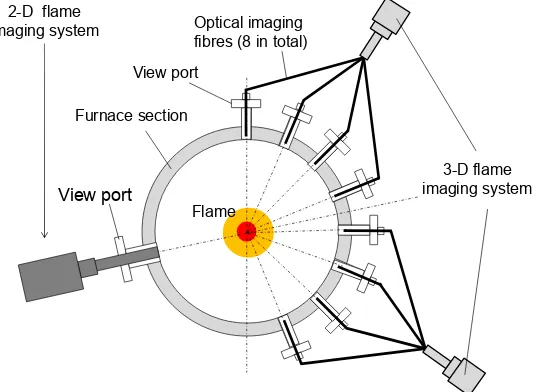
distribution, soot concentration and emissivity as well as intensities of flame radicals. Photodiodes are incorporated in the 2-D imaging system to measure the oscillation frequency and stability of the flame. These techniques provide digital images and videos of the flame as well as computer tomographic reconstruction of the flame in 3-D [3]. As noted above, experimental work has been undertaken on the 250 kW solid fuel combustion test facility to assess the performance and operability of the systems (see also Fig. 1). Measurements include:
x in-flame temperature profiles using suction pyrometry;
x heat flux profiles using an ellipsoidal radiometer and total heat flux probes; x in-flame and exhaust species profiles;
x flame characteristics, including shape, luminosity, temperature, soot concentration and oscillation frequency;
x intensities of flame radicals;
x flame stability index;
x velocity profiles within the top section of the furnace (for both non-reactive and reactive cases); and
[image:3.544.160.427.440.636.2]x coal burnout and ash characterisation.
Fig. 1. Schematic of the 2-D and 3-D flame imaging system deployed at the UK CCS Research Centre core facilities.
Optical imaging fibres (8 in total) 2-D flame
imaging system
3-D flame imaging system Furnace section
View port
View port
Additionally, a novel instrumentation system for measuring velocity, concentration and particle size distribution of pulverised fuel flow has been developed. The system operates on electrostatic and piezoelectric sensors and signal processing algorithms [4]. It has been evaluated on a coal/biomass flow test rig at Kent and on a biomass flow pipeline at Tilbury Power Station.
The project has also developed improved capability to use laser diagnostic techniques to make flow field
measurements under oxyfuel conditions building on previous experience at the University of Cambridge. This work found that optical diagnostics can be usefully employed in obtaining velocities in coal-laden flames, with coal as the seeding particle. Laser Doppler anemometry (LDA) provides time and space resolved measurements with 1 mm spatial resolution, whilst particle image velocimetry (PIV) requires fast shuttering to reject the high luminosity of flames. A database of velocity, OH PLIF and LII in turbulent flame measurements is now available for different coal loadings, O2 and CO2/N2 ratios [5]. The data will be used for validation of CFD codes, with requests received
from Japan and Germany as part of a new workshop initiative for coal oxyfuel combustion modelling. The measurements show that O2 content must be increased from 21% to 30-40% to achieve similar reactivity in oxyfuel
firing conditions.
4.Fundamental aspects of oxyfuel combustion systems
A broad range of activities have been undertaken within the OxyCAP-UK programme to improve knowledge and understanding in key underpinning science relevant to oxyfuel combustion systems. This work has included fuel characterization using a drop tube furnace (DTF) and a purpose-built ignition chamber, analysis of ash
transformation and deposition in oxyfuel environments and also developments in understanding of materials and corrosion that are relevant for design and operation of oxycombustion systems.
The impact of CO2 and steam on devolatilisation and char burn-out in relation to normal air firing has been
assessed by a comprehensive DTF programme at the University of Nottingham. The DTF operates up to 1450°C which is high enough to achieve the maximum volatile matter yields for coals with relatively short residence times. The key findings from this experimental programme are:
x Significantly higher yields of volatiles were obtained for all coal samples examined when devolatilisation occurred in CO2 at higher temperatures above 1100°C and residence time 200 ms;
x With the presence of steam, the combinative effect of CO2-char and steam-char gasification reactions led to even
higher yields of volatiles being produced in oxy-fuel conditions;
x For devolatilisation in both N2 and CO2, the amount of nitrogen released into volatiles is proportional to the
yields of volatiles being produced. However, when devolatilisation occurred in CO2 or CO2/steam, the higher
yields of volatiles led to significantly higher proportions of fuel nitrogen being released;
x The impact of CO2 on char burnout varied significantly with different coals; and
x Biomass co-firing can improve char combustion performance in both air and oxy-fuel firing conditions, and the effect is significantly more pronounced in oxy-combustion [6].
Researchers at the University of Cambridge have also carried out fundamental work to quantify the effect of gasification on rates of char combustion in fluidised beds for highly reactive chars. This work provides increased understanding of interactions between mass transfer and gasification in fluidised bed conditions, which will benefit the development of associated models.
Additionally, dust ignition tests in oxyfuel atmospheres have been carried out at the University of Edinburgh using a purpose built ignition chamber. Fundamental data on ignition under oxyfuel conditions has been gathered for a range of coal and biomass types leading to improved understanding of acceptable O2 levels in the flue gas
recycle. For example, for the series of experiments carried out within the OxyCAP programme a relatively stronger ignition source was required for the biomass samples tested when compared with pulverised coals previously tested. This is tentatively attributed to larger particle sizes and higher moisture contents [7]. Insights from this work are expected to improve mill safety in oxyfuel conditions as well as providing fundamental data for combustion modellers.
OxyCAP-UK partners. Analysis of ashes was conducted using scanning electron microscopy (SEM). Analysis of sample microstructure for samples fired pilot scale under oxyfuel conditions (26% enrichment and 2, 3 and 4% excess O2) showed that:
x The morphology of the particles changed from highly distributed spherical shapes to agglomerates of fine particles;
x The shape of particles changed from mainly spherical to plate like shapes and mottled surface textures; and
x For two of the coals tested particle sizes are significantly lower for oxyfuel particles, but for a third coal similar particle sizes are observed.
Additionally, comparison of air- and oxy-firing trials indicate that the phases (examined by XRD) are closely comparable, which means the cement industry can take ashes from either source. Further work to examine whether carbonates might persist in oxy-firing conditions could be considered. The analysis in this study suggested that Ca may be more leachable from air-fired ashes (more CaO, less CaCO3), but fresher ash samples should be used to
verify this tentative conclusion.
Finally, Cranfield University have carried out combustion rig trials under a range of oxy-fuel combustion conditions to support a series of laboratory corrosion and trace element speciation tests, which have generated new data required for the development of predictive corrosion rate and trace element distribution models. The corrosion performance of materials in a wide range of gaseous/deposition environments simulating industrial process conditions has been considered. In particular, different fuels, a range of operational conditions and the practicality of changes in fuel quality under different oxygen percentages, relevant for both pulverised fuel and pressurised fluidised bed combustion, have been assessed in order to define the operation envelope.
The experimental programme at Cranfield has also suggested no major difference between air- and oxy-firing ash deposits for the range of test conditions explored (except for an expected increase in levels of sulphur compounds that is typically expected with recycled flue gas). The deposit compositions broadly follow conventional understanding of expected influence of fuel properties on deposition, although further work with a broader range of fuels (particularly different biomasses) is needed.
5.Development of advanced simulation based on CFD modelling
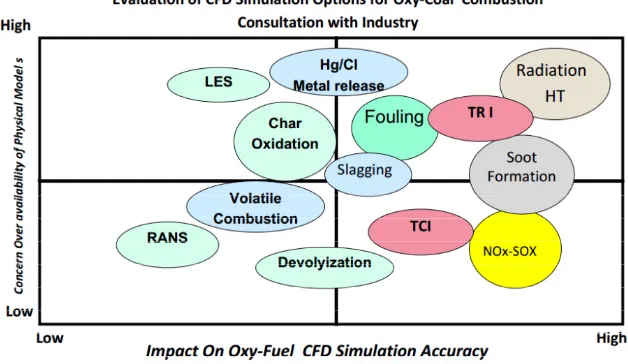
CFD (computational fluid dynamics) simulations have been performed in ANSYS FLUENT using RANS and LES. The priorities for advanced simulation within the OxyCAP-UK programme were determined in consultation with industry, which included discussing key concerns over availability of physical models for CFD simulation and the expected impact of models of CFD simulation accuracy with several industrialists. The key findings of this consultation are shown in Fig 2. A particular focus of the OxyCAP-UK programme was, therefore, in developing new CFD submodels including radiation and char gasification reactions. Other techniques such as flicker analysis were also progressed [8]. Validation and improvements to new and existing models have been completed, with model development including the incorporation of the full spectrum correlated k-method (FSCK) and Mie theory for spectral radiation in CFD.
Fig. 2. Overview of outcomes from consultation with industry on oxy-coal combustion CFD sub-model priorities
In addition to effective use of ANSYS, the Oxy-CAP programme has also included work to develop improved Large Eddy Simulation (LES) as an effective approach to simulation of turbulent combustion of coal [10-12]. In particular, it is expected that these approaches can provide improved representation of the interaction between turbulence and combustion. In LES, closure models are used only for the smallest scales with equations retained in the model and solved for larger scales. Although this approach is more computationally expensive, it is able to provide improved predictive capability since an accurate description of turbulent flow is used. This allows unsteady analysis to be undertaken and extreme events to be observed.
6.Conclusions
This paper has provided an overview of the OxyCAP-UK programme. Overall, the programme has progressed state-of-the-art understanding in a number of areas that are important for effective development and deployment of oxyfuel power plants. Improved systems for flame imaging and flame diagnostics have been developed and tested under realistic conditions. Advanced CFD-based simulation techniques have also been progressed, including development of key sub-models identified as priorities in consultation with relevant industrialists and advances in Large Eddy Simulation for turbulent combustion of coal. These activities have been complemented by a substantial body of work on fundamental aspects of oxycombustion systems including fuel characterization using a drop tube furnace (DTF) and a purpose-built ignition chamber, analysis of ash transformation and deposition in oxyfuel environments and also developments in understanding of materials and corrosion that are relevant for design and operation of oxycombustion systems. A further achievement of the programme has been substantial developments in infrastructure and capacity, including combustion test facilities that have now been incorporated into the UK CCS Research Centre PACT facilities (www.pact.ac.uk).
Acknowledgements
References
[1] UK CCS Research Centre Pilot-scale Advanced Capture Technology (PACT) facilities, www.pact.ac.uk
[2] Jurado N, Gohari Darabkhani H, Anthony EJ, Oakey JE. Co-firing Performance of a Retrofitted Oxy-Combustor burning Coal/Biomass Blends: Experimental and Simulation Study. 3rd Oxy-fuel Combustion Conference (OCC3), International Energy Agency Greenhouse Gases Programme (IEAGHG), Ponferrada/CIUDEN (Spain), September 2013.
[3] Hossain MM, Lu G, Sun D and Yan Y. Three-dimensional reconstruction of flame temperature and emissivity distribution using optical tomographic and two-colour pyrometric techniques. Measurement Science and Technology 2013; 24 (7) 074010.
[4] Gao L, Yan Y, Carter RM, Sun D, Lee P and Xu CL. On-line Particle Sizing of Pneumatically Conveyed Biomass Particles Using Piezoelectric Sensors. Fuel 2013; 113, 810-6.
[5] Balusamy S, Schmidt A, Hochgreb S. Flow field measurements of pulverized coal combustion using optical diagnostic techniques. Exp. Fluids. 2013; 54, 1534.
[6] Farrow TS, Sun C-G. and Snape C. Impact of biomass char on coal char burn-out under air and oxy-fuel conditions. Fuel 2013; 114, 128-34. [7] Trabadela I, Chalmers H and Gibbins J. Oxy-biomass ignition in air and relevant oxy-combustion atmospheres for safe primary recycle and
oxy-burner development. GHGT-12, Austin, USA, October 2014.
[8] Black S, Szuhánszki J, Ma L, Ingham DB, Pourkashanian M. LES of oxy-coal combustion: an investigation into flame stability. 3rd Oxy-fuel Combustion Conference (OCC3), International Energy Agency Greenhouse Gases Programme (IEAGHG), Ponferrada/CIUDEN (Spain), September 2013.
[9] Black S, Szuhánszki J, Pranzitelli A, Ma L, Stanger PJ, Ingham DB, Pourkashanian M. Effects of firing coal and biomass under oxy-fuel conditions in a power plant boiler using CFD modelling. Fuel 2013; 113, 780-6.
[10] Rabacal M, Franchetti BM, Cavallo Marincola F, Proch F, Costa M, Hasse C, Kempf AM. Large eddy simulation of coal combustion in a large scale laboratory furnace, accepted for publication in Proc. Combust. Inst 2014; 35.
[11] Franchetti BM, Cavallo Marincola F, Navarro-Martinez S, Kempf AM. Large Eddy Simulation of a Pulverised Coal Jet Flame, Proc. Combust. Inst 2013; 34, 2419-26.