Efficient Data Intensive Secure Computation:
Fictional or Real?
Changyu Dong
Department of Computer and Information Sciences, University of Strathclyde, Glasgow, UK
Abstract. Secure computation has the potential to completely reshape the cyber-secruity landscape, but this will happen only if we can make it practical. Despite significant improvements recently, secure computation is still orders of magni-tude slower than computation in the clear. Even with the latest technology, run-ning the killer apps, which are often data intensive, in secure computation is still a mission impossible. In this paper, I present two approaches that could lead to practical data intensive secure computation. The first approach is by designing data structures. Traditionally, data structures have been widely used in computer science to improve performance of computation. However, in secure computa-tion they have been largely overlooked in the past. I will show that data structures could be effective performance boosters in secure computation. Another approach is by using fully homomorphic encryption (FHE). A common belief is that FHE is too inefficient to have any practical applications for the time being. Contrary to this common belief, I will show that in some cases FHE can actually lead to very efficient secure computation protocols. This is due to the high degree of inter-nal parallelism in recent FHE schemes. The two approaches are explained with Private Set Intersection (PSI) as an example. I will also show the performance figures measured from prototype implementations.
1
Introduction
Secure computation research started in the 1980s. Yao first defined the concept of secure computation in his seminal paper [2]. The goal of secure computation is to allow multiple parties to jointly compute a function over their inputs, and keeping these inputs private. There are several different approaches for achieving this goal. One prominent secure computation technique is Yao’s garbled circuits protocol [3]. In this protocol, a function converted into an encrypted Boolean circuit and the parties evaluate the circuit with encrypted inputs. Another Boolean circuit based technique is the GMW proto-col by Goldreich et al. [4]. Also Cramer et al. showed that secure computation can be done with arithmetic circuits and secret shared inputs [5]. Gordon et al. proposed a tech-nique for secure computation in a von Neumann-style Random Access Machine (RAM) model by using an Oblivious RAM [6]. Recently, the development of Fully Homomor-phic Encryption (FHE) provided a new direction in secure computation [7]. Apart from those generic secure computation techniques, there are also many special-purpose pro-tocols that are designed for specific secure computation problems, e.g. private set inter-section [8] and oblivious polynomial evaluation [9]. Secure computation is an obvious solution for a class of problems in which parties must provide input to a computation, but no party trusts any other party with that data. Examples include e-voting, auctions, information retrieval, data sharing, data mining and many more. Despite the fact that it has so many potential applications, secure computation has remained purely theoretical for many years. Efficiency is one of the main reasons.
Recently there have been a few efforts aiming to turn secure computation from a theorists’ toy to a real world tool. Significant progress has been made in the last five years to improve the efficiency of secure computation by algorithmic advancements. For example, various protocols designed to efficiently compute a specific function securely; improvements on garbled circuits including free XOR [10], efficient OT extension [11] and fast cut-and-choose [12]; more efficient share-based multiparty secure computation protocols including Sharemind [13] and SPDZ [14]; more efficient RAM program based secure computation [15]; optimizations for FHE including SIMD operations [16] and polylog FHE [16]. The improvement is significant. Taking garbled circuit based secure computation as an example, after integrating many optimizations to date, the FastGC framework [17] is104times faster than FairPlay [18] which was implemented in 2004.
How to make data intensive secure computation practical? In the rest of this paper, I will show two new approaches that have great potential: by designing data structures and by using newly developed FHE techniques. I will present the ideas using Private Set Intersection (PSI) protocols as an example.
2
Private Set Intersection: Background
A PSI protocol is a two-party protocol in which a client and a server want to jointly compute the intersection of their private input sets in a manner that at the end the client learns the intersection and the server learns nothing. PSI protocols have many practical applications. For example, PSI has been proposed as a building block in applications such as privacy preserving data mining [19, 20], human genome research [21], home-land security [22], Botnet detection [23], social networks [24], location sharing [25] and cheater detection in online games [26]. Many applications requires massive datasets as inputs. The first PSI protocol was proposed by Freedman et al. [8]. There are several approaches for PSI protocols. Some of them are based on oblivious polynomial evalua-tion [8, 27, 28], some are based on oblivious pseudorandom funcevalua-tion (OPRF) evaluaevalua-tion [29, 30, 22, 31], and some are based on generic garbled circuits [32].
3
Data Structural Approach
In computer science, traditionally an effective approach to improve the efficiency of data intensive computation is by using an appropriate data structure, but in secure com-putation, the power of data structures has been largely overlooked. The reason for that is probably because in the past secure computation research focused on showing feasi-bility and the use cases were limited to those with small data input. But when we are moving towards real world applications in which data plays the central role and drives the computation, data structural design will become an indispensable part of secure computation. A good example of this data structural approach is the garbled Bloom Filter and the PSI protocol based on this data structure [33].
3.1 From Bloom Filter to Garbled Bloom Filter
A Bloom filter [34] is a compact data structure for probabilistic set membership testing. It is an array ofmbits that can represent a setSof at mostnelements. A Bloom filter comes with a set of kindependent uniform hash functionsH = {h0, ..., hk−1}that eachhimaps elements to index numbers over the range[0, m−1]uniformly. Let us use BFS to denote a Bloom filter that encodes the setS, and useBFS[i]to denote the bit at indexiinBFS. Initially, all bits in the array are set to 0. To insert an elementx∈S into the filter, the element is hashed using thekhash functions to getkindex numbers. The bits at all these indexes in the bit array are set to 1, i.e. setBFS[hi(x)] = 1for 0≤i≤k−1. To check if an itemyis inS,yis hashed by thekhash functions, and all locationsyhashes to are checked. If any of the bits at the locations is 0 ,yis not in
Private Set: C Private Set: S
BFS
Secure AND
BF
C\SBF
C [image:4.612.239.376.113.189.2]client server
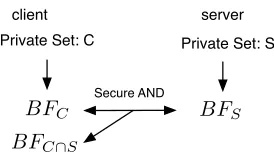
Fig. 1: The Naive PSI protocol Based on Bloom Filters
A standard Bloom filter trick is that if there are two Bloom filters, each encodes a setS1 andS2, and both are of the same size and built using the same set of hash functions, we can obtain another Bloom filterBFS1∩S2 by bit-wisely ANDingBFS1
andBFS2. The resulting Bloom filterBFS1∩S2 encodes the set intersection S1∩S2.
It seems that we can obtain an efficient PSI protocol (Fig. 1) immediately from this trick. However, this naive protocol is not secure. The reason is that due to collisions, the resulting Bloom filterBFC∩S usually contains more 1 bits than the Bloom filter built from scratch usingC∩S. This meansBFC∩S leaks information about elements inS. To avoid information leakage, we designed the garbled Bloom filters (GBF). A gar-bled Bloom filter is much like a Bloom filter: it is an array of sizemwithkhash func-tions. The difference is that at each position in the array, it holds aλ-bit string rather than a bit, whereλis the secure parameter. The bit string is either a share of a set element or a random string. To encode a setS, each elements∈Sis inserted as follows: initially all positions in the GBF is set to NULL. We then hash the element using thekhash functions. For0≤j ≤k−2, IfGBF[hj(s)] =N U LLthen we put anλ-bit random string at this position, and then we setGBF[hk−1(s)] = s⊕(Lkj=0−2GBF[hj(s)]). We can see that each of thekpositionGBF[hj(s)]holds a share ofs. The shares has the property that if all kshares are present, we can reconstruct the element from the sharess=Lk−1
j=0GBF[hj(s)]); however any subset that has less thankshares reveals no information about the element. After inserting all elements insto the GBF, we put aλ-bit random string at each position that is still NULL. To query an elementy,y is
hashed by thekhash functions and we testLk−1
j=0GBF[hj(y)] ?
=y. If the test is true, thenyis in the setS.
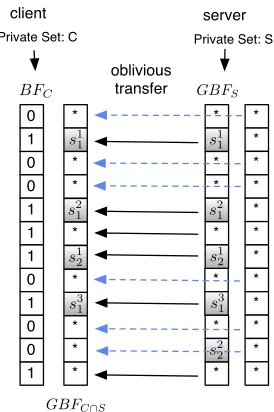
A secure PSI protocol can then be built using a Bloom filter and a garbled Bloom filter (Fig. 2). In the protocol, the client encodes its set into a Bloom filterBFC, the server encodes its set into a garbled Bloom filterGBFS. The server also generates an array contains mrandom bit strings of lengthλ. For each position0 ≤ i ≤ m−1, the client and server run a (2,1)-Oblivious Transfer protocol [35] such that if the bit
BF[i] = 1, the client receivesGBF[i], if the bitBF[i] = 0, the client receives theith string from the random string array. At the end of the protocol, the result is a garbled Bloom filterGBFC∩S that encodes the intersection.
* * * * * * * s1 1 s2 1
s12
s31
s2 2 * * * * * * * * s1 1 s2 1 s1 2 s3 1 0 0 0 1 0 0 1 1 1 1 1 0
Private Set: C Private Set: S
BFC GBFS
* * * * * * * * * * * *
GBFC\S
oblivious transfer
[image:5.612.240.377.114.320.2]client server
Fig. 2: The Oblivious Bloom Intersection Protocol
property of the shares, the residue shares ofsinGBFC∩Sleak no information abouts. For example, in Fig 3,s1
2inGBFC∩Sis a share ofx2which is not in the intersection. The elementx2has 3 shares and one of the shares22is not transferred to the client in the protocol. Then the other two shares remain inGBFC∩S look uniformly random and do not leak information aboutx2.
x1 x2
* s11 * * s12 * s12 * s31 * s22 * * s1 * * * * * * *
1 s21 s12 s31
GBF
C∩SGBF
S* s1 * * * * * * *
1 s21 * s31 GBF{x1}
Fig. 3: Indistinguishability of the Intersection Garbled Bloom Filter
3.2 Performance Comparison
[image:5.612.205.414.449.541.2]68X$ 106X$
163X$
227X$
640X$
757X$
13X$ 17X$ 18X$ 18X$ 18X$ 17X$
0$ 100$ 200$ 300$ 400$ 500$ 600$ 700$ 800$
1,024$ 4,096$ 16,384$ 65,536$ 262,144$ 1,048,576$
Set$Size$
[image:6.612.188.429.115.242.2]Huang's$ De$Cristofaro's$
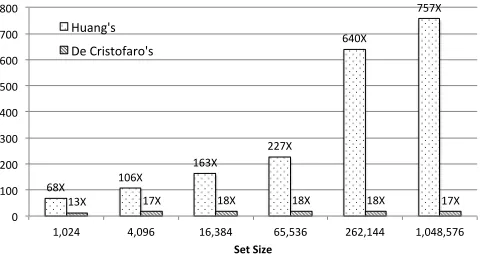
Fig. 4: Performance Comparison
the previous best protocols. One protocol is by Huang et al based the garbled circuits approach [32], and another is by De Cristofaro et al based on ORPF evaluation[22]. Fig 4 shows the performance improvement at 128-bit security. The numbers displayed in the figure are ratios of running time (previous protocol to our protocol).
4
Fully Homomorphic Encryption Approach
FHE is a newly established area in cryptography. An FHE scheme allows (any) com-putation to be carried out on encrypted data directly. FHE is a powerful tool and at the same time is notorious for its inefficiency. It is a common belief that FHE is too inefficient to be practical yet. However, this common belief is not always true. In this section I will show how to build a more efficient PSI protocol using fully homomorphic encryption.
4.1 The BGV FHE Scheme
In 2009, Gentry [7] developed the first FHE scheme. Following the breakthrough, several FHE schemes based on different hardness assumptions have been proposed, e.g. [36, 37].
The RLWE variant of BGV [37] is among the most efficient FHE schemes; it op-erates in certain polynomial rings. Namely, letΦm(x)be them-th cyclotomic poly-nomial with degreeφ(m), then we have a polynomial ringA =Z[x]/Φm(x), i.e. the set of integer polynomials of degree up toφ(m)−1. Hereφ(·)is the Euler’s totient function. The ciphertext space of the BGV encryption scheme consists of polynomials over Aq = A/qA, i.e. elements inAreduced modulo qwhereqis an odd integer1. The plaintext space is usually the ringAp = A/pA, i.e. polynomials of degree up to φ(m)−1with coefficients inZpfor some prime numberp < q.
There are three basic algorithms in the BGV scheme:
1
– G(p, λ, L): The key generation algorithm. Givenp, λandLsuch thatpis the prime number that defines the plaintext space,λis the security parameter andL is the depth of the arithmetic circuit to be evaluated, generate a secret key, the corre-sponding public key and a set of public parameters.
– Epk( ¯m): The encryption algorithm. Given a public key pk, encrypt an element ¯
m∈ Ap.
– Dsk(c): The decryption algorithm. Given the secret keysk, decrypt a ciphertextc.
Being a fully homomorphic encryption scheme, the BGV scheme supports both multiplication and addition operations over ciphertexts. Let us denote homomorphic addition byand homomorphic multiplication by. We can homomorphically add or multiply two ciphertexts together. We can also homomorphically add or multiply a ciphertext with a plaintext.
4.2 Polynomial Representation of a Set
Freedman et al [8] first proposed to use a polynomial for representing a set in PSI. Given a set S, we can map each element inS to an element in a sufficiently large field R. ThenScan be represented as a polynomial (in a ringR[x]). The polynomial is defined asρ(x) = Q
si∈S(x−si). The polynomialρ(x)has the property that every element
si ∈Sis a root ofρ(x). For two polynomialsρ1andρ2that represent the two setsS1 andS2respectively, the the greatest common divisor of the two polynomialsgcd(ρ1, ρ2) represents the set intersectionS1∩S2. Based on this, we can design protocols to securely obtain the set intersection. Without loss of generality, let bothρ1andρ2to be of degree
δand letγ1andγ2to be two uniformly random degreeδpolynomials inR[x], Kissner and Song proved in [27] thatγ1·ρ1+γ2·ρ2=µ·gcd(ρ1, ρ2)such thatµis a uniformly random polynomial. This means ifρ1andρ2are polynomials representing setsS1and S2, then the polynomialγ1·ρ1+γ2·ρ2contains only information aboutS1∩S2and no information about other elements inS1orS2. This forms the basis of their PSI protocol in which a party obtainsγ1·ρ1+γ2·ρ2to find the set intersection but learns nothing more about elements in the other party’s set. However, Kissner’s protocol is not practical due to the facts that it uses expensive Paillier encryption and the computational complexity is quadratic in the size of the sets.
4.3 The Private Set Intersection Protocol Based on FHE
We parallelize computation by utilizing the native plaintext space of BGV to load mul-tiple data items. The native plaintext space of BGV is a polynomial ring, therefore a set can be easily represented in the plaintext space. To simplify the description, I will start from the case where|C|=|S|= φ(m)2 −1. In the protocol, the client has a BGV key pair(pk, sk)and a setC. The server has a setS. The two parties encode their sets into
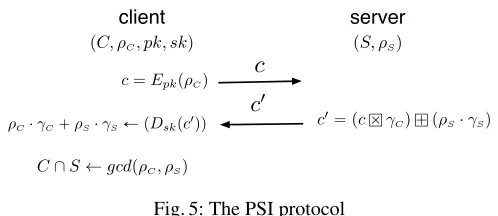
ρCandρS that are polynomials inAp. The protocol is shown in Figure 5:
1. The client encrypts its set polynomialρCand sends the ciphertextcto the server. 2. The server chooses random polynomialγCandγSinAp, each of degree
φ(m) 2 −1, then the server computes homomorphicallyc0 = (cγ
client server pC, ⇢C, pk, skq pS, ⇢Sq
c1“ pcb Cq‘p⇢S¨ Sq
c
c
1⇢C¨ C`⇢S¨ S– pDskpc1qq
c=Epk(⇢C)
[image:8.612.183.432.114.222.2]C\S gcd(⇢C, ⇢S)
Fig. 5: The PSI protocol
sendsc0 to the client, who then decrypts the ciphertext and obtains the polynomial
ρC·γC+ρS·γS.
3. The client then evaluates the polynomial obtained in the last step with elements inC. For each element, if it is a root then it is in the intersection. The client then outputs the intersectionC∩S.
To compute the intersection of sets whose sizes are larger than φ(m)2 −1, we can use bucketization. Bucketization is a process to partition a large set into disjoint subsets (buckets). The two parties use a public uniform hash functionH : {1,0}∗ → [1, k] to map their set elements intokbuckets. This is done by hashing each element to get a bucket number and putting the element into the bucket with this number. If the size of the set to be bucketized isn, then each bucket will have aroundn/kelements. The two parties can choosekso that with a high probability, each bucket has no more than
φ(m)
2 −1elements. To prevent information leakage through bucket size, the two parties pad each bucket with random elements so that all buckets have the same size φ(m)2 −1. They then run the PSI protocolktimes. In theith run, each party uses itsith bucket as the input to the PSI protocol. The union of outputs is the intersection of the two sets.
4.4 Efficiency
The protocol is very efficient. This is due to the high degree of parallelism provided by the BGV scheme. In the protocol, we process a set of φ(m)2 −1 elements in one go, rather than processing them individually. Therefore the total computational cost is amortized by φ(m)2 −1. The parameterφ(m)is large, therefore the amortized cost is small.
210 212 214 216 218 220 GBF-PSI 0.67 1.99 8.21 32.41 130.42 530.36 FHE-PSI 0.110.140.45 1.55 5.91 23.48 Improvement 6X 14X 18X 21X 22X 23X * Running Time in seconds
Table 1 shows the performance comparison of the GBF based and the FHE based PSI protocols. In the experiment, security parameter is set to 128-bit. The parameters for the BGV keys were|p|= 32, L= 1,|q|= 124, φ(m) = 5002. The set size varied from210(1024) to220(1,048,576). As we can see, the FHE based PSI protocol is much faster. For two 1 million elements input sets, the running time is less than half a minute, which is only 1 - 2 orders of magnitude slower than the computation in the clear.
5
Conclusion
In this paper, I presented two approaches that could lead to practical data intensive secure computation. One approach is by designing better data structures. The rationale behind this approach is that when the data to be processed is big, arranging it into certain data structures may make it more amendable for computation. Another approach is by using fully homomorphic encryption. Recent fully homomorphic encryption schemes provide us facilities to parallelize computation, which can greatly reduce the overall cost if the computation task is data parallel. The two approaches can be combined. For example, when using bucketization in the PSI protocol, the list of buckets is essentially a hash table data structure. The research along these two lines is still in an early stage, but further investigation will lead to fruitful results.
References
1. Evans, D.: Secure computation in 2029: Boom, bust, or bonanza. Applied Multi-Party Computation Workshop 2014
2. Yao, A.C.: Protocols for secure computations (extended abstract). In: 23rd Annual Sym-posium on Foundations of Computer Science, Chicago, Illinois, USA, 3-5 November 1982. (1982) 160–164
3. Yao, A.C.: How to generate and exchange secrets (extended abstract). In: 27th Annual Symposium on Foundations of Computer Science, Toronto, Canada, 27-29 October 1986. (1986) 162–167
4. Goldreich, O., Micali, S., Wigderson, A.: How to play any mental game or A complete-ness theorem for protocols with honest majority. In: Proceedings of the 19th Annual ACM Symposium on Theory of Computing, 1987, New York, New York, USA. (1987) 218–229 5. Cramer, R., Damg˚ard, I., Maurer, U.M.: General secure multi-party computation from any
linear secret-sharing scheme. In: Advances in Cryptology - EUROCRYPT 2000, Interna-tional Conference on the Theory and Application of Cryptographic Techniques, Bruges, Bel-gium, May 14-18, 2000, Proceeding. (2000) 316–334
6. Gordon, S.D., Katz, J., Kolesnikov, V., Krell, F., Malkin, T., Raykova, M., Vahlis, Y.: Secure two-party computation in sublinear (amortized) time. In: ACM Conference on Computer and Communications Security. (2012)
7. Gentry, C.: Fully homomorphic encryption using ideal lattices. In: Proceedings of the 41st Annual ACM Symposium on Theory of Computing, STOC 2009, Bethesda, MD, USA, May 31 - June 2, 2009. (2009) 169–178
9. Naor, M., Pinkas, B.: Oblivious transfer and polynomial evaluation. In: Proceedings of the Thirty-First Annual ACM Symposium on Theory of Computing, May 1-4, 1999, Atlanta, Georgia, USA. (1999) 245–254
10. Kolesnikov, V., Schneider, T.: Improved garbled circuit: Free XOR gates and applications. In: ICALP (2). (2008)
11. Asharov, G., Lindell, Y., Schneider, T., Zohner, M.: More efficient oblivious transfer and extensions for faster secure computation. In: ACM Conference on Computer and Commu-nications Security. (2013)
12. Lindell, Y.: Fast cut-and-choose based protocols for malicious and covert adversaries. In: CRYPTO (2). (2013)
13. Bogdanov, D., Niitsoo, M., Toft, T., Willemson, J.: High-performance secure multi-party computation for data mining applications. Int. J. Inf. Sec.11(6) (2012)
14. Damg˚ard, I., Pastro, V., Smart, N.P., Zakarias, S.: Multiparty computation from somewhat homomorphic encryption. In: CRYPTO. (2012)
15. Liu, C., Huang, Y., Shi, E., Katz, J., Hicks, M.W.: Automating efficient ram-model secure computation. In: 2014 IEEE Symposium on Security and Privacy, SP 2014, Berkeley, CA, USA, May 18-21, 2014. (2014) 623–638
16. Gentry, C., Halevi, S., Smart, N.P.: Fully homomorphic encryption with polylog overhead. In: EUROCRYPT. (2012)
17. Huang, Y., Evans, D., Katz, J., Malka, L.: Faster secure two-party computation using garbled circuits. In: 20th USENIX Security Symposium, San Francisco, CA, USA, August 8-12, 2011, Proceedings. (2011)
18. Malkhi, D., Nisan, N., Pinkas, B., Sella, Y.: Fairplay - secure two-party computation system. In: Proceedings of the 13th USENIX Security Symposium, August 9-13, 2004, San Diego, CA, USA. (2004) 287–302
19. Aggarwal, C.C., Yu, P.S., eds.: Privacy-Preserving Data Mining - Models and Algorithms. Volume 34 of Advances in Database Systems. Springer (2008)
20. Dong, C., Chen, L.: A fast secure dot product protocol with application to privacy preserving association rule mining. In: PAKDD (1). (2014)
21. Baldi, P., Baronio, R., Cristofaro, E.D., Gasti, P., Tsudik, G.: Countering gattaca: efficient and secure testing of fully-sequenced human genomes. In: ACM Conference on Computer and Communications Security. (2011) 691–702
22. Cristofaro, E.D., Tsudik, G.: Practical private set intersection protocols with linear complex-ity. In: Financial Cryptography. (2010) 143–159
23. Nagaraja, S., Mittal, P., Hong, C.Y., Caesar, M., Borisov, N.: Botgrep: Finding p2p bots with structured graph analysis. In: USENIX Security Symposium. (2010) 95–110
24. Mezzour, G., Perrig, A., Gligor, V.D., Papadimitratos, P.: Privacy-preserving relationship path discovery in social networks. In: CANS. (2009) 189–208
25. Narayanan, A., Thiagarajan, N., Lakhani, M., Hamburg, M., Boneh, D.: Location privacy via private proximity testing. In: NDSS. (2011)
26. Bursztein, E., Hamburg, M., Lagarenne, J., Boneh, D.: Openconflict: Preventing real time map hacks in online games. In: IEEE Symposium on Security and Privacy. (2011) 506–520 27. Kissner, L., Song, D.X.: Privacy-preserving set operations. In: CRYPTO. (2005) 241–257 28. Hazay, C., Nissim, K.: Efficient set operations in the presence of malicious adversaries. In:
Public Key Cryptography. (2010) 312–331
29. Hazay, C., Lindell, Y.: Efficient protocols for set intersection and pattern matching with security against malicious and covert adversaries. In: TCC. (2008) 155–175
30. Jarecki, S., Liu, X.: Efficient oblivious pseudorandom function with applications to adaptive ot and secure computation of set intersection. In: TCC. (2009) 577–594
32. Huang, Y., Evans, D., Katz, J.: Private set intersection: Are garbled circuits better than custom protocols? In: NDSS. (2012)
33. Dong, C., Chen, L., Wen, Z.: When private set intersection meets big data: an efficient and scalable protocol. In: ACM Conference on Computer and Communications Security. (2013) 34. Bloom, B.H.: Space/time trade-offs in hash coding with allowable errors. Commun. ACM
13(7) (1970) 422–426
35. Ishai, Y., Paskin, A.: Evaluating branching programs on encrypted data. In: TCC. (2007) 36. van Dijk, M., Gentry, C., Halevi, S., Vaikuntanathan, V.: Fully homomorphic encryption
over the integers. In: EUROCRYPT. (2010) 24–43