City, University of London Institutional Repository
Citation
:
Silvers, L. J. (2008). Magnetic Fields In Astrophysical Objects. Philosophical
Transactions of the Royal Society A, 366(1884), pp. 4453-4464. doi: 10.1098/rsta.2008.0173
This is the unspecified version of the paper.
This version of the publication may differ from the final published
version.
Permanent repository link:
http://openaccess.city.ac.uk/1350/
Link to published version
:
http://dx.doi.org/10.1098/rsta.2008.0173
Copyright and reuse:
City Research Online aims to make research
outputs of City, University of London available to a wider audience.
Copyright and Moral Rights remain with the author(s) and/or copyright
holders. URLs from City Research Online may be freely distributed and
linked to.
City Research Online:
http://openaccess.city.ac.uk/
[email protected]
arXiv:0808.1118v2 [astro-ph] 11 Aug 2008
B y L. J. Silvers
Department of Applied Mathematics and Theoretical Physics, University of Cambridge, Wilberforce Road, Cambridge, Cambridgeshire, CB3 0WA, U.K.
Magnetic fields are known to reside in many astrophysical objects and are now believed to be crucially important for the creation of phenomena on a wide variety of scales. However, the role of the magnetic field in the bodies that we observe has not always been clear. In certain situations, the importance of a magnetic field has been over looked on the grounds that the large-scale magnetic field was believed to be too weak to play and important role in the dynamics.
In this article I discuss some of the recent developments concerning magnetic fields in stars, planets and accretion discs. I choose to emphasise some of the sit-uations where it has been suggested that weak magnetic fields may play a more significant role than previously thought. At the end of the article I list some of the questions to be answered in the future.
Keywords: Magnetic Fields – Magnetohydrodynamics (MHD) – Accretion Discs – Stellar and Planetary Dynamos – Planetary Magnetic Fields
1. Introduction
Our knowledge of magnetism, and of magnetic fields, began with the study of lodestones several hundred years before Christ. Stones of this type can become magnetic, and then two such stones will naturally align (see, for example, Parker 1979). Scholars of the time proposed a variety of reasons for this peculiar behaviour and it was even suggested at one point that the lodestone might even have a soul!
Many centuries later, at the start of the 17th
century, William Gilbert noted that the Earth also behaves like a large lodestone (see for example Childress & Gilbert, 1995). Gilbert noted that a lodestone always points to align with what is now referred to as magnetic north/south in the same way that a small stone aligns itself relative to a larger one. By the end of the nineteenth century, it had been concluded that the Earth is not unique in having a magnetic field. In 1908, Hale determined that the Sun has a magnetic field and that the phenomena that are known as sunspots, which are dark patches on the surface of the Sun (Hale 1908), have a magnetic field that is incredibly strong (of the order of 1000 Gauss). In the last century, studies of different stars, planets and other non-Earth objects, have been made and it is now known that many of them have a detectable magnetic field. A useful summary of typical field strengths for some objects can be found in Zeldovichet al. (1983) and Jones (2007).
if the magnetic field is one that is constantly being generated by some kind of hydromagnetic dynamo mechanism.
In the last few decades, the importance of a magnetic field in many of the astrophysical bodies has become increasingly recognised. This has stimulated con-siderable research in the area of magnetohydrodynamics (MHD) to understand how a plasma and a magnetic field interact. In some phenomena, such as sunspots, the role of such a strong magnetic field is fairly easy to grasp at a basic level but only re-cently has a more comprehensive understanding of these phenomena been obtained (see the article by Bushby in this volume). However, it has proved to be more dif-ficult to understand the important and role of weaker fields, where the magnetic energy is much less than the kinetic energy†. Further, understanding why some planets have magnetic fields that are easy to detect, and others don’t means that there is a vast array of issues and interesting questions still to be resolved about magnetic fields and their interactions with electrically conducting fluids in objects throughout the universe.
In this short article, I will discuss some of the recent developments in our knowl-edge and understanding of astrophysical magnetic fields, and discuss some of the interesting open problems and issues. Much of this revolves around the study of how astrophysical object generate magnetic fields i.e. their dynamo mechanisms.
[image:3.612.220.358.377.518.2]2. The Role of the magnetic field in the Sun, other stars and
planets
Figure 1. An illustration showing the different zones of the Sun.
Given that our knowledge of magnetism in non-Earth objects is greatest for the Sun, this seems a good starting point for our brief trip around a portion of the magnetic Universe. This star is a fascinating and complex astrophysical object that has now enthralled mankind for thousands of years. It is a vast ball of plasma that can, somewhat crudely, be pictured as being comprised of a series of layers, as
shown in figure 1. Events in the outer parts of this star (on the the visible surface of the Sun that is referred to as the photosphere; in the chromosphere and in the corona) can be observed directly and images such as those from the SOHO mission show a variety of transient events. Historically, the first solar phenomena feature to be identified were sunspots, which appear in the records dating as far back as 350BC and have been known to persist for several weeks (Tobias 2002). Figure 2 shows images of a sunspot viewed in three different ways.
[image:4.612.114.457.275.421.2]In 1908 Hale, utilizing the Zeeman effect (the splitting of a spectral line in the presence of a magnetic field), was able to show that these patches on the solar surface are regions with strong magnetic field. In fact, it is the presence of a strong magnetic field that inhibits convection and gives rise to spots. They are dark in appearance as the temperature in a spot is lower than its surroundings. Recently progress has been made in our understanding of these phenomena (Thomas, Weiss, Tobias & Brummell 2002; 2004; 2006) and a non-technical account of this develop-ment is discussed by P. J. Bushby in this volume (Bushby 2008).
Figure 2. High resolution (pseudo-colour) images of a sunspot viewed in three different ways. Left: In Ca II H; Middle: in G-band; Right: Magnetogram. Images are courtesy of the Hinode mission. (Hinode is a Japanese mission developed and launched by ISAS/JAXA, with NAOJ, NASA and STFC as partners. It is operated by these agencies in co-operation with ESA and NSC.)
The most noted example in history occurred in the 17th century, and is called the Maunder minimum (see, for example, Tobias 2002).
While sunspots were the first solar phenomena to be observed, there are a host of others, which include flares (regions of high brightness associated with a complex topology of the magnetic field) and prominences (regions where cool, dense material is suspended above the surface of the Sun). The origin of the solar magnetic field, which is crucial for observed transient phenomena, is rooted deep inside the Sun and therefore the interactions in the solar interior (below the photosphere), between the plasma and the magnetic field, give rise to what is observed on, and above, the surface. Since the observations of the sunspots and other phenomena change with time, the magnetic field in the interior must also be time dependent. In order to produce such a complicated collection of magnetic phenomena, the interaction between the magnetic field and the plasma must be complex, and one of the most crucial questions in solar physics is:How do a plasma and a magnetic field interact in the interior of the Sun?
The solar interior can be divided into three principal, large, regions – the core, radiative zone, and convection zone. Despite the fact that these interior regions are not observable directly, there is still a fairly large amount that is known about the internal structure particularly through utilizing a relatively new branch of solar research called helioseismology. Research in this area seeks to infer information about the interior of the Sun via the oscillations observed at the surface (Stix 1996; Thompson 2004). Helioseismological inversions (e.g. Schouet al. 1998) suggest that the differential rotation profile that is observed at the surface of the Sun is maintained throughout the bulk of the convection zone Furthermore, the radiative zone rotates essentially as a solid body with angular velocity equal to that of the surface at a latitude of approximately 35◦. Thus, separating the convection and
radiative zones, there is a thin transition region of strong radial shear - a region known as the tachocline. This region has been postulated for a number of years, but has only recently been confirmed by helioseismology and, despite its relatively narrow radial extent, is believed to play a crucially important role in the evolution of the solar magnetic field due to its large shear.
still have an incredibly significant effect on the flow and so a catastrophic effect on the rate of field regeneration†. This leads to the conclusion that the magnetic field cannot reside entirely in the solar convection zone, and new mechanisms such as the interface dynamo mechanism were proposed (starting from Parker 1993).
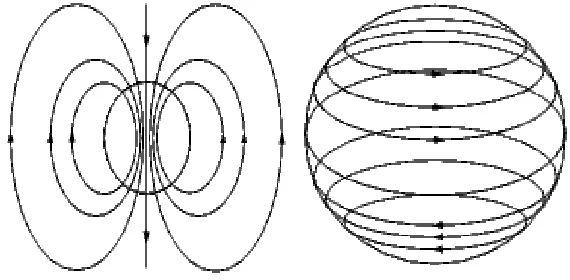
Figure 3. Illustrations showing the poloidal (left) and toroidal (right) components of the magnetic field courtesy of J. J. Love.
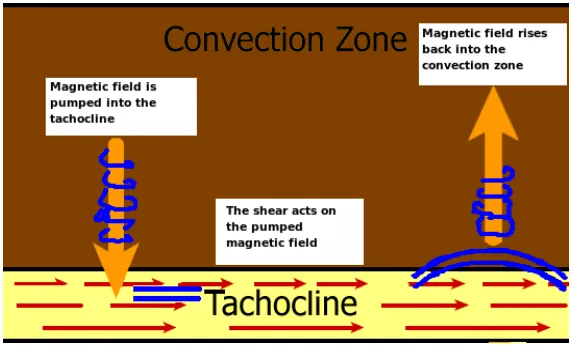
In the interface model, the turbulence within the convection zone retains the ability to generate the poloidal component of magnetic field (see Figure 3) but it invokes the natural tendency of overshooting convection to transport the magnetic field out of the convection zone into the tachocline. This movement of magnetic field out of the convection zone prevents the catastrophic effects mentioned above. Once in the tachocline the magnetic field is sheared out to generate a large-scale toroidal component of the field, which then rises returning magnetic field back into the convection zone for the cycle to continue. This is shown in figure 4.
It is important to note that the interface dynamo mechanism is not the only current proposal for a mechanism for the solar dynamo and others include, for example, the Babcock-Leighton model (Babcock 1961; Leighton 1969)†. Also, there have been papers in recent years to suggest that the catastrophic quenching that, in part, motivated the interface dynamo model may not be as severe as anticipated (Blackman & Field 2000; Silvers 2006). However, recent observational evidence from another star,τ Boo, with some characteristics similar to the Sun, has added
greater weight to the idea that magnetic fields in stars may be being maintained by an interface mechanism described above (Donatiet al. 2008).
† Extremely weak here refers to fields that are such that the magnetic energy isRm times
smaller than the kinetic energy, whereRmis a measure of the relative importance of the advective
to diffusive terms that appear in the equation that governs the evolution on the magnetic field.
Figure 4. The interface dynamo mechanism.
The star that is known as τ Boo has a similar internal structure to the Sun,
but with a very thin convection zone. The magnetic field for this star has been monitored over a several year period and recently the first flip in the large-scale magnetic field of a star other than the Sun has been seen (Donatiet al. 2008). This is an exciting advance in observations of stellar magnetic fields and raises questions as to how long it would be before detect another reversal. In this star, as is the case in the Sun, there is region of strong shear (a tachocline) where the convection zone that differentially rotates joins onto the rest of the interior. This has led the authors to conclude that there is most likely an interface dynamo mechanism, similar to that for the Sun discussed above, that is giving rise to the maintenance of a magnetic field in this star.
As τ Boo reminds us, there is considerable variation in the internal structure
of stars, and not just in the ratio of the thicknesses of the layers, which will play an important role in the internal dynamics between the electrically conducting fluid and the magnetic field. For some stars, there is a large convectively driven core as opposed to a large convectively driven envelope just below the surface. However, there does not have to be only one convective region within a star and it is believed that there can be multiple convection zones near the surface of some stars. Such complex structures inside stars are the result of compositional changes as you move radially outward from the centre of the star (see Silvers & Proctor 2007 and references there in). Comparing and contrasting different stars and their magnetic fields in future years will surely give us greater insight into stellar dynamos.
field (see, for example, Jones 2007 and references therein) and Mars appears to have have a magnetic field (Stevenson 2001) but there seems to be no current dynamo mechanism. This has forced astrophysicists to ask questions about what it is about some planets that give rise to a working dynamo mechanism.
What we are learning about the magnetic field in the planets in the solar system will help in the long run with our understanding of the extra solar planets that are now being detected (see the Extrasolar Planets Encyclopedia for a list that is frequently updated†), of which there is much less detailed observational data. Many of these extra solar planets are Jovian-like but with considerable variation in the proximity of the planet to the star it orbits (leading to the name: hot Jupiters). As such, achieving a comprehensive understanding of the behaviour of the magnetic field in Jupiter via theory and direct observations and measurements will help us form a better picture of these planets that have recently been discovered.
3. The role of the magnetic field in accretion discs
Magnetic fields not only play a significant role once stars and planets are formed, but are also believed to have an important role to play in their formation due to the interactions of the plasma with the weak magnetic field that resides in parts of the discs from which these objects are formed. Matter from the disc accretes onto an initially small object in the centre to form the star or planet.
To accrete onto the central body it is necessary to transport angular momentum outward. This seems, on the surface, a simple objective. However, it has given rise to a great deal of debate, with several mechanisms that give rise to the outward transport of angular momentum in an accretion disc having been proposed (see Balbus & Hawley 1998 for a discussion of the historical suggestions).
The drive to understand the transport of angular momentum started in the 1970s with papers such as that of Shakura & Sunyaev (1973). Early approaches sought a purely hydrodynamical based reason (see Balbus & Hawley, 1998, for a detailed historical overview). Any mechanism that involved the magnetic field playing a substantial role was discounted until the early 1990s because the magnetic field in the accretion discs can be extremely weak and so, as in the Sun, initially considered to be inconsequential. Hence, it was believed for many years that what was required was a hydrodynamical instability yielding turbulence within the disc. Turbulence is known to give rise to a greatly enhanced transportation and mixing rate of quantities - for example movement of a drop of dye in a vat of water is greatly increased over the pure diffusion rate if the water is turbulent.
However, in the early 1990s it was realised that the role of the magnetic field had not really been examined despite discussions of the magnetic field in accretion discs appearing since an article by Lynden-Bell in 1969. It has now become clear that one way to generate turbulence in a disc is by appealing to an instability that occurs when there is rotation in the presence of a weak magnetic field (an instability that was first identified in a different context by Velikov in 1959). Linear stability analysis has show that a differentially rotating disc, with angular velocity decreasing outwards, is unstable in the presence of a weak magnetic field (Balbus & Hawley 1991; Hawley & Balbus 1991). This magnetorotational instability (MRI)
gives rise to an enhanced transportation of angular momentum via the turbulence that is created in the disc. However, I note here that there are some alternative theories on how accretion may be occurring within accretion discs which do involve strong magnetic fields (see for example, Ferreira, 1997, for further details).
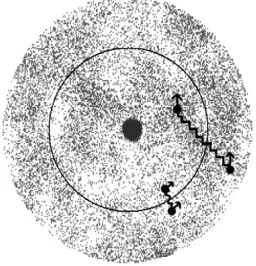
Figure 5. Illustration of how the basic MRI instability works in an accretion disc.
To understand the essence of the MRI instability in a disc, one can picture the weak magnetic field that resides in the disc as acting like a spring that tethers two elements in the disc together†. Figure 5 shows an initial configuration where one of our elements starts a little closer to the central mass than the other. As such, the inner element will orbit the central mass at a faster rate, which would stretch our hypothetical spring that connects them. This stretching gives rise to a torque that pulls the inner element back in its orbit and the outer element is pulled forward at the same time, transferring angular momentum from the inner element to the outer element. The inner element, which has lost angular momentum, moves further in, stretching the spring even more, and the process continues. This descriptive picture of the magnetorotational instability is only valid for a weak field; if the magnetic field were strong, the particles would be connected by an extremely stiff spring or bar, and the run-away instability process cannot occur. Therefore, for the magnetorotational instability to occur, the magnetic field must be weak, which is precisely the scenario that is found in accretion discs.
While there is now a plausible mechanism through which accretion can occur, it is not clear how efficient it is i.e. how fast angular momentum would be transferred in accretion discs via only this mechanism. Due to the non-linear coupled equations that govern the system, determination of this rate requires the use of numerical techniques to evolve the equations, but with current resources there is no way that a fully resolved simulation of the full disc can be constructed for the viscosity, resistivity and thermal conductivity values associated with discs.
To make some progress in the subject, the initial strategy was to consider the MRI in a small patch of the disc. By reducing the size of the computational domain, one can obtain higher resolutions for the same computational cost and so resolve much smaller scales. Great advances in understanding various issues related to this
instability have been made via local models of a section of the disc (see, for example Sano, Inutsuka, Turner & Stone 2004; Fromang, Papaloizou, Lesur & Heinemann 2007; Lesur & Longaretti 2007; Pessah, Chan & Psaltis 2007; Silvers 2008). With the computational resources that exist now, and for the foreseeable future, it is impossible to work with the real values for viscosity etc but it is possible to gradually decrease the values towards more astrophysically relevant values. This approach may make it possible to determine, for example, the behaviour, and possibly a scaling law, for how key quantities change as the dissipative parameters are reduced. However it may also prove helpful to consider methods to cut the computational resources even further, e.g. by including some kind of sub-grid scale modelling, but this is a complex issue and will require considerable thought on the precise way that the calculations should be carried out.‡
It is important to note that, while helpful to some degree, a local modelling approach leaves many questions unanswered, particularly how the results relate to the full disc problem. In the full disc there are a lot more questions to resolve such as the effect of the choice of boundary conditions. As such, one useful goal for the future, in our way to understanding the rate of accretion in discs, should be higher resolution computations in full disc models.
4. Concluding remarks
Over the last 100 years, since Hale made the first discovery of a magnetic field in a non-Earth object, there has been vast progress in our understanding of the interac-tions between astrophysical plasmas and a magnetic field. There is now a detailed picture of how solar features arise, what ingredients preclude dynamo action in stars and planets, and how turbulence in a disc gives rise to accretion of matter onto the central object. This said, there are still a plethora of questions that remain for us to answer such as:
• Why is it the case that there are extended periods in history, such as the Maunder minimum where there is an absence of the ‘usual’ sunspots that are associated with solar cycle? What is the trigger for the sunspot cycle to appear again several decades later?
• What is it that makes Venus different, such that no dynamo mechanism op-erates?
• How does a more complex internal structure within a star affect the mainte-nance and transport of the magnetic field?
• Are there further astrophysical areas where the magnetic fields have so far been perceived to be weak, and so neglected, which now warrant reconsider-ation in the light of the vital role played by weak magnetic fields?
• In how many stars is there a flip in the magnetic field, and on what time-scales do these flips occur? It is possible to obtain a comprehensive understanding of how the time-scale for flips relates to the structure of each star?
Hopefully in the next 100 years new considerable progress will be made on these topics and other areas with the help of new space-based missions and other tech-nology that will improve our current knowledge from observations, and advanced in computer resources.
I would like to thank David Hughes, Michael Proctor, Sam Falle, Steve Balbus, Nigel Weiss, John Papaloizou, Paul Bushby, Geoffroy Lesur and Steve Tobias for many stimulating conversations over the years.
References
Babcock, H. W., 1961, The topology of the Sun’s magnetic field and the 22-year cycle,
ApJ,133, 572-589.
Balbus, S. A. & Hawley, J. F., 1991, A powerful local shear instability in weakly magnetized
disks. I - Linear analysis,ApJ,376, 214-233.
Balbus, S. A. & Hawley, J. F., 1998, Instability, turbulence and enhanced transport in
accretion disks.,RvMP,70, 1-53.
Blackman, E. G. & Field, G. B., 2000, Constraints on the magnitude of α in dynamo
theory,ApJ,534, 984-988.
Bushby, P. J., 2008, Solar surface magnetic fields,RSPTA, in this volume.
Buffett, B. A., 2003, A comparison of subgrid-scale models for large-eddy simulations of
convection in the Earth’s core,Geophys. J. Int..153, 753-765.
Cattaneo F. & Vainshtein, S. I., Suppression of turbulent transport by a weak magnetic
field, 1991,ApJ,376, L21-L24.
Childress, S. & Gilbert, A. D., 1995, Stretch, twist, fold: The fast dynamo, Springer. Donati, J.-F., Moutou, C., Far`es, R., Bohlender, D., Catala, C., Deleuil, M., Shkolnik, E.,
Camberon, A. C., Jardine, M. M., Walker, G. A. H., 2008, Magnetic cycles of the planet
hosting starτ Bootis.,MNRAS,385, 1179-1185.
Fromang, S., Papaloizou, J., Lesur, G. & Heinemann, T., 2007, MHD simulations of the magnetorotational instability in a shearing box with zero net flux. II. The effect of
transport coefficients,A&A,4761123-1132.
Ferreira, J., 1997, Magnetically-driven jets from Keplerian accretion discs, A&A, 319,
340-359.
Jones, C., 2007, Chapter 5: Planetary dynamos,Mathematical Apsects of Natural
Dyan-mos, CRC Press.
Kono, M. & Roberts, P., 2002, Recent geodynamo simulations and observations of the
geomagnetic field,RvGeo,40, 4, 1-53.
Leighton, R. B., 1969, A magneto-kinematic model of the solar cycle,ApJ,156, 1-26.
Lynden-Bell, D., 1969, Galactic neuclei as collapsed old quasars,Nature,223, 690-694.
Lesur, G. & Longaretti, P.-Y., 2007, Impact of dimensionless numbers on the efficiency of
magnetorotational instability induced turbulent transport,MNRAS,378, 1471-1480.
Luhmann, J. G. & Russell, C. T., 1997, Mercury: Magnetic field and magnetosphere, Encyclopedia of Planetary Science, Chapman & Hall.
Gruzinov, A. V. & Diamond, P. H., Nonlinear mean field electrodynamics of turbulent
dynamos,PoP,3, 1853-1857.
Hale, G. E., (1908) Solar vorticies and the zeeman effect,Pub. A. S. P.,20, 220-223.
Hawley, J. F. & Balbus, S. A., 1991, A powerful local shear instability in weakly magnetized
disks. II - Nonlinear evolution,ApJ,376, 214-233.
Mestel, L., (1999) Stellar Magnetism, Oxford University Press.
Parker, E. N., 1993, A solar dynamo surface wave at the interface between convection and
non-uniform rotation,ApJ,408, 707-719.
Pessah, M. E., Chan, C.-K., & Psaltis, D., 2007, Angular momentum transport in accretion
disks: scaling laws in MRI turbulence,ApJ,668: L51-L54.
Sano, T., Inutsuka, S., Turner, N. J. & Stone, J. M., 2004, Angular Momentum Transport by Magnetohydrodynamic Turbulence in Accretion Disks: Gas Pressure Dependence of
the Saturation Level of the Magnetorotational Instability,ApJ,605, 1, 321-339.
Shakura, N. I. & Syunyaev, R. A., 1973, Black holes in binary systems. Observational
appearance.,A&A,24, 337-355.
Schou, J., Antia, H. M., Basu, S., Bogart, R. S., Bush, R. I., Chitre, S. M., Christensen-Dalsgard, J., Dimauro, M. P., Dziembowski, W. A., Eff-Darwich, A., Gough, D. O., Haber, D. A., Hoeksema, J. T., Howe, R., Korzennik, S. G., Kosovichev, A. G., Larsen, R. M., Pijpers, F. P., Scherrer, P. H., Sekii, T., Tarbell, T. D., Title, A. M., Thompson, M. J. & Toomre, J., 1998, Helioseismic studies of differential rotation in the solar
en-velope by the solar oscillations investigation using the michelson doppler imager,ApJ,
505, 390-417.
Silvers, L. J., 2006, On the choice of boundary conditions when studying the turbulent
diffusion of magnetic fields,MNRAS,367, 1155-1162.
Silvers, L. J. & Proctor, M. R. E., 2007, The interaction of multiple convection zones in
A-type stars,MNRAS,380, 44-50.
Silvers, L. J. , 2008, Long-term nonlinear behaviour of the magnetorotational instability
in a localized model of an accretion disc,MNRAS,385, 2, 1036-1044.
Stevenson, D. J., 2001, Mars’ core and magnetism,Nature,412, p214-219.
Stix, M., 1996, The Sun: An introduction, Springer.
Tobias S. & Weiss N. O., 2007, The solar dynamo and the tachocline,The Solar Tachocline,
C.U. Press. p319-350.
Thomas, J. H., Weiss, N. O., Tobias, S. M. & Brummell, N. H., 2002, Downward pumping
of magnetic flux as the cause of filamentary structures in sunspot penumbrae,Nature,
420, 390-392.
Thomas, J. H., Weiss, N. O., Brummell, N. H., Tobias, S. M., 2004, The Origin of
Penum-bral Structure in Sunspots: Downward Pumping of Magnetic Flux,ApJ,600, 2,
1073-1090.
Thomas, J. H., Weiss, N. O., Tobias, S. M. & Brummell, N. H., 2006, On the fine structure
of magnetic fields in sunspot penumbrae,A&A,452, 3, 1089-1090.
Thompson, M. J., 2004, Helioseismology and the Sun’s interior,A & G,45, 4, 4.21-4.25.
Tobias, S. M., 2002, The solar dynamo,RSPTA,360, 1801, 2741-2756.
Velikov E. P. 1959, Stability of an ideal conducting liquid flowing between cylinders
ro-tating in a magentic field,Sov. Phys JETP,36, 995-998.