City, University of London Institutional Repository
Citation
:
Murphy, R. A., Mondragon, E. ORCID: 0000-0003-4180-1261 and Murphy, V. A. (2008). Rule learning by rats. Science, 319(5871), pp. 1849-1851. doi:10.1126/science.1151564
This is the accepted version of the paper.
This version of the publication may differ from the final published
version.
Permanent repository link: http://openaccess.city.ac.uk/22060/
Link to published version
:
http://dx.doi.org/10.1126/science.1151564Copyright and reuse:
City Research Online aims to make research
outputs of City, University of London available to a wider audience.
Copyright and Moral Rights remain with the author(s) and/or copyright
holders. URLs from City Research Online may be freely distributed and
linked to.
City Research Online: http://openaccess.city.ac.uk/ [email protected]
Rule Learning by Rats
Summary
Rats can transfer learning of a three-element rule-based sequence to novel exemplars.
Authors
Robin A. Murphy1*, Esther Mondragón1*, Victoria A. Murphy2
1
University College London,2University of Oxford, United Kingdom
*To Whom Correspondence should be addressed email:[email protected],
Using rules extracted from experience to solve problems in novel situations involves
cognitions such as analogical reasoning and language learning and is considered a keystone
of humans’ unique abilities. Non-primates, it has been argued, lack such rule transfer. We
report thatrattus norvegicuscan learn simple rules and apply them to novel exemplars. Rats learned that sequences of stimuli consistent with a rule (e.g., XYX), were different from
other sequences (e.g., XXY, YXX). When novel stimuli were used to construct sequences
that did, or did not, obey the previously learned rule, rats transferred their learning.
The ability to extract generalizable rules from specific experiences is a fundamental attribute
of human higher cognitive functioning (1, 2). For instance, human language learning relies
on learning grammatical rules that allow the English speaker to discriminate; ‘The dog bit
the woman’ (Subject-Verb-Object) vs ‘Bit the woman the dog’ (Verb-Object-Subject). Rules
importantly can also be transferred to newly encountered items contributing to the
understanding and production of new sentences. Cross-linguistic differences in grammatical
rules serve to highlight the challenge facing the developing child, that phrase structure rules
must be learned. Language is only one of many cognitive domains where problems of this
type are present raising the issue of the nature of the underlying cognitive substrates
supporting rule learning in general.
Rule learning has been investigated in different species and stages of human development (3,
4). Pre-linguistic infants (5), primates (6) and even some birds (7, 8) can learn rule-like
temporal structures. Starlings, for example, are able to learn sequential structures made up of
segments of bird song and can recognize whether patterns are consistent with a training set.
Although the question of whether the birds used recursion to solve the discrimination is
controversial, they do appear to use a form of rule (8,9).
In this paper we studied the ability of rats to learn and transfer rules. We developed a
procedure to test rule-transfer learning in the rat, an animal it has been argued might have a
trained with three-element sequences (e.g., ABA, BAB) paired with food. We asked whether
they would learn something about the overall pattern of cues (i.e., XYX). There are at least
three cognitive abilities required in order to learn this rule and apply it in novel situations.
The first is an ability to learn that a sequence of cues signals food (10, 11). Second, animals
need to discriminate sequences paired with food from those that are not. Rats can learn
two-element sequences, A followed by B rather than B followed by A (12), as signals for food.
The third is the ability to transfer to novel instances to test whether the rats learn a
generalized rule rather than simply the trained instances. The transfer involved novel
sequences that were either consistent or inconsistent with the previously trained rule, but that
used stimuli that had never been exposed or trained.
Discrimination between stimuli is not a fixed ability as animals usually show some
generalization to novel items. For example, to the extent that a new stimulus C has more
perceptual similarity to A than to B, animals will treat C like it is A (10, 13). Furthermore,
similarity is not restricted to perceptual features. Animals will treat two different cues with
the same consequences (e.g., paired with food) as similar (14). Finally, animals will
sometimes treat stimuli that have the same relative position on a stimulus dimension (e.g.,
greater than, brighter than) as similar (15). In our experiment the stimulus changes within
and between sequences were not monotonically distributed along a dimension. There were
no stimulus specific perceptual cues or common consequences that previous research might
The rules were based on experiments that have shown that prelinguistic human infants
behave as if they learn rules embedded in sequences created from auditory phonemic cues
(5, 16). We used patterns of visual (Experiment 1) and auditory (Experiment 2) stimuli that
obeyed a similar rule.
The cues in Experiment 1 consisted of three-element sequences comprising short 10-second
exposures to two visual cues: a bright light (A), or darkness (B) presented in a dimly lit
environment. The rats were divided into three groups with each group receiving Pavlovian
conditioning for food following sequences that obeyed one of three rules. One group
received food with the XYX rule (i.e., ABA and BAB), another group with the XXY rule
(i.e., AAB and BBA) and finally a third group with the YXX rule (i.e., BAA and ABB).
Each group also received trials with the other two sequences but without food. Would each
group learn their rule for food and discriminate the reinforced from non-reinforced
sequences? We compared the rats’ anticipatory responding for food during the third element
of each sequence but before the food was available. The animals were able to discriminate
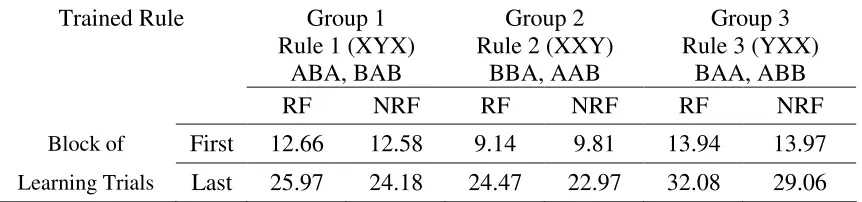
the sequences by the end of the experiment (Table 1). They came to respond more at the end
of sequences that signalled food than to trials of either of the other two rules and there was
no evidence for differential responding to these two non-reinforced rules (17). Since A and B
immediately preceded both food delivery and the absence of food, animals could not use the
identity of the final stimulus to solve the discrimination. One possible solution involves the
rats using unique pairs of stimuli that might have differentially signalled reinforced from
used the first pair of stimuli as a unique cue, while those trained with YXX might have used
the final pair of stimuli; finally, the group whose reinforced sequence was XYX could have
learned to use a pair formed by the first and third stimuli. However, if animals did make use
of different stimulus combinations in each group we would expect discrimination levels to
differ because each of these discriminations would have involved quite different levels of
difficulty. For instance, using a strategy based on the first two stimuli to discriminate XXY
from the other patterns would imply that the third stimulus is uninformative. The third
stimulus would effectively delay reinforcement, and weaken the discrimination, relative to
reinforcement following YXX in which food was contiguous with the unique stimulus pair.
Overall, the notion that only stimulus pairs were crucial for learning does not account for the
similar learning observed in all three groups. Discrimination performance did not differ
among groups (17), suggesting that animals were anticipating food delivery by learning the
whole triplet stimulus pattern. Rats had to use all three stimuli and their position in the
sequence, a form of rule learning, to solve the discrimination.
These results demonstrate that rats can learn three-element sequences, but it is possible that
one method of solving the task involved memorising the two sequences paired with food.
Perhaps multiple instances of the rule (e.g., ABA and BAB) were treated as behaviourally
similar but not perceived as examples from a broader category.
In a second experiment we used a transfer test to explore this possibility. We tested whether
inconsistent with the trained rule. We used a similar procedure to Experiment 1, but because
there were no differences in learning the three rules in Experiment 1 we trained all subjects
with rule 1 (XYX) using two auditory pure tones (e.g., A = 3.2 kHz and B = 9 kHz).
Auditory cues were used because they allow a wider range of cues for the transfer test.
Animals received food at the end of ABA and BAB sequences, but not following BBA,
AAB, BAA or ABB. After acquisition, we presented them with transfer stimuli comprised of
two novel pure tones (e.g., C = 12.5kHz and D = 17.5kHz). The stimuli were
counterbalanced so that the stimuli in the roles of A, B and C, D were reversed for half the
animals and were chosen to ensure that no common frequency relation was present between
the pairs. If rats had simply learned something specific about the reinforced elements ABA
they should have been unable to choose CDC and DCD over CCD, DDC, CDD and DCC.
The time the rats kept their head in the food trough during the final element of the sequence
was used as a measure of learning. The results of the transfer test are presented in Fig. 1
excluding two rats that failed to learn the initial discrimination. More anticipatory behaviour
for food was exhibited during sequences that were consistent with the previously learned
rule even though the rats had never been presented with these particular instances and there
was no food presented during the test. As with Experiment 1, animals responded more to the
rule-consistent sequences compared with both inconsistent sequences. There were no
differences in responding to the two inconsistent rules (17). To test that the rats remembered
the trained sequences we presented the original stimuli again, without any food
reinforcement or any retraining and found that they could still apply the rule to the original
The design of these experiments rules out a number of simple explanations of the rats’
behavior. They could not have solved this discrimination simply by learning the final
element of the sequences, because these elements were the same for both reinforced and
non-reinforced sequences. Similarly, they could not use pairs of stimuli embedded in the
sequences to solve the discrimination as this would lead to differing levels of performance in
Experiment 1. The result of Experiment 1 could be explained by the animals memorising
the sequential configuration of the reinforced triplets. Experiment 2 showed that the rats
transferred what they had learned about the sequences to novel instances. This transfer could
not be achieved by memorizing the specific patterns. The counterbalancing of the exemplars
of each rule prevented learning of a particular pitch or timbre pattern instead of the sequence
pattern. Animals were trained with both High - Low - High and Low - High - Low frequency
changes and therefore no simple pitch change can account for the original or transfer results.
Pitch changes along the frequency dimension were not fixed, did not follow a continuum and
the transfer cues were outside of the training range. Transfer had to be based on the entire
relational sequence, resulting in rule-based behavior.
Finally, it remains possible that the animals learned the relational sequences as two separate
but unrelated relational patterns and not as instances of the same category. However, during
transfer rats treated both patterns in the same way and equally different from all other
patterns as instances of the same category is parsimonious and in line with data suggesting
rule governed performance.
These experiments show that rats can learn simplified rules and apply these rules to novel
stimuli. Even if the cognitive mechanism that allows the rats’ behaviour is found to be
dissimilar to that found in humans, it does seem that both species have evolved means of
solving similar information problems, in this case transfer of overall sequence relations (see
also 5, 6, 9). These experiments suggest that some rule governed behaviour is present in rats
and well-understood principles of conditioning provide a perspective on our most human of
References and Notes
1. S. Pinker,Science253, 530 (1991).
2. D.C. Penn, D.J. Povilenni,Ann. Rev. Psych.58, 97 (2007).
3.C.M. Conway, M.H. Christiansen,Trends in Cog. Sci.5, 539 (2001).
4. J.L. Elman, et al. Rethinking innateness: A connectionist perspective on development. (MIT Press: Cambridge, MA 1996).
5. G.F. Marcus, S. Vijayan, S. Bandi Rao, P.M. Vishton,Science283, 77 (1999).
6. M.D. Hauser, D. Weiss, G. Marcus,Cognition86, 15 (2002).
7. W.T. Hebranson, C.P. Shimp,Learn. & Behav.31, 98 (2003).
8. T.Q. Gentner, K.M. Fenn, D. Margoliash, H.C. Nusbaum,Nature440, 1204 (2006).
9. M.C. Corballis,Cog. Sci.31, 697 (2007).
10. I.P. Pavlov,Conditioned reflexes(Dover Press: London 1927).
11. N.J. Mackintosh,The psychology of animal learning(Academic Press: London 1974). 12. R.A. Murphy, E. Mondragón, V.A. Murphy, N. Fouquet,Behav. Proc.67, 303 (2004).
13. N. Guttman, H.I. Kalish, J. Exp. Psych.51, 79 (1956).
14. R.C. Honey, A. Watt,J. Exp. Psych. Anim. Behav. Proc.24, 325 (1998).
15. K.W. Spence,Psychol. Rev.44, 430(1937).
16. J. Saffran, E. Aslin, E. Newport.Science274, 1926 (1996).
17. Materials, methods and procedural details as well as additional statistical analyses are
18. We would like to thank E. Alonso, D.C. Penn, J.Tennenbaum for useful discussions and
A.G.Baker and D.Shanks for comments on the manuscript. This research was
Table 1. Illustration of the three rules and mean rate (per min.) of food tray entries in each
group to both reinforced (RF) and non-reinforced (NRF) rules on the first and last block of
training. Each group received food following one of the three rules (XYX, XXY or YXX)
and no food following the other two rules. While no differences were found between the
three groups or between reinforced and non-reinforced rules during the first two blocks of
training trials [Fs (2,12) < 1], by the last block of training trials the main effect of reinforced
vs. non-reinforced rule was statistically significant in all three groups [F(1,12) = 8.21, p < .01], although neither the main effect for the different groups or the interaction were
statistically significant [Fs(2,12) < 1] suggesting that the effect was similar with all three
rules.
Trained Rule Group 1 Rule 1 (XYX)
Group 2 Rule 2 (XXY)
Group 3 Rule 3 (YXX)
ABA, BAB BBA, AAB BAA, ABB
RF NRF RF NRF RF NRF
Block of First 12.66 12.58 9.14 9.81 13.94 13.97
[image:13.612.89.520.419.520.2]Fig. 1. Mean time (centiseconds) with head in the food trough during the final 10 seconds of
a sequence subtracting the 10 second prestimulus interval for that trial. Response rates are
shown separately for consistent sequences and inconsistent sequences and the analysis
confirmed that there was more responding to consistent than inconsistent sequences during
the transfer test in the absence of food [F(1,13) = 5.35, p < .05] and during a test of the
Supporting Online Material
Experiment 1
Method
Subjects. Fifteen male Lister hooded rats (Charles-River, London) initially weighing 302-352 grams were food restricted to 85% of their free-feeding weights for the duration of
the experiment. Housing was maintained on a 12 hour light dark cycle with training taking
place during the light part of the cycle.
Apparatus. Eight identical conditioning chambers with internal dimensions 30.5 cm X 21 cm X 24.1 cm were used. The chambers were housed in sound and light attenuating
shells. The interiors consisted of a floor of metal bars 4.8 mm in diameter and 6.4 mm apart.
The ceiling and two walls were metal with the two other walls in clear polycarbonate. Two
visual cues were used in this experiment: darkness involved turning off the houselight (20V)
and light which involved illuminating a bright stimulus light (28V).
Procedure.Training consisted of a single food retrieval pre-training phase in which food pellets were delivered on a variable interval 60 second schedule followed by training
with the stimulus sequences. Each training session consisted of 60 trials presented with a
variable intertrial interval (VI) of 60 seconds. Training continued for 24 sessions. Each trial
consisted of a sequence of three 10 second presentations of one of two stimuli separated by a
0.5 seconds interval. The stimuli consisted of two visual cues, the illumination of a stimulus
light or darkness (houselight off). All animals were presented with 10 trials of each of 6
(XYX, XXY, and YXX). Three groups of rats (n = 5) differed with respect to which of the
three rules ended with the delivery of a single food pellet. Animals in Group XYX received
food after ABA and BAB trials; AAB and BBA trials were followed by food in Group XXY;
Group YXX received food after BAA and ABB trials.
The number of head entries into the food trough was recorded when a photo-electric beam
crossing the entrance of the trough was broken. Responses were recorded during the final
stimulus of each three-element sequence (the CS interval) and during the 10 seconds
preceding the first element (the preCS interval).
Results
The results of the training were analysed by averaging difference scores (CS interval - preCS
interval) in 6 four-session blocks. A mixed ANOVA comparing responding across the blocks
supports the conclusion that differences in responding to the reinforced and nonreinforced
sequences emerged over the course of training. The only statistically significant results from
this analysis were the main effect of training blocks [F(5,60) = 25.84, p < .001)] and the
interaction between blocks and reinforced vs nonreinforced rule [F(10,120) = 1.97, p < .05)].
The interaction reflects the fact that there was no differential responding at the start of
training [F(1,12) < 1] whereas during the final two blocks of training there was a significant
difference in responding in all groups, the rats responded more on the trials that were to be
followed by food than on those trials that did not [F(1,12) = 8.21, p < .01]. None of the
(F(2,12) < 1] was significant suggesting that the ability to discriminate the food-paired
sequence from the nonfood-paired sequence was similar regardless of which sequence was
paired with food. It is possible that rats were solving this discrimination by withholding
responding to only one of the two types of non-reinforced sequences. To test this possibility
we subjected these response rates to further statistical scrutiny by conducting a separate
analysis directly comparing responding to the reinforced sequence to each of the
non-reinforced sequences (means = 27.50, 25.87, and 24.94 for the consistent and the two
inconsistent sequences respectively). Animals responded more to the reinforced than to
either nonreinforced sequence [F(1,14) = 4.84, p < .05 and F(1,14) = 8.13, p < .05] and there
were no differences in responding between the pairs of non-reinforced sequences [F(1,14) =
1.12, p > .30]. Therefore the discrimination does not seem to reflect some type of strategy
that encouraged differential responding to the inconsistent sequences.
Experiment 2
Method
Subjects. Sixteen male Lister hooded rats (Charles-River, London) initially weighing 310-330 grams were food restricted to 85% of free-feeding weights. To accommodate
developmental growth 5% was added to the goal weight every 3rdweek following the start of
the experiment. Housing was maintained on a 12 hour light dark cycle with training taking
place during the light part of the cycle.
tone generator and presented through a speaker mounted on the ceiling of the chamber. Four
different tones were generated [A = 3.2KHz; B = 9KHz; C = 12.5KHz; D = 17.5KHz tones].
Procedure.
Training. In an initial session the animals were trained to find the food using the procedure described in Experiment 1. Training on the sequences continued for 75 sessions.
Each one hour session involved 18 trials (3 of each type of trial, 6 consistent and 12
inconsistent). Trials appeared on a VI 155 second schedule. Each trial comprised a 10
seconds presentation of a CS1, followed by a 10 seconds CS2 and finally by a 10 seconds
CS3 presentation. Each stimulus was separated from the following one by a gap of 2
seconds. The termination of CS3 was followed immediately by food on consistent
sequences. The reward consisted of 4 food pellets. Food pellets followed ABA and BAB.
For half the rats A and B were a 3.2 and a 9 kHz tone respectively while for the other half of
the animals A and B were 12.5 and 17.5 kHz tones. The amount of time the animals kept
their head in the food trough, a reliable measure of conditioned behaviour to auditory cues,
was recorded during the final stimulus of each compound and during a 10 second PreCS
period. Two rats were removed from the analysis of the test data for failing to learn this
initial discrimination (> 3 Standard Deviation away from the mean).
Test. On the first session following training animals were exposed to the same consistent and inconsistent sequences except that the stimuli were changed. The animals
trained with the 3.2 and 9kHZ tones now received non-reinforced exposure to stimulus
sequences of 12.5 and 17.5 kHz. The other half of the animals were exposed to the other two
training except for the change in the nature of the two cues and the fact that no food was
delivered. On the day after this transfer test a second test of the original training stimuli was
conducted. The original training stimuli were presented using the same procedure as during
training but, as with the transfer test, no food pellets were delivered at the end of the
consistent rule sequences.
Results.
Animals responded more to the third element of consistent than to inconsistent sequences.
Responding was also higher to the original training stimuli than to the novel test stimuli. Fig.
1 shows mean difference response time rates to the consistent and inconsistent stimuli during
the transfer and original stimulus tests. An overall analysis of variance (ANOVA)
conducted on these data with test (Transfer, Original) and stimulus (Consistent, Inconsistent)
as variables, found a statistically significant main effect of Consistent vs Inconsistent
sequences [F(1,12) = 12.81, p < .01], and a marginal effect of test [F(1,12) = 3.96, p < .070].
Although no other effects were reliable, including the interaction between test and stimulus,
two separate direct tests of learning during the tests were conducted. These analyses found
separate reliable discriminations between consistent and inconsistent sequences for both tests
[F(1,13) = 5.35, p < .05, F(1,13) = 4.87, p < .05 for the transfer and original stimulus test,
respectively]. As with Experiment 1 we also looked at the data more closely to ensure that
responding to the consistent sequences was greater than responding to both types of
inconsistent sequences. The mean difference response time rates during the transfer test were
sequence respectively; during the test with the original stimuli means were 903.36, 696.96,
and 713.14 centiseconds for consistent and the two types of inconsistent sequence
respectively. An overall analysis of variance of these data found a main effect of test type
[F(1,13) = 5.23, p < .05] indicating that responding was higher during the test of the original
cues, and a significant effect of sequence type [F(1,13) = 8.77, p < .001] with no other
interactions of main effects, suggesting differential responding to the sequences was similar
during both tests. We conducted a further analysis showing that responding to consistent
sequences was greater than to either inconsistent sequence [F(1,13) = 10.47, p < .01 and
F(1,13) = 29.16, p < .001 respectively]. Finally, an analysis of the crucial transfer test data
showed that rats responded more to the consistent sequences than to either type of
inconsistent sequence [F(1,13) = 4.51, p < .05 and F(1,13) = 6.14, p < .01]. Furthermore,
there was no evidence of any difference in responding to the two types of inconsistent