City, University of London Institutional Repository
Citation
: Stankovic, V. (2008). Performance Implications of Using Diverse Redundancy
for Database Replication. (Unpublished Doctoral thesis, City, University of London)This is the accepted version of the paper.
This version of the publication may differ from the final published
version.
Permanent repository link:
http://openaccess.city.ac.uk/17440/Link to published version
:
Copyright and reuse:
City Research Online aims to make research
outputs of City, University of London available to a wider audience.
Copyright and Moral Rights remain with the author(s) and/or copyright
holders. URLs from City Research Online may be freely distributed and
linked to.
City Research Online: http://openaccess.city.ac.uk/ [email protected]
Redundancy for Database Replication
by
Vladimir Stankovic
Centre for Software Reliability City University
London EC1V 0HB United Kingdom
List of Contents
1. Introduction ...1
1.1. Motivations and Aims ...1
1.2. Summary of Work...3
1.3. Thesis Outline ...5
2. Concepts and Background ...6
2.1. Fault Tolerance via Diverse Redundancy ...6
2.2. Database Definitions ...9
2.2.1. Transactions ...9
2.2.2. Isolation Levels ...11
2.2.3. Concurrency Control and Correctness Criteria ...13
2.2.4. Liveness...16
2.3. Database Replication...17
2.3.1. ROWAA-Based Replication ...18
2.3.2. Correctness in Replicated Databases ...19
2.3.3. Conflicts and Deadlocks ...23
2.3.4. Transaction Atomicity...24
2.4. TPC-C – an On-Line Transaction Processing Benchmark ...25
3. Architecture of DivRep Middleware ...28
3.1. DivRep – Replication with Diverse Database Servers...28
3.1.1. Dependable Replication Algorithm (DRA) ...32
3.1.2. DRA Optimisations...40
3.1.3. Distributed Deadlock Avoidance ...42
3.2. Correctness of DRA ...46
3.2.1. Safety ...46
3.2.2. Liveness...48
3.3. Hybrid Approach of DivRep...49
3.4. Discussion ...50
3.4.1. Comparing DivRep to Other Replication Techniques ...51
3.4.2. Possible Changes to DivRep ...53
4. Experimental Evaluation of DivRep Performance ...56
4.2. Preliminary Experiments – Systematic Differences in the Performance of
Diverse Servers... 64
4.3. When Diverse Redundancy Performs Better than Non-Diverse Redundancy . 68 4.3.1. Confidence in the Results ... 70
4.3.2. Performance Comparison of Different DBMS Configurations ... 70
4.4. Performance Implications of Improving Dependability ... 74
4.4.1. SI-Rep Simulation ... 75
4.4.2. DivRep vs. a ROWA-Based Replication (SimSI-Rep) ... 76
4.4.3. Discussion of DivRep vs. SimSI-Rep Comparison ... 84
4.4.4. User-Centric Analysis... 86
4.5. Minimising Replication Overhead Using Priority Mechanisms... 100
4.5.1. The Problem... 100
4.5.2. The Solution... 103
4.5.3. Discussion... 107
4.5.4. Related Work ... 110
5. Uncertainty-Explicit Assessment of DivRep Components ... 111
5.1. Motivation for Using Uncertainty-Explicit Assessment... 112
5.2. Bayesian Approach to Assessment of a Single Attribute ... 114
5.3. A Model for Assessment of 2 Non-Independent Attributes ... 115
5.4. A Numerical Example ... 117
5.4.1. Prior Distributions ... 119
5.4.2. Observations ... 120
5.4.3. Posteriors ... 121
5.5. Discussion and Related Work... 123
6. Related Work ... 126
6.1. A Multitude of Database Replication Solutions ... 126
6.2. Load Balancing and Adaptability ... 130
6.3. Consistency Guarantees... 133
7. Conclusions... 135
7.1. Research Assessment... 136
7.2. Future Directions ... 138
Bibliography ... 141
List of Acronyms... 152
List of Tables
TABLE 4-1 ...80
TABLE 4-2 ...81
TABLE 4-3 ...91
TABLE 4-4 ...91
TABLE 4-5 . ...99
TABLE 4-6 ... 107
TABLE 5-1 ... 116
TABLE 5-2 ... 120
TABLE 5-3 ... 121
List of Figures
FIGURE 2-1... 24
FIGURE 3-1... 29
FIGURE 3-2... 30
FIGURE 3-3... 31
FIGURE 3-4... 32
FIGURE 3-5... 34
FIGURE 3-6... 41
FIGURE 3-7... 42
FIGURE 3-8... 43
FIGURE 3-9... 45
FIGURE 3-10... 46
FIGURE 4-1... 58
FIGURE 4-2... 66
FIGURE 4-3... 67
FIGURE 4-4 ... 68
FIGURE 4-5... 71
FIGURE 4-6... 71
FIGURE 4-7... 73
FIGURE 4-8... 73
FIGURE 4-9... 74
FIGURE 4-10... 79
FIGURE 4-11... 79
FIGURE 4-12... 88
FIGURE 4-13... 96
FIGURE 4-14... 96
FIGURE 4-15... 97
FIGURE 4-16... 97
FIGURE 4-17... 98
FIGURE 4-18... 98
FIGURE 4-19... 102
FIGURE 4-20... 103
FIGURE 4-21... 106
Acknowledgements
I would like to express my gratitude to several people who have, in distinct ways, contributed to producing the research work.
I would like to thank my supervisor, Peter Popov, for the indispensable help in many aspects. First, I thank him for offering me the opportunity to conduct the research. He provided continuous support and conveyed great enthusiasm throughout the course of the research. Together with his prompt and precise guidance, the motivation helped me in outstanding the obstacles of the research work.
I wish to thank Ilir Gashi for his friendship and thoughtful remarks on many facets of research. Sharing the working space with him made the research life easier.
While presenting the work at local departmental meetings, my colleagues in CSR offered scientific advice and suggested constructive alternatives for the research. This helped me gain a deeper insight and improve the research work. Optimistic comments from Andrey Povyakalo encouraged me in persevering during the writing up. Peter Bishop provided useful comments on the presentation of the thesis. I am grateful to Basi Isaacs for the smooth running of the administrative parts of the research life.
I am thankful to Prof. Ricardo Jimenez-Peris and Prof. Alexander Romanovsky for accepting the invitation to be the external examiners.
Special thanks goes to my dear friend Marko Ivin, whom I am indebt for fruitful technical discussions and, more importantly, the encouragement throughout the research.
In addition, I would like to thank Phil Parkin for useful editorial suggestions for the parts of the thesis.
Abstract
Using diverse redundancy for database replication is the focus of this thesis. Traditionally, database replication solutions have been built on the fail-stop failure assumption, i.e. that crashes are believed to cause a majority of failures. However, recent findings refuted this common assumption, showing that many of the faults cause systematic non-crash failures. These findings demonstrate that the existing, non-diverse database replication solutions, which use the same database server products, are ineffective fault-tolerant mechanisms. At the same time, the findings motivated the use of diverse redundancy (when different database server products are used) as a promising way of improving dependability. It seems that using a fault-tolerant server, built with diverse database servers, would deliver improvements in availability and failure rates compared with the individual database servers or their replicated, non-diverse configurations.
Besides the potential for improving dependability, one would like to evaluate the performance implications of using diverse redundancy in the context of database replication. This is the focal point of the research. The work performed to that end can be summarised as follows:
- We conducted a substantial performance evaluation of database replication using diverse redundancy. We compared its performance to the ones of various non-diverse configurations as well as non-replicated databases. The experiments revealed systematic differences in behaviour of diverse servers. They point to the potential for performance improvement when diverse servers are used. Under particular workloads diverse servers performed better than both non-diverse and non-replicated configurations.
- We devised a middleware-based database replication protocol, which provides dependability assurance and guarantees database consistency. It uses an eager update everywhere approach for replica control. Although we focus on the use of diverse database servers, the protocol can be used with the database servers from the same vendor too. We provide the correctness criteria of the protocol. Different regimes of operation of the protocol are defined, which would allow it to be dynamically optimised for either dependability or performance improvements. Additionally, it can be used in conjunction with high-performance replication solutions.
- We developed an experimental test harness for performance evaluation of different database replication solutions. It enabled us to evaluate the performance of the diverse database replication protocol, e.g. by comparing it against known replication solutions. We show that, as expected, the improved dependability exhibited by our replication protocol carries a performance overhead. Nevertheless, when optimised for performance improvement our protocol shows good performance.
- In order to minimise the performance penalty introduced by the replication we propose a scheme whereby the database server processes are prioritised to deliver performance improvements in cases of low to modest resource utilisation by the database servers.
1.
Introduction
There never were, in the world, two opinions alike, no more than two hairs, or two grains; the most universal quality is diversity.
Michel Eyquem de Montaigne
1.1.
Motivations and Aims
A vast family of computer technologies, commonly referred to as Commercial-Off-The-Shelf (COTS) products, has emerged as the alternative to building bespoke developments. The use of COTS is stimulated by a desire to reduce overall system development cost and time to deployment. Although using COTS software has become pervasive in the past two decades and many governments and businesses mandate their use, doubts are often raised due to the increased cost of integration and insufficient level of dependability. The latter has motivated the research on using
software fault tolerance, as the only viable way of obtaining the required system dependability when COTS components are used (Popov, Strigini et al. 2000), (Hiltunen, Schlichting et al. 2000), (Valdes, Almgren et al. 2003).
The field of fault tolerance is well-established (Anderson and Lee 1990). This is true for hardware fault tolerance as well as for its software counterpart (Lyu 1995): both have been providing techniques for building highly reliable, continuously available and extremely safe software. There are many proven concepts of software fault tolerance, such as recovery blocks (Randell 1975), used primarily for error detection (beside facilitating recovery and providing continuity of service), but also more mature and able forms: N-version-programming, of which a replication with diverse products is an instance (Avizienis and Kelly 1984) or self-checking modular redundancy (Laprie, Béounes et al. 1990). Using N-version programming in the form of diverse modular redundancy became more practicable with the advent of COTS components.
either is significantly less than if a corresponding purpose-built product was being developed. The distinction between the two families of components is, therefore, unimportant for the research described in this thesis. In addition, despite the term COTS being commonly used to refer to both software and hardware products, the work in this thesis focuses on the former.
Using products diverse by design in a fault-tolerant configuration (diverse redundancy
or design diversity) with the aim of increasing system dependability is an attractive idea. Diverse redundancy can be applied to a number of (complex) software e.g. application or web servers, Business Process Execution Language (BPEL) engines etc. The effectiveness of design diversity will depend on the achievable dependability gains, implementation difficulties and associated cost (developmental, operational etc.). Recently, a thorough research (Gashi, Popov et al. 2007), (Gashi, Bishop et al. 2007) was conducted to explore and estimate the possible advantages of using diverse redundancy with Database Management Systems (DBMS), a category of complex COTS. The results obtained showed that considerable dependability gains can be achieved. Some of the most distinct findings are as follows:
- Using the fault (“bug”) scripts from four DBMSs and subsequently executing them against each, Gashi et al. demonstrated that very few bugs cause failures in more than one product and none causes failures in more than two. Hence, a simple two-diverse configuration using different DBMS products would detect most of the failures.
- If a single DBMS product is replaced with a 1-out-of-2 diverse redundant system, an order of magnitude increase in reliability gains is possible.
database practitioners in answering the following questions with respect to
practicality and performance of database replication with diverse DBMSs: - Performance:
o What is the magnitude of performance penalty incurred when database
replication is based on diverse redundancy?
o Are there any characteristics of diverse database servers that can be
exploited for performance gain? Can these characteristics bring performance benefits under (at least) relaxed dependability requirements?
o Are there ways of trading off dependability assurance for performance
improvement? - Practicality:
o How can data consistency be ensured when diverse database servers are
used for database replication?
1.2.
Summary of Work
The work described in the thesis has been performed as a part of the wider research initiative in the Centre for Software Reliability (City University London) to evaluate the usefulness of diverse redundancy for potential improvements in dependability and performance of COTS software components. In this respect, the central point of this thesis is evaluation of performance implications of such an approach applied to database replication. In particular, the research work encompasses the following:
A replication algorithm that ensures database consistency. We have devised a novel replication algorithm that ensures eager, update-everywhere replication and guarantees consistency of diverse databases. Little complexity is added to the concurrency control mechanisms of underlying databases to achieve this. In this way no significant performance overhead due to possibly complex replication protocol is incurred. A proof of correctness of the algorithm has been provided.
servers be employed in a fault-tolerant configuration (FT-node). Certain optimisation techniques have been introduced in the middleware to improve performance of the FT-node.
Extensive performance evaluation of the proposed replication solution. The research described in the thesis includes extensive experimental results of performance implications when diverse database servers are used for replication. We obtain our experimental results on a real implementation that evaluates the feasibility of the middleware-based solution in the real environment. Despite inherent complexity this experimental method is preferred over simulation studies that have limited capabilities and often produce misleading results (Jain 1991). The experimental evaluation includes a comparison of diverse and non-diverse database servers when the replication solution is optimised for either maximum dependability or maximum performance. The main findings of the experimental studies are as follows:
- The results of preliminary experiments (Gashi, Popov et al. 2004) demonstrate that systematic differences between performances of diverse servers exist, i.e. one of the servers exhibits better performance on particular (sets of) SQL operations. This observation suggests that performance improvement might be observed when a pair of diverse database servers is used: if the execution of SQL operations is distributed in the way that each server executes only the portions of operations it is faster on, the diverse pair performance will be better than the performance of individual servers.
- Under a workload with a single modifying client, a significant performance gain can be obtained with a pair of diverse database servers when compared to non-diverse pairs or single server configurations (Stankovic and Popov 2006).
- We compare our replication solution against an instance of Read-Once-Write-All-Available (ROWAA) (Bernstein, Hadzilacos et al. 1987), a well-known replication approach. The results show that under specific application conditions, dependability assurance might be costly due to the performance penalty it introduces. We propose a solution for decreasing the performance penalty. Also, we identify significant difference in the performance of diverse servers as an important factor in the recorded performance deterioration.
- performance, represented by timeliness of the product’s results and - reliability, represented by correctness of the product’s results.
The model is applied for ranking a set of DBMS products using experimental data (based on the TPC-C benchmark (TPC 2002a)) as evidence. In this way the selection of the components to be included in an FT-node has been conducted using both
reliability and performance.
1.3.
Thesis Outline
2.
Concepts and Background
Physical concepts are free creations of the human mind, and are not, however it may seem, uniquely determined by the external world.
Albert Einstein
2.1.
Fault Tolerance via Diverse Redundancy
Dependability (Laprie, Randell et al. 2004 ) is the term used to precisely describe those system properties that allow us to rely on a system functioning as required. Dependability includes, among other attributes, reliability, safety, security, and availability. From the dependability point of view, we will be concerned in particular with the reliability of the database replication solutions.
drawback of Triple Redundancy is that a failure of the voter causes the overall system failure. To remedy the single point of failure, TMR configuration employs three identical voting systems instead of one. Note that the use of term voter is somewhat imprecise – it is the underlying redundant systems that perform the voting rather than the voting system itself, which instead makes a decision based on the votes. Thus, possibly, a more accurate term for a voting system would be a decider (N.B. von Neumann called it a majority organ). The concept of TMR has been also applied to software redundancy; the most notable example is N-Version Programming (NVP) (Avizienis and Chen 1978). NVP uses redundancy, i.e. multiple functionally equivalent programs are independently created from the same initial specification, with the aim to improve reliability of a system. The assumption is that when one of the channels fails the others will perform correctly.
We are concerned with the use of diverse database servers for building database replication solution that exhibits improved dependability. Diverse redundancy, often referred to as design diversity, involves bespoke development or reuse of multiple diverse versions of a piece of software with the goal of increasing availability or reliability of a system. The saying “Two heads are better than one” expresses the widespread belief that the use of redundancy and diversity is a suitable way for reducing the risk of failures. Charles Babbage (Babbage 1974) advocated such a principle by stating that humans would more likely trust the results of complex arithmetic calculation if two persons have arrived independently at the same output. The premise that software suffers exclusively from design faults and not from
(Knight and Leveson 1986), (Kelly and Avizienis 1983) and (Eckhardt, Caglayan et al. 1991), demonstrated that this goal is unlikely to be attainable in practice. Despite the experiments pointing to the lack of independence of failures between different software versions, there is evidence that diverse redundancy would deliver some increase in reliability compared to using a software system built out of a single version. The review in (Littlewood, Popov et al. 2001) explores the extent of such an increase with a particular focus on the modelling of reliability of systems using diverse redundancy.
Gashi et al. (Gashi, Popov et al. 2007) have experimentally evaluated the potential for dependability gains from diverse redundancy when using DBMSs. The results suggest that diverse redundancy would be effective for tolerating design faults. By experimenting with publicly available fault reports of diverse DBMSs, the authors showed that a very small percentage of the collected faults would cause coincident failures in diverse database servers - only in very few cases, a demand that triggers a bug in one server would cause failure in another one. Also, no demand caused a coincident failure in more than two servers. Therefore, a fault-tolerant server built with two diverse servers is likely to ensure a high failure detection rate.
2.2.
Database Definitions
2.2.1.
Transactions
We are concerned with database transactions, logical units of work within a database management system that are treated reliably and independently of each other. A transaction represents a unit of interaction with a DBMS and consists of any number of read and write operations and finishes with either commit or abort. Let D = {x1, x2, …, xn} be a representation of data items stored in a database and let r(xk) and w(xk) be a read and a write operation on data item xk: xk∈D respectively, and let c and a be the commit and abort operations. We define (Bernstein, Hadzilacos et al. 1987) a transaction Ti to be a partial order with ordering relation <i where:
1. Ti ⊆{ri(xk), wi(xk)| x∈D } {U ai, ci}; 2. ai ∈Ti iffci ∉Ti;
3. let o be ai or ci, whichever is in Ti, for all other operations o’∈Ti : o’ <i o;and
4. if ri(xk), wi(xk)∈Tithen either ri(xk) <iwi(xk) or wi(xk) <iri(xk);
An implicit assumption is made in the above model: a transaction writes a particular data item only once. This is the reason why in the property 4. a pair of write operations is not considered.
We use a structure called history (Bernstein, Hadzilacos et al. 1987) to model (concurrent) execution of transactions. It indicates the relative order in which the operations of transactions have executed. Since the operations might execute concurrently, a history is defined as a partial order. Let T = {T1, T2, …, Tn} be a set of transactions. A complete historyH over T is a partial order with ordering relation <H
where:
- H =
U
ni=1Ti;-
U
ni=1 <i ⊆ <H; and- for any two conflicting operations p, q∈H, either p <H q or q <H p;
A history is a prefix of a complete history. While a history could contain a transaction that has neither committed nor aborted (active transaction), a complete history
contains no such transactions. We are specifically interested in the committed projection of history H, denoted as C(H): it is the history obtained from H by removing all operations that do not belong to any of the committed transactions in H.
C(H) is a complete history over the set of committed transactions in H. We provide a definition of a partial order prefix with the aim to disambiguate the term (Bernstein, Hadzilacos et al. 1987):
Prefix P` = {
∑
`, <`} is a prefix of a partial order P = {∑
, <}, where∑
is the domain of the partial order P and < is an irreflexive, transitive binary relation on∑
,if:
-
∑
`⊆∑
- ∀ei ∈
∑
`, e1 <` e2 iff e1 < e2- ∀ei ∈
∑
`, if e∃ j ∈∑
and ej < ei, then ej ∈∑
`A first formal discussion of database transaction properties can be found in (Gray 1981). Since then a standard approach has emerged in the literature through ACID properties. The acronym ACID stands for the following:
- Atomicity – ability to guarantee that either all of the tasks of a transaction are performed or none of them is.
- Consistency – ability to preserve the legal states imposed by the integrity constraints. More informally, this means that no rules are broken as a consequence of transaction execution.
- Isolation - ability to make operations in a transaction appear isolated from all other operations executed by other transactions. This property guarantees that, although transactions could execute concurrently, the outcome of the execution is equal to the outcome of a serial transaction execution.
- Durability – ability to guarantee that changes made by a transaction are permanent once the transaction successfully completes (commits).
distinct nodes of a distributed database. They are commonly observed in replicated database systems. A distributed transaction must provide ACID properties among multiple participating databases, which are dispersed among different physical locations. The isolation property poses a special challenge for multi database transactions, since the requirement that transactions execute in a serial manner is exacerbated in a distributed setting.
2.2.2.
Isolation Levels
Of particular interest to our work is the isolation property (it has appeared for the first time under the term Degrees of Consistency in (Gray, Lorie et al. 1975)). Isolation guarantees that if a conflict between transactions is possible then the transactions must be isolated from each other. Different types of isolation have been proposed. The ANSI SQL standard specifies four levels of isolation (ANSI 1992): serializable,
repeatable read, read committed and read uncommitted. The highest level of isolation is the serializable level, which requires every history to be equivalent to a serial
history, i.e. history in which transactions appear to have executed one after another without overlapping. Lower isolation levels are less restrictive but they can introduce inconsistencies during transaction executions, i.e. they offer better performance at the expense of compromising consistency. Due to its impact on system performance, isolation is the most frequently relaxed ACID property.
In order to characterise transactional isolation property and allow for different implementations ANSI SQL defines three phenomena. A description of the phenomena is given in (Berenson, Bernstein et al. 1995) and an additional one, dirty writes, is specified:
- Dirty writes – Assume a transaction, Ti, modifies a data item, and another
transaction, Tj, then modifies the same data item before Ti ends (commits or
aborts). Subsequently, after Tj ends, it will be unclear what the correct value of the
data item should be.Subsequently, if any of the two transactions perform an abort, it is unclear what the correct data value should be.
- Dirty reads – Assume a transaction, Ti, modifies a data item, and another
transaction, Tj,then reads the data item before Tiperforms a commit or abort. If Ti
then performs an abort, Tjhas read a data item that never really existed because it
- Non-repeatable (fuzzy) reads – Assume a transaction Ti reads a data item and
another transaction, Tj, then modifies or deletes that data item and commits. If Ti
then attempts to reread the data item, it receives a modified value or discovers that the data item has been deleted.
- Phantoms – Assume a transaction Ti reads a set of data items satisfying some
search condition. Transaction Tj then creates data items that satisfy Ti’s search
condition and commits. If Tithen repeats its read with the same search condition,
it gets a set of data items different from the first read.
Preventing dirty writes is a prerequisite for database consistency and automatic transaction rollback (Gray, Lorie et al. 1975), (Berenson, Bernstein et al. 1995). The ANSI isolation levels are defined in terms of the above phenomena, and in particular, according to the ones they are disallowed to experience:
- Read uncommitted prevents dirty write.
- Read committed prevents dirty writes and dirty reads.
- Repeatable read prevents dirty writes, dirty reads and non-repeatable reads.
- Serializable prevents dirty writes, dirty reads, non-repeatable reads and
phantoms.
The ANSI isolation levels have been criticised in (Berenson, Bernstein et al. 1995) and (Adya, Liskov et al. 2000) because they do not accurately capture the isolation levels offered by many database management systems. The work has shown that the three phenomena defined by ANSI are ambiguous and they fail to characterise all possible anomalous behaviour of different isolation levels. The work in (Berenson, Bernstein et al. 1995) defines an additional isolation level, snapshot isolation (SI), which is offered in leading commercial and open-source database systems (Oracle, Microsoft SQL Server, with certain variations, PostgreSQL etc.). Snapshot isolation avoids the phenomena defined in ANSI but exhibits inconsistent behaviour in some situations because it can produce other types of anomalies, such as write skew
(Berenson, Bernstein et al. 1995) and read skew (Fekete, Liarokapis et al. 2005), (Fekete, O'Neil et al. 2004). The two anomalies can be described as follows:
- Write skew - Assume two data items, x and y,are related by a constraint that x + y
> 0, and the initial values of the two data items satisfy the constraint. Further assume that the following order of operations, belonging to two transactions, Ti
transactions modify the data items in the way that the constraint is violated, e.g. Ti
sets x to 100, but Tj sets y to -150.
- Read skew - Assume two data items, x and y,are related by a constraint that x + y
> 0, and the initial values of the two data items satisfy the constraint. Further assume that the following order of operations, belonging to two transactions, Ti
andTj, is executed: ri(x), wj(x), wj(y), cj, ri(y). It is possible that the reading of the sum x + y by transaction Ti returns a result that violates the constraint.
2.2.3.
Concurrency Control and Correctness Criteria
Concurrency control mechanisms in DBMSs ensure that transactions execute concurrently without violating data integrity of a database. The main goal of concurrency control mechanisms is providing different degrees of isolation to transaction execution. However they should also prevent concurrent executions, which exhibit worse performance than a serial execution (Second Law of Concurrency Control (Gray and Reuter 1993)).
A component in a DBMS, referenced as a scheduler, manages the overlapping executions of transactions. A scheduler receives operations from users and makes sure that they are executed in a correct way, according to the specified isolation levels. Typically, correctness implies that an execution of a set of concurrent transactions produces a serializable history, i.e. one that demonstrates the same effects as a serial execution of the same set of transactions.
Serializability theory (Bernstein, Hadzilacos et al. 1987) has been developed to provide criteria for deciding whether a history is serializable. The concept of
equivalence was introduced in order to provide syntactical rules for transforming one history to another. In this way it becomes possible to determine if two histories have the same effect and if a history is serializable. In database concurrency control literature there are in fact two established approaches for deciding equivalence of histories and deciding if a history is serializable: conflict serializability and view serializability (Papadimitriou 1986), (Bernstein, Hadzilacos et al. 1987). The former is usually applied to concurrency control of a single-version DBMSs, while the latter is used for multi-version DBMSs.
result would be produced if the order of non-conflicting operations, belonging to different concurrent transactions, was interchanged in the history. The order imposed by conflicting operations determines dependencies of precedence between the transactions that contain those operations. A structure called serialization graph
captures these dependencies for a history H. It is a directed graph denoted as SG(H). The graph contains one node for each transaction in the committed projection of the history; there exists an edge between Ti and Tj if and only if there are two conflicting
operations, pi and qj such that pi comes before qj. It can be shown that two histories are conflict-equivalent if their serialization graphs are identical. A history is serializable if the serialization graph has no cycles.
On the other hand, two histories, H and H’, are view-equivalent if:
- They are over the same set of transactions and have the same operations.
- They have the same reads-from relation: for any two committed transactions Ti and Tjand for any data item x, if Tireads x from Tjin H then Ti reads x from Tj in
H’.
- They have the same final writes: for each data item x, if wi is the final write of x in
H then it holds for H’ too.
Then view-serializability is defined as follows: A history H is view-serializable if for any prefixH’ of H, the committed projection C(H’) is view equivalent to some serial history.
locks are released only after the transaction had ended. This is different from standard two-phase locking (2PL), which also consist of two phases: acquiring locks without releasing any (Phase 1) and releasing locks without acquiring any (Phase 2), but it does not require that the Phase 2 happens only after transaction has ended.
Snapshot Isolation
Of particular interest to the work described in the thesis is the snapshot isolation. SI is commonly implemented using extensions of multiversion mixed method described in (Bernstein, Hadzilacos et al. 1987). A transaction executing in snapshot isolation operates on a snapshot of committed data, which is taken upon the transaction’s
begin. Snapshot isolation guarantees that all reads of a transaction see a consistent snapshot of the database. Additionally, any write performed during the transaction will be seen by subsequent reads within that same transaction. A transaction aborts only due to write-write conflicts when some of its operations try to modify data item(s) that had been updated by concurrent transactions. For a begin operation, b, and a commit operation, c, where bi, ci ∈Ti and cj ∈Tj, we say that the two
transactions, Ti and Tj, are concurrent if the following holds:
bi < cj < ci
The absence of conflicts between readers and writers in snapshot isolation improves performance and makes it more appealing than the traditional serializable isolation level. This is particularly evident in the workloads characterised with long-running read-only transactions and short modifying transactions.
In most real-world DBMSs the snapshot isolation is implemented using S2PL by acquiring exclusive locks for writing data items. Instead of waiting for transaction commit these concurrency control mechanisms check for write-write conflicts during transaction executions using first-committer-wins and first-updater-wins rules
(Fekete, O'Neil et al. 2004).
Let us explain the mechanism in somewhat more detail. In order to write a data item x
transaction Ti has to obtain the exclusive lock. There are two possibilities:
a) if the lock is available Ti performs a version check against the executions of the
concurrent transactions. Two outcomes are likely: if a concurrent transaction had modified the same data item and it had already committed, Ti has toabort (
b) in the case the lock is unavailable, because another transaction Tj has an exclusive
access, Ti is blocked. If Tj commits, the version check results in aborting Ti (
first-committer-wins). On contrary, if Tj aborts, the version check results in granting the
lock to Ti so that it can subsequently proceed.
In both cases, a) and b), the key is that the version checks are performed at the same time Ti attempts to create a version. We call this version-creation-time conflict check.
An alternative to the particular use of S2PL is the possibility for transaction Ti to
execute on the particular snapshot (taken at the time it starts) in the private universe
(Fekete 2005). In this way, the transaction acquires the lock, performs version check (using first-committer-wins rule) and transfers the version from the private universe to the database only in the end of the transaction. We call this commit-time conflict check. This approach brings unnecessary delay because it postpones the validation of the updates until the end of transaction. In any case the locking is necessary for this approach too, as stated in (Fekete 2005):
“While it is not mentioned in (Berenson, Bernstein et al. 1995), implementations of SI such as Oracle's ensure that a version of an item x produced by an SI transaction T must be protected by an exclusive lock from the time it leaves any private universe of T, until (and including the instant when) the version is installed because T commits”.
2.2.4.
Liveness
Traditionally database replication protocols have been more concerned with safety than liveness properties. The latter is usually characterised with only blocking/non-blocking nature of a protocol – if a transaction eventually terminates, commits or aborts, the protocol is classified as a non-blocking one. This goes against the frequent concern of a database user, who would like to know if a transaction (eventually) commits. To reason about this matter we use the classification of liveness from (Pedone and Guerraoui 1997) where three liveness degrees are specified:
- Liveness 3 (the highest degree) ensures that every transaction commits. - Liveness 2 ensures that read-only transactions are never aborted.
- Liveness 1 ensures that every transaction eventually terminates (i.e. commits or
2.3.
Database Replication
Database replication is a process of sharing data between redundant resources, which typically belong to a system of physically distributed nodes (commonly referred to as
replicas). A replicated database system implements either a full replication (every node stores a copy of all data items) or a partial replication (each node has a subset of data items). Database replication is a thoroughly studied subject. Two main challenges of database replication are concurrency control and replica control. The former aims at isolating transactions with conflicting operations, while the latter ensures the consistency of data on the replicas. The work of (Gray, Helland et al. 1996) showed that replication solutions can be categorised according to the:
- Place where the writes take place. - Time when the writes happen.
The first parameter divides the solutions into primary copy and update everywhere
approaches. Primary copy approach designates only one replica to accept the writes. By contrast, in the update everywhere approach, writes are executed on all (available) replicas (Bernstein, Hadzilacos et al. 1987). The forwarding of updates to remote replicas incurs an overhead in the primary copy approach while the most common challenge in update everywhere replication is conflict resolution. The second parameter divides the solutions into eager and lazy replication. Eager solutions guarantee that the writes are propagated to all replicas before transaction commit. This has a negative impact on system performance, but ensures database consistency in a straightforward way. Lazy solutions perform writes after commit. They offer improved performance at the possible expense of compromising database consistency. If two transactions update different copies for the same data item with different values, data becomes inconsistent.
Another classification of database replication protocols identifies two broad groups:
2.3.1.
ROWAA-Based Replication
Eager replication protocols have been based on the read-one/write-all ROWA protocol (Bernstein, Hadzilacos et al. 1987). While read operations are executed only at one site in ROWA, updates are performed on all the replicas. However the main disadvantage of the protocol is its blocking nature, i.e. when a replica fails ROWA cannot continue. To remedy the deficiency, a refined version of the protocol was suggested, read-once/write-all-available (ROWAA). In ROWAA replica failures are tolerated by updating only the available copies of data items.
As suggested in (Kemme 2000) one of the drawbacks of traditional ROWAA solutions is the message overhead. If the updates of a transaction are executed
immediately on all replicas, an update message involves a request and an acknowledgement per each copy of data item. Clearly, this will have a significant impact on the scalability of this approach. It is also the case that aborting a transaction will cost less if the update has been executed only on a single replica than if the updates have been immediately propagated to all replicas. Deferred writing (Bernstein, Hadzilacos et al. 1987) was proposed as an alternative to immediate writing. All the writes are executed on one replica and at the end of a transaction they are bundled together in one message and sent to all other replicas. Deferred writing, however, exhibit an overhead because the commitment of each transaction will be delayed by possible large volume of writes to be executed. The execution of writes in the critical path is alleviated with the use of writesets – the modifications of a transaction are extracted, propagated and applied in a single unit instead of executing full SQL operations. This drawback does not exist when using immediate writing approach where processing of the writes happens in parallel. Another drawback of deferred writing is that detection of possible conflicts among transactions is delayed. While immediate writing might detect conflict during the execution of transactions, the conflict detection is performed at the end of transaction executions when deferred writing is the technique of choice.
their main disadvantage is that they do not scale well. In addition, complexity of read operations, commonly observed in many real life applications is better suited to ROWAA than quorums, since reads are done only on one replica in the case of the former. The work of Jimenez-Peris et al. (Jimenez-Peris, Patino-Martinez et al. 2003) provides a comparison of ROWAA and quorum solutions and indicates that the former is the replication protocol of choice for many types of applications. On the other hand Wool et al. (Wool 1998) argued that, due to the increasing speed of networks compared to hard disk drives, quorum solutions might be able to offer a way of scaling up throughput in heavily loaded environments.
2.3.2.
Correctness in Replicated Databases
The strongest correctness criterion for replicated databases is 1-copy serializability (1SR) (Bernstein, Hadzilacos et al. 1987). It represents an extension of the conflict-serializability defined for centralized databases (Section 2.2.3). It utilizes two types of histories for representing the correctness of replication protocols: Replicated Data (RD) histories and one-copy (1C) histories. The former characterizes the execution of operations on the replicated database and the latter characterizes the user’s view of the replicated database as a single copy database - although a replicated database comprises multiple copies of data items, users perceive each data item as one logical copy. Most importantly, the criterion states that a replication protocol ensures 1SR if for any interleaved execution of transactions there is an equivalent serial execution of those transactions performed on the logical copy of the database. Testing the correctness of replication protocols has been traditionally performed using replicated data serialisation graphs (RDSG), which are extensions of SGs to replicated data. Similar to a history and the corresponding SG in a centralised database, a replicated data history that can be represented by an acyclic RDSG is 1-copy serializable (Theorem 8.5 from (Bernstein, Hadzilacos et al. 1987)). Additionally, atomicity of transactions guarantees that each transaction executes successfully (commits) on all, or at none of the replicas, even in the presence of failures. Different replica control solutions vary in level of isolation they offer and some of them violate the atomicity property.
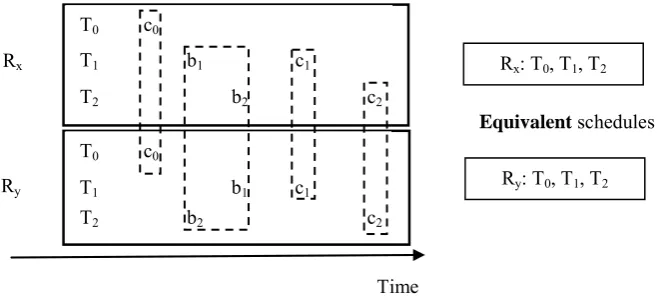
that an execution of transactions over a set of replicas produces a global schedule that is equivalent to a schedule produced by a centralised database system which offers snapshot isolation. The authors provide the following three definitions to formalise 1-copy-SI correctness:
Definition 1 (SI-Schedule). Let T be a set of committed transactions, where each
transaction Ti is defined by its readset RSi and writeset WSi. An SI-schedule S over T
is a sequence of operations o ∈ {b, c}. Let (oi < oj) denote that oi occurs before oj in
S. S has the following properties. i. For each Ti∈ T: (bi < ci) ∈ S.
ii. If (bi < cj < ci) ∈ S, then WSi∩ WSj = {}.
The read and write operations are excluded from Definition 1 because the transaction boundary operations, begin (b) and commit (c), implicitly determine the logical time of their executions: a begin of transaction Ti indicates when its reads have taken place
and similarly the commit of Ti indicates when the write operations take effect. This
reasoning is based on the characteristics of SI (Section 2.2.2 and 2.2.3)
Definition 2 (SI-Equivalence). Let S1 and S2 be two SI-schedules over the same set of
transactions T. S1 and S2 are SI-equivalent if for any two transactions Ti, Tj T the
following holds:
∈
i. if WSi∩ WSj≠ {} : (ci < cj) ∈ S1 ⇔(ci < cj) ∈ S2.
ii. if WSi∩ RSj≠ {} : (ci < bj) ∈ S1 ⇔(ci < bj) ∈ S2.
Definition 2 is based on the equivalence definitions as specified for the non-replicated database systems using serializability theory. Condition i. ensures that the order of committed transactions with overlapping writesets is the same in both schedules. Thus, the final writes (a write performed by a committed transaction after which no other committed transaction modified the same data item) are the same in the two schedules and each prefix of the partial order of committed transactions in both schedules is an SI schedule. Condition ii. ensures that if in one schedule a transaction, Tj, reads data modified by a committed transaction, Ti,the same will be true for the
other schedule – the begin of Tj will follow the commit of Ti. The condition, on the
other hand, does not specify which transaction exactly Ti reads from in either of the
In order to define 1-copy-SI criterion the authors of (Lin, Kemme et al. 2005) assume the following:
- Each replica produces SI schedules.
- Replication is based on ROWA approach: each transaction is executed on a local replica and only its writes are propagated to the remaining ones. To formalise the ROWA approach the authors use a mapper function rmap. The input to the function is a set of transactions T and a set of replicas R. Each update transaction is transformed into a set of transactions {Tik|Rk ∈ R}, one for each replica. Only one of these transformed transactions contains both, the read and the write set of the original transaction - this is the local transaction. The rest of the transactions are remote and consist of only the writeset of the transaction. Every read transaction, on the other hand, has a single transformation into a local transaction.
Definition 3 (1-Copy-SI). Let R be a set of replicas following ROWA approach. Let
T be a set of submitted transactions for which Ti ∈ T committed at its local site. Let
Sk be the SI-schedule over the set of committed transactions Tk at replica Rk ∈ R.
Then R ensures 1-copy-SI if the following is true:
i. There is ROWA mapper function, rmap, such that UkTk = rmap (T, R)
ii. There is an SI-schedule S over T such that for each Sk and Tik, Tjk ∈ Tk being
transformations of Ti, Tj ∈T:
a. if WSik∩ WSjk≠ {} : (cik < cjk) ∈ Sk ⇔(ci < cj) ∈ S,
b. if WSik∩ RSjk≠ {} : (cki < bjk) ∈ Sk ⇔(ci < bj) ∈ S.
From the condition i., we infer an existence of an rmap function that maps committed transactions as a subset of the set of submitted ones. Condition ii. ensures equivalence between a schedule produced by a replica, Sk, and the global schedule, S, over the set of all transactions T. Due to the use of ROWA approach, the definition of equivalence as stated in Definition 2 has to be modified. The condition i. from the Definition 2
holds between every Sk and S for all committed transactions, because the writes are executed on all replicas. However, the reads-from relation of a schedule Skis the same as in S (condition ii. from Definition 2) for only the subset of the readsets obtained at the replica Rk. There are two consequences of the 1-copy-SI definition:
- The position of the commits of the read-only transactions is arbitrary since they do not include any write operations.
Similarly to 1-copy-SI, Elnikety et al. (Elnikety, Zwaenepoel et al. 2005) defined Generalised Snapshot Isolation (GSI) - a correctness criterion for replicated databases that offer snapshot isolation. GSI is an extension to the snapshot isolation as found in centralized databases. The authors formalize the “centralized” snapshot isolation and refer to it as Conventional Snapshot Isolation (CSI). To model the timing relationships between transactions the following definitions of the operations in a transaction, Ti,are given:
- snapshot(Ti) – the time when Ti’s snapshot is taken.
- start(Ti) – the time of the first operation of Ti.
- commit(Ti) – the time of commit of Ti.
- abort(Ti) – the time of abort of Ti.
In addition, they showed that serializability can be guaranteed under GSI by ensuring that either a static property, which can be checked by examining the transactional profile, or a dynamic one, which checks the intersection between the readsets and writesets of overlapping transactions, is satisfied.
The definitions of GSI and CSI, and the corresponding definitions of impacting
transactions, are as follows:
Generalised Snapshot Isolation (GSI) Definition: G1. (GSI Read Rule)
∀Ti, Xj such that Ri(Xj) ∈ h :
1. Wj(Xj) ∈ h and Cj∈ h;
2. commit(Tj) < snapshot(Ti);
3. ∀Tk such that Wk(Xk), Ck ∈ h :
commit(Tk) < commit(Tj) or snapshot(Ti) < commit(Tk); G2. (GSI Commit Rule)
∀Ti, Tj such that Ci, Cj ∈ h : 1. ¬(Tj impacts Ti)
Definition of Impacting Transactions for GSI:
- Ti impacts Tjiff:
snapshot(Ti) < commit(Tj) < commit(Ti) and writeset(Ti) ∩ writeset(Tj)≠{}
∀Ti, Xj such that Ri(Xj) ∈ h :
1. Wj(Xj) ∈ h and Cj ∈ h;
2. commit(Tj) < snapshot(Ti);
3. ∀Tk such that Wk(Xk), Ck∈ h :
commit(Tk) < commit(Tj) or start(Ti) < commit(Tk); C2. (CSI Commit Rule)
∀Ti, Tj such that Ci, Cj∈ h :
1. ¬(Tj impacts Ti)
Definition of Impacting Transactions for CSI:
- Ti impacts Tjiff:
start(Ti) < commit(Tj) < commit(Ti) and writeset(Ti) ∩ writeset(Tj)≠{}
CSI states that the last snapshot, committed on any of the database replicas, in respect to the transaction start time, is available. CSI is a special case of GSI as the latter does not specify which database snapshot should a transaction observe, i.e. snapshot(Ti) =
start(Ti) in CSI. We aid the description of the difference between GSI and CSI with the following example. Let history h = Wi(Xi), Ci, Wj(Xj), Cj, Rk(Xi), Wk(Yk), Ck. The
history is not permitted by CSI because Tk reads an “old” snapshot, snapshot(Ti), instead of the last one, snapshot(Tj). However h is a GSI history since snapshot(Tk) =
commit(Ti) is allowed.
2.3.3.
Conflicts and Deadlocks
As detailed in (Gray, Helland et al. 1996), a severe drawback of eager, update-everywhere replication is the high conflict rate and probability of deadlocks. The work showed that, in some situations, the probability of deadlocks is directly proportional to n3, where n is the number of replicas. The observation is not surprising: as the number of replicas increases, the time to lock the resources will increase too and transaction execution times will deteriorate. Furthermore, the longer transaction times are caused by the additional communication overhead when the number of replicas increases. Certain database replication solutions are prone to a
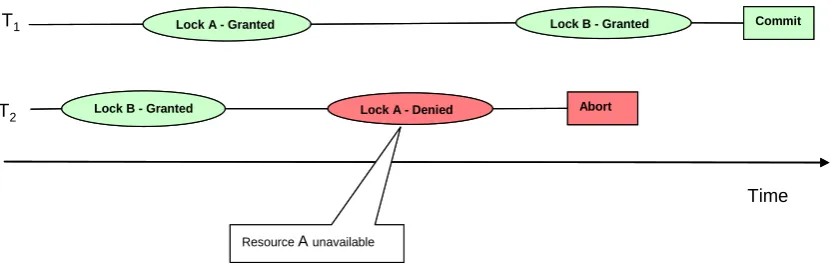
distributed deadlock, a more complicated form of deadlock. This happens if a resource lock is acquired in different order on different replicas. Figure 2-1 shows two concurrent transactions T1 and T2, which are competing for resource A while
lock requests by T1 and T2 is different on the two replicas, i.e. T2 is blocked waiting
for T1 on Rx and vice versa is true on Ry. As a result, in replication schemes where a
transaction commits only after all the replicas are ready to do so, the transactions would be deadlocked without possibility to progress further.
T1
T2
Lock A - Granted
Lock A - Wait
Time T1
T2
Lock A - Wait
Lock A - Granted
Rx
Ry
T1
T2
Lock A - Granted
Lock A - Wait
Time T1
T2
Lock A - Wait
Lock A - Granted
Rx
Ry
Figure 2-1 An example of distributed deadlock.
It has been suggested that group communication systems (Hadzilacos and Toueg 1993) be used as a means of reducing conflicts and avoiding deadlocks as well as ensuring consistent data on multiple replicas. These systems are capable of ensuring that a message multicast in a group will be delivered in the same total order on all group members. This holds for the sender of the message too. Many replication protocols, e.g. (Agrawal, Alonso et al. 1997), (Kemme and Alonso 2000a), combine group communication primitives with deferred updates technique, in which, usually, the write operations of a transaction are executed on one replica, grouped in one message (writeset) and delivered to all the replicas in the same total order.
2.3.4.
Transaction Atomicity
- A coordinator sends a request to each replica for a vote (to commit or abort). - Upon receiving the request each replica replies with a message, YES (commit) or
NO (abort). If the vote is NO the replica aborts the execution.
- Upon collecting all the votes the coordinator decides on the outcome of the transaction:
o If all replicas have voted YES, the coordinator notifies the replicas to
commit.
o If a replica voted NO, the coordinator notifies the replicas to abort.
- Upon receiving the notification (commit or abort) from the coordinator, a replica decides accordingly.
2PC is a blocking implementation of a more general atomic commitment solution. Atomic commitment protocols suffer long transaction times because the synchronisation point is dependant on the performance of all the replicas. It is the slowest server that determines the response time of a transaction.
In non-voting techniques each server must independently decide on the same serialisation order among transactions. For example, when using group communication primitives, total order detects possible conflicts between transactions and warrants the same serialisation order on all replicas. Since an abort may happen due to different reasons in a database, e.g. due to an interaction with a local operation or a violation of a consistency constraint, additional measures have to be taken to guarantee atomic termination of a transaction. To that end a certification step (Pedone, Guerraoui et al. 2003) has to be performed or a commit order has to be decided by sending an additional message to all replicas, like in SER-D protocol (Kemme 2000). Using non-voting techniques each replica is allowed to terminate a transaction without waiting for all other replicas to finish. This is a performance improvement towards shorter response times.
2.4.
TPC-C – an On-Line Transaction Processing Benchmark
therefore not suitable as test workloads. Consequently, we chose TPC-C, a synthetic
benchmark, as the basis for our performance evaluation. Its representativeness of an order-entry system and wide adoption in industry and academia warrants the choice. TPC-C defines five types of transactions: New-Order (NO), Payment (P), Order-Status (OS), Delivery (D) and Stock-Level (SL) and sets the probability of execution of each. NO, P and D are update transactions with a different number of read and write operations while SL and OS are read-only transactions consisting of only read operations. In our implementation of TPC-C, OS transaction consists of three and SL of two SELECT operations. NO and P transactions are the most frequently executed ones. The minimum probability of execution for each transaction type is as follows: P – 43%, OS – 4%, D – 4% and SL – 4%. TPC-C does not specify the minimum frequency for NO transactions because the throughput measure of interest is the number of NO transactions per minute (under the specified mix of transaction types). The benchmark provides for performance comparison of the database servers from different vendors, with different hardware configurations and operating systems. The workload of TPC-C is highly write-intensive and in particular the application is limited with a random I/O access pattern. This is why it is not unusual that commercial TPC-C results report the use of several CPU cores with multiple RAID controllers and hundreds, or even thousands, of disk drives (Hewlett-Packard 2005). One relation, warehouse, is used as the base unit of scaling, e.g. the standard specifies that the number of clients is 10 times greater than the number of warehouses. To model the time spent by interactive clients on interpreting results, the standard introduces think times, with an additional consequence of reducing conflict rates, e.g. a conflict happens when multiple clients modify the same warehouse record. Greater
think times decrease the contention and load on the system by increasing time breaks between transactions requested by a particular client. The values of the mean think times for each transaction type are as follows: NO – 12 sec, P – 12 sec, OS – 10 sec, D – 5 sec and SL – 5 sec.
hardware is near 100%. The choice for the values used as response time constraints was made by vote at TPC. Several values were proposed and the values that obtained a majority agreement were included in the standard benchmark. These values are somewhat loose, even 10 years ago when they were set, and could easily be changed to something shorter (Raab 2005). These values are inherently dependant on the characteristic of the system under test (SUT), such as hardware and database size as well as the load and the profile of the experiments.
The access pattern of TPC-C benchmark is characterised with a high degree of locality when the warehouse table is accessed. Multiple clients read and modify a single row in the table. While this access hotspot might be beneficial in terms of keeping data in memory, it has a significant disadvantage of generating frequent conflicts and incurs a performance cost as a result of resolving these conflicts. This is exacerbated in workloads with slow-running transactions that cause the conflicts to persist for long periods of time.
3.
Architecture of DivRep Middleware
A pessimist is an optimist with experience
Anonymous
3.1.
DivRep – Replication with Diverse Database Servers
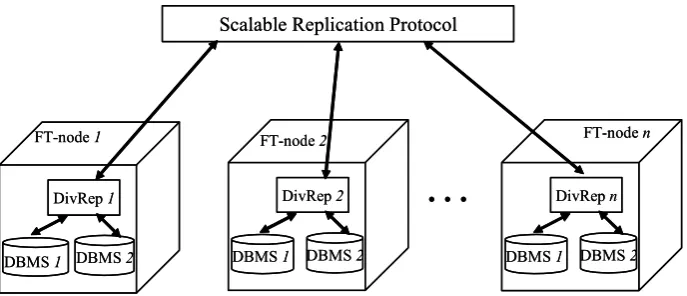
We have developed a middleware-based database replication solution, DivRep, which uses redundant database servers as the underlying components. Although non-diverse database servers can be deployed, we propose that DivRep is used to build a fault-tolerant server (FT-node) employing diverse redundancy. Figure 3-1 depicts the architecture of an FT-node with two diverse replicas. DivRep supports interactive transactions and replication is done at the SQL operation level. Hence, dependence between SQL operations within a transaction is allowed, a feature unavailable in many replication solutions, e.g. in some replication solutions clients are assumed to submit a whole transaction at once and as a consequence SQL operations created by an operator on the fly, possibly using results of previous operations, are impossible to handle. The middleware propagates the operations generated by the client applications to both diverse replicas for execution. The results from the replicas are collected by the middleware, and in the case of a positive adjudication, the middleware reports a result back to the client application(s). In this way the parallel-redundant architecture using two diverse DBMS products provides high error detection rate (Section 2.1) via comparison of results. Clearly, this architecture differs from ROWAA scheme. In the new architecture both diverse replicas execute all operations (including the reads), while in ROWAA scheme all active replicas execute only the writes submitted to any replica and the respective local read operations.
The overall performance of the system that is shown in Figure 3-1 depends on the performance of the diverse replicas deployed and on the performance characteristics of the middleware itself. For instance, the middleware can use different adjudication mechanisms. A few reasonable alternatives are listed below:
- Slowest response regime. The middleware collects the results of the individual SQL
Figure 3-1 Fault-tolerant server node (FT-node) with two diverse DBMSs (DBMS 1 and DBMS 2) as a UML 2.0 deployment diagram. The middleware “hides” the servers from the clients (1 to n) for which
the data storage appears as a single DBMS.
diverse replicas. Once a sufficient number of responses are collected, they are adjudicated and only if identical responses from both replicas are observed a successful completion of the operation is reported back to the client application. Subsequently the client sends the following operation to the middleware for processing.
- Pessimistic response regime. Alternatively, the middleware may buffer the
one, as indicated with the dashed rectangle). The transactions are committed (or aborted) based on the outcome of adjudicating the results of the operations. Commit is only applied if the replicas execute all operations successfully and all responses are positively adjudicated. Otherwise, the transaction is aborted.
1
2
3
4 Client
n SQL operation
SQL operation
SQL operation
DBMS 1
DBMS 2 Middleware
SQL SQL SQL
[image:43.595.78.479.178.353.2]ith
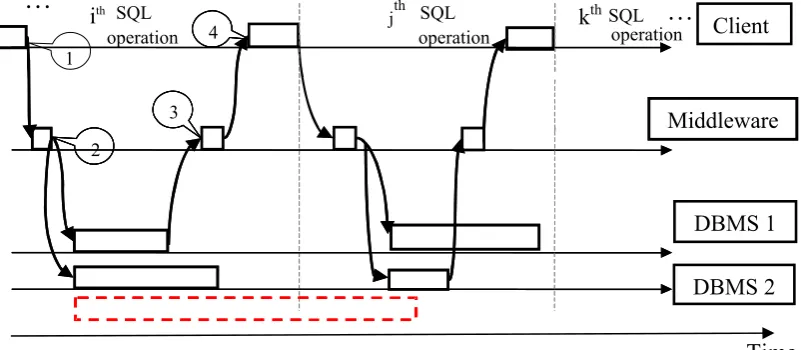
Figure 3-2 Timing diagram of a client communicating with two, possibly diverse, database servers and the middleware running in the pessimistic or the optimistic response regime. The meanings of the callouts are: 1 – the client sends an SQL operation to the middleware; 2 – the middleware translates the
request to the dialects of the servers and places the resulting SQL operations, or sequences of SQL operations, in the respective server buffers; 3 – the fastest response is received by the middleware; 4 -
the middleware sends the response to the client. Processing of only a subset of SQL operations in a transaction is depicted. The dashed rectangle shows an alternative effect of asynchronous execution by the two DBMSs - it indicates that DBMS 2 will not be ready to start jth SQL operation at the same time
with DBMS 1.
- Optimistic response regime. This is similar to the pessimistic response except: o No adjudication of the responses from the diverse replicas is applied.
o A skip feature (Figure 3-3) is implemented in the middleware as follows.
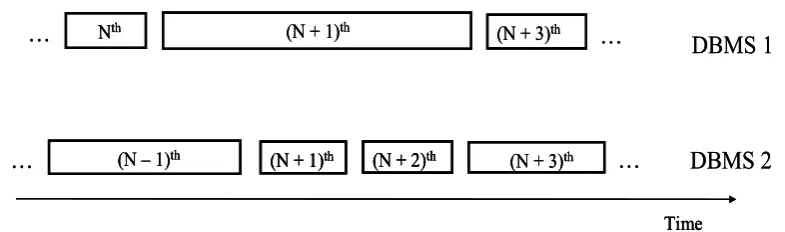
Before a replica, e.g. DBMS 1, executes a read (i.e. SELECT) operation it checks if a response to this operation has already been received from the other replica, DBMS 2. If so then DBMS 1 does not execute the operation (i.e. skips it). The modifying SQL operations (DELETE, INSERT and UPDATE) are executed on all servers, i.e. they cannot be skipped. The functionality of looking up the next operation and the skip feature is, of course, implemented in the middleware, which relays to the DBMSs the operations for execution. If a read operation is to be skipped, then the middleware simply does not pass it to the respective DBMS for execution. Clearly, this regime of operation does not offer the same level of protection as the previous ones. It may, however, be adequate in many cases.
…
…
kth
jth