City, University of London Institutional Repository
Citation
:
Theresa, P. (2010). Coping and help seeking behaviour in women with Pelvic
Floor Dysfunction : the emic perspective. (Unpublished Doctoral thesis, City University
London)
This is the accepted version of the paper.
This version of the publication may differ from the final published
version.
Permanent repository link:
http://openaccess.city.ac.uk/8612/
Link to published version
:
Copyright and reuse:
City Research Online aims to make research
outputs of City, University of London available to a wider audience.
Copyright and Moral Rights remain with the author(s) and/or copyright
holders. URLs from City Research Online may be freely distributed and
linked to.
Porrett, Theresa (2010). Coping and help seeking behaviour in women with Pelvic Floor Dysfunction
– the emic perspective. (Unpublished Doctoral thesis, City University London)
City Research Online
Original citation
: Porrett, Theresa (2010). Coping and help seeking behaviour in women with Pelvic
Floor Dysfunction – the emic perspective. (Unpublished Doctoral thesis, City University London)
Permanent City Research Online URL
: http://openaccess.city.ac.uk/1164/
Copyright & reuse
City University London has developed City Research Online so that its users may access the
research outputs of City University London's staff. Copyright © and Moral Rights for this paper are
retained by the individual author(s) and/ or other copyright holders. All material in City Research
Online is checked for eligibility for copyright before being made available in the live archive. URLs
from City Research Online may be freely distributed and linked to from other web pages.
Versions of research
The version in City Research Online may differ from the final published version. Users are advised to
check the Permanent City Research Online URL above for the status of the paper.
Enquiries
1
‘Coping and help seeking behaviour in women
with Pelvic Floor Dysfunction – the emic
perspective’
Theresa Porrett MSc, RGN
Thesis submitted for the degree of
Doctor of Philosophy (PhD)
CITY UNIVERSITY, London
Department of Applied Biological Sciences
School of Community and Health Sciences
2
TABLE OF CONTENTS
Page
Table of Contents 2-10
Index to Figures 11
Index to Tables 12
Index to Appendices 13
Acknowledgements 14
Declaration 15
Watermark of conceptual model 16
Abstract 17
Chapter 1: Introduction 18-24
1.0 Rational for the area of study 18 1.1 Definition of Pelvic Floor Dysfunction 18 1.1.1 Pelvic Floor Dysfunction as a concept 19 1.2.1 The emic and etic perspective in PFD 20 1.2 Incidence and demographics of PFD 21 1.3 Symptomatology spectrum in PFD 22 1.4 Help seeking behaviour in PFD 23 1.5 Aims and objectives of the study 23
1.6 Summary 24
Chapter 2: Explication and critique of the theoretical frameworks underpinning 25-43 this study
2.0 Introduction 25
2.1 Rationale for the utilisation of Culture Care Theory to 25 underpin this study
2.1.1 The importance of Culture Care Theory in nursing 26 2.2 Culture Care Theory 27 2.3 The evolution of Culture Care Diversity and Universality: 27
3
Page
2.4 Description of the Theory of Culture Care and the Sunrise 28 Enabler
2.5 Analysis and evaluation of the Theory of Culture Care 31 Diversity and Universality
2.5.1 Scope of the Theory 31 2.5.2 Context of the Theory 32 2.5.3 Philosophical Claims 32 2.5.4 Conceptual Model 33 2.5.5 Antecedent Knowledge 33 2.5.6 Content of the Theory 34 2.5.7 Relational Propositions 36 2.6 The application of the Theory of Culture Care 37
Diversity and Universality to nursing practice
2.6.1 Variety of settings in which Culture Care Theory 39 has been utilised in published studies
2.7 Rationale for the utilisation of Shaw’s Framework for the 39 study of Coping
2.7.1 The importance of the Coping Framework 40 2.7.2 The Coping Framework 41 2.7.3 Methodology employed to develop the framework 41 2.7.4 Framework assumptions 42 2.7.5 Analysis and evaluation of the Coping Framework 42
2.8 Summary 42
Chapter 3: Coping and Help Seeking Behaviour – a review of the literature 44-66
3.0 Introduction 44
3.1 Literature Search Strategy 45
3.1.1 Findings 45
3.2 PFD as a Stressor 45 3.2.1 The impact of PFD on Quality of Life 46 3.2.2 The stigma, embarrassment and feelings of 48
disgrace associated with PFD
4
Page
3.3.1.3 Health beliefs and Locus of Control 52 3.3.1.4 Emotional processes 53 3.3.1.5 Group differences and Socio-Economic 53 factors
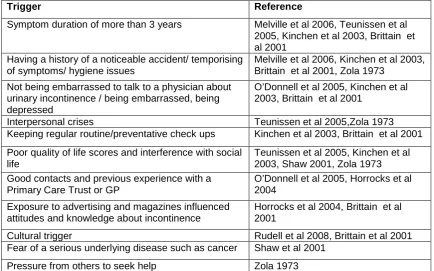
3.3.2 Primary Appraisal – Situation 55 3.3.2.1 Perceived severity of illness 55 3.3.2.2 Raised Awareness 57 3.3.3 Secondary Appraisal – Condition 57 3.3.3.1 Emotions 58 3.3.3.2 Social Support 58 3.3.4 Coping behaviour 58 3.3.5 Secondary Appraisal – Cue 59 3.3.5.1 Barriers to help seeking 59 3.3.5.1.1 Evidence with respect to 63
women who do not seek help 3.3.5.2 Factors which promote help seeking 63
3.4 Summary 65
Chapter 4: Methodology 67 - 82
4.0 Introduction 67
4.1 Research question 67
4.1.1 Study aims 67
4.1.2 Study assumptions 67 4.1.3 Inclusion criteria 68 4.1.4 Exclusion criteria 68
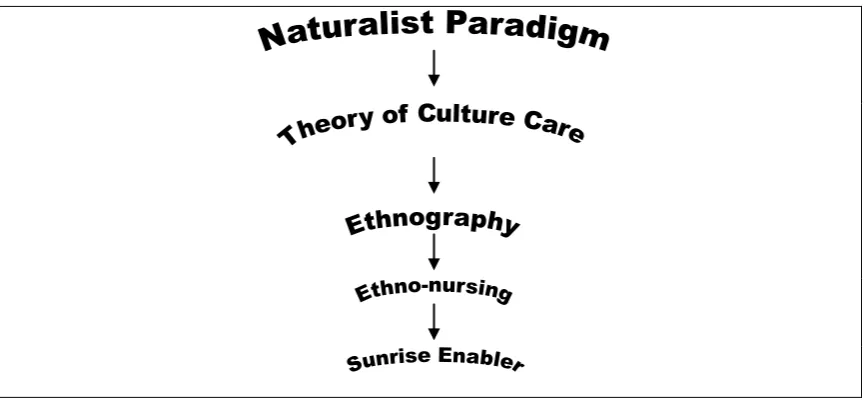
4.2 Rationale for the use of Leininger’s Culture Care Diversity 68 and Universality: a theory of nursing and ethnographic
methods to underpin the study
4.3 Rational for the use of Shaw’s Framework of coping 70 4.4 Dual role of nurse and researcher 71 4.5 Research Study Phases 72 4.5.1 Phase One – One Life Health Care History 72 4.5.1.1 Sampling methods for Phase 1 73 4.5.1.2 Data Analysis methods used throughout 74 the study
5
Page
4.8.1 Thematic development of questions and question 76 format
4.8.2 Sampling methods for Phase Two 78 4.8.3 Data Analysis 78
4.9 Phase Three Focus Groups – the emic perspective of 78 women with PFD from diverse cultures
4.9.1 Sampling methods for Phase Three 79 4.9.2 Thematic development of Focus Group questions 79
and question format
4.9.3 Data Analysis 79 4.10 Qualitative Criteria for trustworthiness used throughout the 79
Study
4.10.1 Credibility 80 4.10.2 Confirmability 80 4.10.3 Dependability 81 4.10.4 Transferability 81 4.11 Ethical considerations 81 4.11.1 Data Protection 82
4.12 Summary 82
Chapter 5: Results Phase One 83-101 5.0 Life Health Care History 83
5.1 Background history of the Life Health Care Informant 83 5.2 Ethnography – ‘Juggling with aspects of my life to cope 83
with PFD’
6
Page
5.3.5 Personality Factors 91 5.3.5.1 Personality traits 91 5.3.5.2 Emotions 91 5.3.5.3 Permission 91 5.3.5.4 Coping Mechanisms 92 5.3.6 Educational Factors 92 5.3.6.1 Knowledge 92 5.3.6.2 Communication and language 93 5.3.6.3 Perception of the problem 93 5.3.7 Technological Factors 93 5.3.7.1 Health Beliefs 93 5.3.7.2 Knowledge of services 94 5.3.8 Socio-Economic Factors 94 5.3.9 Care Influencers 94 5.3.9.1 Trigger to help seeking 94 5.3.9.2 Barrier to help seeking 94 5.3.9.3 Facilitator of help seeking 95 5.3.10 Summary of thematic analysis 95 5.4 Expositional Analysis 96 5.4.1 Sunrise Enabler 96 5.4.2 Shaw’s Framework of Coping 99
5.5 Conclusion 101
Chapter 6: Results of Phase Two 102-128
6.0 Introduction 102
7
Page
6.3.5 Personality Factors 113 6.3.5.1 Personality traits 113 6.3.5.2 Emotions 114 6.3.5.3 Permission 114 6.3.5.4 Coping strategies 115 6.3.6 Educational Factors 115 6.3.6.1 Knowledge 116 6.3.6.2 Communication and Language 117 6.3.6.3 Perception of the problem 118 6.3.7 Technological Factors 118 6.3.7.1 Health Beliefs 118 6.3.7.2 Knowledge of services 119 6.3.8 Socio-Economic Factors 120 6.3.9 Care Influences 120 6.3.9.1 Trigger to help seeking 121 6.3.9.2 Barriers to help seeking 121 6.3.9.3 Facilitator of help seeking 122 6.3.10 Ideal world comments 124 6.3.10.1 Aids to help seeking 124 6.3.10.2 Service improvement 124 6.3.11 Summary of thematic analysis 125
Chapter 7: Results of Phase Three 129-174
7.0 Introduction 129
7.1 Turkish Focus Group 130
7.1.1 Ethnohistory 130
8
Page
7.1.7.3 Permission 136
7.1.7.4 Coping strategies 137 7.1.8 Educational Factors 137 7.1.8.1 Knowledge 137 7.1.8.2 Communication and language 138 7.1.8.3 Perception of the problem 139 7.1.9 Technological Factors 139 7.1.9.1 Health beliefs 139 7.1.9.2 Knowledge of services 140 7.1.10 Socio-Economic Factors 140 7.1.11 Ideal world comments 141 7.1.11.1 Aids to help seeking 141 7.1.11.2 Service improvement 141 7.1.11.3 Summary Of Turkish Focus Group Thematic analysis 142
7.2 African Focus Group 144
7.2.1 Ethnohistory 144
9
Page
7.2.11 Ideal world comments 154 7.2.11.1 Aids to help seeking 154 7.2.11.2 Service improvement 154 7.2.11.3 Summary of African Focus Group Thematic Analysis 155
7.3 Orthodox Jewish Focus Group 158
7.3.1 Ethnohistory 158
7.3.2 Demographics 158 7.3.3 Kinship and Social Factors 159 7.3.3.1 Kinship – Knowledge 159 7.3.3.2 Kinship – Social Support 159 7.3.3.3 Social – Societal Pressure 161 7.3.4 Political and Legal Factors 161 7.3.5 Cultural Values, Beliefs and Lifeways 161 7.3.5.1 Women in Society 161 7.3.5.2 Role and status of women 162 7.3.6 Religious and Philosophical Factors 163 7.3.6.1 Religious beliefs and health 163 7.3.7 Personality Factors 164 7.3.8 Educational Factors 165 7.3.8.1 Knowledge 165 7.3.8.2 Communication and language 166 7.3.8.3 Perception of the problem 166 7.3.9 Technological Factors 167 7.3.9.1 Health beliefs 167 7.3.9.2 Knowledge of services 167 7.3.10 Socio-Economic Factors 168 7.3.11 Ideal world comments 168 7.3.11.1 Aids to help seeking 168 7.3.11.2 Service improvement 169 7.3.11.3 Summary of Orthodox Jewish Focus Group 170
Thematic Analysis
7.4 Summary 172
10
Page
8.1 Defining Opprobrium 175 8.1.1 The impact of opprobrium on help seeking behaviour 175 8.1.2 Conceptual Framework – Opprobrium Appropriation 179 8.2 Critique of findings 181
8.2.1 Knowledge 181
8.2.2 Embarrassment and shameful conditions 181 8.2.3 Coping Mechanisms 182 8.2.4 Coping an help seeking pathway 183 8.2.5 Personality 184 8.2.6 Care Influencers 184 8.2.7 Race and help seeking 185 8.3 Pelvic Floor Dysfunction 186 8.4 Limitations of the study 187
8.5 Summary 188
Chapter 9: Conclusion 190-197 9.1 Recommendations for practice and service development 190 9.2 Areas for future research 193 9.3 Publication strategy 195
9.4 Summary 197
References 198-232
Appendices 233-252
11
INDEX TO FIGURES
Page
Figure 2.1 The Sunrise Enabler (Leininger) 30
Figure 2.2 Framework for the study of coping, illness behaviour and 41
outcomes (Shaw)
Figure 4.1 Study paradigm and theoretical perspective 70
Figure 5.1 Adaptationof Sunrise Enabler 98
Figure 5.2 Adaptation of Shaw’s Framework of Coping 100
Figure 6.1 Thematic categorisation of the Sunrise Enabler 105
Figure 6.2 Sunrise Enabler depicting the influences impacting on help 106
seeking behaviour
Figure 7.1 Turkish Focus Group Thematic Analysis applied to Leininger’s 143
Sunrise Enabler
Figure 7.2 AfricanFocus Group Thematic Analysis applied to Leininger’s 157
Sunrise Enabler
Figure 7.3 Orthodox JewishFocus Group Thematic Analysis applied to 171
Leininger’s Sunrise Enabler
Figure 8.1 Conceptual Framework – Opprobrium appropriation and its 180
12
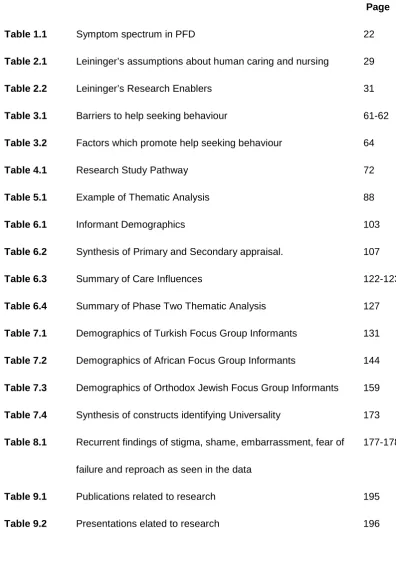
INDEX TO TABLES
[image:14.595.109.506.83.662.2]Page
Table 1.1 Symptom spectrum in PFD 22
Table 2.1 Leininger’s assumptions about human caring and nursing 29
Table 2.2 Leininger’s Research Enablers 31
Table 3.1 Barriers to help seeking behaviour 61-62
Table 3.2 Factors which promote help seeking behaviour 64
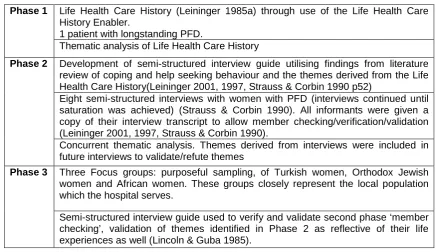
Table 4.1 Research Study Pathway 72
Table 5.1 Example of Thematic Analysis 88
Table 6.1 InformantDemographics 103
Table 6.2 Synthesis of Primary and Secondary appraisal. 107
Table 6.3 Summaryof Care Influences 122-123
Table 6.4 Summary of Phase Two Thematic Analysis 127
Table 7.1 Demographics of Turkish Focus Group Informants 131
Table 7.2 Demographics of African Focus Group Informants 144
Table 7.3 Demographics of Orthodox Jewish Focus Group Informants 159
Table 7.4 Synthesis of constructs identifying Universality 173
Table 8.1 Recurrent findings of stigma, shame, embarrassment, fear of 177-178
failure and reproach as seen in the data
Table 9.1 Publications related to research 195
13
INDEX TO APPENDICES
Page
Appendix 1 Life Health Care History interview guides 233
Appendix 2 Phase Two semi structured interview guide 240
Appendix 3 Phase Three semi structured interview guide 244
14
ACKNOWLEDGEMENTS
I should like to thank the following, without whose help and support this work would not have been possible:
Professor Carol Cox for her supervision of this project, most particularly her patience, enthusiasm and unending support;
Teresa Allen for her advice and support as my second supervisor;
Wendy Atkinson for her speedy and accurate transcription skills;
Kirsi Roine for her assistance with the preliminary literature review;
The Academic Department of Colorectal Nursing at Homerton University Hospital NHS Foundation Trust for their support, understanding and humour. They kept me firmly based in reality throughout the study.
15
DECLARATION
The study undertaken in this thesis has been all my own work. All informants in the study were interviewed by me and all thematic analysis undertaken by me alone. Data analysis was reviewed and confirmed by my supervisors.
16
17
ABSTRACT
Pelvic Floor Dysfunction (PFD) encompasses symptoms that rarely occur in isolation and include urinary and faecal incontinence, rectal evacuatory dysfunction and pelvic organ prolapse. It impacts on the quality of life of at least one third of adult women, with recent reviews suggesting that pelvic floor prolapse may occur in up to 50% of parous women. PFD is associated with a delay in seeking help. Why women with PFD seek or do not seek help for their symptoms has been unclear but is recognised as being multi-factorial.
Aim To learn from women with PFD, to understand the coping mechanisms they develop to live with PFD, and the triggers which prompt their seeking help.
Methodology This study, grounded in the naturalist paradigm, was a micro-ethnographic study focusing on the emic perspective of a defined group, women diagnosed with PFD, who presented to an East London Hospital for treatment. Leininger’s Culture Care theory and ethno-nursing methods were used to facilitate knowledge generation. The study took place in three consecutive phases, each informing the next phase. Phase 1 - One Life Health Care History. This was an instrumental case study which obtained a personalised and longitudinal account of the woman’s health, care and illness experiences from a lifetime perspective. Phase 2 - Eight semi structured interviews; these focussed on the themes generated from a review of the literature pertaining to coping and help seeking behaviour, and themes generated from Phase 1, which were continued until saturation was achieved. Phase 3 - Focus groups from three cultures (Turkish, Orthodox Jewish and African) which represent the ethnic mix of the local population. These explored universality and diversity amongst different cultural groups with respect to coping and help seeking behaviour.
Results This study has identified universality and diversity in coping and help seeking behaviour in women with PFD. Personality and culture have a significant impact on coping and help seeking behaviour, and lack of knowledge is a barrier to help seeking. Social taboo and the role of women in society influenced the coping behaviours of women. Women developed masking and containment strategies, and avoided aspects of social interaction to ensure their PFD problems remained secret. The fear of disgrace (opprobrium) and the delay in seeking help is linked to the woman’s position in her society, and the degree to which women appropriate opprobrium is dependent on their personality and their cultural feelings of self-worth as women in their own communities.
Recommendations If women are to be encouraged and supported to seek help for their PFD, it will be imperative to raise public knowledge and awareness of PFD. Public Health Departments, in conjunction with GP practises, will be key in promoting awareness and advertising integrated PFD services, ensuring posters and information leaflets are translated and displayed in facilities frequently used by women. Facilitating ease of access to PFD services will require the development of integrated PFD services, with community based self referral clinics or drop-in clinics being made available. Health care providers need education and support to ensure they empower women to seek help by giving them permission to discuss any PFD concerns they may have.
18
CHAPTER 1: INTRODUCTION
‘Coping and help seeking behaviour in women with Pelvic Floor Dysfunction – the emic perspective’
1.0 Rationale for the area of study
Principally affecting females, Pelvic Floor Dysfunction (PFD) describes functional clinical problems which seldom occur in isolation (Davis & Kumar 2003, Barber et al 2001). These problems include urinary and faecal incontinence, ‘obstructed defaecation’ and pelvic organ prolapse. PFD (with its range of clinical symptoms) is associated with stigma, embarrassment and a delay in seeking medical help (Davis & Kumar 2003, Norton et al 1998, Royal College of Physicians 1995). Traditionally, women with PFD symptoms have been treated for their presenting symptom in isolation, and until recently, integrated PFD services have not been available in the UK. Consequently PFD as a concept is poorly understood and there is little evidence with regard to help seeking behaviour in respect of women with PFD. There are data available with respect to coping and help seeking behaviour in individual symptoms (e.g. urinary incontinence, faecal incontinence, pelvic organ prolapse) but the coping and help seeking behaviours of women with PFD (usually experiencing symptoms from at least one of the three pelvic compartments) is not described. The justification for this field of enquiry was determined by the lack of data. Equally the literature suggests that women with PFD do not seek help immediately following symptom onset, unless they consider them very severe (Davis & Kumar 2003, Shaw 2001). Rather, women appear to cope with one symptom for many years and not seek help until the symptom worsens or an additional symptom develops.
The rationale for this study is to understand the coping mechanisms and help seeking behaviour of this group of women. The research question is ‘What are the reasons for women with Pelvic Floor Dysfunction not seeking help earlier in the course of their symptomatology?’
1.1 Definition of Pelvic Floor Dysfunction
19
2000, Nager et al 1997). Many women experience symptoms from more than one compartment simultaneously, or symptoms can develop sequentially over time; indeed, weakness or injury to any of the pelvic floor structures (nerves, muscles ,supporting tissues) can predispose a woman to multiple compartment problems (Slieker-ten et al 2009, Varma et al 2008, Pescatori 2006, Davis & Kumar 2003, Barber et al 2001, Smith & Witherow 2000).
1.1.1 Pelvic Floor Dysfunction as a concept
20
itself primarily originates in the supporting connective tissue structure of the pelvic floor structures (Petros & Swash 2008). A recent study by Slieker-ten et al (2009) investigated the prevalence of pelvic organ prolapse symptoms and signs and their relation with bladder and bowel disorders in a general female population. The aim of the study was to obtain normative data on the prevalence of pelvic organ prolapse and pelvic floor dysfunction symptoms and signs and to identify associations. Validated pelvic floor dysfunction symptom questionnaires were sent to a cross section of Dutch women aged 45 to 85 years. A response rate of 62% was achieved and results identified that anatomical locations of pelvic organ prolapse and pelvic floor dysfunction symptoms correlated significantly with incontinence of flatus, the feeling of anal prolapse, need for manual evacuation of stool, vaginal bulging, and constipation. The author’s report the prevalence of bladder and bowel symptoms to be high, and that pelvic organ prolapse was found to be strongly associated with obstructive bowel symptoms. It is suggested that comprehensive assessment of women presenting with a (one) pelvic floor dysfunction symptom should be undertaken and strategies should be developed to alleviate obstructive bowel disorders associated with pelvic organ prolapse. This represents a further example perhaps, of the way in which, in Europe, PFD integrated services are considered to be the optimal way in which to provide treatment and management to women with PFD. Importantly, implicit in current knowledge of PFD is the realisation that symptomatology is non-specific in relation to underlying cause, and that symptoms may originate without necessarily any identifiable structural weakness. Central influences, perhaps best exemplified by the potential impact of sexual abuse on pelvic floor function (Leroi et al 1995), are increasingly acknowledged to be of major significance in some individuals, especially those in whom there is evidence of dyssynergic defaecation (lack of co-ordination of straining with skeletal muscle relaxation during attempted defaecation) (Beck et al 2009, Rao et al 2004).
The discussion above resides in classical medical methodological philosophy (history, examination, investigation and treatment) and reflects the etic perspective of Pelvic Floor Dysfunction. The fact that many women will initially report one PFD symptom only, and will not use or are unaware of the term PFD, reflects the difference between the etic (as described above) and the emic perspective of PFD and hence strengthens the justification and rationale for this study.
1.1.2 The emic and etic perspective in PFD
21
and beliefs of the medical/nursing profession with respect to coping and help seeking behaviour in women with PFD. PFD is a term which embraces a multitude of symptoms or symptom complexes relating to an individual’s perception and personal satisfaction with bodily functions which relate to the pelvic floor. It is essentially an etic term which is not used by women with PFD symptoms. Women present complaining of a symptom. If multiple symptoms are discovered on history and examination, an explanation of how these symptoms link can be made . The traditional focus on individual symptoms is entirely reasonable but the raising of public awareness with respect to PFD is considered necessary if women are to have more knowledge about their bodies and available treatments (should they wish to seek help). The fact that currently women are unfamiliar with the tem PFD emphasises the gulf between the emic and etic perspective in PFD. Until services are better advertised and knowledge is raised amongst women of the potential variety of pelvic floor symptoms they might experience, this will continue to be an issue which might impact on a woman’s help seeking behaviour.
1.2 Incidence and demographics of PFD
22
questionnaire assessing general health and continence status. The 61% response rate found more than half of the responders reporting urinary incontinence. The majority of studies identified in this review report the incidence of a presenting symptom, for example stress urinary incontinence, rather than a lifetime longitudinal incidence of pelvic floor symptoms; interestingly there are little data that examine co-existing pelvic floor symptoms (Wang et al 2006, Smith & Witherow 2000, Jackson et al 1997). Presumably this relates to the historical medical perspective of treating symptoms in isolation that is specialty based (Urology, Gynaecology, Coloproctology).
1.3 Symptomatology spectrum in PFD
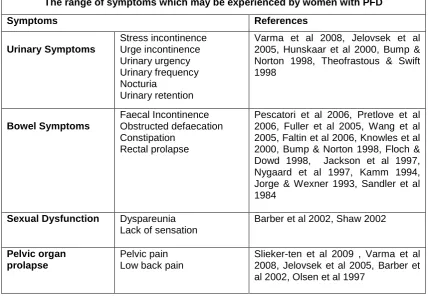
Many women with PFD may experience symptoms from all three compartments simultaneously (Varma et al 2008, Pescatori et al 2006, Jelovsek et al 2005, Barber et al 2001, Smith & Witherow 2000, Table 1.1), or they can develop sequentially over time. The literature suggests that only the most severe symptoms are likely to be presented to the doctor (Slieker-ten et al 2009, Davis & Kumar 2003, Jackson et al 1997). This is a finding informally observed in my own practice, with women being referred with faecal incontinence symptoms who, on taking a history, are found to also have longstanding urinary incontinence for which they have not sought medical help (Pretlove et al 2006, Shaw 2001, Roe et al 1999, Norton et al 1998, Ashworth & Hagan 1993).
The range of symptoms which may be experienced by women with PFD
Symptoms References
Urinary Symptoms Stress incontinence Urge incontinence Urinary urgency Urinary frequency Nocturia Urinary retention
Varma et al 2008, Jelovsek et al 2005, Hunskaar et al 2000, Bump & Norton 1998, Theofrastous & Swift 1998 Bowel Symptoms Faecal Incontinence Obstructed defaecation Constipation Rectal prolapse
Pescatori et al 2006, Pretlove et al 2006, Fuller et al 2005, Wang et al 2005, Faltin et al 2006, Knowles et al 2000, Bump & Norton 1998, Floch & Dowd 1998, Jackson et al 1997, Nygaard et al 1997, Kamm 1994, Jorge & Wexner 1993, Sandler et al 1984
Sexual Dysfunction Dyspareunia Lack of sensation
Barber et al 2002, Shaw 2002
Pelvic organ prolapse
Pelvic pain Low back pain
[image:24.595.112.541.423.722.2]Slieker-ten et al 2009 , Varma et al 2008, Jelovsek et al 2005, Barber et al 2002, Olsen et al 1997
23
1.4 Help seeking behaviour in PFD
Little is understood of the factors that precipitate women with PFD to seek help for their symptoms (Davis & Kumar 2003, Harris 1999, Norton et al 1998, Ashworth & Hagan 1993, Grimby et al 1993). The socio-economic, cultural and religious factors which impact on women’s attitudes towards seeking help for their symptoms are also poorly understood. A number of studies have demonstrated the negative impact of PFD symptoms on quality of life (Davis & Kumar 2003, Luber et al 2001, Norton et al 1998) and yet background evidence and clinical experience suggest that women with PFD do not seek help immediately following symptom onset, unless they consider them very severe (Davis & Kumar 2003, Shaw 2001). Rather, women appear to cope with one symptom for many years and not seek help until the symptom worsens or an additional symptom develops. Chapter 3 presents a review of the literature pertaining to coping and help seeking behaviour in women with individual PFD symptoms and the general constructs with regard to coping and help seeking in chronic illness. The absence of data regarding coping and help seeing behaviour in relation to women with PFD reinforces the rationale for this study.
1.5 Aims and objectives of the study
This study aimed to learn from women with PFD, to understand the coping mechanisms they develop to live with PFD and the triggers that prompt help seeking, whilst gaining knowledge of cultural diversity and universality in women with PFD from different cultural backgrounds. The primary aims were:
• To understand the underlying reasons why women with PFD don’t seek help earlier in their symptomatology.
• To understand the coping mechanisms that women with PFD employ to compensate for or mask their symptoms.
• To understand the ‘triggers’ for women seeking help.
• To delineate cultural universality and diversity in women with PFD from different cultural backgrounds.
• To develop a conceptual model that can facilitate understanding of coping and help seeking in women with PFD.
• To make recommendations for how services can be targeted and developed to more adequately meet the needs of women with PFD.
24
potential that future service developments will not adequately address the needs of this group of women. As stated previously, the literature indicates that demand on PFD services will increase over the next 30 years, at approximately twice the rate of growth of the same population (Luber et al 2001). With greater insight, recommendations for service development, provision and availability of services and health education programmes can be made to specifically meet the needs of women with PFD. Therefore the research that is delineated in this thesis is essential to overcome this expanding problem.
1.6 Summary
The study aims to understand the coping and help seeking behavior of women with PFD. Knowledge concerning pelvic floor related symptoms is lacking. Specifically, very little is known in relation to women with symptoms seeking help.
This research is grounded in the naturalist paradigm and is a micro-ethnographic study focusing on the emic perspective of a defined group: women with PFD who present to a London Hospital for treatment. PFD as a concept is now well documented in the literature, but traditionally services have been fragmented and emphasis placed on the presenting symptom only. Integrated PFD services are well established in the USA, Australia and many parts of Europe but are relatively novel in the UK. As integrated and holistic services are developed in the UK to treat women with PFD, an understanding of their coping and help seeking behavior is necessary if services are to truly reflect the needs of women.
25
CHAPTER 2: EXPLICATION AND CRITIQUE OF THE THEORECTICAL FRAMEWORKS UNDERPINNING THIS STUDY
2.0 Introduction
Leininger’s Culture Care Diversity and Universality: a theory of nursing (2002, 2001, 1997, 1990, 1988, 1985, 1985a, 1978, 1970) is the theoretical perspective that was chosen to underpin this study. This explanation of the literature pertaining to Leininger's Culture Care Diversity and Universality, whilst critiquing the theory itself, aims to establish the appropriateness of the theory to underpin this research study and the rationale for its use. A key text informing the critique of Culture Care Theory is Fawcett’s model for analysis and evaluation of conceptual models of nursing (Fawcett 1993, 1989, 1980). Fawcett is a nurse theorist whose specialist academic area is the development of frameworks for analysis and evaluation of nursing theories and models.
Since the late 1990s, Shaw has been investigating the help seeking behaviour of people with urinary incontinence. In preparation for the studies Shaw undertook; a review of the literature within health psychology was undertaken to identify models of coping and health behaviour. From this review Shaw developed a theoretical framework to enable researchers to utilise psychosocial variables when investigating help seeking health behaviours (Shaw 1999). Shaw’s Framework is reviewed and evaluated in respect of its appropriateness in the exploration of coping and help seeking behaviour in women with PFD.
2.1 Rationale for the utilisation of Culture Care Theory to underpin this study
26
seeking behaviour amongst women (with PFD) from different ethnic backgrounds was seen as essential to ensure future service developments would meet the needs of the local population.
Culture Care Theory is congruent with methods that support the discovery of emic perspectives, rather than methods that follow the preconceived views of the researcher. Leininger postulates that ethnomethods (ethnography, ethno-nursing, ethnohistory, ethnoscience) are the methods of choice when nurses only know some aspect of care or other phenomena from a professional (etic) perspective but do not know the client’s emic views.
The methods chosen to address this study had to facilitate understanding from the perspective of women with PFD, allow identification of the lay care beliefs that impact on their coping and help seeking behaviour (the emic perspective) and reveal the tacit knowledge within this group in relation to coping and help seeking. Leininger’s Culture Care Theory can legitimately be applied to the cultural understanding of a group who have a shared disease process (PFD); particularly when the disease process is a common, female predominant chronic problem which is known to be socially stigmatizing (Vandoninck et al 2004, Davis & Kumar 2003, Roe & Doll 2000, Bump & Norton 1998, Norton et al 1998, Bernard & Krupat 1994, Ashworth & Hagan 1993, Goldstein et al 1992). Marked differences between emic and etic perspectives identify areas of cultural conflicts and potential non-compliance between health service and client (Leininger 1990). This encapsulates and addresses the aims of this study: to understand the emic perspective of women with regard to coping and help seeking behaviour in order that etic advice and service provision may be culturally congruent.
Culture Care Theory has been described and published, the theory critiqued by leading nursing academics (Fawcett 2002, George 2002, Wesley 1992, Parker 2001, Tomey & Alligood 2002), used in the clinical arena by multiple nurse practitioners (Mahoney 2001, Spangler 2001, Saewyc 2000, Carr 1998, Polaschek 1998, McFarland 1997, Miller 1997, Preston 1997, Rosenbaum 1997, 1996, Finn 1994, Cohen 1991) and mandated by national bodies in the USA to provide transcultural nursing education and clinical services (National Advisory Council on Nurse Education 1996, American Academy of Nursing 1995, Institute of Medicine 1994).
2.1.1 The importance of Culture Care Theory in nursing
27
delivery of culturally congruent care in this era of rapid globalisation has emerged as more than just a focus within nursing care (Webber 2008). Webber (2008), in a paper exploring the emergence of nursing laws, considers that currently only Orem (The Law of Self-Care) and Leininger (The law of culturally congruent care) meet the criteria for logical adequacy, teleologia, practical applicability and universality, and as such constitute nursing’s first laws.
Culture Care Theory has been analysed and presented in many key nursing textbooks such as the work of Fawcett (2000), George (2002), Wesley (1992), Parker (2001), Tomey & Alligood (2002). It has also featured extensively in Journal papers: Fawcett 2002, Saewyc (2000), Carr (1998), Polaschek (1998), Rosenbaum (1997 1996), Cohen (1991). Transcultural nursing has become recognised in nursing as one of the most significant and growing trends in the 21st century (Seisser 2002). In the USA, national mandates require education in the health professions to take innovative approaches to ensure the delivery of culturally congruent care (National Advisory Council on Nurse Education 1996, American Academy of Nursing 1995, Institute of Medicine 1994).
2.2 Culture Care Theory
The central tenet of Culture Care Theory is that culturally congruent care is essential for clients’ wellbeing or to become and remain healthy. The theory was developed using selected culture constructs from both anthropology and nursing. The basis of this theory is that the knowledge, beliefs and experiences of a culture (or group) are important factors in maintaining health (Leininger 1985). Factors such as world views, social structure and cultural practices cannot be separated from health, wellness, illness or health service utilisation. Leininger (1978) postulates that all human cultures have forms, patterns, expressions and structures of care which impact on health or illness status and health service utilisation. Leininger maintains that there is a major cultural gap between generic and professional care values and practices, and reducing the knowledge gap between nurses and diverse cultures remains a problem in nursing. This professional nursing knowledge gap perpetuates cultural imposition, which can lead to destructive care practices.
2.3 The evolution of Culture Care Diversity and Universality: a theory of nursing
28
during the course of this study that Leininger came to understand that care beliefs and attitudes towards health and illness are embedded in the values, world views and life patterns of people (Cohen 1991), and came to consider that anthropological knowledge was a missing knowledge domain in nursing. Leininger published her first textbook on transcultural nursing in 1970, Nursing and Anthropology: Two Worlds to Blend. It was in this text that she postulated the need for the field of transcultural nursing by discussing the nature, rationale and need for a transcultural nursing theory base (Leininger 2002, 1970). Initially, little interest was shown within the nursing profession for the concept of transcultural nursing but Leininger persisted with the dissemination of her ideas, motivated by the belief that the world was moving more rapidly towards multiculturalism than the nursing profession realised. She did not publish her first theoretical text on Culture Care Diversity and Universality until 1991. It is now in its third edition.
Whilst developing her theory of nursing, Leininger was simultaneously developing transcultural nursing courses. Leininger herself admits that interest in her ideas was slow to become established. Between 1960 and 1974 only 45 nurses took graduate courses in anthropology or enrolled on her transcultural nursing courses. With the development of the Transcultural Nursing Society in 1973, the idea of transcultural nursing became more widespread and widely discussed at conferences and in nursing journals. The written dissemination of ideas pertaining to transcultural nursing theory became even more widespread in 1989 with the launch of the Journal of Transcultural Nursing, established by Leininger, and of which she was editor until 1995.
2.4 Description of the Theory of Culture Care and the Sunrise Enabler
29
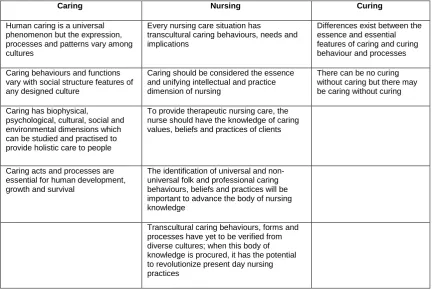
Caring Nursing Curing
Human caring is a universal phenomenon but the expression, processes and patterns vary among cultures
Every nursing care situation has
transcultural caring behaviours, needs and implications
Differences exist between the essence and essential features of caring and curing behaviour and processes Caring behaviours and functions
vary with social structure features of any designed culture
Caring should be considered the essence and unifying intellectual and practice dimension of nursing
There can be no curing without caring but there may be caring without curing Caring has biophysical,
psychological, cultural, social and environmental dimensions which can be studied and practised to provide holistic care to people
To provide therapeutic nursing care, the nurse should have the knowledge of caring values, beliefs and practices of clients
Caring acts and processes are essential for human development, growth and survival
The identification of universal and non-universal folk and professional caring behaviours, beliefs and practices will be important to advance the body of nursing knowledge
[image:31.595.113.547.56.346.2]Transcultural caring behaviours, forms and processes have yet to be verified from diverse cultures; when this body of knowledge is procured, it has the potential to revolutionize present day nursing practices
Table 2.1Leininger’s Assumptions about Human Caring and Nursing (1988)
Leininger developed the Sunrise Enabler to depict both the care assumptions and theoretical definitions (Figure 2.1). The Sunrise Enabler identifies potential influences that might explain care related to historical, cultural, social structure, worldview, environmental and other factors. Leininger incorporates within the Enabler constructs embedded in social structure such as religion, kinship, politics and economics. Gender, age and ethnicity are embedded in family ties and specific practices. Leininger states that the Enabler is not the theory per se but a conceptual picture (Leininger 1988). It can be argued that the Enabler is a holistic depiction of the diverse components of the theory, allowing the nurse to obtain a holistic perspective and to discover and assess care phenomena. The Enabler depicts the worldview of the individual client, the lay and professional care practices and the nursing care decisions and actions. The Enabler helps to discover potential and actual influences on care and health phenomena, relating them to historical, cultural, religious and other social structure factors.
30
[image:32.595.146.510.139.500.2]defining the three phases of culturally congruent care practice, cultural care preservation or maintenance, cultural care accommodation or negotiation and culture care repatterning or restructuring. These phases of culturally congruent care are depicted in the Sunrise Enabler (Figure 2.1).
Figure 2.1The Sunrise Enabler. Reproduced from The Transcultural Nursing Website, also printed in Leininger M (2001) Culture Care Diversity and universality: A Theory of nursing.
Jones & Bartlett, NLN Press, New York
31
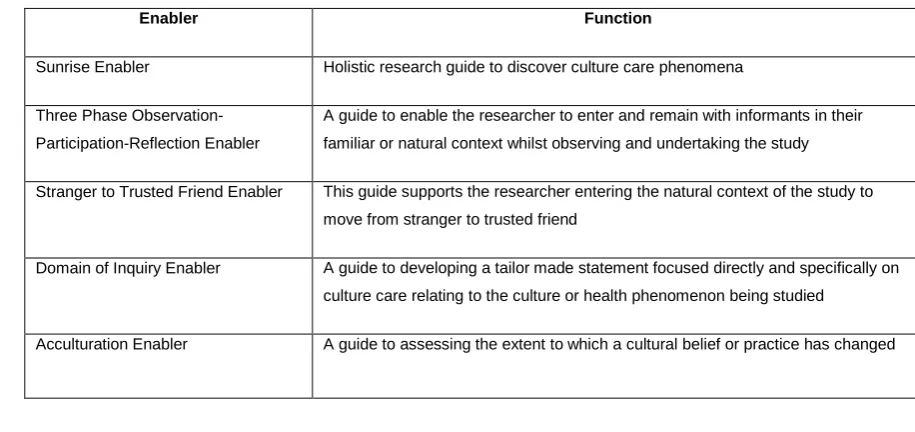
To support the study of cultures, Leininger developed the Ethno-nursing Method, its central purpose being to facilitate the identification, documentation and discovery of in-depth data related to care and culture (Leininger 1997, 1990, 1985a). Leininger defines ethno-nursing as a naturalistic qualitative research method using open discovery processes to document, describe and understand the emic people’s viewpoints and beliefs about care (Leininger 1985a). The research method has been designed to focus on emic and etic knowledge and practices related to care. Leininger has developed research enablers to facilitate Ethno-nursing Methods. The five enablers are summarised in Table 2.2.
Enabler Function
Sunrise Enabler Holistic research guide to discover culture care phenomena
Three Phase Observation-Participation-Reflection Enabler
A guide to enable the researcher to enter and remain with informants in their familiar or natural context whilst observing and undertaking the study
Stranger to Trusted Friend Enabler This guide supports the researcher entering the natural context of the study to move from stranger to trusted friend
Domain of Inquiry Enabler A guide to developing a tailor made statement focused directly and specifically on culture care relating to the culture or health phenomenon being studied
[image:33.595.101.559.228.444.2]Acculturation Enabler A guide to assessing the extent to which a cultural belief or practice has changed
Table 2.2 Leininger’s Research Enablers
2.5 Analysis and evaluation of the Theory of Culture Care Diversity and Universality
The analysis of Leininger’s theory is based on Leininger’s publications about her theory (2002, 1997, 1990, 1988, 1985, 1985a, 1978, 1970). A key text informing the analysis and evaluation is Fawcett’s model. Fawcett has undertaken an analysis of the theory using a framework which was developed in 1980 (Fawcett 2000, 1993, 1980). The main components of Fawcett’s model for analysis and evaluation is a framework for identifying the context of the theory, antecedent knowledge and the content of the theory. The framework describes the stages of theory evaluation (establishing significance, internal consistency, parsimony and testability). Evaluation of the theory is based upon the results of the analysis of the theory as well as on the publications by others who have used the theory.
2.5.1 Scope of the Theory
32
2.5.2 Context of the Theory
Leininger (2001, 1988) rejected the widely used definition of nursing as the concepts of person, environment, health and nursing. Instead she proposed a metaparadigm comprising the concepts of human care, environmental contexts and well being. Leininger identified caring or the concept of care as being the central essence and unifying domain of nursing (Leininger 1988) with care being placed in a cultural context, since lay care practices can differ transculturally.
During the conceptualisation and development of The Theory of Culture Care, Leininger did not follow the conventional stages of theory development (Walker & Avant 1983) as she perceived these were grounded in the quantitative paradigm with the emphasis on hypo-deductive logical positivism (Leininger 2001). The theory of Culture Care was conceptualised using inductive emic views and not from Leininger's a priori hypotheses (Leininger 2001). In fact, Leininger does not describe the theory as ‘grand theory’, but instead identifies that Culture Care Theory has purposeful built-in action which minimises abstraction of the theory. She describes the development of the theory as a creative process of concept explication, reformulation and resynthesis (Leininger 1988). Leininger opposed the view that a theory was a set of interrelated concepts or hypotheses with measurable relationships which would predict and control the phenomena under study (Polit & Hungler 1997). Leininger maintains that such a definition arises from the quantitative paradigm and was inappropriate for qualitative enquiry. As a consequence Leininger deliberately sought to develop her theory without testing pre-conceived etic views (Sandelowski 1993). Leininger therefore defines theory as sets of interrelated knowledge with meanings and experiences that describe, explain, predict or account for a phenomenon through open, creative and naturalistic discovery methods (Leininger 1988). The theory of Culture Care is congruent with methods that support the discovery of emic perspectives, rather than methods that follow the preconceived views of the researcher.
2.5.3 Philosophical Claims
33
number of assumptions about caring and these are reflected in the theory of Culture Care. These assumptions have been summarised in Table 2.1
2.5.4 Conceptual Model
Leininger describes the person as an individual human caring and cultural being, as well as a family, a group, a social institution or a culture (Leininger 2001 p49-56, 1985a). This is the conceptual model on which her metaparadigm is based.
2.5.5 Antecedent Knowledge
34
Walker & Avant (1983) describe three approaches to theory development: analysis, synthesis and derivation. Leininger’s work has been based for the most part on the use of concept synthesis, concept derivation and theory synthesis strategies (Cohen 1991). Cohen considers that concept derivation is evident in Leininger’s selection of the anthropological concept and the methodology of ethnography (2001). Leininger has used ethnographic methodologies and made them applicable to nursing, naming it ethno-nursing. By using a concept from anthropology and ethnography and redefining it for nursing would fulfil the criteria of a concept derivation strategy in the development of Culture Care Theory (Walker & Avant 1983). The Sunrise Enabler is constructed using the anthropological concepts of world view and social structure based on the work of Redfield, a social anthropologist (1957) and is another example of concept derivation utilised by Leininger (Cohen 1991).
2.5.6 Content of the Theory
Within Leininger’s publications (2001, 1988) it is stated that the concepts of the theory are care, caring, culture, language, ethnohistory, environmental context, holistic health, worldview, cultural care, care systems and culturally congruent nursing care. The concept of care has already been discussed. A review of Leininger’s definition of culture is required to contextualize the concept. Leininger defines culture as ‘the learned, shared, transmitted values, beliefs, norms and lifeways of a particular group that guides their thinking, decisions and actions’ (Leininger 2001,p47). During the development of the theoretical conceptualization of Culture Care Theory, Leininger made a number of assumptive premises with regard to culture. One of these was that clients who experience nursing care that fails to be congruent with their beliefs, values and general lifeways will show signs of cultural conflict, noncompliance, stresses and slow recovery. The goal of Leininger's theory is to provide care which is culturally acceptable and beneficial to the client, family or culture group’s health beliefs. The theory is congruent with the philosophical claims and conceptual model on which it is based.
In Leininger’s personal work there are no examples of her use of the theory in anything other than distinct cultural groups (defined purely by race). However in the literature there are many examples of Leininger’s Cultural Care theory, ethno-nursing and ethnographic methods being applied to cultural groups defined by sexuality (Gosner 2000), used in a hospital to identify nurses care concepts (Spangler 2001), to study the fate of health promotion in coronary heart disease families (Preston 1997), to understand the illness experiences of patients with congestive heart failure (Mahoney 2001) and to understand the perceptions of dying in hospice and hospital (Gates 2001).
35
members; it is not a finite and self-sufficient body of contacts, customs and traditions (Hall 1993). As a consequence of the expansion of the meaning of culture, Gosner postulates that individuals who identify as being lesbian, gay, bisexual and or transgendered can be classified as a cultural group. The unique health care needs of sexual minority groups are often ignored and gay men and lesbians have a higher rate of depression, suicide, alcoholism and breast cancer (Harrison 1996). Gosner identifies that Leininger’s theory contains two operational definitions which support the development of culturally aware health care for persons who identify as members of sexual minority groups: Cultural Care and Cultural Care Diversity. Rather simplistically, Gosner suggests that using Leininger’s model, the health needs of this minority sexual group could be better met and they would have the opportunity for their cultural symbols, values and belief needs recognized and met. Disappointingly, Gosner provides no practice or research examples to support this viewpoint. Nevertheless, I concur with Gosner's view on the historically rigid definition of culture being outmoded, and that by expanding the definition to include relationships with an interlinking web, sub cultures such as women with PFD can benefit from the tenets of Leininger's Theory of Cultural Care Diversity and Universality.
Preston (1997) used ethnographic methods to study the fate of health promotion in coronary heart disease families. The premise of her work was the proposal that each family can be regarded as a unique small-scale society or culture, with its own internal organization and view of the world. In her study, Preston identified that a crucial aspect of each family culture involved those beliefs, behaviours and habits that were either protective of health or pathogenic. Mahoney (2001), in a focused ethnography aimed at understanding the illness experience of patients with congestive heart failure and their family members, undertook 28 in-depth interviews (the informants were both Caucasian and African Americans). Data were analysed using an integration of recommendations from Leininger (1985) and Spradley (1979). Thematic analysis revealed that all patients and family members living with congestive heart failure experience a process that includes disruption, incoherence and reconciling. In her discussion, Mahoney outlines the need for health care providers to recognize that the resources of the popular and folk sectors are important aspects of the individual’s experience. Given that the themes were identified equally in both racial groups with congestive heart failure, it is suggested that these common behaviours and practices derived from a ‘disease’ culture and not an ethnic culture.
36
care, health, wellness, illness patterns, beliefs and values. Without including sub cultures in this work our comparative focus is limited and there would be risk of excluding subcultures from provision of congruent care.
2.5.7 Relational Propositions
The relational propositions are depicted in the Sunrise Enabler (Figure 2.1). The Sunrise Enabler is not the model as it now stands, but during the early evolution and development of Culture Care Theory Leininger originally referred to the Sunrise Enabler as a model. Leininger explained that the Enabler represents the sun; the upper portion of the Enabler depicts the world view, cultural and social dimensions which influence care. The lower part of the Enabler describes the care systems and dimensions of culturally congruent care (Fawcett 1993, Leininger 1985). Earlier in her work, Leininger developed the Sunrise Model (1985) to study different levels and phases of culture and healthcare. Leininger began work on the Sunrise Model in 1955 and continued to revise it in relation to the theory and the multiple holistic factors which she believes could influence cultural care until 1985. Initially Leininger described the ‘Sunrise Model’ but as her revisions continued and ethno-nursing methods became more formalised and tested she renamed the model the Sunrise Enabler. The Sunrise Enabler is a cognitive map or enabler to guide the researcher and not a conceptual model (Leininger 2001a, Fawcett 1989). The Enabler was originally developed by Leininger to support the transcultural nursing research process but it is equally appropriate for use in nursing assessment. When using the Enabler the nurse may start with any construct depending on the focus of the examination. The aim of the Sunrise Enabler is to facilitate the drawing of a comprehensive picture of the patient and their daily living practices and beliefs. It represents the historical, cultural and social context of human beings and as such clearly has its roots in anthropology. The Enabler is considered significant in that it combines both theory and method and distinguishes between different levels of abstraction (Cohen 1991, Leininger 1985). Included in the Sunrise Enabler are four levels of abstraction and analysis:
• Level one - focus on the structure of the culture of a group.
• Level two - focus on the specific meanings of health to individuals, families and groups.
• Level three - concerned with folk and professional systems of care.
• Level four - guides the development of care that is culturally acceptable.
37
Ethno-nursing methodology utilising a Life Health Care History of an individual followed by individuals and then specific groups facilitates the process of abstraction.
2.6 The application of the Theory of Culture Care Diversity and Universality to nursing practice
Leininger herself has no doubt of the significance that Culture Care Theory has had on the nursing profession worldwide. She states that many nursing leaders hold that it has been the most significant breakthrough in nursing and health fields in the 20th century (Leininger 1997). This view is supported by Webber (2008), Seisser (2002) and McCance (1999), who consider Culture Care Theory and transcultural nursing to be one of the most significant and growing nursing developments influencing the discipline of nursing. The special significance of the theory lies in its contributions to understanding the influence of culture on people’s experiences of health. Cohen (1991) considers that Leininger used her anthropological roots to provide nursing with a way to study caring that takes into account people’s culture, beliefs and lifeways to provide culturally congruent care. It can be considered to have particular relevance as migration and world travel continue to escalate whilst the world appears to be growing smaller and cultural boundaries are becoming blurred and less defined. From a historical nursing perspective Leininger’s beliefs and assumptions about the importance of care and culture must be viewed as forward thinking and innovative in a period when mainstream nursing remained focused on the medical model of care and the task orientated nature of ‘nursing’.
It is postulated that Culture Care Diversity and Universality: a theory of nursing, and the research studies produced by the ethno-nursing methods, may not appear clinically relevant and certainly not clearly applicable to practice for nurses involved in direct patient contact. This perception has arisen primarily from the continued narrow application of transcultural nursing theory and research on ethnic groups defined by race. The ethnography which resulted from Leininger’s studies of the Gadsup people (2001a) is a fascinating account of the culture and lifeways of the people, but unless the constructs described by Leininger are translated into the context of modern health care they may be considered irrelevant to modern nurses, whose likelihood of meeting a Gadsup villager in the course of their working life is minimal. If the methods described by Leininger are applied to cultures and sub-cultures not solely defined by race but by disease, then the research findings would be more clinically relevant in the practice setting.
38
discipline of nursing as a whole, with care as its unifying domain. Glittenberg (2004) suggests that transcultural nursing research has clearly increased nursing awareness of the importance of culturally competent care to the extent that cultural competence is now perceived as good nursing practice and competent healthcare (Dreher & MacNaughton 2002). Therefore it should not be viewed as a separate discipline of nursing, rather nursing itself. Leininger contends that all nurses and nursing must become transcultural by 2015 to be relevant, therapeutic and safe with people of diverse cultures (1995), which is an indication that this construct is central to nursing itself and not simply a new discipline.
With the development of ethno-nursing methods and enablers such as the Sunrise Enabler, Leininger promotes the use, testing and reproducibility of the theory by providing the practical research methods and tools to discover the meanings of culture care. Ethno-nursing methods allow application of theory to practice by providing tools to use the theory and a framework with which to do so. Summaries from the studies of 23 cultures conducted by Leininger and her students are presented by Leininger (2001); these identify the major research findings from Culture Care Theory:-
• There are far more cultural diversities and less universality among and between cultures.
• Culture care meanings and practices tend to be embedded in the social structure and are difficult to find.
• Marked differences between generic and professional care values and practices often lead to cultural clashes and cultural imposition with negative outcomes.
• High technology practices in Western hospitals tend to increase the distance between client and nurse.
• Generic (emic) practices provide the most credible and meaningful knowledge to guide professional nursing care practices (generic practices being the way in which a person /culture would care or mange a health problem, it encompasses the beliefs about cause, prevention and how the problem might get better).
39
diverse cultures and sub-cultures will be essential if nursing knowledge is to advance in order that clients receive culturally congruent personalised care.
2.6.1 Variety of settings in which Culture Care Theory has been utilised in published studies
As previously described in section 2.5.6, and to summarise, in the literature there are many examples of Culture Care Theory being utilised in studies of different cultural groups (i.e. those not defined purely by ethnicity). Gosner explored care needs of a group defined by sexuality (Gosner 2000), whilst Spangler used Culture care Theory in a hospital to identify nurses care concepts (Spangler 2001). Preston utilized the theory to study the fate of health promotion in coronary heart disease families (Preston 1997), whilst Mahoney has applied Culture Care Theory to understand the illness experiences of patients with congestive heart failure (Mahoney 2001). Gates used the theory to understand the perceptions of dying in hospice and hospital (Gates 2001). Miller explored the perceptions of politics and care amongst the Czech Americans (Miller 1997) whilst Finn described the care needs of Euro-American women during childbirth (Finn 1994).
Culture Care Theory has been used in a variety of settings from hospital, hospice, to long term care facilities. It has been applied to cultures defined by race, but also has been equally effective in discerning the care needs of sub cultures defined by sexuality and disease process. The theory has also be used within nursing academia to identify nurses care concepts and theoretical perspectives of care and care giving. It is therefore suggested that Culture Care Theory has utility and can be effectively used in any study setting when the emic care perspective of an individual or group is being explored.
2.7 Rationale for the utilisation of Shaw’s Framework for the Study of Coping (1999)
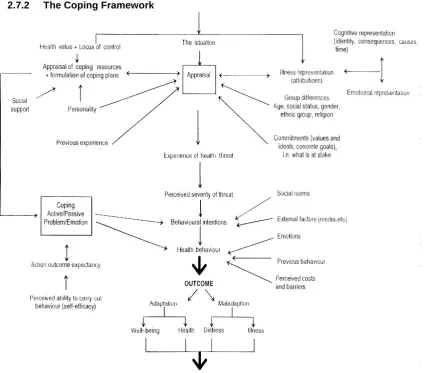
Following a review of the literature, Shaw’s (1999) framework for coping, illness behaviour and outcomes was identified as a model which facilitates identification of the determinants of health behaviour and outcomes. As such it was considered an appropriate framework to use to explore the coping and help seeking behaviour of women with PFD.
40
Shaw’s Framework of Coping is not a nursing theory and does not have the depth of literature or previous review and utilisation as does the work of Leininger. This is for the most part due to the relatively recent publication of Shaw’s Framework of Coping. Despite this, it has been possible to analyse and evaluate the Framework to establish its appropriateness to be used as a tool for facilitating data collection and organisation of themes.
2.7.1 The importance of the Coping Framework
The Coping Framework is used in this study to aid data collection and organise themes arising from the data as it relates to coping and help seeking. The Coping Framework has been used to investigate the help seeking pathway of women with PFD and validate or refute the Framework in respect of help seeking behaviour in women with PFD. Whilst reviewing the literature on the four coping stages (event, situation, condition and cue) (Chapter 3), I utilised Shaw’s framework to ascertain if the coping behaviours identified in the framework included all the potential variables that might be employed by a woman with PFD. Reviewing the data enabled me to draw comparisons between the data available on coping and help seeking behaviour. For each woman experiencing PFD symptoms the coping mechanism at each of these coping stages will differ as a number of variables will impact and interact with her coping mechanisms. It is essential that the four concepts: event, situation, condition and cue are seen as fluid states. A woman may progress through these four stages in a linear fashion, but equally may start her coping and help seeking pathway mid way through these concepts with, for example, condition.
41
[image:43.595.106.531.112.485.2]2.7.2 The Coping Framework
Figure 2.2 Framework for the Study of Coping, Illness Behaviour and Outcomes.
Reproducedfrom Shaw C (1999) A framework for the study of coping, illness behaviour and outcomes. Journal of Advanced Nursing 29: 1246-1255.
2.7.3 Methodology employed to develop the framework
42
locus of control, self-efficacy and social support where key barriers or facilitators of help seeking. These variables are discussed in Chapter 3.
2.7.4 Framework assumptions
Shaw (1999) developed a framework for coping, illness behaviour and outcomes, based on models developed in health psychology and views outcomes such as help seeking behaviour as dependent upon both situation and person (personality) variables. Shaw postulates that the framework is dynamic and changes over time subsequent to changes in any of the variables.
2.7.5 Analysis and evaluation of the Coping Framework
The framework has been tested with regard to help seeking behaviour in people with urinary incontinence (Shaw 2001). Shaw indicates that although severity of symptoms was found to be an important factor in predicting help seeking behaviour, illness and coping appraisal are important moderators of help seeking behaviour. Shaw identified that lay beliefs are important barriers to help seeking. The review of the literature, undertaken by Shaw, was limited in that it sought studies that examined associations between any of the variables previously identified by Shaw and stated in the framework.
Shaw (2001) undertook a study to examine why people do or do not seek help for their urinary incontinence. Thirty one people undergoing treatment for urinary incontinence were interviewed by 4 interviewers. Respondents reported two main reasons for seeking help: fear of a serious underlying problem and serious impact on quality of life. Lack of awareness about the condition and treatment options were the most common themes to emerge. It is difficult to apply the findings specifically to women with PFD as little information is given with regard to gender differences other than a statement that attitudes of men and women were very similar. However, it was noted that women were less likely to perceive urinary incontinence symptoms as a disease, whereas men considered urinary symptoms signified a disease process (prostate cancer) and were more likely to seek help. There are limitations to the study as the sample population were individuals who had sought help for their urinary incontinence problems. Consequently a respondent bias is probable. It is acknowledged that all research studies aiming to explore help seeking behaviour in people will have difficulty in accessing the population of non-help seekers and consequently transferability will be limited.
2.8 Summary
43
on which to underpin this study, which aims to understand the emic perspective of women with PFD, specifically in relation to coping and help seeking behaviour. The following premises based on Leininger’s Culture Care Theory (Leininger 1988) have been used to guide this study:
• Care is the essence of nursing.
• Women with PFD have developed generic folk care values, beliefs, coping mechanisms and practices that can influence professional cultural care practices.
• Worldview, values, social structure and folk and professional health systems influence healthcare practices.
• Patterns and variability of health practices (or coping amongst women with PFD) need to be understood not only from the context of the women who express them but also from their social structure, worldview and cultural context in order that culturally congruent services can be provided for women with PFD.
• The culture care beliefs of women with PFD will influence women’s well being, health status and use of health services.
Shaw’s (1999) framework for the study of coping, illness behaviour and outcomes is an interactionist model, based on health psychology models, which facilitate identification of determinants of health behaviour and outcomes. This model has been utilised by Shaw (Shaw 2006, 2001, 2000 ) to inform studies of people with urinary incontinence (one of the symptoms of PFD). The Framework, alongside the Sunrise Enabler has been used to facilitate explanation and examination of the coping mechanisms and help seeking behaviour in women with PFD.