Abstract—Switching operations of circuit breakers and discon-nect switches radiate transient electromagnetic fields within high-voltage substations. The generated fields may interfere and dis-rupt normal operations of electronic equipment. Hence, the elec-tromagnetic compatibility (EMC) of this electronic equipment has to be considered as early as the design stage of substation planning and operation. Also, microelectronics are being introduced into the substation environment and are located close to the switching de-vices in the switchyards more than ever before, often referred to as distributed electronics. Hence, there is the need to re-evaluate the substation environment for EMC assessment, accounting for these issues. This paper deals with the computation of transient elec-tromagnetic fields due to switching within a typical high-voltage air-insulated substation (AIS) using the finite-difference time-do-main (FDTD) method.
Index Terms—Air-insulated substation, electromagnetic com-patibility (EMC), electromagnetic fields, finite difference time domain (FDTD), switching transients.
I. INTRODUCTION
S
UBSTATION electromagnetic environments can be char-acterized by either measurement or computation. Measure-ment of the emissions due to switching involves complex and expensive equipment. The alternative is to develop models to predict the emissions. Substation models can be developed to aid in understanding the measurements and to provide means for estimating electromagnetic interference levels beyond measure-ment limitations [1]. Once the models have been demonstrated to be robust and accurate they have the potential to greatly sim-plify the analysis process.Various substation models have been developed since the in-troduction of automation and control in power systems in gen-eral and substations in particular [2]–[5]. Even with the exis-tence of these models, further investigations as suggested in [1], [6], to determine the effect of different materials and structures that may be found in the substation environment on the transient fields, for example transformers, support structures, grounding mesh and the soil content are required. Initially, the emphases of the transient field predictions are mainly on how the radiated field affects the control rooms as most of the electronic
equip-Manuscript received December 08, 2008; revised June 25, 2009. First pub-lished February 22, 2010; current version pubpub-lished March 24, 2010. Paper no. TPWRD-00903-2008.
The authors are with the University of Strathclyde, Electronic and Electrical Engineering Dept., Glasgow G1 1XW, U.K. (e-mail: [email protected]; [email protected]; [email protected]).
Color versions of one or more of the figures in this paper are available online at http://ieeexplore.ieee.org.
Digital Object Identifier 10.1109/TPWRD.2009.2034008
ments are located there. There have been suggestions that the effect of radiated disturbances from busbars may be insignif-icant in the control rooms [7]. This is because the busbar is assumed to be a poor radiator; and the distance from the bus-bars to the control rooms is considered to be significantly great for any radiated fields to reduce to a negligible value before reaching the electronic equipment. However, equipment used in the substations has greatly changed, and become highly sophis-ticated. Moreover and most importantly, some new electronic equipment that has been introduced into the substations are not necessarily housed in the control rooms anymore; it may be lo-cated close to the switching devices or sources of disturbance in the switchyard. This is referred to as “distributed electronics” in the switchyards [8]. For the successful introduction and op-eration of this new equipment in the substations, it must be im-mune to the interference in this harsh environment. Hence the there is the need to evaluate the transient electromagnetic emis-sions in the switchyard, taking into consideration points close to the switching devices. The FDTD method can be used to sim-ulate the above scenario and predict the electromagnetic fields effectively.
For the computation of transient fields in a substation, the transient current propagating along the busbars is needed. In-stead of using the actual bus currents, a damped sinusoidal cur-rent and a sinusoidal curcur-rent with varying frequency, which are good representations for transient currents in substations, have been used to calculate the radiated fields in this research. Once the capability of the method for the field calculation is estab-lished using the assumed current, the next step is to develop suitable method to compute the actual transient current on the busbars, including the physics of the switching elements in the model. The current thus obtained can be used to calculate the transient fields. First, the results obtained with FDTD code for a simple electromagnetic field transient model will be com-pared with analytical method in a similar environment. Sec-ondly, simulation results for a simplified busbar section in a typ-ical high-voltage substation will be presented.
II. ANALYTICAL AND FDTD METHODS OFFIELDCALCULATION
The computation of transient electromagnetic fields in sub-stations is effectively a two-step procedure [2]:
Step 1) calculation of the transient currents on the conduc-tors due to switching;
Step 2) calculation of the resulting radiated fields near the conductors due to the travelling current.
The electromagnetic fields can be calculated by analytical or numerical methods. The hertzian dipole [4], [9] or the
Fig. 1. Vertical filament of current carrying conductor.
ical [10]–[12] method assumes the line or conductor (which is the substation busbar in this case) to be cylindrical. The radius is assumed small in comparison with the minimum wavelength of the transient current so that the current can be regarded as a filament. With reference to Fig. 1 assuming the line is of length
, lying along the axis from the origin of a Cartesian
coordinate system; is the coordinate of point of ob-servation, the transient fields can be calculated as follows [10]. Based on the assumptions above, the and component of the magnetic vector potential can be neglected. The electric and the magnetic fields are computed using ; for example, the component of the electric field and the component of the magnetic field are given by
(1)
(2)
(3)
(4)
current at the lower end of the conductor;
current at the upper end of the conductor;
distance from the lower end of the conductor, which is also the origin to the observation point ;
distance from the upper end of the conductor to the observation point ;
speed of light in vacuum;
Fig. 2. Damped sinusoidal current.
current at and time ;
current at and time ;
distance from an arbitrary point on the conductor to the observation point ;
length of the conductor.
From the equations above, it was shown that the fields are functions of the currents at the ends of the conductor [10]. For the comparison of the results obtained using analytical and FDTD methods, the model in Fig. 1 is considered, a single conductor, 30 m long, vertically oriented as shown. The current applied at the lower end of the conductor, propagating upward is a damped sinusoidal pulse, shown in Fig. 2.
The equation describing the current is:
in which , , , and
. With this current, (1) and (2) are solved nu-merically. The ground is assumed to have constant constitutive parameters that are frequency-independent and is considered to have relative permittivity and permeability values of unity. This model was simulated using both the analytical and FDTD methods to validate the developed method.
The FDTD method is a numerical technique, which models transient electromagnetic signal scattering or radiation from objects of arbitrary shapes. The method relies on discretizing Maxwell’s curl equations in both time and space, where all derivatives are approximated by the central difference equa-tion. The computational region, i.e., the region of interest where the solution is sought, is divided into cells with the corresponding electric and magnetic fields being located on the edges and the faces. It usually assumed that all fields in the entire solution region are initially zero. The scattering or radiating objects of interest are defined by specifying the dielectric and magnetic material parameters at each discrete location in the FDTD mesh. The computational region must be large enough to enclose the objects to be analyzed. In ad-dition, suitable boundary conditions on the artificial boundary must be imposed to absorb outgoing waves to simulate the extension of the computational region to infinity [13]. Finally, to ensure the stability of the finite-difference scheme, the time increment must satisfy the Courant condition [13],
, where
[image:2.594.94.229.64.212.2]A. Thin Wire Representation
It is a condition of the basic FDTD code that the cell size must be comparable with the smallest structure in the computational space. The radiating elements in the substations are mostly the cables and busbars, which will usually have radius smaller the cell size; it is therefore necessary to include the busbar radius into the physics of the problem. A method of approximating thin wires in the FDTD was required to achieve this. Noda [15] pro-posed thin wire representation by correcting the adjacent elec-tric and magnetic fields according to its radius and used it for surge simulation. This thin wire representation formulation was adopted in this paper and the conductor radius was set to be 0.025 m. While the use of thin wire representation with a time increment at 99% of the Courant stability condition has been found to cause numerical instability [16], no instability was ex-perienced at 95% for the simulations reported here.
B. Reflections at the End of Bus and Ground
In the analytical method of transient field calculations, reflec-tions at the ends of wire are not considered since it is assumed that the current suddenly “appears” at one end and ultimately “disappears” on the other end of the conductor without reflec-tions. These criteria may not be met in the FDTD formulation adopted here. Of course, there should be reflections at the ends of truncated conductors; nonetheless, the situation is addressed in the FDTD method by placing the upper end of the conductor at boundary of the computational space.
On the reflections due to ground, using the ramp or the Hertzian method, separate techniques must be used to account for the reflections. For example [2], [6] used a method based on Fresnel reflection coefficients and recursive convolution, while [4], [5] used the image method. However, in the FDTD formulation it is a matter of specifying the conductivity, per-mittivity and permeability at the points, which lie within the ground region. Then the reflection due to ground is automat-ically incorporated into the computation, which is one of the advantages of the FDTD method.
The ground parameters used were as follows [2], [17]:
, and
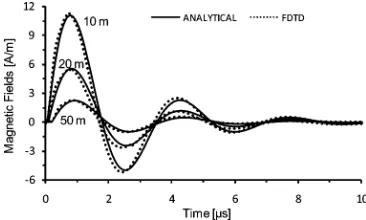
[image:3.594.335.518.218.328.2]Having specified all the parameters, the model in Fig. 1 was set up in the FDTD space and simulated. Current was applied at the lower end of the wire as shown in the figure, propagating up-ward. The transient field calculation assumes matching at both ends. Figs. 3 and 4 show and components of the electro-magnetic fields at a point located 10 m, 20 m and 50 m from the centre of the conductor computed by the FDTD as well as the analytical methods. Table I shows the peak-to-peak values of
Fig. 3. E component of electric field produced by the damped sinusoidal pulse for pointPlocated 10 m, 20 m, and 50 m from the centre of conductor.
Fig. 4. H component of magnetic field at a pointP 10 m, 20 m and 50 m from the centre of conductor produced by the damped sinusoidal pulse.
TABLE I
PEAKVALUES OFELECTROMAGNETICFIELDSE ANDH PRODUCED BY THE
DAMPEDSINUSOIDALPULSE AT3 DISTANCESFROM THECONDUCTOR
the fields at the same points. It can be seen that there is very good agreement between the two methods in amplitude and phase.
III. MODELLING A SECTION OF HIGH VOLTAGE
AIR-INSULATED(AIS) SUBSTATION
[image:3.594.308.548.406.590.2]Fig. 5. Three-phase bus section used in high-voltage substation model. (a) Side view. (b) End view.
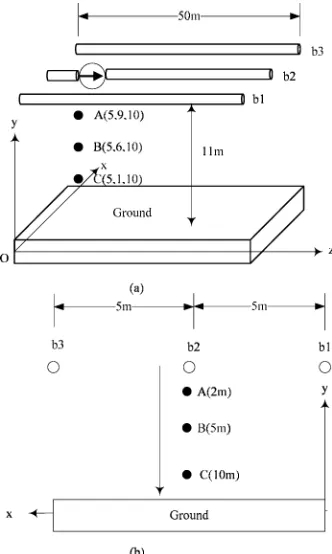
complexity of the substation increases, the programming and computation resources also increase. This could even require a mesh generation algorithm to be employed. The simple substation model described here represents a step towards this goal. Typical bus lengths are 20–80 m long and located 5–15 m above ground. Thus, a bus section in a substation consisting of three parallel busbars; 50 m long, located 11 m above ground (as shown in Fig. 5) was set up in FDTD space. The ends of the busbars are 2.5 m away from a 10- cell perfectly matched layer boundaries. Two different ground conditions were considered for this simulation: imperfect ground and a perfectly con-ducting ground. The conductor radius used was 0.05 m in both cases. The imperfect ground properties were chosen as follows: relative permittivity of 10, conductivity of 0.01 S/m and relative permeability of unity. In both cases, a sinusoidal current with varying frequency was used. The frequency was varied from 1 MHz to 50 MHz in discrete steps. This frequency range was deliberately chosen so that it includes frequencies expected in high-voltage substation transients. Normally switching surges may produce less frequency spectrum than this. However, short duration surges may be expected to occur within this range [1]. This will also enable the analysis of the fields with current of varying frequency.
The current was applied at 10 m from one end of the middle conductors as shown in Fig. 5 and travels in positive direc-tion thus simulating a bus secdirec-tion acting as antenna. The peak amplitude of the current was chosen as 1000 A to emulate a high-voltage bus current transient due to switching. The spa-tial increments were set to 0.5 m and at 95% of the Courant condition gives discrete time step as
Fig. 6. Variation of electric fields with frequency at three points due to sinu-soidal current for imperfect ground conditions. (a) Fields atA. (b) Fields atB. (c) Fields atC.
. The volume of the computational domain was
set as , , .
and are the dimensions in the directions respectively. The perfectly matched layer absorbing boundary condition was applied as before.
Electric and magnetic fields at three points , and di-rectly under the switch location were calculated and analyzed. Referring to Fig. 5, point is 2 m below the busbars, is 5 m and is 10 m (1 m the above the ground). The coordinates of the points are shown in Fig. 5(a). Fig. 5(b) shows the conductors and the three points in the - plane.
A. Effect of Varying Source Frequency
Fig. 6 shows the , and components of the electric fields at the three points for imperfect ground conditions. is the dominant field component except at low frequencies where the component is higher. At point , the dominant field is almost constant with increase in frequency. At point , this field increases slightly with increase in frequency up to about 30 MHz and then starts to decrease again.
[image:4.594.80.246.68.345.2]Fig. 7. Variation of electric fields with frequency at three points due to sinu-soidal current for perfect ground conditions. (a) Fields atA. (b) Fields atB. (c) Fields atC.
field increases with increase in frequency up to 35 MHz. At point , both and increase with frequency up to about 35 MHz.
Fig. 7 show the components of the electric field at the same locations , and within the substation for perfect ground conditions.
At point (far from ground), there is little difference in any component of . At point , the main change is in . At point , close to ground, both and are different. Shows no noticeable changes.
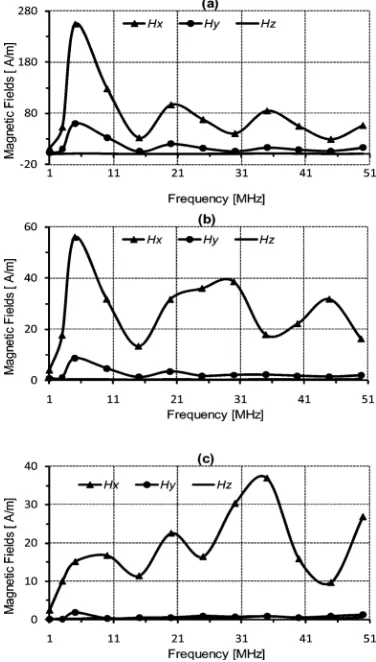
[image:5.594.333.521.68.399.2]Fig. 8 shows the components of the magnetic field at the same locations , and within the substation for perfect ground conditions. In all cases is negligible compared to the rest of the fields, as would be expected for directed current. is about a factor of 5 higher than . For points and that are further from the ground, fields generally decrease with in-crease in frequency though the relationship is not linear. Also, the fields have high magnitudes at about 5 MHz. For point , which is near the ground, the behaviors of the fields are quite different from the above points. At this point, the field magni-tudes increase with increase in frequency up to about 35 MHz. This could be due to the proximity to the ground, where induced currents will contribute to the magnetic field. In addition, the fields have high magnitudes at about 5 MHz. This could be due
Fig. 8. Variation of magnetic fields with frequency at three points due to si-nusoidal current for perfect ground conditions. (a) Fields atA. (b) Fields atB. (c) Fields atC.
to resonance effect relating the length of the busbars to the fre-quency. At this frequency, since the length of the busbar is 50 m, the wave goes into resonance and hence high value of the fields. Fig. 9 shows the , and components of the magnetic fields at the same locations , and within the substation for imperfect ground conditions.
For points and , the fields follow the same trend as for the perfectly conducting ground. For point , there is less variation in field with frequency as recorded for the perfect ground. The field variation is almost flat with increase in frequency from 5 MHz up to about 35 MHz. Comparing Figs. 8(c) and 9(c), the fields start off at about the same level, but attenuated at high frequencies, due to increasing losses for induced currents in the imperfect ground.
B. Variation of Fields With Distance
Fig. 9. Variation of magnetic fields with frequency at three points due to sinu-soidal current for imperfect ground conditions. (a) Fields atA. (b) Fields atB. (c) Fields atC.
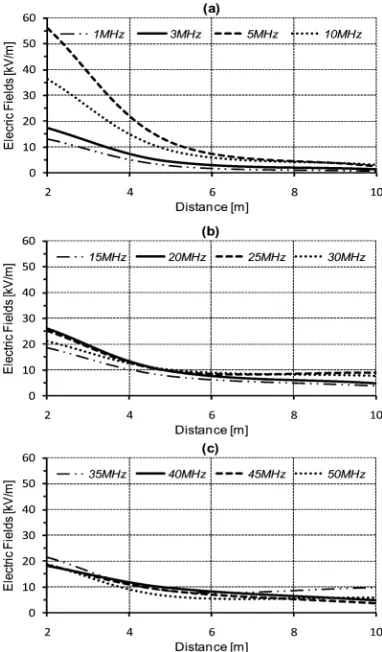
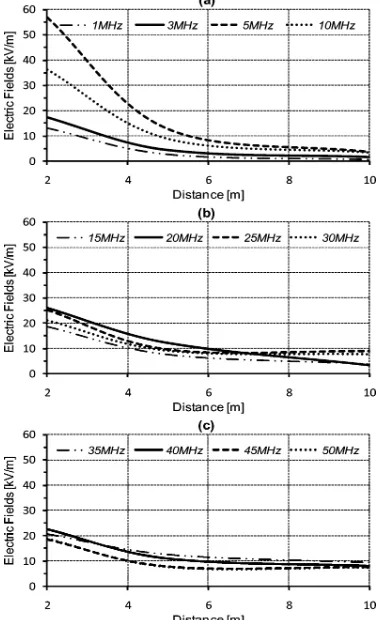
Generally, there is a decrease in magnitudes for both electric and magnetic field strengths with increase in distance from the busbars towards ground. However, at of 35 MHz electric fields are higher at point than point . In addition, magnetic fields are higher at point than point at 50 MHz. These can be seen by closer examination of Figs. 10(c) and 11(c).
Figs. 12 and 13 show the variation of the electric and magnetic fields magnitudes respectively with distance for perfect ground conditions. Just as in the imperfect ground situation for both electric and magnetic fields, there is general decrease in field magnitudes with increase in distance from the busbars towards ground. However, magnetic field magnitudes are higher at 35 MHz and 50 MHz at points than at point . Also, at 45 MHz, magnetic fields are higher at point than at point . Refer to Fig. 13(c).
C. Effect of Ground
With reference to Figs. 10 and 12, it can be seen that the vari-ation of fields with respect to ground conditions depends on the frequency of the current. For example at frequencies of 15 MHz, 20 MHz, 25 MHz, 30 MHz and 35 MHz (Figs. 10(b)–(c) and 12(b)–(c)) comparison of field magnitudes at point , which is close to the ground, shows that electric fields are the same for both imperfect and perfect grounds. Fields are higher with per-fect ground conditions at all other frequencies.
Fig. 10. Variation of electric fields (at twelve frequencies) with distance for imperfect ground.
Referring to Figs. 11 and 13, it can be seen that the variation of magnetic fields with respect to ground conditions also depends on the frequency of the current source.
Magnetic fields are higher with perfect ground conditions than with imperfect ground at for most of the frequencies. However at frequencies of 5 MHz, 15 MHz and 25 MHz (Figs. 10(a)–(b) and 12(a)–(b)), the fields are the same for imperfect and perfect grounds. This means that the condition of the ground has a significant influence on the magnetic fields at points in close proximity to the ground, in that a more conduc-tive ground will enhance the transient magnetic fields. Electric fields strengths are rather less affected by ground conditions.
IV. CONCLUSION
[image:6.594.68.258.66.409.2]Fig. 11. Variation of magnetic fields (at 12 frequencies) with distance for im-perfect ground.
[image:7.594.69.259.427.737.2]Fig. 12. Variation of electric fields (at twelve frequencies) with distance for perfect ground.
Fig. 13. Variation of magnetic fields (at twelve frequencies) with distance for perfect ground.
Although the model used to test the ability of the simulation is a small section of a substation, this is not a limitation of the code. It would be possible to model a complete high-voltage air-insulated substation, including equipments such as discon-nect switch and circuit breakers condiscon-nected to the busbars, and predict transient electromagnetic fields emissions at any loca-tion within the structure. This can be done by specifying the geometry of the various substation components together with their constitutive parameters within the computational space. The predicted transient electromagnetic fields could further be used for electromagnetic compatibility studies and incorporated into the planning and design of substations.
The FDTD model has been used to predict the transient fields in the substation using an analytical waveform transient cur-rent due to switching operations. However, an advantage of the developed method is that any type of current waveform can be used as the input source. Extensions to this research could therefore be: 1) to use bus currents obtained from actual sub-station measurements and 2) develop methods to compute the transient currents produced during switching operations. The second method could finally lead to the development of a com-prehensive package that combines the two programs in seamless fashion to run concurrently for predicting electromagnetic fields within a high-voltage substation.
REFERENCES
[2] D. E. Thomas, C. M. Wiggins, F. S. Nickel, C. D. Ko, and S. E. Wright, “Prediction of electromagnetic field and current transients in power transmission and distribution systems,”IEEE Trans. Power Del, vol. 4, no. 1, pp. 744–754, Apr. 1989.
[3] B. Neikhoul, R. Feuillet, and J. C. Sabonnadiere, “Prediction of tran-sient electromagnetic environment in power networks,”IEEE Trans. Magn., vol. 30, no. 5, pp. 3745–3748, Sep. 1994.
[4] N. Ari and W. Blumer, “Transient electromagnetic fields due to switching operations in electric power systems,”IEEE Trans. Electro-magn. Compat, vol. EMC-29, pp. 510–515, Aug. 1987.
[5] E. T. Pereira, D. W. P. Thomas, A. F. Howe, and C. Christopoulos, “Computation of electromagnetic switching transients in a substation,” inProc. Inst. Elect. Eng. Int. Conf. Comp. Electromagnetics., Nov. 1991, pp. 331–334.
[6] A. Orlandi, “On the inclusion of switch arc restrikes and lossy ground in EMI analysis for HV substations,” inProc. 9th Int. Conf. Electromag-netic Compatibility, Conf. Publ. No. 396, Sep. 5–7, 1994, pp. 92–98. [7] P. H. Pretorius, J. P. Reynders, and A. Fourie, “On radiated EMI
gener-ated by disconnector operations in open air high voltage substations,” inSAIEE/CIGRE Colloq.: Interference in Power Systems—LF and HF, Midrand, South Africa, Oct. 1999.
[8] C. Imposimato, J. Hoeffel man, A. Eriksson, W. H. Siew, P. H. Preto-rius, and P. S. Wong, “EMI characterization of HVAC substations-up-dated data and influence on immunity assessment,” inCIGRE Working Group 36.04(EMC and EMF, General aspects)., 2002.
[9] M. A. Uman, D. K. McLain, and E. P. Krider, “The electromagnetic radiation from a finite antenna,”Amer. J. Phys., vol. 43, pp. 33–38, 1975.
[10] R. S. Shi, J. C. Sabonadare, and D. A. Dacherif, “Computation of tran-sient electromagnetic fields radiated by a transmission line: An exact model,”IEEE Trans. Magn., vol. 31, no. 4, pp. 2423–2431, Jul. 1995. [11] B. Neikhoul, R. Feuillet, and J. C. Sabonnadiere, “Prediction of
tran-sient electromagnetic environment in power networks,”IEEE Trans. Magn., vol. 30, no. 5, pt. 2, pp. 3745–3748, Sep. 1994.
[12] B. Neikhoul and R. Feuillet, “A new method for calculating the tran-sient electromagnetic field radiated by a power transmission line,” in
Proc. 9th Int. Conf. Electromagnetic Compatibility, 1994, pp. 143–146, IEE Conf. Publ. No 396.
[13] A. Taflove and S. C. Hagness, Computational Electrodynamics the Fi-nite Difference Time Domain Method. Boston, MA: Artech House, 2000.
[14] J. P. Berenger, “A perfectly matched layer,”J. Comp. Phy., vol. 114, no. 2, pp. 185–200, Oct. 1994.
[15] T. Noda and S. Yokoyama, “Thin wire representation in finite differ-ence time domain surge simulation,”IEEE Trans. Power Del., vol. 17, no. 3, pp. 840–847, Jul. 2002.
[16] Y. Taniguchi, Y. Baba, N. Nagaoka, and A. Ametani, “An improved thin wire representation for FDTD computations,”IEEE Trans. An-tennas. Propag., vol. 56, no. 10, pp. 3248–3252, Oct. 2008. [17] A. Maaouni and A. Amri, “Overhead line switching transients,”J
.Phys.A: Math. Gen., vol. 35, pp. 7125–7135, 2002.
Bukar Umar Musa (M’09) received the B.Eng. degree in Electrical and Electronic (Hons.) at the University of Maiduguri, Maiduguri, Nigeria, in 1994 and the M.Sc. and Ph.D. degrees in electrical engineering from the University of Strathclyde, Glasgow, U.K., in 2003 and 2009, respectively.
In 1995, he joined the Borno State Rural Electri-fication Board where was actively involved in the design and construction of town distribution net-works and intertown connection netnet-works. In 2000, he joined the University of Maiduguri where he is currently a lecturer in the Department of Electrical and Electronic Engineering. His research interests are power system transients, electromagnetic-wave propagation, and computational electromagnetics.
Wah Hoon Siewreceived the B.Sc. (Hons.) degree in electronic and electrical engineering, the Ph.D. de-gree in electrical engineering in 1982; and the Master of Business Administration degree from the Univer-sity of Strathclyde, Glasgow, U.K., in 1978, 1982, and 1985, respectively
Currently, he is a Reader in the Department of Electronic and Electrical Engineering at the Uni-versity of Strathclyde, Glasgow, U.K. His research interests include lightning protection to aircraft and grounded structures, electromagnetic compatibility in large installations due to switching and lightning, lightning, EMP and ESD; and cable diagnostics.
Dr. Siew is a Chartered Engineer and a member of the Institution of En-gineering and Technology. He is also a member of several CIGRE Working Groups under C4 and a member of the Technical Panel for the IET Professional Network on electromagnetics.
Martin D. Judd(M’02–SM’04) is a Reader with the Institute for Energy and Environment at the University of Strathclyde, Glasgow, U.K., where he manages the High Voltage Diagnostics Laboratory. He is an expert on electromagnetic theory, propa-gation, and measurement, and leads a research team specializing in high-frequency diagnostic techniques for high-voltage electrical equipment and systems.