Creative Idea Exploration within the Structure of a Guiding
Framework: The Card Brainstorming Game
Eva Hornecker
The Mobiquitous Lab, Dept. of CIS, University of Strathclyde, Glasgow G11 XH, UK
[email protected]
ABSTRACT
I present a card brainstorming exercise that transforms a conceptual tangible interaction framework into a tool for creative dialogue and discuss the experiences made in using it. Ten sessions with this card game demonstrate the frameworks’ versatility and utility. Observation and participant feedback highlight the value of a provocative question format and of the metaphor of a card game.
Author Keywords
Ideation, tangible, embodied, design, creativity, analysis
INTRODUCTION
A range of frameworks on tangible interfaces and tangible interaction [1, 5, 6, 7, 10, 18] have helped us to attain a better understanding of these systems, of user interaction and experience, and given us a vocabulary to describe this analysis. The contribution of these frameworks usually lies in providing structured lists of relevant issues or themes that should be considered in design and evaluation and in increasing our understanding of the central characteristics of tangible systems. This also means that they do not provide step-by-step guidance or process descriptions. Neither do they lend themselves easily to supporting creative design and ideation. Creative design alternates between problem analysis, problem framing, generation of potential solutions and subsequent critical analysis of ideas [17], which again results in a better problem understanding or in a reframing of the problem. Frameworks tend to be systematic and abstract, and this makes them hard to use in creative practice. While they work well for a final analysis and in principle can inform design, they tend to feel heavyweight and tedious during ideation.
The question is thus how to combine the freedom of a creative idea exploration process with the structure of a guiding framework, ensuring that its central tenets are taken account of. Creativity in fact often benefits from structure
and artificial constraints, which many creativity methods intentionally introduce.
This paper presents a derivation of the Tangible Interaction Framework [10] that transforms its abstract concepts into provocative questions for a brainstorming exercise with a ‘game’ format. The questions have been revised, extended, and rephrased over the past years in response to insights and experiences made with the game.
I describe the experiences with this game in a set of brainstorming sessions on the design and analysis of systems related to tangible, embedded and embodied interaction. These sessions served multiple purposes. A central aim was to explore the utility of the framework for understanding and informing tangible interaction systems. Furthermore the range of technologies and application areas was intentionally wide to investigate the framework’s applicability. A further core question was how to organize and run these sessions in terms of the ‘game’ structure and to determine for what purposes and situations the card exercise is most useful. This paper focuses on the processional aspects of these experiences and gives a short overview of experiences regarding the former issues.
BACKGROUND
Design Games
a concept’ and thereby frees creative impulses. Design games can furthermore foster the combination of seemingly unrelated elements, an aspect for innovativeness. According to Halskov and Dalsgard [9], factors that improve the outcome of such workshops are: familiarity of the group, familiarity with creative methods (makes group quicker to grasp the format and more likely to embark on the activity), and insight into the use domain. They note that the use of cards supports focus shifts, making it easier to bring in new perspectives and ideas.
The Overall Framework
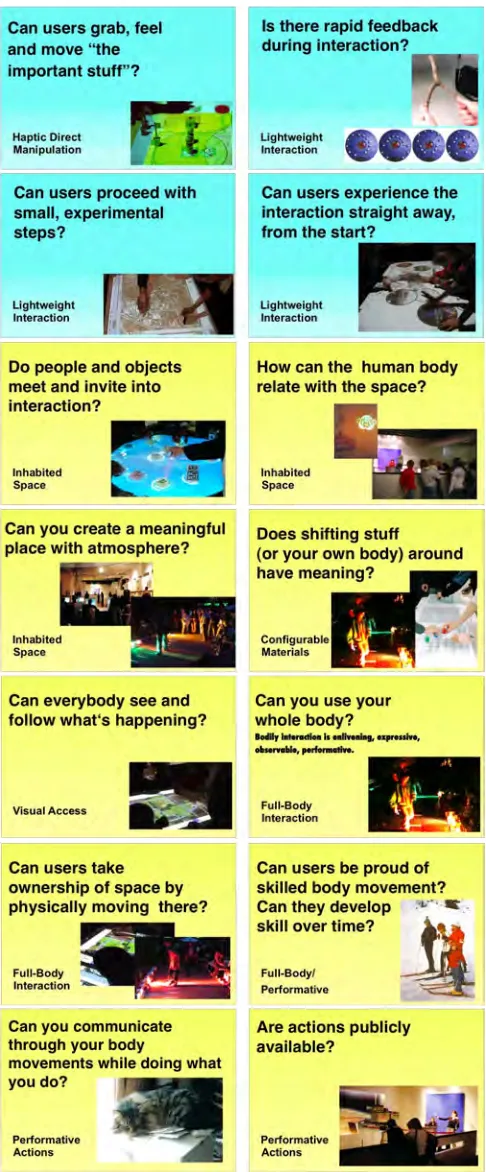
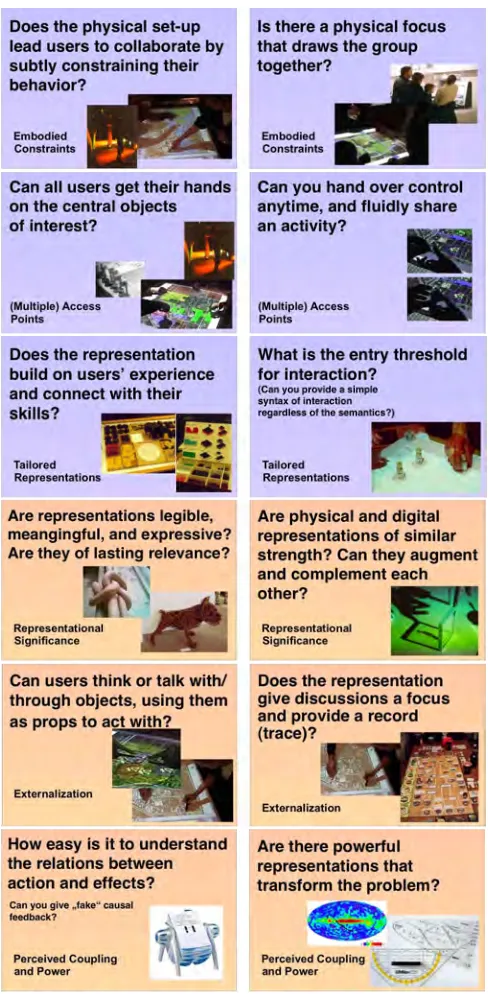
The original version of the framework was published in [10]. Overall, it consists of four themes, explicated in a set of concepts. This theoretical layer of themes and concepts sets apart a range of issues and supports deep analysis. The concepts are concretized in ‘provocative questions’ that work on a more pragmatic level. They are intended to support creative thinking and to be easily accessible, not requiring a deep understanding of theoretical issues and research terminology. Discussions with designers had made it clear that the framework should not provide ‘guidelines’ since the concepts are rather ‘things to think about’. There is a risk of guidelines being followed somewhat mechanically, trying to tick boxes. Moreover, not all issues would be relevant alike across application areas or might involve trade-offs (cf. [7]). Therefore all issues were ‘colloquially rephrased’ as open questions. These questions thus constitute suggestions that may be taken on or refuted. The four themes are: Tangible Manipulation (this refers to the haptic nature of interfaces and to lightweight modes of interaction), Spatial Interaction (this relates to the spatial nature of the setup and the ability to engage in full-body interaction), Embodied Facilitation (this highlights how physical, spatial, and programmed configuration of the system affect group interaction patterns), and Expressive Representation (this focuses on the expressive powers of interface objects and their support for human cognition). Over the past years, I have revised, extended, and rephrased the framework in response to insights and experiences made while using it. To summarize the evolution of the framework briefly, any concepts that were found to overlap were either merged or split, a few concepts were renamed, and others expanded to reflect recent work on entry and access [11] and the relevance of embodied skills. A major emphasis was on the concrete and pragmatic level of questions, which were reworked and extended to stand on their own (not requiring any additional reading or explanation), while still covering the entire framework. Figure 1 and 2 present the questions, as used within the brainstorming card exercise.
The card exercise constitutes a tool to be used within an analysis and design process; it is not a full-blown method for the entire design process. The focus of this paper is on this exercise, and thus it will present and discuss framework questions and overarching themes as they are now.
THE FRAMEWORK GAME
Question Cards, Basic Process and Rules
Inspired by the notion of design games and their card-game like artifacts and rules, the questions are printed each on a card. This has the added benefit of preventing them to
[image:2.612.315.558.51.637.2]
appear like a list of issues that can be ticked off. Physical cards further allow participants to sort them, spread them out, stack them, and even to throw them to the side. Each card (figure 1 and 2) shows a question in large text, the related concept in small font, and one or two images. The themes are intentionally omitted. Instead, cards are color-coded by theme. This was originally intended to support quick assessment of which themes are important for the project in question after a session. Over time, this turned out to be a useful feature, since people are accustomed to color or icon-based rules in card games. Another practical advantage is that colors help finding a specific card back.
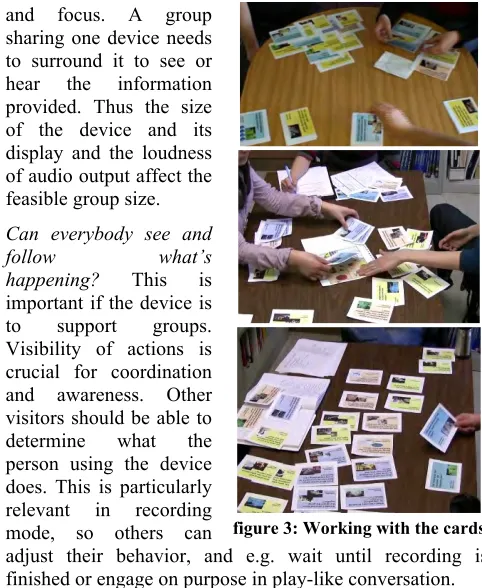
The phrasing of questions and imagery was revised several times based on participants’ feedback to improve legibility of cards. Images are to illustrate and allude to the question’s meaning, providing inspiration, while leaving space for interpretation. Any images that required much explanation or seemed unclear or confusing were replaced with everyday objects and evocative images, in particular with pictures that give positive examples of the core notion. For example, expressive representation is illustrated with the statue of an aggressive bulldog (woven from willow), hinting at a visceral, emotional legibility; lasting relevance with a knot in a marble pillar, rapid feedback with a divining rod, and a game-board illustrates a focus for discussions. Repeated use of the revised cards provided feedback on whether changes had been successful, until a stable version was reached at, which is presented here. At the start, cards are mixed and distributed as in a normal card game. Taking turns, people play a card they consider relevant or irrelevant, and explain their decision and thoughts. The group negotiates whether the card is relevant before the game moves on. With smaller groups, the card set is split up so that everybody had a subset as ‘a hand’. With larger groups, two to three people share a set. Usually, cards will be sorted into a cluster of very relevant cards, one of ‘somewhat related’ ones and an ‘irrelevant’ stack.
THE SESSIONS
Over the past years the framework card game has been employed on a wide variety of projects. One research goal was to explore its utility for different technological setups and application areas and to investigate which themes are relevant in which contexts. Hence, many sessions by intent concerned projects or technologies that might be considered a ‘distant relative’ for tangible interaction. About half discussed completed projects, with participants being interested in uncovering neglected issues and new insights. The other half was aimed at moving from situation analysis towards concept design or at fleshing out a core concept. Table 1 lists all ten sessions, numbered for reference, and shows how strongly framework themes applied to the projects discussed. Sessions took between 45 and 90 minutes. The author took part in several, partly for a first-hand experience, but also when asked to contribute. Seven of the ten sessions were recorded on video. During non-recorded sessions, notes were taken of what card triggered what ideas, and the resulting card set was photographed. After sessions, participants were asked for feedback about the game and the cards. This also was recorded or taken note of. The videos have been roughly transcribed, focusing on verbal utterances and card handling. This data e.g. documents the card sets decided upon as relevant. Transcripts and other data have been used during the post-hoc analysis. Quotes from this data are printed in italics. Next, two sessions are described in detail, focusing on session outcomes and applicability of framework themes, and an overview of the remaining eight is given.
[image:3.612.55.299.50.547.2]Case Study: Chawton, a Design Ideation Session During the early stages of the Chawton House project [8], members of the Sussex Interact Lab took part in a brainstorming session (#7) that imagined having further resources, exploring possible avenues for enriching the scenario. The aim of the project was to deliver novel visitor experiences to visitors of a historic country estate. Visitors should be enabled to explore its vast gardens on their own using a mobile context-aware device, while tapping into curators’ knowledge. Information (audio, text, images) was to be delivered based on contextual cues such as location or interests. The device should accommodate individuals and small groups. Besides of personalized tours, the research team was interested in user annotation so that curators and visitors might record stories in-situ. As a specific example for a visitor activity, a school fieldtrip on creative writing was designed in collaboration with teachers and curators [8]. Teachers valued the atmosphere and history of the place as inspiring children’s writing. These were to be enabled to save information and record audio (e.g. their own descriptions). When convening together, they should show each other what they collected and swap content. A group of lab members decided to use the project as scenario for a card brainstorming session. It was clear that this was only a thought experiment, as the project was already on its way. Nevertheless it was deemed ideal, ensuring the group had a good conception of setting and problem space. Overall, the setting and project goals focused the brainstorming, and the clearly hypothetical nature encouraged free development of ideas. Discussion was lively and controversial, resulting in a wide range of ideas that would have been interesting to pursue.
Can you create a meaningful place with atmosphere? This related immediately to the aim to build upon and enhance the site’s sense of place. By building layers of stories we can deepen its meaning. These can include e.g. stories told years ago, from other visitors, former servants and workers, or snippets from novels taking place in locations similar to the garden architecture (e.g. a walled garden or the wilderness, a managed forest), giving visitors an idea how people at that time perceived and used these places.
How does the human body relate with the space? This question seemed immediately relevant for the mobile use context. Users navigate by walking, and stories are attached to locations. The question suggested taking this idea to the extreme. Distance to locations could affect what happens. Devices could notice that people quickly approach a location or stop at a distance. People might then hear information that encourages them to look back and enjoy the view, or that lures them to go on. Audio might get louder if people approach, and provide navigation clues. Devices might notice if devices come into proximity, and invite further interaction, e.g. swapping of content.
Is there a physical focus that draws the group together?
The portable device can be seen as creating a shared space
and focus. A group sharing one device needs to surround it to see or hear the information provided. Thus the size of the device and its display and the loudness of audio output affect the feasible group size.
Can everybody see and follow what’s happening? This is important if the device is to support groups. Visibility of actions is crucial for coordination and awareness. Other visitors should be able to determine what the person using the device does. This is particularly relevant in recording mode, so others can
adjust their behavior, and e.g. wait until recording is finished or engage on purpose in play-like conversation.
Are actions publicly available? Are there powerful representations that transform the problem? These questions highlight the tangible aspects of interaction. A strategy for making actions easily observable is to require large and legible movements. The group developed the idea of scooping up sound with the portable device. This non-literal action would hopefully be comprehensible while having a magical element that children might enjoy.
Are representations legible, meaningful and expressive?
The group found that it would be nice if the device could look different from a standard PDA. In particular interaction could be tangible, replacing on-screen interactions with gestures or manipulations of things attached to the device (e.g. a sniffer).
[image:4.612.314.555.53.347.2]Session 7 was one of the early sessions, and thus there were a few requests to clarify the meaning of cards. Nevertheless, the game made the group discuss a wide variety of issues. The question format was very successful, some cards being vividly rejected, even playfully thrown away as irrelevant for the context. For this project, Tangible Manipulation was deemed important mostly in regard to support of intuitive use. Spatial Interaction and Embodied Facilitation were the most interesting themes in terms of inspiring ideas and discussion. The cards inspired a range of new ideas on how to enhance the role of the physical environment, how to use physical movement as interaction mechanism, on additional artifacts to enrich the activity, and coordination and content sharing mechanisms. Most of these aspects are easily overlooked when thinking of a project as device-centered, mobile technology.
Case Study: Tangible Aspects of Agile Programming Session 6 looked at field studies of agile programming teams [15], aiming to tease out the role of physicality, tangibility and embodiment for group coordination and awareness. A longer-term goal was to develop ideas on how to support distributed agile teams by emulating some of the aspects found crucial. Agile programming depends heavily on using paper, which is moved around, distributed, annotated, and handed on. The overall progress is documented publicly visible on a wall, and people often congregate there. With everybody in the room, physical movement provides important awareness cues supporting ad-hoc collaboration. Full-Body Interaction, physical configuration of objects (shifting stuff around), and team members moving to different areas of the workspace for different activities are the normal state of affairs. With a distributed team, this is rendered invisible.
A design idea for how to address this was that it might be feasible to detect if somebody approaches the project wall, and to indicate this at the remote location, while opening an audio channel. This would also support shared focus, currently created in so-called ‘stand-up meetings’ at the board. Pointing gestures and position of remote people could also be transmitted. If a developer takes a card from the project wall, this indicates they are taking on this task. In a collocated situation, Visual Access and Public Availability of actions are given. With a distributed board, a visual indication of who took a card needs to be provided. The analysis revealed that cards act as physical tokens for tasks, being reminders, props for conversations, and externalization. There is a strong sense of ownership for handwritten cards, it assisting in quick identification of who is responsible for a task or did a change. Their physical nature and the manual interaction contribute to expressivity and legibility, while providing a trace of past events (annotations). These aspects seem almost impossible to replicate digitally. One idea generated in the session was to use Anoto pens for writing and annotating cards, so that these could be reproduced on the remote site. A card written at one location could be handed to the other to be reprinted. A digital representation at both sites could reflect annotations. Another advantage of reprinting handwritten cards would be that the interaction patterns with cards are familiar for developers, the cards thus being ‘tailored representations’ and lightweight means of interaction.
In this session, the ‘problem owner’ considered the cards to be very effective in attaining a different perspective of the field study data, asking questions from new angles, and in triggering ideas. The cards enabled a creative connection between technology ideas and application issues, with one participant an expert on the application area and the other on potential technologies. This session was especially interesting in successfully combining a meta-analysis with the generation of design ideas.
Overview of the Remaining Sessions
Two analysis sessions were conducted with interaction design researchers at the University of Limerick. These concerned the Shannon Portal [3], and the Milk Market Recipe station [13]. The Shannon Portal was an installation in the shape of a dolmen located in Shannon airport with an adjacent big screen that reacts to people in front of it. People could upload or use existing photos, add text, and send these per email. The Portal was primarily a spatial installation, with no movable tangible parts. Yet its table-like shape and spatial setup were important for how people interacted with and around it. The Milk Market Recipe station was an installation inside a tent at a local market. Visitors could pick index cards with foodstuffs on them from boxes, and throw them into a little tower. The machine looks for recipes based on these ingredients and people can select among recipes and print them. Tangibility here clearly was part of the attraction, and people often browsed extensively through boxes before choosing cards to use. Many cards relating to Spatial Interaction and Embodied Facilitation were selected as highly relevant for the Portal. Tangible Manipulation and Expressive Representation seemed only weakly related. For the Recipe station, all four themes were central, and tangibility a core aspect. The exercise pointed out similar issues as investigated during the projects’ evaluation. A few potential avenues for further analysis were discovered, but at this point both projects were already being documented. Overall, the sessions confirmed the relevance of the cards for these very different projects and, from participants’ viewpoint, confirmed that previous analysis had not missed out important issues. A similar situation arose from two post-hoc analysis sessions (# 3 + 4) conducted at the University of Cambridge. The first project was on a distributed tabletop for remote collaboration and explores the use of 1. Shannon
Portal
2. Milk-market
3. Distant Tabletop
4. Personal Desktop TUI
5. Touch Game
6. Agile Program.
7. Chawton House
8. Genealogy application
9. Home Awareness
10. Museum Table
Tangible
Manipulation
?
Spatial Interaction
?
Embodied Facilitation
?
Expressive Representation
?
participants’ shadows in different configurations during discussion and design tasks [16]. This session explored whether the framework can be applied to spatially organized distant interaction. The other session discussed a personal desktop TUI that supports activities such as task/time management and document sharing, and drifts between focus and periphery of a user’s attention during office work (see [4]). Tokens on an interactive surface represent tasks and documents, can be personalized and annotated, and handed on to transfer tasks. Here the tool is tangible, but personal, only indirectly supporting collaboration, and manipulation is explicit.
For the distributed tabletop [16], Spatial Interaction and Embodied Facilitation were deemed important, with many cards from these themes selected, even though only the table itself was considered to be the interaction space. Tangible Manipulation and Expressive Representation were deemed irrelevant, as interaction is touch only, and the system a generic tool. Apart from users’ arms there are no representations. For the personal desktop TUI [4], Spatial Interaction was considered only partially relevant. For this project, Expressive Representation, Tangible Manipulation and the ability to tailor objects were deemed the most relevant strands of the framework.
Session 5, at the University of Calgary, focused on the post-hoc reflection of a project on a game played on a Diamondtouch surface. The game utilizes interpersonal touch as a game move. Embodied Facilitation and Spatial Interaction were the strongest themes (similar to the distributed tabletop session above), with ambivalence about whether interpersonal touch could be a form of tangibility. An open-ended brainstorming session (# 8) at the Open University started off from the initial idea of a multi-touch application that would allow families to explore their genealogy. This session was only a partial success, with a wide range of ideas developed, but the group not managing to focus on one avenue. The session lacked a sufficiently constrained starting point to focus discussion, with neither technology, use setting, users, nor design goal defined well. Two design-oriented sessions (# 9 + 10) were conducted at the University of Calgary. Both aimed at developing concrete ideas for applications based on prior analysis of a context. The first project was to develop applications or devices that support awareness of processes in the home (details confidential at time of writing). The concrete technology (screens, physical devices, desktop software) for presenting the awareness information was still unclear, and part of the design discussion focused on how best to integrate it into the physical, social and cultural context of a home. The framework game resulted in a very productive session that helped the researchers to collate and reflect field study data, literature analysis, and existing design ideas, while fostering new ideas. Overall, framework concepts around Expressive Representations were found the most relevant and useful for developing design ideas along
with Embodied Facilitation. Spatiality played a smaller role than usually, but did trigger discussions about location of screens and ideas on mobile devices reacting to location. The second project on tabletop installations in museums focused around explorative and artistic engagement with information on world politics (details confidential). Here the exercise guided a deeper consideration of the physical aspects of the installation (e.g. table style and shape), the space it would be situated in, and how this could enrich its meaning. The cards helped the group to flesh out core metaphors and stimulated discussion about collocated and asynchronous collaboration, and sharing of content. In this session all four themes were thought to be equally relevant.
DISCUSSION OF EXPERIENCES Where: Surprisingly Versatile
The projects chosen for the sessions were diverse by intent, covering a broad range of technologies, application areas, and use scenarios. Generally, two to three themes were deemed very relevant and only rarely was a theme completely dismissed (see table 1). Even with projects that deliberately stretched the notion of tangible interaction, participants found the questions useful and inspiring. To some extent, the nature of the project predicts which themes are relevant. Tangible Manipulation relates best when multiple objects are physically manipulated and Spatial Interaction applies well to spatial setups where users move around. As all projects had collaborative aspects, Embodied Facilitation was always relevant. Yet it is not always evident which themes will be most fruitful. Often ‘irrelevant’ and partially relevant cards could result in the most intense and fruitful debate, while a clearly relevant question was too obvious. Usability-related questions (e.g. ‘is there rapid feedback’) were often considered relevant, though non-interesting (standard usability) when analyzing systems, but triggered ideas in design-oriented sessions.
When: Hitting the Sweet Spot
good understanding of the problem is reached, use situation and core goals are decided upon, but there is still space to flesh out details. This understanding constrains and anchors conversation. While no session dealt with a project that had already been implemented, but not been evaluated, discussions of completed projects tended to confirm findings and to uncover additional issues, indicating the exercise might also be useful to plan evaluations.
How: Session Structure and Evolving Rules
Comparing sessions, it seems that a group size of at least three participants is advisable, as having more perspectives can challenge preconceptions and yield new ideas. Furthermore, it supports the rules, as turn-taking is evident and keeps participants in a game mode.
Over time, different variations of game rules were experimented with. Rules should make groups move between themes, and ensure that seemingly irrelevant cards are discussed. Game rules should furthermore pace the group and support turn-taking. Strict rules would require holding back ideas if a card is not allowed to be played. With soft rules, the group may ignore them temporarily (“I want to play this card because it carries on from what was just said”). An instruction that worked well to start the process was: Pick a question that strikes you as either relevant or irrelevant, that makes you think. The next person then picks one of the same color or a relevant card (if yours was relevant) and otherwise an irrelevant one. These rules were good to get discussion going. Groups then tended to improvise, handling related issues quickly after each other, or diverting from turn-taking to deal with a card that follows on from the previous (A puts a card next to one just played by B: “I think this is related”. B adds another card: “and this one”. C moves another card closer: “this is also related”) or placed two closely related two cards as one (“so these two are– we talked about this already – and they are so much related– they are kind of together”).
The Cards as Orienting Devices
The cards and game rules force participants to explain their decision and the group to negotiate. Dismissal of a card as non-relevant can trigger discussion and provoke ideas that extend the current concept, as in the following excerpt from a session: Alex: “I don’t think we got any physical representations, so this question is irrelevant.” Ben: “Can we have physical representations?” Chris: “We could introduce them” Aspects first deemed irrelevant often became relevant as the cards encouraged groups to explore the design space and think about options. In session 9, Ali asks: “does this card apply? It was about physical representation.” Marie, problem owner, replies: “This would depend on where I set it (system/screen) up, because that’s not decided yet. I think the question provokes that thought.” The willingness to interpret the questions loosely was a success factor for productive discussion, leading to new ideas. Sometimes cards also triggered thinking about
the reverse notion. E.g. ‘representations of lasting relevance’ inspired the idea of supporting printouts from an art installation, which then led to the question whether people might also bring in something. ‘Public availability of action’ raised questions about the interplay between visibility and privacy needs.
Feedback from session participants indicates that the cards successfully structure discussion, ensuring coverage of a wide set of issues, while being open to interpretation. The cards were described as fostering shifts of focus: “have you thought about this from all angles” and as thinking aid. Nel: “See it as, they are orienting devices. It helps us, as a group, orient towards the themes, and to come to some kind of agreement or not. It helps us think about our constraints”. Ben: “I think you just use it as a conversation
starter, (…) if it grinds to a halt just throw some cards in.”
The cards thus act as pace-maker. Louise explains: “You don’t get stuck too long. At some point somebody will say lets go to the next card.” Thus game structure and your own hand of cards provide an incentive and a legitimate argument to short-cut unproductive discussions.
some kind of organization”. Interaction with the cards could be very physical, being shuffled, spread out, handed over, turned around, and non-relevant cards being tossed away. Several participants remarked on the card game itself as a good example of tangible interaction. The cards are tangibly manipulated, invite and support spatial interaction, allowing for meaningful spatial arrangements that enable the group to exploring relations, while manipulations are visible to the rest of the group. The cards thus support legibility of action as well as performative behavior. They are expressive representations (this was one of the main aims in revision of text and imagery), and provide a record of discussion. Moreover, they are a form of embodied facilitation as they can be handed over, and do provide a physical focus while having a low entry threshold.
CONCLUSION
Frameworks often are high level and only abstractly inform design processes. While useful to evaluate ideas and systems, they rarely lend themselves to actively exploring a design space in a generative way. In addition, for practitioners the analytic frameworks used in HCI tend to take too much effort and time. Rogers [14] asks whether it is feasible to transfer theory-based knowledge so it becomes easier to use and suggests that for theory to inform design, a focus on the process of design is needed.
This paper described an approach for structuring idea generation that supports the free flow of ideas during brainstorming, while ensuring that the design space is viewed from different perspectives and informed by a framework. Different from most theory-led approaches, concepts are utilized to inspire discussion, and it is allowed to interpret them freely. Instead of prescriptive guidelines, the game provides open-ended suggestions and design provocations. This entails a risk of misinterpreting and diluting the original theory, but is consistent with the pragmatic and creative nature of design.
The contribution of this paper is on two levels. The card sessions have demonstrated the framework [10] themes’ relevance for a wide range of systems within the area of tangible, embedded and embodied interaction, and have provided a clearer understanding of which themes relate to which types of settings or systems. The question cards and the card exercise expand the original frameworks’ utility from the predominantly descriptive, explanatory and rhetorical towards the generative, with the cards designed to stand on their own, and to provoke creative ideation through a question format, leaving space for interpretation. This approach can be used as a tool within a larger design process. It does not constitute a method in itself, as it is still left to the designer to e.g. sort and filter ideas. The experiences described here provide indication for the utility of the card brainstorming exercise and give readers some guidance on when and how to run it. The cards will be made available for download with instructions on http://www.ehornecker.de/TangiblesFramework.html.
ACKNOWLEDGMENTS
Thanks to all participants, their institutions, and all who discussed framework, game, and cards over the years with me, to Luigina Ciolfi and Uta Hinrichs for feedback on early paper versions. This work was funded by DFG fellowship grant Ho3901/1-1.
REFERENCES
1. Antle, A. The CTI framework: informing the design of tangible systems for children. Proc. of TEI’2007, ACM, 195-202.
2. Brandt, E., Messeter, J. Facilitating collaboration through design games. Proc. of PDC’04. ACM. 121-131 3. Ciolfi, L., et. al. The Shannon Portal Installation: An
Example of Interaction Design for Public Places, IEEE Computer, July 2007. 65-72.
4. Edge, D., Blackwell, A. Peripheral Tangible Interaction by Analytic Design. Proc. of TEI’09. ACM. 69-76 5. Fernaeus, Y., Tholander, J., Jonsson, M. Towards a new
set of ideals. Proc of TEI’2008, ACM, 223-230 6. Fishkin, K. P. A taxonomy for and analysis of tangible
interfaces. Personal and Ubiquitous Computing, 8 (5), (2004). 347-358
7. Jacob, R. et al. Reality-based interaction. A Framework for Post-WIMP Interfaces. Proc. CHI’2008. ACM. 201-210.
8. Halloran, J. et al. The Literacy Fieldtrip: Using
Ubicomp to Support Children’s Creative Writing. Proc. of IDC’2006, ACM. 17-2
9. Halskov, K. Dalsgard, P. Inspiration Card Workshops.
Proc. of DIS’2006, ACM, 2-11
10.Hornecker, E., Buur, J. Getting a grip on tangible interaction: A framework on physical space and social interaction. Proc. of CHI’2007, ACM, 437-446
11.Hornecker, E., Marshall, P., Rogers, Y. Entry and access – How shareability comes about. Proc. of DPPI’2007.
ACM, 328-342
12.Mackay, W.E. The Interactive Thread: Exploring Methods for Multi-disciplinary Design. Proc. of DIS’2004, ACM, 103-112.
13.McLoughlin, M., The Recipe Station: Technology Facilitating Social Interaction in a Public Environment.
Proc. of Create 2008, London.
14.Rogers, Y. New Theoretical approaches for Human-Computer Interaction. Annual Review of Information, Science and Technology, 38, (2004) 87-143
15.Sharp, H., Robinson, H., Petre, M. The role of physical artefacts in agile software development. Interacting with Computers Vol. 21, Nr. 1-2 (2009). 108-116
16.Tuddenham, P., Robinson, P. Territorial Coordination and Workspace Awareness in Remote Tabletop Collaboration. Proc. of CHI'2009, ACM, 2139-2148 17.Schön, D. Educating the Reflective Practicioner. San
Francisco, London: Jossey-Bass (1989)