Modelling Project Complexity driven Risk Paths in
New Product Development
(presented at the 6th IESM Conference, October 2015, Seville, Spain) © I4e2 2015
Abroon Qazi, John Quigley, Alex Dickson
Strathclyde Business SchoolUniversity of Strathclyde G4 0QU Glasgow, UK
(abroon.qazi, j.quigley, alex.dickson)@strath.ac.uk
Konstantinos Kirytopoulos
School of Natural and Built EnvironmentsUniversity of South Australia Adelaide, Australia
Abstract—Project complexity has been extensively explored in the literature because of its major contribution towards the failure of major projects in terms of cost and time overruns. Researchers have identified important factors that contribute to the project complexity and validated their findings through case studies. Few studies have even focused on developing tools for evaluating the project complexity. However, existing research has not explored an important aspect of linking project complexity to different types of project and supply chain risks. We propose a framework for establishing risk paths across project complexity elements, project and supply chain risks, and resulting consequences. Project complexity elements are the knowns at the commencement stage of a project whereas project and supply chain risks are the uncertainties that might realize within the life cycle of the project. We demonstrate application of our proposed framework through a simple simulation example using Bayesian Belief Network. The method can be an important contribution to the literature and beneficial to the practitioners in terms of introducing a new perspective of investigating causal paths of interacting project complexity elements and risks.
Keywords—Project complexity; project and supply chain risks; risk paths; Bayesian Belief Network
I. INTRODUCTION
Long-term engineering development projects often result in major delays and cost overruns and therefore, keeping in view the complexity of such projects, it is extremely important to consider interdependency between risks and involve different stakeholders in identifying key risks [1]. Boeing adopted an unconventional supply chain and introduced loss-sharing partnership in the development project of 787 Dreamliner in order to reduce financial risks and development time, however, the project was delayed incurring major financial penalty because the project team did not realize the importance of assessing and managing supply chain risks before commencement of the project [2].
Complexity in projects relate to structural elements, dynamic elements and interaction of these elements across the broad categories of technical, organizational and environmental domains. Technical elements focus on the technical aspects of a project, organizational elements capture softer perspective while environmental elements influence the project and
stakeholders from outside the project scope [3]. Analytical hierarchy process has been used to measure project complexity [4]. However, it is not only important to understand the complexity of a project but also to visualize the complex interaction between these complexity elements and risks in order to plan and implement appropriate risk mitigation strategies. Moreover, these risks must also be connected to the project objectives which in turn will influence the utility function of the decision maker.
Bayesian Belief Networks (BBNs) offer an effective modelling technique for capturing these complex interactions between risks [5, 6]. BBN is an acyclic directed graph representing uncertain variables as nodes and the causal relationship between variables as arcs. The strength of causal relationship is captured through conditional probability values. We make use of the BBNs in modelling the project complexity elements (knowns at the Project commencement stage) as deterministic nodes and risks and objectives as chance nodes. A utility node is also incorporated in our model for characterizing the utility function of a decision maker in relation to the project objectives.
Research Gap and Contribution
Major projects involving new product development often result in cost and time overruns. Project complexity elements pose vulnerabilities to the successful culmination of these projects. No existing study has focused on capturing the interaction between the knowns (complexity attributes) at the commencement stage of a project and the unknowns realizing within the life cycle of the project. We propose a new approach of modelling causal paths across project complexity elements, risks and consequences affecting the project objectives. The proposed approach will help researchers focus on an important theme of investigating causal paths within a setting of interconnected vulnerabilities, risks and consequences. Furthermore, the research is equally beneficial to practitioners in terms of helping them visualize the interaction of different causal paths and identify important risks for implementing mitigation strategies.
Outline
Literature review is briefly presented in Section II. Our proposed framework is described in Section III followed by its
demonstration as a simulation study in Section IV. Results and managerial implications are discussed in Section V followed by the description of conclusion and future research in Section VI.
II. LITERATURE REVIEW
Project Complexity
Baccarini [7] defined project complexity as ‘consisting of many varied interrelated parts’ and operationalized it in terms
of differentiation and interdependency. He emphasized the
importance of clearly establishing the context of project complexity within the broad dimensions of organization, technology, environment, information, decision making and systems. Furthermore, he reiterated the need for differentiating the concept of project complexity from two other project characteristics-size and uncertainty.
Bosch-Rekveldt et al. [3] presented a comprehensive framework for characterizing project complexity in large engineering projects. The framework is designed across the technical, organizational and environmental facets of interconnected network of organizations. The study focused on a literature survey followed by the empirical work comprising interviews about six projects in the process engineering industry. It can be of great value to the practitioners in assessing the project complexity and adapting the front-end development phase of projects in order to manage the assessed complexity. However, the proposed framework does not capture the complex interaction between identified complexity factors and risks. Their proposed complexity elements do not distinguish between the complexity features and other project characteristics of size and uncertainty.
Vidal et al. [4] introduced a multi-criteria approach of evaluating project complexity measure through the use of Analytic Hierarchy Process. They validated their framework through a case study conducted in the entertainment industry. He et al. [8] developed a complexity measurement model based on the Shanghai Expo construction project in China using Fuzzy Analytic Network Process. Evaluation of complexity measure can help practitioners understand the complexity of a project, however, it might not be of great use in terms of understanding the impact of these attributes on the project objectives and uncertainties.
Risks in New Product Development
Ahmed et al. [9] conducted a comprehensive review of literature focusing on risk management techniques in product development projects using the concurrent engineering philosophy. Risk management is gaining importance in the field of project management because of the companies striving for global competition. Khan et al. [10]conducted an in-depth longitudinal case study of a major UK retailer and provided a framework for design-led supply chain risk management emphasizing the need to include product design consideration in the development of global supply chain strategies. Chin et al. [11] identified critical risk factors involved in the new product development and proposed a systematic probability generation approach of populating the Bayesian network comprising risk factors.
Boeing utilized an unconventional supply chain for the development of 787 Dreamliner in order to drastically reduce development cost and time, however, the project objectives could not be met. Tang et al. [2] analysed the rationale of Boeing for choosing the unconventional supply chain and described the challenges faced during the execution of project. They also recommended important considerations for the manufacturers involved in designing supply chains for new product development. The study also highlights the importance of assessing key risks before the commencement of such major projects and implementing proactive risk mitigation strategies. Lin and Zhou [12] conducted a case study in the Chinese special-purpose vehicle industry and presented their findings in the shape of fishbone diagram representing major supply chain risks faced by the focal company in relation to the design changes proposed by the customers.
Pashaei and Olhager [13] conducted a systematic review of the extant literature on the relationship between product architectures and supply chain design. They identified a major research gap concerning limited research on the management of risks associated with product architectures and supply chain design. According to Qazi et al. [14], there is a need for conducting extensive research in investigating best practices of supply chain risk management associated with new product development.
Causal Mapping of Project and Supply Chain Risks
Fidan et al. [15] introduced an ontology for linking risk and vulnerability to cost overrun in international construction projects. They attributed poor definition of risk and patterns of risk propagation as the major limitation of existing techniques in modelling and evaluating project risks. Their proposed framework can be extended to incorporate impact of risks and vulnerabilities on other project objectives as well. Following the same ontology, Yildiz et al. [16] developed a knowledge-based risk mapping tool for cost estimation of international construction projects. They validated the reliability of their developed tool through conducting a case study relating to a construction project. The major limitation of their model relates to the linking of project complexity to the design feature of project only. Project complexity can have an impact on multiple risks and it is important to capture the holistic interaction of project complexity elements and risks. Eybpoosh et al. [17]introduced the concept of identifying risk paths in international construction projects using Structural Equation Modelling. They have emphasized the need for treating risks as interconnected web of interacting vulnerabilities, sources, risks and resulting losses. However, their proposed modelling approach might not be beneficial in propagating evidence through the network.
missing data on relative strength measures of interconnected risks.
Ackermann et al. [1] developed a modelling process to help project managers appreciate the impact of interactions between project risks through explicitly engaging a wide stakeholder base using a group support system and causal mapping process. Keeping in view the limitations of existing techniques for managing project risks in terms of treating risks as independent and anchoring on classical risk identification techniques, their study focuses on developing a comprehensive process involving a problem structuring method of causal mapping and a group support system in order to elicit a holistic view of systemic risks encompassing wide range of stakeholders. Application of such brainstorming techniques involving multiple stakeholders can help the project owner understand dynamics of interacting risks across the domains of other stakeholders.
Badurdeen et al. [5] developed supply chain risk taxonomy and introduced risk network map capturing interdependency between risks. They applied their modelling approach in the Boeing’s development project of a product used in guidance systems for military applications. They were able to incorporate the impact of different risk factors on the performance measures of quality, timeliness and cost in their model. However, they did not focus on the relative importance
of each objective for the main stakeholder as each specific allocation of relative weights to the utility function results in different outcomes concerning identification of key risk factors. Though they have presented the causal interaction of risks in the form of a risk map but their proposed taxonomy does not differentiate between the vulnerabilities, risks and resulting losses.
III. PROPOSED FRAMEWORK AND MODELLING APPROACH
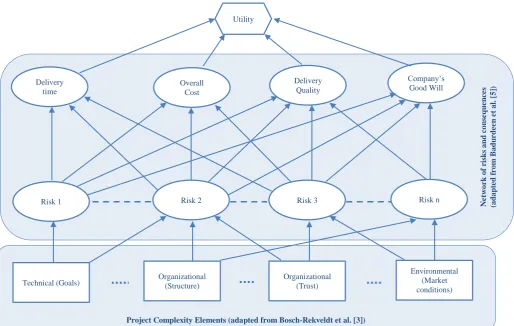
[image:3.595.44.559.360.686.2]It is significant to understand the complexity of a project before the commencement stage. We propose a new approach of integrating project complexity attributes, resulting risks, project objectives and utility function of a decision maker into a single model as shown in Fig. 1. Various characteristics of a project including but not limited to outsourced percentage of design and development task, extent of technological innovation and experience with technology contribute to different risks. It is also necessary to distinguish between controllable and uncontrollable risks for planning mitigation strategies. The resulting risk events in turn affect the performance measures (objectives) of a project like time, cost, quality and so on. Each decision maker does have a specific utility function characterized by the relative weighting scheme assigned to the project objectives. Process for the development of our proposed model is shown in Fig. 2.
Fig. 1.Framework capturing causal paths across project complexity elements, risks and project objectives.
N
et
w
o
rk
o
f
ri
sk
s
a
n
d
c
o
n
se
q
u
en
ce
s
(a
d
a
p
te
d
f
ro
m
B
a
d
u
rd
ee
n
e
t
a
l.
[
5
])
Project Complexity Elements (adapted from Bosch-Rekveldt et al. [3])
Utility
Delivery time
Overall Cost
Delivery Quality
Company’s Good Will
Risk 1 Risk 2 Risk 3 Risk n
Technical (Goals) Organizational (Structure) Organizational (Trust)
Fig. 2.Flowchart for developing and using the proposed model (adapted from Sigurdsson et al. [19]).
We adapt the BBN based modelling approach [19] for the implementation of our proposed approach. The first stage of Problem Structuring involves identification of project complexity attributes (knowns at the project commencement stage) and objectives, project and supply chain risks, and development of the network structure followed by representing these as statistical variables. In the second stage of Instantiation, conditional probability values and utility function are specified for respective nodes. In the final stage of Inference, evidence in the form of project characteristics and risks is fed into the model and propagated in order to conduct sensitivity analysis. Finally, key risk factors are identified on the basis of detailed analysis and mitigation strategies are planned at the commencement stage of the project.
IV. SIMULATION STUDY
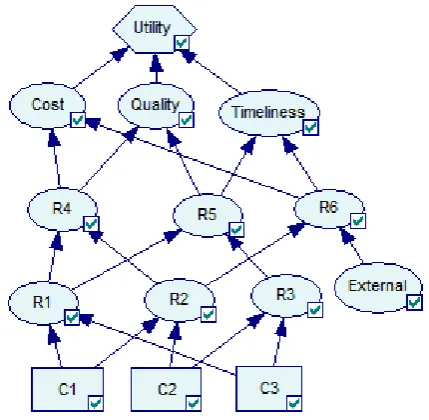
We present a very simple model for illustrating the application of our proposed approach as shown in Fig. 3. All the oval shaped nodes represent uncertain variables. Diamond shaped node at the top represents the overall utility function of the decision maker. At the bottom, three project complexity elements have been represented as C1, C2 and C3. Each of C1 and C3 comprises two states of ‘High (H)’ and ‘Low (L)’ that may be considered as the degree of technological innovation and interfaces between different disciplines respectively. C2 comprises binary states of ‘Yes (Y)’ and ‘No (N)’ that may represent the attribute of ambiguity in project scope. The hypothetical project is considered having states of ‘High’ against each of C1 and C3 and ‘Yes’ for C2. All risk factors have binary states of ‘True (T)’ and ‘False (F)’. ‘External’ represents a trigger which is not controllable having the
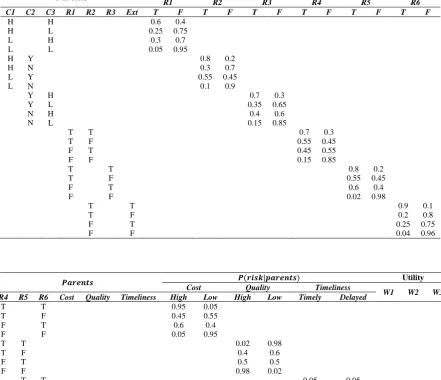
probability of occurrence as 0.4. Three project objectives of Cost, Quality and Timeliness are selected. Three different weighting schemes have been assigned to the project objectives representing relative importance of each objective to the decision maker. Weighting scheme ‘W1’ assigns equal weightage to all three objectives whereas weighting schemes ‘W2’ and ‘W3’ consider Cost and Timeliness as significant objectives respectively. Conditional probability and utility values for the model are shown in Table I.
Fig. 3.Simulation model developed in GeNIe [20].
Identify project complexity elements and objectives
Identify project/supply risks and network structure
Express as statistical variables
Specify conditional probability and utility values
Enter evidence specifying project characteristics
Propagate and conduct sensitivity analysis
Identify key risks and plan mitigation strategies Problem
Structuring
Instantiation
[image:4.595.329.544.485.695.2]TABLE I. CONDITIONAL PROBABILITY AND UTILITY VALUES
𝑷𝒂𝒓𝒆𝒏𝒕𝒔 𝑷(𝒓𝒊𝒔𝒌|𝒑𝒂𝒓𝒆𝒏𝒕𝒔)
R1 R2 R3 R4 R5 R6
C1 C2 C3 R1 R2 R3 Ext T F T F T F T F T F T F
H H 0.6 0.4
H L 0.25 0.75
L H 0.3 0.7
L L 0.05 0.95
H Y 0.8 0.2
H N 0.3 0.7
L Y 0.55 0.45
L N 0.1 0.9
Y H 0.7 0.3
Y L 0.35 0.65
N H 0.4 0.6
N L 0.15 0.85
T T 0.7 0.3
T F 0.55 0.45
F T 0.45 0.55
F F 0.15 0.85
T T 0.8 0.2
T F 0.55 0.45
F T 0.6 0.4
F F 0.02 0.98
T T 0.9 0.1
T F 0.2 0.8
F T 0.25 0.75
F F 0.04 0.96
𝑷𝒂𝒓𝒆𝒏𝒕𝒔 𝑷(𝒓𝒊𝒔𝒌|𝒑𝒂𝒓𝒆𝒏𝒕𝒔) Utility
Cost Quality Timeliness
W1 W2 W3
R4 R5 R6 Cost Quality Timeliness High Low High Low Timely Delayed
T T 0.95 0.05
T F 0.45 0.55
F T 0.6 0.4
F F 0.05 0.95
T T 0.02 0.98
T F 0.4 0.6
F T 0.5 0.5
F F 0.98 0.02
T T 0.05 0.95
T F 0.35 0.65
F T 0.4 0.6
F F 0.5 0.5
High High Timely 0.66 0.3 0.8
High Low Timely 0.33 0.1 0.6
High High Delayed 0.33 0.1 0.25
High Low Delayed 0 0 0
Low High Timely 1 1 1
Low Low Timely 0.66 0.85 0.75
Low High Delayed 0.66 0.85 0.3
Low Low Delayed 0.33 0.7 0.2
V. RESULTS AND DISCUSSION
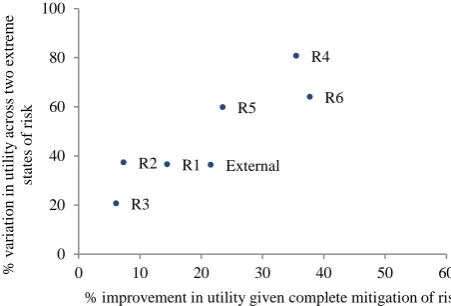
The main purpose of undertaking this simulation study was to demonstrate the application of our proposed approach in capturing interaction between project complexity elements, risks and project objectives. Keeping the overall utility node as the target node, we instantiated each risk factor to the two extreme states and registered the corresponding utility values. In order to identify key risk factors for further improvement, we calculated the percentage improvement in utility given complete mitigation of each risk factor in turn. Furthermore, we also calculated the percentage variation in the utility across
higher than R2) which directly influences R4. R6 is another important risk factor and it is interesting to observe that both these risks share common risk source of R2. If the risks appearing as significant factors are not observable then the underlying causes or risks must be dealt with. When the causality of key risks is mainly determined by their parent nodes and the key risks share common underlying causes, it will be beneficial to plan mitigation strategies in eliminating those causes. Risk spectrum for the other weighting schemes of W2 and W3 is shown as Fig. 5 and Fig. 6 respectively. These graphs differ in terms of displaying different values for measures of key risks under specific weighting scheme.
It is important to understand that the condition of complete mitigation of a risk necessitates reducing the impact of its causal sources. For example, in Fig. 4, it is shown that complete mitigation of R6 will result in achieving the maximum percentage improvement of the overall utility. However, given the fact that R6 is greatly influenced by the states of its parent nodes ‘R2’ and ‘External’, mitigating R6 will require dealing with the root causes of this risk. Similarly, once the risk event represented by R6 is observed, it will already have caused damage to the project objectives through activation of underlying risk paths. Therefore, the causal paths must be given due consideration in planning effective mitigation strategies.
[image:6.595.319.548.59.191.2]We also ranked the risks on the basis of their impact on utility function corresponding to the three weighting schemes as shown in Table II. Importance score of each risk was evaluated as the modulus of its unique two-dimensional vector represented in Fig. 4-6. Identification of key risks is contingent upon the specific allocation of weighting scheme to the utility function. We also investigated the impact of variation in project complexity attributes on the risks and project objectives. The resulting graph is shown in Fig. 7. It can be observed that the risks and resulting consequences are highly sensitive to the project characteristics. Such an analysis can be of great help to the project stakeholders in understanding the impact of project complexity features at the commencement stage of the project on their objectives. It can help them visualize the propagation of risks and plan appropriate mitigation strategies taking into account the domain of each stakeholder.
[image:6.595.309.523.431.537.2]Fig. 4.Impact of individual risks on utility under weighting scheme ‘W1’.
Fig. 5.Impact of individual risks on utility under weighting scheme ‘W2’.
Fig. 6.Impact of individual risks on utility under weighting scheme ‘W3’.
TABLE II. RANKING OF RISKS IN RELATION TO DIFFERENT WEIGHTING
SCHEMES
Risk Ranking under Weighting Scheme
W1 W2 W3
R1 5 5 5
R2 6 4 6
R3 7 7 7
R4 1 2 3
R5 3 6 2
R6 2 1 1
External 4 3 4
Managerial Implications
Our proposed framework and modelling approach present a holistic picture of interacting project complexity attributes, risks and project objectives. Managers can visualize interaction between different risks, appreciate the propagation patterns through risk paths and locate key risks endangering the success of a project. Furthermore, in case of high risks involved in a project because of the project complexity, the project owner might either bring changes in the features at the commencement stage or plan effective control strategies taking into account the interdependency between various factors. The model also captures the decision maker’s personal preference of each project objective in the form of utility function.
R1 R2 R3 R4 R5 External R6 0 20 40 60 80 100
0 10 20 30 40 50 60
% v ar ia ti o n i n u ti li ty a cr o ss t w o e x tr eme sta te s o f risk
% improvement in utility given complete mitigation of risk
R1 R2 R3 R4 R5 External R6 0 20 40 60 80 100
0 10 20 30 40 50 60
% v ar ia ti o n i n u ti li ty a cr o ss t w o ex tr eme st at es o f ri sk
% improvement in utility given complete mitigation of risk
R1 R2 R3 R4 R5 External R6 0 20 40 60 80 100
0 10 20 30 40 50 60
% v ar ia ti o n i n u ti li ty a cr o ss t w o ex tr eme st at es o f ri sk
[image:6.595.50.276.537.690.2]Fig. 7.Impact of project complexity attributes on risks and project objectives.
VI.CONCLUSION
Long-term projects involving major technological innovation often result in major delays and cost overruns. The situation is further exacerbated by the complexity resulting from global outsourcing. It is important to consider chains of adverse events originating from the project complexity features and influencing the project objectives through active risk paths. Existing literature has not addressed the issue of investigating these risk paths within a setting of interconnected web of project complexity elements, project and supply chain risks and project objectives. We have proposed a conceptual research framework and modelling approach for capturing the holistic interaction between mentioned factors and also demonstrated its application through a simple simulation example that gave
an insight into understanding dynamics across risks and identifying key risks.
Project complexity measure can help practitioners understand the project complexity but it might not be of significant use in managing the project and supply chain risks. It is important to investigate the interaction of project complexity and resulting risks. Bayesian belief networks can capture these dynamics and help practitioners visualize propagation patterns of risk paths. In future, the proposed framework will be further developed and validated in the context of construction projects. Furthermore, experts will be consulted in evaluating efficacy of the framework.
REFERENCES
[1] Ackermann, F., Howick, S., Quigley, J., Walls, L., et al., Systemic risk elicitation: Using causal maps to engage stakeholders and build a comprehensive view of risks. European Journal of Operational Research, 2014. 238(1): pp. 290-299.
[2] Tang, C.S., Zimmerman, J.D., and Nelson, J.I., Managing New Product Development and Supply Chain Risks: The Boeing 787 Case. Supply Chain Forum: an International Journal, 2009. 10(2): pp. 74-86.
[3] Bosch-Rekveldt, M., Jongkind, Y., Mooi, H., Bakker, H., et al., Grasping project complexity in large engineering projects: The TOE (Technical, Organizational and Environmental) framework. International Journal of Project Management, 2011. 29(6): pp. 728-739.
[4] Vidal, L.-A., Marle, F., and Bocquet, J.-C., Measuring project complexity using the Analytic Hierarchy Process. International Journal of Project Management, 2011. 29(6): pp. 718-727.
[5] Badurdeen, F., Shuaib, M., Wijekoon, K., Brown, A., et al., Quantitative modeling and analysis of supply chain risks using Bayesian theory. Journal of Manufacturing Technology Management, 2014. 25(5): pp. 631-654.
[6] Lee, E., Park, Y., and Shin, J.G., Large engineering project risk management using a Bayesian belief network. Expert Systems with Applications, 2009. 36(3, Part 2): pp. 5880-5887.
[7] Baccarini, D., The concept of project complexity—a review. International Journal of Project Management, 1996. 14(4): pp. 201-204.
[8] He, Q., Luo, L., Hu, Y., and Chan, A.P.C., Measuring the complexity of mega construction projects in China—A fuzzy analytic network process analysis. International Journal of Project Management, 2015. 33(3): pp. 549-563.
[9] Ahmed, A., Kayis, B., and Amornsawadwatana, S., A review of techniques for risk management in projects. Benchmarking: An International Journal, 2007. 14(1): pp. 22-36.
[10] Khan, O., Christopher, M., and Burnes, B., The impact of product design on supply chain risk: a case study. International Journal of Physical Distribution & Logistics Management, 2008. 38(5): pp. 412-432.
[11] Chin, K.-S., Tang, D.-W., Yang, J.-B., Wong, S.Y., et al., Assessing new product development project risk by Bayesian network with a systematic probability generation methodology. Expert Systems with Applications, 2009. 36(6): pp. 9879-9890.
[12] Lin, Y. and Zhou, L., The impacts of product design changes on supply chain risk: a case study. International Journal of Physical Distribution & Logistics Management, 2011. 41(2): pp. 162-186. [13] Pashaei, S. and Olhager, J., Product architecture and supply chain
design: a systematic review and research agenda. Supply Chain Management: An International Journal, 2015. 20(1): pp. 98-112. 0
0.1 0.2 0.3 0.4 0.5 0.6 0.7 0.8 0.9
P
(R
i=
T
ru
e)
C1=H, C2=Y, C3=H
[14] Qazi, A., Quigley, J., and Dickson, A. Supply Chain Risk Management: Systematic literature review and a conceptual framework for capturing interdependencies between risks. in 5th International Conference on Industrial Engineering and Operations Management. 2015. Dubai, UAE.
[15] Fidan, G., Dikmen, I., Tanyer, A.M., and Birgonul, M.T., Ontology for Relating Risk and Vulnerability to Cost Overrun in International Projects. Journal of Computing in Civil Engineering, 2011. 25(4): pp. 302-315.
[16] Yildiz, A.E., Dikmen, I., Birgonul, M.T., Ercoskun, K., et al., A knowledge-based risk mapping tool for cost estimation of international construction projects. Automation in Construction, 2014. 43(0): pp. 144-155.
[17] Eybpoosh, M., Dikmen, I., and Birgonul, M.T., Identification of Risk Paths in International Construction Projects Using Structural Equation Modeling. Journal of Construction Engineering and Management, 2011. 137(12): pp. 1164-1175.
[18] Fang, C., Marle, F., Zio, E., and Bocquet, J.-C., Network theory-based analysis of risk interactions in large engineering projects. Reliability Engineering & System Safety, 2012. 106(0): pp. 1-10. [19] Sigurdsson, J.H., Walls, L.A., and Quigley, J.L., Bayesian belief nets
for managing expert judgement and modelling reliability. Quality and Reliability Engineering International, 2001. 17(3): pp. 181-190. [20] GeNIe. The Decision Systems Laboratory, GeNIe and SMILE. 2015