ANDERS CLAESSON, V´IT JEL´INEK, EVA JEL´INKOV ´A, AND SERGEY KITAEV
Abstract. Motivated by the concept of partial words, we introduce an anal-ogous concept of partial permutations. Apartial permutation of lengthnwith k holes is a sequence of symbols π=π1π2· · ·πn in which each of the
sym-bols from the set{1,2, . . . , n−k}appears exactly once, while the remaining
ksymbols ofπare “holes”.
We introduce pattern-avoidance in partial permutations and prove that most of the previous results on Wilf equivalence of permutation patterns can be extended to partial permutations with an arbitrary number of holes. We also show that Baxter permutations of a given lengthkcorrespond to a Wilf-type equivalence class with respect to partial permutations with (k−2) holes. Lastly, we enumerate the partial permutations of lengthnwithkholes avoiding a given pattern of length at most four, for eachn≥k≥1.
Keywords: partial permutation, pattern avoidance, Wilf-equivalence, bijec-tion, generating funcbijec-tion, Baxter permutation
MSC (2000):05A15
1. Introduction
Let Abe a nonempty set, which we call an alphabet. Aword overA is a finite sequence of elements ofA, and thelengthof the word is the number of elements in the sequence. Assume that is a special symbol not belonging toA. The symbol will be calleda hole. Apartial word overAis a word over the alphabetA∪ {}. In the study of partial words, the holes are usually treated as gaps that may be filled by an arbitrary letter of A. Thelength of a partial word is the number of its symbols, including the holes.
The study of partial words was initiated by Berstel and Boasson [6]. Partial words appear in comparing genes [25]; alignment of two sequences can be viewed as a construction of two partial words that are compatible in the sense defined in [6]. Combinatorial aspects of partial words that have been studied include periods in partial words [6, 29], avoidability/unavoidability of sets of partial words [7, 9], squares in partial words [20], and overlap-freeness [21]. For more see the book by Blanchet-Sadri [8].
Let V be a set of symbols not containing . A partial permutation of V is a partial word πsuch that each symbol ofV appears in πexactly once, and all the remaining symbols ofπare holes. LetSk
n denote the set of all partial permutations of the set [n−k] ={1,2, . . . , n−k} that have exactly k holes. For example, S1 3
contains the six partial permutations 12, 12, 21, 21,12, and21. Obviously, all elements ofSk
n have length n, and|Snk|= n k
(n−k)! =n!/k!. Note that S0 n is the familiar symmetric groupSn. For a setH ⊆[n] of sizek, we letSnH denote the set of partial permutations π1· · ·πn ∈ Snk such that πi = if and only if i ∈ H. We remark that our notion of partial permutations is somewhat reminiscent of
the notion of insertion encoding of permutations, introduced by Albert et al. [1]. However, the interpretation of holes in the two settings is different.
In this paper, we extend the classical notion of pattern-avoiding permutations to the more general setting of partial permutations. Let us first recall some definitions related to pattern avoidance in permutations. LetV ={v1, . . . , vn}withv1<· · ·<
vn be any finite subset of N. Thestandardization of a permutationπ onV is the permutation st(π) on [n] obtained fromπby replacing the letterviwith the letteri. As an example, st(19452) = 15342. Givenp∈ Sk andπ∈ Sn, anoccurrence ofpin
πis a subwordω=πi(1)· · ·πi(k)ofπsuch that st(ω) =p; in this contextpis called
a pattern. If there are no occurrences ofpin π we also say thatπ avoids p. Two patterns pandq are calledWilf-equivalent if for eachn, the number ofp-avoiding permutations inSn is equal to the number ofq-avoiding permutations inSn.
Letπ∈ Sk
n be a partial permutation and leti(1)<· · ·< i(n−k) be the indices of the non-hole elements ofπ. A permutationσ∈ Sn is anextensionofπif
st(σi(1)· · ·σi(n−k)) =πi(1)· · ·πi(n−k).
For example, the partial permutation 21 has three extensions, namely 312, 321 and 231. In general, the number of extensions ofπ∈ Sk
n is n k
k! =n!/(n−k)!. We say thatπ∈ Sk
n avoids the patternp∈ S`if each extension ofπavoidsp. For example,π= 32154 avoids 1234, butπdoes not avoid 123: the permutation 325164 is an extension ofπand it contains two occurrences of 123. LetSk
n(p) be the set of all the partial permutations inSk
n that avoidp, and let skn(p) =|Snk(p)|. Similarly, if H ⊆[n] is a set of indices, then SH
n(p) is the set of p-avoiding permutations in SH
n , andsHn(p) is its cardinality.
We say that two patterns p and q are k-Wilf-equivalent if sk
n(p) = skn(q) for all n. Notice that 0-Wilf equivalence coincides with the standard notion of Wilf equivalence. We also say that two patterns pandq are?-Wilf-equivalentifpand q are k-Wilf-equivalent for all k ≥ 0. Two patterns pand q are strongly k -Wilf-equivalent if sH
n(p) = sHn(q) for each n and for each k-element subset H ⊆ [n]. Finally,pandqarestrongly?-Wilf-equivalentif they are stronglyk-Wilf-equivalent for allk≥0.
We note that although strongk-Wilf equivalence impliesk-Wilf-equivalence, and strong?-Wilf equivalence implies?-Wilf equivalence, the converse implications are not true. Consider for example the patterns p = 1342 and q = 2431. A partial permutation avoids pif and only if its reverse avoids q, and thus pand q are ? -Wilf-equivalent. However, pand q are not strongly 1-Wilf-equivalent, and hence not strongly?-Wilf-equivalent either. To see this, we fixH ={2}and easily check that sH
5(p) = 13 whilesH5 (q) = 14.
1.1. Our Results. The main goal of this paper is to establish criteria fork-Wilf equivalence and ?-Wilf equivalence of permutation patterns. We are able to show that most pairs of Wilf-equivalent patterns that were discovered so far are in fact? -Wilf-equivalent. The only exception is the pair of patternsp= 2413 andq= 1342. Although these patterns are known to be Wilf-equivalent [32], they are neither 1-Wilf-equivalent nor 2-Wilf equivalent (see Section 7).
Many of our arguments rely on properties of partial 01-fillings of Ferrers dia-grams. These fillings are introduced in Section 2, where we also establish the link between partial fillings and partial permutations.
argument than the original proof of Backelin, West and Xin. The main ingredient of our proof is an involution on a set of fillings of Ferrers diagrams, discovered by Krattenthaler [24]. We adapt this involution to partial fillings and use it to obtain a bijective proof of our result.
Our next main result is Theorem 5.1 in Section 5, which states that for any per-mutation X of the set {4,5, . . . , k}, the two patterns 312X and 231X are strongly ?-Wilf-equivalent. This is also a refinement of an earlier result involving Wilf equiv-alence, due to Stankova and West [33]. As in the previous case, the refined version requires a different proof than the weaker version.
In Section 6, we study the k-Wilf equivalence of patterns whose length is small in terms ofk. It is not hard to see that all patterns of length`arek-Wilf equivalent whenever`≤k+ 1, becausesk
n(p) = 0 for every suchpand everyn≥`. Thus, the shortest patterns that exhibit nontrivial behaviour are the patterns of lengthk+ 2. For these patterns, we show that k-Wilf equivalence yields a new characterization of Baxter permutations: a patternpof length k+ 2 is a Baxter permutation if and only if sk
n(p) = n k
. For any non-Baxter permutation q of length k+ 2, sk n(q) is strictly smaller than nk
and is in fact a polynomial innof degree at mostk−1. In Section 7, we focus on explicit enumeration ofsk
n(p) for small patternsp. We obtain explicit closed-form formulas forsk
n(p) for everypof length at most four and everyk≥1.
1.2. A note on monotone patterns. Before we present our main results, let us illustrate the above definitions on the example of the monotone pattern 12· · ·`. Let π∈ Sk
n, and letπ0 ∈ Sn−k be the permutation obtained fromπby deleting all the holes. Note thatπavoids the pattern 12· · ·`if and only if π0 avoids 12
· · ·(`−k). Thus,
(1) sk
n(12· · ·`) = n
k
s0n(12· · ·(`−k)),
where nk
counts the possibilities of placing k holes. For instance, if ` = k+ 3 then sk
n(12· · ·`) = n k
s0
n(123), and it is well known that s0n(123) = Cn, the n -th Catalan number. For general `, Regev [28] found an asymptotic formula for s0
n(12· · ·`), which can be used to obtain an asymptotic formula fors k
n(12· · ·`) as
ntends to infinity.
2. Partial fillings
In this section, we introduce the necessary definitions related to partial fillings of Ferrers diagrams. These notions will later be useful in our proofs of ?-Wilf equivalence of patterns.
Let λ = (λ1 ≥ λ2 ≥ · · · ≥ λk) be a non-increasing sequence of k nonnegative integers. A Ferrers diagram with shape λ is a bottom-justified array D of cells arranged into k columns, such that the j-th column from the left has exactlyλj cells. Note that our definition of Ferrers diagram is slightly more general than usual, in that we allow columns with no cells. If each column ofDhas at least one cell, then we call D a proper Ferrers diagram. Note that every row of a Ferrers diagramD has nonzero length (while we allow columns of zero height). If all the columns of D have zero height—in other words,D has no rows—thenD is called degenerate.
Bycell(i, j) of a Ferrers diagramDwe mean the cell ofDthat is the intersection ofi-th row andj-th column of the diagram. We assume that the cell (i, j) is a unit square whose corners are lattice points with coordinates (i−1, j−1), (i, j−1), (i−1, j) and (i, j). The point (0,0) is the bottom-left corner of the whole diagram. We say a diagram D contains a lattice point (i, j) if either j = 0 and the first column ofD has height at leasti, orj >0 and thej-th column ofD has height at leasti. A point (i, j) is aboundary point of the diagramDifDcontains the point (i, j) but does not contain the cell (i+ 1, j+ 1) (see Figure 1). Note that a Ferrers diagram with rrows andc columns hasr+c+ 1 boundary points.
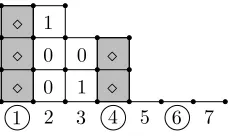
Figure 1. A Ferrers diagram with shape (3,3,2,2,0,0,0). The black dots represent the points. The black dots in squares are the boundary points.
A01-filling of a Ferrers diagram assigns to each cell the value 0 or 1. A 01-filling is called atransversal filling (or just atransversal) if each row and each column has exactly one 1-cell. A 01-filling is sparse if each row and each column has at most one 1-cell. A permutationp=p1p2· · ·p`∈ S`can be represented by apermutation matrix which is a 01-matrix of size`×`, whose cell (i, j) is equal to 1 if and only if pj = i. If there is no risk of confusion, we abuse terminology by identifying a permutation pattern pwith the corresponding permutation matrix. Note that a permutation matrix is a transversal of a diagram with square shape.
Let P be permutation matrix of size n×n, and let F be a sparse filling of a Ferrers diagram. We say thatF contains P ifF has a (not necessarily contiguous) square submatrix of size n×nwhich induces in F a subfilling equal to P. This notion of containment generalizes usual permutation containment.
We now extend the notion of partial permutations to partial fillings of diagrams. LetDbe a Ferrers diagram withkcolumns. LetHbe a subset of the set of columns of D. Let φbe a function that assigns to every cell ofD one of the three symbols 0, 1 and , such that every cell in a column belonging to H is filled with , while every cell in a column not belonging toH is filled with 0 or 1. The pairF = (φ, H), will be referred to as a partial 01-filling (or a partial filling) of the diagramD. See Figure 2. The columns from the set H will be calledthe -columns ofF, while the remaining columns will be calledthe standard columns. Observe that if the diagram D has columns of height zero, thenφitself is not sufficient to determine the filling F, because it does not allow us to determine whether the zero-height columns are -columns or standard columns. For our purposes, it is necessary to distinguish between partial fillings that differ only by the status of their zero-height columns.
1
0
0 1
0
[image:4.595.241.357.654.723.2]
1 2 3 4 5 6 7
We say that a partial 01-filling is apartial transversal filling(or simply apartial transversal) if every row and every standard column has exactly one 1-cell. We say that a partial 01-filling is sparse if every row and every standard column has at most one 1-cell. A partial 01-matrix is a partial filling of a (possibly degenerate) rectangular diagram. In this paper, we only deal with transversal and sparse partial fillings.
There is a natural correspondence between partial permutations and transversal partial 01-matrices. Let π∈ Sk
n be a partial permutation. A partial permutation matrix representingπis a partial 01-matrixP withn−krows andncolumns, with the following properties:
• Ifπj=, then thej-th column ofP is a-column.
• If πj is equal to a number i, then the j-th column is a standard column. Also, the cell in columnjand rowiis filled with 1, and the remaining cells in columnj are filled with 0’s.
If there is no risk of confusion, we will make no distinction between a partial per-mutation and the corresponding partial perper-mutation matrix.
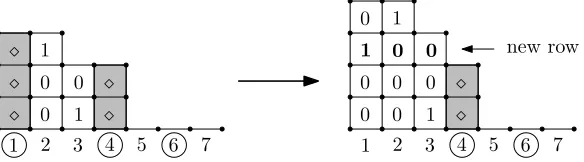
To define pattern-avoidance for partial fillings, we first introduce the concept of substitution into a -column, which is analogous to substituting a number for a hole in a partial permutation. The idea is to insert a new row with a 1-cell in the -column; this increases the height of the diagram by one. Let us now describe the substitution formally.
Let F be a partial filling of a Ferrers diagram with m columns. Assume that the j-th column of F is a -column. Let hbe the height of the j-th column. A substitution into thej-th column is an operation consisting of the following steps:
(1) Choose a numberi, with 1≤i≤h+ 1.
(2) Insert a new row into the diagram, between rowsi−1 and i. The newly inserted row must not be longer than the (i−1)-th row, and it must not be shorter than the i-th row, so that the new diagram is still a Ferrers diagram. If i= 1, we also assume that the new row has lengthm, so that the number of columns does not increase during the substitution.
(3) Fill all the cells in columnj with the symbol 0, except for the cell in the newly inserted row, which is filled with 1. Remove column j from the set of-columns.
(4) Fill all the remaining cells of the new row with 0 if they belong to a standard column, and withif they belong to a-column.
Figure 3 illustrates an example of substitution.
1 0 0 1
0
1 2 3 4 5 6 7
1
0 0 1
0
1 2 3 4 5 6 7 0
0 0
[image:5.595.154.446.573.654.2]1 0 0 new row
Figure 3. A substitution into the first column of a partial filling, involving an insertion of a new row between the second and third rows of the original partial filling.
transformed into a (non-partial) fillingF0 by a sequence ofksubstitutions; we then say that F0 is anextension ofF.
Let P be a permutation matrix. We say that a partial filling F of a Ferrers diagramavoidsP if every extension ofF avoidsP. Note that a partial permutation π ∈ Sn
k avoids a permutation p, if and only if the partial permutation matrix representingπavoids the permutation matrix representingp.
3. A generalization of a Wilf-equivalence by Babson and West
We say that two permutation matrices P and Q are shape-?-Wilf-equivalent, if for every Ferrers diagram D there is a bijection between P-avoiding and Q -avoiding partial transversals of D that preserves the set of -columns. Observe that if two permutations are shape-?-Wilf-equivalent, then they are also strongly ?-Wilf-equivalent, because a partial permutation matrix is a special case of a partial filling of a Ferrers diagram.
The notion of shape-?-Wilf-equivalence is motivated by the following proposi-tion, which extends an analogous result of Babson and West [3] for shape-Wilf-equivalence of non-partial permutations.
Proposition 3.1. Let P and Q be shape-?-Wilf-equivalent permutations, let X
be an arbitrary permutation. Then the two permutations (0 X
P 0) and 0 X Q 0
are strongly?-Wilf-equivalent.
Our proof of Proposition 3.1 is based on the same idea as the original argument of Babson and West [3]. Before we state the proof, we need some preparation. Let M be a partial matrix withrrows andccolumns. Letiandjbe numbers satisfying 0≤i≤rand 0≤j≤c. LetM(> i, > j) be the submatrix ofM formed by the cells (i0, j0) satisfyingi0> iandj0 > j. In other words,M(> i, > j) is formed by the cells to the right and above the point (i, j). The matrix M(> r, > j) is assumed to be the degenerate matrix with 0 rows andc−jcolumns, whileM(> i, > c) is assumed to be the empty matrix for any value ofi. When the matrixM(> i, > j) intersects a -column of M, we assume that the column is also a -column of M(> i, > j), and similarly for standard columns.
We will also use the analogous notation M(≤i,≤j) to denote the submatrix of M formed by the cells to the left and below the point (i, j).
Note that ifM is a partial permutation matrix, thenM(> i, > j) andM(≤i,≤j) are sparse partial matrices.
Let X be any nonempty permutation matrix, andM be a partial permutation matrix. We say that a point (i, j) of M is dominated by X in M if the partial matrixM(> i, > j) containsX. Similarly, we say that a cell ofM is dominated by X, if the top-right corner of the cell is dominated byX. Note that if a point (i, j) is dominated byX inM, then all the cells and points inM(≤i,≤j) are dominated by X as well. In particular, the points dominated by X form a (not necessarily proper) Ferrers diagram.
Letk≡k(M)≥0 be the largest integer such that the point (0, k) is dominated byX. If no such integer exists, setk= 0. Observe that all the cells ofM dominated by X appear in the leftmost kcolumns ofM. LetM(X) be the partial subfilling ofM induced by the points dominated byX; formallyM(X) is defined as follows:
• M(X) hask columns, some of which might have height zero, • the cells of M(X) are exactly the cells of M dominated byX,
• a columnj ofM(X) is a-column, if and only ifj is a -column ofM. Our proof of Proposition 3.1 is based on the next lemma.
Lemma 3.2. Let M be a partial permutation matrix, and let P andX be permu-tation matrices. Then M contains(0 X
Proof. Assume thatM contains (0
P 0). It is easy to see thatM must then contain a
point (i, j) such that the matrixM(> i, > j) containsXwhile the matrixM(≤i,≤j) containsP. By definition, the point (i, j) is dominated byX in M, and hence all the points of M(≤i,≤j) are dominated by X as well. Thus, M(≤i,≤j) is a (possibly degenerate) submatrix of M(X), which implies thatM(X) contains P.
The converse implication is proved by an analogous argument.
We are now ready to prove Proposition 3.1.
Proof of Proposition 3.1. Let P and Q be two shape-?-Wilf-equivalent matrices, and letf be the bijection that mapsP-avoiding partial transversals toQ-avoiding partial transversals of the same diagram and with the same -columns. LetM be a partial permutation matrix avoiding (0X
P 0).
By Lemma 3.2, M(X) is a sparse partial filling avoidingP. LetF denote the partial fillingM(X). Consider the transversal partial fillingF−obtained fromF by removing all the rows and all the standard columns that contain no 1-cell. Clearly F− is a P-avoiding partial transversal. Use the bijection f to map the partial filling F− to a Q-avoiding partial transversal G− of the same shape as F−. By reinserting the zero rows and zero standard columns into G−, we obtain a sparse
Q-avoiding filling Gof the same shape as F. Let us transform the partial matrix M into a partial matrixN by replacing the cells ofM(X) with the cells ofG, while the values of all the remaining cells of M remain the same.
We claim that the matrix N avoids 0X Q 0
. By Lemma 3.2, this is equivalent to claiming that N(X) avoidsQ. We will in fact show that N(X) is exactly the filling G. To show this, it is enough to show, for any point (i, j), that M(X) contains (i, j) if and only ifN(X) contains (i, j). This will imply thatM(X) and N(X) have the same shape, and henceG=N(X).
Let (i, j) be a point ofM not belonging toM(X). Since (i, j) is not inM(X), we see thatM(> i, > j) is the same matrix asN(> i, > j), and this means that (i, j) is not dominated by X in N, hence (i, j) is not inN(X).
Now assume that (i, j) is a point ofM(X). Let (i0, j0) be a boundary point of
M(X) such that i0 ≥i andj0 ≥j. Then the matrix M(> i0, > j0) is equal to the matrixN(> i0, > j0), showing that (i0, j0) belongs toN(X), and hence (i, j) belongs to N(X) as well. We conclude that N(X) andM(X) have the same shape. This means that N(X) avoidsQ, and henceN avoids 0 X
Q 0
.
Since we have shown thatM(X) andN(X) have the same shape, it is also easy to see that the above-described transformationM 7→N can be inverted, showing that the transformation is a bijection between partial permutation matrices avoiding (0 X
P 0) and those avoiding 0 X Q 0
. The bijection clearly preserves the position of -columns, and shows that (0 X
P 0) and 0 X Q 0
are strongly?-Wilf equivalent.
4. Strong?-Wilf-equivalence of12· · ·`X and`(`−1)· · ·1X
We will use Proposition 3.1 as the main tool to prove strong?-Wilf equivalence. To apply the proposition, we need to find pairs of shape-?-Wilf-equivalent patterns. A family of such pairs is provided by the next proposition, which extends previous results of Backelin, West and Xin [4].
Proposition 4.1. Let I`= 12· · ·` be the identity permutation of order `, and let
J` =`(`−1)· · ·21be the anti-identity permutation of order `. The permutations
I` andJ` are shape-?-Wilf-equivalent.
Let I(F, i, j) denote the largest integer ` such that the partial matrixF(≤i,≤j) contains I`. Similarly, let J(F, i, j) denote the largest ` such that F(≤ i,≤j) containsJ`.
We let F0 denote the (non-partial) sparse filling obtained by replacing all the
symbols inF by zeros.
Let us state without proof the following simple observation.
Observation 4.2. LetF be a sparse partial filling.
(1) F contains a permutation matrixP if and only ifF has a boundary point (i, j) such thatF(≤i,≤j) containsP.
(2) For any boundary point (i, j), we haveI(F, i, j) =h(F, j) +I(F0, i, j) and
J(F, i, j) =h(F, j) +J(F0, i, j).
The key to the proof of Proposition 4.1 is the following result, which is a direct consequence of more general results of Krattenthaler [24, Theorems 1–3] obtained using the theory of growth diagrams.
Fact 4.3. Let D be a Ferrers diagram. There is a bijective mappingκfrom the set of all (non-partial) sparse fillings of D onto itself, with the following properties.
(1) For any boundary point (i, j) of D, and for any sparse filling F, we have
I(F, i, j) =J(κ(F), i, j)andJ(F, i, j) =I(κ(F), i, j).
(2) The mappingκpreserves the number of 1-cells in each row and column. In other words, if a row (or column) of a sparse filling F has no 1-cell, then the same row (or column) of κ(F)has no 1-cell either.
In Krattenthaler’s paper, the results are stated in terms of proper Ferrers di-agrams. However, the bijection obviously extends to Ferrers diagrams with zero-height columns as well. This is because adding zero-zero-height columns to a (non-partial) filling does not affect pattern containment.
From the previous theorem, we easily obtain the proof of the main proposition in this section.
Proof of Proposition 4.1. Let D be a Ferrers diagram. Let F be an I`-avoiding partial transversal ofD. LetF0be the sparse filling obtained by replacing all the
symbols of F by zeros. DefineG0=κ(F0), whereκis the bijection from Fact 4.3.
Note that all the -columns of F are filled with zeros both in F0 and G0. Let G
be the sparse partial filling obtained from G0 by replacing zeros within all such
columns. ThenGis a sparse partial filling with the same set of-columns asF. We see that for any boundary point (i, j) of the diagramD, h(F, j) =h(G, j). By the properties of κ, we further obtainI(F0, i, j) =J(G0, i, j). In view of
Ob-servation 4.2, this implies that Gis a J`-avoiding filling. It is clear that this con-struction can be inverted, thus giving the required bijection between I`-avoiding andJ`-avoiding transversal partial fillings ofD.
Combining Proposition 3.1 with Proposition 4.1, we get directly the main result of this section.
Theorem 4.4. For any`≤m, and for any permutationX of {`+ 1, . . . , m}, the permutation pattern 123· · ·(`−1)`X is strongly ?-Wilf-equivalent to the pattern
`(`−1)· · ·21X.
1 2 3 4
5 6 7 8
top part
bottom part
[image:9.595.198.401.118.249.2]left part right part
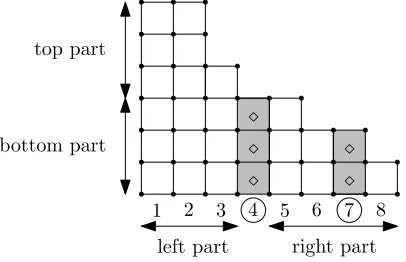
Figure 4. An example of a Ferrers diagram with two-columns. The left, right, top, and bottom parts are shown.
5. Strong?-Wilf-equivalence of312X and231X
We will now focus on the two patterns 312 and 231. The main result of this section is the following theorem.
Theorem 5.1. The patterns 312 and 231 are shape-?-Wilf-equivalent. By Propo-sition 3.1, this means that for any permutation X of the set {4,5, . . . , m}, the two permutations312X and231X are strongly?-Wilf-equivalent.
Theorem 5.1 generalizes a result of Stankova and West [33], who have shown that 312 and 231 are shape-Wilf equivalent. The original proof of Stankova and West [33] is rather complicated, and does not seem to admit a straightforward generalization to the setting of shape-?-Wilf-equivalence. Our proof of Theorem 5.1 is different from the argument of Stankova and West, and it is based on a bijection of Jel´ınek [22], obtained in the context of pattern-avoiding ordered matchings.
Let us begin by giving a description of 312-avoiding and 231-avoiding partial transversals. We first introduce some terminology. Let D be a Ferrers diagram with a prescribed set of -columns. If j is the index of the leftmost -column of D, we say that the columns 1,2, . . . , j−1 formthe left part ofD, and the columns to the right of column j form the right part ofD. We also say that the rows that intersect column jform thebottom part ofD and the remaining rows formthe top part of D. See Figure 4.
IfD has no-column, then the left part and the top part is the whole diagram D, while the right part and the bottom part are empty.
The intersection of the left part and the top part ofD will be referred to asthe top-left part of D. The top-right, bottom-left and bottom-right parts are defined analogously. Note that the top-right part contains no cells of D, the top-left and bottom-right parts form a Ferrers subdiagram of D, and the bottom-left part is a rectangle.
Observation 5.2. A partial transversalF of a Ferrers diagram avoids the pattern 312 if and only if it satisfies the following conditions:
(C1) F has at most two-columns.
(C2) IfF has at least three columns, then at most one-column ofFhas nonzero height.
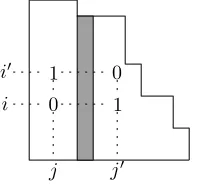
(C3) Let i < i0 be a pair of rows, let j < j0 be a pair of columns. If the rowi0 intersects columnj0 inside F, and if the 2×2 submatrix of F induced by rowsi, i0and columnsj, j0is equal to the matrix (1 0
0 1), then either the two
1
1 0
0 i i0
[image:10.595.250.349.118.210.2]j j0
Figure 5. The configuration forbidden by condition (C3) of Ob-servation 5.2. The columnjis in the left part of the diagram, while j0 is in the right part.
(C4) The subfilling induced by the left part ofF avoids 312. (C5) The subfilling induced by the right part ofF avoids 12. (C6) The subfilling induced by bottom-left part ofF avoids 21.
Proof. It is easy to see that if any of the six conditions fails, thenF contains the pattern 312.
To prove the converse, assume thatF has an occurrence of the pattern 312 that intersects three columns j < j0 < j00. Choose the occurrence of 312 in such a way that among the three columnsj, j0andj00, there are as many-columns as possible. If all the three columns j, j0, j00 are -columns, (C1) fails. If two of the three columns are -columns, (C2) fails. Ifj is a-column andj0 andj00 are standard, (C5) fails.
Assumej andj00are standard columns andj0 is a
-column. Ifj0is the leftmost -column, (C3) fails, otherwise (C2) fails. Assumej00 is a
-column and j and j0 are standard. Ifj00 is the leftmost
-column, (C6) fails, otherwise (C2) fails. Assume all the three columns are standard. Let i < i0 < i00 be the three rows that are intersected by the chosen occurrence of 312. If there is a -column that intersects all the three rows i, i0, i00, we may find an occurrence of 312 that uses this -column, contradicting our choice of j, j0 and j00. On the other hand, if no -column intersects the three rows, then the whole submatrix inducing 312 is in the
left part and (C4) fails.
Next, we state a similar description of 231-avoiding partial transversals.
Observation 5.3. A partial transversalF of a Ferrers diagram avoids the pattern 231 if and only if it satisfies the following conditions (the first three conditions are the same as the corresponding three conditions of Observation 5.2):
(C1’) F has at most two-columns.
(C2’) IfF has at least three columns, then at most one-column ofFhas nonzero height.
(C3’) Let i < i0 be a pair of rows, let j < j0 be a pair of columns. If the rowi0 intersects columnj0 inside F, and if the 2×2 submatrix of F induced by rowsi, i0and columnsj, j0is equal to the matrix (1 0
0 1), then either the two
columnsj, j0 both belong to the left part, or they both belong to the right part.
(C4’) The subfilling induced by the left part ofF avoids 231. (C5’) The subfilling induced by the right part ofF avoids 21. (C6’) The subfilling induced by bottom-left part ofF avoids 12.
Figure 6. A Ferrers diagram with one -column, indicated in gray. The rows with crosses are the rightist rows ofD.
In the next part of our argument, we will look in more detail at fillings satisfying some of the Conditions (C1) to (C6), or some of the Conditions (C1’) to (C6’).
For later reference, we state explicitly the following easy facts about transversal fillings of Ferrers diagrams that avoid permutation matrices of size 2 (see, e.g., [3]).
Fact 5.4. Assume thatD is a Ferrers diagram that has at least one (non-partial) transversal. The following holds.
• The diagram D has exactly one 12-avoiding transversal. To construct this transversal, take the rows of D in top-to-bottom order, and in each row i, insert a 1-cell into the leftmost column that has no 1-cell in any of the rows above rowi.
• The diagram D has exactly one 21-avoiding transversal. To construct this transversal, take the rows of D in top-to-bottom order, and in each row i, insert a 1-cell into the rightmost column that has no 1-cell in any of the rows above rowi.
Our next goal is to give a more convenient description of the partial fillings that satisfy Conditions (C1), (C2) and (C3) (which are equal to (C1’), (C2’) and (C3’), respectively). Let D be a Ferrers diagram with a prescribed set of-columns, and with krows in its bottom part. We will distinguish two types of rows ofD, which we refer to as rightist rows and leftist rows (see Figure 6). The rightist rows are defined inductively as follows. None of the rows in the top part is rightist. The k-th row (i.e., the highest row in the bottom part) is rightist if and only if it has at least one cell in the right part of D. For any i < k, the i-th row is rightist if and only if the number of cells in the i-th row belonging to the right part ofD is greater than the number of rightist rows that are above rowi. A row is leftist if it is not rightist.
The distinction between leftist and rightist rows is motivated by the following lemma.
Lemma 5.5. Let D be a Ferrers diagram, and letF be a partial transversal of D
that satisfies (C1) and (C2). The following statements are equivalent. (a) F satisfies (C3).
(b) All the 1-cells in the leftist rows appear in the left part of F. (c) All the 1-cells in the rightist rows appear in the right part of F.
1
1
1 1
1
1
1
1 1
1 i
j j0
i0
(R)
(R)
(R)
[image:12.595.226.370.117.240.2](R)
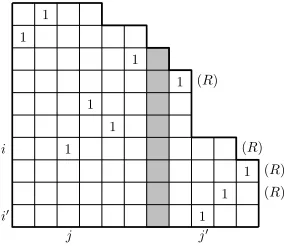
Figure 7. An example of a partial transversal violating condition (c) of Lemma 5.5. Rightist rows are marked by (R).
the bottom-left part is equal to the number of bottom rows minus the number of non-degenerate right columns.
We claim that the number of rightist rows is equal to the number of non-degenerate columns in the right part. To see this, consider the (unique) partial transversal F21 of D in which no two standard columns contain the pattern 21.
The characterization of Fact 5.4 easily implies that inF21, a row has a 1-cell in the
right part, if and only if it is a rightist row. Thus, in the partial filling F21, and
hence in any other partial transversal of D, the number of rightist rows is equal to the number of 1-cells in the right part of D, which is equal to the number of non-degenerate right columns.
Thus, if in a partial transversalF there is a leftist row that has a 1-cell in the right part ofD, there must also be a rightist row with a 1-cell in the left part ofD, and vice versa. In other words, conditions (b) and (c) are indeed equivalent for any partial transversalF.
Assume now thatF is a partial transversal that satisfies (a). We claim that F satisfies (c) as well. For contradiction, assume that there is a rightist row i that contains a 1-cell in the left part of F. Choose ias large as possible. Let j be the column containing the 1-cell in rowi. See Figure 7.
Since i is a rightist row, it follows that the number of cells in the right part of i is greater than the number of rightist rows abovei. We may thus find a column j0 in the right part ofD that intersects rowiand whose 1-cell does not belong to any of the rightist rows above row i. Leti0 be the row that contains the 1-cell in column j0. If i0 < i, then the two rowsi, i0 and the two columns j, j0 induce the pattern that was forbidden by (C3), which contradicts statement (a).
Thus, we see that i0> i. By the choice ofj0, this implies thati0 is a leftist row. Furthermore, by the choice of i, we know that all the rightist rows above i, and hence all the rightist rows abovei0, have a 1-cell in the right part. Since rowi0 has a 1-cell in the right part as well, it means that the number of cells in the right part of rowi0 is greater than the number of rightist rows above rowi0. This contradicts the fact thati0 is a leftist row. This contradiction proves that (a) implies (c).
It remains to show that statement (c) implies statement (a). Assume F is a partial transversal that satisfies (c), and hence also (b). For contradiction, assume thatF contains the pattern forbidden by statement (a). Assume that the forbidden pattern is induced by a pair of rowsi < i0 and a pair of columnsj < j0, where the column j0 is in the right part and the columnj in the left part, and the two cells (i0, j) and (i, j0) are 1-cells, as in Figure 5.
number of rightist rows above rowi, because all the rightist rows above rowi have 1-cells in distinct right columns intersecting row i0, and all these columns must be different from columnj0, whose 1-cell is in rowibelow rowi0. This contradicts the fact thati0 is a leftist row, and completes the proof of the lemma.
Lemma 5.5, together with Observations 5.2 and 5.3, shows that in any partial transversal avoiding 312 or 231, each 1-cell is either in the intersection of a rightist row with a right column, or the intersection of a leftist row and a left column.
The next lemma provides the main ingredient of our proof of Theorem 5.1.
Lemma 5.6 (Key Lemma). Let k≥1 be an integer, and let D be a proper Fer-rers diagram with the property that the bottom k rows of D all have the same length. Let F(k)(D,312,21) be the set of all (non-partial) transversals of D that avoid 312 and have the additional property that their bottom k rows avoid 21. Let F(k)(D,231,12) be the set of all (non-partial) transversals of D that avoid 231 and have the additional property that their bottom k rows avoid 12. Then |F(k)(D,312,21)|=|F(k)(D,231,12)|.
Before we prove the Key Lemma, let us explain how it implies Theorem 5.1.
Proof of Theorem 5.1 from Lemma 5.6. Let D be a Ferrers diagram with a pre-scribed set of-columns. Assume thatD has at least one partial transversal. Our goal is to show that the number of 312-avoiding partial transversals ofD is equal to the number of its 231-avoiding partial transversals.
Assume that D satisfies conditions (C1) and (C2), otherwise it has no 312-avoiding or 231-312-avoiding partial transversal. Letkbe the number of leftist rows in the bottom part ofD. LetDLbe the subdiagram ofDformed by the cells that are intersections of leftist rows and left columns of D, and letDR be the subdiagram formed by the intersections of rightist rows and right columns. Notice that neither DL nor DR have any -columns, and the k bottom rows of DL have the same length.
By Lemma 5.5, in any partial transversalF ofDthat satisfies (C3), each 1-cell of F is either in DL or in DR. Thus, F can be decomposed uniquely into two transversals FL and FR, induced by DL and DR, respectively. Conversely, if FL and FR are any transversals of DL and DR, then the two fillings give rise to a unique partial transversalF ofDsatisfying (C3).
Let F be a partial transversal of D that satisfies condition (C3). Note that F satisfies condition (C4) of Observation 5.2 if and only ifFL avoids 312, and F satisfies (C6) if and only if FL avoids 21 in its bottomk rows. Thus, F satisfies (C4) and (C6) if and only if FL ∈ F(k)(DL,312,21). Observe also that F satisfies (C5) if and only if FR avoids 12. By Fact 5.4, this determinesFRuniquely.
By combining the above remarks, we conclude that a partial transversalF of the diagram D avoids 312 if and only if FL belongs to the set F(k)(DL,312,21) and
FR is the unique transversal filling ofDR that avoids 12. By analogous reasoning, a partial transversalF0 ofD avoids 231, if and only if its subfillingF0
L induced by
DLbelongs toF(k)(DL,231,12) and the subfillingFR0 induced byDR is the unique transversal ofDRavoiding 21.
The Key Lemma asserts that F(k)(D
L,312,21) and F(k)(DL,231,12) have the same cardinality, which implies that the number of 312-avoiding partial transversals ofD is equal to the number of its 231-avoiding partial transversals.
The rest of this section is devoted to the proof of the Key Lemma.
1
1 1
[image:14.595.251.342.120.217.2]x1 x2 y3 x3 y2 y1
Figure 8. The bijection µ between transversals of Ferrers dia-grams and matchings. The dotted arrows show the correspon-dence between rows and columns of the diagram and vertices of the matching.
in the (equivalent) language of matchings. This will allow us to apply previously known results on pattern-avoiding matchings in our proof.
Let us now introduce the relevant terminology. A matching of order n is a graph M = (V, E) on the vertex set V = {1,2, . . . ,2n}, with the property that every vertex is incident to exactly one edge. We will assume that the vertices of matchings are represented as points on a horizontal line, ordered from left to right in increasing order, and that edges are represented as circular arcs connecting the two corresponding endpoints and drawn above the line containing the vertices. If e is an edge connecting verticesi andj, withi < j, we say thatiis theleft-vertex andj is theright-vertex ofe. Clearly, a matching of ordernhasnleft-vertices and nright-vertices. Let L(M) denote the set of left-vertices of a matchingM.
IfM is a matching of ordern, we define thereversal ofM, denoted byM, to be the matching on the same vertex set asM, such that{i, j} is an edge ofM if and only if{2n−j+ 1,2n−i+ 1} is an edge ofM. Intuitively, reversing corresponds to flipping the matching along a vertical axis.
Lete=ij and e0 =i0j0 be two edges of a matchingM, withi < j and i0 < j0. If i < i0 < j < j0 we say thate crosses e0 from the left and e0 crosses e from the right. Ifi < i0< j0< j, we say thate0 is nested belowe. Moreover, ifk is a vertex such that i < k < j, we say that kis nested below the edgee=ij, or thate=ij
covers the vertexk.
A set of kedges of a matching is said to form ak-crossing if each two edges in the set cross each other, and it is said to form ak-nesting if each two of its edges are nested.
If M = (V, E) is a matching of ordernand M0 = (V0, E0) a matching of order
n0, we say thatM contains M0 if there is an edge-preserving increasing injection from V0 to V. In other words, M contains M0 if there is a function f: V0 →V such that for each u, v∈V0, if u < v thenf(u)< f(v) and ifuvis an edge ofM0 then f(u)f(v) is an edge ofM. IfM does not containM0, we say thatM avoids
M0. More generally, ifF is a set of matchings, we say thatM avoidsF ifM avoids all the matchings inF.
Let Mn denote the set of all matchings of order n. For a set of matchings F and for a set of integers X⊆[2n], define the following sets of matchings:
Mn(X) ={M ∈ Mn; L(M) =X} Mn(X,F) ={M ∈ Mn(X); M avoidsF}
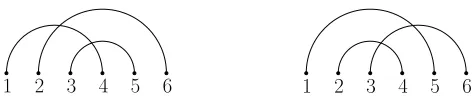
1 2 3 4 5 6 1 2 3 4 5 6
Figure 9. The matchingM312, corresponding to the permutation
pattern 312 (left), and the matching M231, corresponding to the
permutation pattern 231 (right).
De Mier [16] has pointed out a one-to-one correspondence between transversals of (proper) Ferrers diagrams withnrows andncolumns and matchings of ordern. This correspondence allows to translate results on pattern-avoiding transversals of Ferrers diagrams to equivalent results on pattern-avoiding matchings. We describe the correspondence here, and state its main properties.
LetF be a transversal of a proper Ferrers diagramD. Letnbe the number of rows (and hence also the number of columns) ofD. We encodeF into a matching µ(F) ∈ Mn defined as follows. First, we partition the vertex set [2n] into two disjoint sets X(D) = {x1 < x2 < · · · < xn} and Y(D) ={y1 > y2 >· · · > yn}, with the property that xj < yi if and only if the j-th column ofD intersects the
i-th row ofD (note that the elements ofY are indexed in decreasing order). The diagramDdeterminesX(D) andY(D) uniquely. Letµ(F) be the matching whose edge-set is the set
E={xjyi; F has a 1-cell in columnjand rowi}.
Figure 8 shows an example of this correspondence.
We state, without proof, several basic properties of µ(see [16]).
Fact 5.7. The mapping µ has the following properties.
• The mapping µis a bijection between transversals of Ferrers diagrams and matchings, with fillings of the same diagram corresponding to matchings with the same left-vertices. IfF is a transversal of a proper Ferrers diagram
D, then µ(F) is a matching whose left-vertices are precisely the vertices from the set X(D). Conversely, for any matching M there is a unique proper Ferrers diagram D such that X(D) is the set of left-vertices of M, and a unique transversal F of D satisfyingµ(F) =M.
• F is a permutation matrix of order n (i.e., a filling of an n×n square diagram) if and only if µ(F)is a matching with L(M) ={1,2, . . . , n}. • Assume that F0 is a permutation matrix. A fillingF avoids the pattern F0
if and only if the matching µ(F)avoids the matchingµ(F0).
• D is a proper Ferrers diagram whosek bottom rows have the same length, if and only if Y(D)contains the k numbers {2n,2n−1, . . . ,2n−k+ 1}. In such case, in any matching representing a transversal of D, all the k
rightmost vertices are right-vertices.
In the rest of this section, we will say that a matching M corresponds to a filling F, if M = µ(F). We will also say that M corresponds to a permutation p if it corresponds to the permutation matrix of p. Specifically, we let M312 be
the matching corresponding to the permutation 312, and letM231be the matching
corresponding to the permutation 231 (see Fig. 9).
LetDbe a proper Ferrers diagram withnrows andncolumns, whose bottomk rows have the same length. To prove the Key Lemma, we need a bijection between the sets of fillings F(k)(D,312,21) and F(k)(D,231,12). Let M(k)(D,312,21) be
and similarly let M(k)(D,231,12) be the set of matchings corresponding to the
fillings fromF(k)(D,231,12).
By definition, a matching M belongs toM(k)(D,312,21) if and only if L(M) =
X(D),M avoidsM312, and thek edges incident to the rightmostkvertices ofM
form ak-nesting. (Notice that all the rightmostkvertices ofM are right-vertices, since the bottom k rows ofD are assumed to have the same length.) Similarly, a matching M belongs toM(k)(D,231,12) if and only if L(M) =X(D),M avoids
M231, and the edges incident to the rightmostkvertices form ak-crossing.
Let M be a matching. A sequence of edges (e1, e2, . . . , ep) is calleda chain of order pfrom e1 toep, if for eachi < p, the edgeei crosses the edgeei+1 from the
left. A chain is proper if each of its edges only crosses its neighbors in the chain. It is not difficult to see that every chain frome1 to ep contains, as a subsequence, a proper chain frome1 toep.
e1 e2 e5 e6
f
[image:16.595.190.407.288.351.2]e3 e4
Figure 10. The cyclic chain of order 7.
A cyclic chain of order p+ 1 is a (p+ 1)-tuple of edges (f, e1, . . . , ep), with the following properties.
• The sequence (e1, . . . , ep) is a proper chain.
• The edgef crossese1from the right andep from the left. Furthermore, for eachi∈ {2,3, . . . , p−1}, the edgeei is nested belowf.
Figure 10 shows an example of a cyclic chain of order 7. The matching of order p+ 1 whose edges form a cyclic chain will be denoted byCp+1. The smallest cyclic
chain is C3, whose three edges form a 3-crossing. Let C denote the infinite set
{Cq:q≥3}.
As shown in [22], there is a bijection ψ which maps the set of M312-avoiding
matchings to the set of C-avoiding matchings, with the additional property that each M312-avoiding matching M is mapped to aC-avoiding matching ψ(M) with
the same order and the same set of left-vertices. Since the reversal of a M312
-avoiding matching is anM231-avoiding matching, while the reversal of aC-avoiding
matching is again C-avoiding, it is easy to see that the mappingM 7→ψ(M) is a bijection that maps an M231-avoiding matchingM to a C-avoiding matching with
the same set of left-vertices.
We will use the bijection ψ as a building block of our bijection between the sets M(k)(D,312,21) andM(k)(D,231,12). However, before we do so, we need to
describe the bijectionψ, which requires more terminology.
LetM be a matching on the vertex set [2n]. For an integerr∈[2n], we letM[r] denote the subgraph of M induced by the leftmost r vertices of M. We will call M[r]ther-th prefix ofM. The graphM[r] is a union of disjoint edges and isolated vertices. The isolated vertices ofM[r] will be calledthe stubs ofM[r].
the same block, and x is a stub satisfying x < x < x, then x belongs to the same block as xandx0. Figure 11 shows an example.
[image:17.595.153.443.157.210.2]x1 x2 x3 x4 x5 x6 x7
Figure 11. A prefix of a matching with seven stubs, forming four equivalence classes{x1, x2},{x3},{x4}, and{x5, x6, x7}.
For a matching M ∈ Mn, the sequence of prefixes M[1], M[2], . . . , M[2n] =M will be called the generating sequence of M. We will interpret this sequence as a sequence of steps of an algorithm that generates the matchingM by adding vertices one-by-one, from left to right, starting with the graphM[1] that consists of a single isolated vertex.
Each prefix in the generating sequence defines an equivalence on the set of its stubs. To describe the bijection ψ, we first need to point how the blocks of these equivalences change when we pass from one prefix in the sequence to the next one. Clearly,M[1] consists of a single stub, so its equivalence has a single block{1}. Let us now show how the equivalence defined by M[r] differs from the equivalence defined byM[r−1]. If a vertexr >1 is a left-vertex of M, then the graphM[r] is obtained fromM[r−1] by adding a new stubr. In such case, we say thatM[r] is obtained from M[r−1] byan L-step. It is obvious that each block ofM[r−1] is also a block ofM[r], and apart from thatM[r] also has the singleton block{r}.
Assume now thatr >1 is a right-vertex ofM. In this situation, we say thatM[r] is obtained from M[r−1] byan R-step. Clearly, M[r] is obtained fromM[r−1] by adding the vertex r and connecting it by an edge to a stubsof M[r−1]. We say that the stubsisselected in stepr. In such case,sis no longer a stub inM[r]. LetB1, B2, . . . , Bb be the blocks ofM[r−1] ordered left to right, and assume that
s belongs to a blockBj. Then B1, B2, . . . , Bj−1 are also blocks inM[r]. The set
(Bj\ {s})∪Bj+1∪ · · · ∪Bb is either empty or forms a block ofM[r]. Notice that the sizes of the blocks of M[r] only depend on the value of j and on the sizes of the blocks of M[r−1]. We define two special types of R-steps: a maximalist R-step is an R-R-step in which the selected stub is the rightmost stub of its block (i.e., s= maxBj), while a minimalist R-step is an R-step in which the selected stub is the leftmost stub in its block.
To connect our terminology with the results from [22], we need a simple lemma.
Lemma 5.8. Let M ∈ Mn be an M312-avoiding matching, let r ∈ [2n] be an integer. Let s ands0 be two distinct stubs of M[r]. The two stubs sand s0 belong to the same block, if and only if M[r]has an edge ethat covers both sands0.
Proof. By definition, if two stubs are covered by a single edge of M[r], they are equivalent and hence belong to the same block. To prove the converse, assume that s < s0 are stubs ofM[r] that belong to the same block. LetC= (e
belowf. Thus, the three edgese1, e2andfform inM a copy ofM312, contradicting
the assumption that M isM312-avoiding.
Combining Lemma 5.8 with [22, Lemma 3], we get the following result that gives characterizations of M312-avoiding andC-avoiding matchings.
Fact 5.9. A matching M ∈ Mn avoids the pattern M312 if and only if, for every right-vertex r >1of M,M[r]is obtained fromM[r−1]by a minimalist R-step. A matchingM ∈ Mn avoids the set of patternsCif and only if, for every right-vertex
r >1 of M,M[r] is obtained fromM[r−1]by a maximalist R-step.
We are now ready to state the following key result from [22], which describes the properties of the bijection ψ.
Fact 5.10. There is a bijectionψbetweenM312-avoiding andC-avoiding matchings. If M is anM312-avoiding matching of order n, and N =ψ(M) its corresponding
C-avoiding matching, then the following holds.
• M andN have the same set of left-vertices (and hence the same size). • For any vertex r∈[2n], the prefixM[r] has the same number of blocks as
the prefix N[r]. Moreover, if B1, . . . , Bb are the blocks of M[r] in left-to-right order, and B0
1, . . . , Bb0 are the blocksN[r] in left-to-right order, then |Bi|=|Bi0| for eachi≤b.
• Assume that r+ 1is a right-vertex of M (and hence also of N), and that
B1, . . . , BbandB10, . . . , Bb0 are blocks ofM[r]andN[r], as above. IfM[r+1] is obtained from M[r]by selecting a stubsfrom a blockBj, thenN[r+ 1]is obtained from N[r] by selecting a stub s0 from the corresponding blockB0
j. In view of Fact 5.9, we must then have s= minBj ands0= maxBj.0
The properties ofψ listed above in fact determineψuniquely.
Finally, we are ready to present the bijection between M(k)(D,312,21) and
M(k)(D,231,12). Recall that the matchings from these two sets have the same set
of left-vertices X(D) and the same set of right-verticesY(D) = [2n]\X(D). Let us writeX(D) ={x1< x2< . . . < xn} andY(D) ={y1> y2> . . . > yn}. Recall also that by assumption, the rightmost k right-verticesy1, . . . , yk are to the right of any left-vertex.
The bijection we present is a composition of several steps, with the correctness of each step proved separately. An example is shown in Figure 12.
Step 1: apply ψ. Use the bijectionψto map the setM(k)(D,312,21) bijectively
to the set S1 ={ψ(M);M ∈ M(k)(D,312,21)}. As shown in Lemma 5.11 below,
S1is precisely the set of all the matchingsN satisfying the following properties:
(P1) N avoidsC. (P2) L(N) =X(D).
(P3) In the prefixN[2n−k] ofN, each block has a single stub. (P4) The edges ofN incident toy1, . . . , yk form ak-nesting.
Step 2: add edge. For a matchingM ∈S1, letM+be the matching obtained from
M by adding two new vertices xnew and ynew and a new edge enew = xnewynew,
such that the edge enew covers precisely the vertices y1, . . . , yk. We relabel the 2n+ 2 vertices ofM+, without altering their left-to-right order, so that their labels
correspond to the integers 1, . . . ,2n+ 2 in their usual order. With this labeling, we havexnew= 2n−k+ 1 andynew= 2n+ 2.
Let S2 be the set {M+; M ∈ S1}. Clearly, all the matchings in S2 share the
same set of left-vertices and the same set of right-vertices. We call these sets X+
and Y+, respectively. It is also clear that the mapping M 7→ M+ is a bijection
betweenS1 andS2. In Lemma 5.12, we will show thatS2is precisely the set of all
(R1) N avoidsC. (R2) L(N) =X+.
(R3) N contains the edgeenew={2n−k+ 1,2n+ 2}.
Step 3: reverse. Recall thatM denotes the reversal of a matchingM. LetS3be
the set{M; M ∈S2}. All the matchings inS3have the same set of left-vertices and
right-vertices, denoted by X+ and Y+, respectively. From the previously stated
properties of S2 it follows that S3 contains precisely the matchings N satisfying
these conditions: (R1) N avoidsC. (R2) L(N) =X+.
(R3) N contains the edge{1, k+ 2}.
Step 4: apply ψ−1. LetS
4 be the set {ψ−1(M); M ∈S3}. In Lemma 5.13, we
show that S4contains precisely the matchingsN satisfying these three conditions:
(S1) N avoidsM312.
(S2) L(N) =X+.
(S3) N contains the edge{1, k+ 2}.
Step 5: remove edge. For a matchingM ∈ S4, let M− denote the matching
obtained from M by removing the edge {1, k + 2} together with its endpoints. Relabel the vertices of M− by integers 1,2, . . . ,2n, in their usual order. LetS
5be
the set{M−; M ∈S
4}. All the matchings inS5have the same set of left-vertices,
denoted by X. We show in Lemma 5.14 that S5 contains precisely the following
matchings N: (S1−) N avoidsM
312.
(S2−) L(N) =X.
(S3−) The edges incident to the leftmostkvertices ofN form ak-crossing. Step 6: reverse back. The properties ofS5stated above imply that the matchings
inS5are exactly the reversals of the matchings inM(k)(D,231,12). Thus, applying
reversal to the elements of S5 we complete the bijection fromM(k)(D,312,21) to
M(k)(D,231,12).
Next, we will prove the correctness of the individual steps. The proofs are mostly routine.
Lemma 5.11. The setS1 contains precisely those matchings that satisfy the four properties (P1)–(P4).
Proof. Let N be a matching from the set S1. Let M ∈ M(k)(D,312,21) be the
preimage ofN underψ. The properties ofψstated in Fact 5.10 directly show that N satisfies (P1) and (P2).
We now show thatN satisfies (P3). Fact 5.10 shows thatN satisfies (P3) if and only if M satisfies (P3). It is thus enough to prove (P3) forM.
In the matching M, the k edges incident to y1, . . . , yk form a k-nesting, by the definition of M(k)(D,312,21). Assume thatM does not satisfy (P3), i.e., in
the prefix M[2n−k], there are two stubss < s0 belonging to the same block. By Lemma 5.8, this means thatsands0are both covered by a single edgee∈M[2n−k]. Letfandf0be the edges ofM incident tosands0, respectively. The right endpoints of f and f0 must belong to {y
1, . . . , yk}, which means that f and f0 are nested. This means that e,f, andf0 form a copy ofM
312 inM, which is impossible.
remove edge
reverse back applyψ−1
reverse add edge applyψ
M3
(D,312,21)
S1
S2
S3
S4
S5
M3
[image:20.595.134.467.118.685.2](D,231,12)
Figure 12. The six steps of a bijection fromM(k)(D,312,21) to
M[2n−i] by an R-step in which the rightmost stub inM[2n−i] is selected. By the properties ofψ, we also select the rightmost stub whenever we createN[2n−i+ 1] from N[2n−i]. This shows thatN has property (P4).
We now show that every matching satisfying the four properties (P1)–(P4) be-longs toS1. LetN be a matching satisfying (P1)–(P4). SinceN isC-avoiding, we
may define M =ψ−1(N). To show thatN belongs toS
1, we need to prove that
M belongs to M(k)(D,312,21). The properties of ψ guarantee that M is M 312
-avoiding and that L(M) =X(D). It remains to show that rightmost kvertices of M are incident to ak-nesting.
SinceNsatisfies (P3), so doesM. Moreover, sinceN satisfies (P4), we know that for eachi≤k, the prefixN[2n−i+1] is obtained fromN[2n−i] by adding the vertex yi and connecting it to the rightmost stub ofN[2n−i]. From this description, we easily notice that for eachi≤k, each block in the matchingN[2n−i] is a singleton. By the properties ofψ, each block ofM[2n−i] is also a singleton, andM[2n−i+ 1] is created formM[2n−i] by connectingyito the rightmost stub ofM[2n−i]. This shows that in M, the vertices y1, . . . , yk are indeed incident to a k-nesting, and
henceM ∈ M(k)(D,312,21).
Lemma 5.12. A matchingN belongs toS2 if and only if it satisfies (R1)–(R3). Proof. Suppose N ∈S2. LetM be a matching from S1 such that N =M+. By
construction, N satisfies (R2) and (R3). We need to show that N also satisfies (R1), i.e., that it is C-avoiding. For contradiction, assume thatN contains a copy C of a cyclic chain formed by p+ 1 edges (f, e1, . . . , ep). Recall that in a cyclic chain, the sequence (e1, . . . , ep) is a proper chain, and f crossese1 from the right
andep from the left, while the edgese2, . . . , ep−1are nested belowf.
Since M is C-avoiding, C must contain the new edge {2n−k+ 1,2n+ 2}. Necessarily, the new edge is the edgeep, which is incident to the rightmost vertex of C. In the matching M, the edges incident to y1, . . . , yk form a k-nesting. In particular, the edges f andep−1 are nested, and hence C has at least four edges.
Letsands0be the left endpoints of the edgesf ande
p−1, respectively. Consider now
the prefixM[2n−k]. This prefix contains the nonempty proper chaine1, . . . , ep−2
(possibly consisting of a single edge), and the two vertices s and s0 are stubs of
M[2n−k]. Since sis covered bye1ands0 is covered byep−2, the two stubs belong
to the same block of M[2n−k], which is impossible, since the matchingM ∈ S1
must satisfy (P3).
We conclude that every matching fromS2 satisfies (R1)–(R3).
To prove the converse, assume that N is a matching satisfying (R1)–(R3). By (R3), there is a matchingM such thatM+=N. We need to show thatM belongs
to S1, i.e., that it satisfies (P1)–(P4). It is clear that M satisfies (P1) and (P2).
If M fails (P4), then N must contain a 3-crossing, which is impossible, since a 3-crossing is a special case of a cyclic chain. IfM satisfies (P4) but fails (P3), then N contains a cyclic chain of length at least four, which is also impossible. ThusM belongs toS1, and henceN belongs toS2, as claimed.
Lemma 5.13. A matchingN belongs toS4 if and only if it satisfies (S1)–(S3). Proof. Choose N ∈S4, and set M =ψ(N). By definition,M belongs toS3, so it
satisfies (R1)–(R3). It follows directly thatN satisfies (S1) and (S2).
same way, and in particular,N contains the edge{1, k+ 2}. We conclude that N satisfies (S1)–(S3).
The same argument shows that every matching satisfying (S1)–(S3) belongs
to S4.
Lemma 5.14. A matchingN belongs toS5 if and only if it satisfies (S1−)–(S3−). Proof. Choose N ∈S5, and let M be the matching fromS4 such thatN =M−.
Clearly,N satisfies (S1−) and (S2−). Assume for contradiction thatN fails (S3−). In such case, N has two nested edgese1 and e2, whose left endpoints are among
the leftmostkvertices ofN. Since the leftmostkvertices ofN are all left-vertices, we know that in the matching M, the two edgese1 ande2 are both crossed from
the left by the edge {1, k+ 2}, forming the patternM312forbidden by (S1).
It is easy to see that any matching satisfying (S1−)–(S3−) belongs toS
5.
This completes the proof of Lemma 5.6, and hence also of Theorem 5.1.
6. The k-Wilf-equivalence of patterns of lengthk+ 2
We will now consider the structure of pattern-avoiding partial permutations in which the number of holes is close to the length of the forbidden pattern.
Let us begin by an easy observation.
Observation 6.1. Letpbe a pattern of length `. Obviously any partial permu-tation with at least`holes containsp. Almost as obviously, a partial permutation with`−1 holes and of length at least`, containspas well. In particular,sk
n(p) = 0 for everyk≥`−1 andn≥`, and all patterns of length`arek-Wilf-equivalent.
In the rest of this section, we will deal with k-Wilf-equivalence of patterns of length ` = k+ 2. As we will see, an important part will be played by Baxter permutations, which we now define.
Definition 6.2. A permutation p∈ S` is called aBaxter permutation, if there is no four-tuple of indices a < b < c < d∈[`] such that
• c=b+ 1, and
• the subpermutationpa, pb, pc, pdis order-isomorphic to 2413 or to 3142. In the terminology of Babson and Steingr´ımsson [2], Baxter permutations are ex-actly the permutations avoiding simultaneously the two patterns 2-41-3 and 3-14-2.
Baxter permutations were originally introduced by G. Baxter [5] in 1964, in the study of common fixed points of commuting continuous functions [5, 12]. Later, it has been discovered that Baxter permutations are also closely related to other combinatorial structures, such as plane bipolar orientations [11], noncrossing triples of lattice paths [19], and standard Young tableaux [17]. An explicit formula for the number of Baxter permutations has been found by Chung et al. [13], with several later refinements [26, 34, 18].
To deal with k-Wilf equivalence of patterns of length k+ 2, we first need to introduce more notation. Let π ∈ SH
n be a partial permutation, with |H| = k. Let h1 < h2 <· · · < hk be the elements ofH. LetI denote the set [n]\H, i.e.,
I is the set of indices of the non-holes of π. We may decompose the set I into k+ 1 (possibly empty) intervalsI1, I2, . . . , Ik+1, by definingI1={i∈I; i < h1},
Ik+1 ={i∈I; i > hk}, and for eacha∈ {2, . . . , k},Ia={i∈I; ha−1< i < ha}.
Lemma 6.3. Let ` and n be integers, let k =`−2. Let p =p1· · ·p` be a per-mutation and let π=π1· · ·πn be a partial permutation with kholes. Assume that
relative order of πi andπj is different from the relative order of pa andpb+1 (i.e.,
πi< πj ⇐⇒ pa > pb+1).
Consequently, for each such p,n andH, we have sH
n(p)≤1.
Proof. Assume thati < j are distinct indices from the setI, withi∈Iaandj ∈Ib. Necessarily,a≤b. Note that inπ there area−1 holes to the left ofπi, there are
b−aholes betweenπi andπj, and there arek−b+ 1 holes to the right ofπj. Assume that for somei∈Ia andj∈Ib, withi < j, the symbolsπi andπj have the same relative order as pa and pb+1. Then π contains an occurrence of p, in
whichπi corresponds topa,πj corresponds to pb+1, and thek holes correspond to
the remainingksymbols ofp.
Conversely, assume thatπcontains an occurrence ofp. This means that there is an`-tuple P of indices, such that the subsequence (πh; h∈P) is a copy ofp. It is not hard to see that in such case we may always find a copy ofpthat uses all thek holes ofπ. In other words, we may assume thatH is a subset ofP. Let iandj be the two indices ofP not belonging toH, with i < j. Fixaandb such that i∈Ia and j∈Ib. In the`-tuple (πh; h∈P), the elementπi is thea-th element, since it hasa−1 holes to the left of it, whilej is (b+ 1)-th element, since it hasb−1 holes and the symbolπi to the left of it. Since (πh; h∈P) is assumed to be a copy ofp, we conclude thatπi andπj have the same relative order aspa andpb+1.
This shows thatπavoidspif and only if for each two distinct indicesi < jwith i∈Ia and j∈Ib, the relative order ofπi and πj differs from the relative order of
pa andpb+1.
For a fixed p∈ S`, for eachnand for each setH ⊆[n] of sizek, ifπis a partial permutation fromSH
n(p), the relative order of every two non-holes ofπis uniquely determined by the relative order of the symbols of p. In particular, πis uniquely determined byp,nandH, implying thatsH
n(p)≤1.
Motivated by Lemma 6.3, we introduce the following notation. Letp∈ S` be a pattern, let k=`−2, let nbe an integer, and let H ⊆[n] be a k-element set of integers. Theorder graphGH
n(p) is a directed graph on the vertex setI= [n]\H, whose edge-set is defined by the following condition: for every i < j, such that i∈Ia andj∈Ib, the graphGHn(p) has an edge fromitoj ifpa> pb+1, and it has
an edge from j toiifpa < pb+1.
Note that GH
n(p) is a tournament, i.e., for each pair of distinct verticesiandj, the graph GH
n(p) has an edge fromitoj or an edge fromj to i, but not both. Letπ=π1· · ·πn be a partial permutation from the setSnH. Using the notion of order graphs, Lemma 6.3 can be restated in the following equivalent way: πavoids p if and only if, for each two distinct vertices i, j of GH
n(p), if the graphGHn(p) has a directed edge from itoj thenπi< πj. Notice that in this statement, we no longer need to assume thati < j.
Lemma 6.4. Let p∈ S` be a pattern, let k =`−2, let n be an integer, and let
H ⊆[n] be ak-element set of integers. The following statements are equivalent: (1) sH
n(p) = 1. (2) GH
n(p)has no directed cycle. (3) GH
n(p)has no directed cycle of length 3.
Proof. Since GH
n(p) is a tournament, the statements 2 and 3 are easily seen to be equivalent.
Let us now show that (1) implies (2). Assume that sH
n(p) = 1, and let π =
π1· · ·πnbe the partial permutation fromSnH(p). As we have pointed out before, if
GH