Shared and Searchable Encrypted Data for
Untrusted Servers
Changyu Dong
1, Giovanni Russello
2, Naranker Dulay
1 1Department of Computing, 2Security Area,Imperial College London, Create-Net,
180 Queen’s Gate, Via alla Cascata 56/D Povo, London, SW7 2AZ, UK 38100 Trento, Italy
{changyu.dong,n.dulay}@imperial.ac.uk [email protected]
Abstract
Current security mechanisms are not suitable for organisations that outsource their data management to untrusted servers. Encrypting and decrypting sensitive data at the client side is the normal approach in this situation but has high communication and computation overheads if only a subset of the data is required, for example, selecting records in a database table based on a keyword search. New cryptographic schemes have been proposed that support encrypted queries over encrypted data. But they all depend on a single set of secret keys, which implies single user access or sharing keys among multiple users, with key revocation requiring costly data re-encryption. In this paper, we propose an encryption scheme where each authorised user in the system has his own keys to encrypt and decrypt data. The scheme supports keyword search which enables the server to return only the encrypted data that satisfies an encrypted query without decrypting it. We provide a concrete construction of the scheme and give formal proofs of its security. We also report on the results of our implementation.
1
Introduction
their storage management activities [10]. Apart from business data, there is also an emerging trend in personal data outsourcing. People are demanding more storage space from service provider for various reasons: data backup [1], sharing photos and videos with family and friends [2] or even to manage their medical record [3].
One of the biggest challenges raised by data storage outsourcing is data confidentiality. Business data is vital to many companies, any security breaches will leave the companies with lost revenues, reduced shareholder value, lawsuits as well as damaged reputations. Exposing this valuable information to outsiders poses huge risks. While companies may trust a Storage Service Provider’s (SSP) reliability, availability, fault-tolerance and performance, they cannot trust that the SSP is not going to use the data for other purposes. The same problem also exists in personal data outsourcing. For privacy reasons, individuals want to be sure that the data can only be accessed by particular people and certainly not by the SSP’s employees. The negative impact of this distrust is two-fold. From the customers’ point of view, it is hard to find a trusted service provider to host their data. From the SSPs’ point of view, as long as they cannot dispel the concern, they will lose potential customers.
Traditional access controls which are used to provide confidentiality are mostly designed for in-house services and depend greatly on the system itself to enforce authorisation policies, effectively relying on a trusted infrastructure. In the absence of trust, traditional security models are no longer valid. Another common approach to provide data confidentiality is cryptography. Server side encryption is not appropriate when the server is not trusted. The client must encrypt the data before sending it to the SSP and later the encrypted data can be retrieved and decrypted by the client. This would ease a company’s concern about data leakage, but introduces a new problem. Because the encrypted data is not meaningful to the SSP’s servers, many useful data operations are not possible. For example, if a client wants to retrieve documents or records con-taining certain keywords, can we keep the data incomprehensible to servers and their administrators while efficiently retrieving the data? Consider the following scenarios:
Scenario 1 Company A is considering outsourcing its data processing centre to a service provider B. This will cut its annual IT cost by up to 25%. But the company is concerned about data security. The company’s databases contain valuable production data and customer information. It would be unacceptable if competitors got hold of the data. Administrative controls such as formal contracts, confidential agreements and continuous auditing provide a certain level of assurance, but the company would also like to encrypt the sensitive data and have fast searches over it.
A trivial solution is to download all the data to the client’s computer and decrypt it locally. This does not scale to large datasets. Several schemes have been proposed to partially address the above problems. The basic idea is to divide the cryptographic component between the client and the server. The client performs the data encryption/decryption and manages keys. The server processes encrypted search queries by carrying out some computation on the encrypted data. The server learns nothing about the keys or the plaintexts of the data nor the queries, but is still able to return the correct results.
These schemes have an important limitation. The operations, e.g. encryp-tion, decryption and query generaencryp-tion, more or less rely on some shared secret keys. This implies that the operations can only be executed by one user, or by a group of users who share the secret keys somehow. A single user is usually not an adequate assumption for data outsourcing. Perhaps the biggest problem for supporting multiple user access to encrypted data is key management. Sharing keys is generally not a good idea since it increases the risk of key exposure. In response to this, keys must be changed regularly. The keys must also be changed if a user is no longer qualified to access the data. However, changing keys may result in decrypting all the data with the old key and re-encrypting it using the new keys. For large data sets, this is not practical.
In this work, we propose a scheme for multi-user searchable data encryption based on proxy cryptography. We consider the application scenario where a group of users share data through an untrusted data storage server which is hosted by a third party. Unlike existing schemes for searchable data encryption in multi-user settings which have constraints such as asymmetric user permis-sions (multiple writers, single reader) or read-only shared data set, in our scheme the shared data set can be updated by the users and each user in the group can be both reader and writer. The server can search on the encrypted data using encrypted keywords. More importantly our scheme do not rely on shared keys. This significantly simplifies key revocation. Each authorised user in the system has his own unique key set and can insert encrypted data, decrypt the data inserted by other users and search encrypted data without knowing the other users’ keys. The keys of one user can easily be revoked without affecting other users or the encrypted data at the server. After a user’s keys have been revoked, the user will no longer be able to read and search the shared data.
2
Related Work
Many systems designed for securing untrusted storage rely on the clients to encrypt the data. For example, in cryptographic distributed file systems such as [23, 20, 16, 26], the untrusted file servers store encrypted files and have no knowledge of the keys. Authorised users can retrieve an encrypted file by its identifier and decrypt it using a key obtained from the owner of the file. The servers perform only the basic I/O function and cannot do advanced operations such as keyword search.
enable server-side searches on encrypted data. Song et.al. [25] introduced the first practical scheme for searching on encrypted data. The scheme enables clients to perform searches on encrypted text without disclosing any informa-tion about the plaintext to the untrusted server. The untrusted server cannot learn the plaintext given only the ciphertext, it cannot search without the user’s authorisation, and it learns nothing more than the encrypted search results. The basic idea is to generate a keyed hash for the keywords and store this informa-tion inside the ciphertext. The server can search the keywords by recalculating and matching the hash value. Yang et. al. [29] proposed an elegant scheme for performing queries on encrypted data and also provided a secure index to speed up queries by two-step mapping. Goh’s scheme [15] enables searches on encrypted data that employed a secure index based on a bloom filter which has low storage overheads. Damiani et.al. [12] proposed an approach to indexing encrypted data which allows efficient data access. The indexed attribute values are encrypted directly with a key or hashed. This approach also support range queries by creating an encrypted B+-tree. Agrawal et.al. [4] proposed an order preserving encryption for numeric data which allows queries based on compari-son conditions. The plaintext is encrypted so that the ciphertext follows a target distribution provided by the user while the order of the data is preserved.
In thebucketization approach for searching encrypted databases [17, 18], an attribute domain is partitioned into a set of buckets each of which is identified by a tag. These bucket tags are maintained as an index and are utilised by the server to process the queries. Bucketization has relatively small performance overhead and enables more complex queries such as range queries and com-parison queries at the cost of revealing more information about the encrypted data.
All the encrypted search schemes above for searches on encrypted data rely on secret keys, which implies single user access or sharing keys among a group of users. Boneh et. al. [8] presented a scheme for searches on encrypted data using a public key system that allows mail gateways to handle email based on whether certain keywords exist in the encrypted message. The application scenario is similar to [25], but the scheme uses asymmetric encryption schemes instead of symmetric ones. Asymmetric keys allow multiple users to encrypt data using the public key, but only the user who has the private key can search and decrypt the data. Curtmola et. al. [11] partly solved the multi-user problem by using broadcast encryption. The set of authorised users share a secret keyr(which is used in conjunction with a trapdoor function). Only people who knowrwill be able to access/query the data. A user can be revoked by changingr, and using broadcast encryption to send the new keyr′
to the set of authorised users. The revoked user does not knowr′, and hence cannot search. In this scheme, the
database is searchable, but is read-only and cannot be updated. In our scheme, any authorised user can read, search and update the encrypted data.
the keys and the plaintext. Proxy encryption schemes can be built on top of different cryptosystems such as El Gamal [14] and RSA [24]. Applications of proxy encryption include: secure email lists [22], access control systems [5] and attribute based publishing of data [21]. A comprehensive study on proxy cryp-tography can be found in [19].
3
Threat Model
Before presenting our scheme, it is necessary to discuss the threat model. In this section, we first identify the entities involved and the assumptions underlying the system design. Then we identify the potential adversaries and the possible attacks.
3.1
Entities
There are three types of entities in our system:
• Users: Authorised users are able to read, write and search encrypted data residing on the remote server. Sometimes we may need to revoke an authorised user. After being revoked, the user is no longer able to access the data.
• Server: The main responsibility of the data storage server is to store and retrieve encrypted data according to authorised users’ requests.
• Key management server (KMS): The KMS is a fully trusted server which is responsible for generating and revoking keys. It generates key sets for each authorised user and is also responsible for securely distributing generated key sets. When a user is no longer trusted to access the data, the KMS revokes the user’s permission by revoking his keys.
Authorised users are fully trusted. They are given permissions to access the shared data stored on the remote server by the data owner. They are believed to behave properly and can protect their key sets properly. The data storage server is not trusted in the sense that we believe that the server will execute requests it received correctly, but we do not rely on them to maintain data confidentiality. In other words, the server is modelled as “honest but curious” in our trust model.The KMS is also fully trusted. Although requiring a trusted KMS seems at odds with using an untrusted data storage service, we argue that the KMS requires less resources and less management effort. Securing the KMS is much easier since a very limited amount of data needs to be protected and the KMS can be kept offline most of time.
3.2
Assumptions
issues and does not provide protection against attacks such as data forgery and denial of service. Our scheme is a building block that can be integrated into larger more comprehensive frameworks for securing data on untrusted servers
We also assume that the server cannot collude with the users. In our scheme, if a user and the server collude and combine their keys, they can recover the encrypted data. Although this assumption is quite strong, we will show later in the paper that in practice the assumption can be weakened to an acceptable level by introducing certain auxiliary mechanisms.
3.3
Adversary and Attacks
We consider a Curious server1 as the adversary. As we mentioned earlier, we model the server as honest but curious. The server has full access to the en-crypted data stored on it and all the server side key sets. It can also observe the communication to and from users. We limit the attacks mounted by the server to passive attacks. That is, the server will not actively manipulate the stored data and communication in order to gain knowledge. This is because we assume that there are mechanisms taking care of integrity issues, which can detect active attacks.
4
Definitions
4.1
Preliminaries
Throughout the paper, we always consider a scheme to be secure in the sense that the probability that an adversary can break the scheme is a negligible function of the security parameter. By negligible we mean an adversary’s success probability is “too small to matter”. Formally:
Definition 1(Negligible Function). A functionf is negligible if for every
poly-nomial p(·) there exists an N such that for all integers n > N it holds that
f(n)< p(1n).
Our proofs rely largely on the assumption that the Decisional Diffie-Hellman (DDH) problem is hard regarding certain groups, i.e. it is hard to tell the difference between group elementsgαβ andgγ givengα andgβ.
Definition 2 (DDH Assumption). We say that the DDH problem is hard
re-garding a group Gif for all probabilistic polynomial time adversaries A, there
exists a negligible functionnegl such that
|P r[A(G, q, g, gα, gβ, gαβ) = 1]−P r[A(G, q, g, gα, gβ, gγ) = 1]|< negl(k)
where G is a cyclic group of order q (|q| = k) and g is a generator of G,
α, β, γ∈Zq are uniformly randomly chosen.
The security of our scheme also depends on the existence of pseudorandom functions. Intuitively, pseudorandom functions are functions that cannot be efficiently distinguished from truly random functions when used as black boxes.
Definition 3(Pseudorandom Function). We sayf :{0,1}∗
× {0,1}∗
→ {0,1}∗ is a pseudorandom function if for all probabilistic polynomial time adversaries
A, there exists a negligible functionneglsuch that
|P r[Afk(·)= 1]−P r[AF(·)= 1]|< negl(n)
where k ← {0,1}n is chosen uniformly randomly and F is a function chosen
uniformly randomly from the set of functions mapping n-bit strings to n-bit strings.
4.2
System Model
A Multi-user Searchable Data Encryption scheme is a mechanism such that a group of authorised users can share encrypted documents and perform keyword search on the encrypted documents without decrypting them. We first intro-duce some notations to be used in the definitions. ∆ is the set of all possible data items (documents). W = {w1, ..., wd} is a dictionary which contains all
the possible words that can be used in the queries. Each documentDi in ∆ has
an identifierid(Di) and can be associated with a list of keywordskw(Di) which
is a subset ofW. The identifiers must be unique and must not contain infor-mation about the content of the documents. For example, the identifiers can be randomly generated strings. We useD={(D1, kw(D1)), ...,(Dn, kw(Dn))} to
denote an arbitrary set of documents with their keywords, i.e. P(∆× P(W)).
Definition 4 (Multi-user Searchable Data Encryption). A multi-user searchable data encryption scheme is a tuple of probabilistic polynomial time algorithms (Init, Keygen, Enc, Re-enc, Trapdoor, Search, Dec, Revoke)such that:
• The initialisation algorithm Init(1k)is run by the KMS which takes as input
the security parameter 1k and outputs master public parameters Params
and a master key set MSK.
• The user key sets generation algorithm Keygen(MSK,i) is run by the KMS
which takes as input the master keys MSKand a user’s identityi,
gener-ates two key sets Kuiand Ksi. Kui is the user side key set for useriand
Ksi is the server side key set for useri.
• The data encryption algorithm Enc(Kui,D,kw(D))is run by a user who uses
his key set Kui to encrypt a document Dand a set of keywords associated
kw(D), then outputs ciphertext c∗
i(D,kw(D)).
• The data re-encryption algorithm Re-enc(i,Ksi,c∗i(D,kw(D))) is run by the
server to re-encrypt a ciphertext tuple c∗
i(D,kw(D)) from a user i. The
server finds the corresponding key set Ksi and outputs re-encrypted
• The trapdoor generation algorithm Trapdoor(Kui,w)is run by a user which
takes the user’s key set Kuiand a keywordwand outputs a trapdoor Ti(w)
for the word.
• The data pre-decryption algorithm Pre-dec(i,Ksi,c(D)) is run by the server
to partially decrypt an encrypted document for useriusingi’s server side
key set Ksi. The result c′i(D)is returned to the user.
• The search algorithm Search(i,Ti(w),E(D),Ksi) is run by the server. For each c(D,kw(D)) ∈ E(D), if the queried keyword w ∈ kw(D) then the
server runs the data pre-decryption algorithm and returns the result c′i(D)
to the user.
• The data decryption algorithm Dec(Kui,c′i(D))is run by a user which
de-crypts c′
i(D) by using the user’s key set and outputs D.
• The user revocation algorithm Revoke(i)is run by the server. Given i, the
server updates its user-key mapping set Ks=Ks\ (i,Ksi).
The system supports the following primitive data operations:
• Get: Given a document identifierid(Di), retrieves the documentDi. The
user sends id(Di) to the server which locates the ciphertext from the
data storage and runs the data pre-decryption algorithm. The partially decrypted document is returned to the user and the user runs the data decryption algorithm to recover the plaintext of the document.
• Search: Given a keywordw, retrieves all the documents associated with the keyword. The user runs the trapdoor generation algorithm and sends the trapdoor generated fromwto the server which runs the search algorithm to find all matching documents and returns the result set to the user. The user runs the data decryption algorithm to decrypt all the documents.
• Insert: Inserts a new document and the keyword list associated with it into the data storage. The user runs the data encryption algorithm to encrypt the document and the keywords. The ciphertext is sent to the server which runs the data re-encryption algorithm and stores the re-encrypted ciphertext.
• Remove: Given a document identifier id(Di), removes the document Di
and the associated keyword list. The server locates the ciphertext by the identifier and removes it from the data storage.
4.3
Security Definition
The security definition for searchable encryption is difficult because searching leaks information about stored data inevitably. As long as the searching al-gorithm is correct, it always returns the same result set for the same query. Although the queries and the result sets are encrypted, the adversary can still build up search patterns. Therefore the security definition for searchable encryp-tion should be modified to reflect the intuiencryp-tion that nothing should be leaked beyond the outcome and the pattern of a sequence of searches. Here we adapt the definition from [11] of non-adaptive indistinguishability security. Informally, non-adaptive indistinguishability security means that given two non-adaptively generated query histories with the same length and outcome, no PPT adversary can distinguish one from another based on what it can “see” in the interaction. Non-adaptive means the adversary cannot choose queries based on the previous queries and results. This is acceptable because in our setting only the authorised user can generate queries.
The major difference between our definition and the one in [11] is that the definition presented in [11] is defined for a static document set. The whole document set is encrypted before searching can take place. Afterwards no mod-ification is allowed on the document set. While in our scheme, the document set can be continuously updated by authorised users. Therefore in our definition we have to consider the dynamic changes on the document set.
We formalise the interaction between the server and the authorised users as
history. Generally speaking, a history is defined as a sequence of queries over
a set of documents. Let Q = (∆× P(W))∪ W denotes all possible queries, we call a query q∈ Q an insert query ifq ∈∆× P(W) and a search query if
q∈ W. Intuitively, an insert query is issued by a user to insert a document into the shared data storage and a search query is issued to search a keyword over currently stored data. We usequ to denote a query issued by a useru.
Definition 5 (History). A history Hi ∈ P(∆× P(W))× Qi is an interaction
between a client and a server over i queries on a document set D, i.e. Hi =
(D, qu1
1 , ..., qiui).
As we mentioned before, searching leaks information. The maximum infor-mation we have to leak is captured by atrace. In our settings, a trace contains information from three sources: the encrypted documents stored on the server, the queries and the search query pattern. The outcome of a search queryq=w
can be represented as a set of identifiers of stored documents which are asso-ciated with the keyword being queried and the index of the keyword in the keyword list, i.e. rs(w) ={(id(D), i)|D∈ Dq∧w is the ith element in kw(D)}.
The intuition of using document identifiers is that the adversaries can identify the documents but should not learn anything about the content of the docu-ments. Here Dq means the document set stored on the server at the point of
time the queryq is issued. Because the users may insert new documents into the data storage,Dq can be different from the initial document setD. We also
where Πi[j, k] = 1 if qj =qk, and Πi[j, k] = 0 otherwise, for 1≤j, k≤i.
Definition 6(Trace of a Query). Given a queryqu, the trace ofquis defined as:
T r(qu) =
(u, id(D),|D|,|kw(D)|) if qu= (D, kw(D))is an update query,
(u, rs(qu)) if qu is a search query,
Definition 7 (Trace of a History). Given a history Hi = (D, qu11, ..., qiui), let
m=|D|, the trace of Hi is defined as a list:
T r(Hi) =
id(D1),|D1|,|kw(D1)|, ..., id(Dm),|Dm|,|kw(Dm)|,
T r(qu1
1 ), ..., T r(quii),Πi
The trace includes the following: the identifier, the size and the number of keywords of each document in the initial set, the trace of each query in the history and the search query pattern.
During an interaction, the adversary cannot directly see the plaintext of the documents or keywords. What the adversary can see is the ciphertext. The view of the adversary is then defined as:
Definition 8(View of a Query). Given a queryqui, the view ofqui under a key
setKui is defined as:
VKui(q
ui) =
c∗
ui(D, kw(D)) if q
ui= (D, kw(D))is an update query,
(Tui(q
ui), c′
ui(rs(q
ui))) if qui is a search query,
In the above definition,c′ ui(rs(q
ui)) is shorthand for{c′
ui(D)|id(D)∈rs(q
ui)}.
Definition 9 (View of a History). Given a history Hi = (D, q1u1, ..., quii), let
m=|D|, the view generated under a set of user side key setsKu is defined as
VKu(Hi) = (c(D1, kw(D1)), ..., c(Dm, kw(Dm)), VKu1(q
u1
1 ), ...VKui(q
ui
i ) )
where eachKu1, ..., Kui∈Ku
Here the view of history is actually defined in a multi-user setting that com-bines encrypted queries from different users. We do not require eachKu1, ..., Kui
in the history to be distinct: obviously some users may submit multiple queries during the interaction. A special case is whenKu contains only one user side key set, in this case the history becomes a history of a single user.
the view. The negligible probability of the adversary successfully distinguishing the two histories implies that it cannot get extra knowledge and in consequence the scheme is secure.
Definition 10 (Non-Adaptive Indistinguishability against a Curious Server). A multi-user searchable data encryption scheme is secure in the sense of
non-adaptive indistinguishable against a curious server if for alli∈N, for all PPT
adversariesAthere exists a negligible functionnegl such that
P r
b′
=b
(P arams, M SK)←Init(1k),
(Ku,Ks)←KeyGen(M SK,U),
Hi0, Hi1 ← A(Ks),
b← {R 0,1},
b′← A(Ks, VKu(Hib))
< 1
2+negl(k)
where U is a set of user IDs, Ku and Ks are the set of user side key sets
and the set of server side keys generated for users in U,Hi0 andHi1 are two
histories overiqueries such that T r(Hi0) =T r(Hi1).
5
Concrete Construction
In this section, we introduce a concrete construction of the multi-user search-able data encryption scheme. The construction is based on a proxy encryption scheme built upon the El Gamal encryption scheme.
5.1
El Gamal-based Proxy Encryption Scheme
We first briefly review the El Gamal encryption scheme [14]. The El Gamal Encryption SchemeE consists of 3 algorithms:
• E-Init(1k): On input 1k, output two prime numbersp, qsuch thatqdivides p−1, a cyclic groupGwith a generatorgsuch thatGis the unique order q subgroup ofZ∗
p. Choose x R
←Zq and compute h=gx. The public key
ispk= (G, g, h, q) and the private key issk=x.
• E-Enc(pk, m): Chooser←R Zqand output the ciphertextc(m) = (gr, hrm).
• E-Dec(sk, c(m)): The ciphertext is decrypted ashrm·(gr)−x=grx−rxm=
m.
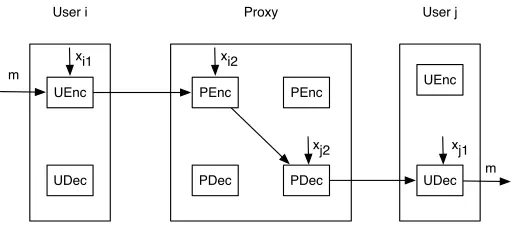
The proxy encryption scheme is described below and the encryption/decryption process is shown in Figure 1:
The proxy encryption schemePE consists of 6 algorithms:
• PE-Init(1k): On input 1k, run E-Init(1k)to obtain (G, g, q, x). Publicise
(G, g, q) as public parameters and keep xsecret as the master key. This
User i
UEnc
UDec
User j
UEnc
UDec PEnc
PDec
PEnc
PDec
m xi1 xi2
xj2 xj1
[image:12.595.175.432.128.241.2]m Proxy
Figure 1: Encryption/Decryption in the El Gamal Proxy Encryption Scheme
• PE-Keygen(M SK, i): For each useri, the key management server chooses
xi1←R Zq and computesxi2 =x−xi1. xi1 is securely transmitted to the user and (i, xi2) is securely transmitted to the proxy.
• PE-U-Enc(xi1, m): The user side encryption algorithm. The user chooses
r←R Zq and outputs the ciphertext c∗
i(m) = (gr, grxi1m). The ciphertext
is sent to the proxy
• PE-P-Enc(i,xi2, c∗i(m)): The proxy re-encryption algorithm. Given the
ciphertext received from useri, the proxy finds the user’s server side key
xi2, compute (gr)xi2·grxi1m =gr(xi1+xi2)m=grxm. The ciphertext at
the proxy side then becomesc(m) = (gr, grxm).
• PE-P-Dec(j,xj2, c(m)): The proxy side decryption algorithm. Before send-ing a ciphertext (gr, grxm) to a user j, the proxy finds j’s server side
key. Then the ciphertext is partially decrypted as grxm· (gr)−xj2 =
gr(x−xj2)m=grxj1
m. c′j(m) = (gr, grxj1
m) is sent to the userj.
• PE-U-Dec(xj1, c′j(m)): After receiving (gr, grxj
1
m), the user fully decrypts the ciphertext asgrxj1
m·(gr)−xj1=
m.
It is easy to see that the proxy encryption scheme is correct. We show that it is also secure under the DDH Assumption.
Theorem 1. If the DDH problem is hard relative to G, then the El Gamal
based proxy encryption scheme is indistinguishable under chosen plaintext attack
(IND-CPA) secure against the proxy. That is, for all PPT adversariesAthere
exists a negligible function negl such that
SuccAP E,P(k) =P r
2
6 6 6 6 6 6 6 4
b′=b
(P arams, M SK)← PE-Init(1k),
(Ku,Ks)← PE-KeyGen(M SK,U), m0, m1← AP E-U-Enc(Ku,·)(Ks)
b← {R 0,1},
c∗i(mb) =PE-U-Enc(xi1, mb), b′← AP E-U-Enc(Ku,·)(K
s, c
∗
i(mb))
3
7 7 7 7 7 7 7 5
Proof. Let’s consider the following PPT adversaryA′
who attempts to solve the DDH problem usingAas a sub-routine. Recall thatA′
is givenG, q, g, g1, g2, g3
as input, where g1 =gα, g2=gβ andg3 could be gαβ or gγ for some random
α, β, γ. A′
does the following:
• A′
sendsG, q, git received toAas the public parameters. It then chooses
randomlyxi2←R Zq for eachi∈ U and also computesgxi1 =g1·g−xi2. It then sends all (i, xi2) toAand keeps all (i, xi2, gxi1).
• Whenever A requires oracle access to the user encryption algorithm, it passesmtoA′
. A′
chooses randomlyr←R Zq and replies with (gr, grxi1m).
• At some point of time,Aoutputsm0, m1. A′ chooses a random bitband sendsg2, g
−xi2
2 g3mb toA.
• Aoutputsb′. Ifb=b′,A′
outputs 1, otherwise outputs 0.
There are two cases to consider:
Case 1: Ifg3=gγ, we know thatgγ is a random group element ofGbecause
γ is chosen at random. Then g−xi2
2 g3mb is also a random group element of G and gives no information about mb, i.e. the distribution of g
−xi2
2 g3mb is
always uniform no matter what valuemb takes.g2 also contains no information about mb. So the adversary A must distinguish m0, m1 without additional information. The probability it can successfully outputb′
=bis exactly 12 when
bis chosen uniformly randomly. A′
outputs 1 iffAoutputsb′
=b, then we have:
P r[A′(G, q, g, gα, gβ, gγ) = 1] = 1
2
Case 2: If g3 = gαβ, because g2 = gβ and g2−xi2g3mb = g−βxi2gαβ = gβ(α−xi2) = gβxi1, then g
2, g2−xi2g3mb is a proper ciphertext encrypted under
PE. In this case, we have:
P r[A′
(G, q, g, gα, gβ, gαβ) = 1] =SuccAP E
,P(k)
If DDH problem is hard regardingG, then the following is true
|P r[A′(G
, q, g, gα, gβ, gαβ) = 1]−P r[A′(G
, q, g, gα, gβ, gγ) = 1]| < negl(k)
P r[A′(G
, q, g, gα, gβ, gαβ) = 1] < 1
2+negl(k)
So we haveSuccA
P E,P(k)<
1
2+negl(k).
5.2
Keyword Encryption
From the proxy encryption scheme, we also obtain a keyword encryption scheme. The aim of this keyword encryption scheme is to securely encrypt keywords and also allow users to generate trapdoors which can be tested over the encrypted keywords in search queries. The keyword encryption schemeKE is defined as follows:
• KE-Init(1k): On input 1k, runPE-Init(1k)to obtain (G, g, q, x). Compute h = gx. Choose a collision resistant hash function H, a pseudorandom
functionf and a random keysforf. Publicise (G, g, q, h, H, f) and keep x, ssecurely as the master key.
• KE-Keygen(M SK, i): RunPE-Keygen(M SK, i)to obtainxi1, xi2.
Trans-mit (xi1, s) securely to useriand (i, xi2) securely to the server.
• KE-U-Enc(xi1, kw): The user chooses r
R
← Zq, the keyword kw is
en-crypted as: c∗i(kw) = (ˆc1,ˆc2,ˆc3) where ˆc1=gr+σ, σ=fs(kw), ˆc2= ˆcx1i1, ˆ
c3=H(hr).
• KE-P-Enc(i, xi2, c∗i(kw)). The proxy computes c(kw) = (c1, c2) such that
c1= (ˆc1)xi2·ˆc2= ˆcx1i2+xi1 = (gr+σ)x=hr+σ andc2= ˆc3=H(hr).
Note that there is no decryption algorithm for this keyword encryption scheme. This is because the ciphertexts of the keywords are only used for testing whether there is a match and do not need to be decrypted.
Next we will prove that this keyword encryption scheme is secure, i.e. that the proxy learns nothing about the encrypted keyword in a chosen plaintext attack.
Theorem 2. If the DDH problem is hard relative toG, then the keyword
en-cryption scheme is IND-CPA secure against the proxy. That is, for all PPT
adversariesAthere exists a negligible function negl such that
SuccAKE,P(k) =P r
2
6 6 6 6 6 6 6 4
b′=b
(P arams, M SK)← KE-Init(1k),
(Ku,Ks)← KE-KeyGen(M SK,U), kw0, kw1← AKE-U-Enc(Ku,·)(Ks)
b← {R 0,1},
c∗i(kwb) =KE-U-Enc(xi1, kwb), b′← AKE-U-Enc(Ku,·)(K
s, c
∗
i(kwb))
3
7 7 7 7 7 7 7 5
<12+negl(k)
Proof. This proof again starts from a PPT adversaryA′
who attempts to chal-lenge the DDH problem usingAas a sub-routine. A′
does the following:
• A′
sets h=g1 and also choosesH, f, s. It then passes (G, g, q, h, H, f) as the public parameters toA. A′
chooses randomlyxi2←R Zq for eachi∈ U
and computes gxi1 =hg−xi2 = gα−xi2. It keeps (i, gxi1, x
i2) and passes
• Whenever A requires oracle access to the user encryption algorithm, it passeskwtoA′
. A′
choosesr←R Zq and replies with c∗
i(kw) = (ˆc1,ˆc2,ˆc3) where ˆc1=gr+σ,σ=fs(kw), ˆc2= (gxi1)r+σ= ˆc1xi1and ˆc3=H(hr).
• Agenerates two keywordskw0, kw1. A′ chooses a random bitb and gen-erates: c1 = g2 ·gσb, c2 = g3g
−xi2
2 gxi1σb and c3 = H(g3). c∗i(kwb) =
(c1, c2, c3) is given toA.
• Aoutputs a bitb′, ifb=b′,A′
outputs 1, otherwise outputs 0.
Case 1: g3=gγ, in this case since bothβ andγ are random we have:
P r[A′
(G, q, g, gα, gβ, gγ) = 1] = 1
2
Case 2: g3 = gαβ, in this case c2 =g2xi1gσbxi1 which is a valid ciphertext, then we have:
P r[A′
(G, q, g, gα, gβ, gαβ) = 1] =SuccAKE
,P(k)
If DDH problem is hard regardingG, we haveSuccAKE
,P(k)<12 +negl(k).
In Theorem 1 and 2 we proved that no PPT adversary can learn anything about the plaintext given a single ciphertext. The following corollary shows that it follows that no PPT adversary can learn anything given multiple ciphertexts.
Corollary 1. Under the same assumptions, the proxy encryption scheme PE
and the keyword encryption schemeKE have indistinguishable multiple
encryp-tion under a chosen-plaintext attack against the proxy.
Proof. The difference is that now the adversaryA is allowed to challenge the
game with two vectors of messages M~0 and M~1 where |M~0| = |M~1| = t. Let
~
C(i)=C(m1
0), ..., C(mi0), C(mi1+1), ..., C(mt1)). It is clear that
SuccA(k) = 1
2P r[A(C~
0) = 0] + 1
2P r[A(C~
t) = 1]
Consider an adversaryA′
that tries to challenge the single encryption IND-CPA game using the corresponding multiple encryption adversaryAas a sub-routine. Since the settings in the two games are the same,A′
passes all the parameters it received to A and answers A’s oracle queries by querying the oracle in its own game. Then A′
obtains two vectorsM~0 and M~1 from A. A′ chooses a randomi←R [1, t], usesmi
0, mi1as its challenge and getscib as the result. It then
constructs a hybrid vector (c10, ...ci0−1, ci b, c
i+1
1 , ...ct1) and sends it toA. It outputs
the bitb′ which is output byA. It is easy to see that in this caseAis required
to distinguishC~(i) and C~(i−1) and the probability that A can distinguish the two is:
SucciA(k) =
1
2P r[A(C~
(i)) = 0] + 1
2P r[A(C~
sinceiis randomly chosen,SuccA′ is
SuccA′(k) = Pti=1SucciA(k)·1t
= 1
2t(P r[A(C~
0) = 0] +Pt−1
i=1(P r(A(C~i) = 0) +P r[A(C~i) = 1]) +P r[A(C~t) = 1])
= 1t(12P r[A(C~0) = 0] +1
2P r[A(C~t) = 1]) +t
−1
2t
= 1tSuccA(k) +t−1
2t
SinceSuccA′(k)<12+negl(k), it follows thatSuccA(k)<12+negl(k).
5.3
Multi-user Searchable Data Encryption
Enc
kw1, ..., kwk
D
c∗i(D) = (gr, grxi1D),
User i
Re-enc
,
c∗
i(D) c(D) = (g
r
, grxD)
Server
σ
1, ..., σ
kfs
c∗
i(σ1), ..., c∗i(σk) c∗i(σm) =
c1=grm+σm
c2=cx1i1
c3=H(hrm)
(c∗
i(D), c∗i(σ1), ..., c∗i(σk))
c∗
i(σ1), ..., c∗i(σk)
c(σ1), ..., c(σk) c(σm) =
!
c1=hrm+σm c2=H(hrm)
x
i1 [image:16.595.143.472.297.456.2]x
i2Figure 2: Data Encryption Process
Now we are ready to present our multi-user searchable data encryption schemeSE. It is constructed as follows:
• Init(1k): the KMS takes as input the security parameter 1k and invokes
KE-Init(1k), outputsParams=(G, g, q, h, H, f) and a master key setMSK=
(x, s).
• Keygen(MSK,i): the KMS takes as input the master key set and a user identifieri, generates two keysKui, Ksiby invokingKE-Keygen(M SK, i).
EachKuiis sent securely to the useriand eachKsiis sent securely to the
server along with the user ID. The server updates its user-key mapping
setKs=Ks∪(i, Ksi).
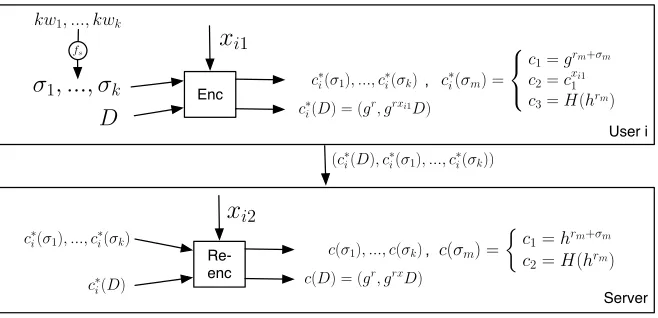
• Enc(Kui,D,kw(D)): as shown in Figure 2, run by a user with his key Kui
Trapd oor
User i
c(D) = (gr, grxD)
Server
w
Test PDec
Dec
D
c2=? H(c 1T−1)
Yes
c′ i(D) = (g
r, grxi1D)
fs
σ
wTi(w) =
!
t1=g−rgσw
t2=gxi2rgxi1σw
T =gxσw
c(σm) =
!
c1=hrm+σm c2=H(h
rm)
x
i1x
i1 [image:17.595.140.474.132.298.2]x
i2x
i2Figure 3: Search and Decryption Process
c∗
i(kw) = KE-U-Enc(Kui, kw), then outputs ciphertext c∗i(D, kw(D)) =
(c∗ i(D), c
∗
i(kw1), ..., c
∗
i(kwk)), wherek=|kw(D)|.2
• Re-enc(i,Ksi,c∗i(D,kw(D))): as shown in Figure 2, run by the server to
re-encrypt a ciphertext tuple from a useri. The server finds the correspond-ing key Ksi = xi2 and outputs re-encrypted ciphertext c(D, kw(D)) =
(c(D), c(kw1), ..., c(kwk)), where c(D) = PE-P-Enc(i, Ksi, c∗i(D)) and
c(kwk) = KE-P-Enc(i, Ksi, c∗i(kwk)) for each c∗i(kwk) . c(D, kw(D)) is
then inserted into the encrypted data storageE(D) =E(D)∪c(D, kw(D)).
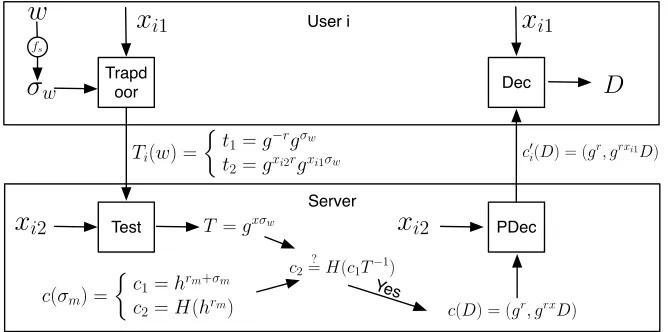
• Trapdoor(Kui,w): as shown in Figure 3, run by a user which takes the
user’s keyKui= (xi1, s) and a keywordw and outputs a trapdoor. The user chooses a random numberr←R Zq, computesTi(w) = (t1, t2) for the
word such thatt1=g−rgσw andt2=hrg−xi1rgxi1σw=gxi2rgxi1σw where
σw=fs(w).
• Pre-dec(i,Ksi,c(D)): as shown in Figure 3, run by the server. c(D) is
par-tially decrypted asc′
i(D) =PE-P-Dec(i, Ksi, c(D)). c′i(D) is returned to
the useri.
• Search(i,Ti(w), E(D),Ksi): as shown in Figure 3, run by the server. On
receivingTi(w) = (t1, t2), find the correspondingKsi=xi2and compute
T =txi2
(c1, c2) = (hrgxσkw, H(hr)), if c2 = H(c1·T−1) then w = kw with a overwhelming probability, i.e. a match is found. Then c(D) is partially decrypted as c′
i(D) = PE-P-Dec(i, Ksi, c(D)). c′i(D) is returned to the
useri.
• Dec(Kui,c′
i(D)): as shown in Figure 3, a user decrypts allc′i(D) in the result set by invokingPE-U-Dec(Kui, c′i(D)).
• Revoke(i)run by the server. Giveni, the server updates its user-key map-ping setKs=Ks\(i, Ksi).
It is easy to see that the correctness of the searching algorithm follows di-rectly from the collision resistant property of H. If w=kw, then c1·T−1 =
hrgxσkw·g−xσw =hrfor sure and thereforeH(hr) =H(c
1·T−1). This means the search algorithm will not produce false negative results. In the case that a false positive occurs, we havew6=kw which meansc1·T−1=hrgxσkw·g−xσw6=hr and we also haveH(hr) =H(c
1·T−1). This equally means we find a collision of H. Since the probability of finding a collision is negligible for a collision resistant hash function, the false positive rate is also negligible.
Note that the re-encryption step here is only used for controlling the write operation. That is, only an authorised user should be able to insert a document into the storage. If another mechanism for the same purpose is available, this step can be omitted. Becauseh=gx is available as a public parameter in the system, the user can encrypt a document and the keyword set asc(D, kw(D)) directly usinggx. Taking out this step will also decrease the server side
compu-tation load.
We now analyse the security of the multi-user searchable encryption scheme according to Definition 10.
Theorem 3. If the DDH problem is hard relative to G, then SE is a
non-adaptive indistinguishable secure multi-user searchable encryption scheme.
Proof. First let’s consider an adversary A′
who wants to challenge the proxy encryption IND-CPA game usingAas a sub-routine. A′
does the following:
• A′ receives public parameters G
, q, g and the server side keys. It then
picks a random user ID u and queries its oracle with m = 1 to obtain the ciphertextgr, grxu1. A′ then computesgrxu1grxu2 =grx. It can then compute for every useri,grxi1 =
grxg−rxi2 since it knows
xi2.
• A′
sets g0 = gr and h = grx = g0x. A
′
also chooses H, f, s. A′
sends
(G, q, g0, h, H, f) toAand also the server side keys.
• Recall thatHi is a sequence (D, qu11, ..., qiui)A ′
can generate a view of the history by doing the following steps:
σ=fs(kw). Then compute (c1, c2) as c1 = ˆc1xi2·cˆ2, c2= ˆc3. (c1, c2) is the ciphertext for this keyword. It then chooses a random number ˜
rand computes (gr˜ 0, grx0˜ D).
2. For each insert queryqui = (D, kw(D)), compute ˆc
1,cˆ2,ˆc3 for each keyword as above and (gr˜
0, grx˜ i 1
0 D). (ˆc1,cˆ2,ˆc3) and (gr0˜, g˜rxi 1 0 D) are valid ciphertext for the insert query.
3. For each search query qui = w, construct the result set rs(w) for
the query. Choose a random number ˆr, compute σw = fs(w) and
generatet1 =g0−ˆrgσ0w, t2=gx0i2ˆrgxi 1σw
0 . (t1, t2) is the trapdoor. For each document whose identifierid(D) is inrs(w), find the encrypted version (the document must be encrypted in the above two steps) and partially decrypt it using the server side key.
• A outputsHi0, Hi1. A′ encrypts every keyword and trapdoor in Hi1 by itself and challenges its game withD~0,D~1 which returns a resultPE(D~b)
whereD~b is the vector of all document inHib. It combines the results to
form a view (PE(D~b),KE(kw~ 1), T rapdoor(w~1)) (in the correct order as in
the trace) and returns it toA.
• A′
outputsb′
which is output byA.
By Theorem 1 and Corollary 1, it is clear that:
1
2+negl(k) > Succ
A′
P E(k)
= 12P r[A((PE(D~0),KE(kw~ 1), T rapdoor(w~1))) = 0]
+12P r[A((PE(D~1),KE(kw~ 1), T rapdoor(w~1))) = 1]
Now let us consider another adversary A′′
who wants to distinguish the pseudorandom functionf usingAas a sub-routine. It does the following:
• It generates (G, g, q, h, H) as public parameters, sends the parameters to
A along with f. For each useri, it chooses randomly xi1, xi2 such that
xi1+xi2=x. Send all (i, xi2) toAand keeps all (i, xi1, xi2).
• A outputs Hi0, Hi1. A′′ encrypts all the documents in Hi0 as PE(D~0). It also chooses a randomb, then consults its oracle and encrypts all the keywords and trapdoors in Hib. It combines the results to form a view
(PE(D~0),KE(kw~ b), T rapdoor(w~b)) and returns it toA.
• Aoutputsb′
. A′′
outputs 1 ifb′
=b and outputs 0 otherwise.
There are two cases to consider:
Case 1: the oracle inA′′
’s game is the pseudorandom function f, then
P r[A′′fs(·)(1k) = 1] = 1
2P r[A((PE(D~0),KE(kw~ 0), T rapdoor(w~0))) = 0]
Case 2: the oracle inA′
’s game is a random functionF, then for each distinct keywordwb, σwb is completely random toA. Moreover we know the traces are
identical, soKE(kw~ b) and T rapdoor(w~b) are completely random to A. In this
case
P r[A′′F(·)(1k) = 1] = 1
2 Sincef is a pseudorandom function, by definition
|P r[A′′fs(·)(1k) = 1]−P r[A′F(·)(1k) = 1]| < negl(k)
P r[A′′fs(·)(1k) = 1] < 1
2+negl(k)
SumSuccA′
P E(k) andP r[A
′′fs(·)(1k) = 1] up, we have
1 +negl(k) > 12P r[A((PE(D~0),KE(kw~ 0), T rapdoor(w~0))) = 0]
+1
2P r[A((PE(D~0),KE(kw~ 1), T rapdoor(w~1))) = 1]
+1
2P r[A((PE(D~0),KE(kw~ 1), T rapdoor(w~1))) = 0]
+1
2P r[A((PE(D~1),KE(kw~ 1), T rapdoor(w~1))) = 1]
= 1
2+Succ
A
SE(k)
Therefore we haveSuccA
SE(k)<
1
2+negl(k).
5.4
User Revocation
In our scheme, revoking a user’s access is straightforward. The KMS sends a request to the server to remove the server side keys. After the keys have been removed, the user cannot access the data unless the KMS generates new keys for him.
Inserting data and generating trapdoors must be done by the server and must involve both the user side keys and the server side keys. If we assume the server is honest, it is trivial to show that after the server removes the revoked user’s server side keys, the user cannot insert new data or search the data anymore.
The revocation of read permission, however, is not so trivial. Although a revoked user cannot directly access the documents stored on the server, he may be able to eavesdrop the communication between the server and the authorised users, namely the insert queries and the result sets of search queries. In the following theorem, we prove that a revoked user cannot distinguish insert queries generated by authorised users even if he has a revoked key set.
Theorem 4. If the DDH problem is hard relative to G, then the revoked users
cannot distinguish the insert queries generated by authorised users. That is, for
all PPT adversaries Athere exists a negligible function negl such that
SuccAS E,U(k) =P r
2
6 6 6 6 6 4
b′=b
(P arams, M SK)←Init(1k) ,
(Ku,Ks)←KeyGen(M SK,U),
(q0, q1)← A
Enc(Ku,·)(Ku
i), j← U, j6=i, b← {R 0,1}, b′← AEnc(Ku,·)(Ku
i, VKuj(qb))
3
7 7 7 7 7 5
whereqb = (Db, kw(Db))is an insert query such thatT r(q0) =T r(q1).
Proof. Consider an adversaryA′
who attempts to challenge the DDH problem usingAas a sub-routine.
• A′ sets
h=g1 and also choosesH, f, s. It passes (G, g, q, h, H, f) as the public parameters toA. A′ also chooses for each authorised user
ua ran-domxu2 fromZq and computesgxu1 =hg−xu2. It keeps all (u, gxu1, xu2).
It then chooses a randomxi1 fromZq and sends (xi1, s) to Aas its user side key set.
• A′ can answerA’s oracle query for
q= (D, kw(D)) as follows:
1. For the document D, choose a random r from Zq and compute
gr, grxu1D.
2. For each keyword kw ∈ kw(D), choose a random r from Zq and
compute ˆc1=gr+σ,σ=fs(kw), ˆc2= (gxu1)r+σ andc3=H(hr).
• After a certain time, Ageneratesq0, q1. q0 andq1 can be viewed as two vectors of equal size t where the first element in~qb is the document Db
and the restt−1 elements are the keywords. A′
chooses a random index
n←R [1, t] and a random bitb. It constructs a hybrid ciphertext vectorC~n
as follows:
1. Encrypt the elementsq10, ..., qn
−1
0 in~q0 and the elements q1n+1, ..., qt1 in~q1 as above.
2. Encryptqn
b as (g2, g3g
−xu2
2 Db) when n= 1 and as (c1, c2, c3) where
c1=g2gσb,c2=g3g
−xu2
2 gxu1σb andc3=H(g3) whenn >1.
• C~n is returned toA. A′
then outputs the bitb′
output byA.
Use a hybrid argument similar to that used in the proof of Corollary 1, wheng3=gc, the probability ofAoutputs 1 is exactly 12. Wheng3=gab, the probability of A outputs 1 is 1
tSucc A
SE,U(k) + t
−1
2t . Since A
′ outputs 1 when
Aoutputs 1, if the DDH problem is hard, then it follows that SuccA
SE,U(k)<
1
2+negl(k).
Theorem 5 states that a revoked user cannot distinguish the result sets of search queries. It follows directly from Theorem 4. Intuitively, each partially decrypted document in the result set returned to a useriisc′
i(D) = (gr, grxi
1D). And let us also consider an insert query submitted by the same user qi =
(D, kw(D)). The view of the query VKui(q
i) = ((grˆ, grxˆ i1D), c∗
i(kw(D))). It
is clear that if the adversary can distinguish the search query result sets, it can also distinguish the insert queries, which contradicts the theorem we have proved.
Theorem 5. If the DDH problem is hard relative to G, then the the revoked
users cannot distinguish the search result sets retrieved by authorised users. That
SuccAS E,U(k) =P r
2
6 6 6 6 6 4
b′=b
(P arams, M SK)←Init(1k),
(Ku,Ks)←KeyGen(M SK,U),
(R0, R1)← AEnc(Ku,·)(Kui), j← U, j6=i, b← {R 0,1}, b′
← AEnc(Ku,·)(Ku
i, c′j(Rb))
3
7 7 7 7 7 5
< 12+negl(k)
where Rb ={Db1, ..., Dbn} is a search query result set such that|D0i|= |D1i|
for eachDbi∈Rb.
Using the same techniques we used in proving Theorem 4, we can also prove Theorem 5. The proof is omitted.
It follows from the above theorems that as long as the server is honest and the authorised users can protect their keys, revocability is guaranteed.
6
Discussion
6.1
Authentication
In our scheme, each authorised user has a secret keyxi1and the server holds the corresponding partxi2 such thatxi1+xi2=xwherexis the master key in the system. This key pair can be used for mutual authentication and establishing secure channels. An example protocol to demonstrate the idea is presented below:
1. A userisends a request to the server which contains his id: {i}.
2. The server retrieves the user’s server side key and generates a fresh nonce
N, replies the user with{gr, hrg−rxi2N}.
3. The user decrypts the message g−rxi1hrg−rxi2N =N, then generates a fresh session key K and replies with{gr′
, hr′
g−r′x
i1
m} wherem= (N −
1, K).
4. The server decrypts the message, checks N −1 is correct, then the au-thentication succeeds and both parties have the shared session keyK.
6.2
Collusion Attacks
The main concern with proxy encryption schemes comes from a collusion attack. If a user colludes with the server, they can easily recover the master keys by combining their keys. Although some work has been done in [5] using bilinear maps to prevent the colluded parties from recovering the master key, the collud-ing parties are still able to decrypt the ciphertext with a weak secret they can recover. Theoretically, the design of fully collusion-resistant proxy encryption schemes is still an open problem.
However in practice, we can lower the risk to an acceptable level by imple-menting other mechanisms. One possible solution is to store user side keys in smart cards (or other tamper resistant devices). Another possible solution is to split the master key into multiple shares and introduce multiple servers from several SSPs competing with each other. The assumption is that a collusion attack is only possible when all the SSPs involved collude and the SSPs are competitors thus are unlikely to co-operate in such a collusion. We explain this solution further by an example.
Consider now that we have two servers and they belong to different SSPs. One server, sayα, will be used as the primary server which stores the encrypted data. The other server, sayβ, is used for countering collusion and needs to be involved in the computation but does not necessarily need to store the data. The first step is still to runInit(1k) to generate parameters (G, g, q, h, H, f) and
a master key set keyMSK= (x, s). This is the same as in section 5.3. Then we need to generate the user side key set and the server side key sets. The algorithmKeygen(M SK, i) is modified a little bit because we have two servers. Remember when we have only one server,xin the master key is split into xi1 and xi2 such that xi1+xi2 =x. xi1 is given to the user and xi2 is given to the server. If we have two servers α and β we split xi2 into xiα+xiβ = xi2 and send xiα to the server α and xiβ to the server β. It is easy to see that
xi1+xiα+xiβ =x.
The primary serverαruns the server side algorithms in section 5.3 without any change. Only the user side algorithms are changed in order to add collusion control.
To insert a document D and the associated keyword list kw(D), the user first runsEnc(Kui, D, kw(D)). This algorithm is unchanged. So the document is
encrypted as (gr, grxi1D) and each keywordkw
mis encrypted as (cm1, cm2, cm3)
wherecm1=grm+σm, cm2=cxmi11, cm3=H(hrm). Now the user needs to run an additional interaction with the serverβ. The user sendsgrin the ciphertext of
the document and cm1 in the ciphertext of each keyword to β. β uses its key
xiβ to computegrxiβ andcxmiβ1 and returns them back to the user. The user then updates the ciphertexts by multiplying grxiβ with grxi1
D and cxiβ
m1 with cm2.
The ciphertext of the document becomes (gr, gr(xi1+xiβ)D) and the ciphertext
of each keyword becomes (cm1, cxmi1+1 xiβ, cm3). The updated ciphertexts are sent
to serverα.
After receiving the ciphertexts, the server α runs the re-encryption algo-rithm. This algorithm is unchanged. α computes grxiα and cxiα
corresponding keyxiα. After re-encryption, the ciphertext of the document
be-comes (gr, grxD) becausegrxiαgr(xi1+xiβ)D=gr(xi1+xiβ+xiα)Dandx
i1+xiβ+ xiα=x. The ciphertext of a keywordkwmbecomes (hrm+σm, H(hrm)) because
cxiα
m1c
xi1+xiβ
m1 =c
xi1+xiβ+xiα
m1 =cxm1=g(rm+σm)x=hrm+σm. The ciphertexts are inserted into the encrypted data storage.
To search, the user must generate a trapdoor of a keywordwwith the help from β. The user first computes t1 = g−rgσw and sends it to β. β computes
txiβ
1 and returns it back to the user. The user then computest2=hrtx1i1t
xiβ
1 =
hrtxi1+xiβ
1 =gxrg
−r(xi1+xiβ)gσw(xi1+xiβ) =grxiαgσw(xi1+xiβ). The user queries
with (t1, t2).
Given the trapdoor (t1, t2),α runs the search algorithm which is the same as in section 5.3. αcomputes T = txiα
1 t2 = g−rxiαgσwxiαgrxiαgσw(xi1+xiβ) =
gσw(xi1+xiβ+xiα) = gσwx = hσw. Then α tests for each encrypted keyword
c(kw) = (hrm+σm, H(hrm)) to see whether H(hrm) =H(hrm+σmT−1). If so, a
match is found and the encrypted document will be returned to the user. To decrypt a document, the document is first partially decrypted by α. α
runs the pre-decryption algorithm in section 5.3. Given the ciphertext (gr, grxD), αcomputesg−rxiαandgrx−rxiαD=gr(xi1+xiβ)D. (gr, gr(xi1+xiβ)D) is returned
to the user. The user then sendsgr to β and getsg−rxiβ back. The user can
then fully decrypt the document by first computingg−rxi1and then multiplying
gr(xi1+xiβ)D withg−rxi1 andg−rxiβ.
This approach can be easily extended to n servers by splitting xi2 into n shares such that they add up to xi2 and give one share to each server. To encrypt, search and decrypt, the user must first interact with alln−1 collusion control servers and then with the primary server.
Introducing more servers will not weaken the security of the system. It can be proved by a simple reduction: if in ann-server setting an adversaryA′ who
controls up to n servers can break the system with non-negligible probability, then in a single-server setting an adversaryA can useA′ to break the system
with non-negligible probability. A just splits xi2 randomly into n shares and givesA′
the number of shares it needs. That is, with multiple servers, the scheme is at least as secure as with one server. And obviously, splitting the master key into multiple shares makes collusion harder: it requires all the servers and at least one user to collude together to recover the master key.
7
Implementation and Performance
We implemented a prototype of our scheme in Java 1.6 using the big integer class provided by the standard API. We used a 1024-bit primep, a 160-bit prime q
!"!#$$% &"!#'(%
&")'()%
'"#!$!% &"!)!*%
*"!+,!% *"!,,'% *"!(*&% *"!*$#%
!"!#$)%
&"((+*%
)"#++!% )"!##(% &"!(&)%
&")!&,% &"*!!&%
#"!)#+% &"!)*!%
!% &% #% )% '% (% *% ,%
-./0122.34564% -./0122.789% -./0122.7:9% ;<3:3<=>% ;<383<=>% 8<3:3?5>% 8<383?5>% 8<3:3<=>% 8<383<=>%
!"##"$%&'()$*
[image:25.595.172.437.128.361.2]@5A%6>B5C5% DE1%6>B5C5%
Figure 4: Performance Evaluation of Individual Operations
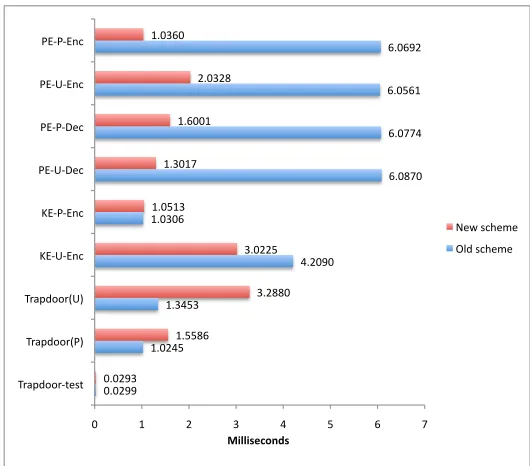
In the first experiment, we measured the execution time of each of the follow-ing operations: (1) PE-P-Enc: the server side proxy encryption; (2) PE-U-Enc: the user side proxy encryption; (3)PE-P-Dec: the server side proxy de-cryption; (4)PE-U-Dec: the server side proxy decryption; (5)KE-P-Enc: the server side keyword encryption; (6)KE-U-Enc: the user side keyword encryp-tion; (7)Trapdoor(U): the user side trapdoor generation; (8)Trapdoor(P): the server side trapdoor generation; (9)Trapdoor-test: the trapdoor/keyword match test.
!"#$%&' &"(&)#'
*"%!+&' ,"(&#('
!",%*(' &",%%*'
("&$$#' ,"%)$)'
&' ,' !' $' )' %' (' *' #' -./012345678'
-./012345698' :5/012345678' :5/012345698'
!"#$%&'(
[image:26.595.173.439.128.293.2];.<'=/>.?.' @AB'=/>.?.'
Figure 5: Performance Evaluation of Bulk Encryption/Decrytpion
better than the RSA based scheme in performance.
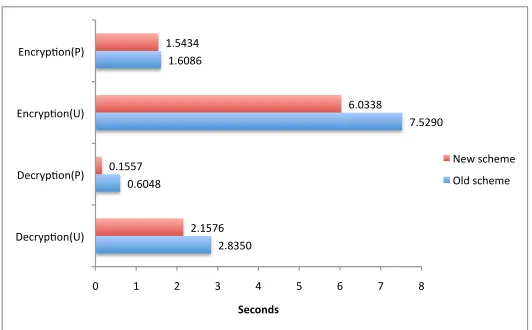
In the second experiment measured the performance of bulk encryption/decryption. The data set we used was 100 pdf files, the total size was 99.2 MB. Each docu-ment was associated with 10 keywords, i.e. 1000 keywords to encrypt in total. The files were encrypted with 128-bit AES and the AES keys were encrypted using proxy encryption. The results are shown in Figure 5. In the figure, P
means server side operation andUmeans user side operation. We can see that the performance of the new scheme is better than the old one.
!"#$##% &"'##!%
&("#$')%
!"$#'#% &"&#!&%
)"$*)$%
!"#(+!% &"',!$%
&,"(&&(%
!"$)!$% &"!('&%
'"'#*)%
!% $% ,% *% )% &!% &$% &,% &*% &)% &!-!!!%
&!!-!!!% &-!!!-!!!%
!"#$%&'(
)
"
*
+
$
,&
'(
[image:27.595.172.439.128.330.2]./0123/4/%5678% ./0%123/4/% 9:;%123/4/%5678% 9:;%123/4/%
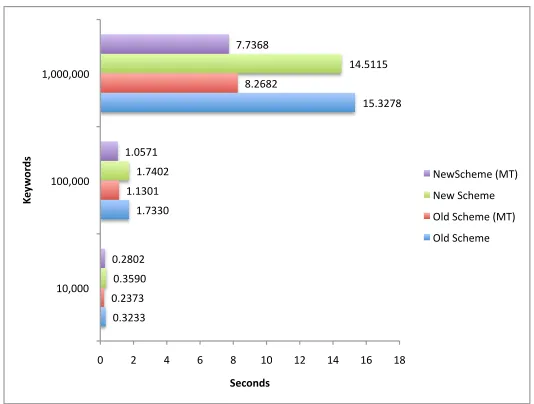
Figure 6: Performance Evaluation of Searches on Different Database Sizes
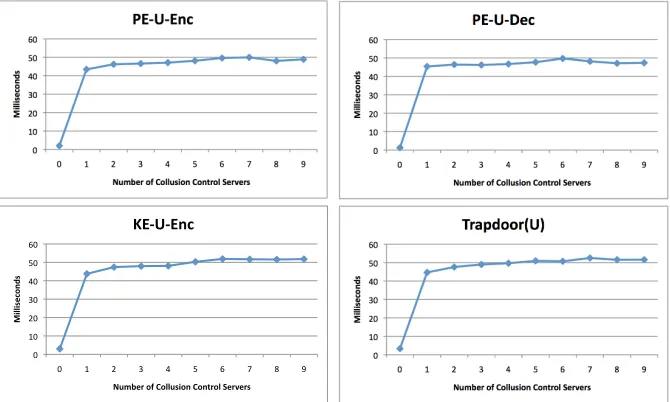
Figure 7 that there is an overhead when using collusion control servers. How-ever, additional collusion control servers resulted in only very small increase in the overhead. Therefore, having more collusion control servers will not have a big impact on scalability of the system.
Note that we did not do any optimisation on the code. Also our implemen-tation is based on groupZ∗
p as described in the paper, however it is not hard
to reformulate the idea based on elliptic curve groups, which might be more efficient.
8
Conclusion and Future Work
In this paper, we presented a new data encryption scheme that does not require a trusted data server. In the scheme the server can perform encrypted searches and updates on encrypted data without knowing the plaintext or the decryption keys. Unlike previous searchable data encryption schemes that require a shared key for multi-user access, each user in our system has a unique set of keys. The data encrypted by one user can be correctly decrypted by all the authorised users in the system. Moreover the keys can be easily revoked without any overhead, i.e. without having to re-encrypt the stored data. We provided a construction for the scheme built on top of proxy encryption schemes. We gave the formal definitions and proofs of security. We also implemented the scheme in Java and evaluated the performance.
!" #!" $!" %!" &!" '!" (!"
!" #" $" %" &" '" (" )" *" +"
!"##"$%&
'()$*
+,-.%/*'0*1'##,$"'(*1'(2/'#*3%/4%/$*
567876(&*
!" #!" $!" %!" &!" '!" (!"
!" #" $" %" &" '" (" )" *" +"
!"##"$%&
'()$*
+,-.%/*'0*1'##,$"'(*1'(2/'#*3%/4%/$*
567879%&*
!" #!" $!" %!" &!" '!" (!"
!" #" $" %" &" '" (" )" *" +"
!"##"$%&
'()$*
+,-.%/*'0*1'##,$"'(*1'(2/'#*3%/4%/$*
5/67)''/89:*
!" #!" $!" %!" &!" '!" (!"
!" #" $" %" &" '" (" )" *" +"
!"##"$%&
'()$*
+,-.%/*'0*1'##,$"'(*1'(2/'#*3%/4%/$*
[image:28.595.139.474.129.330.2]567876(&*
Figure 7: Performance Evaluation under Collusion control
the server knows the access pattern of the users which allows it infer some in-formation about the queries. One possible direction is to combine our scheme with Private Information Retrieval (PIR) schemes. PIR schemes allow a user to retrieve data items from a database without revealing to the database which items were queried. By combining PIR, the search queries can be executed without revealing the access pattern to the server. This idea has been inves-tigated in [9] and a scheme for single-reader/multiple-writers environment has been proposed in the paper. However, PIR schemes are computationally ex-pensive. Using secure hardware assisted PIR schemes which are more efficient [27, 28] is a possible approach to address this.
Another possible extension may be to integrate bucketization [17, 18]. Buck-etization means to partition an ordered attribute domain into a set of buckets and each of which is identified by a tag. Range queries can be translated into querying a set of bucket tags. A tag is equivalent to a keyword and can be easily encrypted and tested in our scheme. This would allow our scheme to support range queries. Another benefit of bucketization is the result set may contain some false positive results, which can obscure the access pattern. However, the impact on security needs to be carefully analysed.