City, University of London Institutional Repository
Citation
:
Thompson, E. H. and Hampton, J. A. (2011). The effect of relationship status on communicating emotions through touch. Cognition & Emotion, 25(2), pp. 295-306. doi: 10.1080/02699931.2010.492957This is the unspecified version of the paper.
This version of the publication may differ from the final published
version.
Permanent repository link:
http://openaccess.city.ac.uk/1011/Link to published version
:
http://dx.doi.org/10.1080/02699931.2010.492957Copyright and reuse:
City Research Online aims to make research
outputs of City, University of London available to a wider audience.
Copyright and Moral Rights remain with the author(s) and/or copyright
holders. URLs from City Research Online may be freely distributed and
linked to.
RUNNING HEAD: Communicating Emotion through Touch
The Effect of Relationship Status on Communicating Emotions through Touch
Erin H. Thompson Institute of Psychiatry, London
James A. Hampton City University, London
Address for correspondence: Erin Hope Thompson
Department of Psychology, P2.13 Institute of Psychiatry
King’s College London De Crespigny Park London, SE5 8AZ, UK [email protected]
Acknowledgements
Abstract
Research into emotional communication to date has largely focused on facial and vocal
expressions. In contrast, recent studies by Hertenstein, Keltner, App, Bulleit and Jaskolka (2006) and Hertenstein, Holmes, McCullough, & Keltner, (2009) exploring nonverbal communication of emotion discovered that people could identify anger, disgust, fear, gratitude, happiness, love,
sadness and sympathy from the experience of being touched on either the arm or body by a
stranger, without seeing the touch. The study showed that strangers were unable to communicate the self-focused emotions embarrassment, envy and pride, or the universal emotion surprise.
Literature relating to touch indicates that the interpretation of a tactile experience is significantly influenced by the relationship between the touchers (Coan, Schaefer & Davidson, 2006). The present study compared the ability to communicate emotions solely via touch of romantic couples and strangers. Results showed that both strangers and romantic couples were able to communicate universal and prosocial emotions, whereas only romantic couples were able to communicate the self-focused emotions envy and pride.
Despite the importance and pivotal influence of touch in a variety of social domains
(Eibl-Eibesfeldt, 1989; Keltner & Kring, 1998; Field, 2001), research has paid very little
attention to how touch is used in the communication of emotion. The majority of investigations
into emotional communication have focused on facial and vocal expressions (Ekman & Friesen,
1975; Banse & Scherer, 1996; Russell, 1991; Juslin & Laukka, 2003) rather than touch, even
though tactile signals represent a unique part of intimate relationships and emotional
communication, as they require close proximity. The present study is the first to observe the
communication of emotion between romantic couples solely through touch, and to compare it to
that between strangers.
In a pioneering study, Hertenstein et al. (2006) explored whether people can
communicate emotions to a stranger using touch alone. Participants were separated by an opaque
barrier, and encoders (touchers) were asked to convey twelve different emotions by touching the
forearm of the decoder (recipient) who had to choose which emotion was being communicated.
This experiment, carried out in the United States and in Spain, found that participants could
accurately communicate anger, fear, disgust, love, gratitude and sympathy. These are broadly the
same set of emotions that have been claimed to have universal means of facial expression across
cultures (Ekman, 1992; Izard, 1992; Ekman, 2003). However, strangers in Hertenstein et al.’s
study were unable to communicate the prosocial emotions surprise, happiness and sadness, as
well as the self-focused emotions embarrassment, envy, and pride. Hertenstein et al. suggested
that communication of self-focused emotions via touch may be particularly difficult relative to
other emotions.
Hertenstein et al. (2009) conducted a follow-up study using the same methodology but
allowing encoders to touch the whole body of decoders, and found that now strangers could
communicate two additional emotions, happiness and sadness, as well as the emotions
Hertenstein et al.’s studies (2006; 2009) used randomly allocated pairs of strangers in the
communication task. As yet there has been no exploration of communication of emotion through
touch between people in romantic relationships. The present study therefore aimed to explore the
effect of relationship status on distinguishing emotions solely through touch. The question to be
addressed was the following: Is there a difference between strangers and romantic partners in the
emotions that can be distinguished via touch? More specifically, can the self-focused emotions
(embarrassment, envy, pride) that could not be communicated between strangers be
communicated to a romantic partner?
Earlier research on touching indicates that the person whom one is touching or by whom
one is being touched can have an effect on the interpretation of the meaning of that touch (Heslin
& Alper, 1983; Coan et al., 2006). The aim of the present study was to observe whether
relationship status has an effect on emotional communication and interpretation. Hertenstein et
al.’s (2006) methodology was used. However, to provide a closely matched control, participants
repeated the experiment twice, once with their romantic partner and once with a stranger. The
primary dependent variable was the match between the emotion label given to the encoder and
the emotion label subsequently chosen by the decoder. Touch analyses were conducted on the
type of touch used to observe how the distribution differed between successful and unsuccessful
actions, and between couples and strangers. Additional analyses were carried out to establish the
confusability of emotions when transmitted by touch to observe whether the confusability was
related to their similarity in arousal and valence (Russell, 1994).
It was hypothesized that (as in Hertenstein et al.’s 2006 study) both strangers and couples
would be able to communicate universal emotions such as anger, disgust and fear, and prosocial
emotions gratitude, love, and sympathy. However, it was predicted that romantic couples would
be better in communicating emotions than strangers and that only romantic couples would be
included all gender combinations (male to male, female to female, male to female, female to
male) although given the scope of the study it was not possible to test all gender combinations
equally, and there was an unbalanced design. Half of the encoders were male and half female;
the majority of decoders within couples were of the opposite gender to the encoder, while the
majority of stranger decoders were of the same gender to the encoder. Thus the couple/stranger
factor was partly confounded with opposite/same gender. This design was chosen in order to
minimize the possible inhibition people might feel about touching or being touched by a stranger
of the opposite gender. Research has shown that receiving touch from a stranger is generally
disliked, although touch on certain parts of the body, including the hands, arms and back, is
considered more acceptable (Heslin & Alper, 1983). On the basis of Hertenstein et al.’s 2006 and
2009 results, gender was in any case not expected to influence success in the task, and indeed the
analysis by gender reported below failed to show significant gender effects.
Method
Participants. Participants were recruited via advertisements throughout the campus of a
London university and in nearby locations to invite both students and a wider population. Only
couples were eligible to take part in the study, and a minimum length of time together was not
required. The length of relationships ranged from 1 - 84 months, with an average of 26.4 months,
and a standard deviation of 19.8 months. All participants were entered into a draw to win £40
and a bottle of champagne, and first year Psychology students received one academic credit for
their participation. Thirty couples (60 participants) took part in the experiment. Participants
ranged in age from 18 - 54, with a mean age of 24.2 and a standard deviation of 6.3 years. The
ethnic background of the sample was primarily White European (78%) but included a variety of
other ethnicities; Indian (10%), African (8%) and Mixed (4%). The majority of participants were
students from a diversity of London universities (n=35) and the sample also included a variety of
were homosexual. Participants within each couple were randomly assigned to the roles of
encoder and decoder.
Design. The experiment was run by taking a foursome of participants (two couples) who
together provided two measures for each of the two conditions of Couples vs. Strangers. Two
relationship couples were booked into each testing time-slot enabling each participant to be
tested once with their partner and once with the accompanying stranger. Each participant was
designated as either an encoder or a decoder, and performed the task twice, once with their
partner, and once with a stranger. Figure 1 illustrates how a unit of 4 participants (2 couples)
created 4 testing sessions. Every participant remained as either an encoder or a decoder for both
communication tasks.
Fifteen testing sessions, each with 2 couples, were performed yielding a total of 60
participants. All participants were aware of whether they were communicating with their
romantic partner or stranger, as well as the gender of the stranger. The order in which the 4 dyads
from a foursome were tested was determined randomly on each occasion. On each testing
session, the encoder was given 12 emotion terms to convey, and the decoder had to choose from
a given list which term they thought had been intended. Accuracy was recorded, as well as the
type of touch used. The repeated measures design ensured that each decoding participant finished
the experiment having provided two scores; a score out of 12 for participation with a stranger
and a score out of 12 for participation with their romantic partner. Thus, a total of 30 decoders
provided 60 sets of results.
Coding analysis of touch. All communication events were filmed and the type of touch
used to express each emotion was coded. To validate the coding, 10 randomly selected testing
sessions were also coded by an assistant, and the results were compared. Judges agreed 97% of
the time, and Kappa was 0.73. Because of equipment failure, one session was not filmed, so
from Hertenstein et al. (2006) were used: finger interlocking, handshake, hitting, lifting,
massaging, patting, picking, pinching, poking, pressing, pulling, pushing, rubbing, scratching,
shaking, slapping, squeezing, stroking, swinging, tapping, tickling, tossing, trembling. In
addition the following three codes were created for three further common types of touch used:
‘body-touch’ for when the encoder used the decoder’s hand or arm to touch part of the encoder’s
body, for example, to pat their chest or stroke their face, ‘lift-dropping’ for the action of lifting
the hand and dropping it from mid-air, and ‘flicking’ for a quick flicking movement of the finger.
Coding of touch was done by judges who were ignorant of the relationship status of the dyad
involved.
Materials and Apparatus. Participants were seated at opposite sides of a table separated
by an opaque black curtain. The curtain was held up by a wooden device which was clamped to
the table. The same emotion words were used for the experiment as used in Hertenstein et al.’s
(2006) study. They were: 6 universal emotions: anger, disgust, fear, happiness, sadness,
surprise; 3 prosocial emotions: love, gratitude, sympathy; and 3 self-focused emotions:
embarrassment, envy, and pride.
Procedure. On each testing session the encoder and decoder were seated at a table on
opposite sides of the opaque curtain. Encoders had the role of translating the emotional words
specified to them into forms of touch; they were asked to focus on how they would effectively
communicate the emotions and were encouraged to respond to each emotion with a
representation of touch as they perceived it. Decoders had the role of interpreting which emotion
was being communicated through the touch sensation on their arm, and were instructed to place
their forearm underneath the black curtain to expose it to the encoder performing the touch.
Encoders were encouraged to use any form of touch they considered appropriate to each of the
Encoders were given a booklet with 12 emotion words, 1 per page, and were instructed to
communicate 1 emotion at a time to the decoder’s forearm. Decoders were given a booklet with
12 answer sheets, each of which listed the 12 emotion words. They were required to circle the
word they believed matched the tactile sensation and then progress onto the next answer sheet
without looking back at previous responses. The emotion words were presented in alphabetical
order on the answer sheets which also included the option ‘none of these terms are correct’ in
the event that the decoder did not feel that the touch they had experienced represented any of the
emotion words listed. Decoders always received the emotions in different random orders from
the partner and the stranger encoders. Participants were not allowed to talk to each other at any
point during the testing session. A camera was used to film the experiments for the purpose of
touch analysis.
Results
Preliminary analyses. Hertenstein et al. (2006) reported no influence of the gender of
decoders and encoders on the success of emotional communication, a result confirmed in a more
recent study with 124 dyads (Hertenstein et al. 2009). In the light of their results, and given the
constraints of the present study, gender was allowed to be confounded to some degree with the
couple/stranger factor, in an unbalanced design in which most decoders received touch from
opposite gender romantic partners, and same gender strangers. As a check on the validity of this
decision, we compared success of communication between two groups of participant pairs.
Group A consisted of 21 decoders who were communicated to by opposite sex partners, and by
same sex strangers. Group B consisted of the 9 remaining decoders who had either same sex
partners, or opposite sex strangers, or both. If an opposite-gender advantage in communication
were responsible for any difference between partners and strangers, then we should find a
stronger effect of Relationship status in Group A (where the effects were confounded) than in
Relationship Status. ANOVA was run across the 30 decoders with Relationship status as a
within-subjects factor, and Group (A vs B) as a between-subjects factor. The interaction between
Group and Relationship status was completely absent (F<1), with the same mean advantage in
accuracy of 1.6 for partners over strangers in each Group. While acknowledging the low power
of this analysis, taken together with the results reported by Hertenstein et al. (2006, 2009) we
were confident that our results were unlikely to reflect gender effects to any significant extent.
A further preliminary analysis examined the time spent touching. Romantic couples took
significantly longer than strangers (M = 7.4s vs 4.9s). ANOVA was run on time spent touching
with Relationship status and Accuracy of communication (Correct vs Incorrect) as within-group
factors. For this, and subsequent ANOVA reported below, to achieve independence the unit of
analysis was a “foursome”, the group of 4 participants tested on a given occasion. The data for
partner versus stranger communication were collapsed over the two decoders in each pair, in
order to remove the statistical dependence in the data generated by the design (the partner
encoder for one decoder was the stranger encoder for the other in each foursome). Because of
equipment failure, no times were recorded for one of the pairs, so the analysis of time taken was
conducted over 14 foursomes. There was a strong main effect of Relationship status (F(1,13) =
41.3, p < .001), but no effect of Accuracy on time taken, and no significant interaction (both
F<1). Thus while it was confirmed that partners took longer to communicate, neither type of pair
took any longer over trials where they were successful and those where they failed to
communicate the emotion. At least at the group level, there was no relation between time and
accuracy. The relationship between accuracy and time across individuals within groups is
considered further below. Finally, length of relationship did not correlate significantly with
success for romantic couples (r(28) = 0.1). Given that longevity of a relationship is not a perfect
Success at communicating emotions. To address our first two questions, the data were
collated to provide a measure of accuracy for each emotion in each condition. Decoders had
twelve emotions and a neutral item (‘none of these terms are correct’) to choose from. The latter
option, chosen very rarely (strangers = 1.1%, couples = 1.4%) was treated as an error. Both
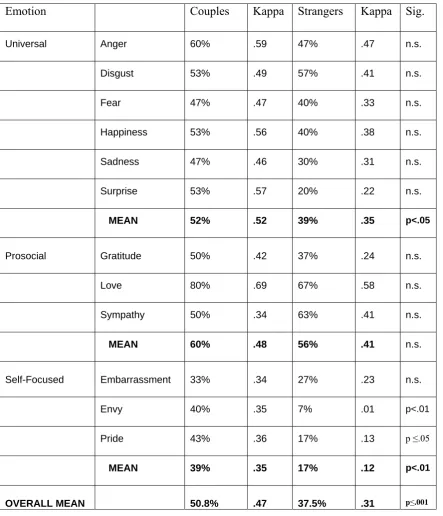
groups showed a good rate of success. Table 1 provides a full breakdown of success for each
type of dyad and for each emotion. Couples succeeded in communicating the selected emotion
51% of the time, and strangers 38%. Mean kappa for a decoder choosing the correct emotion
term was .47 for couples and .31 for strangers. Compared to a conservative estimate of a chance
rate of 25% (as used by Hertenstein et al., 2006, 2009), both groups performed significantly
above chance (t(29) = 6.61, p < .001, for couples, t(29) = 3.47, p < .005, for strangers). Taking
each foursome as a unit of analysis, mean accuracy was greater with partners within a foursome
than with strangers in 11 of the 15 foursomes, and only worse in 1 (Wilcoxon T = 2, p < .001).
We can conclude therefore that both partners and strangers were successful at the task, but that
partners were more successful than strangers.
A key aim of this study was to investigate accuracy of communicating different kinds of
emotion. Our third question was whether either of the groups would be able to communicate the
self-focussed emotions. To answer the question more generally, the 12 emotions were classed
into universal (anger, disgust, fear, happiness, sadness, surprise), prosocial (gratitude, love and
sympathy), and self-focussed emotions (embarrassment, envy and pride) (see Table 1). Success
was calculated across foursomes for each of these classes of emotion. Couples achieved success
rates of 52%, 60% and 39% across universal, prosocial and self-focussed emotions, compared to
rates of 39%, 56% and 17% for strangers. ANOVA showed strong effects of Relationship
(F(1,14) = 17.3, p < .001) and Type of Emotion (F(2,28) = 21.5, p < .001), but the interaction
was not significant (F(2,28) = 1.87, p < .2). Thus although strangers appeared to have particular
generally less accurate, and this type of emotion being the hardest to convey. Our hypothesis
called for two planned tests of the ability of each type of pair to communicate Self-focussed
emotions. Taking a 25% chance rate (Hertenstein et al., 2006), it is clear that the strangers, with a
mean of 17% correct, were not succeeding. On the other hand the couples, with 30% correct
were well above the chance rate (t(14) = 3.3, p < .01).
To unpack the data further, an analysis was performed for each emotion separately, using
a statistical rather than an arbitrary definition of chance levels. Fisher exact tests (Siegel, 1956)
were used to test whether there was significant agreement between the decoders and the encoders
for each emotion for each type of pair. Alpha was set at .001 in recognition of the 12 tests that
were made. Frequency of success at identifying emotions for couples and strangers is displayed
in Table 1 together with Cohen’s kappa. Couples successfully communicated all emotions better
than chance, whereas strangers were successful on all except for Envy (7%) and Pride (17%),
two of the self-focussed emotions. The final column of Table 1 shows the significance of tests
for the difference between couples and strangers for each emotion. Wilcoxon tests were used for
individual emotions, comparing the number of foursomes in which couples were better with the
number where strangers were better. For tests of the mean for each type of emotion and the
overall mean, related t-tests were used across the 15 foursomes.
Accuracy and time taken. The fact that couples both took longer and were more accurate
than strangers raises the possibility that across dyads success was a consequence of greater time
taken. To assess this notion, two measures were calculated across the 14 foursomes (an
equipment failure meant that no times were recorded for one pair). First an overall measure of
the Couple’s Accuracy advantage within each foursome was taken by subtracting the stranger
pairs’ total of successfully communicated emotions from that for the couple pairs. Second, a
similar measure was calculated for each foursome for the overall Time Difference between
we would expect a positive correlation between these two measures. That is to say that those
foursomes where the couples took a lot longer than strangers should show a correspondingly
bigger accuracy advantage for couples than those foursomes where the difference in time taken
was less extreme. The correlation between the two measures was positive but not significant
(r(12) = .20, p >.5). Thus there was no evidence that accuracy differences were attributable to
differences in time taken (although the low power of the test means that this account can not be
entirely ruled out).
Use of different types of touch. Our next analysis considered how different types of
touching actions were used in the communication of different emotions. Touches were
categorized into 27 types, according to the scheme described in the Methods section. On average
each communication used 1.9 types of touch. Table 2 shows the types of touch commonly used
for each emotion, between couples, between strangers, and in Hertenstein et al.’s (2006) study,
together with the percentage of trials on which they were used. Particular types of touch were
strongly associated with particular emotions, across all three groups. For example, positive
emotions tended to be communicated with lift, shake and squeeze regardless of interpretation
success or relationship status. Overall, it appears that couples and strangers communicated
emotion via touch in very similar ways. The distribution of types of touch used to communicate
each emotion allows us to examine the similarity between emotions. Table 3 shows the
correlation between each pair of emotions calculated across the two frequency distributions of
touch-types used for each emotion. The emotions have been clustered to illustrate the fact that
Positive emotions (pride, happiness, gratitude and surprise) formed a cluster, as did what might
be termed Tender emotions (sadness, sympathy and love). The middle group of Negative
emotions (Embarrassment, Envy, Anger, Disgust and Fear) formed a third cluster.
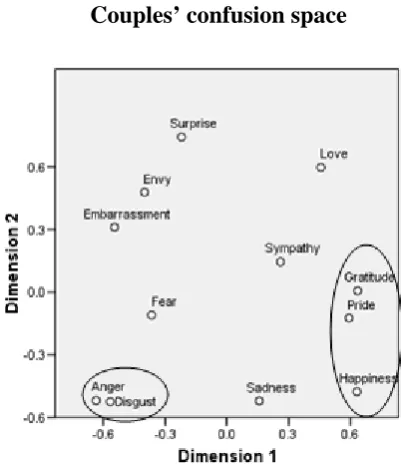
Confusability of emotions. The last analysis considered the confusability of one emotion
reflecting how often each emotion was correctly identified or confused with each of the other
emotions. Proxscal multidimensional scaling (Busing, Commandeur, & Heiser,1997) was carried
out to provide a spatial representation in which the similarities between the individual emotions,
in terms of their confusability, are projected into proximities in the space. The closer two
emotions are in the diagram, the more often they were mistaken for each other. Normalised raw
stress was .065 for couples and .05 for strangers. (Stress measures the degree of correspondence
between the input similarity matrix and the distance between items in the spatial model. Values
below 0.10 indicate a good fit to the data.) Figure 3 illustrates the findings and shows interesting
differences between the two groups. For example, strangers found it difficult to differentiate
between envy, disgust and anger via touch, as can be seen by their proximity in the diagram.
Strangers also confused love, sadness and sympathy. By contrast the Couples’ confusion space
was more widely spread implying that couples were less likely to confuse emotions. Specifically,
couples did not have difficulty differentiating between love, sadness and sympathy in the same
way that strangers did. On the other hand, anger and disgust were more often confused for
couples than for strangers.
Discussion
The present study confirmed that the success of interpreting emotions correctly via touch
is influenced by the relationship between the person giving and the person receiving the touch.
We supported previous findings (Hertenstein et al., 2006; 2009) that strangers could
communicate universal and prosocial emotions via touch, as well as documenting the
communication of an additional emotion, embarrassment. In contrast, couples were able to
communicate universal, prosocial and three different self-focused emotions at levels well above
chance.
Additionally, the study showed that people were more likely to confuse particular
envy, anger and disgust (high arousal, negative valence). Comparing the confusability maps with
the data on touching in Tables 2 and 3 it is clear that the commonly confused emotions often
involved similar types of touch. For example, strangers often confused love, sadness and
sympathy (Figure 3), and Tables 2 and 3 indicate that these emotions involved very similar types
of touch; most often stroking and squeezing. The confusion between emotions replicates
confusion found in facial recognition of emotion (Ekman, 2003; Widen & Russell, 2003), as well
as confusion found in distinguishing emotions expressed by body pose (Schindler, Van Gool, &
de Gelder, 2008). Couples had fewer confusions between emotions, in particular having an
appropriately clear distinction of love from sadness and sympathy, which had been confused by
strangers. The only two emotions that couples still tended to confuse were anger and disgust,
which may also not be mutually exclusive emotions in facial recognition (Widen, 2004).
Despite the higher accuracy of communication shown by couples, analysis of the types of
touch used revealed that couples and strangers tended to use much the same touch actions for
specific emotions, including the self-focused emotions that were decoded by couples only. The
similarity in touching actions for couples and strangers and the disparity in their successful
interpretation may indicate that more subtle differences in the manner of touch, not picked up by
our coding scheme, were responsible for differences in success. However, it is more likely that
the same cues are being interpreted differently due to relationship status, which is an exciting
new finding deserving of further exploration. Further work could utilize anonymity so that it
remains unknown whether the touch is from / to a stranger or a romantic partner to confirm our
findings. Anonymity would also eliminate the possibility that people in relationships are more
motivated, as opposed to more able, to decode emotions from their partners than strangers.
However, achieving anonymity could prove difficult as Kaitz (1992) found that blindfolded
Although no gender effects in emotional communication via touch have been reported
(Hertenstein, et al., 2006, 2009), the fact that gender was partly confounded with relationship
status was a major limitation of the present study. Future research using the same methodology
would benefit from using a population that would not oppose other-sex touching in a carefully
supervised research setting, creating a balanced gender design. Furthermore, it would be
interesting to develop extensions of the present paradigm outside the constraints of a laboratory
setting, as distinguishing the ambiguous nature of tactile messages may require the presence of
other nonverbal cues to put messages into context.
Adding variables to gain more information about the quality of a couple’s relationship
would be valuable in future studies; for example spouses’ ability to decode their partner’s
nonverbal messages has been found to be related to their marital satisfaction (Gottman &
Porterfield, 1981; Noller, 1980; Noller, 1981), and couples with a more secure attachment style
tend to touch each other more (Tucker & Anders, 1998).
Intricacies of interaction may differ between cultures, and investigations into how
manners of touch vary across cultures provide another realm for research. Cross-cultural studies
have shown that facial expressions of emotion correlate very highly among various cultures and
races throughout the world (Fridlund, Ekman, & Oster, 1987, Ekman, Friesen, & Ellsworth,
1972). Photos expressing basic emotions such as happiness, surprise, fear, anger, disgust, and
sadness were significantly recognised at above chance levels in literate and preliterate cultures.
These findings have been widely replicated and extended in over a dozen nations (Boucher &
Carlson, 1980; Izard, 1971; Shimoda, Argyle & Ricci-Bitti, 1978). However, despite support for
universality, researchers have also reported evidence for systematic cultural differences in the
communication of emotion, for example, in the form of categorization of emotions (Russell
in-group advantages (Elfenbein & Ambady, 2002). This raises the question of whether emotions
can be successfully communicated via touch within and across different cultures.
In developing this research further, the results of the present study give rise to several
other interesting questions. Is the advantage shown by couples relative to strangers specific to the
communication of emotional material, or is it part of a general superiority in communication via
touch? Would the results be successfully replicated with other long-term relationships such as
parents and children, or life-long friends, or does sexual intimacy make a difference? Would
homosexual couples provide the same results? Do couples share something unique in their
emotional communication, and what are the factors that contribute to their success? Is message
salience increased if modalities are combined? These questions provide a broad agenda for future
studies; the potential for future research in emotional communication via touch is rich.
Summary and Conclusions
Romantic couples have the ability to distinguish a broad variety of emotions purely
through the sensory modality of touch, including the self-focused emotions embarrassment, envy
and pride, which can be considered highly abstract. In comparison, strangers are successful at
interpreting certain universal and prosocial emotions via touch, but not all of the aforementioned
self-focused emotions. The present study supports the notion of touch as a diverse and adaptable
modality, provides possibilities for future experiments in this field, and possesses relevance for
many different disciplines. Our findings extend the literature on the communication of emotion;
the nature of particular relationships appears to have the ability to diminish the ambiguity of
References
Banse, R., & Scherer, K. (1996). Acoustic profiles in vocal emotion expression. Journal of
Personality and Social Psychology, 70, 614-636.
Boucher, J.D., & Carlson, G.E. (1980). Recognition of facial expression in three cultures.
Journal of Cross-Cultural Psychology, 11, 263-280.
Busing, F.M.T.A., Commandeur, J.J.F., & Heiser, W.J. (1997). PROXSCAL: A
multidimensional scaling program for individual differences scaling with constraints. In W.
Bandilla & F. Faulbaum (Eds.), Softstat'97: Advances in Statistical Software, Vol 6 , pp.
67-74. Stuttgart: Lucius & Lucius.
Coan, J.A., Schaefer, H.S., & Davidson, R.J. (2006). Lending a hand. Social regulation of the
neural response to threat. Psychological Science,17:(12), 1032-1039.
Eibl-Eibesfeldt, I. (1989). Human Ethology. New York: Aldine de Gruyter.
Ekman, P. (1992). An argument for basic emotions. Cognition and Emotion, 6, 169-200.
Ekman, P. (2003). Emotions Revealed. Recognizing Faces and Feelings to Improve
Communication and Emotional Life. New York: Henry Holt & Company.
Ekman, P., Friesen, W. V., & Ellsworth, P. (1972). Emotion in the human face: Guidelines for
research and an integration of findings. New York: Pergamon Press.
Ekman, P., & Friesen, W.V. (1975). Unmasking the face. Englewood Cliffs, NJ: Prentice-Hall.
Elfenbein, H. A., & Ambady, N. (2002). On the universality and cultural specificity of emotion
recognition: A meta-analysis. Psychological Bulletin, 128, 203-2.
Field, T. (2001). Touch. Cambridge, MA: MIT Press.
Fridlund, A.J., Ekman, P., & Oster, H. (1987). Facial expressions of emotion: review of
literature, 1970-1983. In A.W. Siegman & S. Feldstein (Eds.), Nonverbal behaviour and
Gottman, J., and A. Porterfield. 1981. Communicative competence in the nonverbal behavior of
married couples. Journal of Marriage and the Family, 43, 817-824.
Hertenstein, M.J., Keltner, D., App, B., Bulleit, B.A., & Jaskolka, A.R. (2006). Touch
communicates distinct emotions. Emotion, 6, 528-533.
Hertenstein, M. J., Holmes, R., McCullough, M., & Keltner, D. (2009). The communication of
emotion via touch. Emotion, 9, 566-573.
Heslin, R., & Alper, T. (1983). Touch: A bonding gesture. In J.M. Wiesmann & R.P. Harrison
(Eds.), Nonverbal interaction, (pp. 47-75). Beverley Hills: Sage.
Izard, C. E. (1971). The face of emotion. New York: Appleton-Century-Crofts.
Izard, C. E. (1992). Basic emotions, relations among emotions, and emotion-cognition relations.
Psychological Review, 99, 561-5.
Juslin, P.N., & Laukka, P. (2003). Communication of emotions in vocal expression and music
performance: Different channels, same code? Psychological Bulletin, 129, 770-814.
Kaitz, M. (1992). Recognition of familiar individuals by touch. Physiology and Behaviour, 52,
565-567.
Keltner, D. & Kring, A. M. (1998). Emotion, social function, and psychopathology. Review of
General Psychology, 2, 320-342.
Mesquita, B., & Frijda, N. H. (1992). Cultural variations in emotions: A review. Psychological
Bulletin, 112, 179-204.
Noller, P. (1980). Misunderstandings in marital communication: A study of couples nonverbal
communication. Journal of Personality and Social Psychology, 39, 1135-1148.
Noller, P. (1981). Gender and marital adjustment level differences in decoding messages from
spouses and strangers. Journal of Personality and Social Psychology, 41, 272–278.
Russell, J. A. (1991). Culture and the categorization of emotion. Psychological Bulletin, 110,
Russell, J.A. (1994). Is there universal re cognition of e motion from facial expression? A review
of the cross-cultural studies. Psychological Bulletin, 115, 102-141.
Schindler K., Van Gool L., & de Gelder B. (2008). Recognizing emotions expressed by body
pose: a biologically inspired neural model. Neural Networks, 21, 9, 1238-1246.
Shimoda, K., Argyle, M., & Ricci-Bitti, P. (1978). The intercultural recognition of expressions
by three national racial groups: English, Italian and Japanese. European Journal of Social
Psychology, 8, 169-179.
Siegel, S. (1956). Nonparametric statistics for the behavioural sciences. New York:
McGraw-Hill.
Tucker, J. S., & Anders, S. L. (1998). Adult attachment style and nonverbal closeness in dating
couples. Journal of Nonverbal Behaviour, 22, 109-124.
Widen, S. C., & Russell, J. A. (2003). A closer look at preschoolers’ freely produced labels for
facial expressions. Developmental Psychology, 39, 114–128.
Widen, S. C., Russell, J. A., & Brooks, A. (2004). Anger and disgust: Discrete or overlapping
categories? Paper presented at the 16th Annual American Psychological Society
Table 1: Mean success of communication (hits out of 30) for each couple and
stranger dyad, together with kappa, and significance of a test for the difference between the two
probabilities (see text). Both types of dyad communicated all emotions successfully, except for
strangers with Envy and Pride.
Emotion Couples Kappa Strangers Kappa Sig.
Universal Anger 60% .59 47% .47 n.s.
Disgust 53% .49 57% .41 n.s.
Fear 47% .47 40% .33 n.s.
Happiness 53% .56 40% .38 n.s.
Sadness 47% .46 30% .31 n.s.
Surprise 53% .57 20% .22 n.s.
MEAN 52% .52 39% .35 p<.05
Prosocial Gratitude 50% .42 37% .24 n.s.
Love 80% .69 67% .58 n.s.
Sympathy 50% .34 63% .41 n.s.
MEAN 60% .48 56% .41 n.s.
Self-Focused Embarrassment 33% .34 27% .23 n.s.
Envy 40% .35 7% .01 p<.01
Pride 43% .36 17% .13 p ≤.05
MEAN 39% .35 17% .12 p<.01
OVERALL MEAN 50.8% .47 37.5% .31 p≤.001
Table 2: Percentage of Three Most Frequent Types of Touch Used for each Emotion in Couple
and Stranger Dyads, and as reported in Hertentstein et al. (2006)
Emotion Couples % Strangers % Hertenstein %
UNIVERSAL
Anger Hit 27
Squeeze 19 Push 17
Hit 22 Push 16
Slap 16
Hit 23
Squeeze 20 Tremble 11
Disgust Push 25
Toss 15
Lift-drop 13
Push 22 Toss 15
Pinch 11
Push 55 Lift 14 Tap 5
Fear Squeeze 36
Tremble 20 Pull 8
Tremble 34 Squeeze 32 Pull 9
Tremble 50 Squeeze 27 Shake 6 Happiness Lift 27
Shake 16 Swing 11
Lift 36 Shake 13 Swing 16
Swing 55 Shake 15 Lift 7 Sadness Stroke 21
Squeeze 18
Body touch 11
Squeeze 20 Stroke 20
Hidden hand/lift 12
Stroke 26 Squeeze 6 Lift 6 Surprise Lift 16
Shake 14
Squeeze 9
Poke 18 Lift 16 Squeeze 14
Squeeze 24 Lift 12 Shake 12
PROSOCIAL
Gratitude Handshake 21
Lift 18 Shake 15
Handshake 25 Shake 23
Pat 17
Shake 67 Lift 9 Squeeze 6
Love Stroke 29
Kiss 17
Lift 11
Stroke 35
Squeeze 16 Kiss 12
Stroke 40 Finger interlock 13 Rub 12 Sympathy Stroke 38
Squeeze 16
Pat 11
Stroke 36 Pat 19 Squeeze 17
Table 2 (continued)
Emotion Couples % Strangers % Hertenstein %
SELF-FOCUSED
Embarrassment Squeeze 19
Push 16 Pinch 9
Squeeze 21
Press 13 Pinch 9
Shake 14
Tap 11
Push 10
Envy Squeeze 25
Pull 17 Push 15
Squeeze 16 Push 14
Hit 12
Pull 22 Lift 12 Stroke 11
Pride Squeeze 27
Lift 21 Shake 20
Lift 28 Shake 25 Squeeze 20
Shake 39 Lift 16 Squeeze 15
[image:24.595.63.550.89.339.2]Table 3
Correlation between Emotions over the Frequency Distribution of Types of Touch (N=27) used in Communication across all Trials. High Values indicate Similar Use of Types of Touch for Communicating the Two Emotions.
1 2 3 4 5 6 7 8 9 10 11 12
1 Pride 1
2 Happiness .83**
1
3 Gratitude .72**
.54** 1
4 Surprise .73** .69** .40** 1
5 Embarrassment .52** 0.18 0.19
.43** 1
6 Envy 0.35 0.08 0.04 0.25 .80** 1
7 Anger 0.15 -0.05 -0.06 0.03 .48** .61** 1
8 Disgust -0.13 -0.18 -0.24 0.11 .38** 0.37 .53** 1
9 Fear .41** 0.23 0.13
.39** .56** .58** 0.22 -0.07 1
10 Sadness .52** 0.34 0.35 0.28 .45** 0.3 0 -0.19 0.37 1
11 Sympathy 0.29 0.14 0.29 0.08 0.17 0.12 -0.07 -0.12 0.2 .83** 1
Figure captions
Figure 1: Illustration of design; unit of analysis as a foursome of participants
Figure 1
Couple¹ : Encoder¹ Decoder¹
Figure 2