THE DEVELOPMENT OF A COMPETENCE FRAMEWORK FOR
ENGINEERING ANALYSIS AND SIMULATION.
J.Wood1, T.Morris2, N.Prinja3
1Department of Mechanical and Aerospace Engineering, University of Strathclyde, Glasgow, UK, G11XJ. 2CEO, NAFEMS, Springwood, Booths Park, Knutsford, Cheshire, UK, WA16 8QZ.
3Technical Director, AMEC Nuclear, Booths Park, Knutsford, Cheshire, UK, WA16 8QZ.
E-mail of corresponding author: [email protected]
ABSTRACT
Engineering analysis and simulation has always played a significant role in the nuclear sector and its use continues to increase across all branches of industry. To remain competitive in an increasingly global environment and to ensure the safety and reliability of products, companies must prepare effectively for the challenges that new engineering simulation technologies will bring. Concerns surrounding the inappropriate use of simulation by staff without the appropriate competences persist, as analyses become more advanced, increasingly embracing more complex physical phenomena and interactions, often in an effort to model reality more faithfully. These trends and the associated competencies required, emphasize the need for life-long learning and continual staff development. Organisations clearly require a sufficient and ongoing supply of well-qualified engineers and the recently funded EASIT2 project is directly aimed at addressing and managing these issues.
INTRODUCTION
The term Suitably Qualified and Experienced Personnel (SQEP) originated within the UK nuclear industry, although similar concepts exist in other industry sectors and other countries. Typically, to be regarded as a SQEP requires suitable qualifications and experience. The SQEP requirements are often broad in nature and also include the requirements for technicians and skilled workers.
There are commercial, legal and regulatory requirements to engage a SQEP and it may be noted that such responsibilities can often be discharged by delegating authority to a SQEP. In the UK, the nuclear industry regulator (Nuclear Installations Inspectorate) requires that any activities related to nuclear safety is carried out by Suitably Qualified and Experienced Personnel (SQEP).
For the general engineering and construction industry, the Construction (Design and Management) Regulations 2007 in the UK require the designers to be competent for the job. The EASIT2 project is inherently linked to the concept of SQEP and a primary aim of the project is to produce deliverables that companies can use to demonstrate SQEP, specifically in the analysis and simulation area.
In industry, it is common for the expertise and skill levels necessary to be matched with the requirements of the job. This then leads to different levels of SQEP such as:
• Level 1 – Supervised • Level 2 – Unsupervised
• Level 3 – Advising and guiding others • Level 4 – As a company “Expert”
• Level 5 – As an externally recognised “Expert”
The design of the EASIT2 Competence Framework and Analysis & Simulation Passport has the inherent flexibility to cater for 1 to 6 levels of competence. Suitable Qualification and Experience cannot be built by simply serving time in a job. It is built through a process of developing competencies and these are at the core of the EASIT2 project.
THE EASIT2 PROJECT
Background
The EASIT2 project[1] can trace its origins back to the EU-funded FENET Thematic Network and more directly to the recently completed CCOPPS Project. In addition, it builds directly on the NAFEMS Registered Analyst Scheme[2] and indirectly on the work of the NAFEMS Education and Training Working Group.
The main aim of the EASIT2 project is the development of a unique and versatile Competence Framework, focused on the use of engineering analysis and simulation tools across all sectors of industry, including Nuclear. The goal is to transfer, modify and extend the innovative output from the CCOPPS project, which was based on the pressure systems industry sector. The CCOPPS Educational Base, consisting of competence statements across 16 analysis and simulation areas, is freely available at http://www.ccopps.eu/. The EASIT2 project also follows on from participation by the authors in a Skills Forum held at SMiRT 20 in Helsinki. The nuclear industry needs outlined during this event, including concerns raised regarding analyst qualifications, fed directly into the project proposal and will be reflected in the project deliverables.
Fig.1: The EASIT2 Project Outline
The project outlined in Figure 1, is managed by a partnership headed up by the University of Strathclyde (also leader of the earlier CCOPPS project). Other key partners are NAFEMS, AMEC (Petrochemical and Process), EADS (Aerospace), EnginSoft, E.ON (Energy), Geofem (Civil and Construction), Nevesbu (Marine and Offshore), Nokia Corporation (Consumer Goods), Renault (Land Transport), Selex Galileo (Defence) and Tetra Pak (General Industrial Goods). The industrial partners are responsible for providing representative input from the 9 sectors highlighted and this includes links into their own organisations, relevant sector bodies and supply chains, for the purpose of needs analysis and evaluation of the project deliverables.
The Educational Base
was drawn up as a result of an extensive study of industry needs[3][4]. Those with a blue background are non-industry-specific versions of the CCOPPS modules and those in green are new.
Table 1: EASIT2 Educational Base Modules
Finite Element Analysis for Structures Optimisation
Mechanics, Elasticity and Strength of Materials Computational Fluid Dynamics
Materials Modelling, Characterization and Selection Simulation Management
Fatigue and Fracture Multi-Physics Analysis
Nonlinear Geometric Effects and Contact Fundamentals of Flow, Heat and Mass Transfer
Beams, Membranes, Plates and Shells Multi-Scale Analysis
Dynamics and Vibration Probabilistic Methods
Plasticity Noise and Acoustics
Thermo-Mechanical Behaviour Electromagnetics
Buckling and Instability Multi-body Dynamics
Composite Materials and Structures Creep and Time-Dependency
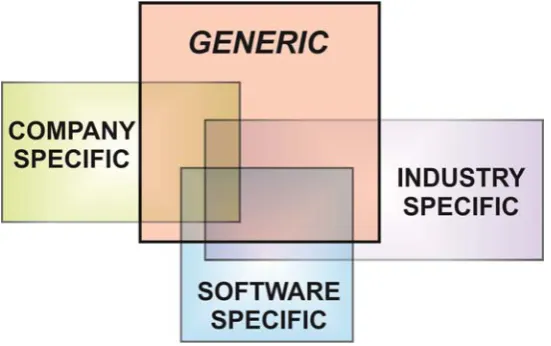
The project will focus on the production of generic (non-industry-specific competences), although it is recognized that SQEP will require additional industry-specific, company-specific and software-specific competences, as shown in Figure 2. The EASIT2 Competence Framework will allow for these specific competences to be added by sector bodies or individual organizations, either by adding to the above modules or by creating new modules.
Fig. 2: Competence Types
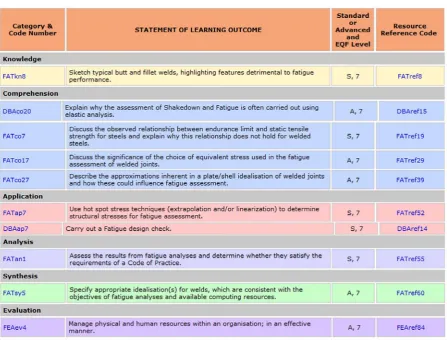
[image:3.595.162.438.380.553.2]Each competence statement will have a reference link to appropriate sections in text books and eventually training courses, that will assist staff in the development of the appropriate competence. This concept is illustrated in Figure 3, which shows a selection of competence statements from the CCOPPS project in the Fatigue area.
A wide range of experts, drawn from the NAFEMS community, will be used to ensure that the various modules in the Educational Base have the appropriate statements of competence and resource references.
The Educational Base, containing over 1000 statements of competence over 22 modules, will have the following uses:
• Providing useful information to self-learners;
• Providing focus for the developers of short courses, text books and other learning material;
• Providing a basis for the production of self-test quizzes and examinations to aid in self-assessment or formal assessment of competence;
• Providing the basis for the Competency Framework and Passport System
Fig. 3: Typical Module Competence Statements (from CCOPPS)
The Competency Framework
The main objective of the Analysis & Simulation Competence Framework is to enable large, medium and small companies, as well as individual analysts and engineers, to record and monitor competence levels in the engineering analysis and simulation area. Basic search and reporting tools will allow organizations to undertake competence planning. At the heart of the Competence Framework will lie the Educational Base described above.
This will be an open and versatile web-based relational database system that will allow the skills that are developed by individuals to be tracked and logged. This can then be used by individuals to plan and monitor their personal development, or by companies to do the same for their staff and to keep a register of the combined simulation skills of their workforce. The structure of the Educational Base and the Competency Framework will allow modules to be added, deleted or modified. Individual competency statements will also be able to be translated and it will also be possible to add preferred links to other resource material.
As shown in Figure 1, the Competence Framework will allow data to be transferred to/from wider company staff development systems and SQEP registers. In the UK, the nuclear industry regulator (Nuclear Installations Inspectorate) requirements are met by maintaining a SQEP database or register that includes the record of independent assessment of the skill claims made by an individual. The aim is to ensure that the EASIT2 developments support the SQEP process.
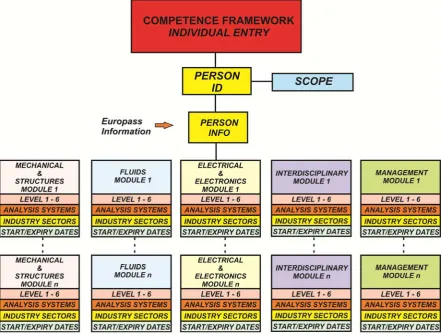
The database record for the Competence Framework is illustrated in Figure 4. Inclusion of a module in a person’s list of competent areas will require a particular subset of competences from the Educational Base to be
competences from the Educational Base or be assigned by an organization as a result of job function. The inclusion of an analysis system in the record will normally be related to the achievement of generic competences in the Educational Base by association, rather than analysis system specific competences.
The inclusion of multiple industry secor entries is to allow the competence framework to reflect employment history or to reflect the variety of work carried out by consultants. Inclusion of a particular industry will require satisfaction of industry-specific competency statements in the Educational Base where available. The specification of industry, company and software specific competence statements is beyond the scope of the EASIT2 project. In summary, the Competence Framework will:
• have an analysis and simulation scope only;
• be flexible, open and capable of being tailored for individuals, SMEs and large organisations; • be web and intranet enabled;
• have relational data-base functionality;
• use open systems for development and will not require implementation of a proprietary software development system for operation;
• will provide integration with the Educational Base;
• will provide integration with the Analysis and Simulation Passport system;
[image:5.595.78.521.347.681.2]• will provide an open system capable of interfacing to existing SQEP and staff development systems.
The Analysis and Simulation Passport
The project proposal includes the development of a Competence-based Registered Analyst Scheme. The existing scheme has not proved to be popular with industry. One reason for this could be that the points-based scheme currently offered by NAFEMS is not appropriate. The new system in contrast will be structured around the competency statements that have been established as part of the above Educational Base. The new system will however retain much of the sound thinking inherent in the present NAFEMS scheme. For example, the new system will also recognize that effective analysis and simulation requires:
• a satisfactory underpinning in engineering or a related discipline;
• the development of competence in the application of analysis and simulation through experience in the workplace;
• product and industry sector knowledge; • training in the software tools being used;
• training in the theoretical underpinnings relevant to the analysis types to be included within the approved scope statement.
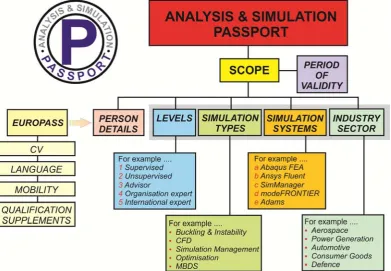
In the current RA Scheme, the scope statement includes the analysis and product types that the analyst has been assessed for and at what level (standard or advanced). On approval, the name of the analyst or simulation engineer is then entered onto a register maintained by NAFEMS. The goal of the EASIT2 project is to revitalize this system by moving to criteria based on clear statements of competence, rather than an accumulation of points. Project thinking however has recently moved towards the development of an Analysis and Simulation Passport, initially inspired by the Europass[5]. This is a system, within Europe, supported by a network of National Europass Centres and is aimed at facilitating workforce mobility by providing a transparent record of skills and qualifications. The various Europass documents are shown in Figure 5 and it is the aim of the EASIT2 project to import this information into both the Competence Framework and the Analysis & Simulation Passport, as a minimum requirement.
[image:6.595.104.496.378.649.2]Fig. 5: Proposed Analysis and Simulation Passport Systems
contract to contract, through the implementation of industry-agreed and cross-site recognized training standards. The Nuclear Skills Passport concept comprises four key elements :
• A learner database that provides a registry of training records for individual passport holders and the facility to generate a skills passport card;
• Datasets that describe job roles, industry training standards and the Skills Academy assured provider network;
• Benchmarking and signposting tools to support up-skilling , involving skills gap analysis against Job Context role profiles, with signposting to training provision to meet the gaps identified.
• A reporting suite that generates statistics at industry, regional and corporate levels.
As we can see, there are fundamental similarities between the goals and structure of the Nuclear Skills Passport and the EASIT2 project deliverables. The EASIT2 Educational Base will however define a comprehensive list of competencies across 22 technical areas, which will in turn assist with personal development and the production of training resource materials designed to deliver the stated competences.
CONCLUSION
By the time of this conference, the EASIT2 project will have just entered its second and final year and should be on schedule to produce deliverables that will allow individuals and organisations of all sizes to identify and develop gaps in competence in the analysis and simulation area.
The final and significant challenge will be to secure the uptake of these deliverables by industry and to assist in tailoring them to sector and organisational needs, where necessary. To ensure that this will happen, on completion of the project NAFEMS will take responsibility for the development and maintenance of the Educational Base, Competence Framework and Analysis & Simulation Passport. The success of any passport system will be largely dependent upon industry seeing its implementation as a business imperative and this will remain one of the biggest challenges for the new Analysis and Simulation Passport. The Nuclear Skills Passport does not specifically address analysis and simulation and there is clearly potential for the two systems to be interfaced. The EASIT2 Competence Framework is being developed with the goal of openess and flexibility, to allow this to happen across all industry sectors, including Nuclear.
The project team is acutely aware of the need to work with industry throughout the project and beyond and the partners were selected to ensure that the project deliverables are relevant across the range of industry sectors represented. These organizations will also provide internal evaluation of the outputs in parallel with external evaluation conducted by companies from the wider analysis and simulation community. The project has received over 600 offers of assistance so far and this is clear evidence of the willingness of industry to engage with the project. It is also noted that the Nuclear Skills Passport, which was over 3 years in planning, was designed in consultation with nuclear employers at every stage.
If you are interested in finding out more about the EASIT2 project, please visit the project website http://www.easit2.eu/ or contact the corresponding author. The project team is also interested in making contact with anyone who may be willing and in a position to help evaluate the deliverables.
The EASIT2 Educational Base, Competence Framework and Analysis & Simulation Passport represents a significant step in competence development, evidencing staff and organizational competence, promoting staff mobility and eventually, in the implementation of industry standards for analysis and simulation across all sectors where this technology plays a key role.
REFERENCES
[1] EASIT2, Grant UK/10/LLP-LdV/TOI-305, EU Leonardo Transfer of Innovation. http://www.easit2.eu/. [2] http://www.nafems.org/involved/analyst_scheme/
[3] Lees, A., Wood, J., “Industry Needs Survey Report”, April 2011, Available for free download at http://www.easit2.eu/
[4] Lees, A., Wood, J., “Skills Development and Recording in Engineering Analysis and Simulation - Industry Needs”, Proceeding of the NAFEMS World Congress. Boston, 23-26May 2011.
[5] http://europass.cedefop.europa.eu/