The role of attention in binding visual features in working
memory: evidence from cognitive ageing.
Louise A. Brown
The University of Edinburgh, Edinburgh, UK
James R. Brockmole
University of Notre Dame, Notre Dame, IN, USA
To cite:
Abstract
Author Notes
The ability to remember visual material such as objects and faces over a short period of time decreases with age (see Reuter-Lorenz & Sylvester, 2005, for a review). While several hypotheses have been offered for general working memory decline (e.g., Craik & Byrd, 1982; Hasher & Zacks, 1988; Salthouse, 1991), relatively little research has been specifically devoted to understanding age-related decline in visual working memory. This is surprising given that working memory deficits for visuo-spatial material have been shown to be more severe than those observed for verbal material (e.g., Jenkins, Myerson, Hale, & Fry, 1999; Jenkins, Myerson, Joerding, & Hale, 2000; Leonards, Ibanez, & Giannakopoulos, 2002; Myerson, Hale, Rhee, & Jenkins, 1999; but see Kemps & Newson, 2006; Park, Lautenschlager, Hedden, Davidson, Smith, et al., 2002; Salthouse, 1995). One recently hypothesised source of visual working memory decline is an age-related impairment in the ability to maintain or ‘bind’ the correct associations between items of related information. Because objects are defined by different combinations of visual features such as colour, luminance, shape, size, orientation, and texture, one’s ability to recall objects accurately depends upon retaining the associated features (e.g., that the car was blue and the lorry was red, or vice versa). Thus, an age-related binding deficit may explain the general performance decrements that have been observed in visual working memory across the adult lifespan.
However, evidence regarding the existence of an age-related binding deficit in visual working memory is mixed. There is some evidence for an age-related deficit in object-location binding (Cowan, Naveh-Benjamin, Kilb, & Saults, 2006; Mitchell, Johnson, Raye, Mather, and D’Esposito, 2000), while binding of an object’s surface features such as colour
they may not account for other kinds of memory deficits. Instead, the binding deficit hypothesis may best explain age-related deficits in long-term memory which do appear to result, at least in part, from multiple types of binding failures (Chalfonte & Johnson, 1996; Naveh-Benjamin, 2000; Naveh-Benjamin, Guez, Kilb, & Reedy, 2004; Naveh-Benjamin, Hussain, Guez, & Bar-On, 2003; Old & Naveh-Benjamin, 2008). However, Brockmole et al. (2008) noted that the possibility of specific age-related binding deficits between features in visual working memory cannot yet be completely discounted, because they may exist under certain circumstances.
In this paper we consider whether age-related binding deficits emerge under conditions of high attentional load. It has been consistently reported that decreased central executive functioning plays an important role in general age-related cognitive decline (e.g., Craik, 1983; Craik & Byrd, 1982; Hasher & Zacks, 1988). For example, greater age-related memory deficits tend to be found in novel tasks which draw heavily upon cognitive resources, and in tasks which require active manipulation of information (e.g., see Craik & Anderson, 1999; Kester, Benjamin, Castel, & Craik, 2002). These deficits are linked to structural (Haug & Eggers, 1991; Murphy, DeCarli, McIntosh, Daly, Mentis, et al., 1996; West, 1996) and functional (Chao & Knight, 1997; Murphy et al., 1996) changes to the frontal lobes which are associated with central executive functioning (Baddeley, 1986; Collette & Van der Linden, 2002; Miller & Cohen, 2001). Furthermore, older adults have been shown to exhibit deficits in executive behaviours associated specifically with dorsolateral prefrontal cortex activity (MacPherson, Phillips, & Della Sala, 2002), while fronto-temporal circuitry has recently been suggested to underlie age-related cognitive decline (Brickman, Zimmerman, Paul, Grieve, Tate, et al., 2006).
older adults. To date, however, the role of attention in feature binding has only been addressed with younger adults, and the results have been mixed. Some evidence suggests that attention is needed to maintain proper associations between features (e.g., Wheeler & Treisman, 2002). For example, the requirement to remember a string of digits, monosyllabic words, or pure tones disrupts visual-spatial, verbal-spatial, and object-feature binding (Elsley & Parmentier, 2009a, 2009b). Some other attentionally demanding tasks such as multiple object tracking have also been shown to affect working memory for concurrently maintained bound features to a greater extent than for individual features (Fougnie & Marois, 2009). These results suggest that binding across working memory components, as well as within the visual working memory component alone, involves the recruitment of general attentional resources. Additionally, feature bindings appear to be more fragile than individual feature representations in visual working memory. For example, binding performance is selectively affected by sequential versus simultaneous presentation of memory items, suggesting that inter-item interference and overwriting by newly processed and stored items result in fragile bindings (Allen, Baddeley, & Hitch, 2006; see also Alvarez & Thompson, 2009; Logie, Brockmole, & Vandenbroucke, 2009). In contrast, other studies have supported the conclusion that feature conjunctions can be maintained without need for continued attention. Gajewski and Brockmole (2006) showed that, in the face of attentional distraction, observers remember either all of an object’s features or none at all. In addition, Allen et al. (2006) and
Johnson, Hollingworth, and Luck (2008) have shown that a variety of dual tasks fail to differentially reduce memory for bound objects compared to individual features.
whether age-related binding deficits a) emerge in tasks that have not exhibited deficits in younger adults, and b) are exacerbated in tasks that have demonstrated a role of attention in binding. Experiment 1 considered the efficacy of binding when individuals must engage in a concurrent task requiring attentional resources, while Experiment 2 investigated how memory is affected by the requirement to create new bindings while maintaining previously encountered ones.
Experiment 1
The purpose of Experiment 1 was to determine whether a concurrent attentionally demanding task differentially affects binding abilities in younger and older adults. The experiment was based on the procedures and results obtained by Allen et al. (2006, Exp. 4), who required young participants to remember coloured shapes while counting backwards by threes from a randomly selected three-digit number. These researchers found that this attentionally demanding task yielded no greater deficit in memory for conjunctions of features compared to individual features, providing support for the argument that binding does not rely upon central executive resources.
specific-age related binding deficits were observed, one could predict no differential effect of the counting task on binding performance. However, if, unlike younger adults, older adults rely more heavily upon general attentional resources for colour-shape binding, then the counting task would be expected to affect older adults’ binding performance to a greater extent than younger adults.
Method
Participants. In total there were 48 participants. There were 24 younger adults from the student population of The University of Edinburgh, aged between 18-22 years (M = 18.96, SD = 1.00), with a mean number of years of education of 13.96 (SD = 1.83) and a mean verbal IQ, as predicted by the National Adult Reading Test (NART), of 104.67 (SD = 5.22). These participants received either course credit or an honorarium. The older adults comprised 24 volunteers randomly selected from the Lothian Birth Cohort 1936 (LBC1936; see Deary, Gow, Taylor, Corley, Brett, et al., 2007), for whom there was a range of demographic data already available. Due to their membership of the Cohort, the older adults were all either 72 or 73 years of age (M = 72.21, SD = 0.42). Their mean number of years of education was 13.67 (SD = 3.61) and their NART-predicted verbal IQ was 110.67 (SD = 11.44). Predicted verbal IQ was slightly higher in older than younger adults, t(46) = -2.34, p
Stimuli and Apparatus. Simuli consisted of coloured shapes presented on a grey background. Memory displays were composed of three objects, each of which was created by combining one of six colours (red, yellow, blue, green, cyan, and purple) and one of six shapes (circle, triangle, diamond, heart, arrow, and cross) randomly without replacement. Test arrays were composed of a single item which differed across three visual task conditions (described below). In the colour memory task the test item was a non-canonically shaped ‘blob’ presented in one of the six colours listed above. In the shape memory task, the test
item was one of the six shapes listed above drawn with a black outline but filled in grey to match the background. In the feature binding (conjunction) memory task, each test item was a coloured shape, as in the memory array. Stimuli were presented on a 17” CRT monitor with a screen refresh rate of 85 Hz. Each stimulus measured approximately 1.6 cm2, and viewing distance was not constrained.
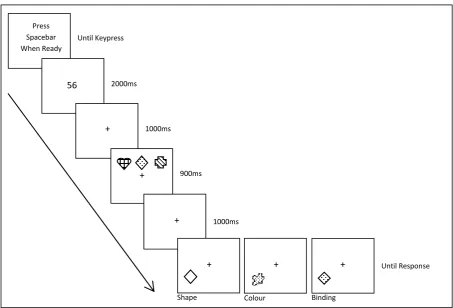
Design and procedure. Prior to the main task younger adults completed the NART to obtain an estimate of verbal IQ (these data were already available for the older adults). The main experiment was then administered. The procedure is illustrated in Figure 1.
(Figure 1 about here)
data allowing scoring of the total number of calculations made and the correct number of calculations made.
After the two-digit number had disappeared from the screen a central fixation cross was presented for 1000 ms (which remained until the end of the trial) after which an array of three coloured shapes were displayed in a row in three fixed locations above the cross for 900 ms. After a delay of 1000 ms, a test item appeared below one of the original memory items (the position of the probe was randomly selected). Participants responded ‘yes’ or ‘no’, by pressing the ‘z’ or ‘m’ keys on a keyboard, to indicate whether or not the colour, shape, or
colour-shape conjunction depicted in the test item had appeared in the memory array, irrespective of location. Incorrect colour-shape conjunctions were created by errantly combining a colour and shape that were present in the initial memory array (cf. Wheeler & Triesman, 2002). Participants continued to repeat or count until this key-press response had been made.
The experiment was divided into six blocks of trials which orthogonally combined the three memory and the two secondary tasks. Control and counting blocks were yoked such that participants completed all three blocks involving repetition followed by all three blocks involving counting, or vice versa. The order of memory tasks was also counterbalanced within the constraint that each participant completed the memory tasks in the same order for each concurrent task. This resulted in 12 orders of administration which were repeated twice within each age group. There were six practice trials followed by 36 experimental trials in each block, with half of the test items present and half absent. Trial order was randomised across participants.
Results and Discussion
correct calculations per trial was 2.48 (SD = .69; see Table 1 for scores in each condition), while the mean number of repetitions per trial was 5.21 (SD = 1.37).
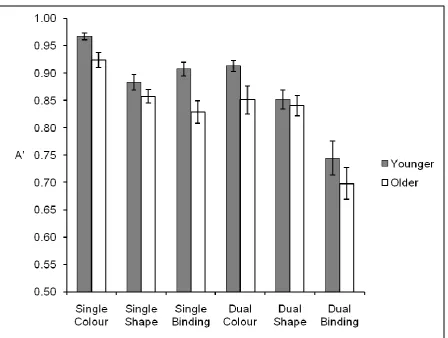
Response accuracy was expressed as A’ with a ‘hit’ defined as the correct detection of change. The mean A’ scores broken down by each factor in the experimental design are
displayed in Figure 2.
(Figure 2 about here)
These data were analysed using a 2 (age) x 2 (concurrent task) x 3 (visual memory task) mixed-model analysis of variance (ANOVA). Main effects of age group, F(1,46) = 6.75,
MSE = .021, p < .02, concurrent task type, F(1,46) = 46.76, MSE = .009, p < .001, and visual memory task type, F(2,92) = 54.62, MSE = .006, p < .001, were observed. Overall, visual memory was superior in younger adults (M = .88) than older adults (M = .83) and better in the control task (M = .89) than the counting task (M = .82). Visual memory for colour (M = .91) was superior to that for shape (M = .86) and bindings (M = .79), a finding that is typical in the literature (Allen et al., 2006; Brockmole et al., 2008; Johnson et al., 2008; Wheeler & Treisman, 2002). The only interaction was between concurrent task type and visual memory task type, F(2,92) = 18.95, MSE = .005, p < .001 (all other p’s > .13).
one hallmark of successful and efficient binding1 (Luck & Vogel, 1997). In contrast, within the counting task, there were differences between the colour and shape blocks, t(47) = 2.47, p
< .02, as well as between the shape and binding blocks, t(47) = 6.02, p < .001. This indicates that binding memory was poorer than memory for individual features and shows that the counting task disrupted binding ability.
Because we emphasized accuracy rather than speed, an analysis of response times (RT) provides limited probative value with respect to the specific experimental hypotheses; however, it is apparent from the RT data that no speed accuracy trade-offs were evident. The control task (M = 1182 ms) yielded faster RTs than the counting task (M = 1464 ms), F(1,46) = 40.67, MSE = 141289, p < .001, and the colour memory condition (M = 1199 ms) was responded to faster than both the shape (M = 1374 ms) and binding (M = 1394 ms) conditions, F(2,92) = 18.44, MSE = 59942, p < .001. Also, younger adults (M = 1099 ms) exhibited faster RTs than the older adults (M = 1546 ms), F(1,46) = 22.06, MSE = 651237, p
< .001. No significant interactions were observed involving RT.
Although backwards counting disrupted memory for bindings more than memory for individual features, from Experiment 1 it is clear that older adults did not exhibit a specific age-related colour-shape binding deficit under circumstances where an attentionally demanding concurrent task was required during the encoding, retention, and recall of visual objects. This result is consistent with previous failures to find age-related binding deficits in visual working memory (Brockmole et al., 2008; Parra et al., 2009). The fact that the binding performance of older adults did not suffer disproportionately compared to younger adults
from the requirement to carry out a concurrent task which draws upon central executive resources, suggests that older adults do not rely upon central executive resources for binding any more than do younger adults.
Experiment 2
The purpose of Experiment 2 was to investigate whether age exacerbates the propensity for feature conjunctions to dissociate as new objects are processed. In everyday life, retention intervals do not span blank displays. Instead, processing of additional or newly encountered objects must take place. According to feature integration theory, however, the binding of features into integrated object percepts requires attention (e.g., Treisman, 1986, 1999; Treisman & Gelade, 1980). Because older adults have been shown to suffer from decreased frontal lobe function and attentional resources (e.g., Brickman et al., 2006; Chao & Knight, 1997; Hasher, Stoltzfus, Zacks, & Rypma, 1991; Hasher & Zacks, 1988; Haug & Eggers, 1991; MacPherson et al., 2002; Murphy et al., 1996; West, 1996), we could predict a greater binding deficit for older than younger adults when both creating and maintaining object representations. Specifically, bindings may be more susceptible to interference from sequential (one item at a time) versus simultaneous presentation.
Method
Participants. In total there were 48 participants. There were 24 younger adults from the student population of The University of Edinburgh, aged between 18-24 years (M = 20.33, SD = 1.93), with a mean number of years of education of 15.57 (SD = 2.09) and a mean NART-predicted verbal IQ of 106.04 (SD = 7.86). These participants received either course credit or an honorarium. As in Experiment 1, the older adults comprised 24 volunteers randomly selected from LBC1936 who did not participate in Experiment 1 (Deary et al. 2007). Their mean age was 72.33 (SD = 0.48) and their mean number of years of education was 13.81 (SD = 3.09). Their NART-predicted verbal IQ was 115.63 (SD = 6.28) and, as in Experiment 1, this was slightly higher than in younger adults, t(46) = -4.67, p < .001. The older participants were screened for unhealthy cognitive decline using the MMSE, and their mean score was 29.04 (SD = 1.23). Sex distribution was the same for both age groups (10 males and 14 females). Participants reported no significant memory problems and normal or corrected-to-normal vision.
Stimuli. The stimuli were the same as in Experiment 1.
Results and Discussion
The rate at which numbers were vocalised in the articulatory suppression task did not differ across age groups or memory tasks (all p’s > .15). Overall, the mean number of
repetitions per trial was 6.15 (SD = 1.54), a similar rate to that observed in Experiment 1, when taking into account the slightly longer trial duration in Experiment 2.
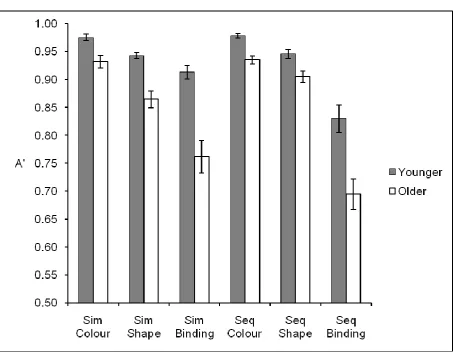
As in Experiment 1, response accuracy was expressed as A’ with a ‘hit’ defined as the correct detection of change. The mean A’ scores are displayed in Figure 3.
(Figure 3 about here)
These data were analysed using a 2 (age group) x 2 (presentation format) x 3 (memory task) mixed ANOVA. Main effects of age group F(1,46) = 38.96, MSE = .012, p < .001, presentation format, F(1,46) = 5.16, MSE = .004, p < .03, and memory task type, F(2,92) = 110.32, MSE = .006, p < .001, were observed. Overall, visual memory was superior in younger adults (M = .93) than older adults (M = .85) and when tested with simultaneous presentation (M = .90) compared to sequential presentation (M = .88). Visual memory for colour (M = .96) was superior to that for shape (M = .91) which, in turn, was superior to bindings (M = .80). There was, however, an interaction between the effects of age group and memory task type, F(2,92) = 12.23, MSE = .006, p < .001, and also between presentation format and memory task type, F(2,92) = 15.81, MSE = .004, p < .001. Remaining interactions were not significant (all p’s > .24).
To follow up on the interaction between age group and memory task, performance on each memory task (collapsing across presentation format) was analysed within each age group individually (see Figure 4).
Within the younger age group, there was a main effect of memory task, F(2,46) = 41.47, MSE = .002, p < .001, and planned comparisons (paired t-tests) revealed that performance for colour was better than for shape, t(23) = 5.35, p < .001, and that performance for shape was better than for binding, t(23) = 5.54, p < .001. Within the older age group, there was also a main effect of memory task, F(2,46) = 69.70, MSE = .004, p < .001, again with performance for colour better than for shape, t(23) = 5.86, p < .001, and performance for shape better than for binding, t(23) = 7.13, p < .001. However, the effect of memory task was larger for the older adults (estimated effect size of block type in younger adults, ηp² = .64, and in older adults, ηp² = .75). Moreover, this disparity is most evident in the binding condition
where the difference between the binding task and the single feature tasks was greater among older adults. Due to the lack of a three-way interaction involving presentation format, we can conclude that an equivalent age-related binding deficit was observed in both the simultaneous and sequential conditions.
To follow up on the interaction between presentation format and memory task, memory task performance (collapsing across age) was assessed within each presentation format individually. Differences between memory task performances were evident in both the simultaneous, F(2,94) = 37.06, MSE = .004, p < .001, and the sequential conditions, F(2,94) = 80.27, MSE = .007, p < .001. However, as confirmed by planned comparisons (paired t-tests), the differences were greater in the sequential condition. While performance was the same between the simultaneous and sequential formats for colour, t(47) = -.47, p = ns, and only slightly different for shape, t(47) = -2.31, p < .03, performance was much better in the simultaneous than the sequential format for binding, t(47) = 3.90, p < .001. Furthermore, the estimated effect size of memory task was much larger in the sequential condition, ηp² = .63, than in the simultaneous condition, ηp² = .44. This finding indicates a specific deficit for
age, we can conclude that the deficit arising from sequential presentation was equivalent for younger and older adults.
Finally, we note that no speed-accuracy trade-offs were present in the data. The simultaneous task (M = 1240 ms) was responded to slightly quicker than the sequential task (M = 1296 ms), F(1,46) = 5.25, MSE = 43492, p < .03. The colour memory condition (M = 1101 ms) was responded to faster than the shape condition (M = 1308 ms), while shape RTs were faster than binding RTs (M = 1396 ms), F(2,92) = 62.19, MSE = 35461, p < .001. Younger adults (M = 951 ms) exhibited faster RTs than the older adults (M = 1585 ms),
F(1,46) = 75.48, MSE = 383678, p < .001. Importantly, however, there were no significant interactions involving RT.
General Discussion
Previous research has considered whether age-related declines in visual working memory can be explained by associative deficits which result in a decreased ability to generate and store bound object representations. This hypothesis arose, in part, from demonstrations of such deficits in long-term memory (Naveh-Benjamin, 2000) as well as some evidence indicating that older adults have more difficulty remembering object-location bindings in working memory (Cowan et al., 2006; Mitchell, Johnson, Raye, Mather, et al., 2000). Despite the promise of this hypothesis, evidence for age-related binding deficits in visual working memory for visual features such as colour and shape has been elusive (Brockmole et al., 2008; Parra, et al., 2009). The present study investigated the effect of attentional load on visual working memory for individual and bound features in order to establish whether or not an age-related binding deficit arises when executive resources are taxed. Because attention resources become more difficult to manage as we age, we hypothesised that binding deficits could emerge under conditions of high attention load.
complement and extend the conclusions of Cowan et al. (2006) who, in the context of object-location binding deficits in working memory, showed that older adults exhibit a deficit over and above that of an attentional one, and argued that the binding deficit is related to a lack of processing robustness and a degradation in memory performance itself. Furthermore, Mitchell, Johnson, Raye, and D’Esposito (2000) provided fMRI evidence that hippocampal
functional deficits are related to binding impairments in working memory. Finally, in the domain of long-term memory, Naveh-Benjamin, Guez, and Shulman (2004) showed that the age-related binding deficit is not explained by attentional deficits. It therefore appears that, where age-related binding deficits exist, they appear not to be related to attentional limitations.
would benefit from the direct assessment of the role of presentation time on binding memory performance.
Focussing on the results within younger adults, our results speak to the general role of attention in feature binding. Our evidence supports recent claims in the literature that attention plays a role in memory for bound object representations (Elsley & Parmentier, 2009a, 2009b; Fougnie & Marois, 2009; Wheeler & Treisman, 2002). Although other attempts to find attention-related binding deficits have been unsuccesful (e.g., Allen et al., 2006; Gajewski & Brockmole, 2006; Johnson, et al., 2008), the format of the attentional tasks and differences in memory task demands or sensitivity may account for the disparities. We suggest that dual tasks which make sufficient demands upon general attention, and that accompany memory tasks in which baseline performance is sufficiently high, should disrupt binding memory to a greater extent than individual feature memory (i.e., Experiment 1 of the current paper; Elsley & Parmentier 2009b). Theoretically, the impact of general attentional demands on feature binding would be predicted by Baddeley’s (2000) working memory model, in which the episodic buffer component is responsible for binding features together via the general attentional resources of the central executive. Because Allen et al. (2006) found no dual task decrements for binding, they concluded that within-modality binding may be carried out relatively automatically at the level of the working memory subsystem and that the episodic buffer may only be required for cross-modal binding. The results of Experiment 1 of the current paper, however, suggest that binding of features within the visuo-spatial subsystem do draw upon central executive resources in the fashion predicted by the Baddeley (2000) model, rather than being carried out more automatically, and therefore the episodic buffer may indeed be required to account for this.
memory, they have proven to be much more difficult to observe in visual working memory (e.g., Experiment 1 of the current paper; Brockmole et al., 2008; Parra et al., 2009), although a variety of other task demands and situations have yet to be considered. What is clear from these findings is that age-related declines in attention resources do not increase the likelihood that binding will fail. Instead, manipulations of attention affect binding equally for both younger and older adults. In the context of Baddeley’s (2000) working memory model, this last observation suggests that visual feature bindings do draw upon central executive resources, perhaps in the episodic buffer component, and are not automatically stored within the visuospatial subsystems as has been suggested previously.
References
Allen, R. J., Baddeley, A. D., & Hitch, G. J. (2006). Is the binding of visual features in working memory resource-demanding? Journal of Experimental Psychology: General, 135, 298-313.
Alvarez, G. A., & Thompson, T. W. (2009). Overwriting and rebinding: Why feature-switch detection tasks underestimate the binding capacity of visual working memory. Visual Cognition, 17, 141-159.
Baddeley, A. D. (1986). Working memory. Oxford, UK: Oxford University Press.
Baddeley, A. D. (2000). The episodic buffer: A new component of working memory? Trends
in Cognitive Sciences, 4, 417-423.
Brockmole, J. R., Parra, M. A., Della Sala, S., & Logie, R. H. (2008). Do binding deficits account for age-related decline in visual working memory? Psychonomic Bulletin & Review, 15, 543-547.
Chalfonte, B. L., & Johnson, M. K. (1996). Feature memory and binding in young and older adults. Memory & Cognition, 24, 403-416.
Chao, L. L., & Knight, R. T. (1997). Prefrontal deficits in attention and inhibitory control with aging. Cerebral Cortex, 7, 63-69.
Collette, F., & Van der Linden, M. (2002). Brain imaging of the central executive component of working memory. Neuroscience and Biobehavioral Reviews, 26, 105-125.
Cowan, N., Naveh-Benjamin, M., Kilb, A., & Saults, J. S. (2006). Life-span development of visual working memory: When is feature-binding difficult? Developmental Psychology, 42, 1089-1102.
Craik, F. I. M. (1983). On the transfer of information from temporary to permanent memory.
Philosophical Transactions of the Royal Society of London, B302, 341-359.
Craik, F. I. M., & Anderson, N. D. (1999). Applying cognitive research to problems of aging. In D. Gopher, & A. Koriat (Eds.), Attention and Performance XVII (pp. 583-615). Cambridge, MA: MIT Press.
Craik, F. I. M., & Byrd, M. (1982). Aging and cognitive deficits: The role of attentional resources. In F. I. M. Craik & S. Trehub (Eds.), Aging and cognitive processes (pp. 191-211). New York: Plenum Press.
Deary, I. J., Gow, A. J., Taylor, M. D., Corley, J., Brett, C., Wilson, V., et al. (2007). The Lothian Birth Cohort 1936: a study to examine influences on cognitive ageing from age 11 to age 70 and beyond. BMC Geriatrics, 7; 28.
binding in working memory impaired by a concurrent memory load? Quarterly Journal of Experimental Psychology, 62, 1696-1705.
Elsley, J., & Parmentier, F. B. R. (2009b). Is verbal-spatial binding in working memory impaired by a concurrent memory load? Quarterly Journal of Experimental Psychology, 62, 1696-1705.
Folstein, M. F., Folstein, S. E., & McHugh, P. R. (1975). “Mini-Mental State”: A practical method for grading the cognitive state of patients for the clinician. Journal of Psychiatric Research, 12, 189-198.
Fougnie, D., & Marois, R. (2009). Attentive tracking disrupts feature binding in visual working memory. Visual Cognition, 17, 48-66.
Gajewski, D. A., & Brockmole, J. R. (2006). Feature bindings endure without attention: Evidence from an explicit recall task. Psychonomic Bulletin & Review, 13, 581-587. Hasher, L., Stoltzfus, E. R., Zacks, R. T., & Rypma, B. (1991). Age and inhibition. Journal of
Experimental Psychology: Learning, Memory, and Cognition, 17, 163-169.
Hasher, L., & Zacks, R. T. (1988). Working memory, comprehension, and aging: a review and a new view. In G. G. Bower (Ed.), The psychology of learning and motivation, Vol. 22 (pp. 193-225). San Diego, CA: Academic Press.
Haug, H., & Eggers, R. (1991). Morphometry of the human cortex cerbri and corpus striatum during aging. Neurobiology of Aging, 12, 336-338.
Jenkins, L., Myerson, J., Hale, S., & Fry, A. F. (1999). Individual and developmental differences in working memory across the life span. Psychonomic Bulletin & Review, 6, 28-40.
Johnson, J. S., Hollingworth, A., & Luck, S. J. (2008). The role of attention in the maintenance of feature bindings in visual short-term memory. Journal of Experimental Psychology: Human Perception and Performance, 34, 41-55.
Kemps, E., & Newson, R. (2006). Comparison of adult age differences in verbal and visuo-spatial memory: The importance of ‘pure’, parallel and validated measures. Journal of
Clinical and Experimental Neuropsychology, 28, 341-356.
Kester, J. D., Benjamin, A. S., Castel, A. D., & Craik, F. I. M. (2002). Memory in elderly people. In A. D. Baddeley, M. D. Kopelman, & B. A. Wilson (Eds.), Handbook of memory disorders (2nd ed., pp. 543-567). Chichester, UK: Wiley.
Leonards, U., Ibanez, V., Giannakopoulos, P. (2002). The role of stimulus type in age-related changes of visual working memory. Experimental Brain Research, 146, 172-183. Logie, R. H., Brockmole, J. R., & Vandenbroucke, A. R. E. (2009). Bound feature
combinations in visual short-term memory are fragile but influence long-term learning.
Visual Cognition, 17, 160-179.
Luck, S. J., & Vogel, E. K. (1997). The capacity of visual working memory for features and conjunctions. Nature, 390, 279-281.
MacPherson, S. E., Phillips. L. H., & Della Sala, S. (2002). Age, executive function, and social decision making: A dorsolateral prefrontal theory of cognitive aging. Psychology and Aging, 17, 598-609.
Miller, E. K., & Cohen, J. D. (2001). An integrative theory of prefrontal cortex function.
Annual Review of Neuroscience, 24, 167-202.
Mitchell, K. J., Johnson, M. K., Raye, C. L., Mather, M., & D’Esposito, M. (2000). Aging
and reflective processes of working memory: Binding and test load deficits. Psychology and Aging, 15, 527-541.
Murphy, D. G. M., DeCarli, C., McIntosh, A. R., Daly, E., Mentis, M. J., Pietrini, P., et al. (1996). Sex differences in human brain morphometry and metabolism: An in vivo quantitative magnetic resonance imaging and positron emission tomography study on the effect of aging. Archives of General Psychiatry, 53, 585-594.
Myerson, J., Hale, S., Rhee, S. H., & Jenkins, L. (1999). Selective interference with verbal and spatial working memory in young and older adults. Journal of Gerontology: Psychological Sciences, 54, 161-164.
Naveh-Benjamin, M. (2000). Adult age-differences in memory performance: Tests of an associative deficict hypothesis. Journal of Experimental Psychology: Learning, Memory, and Cognition, 26, 1170-1187.
Naveh-Benjamin, M., Guez, J., Kilb, A., & Reedy, S. (2004). The associative memory deficit of older adults: Further support using face-name associations. Psychology & Aging, 19, 541-546.
Naveh-Benjamin, M., Guez., J., & Shulman, S. (2004). Older adults’ associative deficit in episodic memory: Assessing the role of decline in attentional resources. Psychonomic Bulletin & Review, 11, 1067-1073.
Naveh-Benjamin, M., Hussain, Z., Guez, J., & Bar-On, M. (2003). Adult age-differences in episodic memory: Further support for an associative deficit hypothesis. Journal of Experimental Psychology: Learning, Memory, and Cognition, 29, 826-837.
Park, D. C., Lautenschlager, G., Hedden, T., Davidson, N. S., Smith, A.D., & Smith, P. K. (2002). Models of visuospatial and verbal memory across the adult lifespan.
Psychology and Aging, 17, 299-320.
Parra, M. A., Abrahams, S., Logie, R. H., & Della Sala, S. (2009). Age and binding within-dimension features in visual short-term memory. Neuroscience Letters, 449, 1-5.
Reuter-Lorenz, P. A., & Sylvester, C. C. (2005). The cognitive neuroscience of working memory and aging. In R. Cabeza, L. Nyberg, & D. Park (Eds.), The Cognitive Neuroscience of Aging: Linking Cognitive and Cerebral Aging (pp. 186-217). New York: Oxford University Press.
Salthouse, T. A. (1991). Theoretical perspectives on cognitive aging. Hillside, NJ: Erlbaum. Salthouse, T. A. (1995). Differential age-related influences on memory for verbal-symbolic
information and visual-spatial information. Journal of Gerontology: Psychological Sciences, 50, 193-201.
Treisman, A. (1986). Features and objects in visual processing. Scientific American, 225, 114-125.
Treisman, A. (1999). Feature bindings, attention, and object perception. In G. W. Humphreys, J. Duncan, & A. Treisman (Eds.), Attention, space, and action: Studies in cognitive neuroscience (pp. 91-111). New York: Oxford University Press.
Treisman, A. M., & Gelade, G. (1980). Feature-integration theory of attention. Cognitive Psychology, 12, 97-136.
Vogel, E. K., Woodman, G. F., & Luck, S. J. (2001). Storage of features, conjunctions, and objects in visual working memory. Journal of Experimental Psychology: Human Perception and Performance, 27, 92-114.
West, R. L. (1996). An application of prefrontal cortex function theory to cognitive aging.
Table 1
Performance of the backwards counting task of Experiment 1 (mean number of correct
calculations with standard deviations) for each age group across each condition.
Colour Shape Binding
Younger 2.63 (0.64) 2.62 (0.64) 2.67 (0.65)
Figure Captions
Figure 1: Experiment 1 procedure. Note that display items are not drawn to scale and that colours are depicted by different fill effects.
Figure 2: Mean A’ values (and standard errors) for younger and older adults across each
condition in Experiment 1.
Figure 3: Mean A’ values (and standard errors) for younger and older adults across each
condition in Experiment 2.
Figure 4: Mean A’ values (and standard errors) for younger and older adults in each memory
Figure 1
Until Keypress
2000ms
1000ms
900ms
1000ms
Until Response Press
Spacebar When Ready
56
+
+ +
+ + +