Other uses, including reproduction and distribution, or selling or
licensing copies, or posting to personal, institutional or third party
websites are prohibited.
In most cases authors are permitted to post their version of the
article (e.g. in Word or Tex form) to their personal website or
institutional repository. Authors requiring further information
regarding Elsevier’s archiving and manuscript policies are
encouraged to visit:
The
a
-effect in cyclic secondary amines: new scaffolds for iminium ion accelerated
transformations
John B. Brazier
a, Julie L. Cavill
a, Richard L. Elliott
b, Gareth Evans
a, Timothy J.K. Gibbs
a, Ian L. Jones
a,
James A. Platts
a,*, Nicholas C.O. Tomkinson
a,*aSchool of Chemistry, Main Building, Cardiff University, Park Place, Cardiff, CF10 3AT, UK
bMedicinal Chemistry, GlaxoSmithKline, New Frontiers Science Park, Harlow, Essex, CM19 5AW, UK
a r t i c l e
i n f o
Article history:
Received 29 July 2009 Received in revised form 16 September 2009 Accepted 2 October 2009 Available online 7 October 2009
a b s t r a c t
Five-membered secondary amine heterocycles containing ana-heteroatom were prepared and shown to be ineffective as catalysts for the iminium ion catalysed Diels–Alder reaction between cinnamaldehyde and cyclopentadiene. Their six-membered counterparts proved to be highly active catalysts. In stark contrast, the catalytic activity observed when comparing the nona-heteroatom cyclic amines proline methyl ester and methyl pipecolinate showed the five-membered ring amine was significantly more active. Concurrent density functional theoretical calculations suggest a rationale for the observed trends in reactivity, highlighting that LUMO activation through an iminium ion intermediate plays a key role in catalytic activity.
Ó2009 Elsevier Ltd. All rights reserved.
1. Introduction
Since the original report by MacMillan in 2000,1 the use of secondary amine catalysts in cycloaddition and conjugate addition reactions of
a
,b
-unsaturated aldehydes has provided an inspiring number of new bond-construction processes that proceed with remarkable levels of enantioselectivity.2 The majority of work reported within this vibrant area of research has focused on the development of new methods for bond-formation, rather than understanding catalyst activity3 and addressing the often high levels of catalyst loading. As the field matures and the number of applications expands, development will undoubtedly focus on the preparation of more active catalyst scaffolds with which to accel-erate this class of transformation.We have recently described the effects on catalyst activity of a heteroatom
a
- to the reactive secondary nitrogen centre, and have discovered a series of acyclic catalysts for the iminium ion catalysed Diels–Alder reaction.4 A combination of experimental and theoretical investigations have yielded a structure–reactivity relationship between amine structure and catalyst activity for the Diels–Alder reaction, which we are adopting with the ultimate goal of developing a predictive model for future rational catalyst design.5Previous synthetic investigations, as well as examination of the literature precedent, revealed two important trends relating the structure of the secondary amine and activity in the iminium ion catalysed Diels–Alder reaction. Firstly, cyclic secondary amines3
give good levels of reactivity for these transformations. Secondly, the introduction of anN-methyl carbamate
a
- to the reactive ni-trogen centre provided a catalyst4with the highest levels of ac-tivity to date, albeit in an achiral series. We wished to investigate if bringing together these two principal findings would lead to a fur-ther increase in catalyst activity, and set out to discover if a cyclic secondary amine incorporating ana
-heteroatom (such as5) would provide a platform with which to generate state-of-the-art chiral catalysts for use in iminium ion catalysed transformations (Fig. 1).2. Results and discussion
As a starting point for this investigation, we selected a series of target scaffolds 6–9 with which to test our original hypothesis. These fell into three distinct classes of compounds: the nature of the heteroatom (6 and 7); inclusion of an endo-cyclic electron withdrawing group (9); incorporation of an exo-cyclic electron withdrawing group (8) (Fig. 2).
The methods adopted to prepare these initial targets are out-lined inScheme 1.6Treatment ofN-Boc hydroxylamine10with 1,3-dibromopropane at reflux, under phase transfer conditions allowed access to the protected precursor to our target isoxazolidine in poor but acceptable yield (17%). Removal of the Boc protecting group (89%) using HCl in diethyl ether (2 M) gave our first target6. The
*Corresponding authors. Tel.:þ44 0 2920874068; fax:þ44 0 2920874030.
E-mail addresses: [email protected](J.A. Platts), [email protected]
(N.C.O. Tomkinson).
Contents lists available atScienceDirect
Tetrahedron
j o u r n a l h o m e p a g e : w w w . e l s e v i e r . c o m / l o c a t e / t e t
pyrazolidine hydrochloride7was prepared in an analogous pro-cedure starting from di-Boc hydrazine11in a pleasing 71% overall yield. Our attention then turned to the inclusion of an electron withdrawing group on the
a
-nitrogen (8), the introduction of which had been crucial to obtaining good levels of catalyst activity within previous work on acyclic catalysts.4Boc protection of ethyl carba-zate14proceeded smoothly to give the protected hydrazine in 97% yield with no purification required. This was subsequently reacted with 1,3-dibromopropane under phase transfer conditions to give the precursor to our target scaffold in 81% after purification. Finally, the Boc protecting group was removed with hydrochloric acid indiethyl ether. The hydrochloride salt15precipitated out of solution giving the desired catalyst in an overall yield of 76% for the three steps. Introduction of a benzyl carbamate
a
- to the reactive nitrogen was achieved in an analogous fashion. Cbz protection oftert-butyl carbazate16proceeded efficiently at room temperature (91%) and the resulting protected hydrazine was then submitted to a cyclisa-tion reaccyclisa-tion with 1,3-dibromopropane followed by removal of the Boc protecting group to give17as a colourless solid in an overall yield of 68% for the three steps.Considering catalysts bearing an endo-cyclic electron with-drawing group encompassing the generic template9, it was en-visaged that18could act as a Mannich base and therefore readily eliminate upon protonation, hence requiring preparation of a de-rivative such as19to circumvent this problem (Fig. 3). While pre-paring these catalysts, we became aware of a series of reports from Ogilvie showing the camphor derived hydrazide20to be effective for iminium ion catalysed Diels–Alder cycloaddition, the reactions proceeding with high e.e.’s.7 The kinetics of these reactions appeared significantly slower than those observed previously with our acyclic scaffolds (e.g.,4), such that we decided not to pursue structures such as19as potential catalysts.
Results of the Diels–Alder reaction of cinnamaldehyde22and cyclopentadiene21catalysed by the four new scaffolds (6,7,15, and
[image:3.595.47.275.72.630.2]17) and our previously optimised acyclic catalyst45are shown in Table 1.
Disappointingly, each of the five-membered cyclic secondary amines containing an
a
-heteroatom (entries 3–6) were sub-stantially less active than the acyclic hydrazide4(entry 2) under our standard reaction conditions. Consistent with previous obser-vations, a nitrogena
-heteroatom resulted in a more efficient cat-alyst when compared to its oxygen analogue (entries 3 and 4), and the introduction of the electron withdrawing group on thea
-het-eroatom increased reactivity further (entries 5 and 6) suggestingN H N EWG ·HCl 8 N H X ·HCl 9
X = O, NH N
H X
·HCl
X = O6
X = NH 7
[image:3.595.76.241.87.301.2]O
Figure 2.Initial target scaffolds.
N H
NH O
·HCl NH
NH O ·HCl NH N O Bn ·TfOH
18 19 20
Figure 3.Endo-cyclic electron withdrawing groups.
N H R High catalyst activity N H N OEt O High catalyst activity ·HCl ·HCl 3 4 N H N OEt O ·HCl Improved levels of catalyst activity?
[image:3.595.43.272.389.638.2]5 N H N O Bn Benchmark catalyst N H H N OEt O ·HCl 2 1 Initial catalyst
Figure 1.Design of potential catalysts.
H N
XH Boc
X = O10
X = NBoc11
X = O 12(17%) X = NBoc 13(74%) BrCH2CH2CH2Br
PhMe, NaOH (aq.)
NEt4Br, Δ
HCl, Et2O
X = O 6(89%) X = NH 7 (96%)
O
OEt N H
1. (Boc)2O, THF, 0 °C
2. BrCH2CH2CH2Br
PhMe, NaOH (aq.) NEt4Br, Δ
3. HCl, Et2O, r.t.
N Boc X N H X ·HCl N H N ·HCl
14 15(76%)
NH2
H N Boc
1. CbzCl, CHCl3,
NaOH (aq.), r.t.
2. BrCH2CH2CH2Br
PhMe, NaOH (aq.) NEt4Br, Δ
3. HCl, Et2O, r.t.
N H N ·HCl 17(68%) 16
CO2Et
CO2Bn
H2N
Scheme 1.Preparation of five-membered ring hydrazides and hydroxylamines.
Table 1
Diels–Alder reaction of five-membered ring catalystsa
CHO
Ph
+
Ph CHO
21 22 23
CHO Ph
24 +
Entry Catalyst Time endo:exoc %Yieldb
1 None 48 64:36 7
2 4 6 35:65 98
3 6 24 34:66 8
4 7 24 55:45 15
5 15 24 33:67 38
6 17 24 32:68 34
aAll reactions carried out in methanol at 25C with 10 mol % catalyst as their
$HCl
salts.
b Isolated yield of23&24after chromatography and is the average of two
cata-lytic runs.
c endo:exoratios determined by1H NMR spectroscopy of the crude reaction
mixtures.
J.B. Brazier et al. / Tetrahedron 65 (2009) 9961–9966
[image:3.595.302.555.493.627.2]a similar reactivity profile to that shown in the acyclic series. However, the level of catalytic activity was substantially less than that obtained with4(98% yield, 6 h). After the 24 h reaction period it was possible to isolate the catalyst (80% recovery), showing that reduced levels of activity were not due to decomposition. We conclude, therefore, that our original hypothesis of combining the
a
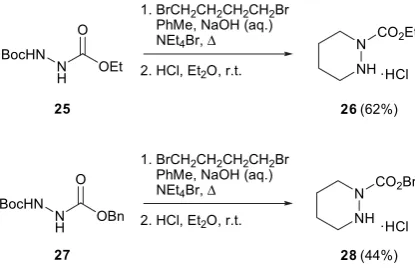
-effect with a five-membered heterocycle does not lead to the desired levels of catalyst activity for this class of transformation.Our attention then turned to preparation of a series of six-mem-bered rings, in order to expand the range of heterocyclic catalysts and hence draw more general structure–reactivity relations. We pre-pared two six-membered cyclic hydrazides26(62%) and28(44%) in an analogous manner to that adopted previously (Scheme 2).
Catalysts26and28were submitted to the standard Diels–Alder reaction conditions for 6 h (Table 2). The results showed excellent yields with near quantitative results being observed for both cat-alysts (entries 2 and 3).exo:endoratios were in favour of theexo -isomer, consistent with literature precedent for iminium ion cata-lysed Diels–Alder reactions of these substrates.1Importantly, both catalysts exhibited higher conversions when compared to the commercially available imidazolidinone1(entry 4) under identical reaction conditions. With near quantitative results being observed with both catalysts after six hours we examined the performance limit of26, altering both catalyst loading and reaction time (entries 5–8), which revealed at 10 mol % loading the reaction resulted in 90% isolated yield of the product after just 3 h, a substantial in-crease in reactivity over our previously described system. Recovery of26from the crude reaction mixture using a Varian Mega Bond ElutÒSCX column resulted in 92% catalyst recovery, highlighting the stability of this class of scaffold to the reaction conditions employed.
The precise reason(s) behind the finding that26(Table 2; entry 8) was more effective than the five-membered ring counterpart15
(Table 1; entry 5) was not apparent. Examination of methyl pipe-colinate hydrochloride29and proline methyl ester hydrochloride
30 (Fig. 4) as catalysts within the standard Diels–Alder reaction (Table 2; entries 9 and 10) showed the five-membered ring het-erocycle30to be significantly better (entry 10; 62%) than the six-membered ring analogue29(entry 9; 3%).
In the design of any chiral catalyst these important findings on reactivity should be taken into account: Catalysts that do not con-tain an
a
-heteroatom should be based upon a five-membered ring, catalysts that have ana
-heteroatom should be based on a six-membered ring.In order to try and rationalise these results we carried out a se-ries of computational studies to examine the effects of an
a
-het-eroatom. In recent studies,5,8we found that two parameters drawn from density functional theory (DFT) methods could be used to gain insight into the formation and reactivity of iminium ions. Firstly, proton affinity (PA) is related to the barrier to formation of iminium ions, since the key step in this process under acidic reaction con-ditions is the transfer of a proton from catalyst to substrate. Sec-ondly, the energy of the lowest unoccupied molecular orbital of the iminium ion (ELUMO) can be used to measure activation of thesubstrate towards Diels–Alder cycloaddition. We therefore calcu-lated these properties for five selected amines, (2,15,26,29, and
30) along with their iminium ion derivatives (Table 3).
From this data it can be concluded that introduction of an
a
-heteroatom on a cyclic framework significantly lowers the proton affinity of the basic nitrogen. This is the case for both five-mem-bered (entry 2; 911.9 kJ mol1vs entry 5; 958.8 kJ mol1) and six-membered rings (entry 3; 917.3 kJ mol1vs entry 4; 957.1 kJ mol1).In the five-membered ring series introduction of the
a
-heteroatom substantially increases the energy level of the LUMO (entry 2; 6.2 eV vs entry 5;6.35 eV) whereas in the six-membered ring series the energy level of the LUMO decreases (entry 3;6.38 eV vs entry 4;6.35 eV). This trend in ELUMOis reflected within there-activity observed with the two series of catalysts where re-activity is reduced on introduction of an
a
-heteroatom in the five-membered ring scaffold but increased in the six-membered ring series. Recent work on the iminium ion catalysed Diels–Alder reaction has shown the cycloaddition step to be rate determining.8,9 It is therefore possible that ELUMO can be adopted as a simple means for the [image:4.595.63.271.236.371.2]computational evaluation of catalyst activity prior to synthesis. It is important to note these computational results do not explain the marked difference in reactivity of proline methyl ester hydrochlo-ride (30) and methyl pipecolinate hydrochloride (29) and further investigations are clearly needed in order to develop a robust predictive model for the reactivity of secondary amines in iminium ion catalysed transformations.
Table 2
Diels–Alder reaction of six-membered ring catalystsa
Entry Catalyst (loading) Time endo:exoc %Yieldb
1 4(10) 6 35:65 98
2 26(10) 6 32:68 99
3 28(10) 6 32:68 94
4 1(10) 6 39:61 87
5 26(1) 3 30:70 14
6 26(2) 3 31:69 26
7 26(5) 3 32:68 50
8 26(10) 3 32:68 90
9 29(10) 6 40:60 3d
10 30(10) 6 30:70 62
aAll reactions between cyclopentadiene and cinnamaldehyde carried out in
methanol at 25C with catalyst as$HCl salt.
bIsolated yield of23&24after chromatography and is the average of two
cata-lytic runs.
c endo:exoratios determined by1H NMR spectroscopy of the crude reaction
mixtures.
d Conversion estimated from1H NMR spectroscopy. O
OEt N H
1. BrCH2CH2CH2CH2Br
PhMe, NaOH (aq.) NEt4Br, Δ
2. HCl, Et2O, r.t.
25 26(62%)
1. BrCH2CH2CH2CH2Br
PhMe, NaOH (aq.) NEt4Br, Δ
2. HCl, Et2O, r.t.
28(44%)
27
BocHN
NH N CO2Et
NH N CO2Bn O
OBn N H BocHN
·HCl
·HCl
Scheme 2.Preparation of six-membered cyclic hydrazides.
N H N
H CO2Me
CO2Me
·HCl ·HCl
29 30
[image:4.595.311.564.468.529.2]Figure 4.Cyclic catalysts without ana-heteroatom.
Table 3
Calculated properties of amines and derived iminium ions (B3LYP/6–31þG(d,p))
Entry Amine PA (kJ mol1) E LUMO(eV)
1 2 913.6 6.41
2 15 911.9 6.20
3 26 917.3 6.38
4 29 957.1 6.35
[image:4.595.43.293.614.716.2]3. Conclusions
In summary, we have explored the use of five- and six-mem-bered cyclic hydrazides as novel molecular scaffolds for use in the iminium ion catalysed Diels–Alder reaction. The five-membered heterocycles performed poorly as catalysts whereas their six-membered counterparts provide an excellent basis for catalyst design. These findings are in stark contrast to catalyst scaffolds that do not bear an
a
-heteroatom, where five-membered cyclic sec-ondary amines deliver significantly improved activity when com-pared to six-membered rings. These results provide a strong basis with which to design novel, state-of-the-art chiral scaffolds that could have applicability in catalytic asymmetric iminium ion cat-alysed cycloaddition and conjugate addition reactions.10 Addition-ally, the catalysts described may also find applicability in the Asymmetric Counteranion-Directed Catalysis (ACDC)11technology recently disclosed by List where an achiral secondary amine can be coupled with a chiral anion in iminium ion activated processes. Our work in these areas will be described in due course.4. Experimental
4.1. General
All1H and13C nuclear magnetic resonance spectra were recor-ded on a Bruker DPX-400, Bruker Avance 500 or Bruker DPX-250 spectrometer, with 13C spectra being recorded at 100, 125 or 62.5 MHz. Mass spectra were obtained using a Fisons VG platform II spectrometer. High resolution mass spectra were obtained by the EPSRC mass spectrometry service, Swansea. Melting points were determined on a Khofler Hot Stage Micro Melting Point Apparatus. Infrared spectra were recorded in the range 4000–600 cm1using a Perkin–Elmer 1600 series spectrophotometer as thin films or as Nujol mulls. Thin Layer Chromatography (TLC) was performed on Merck 5554 60F silica gel coated aluminium plates and detection was effected with a solution of 10% ceric sulfate in 10% sulfuric acid, followed by heating the plates. Purification of compounds was achieved by medium pressure chromatography using Merck 9385 60 silica gel.
All DFT calculations were carried out using the Gaussian03 package,12at the B3LYP/6–31þG(d,p) level.13,14ELUMO was
calcu-lated with this method directly, while PA included an unscaled zero-point vibrational energy (ZPVE) correction from harmonic frequency calculation at the same level.
4.2. Isoxazolidine hydrochloride 66
tert-Butyl N-hydroxycarbamate 10 (2.00 g, 15.0 mmol) was stirred in a solution of toluene (20 mL), sodium hydroxide (10 mL, 50% w/w) and tetraethylammonium bromide (453 mg, 2.16 mmol). 1,3-Dibromopropane (4.71 g, 22.5 mmol, 2.37 mL) was added to the slurry, which was subsequently brought to reflux for 90 min. Ethyl acetate (15 mL) was added and the mixture, which was washed with saturated sodium hydrogen carbonate solution (20 mL), water (15 mL), and brine (15 mL). The organic phase was separated, dried (MgSO4) and the solvent removed under reduced pressure. The
crude product was purified by chromatography eluting with ace-tone in light petrol (1:9) to givetert-butyl isoxazolidine-2-carbox-ylate12(441 mg, 17%) as a clear colourless oil;
n
max(Nujol)/cm12979, 1734, 1709;
d
H(400 MHz, CDCl3) 3.84 (2H, t,J7.2, CH2CH2ON),3.55 (2H, t,J7.2, CH2N), 2.16 (2H, quin,J7.2, CH2CH2N), 1.43 (9H, s,
CH3);
d
C(100 MHz, CDCl3)d
C159.7 (C), 81.8 (C), 68.4 (CH2), 46.8(CH2), 28.2(CH3), 27.9 (CH2);m/z(APCI): 174.7 (MþHþ, 8%), 118.7
(100); HRMS (ES): found MþHþ, 174.1128. C
8H16NO3 requires,
174.1125.
tert-Butyl isoxazolidine-2-carboxylate12(112 mg, 0.65 mmol) was dissolved in dry ether (0.5 mL). Hydrochloric acid in ether (2 M, 3.24 mmol, 1.62 mL) was added and the resulting solution allowed to stand until reaction was complete by TLC. The volume of liquor was reduced in vacuo and the precipitate was filtered and washed with cold ether affording thetitle compound6as a colourless solid (63 mg, 89%); mp (ether/chloroform) 111–112C;
n
max(Nujol)/cm1
3386, 2923, 2853, 1459, 1377, 1003;
d
H(400 MHz,d6-DMSO) 12.48(2H, br s, NH2), 4.19 (2H, t,J7.1, CH2O), 3.49 (2H, t,J7.1, CH2N), 2.41
(2H, quin,J7.1, CH2CH2N);
d
C(125 MHz,d6-DMSO)d
C70.9 (CH2),45.5 (CH2), 27.9 (CH2).
4.3. Pyrazolidine hydrochloride 7
Di-tert-butyl hydrazodiformate11(5.00 g, 21.5 mmol) was stir-red in a solution of toluene (50 mL), sodium hydroxide (25 mL, 50% w/w) and tetraethylammonium bromide (650 mg, 3.10 mmol). 1,3-Dibromopropane (6.50 g, 32.3 mmol, 3.27 mL) was added and the reaction was brought to reflux for 90 min. Ethyl acetate (50 mL) was added and the mixture was washed with saturated sodium hy-drogen carbonate (70 mL), water (50 mL) and brine (30 mL). The organic phase was separated, dried (MgSO4) and the solvent was
removed under reduced pressure. The crude product was purified by chromatography eluting with acetone/light petrol (1:9) to give di-tert-butyl pyrazolidine-1,2-dicarboxylate 13 (4.33 g, 74%) as a clear colourless oil;
n
max (Nujol)/cm12928, 2853, 1704, 1489,1422, 1156;
d
H(400 MHz, CDCl3) 3.79–3.86 (2H, m, CHHN), 3.11–3.19 (2H, m, CHHN), 1.91–1.98 (2H, m, CH2CH2N), 1.41 (18H, s, CH3);
d
C(100 MHz, CDCl3)d
C156.1 (C), 81.1 (C), 46.3 (CH2), 28.2 (CH3),25.7 (CH2);m/z(APCI): 273.7 (MþHþ, 10%), 217.7 (10), 117.8 (100);
HRMS (ES): found MþHþ, 273.1812. C
13H25N2O4requires, 273.1809.
Di-tert-butyl pyrazolidine-1,2-dicarboxylate 13 (200 mg, 0.73 mmol) was dissolved in dry ether (0.5 mL). Hydrochloric acid in ether (2 M, 1.85 mL, 3.67 mmol) was added and the resulting solution was left to stand until reaction was complete by TLC. The volume of liquor was reduced and the precipitate was filtered and washed with cold ether resulting in thetitle compound7as a col-ourless solid (95 mg, 96%); mp (ether/chloroform) 77–78C [lit.6 mp 54–56C];
n
max(Nujol)/cm13395, 2922, 2852, 1461, 1377;
d
H(400 MHz,d6-DMSO) 8.89 (3H, br s, NH2), 3.12 (4H, t,J7.2, CH2N),
2.04 (2H, quin,J7.2, CH2CH2N);
d
C(100 MHz,d6-DMSO) 45.8 (CH2),25.4 (CH2). m/z (APCI): 73.1 (MþHþ, 100%); HRMS (ES): found
MClþ, 73.0773. C3H9N2requires, 73.0766.
4.4. Ethyl pyrazolidine-1-carboxylate hydrochloride 15
Di-tert-butyl dicarbonate (10.50 g, 48 mmol), in THF (90 mL), was cooled to 0C. Ethyl carbazate14(5.00 g, 48 mmol) was added.
The resulting solution was stirred at 0C for 30 min and then
allowed to warm to room temperature for a further 24 h. Removal of the solvent under reduced pressure affordedN0-tert-butyl ester
ethyl carbazate (9.40 g, 96%) as a white amorphous solid with no further purification required; mp (THF) 98–99C [lit.15 mp 92– 93C];
n
max (Nujol)/cm1 3282, 2926, 2852, 1740, 1712;
d
H(400 MHz, CDCl3) 6.54 (1H, br s, NH), 6.39 (1H, br s, NH), 3.95 (2H, q,
J 7.1, CH2), 1.36 (9H, s, C(CH3)3), 1.20 (3H, t, J 7.1, CH2CH3);
d
C(100 MHz, CDCl3) 156.9 (C), 155.8 (C), 81.7 (C), 62.1 (CH2), 28.1
(CH3), 14.4 (CH3);m/z(APCI): 205 (MþHþ, 10%), 149 (100); HRMS
(ES): found MþHþ, 205.1183. C8H17N2O4requires, 205.1183.
N0-tert-Butyl ester ethyl carbazate (2.00 g, 9.8 mmol) was stirred
in a solution of toluene (20 mL), sodium hydroxide (10 mL, 50% w/ w), and tetraethylammonium bromide (290 mg, 1.24 mmol). 1,3-Dibromopropane (3.07 g, 14.7 mmol, 1.55 mL) was added to the slurry, which was subsequently brought to reflux for 90 min. Ethyl acetate (15 mL) was added and the mixture, which was washed with saturated sodium hydrogen carbonate solution (20 mL), water J.B. Brazier et al. / Tetrahedron 65 (2009) 9961–9966
(15 mL) and brine (15 mL). The organic phase was separated, dried (MgSO4) and the solvent removed under reduced pressure. The
crude reaction mixture was purified by chromatography eluting with acetone/light petrol (1:9) resulting in tert-butyl ethyl pyr-azolidine-1,2-dicarboxylate (1.94 g, 81%) as a clear colourless oil;
n
max (Nujol)/cm1 2979, 1730, 1700, 1484, 1453, 1426, 1108;d
H(400 MHz, CDCl3) 4.03–4.22 (2H, m, CH2N), 3.85 (2H, q, J 7.1,
CH2CH3), 3.10–3.26 (2H, m, CH2N), 1.98 (2H, quin,J7.0, CH2CH2N),
1.42 (9H, s, CH3), 1.23 (3H, t,J7.1, CH2CH3);
d
C(100 MHz, CDCl3)160.4 (C), 158.2 (C), 82.1 (C), 59.7 (CH2), 51.2 (CH2), 51.9 (CH2), 34.1
(CH2), 29.7 (CH3), 14.2 (CH3);m/z(APCI): 245.7 (MþHþ, 16%), 189.6
(100), 145.6 (71); HRMS (ES): found MþNH4þ, 262.1759. C11H24N3O4
requires, 262.1761.
tert-Butyl ethyl pyrazolidine-1,2-dicarboxylate (100 mg, 0.40 mmol) was dissolved in dry ether (0.5 mL). Hydrochloric acid in ether (2 M, 1.0 mL, 2.00 mmol) was added and the reaction left to stand until complete by TLC. The volume of ether was reduced and the precipitate was filtered and washed with cold ether. The solvent was removed under reduced pressure resulting in thetitle compound
15as a colourless solid (74 mg, 87%); mp (ether/chloroform) 129– 130C;
n
max(Nujol)/cm12921, 1712, 1460, 1377, 1300, 1215, 1157,
1122,1090,1032;
d
H(400 MHz, CD3OD) 4.30 (2H, q,J7.1, CH2CH3), 3.74(2H, t,J7.0, CH2N), 3.60 (2H, t,J7.0, CH2N), 2.37 (2H, quin,J7.0,
CH2CH2N), 1.34 (3H, t,J7.1, CH2CH3);
d
C(100 MHz, CDCl3) 153.8 (C),63.8 (CH2), 46.3 (CH2), 45.4 (CH2), 24.4 (CH2),14.4 (CH3);m/z(ES): 145
(MClþ, 100%), 116.9 (43); HRMS (ES): found MClþ, 145.0973. C6H13N2O2requires, 145.0972.
4.5. Benzyl pyrazolidine-1-carboxylate hydrochloride 17
Benzylchloroformate (5.69 g, 33.4 mmol, 4.80 mL) was added to a vigorously stirred solution of tert-butyl carbazate 16 (4.41 g, 33.4 mmol), in a biphasic solution of chloroform (62 mL) and aqueous sodium hydroxide (1.8 M, 1.49 g, 37 mmol, 21 mL). The resulting solution was stirred at room temperature for 24 h. The organic layer was separated and washed with water (10 mL) and a citric acid solution (10 mL, 10% w/w). The resultant liquor was dried (MgSO4) and the solvent was removed to giveN0-tert-butyl
ester benzyl carbazate (8.08 g, 91%) as a white solid with no further purification required; mp (chloroform/light petrol) 71–73C [lit.6 mp 79–80C];
n
max(Nujol)/cm13268, 2924, 1755, 1703, 1515, 1463,
1377;
d
H(400 MHz, CDCl3) 7.26 (5H, br s, Ar-H), 6.76 (1H, br s, NH),6.45 (1H, br s, NH), 5.07 (2H, s, CH2), 1.38 (9H, s, CH3);
d
C(100 MHz,CDCl3) 156.7 (C), 155.7 (C), 135.6 (C), 128.5 (CH), 128.4 (CH),
128.3(CH), 81.9 (C), 67.8 (CH2), 28.1 (CH3);m/z(APCI): 167.5 (Mþ
H-Bocþ, 46%), 91.8 (100); HRMS (ES): found MþHþ, 267.1268. C13H19N2O4requires, 267.1267.
N0-tert-Butyl ester benzyl carbazate (5.00 g, 18.8 mmol) was
stirred in a solution of toluene (50 mL), sodium hydroxide (25 mL, 50% w/w), and tetraethylammonium bromide (650 mg, 3.10 mmol). 1,3-Dibromopropane (5.69 g, 28.2 mmol, 2.90 mL) was added and the solution was brought to reflux for 80 min. Ethyl acetate (50 mL) was added and the mixture was subsequently washed with satu-rated sodium hydrogen carbonate solution (70 mL), water (50 mL), and brine (30 mL). The organic phase was separated, dried (MgSO4),
and the solvent removed under reduced pressure. The reaction mixture was purified by chromatography eluting with acetone/light petrol (1:9), which resulted intert-butyl benzyl pyrazolidine-1,2-dicarboxylate (4.54 g, 79%) as a clear colourless oil;
n
max(Nujol)/cm12933, 1710, 1459, 1379, 1087;
d
H(500 MHz, CDCl3) 7.25–7.38(5H, m, Ar-H), 5.10–5.28 (2H, m, OCH2Ar), 3.87–3.96 (2H, m, CHHN),
3.16–3.35 (2H, m, CHHN), 1.98–2.08 (2H, m, CH2CH2N), 1.37 (9H, s,
CH3);
d
C(60 MHz, CDCl3) 156.8 (C), 156.3 (C), 136.2 (C), 128.5 (CH),127.9 (CH), 127.0 (CH), 81.6 (C), 67.8 (CH2), 46.7 (CH2), 46.3 (CH2),
28.1 (CH3), 25.7 (CH2);m/z(APCI): 307.3 (MþHþ, 100%); HRMS (ES):
found MþHþ, 307.164. C16H23N2O4requires, 307.1652.
tert-Butyl benzyl pyrazolidine-1,2-dicarboxylate (100 mg, 0.33 mmol) was dissolved in dry ether (0.5 mL). Hydrochloric acid in ether (2 M, 0.85 mL, 1.65 mmol) was added and the reaction left to stand until complete by TLC. The volume of ether was reduced and the precipitate was filtered and washed with cold ether. The solvent was removed under reduced pressure resulting in thetitle compound
17as a colourless solid (74 mg, 94%); mp (ether/chloroform) 150– 151C;
n
max(Nujol)/cm12927, 2854, 1721;
d
H (400 MHz, CDCl3)7.30–7.51 (5H, m, Ar-H), 5.22 (2H, s, CH2Ar), 3.64 (2H, t,J6.9, CH2N),
3.42 (2H, t,J6.9, CH2N), 2.51 (2H, br s, NH2), 2.20 (2H, quin,J6.9,
CH2CH2N);
d
C(125 MHz,d6-DMSO) 154.7 (C), 136.0 (C), 128.9 (CH),128.7 (CH), 128.4 (CH), 68.3 (CH2), 46.6 (CH2), 46.4 (CH2), 24.6 (CH2);
m/z(APCI): 207.7 (MClþ, 81%); HRMS (ES): found MClþ, 207.1126. C11H15N2O2requires, 207.1128.
4.6. Experimental procedure for catalytic runs
trans-Cinnamaldehyde22(252 mg, 1.9 mmol, 0.24 mL, 1.0 equiv) was added to a solution of catalyst (10 mol %, 0.19 mmol) in methanol (2.0 mL) at 25C and the resulting mixture was stirred for 5 min to
initiate iminium ion formation. Freshly cracked cyclopentadiene21
(323 mg, 4.9 mmol, 0.38 mL, 2.5 equiv) was added in a single aliquot and stirring was continued for a known time. The solvent was re-moved under reduced pressure and the residue was hydrolysed in a chloroform (2 mL), water (1 mL) trifluoroacetic acid (1 mL) mixture over night. Saturated sodium hydrogen carbonate solution (18 mL) was added to neutralise the solution and the aqueous phase was extracted with dichloromethane (220 mL). The combined organic phase was washed with water (10 mL) and dried (Na2SO4) prior to the
removal of the volatiles under reduced pressure.1H NMR spectros-copy of the crude reaction mixture was used to establish the con-version to the products andexo:endoratios through the integration of aldehyde peaks at:
d
H(400 MHz, CDCl3) 9.8 (exo) 9.65(cinnamalde-hyde) 9.53 (endo). The products were then purified by flash column chromatography eluting with ethyl acetate/light petroleum (1:9) resulting in a mixture of theexo- andendo- isomers of 3-phenyl-bicyclo[2.2.1]hept-5-ene-2-carboxaldehyde23and24as a pale yel-low oil.1H NMR,13C NMR and IR data were consistent with previously reported literature values;16
y
max(liquid film)/cm11718, 1601, 1497;m/z(EI): 198 (Mþ, 10%), 132 (89), 131 (100), 103 (52), 77 (21), 66 (54); exo-23
d
H(400 MHz, CDCl3) 9.85 (1H, d,J2.02, CHO), 7.4–7.0 (5H, m,ArH), 6.27 (1H, dd,J5.6 and 3.6, CH]CH), 6.01 (1H, dd,J5.6 and 3.6, CH]CH), 3.66 (1H, dd,J5.0 and 3.4, CHPh), 3.25–3.05 (2H, m, CHCH2),
2.55–2.45 (1H, m, CHCHO), 1.65–1.45 (2H, m, CH2); endo- 24
d
H(400 MHz, CDCl3) 9.53 (1H, d,J2.2, CHO), 7.4–7.0 (5H, m, ArH), 6.36
(1H, dd,J5.6 and 3.6, CH]CH), 6.10 (1H, dd,J5.6 and 3.6, CH]CH), 3.3–3.2 (1H, m, CHPh), 3.1–3.05 (1H, m, CHCH2), 3.04–3.0 (1H, m,
CHCH2), 2.94–2.86 (1H, m, CHCHO), 1.85–1.66 (2H, m, CH2).
4.7. tert-Butyl ethyl piperazine-1,2-dicarboxylate hydrochloride 26
N0-tert-Butyl ester ethyl carbazate (2.00 g, 9.80 mmol) was
added to a stirred solution of toluene (40 mL) containing tetrae-thylammonium bromide (230 mg, 1.63 mmol) and 1,4-dibromo-butane (3.17 g, 14.7 mmol, 1.75 mL). Aqueous sodium hydroxide (20 mL, 50% w/w) was added at ambient temperate and the re-action brought to reflux for 45 min or until theN0-tert-butyl ester
ethyl carbazate was consumed. The reaction was cooled and diluted with ethyl acetate (50 mL) and washed with aqueous saturated sodium hydrogen carbonate. The organic layer was separated, washed with water (10 mL) and brine (10 mL) and subsequently dried (MgSO4). The solvent was removed under reduced pressure.
-DMSO) 4.20–4.10 (2H, m, OCH2CH3), 4.10–4.05 (2H, m, CHHN), 2.88
(2H, m, CHHN), 1.65–1.61 (4H, m, CH2CH2CH2CH2), 1.46 (9H, s,
(CH3)3), 1.27 (3H, t,J7.0, CH3);
d
C(100 MHz, CDCl3) 161.2 (C), 159.9(C), 80.4 (C), 59.7 (CH2), 47.2 (CH2), 46.5 (CH2), 29.1 (CH3), 21.7
(CH2), 14.1 (CH3);m/z(ES): 258.0 (MþHþ, 68%), 231.1 (21), 185.0
(79), 157.0 (100); HRMS (ES): found MþHþ, 259.1581. C12H23N2O4
requires, 259.1580.
tert-Butyl ethyl piperazine-1,2-dicarboxylate (500 mg, 1.97 mmol) was dissolved in dry ether (1.0 mL) prior to the addition of hydro-chloric acid in ether (1 M, 10 mL). The reaction was left to stand at ambient temperature until complete by TLC. The volume of liquor was reduced and the precipitate filtered and washed with cold ether affording thetitle compound26(294 mg, 78%) as a colourless solid; mp 147.5–148C;
n
max(Nujol)/cm13460, 2962, 2253, 1734, 1560, 1468,
1382, 1261;
d
H(400 MHz,d6-DMSO) 4.32 (2H, q,J7.1, OCH2CH3), 3.92(2H, t,J5.6, CH2NCO), 3.45 (2H, t,J5.8, CH2NH2), 2.08–2.19 (2H, m,
CH2CH2NCO), 1.69–1.78 (2H, m, CH2CH2NH2), 1.36 (3H, t, J 7.1,
CH2CH3);
d
C(125 MHz,d6-DMSO) 153.2 (C), 62.7 (CH2), 46.0 (CH2),45.7 (CH2), 24.0 (CH2), 14.6 (CH2), 14.3 (CH3);m/z(ES): 159.1 (MClþ,
90%) 131.0 (28), 113.0 (100); HRMS (ES): found MþHþ, 159.1129. C7H15N2O2requires, 159.1128.
4.8. tert-Butyl benzyl piperazine-1,2-dicarboxylate hydrochloride 28
tert-Butyl benzyl piperazine-1,2-dicarboxylate was prepared under the standard reaction conditions from N0-tert-butyl ester
benzyl carbazate 27 (2.00 g, 7.51 mmol) and 1,4-dibromobutane (2.43 g, 11.3 mmol, 1.35 mL) (1.26 g, 52%) as a colourless solid; mp 73–74C;
n
max (Nujol)/cm12928, 2855, 1712, 1683, 1453, 1425,
1369, 1288, 1261, 1201, 1164, 1134, 1080, 1058;
d
H(400 MHz, d6-DMSO) 7.29–7.39 (5H, m, Ar-H), 5.05–5.29 (2H, m, CH2Ar), 4.00–
4.22 (2H, m, CHHN), 2.81–3.12 (2H, m, CHHN), 1.54–1.72 (4H, m, CH2CH2CH2CH2), 1.28–1.54 (9H, m, C(CH3)3);
d
C(125 MHz, CDCl3)154.8 (C), 154.0 (C), 136.4 (C), 128.4 (CH), 128.0 (CH), 127.9 (CH), 81.2 (C), 67.5 (CH2), 44.8 (CH2), 40.4 (CH2), 28.1 (CH3), 23.8 (CH2), 23.6
(CH2);m/z(ES): 343 (MþNaþ, 20%) 265 (31), 221 (78); HRMS (ES):
found MþHþ, 321.1803. C
17H25N2O4requires, 321.1809.
The hydrochloride salt was prepared under standard conditions (682 mg, 85%) as a colourless solid; mp (ether/chloroform) 146– 147C;
n
max(Nujol)/cm13340, 2920, 1736, 1558, 1461, 1377;
d
H(400 MHz,d6-DMSO) 11.92 (2H, br s, NH2), 7.23–7.39 (5H, m, Ar-H),
5.52 (2H, s, CH2Ar), 3.78–3.86 (2H, m, CH2N), 3.38–3.42 (2H, m,
CH2N), 1.95–2.08 (2H, m, CH2CH2CH2CH2), 1.56–1.65 (2H, m,
CH2CH2CH2CH2);
d
C(100 MHz,d6-DMSO) 159.1 (C), 141.2 (C), 129.4(CH), 128.1 (CH), 127.4 (CH), 66.8 (CH2), 52.4 (CH2), 49.1 (CH2), 23.4
(CH2), 20.8 (CH2);m/z(ES): 221 (MClþ, 100%); HRMS (ES): found
M–Clþ, 221.1285. C12H17N2O2requires, 221.1285.
Acknowledgements
The authors wish to express their gratitude to the EPSRC and GSK for financial support and the EPSRC Mass Spectrometry Ser-vice, Swansea for high resolution spectra.
References and notes
1. Ahrendt, K. A.; Borths, C. J.; MacMillan, D. W. C.J. Am. Chem. Soc.2000,122, 4243. 2. For a comprehensive review on iminium ion catalysed processes see: Erkkila¨,
A.; Majander, I.; Pihko, P. M.Chem. Rev.2007,107, 5416.
3. For structural investigations into iminium ions derived from imidazolidinones see: (a) Brazier, J. B.; Evans, G.; Gibbs, T. J. K.; Coles, S. J.; Hursthouse, M. B.; Platts, J. A.; Tomkinson, N. C. O.Org. Lett. 2009,11, 133; (b) Grosˇelj, U.; Schweizer, W. B.; Ebert, M.-O.; Seebach, D.Helv. Chim. Acta2009,92, 1; (c) Seebach, D.; Grosˇelj, U.; Badine, D. M.; Schweizer, W. B.; Beck, A. K.Helv. Chim. Acta2008,91, 1999.
4. Cavill, J. L.; Peters, J.-E.; Tomkinson, N. C. O.Chem. Commun.2003, 728. 5. (a) Cavill, J. L.; Elliott, R. L.; Evans, G.; Jones, I. L.; Platts, J. A.; Ruda, A. M.;
Tomkinson, N. C. O.Tetrahedron2006,62, 410; (b) Evans, G. J. S.; White, K.; Platts, J. A.; Tomkinson, N. C. O.Org. Biomol. Chem.2006, 2616.
6. Boros, E. E.; Bouvier, F.; Randhawa, S.; Rabinowitz, M. H.J. Heterocycl. Chem. 2001,28, 613.
7. (a) Lemay, M.; Ogilive, W. W.Org. Lett.2005,7, 4141; Lemay, M.; Ogilive, W. W.J. Org. Chem.2006,71, 4663; (b) Lemay, M.; Aumand, L.; Ogilvie, W. W.Adv. Synth. Catal.2007,349, 441.
8. Evans, G.; Gibbs, T. J. K.; Jenkins, R. L.; Coles, S. J.; Hursthouse, M. B.; Platts, J. A.; Tomkinson, N. C. O.Angew. Chem., Int. Ed.2008,47, 2820.
9. It is important to note that these experiments were conducted in a different solvent and with a different catalyst.
10. Lelais, G.; MacMillan, D. W. C. InNew Frontiers in Asymmetric Catalysis; Mikami, K., Lautens, M., Eds.; John Wiley & Sons: New Jersey, 2007; p 313.
11. Mayer, S.; List, B.Angew. Chem., Int. Ed.2006,45, 4193.
12. Frisch, M. J.; Trucks, G. W.; Schlegel, H. B.; Scuseria, G. E.; Robb, M. A.; Cheeseman, J. R.; Montgomery, J. A., Jr.; Vreven, T.; Kudin, K. N.; Burant, J. C.; Millam, J. M.; Iyengar, S. S.; Tomasi, J.; Barone, V.; Mennucci, B.; Cossi, M.; Scalmani, G.; Rega, N.; Petersson, G. A.; Nakatsuji, H.; Hada, M.; Ehara, M.; Toyota, K.; Fukuda, R.; Hasegawa, J.; Ishida, M.; Nakajima, T.; Honda, Y.; Kitao, O.; Nakai, H.; Klene, M.; Li, X.; Knox, J. E.; Hratchian, H. P.; Cross, J. B.; Bakken, V.; Adamo, C.; Jaramillo, J.; Gomperts, R.; Stratmann, R. E.; Yazyev, O.; Austin, A. J.; Cammi, R.; Pomelli, C.; Ochterski, J. W.; Ayala, P. Y.; Morokuma, K.; Voth, G. A.; Salvador, P.; Dannenberg, J. J.; Zakrzewski, V. G.; Dapprich, S.; Daniels, A. D.; Strain, M. C.; Farkas, O.; Malick, D. K.; Rabuck, A. D.; Raghavachari, K.; Fores-man, J. B.; Ortiz, J. V.; Cui, Q.; Baboul, A. G.; Clifford, S.; Cioslowski, J.; Stefanov, B. B.; Liu, G.; Liashenko, A.; Piskorz, P.; Komaromi, I.; Martin, R. L.; Fox, D. J.; Keith, T.; Al-Laham, M. A.; Peng, C. Y.; Nanayakkara, A.; Challacombe, M.; Gill, P. M. W.; Johnson, B.; Chen, W.; Wong, M. W.; Gonzalez, C.; Pople, J. A.Gaussian 03, Revision C. 02; Gaussian,: Wallingford CT, 2004.
13. Becke, A. D.Phys. Rev. A1988,38, 3098.
14. Lee, C. T.; Yang, W. T.; Parr, R. G.Phys. Rev. B1988,37, 785.
15. Wieczerzak, E.; Kozlowska, J.; Lankiewicz, L.; Grzonka, Z.Pol. J. Chem.2002,76, 1693.
16. Ishihara, K.; Kurihara, H.; Matsumoto, M.; Yamamoto, H.J. Am. Chem. Soc.1998,
120, 6920.
J.B. Brazier et al. / Tetrahedron 65 (2009) 9961–9966