Performance Measurement: Challenges for Tomorrow
Abstract
Introduction
Ever since Johnson and Kaplan (1987) published their seminal book entitled Relevance Lost – The Rise and Fall of Management Accounting, performance measurement gained increasing popularity both in practice and research. In fact Neely (1999), having identified that between 1994 and 1996 over 3600 articles were published on performance measurement, has coined the phrase the performance measurement revolution.
Today, performance measurement and performance management practices are commonplace in all sectors of industry and commerce, including the public sector. However, as we move further into the 21st century, there is an increasing belief that the world as we know it is changing, both in natural and business sense. Issues such as global warming, environmental considerations and sustainability of our planet are becoming key concerns for everyone, from individual citizens, through small and multinational businesses, to public servants and politicians. Fuelled by rapidly developing technologies, increasing globalisation and dismantling of trade barriers, we are also seeing rapid changes to how we are managing organisations.
and “Which lines of enquiry do we need to pursue to develop a better understanding of performance measurement within the emerging context?”
Through this paper we will demonstrate how the contemporary performance measurement literature and practice developed. We will then go on to provide an insight into the contextual trends and changes that may lie ahead. These include: cultural and multi-cultural aspects of performance measurement; collaborative organisations; autopoietic networks; servitization; sustainability, as well as the open source movement. We then engage with the performance measurement literature, seeking answers to the questions posed above within the context of these trends. Finally, we present a research framework that identifies the gaps in knowledge and the lines of enquiry that need to be pursued.
Methodological considerations
specific research challenges, as well as the need for a systems-based approach recognising the integrated and concurrent nature of these challenges.
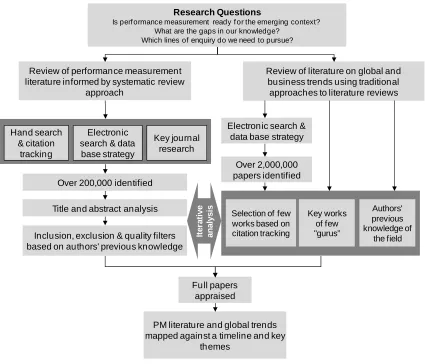
During the last 20 years, business performance measurement (BPM) was studied using many different perspectives (Franco-Santos et al., 2007). These perspectives could be summarized in three main research streams coming from a number of disciplines: operations perspectives, strategic control perspective and management account perspective. Although our literature review includes performance measurement in general, as well as the above three perspectives, in this paper we have used the term “performance measurement” as an all-inclusive term (Neely, 2005; Taticchi et al., 2010).
Research Questions
Is perf ormance measurement ready f or the emerging context? What are the gaps in our knowledge?
Which lines of enquiry do we need to pursue?
Review of performance measurement literature informed by systematic review
approach
Review of literature on global and business trends using traditional approaches to literature reviews
Hand search & citation
tracking
Electronic search & data
base strategy
Key journal research
Over 200,000 identified
Title and abstract analysis
Inclusion, exclusion & quality filters based on authors' previous knowledge
Electronic search & data base strategy
Over 2,000,000 papers identified
Selection of few works based on citation tracking Key works of few "gurus” Authors' previous knowledge of the field Full papers appraised
PM literature and global trends mapped against a timeline and key
[image:5.595.87.512.82.446.2]themes It er at ive an al ysi s
Figure 1. Development of the performance measurement literature and global trends.
In parallel, we explored general literature on Global and Business Trends. Here our objective was to uncover the global and business trends that are predicted for the near future in order to provide a contextual framework against which we could synthesise the performance measurement literature. Our initial search of the popular research databases with key words such as “Global Trends” and “Business Trends” resulted in over two million possible articles. Consequently, rather than conducting an exhaustive review of the literature, which would have been impractical and of little additional value, we relied significantly on: works of a few “gurus” such as Drucker, Mintzberg, Porter and Prahalad; recurring references that we have come across throughout our search; as well as relying on our own knowledge of the field. We started by identifying the most significant commentators, including both academic and non-academic authors, of the global trends of the various eras. To this end, we consulted sources such as the
www.thinkers50.com and Who are the gurus’ gurus (Prusak and Davenport, 2003). We gathered the most important messages from these thinkers and extrapolated these in the context of the performance measurement themes emerging from the literature. This approach provided us with a picture of the global and business trends most relevant from a performance measurement perspective.
meeting, which comprised of a multidisciplinary group of academics and practitioners specialising in performance measurement from different perspectives (Morgan, 1997; Franco-Santos et al., 2007; Stewart et al. 2007), including: Operations Management, Manufacturing Management, Service Management, Strategic Management, Industrial Engineering, Facilities Management, Public Sector Management, Psychology, Human Resources Management and Change Management. The discussion and feedback received from the focus group informed further development of the conclusions and the research framework that is presented in this paper.
Evolution of the Performance Measurement Literature – An Overview
As Bourne (2001) already provides a comprehensive overview of how performance measurement systems evolved, in this section we attempt to summarise the relevant literature and organise it into eras in order to identify the key themes. According to Johnson (1981), the origins of performance measurement lie in the double entry bookkeeping that emerged in the late thirteenth century and remained unchanged until the Industrial Revolution. Starting from the nineteenth century, the performance management field has evolved through a number of phases. Throughout its evolution it has been converging with other related fields of management, as well as spawning sub-fields of interest of its own. The following paragraphs provide a brief overview of the evolution of the field through these phases.
with increasing organisational and managerial complexity, resulted in power and control being delegated. This led to the emergence of divisional and departmental budgets (Chandler, 1977; Bourne, 2001). These developments were paralleled in government institutions (Williams, 2002, 2003, 2004).
The early stages of globalisation during the 1950s led to development of more sophisticated approaches to productivity management, such as quality control, motion-time-study, variety reduction, etc. Here, productivity improvements were often gained at the expense of customer/employee/stakeholder satisfaction (Schonberger, 1982; Suzaki 1987) with much emphasis on financial indicators (Kaplan 1983; Johnson and Kaplan, 1987; Keegan et al. 1989; Neely et al. 1995). Between the 1960s and 1980s, with the economic engine of supply and demand moving from supply-side to demand-side, the focus of performance measurement shifted towards new dimensions of performance, such as quality, time, flexibility and customer satisfaction (Hayes and Abernathy, 1980; Slack 1983; Kaplan 1984). This led to recognition of performance measurement as a multi-dimensional domain (Skinner 1974; Hayes and Abernathy, 1980; Goldratt and Cox 1986; Keegan et al., 1989; Dixon et al., 1990; Kaplan et al., 1992; Neely et al., 1995) and essentially leading to the development of more integrated and balanced approaches to performance measurement (Johnson and Kaplan, 1987).
Goold and Quinn (1990) and Simons (1995) suggest that short-term performance indicators should be developed as strategic controls that are explicitly linked to achievement of long-term strategic goals. In other words “it became increasingly important to do the right things apart from doing things right” (Drucker, 1994). As a result, throughout the integrated performance measurement period much emphasis was placed on what to measure and how these measures achieved strategic alignment (Dixon
et al., 1990; Bititci and Carrie, 1998). These works resulted in development of various performance measurement models and frameworks that facilitated alignment between performance measures and business strategy (Keegan et al., 1989; Dixon et al., 1990; Fitzgerald et al., 1991; Goold, 1991; Atkinson and Waterhouse, 1997; Bititci and Carrie 1998; Bourne et al., 2000; Cross and Lynch, 1988-1989; EFQM, 1999; Kaplan and Norton, 1992, 1996, 2001; Neely and Adams, 2001; McAdam and Bailie, 2002; Neely
1999; Reid and Smith, 2000; Hoque and James, 2000; Chenhall, 2003; Franco and Bourne, 2003; Garengo and Bititci, 2007).
In parallel, the need for aligning human resource based performance management systems with organisational performance measurement systems was recognised (Meyer
Ostensibly, as the field has developed and matured, more specific sub-fields of performance measurements started to emerge. Research into performance measurement in Small and Medium Enterprises (SMEs) has concluded that the majority of performance measurement work, although theoretically valid, does not take into consideration the fundamental differences between SMEs and larger organisations. Thus, resulting in poor take up of performance measurement practices in SMEs (Walley
et al., 1994; Cook and Wolverton, 1995; Burns and Dewhurst, 1996; Brouthers et al., 1998; Hussein et al., 1998; Ghobadian and Galler, 1997; Jennings and Beaver, 1997; McAdam, 2000; Franco and Bourne, 2003; Fuller-Love, 2006; Garengo et al., 2005; Garengo and Bititci, 2007; Hudson et al., 2001; Hudson-Smith and Smith, 2007; Turner
et al., 2005; Wiesner et al., 2007).
Another area that seems to have spawned from the mainstream performance measurement literature is concerned with performance measurement and performance management across organisational boundaries. This includes supply chains and collaborative enterprises. Those works, exploring performance measurement in supply chains, consider operational and informational aspects that go on to propose process-based approaches to measure the performance of supply chains (Beamon, 1999a, 1999b; Brewer and Speh, 2001; De Toni and Tonchia, 2001; Chan and Qi, 2003; Gunasekaram
organisations and of the collaborative organisation. These include a greater variety of operational, cultural, organizational and technological conflicts (Norek and Pohlen, 2001; Simatupang and Sridharan, 2004; Bititci et al., 2005; Folan and Browne, 2005; Busi and Bititci, 2006; Parung and Bititci; 2006; Chen and Yang 2007; Chang et al,. 2010).
Performance measurement and management in the public sector is another area that seems to have spawned from the mainstream performance measurement literature with a plethora of works covering all aspects of public sector management. Williams (2002, 2003, 2004) provides a succinct overview of these works. As the performance measurement body of knowledge is mainly focused on the private and public sectors, scholars are also investigating if and how the knowledge could be used to inform the design of performance measurement systems in non-profit organisations (Paton, 2003; Poister, 2003; Cairns et al., 2005; Micheli and Kennerly, 2007; Moxam, 2010).
Performance Beyond Measurement
turn influenced much of the work on performance measurement and management presented so far. The essence of this line of research is that organisations need performance measures and they have to make them more relevant in order to use them for improving the organisations’ performances. Reflecting on this, Davenport suggests that the ultimate goal of performance measurement should be learning rather than control (Davenport, 2006; Davenport and Harris, 2007; Davenport et al., 2010). The work of Johnson took a different direction. In his book entitled “Profit Beyond Measure” (Johnson and Broms, 2000), the message is that it is possible to run a well performing organisation without measuring performance. It seems that both pro- and against- measurement views agree that increased control does not lead anywhere by itself and that the organizations need to learn to perform, with or without measures. Bititci et al. (2006) suggest that in certain cultural contexts the use of performance measures can, and indeed does, lead to dysfunctional behaviours and poor overall performance. This line of thinking is probably best articulated by Seddon (2008) where he suggests that from a systems thinking perspective, performance measures and targets create a command and control culture that often generates hidden costs and demoralizes people by sub-optimizing various parts of the system.
organisational purpose, plans and targets. They suggest that organisational control, therefore, encompasses any process in which a person (or group of persons) intentionally affects what another person, group, or organization will do. They suggest two contradicting approaches to organisational control. First, the more rational and bureaucratic approach focusing on structural elements of the organisation. Second, the cultural control, the kind of control achieved through personal interaction and socialisation.
The performance measurement literature clearly recognises the dyadic relationship between performance measurement and organisational behaviour (Bourne et al 2002; Franco and Bourne, 2003; Nudurupati and Bititci, 2005; Bititci et al., 2006). Arguably, performance measurement and management is a social phenomenon as its behaviour is shaped by the feelings, values and basic beliefs of the individuals, organisation, community and the society within which it operates.
Research Challenges in Performance Measurement
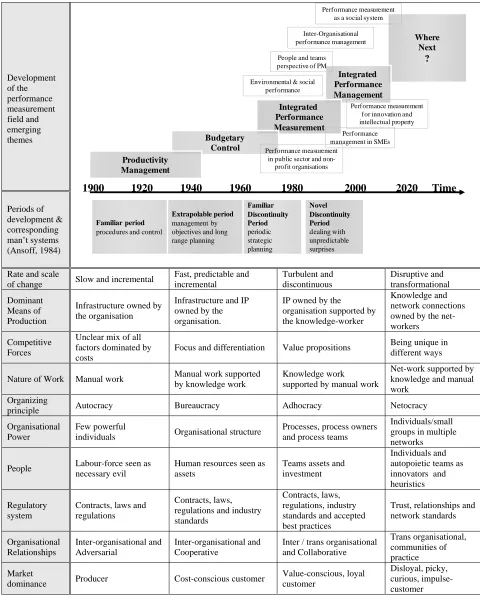
shifting towards integrated performance measurement and subsequently on to integrated performance management, whilst still maintaining a focus on productivity and budgetary control. In effect, we could argue that, in following the emerging industrial, business and social trends, the purpose and the methods of performance measurement broadened by compounding multiple purposes (Figure 2). The review also reveals a number of trends emerging from the literature (also illustrated in Figure 2) that include: Performance measurement in public sector and non-profit organisations; Environmental and social performance; People and teams perspective of performance measurement and management; Performance management in SMEs; Inter-Organisational performance management; Performance measurement for innovation and intellectual property; Performance measurement as a social system.
Today, as we write this paper, we seem to be in the midst of another global revolution that seems to have been somewhat accelerated by the global financial crisis of the 2008-2009 period. With the global economic power base shifting towards emerging economies, such as Brazil, Russia, India and China (Goldman Sachs, 2009; Yamakawa
et al., 2009), certain trends that were embryonic just a few years ago seem to be accelerating. Our review of business trends revealed a plethora of developments that we attempted to tabulate in the lower half of Figure 2. Further analysis of these developments, in relation to the themes emerging from the performance measurement literature, resulted in identification of the following business trends for further consideration:
• Emergence of the need for organisations to collaborate across global multicultural
Birkinshaw, 2007; Pisano and Verganti, 2008; Chesbrough and Garman, 2009). This relates directly to the Inter-organisational performance measurement and
Performance measurement for innovation themes identified above. It also indirectly impacts on Performance measurement in SMEs and Public sector/non profit organisations themes as they are increasingly playing an important and critical role in global networks.
• Increasing emphasis on servitization and the trend towards service-dominant logic
(Lovelock and Gummesson, 2004; Vargo and Lusch 2004; Neely, 2007; Vargo and Lusch, 2008; White et al., 2009) that cuts across all of the themes identified. This has far reaching implications in the way performance is measured and managed in organisations small and large, including manufacturing, service and public sector organisations. This would include measurement of service supply chains, innovation and management of intellectual property in service dominant network organisations, etc. Thus, further research into understanding the value of these measures is deemed essential (Ostrom et al., 2010)
• Shifting of value from manual work towards knowledge-work, with the need for
organizations to collaborate across global multicultural networks (Wenger, 1999; Berry 2004; Ulhøi, 2004; Hilton 2008; Snowden and Boon, 2007; Wenger and Snyder, 2000), directly relates to the inter-organisational and people and teams
perspectives of performance measurement, as well as encompassing the social systems view of performance measurement.
• Increasing emphasis on SMEs as the future economic engines (Ruigrok and Tate,
Mikhailitchenko and Lundstrom, 2006; Prashantham and Birkinshaw, 2008; Herbane, 2010) directly relates to the performance management in SMEs theme as well as impacting on themes such as inter-organisational performance, performance measurement for innovation and performance measurement as a social system.
• Increasing emphasis on sustainability, if suitably managed, should become a
touchstone of the future competitive advantage, as it drives cost reduction, increasing in revenues and innovations (Hopkins, 2009; Nidimolu et al. 2009; Lubin and Esty, 2010). This trend directly relates to the environment and social performance theme. It also cuts across all other themes as the notion of corporate social responsibility becomes a means of developing and sustaining competitive advantage for networks, as well as small and large organisations across all sectors.
Figure 2 maps the evolution of the performance measurement literature against the global trends observed in the literature. In the face of the emerging trends listed above, the key questions are: Is performance measurement ready for the emerging context? What are the gaps in our knowledge? and Which lines of enquiry do we need to pursue to develop a better understanding of performance measurement within the emerging context?
Development of the performance measurement field and emerging themes Periods of development & corresponding man’t systems (Ansoff, 1984)
Rate and scale
of change Slow and incremental
Fast, predictable and incremental Turbulent and discontinuous Disruptive and transformational Dominant Means of Production
Infrastructure owned by the organisation
Infrastructure and IP owned by the organisation.
IP owned by the
organisation supported by the knowledge-worker
Knowledge and network connections owned by the net-workers
Competitive Forces
Unclear mix of all factors dominated by costs
Focus and differentiation Value propositions Being unique in different ways
Nature of Work Manual work Manual work supported by knowledge work
Knowledge work
supported by manual work
Net-work supported by knowledge and manual work
Organizing
principle Autocracy Bureaucracy Adhocracy Netocracy
Organisational Power
Few powerful
individuals Organisational structure
Processes, process owners and process teams
Individuals/small groups in multiple networks
People Labour-force seen as necessary evil
Human resources seen as assets
Teams assets and investment
Individuals and autopoietic teams as innovators and heuristics
Regulatory system
Contracts, laws and regulations
Contracts, laws, regulations and industry standards
Contracts, laws, regulations, industry standards and accepted best practices
Trust, relationships and network standards Organisational Relationships Inter-organisational and Adversarial Inter-organisational and Cooperative
Inter / trans organisational and Collaborative
Trans organisational, communities of practice
Market
dominance Producer Cost-conscious customer
Value-conscious, loyal customer Disloyal, picky, curious, impulse-customer Where Next ? Integrated Performance Management Integrated Performance Measurement Budgetary Control
1900 1920 1940 1960 1980 2000 2020 Time
Productivity Management
Familiar period
procedures and control
Extrapolable period
management by objectives and long range planning Familiar Discontinuity Period periodic strategic planning Novel Discontinuity Period dealing with unpredictable surprises Performance management in SMEs Inter-Organisational performance management
Environmental & social performance
People and teams perspective of PM
Performance measurement in public sector and
non-profit organisations
Performance measurement for innovation and intellectual property Performance measurement
[image:19.595.78.558.83.678.2]as a social system
Collaborative organisations and performance measurement
It is now widely accepted that inter-organisational collaborations, by breaking down traditional organisational boundaries, allow intellectual property, ideas and people to flow freely between organisations, promoting increased levels of innovation whilst reducing risks (Hansen and Birkinshaw, 2007; Chesbrough and Garman, 2009). According to Pisano and Verganti (2008) the question regarding collaboration is no longer about whether to collaborate, rather it is about the need to understand and choose the suitable collaboration options.
The literature on performance measurement recognises the trends towards inter-organisational working and regularly calls for research into performance measurement in supply chains and collaborative organisations. This covers issues such as: inter-organisational agreement on performance measurement; managing the entire supply chain beyond the single dyadic relationship; green supply chain management and green performance measurement; product stewardship, design for life cycle along the supply chain and so on (Beamon, 1999b; Brewer and Speh, 2001; Folan and Browne 2005; Li
et al., 2005). There is evidence in the literature of some progress towards these issues. However, most of the research presented is either theoretical in nature or based on simple supply chain case studies.
virtual organisation that is additional to the organisations that are participating in the collaborative enterprise. That is, the collaboration between three separate organisations by its very nature creates a fourth enterprise that needs to be managed separately. Although this point is made quite succinctly by a number of authors, there is very little grounded empirical research that explores the performance measurement and management related issues in such collaborative organisations. As yet, we do not truly understand the performance measurement and management challenges, theoretical and practical, associated with such a system of collaborative enterprises, where the act of collaboration creates an additional dimension of complexity. Here the key question is:
• How do we concurrently manage the performance of the collaborative organisation
whilst also managing the performance of the participating organisations as a complete system?
Networks and performance measurement
expected that these networks will be autopoietic1 in nature (cf Maturana and Varela, 1979, 1998). Consequently, we expect development of networks that criss-cross organisational boundaries shifting from inter- to trans-organisational networks. We are already experiencing networking where organisations, small and large, and even individuals, are forming and reforming global collaborative networks to deliver innovative value propositions to global markets and customers. Working in this fashion, these collaborative networks are able to compete with, and indeed threaten, the dominance of large corporations (e.g. Linux vs. Microsoft).
We would propose that, as we evolve from simple collaborative relationships between a small number of enterprises towards autopoietic networks, the importance of performance measurement as we know it today will diminish and be replaced with a form of performance evaluation within the network. Today, performance measurement is based around business structures, units, processes and workflows measuring efficiency and effectiveness of actions using variables such as cost, quality and time. For example, all of the performance measurement frameworks identified earlier in the paper (such as SMART, IPMS, BSC, Performance Prism and so on) are focused on performance measurement in a single organisation and rely on defined business structures and processes. Similarly, other inter-organisational performance measurement frameworks (Gunasekaran et al. 2001; 2004; Angerhofer and Angelides, 2006; etc) focus on extended processes and attempt to measure the effectiveness and efficiency of inter-organisational actions and workflows (Lehtinen and Ahola, 2010). Although Marr and Neely (2001) carried out an empirical study to explore the organisational performance measurement in the emerging digital age, their study was limited to single
1
organisations, including bricks-and-mortars, clicks-and-mortars and dot.coms. In fact, Holmberg (2000) wrote that most organizations are unable or unwilling to measure and manage performance collaboratively with partners. According to the literature on networking, performance of an organisation or individual will be judged by the network/community they belong to, according to their contribution, where factors such as trust, relationship and ingenuity will become important dimensions of performance evaluation. Whilst health-check, communicate, compel progress and comply with non-negotiables will still be valid objectives for performance measurement (Neely et al. 2000), the context will be different. It is likely that performance will propagate through networks in ways unknown earlier, creating synergies at some nodes (interfaces) and/or destroying existing synergies at others. Today’s frameworks and models for performance measurement may not be able to deal with this level of complexity and dynamism. Thus, the research challenges we identified here include:
• Do we need performance measures to manage autopoietic networks?
• Are the current performance measurement concepts (productivity, control, etc.),
frameworks and techniques appropriate or adequate for these autopoietic networks?
• What will be the interplay between network politics and performance measurement?
• How would power relationships effect how performance is evaluated in a network?
• Are there different network types with different measurement needs?
• How can performance be planned in trans-organisational, autopoietic networks?
Turbulent operating environment and performance measurement
use of these measures to manage the performance of the organisation (Lebas, 1995; Bititci et al., 1997; Adair, 2003). This development was driven from two related sources. Firstly, the recognition of the turbulent nature of the organisations’ operating environment that led to the need to understand how performance measurement systems can be used and how they could adapt to the changing operating environment. Secondly, as the availability of the empirical data on the use of performance measurement systems became available, a number of factors relating to implementation and use of measurement systems started to emerge. These included organisational, people, behavioural and cultural factors. Although many authors recognise and confirm the interplay between success and failure of performance measurement initiatives and the organisational culture, to date there is little longitudinal empirical data that makes these dependencies explicit. Indeed, there is need for longitudinal studies that explore and explain the evolution of performance measurement systems within organisations as well as in collaborative networks. The pertinent questions are:
• How do performance measurement systems evolve in response to changes in the organisations inner and outer operating environment?
• How does network-based performance measurement systems evolve in response to changes in networks inner and outer operating environment?
Culture, networks and performance measurement
circumstances performance measurement and management may be counterproductive to performance. It is thought that the culture of the organisation and the nature of the work that is being conducted, although not mutually exclusive, have an impact on how performance should be measured and managed, if at all. There appears to be a need for better understanding of the interplay between organisational culture and performance measurement. Here the particular questions are:
• When to use performance measures and when not to?
• How to use performance measures and how not to?
Building upon the previous themes, as the level of globalisation deepens, organisations and individuals are likely to be networking across multiple and diverse national and organisational cultures. Above, we have already identified separate research challenges with respect to inter-firm collaboration, networking, dynamic organisational environment, organisational culture and performance measurement. The notion of multi-cultural collaborations or multi-cultural networks raises a new set of compounded research challenges that need to be pursued. The challenge here is:
• How would performance measurement and management practices need to
change to be effective in multicultural collaborations and networks?
Open innovation and performance measurement
innovation and creativity remains a current research challenge that is widely discussed. However, open innovation is identified as an emerging model for promoting access to the end-product’s source materials (Raymond, 2001; Berry, 2004; Ulhøi, 2004). It is argued that opening the source enables a self-enhancing diversity of production routes, communication paths and interactive communities to emerge. In contrast with more centralized models of innovation, the main principle of open innovation is peer production and collaboration, with the end-product and source-material available to anyone, sometimes at no cost. This is increasingly being applied in fields such as software and biotechnology (Menon, 2009).
However, the majority of the performance measurement research relating to innovation seems to focus on traditional centralised structures (Adams, 2006) with little attention on how to measure knowledge and intellectual property in this completely new and unfamiliar territory. The literature makes it clear that, in order to operate in this open environment, we would be increasingly relying on trust and relationships rather than protection of formal contracts, laws and regulations. Here the pertinent questions are:
• Do we need to measure and manage innovation and knowledge in an open
environment?
• Would performance-evaluation rather than performance measurement, provide
an adequate indication of trust?
Servitization and performance measurement
2004; Lovelock and Gummesson, 2004; Neely 2007; White et al., 2009). The main tenet that underpins the notion of servitization is the shift from value-in-exchange towards value-in-use (Woodruff 1997; Ng and Nudurupati 2010). This suggests that regardless of whether the value to the customer is delivered through products or services, the value chain should be viewed from the customer’s perspective, i.e. how the customer uses the product and/or service throughout its life (Vargo and Lusch, 1994; Wise and Baumgartner, 1999). This transition from product-dominant thinking to service-dominant thinking is challenging both researchers and practitioners, requiring fresh and innovative thinking as to how organisations need to be configured, measured and managed (Ng and Nudurupati, 2010). According to Ostrom et al. (2010), performance measurement should transform the business strategy and service design to deliver value-in-use. Today, the majority of customer-facing measures, such as on-time delivery, flexibility, responsiveness, accuracy of documentation and even customer satisfaction, tend to focus on value-in-exchange rather than value-in-use-through-life. The questions here are:
• How the current performance measurement systems should change to measure
value-in-use-through-life?
• Whether the notion of performance-evaluation (as introduced earlier in the
paper), rather than measurement would be a viable alternative?
• If so, how would organisations motivate their customers to evaluate their
Knowledge-work and performance measurement
The traditional performance measurement theory stipulates that performance measures for the organisation, processes, teams and individuals need to be integrated and aligned, where the performance measures for teams and individuals are used for reward and recognition purposes (Sink, 1986; Dixon et al., 1990; Goold, 1991; Lynch and Cross, 1991; Kaplan and Norton, 1992, 1996; Neely et al., 1994; Atkinson and Waterhouse, 1997; Keegan et al. 1989; Bourne et al. 2000; McAdam and Bailie, 2002). However, this notion of alignment seems to conflict with the emerging networked, open-innovation environment where the knowledge workers within networks dominate the economics of production (Wenger, 1999; Wenger and Snyder, 2000 Berry 2004; Ulhøi, 2004). According to Hilton (2008), in the future the nature of work will be affected by the globalization of science and technology and the knowledge workers will require a greater complexity of skills. Hilton (2008) suggests that the core of the emerging knowledge economy is based on the indistinct boundaries between knowledge and service work (fuelled through servitization), which is creating new knowledge-based occupations combining products, services and technology. Moreover, there is also a growing consensus that the performance of a knowledge worker cannot be effectively measured or managed (Johnson and Broms, 2000; Bititci et al., 2007; Seddon, 2008; Sobotka and Platts, 2010).
creator or owner of new knowledge may be. This line of thinking has led us to ask the following questions:
• How can we measure performance of knowledge workers that operate within an
autopoietic network? Indeed, do we even need to?
• How would the network evaluate its members’ performance?
• How do we manage reward and recognition in an autopoietic network or in an
open-innovation environment?
SMEs and performance measurement
The literature on performance measurement in SMEs seems to accept the fact that the take-up of performance measurement practices amongst SMEs is likely to remain low due to contextual differences of SMEs (Cook and Wolverton, 1995; Garengo et al., 2005; Hudson-Smith and Smith, 2007; Wiesner et al. 2007; Garengo, 2009). However, other literature suggests that for economic sustainability, SMEs are increasingly playing a key role as engines of economic growth in industrialised world economies (Ruigrok and Tate, 1996; Dutta and Evrard, 1999; DeVries and Margaret, 2003; Van Gils, 2005; Mikhailitchenko and Lundstrom, 2006). It is estimated that in the European Union SMEs account for 75% of GDP2. Worldwide, they account for 70% of the world’s production (Moore and Manring, 2009). Furthermore, it is thought that SMEs will play a key role on globalization and make significant contributions to the economy at a time of crisis (Herbane, 2010). Prashantham and Birkinshaw (2008) point out that, on one hand, in some industries small local businesses have a level of agility, market knowledge and innovative capabilities that allow them to prosper in the shadow of the
2
large multinational corporations. On the other hand, they are capable of operating globally through partnerships, which they can leverage to generate opportunities on a global scale.
It seems that in the future SMEs will play an important role in economic development and indeed innovation. In this context, they are expected to work and thrive within globalised autopoietic networks, working across multiple cultures, contributing to and benefiting from the emerging open-innovation environment. However, our current state of knowledge with respect to performance measurement in SMEs seems to be limited to study of SMEs from more traditional performance measurement perspectives. As yet, there is little evidence of theoretical or empirical research into how the contextual differences of SMEs may advantage or disadvantage SMEs. The key questions are:
• Whether SMEs need to adopt traditional performance measurement practices in
open-innovation driven global networks or would their inherent characteristics allow them to operate more effectively in this emerging environment using different or indeed no performance measurement?
• What would be the performance measurement challenges for SMEs be in the
emerging context?
• Would these new challenges compound the current difficulties SMEs have with
Global sustainability and performance measurement
The emergence of sustainability and the need for sustainable development as a global challenge is recognised by everyone. The notion of sustainability encompasses global challenges such as energy, pollution, food-supply, overpopulation, the built environment and transport, to mention a few. According to Nidumolu et al. (2009), in the future only companies that make sustainability a goal will achieve competitive advantage. They suggest that sustainability presents an opportunity towards improving performance and gaining competitive advantage by making sustainability a touchstone for rethinkingbusiness models, as well as products,technologies, and processes.
• How to take an integrated systems view to performance measurement in general,
whilst ensuring that the sustainability agenda is explored in sufficient depth and breadth?
Indeed, this is true for many areas we have covered in our review, which we discuss later in the paper.
Information technologies for performance measurement
support towards sharing performance information with external parties, such as customers and suppliers.
Based on the discussion we presented above, we believe that the questions and challenges posed require a complete rethink of how we measure and manage performance of organisations in the future. Thus, it is highly likely that the current information and communication technology (ICT) platforms would be inadequate to support our future performance measurement and management needs. Here the questions are:
• Are current ICT platforms capable of supporting our future performance
measurement and management needs? If not, how should they be designed, developed and configured?
• What will the forthcoming information technologies enable the organisations to
do that we cannot even imagine today?
• Will information technology be a barrier or will it be an enabler that offers us
new ways of performance measurement and management?
Towards a Holistic Research Framework for Performance Measurement
research challenges. However, our review also suggests that the community is aware of these challenges as discreet areas of research, but pays little attention to the complexity and additional challenges associated with an integrated holistic view of these discreet areas of research. For example, there are theoretical works that address performance measurement in collaborative organisations, there is an awareness of the need to understand performance measurement in networks and there are various theoretical and empirical works that explore performance measurement challenges in SMEs. However, there is little or no awareness of performance measurement implications of SMEs working and collaborating in multicultural, open-innovation driven, autopoietic networks. Similarly, there is no recognition of the complexities associated with integrating sustainability-based measures across an industrial network where performance measurement may have been replaced with performance evaluation.
In addition, even from a narrow and discreet perspective, some areas present specific research challenges. For instance, with respect to performance measurement in collaborative organisations, we seem to be aware of the research challenges and there appears to be some theoretical works that propose how performance could be measured and managed in collaborative enterprises. However, there is little or no empirical research to further strengthen our understanding in this area. Similarly, although we may be aware of the performance measurement challenges in autopoietic networks, there are no theoretical or empirical works that attempt to address this area.
the way we measure, manage and evaluate performance of organisations and individuals in the future.
The fact that the new context is rapidly emerging, and we have little or no reference points upon which we can base our research, represents an additional research challenge. On one hand, from a deductive perspective it is difficult to judge whether existing assumptions and theories remain relevant or how they should be modified or extended, as there are very few practical cases that could be used to test them. On the other hand, from an inductive perspective, lack of easily accessible cases also limits our ability to develop a grounded understanding of these research challenges. In the authors’ collective experience, it is much simpler to conduct research in a single organisation or in a limited number of collaborating organisations. However, conducting empirical research in an autopoietic network represents another challenge. Perhaps the researchers would need to embed themselves into such networks in order to conduct the research.
either formally or informally peer-evaluate each member’s performance may yield some insights towards addressing the research challenges posed in this paper.
Synthesising a research framework
Finally, it is evident that the fundamental purpose behind performance measurement may be changing, with a diminishing emphasis on control and increasing emphasis on learning (Johnson and Broms, 2000; Davenport and Harris, 2007; Davenport et al., 2010). Particularly in the context of autopoietic networks the behaviour of organisations are being influenced through social interaction and relationships through peer-evaluation rather than bureaucratic processes. Consequently, one could argue that performance measurement is evolving from rational control towards cultural control (Tannenbaum, 1968; Child, 1973; 1972). Although the performance measurement literature already recognises the dyadic relationship between performance measurement and organisational behaviour, it is becoming increasingly apparent that performance measurement is a social phenomenon where behaviours (organisational and individual) are shaped by the values and perceptions of the individuals and the communities within which the individual operates.
innovation and knowledge indicators will provide the early warning systems for the future performance measurement systems.
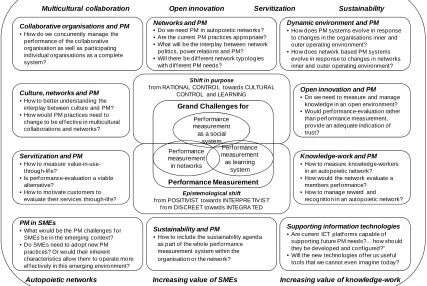
Based on the review presented in this paper, our view is that there are three grand challenges the performance measurement research community needs to address in an integrated manner. These are:
• Understanding performance measurement as a social system
• Understanding performance measurement as a learning system
• Understanding performance measurement in autopoietic networks
However, we believe that the real challenge lies in the development of an integrated and holistic understanding of performance measurement, i.e. performance measurement as a social system that enables learning in autopoietic networks. In Figure 3 we have
Multicultural collaboration Open innovation Servitization Sustainability
Autopoietic networks Increasing value of SMEs Increasing value of knowledge-work Supporting information technologies • Are current ICT platf orms capable of
supporting f uture PM needs?... how should they be developed and conf igured?” • Will the new technologies of f er us usef ul
tools that we cannot even imagine today?
Shift in purpose
f rom RATIONAL CONTROL towards CULTURAL CONTROL and LEARNING
Epistemological shift
f rom POSITIVIST towards INTERPRE TIV IS T f rom DISCREET towards INTEGRA TED
Grand Challenges for
Performance Measurement Performance measurement in networks Performance measurement as learning system Performance measurement as a social
system
Sustainability and PM
• How to include the sustainability agenda as part of the whole perf ormance measurement system within the organisation or the network? PM in SMEs
• What would be the PM challenges f or SMEs be in the emerging context? • Do SMEs need to adopt new PM
practices? Or would their inherent characteristics allow them to operate more ef f ectively in this emerging environment?
Networks and PM
• Do we need PM in autopoietic networks? • Are the current PM practices appropriate? • What will be the interplay between network
politics, power relations and PM? • Will there be dif f erent network typologies
with dif f erent PM needs? Collaborative organisations and PM
• How do we concurrently manage the perf ormance of the collaborative organisation as well as participating individual organisations as a complete system?
Dynamic environment and PM • How does PM systems evolve in response
to changes in the organisations inner and outer operating environment? • How does network based PM systems
evolve in response to changes in networks inner and outer operating environment?
Open innovation and PM • Do we need to measure and manage
knowledge in an open environment? • Would perf ormance-evaluation rather
than perf ormance measurement, provide an adequate indication of trust?
Culture, networks and PM • How to better understanding the
interplay between culture and PM? • How would PM practices need to
change to be ef f ective in multicultural collaborations and networks?
Knowledge-work and PM • How to measure knowledge-workers
in an autopoietic network? • How would the network evaluate a
members perf ormance? • How to manage reward and
recognition in an autopoietic network? Servitization and PM
• How to measure value-in-use-through-lif e?
• Is perf ormance-evaluation a viable alternative?
[image:38.595.86.513.86.372.2]• How to motivate customers to evaluate their services through-lif e?
Figure 3. A holistic research framework for performance measurement.
Conclusions
In conducting this review, we have also identified some new but rapidly emerging trends that are likely to present practical and theoretical challenges for performance measurement. Although the review of performance management literature identified several research agendas, they were largely dealing with contemporary issues, which are valid in their own right, but fail to develop a holistic, integrated and forward-looking view of the challenges for performance measurement. Through this paper, we have predicted and identified performance measurement challenges of the future, thus presenting the community with an opportunity for developing proactive research programmes in anticipation of these challenges.
The principle limitation of the paper is that it covers a broad base, reviewing and discussing literature from different aspects of performance measurement without necessarily exploring the intricacies of each area in any significant depth. However, we believe that this weakness is also the strength of this paper. In undertaking this broad literature review and discussing its findings, we have identified a number of research challenges. Still what is perhaps more significant is that there is a need for rethinking our approach to how we research the field of performance measurement. Indeed,
REFERENCES
Acar, Y., Kadipasaoglu, S. and Schipperijn P. (2010). A decision support framework for global supply chain modelling: an assessment of the impact of demand, supply and lead-time uncertainties on performance. International Journal of Production Research, 48, pp. 3245-3268
Adair, C.E., Simpson, L., Birdsell, J.M., Omelchuk, K., Casebeer, A.L., Gardiner, H.P., Newman, S., Beckie, A., Clelland, S., Hayden, K. A. and Beausejour, P. (2003).
Performance measurement systems in health and mental health services: models,
practices and effectiveness. Edmonton, CA: The Alberta Heritage Foundation for Medical Research.
Adams, R., Bessant, J. and Phelps, R. (2006). Innovation management measurement: A review. International Journal of Management Reviews, 8, pp. 21-47.
Andersen, B. and Fagerhaug, T. (2004). Green performance measurement.
International Journal of Business Performance Management, 1, pp.171-185. Angerhofer, B.J. and Angelides, M.C. (2006). A model and a performance
measurement system for collaborative supply chains. Decision Support Systems,
42, pp. 283-301.
Ansoff, I.H. (1984). Implanting Strategic Management, Englewood Cliffs, N.J.:Prentice Hall.
Atkinson, A. and Waterhouse, J. H. (1997). A Stakeholder approach to strategic performance measurement. Sloan Management Review, 38, pp. 25-37.
Bacal, R. (1999). Performance Management. New York, NY: McGraw-Hill.
accreditation system. Journal of Public Health Management and Practice, 13, pp. 427-429.
Baker, G. (2000). The use of performance measures in incentive contracting. The American Economic Review, 90, pp. 415-420.
Banuelas, R., Tennant, C., Tuersley, I. and Tang, S. (2006). Selection of six sigma projects in the UK. The TQM Magazine, 18, pp. 514-527.
Bard, A. and Soderqvist, J. (2002). Netocracy: The new power elite and life after capitalism.London: Reuters.
Beamon, B.M. (1999a). Measuring supply chain Performance. International Journal of Operations and Production Management, 19, 275-292.
Beamon, B.M. (1999b). Designing the green supply chain. Logistics Information Management, 12, pp. 332-342.
Berry, D.M. (2004). Internet research: privacy, ethics and alienation: an open source approach. Internet Research, 14, pp. 323-332.
Bititci, U., Turner, T., Mackay, D., Kearney, D., Parung, J. and Walters, D. (2007). Managing synergy in collaborative enterprises. Production Planning & Control,
18, pp. 454–465.
Bititci, U.S. and Carrie, A.S. (1998). Integrated performance measurement systems: Structures and relationships. EPSRC Final Research Report, Grant GR/K 48174, Swindon UK.
Bititci, U.S., Mendibil, K., Albores, P. and Martinez, M. (2005). Measuring and managing performance in collaborative enterprises. International Journal of Operations and Production Management, 25, pp. 333-353.
Bititci, U.S., Mendibil, K., Nudurupati, S., Turner, T. and Garengo, P. (2006). Dynamics of Performance measurement and organizational culture. International Journal of Operations and Production Management,26, pp. 1325-1350.
Blackler, F. and Brown, C. (1987). Information technology and people: designing for the future. Leicester, UK: The British Psychology Society.
Bourne, M. (2001). The handbook of performance measurement. London: Gee Publishing.
Bourne, M. and Neely, A. (2000). Why performance measurement interventions succeed and fail. Proceedings of the 2nd International Conference on Performance Measurement, Cambridge, pp. 165-173.
Bourne, M., Mills J., Wilcox M., Neely, A. and Platts, K. (2000). Designing, implementing and updating performance measurement systems. International Journal of Operations and Production Management, 20, pp.754-771.
Bourne, M., Neely, A., Platts, K., Mills, J. (2002). The success and failure of performance measurement initiatives. International Journal of Operations & Production Management, 22, pp. 1288-1310
Brewer, P. and Speh, T. (2001). Adapting the balanced scorecard to supply chain management. Supply Chain Management Review, 5, pp. 48-56.
Burns, P. and Dewhurst, J. (1996). Small business and entrepreneurship. London: Macmillan.
Busi, M. and Bititci, U.S. (2006). Collaborative performance measurement: a state of the art and future research. International Journal of Performance and Productivity Management, 55, pp. 7-25.
Cairns, B., Harris, M., Hutchison, R. and Tricker, M. (2005). Improving performance? The adoption and implementation of quality systems in UK nonprofits. Nonprofit, Management and Leadership, 16, pp. 135-151.
Chan, F.T.S. and Qi, H.J. (2003). An innovative performance measurement method for supply chain management. Supply Chain Management: An International Journal,
8, pp. 209-223.
Chandler, A.D., (1977). The Visible Hand, Harvard University Press, Cambridge Mass., USA.
Chang H.H., Wang, H.W. and Kao, T.W. (2010). The determinants of long-term relationship on inter-organizational systems performance. Journal of Business and Industrial Marketing, 25, pp. 106-118.
Chen, M.C., Yang, T. and Li. H.C. (2007). Evaluating the supply chain performance of IT-based inter-enterprise collaboration. Information and Management, 44, pp. 524-534.
Chenhall, R.H. (2003). Management control systems design within its organizational context: findings from contingency-based research and directions for the future.
Accounting, Organizations and Society, 28, pp. 127-168.
Child, J. (1972). Organization Structure and Strategies of Control: A Replication of the Aston Study. Administrative Science Quarterly, June 1972, pp. 163-177.
Child, J. (1973). Strategies of Control and Organizational Behavior. Administrative Science Quarterly, March 1973, pp. 1-17.
Chiesa, V. and Frattini, F. (2007). Exploring the differences in performance measurement between research and development: evidence from a multiple case study. R&D Management, 37, pp. 283-301.
Chiesa, V., Frattini, F., Lazzarotti, V. and Manzini, R. (2009). Performance measurement in RandD: exploring the interplay between measurement objectives, dimensions of performance and contextual factors. R&D Management, 39, pp. 488-518.
Cicek, M. C. Koksal, G. and Oxdemirel, N.E. (2005). A team performance measurement model for continuous improvement. Total Quality Management and Business Excellence, 16, pp. 331-349.
Cook, R.A. and Wolverton, J.B. (1995). A scorecard for small business performance.
Journal of Small Business Strategy, 6, pp. 1-18.
Corona, C. (2009). Dynamic performance measurement with intangible assets. Review of Accounting Studies, 14, pp. 314-348.
Cross, K. F. and Lynch, R. L. (1988-1989). The SMART way to define and sustain success. National Productivity Review, 9,pp. 23-33.
Davenport, T H. and Prusak, L. (2003). What's the big idea? Creating and capitalizing on the best management thinking. Boston, MA: Harvard Business School.
Davenport, T.H. and Harris, J.G. (2007). Competing on analytics: The new science of winning. Boston, MA: Harvard Business School Press.
Davenport, T.H., Harris, J.G. and Morison, R. (2010). Analytics at Work: Smarter Decisions, Better Results. Boston, MA: Harvard Business School Press.
De Toni, A.F. and Tonchia, S. (2001). Performance measurement system – Models, characteristics and measures. International Journal of Operations and Production Management, 21, pp. 46-70.
De Vries, H. and Margaret, J. (2003). The development of a model to assess the strategic management capability of small and medium-size businesses. Journal of American Academy of Business,3, pp. 85-92.
Denyer, D. and Tranfield, D. (2008). Producing a systematic review. In Buchanan, D. (ed.), The Sage Handbook of Organizational Research Methods. London: Sage. Ditz, D. and Ranganathan, J. (1997). Measuring up: Toward a common framework for
tracking corporate environmental performance. Washington, DC: World Resources Institute.
Dixon, J.R., Nanni, A.J. and Vollmann, T.E. (1990). The new performance challenge: measuring operations for world class competition. Irwin Homewood, IL: McGraw-Hill.
Drucker, P.F. (1969). The age of discontinuity: guidelines to our changing society.
London: Heinemann Press.
Drucker, P.F. (1994). The Theory of the Business. Harvard Business Review, 72, pp. 95-104.
Dutta, S. (2009). Discussion of Dynamic performance measurement with intangible assets. Review of Accounting Studies, 14, pp. 349-357.
Dutta, S. and Evrard, P. (1999). Information technology and organisation within European small enterprises. European Management Journal, 17, pp. 239-251. EFQM, (1999). Self-assessment guidelines for companies. Brussels: European
Foundation for Quality Management.
Elkington, J. (1999). Cannibals with forks: The triple bottom line of 21st century business. Oxford: Capstone.
Epstein, M. and Roy, M.J. (1998). Managing corporate environmental Performance: A multinational perspective. European Management Journal, 16, pp. 284-296. Fitzgerald, L., Johnston, R., Brignall, T.J., Silvestro, R. and Voss, C. (1991).
Performance measurement in service industries. London: CIMA.
Folan, P. and Browne, J. (2005). A review of performance measurement: Towards performance management. Computers in Industry, 56, pp. 663-680.
Ford, H. (1922). My life and work. Garden City, NY:Doubleday, Page and Company. Franco, M. and Bourne, M. (2003). Factors that play a role in managing through
measures. Management Decision, 41, pp.698-710.
Franco-Santos, M., Kennerley, M., Micheli, P., Martinez, V., Mason, S., Marr, B., Gray, D., Neely, A. (2007). Towards a definition of a business performance measurement system. International Journal of Operations and Production Management,27, pp. 784-801.
Garengo P. (2009). Performance Measurement System in SMEs taking part to Quality Award Programs. Total Quality Management and Business Excellence, 20, pp. 91-105.
Garengo, P. and Bititci, U.S. (2007). Towards a contingency approach to performance measurement: an empirical study in Scottish SMEs. International Journal of Operations and Production Management, 27, pp. 802-825.
Garengo, P., Biazzo, S. and Bititci, U.S. (2005). Performance measurement systems in SMEs: a review for a research agenda. International Journal of Management Reviews, 7, pp. 25-47.
Ghobadian, A. and Gallear, D. (1997). TQM and organisation size. International Journal of Operations and Production Management, 17, pp. 121-163.
Glueck, W. F., & Jauch, L. (1984) Business policy and strategic management (4th ed.). New York: McGraw-Hill.
Goldratt, E.M. and Cox, J. (1986). The goal: A process of ongoing improvement, New York, NY: North River Press.
Goldman, Sachs, 2009. The BRICs Nifty 50: The EM and DM winners, Goldman Sachs
Global Strategy Report, 4 November 2009,
(http://www2.goldmansachs.com/ideas/brics/nifty-50-doc.pdf) Accessed on 9
April 2010.
Goold, M. (1991). Strategic control in the decentralised firm. Sloan Management Review, 32, pp. 69-81.
Greiling, D. (2006). Performance measurement: a remedy for increasing the efficiency of public services?. International Journal of Productivity and Performance Management, 55, pp. 448-465.
Gunasekaran, A., Patel, C. and McGaughey, R.E. (2004). A framework for supply chain performance measurement. International Journal of Production Economics, 87, pp. 333-347.
Gunasekaran, A., Patel, C. and Tirtiroglu, E. (2001). Performance measures and metrics in a supply chain environment. International Journal of Operations and Production Management, 21, pp. 71-87.
Haag, S., Cummings, M. and McCubbrey, D.J. (2002). Management information systems for the information age. New York, NY: McGraw-Hill.
Hammer, M. (2001). The agenda: What every business must do to dominate the decade. London: Random House Business Books.
Hammer, M. (2007). The process audit. Harvard Business Review, 82, pp. 111-123. Handy, C. (2002a). The age of unreason: New thinking for a new world. London:
Arrow Books.
Handy, C. (2002b). The elephant and the flea: Reflections of a reluctant capitalist.
Boston, MA: Harvard Business School Press.
Hansen, M.T. and Birkinshaw, J. (2007). The Innovation Value Chain. Harvard Business Review, 85, pp. 121-130.
Hayes, R.H. and Abernathy, W.J. (1980). Managing our way to economic decline.
Harvard Business Review, 58, pp. 67-77.
Herbane, B. (2010). Small business research: Time for a crisis-based view.
International Small Business Journal, 28, pp. 43-64.
Hernandez-Espallardo, M., Rodriguez-Orejuela, A. and Sanchez-Perez, M. (2010). Inter-organizational governance, learning and performance in supply chains.
Supply Chain Management: an International Journal,15, pp. 101-114.
Hervani, A.A., Helms, M.M. and Sarkis, J. (2005). Performance measurement for green supply chain management. Benchmarking: An International Journal, 12, pp. 330-353.
Hilton, M. (2008). Skills for Work in the 21st Century: What Does the Research Tell Us?. Academy of Management Perspectives, 22, pp. 63-78.
Hines, P. and Rich, N. (1997). The seven value stream mapping tools. International Journal of Operations and Production Management, 17, pp.46-64.
Holmberg, S. (2000). A systems perspective on supply chain measurements.
International Journal of Physical Distribution and Logistics Management, 30, pp. 847-868.
Hopper, T. and Powell, A. (1985). Making sense of research into the organizational and social aspects of management accounting: a review of its underlying assumptions.
Journal of Management Studies, pp. 429-65.
Hopkins M.S. (2009). 8 Reasons Sustainability Will Change Management (That You Never Thought of). Sloan Management Review, 51, pp. 27-30.
Hoque, Z. and James, W. (2000). Linking Balanced Scorecard measures to size and market factors: impact on organizational performance. Journal of Management Accounting Research, 12, pp. 1-17.
Huang, S.H., Sheoran, S.K. and Keskar, H. (2005). Computer assisted supply chain configuration based on supply chain operations reference (SCOR) model.
Computers and Industrial Engineering, 48, pp. 377-94.
Hudson, M., Smart, P.A. and Bourne, M. (2001). Theory and practice in SME performance measurement systems. International Journal of Operations and Production Management, 21, pp. 1096-1116.
Hudson-Smith, M. and Smith, D. (2007). Implementing strategically aligned performance measurement in small firms. International Journal of Production Economics, 106, pp. 393-408.
Hussein, M., Gunasekaran, A. and Laitinen, E.K. (1998). Management accounting system in Finish service firms. Technovation, 18, pp. 57–67.
Ittner, C. and Larcker, D. (1998). Innovations in performance measurement: Trends and research implications. Journal of Management Accounting Research, 6, pp. 205–238.
Jennings, P. and Beaver, G., (1997). The performance and competitive advantage of small firms: A management perspective. International Small Business Journal,
15, pp. 63-75.
Johnson, H.T. (1981). Towards an understanding of 19th century cost accounting. The Accounting Review, 56, pp. 510-518.
Johnson, H.T. and Kaplan, R.S. (1987). Relevance lost – The rise and fall of management accounting, Boston, MA: Harvard Business School Press.
Kanji, G. and Sá, P. (2007). Performance measurement and business excellence: the reinforcing link for the public sector. Total Quality Management and Business Excellence,18, pp. 49-56.
Kaplan, R.S. (1983). Measuring manufacturing performance: A new challenge for management accounting research. The Accounting Review, 18, pp. 686-705.
Kaplan, R.S. (1984). The evolution of management accounting. The Accounting Review, 59, pp. 390-418.
Kaplan, R.S. and Norton, D.P. (1992). The Balanced Scorecard – Measures that drive performance. Harvard Business Review, 70, pp. 71-79.
Kaplan, R.S. and Norton, D.P. (1996). Translating strategy into action: The balanced scorecard. Boston, MA: Harvard Business School Press.
Kaplan, R.S. and Norton, D.P. (1996a). The Balanced Scorecard. Boston, MA: The Harvard University Press.
Kaplan, R.S. and Norton, D.P. (2001). The strategy-focused organization: How balanced scorecard companies thrive in the new business environment. Boston, MA: Harvard Business School Press.
Keegan, D.P., Eiler, R.G. and Jones, C.R. (1989). Are your performance measures obsolete? Management Accounting, 70, pp. 45-50.
Kennerley, M. and Neely, A. 2003. Measuring performance in changing business environment. International Journal of Operations and Production Management,
Kleijnen, J.P.C. and Smits, M.T. (2003). Performance metrics in supply chain management. Journal of the Operational Research Society, 54, pp. 507–514. Kroes, J.R. and Ghosh, S. (2010). Outsourcing congruence with competitive priorities:
Impact on supply chain and firm performance. Journal of Operations Management,28, pp. 124-143.
Langfield-Smith, K. (1997). Management control systems and strategy: A critical review. Accounting, Organizations and Society, 22, pp. 207-232.
Lawler, E.E., III. (2003). Reward practices and performance management system effectiveness. Organizational Dynamics, 32, pp.396-404.
Lebas, M. (1995). Performance measurement and management. International Journal of Production Economics, 41, pp. 23-35.
Lehtinen, J. and Ahola, T. (2010). Is performance measurement suitable for an extended enterprise?. International Journal of Operations & Production Management, 30, pp. 181-204.
Li, S., Rao, S., Ragu-Nathan, T.S. and Ragu-Nathan, B. (2005). Development and validation of a measurement instrument for studying supply chain management practices. Journal of Operations Management,23, pp. 618-641.
Liu, Y. and He, M. (2005). Design of “green grade” rating system for the environmental performance assessment of a firm. International Journal of Management and Enterprise Development. 2, pp. 183-203.
Lovelock, C. and Gummesson, E., (2004). Wither service marketing? In search of new paradigm and fresh perspectives. Journal of Service Research,47, pp. 9-20. Lubin, D.A. and Esty, D.C. (2010). The Sustainability Imperative. Harvard Business
Review,88, pp. 42-50.
Lynch, D.R., Cloutier, E. and Bertolino, S. (2003). How to scope DMAIC projects.
Quality progress, 36, pp. 37-41.
Lynch, R. and Cross, K. (1991). Measure up! Yardsticks for continuous improvement. Cambridge, MA: Blackwell Publishers.
Macpherson, A. and Jones, O. (2010). Editorial: Strategies for the Development of International Journal of Management Reviews. International Journal of Management Reviews, 282, pp. 107-113
Marchand D., Davenport T. and Dickson T. (2000a). Mastering information management, London: Prentice Hall.
Marr, B. and Neely, A. (2001). Organisational performance measurement in the emerging digital age. International Journal of Business Performance Management, 3, pp.191-215.
Marr, B. and Neely, A. (2002). Software for measuring performance. In M., Bourne (Ed.), Handbook of Performance Measurement, London: Gee Publications.
Maturana, H.R. and Varela, F.J. (1979). Autopoiesis and cognition: The realization of the living. Dordrecht, Netherlands: Kluwer Academic Publishers.
Maturana, H.R. and Varela, F.J. (1998). The tree of knowledge: The biological roots of human Understanding, Boston, MA: Shambhala.