Int. J. Electrochem. Sci., 14 (2019) 4066 – 4073, doi: 10.20964/2019.05.15
International Journal of
ELECTROCHEMICAL
SCIENCE
www.electrochemsci.org
Short Communication
Characterization and Intermediate Temperature Solid Oxide
Fuel Cell Performances of BaCe
0.9Tm
0.1O
3--KCl-NaCl
Composite Electrolyte
Hui Miao1,3, Wei Chen2, Wenli Hu2, Hongtao Wang1,3,*
1 School of Chemical and Material Engineering, Fuyang Normal University, Fuyang 236037, China 2 Fuyang Preschool Education College, Fuyang 236015, China
3 Anhui Provincial Key Laboratory for Degradation and Monitoring of Pollution of the Environment,
Fuyang 236037, China
*E-mail: [email protected]
Received: 31 January 2019 / Accepted: 5 March 2019 / Published: 10 April 2019
In this study, BaCe0.9Tm0.1O3- was prepared via a sol-gel combustion method using cerium nitrate,
thulium oxide and barium nitrate as raw materials. Subsequently, it was reacted with the binary KCl-NaCl salts to obtain BaCe0.9Tm0.1O3--KCl-NaCl composite electrolyte. The structure, morphology,
conductivity and fuel cell performance of the obtained samples were investigated. SEM images showed that KCl-NaCl inorganic molten salts covered and filled in the areas between the BaCe0.9Tm0.1O3- particles. The highest power density and conductivity of BaCe0.9Tm0.1O3-
-KCl-NaCl were 244.4 mW·cm-2 and 2.1×10⁻¹ S·cm-1 S·cm-1 at 700 °C, respectively.
Keywords: Composite electrolyte; BaCeO3; Molten salt; Fuel cell; Conductivity
1. INTRODUCTION
Electrolytes including oxygen-ion and protonic conductors as important components of solid oxide fuel cells (SOFCs) have attracted a great deal of research attention over the past decades [1-9]. SOFCs using oxygen-ion conductors as electrolytes usually require high operating temperature which limits their scope of application. Perovskite complex oxides have excellent protonic conductivities at high temperatures (700–1000 °C) and can be used in proton-conducting solid oxide fuel cells (PC-SOFCs) [10-15]. It is well known that BaCeO3-based electrolytes have higher conductivities than
SrCeO3-based ceramics. Doping with low-valent metal ions, especially rare earth metal cations, can
ratio of Tm3+/Ce4+ is 0.088 nm/0.087 nm = 1.01 in 6-fold coordination [20]. Therefore, BaCe0.9Tm0.1O3- was selected for this study.
It has been extensively proven that the electrochemical properties of electrolytes are influenced by the method of synthesis. The conventional method of synthesis for BaCeO3-based electrolytes is
solid-state reaction using cerium dioxide, barium carbonate and rare earth oxides as raw materials. Although this method of synthesis is simple, it requires high temperatures (1600–1700 °C). Usually, nanosized pure powders can be obtained by wet chemical preparations such as chemical precipitation, sol-gel combustion and microemulsion method etc. [21-23].
Medvedev et al. [24] reported that the addition of a phase to BaCeO3-based electrolytes is the
most effective strategy for improving the electrochemical properties of composites. Therefore, two-phase composite electrolytes with improved SOFC performances became a research hotspot [25-28]. Marques et al. combined Ce0.5Yb0.5O1.75 with Li2CO3-Na2CO3 and the conductivities improved from
1.0×10⁻³ S·cm-1 (Ce0.5Yb0.5O1.75 at 800 °C) to 0.1 S·cm-1 (Ce0.5Yb0.5O1.75- Li2CO3-Na2CO3 at 500 °C)
[26]. Park et al. investigated BaZr0.85Y0.15O3−δ-Li2CO3-Na2CO3 composite electrolyte which had
excellent intermediate temperature electrochemical properties [27].
There are few studies about thulium-doped BaCeO3. Therefore, in this study, BaCe0.9Tm0.1O3-
was synthesized using a sol-gel combustion method. The corresponding composite electrolyte of BaCe0.9Tm0.1O3--KCl-NaCl was also prepared. Structural characterization and the intermediate
temperature electrochemical properties of BaCe0.9Tm0.1O3- and BaCe0.9Tm0.1O3--KCl-NaCl were
investigated.
2. EXPERIMENTAL
BaCe0.9Tm0.1O3- was synthesized via a sol-gel combustion method using cerium nitrate,
thulium oxide, nitric acid, citric acid, ammonia and barium nitrate as raw materials. All the reagents used were analytical-grade (Shanghai Guoyao Group Chemical Reagents Co., Ltd.). Firstly, thulium oxide was dissolved in nitric acid and mixed with a metal nitrates solution in stoichiometric molar ratio. The barium nitrate: cerium nitrate: thulium oxide ratio was 1: 0.9: 0.1. Then, the citric acid solution was dropped as the chelating agent. The citric acid was three times as much as the total metal ion salts.The pH of the above solution was adjusted to 8-9 using ammonia. The water was evaporated until a solidified gel was obtained. Finally, after being combusted and sintered at 1250 °C and 1550 °C for 5 h, respectively, the BaCe0.9Tm0.1O3- was obtained [22, 29-31].
The mole ratio of KCl: NaCl was 1:1. The weight ratio of BaCe0.9Tm0.1O3-: (KCl-NaCl) was
80:20. The resulting mixture was pelletized and calcined at 750 °C for 2 h to obtain BaCe0.9Tm0.1O3-
-KCl-NaCl composite electrolyte [32-33].
Thermogravimetric Analysis and Differential Scanning Calorimetry (TGA-DSC) was conducted before and after gel combustion of the BaCe0.9Tm0.1O3- precursor using a TA instrument.
The initial mass of the BaCe0.9Tm0.1O3- precursor was 10 mg. The heat flow of DSC expressed the
°C. The phase structures of BaCe0.9Tm0.1O3- and BaCe0.9Tm0.1O3--KCl-NaCl were analysed by a
powder diffractometer. The morphological characteristics of BaCe0.9Tm0.1O3- and BaCe0.9Tm0.1O3-
-KCl-NaCl were examined using scanning electron microscopy (SEM) [23].
For impedance measurements, 20 % Pd-80 % Ag paste was painted onto both side surfaces (area: 0.5 cm2) of BaCe0.9Tm0.1O3- and BaCe0.9Tm0.1O3--KCl-NaCl. The electrochemical impedance
spectroscopy (R) was tested using an electrochemical analyser (CHI660E made in China) in air at 400– 700 °C. Then, the conductivity could be calculated from: =
S R
L
, where is conductivity, R is
resistance, L is thickness and S is area of electrolyte pellet. Finally, H2/O2 fuel cells of BaCe0.9Tm0.1O
3- and BaCe0.9Tm0.1O3--KCl-NaCl (thickness: 1.1 mm) were investigated at 700 °C [29-33].
3. RESULTS AND DISCUSSION
0 200 400 600 800 1000
0 20 40 60 80 100 0 5 10 15 20
Heat
Flo
w (
W/g
)
Temperature / oC
Weig
ht(%)
Weight(%)
Heat Flow (W/g) (a)
0 200 400 600 800 1000 1200
80 90 100 -5 0 5 10 15
Heat
Flo
w (
W/g
)
Temperature / oC
Weig
ht(%)
Weight(%)
Heat Flow (W/g)
[image:3.596.168.455.290.730.2](b)
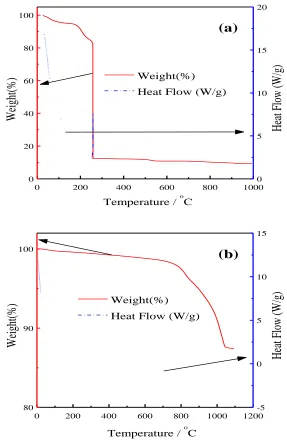
The TGA-DSC curves before (a) and after (b) gel combustion of the BaCe0.9Tm0.1O3-
precursor are shown in Fig. 1. The atmosphere was of nitrogen and the heating rate was 15 °C·min -1from room temperature up to 1100 °C. In Fig. 1(a), the 17 % weight loss up to 255 °C with a broad
endothermic peak is ascribed to the absorption of ammonia, water and dehydration of organic compounds. The further 70 % weight loss accompanied by a sharp exothermic peak from 255 °C to 259 °C in DSC is attributed to the abrupt decomposition of citric acid [34]. From Fig. 1(b), the weight loss gently declined from room temperature to 300 °C accompanied by two endothermic peaks attributed to the incomplete decomposition of organic compounds. From 800 °C to 1050 °C, there is a 12 % weight loss accompanied by two weak endothermic peaks attributed to the incomplete decomposition of BaCO3, polymorphic phase transformation and phase formation of BaCe0.9Tm0.1O3-
[image:4.596.207.421.375.620.2][23].
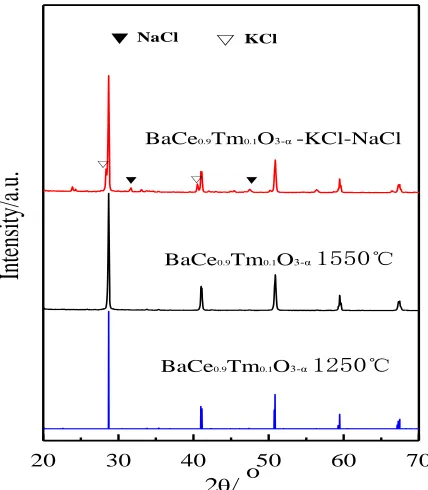
Fig. 2 shows XRD patterns of BaCe0.9Tm0.1O3- (1250 °C and 1550 °C) and BaCe0.9Tm0.1O3-
-KCl-NaCl. According to the results of BaCe0.9Tm0.1O3- (1250 °C and 1550 °C), single orthorhombic
BaCeO3 (JCPDS 85-2155) phases are observed, which imply that the first synthetic temperature of
1250 °C was appropriate. Fig. 2 shows that BaCe0.9Tm0.1O3--KCl-NaCl has BaCeO3, KCl (JCPDS
75-0296) and NaCl (JCPDS 88-2300) phases which indicates the chloride molten salts exist as crystalline phases in the composite electrolyte [29-32].
20 30 40 50 60 70
▽
KCl
▽
NaCl
▼
▼ ▽ ▼
BaCe0.9Tm0.1O3-α1550℃ BaCe0.9Tm0.1O3-α-KCl-NaCl
BaCe0.9Tm0.1O3-α1250℃
2/ o
Int
ensi
ty/
a.
u.
Figure 3. The SEM images of BaCe0.9Tm0.1O3- (1550 °C) (a,b) external and cross-sectional surfaces,
and BaCe0.9Tm0.1O3--KCl-NaCl sintered at 750 °C for 2 h (c,d) external and cross-sectional
surfaces.
1.0 1.1 1.2 1.3 1.4 1.5
-2 -1 0 1 2 3
BaCe0.9Tm0.1O3-α-KCl-NaCl
BaCe0.9Tm0.1O3-α
1000 T-1 / K-1
Log(
T/
Sc
m
-1 K)
Figure 4. The conductivities of BaCe0.9Tm0.1O3- (1550 °C) and BaCe0.9Tm0.1O3--KCl-NaCl as a
[image:5.596.204.424.448.701.2]
The surface and cross-section SEM images of BaCe0.9Tm0.1O3- (1550 °C) and BaCe0.9Tm0.1O
3--KCl-NaCl are displayed in Fig. 3. Fig. 3(a,b) shows the grain size range of sintered BaCe0.9Tm0.1O3-
(1550 °C) pellet is 0.5-1.7µm. This shows that the sol-gel combustion method is advantageous to particle agglomeration. However, the grain boundary of BaCe0.9Tm0.1O3- (1550 °C) had not yet
completely formed [23–25]. In the Fig. 3(c,d), it can be seen that the KCl-NaCl inorganic molten salts covered and filled in the areas between the BaCe0.9Tm0.1O3- particles promoting the sintering of the
composite electrolyte [25–28].
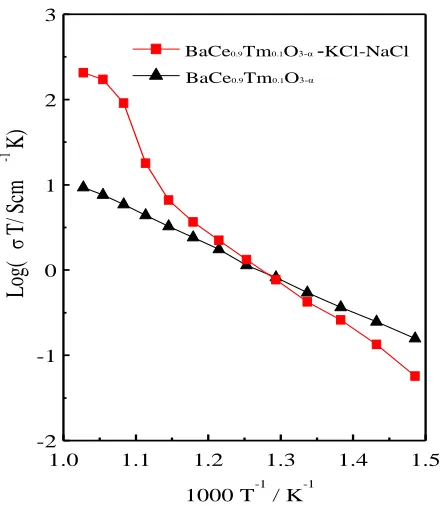
The Arrhenius plots of BaCe0.9Tm0.1O3- (1550 °C) and BaCe0.9Tm0.1O3--KCl-NaCl as a
function of temperature in air from 400 °C to 700 °C are recorded in Fig. 4. Within the test temperature range, the BaCe0.9Tm0.1O3- (1550 °C) agrees with the Arrhenius linear curve in air from
400 °C to 700 °C. The conductivity of BaCe0.9Tm0.1O3--KCl-NaCl (2.1×10⁻¹ S·cm-1) is much higher
than that of BaCe0.9Tm0.1O3- (9.6×10⁻³ S·cm-1) in air at 700 °C. The conductivities of BaCe0.9Tm0.1O
3--KCl-NaCl show similar trends to previous reports [25–33], with sharp improvements near the melting point of inorganic salts. The results indicate that the molten KCl-NaCl salt provides more ion transport channels at high temperatures [24–28].
0.0 0.3 0.6 0.9 1.2
BaCe0.9Tm0.1O3-Cl-NaCl
BaCe0.9Tm0.1O3-
P
/ (mW
c
m
-2 )
Vo
lta
ge
/
V
Current density / (mA cm-2)
0 200 400 600 0 50 100 150 200 250
Figure 5. The I-V-P curves for H2/O2 fuel cells based on BaCe0.9Tm0.1O3- (1550 °C) and
BaCe0.9Tm0.1O3--KCl-NaCl at 700 °C.
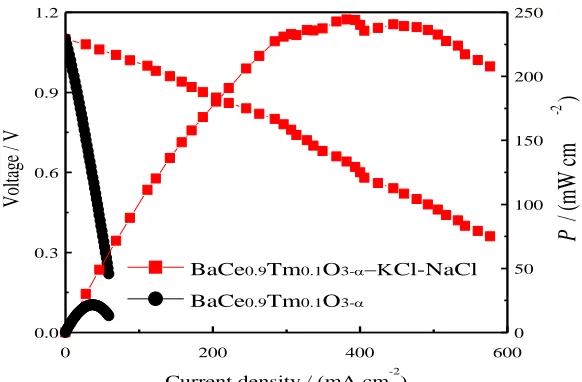
The I-V-P curves for H2/O2 fuel cells based on BaCe0.9Tm0.1O3- (1550 °C) and
BaCe0.9Tm0.1O3--KCl-NaCl at 700 °C are shown in Fig. 5. As can be seen from Fig. 5, the open circuit
voltages (OCVs) of BaCe0.9Tm0.1O3- (1550 °C) and BaCe0.9Tm0.1O3--KCl-NaCl are 1.1 and 1.09 V,
respectively. This indicates that the molten phase fills in the remaining holes that may remain at 700 °C. The power density (P) of BaCe0.9Tm0.1O3--KCl-NaCl reaches 244.4 mW·cm-2, which is higher
than that of BaCe0.9Tm0.1O3- (21.6 mW·cm-2) under the same conditions. For BaCe0.9Tm0.1O3-
[image:6.596.167.458.361.552.2]
SrCe0.9Gd0.1O3-α-NaCl-KCl (215 mW·cm-2) [33] at 700 °C. This may be due to the different electrolyte
types.
4. CONCLUSIONS
In this study, BaCe0.9Tm0.1O3- was prepared via the sol-gel combustion method. XRD and
TGA-DSC results indicated that the first synthetic temperature (1250 °C) for BaCe0.9Tm0.1O3- is
appropriate. SEM images showed that KCl-NaCl inorganic molten salts covered and filled in the areas between the BaCe0.9Tm0.1O3- particles. The highest power density and conductivity of
BaCe0.9Tm0.1O3--KCl-NaCl were 244.4 mW·cm-2 and 2.1×10⁻¹ S·cm-1 S·cm-1 at 700 °C, respectively.
ACKNOWLEDGEMENTS
This work was supported by the National Natural Science Foundation (No. 51402052) of China, the Natural Science Foundation of Higher Education Institutions in Anhui Province (No. KJ2018A0332, KJ2018A0337, KJ2018A0980), Excellent Youth Foundation of Anhui Educational Committee (No. gxyq2018046), Horizontal cooperation project of Fuyang municipal government and Fuyang Normal College (No. XDHX2016013, XDHX2016019, XDHXTD201704).
References
1. G. L. Liu, W. Liu Q. Kou and S. J. Xiao, Int. J. Electrochem. Sci., 13 (2018) 2641.
2. Y. Yang, H. Hao, L. Zhang, C. Chen, Z. Luo, Z. Liu, Z. Yao, M. Cao and H. Liu, Ceram. Int., 44 (2018) 11109.
3. Y. N. Chen, T. Tian, Z. H. Wan, F. Wu, J. T. Tan and M. Pan, Int. J. Electrochem. Sci., 13 (2018) 3827.
4. T. Hibino, K. Kobayashi, P. Lv, M. Nagao, S. Teranishi, and T. Mori, J. Electrochem. Soc., 164 (2017) F557.
5. S. Lee, and X. Guan, MRS Communications., 7 (2017) 199.
6. J. Luo, A.H. Jensen, N.R. Brooks, J. Sniekers, M. Knipper, D. Aili, Q. Li, B. Vanroy, M. Wübbenhorst, F. Yan, L.V. Meervelt, Z. Shao, J. Fang, Z.-H. Luo, D.E.D. Vos, K. Binnemans, and J. Fransaer, Energy Environ. Sci., 8 (2015) 1276.
7. A.A. Solovyev, S.V. Rabotkin, A.V. Shipilova and I.V. Ionov, Int. J. Electrochem. Sci., 14 (2019) 575.
8. C. Xia, Z. Qiao, C. Feng, J. Kim, B. Wang and B. Zhu, Materials, 11(2018) 40. 9. Y. Tian, Z. Lü, X. Guo and P. Wu, Int. J. Electrochem. Sci., 14 (2019) 1093.
10.Z. Zhang, L. Chen, Q. Li, T. Song, J. Su, B. Cai, H. He, Solid State Ionics, 323 (2018) 25. 11.W. Wang, D. Medvedev and Z. Shao, Adv. Funct. Mater., (2018) 1802592.
12.S.H. Morejudo, R. Zanón, S. Escolástico, I. Yuste-Tirados, H. Malerød-Fjeld, P.K. Vestre, W.G. Coors, A. Martínez, T. Norby, J.M. Serra and C. Kjølseth, Science, 353 (2016) 563.
13.E. Pikalova and D. Medvedev, Int. J. Hydrogen Energ., 41 (2016) 4016. 14.S. Y. Bae, J.-Y. Park and H.-T. Lim, Electrochim. Acta, 236 (2017) 399.
15.H. Sun, S. Zhang, C. Li, B. Rainwater, Y. Liu, L. Zhang, Y. Zhang, C. Li and M. Liu, Ceram. Int., 42 (2016) 19231.
16.N. Danilov, E. Pikalova, J. Lyagaeva, B. Antonov, D. Medvedev, A. Demin and P. Tsiakaras, J. Power Sources, 366(2017) 161.
18.J. Lyagaeva, G. Vdovin, L. Hakimova, D. Medvedev, A. Demin and P. Tsiakaras, Electrochim. Acta, 251 (2017) 554.
19.G. S. Reddy and R. Bauri, J. Alloy Compd., 688 (2016) 1039. 20.R.D. Shannon, Acta Cryst., A32 (1976) 751.
21.J.M. Sailaja, K.V. Babu, N. Murali, and V. Veeraiah, J. Adv. Res., 8 (2017) 169. 22.J. Song, B. Meng and X. Tan, Ceram. Int., 42 (2016) 13278.
23.J.M. Sailaja, N. Murali, S.J. Margarette, T.W. Mammo and V. Veeraiah, Results Phys., 8 (2018) 128. 24.D.A. Medvedev, J.G. Lyagaeva, E.V. Gorbova, A.K. Demin and P. Tsiakaras, Prog. Mater. Sci.,
75 (2016) 38.
25.A.I.B. Rondao, S.G. Patricio, F.M.L. Figueiredo and F.M.B. Marques, Int. J. Hydrogen Energ., 39 (2014) 5460.
26.N.C.T. Martins, S. Rajesh and F.M.B. Marques, Mater. Res. Bull., 70 (2015) 449.
27.K.-Y. Park, T.-H. Lee, J.-T. Kim, N. Lee, Y. Seo, S.-J. Song and J.-Y. Park, J. Alloy Compd., 585 (2014) 103.
28.Y. Hei, J. Huang, C. Wang and Z. Mao, Int. J. Hydrogen Energ., 39 (2014) 14328. 29.W. Zhang, M. Yuan, H. Wang and J. Liu, J. Alloy Compd., 677(2016) 38.
30.R. Shi, J. Liu, H. Wang, F. Wu and H. Miao, Ceram. Int., 43 (2017) 16931. 31.Q. Guan, H. Wang., H. Miao, L. Sheng and H. Li, Ceram. Int., 43 (2017) 9317.
32.R. Shi, J. Liu, H. Wang, F. Wu, H. Miao and Y. Cui, Int. J. Electrochem. Sci., 12 (2017) 11594. 33.L. Sun, H. Wang, L. Sheng and H. Li, Int. J. Electrochem. Sci., 12 (2017) 9689.
34.A. Matsuda, S. Oh, V.H. Nguyen, Y. Daiko, G. Kawamura and H. Muto, Electrochim. Acta, 56 (2011) 9364.