“Microalloying for New Steel Processes and Application”. The conference is held in September, 2005, Spain.
Vanadium Microalloyed Steel for Thin Slab Casting and Direct Rolling
Yu Li
1,a, P. S. Mitchell
2,band T. N. Baker
3,c1 ,2
Vanitec, Winterton House, High Street, Westerham, Kent, TN16 1NP, UK 3
Metallurgy and Engineering Materials Group, Department of Mechanical Engineering, University of Strathclyde, Glasgow, G1 1XJ, UK
a
[email protected], b [email protected], c [email protected]
Keywords: vanadium, nitrogen, titanium, microalloyed steel, thin slab casting and direct rolling.
Vanadium microalloyed steels with high yield strength (≈600 MPa), good toughness and ductility have been successfully produced in commercial thin slab casting plants employing direct rolling after casting. Because of the high solubility of VN and VC, most of the vanadium is likely to remain in solution during casting, equalisation and rolling. While some vanadium is precipitated in austenite as cuboids and pins the grain boundaries, a major fraction is available for dispersion strengthening of ferrite. Despite a coarse as-cast grain size, significant grain refinement can be achieved by repeated recrystallisation during hot rolling. Consequently, a fine and uniform ferrite grain structure is produced in the final strip. Increasing the V and N levels increases dispersion strengthening which occurs together with a finer ferrite grain size. The addition of titanium to a
vanadium containing steel, decreases the yield strength due to the formation of V-Ti(N) particles in austenite during both casting and equalisation Theselarge particles reduced the amount of V and N available for subsequent precipitation of fine (~5nm) V rich dispersion strengthening particles in ferrite.
Introduction
This paper reviews the results of research carried out by Vanitec and others into the use of vanadium microalloyed steels in TCDR.
1. Precipitation
For optimum dispersion strengthening, the microalloying elements should be in solution during casting, equalisation and throughout the rolling process, in order to precipitate asubstantial amount
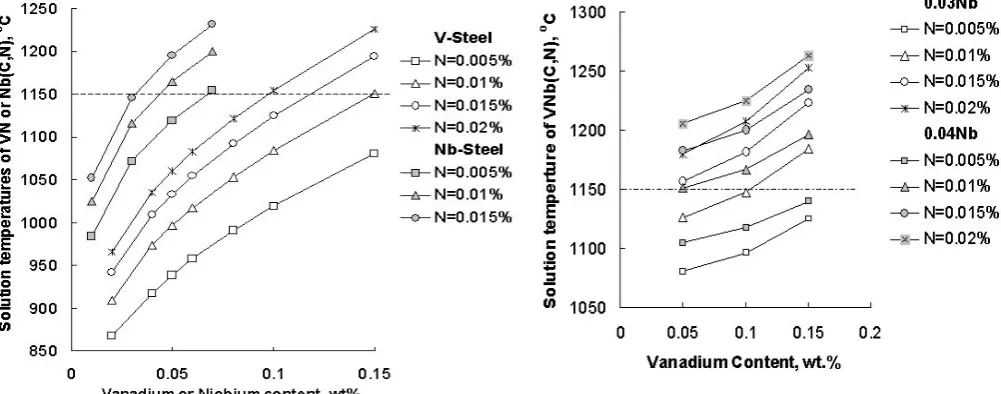
in ferrite. Therefore, the solubility of the microalloying elements is significant. Because the carbides and nitrides of Ti, Nb and V are isomorphous and mutually soluble, the equilibrium precipitate in the multiple microalloyed steels should be mixed compounds of V-Nb(C,N), V-Ti(C,N) depending on the composition of the steel. Based on the solubility equalisations of the carbides and nitrides in V, Nb and Ti microalloyed steels, which were recommended by Tukdogan and Rose [5,8], the equilibrium solution temperatures of the carbonitrides in austenite for a series low carbon, (0.06%C, 0.25%Si, 1.35% Mn, 0.005%S and 0.025%Al) V, Nb, V-Nb and V-Ti steels, containing varying amounts of vanadium, niobium, titanium and nitrogen, were calculated using the ChemSage thermodynamic software package and the results, which describe the solubility under equilibrium conditions, are shown in Figs. 1-3. Since AlN has a close packed hexagonal structure and nucleates with some difficulty in austenite, it is assumed that AlN is dormant in the steels, which is the fact of the observation in previous studies [5,8].
Fig. 1 Solution temperature of VN or Nb(C,N) in V and Nb steels respectively.
[image:2.595.54.555.384.581.2]Fig. 3 Solution temperature of V-Ti(N) in V-Ti steel.
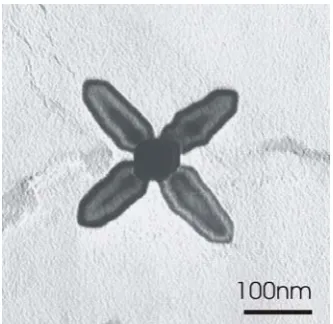
Fig. 4 Cruciform Particle in Steel V-Ti-N Steel after equalisation at 1100°C.
When a typical equalisation temperature (1100°C-1150°C) is used, for most of the V steel compositions, V can be kept in solution during the equalisation. However, for two out of three of the Nb steel compositions, the solution temperature of Nb(C,N) is higher than this equalisation temperature range, and therefore, there will be some Nb out of solution during equalisation, which precipitated as Nb(C,N). Additions of niobium, and especially titanium, to V steels, increases the solution temperature of vanadium in austenite, resulting in precipitation of vanadium at higher temperatures during casting and equalisation. For example, adding 0.03%Nb or 0.01Ti to the 0.1%V-0.015%N steel could increase the solution temperature of VN from 1124°C to 1181°C and 1445°C respectively. This prediction is consistent with the observations in the previous studies [5,8]. Furthermore, addition of Ti to V steel changes the morphology of the precipitates. For the Ti containing steels, large dendritic particles were observed after casting and cruciform particles precipitates during equalisation, while cuboid particles were in the Ti free steels. The dendritic and cruciform particles in the Ti containing steels were too big to have any contribution to dispersion strengthening, but restricted austenite growth during the rolling process. Extensive precipitation is not expected in any of the vanadium microalloyed steels during the rollingprocess, due to the short
interpass and total rolling times in thin slab cast and direct rolling process.
Fig. 6 Atomic ratio of V/Metal of the carbonitrides in the multiple microalloyed steels.
Therefore, the microalloying elements, which stay in solution before rolling would precipitate after rolling as fine particles in ferrite to contribute to
dispersion strengthening. In addition, both ChemSage calculations and experimental results show that when the particles form
[image:3.595.356.523.69.231.2] [image:3.595.52.296.76.269.2] [image:3.595.50.313.556.744.2]2. Microstructure Evolution
In convention rolling, the austenite is metallurgically conditioned by the phase transformation that
occurs during slab cooling and reheating. The austenite grain size after soaking and at the start of the rolling process is then usually smaller than it was in the original cast slab, being controlled by any undissolved inclusions and carbonitrides, which formed during solidification and cooling[9].
With TCDR, the continuously cast steel is hot rolling following direct charging to an equalisation furnace, without the intermediate stages of cooling to room temperature before rolling, as in the conventional rolling. Prior to the commencement of hot rolling, the austenite then has the coarse-grained, dendritic and segregated microstructure of the original casting with an austenite grain size typically ranged from 250μm to 2.5mm [10]. In addition, equalisation temperature has been found to have no significant effect on the prior austenite grain size [5].
In order to achieve a fine ferrite grain size in the final product, the initial coarse austenite grain size must be refined during rolling to produce the largest possible austenite grain boundary area per unit volume at the onset of the γ/α transformation. This can be accomplished by low temperature controlled rolling, which involves heavy reductions below the non-recrystallization temperature to
flatten the austenite grains or by recrystallisation controlled rolling, which takes deformations at high temperatures to achieve austenite grain refinement by repeated recrystallization after each rolling pass. A high finish rolling temperature is expected in TSDR, which producesa strip flatness to a close tolerance and with high productivity. Therefore, the process of recrystallization controlled rolling is commonly applied in the production of TSDR. It is well known that Nb steel is suitable for low temperature controlled rolling, since Nb inhibits recrystallization by strain induced precipitation during rolling and /or a solute drag mechanism[11,12]. By comparison, V offers no effective resistance to austenite recrystallization during hot rolling due to the larger solubility of V(C,N). In addition, vanadium in solution has the least solute drag effect of all the microalloying elements in retarding recrystallization [13,14]. Therefore, V steel is more desirable for use in steels which subsequently follow a recrystallization controlled rolling process.
Fig. 7 Relationship between VxN and ferrite grain size.
As the equalisation temperature
decreased, the initial rolling temperature
also decreased. The rolling temperature affects both the rate at which recrystallization occurs and the rate of austenite grain growth after recrystallization. Consequently, a smaller austenite grain size is likely to be developed after rolling at lower temperatures, which results in a finer ferrite grain size. When the end cool temperature is decreased, the cooling rate of the strip after rolling is increased, which favours the nucleation of ferrite and reduces ferrite grain growth, again, leading to a finer ferrite grain size.
3. Mechanical Properties
Lower yield strengths up to 640MPa, with good Charpy toughness and good ductility, have been obtained in vanadium microalloyed steels produced by the TSDR route, Figs. 8-10. Increasing VxN in the steels refines ferrite grain size and increases dispersion strengthening, resulting in higher yield strength (Figs.7-8). However, increasing VxN in the steels leads to a reduction in both Charpy toughness and ductility, which is thought to be due to the increase in dispersion strengthening (Figs. 9 and 10). An addition of Ti to the V steels results in a decreased strength, but improved toughness. The lower level of the yield strength in the Ti containing steels is also directly related to a reduction in the contribution from dispersion strengthening, whereas, addition of niobium to the V steels has a beneficial effect on the lower yield strength, but a detrimental effect on the toughness and ductility.
[image:5.595.57.538.499.698.2]Fig. 10 Effect of VN on the elongation.
Fig. 11 Effect of equalisation temperature on the strength.
Dispersion strengthening in steel is dependent on the volume fraction, particle size and inter-particle spacing of fine inter-particles in ferrite. The size and inter-inter-particle spacing of the fine inter-particles are controlled by the nucleation and growth rates. The essential parameter governing the variation in nucleation rate is the chemical driving force for precipitation, while that governing growth is the diffusion rate. Increasing the vanadium content increases the volume fraction of the fine particles since the high solubility of V(C,N) in austenite allows almost all the vanadium present in the steel
to be available forprecipitation in ferrite. Furthermore, vanadium has a much higher affinity for N
than C. By increasing the nitrogen content in the steel, the nucleation of N rich V(C,N) is enhanced. The consequence is a dispersion of a high volume fraction of fine V(C, N) particles, with a small interparticle spacing. Therefore, increasing the V and N content of a steel could lead to a more
effective strengthening by precipitation. For multiple microalloyed steels, the fine particles in ferrite
are essentially V-rich nitrides [5,8], hence the volume fraction of fine particles will rely mainly on the amounts of V and N which are available to precipitate in ferrite. Fig X shows the size range in a distribution of particles of VN responsible for dispersion strengthening. The average size is 7nm. An addition of Ti to the V steel promotes precipitation of VTiN in austenite during casting and equalisation, resulting in more V and N being out of solution before γ−α transformation, leading to a smaller particle volume fraction, a lower density, a larger inter-particle spacing and a
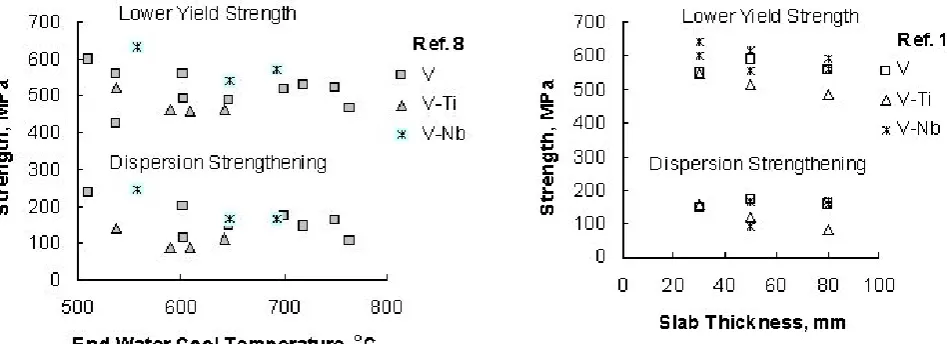
[image:6.595.55.529.599.771.2]Fig. 13 Effect end water cool temperature on the strength.
Fig. 14 Effect of slab thickness on the
strength.
A higher equalisation temperature could result in a more complete solution of the microalloying elements in austenite, which increases the contribution of dispersion strengthening and hence increases the lower yield strength (Fig. 12). Lowering the end water cool temperature could reduce both the ferrite grain size and the size of the dispersion strengthening particles in ferrite, and
therefore have a beneficial effect on the lower yield strength (Fig. 13). However, equalisation and the end water cool temperatures have been shown to have no significant effect on the Charpy toughness. Furthermore, increasing the slab thickness has been found to improve the toughness due to ferrite grain size refinement, but to have no significant effect on the yield strength (Fig. 14).
4. Conclusions
Vanadium microalloyed steel has proved to be a preferred choice for producing hot strip when using a TCDR process. A good combination of high yield strength (≈600MPa), good toughness and good ductility has been obtained in the vanadium microalloyed steels.
1. The initial coarse, dendritic austenite structure can be refined in vanadium steels by repeated recrystallisation during a rolling process, leading to a fine (3-5μm) ferrite grain size in the final product.
2. Almost all of the vanadium in the steel is available to precipitate in ferrite as fine particles, contributing to dispersion strengthening due to the higher solubility of V(C,N) which permits most of thevanadium to remain in solution during casting, equalisation and rolling.
Increasing the V and N levels in the steel results in a finer ferrite grain size and a higher dispersion strengthening contribution, giving a higher yield strength.
3. For V-Ti and V-Nb microalloyed steels, the carbonitrides are richer in Ti or Nb when they form in austenite at higher temperatures, but richer in V when they precipitate as fine particles in ferrite. Therefore, vanadium makes the major contribution to dispersion strengthening.
4. Addition of Ti to vanadium containing steel increases the solution temperature of carbonitrides in the steel, resulting in precipitation of complex VTiN particles during and/or after casting, and during equalisation. The formation of VTiN particles in austenite reduces the amount of V and N available for subsequent precipitation as afine dispersion of particles (<10nm diameter) in ferrite, which leads to a reduction in the yield strength. However, the V-Ti steels have shown an improved toughness due to ferrite grain refinement.
5. Decreasing the equalisation temperature and the end water cool temperature slightly
increased the yield strength, but had no significant effect on the Charpy toughness.
Reference
[1] D.N. Crowther, P.S.Mitchell and W.B. Morrison: Proc. of the Int. Conf. 39th Mechanical Working and Steel Processing, Iron & Steel Soc. of AIME, Warrendale, PA, (1997), p. 839. [2] K. Kunishige and N. Nagao: ISIJ Int., Vol. 29 (1989), p. 940.
[3] B. Mintz and J.M. Arrowsmith: Met. Technol., Vol. 6 (1979), p. 24.
[4] R. Lagneborg, T. Siwecki, S. Zajac and B. Hutchinson: Scand. J. Metall., Vol. 28 (1999), p. 186. [5] Y. Li, D.N. Crowther, P.S. Mitchell and T.N. Baker: ISIJ Int. Vol. 42 (2002), p. 636.
[7] R.J. Glodowski: The International Symposium on Thin-Slab Casting and Rolling, Guangzhou, China, December 3-5, 2002.
[8] Y. Li, D.N. Crowther, P.S. Mitchell and T.N. Baker: ISIJ Int. Vol. 44 (2004), p. 1093.
[9] T. Gladman: The Physical Metallurgy of Microalloyed Steels, The Institute of Materials, London, (1997), p. 213.
[10] P. Uranga, A.I. Fernandez, B. Lopez and J.M. Rodriguez-Ibabe, 43rd Mechanical Working and Steel Processing Conference Proceeding, Iron and Steel Society, Vol. 39 (2001), p. 511.
[11] O. Kwon and A. J. DeArdo: Acta Metall. Mater., Vol. 39(1991), p. 529. [12] M. Suehiro: ISIJ Int., Vol.38 (1998), p.547.
[13] L. J. Cuddy: Thermomechanical Processing of Microalloyed Austenite, ed. A. J. DeArdo, et al., (1982), Warrendale, PA, TMS, p. 129.