Efficient tight-binding approach for the study of strongly correlated systems
Simone Sanna,1,2,*B. Hourahine,3U. Gerstmann,4and Th. Frauenheim21Theoretische Physik, Universität Paderborn, Warburger Strasse 100, D-33098 Paderborn, Germany 2BCCMS, Universität Bremen, Otto-Hahn-Allee 1, 28359 Bremen, Germany
3SUPA, Department of Physics, University of Strathclyde, John Anderson Building, 107 Rottenrow, Glasgow G4 0NG, United Kingdom 4Institut de Minéralogie et de Physique des Milieux Condensés, Université Pierre et Marie Curie, Campus Boucicaut,
140 rue de Lourmel, 75015 Paris, France
共Received 11 June 2007; revised manuscript received 14 September 2007; published 30 October 2007兲
In this work, we present results from self-consistent charge density functional based tight-binding共DFTB兲 calculational scheme, including local-density approximation +U 共LDA+U兲 and simplified self-interaction-corrected-like potentials for the simulation of systems with localized strongly correlated electrons. This ap-proach attempts to combine the efficiency of tight binding with the accuracy of more sophisticatedab initio methods and allows treatment of highly correlated electrons for very large systems. This is particularly inter-esting for the case of rare earths in GaN, where dilute amount of rare earth ions is used. In this work, we show the results of test calculations on bulk ErN and on the substitutional ErGain wurtzite GaN, which we choose as representatives of bulk and point defects in solids with strongly correlated electrons. We find that ErN is a half metal in the ferromagnetic phase and that the substitutional ErGain wurtzite GaN hasC3vsymmetry. These examples show that the DFTB approach reproduces well the results of more demanding calculation schemes with a very low computational cost, making it suitable for the study of extended systems beyond the capabili-ties of density functional theory.
DOI:10.1103/PhysRevB.76.155128 PACS number共s兲: 61.72.Ji, 71.20.Eh, 71.27.⫹a
I. INTRODUCTION
Rare earth compounds have been a long time puzzle. They show extremely interesting properties but are quite dif-ficult to investigate both experimentally and from the theo-retical point of view. Researchers realized that even a small amount of impurities or crystal disorder could dramatically affect the properties of relatively simple systems such as rare earth共RE兲monopnictides,1 which were then combined with
the well known problems of chemically separating different rare earths. Theorists instead had to face the problem that usual approaches for the simulation of large electronic sys-tems, local-density approximation共LDA兲or generalized gra-dient approximation共GGA兲, could not satisfactorily describe compounds with strong electron-electron interactions. A proper treatment of the strongly correlated 4felectrons of the lanthanides, in fact, goes beyond a classical mean-field approach, and computational methods which are able to address this correlation problem, such as the GW approximation2 or LDA extensions including
orbital-dependent potential such as self-interaction correction
共SIC兲,3,4 are computationally demanding. In an attempt to
improve the description of strongly correlated systems while extending the size of the studied system, different orbital-dependent corrections have been implemented in the spin-polarized charge-self-consistent density functional based tight binding共DFTB兲,5,6namely, the LDA+U关in both fully
localized limit共FLL兲 and around mean field 共AMF兲兴 and a pseudo-SIC approach.7,8This gives us the possibility to treat
large systems containing RE in an accurate manner within a fast tight-binding共TB兲framework. At the same time, we can make a comparison of pros and cons of the different orbital-dependent approaches as well as investigating how far simple LDA-like approaches can be used to simulate f
sys-tems, in order to help elucidate whether to include the f
electrons in the valence or treat them assemicore electrons when using standard LDA. We find that in general, as was suggested over ten years ago by Pethukovet al.,9including the strongly localized RE 4f electrons in the core is a satis-factory approximation when f electrons are not directly in-volved in the bond and the ionization energy of the 4f states is large in comparison with the band gap. In particular, struc-tural properties such as lattice constants or bulk moduli are quite unaffected by the details of the method used to treat the 4f orbitals. We test our methods on both a bulk RE com-pound and RE impurities: We choose ErN as representative of the first class of systems and ErGain GaN as representa-tive of the second. Both examples are relevant for techno-logical applications: ErN has been recently suggested as an ideal magnetic refrigerator and regenerator for cryogenic applications10,11and as basis for spin filter devices 共because of its half metallicity兲, while Er-doped GaN samples have been successfully exploited共because of the sharp intra-f op-tical transitions兲 for both the 1.54m telecommunications frequency and as a primary color emitter共green兲in thin film electroluminescent phosphor systems.12More generally, rare
earths are also promising candidates for the realization of highTcsemiconductor spintronic devices.13,14These are also controversial systems: Pehtukov et al.9 found ErN to be a
semiconductor, while Duan et al.1 recently classified it as
half metal. We present here a characterization of ErN includ-ing the electronic structure primarily in the ferromagnetic
共FM兲phase, finding ErN to be a half metal.
measurements andab initiocalculations兲. Finally, in Sec. IV, we summarize and discuss the features of the approaches in the framework of DFTB.
II. METHODS
A. Density functional based tight-binding approach
Despite its simplicity 共a only two-center nonorthogonal Hamiltonian is used兲, the density functional based tight-binding共DFTB兲 method scheme has been proven to be ac-curate when applied to solid state,15molecular, or biological
systems.16Materials such as silicon,17SiC,18 diamond,19
bo-ron and bobo-ron nitride,20 and III-V semiconductors such as
GaN 共Ref. 21兲 and GaAs 共Ref. 22兲 have successfully been studied within the DFTB approach.
The study of strongly correlated systems共such as RE or transition metal containing compounds兲 requires somewhat different techniques to the usual methods for the simulation of solid state systems because of the nature of these atoms. RE ions, for example, have atomic numbers of between 57 and 70; hence, relativistic effects become important. Addi-tionally, many properties of transition metal or lanthanide elements depend on the strongly correlated behavior of their
dorf electrons. Studying such cases requires a more sophis-ticated theory than simple mean-field methods. To address all of these additional complexities in treating lanthanides, the DFTB method has been substantially extended. To treat strongly correlated systems, LDA+U5,23 and
pseudo-SIC-like7,8approaches have been adopted. We would like to remark that 共to our knowledge兲 DFTB contains the published TB implementation of LDA+U and SIC-like methods. The spin-polarized, charge-self-consistent DFTB approach has been extensively discussed elsewhere;6,24 we
briefly review the method in the Appendix for completeness and to introduce the notation used in Sec. II B.
B. Orbital-dependent potentials
In the density functional theory 共DFT兲, the exchange-correlation potential is often approximated by using the ex-change correlation present in a homogeneous electron gas
共LDA兲, which has been proven to be very successful for solids even if not all systems are equally well described. Materials with strongly correlated electrons, however, are ex-amples where this mean-field approach most strikingly fails. LDA is, in fact, a one-electron method with an orbitally in-dependent potential, and applying it to a system containing transition metals 共TM兲 or rare earths 共REs兲 with partially filled d or f shells gives results consistent with a metallic electronic structure and itinerant d or f electrons, which is definitely wrong for most RE compounds and several ex-amples of TM systems 共NiO being the classic example兲. Other choices for the exchange correlation such as general-ized gradient共GGA兲 can also be applied, but as with LDA, this is a mean-field correction for the noninteracting system and so suffers from the same pathology. In the strongly cor-related systems, thed or felectrons are often strongly local-ized, and there is a noticeable energy difference between occupied and unoccupied states with strongd or f character,
which are calledlowerandupperHubbard bands, in analogy with the Hubbard Hamiltonian approach. There have been a number of attempts to go beyond the LDA and make it able to account for strong electron-electron correlation in such systems. The full self-interaction-corrected 共SIC兲 approach3
can reproduce the localized nature ofdandfelectrons in TM and RE compounds as well as the total energy of these sys-tems but is not intended to reproduce the one-electron ener-gies; additionally, SIC is known to overcorrect many properties.25As discussed in Sec. II E, there have also been
several recent attempts to approximate the effects of the SIC method with共semi兲local corrections. An alternative correc-tion, the LDA+U approach, is conceptually similar to the Hubbard Hamiltonian approach: the nonlocal and energy de-pendent self-energy is approximated by a frequency indepen-dent but nonlocal screened Coulomb potential.
C. LDA+U
As discussed by Anisimovet al.,26it is natural to separate
electrons into localizeddor felectrons and delocalizedsand
pelectrons. While for the latter an orbitally independent one-electron potential共as in LDA兲 will suffice, a Hartree-Fock-like interaction better describes the local interactions of the strongly localized d or f electrons. This is of the form 1
2兺i⫽jninj, where ni are the occupancies of the localized
shells. If we assume that the Coulomb energy of the electron-electron interaction as a function of the total number of elec-trons N=兺ni is well represented by LDA 共even if it gives wrong single-particle energies兲, then LDA already contains part of this energy. This must be subtracted from the total energy and instead replaced with a Hubbard-model-like term. As a result, we get the functional27,28
E=ELDA−
1
2UN共N− 1兲+
U
2
兺
i⫽jninj=ELDA+⌬ELDA+U.
In the limit of uniform occupancy共all occupations equal to the average value in that shell兲, the corrections for total energy and potential can be written in terms of on-site occu-pation matrices共n兲as29
⌬EAMF= −1 2
兺
a兺
l苸a共U−J兲l
兺
兺
共␦n ·␦n
兲
苸l, 共2兲
⌬V = −共U−J兲␦n 苸l, 共3兲
whereUis the spherically averaged Hubbard repulsion andJ
is the intra-atomic exchange.␦n, the orbital occupation ma-trix, is given by
␦n =n −¯n ␦.
Here, ␦ “masks out” elements off the diagonal of the average occupation matrix¯n , the effect being to return a matrix shifted by the average occupation. In the “around mean-field”共AMF兲limit, the LDA+Ucorrection to the elec-tronic potential averaged over all occupied states is, in a given shell, zero; this is a possible way to define a mean field. For strongly correlated systems共or in the presence of a crystal and/on ligand field兲, the limit of uniform occupancy is not correct and the AFM functional leads to rather unreal-istic results for strongly localized electrons. This has led to the suggestion of another correction which produces the cor-rect behavior in the fully localized limit 共FLL兲 where the eigenvalues ofn are either 0 or 1,
⌬EFLL= −1
2共U−J兲
兺
兺
A兺
关共n 兲2−n 兴苸l苸A, 共4兲
⌬V = −共U−J兲
冉
n −12␦
冊
苸l苸A. 共5兲
AMF and FLL correct the mean-field double counting if the occupation numbers are, respectively, all equal or only 0 or 1. Most of the modern LDA+U calculations rely on one of these two functionals, although in real materials, the oc-cupation numbers should lie between these two limits; hence, neither AMF nor FLL is strictly speaking correct for real systems, and one should therefore use an interpolation be-tween the two limits.28However, AMF and FLL will bracket
the correct values.
D. LDA+U-like approach in density functional based tight binding
While it has previously been suggested that forempirical
tight binding the effects of on-site correlation can be mim-icked by an empirical adjustment of symmetry resolved on-site energies,30this is problematic, for example, for low
sym-metrydelectron systems or for f manifolds. In the RE ions of interest here, the so-called fully localized limit should be achieved 关i.e., the orbital occupations of states localized within the 4f manifold should either be 0 or 1共Refs.27and
28兲兴. However, we also wish to test the AFM-like limit as well.
In the simplest rotationally invariant form of LDA+U,31
the correction to the LDA potential is of the form
⌬V = −共U−J兲l共n−DC关n 兴兲苸l. 共6兲
wheren is the local spin occupation matrix within a given atomic manifold, and共U−J兲is the screened and spherically averaged electron-electron interaction. DC关n兴 is the double counting term, and the two limiting cases FLL and AMF are
DC 关n兴FLL= 1
2␦,
DC 关n兴AMF=Tr共n兲
2l+ 1 ␦,
Where l is the angular quantum number. 共U−J兲 is usually taken to be either an adjustable parameter or from a con-strained DFT calculation. We instead present a prescription for choosing U and J from atomic calculations. Since the DFTB energy aims to be a reasonable approximation to the LDA energy, it seems sensible to adopt the form of the LDA+U energy correction unchanged for DFTB. There is then the issue of how to choose the on-site occupation matrix32 for a nonorthogonal basis. In the on-site case, the
modification to the total energy and the DFTB Hamiltonian can be written in terms of atomic sub-blocks of the single-particle density matrix 共苸l苸A兲, while for the dual basis
case, the occupation matrix takes the form of a generalization of Mulliken charges:
n苸l苸A,苸l苸A=
1 2
兺
B 兺
苸B共S+S兲, 共7兲
where the diagonal of the resulting occupation matrices is then basis-function resolved Mulliken charges.
E. Pseudo-self-interaction-corrected-like approach in density functional based tight binding
Full self-interaction-corrected共SIC兲LDA is relatively ex-pensive; hence, several cheaper approximations have ap-peared. We adopt in DFTB an approximation of the full SIC based on the method proposed by Vogelet al.7and its recent
refinements,8,33which is referred to as pseudo-SIC共or pSIC兲
as it only includes contributions near to atoms. Since the majority of the self-interaction error, in the case of interest, is local in character, this hopefully captures the majority of the error. To ensure that for single electrons the Coulomb and exchange-correlation terms are canceled out exactly, the exchange-correlation potential is modified by subtracting off the local self-interaction in this basis:
⌬V,pSIC = −␣V,H+XC关n共r兲,m共r兲兴. 共8兲
to the potential is available;8,33 hence, no expression for
in-teratomic forces has been derived. In the following, we will derive such an expression from similarities between the LDA+Uand pSIC formalism. Equation 共8兲 is not invariant to unitary transforms; however, similar to the original LDA +U formalism,23 this can be achieved by using the density
matrix formulation, ⌬VpSIC
= −␣V
H+XC
关1,1兴n
. 共9兲
Considering, as previously, a fully occupied and com-pletely spin-polarized state, we can write共due to the similar-ity in the functional of the potential to LDA+U兲 in matrix form an energy expression 共which is directly connected to the potential兲as
⌬EpSIC= −␣
兺
VH+XC关1,1兴Tr共n·n兲. 共10兲
In these approximations, pSIC is written as a type of non-double counted LDA+U关i.e.,DC关n兴is absent from Eq.共6兲兴, without ambiguity in the choice of共U−J兲, since the prefac-tor comes from the exchange-correlation potential. Addition-ally, atomic forces can be derived.32This has some similarity
to the atomic SIC 共or ASIC兲 form of Pemmaraju et al.;33
however, they do not provide a variationally connected energy.
F. Connection between LDA+Uand pseudo-self-interaction-corrected
In the following, we will discuss a connection between LDA+U in its FLL version and pSIC that allows a further simplification of the latter approach in a tight-binding scheme. The starting point of this discussion is Eq.共44兲of Anisimovet al.,26 relating the atomic Slater integralF0and the exchangeJto the LDA potential for an atomic state as
VH+XC=F0N−
1 2共F
0−J兲−JN
. 共11兲
Thus, for the orbital occupation choices for whichVH+XC is needed in pSIC共VH+XC关1 , 1兴, i.e., N=N= 1兲, the spheri-cally symmetric part of the exchange-correlation potential is given by
VH+XC关1,1兴=
F0−J
2 .
In DFTB, we useUin the SCC-DFTB correction共see the Appendix兲that is related to the screenedF0Slater integral.26
If we, moreover, assume in the zeroth limit that screening in the isolated atom, for whichUis calculated, is small,F0can be substituted byU. Similarly, the diagonal part of the spin coupling matrixWll⬘␦ll⬘, given in the Appendix, is equivalent
toJl. We thus obtain, for the basis that is used to expand the local states in pSIC,
VH+XC关1,1兴 ⬇
共U−J兲atomic
2 . 共12兲
In this approximation, pSIC then gives a contribution to the potential of
共pSIC兲⌬V = −␣共U−J兲atomic
2 n
. 共13兲
For a system with a Hubbard gap, the relaxation-corrected form of pSIC
共
␣=21兲
would apply the same potential to the lower Hubbard band as obtained by a FLL-LDA+U contri-bution of共FLL兲⌬V = −共U−J兲atomic
2
冉
n−1
2
冊
. 共14兲 Since the eigenvalues of then matrix are either 0 or 1, the occupied states in the local manifold experience a net down-ward shift of −共U−J4兲atomic. This suggests, in comparison with Eq.共5兲, that the LDA+Uand relaxation-corrected pSIC have the same effect on the occupied band structure and that共U−J兲=共U−J2兲atomic is a sensible first choice for the parameters in
LDA+U. This agrees with the 共empirical兲 choice of ⬇0.5 ⫻共U−J兲atomic being suitable for many LDA+U
applications.26,29 Since there are different potentials for un-occupied states in pSIC and FLL-LDA+U, these methods give different gaps,33 and different total energy corrections 关compare Eqs.共4兲and共10兲兴.
All of the above corrections share the feature that they are semilocal共decaying on the length scale of the overlap matrix in the dual basis form兲; hence, they cannot fully address nonlocal effects such as the derivative discontinuity in Kohn-Sham theory.34,35
III. RESULTS AND DISCUSSION
A. ErN
ErN is a good test system for our methods because it is a standard representative of a class of materials 共the RE monopnictides兲 which have attracted much recent attention due to their peculiar characteristics. Particularly interesting is the fact that despite their simple rock salt structure共common to most of the RE monopnictides兲, the RE-N compounds show a variety of electrical and magnetic properties,9
includ-ing ferromagnetic behavior, extremely low Curie and Néel temperatures, and an unusual 具111典 spin orientation. Their suitability for epitaxial growth on several semiconductors has made them interesting materials for the realization of electronic and spintronic devices. ErN has not been as exten-sively investigated as other Er pnictides 共such as ErAs兲 or other RE nitrides共such as GdN兲, but there is a substantial set of experimental data in the literature 共see Refs.10 and11
and references therein兲 as well as several theoretical investigations1,9,36–38 of this material. It is only recently1,36
that a consensus has been reached about its half-metallic character, i.e., ErN shows a finite density of states at the Fermi level for one spin channel and a zero density of states for the other. In some earlier works,37 ErN was described as
a metal, while in others,9it was found to be a semiconductor
in both ferromagnetic and paramagnetic共PM兲phases. Unlike the other Er pnictides, in the ground state, ErN is a ferromag-net with a magferromag-netic transition at 3.4– 6 K.39,40
spin-polarized calculation will be a sensible representation of the FM phase共or the saturation limit of the PM phase in a mag-netic field兲, to simulate the PM phase we adopt a crude vir-tual crystal approximation. Following the considerations of Pethukovet al.,9 we consider a non-spin-polarized
calcula-tion as representative of the paramagnetic phase. This is a very drastic approximation; a proper treatment of the PM phase would require the consideration of thermal fluctuation effects and knowledge of the magnetic phase diagram. How-ever, this approximation gives us the possibility to compare our results with literature9 and suffices for the goal of this
work, which is to present our methods.
We find the difference in the cohesive energy共defined as energy difference of free Er and N atoms in their spin polar-ized state兲 of the PM and FM phases to be, independent of the particular calculation approach, about 0.5 eV per atom, which is somewhat higher than the difference reported by Pethukovet al.9.
Like other RE nitrides ErN is9,36 characterized by ionic
bonding; however, the equilibrium distance41 共2.432 Å兲 of
Er and N in the compound is only 0.1 Å longer than the sum of the covalent radii of Er共1.57 Å兲and N共0.75 Å兲. The Er ions in ErN are trivalent, existing in the +3 oxidation state, corresponding to an outer electronic configuration for the Er ions of关Xe兴 4f11, with a full f semishell containing seven spin up electrons and an half filled f semishell containing four spin down electrons. This was verified with all spin-resolved approaches implemented in DFTB. Eleven of the 12
f electrons remain strongly localized while the remaining one is delocalized, in agreement with the results of
Temmer-man et al.42 who predict the existence of two kinds of f
electrons, localized and delocalized, whose relative numbers change depending on the RE.
All ErN calculations in this work were performed using the rocksalt primitive cell and a 12⫻12⫻12 Monkhorst-Packk-point mesh.43TheUin the LDA+Uapproach is not
considered as a free parameter as in our earlier work.44As
discussed in Sec. II F, we use half of the atomicU−Jvalue of the Er 4f shell.UandJwere calculated for the atom using Janak’s theorem. TheU−Jvalue of 7.6 eV we use is consis-tent with that used in similar simulations.45 The +U
poten-tials are applied only to thef shells.
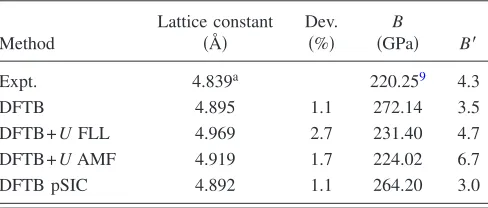
We start our ErN characterization with the determination of the lattice parameter. It is interesting to see how this is influenced by different methods. As the LDA-like approach in DFTB already gives relatively accurate results for ErN, one expects LDA+U to overestimate the ErN lattice con-stant. This is verified, even if the difference between LDA and LDA+U is less than 2% of the lattice constant 共See TableI兲.
In the same table, reported are the values of the bulk moduli and their first derivative共with respect to the pressure兲 calculated with different approaches. The values we have are, on average, slightly larger than that calculated by Pethukovet al.9but still within the typical error of the DFTB
method. We observe that the application of the AMF and FLL approaches leads to a great improvement in the descrip-tion of the bulk modulus共and a small worsening in the de-scription of the lattice constant兲, while the pSIC approach improves the description of the bulk modulus without lost of
precision in the description of the lattice constant. The cal-culated values for the first derivative of the bulk modulus, which is a delicate parameter for both theoretical simulation and experiment, are around the experimental value for all the approaches. While the calculated values of the bulk modulus come close to the experiment with the application of orbital-dependent potentials, it does not seem to lead to major ad-vantages in the description ofB
⬘
.As already mentioned, ErN is ferromagnetic in the ground state, and the results reported here are for this magnetic phase. The local共spin兲density approximation关L共S兲DA兴-like picture is not adequate for the simulation of ErN as it shows the narrow bands deriving from the f states pinned at the Fermi level, which is incorrect for this material. Orbital-dependent approaches such as DFTB+U 共both in the AMF and FLL limits兲instead find ErN in the FM phase to be a half metal, in agreement with Aerts et al. and Duan et al. 共see Fig.1兲. As in the previously mentioned works, the paramag-netic phase has been simulated by the spin unresolved LDA+U approach: in this case, in both the AMF and FLL limits, ErN is then a narrow-gap semiconductor.
B. Substitutional ErGa
As a further test application to check the validity of our calculational methods, we chose to investigate in some detail the Er substitutional REGain hexagonal共wurtzite兲GaN, pay-ing particular attention to the density of states 共DOS兲 and stressing the differences between a classic LDA-like and the LDA+U approach. ErGa can be used for testing since the REGa substitutionals are the simplest stable lanthanide de-fects in GaN and have been already studied both experimen-tally and theoretically.46–48 Er:GaN based light emitting
diodes49 have stimulated many experimental attempts to
understand58 the mechanisms underlying the emission from
Er-doped samples and to exploit51–53 and improve54,55 the
emission itself. From experimental studies, we know that Er ions in GaN prefer the Ga position,56 occur in 3+ valence
state49and possessC
3vsymmetry57with relatively short
dis-tances to the surrounding N ligands.58
We first discuss the geometry of the defect. Two DFTB-parameter sets have been created for the simulation of RE in GaN: in one, the Ga 3dorbitals are treated as valence and in the other, as core. We report here results obtained not includ-TABLE I. Lattice constants and elastic parameters calculated with the different approaches implemented in DFTB for the FM phase of ErN. Dev. stands for the deviation of the calculated from the experimental value.
Method
Lattice constant
共Å兲
Dev.
共%兲
B
共GPa兲 B⬘
Expt. 4.839a 220.259 4.3
DFTB 4.895 1.1 272.14 3.5
DFTB+UFLL 4.969 2.7 231.40 4.7
DFTB+UAMF 4.919 1.7 224.02 6.7
DFTB pSIC 4.892 1.1 264.20 3.0
[image:5.612.315.559.107.211.2]ing the Ge 3din the valence. Results obtained including the Ga 3d orbitals do not differ substantially and have been re-ported in a previous publication.59Supercells containing 256
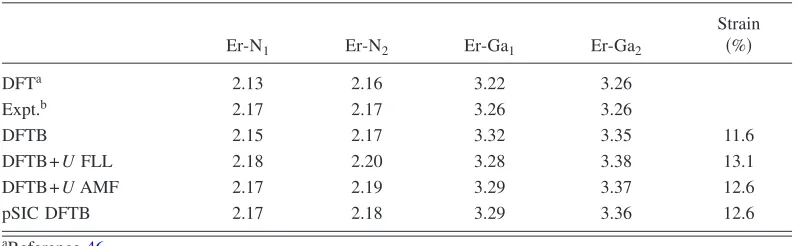
atoms and a 4⫻4⫻4 Monkhorst-Pack k-point sampling were used to calculate the data reported here. The supercells have been relaxed in different spin configurations to find out the one that minimizes the total energy. The substitutional ErGa is found to have the C3v symmetry. The Er ion is, in fact, surrounded by four N atoms, one共identified by the label Er-N1in the TableII兲being slightly more distant from the Er ion than the other three共Er-N1in the TableII兲. According to
theC3vsymmetry, the Er second neighbors can be similarly
divided in two groups共called Er-Ga1and Er-Ga2in TableII兲. The symmetry is a particularly important parameter in the investigation of the RE defects, both because it can be mea-sured experimentally and also because it is known that the intensities of intra-f transitions are enhanced by lowering the symmetry. For example, the symmetry difference between Eu and Tb substitutionals in GaN is believed to be the cause of the higher relative luminescence intensity of Eu-doped GaN, as suggested by Banget al.60We find that the Er
sub-stitutional, after geometry optimization, sits on-site; the cal--7
-6 -5 -4 -3 -2 -1 0 1 2 3 4 5 6 7
Energy
(eV)
-LSDA
Spin up
L Λ Γ ∆ XΖ W VK Σ Γ
EF
-7 -6 -5 -4 -3 -2 -1 0 1 2 3 4 5 6 7
Spin down
L Λ Γ ∆ XΖ W VK Σ Γ
F
E
-7 -6 -5 -4 -3 -2-1 01 2 3 4 5 6 7
Energy
(eV)
-FLL
Spin up
L Λ Γ ∆ X ΖW VK Σ Γ
-7 -6 -5 -4 -3 -2 -1 0 1 2 3 4 5 6 7
Spin down
L Λ Γ ∆ XΖ W K Γ
V Σ
-7 -6 -5 -4 -3 -2 -1 0 1 2 3 4 5 6 7
Energy
(eV)
-AMF
Spin up
L Λ Γ ∆ XΖ WVK Σ Γ
-7 -6 -5 -4 -3 -2 -1 0 1 2 3 4 5 6
7 Spin down
[image:6.612.120.486.62.558.2]L Λ Γ ∆ XΖ W VK Σ Γ
culated geometry in the neighborhood of the substitutional is reported in Table II together with experimental measure-ments and other theoretical results. The calculated values are in good agreement with the experimental measurements, and the lattice distortion has values very close to previous pseudopotential LDA calculations.46 Different
orbital-dependent calculation schemes do not really influence the system geometry. Apart from the relatively small compres-sive stress in the neighborhood of the defect关Er is a bigger ion than Ga with covalent共3+ ionic兲radii of 1.57共1.03兲and 1.26共0.62兲Å, respectively兴, no other effects on the host ge-ometry are observed. The compressive stress, estimated by the ratio between the Er-N bonds and the Ga-N bonds in the bulk, is reported in the last column of TableII. Already the classic LDA formulation of the DFTB approach provides Er-N bond lengths in good agreement with experimental data. The LDA+U, like and pSIC implementations, leads to small changes only. In other words, relaxing the structure with or without the contributions of the orbital-dependent potentials anyway does not substantially change the geom-etry of the system and influences only slightly the bond lengths: Bond lengths calculated with and without the orbital-dependent potentials differ at most by 0.03 Å 共see TableII兲.
Let us consider now the electronic properties of the Er substitutional. We report here, for convenience, only results obtained with the FLL approach. The substitutional ErGais a representative example, because all of the midseries RE sub-stitutionals behave in a similar way. Reference calculations were executed with theab initioall electron codeWIEN2K.61
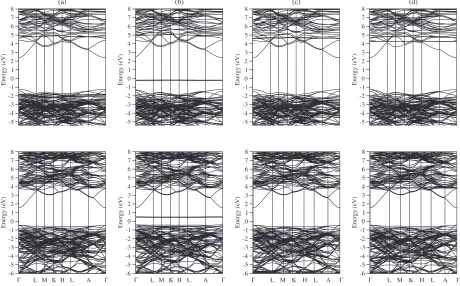
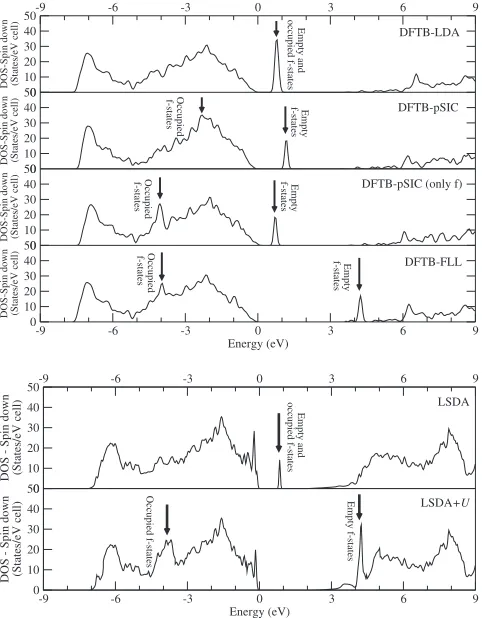
In the Fig. 2, the band structures of the substitutional ErGa calculated with DFTB and DFT are reported. With LSDA/ spin-DFTB共SDFTB兲, the GaN original band gap共3.5 eV in DFTB, 2.2 eV inWIEN2K兲remains more or less unchanged on addition of the RE, while in the middle of the gap, there appears a group of very localized f-related levels. As with ErN, these levels are filled with seven up and four down electrons, which are considered to be trivalent in comparison with the isolated atomic occupations. The corresponding DOS is reported in Fig.3where the DFTB calculations ap-pear on the upper part, while theWIEN2Kreference calcula-tions are reported for comparison in the lower part. For con-venience, data reported in Figs. 2 and 3 were calculated using smaller 72-atom supercells.
When we apply the +Upotential共see Figs.3and4兲to the
f shell, the occupied states are pushed downward into the valence band and the empty states are pushed upward into the conduction band, leaving the original band gap com-pletely empty. A detailed discussion about the interpretation of this clear gap can be found in Ref. 62 and references therein. The DOS changes are consistent with what is ob-served for the band structure: Thef-related peak in the band gap is removed, leaving the GaN band gap free again. This is in agreement with the paper of Filhol et al.,46 where they
found that simple RE substitutionals do not induce localized states in the band gap 共in their case, they investigated this only for non-4f-related states, however兲. In Fig.4, the DOSs for the studied system calculated with WIEN2K and with DFTB are shown to be in very good agreement. In this situ-ation, a simple LDA-like approach treating thefelectrons as corelike electrons produces the same results of a more so-phisticated approach with a physical handling of the f elec-trons.
In Fig. 4, we also report the DOS calculated with the pSIC approach as implemented in DFTB. The pSIC poten-TABLE II. Bond lengths共Å兲and local strain around theC3vErGasubstitutional in hexagonal GaN. For
the definition of the entries in the table, see text. The local strain is defined as the ratio between the Er-N1 bonds and the Ga-N1bonds in the bulk. For further details, see the individual references.
Er-N1 Er-N2 Er-Ga1 Er-Ga2
Strain
共%兲
DFTa 2.13 2.16 3.22 3.26
Expt.b 2.17 2.17 3.26 3.26
DFTB 2.15 2.17 3.32 3.35 11.6
DFTB+UFLL 2.18 2.20 3.28 3.38 13.1
DFTB+UAMF 2.17 2.19 3.29 3.37 12.6
pSIC DFTB 2.17 2.18 3.29 3.36 12.6
aReference46. bReference50.
[image:7.612.107.505.95.218.2]tials shift occupied states downward but do not act on the empty ones. If we apply the pSIC potentials only on the f
shells共similar to the usual LDA+Utreatment兲, the shift of the occupied f states is the same as in FLL, as already ex-pected by Eqs. 共13兲 and 共14兲, whereas the positions of the unoccupied states remain unchanged. However, SIC is usu-ally applied to all occupied orbitals, as shown in the second box in Fig.3. In this case, due to the interactions of all the SIC-corrected states, the splitting between occupied and un-occupiedf levels is reduced. Furthermore, the unoccupiedf
states are slightly shifted to higher energies.
So far, we have neglected in our discussion the effects of spin-orbit coupling; however, we have also carried out pro-visional calculations in the case of Er using the methodology outlined in Ref.77in addition to the LDA+U-like treatment for DFTB. Using spin DFTB and a 4f spin-orbit constant of 2234 cm−1, with the Er magnetic moment in the a plane,63 we find that the sevenfold degenerate localized gap levels shown in Fig.2in the gap are split into four filled and three empty nondegenerate levels which remain in the gap span-ning a range of⬃700 meV. Applying the FLL-LDA+U ap-proach and the same constant for the spin-orbit splitting ejects these states from the gap, demonstrating that in this case correlation has a larger effect than spin-orbit coupling. The possibility of acceptor or donor states was not investi-gated in this work, since all calculations was performed with neutral supercells.
IV. SUMMARY
We have presented a parametrization for the simulation of RE doping in GaN in the framework of the SCC-DFTB. The capability of this method to perform spin-polarized calcula-tions and to treat strongly correlated systems with LDA+U-like approaches makes DFTB a powerful tool for the simulation of RE systems as well as other strongly cor-related systems. The DFTB Er/ Ga/ N parametrization was tested for two different systems, RE nitrides and the substi-tutionals ErGa in GaN. Properties such as geometries, band structures, and density of states were tested against experi-mental measurements and DFT calculations and show good agreement between our simulations and existing data. The accuracy of the parameters and the efficiency of this method allow the investigation of extended systems and the system-atic sampling of many configurations for defect physics and chemistry.
ACKNOWLEDGMENTS
This work was partially funded by the European Commis-sion through the RENiBEl共Rare Earths Doped Nitrides for High Brightness Electroluminescence Emitters兲 Network
共Contract No. HPRN-CT-2001-00297兲. The authors thank Bálint Aradi and Christof Köhler 共Universität Bremen兲 for the technical support and useful discussion about the param-etrization process, Th. Gallauner 共Technische Universität
-6 -5 -4 -3 -2 -1 0 1 2 3 4 5 6 7 8 Energy (eV) (a)
Γ L M K H L A Γ
-6 -5 -4 -3 -2 -1 0 1 2 3 4 5 6 7 8 Energy (eV) (b)
Γ L M K H L A Γ
-6 -5 -4 -3 -2 -1 0 1 2 3 4 5 6 7 8 Energy (eV) (c)
Γ L M K H L A Γ
-6 -5 -4 -3 -2 -1 0 1 2 3 4 5 6 7 8 Energy (eV) (d)
Γ L M K H L A Γ
-6 -5 -4 -3 -2 -1 0 1 2 3 4 5 6 7 8 Energy (eV)
Γ L M K H L A Γ -6
-5 -4 -3 -2 -1 0 1 2 3 4 5 6 7 8 Energy (eV)
Γ L M K H L A Γ -6
-5 -4 -3 -2 -1 0 1 2 3 4 5 6 7 8 Energy (eV)
Γ L M K H L A Γ -6
-5 -4 -3 -2 -1 0 1 2 3 4 5 6 7 8 Energy (eV)
[image:8.612.76.536.61.347.2]Γ L M K H L A Γ
Wien兲for the WIEN2Kcalculations, and Knut Vietze 共 Tech-nische Universität Dresden兲for making available the atomic code RLCAO. B.H. gratefully acknowledges the Royal Soci-ety of Edinburgh for funding.
APPENDIX: SPIN-POLARIZED DENSITY FUNCTIONAL BASED TIGHT BINDING
In the SCC-DFTB approximation, the expression for the total energy of a system ofM atoms in the Kohn-Sham64,65 共KS兲formulation of the spin DFT is expressed expanding the charge density n共r兲 around a reference charge density of
n0共r兲:
n共r兲=
兺
=↑,↓
兺
iN
ni,兩i,兩2=n0共r兲+␦n共r兲, 共A1兲
with␦n共r兲being the difference between the reference charge density used in parametrization and the charge distribution in the system. The system magnetization is also expanded around the spin-unpolarized atomic case which has共per defi-nition兲a magnetization density of zero:
m共r兲=m0共r兲+⌬m共r兲 withm0= 0. 共A2兲
Introducing the abbreviationsn,n0,⌬n, and⌬mforn共r兲,
n0共r兲,⌬n共r兲, and⌬m共r兲and with a little algebra, the expres-sion for the DFTB total energy of the system is written as
E
tot=
σ=↓,↑ occ
i
n
iσψ
iσ| −
∇
22
+
v
ext+
n
′0|
r
−
r
′|
d
3
r
′+
v
xc
[
n
0,
0]
ˆ H0[n0,0]
|
ψ
iσ+
E
NN+
E
xc[
n
0,
0]
−
v
xc[
n
0,
0]
n
0d
3r
−
1
2
n
0n
′0|
r
−
r
′|
d
3
rd
3r
′Erep
+
1
2
1
|
r
−
r
′|
+
δE
xc∆
n
∆
n
′n0,0
∆
n
∆
n
′d
3rd
3r
′Eδn
+
1
2
δ
2E
xcδm
2n0,0
∆
m
2d
3r
Eδm 共A3兲
as explained in Ref.66. In this equation,Hˆ0关n0, 0兴andEreponly depend on the reference density, whileE␦nandE␦minclude
fluctuations of the charge and magnetization densities.
-9 -6 -3 0 3 6 9
0 10 20 30 40 50
DOS-Spin
down
(States/eV
cell)
0 10 20 30 40 50
DOS-Spin
down
(States/eV
cell)
0 10 20 30 40 50
DOS-Spin
down
(States/eV
cell)
-9 -6 -3 0 3 6 9 Energy (eV)
0 10 20 30 40 50
DOS-Spin
down
(States/eV
cell)
DFTB-LDA
DFTB-pSIC
DFTB-pSIC (only f)
DFTB-FLL
Occupied
f-states
Occupied
f-states
Occupied
f-states
Empty
f-states
Empty
f-states
Empty
f-states
Empty
and
occupied
f-states
-9 -6 -3 0 3 6 9
0 10 20 30 40 50
DOS
-Spin
down
(States/eV
cell)
-9 -6 -3 0 3 6 9 Energy (eV)
0 10 20 30 40 50
DOS
-Spin
down
(States/eV
cell)
LSDA
LSDA+U
Empty
and
occupied
f-states
Empty
f-states
Occupied
[image:9.612.54.295.59.368.2]f-states
1. Zeroth-order Hamiltonian
The zeroth-order Hamiltonian contribution to this expres-sion共Hˆ0关n0, 0兴兲is derived expanding the spin orbitals of the reference system as a linear combination atomic orbitals:
兩i典=
兺
ci兩共r−RA兲典, 苸A. 共A4兲
The basis function共r−RA兲 is centered on the atomic nucleus A, with position RA. The spin is included in the
coefficientsci of the expansion. The basis functions共r兲
are themselves a linear combination of Slater orbitals. The coefficients of the expansion are calculated from neutral, spin-unpolarized, and spherically symmetric pseudoatoms, which are described by a modified relativistic single atom Dirac equation67 and to which an additional harmonic con-fining potential is added. Inserting Eq. 共A4兲 into Eq. 共A3兲, we can derive
具i兩Hˆ0关n0,0兴兩i典=
兺
,
ci
*
ciHˆ0 关n0,0兴, 共A5兲
where the Hamiltonian matrix elements are calculated only for the valence electrons in a minimal basis within a two-center approximation. Neglecting crystal field and three cen-ter cen-terms,
H0 =
冦
free atom if= andA=B
具A兩T+VA
0 +VB
0兩
B典
ifA⫽B
0 r⬎rcutoff,
冧
共A6兲 where the are the eigenvalues of the 共uncompressed兲 atomic Kohn-Sham orbitals,68andV
effis the effective Kohn-Sham potential 共Coulombic plus exchange correlation兲 for atomsA andB.69 The Hamiltonian Hˆ
0 and overlap matrix elements共S=具兩典兲 are calculated only once and tabu-lated as function of the interatomic distance betweenA and
B. Then, by following the method of Slater and Koster70and its extension to the f shell,71,72 this is used to generate the
two-center H0. The values of the matrix elements in each particular calculation are computed by interpolating the tabu-lated data.73
2. Fluctuation dependent contributions to the energy
It has been shown66,74that using the Mulliken charges,
qAl=1
2
兺
i=1occ
ni
兺
苸A,l
兺
ci
*
ciS, 共A7兲
to write the charge density fluctuations as sum of atomic contributions compared to a reference charge distribution共q0 which is chosen from the limiting isolated atomic case兲,
⌬qAl=
冉
兺
=↑,↓
qAl
冊
−qAl0 共A8兲共wherel labels the orbital,A the atom, and the spin兲, the term inE␦n关Eq.共A3兲兴can be written共in anl-shell resolved24
monopole approximation兲as
E␦n=
1 2
兺
AM
兺
MB l兺
苸A兺
l⬘苸B
⌬qAl⌬qBl⬘␥Al,Bl⬘, 共A9兲
where ␥Al,Bl⬘ is an analytical74 function of the interatomic
distance between atom A and atom B, which approximates the Hartree and共spin-unpolarized兲exchange-correlation con-tributions from the charge fluctuations. The chosen form of␥ depends on the quantities
UAl=l
nl, 共A10兲
which can be considered as a generalization of the Hubbard modelUvalues. In a similar way, writing the magnetization fluctuation compared to the unpolarized reference 共⌬m兲 as sum of atomic contribution, in the framework of the mono-pole approximation, the term E␦m in Eq. 共A3兲 can be
written66 as
E␦m=
1
2
兺
A l兺
苸Al兺
⬘苸A⌬mAl⌬mAl⬘WAll⬘, 共A11兲
where theWll⬘are atomic constants defined as
Wll⬘=1
2
冉
l↑l⬘↑
− l↑ l⬘↓
冊
共A12兲
and the magnetization fluctuations in the Mulliken popula-tions compared to the spin unpolarized reference system are
⌬mAl=
1 2
兺
i=1occ
ni
兺
苸A,l
兺
共c*i↑ci↑S−c*i↓ci↓S兲,
共A13兲
with the up and down coefficients labeled by arrows.
3. Repulsive contribution
The terms collected together as Erep in Eq. 共A3兲 are not calculated separately, although this is, in principle, possible, but merged into one repulsive pair potentialUrep共兩RA−RB兩兲,
in the spirit of empirical TB.75 This potential only depends
on atomic separation and species and is evaluated as the difference between the Kohn-Sham DFT total energy and the electronic part of the DFTB energy. For each chemical com-bination of atom pairs in our system, we have
Urep共兩RA−RB兩兲=Etot
KS共兩
RA−RB兩兲−Eel
DFTB共兩
RA−RB兩兲, 共A14兲
and the sum over all the atom pairs in the system gives the repulsive part of the energy:
Erep=
1 2
兺
A,BUrep共兩RA−RB兩兲. 共A15兲
For each combination of atomic species, the pair repulsive potential Urep共兩RA−RB兩兲 is calculated for a fit system in a
4. Total energy and potential
The expression for the total energy within the spin-polarized DFTB approximation is then the sum of four con-tributions:
Etot=
兺
=↓,↑
兺
iocc
ni具i兩Hˆ0关n0,0兴兩i典+E␦n+E␦m+Erep.
共A16兲 The Hamiltonian operator of zeroth order depends only on the reference density, the second term on fluctuations in the Mulliken charges,⌬qAl, compared to the parametrizing ref-erence system, the third from the spin polarization共through the Mulliken spin population⌬mAl兲, and the fourth term, the repulsive potentialErep, depends only on the atomic coordi-nates and species. Applying the variational principle to Eq.
共A16兲for the total energy, we get19,74 a secular equation for
the coefficientsci of the wave functions:
兺
ci共Hˆ−iS兲= 0, 共A17兲with Hamiltonian matrix elements
Hˆ=Hˆ0 + 1
2S
兺
C M兺
l⬙苸C
共␥A共兲l共兲,Cl⬙+␥B共兲l共兲,Cl⬙兲⌬qcl⬙
+␦1
2S
冉
l兺
⬘苸B共兲WB共兲l共兲l⬘⌬mB共兲l⬘
+
兺
l⬘苸B共兲
WB共兲l共兲l⬘⌬mB共兲l⬘
冊
共A18兲and overlap matrix elements
S=具兩典. 共A19兲
Here, we have used the symbol␦= ± 1 for the up and down electrons, respectively. Note that this expression slightly dif-fers from that reported in the earliest form of spin-resolved DFTB66as the one-center spin approximation in the potential
has been dropped.76The Hamiltonian matrix elements in the
Eq.共A18兲depend, through the Mulliken spin populations, on the wave function coefficients ci; therefore, the problem
must be solved self-consistently.
1C. G. Duan, R. F. Sabiryanov, W. N.Mei, P. A. Dowben, S. S.
Jaswal, and E. Y. Tsymbal, J. Phys.: Condens. Matter 19, 315220共2007兲.
2F. Aryasetiawan and O. Gunnarson, Rep. Prog. Phys. 61, 237
共1998兲.
3J. P. Perdew and A. Zunger, Phys. Rev. B 23, 5048共1981兲. 4A. Svane and O. Gunnarsson, Phys. Rev. Lett. 65, 1148共1990兲. 5B. Hourahine, B. Aradi, and T. Frauenheim共unpublished兲. 6T. Frauenheimet al., J. Phys.: Condens. Matter 14, 3015共2002兲. 7D. Vogel, P. Krüger, and J. Pollmann, Phys. Rev. B 58, 3865
共1998兲; 55, 12836共1997兲.
8A. Filippetti and N. A. Spaldin, Phys. Rev. B 67, 125109共2003兲. 9A. G. Petukhov, W. R. L. Lambrecht, and B. Segall, Phys. Rev. B
53, 4324共1996兲.
10S. Nishio, T. Nakagawa, T. Arakawa, N. Tomioka, T. A.
Yama-moto, T. Kusunose, K. Niihara, T. Numazawa, and K. Kamiya, J. Appl. Phys. 99, 08K901共2006兲.
11T. Nakagawa, T. Arakawa, K. Sako, N. Tomioka, T. A.
Yama-moto, T. Kusunose, K. Niihara, K. Kamiya, and T. Numazawa, J. Alloys Compd. 408, 191共2006兲.
12A. J. Steckl, J. Heikenfeld, D. S. Lee, and M. Garter, Mater. Sci.
Eng., B B81, 97共2001兲.
13G. M. Dalpian and Su-Huai Wei, Phys. Rev. B 72, 115201
共2005兲.
14S. Dhar, O. Brandt, M. Ramsteiner, V. F. Sapega, and K. H.
Ploog, Phys. Rev. Lett. 94, 037205共2005兲.
15M. Haugket al., Phys. Status Solidi B 217, 473共2000兲. 16M. Elstner, Th. Frauenheim, E. Kaxiras, G. Seifert, and S. Suhai,
Phys. Status Solidi B 217, 375共2000兲.
17A. Sieck, Ph.D. thesis, Universität Paderborn, 2001. 18E. Rauls, Ph.D. thesis, Universität Paderborn, 2003.
19D. Porezag, Th. Frauenheim, Th. Köhler, G. Seifert, and R.
Kaschner, Phys. Rev. B 51, 12947共1995兲.
20J. Widany, Th. Frauenheim, Th. Köhler, M. Sternberg, D.
Porezag, G. Jungnickel, and G. Seifert, Phys. Rev. B 53, 4443
共1996兲.
21J. Elsner, R. Jones, M. I. Heggie, P. K. Sitch, M. Haugk, Th.
Frauenheim, S. Oberg, and P. R. Briddon, Phys. Rev. B 58, 12571共1998兲.
22J. Elsner, M. Haugk, J. Jungnickel, and Th. Frauenheim, J. Mater.
Chem. 6, 1649共1996兲.
23A. I. Liechtenstein, V. I. Anisimov, and J. Zaanen, Phys. Rev. B
52, R5467共1995兲.
24C. Köhler, G. Seifert, and Th. Frauenheim, Chem. Phys. 309, 23
共2005兲.
25O. A. Vydrov, G. E. Scuseria, J. P. Perdew, A. Ruzsinszky, and G.
I. Csonka, J. Chem. Phys. 124, 094108共2006兲.
26V. I. Anisimov, F. Aryasetiawan, and A. I. Lichtenstein, J. Phys.:
Condens. Matter 9, 767共1997兲.
27M. T. Czyżyk and G. A. Sawatzky, Phys. Rev. B 49, 14211
共1994兲.
28V. I. Anisimov, I. V. Solovyev, M. A. Korotin, M. T. Czyżyk, and
G. A. Sawatzky, Phys. Rev. B 48, 16929共1993兲.
29A. G. Petukhov, I. I. Mazin, L. Chioncel, and A. I. Lichtenstein,
Phys. Rev. B 67, 153106共2003兲.
30D. A. Papaconstantopoulos and C. S. Hellberg, Phys. Rev. Lett.
89, 029701共2002兲.
31S. L. Dudarev, G. A. Botton, S. Y. Savrasov, C. J. Humphreys,
and A. P. Sutton, Phys. Rev. B 57, 1505共1998兲.
32M. J. Han, T. Ozaki, and J. Yu, Phys. Rev. B 73, 045110共2006兲. 33C. D. Pemmaraju, T. Archer, D. Sanchez-Portal, and S. Sanvito,
Phys. Rev. B 75, 045101共2007兲.
and A. Svane, Phys. Rev. B 69, 045115共2004兲.
37Z. Szotek, W. M. Temmerman, A. Svane, L. Petit, P. Strange, G.
M. Stocks, D. Ködderitzsch, W. Hergert, and H. Winter, J. Phys.: Condens. Matter 16, S5587共2004兲.
38C. G. Duan, R. F. Sabiryanov, J. Liu, W. N. Mei, P. A. Dowben,
and J. R. Hardy, J. Appl. Phys. 97, 10A915共2005兲.
39G. Busch, P. Junod, O. Vogt, and F. Hulliger, Phys. Lett. 6, 79
共1963兲.
40O. Vogt and K. Mattenberger, J. Alloys Compd. 223, 226共1995兲. 41Ralph W. G. Wyckoff,Crystal Structures共Krieger, Malabar, FL,
1982兲, Vol. 1.
42W. M. Temmerman, Z. Szotek, A. C. Jenkins, A. Svane, H.
Win-ter, S. V. Beiden, and G. A. Gehring, inMagnetism and Elec-tronic Correlations in Local Moment Systems: Rare Earth Ele-ments and Compounds, edited by M. Donath, P. A. Dowben, and W. Nolting, Proceedings of Magnetism and Electronic Correla-tions in Local-Moment Systems: Rare-Earth Elements and Com-pounds, Berlin, Germany, 1998 共World Scientific, Singapore, 1998兲, pp. 21–33.
43H. J. Monkhorst and J. D. Pack, Phys. Rev. B 13, 5188共1976兲. 44B. Hourahine, S. Sanna, B. Aradi, C. Köhler, and Th.
Frauen-heim, Physica B 376, 512共2006兲.
45Z. Huang, L. Ye, Z. Q. Yang, and X. Xie, Phys. Rev. B 61, 12786
共2000兲.
46J.-S. Filhol, R. Jones, M. J. Shaw, and P. R. Briddon, Appl. Phys.
Lett. 84, 2841共2004兲.
47P. Dorembos and E. van der Kolk, Appl. Phys. Lett. 89, 061122
共2006兲.
48A. Svane, N. E. Christensen, L. Petit, Z. Szotek, and W. M.
Tem-merman, Phys. Rev. B 74, 165204共2006兲.
49J. T. Torvik, R. J. Feuerstein, J. I. Pankove, C. H. Qiu, and F.
Namavar, Appl. Phys. Lett. 69, 2098共1996兲.
50P. H. Citrin, P. A. Northrup, R. Birckhahn, and A. J. Steckl, Appl.
Phys. Lett. 76, 2865共2000兲.
51D. S. Lee, J. Heikenfeld, R. Birkhan, M. Garter, B. K. Lee, and A.
J. Stekl, Appl. Phys. Lett. 76, 1525共2000兲.
52A. J. Stekl, J. Heikenfeld, D. S. Lee, and M. Garter, Mater. Sci.
Eng., B 81, 97共2001兲.
53J. M. Zavada, S. X. Jin, N. Nepal, J. Y. Lin, H. X. Jiang, P. Chow,
and B. Hertog, Appl. Phys. Lett. 84, 1061共2004兲.
54M. Thaik, U. Hömmerich, R. N. Schwartz, R. G. Wilson, and J.
M. Zavada, Appl. Phys. Lett. 71, 2641共1997兲.
55S. F. Song, W. D. Chen, J. Zhu, and C. C. Hsu, J. Cryst. Growth
265, 78共2004兲.
56U. Wahl, E. Alves, K. Lorenz, J. G. Correia, T. Monteiro, B. de
Vries, A. Vantomme, and R. Vianden, Mater. Sci. Eng., B 105,
132共2003兲.
57V. Glukhanyuk, H. Przybylińska, A. Kozanecki, and W. Lantsch,
Phys. Status Solidi A 201, 195共2004兲.
58V. Katchkanov, J. F. W. Mosselmans, K. P. O’Donnel, E. Nogales,
S. Hernandez, R. W. Martin, A. J. Stekl, and D. S. Lee, Opt. Mater.共Amsterdam, Neth.兲 28, 785共2006兲.
59S. Sanna, B. Hourahine, Th. Gallauner, and Th. Frauenheim, J.
Phys. Chem. A 111, 5671共2007兲.
60H. Bang, S. Morishima, Z. Li, K. Akimoto, M. Nomura, and E.
Yagi, J. Cryst. Growth 237-239, 1027共2002兲.
61P. Blaha, K. Schwarz, G. Madsen, D. Kavasnicka, and J. Luitz,
WIEN2K, Institute of Materials Chemistry, TU Vienna.
62K. P. O’Donnell, and B. Hourahine, Eur. Phys. J.: Appl. Phys. 36,
91共2006兲.
63M. Kotzian, N. Rösch, and M. C. Zerner, Theor. Chim. Acta 81,
201共1992兲.
64U. von Barth and L. Hedin, J. Phys. C 5, 1629共1972兲. 65W. Kohn and L. P. Sham, Phys. Rev. 140, A1133共1965兲. 66T. Frauenheim, G. Seifert, M. Elstner, Z. Hajnal, G. Jungnickel,
D. Porezag, S. Shuai, and R. Scholz, Phys. Status Solidi B 217, 41共2000兲.
67V. Heera, G. Seifert, and P. Ziesche, J. Phys. B 17, 519共1984兲. 68Hence giving the correct limiting case for isolated atoms. 69Since the basis functions decay in space, above a certain distance
共rcutoff兲, their matrix elements are then smaller than a reasonable tolerance, and these elements are then discarded. Note that the potential in Eq.共A6兲is a superposition of the atomic potentials. Another possibility is to express it as the potential generated by the superposition of the charge densities ofAandB, as is used instead in some DFTB parametrizations共Ref.74兲.
70J. C. Slater and G. F. Koster, Phys. Rev. 94, 1498共1954兲. 71K. Lendi, Phys. Rev. B 9, 2433共1974兲.
72A. V. Podolskiy and P. Vogl, Phys. Rev. B 69, 233101共2004兲. 73Unlike empirical tight binding, however, since an explicit basis
set is used in the generation of parameters, it is also possible to plot the resulting single-particle wave functions or the total “charge density”共see Fig.4, for example兲.
74M. Elstner, D. Porezag, G. Jungnickel, J. Elsner, M. Haugk, T.
Frauenheim, S. Suhai, and G. Seifert, Phys. Rev. B 58, 7260
共1998兲.
75D. J. Chadi, Phys. Rev. Lett. 43, 43共1979兲.
76C. Köhler, G. Seifert, and Th. Frauenheim, Chem. Phys. 23, 309
共2005兲.
77C. Köhler, B. Hourahine, G. Seifert, M. Sternberg, and T.