Rochester Institute of Technology
RIT Scholar Works
Theses Thesis/Dissertation Collections
9-13-2008
Pottery, the multi-sensual medium
Ryan BothamleyFollow this and additional works at:http://scholarworks.rit.edu/theses
This Thesis is brought to you for free and open access by the Thesis/Dissertation Collections at RIT Scholar Works. It has been accepted for inclusion in Theses by an authorized administrator of RIT Scholar Works. For more information, please [email protected].
Recommended Citation
Rochester Institute of Technology
A Thesis Submitted to the Faculty of
The College of Imaging Arts and Sciences
Rick Hirsch, Julia Galloway and Eileen Bushnell
In Candidacy for the Degree of Master of Fine Arts
Pottery, the Multi-Sensual Medium
By
Ryan J. Bothamley
Final Approvals
Chief Advisor: _____________________ _____________________________
Print Name Signature
Date: _____________________
Associate Advisor: _____________________ _____________________________
Print Name Signature
Date: _____________________
Associate Advisor: _____________________ ____________________________
Print Name Signature
Date: _____________________
Chairperson: _____________________ ____________________________
Print Name Signature
Date: _____________________
I, ________________________, prefer to be contacted each time a request for reproduction is made. I can be reached at the following address:
141 Main Street East Hampton, CT. 06424
Contents
Thesis Proposal
Experiencing Pottery through Maker and User
Pottery, the Multi-Sensual Medium
Historical and Interpersonal Influences on My Work
My Thesis Body of Work
Alchemy and the Ceramic Process in My Work
Thesis Proposal
The search for beauty, nourishment, and celebration of life can be found within
thoughtful hand made pottery. These objects help create, recreate and bring together a
community. The most intimate, personal, and enriching objects are useful and found in
the home. I strive to create pottery for occasions, to celebrate a memorable event or to
make the everyday routine include more significant moments. I want my pottery to be so
captivating that a viewer will be compelled to interact with it. My hope is that the use of
these pots will create more significant moments within the user’s life. While producing
and sharing my work, I also wish to share concepts of nature, nurture, community and
support of a social message.
There have been many people that have inspired my work through conversations
and dialog including teachers, and class mates. Formal inspirations include, historical
ceramics, biological structures such as plant seed pods, crustaceans, and other forms
found in nature that have presented an inner and outer contrast. The balance between
outside and inside space is a driving force in my work. For example, the crude outer
shell of an oyster juxtaposed against the smooth, pearly inside. The contrast of rough to
smooth is also a statement of contrast of form and surface. Pottery is both visual and
tactile, capitalizing on the unique quality of being a multi-sense media.
The intense focus on the creation process is such that, for me, process is
inseparable from the product. It is of great importance that the evidence of an object’s
processes involve four elements of earth, water, fire, and air. Each is an essential
component necessary to create the finished ceramic object. The philosophical idea of
alchemy dovetails with the ceramic process. The four elements, as primal archetypes in
our subconscious, intrigue me.
My thesis body of work was created using and integrating the following concepts;
• Celebrating the occasion or making the occasion a celebration through the
interplay of art and function;
• Contrasting and comparing the differences in nature between coarse
protective exteriors and refined and sheltered interior objects; and,
• Optimizing the opportunity clay gives the artist to communicate directly to
Experiencing Pottery through Maker and User
“The uniqueness of esthetic experience is in turn a challenge to thought. It is
particularly a challenge to that systematic thought called philosophy. For esthetic
experience is experience in its integrity – combining expression as embodied in a
physical medium with the work of the imagination and interpretation.” 1
John Dewy proposed that the unique esthetic experience is a challenge to thought
and philosophy. Through the act of making a work, there is a dialogue between the
maker and the medium. The esthetic experience is created within this conversation. The
maker and the work both give, receive, and benefit from the creative process. The maker
is also engaged as a viewer. The work is seen through interpretation and the imagination.
Every viewer will have a unique interpretation and imagination, therefore, a large range
of esthetic experiences will be the result of one work of art. Most of the potter’s dialogue
is passed to the user through the sensation of touch.
The tactile component is a significant part of investigating and experiencing a
piece. I seek to enhance this experience by using a rich contrast of texture, setting the
stage for interaction that has a unique concept of function. Through the contrast of
texture, and the functionality of my work, the viewer is invited to become the user,
enhancing and merging one sense with another. The viewer interacts, bringing with them
their own rich history of experiences which are, in turn, are projected on the work of art.
work in cupboards, cabinets, on mantles or tables, sets the stage for this interaction as
well as a great opportunity for expression.
It was John Dewey’s philosophy that esthetic experience is the authentic
experience. According to Dewey the esthetic experience is unsurpassed. Art is separate
from the experience of the artist and art that has been divorced from the artist’s
experience becomes an object or objects of contemplation. The esthetic experience is all
that art can be. There must be a beginning, middle, and an end to an esthetic experience,
or it could not be distinguished from any other part of life. Without triggering an
experience in the making, viewing, or in the use, the piece is dead. It is not art. Dewey
believed that when experience collaborates with a medium, and then is unified with
imagination and interpretation, the resulting effect is the uppermost figure of human
accomplishment.
John Dewey’s motivation was linked to his conviction of the value of human
experience. For Dewey, the experience was not systematic thought or state of mind, but a
self witnessed human act, a reaction to a catalyst. This process of making art and
interpreting art leads into self-discovery and realization. Dewey was concerned with
process before product, with learning by doing and with active learning. He created a
model that takes experiencing art to a higher level.
“Pottery’s potency lies in its resolution of dual realities. There is the obvious
sphere of physical use: the realms of filling, pouring, caring, or perhaps brewing. Then
there is the sphere of abstract use: the metaphorical realms of sustenance offerings,
cosmology. For pottery this duality of abstract and physical use confers both
irreplaceable-no other medium can take its place-and indivisibility-the utilitarian,
spiritual, and aesthetic are forever intertwine.” 2
We experience pottery through the sight of place settings, or the touch of a cup’s
handle. Taste and smell are commonly stimulated at a meal as well. Our hands find a
particular place to hold a pot, and this creates a memory. Meal time can be enhanced and
enriched by pots that challenge traditional utility, requiring attention to be given to the
dinner company and the pottery set on the table. This dynamic relationship creates a
collaborative dialog between the pot, the potter, and the people using it. It allows us to
have the time and space for the softer, shinier moments, moments away from the rough
Pottery, the Multi-Sensual Medium
“This whole question of the intimate relationship that pottery shape and surface
have to the hand has one other profoundly important aspect. By emphasizing the
functional connection between hand and form it can provide a bridge to understand a
fundamental, but subtle and barely describable element in the expression of the visual
qualities of pots. For these, in an allusive and metaphorical but quite definite what, refer
to their experience-traces of moving hand gestures and their meanings. Many bowls, to
take the obvious example, are in effect three-dimensional projections of the cupped hands
making gestures of receiving and/or giving.” 3
Pottery made by hand can bring a level of fundamental, perhaps even primitive,
tactile investigation to a modern world that is overwrought with virtual stimulation.
These objects can make the mundane extraordinary. Our minds have become trained for
immediate gratification largely due to having access to so much advanced technology
with instant results. Mass produced, disposable consumables seem nearly inescapable.
Paper, plastic, and styrofoam have become commonplace in our world. I create objects
that are the total opposite, in nearly every way, handmade unique, precious, personal,
special and beautiful. The interaction through touch and use of thoughtful handmade
objects allows us the opportunity to slow down a moment in perceived time, also
fostering enjoyment through use. Though the use of these handmade pots, there will be
reflected this in his discussion with Betty Woodman when he says how her teacups
enhance his experience of tea and coffee.
“They were so seductive visually that I began to use them. After several months I
discovered that they had initiated a new ritual in my life. Before using these cups I had
simple, efficient coffee shop mugs for my tea and coffee- and as a writer consumed
gallons of these beverages a week. I drank the tea and coffee absent mindedly, without
enjoyment, gulping it while typing or else pacing around and sipping during a writer’s
block. Betty’s cups brought that to an end. They cannot be used casually. Their balance
is precarious and the act of picking and putting down a cup became a very considered
action.” 4
My work will be seen in different ways by different people. One person might
use a creamer daily, while another could receive as much enjoyment from viewing the
same work as a nonfunctional piece, but not actually using it. I feel truly gratified when
my work captivates the viewers, and compels them to interact in a way that produces a
subtle and lasting effect. For me, making art is such a private, idiosyncratic method that
attempting to write about such a dear practice threatens to trivialize it. I am committed to
using clay because it is the medium most responsive to touch. There is immediacy to the
work. Hands are the primary tool, and the maker is in direct contact with the evolving
work. Once work is finished, it is released into the world for willing eyes to see and
hands to feel. This experience is passed through form and texture from hand to hand. It is
Historical and Interpersonal Influences on My Work
The rich history of ceramic art is important to me because I want to understand
more about the amazing story of the people who worked with clay and the objects they
produced. Functional and sculptural objects made of clay have been created since the
beginning of civilization and are a deep wellspring of inspiration. They are a baseline to
judge and assess my work and my steps forward. These pieces offer a chance for me to
use the product of other potters’ talent, to stand on their shoulders, in order to create a
fresh and stimulating new set of ideas to explore. Viewing these pieces of history is both
a challenging and humbling experience. I have found influence in many different
historical bodies of ceramic work. Developing personal connections within the vastness
of historical ceramics is an ongoing investigation. I chose to present the historical
influences which speak most specificity to my work.
Historical Late Minoan pots and Mycenaean pots of Crete feed my inspiration
because they strive for graceful form. At my first sight of the fanciful use of marine
elements, my attention was captured. Looking back with closer examination, I realize
that it was the form, and not just the details, that carried most of the pot’s voice for me.
These were some of the first historical vessels I had ever seen in person. As a teenager
interested in ceramics I visited The Museum of Fine Art in Boston and the image of
seeing those pots for the first time is still very clearly imprinted in my mind’s eye. The
forms exuded both a sense of upward buoyancy and outward fullness.
As I consider other historical ceramic works that have a comparable heightened
The forms suggest that these pots could be lighter than air, and they almost stretch toward
the sky. The satin celadon is unquestionably the surface for these pots. These celadon
glazed pots keep a sense of softness of the porcelain while at the same time seeming hard
as jade. This skin becomes completely unified with the form. There is a feeling that the
glaze is not covering anything up and the surface information of the pots’ exteriors are
holistic surfaces. This is a feeling that I strive for in my glazes.
I have a strong attraction to Japanese pottery, specifically the Oribe baskets
decorated with iron and a splash of glassy green copper glaze. The asymmetry is startling
and refreshingly playful, and the contrast of the green drips over the lively iron marking
is so extreme. The objects of the tea ceremony are held so highly in reverence that it can
not be ignored by any potter. There is an inescapable gravity that pulls many
contemporary American potters to produce their version of a Japanese style. I am acutely
aware of this because I mimicked Japanese pottery myself as I was developing my very
own sensibility in clay. This was a valuable lesson and exercise for me. I hold Japanese
tea ware to be of high influence in my work, although I do not attempt to recreate these
objects.
Thirteenth century Medieval English pitchers and jugs hold a poise of figure that
conveys an elegant and simple human form. Abstract shoulders, waist and hips have
become a fictional pitcher in the most anthropomorphic way. Thumb prints around the
pot’s foot are stamped into the short and sandy earthenware. This statement in the raw
clay becomes a rich contrast peeking behind the glimmer of leaded glassy glaze. I greatly
appreciate the formal elements in these works. Although, these wares were made across
embody certain vitality within the structure, as if there were an outward expanding force.
I can imagine what the maker felt at the point these vessels were created. These pots
have made a powerful and lasting impression on me.
As a life long learner, I have a deep fascination with historical ceramics which I
will continue to investigate. As a maker, I do not consciously attempt to emulate or
duplicate these particular forms. Instead, they urge me to attain the ideas that are apart of
these forms, and blend them into the direction that supports the sensibilities of my work
and interests. The thought that an individual’s idea can be completed in a material that is
so malleable and can be made permanent, is absolutely captivating to me.
During my travels I have been influenced by the ceramics in Central America, the
ancient Mayan carvings and pots as well as more contemporary but similar work. To be
specific, it is the monumental form of these pieces more than the decoration which draws
me. Though some of the pieces I admire are small, the simplicity makes them appear to
defy their size. A series of ceremonial Mayan bowls that I saw while I was in Belize
continue to brine me to appreciate the seemingly large scale yet the actual size was rather
small. On travels to Ireland, I was interested in the pots that had been dug from medieval
earthen mounds, many of which were displayed at Trinity University in Dublin. I was
fortunate to find a very old earthenware pitcher to purchase near Tipperary. Many potters
haled from that area because of the clay deposits there, and it is also where many of my
ancestors came from. I sometimes wonder when I hold that piece just how connected to
it I might be. I enjoy the simple timelessness of these pots, and the way they fit so
As I look at some of my work, I can see the influence of Antoni Gaudi. A major
attraction of mine to Gaudi’s architecture is his lack of hard edges and obvious geometry
that is so familiar in most buildings. He has taken something hard and made it soft.
Though an architect rather than a potter, his work contains sculptural and organic
elements that I have often incorporated in my work. I particularly see it in his Casa Mila
House, Barcelona, Spain: the organic sagging, and the chimneys which look as though
Apartment they show the ribs made by a potter’s hand as they were thrown. Antoni
Gaudi sought to develop a utopian society enveloped by the gates and fantastic walls of
Park Guell. The park is a place with an over all feeling of wonderment and is
embellished with ornamentation encrusting fantastic organic forms Gaudi represents a
meeting of swelling and undulating organic form and ornament that my approach in clay
has often incorporated.
I must mention the pottery of the George E. Ohr as source of inspiration for my
work. Both the personality of George E Ohr and the objects of his creation fill my head
with astonishment. Known as the misunderstood “Mad Potter”, his forms in clay are as
outrageously flamboyant as his personality was. This is illustrated when one compares
his photography to his pottery. His mustache was an unmistakable inspiration for the
amazing twining handles with which he adorned his pottery. His mastery over the
material is clearly demonstrated in the delicate rippling folds and large scale of his wares.
While I recognize all of the sources I have mentioned as influential in my work,
there is one more source of inspiration that is very helpful to me. It is my collection of
contemporary work. This consists of pieces I have purchased and those which have been
pieces, having them around me daily, being able to hold them and use them is an
ongoing influence on my work. The collection has been valuable to me in that way as
well as being a reminder that I am linked to so many others by a common interest.
My investigation of form has been greatly inspired by predecessors whose work
appears in art history books and in museums, and I have also been influenced by the
exploration of nature and natural history. The arts were always important in my family,
and some of my first memories are of homemade peanut butter flavored play dough, and
of the way that salt dough would become hard and able paint after I made something and
we baked it. I could not have been more than seven when a friend and I found a natural
clay deposit in the wetlands behind his home. Making little pots of that clay and letting
them dry in the sun seemed like the most natural and fun thing I could do. In my fourth
grade art class, I made a bell of white stoneware that I had marbled with terracotta, and it
became my first fired piece. Even then I marveled that the material for the clay projects
came out of the earth and was made permanent by being heated. I was hooked on clay.
I was fortunate to attend a high school that had a large art department with intro
classes in hand building and more advanced classes on the wheel. I spent all my extra
time in the ceramics rooms making work, helping to reconstitute clay and learning to mix
glazes. I was amazed that so many of the materials used in glazes were natural and came
out of the earth, and that the combinations were endless. Again, as when I was much
younger, I found deposits of clay in the wetlands and the streams near my home, and
experimented with what I had found. I fired it at different temperatures, using it as the
Now, as I do work and live my life each day, I am very conscious of my ceramic
materials as natural elements, and of the natural history of these materials as well. When
I am outside, I am aware of the landscape in relation to what materials it might contain,
particularly if the land is cut away and I can see the layers of earth where it has folded
and faulted. As I fish in a stream or lake, I always look for clay deposits that I might
experiment with. The colors and forms that I observe in nature are a reference when
forming and finishing my work. Colors are presented to in nature, become lessons to me
as I choose color combinations for my pots. Natural history and nature itself have created
a lifelong classroom for me, one that I continue to visit daily.
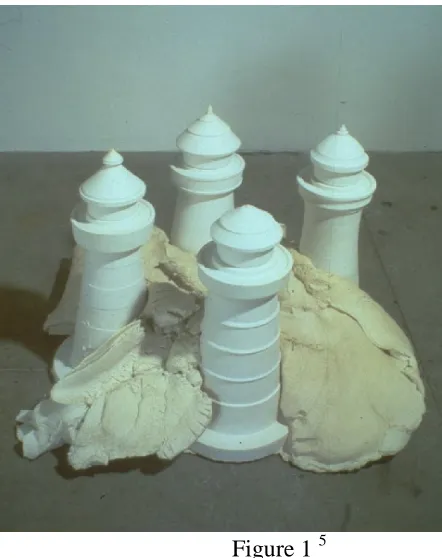
I have found kinship with
contemporaries in different ways, and I
feel connected to these artists by way of
similar approach in my work. British
sculptor Tony Cragg’s sensitivity and
reaction to various materials is a starting
point for his work. He responds
intuitively, and also from his association
with his memories concerning material.
Figure 1 5
Tony Cragg mentions that the word material originates from the Latin word
mater-mother. Particular attributes of a material promote ideas which in turn help the
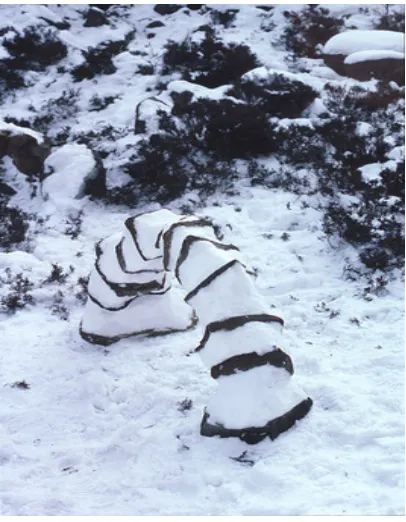
[image:17.612.298.519.329.608.2]Scottish sculpture Andy Goldsworthy uses natural materials in ways that astonish
me, yet his work remains so honest in their construction. His stone and snow arch
displays this directness of material. The snow’s compression between the stone slabs has
just enough tension to be self supporting. This contrast of physical tension gives the
observer a seamless visual translation of the material’s inherent property. Through the
truthfulness of his handling of materials, the character of each material is highlighted.
His sensibility, appreciation and consideration of raw materials allow such vast
manipulation, and yet the natural grace of each medium is conserved.
“I have become aware of how nature is
in a state of change and how that change is the
key to understanding. I want my art to be
sensitive and alert to changes in material,
season and weather.” 6
While I was working as a pottery
instructor at Worcester Center for Craft, I found
that Thomas O’Malley’s work struck a
[image:18.612.333.536.322.583.2]comparable cord with my own, though he
approaches his work from a different place Figure 2 7
and different sources of inspiration. His glossy pots appear to be as hard as little gems set
Peter Beasecker’s carriers are also a beautiful statement about a refined balance of
form and function.
“As the word implies, a carrier is a thing of use, of utilitarian value. The ‘value’
implied in carriers such as these, with multiple cups within, is that they ‘behave’
communally. They are meant to be
used by many gathered together in a
communal ritual almost certainly
acted out in a small duration of time.
Even when not in use (which is most of
the time), the carriers still actively, one could say Figure 3 8
even joyously, announce their communal intentions.” 9
His graceful forms are sleek and linear, yet I was immediately drawn to his view
of function. Formally, our work differs greatly, yet the content is based on a similar type
Through out the conversations and the discourse of my studies and work in
ceramics the influences of my class mates and peers have shaped and developed my
sensibility in clay. Of course most importantly, the work and teachings of my professors
Rick Hirsch and Julia Galloway will always have an impact on my work. Our
conversations have permeated my thoughts on all things related to clay. The diversity of
these two professors challenge, question and provoke my own understanding of craft/art.
I am so fortunate to have studied under these professors, each of whom contributed
significantly to the field. Discussions regarding their differing points of view have been
My Thesis Body of Work
For as long as I can remember, I have been fascinated by the color, texture and the
form of marine life such as oysters, snails and coral. While living in Portland, Maine, I
was able to take classes and study marine biology at the University of Southern Maine.
This fascination is evident in much of my work. The spiral of a shell is reflected in the
ribs made by my fingers as I throw. The images of a barnacle encrusted oyster shell have
stayed with me.
I regard what I produce to be functional forms: pottery with a place and a special
time for use in a home. This pot will hold juice, wine or vinegar for a salad. Its uses are
left to be decided by the owner. It is a pot for Sundays or special occasions. It is an
A pouring vessel on a base: this succulent, round, soft porcelain ewer perches
atop the stout, rough, textured saucer. The composition of a saucer and pot allows one to
enjoy the food or drink through the experience of two pieces which relate to each other:
presentation in an extraordinary way. Lifting the smoothly rounded pourer from its rough
and craggy saucer and filling a cup, then returning the pot to its place: lifting the ethereal
from the earthly. This action heightens a sense of ritual, making the ordinary into the
extraordinary.
The single cup and saucer sets that I prepared for
my thesis exhibition are the items from which I have
learned the most. The cups are small in scale, only three
and a half inches standing without the saucer. A cup is
the most used pot in one’s cupboard. We use cups
throughout the day. These realizations led me to my body
of work. I gave cup and saucer sets to my professors,
fellow students and to friends who are not involved in the
arts, so that they could use them in their own homes. What I learned was incredibly
valuable. I learned that this series of cups would certainly lengthen one’s coffee break. It
was often stated that the cup and saucer were a remarkable composition together,
although during actual use, the cups were often used alone. In comparison, the oversized
saucer makes an awkward dance partner for the petite porcelain cup during the action of
drinking. Together they are not practical by any means, and, therefore, most people used
my cups without the saucer. At first, this was unexpected and a disappointment to me,
learned from it. The bases are not the most utilitarian saucers for the cups, although they
function as a resting place, and when not in use, a base’s or pedestal’s function is
presentation and display. This understanding led me to my next group of work.
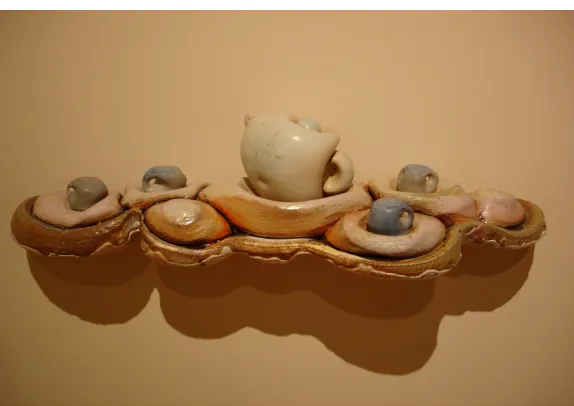
A teapot accompanied by four small cups nestled into a mantle. The body of a
mollusk such as an oyster or a clam is called a mantle
and this term regarding my work intrigues me. The
tea service set is seated on the mantle which is
installed on the wall. The shelf is installed using
three large screws with wall anchors. Again, there is
a textual contrast between the inside and outside of
the mantel. The undulating flowing mantel’s interior Figure 4 10
is framed by a coarser textured outer surface. Tension is built between the visual weight
of the shell-like mantel and the appearance of floating against the wall. This gives a
feeling of weightlessness, as if the piece were underwater. The mantle’s function is to
support and display the pots: an
abstract “china cabinet” that
becomes a part of the wall. This
piece has a direct relationship with
the architecture of a room, because
it is attached to the wall. I pushed
this relationship even further with
[image:23.612.271.558.444.647.2]Regarding the tray with four cups, the cups are porcelain and are left unglazed
except for a faint iridescent luster. Their interiors are lined with a clear glossy glaze.
Each porcelain cup is set on the tray which is made of stoneware and slip. The
appearance of the cups on the tray is as if the cups are nestled into a soft pillow. During
trials and the development of this piece, the function became apparent: a beverage service
for a celebration. It approaches function from yet another point of view. This could be a
centerpiece for a small gathering where participants are sharing a drink. The cups are
completely round and are supported by the tray when not in someone’s hand. One’s
perception and relationship to the cup changes whether it sits on the tray, or is held in the
user’s hand.
The creamer and sugar set invites play through its small scale and multiple parts.
The pebbly textured stoneware sugar bowl acts as a pedestal for the delicate porcelain
creamer. Inside the sugar bowl, there is a small, smooth, round porcelain scoop. The
scoop is revealed the moment the lid is lifted, creating a pleasant surprise.
The pots I make may not be for everyday utility. I strive to create pottery for
occasions, pottery which will be so captivating that a viewer will be compelled to interact
with it. I build forms that beckon to be cupped by hands. It would be difficult to, hastily
use the objects that I make, and this slower pace expands one’s awareness and enjoyment
of the moment.
Almost downy in appearance, the soft finish of the ewer is achieved through
smoothing and sanding. Later, a thin layer of glaze is applied, a buttery satin-matt that
becomes one with the clay’s skin. The work is then fired in the soda kiln; not adding any
and spouts. The subtle atmospheric firing further accentuates a fullness of volume by
highlighting and shadowing the form by using the fluxing vapor carried by the flame.
A pearl sits within a shell of an oyster. An egg is surrounded by a nest of twigs.
It could be seen as a figure in a landscape. It could be someone on stage. The form is a
statement of contrast between roughness and refinement. The pouring vessel is more
advanced in the hierarchy of form in comparison to its supporting base. Base and the pot
formulate a whole that, when presented together, creates a relationship of visual
discourse. The base’s encrusted texture is partially achieved in the course of the “burning
out” organic inclusions applied within slip. The fossil impression is created with a small
amount of pasta, cereal and grain. This presents an appearance of an outer shell covered
in barnacles and marine growth.
Juxtaposed traits are a soft, delicate and refined interior against an exterior which
is hard, heavy and coarse. While the inner shell is smooth and iridescent, the outside has
the appearance of an accumulation of scars and the impact of outside elements.
“Nests and shells cannot unite as strongly as this otherwise than by virtue of their
oneirism. Here an entire branch of “dream houses” finds two remote roots that
intermingle in the same way that, in human daydreams, everything remote
intermingles.”11
A pearl is created after a mollusk ingests an irritating grain of sand. Calcium is
deposited over time and accumulated into the precious stone: alchemy created through
creation, life and beginning. It needs care and nurture. A swelling ripe fruit’s full
volume is composed of nourishing flesh and the seeds that allow it to reproduce. Pottery
can be concrete and abstract at the same time. A pot is a pot, but the visual content of
metaphor and meaning is plural of what one sees at first as just a container. These
conceptual ideas, metaphors and the spirit conveyed, are reflections and responses to
objects of inspiration. This also reflects elements and traits of my own daily life and
personality. When I am confused or uncertain about the direction of my work, the
alternatives roll around in my mind like an irritating grain of sand in an oyster shell.
With thought, struggle and work, I know it is possible to produce the pot I desire - to
make a pearl. The pot may be a gem to adorn a place in a room, a catalyst to help one
center down in one’s home. Possibly this piece may wash a granule of sand from
Alchemy and the Ceramic Process in My Work
“I was going to say that our heads are our offices or charnel houses, as if
creativity lived in a small flat in Soho. We know the mind doesn’t dwell in the brain
alone, so the where of it is as much a mystery as the how.” 12
In the act of making my work, the time on the clock is not relevant, and my brain
switches from being an engine running on language to one running on visual
representation. Sometimes I believe, and jokingly tell people, that half my brain is in my
hands. Artwork is a beneficial and healing meditation to me. Being inspired is never a
linear path. It is a struggle and a cycle that sometimes leads me back to the beginning,
often with a new perspective. There is always something additional to consider and with
which to deal. Art is a vehicle that puts me in a mindset that feels natural. I focus so
intensely on process, that I believe it sometimes overshadows the product. Although the
process is sometimes seen as secondary to the product, it is of critical importance to me.
I want the objects of my creation to pass on what I have felt during the making, and if the
“Indeed, the principle of solidification is so powerful, the conquest of hardness is
carried so far, that the shell achieves its enamel-like beauty as though it had been helped
by fire. Beauty of substance is added to beauty of geometrical form. For a potter or an
enamellist, a shell must indeed be a subject for infinite meditation. But there are many
animals beneath the enameled glaze of this gifted potter’s plates that have made the
hardest possible shells of their skins. If we relive Bernard Palissy’s passion in the cosmic
drama of different sorts of matter, or in the struggle between clay and fire, we can
understand why the humblest snail that secreted its own shell should have provided him
with food for infinite dreaming.” 13
The innate primal character of the ceramic process is compelling to me; liquid,
viscous, soft, plastic, leather, crackle, crumbly. The natural history of clay as a material
is an influence in my work. Clay is a medium of memory. As I consider my body of
work in clay, I am struck by the way two major interests have always been woven
together: one, the soft malleability of clay; and the other, the excitement about
transformation that takes place during the ceramic processes. As in alchemy the ceramic
processes involve the four elements of earth, water, fire and air. Each is a necessary
component for the completion of a finished clay object. The four elements are intriguing
to me as archetypes in our subconscious.
Earth, or clay, is of primary importance to me as a material. It is the most
responsive medium to touch. Hands are the primary tools, and the artist is in direct
making of a clay object, I respond to the inherent natural properties, and visual dialogue
between process and design.
Water is a necessity and a symbol for all life that we know of on earth. It is what
allows clay to be soft and able to be formed. The right balance of clay and water is
crucial for the desired consistency. I personally prefer more water for a softer more
responsive clay body. Many bodies of water, including the lake I lived on as a child and
the ocean I lived by as a young adult, have also been tremendous sources of inspiration in
my work.
Fire can be harsh and ruthless. Fire is also warmth; a hearth is a center of a home.
The kiln adds heat to my studio in the winter. Fire gives clay the temperature needed to
become mature and permanent. It is a force of nature that is manipulated and controlled
to give the clay its hardness, and the glazes their fluid properties. Fire allows the potter
to direct the clay’s final outcome. I love using an element of nature in my process that is
so dangerous and, at the same time, beautiful. It fascinates me that something so
naturally destructive can create the most amazing objects.
Air is usually soft and enveloping. Air is necessary for fire, and also to the space
within a successful vessel. Vessel forms that possess buoyancy and swelling are dealing
with the space inside. The vessel holds energy when the walls are pushing outward from
the inside. The air inside of the kiln is of great importance to me as well, and its imprint
on the surface of clay is as important as the maker’s touch. I am drawn to ceramic
materials and processes that are sensitive to the kiln’s atmosphere, and I want my pieces
to show the method by which they are made. For this reason, soda firing has been one of
luster. First oxides are brushed on, and then wiped off. After that the glaze is applied by
brushing and dipping. Firing in a soda kiln is next, then a cone six firing to deepen the
surface. A complexity and depth of glaze is caused by the accumulation of surface
Conclusion
It is very important that my work is well crafted. I have learned to embrace craft
as a rich source to draw upon and to manipulate for expression and communication. It is
a tremendous satisfaction to create functional pieces, some of which may also be viewed
as works of art. I believe that the most intimate, personal, and enriching objects are
useful, used everyday, and found in the home. Food, nourishment, and celebration of life
can be contained in a vessel. There are not many art forms that one is expected to touch
and put to one’s lips. Thoughtful handmade objects enhance the ritual of a morning
coffee, the enjoyment of a meal alone or with others and tea at night.
In their way, these objects help to recreate and bring us together in community;
something that has been lost in our fragmented lives. Modernization and industrialization
have literally scattered us. Swamped by technology, we are losing our connection to the
earth, to ourselves and to each other. It is important for me to know where the things I
need come from. Strawberries from a neighbor’s garden, fuel wood from a tree behind
the house, a mug made for me by a friend: the more of these sources I have in my life, the
more grounded I feel. A handmade cup may not save the world, but there is great
comfort in holding a warm mug of coffee and feeling the maker’s touch fired
permanently in clay. With my art, I try to deconstruct the isolation that I feel as I live my
life in a modern technological world. I hope to do the same for those who use my work.
With my work, I hope to promote a sense of community and wholeness of self, and to
express the happiness I feel in being grounded and alive. I live as gently as I can, and I
As I produce my vessels and others use them, I wish them to feel the influence of
nature that I have felt in the creation of each item. I want them to experience a sense of
being nurtured as they view or hold a beautiful handmade ceramic piece. In a fast paced
world filled with industry and technology, it is my hope that people feel some sense of
community as they experience objects crafted by hands out of natural elements. The
social message may be as small or as large as the fact that one cannot hold a beautifully
created clay pot that has been imprinted with the maker’s touch without feeling more
Bibliography
1 Dewey, John. “Art and Its Significance, Art as Experience” State University of New York Press, 1994. p.
204
2 Frederick, Warren. “Inescapable, Indivisible Essence of Pottery”
http://www.artistpotters.com/artist_potters/frederick/wf_articles/inescapable_indivisible.htm
3 Rawson, Philip, “Ceramics” University of Pennsylvania Press, 1984. p. 90
4 Clark, Garth, "Shards, Betty Woodman: A Storm in a Teacup” CAF: Ceramic Arts Foundation and Dap:
Distributed Art Publications, 2003. p. 252
5
Cragg, Tony, Sculptures, www.tony-cragg.com 2008
6 Goldsworthy, Andy, Digital Catalogue Image, 1986 http://www.goldsworthy.cc.gla.ac.uk/ 2006
7 Goldsworthy, Andy, Digital Catalogue, Selected Extracts, http://www.goldsworthy.cc.gla.ac.uk/ 2006
8 Beasecker, Peter, Work http://peterbeasecker.net/ 2008
9
Van Keuren, Philip, Ceramic Art and Perception, “Adapted to Condition: Recent Work by Peter Beasecker,” 2004, issue 55, p. 3
10 http://en.wikipedia.org/wiki/Seashell, Wikipedia Foundation, Inc 2008
11 Bachelard, Gaston, “The Poetics of Space” Beacon Press, 1994 Edition, p. 120
12 Ackerman, Dian, “A Natural History of the Senses” First Vintage Books, 1990 p. 293
13