T
HE
SET-P
LAN
T
HE
SET-P
LAN
F
ROM
C
ONCEPT TO
S
UCCESSFUL
I
MPLEMENTATION
CEPS
T
ASK
F
ORCE
R
EPORT
CHAIR: Lars Erik Liljelund
Chief Executive Officer, The Foundation for Strategic Environmental Research (MISTRA), Sweden, former Special Envoy of the Prime Minister of Sweden on Climate Change and Director General of the Environmental Protection Agency
RAPPORTEURS: Jorge Núñez Ferrer
Associate Research Fellow, CEPS
Christian Egenhofer
Senior Research Fellow, CEPS
Monica Alessi
Research Fellow & Programme Manager, CEPS
CENTRE FOR EUROPEAN POLICY STUDIES
This report is based on discussions in the CEPS Task Force on “Implementation of the Strategic Energy Technology (SET) Plan”. The group met four times between November 2010 and February 2011. Participants included senior executives from a broad range of stakeholders, including business and industry, business associations, academic experts and NGOs. A full list of members and invited guests and speakers appears in Appendix 3.
The members of the Task Force engaged in extensive debates over the course of several meetings and submitted comments on earlier drafts of this report. Its contents reflect the general tone and direction of the discussion, but its recommendations do not necessarily represent a full common position agreed by all members of the Task Force, nor do they necessarily represent the views of the institutions to which the members belong.
ISBN-978-94-6138-097-5
© Copyright 2011, Centre for European Policy Studies.
All rights reserved. No part of this publication may be reproduced, stored in a retrieval system or transmitted in any form or by any means – electronic, mechanical, photocopying, recording or otherwise – without the prior permission of the Centre for European Policy Studies.
Centre for European Policy Studies Place du Congrès 1, B-1000 Brussels Tel: (32.2) 229.39.11 Fax: (32.2) 219.41.51
E-mail: [email protected]
CONTENTS
Preface ... i
Executive Summary ... 1
I. Key Messages ... 1
II. Recommendations: How to make the SET-Plan a success ... 5
Introduction ... 8
1. The SET-Plan: A Pillar of EU Climate Change, Energy and Growth Strategies ... 10
1.1 The EU long-term research, demonstration and innovation agenda ... 12
1.2 Correcting market and policy failures ... 15
1.3 Improving market pull ... 16
1.4 The role of technology push ... 17
1.5 Why public support and what is the role of the EU? ... 18
2. Closing the EU Financing Gap for Innovation ... 20
2.1 Expanding the leverage and multiplier effect of EU funds ... 21
2.2 Bridge financing ... 22
2.2.1 Blending tools for bridge financing ... 22
2.2.2 Balancing grants and loans ... 23
2.2.3 The Risk-Sharing Financing Facility ... 25
2.3 Increasing the contribution by the EU budget... 28
2.4 Project bonds ... 30
2.5 The NER 300 ... 31
3. Harnessing the Potential of the SET-Plan through Policy Coherence33
3.1 Reforming the management of EU innovation and research policy ... 33
3.2 Harnessing synergies between the SET-Plan technologies and the EU Structural and Cohesion Funds ... 35
3.3 Public procurement ... 36
3.4 Coherence of state aid between EU and member states ... 36
Bibliography ... 38
Appendix 1. Glossary of Abbreviations and Technical Terms ... 40
Appendix 2. Estimated Financial Needs ... 42
| i
PREFACE
t has always been clear that technology will play a decisive role in addressing the challenges of climate change. Ultimately, the stabilisation of GHG emissions can only be met by an accelerated deployment of low-carbon and highly energy-efficient technologies and the development of new breakthrough technologies, in line with the objective set out in the UN Framework Convention on Climate Change and reiterated more concretely by the Cancún agreements. But the importance of technology goes beyond the remit of climate change. Meeting the ambitious goals of the new EU 2020 economic growth strategy will also require the development, demonstration and deployment of low-carbon technologies at a higher rate than is currently taking place. As early as 2006, the European Commission launched a debate on new tools to make this happen with the publication of the first Communication on the so-called Strategic Energy Technology (SET) Plan. By 2010, the SET-Plan had been approved by member states, yet crucial elements of it are still to be decided, including funding.
Against this background, CEPS brought together a Task Force, which I had the pleasure and privilege to chair, representing a broad range of industries, business associations and non-governmental environmental organisations to engage in extensive discussions, often at senior executive level. During the meetings, the members also had ample opportunity to discuss these issues with officials from the EU institutions, member states and international organisations. The objective was to assess ongoing EU policy discussions and provide expert input into them, but also to share knowledge and understanding among different stakeholders, and to draw up a set of conclusions and recommendations.
As readers consider these conclusions and recommendations, I urge them to reflect on the importance of the underlying question of how to accelerate the rate of low-carbon technologies in an economically efficient way in today’s market. This is a challenge that goes beyond EU borders. Different parts of the world will find different answers to this same question.
ii |PREFACE
Discussions were always rich, the debate was at times intense and I believe that this Task Force has made a constructive contribution to this important debate. I would like to thank the members of the Task Force for their active and positive contributions throughout the meetings, and especially for the many written contributions that have been submitted. Although each member endorses the general content of the report, one should not conclude that all members subscribe to every sentence of the text. Finally, my thanks go to the CEPS’ research team, which has led the efforts to draft this report.
Lars-Erik Liljelund Chair of the CEPS Task Force Chief Executive Officer, Foundation for Strategic Environmental
| 1
EXECUTIVE SUMMARY
ealising both the EU’s climate change objectives of 2020 and beyond and the ambitions of the Europe 2020 economic growth agenda will require the development, demonstration and deployment of new low-carbon technologies at a faster rate than is currently taking place. EU policies to make this happen have been or are being put in place. At the core of the climate and energy agenda is the 2008 Climate and Energy Package, notably the flagship legislation on renewable energy and, most important, the EU Emissions Trading System (ETS), designed to provide market pull. Alongside these initiatives, the EU has launched the Strategic Energy Technology (SET) Plan, essentially to promote low-carbon energy technologies. Approved by the member states, the SET-Plan has been in operation since 2010. Yet important decisions are still to be taken, with financing being one of them.
This CEPS Task Force Report examines the case for government intervention to support low-carbon energy technologies, in addition to carbon pricing. In a second section, it identifies the potential role for the EU, notably where it can add value to member state activities before identifying financial needs and the tools with which to meet them. The analysis then concentrates on the content of this EU framework, focusing on issues such as governance, finance needs, (new) sources of finance and the positive impact that the consistency and coherence of other EU policies with SET-Plan objectives can bring about.
I.
Key Messages
General
2 |EXECUTIVE SUMMARY
change. Other types of impact will also have to be taken into account, such as policy frameworks, regulation and infrastructure. This includes an efficient and truly competitive integrated EU energy market, the necessary grid infrastructure and accompanying cross-border regulation, and will provide market pull for low-carbon technologies. While the ETS aims at providing such signals for the industry and power sectors outside the ETS, no such signals exist yet for many sectors.
In parallel to this market pull there is also the need for a ‘technology push’, i.e. support in the areas of R&D, demonstration and deployment. The EU’s technological ambitions will only work if they are accompanied by necessary resources.
2. The EU is not alone in this field. Other countries such as China, Japan, South Korea and the US are also pursuing ambitious industrial strategies in low-carbon energy. For Europe to be a beneficiary in the low-carbon market, rather than just a consumer of technologies developed elsewhere, there is no alternative to putting innovation at the heart of its growth strategy. A successful industrial policy in low-carbon energy is also essential if Europe wants to preserve political influence in the area of climate change.
SET-Plan
3. It is important to define the role of government intervention and the role of the EU carefully. This CEPS Task Force Report has identified a need for public intervention if :
(a) Market and financial risks are too high for a private investor, i.e. benefits are realised beyond the period in which a private investor requires a pay-back;
(b) Technology risks are too high, i.e. if large-scale technologies carry a high risk of failure, for example at demonstration or early deployment level;
(c) Traditional energy technologies have an advantage over some new ones if the infrastructure for existing technologies is paid off or if regulation provides disincentives to invest;
or because a technology does not pay its full cost, giving existing technologies an advantage over new ones; and
(e) Investment in RD&I (research, development and innovation) is not rewarded by the market because the technology becomes freely available before a private investor can make a profit from it.
4. The SET-Plan, notably through its current governance framework, has the potential to accelerate the rate of innovation by bringing together the innovation capabilities of the academic and corporate sectors. EU support can:
(a) Increase collaboration among different technology developers and increase economies of scale, including cross-border infrastructure such as the grid;
(b) Provide the incentives to invest in projects that are too costly for individual member stats but have high European value added; (c) Reduce the risks of duplication of efforts and;
(d) If properly designed, increase the leverage effect of EU financial support, raising the aggregate level of R&D and innovation in Europe for SET-Plan priority technologies.
5. It is important that the SET-Plan governing bodies, which include the European Commission, member states and industry, assume the role to facilitate, accelerate and drive forward low-carbon technology development, demonstration and deployment at EU level. This will mean a particular leadership role for the European Commission regarding those technologies with important cross-border implications or with EU-wide scale effects. A leading EU role is particularly indicated if the EU:
(a) Can capture the full technology capacity within the EU;
(b) Address technology projects that are too big for any one member state or require coordinated actions between member states to provide value;
(c) Cope with the risks associated with new and untested technologies and avoid the risk of duplicating national or regional initiatives implemented in an un-coordinated fashion; (d) Build upon the ‘Innovation Union’ by improving co-operation
4 |EXECUTIVE SUMMARY
Possible examples could be (smart) grids, carbon capture and storage, transport electrification and nuclear energy. For all SET-Plan technologies, the European Commission’s role will be one of facilitation and coordination to ensure that member state efforts are compatible and, ideally, mutually reinforcing; avoiding duplication, spreading best practice across the EU and ensuring the inclusion of all member states and regions.
6. There are major differences across technologies or technology clusters in relation to the nature of barriers, which depend on the maturity of the technology. This will require tailor-made support in line with technological needs. For energy policy to promote new and advanced energy technologies effectively, it is vital that policy-makers recognize the different requirements at each technology readiness level. There are big differences between: proven technologies that show
potential for commercial deployment in a competitive environment, which
may require mandates permitting support and stable long-term measures, and proven technologies that are not yet commercially
competitive, which require funding for demonstration and transitional
incentives. These technologies require quite different policy measures. Early on in the technology development cycle where we have unproven technologies with significant research and development still
required R&D support is essential for underpinning science.
8. The SET-Plan does not operate in a vacuum and it is important that the technologies developed for the future encounter the right market and infrastructure conditions for their deployment. At the same time, policy coherence at EU and national levels with SET-Plan priorities will need to provide additional leverage to SET-Plan technologies. Key areas identified in this report are regional policy, state aid policy and especially public procurement, which is an underexploited tool to boost the deployment of low-carbon technologies.
9. While demonstration and deployment are at the heart of the SET-Plan strategy, making the SET-Plan a success will also require the review and reform of rules for EU research projects to stem the declining participation of industry. The successful promotion of collaboration between industry, including SMEs and academia via Public Private Partnerships (PPP) will require, among other things, a modification of the rules on intellectual property rights for collaborative projects, which do not reflect the concerns of industry or the often mixed public and commercial interests of academic institutes. Bureaucracy, both in the pre-formulation and implementation phases, has been identified as another shortcoming. This latter point and proposals for reform have also been identified by the Carvalho Report1 from the European Parliament.
II.
Recommendations: How to make the SET-Plan a success
The Task Force has formulated the following recommendations:
1. The SET-Plan policy must ensure the right economic and regulatory framework conditions to foster low-carbon technology development, demonstration and deployment. These must include:
(a) A truly integrated and competitive energy market, including the necessary cross-border infrastructure and appropriate regulation, and
1 Among other recommendations, the Carvalho Report (European Parliament,
6 |EXECUTIVE SUMMARY
(b) Energy prices that adequately reflect the costs of security of energy supply, climate change, the environment or other social impacts.
2. In parallel, the EU and member states must support the technology (push) by addressing specific non-market barriers to RD&I, demonstration and deployment.
3. Those governing the SET-Plan, namely the European Commission, member states and industry, must go beyond declarations of intent and accept responsibility to drive forward low-carbon technology development, demonstration and deployment at EU level.
4. The European Commission should lead in areas with important cross-border or scale effects, notably (smart) grids, carbon capture and storage (CCS) and nuclear energy.
5. For all SET-Plan technologies, the European Commission should help facilitate member state efforts to ensure compatibility, avoid duplication, spread best practice across the EU and ensure inclusion of all member states and regions.
6. The EU must ensure a higher level of financial intervention, including a higher EU budget allocation. This must include:
(a) Higher levels of grant funding for basic research and early stages of demonstration, and especially
(b) ‘Bridge financing’ to cover technological, market and financial risk in the demonstration and early deployment phase.
7. In particular, the EU should envisage setting up appropriate risk-sharing instruments, building on the success of the Risk Sharing Finance Facility (RSFF), probably based on a Portfolio First Loss Piece approach to ease the provision of (bridge) financing to facilitate the market deployment of unexploited new technologies.
8. The SET-Plan should also
(a) Promote the idea that the Cohesion and Structural Funds are used to finance infrastructures which are appropriate for SET-Plan technologies;
(c) Align EU state aid rules to allow member states to support national investments in energy RD&I to the same extent as EU projects. This should especially be so when national investments have an important European added value (based on Article 107 3(b)of the Treaty);
(d) Include a review and reform of financial and control rules for initiatives in the area of RD&I, such as for the EU Research Framework Programme in line with recommendations of the Carvalho Report of the European Parliament, with a particular focus on bureaucracy; and
8 |
I
NTRODUCTION
echnology has moved centre stage within the arena of climate change policy. While there may be different views on whether stabilisation of GHG emissions in line with the UNFCCC’s objective can be achieved with technically proven technology, the need to bring carbon-efficient technologies to the market at scale more quickly is undisputed. Also uncontested is the need to develop, demonstrate and deploy as yet unproven technologies, in order to reach climate change targets beyond 2050.
Significant efforts have been made by the European Union to give shape to a “technology pillar of the EU’s energy and climate policy” to create “a blueprint for Europe to develop a world-class portfolio of affordable, clean, efficient and low emission energy technologies” by developing the Strategic Energy Technology (SET) Plan, in the European Commission’s words. Approved by the member states, the SET-Plan “lays out the EU’s strategy to accelerate the development of these technologies and to bring them more quickly to the market.” This acknowledges that “the development of resource-efficient and green technologies will be a major driver of growth” as was outlined in the Commission’s May 2010 Communication on the implications of Copenhagen. In the context of the SET-Plan, the December 3rd Energy Council reiterated that “future financial perspectives should provide adequate support for the Union’s activities in the field of innovation and technology”. The European Council of 4 February 2011 confirmed that the “EU and its Member States will promote investment in renewables and safe and sustainable low carbon technologies and focus on implementing the technology priorities established in the European Strategic Energy Technology plan.”2 Priority 4 of the Energy
2 Item 10 of the European Council Conclusions of 4 February 2011 reads as follows:
“The EU and its Member States will promote investment in renewables and safe
and sustainable low carbon technologies and focus on implementing the
technology priorities established in the European Strategic Energy Technology plan. The Commission is invited to table new initiatives on smart grids, including those linked to the development of clean vehicles, energy storage, sustainable bio fuels and energy saving solutions for cities.”
Strategy 2020 calls for the EU to extend its leadership in energy technology and innovation against competition in international technology markets in particular from the US, China, South Korea and Japan.
The SET-Plan represents the paradigm shift “going well beyond the narrow domain of R&D and innovation policy” by combining the “market for innovative goods and services, focused resources, new financial structures and mobility of people, money and organisations”, which was demanded as early as 2006 in the report by the Independent Expert Group on R&D,3 chaired by the former Prime Minister of Finland, Esko Aho and entitled “Creating an Innovative Europe”.
This CEPS Task Force Report and its accompanying policy recommendations are intended to serve as a contribution to the ongoing EU discussions in a number of strategic areas such as the EU’s growth strategy, the EU’s role in climate change policy and the new EU budget.
The report is structured in four chapters. Chapter 1 establishes the context both from a political and technological perspective and presents the economic and strategic case for supporting the SET-Plan. Chapter 2 examines the financial challenges and the potential financial instruments to be deployed to reach the SET-Plan objectives, from straightforward grants to more complex financial engineering systems. Chapter 3 analyses the framework conditions, including management of RD&I, coherence of and synergies with other EU policies and state aid policy. The report sums up with concluding remarks in Chapter 4.
The main findings of the report are contained in the Executive Summary with Key Messages and Recommendations.
The report has three annexes, the first of which contains a glossary of technical terms and abbreviations used; the second contains information on the financial development needs for SET-Plan Technologies, and the third a list of members of the Task Force and invited guests and speakers.
The report uses the term RD&I (Research Development and Innovation) rather than R&D, to broaden its scope beyond basic research. The SET-Plan largely focuses on later stages of technology development and innovation, mainly demonstration and deployment.
3 See the European Commission website (http://ec.europa.eu/invest-in-research/
10 |
1.
THE SET-PLAN: A PILLAR OF EU
CLIMATE CHANGE, ENERGY AND
G
ROWTH
S
TRATEGIES
or many years, the EU has been leading international efforts in domestic and international climate change, for example by setting unilateral targets for greenhouse gas (GHG) reductions or renewables for 2020, by policy innovation such as the EU Emissions Trading System (ETS) or by the decision aiming to limit the temperature increase to a maximum of 2°C as early as 1996. While the outcome of the Copenhagen negotiations in 2009 was a disappointment, nevertheless, the Cancún Agreements mark the first time that all major economies have not only pledged explicit actions under the UN Framework Convention on Climate Change, but have also formally agreed to limit the average global warming to below 2°C.
While this constitutes progress in its own right, it also means the attention is irrevocably shifting to technology policy, i.e. how to accelerate the development, demonstration and, most important, the deployment of low-carbon technologies.4 Creating a global economy that emits a fraction of its current GHG emissions will not only require wholesale change in the ways economies are structured, but more importantly an unprecedented innovation drive in the EU and beyond. This is especially true for the energy producing and consuming sectors, which are responsible for up to 80% of total GHG emissions.
4 The current US Ambassador to the EU has even proposed that EU-US relations be
transformed into a transatlantic “Partnership for Innovation” with technology at its heart. See Kennard (2010).
By adopting the climate and energy package in 2008-09, the EU has put in place a comprehensive policy framework, including a GHG reduction target of -20% compared to 1990, renewable energy targets for a 20% share of renewables in primary energy and a streamlined and centralised EU-ETS that not only imposes a carbon price but also requires that emissions in the sector covered decrease by 1.74% per annum as of 2013. Internationally, the EU aspires to achieve a legally binding comprehensive global agreement that makes it possible to reduce GHG emissions globally by 50% in 2050, translating into a reduction by the EU of the order of 80-95% by 2050 compared to 1990, as was confirmed by the European Council on 4 February 2011. The EU “low carbon roadmap” (European Commission, 2011) published in March 2011 judges that a cost-effective and gradual transition to the 2050 objective requires reductions of 25% in 2020, 40% in 2030 and 60% in 2040, compared to 1990. New energy technologies will also be essential to address energy challenges, including import dependency, price volatility or unsustainable resource use.5
Production and trade in high-value added sectors, which include energy technology, are basic elements of economic growth and sustainability. The SET-Plan is an integral part of the “Innovation Union” strategy launched by the European Commission in October 2010, and key to the elements that will drive Europe’s growth potential as estimated in the Europe 2020 Communication. A successful SET-Plan holds the promise for Europe to achieve its technological and political ambitions in the key areas of energy and climate change policy, affecting its economic prospects and its role at international level. There is consensus now that the economic growth, welfare and competitiveness of the EU will depend on the EU’s success in developing, deploying and competing in new low-carbon
5 The Energy 2020 Communication of the European Commission identifies the
12 |THE SET-PLAN:APILLAR OF EUCLIMATE CHANGE,ENERGY AND GROWTH STRATEGIES
technologies. The SET-Plan has therefore become the nucleus of a new EU industrial policy for the low-carbon age.
Low-carbon technologies are becoming the focus of industrial policies around the globe. Other countries such as China, Japan, South Korea and the US are pursuing ambitious industrial strategies in energy due to the rising demand for new low-carbon technologies. For Europe to be a key player in this market, rather than just a consumer, it needs to put innovation at the top of the agenda, not just in word but also in deed. If the EU fails to innovate, competitors such as China and the US will quickly surpass the EU in its technological capacity on low-carbon technologies. Single member states would not be able to counter such a development.
1.1
The EU long-term research, demonstration and innovation
agenda
Against this background the EU has developed the SET-Plan with its special focus on a long-term energy research, demonstration and innovation agenda for Europe to make low-carbon technologies affordable and competitive and thereby enable market uptake to meet the EU 2020 targets, as well as to realise its 2050 vision of a low-carbon economy.
The European Commission has identified goalposts6 for progress in technology development, demonstration and deployment that would be required to meet the 2020 targets as set out by the EU climate and energy package and accompanying legislation, as well as the longer-term vision of a low-carbon economy by 2050. Goalposts for the next ten years to achieve for 2020 targets include to:
• make sustainably produced second-generation biofuels competitive with fossil fuels,
• enable the commercial use of CCS technologies,
• double the power generation capacity of the largest wind turbines, • demonstrate the commercial readiness of large-scale photovoltaic and
concentrated solar power,
• enable a single, smart European electricity grid able to integrate renewable and decentralised energy sources,
6 European Commission Brochure “EU SET-Plan – Strategic Energy Technology
• bring to a mass market more efficient conversion and end-use devices and systems and
• maintain competitiveness in fission technologies, together with long-term waste management solutions.
In relation to the 2050 visions of a low-carbon economy, critical goalposts for the European Commission are to:
• bring the next generation of renewable energy technologies to market competitiveness,
• achieve a breakthrough in the cost efficiency of (electric) energy storage technologies,
• develop the technologies and create the conditions to enable industry to commercialise hydrogen fuel cell vehicles,
• complete the preparations for the demonstration of a new generation of fission reactors,
• complete the construction of the ITER fusion facility,
• elaborate alternative visions and transition strategies towards the development of the future trans-European energy networks and • achieve breakthroughs in enabling research for energy efficiency.
The strategy focuses on the so-called ‘industrial initiatives’ on all seven key technology clusters, recognising the key role of industrial participation. See Box 1.1.
Box 1.1. EU Industrial Initiatives
European Industrial Bioenergy Initiative (EIBI) (launched 15 November 2010)
European Sustainable Nuclear Industrial Initiative (ESNII) (launched 15 November 2010)
Wind European Industrial Initiative (WEII) (launched 3 June 2010) Solar Europe Industry Initiative (SEII) (launched 3 June 2010)
Solar Thermal Electricity European Industrial Initiative (STE-EII) (launched 3 June 2010)
The European Electricity Grid Initiative (EEGI) (launched 3 June 2010)
Carbon Capture and Storage European Industrial Initiative (CCS-EII) (launched 3 June 2010)
14 |THE SET-PLAN:APILLAR OF EUCLIMATE CHANGE,ENERGY AND GROWTH STRATEGIES
The SET-Plan outline was first presented in 2006 and then further developed in 2007, 2009 and 2010.7 The technology roadmap (2009b) presents a detailed description up to 2020 of the financial requirements and areas of research. The SET-Plan was approved and officially started in 2010, although many of its elements still need to be decided upon.
The SET-Plan aims to build a platform of cooperation across Europe to promote collaboration between technology developers (academic and industry corporate) and the public sector on the European scale. This should result in important economies of scale, a reduction in the duplication of efforts and a leveraging of RD&I investments in the private sector. This cooperation is as important as the public financial package that should accompany it.
It is governed by the SET-Plan Steering Group (SET-Group) comprising high-level representatives from the EU member states, chaired by the European Commission. Norway, Switzerland and Turkey participate as observers. Its essential mission is to manage the SET-Plan process and thereby facilitate and drive implementation.
The SET-Plan also establishes the EIIs, which are an industrial policy version of the more academically focused European Technology Platforms (ETPs) and Knowledge and Innovation Communities (KICs) which form the research backbone of the European Research Area (ERA). Ten leading European research institutes have taken up this ‘low-carbon window’ of a new EU approach to technology and industrial policy by founding an
7 EC (2006): Communication, Towards a European Strategic Energy Technology
European Energy Research Alliance (EERA). The objective of the EERA is
to accelerate the development of new energy technologies by conceiving and implementing Joint Research Programmes in support of the SET-Plan, by pooling and integrating activities and resources, combining national and Community sources of funding and maximising complementarities and synergies.
This institutional framework is also accompanied by SETIS (Strategic Energy Technology Information System), which is an information system to support decision-making by providing information on RD&I performed in Europe, and mapping the capacities available in each area of research. It gives companies, academic institutions and the public sector a view of what RD&I is being carried out.
1.2
Correcting market and policy failures
Markets in general do not invite costly or high-risk – financial or technological – innovations, such as some low-carbon technologies. A more rapid deployment of low carbon technologies at the necessary rate to achieve EU targets will therefore require an adapted framework that provides incentives both for RD&I and market uptake. In reality, however, more efficient and low-carbon technologies are hindered by market policy failure, such as the lack of carbon pricing or the continued existence of fossil fuel subsidies.
Fossil fuels benefit from a number of consumption subsidies. The IEA (2010) estimated consumption subsidies at $312 billion in 2009 (Figure 1.1), although they reached a peak at $558 billion in 2008 when oil prices were at their highest.8
8 Note that this estimate has been criticised as not being adequate enough due to
16 |THE SET-PLAN:APILLAR OF EUCLIMATE CHANGE,ENERGY AND GROWTH STRATEGIES
Figure 1.1 Economic value of world fossil fuel consumption subsidies by type
Source: OECD/IEA (2010, p. 579).
In other cases, regulatory barriers (e.g. market structure, lack of carbon value, lack of access to funding) or a lack of skills (e.g. lack of capacity to install, maintain and operate technology, lack of independence on technology) may exist that hinder the development, demonstration and deployment of new low-carbon energy technologies. There is also an observed weak level of patenting in Europe (see Aghion et al., 2009) compared to other advanced economies. Other barriers and their potential remedies will be discussed in Chapters 2 and 3.
1.3
Improving market pull
The uptake of new low-carbon technologies can be accelerated, for example by making existing – high-carbon – technologies more expensive through taxes, cap-and-trade or regulation. Carbon pricing aims to internalise externalities and therefore make new and low-carbon technologies potentially profitable more quickly.
which also introduces a carbon price through energy use benchmarking and the auctioning of emission permits.9
The higher the carbon price, the faster the deployment rate in low-carbon technologies. However, often this does not do away with the disadvantages of new low-carbon technologies in the demonstration and early deployment phase (see Chapter 2 for a detailed analysis) or at least would require a very high carbon price, which could have other negative economic consequences and might not be politically feasible after all. But market pull goes beyond carbon pricing. Another important instrument is public procurement, which amounts to about 19.8% of EU GDP (retrieved from the Eurostat 2008 database10 for the EU27). Detailed data for energy-related public procurement is not available. On the one hand, public procurement standards on energy use or CO2 emissions can give a major boost to the market penetration of low carbon technologies. Research procurement, on the other hand, can boost the R&D element of energy technologies.
1.4
The role of technology push
For areas that market pull instruments cannot address, technology push is required. For example, RD&I subsidies address the market failure of the lack of profitability of certain RD&I. Support for demonstration attempts to provide incentives for risky and typical large-scale technologies, which investors might otherwise shy away from even at the demonstration phase. Deployment support finally tries to finance the gap before a technology becomes profitable because it lacks scale or competes with technologies that benefit from existing infrastructures.
The focus of support, i.e. RD&I, demonstration or deployment is technology-specific and depends on each technology, its specific barriers and notably the state of its development towards market maturity. While some technologies will require mostly RD&I support, others will call for
9 Another route, currently not chosen by the EU, would be by regulating
technologies. Regulation provides a high degree of certainty for investors, yet provides fewer incentives to innovate on a continous basis. Once a technology standard is regulated, the regulatee has no incentive to go beyond that standard.
10 See: http://epp.eurostat.ec.europa.eu/portal/page/portal/statistics/
18 |THE SET-PLAN:APILLAR OF EUCLIMATE CHANGE,ENERGY AND GROWTH STRATEGIES
support in demonstration and others in deployment. (See Chapter 2 for a more detailed discussion of this issue.)
Attention to low-carbon technologies is typically concentrated on those with the highest potential to be successful in the market in the medium and long term. For details, see Box 1. It is likely that additional technologies will be added to this list over time as they mature.
1.5
Why public support and what is the role of the EU?
There is an emerging consensus that a large innovation drive in the energy sector to bring Europe onto the path to a low-carbon economy is unlikely to take place without a substantial additional public finance effort, either by the EU or member states or both (e.g. Aghion et al., 2009; European Commission, 2009b). Public support will be needed for a number of specific reasons.
• Benefits of energy technologies are often public rather than private and therefore not fully rewarded by the market. From a rational point of view the private operator will under-invest compared to a social optimum.
• Benefits and profits are often realised in the longer term only, which creates a disincentive to invest. The situation is aggravated where costs are very high.
• Many of the new technologies carry risks of failure, for example at demonstration or early deployment level, affecting the risk-reward ratio negatively.
• Some traditional energy technologies have an advantage over new ones as the infrastructure is already there or as regulation discourages new investments. This favours ‘traditional’ technologies over new ones, cementing a certain technological path (‘path dependency’).
open for the different regions of the EU. In addition to the subsidiarity proof, as to the SET-plan, the case for EU action rests on the following fundamental arguments.
Generally, the EU will be in a position to drive forward low-carbon technologies because it can:
• capture the full technology capacity within the EU;
• address technology projects that are too big for any one member state or require coordinated actions between member states to provide value;
• cope with the risks associated with new and untested technologies and avoid the risk of duplicating national or regional initiatives implemented in an uncoordinated fashion; and
• build upon the ‘Innovation Union’ by improving cooperation and coordination on low-carbon technologies.
20 |
2.
CLOSING THE EU FINANCING GAP
FOR INNOVATION
he European Commission’s SET-Plan documents claim that the EU is under-investing in new energy technologies, and has called for more than a doubling of funding for RD&I, from €3 billion per year today to €8 billion (total EU public and private expenditure) for the next decade. While increased public financing will be necessary, there is savings potential in better, more coordinated and more efficient use of resources, including efforts to increase the leverage effect to attract additional private investment, where possible.
The average investment in energy RD&I for the Financial Perspectives is €720 million a year, of which €389 million is destined for the ITER project,11 (which is not under SET-Plan auspices). According to the Seville-based Institute for Prospective Technological Studies (IPTS), one of the seven scientific institutes of the European Commission's Joint Research Centre (JRC) (JRC-IPTS, 2009), the value of the EU intervention in the overall energy RD&I investment in Europe was 11% in 2007; approximately one third of the total public RD&I investment.
The EU also injected €5 billion in funds for the energy sector with the economic recovery plan, half of which can be considered as finance for
11
ITER (International Thermonuclear Experimental Reactor) is an international research and engineering project that is currently building the world's largest and most advanced experimental nuclear fusion reactor, which is under construction at Cadarache in the south of France. The ITER tokamak aims to make the long awaited transition from today's studies of plasma physics to full scale electricity-producing fusion power plants. The project's members are the European Union, India, Japan, the People's Republic of China, Russia, South Korea and the United States.
demonstration and deployment in the areas of offshore wind and CCS. Nevertheless, the recovery plan was a one-off and a more sustainable funding programme needs to be established.
Of the recovery plan, €146 m remained uncommitted. The European Parliament gave the go ahead to use the funds for renovations of public and private buildings to improve energy efficiency, as well as other urban energy efficiency projects. The funds will be allocated to a European Energy Efficiency Facility, which then will be given in the form of loans, guarantees, equity or other forms of financial support through financial intermediaries. € 20 million will, however, be allocated to technical assistance. The EIB will add €75 million to bring the total of the fund to be used for investments to at least €200 million. Other financial institutions at member state level have also been invited to contribute to and join the fund. The total size of the fund and the level of investment ultimately leveraged by it will only be clear once the additional investors are clear and investment portfolios are decided upon.
However – even if necessary – just increasing the EU or national public budgets for RD&I in energy is not enough. Also, the usual EU budget operations on RD&I through the Framework Programmes are not suited to the big ambitions of Europe in the energy sector. More is needed, tailored to the different stages. The most important role of the EU budget may well be that of a catalyst, focusing on leverage, yet avoiding substituting existing or planned non-EU public or private funding.
2.1
Expanding the leverage and multiplier effect of EU funds
22 |CLOSING THE EUFINANCING GAP FOR INNOVATION
here to be the effectiveness of operations, thus their capacity to generate markets that grow sustainably after the completion of the projects.
2.2
Bridge financing
Costs, time lags and risk are hampering the transposition of research results into commercially viable and profitable technologies in the market. Blending grants and loans via appropriate financial engineering can generate the bridge financing necessary to reduce the risk profile for private investors, i.e. the support needed to bring a newly developed but untested technology to the market and ensuring its deployment.12
2.2.1 Blending tools for bridge financing
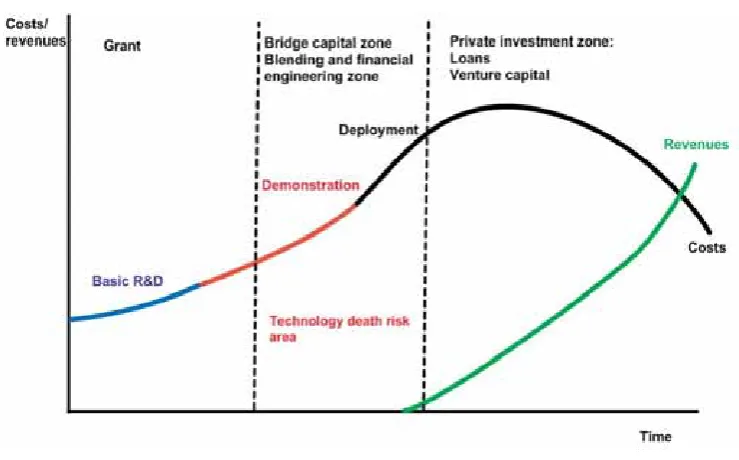
As basic research and testing are usually covered by research grants, there is typically a gap to viability and successful deployment, sometimes called the ‘technology death-risk area’.13 The timescale, cost and risk level for each technology will determine the existence and size of the ‘technology death risk-area’ – an area where venture capital cannot be raised without government support. In this twilight zone, where a product has the long-term potential to be profitable but is commercially not viable in the short term, so that additional support is required to leverage sufficient private capital by reducing the risk involved for private investors. The European Investment Fund (EIF), in co-operation with other financial institutions is becoming a key actor in the field of developing new instruments for the valorisation of IPR such IP funds. It complements the role of the EIF in technology transfer operations.
Bankable demonstration projects belonging to the SET-plan promoted by investment grade entities could gain access to standard loans from the European Investment Bank (EIB), which is able to finance up to 50% of the investment cost. When the risk profile of the operation increases, and to achieve an efficient use of existing funding resources, blending grant and loan mechanisms in a way tailored to the technology might be a valuable option. Financial engineering tools can increase the bankability of investments in new technologies by reducing costs and risk. The optimal
12 The needs vary according to the technology so it is unlikely there will be a single
response for each case.
mix of funding sources changes with market maturity and technological development. They include blending (mixing grants and loans), risk-sharing arrangements and loan guarantees, or long-term loans.
Figure 2.1. Technology cycle and financial needs
Source: Authors’ own compilation.
2.2.2 Balancing grants and loans
Blending loans and grants can take a number of forms, where the EU offers financial assistance that does not need to be reimbursed, combined with other financial support that may be in the form of loans, debt financing or guarantees.
Ensuring that public funds are appropriately used to leverage private funds without substituting private investment will depend on the stage of development of the technology and the size of the ‘technology death risk area’ (see Figure 2.1). Figure 2.2 presents a decision-making structure on the selection of the share of grant, loan and private financing sources.
24 |CLOSING THE EUFINANCING GAP FOR INNOVATION
[image:32.595.109.475.198.417.2]by nature not profitable, at least in the foreseeable future, grant financing is the only possibility. For applied industrial research there may be some scope for EIB loans, as the research is expected to result in marketable products with a profit return in the future. Nevertheless, depending on the risk and timescale, mainly grant-based mechanisms are going to be possible. At the stages of final prototype and demonstration, EIB loans become possible depending on the risk level, a blend of grants and loans can be envisaged.
Figure 2.2.Selection criteria for level of support
Source: European Investment Bank.
The EIB also issues project bonds, one form of credit enhancement that could be used to finance ring-fenced projects. Through its borrowing activity, the EIB could issue specific bonds earmarked to support the Bank’s priority. For instance, the EIB issues “climate awareness bonds” earmarking the proceeds from these bonds for EIB projects in the fields of renewable energy and energy efficiency. While these bonds do not target RD&I, they can be an additional instrument to channel funding for the deployment stages of those technologies. For the final stage of commercialisation of new technologies, the EIB may support the project, although where risks are low and the project is cash-flow generating, commercial loans should be favoured wherever possible. In addition to EIB
Economic and social benefit ERR Financial Profitability IRR Risk level Risk Funding sources Venture capital/ guarantee (EIF) Risk Pure loan EC budget grant high neg ati v e low hi gh low high medium high medium high
The blending route
loans, the role of EIF instruments could be further explored for innovation at SME level. Generally, whatever the instrument, it is important not to substitute the private financial sector unnecessarily.
One way to increase the multiplier effect of existing budgetary resources for the SET-plan could be with a guarantee instrument. A dedicated maturity enhancement instrument comprising or embedded in a guarantee facility could be established as a joint EU-EIB initiative to guarantee long-term EIB loans over part of their life, as considered under the new EU project bonds initiative. The EU budgetary funding would serve as a first-loss risk cover (which could be recycled if unused at the end of the guarantee), while the EIB covers the second-loss risk. This will mitigate the risk profile of the operation and at the same time release necessary capital on the EIB side.
The selection procedures should ensure that there is no crowding out of the private sector. For the EU, there are indications that today’s instruments for RD&I support have in general been positive in this respect. According to Cox & Gagliardi (2009) from the JRC, EU public RD&I expenditure seems to have leveraged additional private investments.
2.2.3 The Risk-Sharing Financing Facility
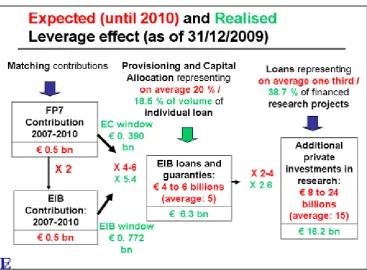
An example of another tool for the financing of RD&I projects is the Risk-Sharing Financing Facility (RSFF), addressing bankable RD&I projects for which the credit risk is perceived to be low or sub-investment grade. The EIB and the European Commission launched the RSFF in 2007. The EIB and the Commission each provide €1 billion as a capital cushion to cover the risks incurred for the provision of debt financing of approximately €10 billion of loans under RSFF. This facility provides substantial additional debt finance to complement more conventional sources of finance such as grants, equity and loans. RSFF has shown convincing results to date, and by the end of 2010, loans worth almost €6.3bn were signed, with €3.5 billion disbursed (Figure 2). Energy projects accounted for 15% of RSFF signatures.
26 |CLOSING THE EUFINANCING GAP FOR INNOVATION
second tranche of FP7 (€500 million) and an additional potential budgetary allocation until 2013, as well as potentially putting in place a "renewed RSFF" for the period 2014-2020, with a budget of €5 billion.
As underlined in the context of the RSFF interim evaluation, the expansion of the size and scope of RSFF beyond its initial remit could be considered to support the acceleration of the financing of SET-plan projects. This was also flagged in the conclusions of the last European Council dedicated to energy and innovation calling for a scaling-up of RSFF. Presently there are limitations on the use of RSFF for SET-plan projects, due to eligibility restrictions.
[image:34.595.107.475.281.551.2]Due to its debt-based characteristics, RSFF could help finance the objectives while reducing some of the procedural difficulties of other ‘grant-based’ financing mechanisms.
Figure 2.3. Performance of the RSFF
The RSFF facility should thus be explored further as a solution to fund bankable projects, for which the credit risk is perceived to be low/sub-investment grade, for the testing and deployment of new technologies and in particular the SET-Plan initiatives. An instrument like the RSFF dedicated to energy could be developed. Such a debt or loan guarantee instrument is used successfully in the US, whose Department of Energy has a dedicated financial instrument for energy technologies. RSFF is also attractive to the private sector because they are exempt from the stringent nature of FP7 agreements and in particular from the IPR obligations. Another positive aspect of the loans is that it will allow further separation of the projects which are pre-commercial and need grants from those where appropriate risk-sharing mechanisms can offer enough incentives to the private sector to invest. The more stringent nature of grants can ensure that the right balance between grants and loans is kept. It is thus recommended, that while grant procedures should be adapted to the needs of research, those grants maintain high requirements to avoid using grant subsidies unnecessarily. The RSFF tool can also be designed as a self-sustaining mechanism, by making it a revolving mechanism whereby the (unutilised portion of) capital provisions released after the repayment of loans are reinvested in the scheme, to provide risk coverage for other eligible loans.
RSFF is currently being explored as a means to support SET-Plan technologies. It excludes financing for nuclear research, owing to a lack of political consensus on this technology.
As a comparison of loan guarantee programmes, Box 2.1 presents the US system, which gives an appreciation of the gap in the effort invested between the EU and the US in the area of guarantees.
Box 2.1 US Department of Energy’s loan guarantee program
The US Department of Energy’s loan guarantee program aims to accelerate
the commercial deployment of technologies that reduce emissions of
28 |CLOSING THE EUFINANCING GAP FOR INNOVATION
The Department of Energy’s loan program has so far committed nearly $18 billion to support 20 clean energy projects, plans additional commitments in the coming months, and has requested the US Congress to provide funding to support more than $40 billion in additional future projects. Examples of projects include:
- A biodiesel project intended to triple the amount of renewable diesel
produced domestically;
- Two of the world’s largest solar thermal projects;
- A 2,200 megawatt (MW) nuclear power plant – US first Generation III
project; and
- The world’s largest wind farm with a generating capacity of 845 MW
Projects are selected according to various criteria, including the quality of risk allocation, the robustness of the economic model and the comfort provided by sponsors to lenders and the Department of Energy. DOE support is intended to be diversified, both in terms of technologies and business models (merchant plant, regulated utilities) supported. Main measures either consist of economic incentives, risk mitigation or guarantees designed to secure sponsors and/or lenders.
2.3
Increasing the contribution by the EU budget
While there is potential to increase the multiplier effect of EU funds there is still a need to ensure that sufficient funding is available for those areas of RD&I where grants are necessary, such as basic and early state research and demonstration. It is then necessary to find funding for the loan provisioning and credit-enhancement instruments as provided by public and private financing institutions.
If one looks at the present €3 billion per year distribution of funding in RD&I for the SET-Plan technologies, we find roughly a 10-20-70 ratio between EU support, national public funding and private investment. Increasing the amount of investment by an additional €5 billion per year will necessarily alter this distribution.
In addition, the development of new technologies in the energy sector is to a large extent an EU public good requiring coordination at EU level to generate the economies of scale. As such, the increase in public support should be highest at EU level followed by national and private funding. Investments in energy technology will have an important impact on energy security and the economy, both being of high importance for member states, which should themselves increase their investments. However, public national funding should increase most, due to the New Entrants Reserve (NER300) of the ETS, which will allow member states to spend approximately €1.5 billion in demonstration projects between 2013 and 2015, see section 2.5. To ensure additionality this should be on top of the present expenditure of around €1.1 billion.
The first point indicates that there is a higher role for the EU to play in fostering new energy technologies, thus the share in public spending would need to grow proportionally more for the EU than for the national budgets and both more than the private sector. This would mean that to reach an annual €8 billion budget we would, for example, have to consider a distribution of around 25-35-40: €2 billion by the EU, €2.8 billion by member states and € 3.2 billion from the private sector. This would be equivalent to a €1.7 billion increase by the EU, €1.7 billion by member states and around €1billion by the private sector. These figures are indicative and can vary substantially, but a change in the distributional share of the burden has to be envisaged. The shares would need to be revised post-2015 depending on the existence or not of an NER.
Through innovative financial mechanisms it is possible to increase the private sector leverage, but there are limitations. If the present RSFF €2 billion provisioning facility by the EU budget and EIB were to be fully used for energy projects (which it is not) and assuming an average project cycle of ten years (which is conservative) with a leverage factor of 1 to 5, the mobilised funding represents €10 billion in EIB investment in ten years, knowing that the EIB is only financing up to 50% of the total investment cost. This is probably at least €30 billion short of the additional €50 billion over the next ten years.14 Of course, the RSFF is not the only EIB lending
14 As the EIB only covers a maximum of 50%, a €10 billion loan will leverage a
30 |CLOSING THE EUFINANCING GAP FOR INNOVATION
instrument; there are other standard loans to R&D which it provides at favourable interest rates due to the banks’ credit rating. Nevertheless, the RSFF is supposed to cover those investments that would not be covered by standard investment rate loans.
It is important to have RD&I-oriented investments aimed at the needs for bridge financing needed in costly, large-scale and long maturity energy R&D. It would be advisable to create a dedicated product within the risk financing facility, such as the renewed RSFF mentioned earlier, specifically for energy technologies, which could leverage up to 2 to 3 billion euro a year in investment. Then the EU budget could provide an additional grant investment of €1 billion a year. Other funding dedicated to energy RD&I from different funds, both EU and national, can provide the remaining public funding, including other loan and risk guarantee facilities.
The cost to the EU budget for RD&I in energy would rise approximately by €2 billion a year, which could come from redirecting funds from other budgetary headings. To put it into perspective, this represents approximately 1.5% of the present size of the EU budget.
2.4
Project bonds
The expansion of loan guarantee instruments can be complemented with EU project bonds for specific late stage more mature long-term projects. These have been proposed in the Europe 2020 strategy by the European Commission. More precisely the aim is to recourse to bonds for the financing of projects as one financial instrument to address the funding needs of major infrastructure projects, with the bonds being issued by project companies. The objective of this approach is to attract additional private sector financing for individual infrastructure projects via a mechanism for enhancing the credit rating of bonds issued by a project company. Leveraging on existing EU funds, it is designed to act as a catalyst to re-open the debt capital market (currently largely untapped for infrastructure investments following the financial crisis) as a significant source of financing in the infrastructure sector.
However, project bonds do not need to be limited to infrastructures; they could also be considered for pan-European demonstration and deployment projects for new energy technologies when the costs are high and timeframes long. An example of bonds which can potentially be used for deployment of technologies is the EIB’s “climate awareness bond”, which is focused on investments in climate protection which includes, for example, deployment of renewables.
2.5
The NER 300
A major new source of financial support for renewables at the EU level – though outside the EU budget – is the so-called NER 300 programme, established under Article 10a(8) of the Emissions Trading Directive 2003/87/EC. NER300 is a funding programme for the demonstration of low-carbon technologies at commercial scale and aims to co-fund at least 34 innovative renewable energy technology demonstration projects in the territories of the EU member states, together with at least eight CCS demonstration projects. At current prices of EU ETS allowances, the programme will provide around €4.5 billion of co-funding, and will leverage a matching funding from industry and member states of the same magnitude.15 The Commission launched the first Call for Proposals comprising 200 million allowances under the NER300 programme in November 2010, the award decision is expected in the second half of 2012.16
The NER300 funding raised by the Commission via issuing ETS allowances certificates is expected to be supplemented by MS contributions subject to state aid assessment and clearance by the Commission of the public funding contribution. Projects benefiting from NER300 support could raise additional funding from other sources (e.g. commercial loans, EIB loans). The investment value of projects supported through the proceeds of the NER300 programme is expected to be a multiple of the equivalent allowances depending on the actual sales price of the certificate and on the true perimeter of the relevant cost identified in the regulation. The NER300 process is planned to last until 2013 but the actual implementation period might be longer, depending on factors such as the
15 See Commission Decision 2010/670/EU of 6.11.2010, OJ L 290, p. 39.
16 OJ C 302, 9.11.2010, p. 4, further information is available at:
32 |CLOSING THE EUFINANCING GAP FOR INNOVATION
type of projects funded, potential administrative and operational delays for the completion of the project.
2.6
Innovation/Technology Accelerator
| 33
3.
HARNESSING THE POTENTIAL OF THE
SET-PLAN THROUGH POLICY
COHERENCE
he SET-Plan is not a stand-alone, self-contained policy. While finance is essential, success will also depend on governance of innovation in the broader sense of raising well-known issues of excessive bureaucracy, provisions for intellectual property rights (IPRs) and notably a more trusting and risk-tolerant approach to EU research funding. Harnessing synergies with other EU policies such as regional policy, public procurement or state aid policy will also prove instrumental.
3.1
Reforming the management of EU innovation and research
policy
The SET-Plan has been conceived to be open and with variable architecture focusing equally on market development, science and technology. The main challenges are to find the right balance between the public and private sector in guiding the decisions of the initiative. This will require the European Commission to adopt a different way of management than it follows for example in the field of research funding, notably avoiding bureaucratic practices and political influence.
The expert group that performed the mid-term evaluation found the grant and basic research components of the FP7 programmes well developed in general and pronounced them a success (European Commission, 2010e), despite problems in the administrative and financial structures. However, industry’s evaluation seems to contradict this finding, evidenced by the falling rate of industry participation in EU research programmes, mainly as a result of real or perceived bureaucracy or issues surrounding intellectual property rights.
The expert group’s enthusiasm is more subdued in the areas that the SET-Plan considers a priority, namely going from the basic results of RD&I towards a deployable and commercially viable product, for example
34 |HARNESSING THE POTENTIAL OF THE SET-PLAN THROUGH POLICY COHERENCE
through the Joint Technology Platforms (JTIs). SMEs, which might be prepared to consider expanding their innovation practices using EU opportunities, consider the present assistance too focused on pre-commercial RD&I, and not enough on the later stages of demonstration, testing, innovation, systems integration and initial deployment.
To improve the performance of the funds and make them better adapted to the nature of RD&I, there is a need to reform the Financial Regulation of the EU, which presently is too rigid and risk-averse. It is based on public procurement rules that focus on process rather than outputs. The Carvalho Report from the European Parliament (2010) identifies the need to change the nature of the rules, focusing on more outputs and increasing flexibility, and calls for the Commission to make the Framework Programme compatible with a ‘science-based’ activity.
The report also calls for a higher rate of tolerable risks of error (TRE), as RD&I is by nature full of unknowns. In particular it calls for more flexibility in accounting rules, accepting more flexible cost estimations.
Evaluations of the EU research and development policy consistently mention the lack of participation of the corporate sector and SMEs in EU RD&I programmes. Industry and SME participation in EU research programmes has been steadily falling. This trend is largely attributable to two causes.
The first relates to the provisions governing IPRs, whereby industry generally is not often awarded the rights coming out of the research programme. This is largely irrelevant for basic research but matters considerably when research moves closer to the commercialisation stage. The present system largely ignores the mixed academic and commercial structures of the research institutes in Europe. This undermines the incentive for industry to participate by investing its own money. This situation – which is far from being an EU/EEA problem – could be overcome by more appropriate rules that better reflect the stage of development from basic R&D, demonstration and deployment and the role and risk incurred by private investors.
project. During implementation, participants complain about a multiplication of financial control rules and onerous reporting procedures. The Framework programmes are heavily focused on procedure rather than the final result.
The use of price-based or ‘lump sum’ selection methods with much lower requirements on cost estimations should be considered in exchange for much higher requirements on the quality of the results. The Carvalho report calls for the elimination of cumbersome and unproductive procedures, such as timesheet completion.
It also mentions the need to simplify and streamline the multitude of “programmes (e.g. FP, CIP, Structural Funds) and associated instruments (JTIs, Article 187 initiatives, PPPs, Article 185 projects, KICs, Era-net, etc.)” (p. 24). This could be combined with a streamlining of pre-formulation procedures.
3.2
Harnessing synergies between the SET-Plan technologies and
the EU Structural and Cohesion Funds
The EU Structural and Cohesion Funds will have an important influence in determining the infrastructure of many regions and countries. The regions and countries benefiting from those funds have an opportunity to install the energy systems of the future. New, existing and future technologies, from renewable energies to smart grids, require more flexible and integrated energy distribution systems. Introducing the right infrastructure now will allow these countries to benefit from the new technologies without the large opportunity costs and problems that regions with more recent but incompatible infrastructure face. The development of the right infrastructures of large areas of the EU will also considerably reduce the barriers and costs of deploying SET-Plan technologies, creating a win-win situation for the regions, the technology developers and the EU as a whole.
More entrepreneurial regions could combine EU funding for Cohesion with the need for large-scale testing and deployment of new technologies, such as the deployment of smart-grids with new renewable energy sources on a regional scale (e.g. Núñez Ferrer et al., 2009). Regions with infrastructures that need upgrading could take advantage of the benefits of being at the forefront of new developments, which could result in considerable economic benefits both in the short and long term.