Rochester Institute of Technology
RIT Scholar Works
Theses Thesis/Dissertation Collections
2008
Computational model of MST neuron receptive
field and interaction effect for the perception of
self-motion
Chen-Ping Yu
Follow this and additional works at:http://scholarworks.rit.edu/theses
This Thesis is brought to you for free and open access by the Thesis/Dissertation Collections at RIT Scholar Works. It has been accepted for inclusion in Theses by an authorized administrator of RIT Scholar Works. For more information, please [email protected].
Recommended Citation
Computational model of MST neuron receptive field and
interaction effect for the perception of self-motion
A Thesis Submitted in Partial Fulfillment of the Requirements for the Degree of
Master of Science in Computer Science
by
Chen-Ping Yu
Submitted to the Department of Computer Science
Rochester Institute of Technology
July 21, 2008
Approved by Committee Members:
Dr. Roger Gaborski, RIT
Chairman
Drs. Charles Duffy, U. of Rochester
Reader
1
Abstract
Biologically plausible approach is an alternative to conventional engineering approaches
when developing algorithms for intelligent systems. It is apparent that biologically inspired
algorithms may yield more expensive calculations when comparing its run time to the more
commonly used engineering algorithms. However, biologically inspired approaches have great
potential in generating better and more accurate outputs as healthy human brains. Therefore more
and more new and exciting researches are being experimented everyday in hope to develop better
models of our brain that can be utilized by the machines.
This thesis work is an effort to design and implement a computational model of neurons
from the visual cortex’s MST area (medial superior temporal area). MST’s primary responsibility
is detecting self-motion from optic flow stimulus that are segmented from the visual input. The
computational models are to be built with dual Gaussian functions and genetic algorithm as its
principle training method, from the data collected through lab monkey’s MST neurons. The
resulting computational models can be used in further researches as part of motion detection
mechanism by machine vision applications, which may prove to be an effective alternative
motion detection algorithm in contrast to the conventional computer vision algorithms such as
frame differencing. This thesis work will also explore the interaction effect that has been
discovered from the newly gathered data, provided by University of Rochester Medical Center,
2
Table of Contents
1. Introduction...5
2. Background ...10
2.1. Retina ...10
2.2. Receptive Fields ...12
2.3. Primary Visual Cortex (V1) ...14
2.4. Ventral and Dorsal Stream (“what” and “where” pathway) ...16
2.5. Ventral Steam (the “what” pathway) ...17
2.6. Dorsal Stream (the “where” pathway) ...19
2.7. MST and Optic Flow...22
3. Data ...24
3.1. Neurophysiological Stimuli...24
3.2. Neuron Recording ...27
3.3. Singles Data...28
3.4. Optic Flow Data ...34
3.5. Doubles Data ...37
3.6. Interaction Effects in Doubles Recordings...40
4. Methods...44
4.1. Training of the Dual Gaussian Model ...44
4.1.1. Dual Gaussian Singles Models ...44
4.1.2. Clamping ...46
4.2. Genetic Algorithm – Singles Model Training...47
3
4.2.2. Selection ...48
4.2.3. Crossover...51
4.2.4. Mutation ...52
4.3. Genetic Algorithm – Doubles Model Training ...54
4.3.1. Dual Gaussian Doubles Model and Template-Matching ...54
4.3.2. Doubles Diagonal Hotspot Data Interpolation ...57
4.4. Gain Modulation ...59
4.4.1. Nine Gain Factors...59
4.4.2. Eighteen Gain Factors ...60
4.5. Optic Flow Prediction ...60
4.5.1. Singles to Flow Prediction...61
4.5.2. Template Matching Flow Prediction with Doubles Dual Gaussian Models ...62
4.5.3. X and O Doubles Template ...63
5. Results ...65
5.1. Singles Model...65
5.2. Doubles Model ...70
5.3. Flow Prediction ...76
5.3.1. Singles to Flow Prediction...76
5.3.2. Doubles to Flow Prediction ...81
5.3.3. Singles Gain Modulation – 9 Gain Factors ...86
5.3.4. Singles Gain Modulation – 18 Gain Factors ...92
5.4. Performance Comparisons ...98
5.4.1. Singles vs Doubles in Flow Prediction...98
5.4.2. Doubles Model with Interaction Effects...103
4
6. Summary and Conclusion ...113
7. Future Work...116
5
1. Introduction
The human brain excels in just about every aspect of function as an intelligent system.
Therefore, biologically inspired systems attempt to base its designs from the organization and the
functionalities of the human brain. This thesis work is an effort to design and implement a
computational model of neurons from the visual cortex’s MST area (medial superior temporal
area), with dual Gaussian receptive field functions derived by a GA as its principle training
method My goal is to fit the data collected in awake monkey neurophysiological studies of MST
neurons, and to better understand the receptive field mechanisms of their role in the visual
motion processing of optic flow stimuli.
The results of the computational models of this thesis will bring us closer to developing a
better biologically feasible computer vision system. However, due to the fundamental differences
between the computational algorithms and the brain's neuronal format, it is difficult to implement
biologically feasible algorithms and systems with many computational approaches. Another
obstacle is that we do not currently have enough understanding of how the brain process visual
information. As we make progress toward understanding the brain in greater detail, we will be
able to develop better and more accurate models for specific parts of the brain. These new
understandings can then be utilized onto machine algorithms that are more biologically plausible.
The criterion of biologically plausibility is an alternative to conventional engineering
approaches when developing algorithms for intelligent systems. It is apparent that biologically
inspired algorithms may yield more expensive calculations when comparing its run time to the
more commonly used engineering algorithms. However, biologically inspired approaches have
6
healthy human brain. Therefore more and more new and exciting research is being developed in
hope of creating the foundation for better models of our brain that can be implemented in
machines.
Computer vision, being a branch of the field of artificial intelligence, is one of the areas
that may benefit greatly from new understandings of biological vision. Approaches include
Gaussian derivative models for motion related detections that are based on the receptive fields of
visual cortex neurons and are able to sense the movement of objects across multiple display
frames [22]. Dr. Young has done extensive research in regards to biologically plausible models of
the visual cortex. His models of Gaussian derivatives mimic the center-surround receptive field
organization of visual cortical neurons. By taking more derivatives of Gaussian curves, it is
possible to create various different models that contain different lobes, phase, directions, and
frequencies. Using these Gaussian derivatives he was able to create models that detect basic
moving edges, as well as cars moving on the highway. The Gaussian derivative models also has
great potential to be used in many different motion sensing applications such as surveillance
cameras and object tracking systems.
There is also modeling effort done in the higher level of the visual cortex. VisNet is one
such example [18]. VisNet focuses on the modeling of connections between neurons within
visual cortex, rather than single neuron's receptive field representations. VistNet is a network of
nodes interconnected in a hierarchical format. The nodes are initially generated with random
connections, and it is a supervised network which is trained with its training set, with Bayesian
probabilistic learning rules that either keep or cut off connections between nodes. The trained
VisNet model can be used as pattern recognition systems, or object recognition applications.
7
contribute as biologically inspired models that can be used in machine vision systems. Gaussian
derivative models [22] are included in this category since their development was based on the
neuron's center-surround receptive field organization [14]. There are also models developed
based on the MT (medial temporal) area of the visual cortex that is analyzed to understand how
the MT neurons can sense motion of visual pattern [19].
Thus, computational neuroscience models includes single neuron models, sensory
processing models, neuron organization models such as VisNet [18], and models of higher
cognitive function, learning, and consciousness. This thesis work focuses on single neuron
contributions of visual motion sensory processing. The work may be used in future machine
vision applications that are related to motion processing as biologically inspired computer vision
systems. Specifically, this thesis work is aimed at developing receptive field models of MST
neurons with discovered interaction effects that may account for flow selectivity in some neurons
[24]. The interaction dependent changes in selectivity can be as dramatic as reversing the
direction of visual motion preferences. To model these effects, recorded firing rates from
neurophysiological studies of interactions between local motion stimuli will be trained into the
MST receptive field models. The interaction effects will be tested to determine whether they
allow the models to mimic the neurons optic flow selectivity by shifting local motion selectivity
according to specific combinations of local-motion across a neuron’s receptive field.
Understanding the pathway of visual information processing enables future research
efforts related to biologically inspired machine vision systems. At the highest level, we all accept
that the eyes receive light that is reflected from the objects around us. The retina transduces that
light to create a neuronal signal that it relays through the optic nerve, then the thalamic lateral
8
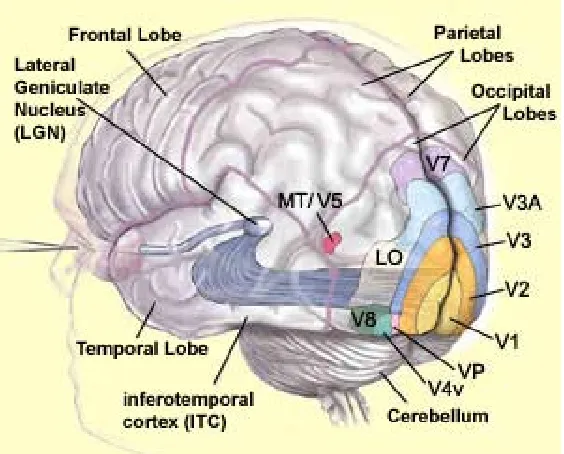
Figure 1 from McGill U. Website, Canada
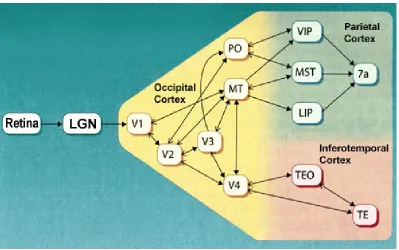
From V1, visual information splits into two parallel steams of processing: the ventral
stream, also known as the what pathway, and the dorsal stream, also known as the where
pathway (Figure 2). The ventral stream goes from V1 to V2, V4, then IT (inferior temporal area).
This pathway is called the what pathway because it mainly detects and recognizes objects from
the visual information. The dorsal stream goes from V1 to V2, MT (medial temporal area), then
MST. This pathway is called the where pathway due to its ability to process object’s motion in
the scene, as well as self-motion. The combination of these two information processing steams in
parallel results in the precise understanding of what we see.
Some further details of each area and each process pathway will be explained in the next
section. In addition, basic receptive field properties and features of the optic flow that is seen
during self-motion will also be discussed in greater length in the next section as they are the
9
Figure 2 The Visual Pathway, from McGill University Website, Canada
[image:11.612.108.507.69.319.2]10
2. Background
Before the details of any neuronal modeling effort can be understood, it is essential to
have some agreed upon description of the basic architecture of the brain systems to be
considered. Since this research is on modeling the receptive field properties of MST neurons, and
interactions between segments of MST neuronal receptive fields, it is important to be aware of
how the human brain processes the visual input received from the eyes.
2.1. Retina
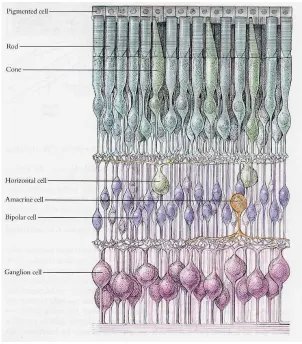
The retina is at the back of the eye and contains several layers of cells that allow us to
process color and light intensities [11]. The retina includes layers of ganglion cells, bipolar cells,
horizontal cell, rods, and cones (Figure 3).
11
Although the ganglion cells are closest to the iris, the light that passes through the cornea
would pass through all the layers of ganglion cells and bipolar cells, and be received by the rods
and cones first, then the input information is propagated to bipolar cells, ganglion cells, then
along the optic nerve to the visual cortex at the back of the brain [11].
The rods are responsible in processing input information in low ambient light intensity
conditions; the cones process color input at higher light intensity conditions [11]. Rods are also
in a much larger numbers compared to the cones in the retina, there are approximately 100
million rods as comparing to just 5 million cones in our retina. However, our fovea, which is
where we see the most detail with our central vision, contains mostly cones.
[image:13.612.172.474.346.690.2]12
Rods and cones output to the bipolar cells. The bipolar cell’s effective responsibility is to
transfer the visual information from the rods and cones to the ganglion cells. The ganglion cells,
which converts the light information into action potentials, fires spikes and outputs to the lateral
geniculate nucleus (LGN), which acts as a relay station for the information inputs [11]. Since the
LGN receives more than just visual information, but also inputs from the cerebral cortex, and the
brainstem, LGN may filter visual information before passing it on to primary visual cortex. In
particular, both the left and right LGN receives visual input from both eyes. This allows the LGN
to send the image of the contra-lateral visual field (opposite side of the visual world) from both
eyes to the primary visual cortex on its side.
2.2. Receptive Fields
Before going further into how visual information is processed in visual cortex, we will
consider the basic design of the neuronal receptive fields that supply information to visual
cortex. The receptive fields of retinal ganglion cells and LGN neurons share the same basic
design. This design is that of the center-surround structured receptive field [14]. This structure is
of two basic varieties: on-center off-surround, and off-center on-surround (Figure 5).
Figure 5 Left: on-center off-surround receptive field
13
When an on-center segment is illuminated it makes the neuron fire more, when an
off-surround segment is illuminated it makes the neuron fire less [11]. Likewise, when the
illumination of an on-center segment is extinguished the neuron fires less. When the illumination
of and off-surround segment is extinguished the neuron fires more. The opposite scenario applies
with off-center on-surround retinal or LGN receptive fields.
The center-surround organization of many retinal and LGN receptive fields has been
thought to be combined to create the various types of receptive field organizations found in V1
cortex. Consider that if such center-surround receptive fields arranged along a straight line
through the visual field their outputs could be combined to create an orientation selective V1
receptive field [11]. If such a cell is organized to be sensitive with a 90 degrees straight line in
sight, then when the 90 degrees straight line is within the center of the receptive field, the cell
would fire its output very frequently, as in an excitatory action. However if the straight line is
perceived at where the surrounding of the receptive field is, then the cell would inhibit its firing
of signal, as in an inhibitory action. The off-center on-surround acts similarly as the example,
just in an opposite way. This is one theory of the orientation selectivity of V1 simple cells
14
Figure 6 Orientation specificity of V1 simple cell receptive field, white bar
is the stimuli. When the white bar is at different orientation in the receptive
field, the cell reacts differently. Figure from Hubel, 1995.
2.3. Primary Visual Cortex (V1)
The primary visual cortex, anatomically known as the striate cortex due to white matter
stripe through layer IV, is also labeled as V1 to refer to its functional role as first visual
processing stage after the LGN. V1 is part of the occipital lobe occupying the posterior tip of the
brain. A diverse assortment of neurons in V1 are designated simple cells (for having separate
excitatory and inhibitory subfields), complex cells (for their inseparable subfields), and
hypercomplex (for end-stop inhibition to long bar stimuli) [11]. All of these cells are higher up in
their processing of visual information than retinal and LGN center-surround cells. The receptive
fields of V1 simple, complex, and hypercomplex have been thought to be composed of a
15
Figure 7 LGN projection to V1, from Hubel, “Eye, Brain, and
Vision.” 1995.
Figure 7 presents a diagram of the inferior view of the human brain, looking from straight
below the brain up into the brain. V1 is at the bottom in this drawing, where it is labeled as
primary visual cortex. Each half of the brain, a hemisphere, contains half of V1. V1 is the first
major processing stage for the analysis of visual information. In addition to the diverse receptive
field properties of V1 cortex, these neurons are also responsive to color and movements in the
visual field, as well as some pattern. However, for the detailed and precise processing of the
visual input, V1 splits its output information into two somewhat distinctive visual processing
16
Figure 8 Blue: Primary Visual Cortex (V1)
Purple: Ventral steam
Green: Dorsal steam
figure from Wikipedia.com, “Dorsal Stream”
2.4. Ventral and Dorsal Stream (“what” and “where” pathway)
As the primary visual cortex, V1, receives the spikes of action potential firing from the
LGN, the information processing starts to split into two parallel processing stream: the ventral
stream and the dorsal stream (Figure 8). The ventral stream processes the objects seen in the
scene and detects what they are, whereas the dorsal stream processes object locations and motion
as well as the full-field motion that results from the observer’s self-motion (optic flow) [11].
The path of information flow in the ventral stream takes place in the sequence of areas
from V1, to V2, to V4, and then to IT. The path of information flow in the dorsal stream takes
place in the sequence of areas from V1, to V2, to MT, and then to MST. Both streams share the
17
is responsible for some color and directional selectivity [11]. V4 is not part of the dorsal stream
because V4’s major functionality is in processing color. Color information is more important
when recognizing objects but much less important when determining the movement or the speed
of something that is in motion. In fact, all we need is the light intensity (black/white) to
determine objects’ motions and self-motion, therefore it makes a lot of sense for dorsal stream,
which detects motion, to go past the V4 processing of color, while the ventral stream gets the
color information to further determine all the objects from the visual scene (Figure 9).
Figure 9, the dorsal and ventral stream.
2.5. Ventral Stream (the “What” pathway)
The ventral stream, which is indicated as the purple blocks along the bottom in figure 9,
represents temporal lobe processing of visual data from V1 in parallel with dorsal stream area
shown as green blocks. The ventral stream is mostly responsible for object and pattern
recognition and identification; therefore it importantly accesses and contributes to long term
18 V4, and IT (Figure 10).
Figure 10, the information flow through dorsal stream extrastriate visual cortical areas.
V1 is, as described earlier, sensitive to color and directional selective stimulus. V2 and
V4 share very similar functionalities in terms of color detection and complex cell directional
selectivity as V1 [11]. However, as the processing level goes higher and deeper from V1 to V4
then to IT (inferior temporal area), some research indicates that the attentional modulation of
neuronal response sensitivities become stronger at the higher stages, although there remains a
great deal of disagreement on this point. V4 primarily processes color and shape information,
therefore IT has very complex receptive fields due to the large amount of processed information
and visual area from the processing of V1 through V4.
Common biologically inspired object detection algorithms that mimic how ventral steam
processes shape and color information utilize Gabor filters [20]. Gabor filters with different
angles of orientation are able to smooth the image, and filter for a specific orientation by
convolution with shaped filter at various angles. For example, applying a Gabor filter that is at
19
Figure 11, Gabor Filter 90° (left) convolved with a grey scale image (middle). Result (right)
shows the vertical (90°) edges displaying higher intensity (darker areas) than non-vertical
parts of the image (lighter areas).
This type of Gabor filter smoothing is very useful for object recognition algorithms that
are biologically inspired. By setting up and getting the responses of multiple Gabor filters with
different orientation at different locations of an input image, we are able to segment for specific
shape of objects from the responses generated [20]. We can also obtain the original color values
of the segmented area from the Gabor filters, which help represent the object segmented with
more information, therefore completing the ventral-stream inspired object detection algorithm.
2.6. Dorsal Steam (the “Where” pathway)
The dorsal stream, which is indicated as the green blocks along the top in figure 8
represents V1 occipital lobe projections toward the parietal lobe of the brain. The dorsal stream
process visual motion data from V1 in parallel with the ventral stream’s processing object
features. The dorsal stream is mostly responsible for spatial understanding, which recognizes
20
Figure 12, the information flow through dorsal stream extrastriate visual cortical areas.
From V2, the ventral stream continues into V4 for more color processing as stated from
the earlier section. The dorsal stream, however, continues into MT (Medial Temporal area) after
the basic edge and color processing done from V1 and V2. MT area is responsible for
recognizing where objects are located in the scene. As the objects move or as we move, MT
keeps us updated with respect to where objects are, therefore enabling us to detect motion over
time. Motion detection in general does not require color information about the object, this may
be related to the fact that a person isn’t able to detect the color and shape details about a car
passing by very quickly, but is able to sense that some object was moving though their visual
field. MST (Medial Superior Temporal area), being another processing stage after MT,
specifically detects the visual motion patterns that result from observer self-motion [4]. These
patterns of visual motion from self-motion are referred to as optic flow, which is represented in
cortical area MST, which also does not require color information.
Dorsal stream’s motion detection processing in MT can be simulated with Gaussian
derivative models developed by Dr. Richard Young [22]. A 3-dimentional Gaussian derivative
model that is convoluted with an input video is able to detect moving objects with time as its 3rd
axis. By generating the GD model with different orientation, it is able to respond to different
21
Figure 13, 3-Dimentional Gaussian Derivative Models. G00 as Gaussian function, G10
being the first derivative of Gaussian, G20 being the 2nd derivative. Figure from Young,
2001.
As the GD model is rotated with respect to Y axis, convolved with each time frame of the
GD model with every frame from the video of interest sequentially, if any object or edge is
moving in similar direction as the rotated GD’s orientation, the GD model will respond with
22
2.7. MST and Optic Flow
MST is the next stage of dorsal stream processing after MT. MST is responsible for
self-motion detection from optic flow and the neural representation of that visual self-motion information.
Due to being aware of self-motion, a person is able to estimate his heading direction and avoid
obstacles even during relatively fast motion through the environment.
Optic flow is the visual input that MST utilizes to process and determine heading
direction during self-motion (Figure 14). Optic flow is the radial pattern of visual motion that is
created by a person’s self-motion. It contains a focus of expansion from which all movement
appears to emanate. The focus of expansion (FOE), the singularity where the optic flow cues
flow out from, indicates the person’s heading direction under most circumstances [15]. By
processing optic flow, we are able to navigate around in an environment very efficiently without
the need of knowing the details of our surrounding objects, except knowing their location and
their relative motion. Optic flow is commonly simulated as being black and white, and these
stimuli appear to activate MST neurons effectively, suggesting that the processing of color
information is independent at this stage, as is consistent with the dual pathways model described
above [4]. MST’s representation of visual motion information is so useful that the airplane pilots
land the planes with optic flow assisted screen to guide the landing more accurately with ease by
23
Adapted from Gibson (1950) Adapted from Gibson (1950)
Figure 14, optic flow of a pilot landing its plane.
MST neurons mainly process optic flow representation of our visual input. It is also the
next processing level after MT, therefore it is not surprising that its neurons appear to have very
complex receptive fields due to its high level of visual motion processing. MST neurons’
receptive fields are conventionally known as solid state much like other motion sensitive neurons
– the responses of firing rate can be summed up from local motions responses, and it does not
alter its tuning of flow selectivity. However, our data reveals interesting findings in which our
MST neurons shift its flow selectivity with different optic flow stimuli, sometimes even reversed
from its local-motion selectivity. This effect will be discussed and displayed in more details in
24
3. Data
3.1. Neurophysiological Stimuli
The neurophysiological data used in this thesis were collected at University of Rochester
Medical Center, Cognitive Neuroscience Laboratory by Drs. Charles Duffy and David Logan
with subsequent data management overseen by Dr. William Page. In brief, the responses of
single neurons were recorded from the dorsal segment of the medial superior temporal area
(MSTd) in the cerebral hemispheres of adult Rhesus monkeys. Surgical preparation began with
sedation followed by venous catheterization, endotracheal intubation, and general anesthesia
using inhaled isoflurane. Scleral search coils were implanted around the limbus in both eyes [13]
to monitor eye position using the magnetic search coil technique [16]. A head holder and bilateral
recording cylinders were placed over 2 cm trephine holes centered above area MSTd.
Postoperative analgesia with banamine was administered in consultation with the veterinary
staff. All protocols were approved by the University of Rochester Committee on Animal
Research and complied with Public Health Service and Society for Neuroscience policy on
laboratory animals.
The monkeys were trained to sit in a primate chair and perform a visual fixation task. All
stimulus presentation trials began with the illumination of a stationary, red fixation point
centered on the tangent screen (Figure14). If the monkey maintained fixation (+/-3o) throughout
the 5-second trial, an auditory tone was sounded and liquid reward was dispensed. Recording
sessions were begun after the animal consistently completed trials with an accuracy of >90%.
25
ECP4100) at 60 Hz to cover the central visual field (90° x 90°) unless otherwise specified.
The monkey maintained visual fixation on a tangent screen during the presentation of all
visual stimuli. The display screen is a 90° x 90° rear-projection screen that is 48 cm in front of
the monkey. In experiments in which local motion stimuli were presented, the projection was
sub-divided into a three by three array (Figure 14). Dividing the viewing area into these nine
segments helps localize difference in response when local motion occurs at different places in the
visual field. This also allows the possibility of multiple segments combination testing. The nine
segments are labeled for implementation usage as follows:
Figure 15, a stationed monkey fixated at the center of the screen as
indicated by the red dot. The screen is divided into 3x3 sections
as the white division lines indicates (there is no real division line
26
After the monkey fixating at the center of the screen for 500 ms, a 2 second block of
motion stimuli was presented. Each block contains 4 different motion stimuli, with each motion
stimuli being displayed for 500 ms. The baseline firing rate of a neuron is recorded during the
500 ms fixation interval for each block, and the neuron’s firing rate from each stimuli block is
averaged over 6 trials of presentation.
Visual motion stimuli are made up of 500 white dots moving toward 1 of the 4 cardinal
planar direction on the black background for singles and doubles experiments, while the motion
stimuli for optic flow experiment contains a set of 16 global flow motions. Each dot encloses
0.19° at 2.61 cd/m² against a 0.18 cd/m² background. Each dots’ initial position is randomly
generated in the first frame with random life of 1 – 60 frames in each stimulus. Dots accelerate
as a sine x cosine function of their distance from the FOE, maintaining an average speed of
40°/s.
According to different experiments, the display screen may have one or more segments of
the 3 by 3 square showing dots moving to one of the eight directions: 0 degrees, 45 degrees, 90
degrees, 135 degrees, 180 degrees, 225 degrees, 270 degrees, and 315 degrees (Figure 15). In the
data sheet, they are labeled as integers 1 to 8 as to indicate motion 0° to 315°.
Figure 16, the eight different directions of motion that white dots may be displaying on
segments of the screen. From left to right: 0°, 45°, 90°, 135°, 180°, 225°, 270°, and 315°.
27
(“singles” experiment), there may be a combination of 2 patches showing the same or different
motions of dots (“doubles” experiment), and all 9 segments may also be fully displaying the
moving dots (“optic flow” experiment). The specifics depend on which experiment is being run
at the moment. During each 2 sec motion stimuli presentation block, the singles and doubles
stimuli were randomly interleaved in either the “X” or “O” pattern (Figure 16). The sequence of
testing is repeated until all stimuli were tested. The optic flow motion stimuli was tested on its
own without interleaving any other type of stimuli, and the optic flow motion stimuli contains 16
different full screen motion consists of white dots moving on the black background (Figure 21).
3.2. Neuron Recording
Microelectrode penetrations were made using epoxy-coated tungsten microelectrodes
(Microprobe) that were passed into cortex through a transdural guide tube positioned within the
recording cylinder [3]. Neural activity was monitored to locate the depth of physiological
landmarks, and experiments were initiated whenever neuronal discharges were clearly isolated.
Single neuron discharges were isolated using a dual window discriminator and stored with the
stimulus and behavioral event markers using the REX experimental control system [10]. Neuron
firing data were averaged across the 500 ms period of six to eight stimulus presentations to
characterize responses to each stimulus. When a neuron was isolated, we used a hand-held
projector to define its approximate receptive field boundaries. We used physiological criteria for
identifying MST neurons including their having large receptive fields (>20x20°), which contain
the fixation point, with direction-selective responses, preferring large moving patterns rather than
28
penetration across the superior temporal sulcus (STS) to identify the responses of MT neurons.
MT was identified as having much smaller receptive fields that are proportionate to the
eccentricity of the receptive field center and show greater responsiveness to bar or spot
movement than is seen in MST.
The stereotaxic positioning of the recording chambers and the depths of microelectrode
penetrations direct neuron recordings into cortical area MST. During the course of these
experiments, microelectrode positioning in MST was confirmed by magnetic resonance imaging
of the brain with microelectrodes in place. Images were obtained in the sagittal plane on a 1.5
Tesla magnet (General Electric) with fast spoiled gradient echo technique (TR = 23.5, TE = 10.3,
30° flip angle). The MR scans confirmed the location of the electrode tips in the anterior bank of
the STS. At the end of experiments on a monkey, electrolytic marks (25 µA x 25 s) were made
along the penetration tracks in three guide tubes in each hemisphere. After perfusing the animal
and fixing the tissue, posterior cortical blocks were cut in 50-mm thick sections. Every fourth
and fifth section was stained by the Nissl and Luxol Fast blue methods, respectively. The
electrolytic lesions were identified relative to anatomic landmarks to extrapolate the position of
the recording sites.
3.3. Singles Data
The singles data were collected by displaying motion in one of the nine patches at a time
for 500 ms. Each testing neuron receives two possible sets of input combinations: X or O type of
segment combinations (Figure 16). If a neuron is being tested for an X combination, the neuron
29
experiment displays motion at four segments one at a time: segment 2, 4, 6, and 8 (Figure 19).
Figure 17, the integer label for each segment of the screen. The X pattern of testing will test
only segment 1, 3, 5, 7, which looks like the character X (red labels), while the O pattern of
testing will test only segment 2, 4, 6, 8, which looks like the character O (white labels).
Each segment of testing includes four planar directions of motion: 0 degrees, 90 degrees,
180 degrees, and 270 degrees. Therefore, the X testing pattern would result in 20 entries of
30
Figure 18, the X pattern of Singles experiment. From left top to right bottom: Segment 1
displays the 4 planar motion (0°, 90°, 180°, 270°) for 4 separate recordings, then recording
31
0.333333 1 0 0 0 0 0 0 0 0 0.333333 0.952 0.285 0 0 0 1 0 0 0 0 0 0 0
0.4 0 0 0 0 1 0 0 0 0 0.4 2 0 0 0 0 0 0 1 0 0 1.154701 0 0 0 0 0 0 0 0 0 1 0 0.333333 3 0 0 0 0 0 0 0 0 0.333333
0 0 0 3 0 0 0 0 0 0 0 0 0 0 0 0 3 0 0 0 0 0 49.25 0 0 0 0 0 0 3 0 0 4.888336
0 0 0 0 0 0 0 0 0 3 0 0 5 0 0 0 0 0 0 0 0 0 0 0 0 5 0 0 0 0 0 0 0 0.5 0 0 0 0 5 0 0 0 0 0.5 0.5 0 0 0 0 0 0 5 0 0 0.5 0.4 0 0 0 0 0 0 0 0 5 0.4 0 7 0 0 0 0 0 0 0 0 0 0 0 0 7 0 0 0 0 0 0 0 0.4 0 0 0 0 7 0 0 0 0 0.4 1.5 0 0 0 0 0 0 7 0 0 1.5 0 0 0 0 0 0 0 0 0 7 0
Figure 19, an X pattern recorded neuron (819R02) comma separated data. Each row is a
recording of a stimulus. For the first row: first column is the firing rate in spikes per
second, column 2 through 10 indicates segment 1 through 9 on the screen. Among the
segments, integer 0 represents no motion for that segment of the screen, 1 means there is
motion of white dots heading at 0°, 2 means 45°, …, 8 means white dots moving towards
315°. 11th column indicates the standard error of this segment’s specific direction firing rate
recording in spikes per second, column 12 is the baseline firing rate in spikes per second for
this neuron (blank screen), and column 13 is the standard error of this neuron’s baseline
firing rate in spikes per second. There are a total of 20 entries from an X pattern recorded
32
The O testing pattern follows the same procedure as the X pattern, but differs in the
segments tested. The O pattern tests segment 2, 4, 6, and 8, with each segment testing four planar
direction of motions: 0 degrees, 90 degrees, 180 degrees, and 270 degrees. The result is 16
entries of recording from a single trial.
Figure 20, the O pattern of Singles experiment. From left top to right bottom: Segment 2
displays the 4 planar motion (0°, 90°, 180°, 270°) for 4 separate recordings, then recording
33
6.25 0 1 0 0 0 0 0 0 0 2.25 5.4792 0.6875 4 0 0 0 1 0 0 0 0 0 2
11.5 0 0 0 0 0 1 0 0 0 2.179449 5.25 0 0 0 0 0 0 0 1 0 1.973787 4.6 0 3 0 0 0 0 0 0 0 1.886796
6 0 0 0 3 0 0 0 0 0 0 2.8 0 0 0 0 0 3 0 0 0 0.489898 5.5 0 0 0 0 0 0 0 3 0 0.5 3.333333 0 5 0 0 0 0 0 0 0 0.666667
3.2 0 0 0 5 0 0 0 0 0 1.2 3.5 0 0 0 0 0 5 0 0 0 0.5 2.8 0 0 0 0 0 0 0 5 0 1.2 11.33333 0 7 0 0 0 0 0 0 0 3.666667
10 0 0 0 7 0 0 0 0 0 2.345208 7.5 0 0 0 0 0 7 0 0 0 2.661453 2.8 0 0 0 0 0 0 0 7 0 0.8
Figure 21, an O pattern recorded neuron (819R04) data. The data follows the same format
as the X pattern. Only that since in an O pattern recording, 4 segments are involved and
each segment is recorded with 4 planar motion, therefore O pattern recorded neuron
34
Some neurons are only tested as an X neuron (only apply X testing pattern and record the
firing rate), while some neurons may be tested only on an O pattern. Some neurons are tested
with both X and O pattern and result in a total of 36 entries of recording results. Therefore, each
neuron's singles data is labeled as X, O, or XO to better identify which testing pattern the neuron
were recorded with.
3.4. Optic Flow Data
The optic flow stimuli simulated the self-movement scene for 16 different heading
directions (Figure 21). The 16 directions were presented in a pseudo-random sequence until each
had been presented during 6-8 successful fixation trials. Each optic flow stimulus consisted of
500 white dots (0.19o at 2.61 cd/m2) on a black background (.18 cd/m2) stimulating the central
90o X 90o of the visual field. All dots were replaced by lifetime expiration (33 to 1000 ms) or by
a smoothing algorithm that maintained a uniform and consistent dot density across the stimulus
in all frames. Dots for these radial patterns accelerated as a sine X cosine function of their
distance from the focus-of-expansion maintaining an average speed of 40o/s.
Optic flow data was collected similarly to the singles data. The main difference is that
each flow stimuli displays motion from all nine segments of viewing area, emulating the
sensation of a specific self-motion. There are a total of 16 flow stimuli recording for each
35
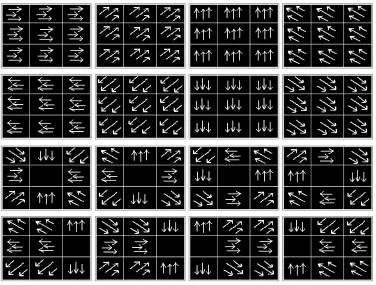
Figure 22, flow stimuli, total 16 of them. Stimulus 1 through 16 is ordered from top left to
top right, then end as the lower right corner as the 16th stimulus. Each of those 16 flow
stimulus has most of the segments displaying motion. White arrows indicate the white dot’s
motion direction within that segment, where all 9 segments combined simulates self-motion
of the opposite direction from the dot’s motion. i.e. flow stimulus 9 has dots moving inward,
which simulates an backward self-motion to the viewing subject; flow stimulus 16 displays
36
15 1 1 1 1 1 1 1 1 1 1.154701 9.75 1.75 23 2 2 2 2 2 2 2 2 2 1
21.66667 3 3 3 3 3 3 3 3 3 3.282953 8 4 4 4 4 4 4 4 4 4 0 6 5 5 5 5 5 5 5 5 5 1.414214 22.5 6 6 6 6 6 6 6 6 6 1.5 27.75 7 7 7 7 7 7 7 7 7 3.326034 30.33333 8 8 8 8 8 8 8 8 8 2.333333 14.25 2 3 4 1 0 5 8 7 6 1.973787 14.75 6 7 8 5 0 1 4 3 2 1.931105 6 8 1 2 7 0 3 6 5 4 0.816497 17.33333 4 5 6 3 0 7 2 1 8 1.452966
4.5 6 6 7 5 5 0 4 4 3 0.5 20.75 2 2 3 1 1 0 8 8 7 1.887459
11.5 7 8 8 0 1 1 3 2 2 2.661453 10.6 3 4 4 0 5 5 7 6 6 1.122497
Figure 23, sample flow data from neuron 819R04. The flow data sheet follows the format
from the singles data, the apparent difference comes to almost fully-filled stimulus numbers
from column 2 through 10, which represents motion being displayed from segment 1 to 9
37
3.5. Doubles Data
The key of this thesis work is the collection and the analysis of the doubles data. The
doubles data are collected similarly as the singles data, except that during each testing, two
segments display motion simultaneously instead of just one. Since there are two segments
showing motion at the same time instead of one, we call it “doubles” data. To better organize the
testing of doubles testing pattern, a “hot spot” is selected from one of the nine segments. The hot
spot is a segment from one of the segments tested from a neuron's singles trial. Therefore, an X
neuron's hot spot could be segment 1, 3, 5, 7, or 9 (Figure 23); an O neuron's hot spot could be
segment 2, 4, 6, or 8; an XO neuron would have 2 hot spots: one from the X pattern and another
one from the O pattern segments. The hotspots are selected as the most excitatory spot from the
single’s recordings. The hot spots are also a reference spot, in which each hot spot is paired with
a “test spot” to form the doubles experiment. The test spot also must be one of the segments
tested from the neuron's singles run. Therefore, an X neuron's doubles experiment contains a
total of 64 entries of recording; an O neuron's doubles experiment contains a total of 52 entries of
recording; an XO neuron's doubles experiment may contain 116 entries since it contains a hot
38
Figure 24, doubles stimulus hot spot #1 first 16 stimulus. As the figure shows, each
“doubles” stimulus displays 2 segments of motion for recording. There is a “hotspot”
segment in which is always present, pairing with another spot we call it “test spot”. In this
case, the hotspot is the 7th segment, and since the 7th segment is a part of the X pattern, the
test spots are the 4 other segments that are part of the X pattern recording. This figure is
the first 16 double stimuli for an X neuron, where the hotspot is heading 0°. The next 16
stimuli would have the hotspot moving at 90° pairing with the test spots; then 180°, and
39
63.333 1 0 0 0 0 0 1 0 0 14.24 24.767 7.6 68 0 0 1 0 0 0 1 0 0 0
8.5 0 0 0 0 1 0 1 0 0 6.1305 99 0 0 0 0 0 0 1 0 1 8.7369 2.5 3 0 0 0 0 0 1 0 0 1.893 30.667 0 0 3 0 0 0 1 0 0 14.678
30.8 0 0 0 0 3 0 1 0 0 18.803 47 0 0 0 0 0 0 1 0 3 41 4.2 5 0 0 0 0 0 1 0 0 2.2891
1 0 0 5 0 0 0 1 0 0 0.57735 12.25 0 0 0 0 5 0 1 0 0 7.7715
1.5 0 0 0 0 0 0 1 0 5 1.5 22.333 7 0 0 0 0 0 1 0 0 7.4461
9 0 0 7 0 0 0 1 0 0 4.1473 164 0 0 0 0 7 0 1 0 0 5.5678 86.333 0 0 0 0 0 0 1 0 7 17.13
Figure 25, doubles sample data from neuron 819R10. Again, the data sheet follows the same
format as the singles and flow data sheet. This data is the recording of when hotspot is
moving towards 0°, as the 8th column (7th segment on screen) is showing the integer 1
through out the whole experiment, while pairing up with other X pattern segments moving
toward a planar direction. There are 4 test spots and 1 hotspot in a X neuron, and we test 4
planar motions per segment, therefore there are 16 entries for 1 planar motion of the
hotspot, making the total experiment having 64 entries from all 4 planar motion recordings
40
3.6. Interaction Effects in Doubles Recordings
It is commonly accepted in the field of neuroscience that local motion responses can be
“add up” to form the total flow response of a neuron, and that a neuron’s flow selectivity is
mostly consistent with its local motion selectivity summed up, which would suggest that the
separately collected singles data recordings would be fairly consistent with the neuron's flow
recordings if we puzzle together the appropriate combinations of the singles responses.
However, from the doubles hot spots recordings, we have noticed that at certain situations when
a combination of two segments are on, the resulting neuron firing rate can be as different as
opposite of the neuron's singles data firing rate in the same segments. In one of the more clear
cases, neuron 819R10 seems to be displaying a reversal of selectivity effect triggered by the 7th
segment: 819R10’s singles has its X segments responsive when the motion on the screen is
moving to the left in general (Figure 25), however in the doubles recording, when the 7th
segment being the hotspot is showing rightward motion on screen, the neuron’s selectivity of
other x segments becomes reversed of its singles selectivity, they all becomes rightward
41
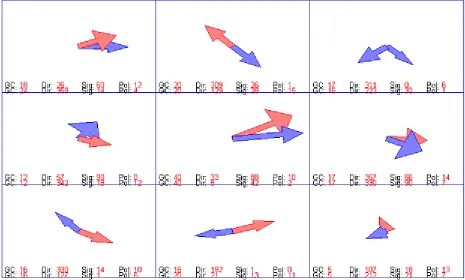
Figure 26, neuron 819R10 Single’s recording in terms of arrows. Each segment’s firing rate
responses from each planar motion is plotted; the length of each arrow indicates the
strength of the neuron’s response when that motion is displayed within that segment. The
strongest two responses are colored as red for easier viewing, which indicates mostly a
42
Figure 27, comparison of 819R10’s Singles X pattern arrow plot, 819R10’s Doubles X
pattern hotspot 180° plot, and 819R10’s Doubles X pattern hotspot 0° plot. The bottom 2
plots are the double’s plots when the hotspot (7th segment, having a red square) is showing
180° movement and its corresponding X patterned test spots, and when the hotspot is
showing 0° movement with its X patterned test spots. It is apparent that when the hotspot is
showing 180° movement, the test spot’s selectivity is more similar to that of its single’s
recording compared to when the hotspot is showing 0° movement: a clearly reversed
43
From the above firing rate illustrations, it is apparent that when specific combinations of
two segments are showing motion, the 2 segments interact and produces a drastically different
response comparing to just one of the 2 segments are being tested. The shift or the reversal of the
responses may also be a type of state-switching, where it is triggered by the hotspot’s motion
stimulus, in which it looks more like a template matching having the hotspot’s motion as its
reference. This finding explains why when puzzling together singles segmental responses to
predict flow responses is a flawed approach, since interaction requires more than one segment
that is displaying motion. The resulting responses from the doubles interaction also indicates that
a neuron's flow selectivity is much more complex than simply adding up local motion selectivity,
that it requires interaction effects to capture a better global selectivity of flow stimuli, resulting in
44
4. Methods
4.1. Training of the Dual Gaussian Model
The aim for the models is to see if singles and doubles model can predict their neuron’s
flow responses. We designed dual-Gaussian models of each MST neuron’s responses to the
singles and doubles local motion responses. Each neuron’s dual-Gaussian model is first trained
by fitting its singles data and then, in a separate step, trained by using its double data. Both
models are derived using the GA. All trainings are done in 3 separate trials of the GA, to provide
an index of the reliability of the model, particularly with respect to the avoidance of local
minima may obscure the actual global minimal error model.
4.1.1. Dual Gaussian Singles Models
The function of choice to model the MST neuron’s singles data firing rates is the Normal
Distribution function; also called the Gaussian function. It was chosen as a reasonable and
widely employed approximation to single neuron response directionality functions (Figure 27).
Dual models were used to accommodate the common impression that local motion mechanisms
include independent excitatory and inhibitory, or less often two excitatory or two inhibitory
mechanisms. The Gaussian function takes the following form:
2 2
-2
( , )
G
e
µ
σ
45
Figure 28, Gaussian curve, µ = 180, σ = 45. As employed in this modeling
effort, the ordinate represents normalized neuronal firing rate
and the abscissa represents local motion stimulus direction.
Since the data is pre-organized into nine different segments, we would need at least nine
Gaussian functions for each segment’s firing rate data. The Gaussian function represents the
preferred direction of motion for each segment. To visualize this, the x-axis of the Gaussian
curve represents the angle (direction) of the segment’s stimulus motion, with a range of 0 to 359
degrees and plotted to label the segment’s preferred direction as 180o from figure 27; the y-axis
represents the neuron’s firing rate when that stimulus direction is presented (Figure 27).
Therefore a Gaussian curve’s µ value represents the preferred direction for a specific segment’s
data, while σ value represents the selectivity of that segment’s firing rate responses. To take into
account potential excitatory and inhibitory responses in each response segment of a neuron’s
receptive field, we added a polarity indicator ( P ) for the Gaussian, which can be either +1 or -1
46
for each segment i, a gain constant ( C ) is applied to the Gaussian curve as well. The complete
function is therefore:
* (
,
) *
i i i i i
response
=
C
G
µ σ
P
We specified two Gaussians per segment to accommodate both excitatory and inhibitory
responses in a segment of the receptive field. In addition, the dual Gaussian models can fit the
bipolar (bi-directional) response functions observed in some segments. Finally, summing the
responses from all nine of dual Gaussian functions with the neuron’s singles baseline ( B )
creates a full accounting of the firing rate data in response to a local motion stimulus. These
baseline values were recorded during recording periods in which no motion stimulus is presented
on the screen, and is taken to be a good indicator of a neuron’s firing rate threshold between its
excitatory state and inhibitory state. Therefore, to obtain a response of a 9-segment singles dual
Gaussian receptive field models from any flow stimulus requires the following function:
4.1.2. Clamping
There is also a need to clamp any negative total response from the dual Gaussian model
47
responses are limited to firing at zero spikes per second, and there are no negative firing rates in
extracellular single neuron recordings. Therefore clamping negative total response to zero for
training the model captures this aspect of the recorded data. Our experience is that this clamping
yields better models.
4.2. Genetic Algorithm – Singles Model Training
After setting up the dual Gaussian functions for all 9 segments of the receptive field (total
of 18 Gaussians), each Gaussian’s parameters were tuned by the GA (genetic algorithm) to
produce the final summed response that match the singles or doubles data for that segment. To
obtain the proper values for each of the variables of the dual Gaussian functions for each
segment, the GA optimizes all of these variables.
4.2.1. Initialization
To initialize the modeling of each neuron, 2550 individual candidate dual Gaussian
models are randomly generated, with each individual Gaussian having the following variables to
be optimized: C, µ, σ, and P. Each candidate model also known as an individual of that
generation in the GA, is the 9-segment model that contains a dual Gaussian for each segment.
Therefore an individual contains 18 Gaussian functions with the above variables that will be
optimized throughout the GA process, and a fitness score indicating how well this individual is
preferred. C is initialized randomly to be between 0 and 200, µ is initialized randomly to be
48
between 0 to 15, with integer larger than 7 representing positive polarity, and negative otherwise.
4.2.2. Selection
For each neuron, each individual model’s fitness score is calculated, then the top 25
individuals are selected for the next phase. The fitness score function combines two different
aspects of each model’s fit to the neurophysiological data. The first fitness function calculates the
absolute error of an individual model’s firing rate responses to the neurophysiological responses.
The absolute error fitness function takes absolute value of the difference between the model’s
response and its corresponding single’s stimulus recorded response, then the difference is divided
by the standard error of this stimulus’ singles recording. This way, larger and smaller standard
error becomes meaningful in the training of the model.
20,16,36
1
i imodel
data
absE
i
i
response
response
Fitness
standardError
=
−
=
∑
The second fitness function calculates the grouping error according to k-means clustering
algorithm. We apply a k-means clustering algorithm to the neurophysiological data assuming
three response clusters for each neuron that corresponds to classifying all responses as low,
medium, or high firing rates. In many cases, this clustering recognizes excitatory responses,
baseline firing responses, and inhibitory responses. Therefore, by having k-means clustering to
49
classified as group 1 (inhibitory group), 2 (baseline/no response group), and 3 (excitatory group).
(
, 3)
(
,3)
groupE model data
Fitness
=
∑
kMeans response
−
kMeans response
The fitness score for each model therefore includes calculated for both absolute error and
group error fitness scores. All of the individual models within the initial population are assessed
the same way to select 25 elite individual models from both fitness functions to make a total of
50
2 54 25 41 5 52 132 39 1 2 166 123 7 13 17 2 21 3 2 117 232 11 10 172 295 43 7 2 40 262 27 1 93 118 31 1 2 35 52 20 10 20 145 79 10 2 165 217 8 4 163 21 83 7 2 195 291 50 7 55 46 46 3 2 70 93 42 6 135 243 4 13 2 93 211 32 1 64 108 5 3
257.67 29 0 0 0 0 0 0 0
Figure 29, a randomly generated initial singles dual-Gaussian model (individual) by the GA
of neuron 712R02. Row 1 through 9 represents receptive field model’s 1st to 9th segment
selectivity dual Gaussians, 10th row represents the 2 fitness scores: absolute error is 257.67,
and group error is 29. Receptive field models all follow the same format as this example
comma separated data file. For row 1 to 9, the first column represents how many Gaussians
are in effect for that segment of the receptive field model; column 2 to 5 are the values for
the first Gaussian: column 2 is the Gain-Constant; column 3 is µ, means the tuning
direction preference; column 4 is σ, indicates how selective this Gaussian is; column 5 is the
polarity of this Gaussian – 8 or larger being positive and other wise negative polarity.
Columns 6 through 9 are the 2nd Gaussian’s parameters which all follows the same format
51
4.2.3. Crossover
Each individual model is consisted of genes, which are represented as binary bits. An
individual model’s genes are its variables that need to be optimized by the GA: C, µ, σ, and P.
The genes of an individual are crossed over with another individual (Figure 29), and the
individuals are provided from the Selection process. The 25 lowest absolute error individuals are
crossed over with the 25 lowest k-means grouping error individuals in the hope that their
crossed-over offspring will have both characteristics: better point to point matching and lower
variance. Each of the 25 lowest total error individuals are crossed over with each of the 25 lowest
grouping error individuals, and each parent produces four offspring. When crossing over from
the 2 parents, we are crossing over the parameters that correspond to each other: gain constant to
gain constant, µ to µ, σ to σ, and polarity to polarity from the 2 parents.
The four offspring from each parents are generated by randomly cutting from an index
point for each of the variables bit strings, split the variable bit string into two pieces from the
index point selected, then combine left piece from parent 1 first to right piece from parent 2 after,
right piece from parent 2 first to left piece from parent 1 after, left piece from parent 2 first to
right piece from parent 1 after, and right piece from parent 1 first to left piece of parent 2 after. If
any of the resulting crossed-over variables contains an invalid number that is larger than the
pre-set limit, such as 500 for µ, the value is then set back to the maximum number that value is
allowed, which is 359 in this case. After all 4 parameters of a Gaussian from each parents are
crossed over successfully, the 4 resulting parameters together represent the newly generated
offspring from the parents. The total offspring is 2500, adding the 50 elite parent individuals
52 individuals.
Figure 30, crossover of 2 parent’s gain constant.
4.2.4. Mutation
In case of any individuals that are locked in possible local minimum from the vast search
space, mutations of the genes are needed. The mutation factor is set as 0.05, and whenever a
random constant between 0 and 1 is less than 0.05, the mutation process will take place for any
candidate variable from an individual. For the variables that are to be mutated, a random index is
53
from 1 to 0 (Figure 30). Possible mutations are considered for every variable for all individuals.
Figure 31, example mutation of a given gain constant bit string. The randomly selected bit
is toggled.
The resulting population becomes the new generation, and is sent back into the selection
process for the loop. A singles dual Gaussian model is expected to take 75 generations of looping
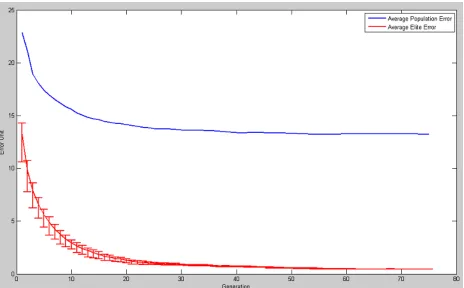
in order to achieve a satisfactory result, whereas for doubles templates X and O would need just
35, due to less data and missing segment firing rates.
54
4.3. Genetic Algorithm - Doubles Model Training
Doubles dataset is different from the singles dataset, in which doubles experiment tests a
pair of segment instead of a single segment from the singles experiment. Therefore, this
difference requires some small modification of the GA training method, as well as how to utilize
the trained models in flow prediction.
4.3.1. Dual Gaussian Doubles Model and Template-Matching
Since the doubles data consists of responses to the selected hotspot paired with a test
spot, some adjustments are required for the GA to find a suitable dual Gaussian model. For each
doubles data file, the hotspot takes one of four planar directions, which is paired with all four
directions of the test spots of either the X or O configuration. In contrast to singles data in which
each segment evokes directional firing rates of its own, doubles data contains firing rates for a
pair of segments. For the GA to find a dual Gaussian model for the doubles data, we do not
assign any Gaussian or firing rate data to the hotspot, we only try to have GA find the
appropriate parameters for the test spot’s dual Gaussian, while using the paired firing rate as the
response to the test spot that the GA tries to fit.
The doubles data is fed into the GA to search for the optimized dual Gaussian curve for
each of the test spot’s segments. Note that for the hotspot, however, does not contain any
Gaussian functions, hotspot will only has identifiers indicating which direction it was tested. The
55
direction serves as a template, that when we use the doubles model to predict flow responses, we
use the doubles template in which the hotspot’s direction matches the flow stimulus’s direction at
hotspot’s segment (Figure 32).
There is a small difference between how doubles data is trained by the GA and that of the
singles: the singles models were trained by the GA optimizing all 9 segments’ dual Gaussian
together, while the doubles models were trained by the GA optimizing just a pair of hotspot and
test spot data at a time, then put back together into a full segments model. Besides the training
efficiency, there is technically no real difference between the two approaches of training as long
as the GA converges to a solution model over the generations. However, the doubles GA training
experienced difficulty in finding a good solution for some neurons, and by dividing the training
set into smaller data sets solved this problem. Therefore, the divide and conquer efficiency was
56
Figure 33, neuron 819R10’s doubles template for flow stimulus 1. This template is
constructed by finding the recording which has its hotspot direction matching the flow
stimulus that we are trying to predict, and for neuron 819R10, it has its X hotspot at the 7th
segment, and O hotspot at the 8th segment, therefore combining the X and O hotspot that
57
4.3.2. Doubles Diagonal Hotspot Data Interpolation
The singles data contains four planar direction’s firing rate responses for X, O, or both
patterns together. The doubles data was recorded the same way as singles. However, for
singles-to-flow prediction we just feed the singles model through the flow’s entire 16 stimuli. For the
doubles-to-flow prediction, we create templates for matching the segmental directions in each of
the optic flow stimuli. The problem with this is that flow was recorded with diagonal motions,
whereas neither singles nor doubles were recorded with any diagonal motion, singles and
doubles were only recorded with the 4 planar motions. Therefore, in order to construct diagonal
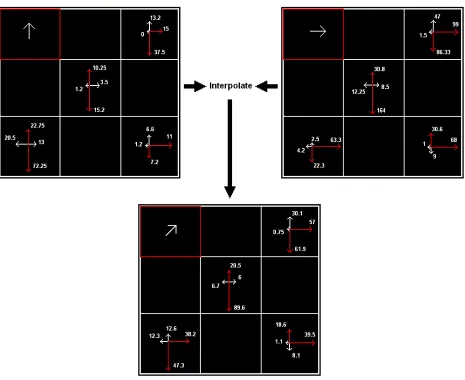
hotspot motion templates, we interpolate for the double’s diagonal hotspot motion’s test spot
firing rates from the data we have.
The doubles data was recorded by presenting just one of the four planar direction motion
stimuli for a hotspot segment paired with a test spot segment. To interpolate for a neuron’s
doubles data X pattern hotspot 45° and X test spot firing rates, simply take the average of hotspot
0° firing rates and 90° firing rates for every tested segment. Repeat the same steps through all of
the other diagonal motion of the hotspot for doubles until all of the diagonal hotspot and test spot