THE SCOTTISH ECONOMY
SHORT-TERM FORECASTS*
The latest official release of the seasonally adjusted output index for Scottish production industries (Divisions 1 to 4 of the 1980 SIC) shows a marked increase (4.7%) in the final quarter over the previous quarter last year. This increase is due largely to a dramatic 30% increase in the output of the electrical and instrument engineering industries in the final quarter. However, considering the overall performance of the UK manufacturing industry (including the electrical and instrument engineering industries which experienced a more modest growth of 3% in the same period), and given all the information contained in various business surveys, such a substantial increase in Scottish production output should, we think, be treated with caution.
There is evidence suggesting that at that u'me the performance of the Scottish production industries
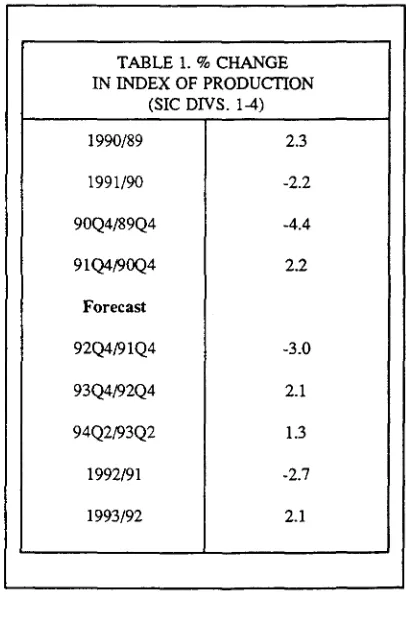
[image:1.511.283.486.313.624.2]was more or less in line with those in the rest of the UK. Therefore, we discarded the last observation on the index for Scottish production output and and ran the forecast from 1992Q3 to 1994Q2. Figure 1 shows the actual index from 1986Q1 to 1992Q4 and the projections for 1993Q4 to 1992Q1. Further details of growth rates for Scottish production output are presented in Table 1. For 1993 as a whole, the output of Scottish production industries is expected to rise by 2.1% over the previous year.
TABLE 1. % CHANGE IN INDEX OF PRODUCTION
(SIC DIVS. 1-4) 1990/89
1991/90
90Q4/89Q4
91Q4/90Q4
Forecast
92Q4/91Q4
93Q4/92Q4
94Q2/93Q2
1992/91
1993/92
2.3
-2.2
-4.4
2.2
-3.0
2.1
1.3
-2.7
2.1
o u t p u t
i
n
d
e
X
Fig. 1 Output Index for Scottish Production Industries
135- 130- 125- 120- 115- 110- 105- 100- 95-QflJ
yvj
(Seasonally adjusted, 1985 = 100)
f actual forecast
1986 1987 1988 1989 1990 1991 1992 1993 1994 time
SCOTTISH CHAMBERS' BUSINESS SURVEY
The principal results of the Scottish Chambers' Business Survey (SCBS) for the first quarter 1993 are detailed below. The SCBS, which is conducted by the Fraser of Allander Institute together with the Chambers of Commerce of Aberdeen, Central, Dundee, Edinburgh, Fife and Glasgow, is the most comprehensive regular survey of business, employment and other issues affecting the Scottish business community. In the present survey, which was conducted during March, 1,223 firms responded to the questionnaire.
Business Confidence
In Manufacturing, business confidence rose appreciably compared with the fourth quarter, with a net balance of 12.6% of respondents reporting that they were more optimistic than three months previously. In the fourth quarter 1992, a net balance of 4% of respondents reported that they were less optimistic than in the third quarter. In the first quarter, Manufacturing respondents were also more optimistic than they were in the same period a year ago, with a net balance of 9.1% of respondents reporting higher optimism. This
compares with a balance of 12% of respondents who were less optimistic in the fourth quarter than in the same period a year earlier.
In Construction, a net balance of 19.6% of respondents reported that they were more optimistic than in the previous quarter. This indicates that the slight net increase in optimism (3%) in the fourth quarter has been sustained after the severe fall in confidence in the third quarter and the previously low levels of confidence present in the industry. A net balance of 13.4% of respondents reported that they were more optimistic than they were a year ago; an improvement of 38 percentage points on the response in the second quarter. Confidence in the sector has clearly improved significantly in recent months.
In Distribution, confidence has also improved considerably. In Retailing, a net balance of 10% of respondents were more optimistic about the general business situation than they were in the previous quarter. In Wholesaling, a net balance of 13.2% reported that they were more optimistic. This can be compared with the net balance of 1% in both Retailing and Wholesaling reporting a fall in optimism in the fourth quarter of last year. While retailers reported, on balance, an increase in
confidence (+4.1%) over the same period a year ago, wholesalers reported a slight decline (-2.6%).
Optimism among respondents from the Tourism and Leisure sector turned round sharply in the current quarter. A net balance of 27.2% of respondents reported that they were more optimistic about the general business situation than they were three months earlier, compared with a balance of 7% in the fourth quarter who reported that they were less optimistic. A net balance of 23% of respondents were more optimistic in the first quarter than in the same period of 1992.
Orders and Sales
In Manufacturing, orders and sales have ceased to fall and appear to be starting to rise. For orders, those reporting a decrease were almost exacdy balanced by those reporting an increase while, for sales, a balance of 2.2% of firms experienced a rise. These figures compare with negative balances of 8% and 10%, respectively, in the previous quarter. The increase in orders and sales was, however, largely confined to export markets.
In Construction, a small net balance of 2.2% reported an increase in orders after several quarters of declines. Orders from Central Government continue to be the most depressed, followed by other Public Sector orders and orders from the Private sector.
Retail sales are now rising again. A net balance of 5.8% of retailers reported that sales had risen, compared with the balance of 10% reporting a fall in sales in the previous quarter. In Wholesaling, sales have also begun to rise. A net balance of 1.9% of respondents reported a rise in sales, compared with the balance of 14% reporting a fall in sales in the last survey.
Tourism demand also increased in the first quarter. A net balance of 12.1% of companies reported an increase compared with the balance of 27% who reported a decline in the three months to December. The upturn in demand appears to have come principally from the Scottish market.
Stock Adjustments
Stocks of finished goods and raw materials in Manufacturing continue to be run down with net
balances of 13.4%% and 19%, respectively, reporting a decline. The rate of contraction has therefore improved somewhat in the current quarter.
Finance and Investment
In the Financial sector, the growth in demand for personal loans has begun to increase again. A net balance of 18.4% of respondents reported and rise, compared with a balance of 5% reporting a fall in the previous quarter. Advances to the corporate sector continue to increase, as does the demand for working capital. Conversely, the demand for finance for investment in buildings, and plant and equipment continues to decline.
Manufacturing investment intentions in plant and machinery have been revised downwards again after stabilising in the previous quarter. There was a further deterioration in manufacturers' investment intentions in land and buildings, with a net balance of 9.2% of respondents reporting a decline, which is much the same as the rate of contraction in the fourth quarter. In Retailing and Wholesaling, investment intentions are now positive. Net balances of 5.1% and 4.4% of retail and wholesale respondents, respectively, reported an upward revision in investment intentions compared to the same period a year ago. The investment intentions of Construction respondents continue to decline.
Expectations
Expectations for the second quarter 1993 are generally for a further improvement in demand conditions. Demand is expected to rise in all principal sectors and in all major markets.The construction sector, on the other hand appears to be less sanguine about the course of future demand than the other sectors.
PRIMARY
FISHING
five year period. In the UK, we have never met the target reductions, and have therefore failed to qualify for EC grants to modernise and renew the fleet Because of the failure to achieve these targets, we also have a backlog so that the UK must achieve a 19% reduction in fleet from the 1992 level by 1996.
Most EC member states have tackled the problem of reducing catches via decommissioning: that is to say, by taking boats out of service completely. However, EC regulations allow 45% of the reductions to be met through restricting the number of days that a vessel can spend at sea through a compulsory tie-up scheme. Legislation going through parliament is presently strengthening the UK tie-up scheme. Each vessel will be given a reference allocation based the number of half days that it spent at sea in 1991. Subsequent reductions in half days at sea which are expected to come into force in September/October of this year will be made against this reference number.
The government have indicated that the additional costs involved with the new tie-up regime are £1.5 million per annum, though the view of the National Federation of Fishermen's Organisations is that the complexity of the scheme, applying as it does to 5,000 fishing vessels, means that implementation will be considerably more expensive. The Sea Fish Industry Authority have calculated a likely loss of individual incomes in fishing of £1500 per annum which will not be compensated. Again, whilst EC funds have been available to aid the implementation of temporary laying-up schemes, the UK has received none of this money.
The House of Lords' Select Committee on the European Communitees has argued that decommissioning is the only long-run effective solution to conserving fish stocks and that compulsory tie-ups should only be used as an interim measure. Every other EC member country, apart from Ireland, which does not have to reduce its fishing fleet under existing EC targets, has had a decommissioning scheme for many years. EC grants are available for up to 50% of payments made by Member States for vessels decommissioned and transferred to other uses and up to 70% for vessels decommissioned for scrap. Between 1987-1992, 336.53 million ECU was paid by the EC to member countries for decommissioning schemes. Again, the UK received none of this.
Although in the recent past the government have
been against decommissioning schemes, in February 1992 they announced their intention of setting up such a scheme and the Fisheries departments are currently finalising this. The government plan to spend £25 million over 3 years on decommissioning, with the effect on the fleet being authoritatively estimated at a 3.6% to 5% reduction. However, given that fleet capacity is increasing at an estimated 2% per annum, the Lords EC Committee has judged that the planned scheme is will not even reduce existing fleet capacity and a scheme four or five times more extensive is required to counter the lack of a decommissioning scheme in the previous decade.
CONSTRUCTION
The Scottish index of construction stood at 105.2 for the fourth quarter 1992, a 6.6% fall in output on the previous quarter. The UK experienced a drop of 0.9% during this period. The year on year change for Scottish construction output was an increase of 2.2%, which compares favourably with the UK drop of 5.3%.
In the light of the third quarter's increase in Scottish construction of 3.8%, the 6.6% fall in the fourth quarter is something of an enigma. The figures used to compile the Scottish index are supplied by the Department of the Environment and are often subject to revision, and it would seem wise in view of the above to see whether the 1992 Q4 figure is revised downward in the future.
Survey data shows a slightly more buoyant construction industry. The latest SCBS, for the first quarter of 1993, shows that a net 20% of respondents are more optimistic than they were in the fourth quarter of 1992 and that a net 3% are more optimistic than they were a year ago.
The trend in new orders shows that the
improvement will be led by the private sector, as central government and other public sector orders continue to exhibit negative balances.
Currently, respondents are reporting capacity utilisation of 72.7%, lower than the figure one year ago. The main limiting factor to output for 87.5% of firms was cited as a lack of orders or sales. Investment is down for a balance of respondents in both new building and for plant and equipment.
Total employment was down for a balance of 20% of respondents in the first quarter. Of those respondents awarding wage settlements, the average award was 3.7%.
The NHBC applications for housing starts increased by 23.1% in Scotland, to 3,200, in the first quarter of 1993. This compares with a quarterly increase of 55.1%, to 40,800, in the UK as a whole. A different picture is evident when comparing the first quarter 1993 with the first quarter 1992, which shows a fall of 13.5% in Scotland and a 4.3% fall in the UK as a whole, showing that there is still a long way to go to before a full recovery is pronounced. Housing completions show falls, when comparing Ql 1992 with Ql 1993, of 17.2% in Scodand and 11.8% in the UK as a whole.
Blue Circle's UK cement division reported a reduction in sales volume (for the first four months of 1993), of 6% on the same period a year ago but state that both demand and prices have now stabilised. RM Group (the former Ready Mixed Concrete company) lifted annual turnover by 12% and held pre tax profits fairly steady at £166.6 million, against the previous years £167.4 million, thus apparently managing to defy the recession.
Very conservative management and substantial cash reserves are cited as the main reasons for Henry Boot and Sons achieving record figures, with pre tax profits of £7 million completed with a bank balance of £11 million. Henry Boot Scotland, based at Ballieston, has been a major contributor to these impressive figures. Edinburgh based Miller Group also announced healthy pre-tax profits up to £3.5 million in 1992 from £0.5 million in 1991.
Trafalgar House has been rationalising its North Sea offshore oil and gas fabrication operations, with the merger of Redpath and RGC and a concomitant cut in the labour force from 7,000 to 4,000. However, it is now felt that the remaining jobs at the company's Fife yard are secure.
Lack of funds for their highway projects are restricting the regional authorities from implementing their 1993-1994 plans. Compounding this is the arrival of the Free Market in Scotland with an Italian joint venture of Impresa Castellie Construzioni Edilizie Sp A and Girola Sp A winning the Eaglesfield-Kirkpatrick Fleming section of the A74 upgrade. Soon the contractors signboards will be evident as you motor towards the border. Without wishing to stir xenophobia, this commentator wonders how many British (let alone Scottish) signboards are on motorway projects in Italy.
ENERGY
OIL AND GAS
The Royal Bank/Radio Scotland index for March was 107.1, representing an average output of 1.76 mbpd. This was a 12% fall in production from February overall, primarily attributable to the closure of BP's Forties complex from 13 March. Fields adversely affected to a significant extent included Forties, Miller, the Brae complex, Arbroath, Balmoral and Buchan. On die other hand, March output increased in Brent, Gannet and Statfjord.
Between February and March, the average dollar price of North Sea crude rose from $18.45 pb to $18.75 pb. However, the pound appreciated against the dollar during the same period, and so the average sterling price remained unchanged at £12.82 pb. By early May, the price of North Sea oil had risen to $19.25 pb, reflecting increased demand from US refineries and IEA estimates that OPEC had cut production in April by 300 thbpd.
Brent field, extending its life by over ten years. The plans involve replacing processing equipment on three of Brent's platforms and upgrading the fourth. The scheme will cost £1.3 billion spread over six years, and will create an estimated 3,000 person-years of employment.
Undoubtedly the major topic of discussion in the oil industry in recent months, and a source of considerable controversy, has been the substantial change in the oil tax regime announced in the Budget. Apparently unexpected by the oil industry itself, the major tax changes, in summary, are that Petroleum Revenue Tax (PRT) has been abolished on all fields receiving development consent after mid-March this year. For existing fields, the rate of PRT falls from 75% to 50% from 1 July. Exploration and appraisal relief, which allows incremental drilling costs to be offset against profits from existing fields, is to be abolished. The major effects of the Budget tax changes are to increase the risk and potential return to exploration, to increase the net cash flow from existing fields, and to increase the incentive for incremental development of mature fields.
Any major change in a tax regime will create individual gainers and losers. Unsurprisingly, the attitude of each company to the new tax structure has been determined primarily by which of these it perceives itself to be! In fact, it is very difficult to estimate what the net effects of the tax changes on UK oil activity both offshore and onshore will be. This is because the outcomes will depend on the complex interaction of a range of, frequently offsetting, factors.
In particular:
(a) to the extent that increased risk reduces exploration activity on the UKCS, this could, other things being equal, lead to fewer new fields being found and ultimately lower the total volume of recoverable reserves. On the other hand, to the extent that incremental development of existing fields is stimulated, this will lead to an increase in the total volume of recoverable reserves. The net outcome of these opposing tendencies is unclear. Furthermore, since there are different time-lags involved in bringing a new field on stream and in incrementally developing on existing field, the net effect on the time
profile of future UK production is also uncertain.
(b) A downturn in offshore exploration activity will decrease demand for associated onshore goods and services, but an upturn in offshore development will increase demand onshore. The net effect on onshore oil-related output and employment will depend on which of these factors is the stronger. However, since it is not generally the same companies which supply to the exploration and development markets, some restructuring of the onshore sector may be implied.
Oil analysts appear able to agree on only one aspect of the new tax regime: the Treasury is a net gainer, by an estimated £300 million in 1994/95 and £400 million in 1995/96.
COAL, ELECTRICITY & WATER
The debate of recent months over the restructuring and possible privatisation of water and sewerage services seems to be over in the face of an apparent Government u-turn over the issue. Indications are that the Government has now rejected both the option of full privatisation and the option of franchising, seen by some as a back-door to a full sell-off. Following a political row over assessment and associated costs, principally the amount paid to consultants Quayle Munro, which are now thought to be close to £lm, and in the wake of a rejection of privatisation by many Scottish Conservatives, the Government has now reconsidered its previous commitment to privatisation.
It is thought that a White Paper due to be published in July will propose the establishment of three/our or five Scottish water authorities to be retained in the public sector within the new single-tier authority structure. Under this scheme, councils or the new water authorities would own the assets with ultimate responsibility for delivery of service but with the day-to-day running contracted out. It is also likely that major capital projects would be carried out by the private sector who would finance and build assets such as sewerage treatment plants, pipelines, water purification plants etc, charging water authorities a fee for their use. The Build Own Operate and Transfer (BOOT) scheme involves such privately funded assets being transferred to local authority control at some point in the future. The costs of such investment would ultimately filter
down to householders through water rates. This proposed mixture of public and private sector investment deals with concerns over public accountability and with pressure from the Treasury to increase private sector investment. It is the Government's priority to have the cost of investment excluded from PSBR calculations and officials are presently revising the estimated £5bn required capital spending over the next decade; £2.5bn is required to bring water up to EC standards and a further £2.5bn is required for infrastructure. Although we would expect the fact the water industry will be required to support an element of private profit to lead to rising costs to the consumer, it would be hoped that the Governments hybrid scheme would only be introduced to more competitive sectors of the industry in order that Scotland would not experience a rise in water rates similar to that of England and Wales i.e. an 8.6% increase in 1993-94 bills compared with a 0.5% increase in Scodand. Until a final decision is announced, details of how the system will be organised are unclear.
a * eo a n no no uo 120-WO m m-40'
t
Cool & Coke output (1«5-1C0)
m tao isae I S M M M isw IMO isa?
The coal industry in Scotland has showed a sharp rise in output in the fourth quarter of 1992, with the index of production rising 7.4%. This compares favourably with a 12.3% decrease in the third quarter and in comparison with an overall decline in UK production of 4.5% in the fourth quarter. The year-on-year increase in Scotland from 1991-92 shows a rise of 10% relative to a UK fall of 9%. It appears that the Scottish Coal industry has consolidated its competitive position both domestically within the UK and internationally.
Scottish Power has announced it is to spend more than £24m over the next four years to clean up pollution from the Longannet generating station. UK standards set in 1990 to meet EC law require Scottish Power and other major generators to cut Nitrous Oxide (NOx) emissions to 70% of 1980
levels. Scottish Power hope the new fuel burners will cut emissions by 30% in order to meet the 1998 provisions. Plans to cut emissions of the other major source of pollution, Sulphur Dioxide (S02), are still under consideration but the required flue gas desulphurisation (FGD) equipment is expected to be installed by the end of the century, at an expected cost of £200m. This would allow diem to achieve a reduction in S02 emissions to 40% of 1980 levels by 2003,as required by UK standards. Scottish Power argue that these are somewhat demanding targets as Longannet already has a very low level of emissions due to the low sulphur content of Scottish coal.
MANUFACTURING
FOOD, DRINK AND TOBACCO
Both sectors of the industry in Scotland recorded a fall in output in the final quarter of 1992. The food industry was hit most severely recording a fall of 6%, which followed a 3% fall in the previous quarter. Output also fell across the UK by a more modest 2%. The performance of the food sector will obviously be in part a result of recession, but its longer term performance is also very sluggish, with an output level which has barely increased for eight years, at a time when real UK output is around 8% higher. The drinks industry saw a smaller reduction in output of only 1% in the final quarter of last year, a picture similar to that seen across the UK. In contrast to the food sector, drink output has risen by 10% since 1985.
112-110 Km *» «• KB «o-|
«< IB M K
A
A
v
I
Food Industries output (1MS-10C)
K
u
h
A
I A i A/
IV \ / U /
A J " ^
W
iA
\A
M
V1tm IMO 1*2 1M4 1W U N IMP W t
In addition, 22.4% reported decreased confidence. 28.8% of companies reported a fall in sales in the April survey compared to 31.8% who saw sales increase, indicating little overall change during the period. Average capacity utilisation was 66.6%, a sharp drop of 6.3% from the January figure, with 35% reporting that capacity utilisation was down on the same period in the previous year. In addition, there was an exact balance between those who had revised investment intentions upwards and downwards, while most investment which had occurred was to increase productivity. Not surprisingly, there appears to be little realistic prospect of any employment growth in the short term. As many firms increased employment as decreased it in the period before the survey and a net balance of increases and decreases is expected over the next quarter, while 60% of companies expect their level of employment to be unchanged.
anticipated no change). A net figure of 8.4% of firms also foresee the trend in sales rising over the next quarter. The responses of those firms surveyed indicated that exports were expected to be the main source of the increase in new orders and sales.
WO
180
HO
130 120 110
XD
«
m-70 1*T»
Mechanical engineering output (l9tS-10Q)
•>«o iQte i w i«e ian IMO M S
Drink ft tobacco Industries output (18*5-100)
The fragile recovery hoped for by the Scottish firms, would be threatened if these additional exports failed to materialise. The Engineering Employers' Federation, in its latest economic trends report, is worried that the sluggish performance of the European economies will not be capable of supporting a recovery in the engineering sector. Additionally, the recent strengthening of the pound (a rise of over 5% against the German Mark since February) may, if it continues, serve to erode the gains in competitiveness made within the UK's engineering sector over the past four years.
MECHANICAL ENGINEERING
The Mechanical Engineering industry in Scotland showed a sharp decrease in output in the fourth quarter of 1-992 with a 9.6% fall in seasonally-adjusted production. This follows a rise in output of 3.3% over the third quarter of 1992. This compares with the smaller drops in production of 1.04% and 1.05% over the third and fourth quarters, respectively, experienced by the industry in the UK as a whole. However, the year-on-year decrease in production in Scotland from 1991 to 1992, of 5%, is mirrored in the figures for the whole of the UK.
The latest business survey by the Fraser of Allander Institute/ Scottish Chamber of Commerce for April, however, generally points to the industry improving slightly over the next three months. Thus, despite the falls in output over the last quarter of 1992, a balance of 10.8% of firms expected the trend in new orders to rise over the next three months (although, slightly less than half the sample
The Business Survey also indicates that capital investment plans in the Mechanical Engineering industry in Scotland, remain largely unchanged with, if anything, a slight downgrading of investment plans for both plant and equipment and land and buildings. The actual trend of a rundown of stocks of finished goods, work-in-progress and raw materials is also set to continue over the coming quarter according to those firms questioned. The main reason given for the investment which has taken place, is to increase efficiency (43.9%), followed by investment to replace the existing capital stock (26.8%).
The reduction in total employment within the industry is also expected to continue over the next three months, although the balance of those anticipating a reduction in total employment (17%) is less than the net number of firms who actually reduced staff levels in the preceding three months (22.4%). Only 25.9% of firms increased wages/salaries over the last three months, and only 27.6% made any attempt to recruit staff over the
same period. Further more, over 95% of firms answered that they were having no difficulty in retaining staff. This general slackness in the labour market is also reflected in the fact that finding suitable staff does not appear to be a problem, except perhaps in the case of skilled manual workers where a third of firms indicated that the were experiencing difficulties in recruiting suitable staff.
From the evidence of the latest Business Survey, the large fall in output in the Scottish Mechanical Engineering industry during the final quarter of 1992 appears to be a temporary phenomenon, with most firms expecting output to hold steady or increase over the next three months. The demand from export markets would also appear to be critical in prompting a recovery in the industry, with the value of the pound and the strength of the European economies being of upmost concern. Despite this, however, the restraint on wages/salaries and the reluctance to recruit looks set to continue into the next quarter.
ELECTRONICS
The Index of Production for the electrical and instrument engineering sector in Scotland rose by a staggering 30% in the final quarter of 1992. While this, if confirmed, would be by far the most encouraging news to emerge for some time (it would put the value of production at the highest level ever recorded), it would seem wise to interpret the figure cautiously for the moment. Large quarterly changes in industry output have previously been observed (notably the 20% drop recorded in the third quarter of 1990) but changes of the order of 30% are not common occurrences. Furthermore, although some encouraging news is contained in the results of the April Scottish Chambers' Business Survey (SCBS), there is nothing to suggest that a recovery of the magnitude suggested by the fourth quarter figure is in progress. Thirdly, there has clearly not been the sort of growth in the industry's main markets in Europe which would cause output to increase to this extent. Finally, the increase in output reported in Scotland is not confirmed for the UK, where output rose by a much smaller 3%, (which includes the increase in Scotland). In view of all of this, we await confirmation when the index is next published.
Results from the SCBS for April do confirm some, albeit much more modest, recovery in the industry. Almost 40% of respondents reported increased business confidence in the quarter, compared to
27.6% who reported increased confidence in the January survey. 37.9% of respondents to the April survey also reported an increase in orders, with sales to Europe showing most growth. Cm average, companies reported operating at 78% of capacity, 3% higher than January. Some new investment may also be in prospect, with 28% of companies having revised investment intensions upwards in the three months prior to April. In January, only 15.6% had increased investment intentions. Despite this, the outlook for short-term employment prospects remains poor, with 24.3% expecting to reduce employment in the next quarter compared to 22% who expect it to increase. To some extent, this reflects increased productivity, with 23.8% of companies who had invested in plant and equipment having done so in order to increase efficiency.
Electrical & Instrument engineering Industries output (UtS-100)
CHEMICALS AND MAN-MADE FIBRES
The latest Index of Production and Construction figures released by the Scottish Office, show that production of chemicals and man-made fibres in Scotland fell by 6% in the fourth quarter of 1992. Production in the latest four compared to the previous four quarters also fell, by 3%, which compares with rises for the UK as a whole of 3% and 2% respectively. The annual production index for Scodand shows the lowest level of output since 1984.
The Scottish Chamber of Commerce Survey for April 1993 shows a different and improving picture. Optimism within the industry is higher, showing a positive net balance of 7.4%, compared to a negative balance of 4.1% in January. This is still less than a year ago, when the 'false dawn' of economic recovery around election time saw a positive balance of 8%.
trend of new orders and sales have materialised. The net balance of actual volume in both new orders and sales over the last 3 months was +11.1%. However this increase was obtained via a strong Sottish market, (with a positive net balance in new orders of 8.3% and in sales of 17.4%), and export markets, (+18.7% and +31.2% respectively). Both indicators saw a negative net balance in the rest of the UK market of 29.5%. Expectations for the next 3 months also show a positive net balance of 22.2% for new orders and 25.9% for sales, with all areas showing an expected improvement, and once again the highest net balances are expected in export markets.
The current level of capacity utilisation, at 79.5% is higher than last quarter, but compared to last year a net balance of 12.5% of respondents have seen capacity utilization fall. Although actual investment in plant and machinery over the last 3 months shows a positive net balance of 15.4%, (with a net balance expecting a rise in investment in the next 3 months also standing at +15.4%), only 7.1% of respondents indicated that this was to increase capacity, and 75% of respondents still expect lack of orders to limit production.
On the employment front, a net balance of respondents saw no change in the trend for total, or male employment over the last three months; however the trend in female employment was seen as downward by a net balance of 7.7%, whilst part-time and temporary employment had a positive net balance of 4.8% and 4.9% respectively. However, expectations for the trend in employment over the next 3 months still shows a small negative net balance for nearly all types of employment. The only exception is in part-time workers, with no change in trend expected. Overtime has continued to fall, with a net balance in the trend of -20.8%, with an expectation of a further fall by a net 16.7% of respondents. However, there are no respondents
who have seen, or expect, the trend in short time working to increase, leaving a net balance expecting a fall of 26.7% for both indicators. 22.2% of employers raised wages last quarter, by an average of 4.3%, above the rate of inflation.
It would appear that the worst of the recession is seen as over by many in this sector of the economy, and though there are still expected to be slight falls in unemployment, the indications of general optimism, sales, short time working and the like seem to be improving, in a similar way to last year. However, the new problems that may face companies over the forthcoming months are indicated by the fact that 40% of those employers recruiting staff are now facing problems finding suitably qualified employees.
In the company sector, government trials of AZT showed that it does not stop or increase the time taken for HIV+ patients to develop AIDS. This result caused a sharp initial fall in the price of Wellcome shares. However the effect of this test result is that there will be no early use of AZT for HIV+ patients, though its general use for patients with AIDS will continue. Thus, though there will be no expansion in the groups who use the drug, the market for the drug remains as it initially was.
TEXTILES, LEATHER, CLOTHING AND
FOOTWEAR
Industry output in Scotland remained unchanged in the final quarter of last year, and still stands around 19% below the peak level achieved in the first quarter of 1988, reflecting the severe difficulties faced by companies in this sector. Output has now either fallen or, at best, remained static for nine quarters. A similar static picture was also recorded across the UK as a whole.
Taxdlu, footwear, leattw t. dothlng oats-ico)
The Scottish Chambers' Business Survey (SCBS)
for April does, however, present some very modest signs of a possible upturn. 31% of respondents reported that confidence had increased in the three months to April (a figure up very slightly on the January figure) while only 24% felt less confident. The net increase in confidence seems to stem mainly from orders in the pipeline - while the net balance of firms experiencing an increase in orders over those experiencing a decrease was less than 1%, 29.3% of companies expected orders to increase in the three months following the April survey, compared to only 18% who expected orders to fall. Most of this increase is expected to occur in export markets. The industry operated at an average capacity level of 77.7%, marginally down from the 79.5% recorded in January. With 19% of companies expecting to increase employment in the next quarter compared to 18% who expect it to decrease. There appears to be little ground for expecting any output increases to follow into the new jobs.
In the company sector, a merger has been announced between two independent textile companies, Bryant of Scotland and Kinloch Anderson. Both companies are highly export-intensive and had previously worked together on a number of joint projects.
PAPER, PRINTING AND PUBLISHING
Figures from the latest Index of Production and Construction for the fourth quarter of 1992 show no change in the levels of production since the previous quarter, in the paper, printing and publishing industry. Output has declined by 1% since the fourth quarter of 1991.
The findings from the latest Scottish Chambers Business Survey show a net 7% of firms feel more optimistic about the current business situation than 3 months ago. However general levels of
confidence are lower than the corresponding period in 1991.
Total new orders fell for a net 2% of firms but the expected trend for the next quarter appears more positive, with a net 15% expecting an improvement in the number of new orders. Total volume of sales are down by a net 11% on corresponding figures from the previous quarter, but again an upturn is expected in the next quarter.
Investment in plants and equipment increased for a net 6% of firms with a slight increase in investment also expected in the next three months. Total employment levels fell for a net 27% of firms with no expected upturn in the foreseeable future. Wage rates have remained fairly static. Only one quarter of firms increased wage rates with an average rise of a modest 3.5%.
Inveresk, the Dunfermline based speciality paper maker plan a share flotation of the company in June 1993 which is expected to raise an estimated £30m. This would take the value of the company to £75m. The turnover of Inveresk, whose management staged a £31m buyout from its American owners Georgia-Pacific in 1990, has fallen from £98m in 1990 to £88m in 1992. However, in 1992 the firm ceased production of cheaper, loss making paper production to concentrate on higher quality products. City analysts expect a rise in Inveresk profits from £5.1m to £9m in the current year.
The newspaper industry, opposed to government plans for statutory control of the press have tabled alternatives to the government which would maintain their self-regulatory status. Mr Harry Roache, chairman of the Press Standards Board of Finance stated the industry's reluctance towards government regulation, but recognised the need for a more socially responsible press. Alternatives put forward included a helpline run by the Press Complaints Commission giving advice on journalists' codes of practice. Also, the structure of
the Press Complaints Commission itself may be altered to redress the current bias of the press in the membership of the Commission. This would be achieved by including more non press members and the presence of an independent chairman.
SERVICES
FINANCIAL SECTOR
based Aegon insurance group has proceeded so far with apparently little unfavourable comment. The basic element of the deal is an injection of £240m into Scottish Equitable of which £200m is to be passed on to policyholders. The operations and hence the profits of Scottish Equitable are being split into two. One part of the business is to belong entirely to the with-profits policyholders and to receive all of the premium payments and investment returns of the with-profits policies. Ownership and profits on the other part of the business is to belong 60% to the with-profits policyholders and 40% to Aegon with an option belonging to Aegon to increase its share of profits to just over 50% by
1999 and presumably higher if it desires, thereafter. In effect, the with-profits policyholders are selling for £200m a 40% share in the non with-profits business of Scottish Equitable, and in addition Aegon is injecting £40m in additional capital into the new joint business.
The attraction of the deal to the managers of Scottish Equitable is that it provides capital for the continued expansion of the business. Scottish Equitable has been very successful in increasing its funds under management in the last- ten years particularly in the area of unit-linked funds. However, expansion in the life assurance industry is expensive with the administrative and marketing costs associated with a new policy occurring up-front in the first year or so of a policy's life, and the income coming as a continuing stream over an extended period of years thereafter. Hence, although in present value terms expansion may be very favourable, in the short term it leaves the life companies with a financing problem which can be difficult to solve given their need to meet regulatory requirements.
The deal with Scottish Equitable can be assumed to be favourable to Aegon. £240m is not a great amount to pay for control of a well established life assurance company particularly since £40m of the total is being used to strengthen the company. We do not know what the appropriate price is to pay for a company which is managing assets for a fee, but we must assume that Aegon believes its new acquisition is at least fairly priced, if not actually cheap.
The question then remains of whether the with-profits policyholders are doing well out of the transaction. They are receiving £200m which will be added to the with-profits pool and may be added to bonuses. In return for this money they are giving up initially 40% of the profits accruing from
the strengthened, non with-profits part of Scottish Equitable's business. They may also be undermining the future of the existing with-profits business since it is unlikely that the new owners will wish to see this being developed since it does not add to Aegon's profits. It is impossible on the basis of current knowledge to argue categorically that the deal on offer is good or bad for policyholders. However, a number of factors are worth considering and might persuade us to look critically at any figures when they become available.
The first and most general point is to question the alternatives open to Scottish Equitable. There is a continuing suspicion that whilst Scottish Equitable (and other mutuals) 'belong' to the policyholders they are actually run for the benefit of managers with little or no outside constraint on managers activities. Expansion of the society is clearly of benefit to the managers but is it in the best interests of existing with-profits policyholders? A popular assertion is that the with-profits policyholders would benefit from the closing of the fund with no further business being taken on and a reduction in expenses. It is important to question whether the monetary contributions from Aegon outweigh the possible advantages to the policyholders of such a strategy. Of course, suggestions such as closing the fund, are open to the objection that the mission of mutuals is not only to existing policyholders but also to future policyholders, but even if we accept such assertions (which are amazingly convenient since they allow the managers to interpret almost any action as being of potential future benefit), much of Scottish Equitable's growth is not in the with-profits business but in other areas. Does it make sense to demutualise in order to expand activities that do not help (except through their profitability just like any other investment) the with-profits policyholders? Closing a fund or restricting its growth to within its traditional activities are likely to be unpopular with Scottish Equitable's managers but can we be sure that they are not in the best interests of the with-profits policyholders?
Even if we are prepared to accept the need for outside capital to fund growth a second question faces us. Is this particular deal the best way of seeking alternative capital? It is probable that the managers explored a variety of alternative methods of raising funds but their perspective inevitably is likely to have been limited by their desire to maintain the status quo and perhaps, more importantly, their employment. The with-profits
policyholders perspective is inevitably different. Leaving aside any emotional arguments in favour of mutuality, and we can be sure that for some policyholders these arguments are important and powerful, the concern of with-profits policyholders should be with maximising the value of their assets. The asset in this case is the non with-profits business of Scottish Equitable. Did the managers investigate the possibility of selling off this side of the business to some other player, domestic or foreign, in the market? Was any thought given to selling off part or all of the business to Scottish Equitable's own policyholders by means of some sort of rights issue or divestment? What were the possibilities of joining with another mutual in order to improve efficiency and achieve significant savings? Inevitably, any alternative is open to objection. Arguments can be made to reject or support any particular course of action. However, what one is looking for is some reassurance that it is the with-profits policyholders interests that are being looked after and not the interests of the managers. A merger with another mutual might have resulted in a need for fewer staff, either in distribution or in head office operations or even both, with considerable personal consequences for some of the managers, or might not have solved the need for increased capital to fund expansion. However, it would be of considerable interest to learn to what extent alternative avenues were explored and with what diligence.
The problem with all mutual societies is that one cannot rely on the takeover mechanism of the stock market to exert any control. The senior managers control the flow of information to policyholders and are largely immune from external pressures. The policyholder has virtually no way of controlling the activities of managers. In many circumstances this does not appear to be too important. A strong sense of professionalism leads the muluals, in general, to invest cautiously and carefully with beneficial results to policyholders. The best interests of the managers are closely associated with the best interests of the policyholders. However, in cases of merger, takeover, or other forms of reorganisation the interests of the managers and their own employment may outweigh their duties to the policyholders. We are not of course suggesting that this is deliberate. It is just that in times of crisis it is too easy to identify the interests of the managers as being identical with the interests of the policyholders. Unfortunately, this is unlikely to be the case. A clear conflict of interest may well occur. There is surely a case for the with-profits policyholders having the right and indeed, given the
importance of the decision, the obligation to select advisers who should have access to the records of the company and be able to question the role and decisions of management in an active fashion. An independent Actuary selected by the managers is not enough. What is required is for the policyholders to have their own representatives examining the deals on offer and providing unbiased information to the members. Only then can we be sure that any deals that are proposed are likely to be in the best interests of the policyholders. Giving the owners the right to access information and see for themselves what their agents are negotiating in their name does not seem much to ask when the stakes are so high.
DISTRIBUTIVE TRADES
In common with other sectors in the Scottish Chambers' Business Survey (SCBS) optimism rose significantly in wholesale distribution in the first quarter, a net balance of 13% reported being more optimistic at the end of the quarter than they had been at the end of 1992. However, a slight majority remained less optimistic than they had been in the first quarter of 1992. Confidence among retail distribution respondents in the SCBS improved in the first quarter of 1993 and the balance of optimism at +10% was the highest since the third quarter of 1991.
The downward trend in total orders for wholesale distribution respondents was reversed and a net balance of 2% reported an increase in sales. 52% expected credit facilities to be the factor most likely to restrict their sales during the second quarter. Compared to the same period a year ago, the trend in total retail sales improved for a net 6% of responding firms and a net of 22% expect a further improvement in the three months to June. 41% of respondents reported that credit facilities is the factor most likely to limit output in the second quarter.
expect to increase female, part time and temporary staff.
A third of wholesale respondents reported increasing wages/salaries, the average increase of 4.0% continued the downward trend in the average settlement level. A third sought to recruit and relatively few recruitment difficulties were reported.
22% of retailers increased wages during the first quarter and the average increase was 4.5%; 0.8% less than in the first quarter of 1992 and 2.6% less than the average increase in the fourth quarter of 1992.
36% of retail firms attempted to recruit staff during the period of the survey, 8% less than in the previous quarter, and 10% of recruiting firms reported that previous recruitment problems had intensified. 10% of recruiting firms reported problems in attracting suitable skilled manual workers; 9% reported problems in attracting other manual staff; and 8% in recruiting professional and managerial staff.
In April, the seasonally adjusted estimate of retal sales fell by 0.3% over the March figure but remained 2.4% higher than the April 1992 level.
HEALTH
Development of the 'internal' market continues in Scotland with health minister Lord Fraser announcing that public consultation on 14 trust applications started at the end of April and that the Scottish Office is considering another 10 expressions of interest.
One approved trust is the Victoria Infirmary in Glasgow, which along with Stobhill Hospital has been earmarked for closure under various options under consideration by Greater Glasgow HB. The Board is soon to announce its preferred strategy and the indications are that a brand new district general hospital for the South Side is under review. Glasgow District council has offered land adjacent to the Victoria.
The new private hospital at Clydebank run by Health Care International is nearing completion and was the subject of recent newspaper coverage. Although the stated aim is to service the (private) international market, it was suggested that several Scottish health boards have already been putting out feelers to the management of the new hospital. In the new market-driven contractual framework for
Quarterly Economic Cummentary
the NHS it will come as no surprise if the new hospital lands some NHS contracts. The intriguing possibility arises that the capacity provided by this hospital may have some bearing on the ultimate outcome of the acute service reorganisation mentioned in the previous paragraph.
Private money was also in the news with the announcement that private partnership funding for NHS capital projects is to be made easier with the announcement that projects up to £10 million in value can go ahead without prior Treasury approval.
Meanwhile, the demands for careful study of the outcomes of health care, for example in terms of changes in health status and quality of life, increase. With this in mind the Scottish Home and Health Department and the Economics and Social science Research Council funded a workshop on the quality of life in relationship to health care in Edinburgh in April. This was attended by a significant proportion of UK researchers who are working on outcome measurement. It was clear from the deliberations at the workshop that a huge agenda remains to be addressed, not least if decision-makers such as purchasers and providers are to be better informed.
TRANSPORT
By April 1994 the Government plans that the first stages of rail privatisation will be underway, believing that the industry which made losses of £144 million can benefit from private sector skills and resources and offer an improved service to passengers.
The question that remains is whether passengers will benefit from such a move? The Government has not sought assurances from the private sector on a number of issues: it will not ask private operators to guarantee off peak services, discounted rail travel or services to rural areas. Mr MacGregor has stated that he will leave such decisions to the private sector. The Railways Bill will split British Rail in two with one body operating trains and the other operating the tracks. Freight operations will be sold and passenger services will be franchised out. The track authority, Railtrack, has argued that unless it earns a commercial return on its assets it will not be able to invest in improved services. However, by requiring Railtrack to earn a commercial return both higher fares and line closures seem inevitable.
Criticism also comes from the largest railway
equipment manufacturer in Britain, GEC, who have argued that the transition to privatisation will result in a lack of orders. They feel that private operators will be unwilling to purchase new stock for fear that they will lose their franchise. As an indication of things to come, Strathclyde Regional Council has cancelled a proposed, and necessary, £52 million development to tracks and trains until it has reassurances that the network would be involved in the franchising of Scotrail and that fares would remain subsidised, not wishing the benefits of investment to go to the private sector.
TOURISM
Headline figures from the United Kingdom Tourism Survey, the results of which are not due to be published by the four UK national tourist boards until the summer, suggest that tourism in Scotland experienced no significant overall growth in the domestic market during 1992.
Volume and value of British tourism to Scotland, 1989-92
All tourism
1989 1990 1991 1992
Trips 10.0m 7.7m 8.2m 8.9m
Bed nights 46.6m 37.4m 42.4m 42.3m
Expend-iture £1385m £1035m £1190m £ 1220m
Source: Scottish Tourist Board
The bulk of the increased number of trips in 1992 is made up by an extra 0.7m visits by Scottish residents, visits by English residents falling by 0.1m. This is certainly a rather better performance than had seemed likely on the basis of interim figures issued at the end of last year. But the full picture for 1992 will only emerge when the International Passenger Survey results confirm or confound expectations of a 6% increase in overseas tourism to Scotland.
The domestic tourism scene has been affected in various ways by the recession. It is likely that the increased number of trips by Scots incudes more holiday trips taken in substitution for more expensive visits abroad or to other parts of the UK. A tendency for these trips to be shorter in duration and to involve less expenditure emerged in the first six months of 1992. Scots seem also to have been making more visits to friends and relatives, which
can typically be expected to involve less expenditure than staying in commercial accommodation.
None of this suggests that the Scottish tourism industry is well placed to make a strong recovery in the domestic market once consumer confidence returns. The industry awaits the outcome of the Scottish Office review of the support arrangements for Scottish tourism, now expected in June. Although the bulk of the more than 200 hundred submissions made by interested parties appear to have supported the position of the Scottish Tourist Board, there is no consensus among the key players as to the best structure for public sector involvement in tourism.
Little can be learned from England, where the outcome of a review last autumn resulted only in further cutbacks in the budget of the English Tourist Board. In announcing this, Heritage Secretary Peter Brooke was ill-advised enough to offer as an explanation the contention that tourism is a mature industry. Victor Middleton, Director of the World Travel and Tourism Environment Research Centre at Oxford, has rightly denounced this muddled thinking, arguing that while the market for tourism may be mature the only relatively mature sector of UK travel and tourism industry are overseas package tour operators. Domestic tourism in the UK is characterised by very small establishments, the majority of which primarily serve residents rather than visitors. Middleton contends that outside London over 85% of the core business is domestic tourism and that while overseas visits are important they are mostly marginal and that to sustain their businesses, tourism operators in the UK need an agreed national strategy which is based on a better understanding of the industry than Peter Brooke's statement seems to indicate.
favourable image for the industry. On the basis of comparisons between the UK, France and Germany, the report also concludes that in general manpower productivity in the UK hotel sector is low. In order to help improve training and performance it suggests two long-term demonstration projects in hotels. Further suggestions include a call for local authorities to be given a statutory duty to provide tourism services in their areas and for more good quality self-catering accommodation to be provided, including Center Parcs-style, purpose-built holiday villages.
So far, little of this seems to have worked its way through into agreed strategies or action plans at the UK level. In Scotland it remains to be seen whether the expected reorganisation of public sector arrrangements and such initiatives as the recently launched Tourism Training Forum with the participation of STB, Scottish Enterprise and the private sector, are adequate measures to help the Scottish tourism industry meet the competitive challenge from other destinations. Although Scotland broadly maintained its share of international travel arrivals in the UK between 1980 and 1991 and has recently done particularly well in attracting more visitors from Europe, there must be some concern as to whether the greater resources recently poured into new product development in other countries - Ireland is a particularly striking example - will not soon begin to erode Scotland's competitive position in the European market. In this sense the opening this year of four new quality visitor attractions - the "Honours of the Kingdom" exhibition at Edinburgh Castle, Glasgow's St. Mungo Museum and Dundee's Discovery Heritage Centre, each of which is unique in content, and of DeepSea World at North Queensferry, which is a family attraction on an ambitious scale - must be seen as an important enhancement of Scotland's offerings.
THE LABOUR MARKET
EMPLOYMENT
Recent experience of changes in official estimates of employment data emphasise the need for caution amongst those who seek to interpret recent labour market trends.
The most recent employment data are for December 1992, and these are reported in Tables 1 and 2. Overall, total employees in employment fell by around 15,000 (0.1%) in the year to December 1992. Male employees in employment fell by 33,000 (3.2%), and total female employment rose by 19,000 (2.0%). Part-time female employment rose by 20,000 (4.8%), and full-time female employment fell by 1,000 (0.0%). The number of employees in employment in production and construction fell by 23,000 over the calendar year, a fall of 4.2%, but numbers employed in services increased by some 2,000.
Over the year to December 1992 an employment gain was registered by Construction (6,000) while Other Manufacturing registered the biggest employment losses (19,000).
Vacancies: stocks and flows
Over the year to March 1993 unfilled vacancies at job centres in Scotland fluctuated between 16.8
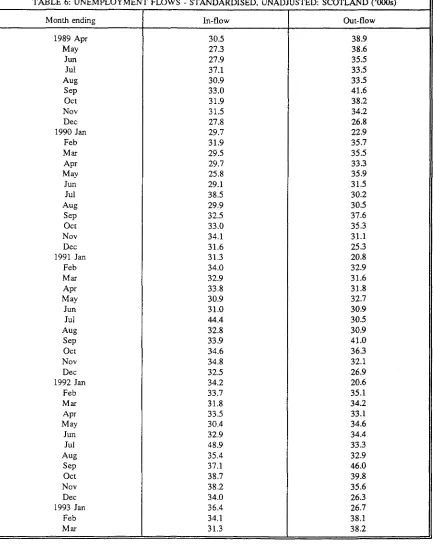
(16.4) and 20.1 (20.9) thousands on a seasonally adjusted (unadjusted) basis (Table 3). Vacancies rose by 1.6 thousands from 18.5 to 20.1 thousands over the year to March 1993 on a seasonally adjusted basis. The net increase in the stock of unfilled vacancies conceals much larger gross inflows and outflows (Table 4). These were of a similar order of magnitude to the outstanding stock of vacancies in each month. For example, in March 1993 inflows of 22.5 thousand were identical to outflows. The short average duration of vacancies is a sign that employers on average do not find it difficult to fill posts because of a continuing slackness in the labour market (although employers may still find it difficult to recruit specific skills in particular locations).
Unemployment: stocks and flows
Recent data on the seasonally adjusted unemployment stock are presented in Table 5. The most recent data, of course, reflect the current rules governing eligibility to claim benefit which have been in place since September 1988. These reflect the extension of a guaranteed offer of a YTS place to all those under 18 who have not found a job, under the Employment Training Scheme. Under 18s are consequently not entitled to claim benefit and so are excluded from the unemployment count.
Unemployment, on a seasonally adjusted basis, rose in each of the ten months up to and including August 1991, fell in September and remained constant in October of that year. In contrast unemployment continued to rise in the UK as a whole. However, unemployment then increased in 14 of the 15 months up to and including January of this year, the exception being March 1992 in which unemployment fell by 0.2 thousand. However, unemployment then fell in both February and March. It is unusual for unemployment to fall at such an early stage in what appears to be a recovery. Normally it takes some time for a recovery in output to feed through to employment as employers eliminate labour which they have "hoarded" during the recession. It remains to be seen whether the data reflect the recent tougher line in the payment of unemployment benefits or genuinely reflect a recovery.
[image:17.530.57.491.54.98.2]Over the year to March 1993 total unemployment rose by about 13.1 thousand, from a low of 231.3 thousand from 9.2% to 9.6% of the working population. This represents a major increase in the level of unemployment of 5.7 per cent. The aggregate figures reflect an increase in female unemployment of 0.3 thousand, and an increase of 12.8 thousand in male unemployment.
If gross outflows were maintained at their March 1993 level unemployment stocks could turnover in just over 6 months.
BUSINESS SURVEY EVIDENCE
Results from the Scottish Chambers' Business Survey for the first quarter of 1993 shed some light on the question of whether employment is actually rising, which is an interesting question given the reported reductions in the numbers unemployed.
Downward trends in total employment levels for all sectors had been expected for the first quarter of 1993, and these did indeed occur in all sectors. The rate of decline in employment levels was steeper than had been predicted in Manufacturing, Wholesale and Finance, but lower than had been expected in Construction, Retail and Tourism/Leisure. Nevertheless, as Table 7 shows, the rate of decline in total employment levels is less in all sectors, other than Wholesale Distribution.
All sectors expect a further slowing down in the rate of decline in employment levels in the second quarter, and a seasonal growth in employment is expected in Tourism/Leisure.
Within Manufacturing a net balance of 24% of metal manufacturing respondents reported a decline in employment levels, in mechanical engineering 22%, and in electronics 10%. In contrast chemicals and food, drink and tobacco respondents reported no change to employment levels. Textiles reported a slight increase.
In Manufacturing part time, temporary and sub contracting appeared to suffer less than full time employment. Temporary employment outperformed full time employment in: metal manufacture, chemicals, electronics and textiles. Subcontracting was reported as outperforming full time employment in metal manufacture, mechanical engineering, food and textiles.
The results support the impression that the declining levels of unemployment over the past three months reflect more a reduction in the numbers recorded as unemployed rather than any increase in employment. Evidence for this interpretation is supported by the trends in overtime and short time working for the first quarter of 1993.
Levels of overtime working remained depressed with downward trends reported in all major manufacturing sectors. In mechanical engineering a
net balance of 27% reported a drop in the levels of overtime working, in electronics 18% and in textiles 15%. Only a slowing down in the rate of decline in levels of overtime working is expected in most manufacturing sectors for the second quarter -suggesting that firms are likely to increase overtime before recruiting staff.
At the regional level Aberdeen reported a net increase in manufacturing employment in contrast to the declines reported elsewhere. Dundee, followed by Aberdeen, reported the best figures for Construction employment. In contrast Construction employment trends remain depressed and negative in both Glasgow and Edinburgh, although both areas expect an improvement in the second quarter.
In the service sector Glasgow and Dundee retailers expect upward trends in employment levels for the second quarter, and Aberdeen and Edinburgh expect a further slowing down in the rate of decline in retail employment. Within the Retail sector the trends in part time and temporary employment continue to outperform full time employment.
A sharp upward trend in employment is expected in the Tourism/Leisure sector, reflecting seasonal factors. Part time and temporary employment trends again outperform the trend for full time employment. In contrast employment trends in Finance remain on a strongly downward trend.
In most sectors temporary, part time and sub contracted employment continues to be affected less than full time employment. Uncertainty as to the extent and duration of any recovery may prompt firms to develop these areas of employment rather than the traditional permanent and full time employment.
A seasonally based improvement in employment levels is expected only in Tourism/Leisure for the second quarter. All other sectors expect a further decline in employment levels, confirming the view that, as yet, there are no signs of any sustained or general improvement in employment levels. On the present trends little improvement is likely for 1993.
Table 8 indicates a slight increase in the percentage of firms seeking to recruit staff during the first quarter of 1993. However, the percentage seeking to recruit is largely unchanged from the figures reported in the first quarter of 1992 and remain well below those for the first quarter of 1991.
Table 9 illustrates the general slackness in the
labour market with relatively few firms reporting increased difficulties in recruiting staff. However, in Manufacturing 23% of firms recruiting reported difficulties in recruiting suitable skilled manual and 22% similar problems in recruiting technical staffs. At the regional level, 36% of Aberdeen and the Highlands Manufacturing respondents reported difficulties in the recruitment of skilled manual, in Glasgow 17% and in Edinburgh 12%.
Aberdeen and Edinburgh Construction respondents reported the greatest difficulties in the recruitment of suitable skilled manual staffs. In Retail recruitment difficulties were most frequendy reported by Glasgow and Edinburgh respondents.
The seasonal demand in Tourism/Leisure has contributed to a significant increase in recruitment difficulties. Problems in recruiting skilled manual were widely reported by Tourism/Leisure respondents in Aberdeen and the Highlands, Dundee and Edinburgh, Lothians and the Borders. Once again the existence of such shortages poses questions as to the adequacy of current training provisions.
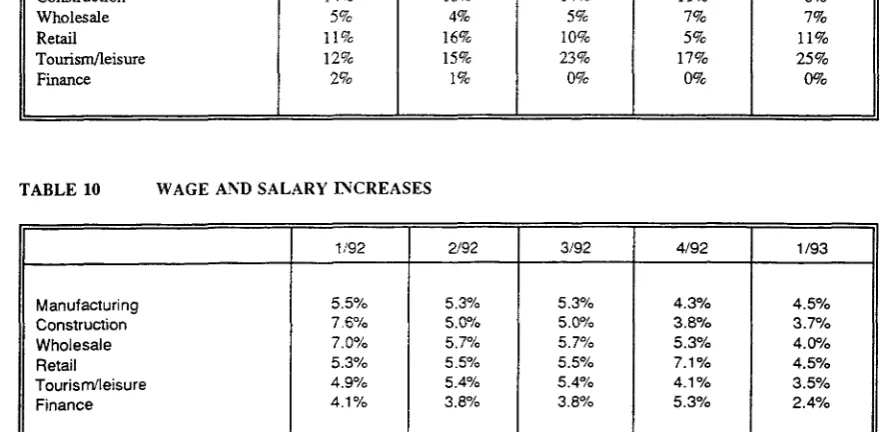
Wage/salary increases in all sectors were below 5%. The average increase continued to fall in all sectors, apart from Manufacturing, where a slight increase was recorded.
As Table 10 indicates die average increase has fallen over the past year by nearly 4% in Construction, 3% in Wholesale, 1.7% in Finance, 1.4% in Tourism/leisure, 1% in Manufacturing and 0.8% in Retail. There is some evidence that the rate of decline in the average wage/salary increase is slowing down.
Within Manufacturing the average increase ranged from 3% to over 8%. Increases between 3% and 4% were recorded by metal manufacture, textiles and printing. Average increase between 4% and 5% were recorded in the chemicals, electronics, food/drink and tobacco industries.