BLIND ERROR DETECTION AND
CHANNEL EQUALISATION
IN COMMUNICATION SYSTEMS
Kutluyil Dogangay
B.S., Bogazigi University, Turkey
M.Sc., Imperial College, University of London, U.K.
October 1995
A thesis submitted fo r the degree o f Doctor of Philosophy of the Australian National University
Telecommunications Engineering Group
Research School of Information Sciences and Engineering
Declaration
The contents of this thesis are the result of original research and have not been submitted to any other university or institution for the purpose of obtaining a postgraduate degree.
Much of the work in this thesis has been published or submitted for publication as journal papers. These papers are:
J l. K. Dogangay and R. A. Kennedy, “Testing for the convergence of a linear decision directed equaliser,” IEE Proc. Vision, Image and Signal Processing, vol. 141, no. 2, pp. 129-136, Apr. 1994.
J2. K. Dogangay and R. A. Kennedy, “Blind detection of equalisation errors in communication systems,” submitted to IEEE Trans. Inform. Theory.
J3. K. Dogangay and R. A. Kennedy, “Least squares approach to blind channel equalisation,” submitted to IEEE Trans. Commun.
A number of papers have been published in conference proceedings. These papers, some of which contain material partially overlapping with the publications listed above, are:
C l. K. Dogangay and R. A. Kennedy, “Testing for parameter convergence in blind adaptive channel equalisation,” in Proc. Second hit. Workshop on Intelligent Signal Processing and Communication Systems, ISPACS ’93, pp. 1-6, Sendai, Japan, Oct. 1993.
C2. J. R LeBlanc, K. Dogangay, R. A. Kennedy and C. R. Johnson, Jr., “Effects of input data correlation on the convergence of blind adaptive equalizers,” in Proc. IEEE Int. Conf. on Acoustics, Speech, and Signal Processing, ICASSP '94, vol. Ill, pp. 313-316, Adelaide, Australia, Apr. 1994.
C3. K. Dogangay and R. A. Kennedy, “A globally admissible off-line modulus restoral algorithm for low-order adaptive channel equalisers,” in Proc. IEEE Int. Conf. on Acoustics, Speech, and Signal Processing, ICASSP '94, vol. Ill, pp. 61-64, Adelaide, Australia, Apr. 1994.
C4. K. Dogangay and R. A. Kennedy, “Testing equalisation performance in blind adaptation,” in Proc. 33rd IEEE Conf. on Decision and Control, CDC '94, pp. 2817-2818, Lake Buena Vista, Florida, USA, Dec. 1994.
-The following journal papers are currently in preparation:
P I. K. Dogangay and Shin-Ho Chung, “Estimation of pulse height distribution in quantal analysis”.
P2. K. Dogangay, R. A. Kennedy and C. R. Johnson, Jr., “Least squares approach to fractionally spaced blind equalisation of FIR channels”.
The research described in this thesis has been performed, to a large extent, in collaboration with Dr. Rodney A. Kennedy. A small portion of the work on fractionally spaced blind equalisation was carried out jointly with Professor C. Richard Johnson, Jr. However, the majority of the work, approximately 90%, is my own.
Kutluyil Dogangay 12 October 1995
-Needless to say, doing a PhD course is not all beer and skittles. I am obliged to a number of individuals for their support and encouragement which have helped reduce the enormity of the task at hand to manageable levels.
First and foremost, I should like to thank my thesis supervisor Dr. Rodney A. Kennedy for his invaluable feedback and guidance in the course of my PhD work and my advisors Professors Brian D. O. Anderson and Robert R. Bitmead for their useful comments on my mid-term review.
I am grateful to Professor C. Richard Johnson, Jr. for introducing me to the area of fractionally spaced blind equalisation during a visit to Cornell University. My thanks are also due to Dr. Zhi Ding for making available the reprints of a number of key publications in that area.
I am thankful to my fellow students—too numerous to list here—for their continued friendship and company.
I am profoundly indebted to my parents for their unabated support and encouragement which helped me go through difficult times without losing my sanity.
Special thanks are due to Jane “SHEILA” Demelley for being a fair dinkum friend and bringing much needed fun.
My acknowledgments will not be complete, however, without mentioning the scholarships I received from the Commonwealth Government of Australia and the Australian National University, which made the research reported in this thesis a reality.
-Abstract
The thesis is concerned with the development of equalisation error tests and globally admissi ble channel equalisation algorithms in data communication systems. Specifically, no explicit knowledge of the channel input sequence is assumed, say, in the form of a training sequence.
Blind detection of equalisation errors is studied in the framework of hypothesis testing. For a linear decision-directed equaliser (LDDE) operating on a linear channel with binary inputs, a necessary and sufficient condition for convergence to an open-eye parameter setting is shown to be identical channel input and sheer output second-order statistics under some assumptions about the channel noise distribution. A consistent threshold test is constructed based on this criterion. For dependent M-ary channel inputs, a simple convergence test criterion comparing the decision device output and channel input variances is conjectured.
In view of the restriction of the convergence test based on second-order statistics to LDDEs and binary channel inputs, a new test criterion is proposed, which is shown to be invariant to the equaliser structure and the digital modulation technique used so long as the channel is linear and time-invariant during the test interval. The criterion draws on the observation that a time variation in the parameters of the underlying linear model taking the decision device output to the equaliser input is commensurate with the presence of equalisation errors. A least squares (LS) parameter estimation approach is adopted to construct uniformly most powerful tests.
The constant modulus algorithm (CMA) is modified to develop a new fast blind equalisation algorithm for channels with approximately finite-duration impulse response (FIR) inverses and constant modulus inputs. An LS approach is employed to compute a nonlinearly transformed version of the equaliser parameters. The actual equaliser parameters are shown to be extractable from their transformed version up to a scaling factor. Unlike CMA, the algorithm is globally admissible, relatively insensitive to correlated channel inputs and “parsimonious” in its use of the channel output observations.
Declaration ii
Acknowledgments iv
Abstract v
Glossary xii
CHAPTER 1 Introduction and Summary 1
1.1 Overview... 1
1.2 Blind Channel E q u a lisa tio n ... 2
1.3 Global Admissibility and Ill-convergence... 7
1.4 Raison d ’etre for Equalisation Error T e s t s ... 8
1.5 Literature R e v i e w ... 10
1.6 Outline of the T h e s is ... 12
1.7 Point Summary of Contributions... 15
CHAPTER 2 Testing for the Convergence of a Linear Decision-Directed Equaliser 17 2.1 In tro d u c tio n ... 17
2.2 Problem Set-Up and M otivatio n ... 18
2.3 Convergence Criterion for Correlated Binary Input Sequences...21
2.4 Statistical Test for Correct C onvergence... 22
2.4.1 Preliminaries... 22
2.4.2 Asymptotic Sampling Distribution of Autocorrelation E s tim a te s ... 24
2.4.3 The Test Statistic... 25
2.4.4 Consistency of the Test ... 27
2.5 Channel Noise E f f e c ts ... 29
2.6 On Generalisation to Dependent PAM Inputs ...31
2.7 Estimating a Lower Bound on the Equalisation D e la y ... 35
2.8 Simulation S tu d ie s ... 36
2.9 Discussion and C o nclusions...41
-2. A Proof of Theorem -2.1 42
2. B Moments of Markov C h a in s ...45
CHAPTER 3 Blind Detection of Equalisation Errors 48 3.1 In tro d u c tio n ...48
3.2 Problem Formulation and A ssu m p tio n s... 50
3.3 Test Criterion for Error D e te c tio n ... 52
3.4 Testing For Equalisation Errors ... 56
3.4.1 Preliminaries... 56
3.4.2 Testing the Equality of the Mean Vector to Z e r o ... 60
3.4.3 Relationship of the Noncentrality Parameter to the Test P o w e r ...63
3.4.4 Relationship of Equalisation Errors to the Noncentrality Parameter . . . . 65
3.4.5 Asymptotic Detection A n a ly s is ... 66
3.4.6 Testing for Time-Invariance of the Mean V ecto r... 69
3.5 Effects of Undermodelling and Incorrect Equalisation Delay A ssum ption... 71
3.5.1 Estimation of the Equalisation Delay ... 74
3.6 Simulation S tu d ie s... 75
3.7 Discussion and C o n clu sio n s...82
3. A Computation of Symmetric Reflexive g-Inverses... 84
3. A. 1 Computation of a Symmetric Reflexive g-Inverse of LS Covariance Matrix Using the S V D ... 84
3. A.2 Recursive Computation of a Symmetric Reflexive g-Inverse of LS Covari ance M a t r i x ... 85
CHAPTER 4 Least Squares Approach to Blind Channel Equalisation 87 4.1 In tro d u c tio n ... 87
4.2 Ill-convergence of C M A ... 89
4.3 Problem Formulation for Constant Modulus C onstellatio n s... 94
4.4 Least Squares S olution... 94
4.4.1 Closed-Form Derivation of the S o lu tio n ... 94
4.4.2 Robust Extraction of Equaliser Parameters ... 98
4.4.3 Real C h a n n e ls... 100
4.5 On-line and Recursive Implementations of the A lg o rith m ...102
-4.5.2 Recursive Least Squares A lg o rith m ...104
4.6 Effects of Overparam eterisation... 106
4.6.1 Some P re lim in a rie s...106
4.6.2 Least Squares Solution Revisited ...108
4.6.3 Iterative Computation of the Minimum-Norm Least Squares Solution . . . 109
4.6.4 Modified Recursive Least Squares A lg o rith m ...109
4.7 Extension to PAM C o n stellatio n s...I l l 4.8 Channel Noise C onsiderations... 115
4.9 Simulation S tu d ie s ... 116
4.10 Conclusions and D iscu ssio n ... 122
CHAPTER 5 Fractionally Spaced Blind Equalisation of FIR Channels 125 5.1 In tro d u c tio n ... 125
5.2 Feasibility of Fractionally Spaced Equalisers on FIR C h a n n e ls ... 126
5.3 A New Fractionally Spaced Blind Equalisation A lgorithm ... 131
5.3.1 Constant Modulus Channel Input Constellations... 132
5.3.2 Overparameterised F S E ... 135
5.3.3 Extension to PAM C o n stellatio n s... 136
5.4 Channel Disparity C onsiderations...136
5.5 Simulation Exam ples... 139
5.6 C o n c lu sio n s... 142
CHAPTER 6 Conclusions and Future Work 144 6.1 C o n c lu sio n s... 144
6.2 Future W o r k ... 145
6.2.1 Convergence Tests for Dependent PAM S e q u e n c e s ... 145
6.2.2 Sequential (On-line) Error Detection ... 146
6.2.3 Nonparametric and Robust Testing of Equalisation E rro rs... 148
6.2.4 Effects of Channel Input Correlation on Global Admissibility of CMA . . 149
6.2.5 Relocation of Closed-Eye Local Minima on the CMA Cost Surface . . . . 150
Bibliography 152
-List o f Tables
2.1 Mapping from channel input to quantiser output...34
2.2 Channel input autocorrelation and sample mean of quantiser output autocorrelation estimates for dependent and independent input sequences... 34
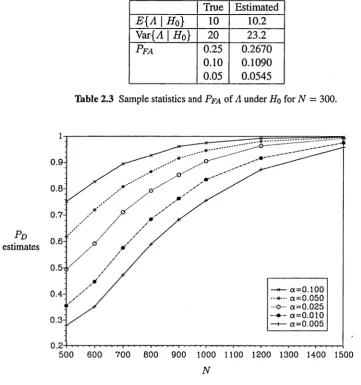
2.3 Sample statistics and Pfa of A under Ho for N = 300... 40
3.1 True and estimated mean, variance and Pfa of T( A' ) under Ho... 77
3.2 Average Pd of T( A') under H \... 82
4.1 List of all possible d vectors and resulting squared L norms of the consistency equation...113
4.2 Sample mean and standard deviation of the equaliser parameter estimates for 8-PAM channel input... 122
5.1 Squared L norm of FSE parameters as a function of e... 138
5.2 Sample mean and standard deviation of FSE parameter estimates...141
-1.1 Block diagram of a data communication system... 3
1.2 Baseband equivalent model of a communication system... 3
1.3 Baseband channel impulse response... 5
1.4 Adaptive channel equalisation... 6
1.5 Equaliser output sequences for some channel-equaliser combination with binary inputs... 9
2.1 Communication channel and linear decision-directed equaliser models... 19
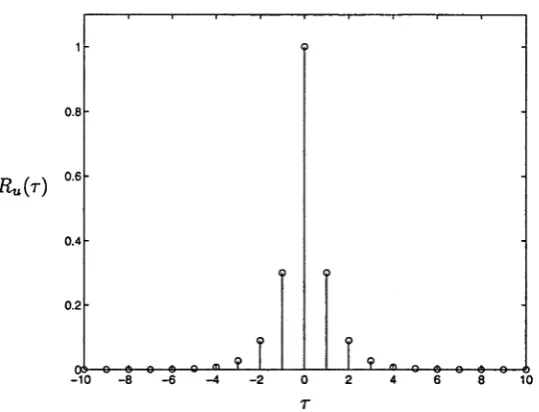
2.2 Autocorrelation of channel input sequence {u ( k) }... 37
2.3 CMA adaptation of equaliser parameters... 38
2.4 Channel input autocorrelation R u {r ) and sample mean of sheer output autocorre lation estimates Rü{t)... 39
2.5 Plot of test power estimates v. sample s i z e ... 40
3.1 Generic channel-equaliser set-up... 50
3.2 Linear decision-directed equaliser and decision feedback equaliser models... 51
3.3 Time domain model of the system that takes the decision device output to the noisy channel output... 53
3.4 Autocorrelation of channel input sequence { u( k) }... 76
3.5 Plot of test statistic v. assumed equalisation delay... 77
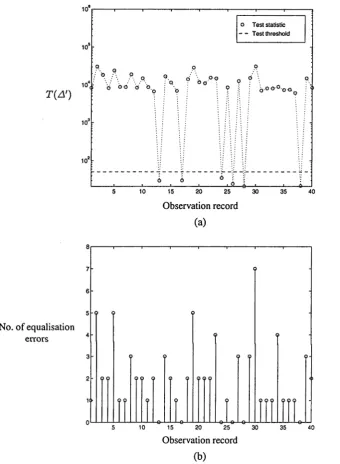
3.6 Test statistic for different observation records of A ' and r' (N = 35, P' = 25, 77' — 23.2)...79
3.7 Test statistic for different observation records of A ' and r ' ( N = 55, P' = 25, 7/ = 50.9)... 80
3.8 Testing for error propagation in DFE... 81
4.1 Channel and equaliser models... 89
4.2 Stationary points of CMA...92
4.3 Equivalent channel and equaliser models when the channel noise is relegated to the channel input... 115
4.4 Real and imaginary parts of the channel impulse response used in the simulations. 118
4.5 Parameter adaptation of the normalised LMS algorithm...118
4.6 Plot of the singular values of A ... 119
4.7 Parameter adaptation of the modified RLS algorithm... 120
4.8 Parameter adaptation for the RLS algorithm...120
4.9 CMA adaptation of equaliser parameters... 121
4.10 The equaliser output for SNR=20dB at the channel output... 123
5.1 Fractionally spaced equalisation... 126
5.2 Multichannel representation for fractionally spaced equalisation... 127
5.3 Modified multichannel representation... 133
5.4 Multichannel representation with common subchannel zeros... 137
5.5 Overall impulse response for small-norm FSE parameters...139
5.6 Parameter adaptation of the modified RLS algorithm...140
5.7 Parameter adaptation of FS-CMA...140
5.8 The smallest 15 nonzero singular values of A ...142
5.9 The FSE output for reduced norm equaliser parameters... 142
6.1 Plot of on-line test statistic T( k) and equalisation error locations...148
6.2 Plot of CMA cost surface cubics and channel input autocorrelation for (a) p = 0.60 and (b) p = 0.65... 150
6.3 Plot of CMA cost surface cubics and channel input autocorrelation for (a) p = 0.45 and (b) p = 0.30... 151
-A b b r e v ia tio n s
a .s . a l m o s t s u r e l y
i.i.d . i n d e p e n d e n t id e n t i c a l l y d i s t r i b u t e d
w .p . l w ith p r o b a b i l i t y o n e
A R a u t o r e g r e s s i v e
A R M A a u t o r e g r e s s i v e m o v i n g a v e r a g e
B P S K b i n a r y p h a s e s h if t k e y i n g
C L E M c l o s e d - e y e m e a s u r e
C M A c o n s t a n t m o d u l u s a l g o r i t h m
D F E d e c i s i o n f e e d b a c k e q u a l i s e r
D P S K d i f f e r e n t i a l p h a s e s h i f t k e y i n g
F I R f i n i t e - d u r a t i o n i m p u l s e r e s p o n s e
F S - C M A f r a c t i o n a l l y s p a c e d C M A
F S E f r a c t i o n a l l y s p a c e d e q u a l i s e r
F S K f r e q u e n c y s h i f t k e y i n g
H R i n f i n i t e - d u r a t i o n i m p u l s e r e s p o n s e
IS I i n t e r s y m b o l i n t e r f e r e n c e
L D D E l i n e a r d e c i s i o n - d i r e c t e d e q u a l i s e r
L M S le a s t m e a n s q u a r e
L S le a s t s q u a r e s
L T I l i n e a r t i m e - i n v a r i a n t
L T V l i n e a r t i m e - v a r y i n g
P A M p u l s e a m p l i t u d e m o d u l a t i o n
P S K p h a s e s h i f t k e y i n g
Q A M q u a d r a t u r e a m p l i t u d e m o d u l a t i o n
Q P S K q u a d r a t u r e p h a s e s h i f t k e y i n g
R L S r e c u r s i v e le a s t s q u a r e s
S N R s i g n a l - t o - n o i s e r a ti o
-SVD UMP
Notation
a t A* Ah A ~ A ~ At col(A) rank(A) tr (A)^ m a x C ^ )
Xd
xl(p)
M(h,e ) sgn(-)
S(-)
E { } 9{ }
» {■ }
Pd
Pfa Qm(-)
singular value decomposition uniformly most powerful
transpose of A conjugate of A
Hermitian (conjugate transpose) of A g-inverse of A:
G = A ~ if A G A — A
symmetric reflexive g-inverse of a real matrix A: G = A ; if A G A = A , G A G = G and G r = G Moore-Penrose inverse of A:
G = A f if A G A = A, G A G = G, ( A G ) H = A G and ( G A ) H = G A column space of A
rank of A trace of A
maximum eigenvalue of A
central chi-square distribution with d degrees of freedom
noncentral chi-square distribution with d degrees of freedom and noncentrality parameter p
(multivariate) Gaussian distribution with mean p, and covariance S signum function:
sgn(x) = 0 if x = 0, sgn(:c) = x/\x\ if x ^ 0 Kronecker delta function:
<5(x) = 1 if x = 0, 5(x) = 0 if x 7^ 0 expectation operator
imaginary part real part
probability of detection probability of false alarm M -ary quantiser
-w h e r e n = i?{:r(A ;)}
Rz(t)
Rx{t)
R x y { T )
a u to c o r r e la tio n o f {rr(A:)} a t lag r
b ia s e d e s tim a te o f Rx(t), i.e. E | ^ x ( r ) | ^ Rx(t)
c r o s s c o r r e la tio n o f { x (/c )} a n d {y(& )} a t la g r
* c o n v o lu tio n o p e r a to r
o H a d a m a r d ( e n try w is e ) p ro d u c t
0 K r o n e c k e r p ro d u c t
d is tr ib u te d a c c o r d in g to
CHAPTER 1
Introduction and Summary
L I Overview
he central theme of this thesis is blind channel equalisation in data communication systems.
VLJ''
The following aspects of blind channel equalisation are considered: (i) the detection ofdecision errors at the output of a blind adaptive channel equaliser, and (ii) the development of globally admissible blind equalisation algorithms. Specifically, no direct access to the channel input is assumed, say, in the form of a training sequence, which enables the detection of equaliser decision errors or equalisation errors in the context of blind channel equalisation, as well as conventional channel equalisation when the training session is not in progress. The development of globally admissible blind equalisation algorithms is motivated by the observation that on line memoryless-cost-function blind equalisation algorithms developed so far are all capable of converging to undesirable parameter settings.
The aspects of blind channel equalisation considered in this thesis are closely intertwined de spite their seemingly different application areas. Whilst convergence to an unacceptable parameter setting can be detected by a blind equalisation error test, the ideas behind blind error detection can be exploited to provide a fix for the observed misbehaviour of on-line blind equalisation algo rithms. It should be noted, however, that the successful development of a globally admissible blind equalisation algorithm does not necessarily detract from the importance of blind error detection since equalisation errors can still occur owing to other reasons such as high channel noise, error propagation and improper equaliser design, to name but a few.
equal-isation objective and a measure of intersymbol interference (ISI) will be defined. In Section 1.3, we will explain the notion of global admissibility in blind channel equalisation. Section 1.4 moti vates the need for testing the equalisation objective and points out the shortcomings of a popular experimental testing method known as the eye pattem test. The problem of testing the equalisation objective is considered in the binary hypothesis testing framework as a viable alternative to the eye pattern test. Section 1.5 summarises the recent work that is relevant to the research reported in this thesis. A chapter-by-chapter summary of the thesis is given in Section 1.6. A point summary of the major contributions of the thesis is listed in Section 1.7.
1.2 Blind Channel Equalisation
Elements of a data communication system are depicted in Fig. 1.1. An analog source signal to be transmitted is first sampled and quantised to produce an input bit stream which is a discrete-time signal with discrete amplitudes. Some information about the analog signal is lost in the process, but the accuracy can be improved by choosing finer quantisation levels at the expense of increasing the number of bits for every source symbol. The bit stream obtained from the analog source signal is encoded to produce an efficient representation for the source symbols (source coding) and to add a controlled amount of redundancy for the purpose of improving its robustness to additive channel noise (channel coding). The encoded signal is passed through a transmit filter to generate pulses with limited bandwidth so that distortion-free transmission through a passband medium can be achieved. The pulse shaping is followed by modulation in which some characteristic, viz. the magnitude, phase or frequency, of a high frequency carrier is varied in sympathy with the pulse shaped signal to make it suitable to be sent through the transmission medium. At the receiver, the signal is demodulated by removing the high frequency carrier, filtered using a knowledge of the pulse shape introduced by the transmit filter, and equalised to cancel the effects of the transmission medium. After sampled and passed through a decision device, the transmitted bit stream is finally recovered at the decoder output.
1.2 Blind Channel Equalisation 3 Output bit stream Discrete Channel stream Encoder Medium Equaliser Modulator Demodulator Transmit Filter Receive Filter D ecision Device
Decoder
Figure 1.1 Block diagram of a data communication system.
Noise
CHANNEL
n( t )
EQUALISER
[ u ( k ) }
h(t )
T / K
G ( z )
MEMORYLESS
DETECTOR
A -
{yWl r— {u(k)}—
Figure 1.2 Baseband equivalent model of a communication system.
symbols. The resulting distortion is called intersymbol interference (ISI) which imposes a limit on reliable transmission of source symbols in high speed data communication systems. The operation of removing ISI is called channel equalisation, and the device used for this purpose is called a channel equaliser. The increasing need for high speed data communication over voice-grade telephone lines has added to the importance of channel equalisation.
While in telephone channels ISI is mostly associated with linear distortion (time dispersion) of the channel, in radio channels ISI is due to multipath fading which is characterised by transmission through several paths with different time-varying magnitudes and phase characteristics. Equalis ers for radio channels are therefore required to be adaptive to track time variations in channel characteristics.
Throughout the thesis we will use the baseband equivalent model of a passband communication system shown in Fig. 1.2. Baseband representation preserves the characteristics of passband signals while providing a common framework to work within by removing the high frequency carrier from consideration. In other words, baseband representation is a convenient abstraction of the actual communication system. The baseband (complex-valued) channel input u(k) and the passband modulated signal sp(t) are related according to
Sp(*) = 3m £ u{k)a{t — kT) exp(j27r/c£)
l k
where 5R{-} denotes real part, a(t) is the continuous-time impulse response of the transmit filter (defining the pulse shape), T is the symbol rate, and f c is the carrier frequency. Note that u(k) corresponds to the baseband encoder output in Fig. 1.1. Likewise, the real-valued passband channel impulse response hp(t) is connected to its (compex-valued) baseband counterpart h(t) through
h P {t) = !ji(t)exp(j2Trfct ) } . (1.2)
The baseband channel impulse response is obtained from a cascade of the transmit filter a(t), the baseband medium fh(t) and the receive filter b[t):
h(t) = a(t) * rh(t) * b(t) (1.3)
where * denotes convolution. The baseband channel noise is given by
n{t) = b(t) * (fip(t) Qxp(—j 2 n f ct)) (1.4)
where n p ( t) is the passband noise. In Eq. (1.4) the receive filter is assumed to suppress high frequency components resulting from demodulation of the received signal. It should be noted that the baseband noise is usually not white even if the passband noise is.
Intersymbol interference occurs in all forms of digital communication when the bandwidth of the channel input signal is wider than half the passband of the channel. As an illustration of ISI consider the baseband channel impulse response depicted in Fig. 1.3. The received signal before sampling is given by
oo
r(t) = ^ u(i)h(t — iT) + n(t). (1.5)
i~ — oo
After sampling r ( t) at T-second intervals, which results in the discrete-time sequence {r(k)}, we obtain
r(k) = u(k — A ) h i 4- ^ u( k — i)h{ +n(k)
desired signal
ISI
where A denotes the time instant of the cursor defined by max^. \hk\, and
r+oo
( 1 . 6 )
1 h(t)S(t — kT) d t = h(kT)
—oo r + o o
(1.7a)
n{k) = j1 n(t)5(t - kT) dt = n( kT)
—oo
(1.7b)
1.2 Blind Channel Equalisation 5
Figure 1.3 Baseband channel impulse response.
respectively. Obviously, ISI is zero if and only if all samples of the channel impulse response except one, viz. are zero.
An adaptive channel equaliser is shown in Fig. 1.4. The objective of the equaliser 0 ( z) is to remove ISI sufficiently so that a decision device can recover the channel input without error. The equaliser is therefore designed to provide a close approximation to a possibly delayed and truncated version of the channel inverse H ~ {(z). In conventional channel equalisation a training sequence is made available at the receiver in the form of a finite-length synchronised channel input sequence. The purpose of the training sequence is to enable the equaliser to get information about the channel characteristics and tune the equaliser parameters accordingly. The training sessions are held at regular intervals to track any changes in the transmission medium characteristics. At the completion of training sessions the equaliser is usually switched to a decision-directed mode of operation. In decision-directed mode, the error signal is derived from the difference between the equaliser output and the decision device output.
u(k)
CHANNEL
EQUALISER
/
©(.-) ■
DECISION DEVICE
y(k) — u(k)
—
Parameter update mechanism
Training sequence
Figure 1.4 Adaptive channel equalisation. If the dotted line is removed, equaliser parameter adaptation is performed by a blind equalisation algorithm.
The equalisation objective can be mathematically described as the satisfaction of the following condition:
ü ( k ) = r u ( k — A) VA; (1-8)
where r is a constant that maps a given channel input u(k) to a member of the channel input constellation and A is the equalisation delay which is a finite nonnegative integer. The ambiguity arising from r is resolved by using differential encoding such as differential phase shift keying (DPSK). For an M-ary DPSK system jT is e-7m27r/ A/ where m is an integer. If Eq. (1.8) is satisfied, then we say that the eye is open. A violation of Eq. (1.8) indicates that the eye is closed.
Assuming an automatic gain control at the decision device, the open-eye condition is charac terised by the satisfaction of the inequality
m a x fc M A O IE ^ I/iil dmin
I M 2 ’
\h^\ = max |/ii|
i 0 .9 )
where the quantity on the left-hand side is the maximum value that the ISI term in Eq. (1.6) can take, divided by the magnitude of the cursor, and dmm denotes the minimum distance between any two members of the channel input constellation. If the above inequality is satisfied the channel input can be recovered at the equaliser output with the aid of a decision device. The closed-eye measure (CLEM), which we shall use throughout the thesis to quantify the amount of ISI at the equaliser output, is defined by
CLEM = 2 maxfe \ u ( k ) \ \ h j \ (1.1 0)
1.3 Global Admissibility and Ill-convergence 7
rendering the eye closed. For pulse amplitude modulated channel inputs that are drawn from the constellation set § = {±1, ± 3 , . . . , ± ( M — 1)}, we have dmin = 2 and max^ |k(A;)| = M — 1, which results in
CLEM = ( M — (1.11)
I'M]
For phase shift keyed inputs drawn from the set § = j 1, ej2?r/ M, ej47r/ M, . . . , \ the minimum distance between the constellation members is given by the expression
(M 2)
Noting that all the symbols have unity modulus which implies max^ |u(A;) | = 1, CLEM for M-ary phase shift keying (PSK) modulation can be written as
CLEM YsijzA.
I^tl
(1.13)ISI at the equaliser output results from the time dispersion of the channel and equaliser combination. Therefore, CLEM for ISI measurements at the equaliser output involves the use of the combined channel-equaliser impulse response rather than the channel impulse response alone. Care should be exercised in interpreting CLEM if the channel noise is not negligible. Whilst for zero channel noise, the necessary and sufficient condition for the equaliser output decisions to have no errors is CLEM < 1, if the channel output is corrupted by noise, the condition CLEM < 1 does not guarantee that the eye is open.
1.3 Global Admissibility and III-converge nee
In blind channel equalisation the lack of direct access to the channel input has resulted in the consideration of pseudo error signals rather than the true error between the channel input and equaliser output sequences. The use of a pseudo error in on-line blind equalisation algorithms with memoryless cost functions has been shown to create multimodal cost functions whose minimisation using simple stochastic gradient-based techniques results in a tendency to get stuck with local minima yielding inferior or unacceptable equalisation performance [13, 41]. The notion of multimodality has endowed the communication and signal processing community with some new terminology, viz. admissibility and ill-convergence.
globally admissible it does not suffer from ill-convergence. That stochastic gradient-based blind equalisation algorithms proposed thus far all exhibit ill-convergence to closed-eye local minima has led to an intensive research into ways of avoiding or fixing this problem. The ill-convergence phenomenon calls for the construction of blind testing procedures to detect its occurrence, on the one hand, and the development of globally admissible algorithms, on the other hand. The latter does not necessarily dispense with the need for detecting equalisation errors due to the existence of other reasons for equalisation errors.
In an effort to alleviate the problem of ill-convergence, the so-called centre-tap initialisation has been proposed as a means to guarantee convergence to an open-eye setting with a proper choice of the centre-tap magnitude. This algorithm fix has been, however, shown to be capable of going astray in the face of channel input correlation [14].
1.4 Raison d ’etre fo r Equalisation Error Tests
In adaptive channel equalisation it is imperative that any discrepancy between the channel input and equaliser output sequences be detected (or monitored) and corrected, if possible. The problem of testing the equalisation objective is particularly acute in the case of blind adaptive equalisation. The reason is two-fold: (i) the adaptation of the parameters is carried out in the absence of a training sequence (i.e. there is no access to the channel input to make a direct comparison between the channel input and equaliser output sequences), and (ii) on-line blind equalisation algorithms in current use have multimodal (non-convex) cost functions, which render them prone to converging to closed-eye local minima. Although it has been suggested that the converged local minimum will eventually be escaped [1, 2], the required time for that to happen can be prohibitively long. Even in conventional channel equalisation where a training sequence is used to update the equaliser parameters, various extraneous influences may lead to a corruption of the equaliser output. The detection of equalisation errors is therefore of crucial importance in blind and conventional equalisation alike, and is of substantive interest in the context of channel equalisation.
1.4 Raison d'etre fo r Equalisation Error Tests 9
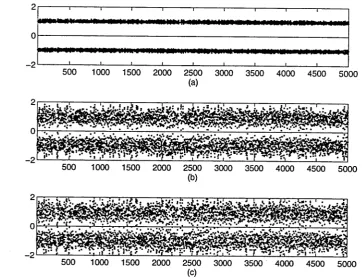
500 1000 1500 2000 2500 3000 3500 4000 4500 5000
2
0
- 2
500 1000 1500 2000 2500 3000 3500 4000 4500 5000
(b)
Figure 1.5 Equaliser output sequences for some channel-equaliser combination with binary inputs; in (a) and (b) the eye is open (i.e. no errors occur at the decision device output), while in (c) the eye is closed.
the problems with the eye pattem test is its complete reliance on visual perception, which renders it misleading at times. Part of the reason for this shortcoming is that while certain amount of ISI can be tolerated by the nonlinear decision device, the eye pattern closes further with increasing ISI. Additionally, it is not feasible to automate the eye pattem test so that inferences can be drawn about the shape of the eye pattern in the absence of a human interpreter. For an illustration of these assertions refer to Fig. 1.5 where various equaliser output observations are shown for some channel-equaliser combination driven by a binary input sequence. In Fig. 1.5(a) the equalisation objective is satisfied as clearly confirmed by the observed eye pattern. In Fig. 1.5(b), the observed eye pattern is severely smeared even though the equalisation objective is still satisfied. The equalisation objective is not satisfied in Fig. 1.5(c) because the observed sequence results in 20 equalisation errors at the decision device output. Note especially the difficulty associated with deducing whether or not the equalisation objective is satisfied from the eye patterns in Figs. 1.5(b) and 1.5(c). The eye pattern test is useful to detect ISI, to measure the noise margin and to determine the sensitivity to timing error, but does not always provide a precise answer to whether or not the decision device output is in error.
[image:23.536.96.459.75.353.2]possibilities, viz. the eye is open or the eye is closed, we formulate the detection problem in the binary hypothesis testing framework. Using the terminology of detection theory, we will call the open-eye case the null hypothesis (denoted Ho) and the closed-eye case the alternative hypothesis (denoted H \). In this framework, the objective of a test is to determine from a probabilistic manifestation of either Ho or H\ which hypothesis is true. Because of the probabilistic mechanism involved the decision made by the test is subject to errors. The process of decision making comprises choosing the hypothesis that has the highest likelihood of fitting the observations. A test statistic is used to reach a decision by comparing it with some threshold. Depending on the amount of a priori information available about the hypotheses, different statistical tests can be devised [3]. In Chapters 2 and 3 threshold tests based on various statistics are constructed for testing ill-convergence and equalisation errors.
7.5
Literature Review
Blind detection of ill-convergence or equalisation errors has not received much attention in the open literature despite its potential application in bandwidth-efficient retransmission protocols and reliability assessment in data communication systems. The first attempt at constructing a convergence test using only the decision device output observations was made in [4], The major result of that work was the conclusion that if the channel input is an i.i.d. (independent identically distributed) binary sequence taking on values ± 1, and a linear decision-directed equaliser (LDDE) is used, the decision device output will be an uncorrelated binary sequence if the parameters of the LDDE have converged to an open-eye setting. The channel noise is assumed to be statistically independent of the decision device output. In [5, 6] we have significantly extended the results of [4] by allowing the channel input to be a correlated binary sequence. We have also provided a practical implementation for the convergence criterion in the form of a statistical test using only the decision device outputs and a priori knowledge of the channel input autocorrelation and fourth-order moments.
1.5 Literature Review 11
Blind channel equalisation has been an active research area since 1970s which has resulted in the development of many blind equalisation algorithms. In his pioneering work [8], Sato proposed a blind (self-recovering) equalisation algorithm for PAM communication systems, which is very similar to the minimum mean square error (MMSE) equalisation algorithm, but uses a different average cost function. Under the assumption of uncorrelated, uniformly distributed channel input (i.e. PAM with infinitely many levels) Sato showed that his algorithm converges to a zero ISI setting from any open-eye initialisation (with CLEM < 1) provided that the equaliser is long enough. In [9] the global convergence of the Sato algorithm was proved under the assumption of sub-Gaussian channel input distribution (such as uniform distribution) and doubly infinite equaliser parameterisation. The ill-convergence of the Sato algorithm was first demonstrated in [1] for i.i.d. PAM inputs, a dynamicless channel and a finite-length equaliser. The importance of initialisation is also emphasised in the same paper. Similar results were proved in [2], The Sato algorithm was later generalised to a family of cost functions for complex quadrature amplitude modulation (QAM), which are collectively called the Godard algorithm [10]. In [11], an alternative form and a special case of the Godard algorithm was proposed independently under the name the constant modulus algorithm (CMA). CMA was applied to the removal of multipath distortion incurred by frequency modulated (FM) signals. The key features of the Godard algorithm (or CMA) are: (i) it does not make use of the signal phase at the channel output (thereby isolating the problem of phase recovery from that of channel equalisation), and (ii) it is applicable not only to constant modulus signals using phase shift keying (PSK) or frequency shift keying (FSK), but also to nonconstant modulus signals. Godard hinted at the possibility of existence of some local minima (of the type described in [ 1 ]) on the cost surface and suggested that a centre-tap initialisation with a sufficiently large tap magnitude should be used to guarantee convergence to an open-eye setting for a doubly infinite equaliser. In [12] the Mazo-type local minima were shown to be unstable for the Godard algorithm and therefore unimportant for i.i.d. QAM channel inputs and a doubly infinite equaliser. This was also used as an argument to claim that special initialisation tactics are not necessary to guarantee convergence to open-eye parameters.
two stable minima exist, both of which open the eye, was also presented in the same paper. The existence of these results overshadows the universality of the centre-tap initialisation, which has yet to be proved to result in global convergence under i.i.d. channel inputs. The on-line blind equalisation algorithms using memoryless cost functions are a bane of many researchers and certainly present a whole spectrum of open problems as regards global convergence and initialisation strategies. In an effort to solve the global admissibility problem, an alternative formulation of CMA was presented in [16, 17] which is relatively insensitive to the channel input correlation and has global convergence properties. This algorithm uses a quadratic unimodal cost function in the nonlinearly transformed equaliser parameter space and has a very fast convergence rate.
The latest approach to blind channel equalisation is based on a revamp of the fractionally spaced equaliser implementation in a blind equalisation context. For i.i.d. channel inputs, fractionally spaced CMA was shown to have all its local minima correspond to optimum open-eye settings with different equalisation delays [18, 19]. Under correlated channel inputs, however, fractionally spaced CMA may exhibit ill-convergence [20].
1.6 Outline of the Thesis
In this section a chapter-by-chapter summary of the thesis is presented.
Chapter 2: Testing fo r the Convergence o f a Linear Decision-Directed Equaliser
The material in the chapter is an extension of [4], In addition to establishing a test criterion for correlated channel inputs, the criterion is implemented as a statistical test. The theoretical manifestation of wrong convergence at the equaliser is combined with statistical methods to construct a practical convergence test that does not require an explicit knowledge of the channel input.
1.6 Outline of the Thesis 13
fourth-order joint moments. An extension to PAM channel inputs is conjectured by way of a heuristic variance matching criterion. A crosscorrelation-based parameter estimation technique is invoked to estimate a lower bound on the equalisation delay.
Moments of Markov chains are discussed in an appendix in order to facilitate the use of a Markov chain to generate the channel input sequence in simulation examples.
Some of the results of this chapter have been published in [5, 6].
Chapter 3: Blind Detection o f Equalisation Errors
Rather than restricting the attention to the detection of ill-convergence, the issue of error detection at the decision device output is considered in a general setting. In this sense, this chapter builds upon the previous chapter, but the approach to the detection problem is completely different in order to relax the requirements for the applicability of the resulting tests. The test criterion proposed in this chapter draws on the fact that if a communication channel is equalised satisfactorily so that the decision device output does not contain any errors, the relationship of the recovered sequence to the noise-free channel output will simply be given by the channel response advanced in time by the equalisation delay. In other words, the above-mentioned relationship will be linear and time-invariant if the eye is open and the channel is an LTI system. The chapter starts with a proof of the observation that if the eye is closed, the relationship in question is no longer linear and time-invariant, but may be considered to be linear and time-varying. The channel input sequence is supposed to have all its finite-length subsequences occur with nonzero probability. This criterion allows the use of short observation records to determine the presence of equalisation errors.
The method of least squares (LS) is used to come by a test statistic whose probability density changes according to whether the observations of the decision device output and the equaliser input fit an LTI model with noisy output. Uniformly most powerful (UMP) tests are constructed to detect the time variance of the model, which in turn flags the presence of equalisation errors. Relations between the test parameters are established. Asymptotic analysis is carried out to get some feel for the detection performance of the tests as the sample size increases. Conditions are derived to achieve consistency. The effects of underestimated channel length and equalisation delay are also discussed and robustness of the tests to variation in these parameters is proved. As a by-product, a method for estimating the equalisation delay is proposed, which returns a lower bound on the equalisation delay if the channel includes a pure delay.
The results of this chapter have appeared in [7, 21].
Chapter 4: Least Squares Approach to Blind Channel Equalisation
A blind equalisation algorithm for constant modulus constellations is developed. The main features of the algorithm are its parsimonious use of the channel output observations to converge to, or to compute, the equaliser parameters and relative insensitivity to the channel input correlation. The communication channel to be equalised is assumed to have an approximately finite-duration impulse response (FIR) inverse.
The chapter starts with a short section explaining the reasons for the general failure of CMA. A set of nonlinear equations is derived to show the potential problem of ill-convergence and its relation to the channel output statistics which are also influenced by the channel input statistics. The effects of the channel input autocorrelation are illustrated in an example.
The new blind equalisation algorithm is developed using the ideas behind CMA with a different equaliser parameterisation. The equaliser output squared modulus is explicitly written in terms of the equaliser parameters. The coupling between the equaliser parameters is left untouched and the coupled parameters are relabelled as if they were independent parameters. This way a quadratic unimodal cost function is obtained in the transformed equaliser parameter space. The equaliser parameters are obtained by means of an LS solution to the transformed parameters and a nonunique backward transformation resulting in a phase ambiguous solution. The use of differential encoding circumvents the problem of phase ambiguity. The algorithm requires a small number of channel output observations to compute the equaliser parameters. For example, given a first-order autoregressive (AR) channel driven by an i.i.d. binary input sequence and followed by a two-tap equaliser, the number of channel output observations required to obtain the equaliser parameters is only four.
Robust estimation of the equaliser parameters is discussed using a singular value decomposition (S VD) based matrix approximation which exploits the special structure of the transformed equaliser parameters. On-line and recursive implementations of the algorithm are also developed. The effects of overparameterisation of the equaliser are investigated and the rank deficient LS problem that emerges as a result of overparameterisation is solved using some property of the nonunique LS solution. A modified version of the recursive least squares algorithm that avoids eigenvalue explosion resulting from the lack of persistent excitation is shown to be applicable to the case of overparameterisation.
1.7 Point Summary of Contributions 15
constellations.
Publications relevant to the material in this chapter are [15, 16, 17].
Chapter 5: Fractionally Spaced Blind Equalisation o f FIR Channels
The LS approach of Chapter 4 is extended to fractionally spaced equalisers which, unlike baud-rate equalisers, are capable of providing perfect equalisation for oversampled FIR channels under the so-called channel disparity condition that the resulting subchannels have no zeros common to all of them. The fractionally spaced implementation of the LS algorithm is motivated by the restriction of the baud-rate algorithm to channels with approximately FIR inverses. The salient features of the baud-rate algorithm directly carry over to the case of fractionally spaced equalisation.
The channel noise enhancement is shown to become a particularly acute problem when the channel disparity is almost but not exactly lost. Some remedies are proposed based on this observation by making the close subchannel zeros exactly identical, which leads to a loss of the channel disparity while greatly reducing the equaliser norm.
Using a modified recursive least squares implementation, the performance of the fractionally spaced LS equalisation algorithm is illustrated and compared to fractionally spaced CMA by way of simulations.
1.7 Point Summary o f Contributions
Following is a list of the major contributions of the thesis.
• Proof of a test criterion for the convergence of a linear decision-directed equaliser to an open-eye parameter setting when the channel input sequence is binary and correlated, and the equaliser parameters are adapted blindly.
• Construction and analysis of a consistent threshold test based on the above test criterion.
• Development of a heuristic test criterion for the convergence of linear decision-directed equalisers when the channel input sequence is a dependent (or correlated) PAM sequence.
• Methods for estimating a lower bound on the equalisation delay introduced by the channel- equaliser combination under convergence to an open-eye parameter setting.
• Implementation of the general test criterion as uniformly most powerful tests and analysis of their optimality properties.
• Recursive and iterative computation of the test statistics.
• Illustration of the effects of channel input correlation on the convergence of CMA.
• Development of a new least squares approach to blind channel equalisation with a quadratic cost function which is comparatively parsimonious in its use of the channel output observa tions and is also insensitive to the channel input correlation, unlike CMA, subject to some channel input richness condition.
• Implementation of the least squares blind equalisation algorithm as a fractionally spaced equalisation algorithm for FIR channels.
CHAPTER
2
Testing for the Convergence o f a
Linear Decision-Directed
Equaliser
2.1 Introduction
n-line blind equalisation algorithms with memoryless cost functions are susceptible to con-verging to undesirable parameter settings giving rise to inferior equalisation performance. This phenomenon, which is called ill-convergence in the blind equalisation jargon, arises from the existence of spurious closed-eye local minima on the cost surface topology. In blind equalisation the dearth of an explicit knowledge of the channel input sequence makes it considerably difficult to establish the occurrence of ill-convergence. In this chapter we will construct a statistical test for the purpose of deciding whether or not a converged parameter setting opens the eye. The test does not resort to an explicit knowledge of the channel input, and is applicable only to linear decision-directed equalisers (LDDEs) operating on binary-input channels. An extension to M-ary channel inputs will also be considered by way of a simple heuristic test criterion.
testing framework. The main advantages of the proposed statistical convergence test vis-ä-vis the eye pattern test are: (i) the statistical test has a simple construction which makes it amenable to performance analysis, and (ii) unlike the eye pattem test it does not rely on potentially deceptive visual information. The channel noise considerations and the necessity of imposing some bound on the channel noise amplitude are discussed in Section 2.5. Section 2.6 is concerned with a generalisation of the convergence test to the case of dependent M-ary channel input sequences. A simple heuristic convergence criterion based on a match between the channel input and decision device output variances is proposed for M-ary channel inputs. In Section 2.7 we briefly digress to look into the problem of equalisation delay estimation when convergence to an open-eye setting has taken place. A classical crosscorrelation-based impulse response estimation technique is invoked to estimate a lower bound on the equalisation delay. Computer simulations illustrating the application of the statistical test are presented in Section 2.8. The results of the chapter are discussed in Section 2.9. In Appendices 2. A and 2.B the main result of the chapter (Theorem 2.1) is proved, and second and fourth-order output moment expressions for Markov chains are derived, respectively.
2.2
Problem Set-Up and Motivation
An HR communication channel followed by an LDDE is shown in Fig. 2.1(a). The LDDE is made up of a linear tapped-delay line with L taps and a decision device (which is a sheer in the case of binary channel inputs) connected in tandem. The adaptation mechanism for the equaliser parameters is omitted from Fig. 2.1 (a) as we are only concerned with the final stage of convergence in which the tap coefficients of the equaliser wander about a local minimum in accordance with a certain probability distribution [22]. Once the adaptation mechanism is switched off, the equaliser parameters {#*} become constant.
2.2Problem Set-Up and Motivation 19
n(k)
(a)
u(k)
C(z) = H(z)G(z)
y(k) — u(k)
—
(b)
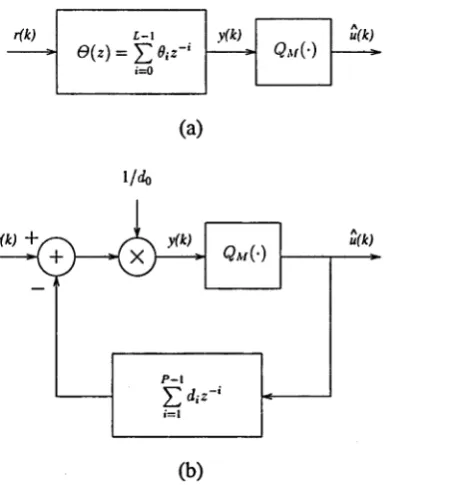
Figure 2.1 (a) IIR communication channel and LDDE models at baseband, and (b) equivalent system if {n(k)} is statistically independent of {u(k)}.
span of dependence. When constructing the statistical test, we will further assume that the input sequence is fourth-order weakly stationary and prior knowledge of certain fourth-order moments of {u(k)} is available. The communication channel will be assumed to be causal so that h{ = 0 for i < 0.
Referring to Fig. 2.1(b) where (n(fc)} and (n(fc)} are assumed to be statistically independent, the sheer output sequence {ü(A;)} can be written as
ii(k) = sgn (y[k)) (2.1)
with
oo
y(k) = ^r,Ciu{k - i) (2.2)
i= 0
where the impulse response {c^} of the equivalent system C(z) is given by the convolution of {hi} and {#*} and the signum function sgn(-) is defined by
sgn(x) = <
1
0
- 1
if a; > 0 if x = 0 if x < 0.
(2.3)
For binary channel input sequences the equalisation objective described in Section 1.2 takes the following form
where A is a fixed nonnegative integer representing the equalisation delay. Recall from Section 1.2 that if Eq. (2.4) holds, we say that the eye is open\ otherwise, the eye is closed.
The case of finite-duration impulse response (FIR) channels with i.i.d. (independent identically distributed) binary inputs was considered in [4]. The main result of [4] can be summarised as follows. Under the assumption of statistical independence between the sheer output and channel noise sequences, an LDDE converges to an open-eye parameter setting if and only if the sheer output sequence {£(&)} is uncorrelated. It is not immediately obvious, however, that the same result should carry over to the case of HR channels. Consider, for example, an HR channel- equaliser combination that happens to be an all-pass system as a result of convergence to a closed-eye local minimum. The autocorrelation of the channel input {u(k)} and the tapped- delay line output {y(k)} would then be identical. The possibility of an all-pass channel-equaliser combination C ( z) may be thought to jeopardise the validity of the convergence test criterion in [4] for HR channels (see Fig. 2.1(b)). As a matter of fact, this concern is unwarranted owing to the nonlinear characteristic of the sheer. As will be proved later, the sequence at the sheer input must be “signwise” independent to ensure that the binary sequence at its output is uncorrelated. If the binary sequence at the channel input is independent, signwise independence at the sheer input is assured if the overall system impulse response {ct} has a cursor whose absolute value is larger than the E\ norm (i.e. sum of absolute values) of the rest. This observation also highlights the importance of using the sheer output sequence rather than its input sequence (the tapped-delay line output) for convergence testing purposes.
2.3 Convergence Criterion fo r Correlated Binary Input Sequences 21
2.3
Convergence Criterion fo r Correlated Binary Input Sequences
In most studies of the channel equalisation problem the channel input sequence {u (k)} is almost invariably assumed to consist of independent symbols. The validity of this assumption is often somewhat dubious from the standpoint of practice. Certain channel coding schemes employed to improve the noise immunity of transmitted symbols inevitably lead to correlation between successive symbols, hence the need to deal with correlated input sequences.
We will assume that the combined channel-equaliser impulse response {c*} obeys the following inequality for some finite integers 0 < I < J
min
k j
- i) i =I
I — 1 co
> £ N + £ M
i=0 i —J+ 1
(2.5)
which implies that the sheer output can be expressed as
u(k) sgn \/k. (2.6)
Eq. (2.5) imposes a mild restriction on C (z) which is automatically satisfied by most exponentially stable channel-equaliser combinations with a proper choice of / and J . Note that Eq. (2.5) is unconditionally satisfied for FIR channels.
Following is a formal statement of our test criterion for the convergence of an LDDE to an open-eye setting when the channel input sequence is binary and correlated.
Theorem 2.1 Let {u(k)} be a wide-sense stationary sequence o f binary’, zero-mean random
variables assuming values ±1, and let ii(k) be as given in Eqs. (2.1) and (2.2) where {c{} obeys the inequality in Eq. (2.5). Suppose that the autocorrelation Ru(t) o f the channel input sequence {u(k)} is known and has a finite support set such that Ru(r) = 0 fo r |r | > m, where m is a nonnegative integer and that the argument o f the signum function never becomes zero* 2. Then,
Ru{t) — R u {r ) fo r all t if and only if
u(k) = sgn (cfo)u(k — A) (2.7)
fo r all k and some fixed integer A > 0.
Refer to Appendix 2. A for a proof of Theorem 2.1. A few remarks about the theorem are in
'in other words, {u(k)} is an m-dependent sequence.
order:
Remarks 2.1
i. As a special case of the above theorem, if the channel input sequence is uncorrelated (or independent), i.e. R u(0) = 1 and Ru{t) = 0 for r ^ 0, then the LDDE converges to an open-eye parameter setting if and only if the slicer output sequence is uncorrelated. This is simply a generalisation of the result for FIR channels given in [4] to HR channels obeying Eq. (2.5).
ii. The terms uncorrelatedness and independence can be used interchangeably for the binary sequences under consideration. Refer to the argument leading to Eq. (2.64) for a proof of this assertion.
iii. If \ca\ = maxj=o,...,oo |ci|> then Eq. (2.7) holds if and only if the following inequality is satisfied
which is an open-eye condition and assures that the sign of y(k) is always determined by the binary input corresponding to the cursor c^. The condition given in Eq. (2.8) tacitly assumes that all possible subsequences of the binary input sequence occur with nonzero
iv. Eqs. (2.4) and (2.7) are equivalent by virtue of their implication on the equalisation performance.
v. The result of Theorem 2.1 does not readily extend to M-ary communication systems where u ( k) can take on more than two possible values. More will be said on this in Section 2.6.
2.4 Statistical Test fo r Correct Convergence
2.4.1
Preliminaries
Before a decision can be made as to whether or not the true autocorrelation of { u( k) } is identical to that of {u(k)}, the former needs to be estimated from a finite-length observation of the slicer output. A decision made in favour of identical autocorrelations implies that the LDDE has converged to a parameter setting that conforms to Eq. (2.7). If the decision is against identical autocorrelations, then the conclusion will be that the equaliser has failed to converge to an open-eye parameter setting.
(2.8)
2.4 Statistical Test fo r Correct Convergence 23
We cast the decision problem at hand into the hypothesis testing framework by defining the null and alternative hypotheses as follows:
H0 : Convergence to an open-eye minimum Hi : Convergence to a closed-eye minimum.
Theorem 2.1 allows us to write the above hypotheses in an equivalent way
H0 : Ru(r) = Ra{r) Vr
Hi : Ru(t) ^ Rü{t) for some r .
For N observations {ü(k), ü{k + 1 ü(k -1- iV — 1)} of the slicer output, a biased estimate of Ru(t) for 0 < r < iV is given by
In the statistical test, we will use the biased estimate of Rü(t) rather than its unbiased version which can easily be obtained by replacing the factor in front of the summation with 1 / ( N — r) in Eq. (2.9). There are a number of reasons for choosing the biased estimate. The biased estimate, unlike its unbiased counterpart, always results in a positive semidefinite covariance matrix. The variance of the biased estimate is 0 ( \ / N ) irrespective of the correlation lag r , whereas the “tail” of the unbiased estimate tends to have an increased variance as r approaches N, thereby resulting in an erratic behaviour for large r [23, 24].
We will assume that {u(A:)} is fourth-order weakly stationary. If the overall channel-equaliser combination is time-invariant during the test interval, the slicer output sequence {£(&)} will also be fourth-order weakly stationary. Then, the biased estimate of Rü{t)has mean
1 JV — T — 1
Rü(t) =
— £
u(k+
i+
r)ü(k + i).
i=o
(2.9)
(2.10)
and covariance
Cov |Ä ü(t| ), -Ru(t2) j = £7 {Äü(ri)Äü('r2)} - E {ä ü(t| ) } £ 7 { ^ (t-2) } (2.11a) N —t\ —1N —T2~1
i=0 j=0
where m ^ a{...) denotes the fourth-order joint moment of {£(£)} defined by
m4tfi (t i,t2,t3) = E{ ü ( k ) ü ( k + T\)u(k + T2)u(k + t3)}. (2.12)
Note that the time index k has been dropped from the arguments of m.4^ ( ...) under the assumption that {u(k)} is a fourth-order weakly stationary sequence.
2.4.2 Asymptotic Sampling Distribution o f Autocorrelation Estimates
Under certain conditions on {u(k)} the central limit theorem holds for the asymptotic sampling distribution of Ru(t). The importance of the asymptotic normality (as N —» oo) of Rü(t) stems from its influence on the approximate distribution of the test statistic as will be explained in the next subsection. To facilitate the asymptotic normality result, we will consider an alternative way of expressing the biased autocorrelation estimate of the sheer output sequence
where
and
# ü (T) = T ? X ! 5*(r ) (2-13)
i=0
l-\
Si ( r ) = ^ ii(k + j a + t + i)ii[k + j a + i) (2.14)
j=o
a = r + u; + 1 (2.15)
with w denoting the span of dependence of {u{k)}. The relation between the sample size N and the other parameters can be found by considering the last term in 5 a_ i(r) corresponding to
j = l — 1. Setting k + (l —1 )a + r + a — 1 = k + N —1 gives
N = a(l + \ ) + t. (2.16)
Note that Si(r) is a sum of independent random variables since the separation between its suc cessive terms is (k + (j + 1 )a + i) — (k + j a + r + i) = w -1- 1 > w. Then, by the central limit theorem,
lim Pr { — ( S ' i ( r ) — E { S i ( r ) } ) < c} = — ~=
f
e~l ^2d t, i = 0, 1 , . . ., a — 1 (2.17)/->oo L v Z J v 2tt 7 - 0 0


![Figure 3.6 Test statistic for different observation records of A 1 and r% Test parameters are N = 35, P' = 25 and t]' = 23.2 (i.e](https://thumb-us.123doks.com/thumbv2/123dok_us/1809870.136213/93.536.84.449.85.545/figure-test-statistic-different-observation-records-test-parameters.webp)