Abstract—Groundwater contamination is one of the serious environmental problems. Effective remediation strategies require accurate characteristics of contamination sources. Contamination source identification approaches need accurate flow and contaminant transport simulation models. In order to obtain reliable solutions, the simulation models need to be provided with reliable hydrogeologic information. In real life scenarios usually sparse and limited hydrogeologic information is available. In this study two hydraulic conductivity sampling networks are ranked based on their effectiveness in identifying reliable contamination source characteristics. Using multiple realizations of hydraulic conductivity fields, and the location and size of the contaminant plume at different monitoring stages, an index of reliability is estimated for each hydraulic conductivity sampling network. It is demonstrated that the source characteristics identified by utilizing the sampling network with higher index of reliability results in more accurate characterization of contamination sources. Therefore the developed methodology provides a tool to select an appropriate hydrogeologic sampling network for more efficient characterizing of contamination sources.
Index Terms—Groundwater contamination, uncertainty, hydraulic conductivity, reliability.
I. INTRODUCTION
Groundwater contaminations can result from inappropriate industrial operations, waste disposal, and mining activities. The two most common real-world scenarios which need to be assessed precisely in contaminated groundwater systems are: 1) existing groundwater contamination from past activities, and 2) possible contamination that may rise from proposed future activities [1]. Characterization of contamination plumes and designing effective remediation plans require an accurate characterization of contamination sources. The (1) location, (2) activity duration, and (3) magnitude of injected pollutant fluxes are three important characteristics which enable engineers and managers to delineate and control contamination plumes. The contamination sources are characterized using an optimization method which aims to minimize the difference between simulated and measured contaminant concentrations at monitoring locations.
The simulation model should replicate the actual migration
Manuscript received April 25, 2014; revised July 18, 2014. This work was supported in part by the CRC for Contamination Assessment and Remediation of Environment, Australia, and James Cook University, Australia.
The authors are with the CRC for Contamination Assessment and Remediation of Environment, Mawson Lakes, Australia , and James Cook University, Townsville, Australia (e-mail: [email protected], [email protected]).
of contaminants in a groundwater aquifer. The groundwater hydrogeologic parameter values and boundary conditions are essential inputs to the simulation model. However, the hydrogeologic parameter values are inherently uncertain and imprecise, and acquiring data is a time consuming and cost extensive procedure. Therefore, a new methodology is developed to evaluate the reliability of the available hydrogeologic information with respect to its contribution to the accuracy of contaminant source characterization process. Amirabdollahian and Datta [2] presented an overview on pollutant source identification techniques and discussed some of the relevant issues in this area. The linked simulation optimization technique characterizes the contamination sources by an internal linkage between flow and contaminant transport simulation models and the selected optimization technique [3]-[5].
The solution of water flow and transport model requires the knowledge of various soil hydrogeologic parameters as well as the determination of boundary conditions, which are subjected to different sources of uncertainty. Tiedeman and Gorelick [6] studied the model parameter uncertainty (hydraulic conductivity and recharge factor) in the design of clean up strategy in a Vinyl Chloride contaminated system.
In a Long Term Monitoring (LTM), the uncertainty in the hydrogeological condition needs to be addressed to be able to track successfully the contamination plume. Mugunthan and Shoemaker [7] evaluated the efficiency of the LTM designs by their performance in simultaneously interpolating many equally likely plume configurations that may be possible for a given set of hydrogeological data. Their model minimizes the monitoring installation, sampling, and analyzing costs. The optimization is constrained by the relative error in the estimation of total mass over all grid points at which the interpolation was performed. Amirabdollahian and Datta [8] studied the effect of hydrogeologic parameter value uncertainty in optimal characterization of contamination sources.
An uncertainty analysis is a vital component of the contaminant characterization which feeds the risk analysis and the economic targets. In this study the un-modeled uncertainty associated with hydrogeologic parameter value is addressed. The hydraulic conductivity uncertainty has major impact on the accuracy of the flow and contaminant transport models. A new framework is developed to evaluate the impact of the adopted hydraulic conductivity sampling network on the accuracy of contamination source characterization model. Therefore, the acquired information about the accuracy of identified source characteristics can be used to design low risk remediation plans. The following sections discuss: the linked simulation-optimization contaminant source identification methodology; the model
Reliability Evaluation of Groundwater Contamination
Source Characterization under Uncertain Flow Field
for analysis of reliability of available flow field information (sampled hydraulic conductivity data); and, the performance evaluation of the proposed methodology for an illustrative study area. It is followed by the discussion of solution results and conclusions.
II. THE LINKED SIMULATION OPTIMIZATION
CONTAMINATION SOURCE IDENTIFICATION
The source identification model consists of an optimization algorithm which switches the inverse source characterization process to a forward simulation model. The optimization model generates candidate unknown source fluxes (decision variables) which are utilized to estimate resulting contaminant concentrations at monitoring wells in a forward simulation model. Finally the optimal solution is obtained by minimizing the differences between observed and simulated values. The objective function for the optimization problem is defined as follow.
2 2
1 1
( ) / ( )
nk nob
k k k
iob iob iob
k iob
Min F Cest Cobs Cobs
(1)Subject to:
( , , , ,i i, , )i i 1,...,
Cest f D K x y z q i N (2)
max
0 qi q i1,...,N (3) where nk, nob and N are the total number of concentration observation time periods, available monitoring locations and candidate source locations, respectively. Cestiobk and
k iob
Cobs are the concentration estimated by the simulation model and the observed concentration at the observation location iob and at the end of time period k, respectively. qi is the contaminant release flux for the candidate location i.
max
q is the upper bound for contaminant release fluxes. α is a
constant and it should be sufficiently large so that errors at low concentrations do not dominate the solution [5]. The objective function is constrained by the flow and transport simulation models (Eq. (2)). Eq. (3) limits the candidate contaminant flux values, at each potential location, to an upper bound.
The Adaptive Simulated Annealing (ASA) optimization algorithm is utilized in this study. Simulated Annealing (SA) starts from a feasible solution and an objective function. A new solution is randomly selected from its neighbors and the objective function is evaluated for the new selected solution. If the new solution has a better objective function value, the most recent solution is accepted and the search moves to a new point and continues from there. If the new solution is not better than the current one, the new solution may or may not be accepted depending on the acceptance probability. The acceptance probability is strongly influenced by the choice of a parameter T. ASA is a variant of SA in which the algorithm parameters that control the temperature schedule and random selection are automatically adjusted according to the
algorithm progress. This makes the algorithm more efficient and less sensitive to the user defined parameters required to be estimated in SA [9].
In this study the available spatially sparse hydraulic conductivity parameter values are interpolated to the whole aquifer using an interpolation method. The flow and transport simulation models use a set of interpolated conductivity data to estimate the contaminated concentration at the monitoring locations. The choice of hydraulic conductivity sampling locations affects the reliability of flow and transport simulation models.
III. RELIABILITY EVALUATION
A. Generation of Hydraulic Conductivity Field
An interpolation algorithm estimates the spatial distribution of parameter values. Using a limited available number of hydraulic conductivity data points, different realizations of a hydraulic conductivity field can be estimated. Usually one single interpolation technique does not work well for all simulations. The geostatistical interpolation algorithms provide a framework for the incorporation of the spatial variability. However, they are computationally demanding, and also to obtain accurate results they require a large number of data points with known values. Mugunthan and Shoemaker [7] compared the efficiency of three interpolation algorithms: Inverse squared Distance weighting (ID); Ordinary Kriging (OrK); and Quantile Kriging (QK). The ID is a simple deterministic method, whereas OrK and QK are non-deterministic geostatistical methods. They showed that the OrK and ID almost perform equally well. However, the ID method was chosen over OrK due to the ease of computation.
Following the result of Mugunthan and Shoemaker [7] and considering the fact that in real life usually a limited number of data points with known values are available, the ID method is utilized. Note that Kriging needs a carefully selected sample variogram and an appropriate log-transformation of the data. To acquire the accurate statistical properties of data, a substantial number of measurements is required. However, usually in real contaminated sites the number of available hydraulic conductivity measurements is limited (compared to the size of study area) and not enough to accurately estimate the statistical properties of hydraulic conductivity distribution for the entire study area.
Using the ID method, the value of variable Z at the un-sampled location x0, Z*(x0), is estimated based on the
data from the surrounding locations, Z x( )i , as Eq. (4).
* 0
1
( ) ( )
n i i i
Z x w Z x
(4)where wi are the weights related to the each Z x( )i value and n is the number of the closest sampled data points used for the interpolation purpose. The weights are estimated using Eq. (5).
2
2 1 1 /
1 /
i i n
i i
d w
d
(5) where di is the distance between the estimated point and the sample. Usually n is selected based on the spatial correlation between the available data points. However, to have an accurate estimation of the statistical correlation, a substantial number of measurements is required. Therefore, usually in actual study areas, the n value is selected based on the experience and judgment of the decision maker.Based on the decision of the n value, different realizations of the hydraulic conductivity field can be estimated from a given set of sampling locations. In this study for the evaluation purpose, four realizations of the hydraulic conductivity field is generated for each set of sampling locations. The ID interpolation algorithm involves generations of equally likely flow conditions using 25, 50, 75, and 100 percent of the actual available data points as the number of closest neighbors included in the interpolation.
B. Hydraulic Conductivity Uncertainty Calculation Contaminants are injected from sources at unknown times and are spread over a groundwater aquifer. The accuracy of spatial and temporal estimates of the concentrations depends on the accuracy of the hydraulic conductivity field. The index of spatial uncertainty and variability of a hydraulic conductivity field is estimated using Eq. (6).
2 , , , , 1 , ,
( )
1 R
i j kl i j kl i j kl
k k
R
(6)
where ki j kl, , and ki j kl, , are the hydraulic conductivity value at
location i, j, and kl using the ηth realization and the average hydraulic conductivity value at location i, j , and kl using all realizations, respectively. R is the total number of realizations. i j kl, , is estimated for all cells in a finite
difference discretized study area. C. Contamination Plume
The contamination plume boundaries are identified using the available contaminant monitoring concentrations. The ID method using all available concentration measurements estimates the spatial concentrations at any given time.
To ensure realistic spatial estimates, a threshold value is required to be considered to define the plume boundary at monitoring times. The plume boundary as defined by a threshold concentration magnitude is estimated with respect to the measured contaminant concentrations at any given time. At each monitoring time stage, the measured concentrations are interpolated throughout the aquifer using the ID interpolation algorithm. Then the lower twenty five percentile value of all interpolated or measured concentrations is defined as the threshold for the plume boundary at a given time.
The finite difference numerical method is used to estimate the contaminant concentrations. Any particle of contaminant
starts migration from the contamination source. At any given location, the uncertainty in the hydraulic conductivity value at that specific location affects the accuracy of the estimated concentration. The inaccuracy generally propagates along the flow direction due to the transport of the contaminants over the aquifer. In this way the inaccuracy is propagated through the migration of the plume over the whole aquifer.
D. Reliability Estimation
The index of reliability for a selected hydraulic conductivity sampling locations is estimated using the characterized contaminant plumes and indices of spatial uncertainty and variability of hydraulic conductivity. The salient steps in the proposed methodology are described below:
Step 1: The indices of spatial uncertainty and variability of conductivity are estimated for all discretized cells using Eq. (6).
Step 2: The monitoring time stage counter is set to 1 (k=1). Step 3: The measured contaminant concentrations at time stage k are interpolated throughout the study area (Ci,j,kl.)
Step 4: The lower twenty five percentile value of the interpolated or measured concentrations is defined as the plume boundary threshold (λ).
Step 5: For all cells,
, ,
, , , ,
1
0 k
i j kl k i j kl otherwis Ci k
e
if j l
Step 6: For all t ≤ k if ti j kl, , =1 then ki j kl, , =1.
Step 7: Increase the time counter by 1. If k≤ nk (nk in the total number of monitoring time stages), repeat steps 3 to 6 for each monitoring time stage.
Step 8: Estimate the reliability index (µ) using Eq. (7).
, , , ,
1 1 1 1
1 / ( ( ))
Nlay nk Nrow Ncol
k
i j kl i j kl k i j kl
(7)where Nrow, Ncol, and Nlay are the number of rows, columns and layers of the finite difference discretized study area. µ is estimated for any given set of hydraulic conductivity sampling locations. The sampling network with higher reliability index is expected to result in higher accuracy in estimation of contaminant source characteristics.
IV. PERFORMANCE EVALUATION
data reliability. A. Study Area
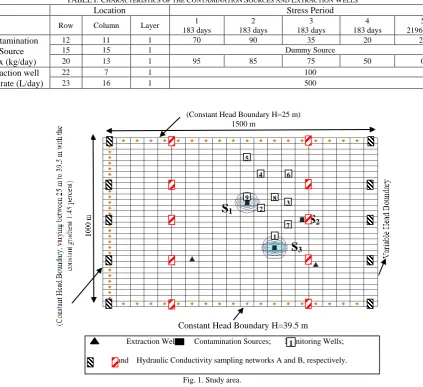
The study area is 1500 m long, 1000 m wide and 30 m deep. It is discretized into 30 rows, 20 columns and two layers. The plan view of the study area is illustrated in Fig. 1. The top, bottom and left side boundaries have specified heads, and the right hand side one has variable head boundary conditions. The location of active extraction wells (sinks), the candidate contamination source locations, and 9
monitoring wells are shown by triangular signs, square signs, and numbers, respectively. The hatched boxes show two hydraulic conductivity sampling networks. Two of the contamination sources are active and actual and one is dummy (not actual source). The contaminant fluxes are specified constant in every stress period. The study period is divided into five stress periods. Table I shows the length of stress periods, and the extraction wells, and contaminant sources properties.
TABLEI:CHARACTERISTICS OF THE CONTAMINATION SOURCES AND EXTRACTION WELLS
Location Stress Period
Row Column Layer 1
183 days
2 183 days
3 183 days
4 183 days
5 2196 days Contamination
Source Flux (kg/day)
12 11 1 70 90 35 20 20
15 15 1 Dummy Source
20 13 1 95 85 75 50 0
Extraction well Flow rate (L/day)
22 7 1 100
23 16 1 500
Fig. 1. Study area.
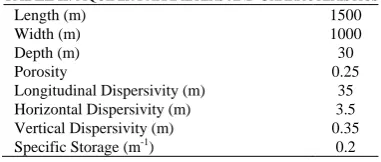
In the evaluation process, it is assumed that all the aquifer hydrogeologic parameter values are known without any error except the hydraulic conductivity (K). Table II shows the aquifer parameters and characteristics.
B. Flow Field
The flow field is analogous to the real hydrogeologic condition in field. The actual hydraulic conductivity values are generated randomly throughout the study area, considering a heterogeneous hydraulic conductivity field. The study area is divided into grids each 50 m long, and 50 m wide for the purpose of specifying hydraulic conductivity values. Considering a two-layer three-dimensional model, for each location two K values corresponding to the 10 m and 20 m depths are required.
A realistic presentation of porous medium can include a hydraulic conductivity field distributed as a Log-Normal
function through space [10]. When the K is log-normally distributed and Y=log K, then the parameter Y can be generated from a normal distribution function with mean
Y
and standard deviationY. A truncated Latin Hypercube
Sampling (LHS) is utilized to produce more efficient estimates than those obtained from random sampling of the distribution function. In the LHS the probability distribution function is divided into non-overlapping, equal-probability intervals. The sample is taken from each interval and permuted in a way that the correlation of the field is accurately presented [11]. The sampling is truncated to the values which are within (0.6Y, 1.4Y) range. For the values located at the depth of 10 m, the mean and standard deviation are 20 m/day and 15% of the mean, respectively. The distribution function utilized for the 20 m depth has a mean value of 15 m/day, and the standard deviation is 0.15
(Constant Head Boundary H=25 m) 1500 m
Constant Head Boundary H=39.5 m 1 2 3 4 5
6
7 8 9
S
1S
3S
2Extraction Wells; Contamination Sources; Monitoring Wells;
and Hydraulic Conductivity sampling networks A and B, respectively.
1
[image:4.595.85.509.187.574.2]times mean value. Using the Kriging interpolation technique, the actual hydraulic conductivity field for the evaluations is generated. Fig. 2 shows the K values for the aquifer first layer.
C. Hydraulic Conductivity Sampling Network
[image:5.595.52.288.268.416.2]Two sets of hydraulic conductivity sampling locations are considered. Assuming the budgetary limitations, 20 samples are collected in both cases. However, different sampling locations are selected for each network. In Fig. 1, sampling networks are shown. The black boxes located on the boundaries show Sampling Network A, and the red boxes located within the study area, show Sampling Network B. The plan view shows, 10 locations for each network. Note that samples are collected for both layers at two depths (10 m and 20 m). Therefore, in total 20 samples are collected in each case.
Fig. 2. The actual hydraulic conductivity field, first layer (unit is m/day).
(a)
[image:5.595.317.535.335.614.2](b)
Fig. 3. Generated hydraulic conductivity fields using the ID interpolation algorithm and n=20. (unit is m/day): (a) using sampling network A, (b) using
sampling network B.
In real life cases, samples are collected at selected
locations, then analyzed and corresponding hydraulic conductivity values are obtained. In this example, the illustrative study area (Fig. 2) is the representative of the actual field. Therefore, the hydraulic conductivity measurement values corresponding to the sampling locations are obtained using the hydraulic conductivity field as described in the section “Hydraulic Conductivity Field”.
The flow simulation model (MODFLOW) requires hydraulic conductivity values at all the finite difference discretized cells. The ID interpolation algorithm is utilized to generate the entire hydraulic conductivity fields using data collected at sampling locations A and B (Fig. 3).
As Fig. 3 shows, the interpolated conductivity fields using sampling network A and B are not identical. Although, both hydraulic conductivity sampling data are collected from one actual field, different interpolated values are generated. The differences among Fig. 2, Fig. 3(a) and Fig. 3(b) demonstrate the source of un-modelled uncertainty in flow simulation model. In real aquifers, precise hydrogeological characteristics are not available. Therefore, the only typical available data are as the fields shown in the Fig. 3(a) and Fig. 3(b).
(a)
[image:5.595.55.284.439.733.2](b)
Fig. 4. Index of spatial uncertainty and variability of hydraulic conductivity. (i j kl, , ): (a) sampling network A, (b) sampling network B.
TABLEII:AQUIFER PARAMETERS AND CHARACTERISTICS
Length (m) 1500
Width (m) 1000
Depth (m) 30
Porosity 0.25
Longitudinal Dispersivity (m) 35 Horizontal Dispersivity (m) 3.5 Vertical Dispersivity (m) 0.35 Specific Storage (m-1) 0.2
D. Index of Spatial Uncertainty and Variability of Conductivity
At this stage four realizations for each sampling network A
2 3 4 5
6
8 9
(Constant Head Boundary H=25 m)
1500 m
S
1S
2 [image:5.595.331.522.659.740.2]and B, are generated. The realizations are obtained as solutions of the ID interpolation algorithm implementation using n= 5, 10, 15 and 20 (Eq. (4)). Then the index of uncertainty and variability of conductivity is estimated using Eq. (6). Fig. 4 shows the estimated index values obtained using sampling network A and B.
E. Contamination Plume
[image:6.595.64.272.231.374.2]The 9 contamination monitoring locations are shown in Fig. 1. The contaminant samples are collected at 16 time stages (every 6 months). The measured concentrations at each monitoring stages are interpolated using ID interpolation algorithm. As the result, the contaminant concentration is estimated throughout the aquifer.
Fig. 5. Contamination plume 183 days after source activation.
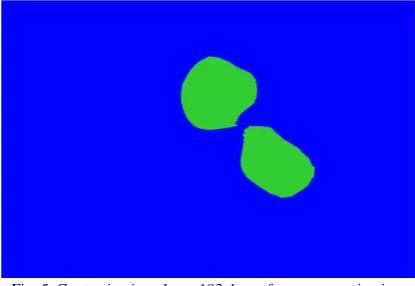
Fig. 5 shows the contamination plume 183 after the activation of sources. The maximum estimated concentrations at this time stage is 84 (mg/L). The plume threshold is 21 (mg/L). Note that for the purpose of uncertainty quantification, the contaminant source characteristics are unknown and the only available information is the concentrations measured at monitoring locations.
F. Reliability index
The contamination plumes at 16 monitoring periods are utilized to estimate ki j kl, , for i= 1: 30; j=1: 20; kl=1: 2 and
k=1: 16. The reliability index is estimated using Eq. (7). Following the steps in Fig. 1, the estimated uncertainty index (µ) for sampling network A and B are 76×10-3 and 74×10-3, respectively. Therefore, using hydraulic conductivity sampling network A will result in more accurate identified source characteristics. The source characteristics identified using sampling network A are more reliable for designing contamination management or remediation plans in this study area.
V. RESULTS AND DISCUSSION
The developed methodology was utilized to rank two hydraulic conductivity sampling networks with respect to their effectiveness in identify reliable contaminant source characteristics. It was concluded that network A outperforms network B. Since the illustrative study area was utilized for the performance evaluation, the actual contaminant source characteristics are available (Table I). Note that this information is not available in real fields and the following
analysis is for the methodology evaluation purpose only. Using the ASA based linked simulation-optimization source identification algorithm (Eqs. (1-3)) the contaminant source characteristics are identified. The linked simulation-optimization was executed two times using sampling network A and B one at a time.
Using both sampling networks, the identified fluxes for source 2 at all stress periods is zero. It shows that using data from both networks, the locations of actual sources are identified accurately. Therefore, both models correctly identified the actual source locations. The Normalized Absolute Error of Estimation (NAEE%), computed using Eq. (8), is utilized to quantify the error in the estimated source fluxes.
1
1
% 100
SP
estimate actual
ii ii
ii SP
actual ii ii
q q NAEE
q
(8)where estimate ii
q and actual ii
q are the estimated and actual source fluxes for stress period ii, respectively. SP is the total number of stress periods. The estimated NAEE% for source 1 and 3 are defined in Table III. The estimated NAEE% values confirm the results obtained by estimated reliability index (µ). The sampling network A outperforms sampling network B by 5.66% and 13.64% for source 1 and 3, respectively.
TABLEIII:THE NORMALIZED ABSOLUTE ERROR OF ESTIMATION (%) AND
INDEX OF UNCERTAINTY
Index of Reliability
Source 1 Source 2
using Sample Network A 76 × 10-3 1.53 10.43
using Sample Network B 76 × 10-4 7.19 24.07
In this study, the utilized contaminant monitoring locations were selected arbitrarily. The proposed methodology has the potential for application to design monitoring networks dedicated to the contamination source identification. The monitoring locations can be selected in the regions where the level of uncertainty in the flow field is low. The simultaneous design of hydraulic conductivity sampling locations and monitoring network can be used to decrease the uncertainty in the contamination source identification.
VI. CONCLUSION
This study presents a methodology to rank the reliability of hydraulic conductivity sampling networks in reducing uncertainty in contamination source characterization. In contaminated groundwater aquifers, the source of pollution is unknown in terms of location, activity duration, and flux. Moreover, limited field hydraulic conductivity information is generally available due to the budgetary constraints. In this study multiple realizations of a hydraulic conductivity field for different sampling networks is utilized. Then the index of reliability for each selected hydraulic conductivity sampling
[image:6.595.345.518.239.306.2] [image:6.595.305.549.439.505.2]network is estimated. This index is shown to be correlated to the accuracy of contamination source characterization.
The contamination source identification model which utilized the hydraulic conductivity data with higher index of reliability is expected to deliver more accurate results.
The developed methodology provides the decision makers with a tool to select an effective hydraulic conductivity sampling network to reduce the uncertainty associated with lack of adequate hydrogeologic information. The reduction in contamination source identification uncertainty will eventually decrease the cost of management and remediation plans, and increase the reliability of any decision taken on management of the contaminated aquifer.
ACKNOWLEDGMENT
We acknowledge the financial support for this work provided by CRC for Contamination Assessment and Remediation of Environment (CRC-CARE), Australia, and by James Cook University, Australia.
REFERENCES
[1] R. A. Freeze, “The role of stochastic hydrogeological modeling in real-world engineering applications,” Stochastic Environmental Research and Risk Assessment, vol. 18, no. 4, pp. 286-289, 2004. [2] M. Amirabdollahian and B. Datta, “Identification of contaminant
source characteristics and monitoring network design in groundwater aquifers: an overview,” Journal of Environmental Protection, vol. 4, no. 5A, pp. 26-41, 2013.
[3] M. M. Aral, J. Guan, and M. L. Maslia, “Identification of Contaminant Source Location and Release History in Aquifers,” Journal of Hydrologic Engineering, vol. 6, no. 3, pp. 225-234, 2001.
[4] B. Datta, D. Chakrabarty, and A. Dhar, “Simultaneous Identification of unknown groundwater pollution sources and estimation of aquifer parameters,” Journal of Hydrology, vol. 376, no. 1-2, pp. 48-57, 2009. [5] P. S. Mahar and B. Datta, “Optimal identification of ground-water pollution sources and parameter estimation,” Water Resources Planning and Management-ASCE, vol. 127, no. 1, pp. 20-29, 2001. [6] C. Tiedeman and S. M. Gorelick, “Analysis of uncertainty in optimal
groundwater contaminant capture design,” Water Resources Research,
vol. 29, no. 7, pp. 2139-2153, 1993.
[7] P. Mugunthan and C. A. Shoemaker, “time varying optimization for monitoring multiple contaminants under uncertain hydrogeology,”
Bioremediation Journal, vol. 8, no. 3-4, pp. 129-146, 2004.
[8] M. Amirabdollahian and B. Datta, “Identification of pollutant source characteristics under uncertainty in contaminated water resources systems using adaptive simulated anealing and fuzzy logic,” Int. J. of GEOMATE, vol. 6, no. 1, pp. 757-762, 2014.
[9] L. Ingber, “Adaptive simulated annealing (ASA): Lessons learned,”
Control Cybern., vol. 25, no. 1, pp. 33-54, 1996.
[10] R. A. Freeze, “A stochastic-conceptual analysis of one-dimensional groundwater flow in nonuniform homogeneous media,” Water Resources Research, vol. 11, no. 5, pp. 725-741, 1975.
[11] Z. Dokou and G. F. Pinder, “Optimal search strategy for the definition of a DNAPL source,” Journal of Hydrology, vol. 376, no. 3, pp. 542-556, 2009.
Mahsa Amirabdollahian got the M.Sc. degree in civil engineering in 2007, and M.Sc. degree in water resources management-civil engineering in 2010. She is currently a PhD student in James Cook University, Townsville, Australia. She studies the effect of hydrogeologic uncertainty on groundwater contamination source identification methods. Her major research areas include groundwater hydrogeology, groundwater contamination, optimization techniques, and uncertainty analysis.
Bithin Datta got the PhD degree from Purdue University, U.S. He has served as a postdoctoral researcher at University of Arkansas, U.S.A. University of Washington, Seattle, U.S.A and University of California, Davis, U.S.A. from 1986 to 1989.
Now, he works in the Civil Engineering Department at James Cook University.
Dr. Datta is internationally recognized in the field of water resources management. His research is in the U.S. during the early part of his career and later at I.I.T. Kanpur, India. Currently he has been devoted to methodology development for solving complex and difficult large scale problems related to water resources management in James Cook University, Australia. He has collaborated with many researchers from countries like U.S.A., Canada, Denmark, India, and Australia.
He was been associated with the research capacity building at CRC-CARE at University of South Australia since 2007 and also served in its annual review committee. He has also contributed internationally to research guidance and training as a visiting professor in a number of Universities of repute, including Denmark Technical University, Dalhousie University, Halifax Canada, and Asian Institute of Technology, Bangkok, Thailand. He has also served at the leading Engineering University in India, I.I.T. Kanpur, as a professor and the head of Civil Engineering Department from 2004 to 2007.
Author’s formal photo Author’s formal