National Child Measurement
Programme: a conversation
framework for talking to parents
About Public Health England
Public Health England exists to protect and improve the nation’s health and wellbeing, and reduce health inequalities. We do this through world-leading science, knowledge and intelligence, advocacy, partnerships and the delivery of specialist public health services. We are an executive agency of the Department of Health and Social Care, and a distinct delivery organisation with operational autonomy. We provide
government, local government, the NHS, Parliament, industry and the public with evidence-based professional, scientific and delivery expertise and support. Public Health England
Wellington House 133-155 Waterloo Road London SE1 8UG Tel: 020 7654 8000 www.gov.uk/phe Twitter: @PHE_uk
Facebook: www.facebook.com/PublicHealthEngland
Prepared by: Paul Chadwick, Associate Professor in Behaviour Change, Consultant Clinical and Health Psychologist and Assistant Director of the Centre of Behaviour Change at University College London and the National Child Measurement Programme Managers (Jade Clark and Alison Gahagan, Registered Dietitians).
For queries relating to this document, please contact: National Child Measurement Programme Team [email protected]
© Crown copyright 2019
You may re-use this information (excluding logos) free of charge in any format or medium, under the terms of the Open Government Licence v3.0. To view this licence, visit OGL. Where we have identified any third party copyright information you will need to obtain permission from the copyright holders concerned.
Published March 2019
PHE publications PHE supports the UN
3
Acknowledgements
Public Health England would like to thank the expert advisory group for their insight in shaping the development of this resource and also the following stakeholders for their invaluable insight and feedback in the development of this resource.
Expert advisory group
Stuart Flint, Leeds Beckett Fiona Gillison, University of Bath
Penny Greenwood, Public Health England Jamie Mills, Public, Health England
Gagandeep Bedi, Public Health England Charlene Mulhern, Public Health England Loretta Sollars, Public Health England Ellen Lithgow, Public Health England Vonesai Muhaso, Public Health England Lisa Mabbs, Public Health England
Michael Heasman, Public Health England
Expert stakeholders
Caroline Machamire, Guy's and St Thomas Foundation Trust Evelina London
Debbie Arrigon, Public Health England and Westminster City Council and Royal Borough of Kensington & Chelsea
Matt Sharp, Cornwall Council
Sara Karrar, Norfolk County Council Jamila Dixon, Oxleas NHS Trust Rachel Livsey, Oxleas NHS Trust
Sam Shaw, Manchester University NHS Foundation Trust Denise Gaston, Manchester University NHS Foundation Trust Julie Bowden, Manchester University NHS Foundation Trust Emma Schneider, Manchester University NHS Foundation Trust Alison Stafford, Greater London Authority
Deb Lowe, Leeds City Council Jackie Moores, Leeds City Council
Helena Wehling, Lisa Thompson, Wendy Nicholson, Eustace De-Sousa, Justine Womack, Public Health England
Contents
Acknowledgements 3
Glossary of terms 5
Executive summary 6
Conversations about weight in the NCMP 8
Understanding parents’ reactions to the NCMP 10
Supporting parents’ through their NCMP journey 12
Summary 16
Resources for further learning and information 17
5
Glossary of terms
National Child Measurement Programme (NCMP): this is the surveillance programme in England where all eligible children in reception year (children aged 4-5) and year 6 (children aged 10-11) height and weight are measured and the data is submitted annually to government
NCMP feedback: includes a parent’s feedback letter providing information about their child’s weight category and/or any phone conversations had with a parent about a child’s weight
Childs weight status: a child’s weight status is determined using an age- and sex-specific centile for BMI rather than the BMI categories used for adults. Parents use the term ‘child’s weight’ when referring to their child’s weight status, this term will be used in this document
School height and weight checks: this is the term used in all communications to parents about the NCMP
NCMP: a conversation framework for talking to parents: the title of this document abbreviates the NCMP throughout the text
Practitioners: this guide is designed for school nurses, their teams and other
professionals involved in the delivery of the NCMP. The term ‘practitioners’ will be used in this document to refer to this group collectively
Executive summary
The National Child Measurement Programme (NCMP) provides an annual opportunity to engage with over a million parents about their child’s health and support positive action towards healthier lifestyles.
It is widely agreed that talking about children’s weight is difficult. Professionals, parents and children find talking about weight uncomfortable and few professionals feel
sufficiently knowledgeable and skilled to have such conversations 1, 2, 3, 4.
Nevertheless, conversations about weight, handled with care, tact and sensitivity can positively influence the way that parents think and feel about the information provided by NCMP feedback and can be an important part of a family’s journey towards a healthier lifestyle. School nurses, their teams and other professionals involved in the NCMP are in a unique position to shape how parents understand their child’s health and to support them to take steps towards positive action.
The guide aims to support school nurses, their teams and other professionals to have supportive and constructive conversations with parents about their child’s weight status. It describes the reasons why some parents react in a range of ways including experiencing distress and feeling anger after receiving feedback about the weight status of their child and provides a framework for practitioners to respond to such distress in a helpful and sensitive manner. This guide relates to parents of primary school age children, specifically those aged 4-5 in reception year and 10-11 in year 6 who have taken part in the NCMP.
As with other sorts of feedback given to parents on their child’s health and
development, such as vision, dental checks, and educational attainment, the NCMP feedback is an important source of information for parents about an aspect of their child’s health. NCMP feedback should be viewed as a positive opportunity to engage and support parents with understanding their child’s growth and taking steps towards a healthier lifestyle.
This guide will help school nurses, their teams and other professionals delivering the NCMP:
• identify common emotional responses to NCMP feedback
• understand the origins of parents’ emotional responses to NCMP feedback
• use the NCMP conversation framework to respond in a helpful and supportive way to parents who experience distress following NCMP feedback
7
To accompany this guidance ‘NCMP: a conversation framework for talking to parents’ there is also a supporting annexe which covers common queries and challenges raised by parents and helpful responses using the conversation framework outlined.
Conversations about weight in the NCMP
Conversations about children’s weight with parents can be challenging. Not all the factors that contribute to such difficulty are associated with the parent: practitioner, organisational and societal factors have also been found to play a role. Practitioners may fear that conversations about weight will harm relationships with families who need their help. Organisational factors such as limited time, resources, and support may make it difficult to talk helpfully about weight, as well as societal factors like the normalisation of overweight, and weight bias.3
Common parental reactions to NCMP feedback
Receiving feedback that their child is outside of the healthy weight range can be
distressing for many parents. Distress can take several forms, including; shock, denial, confusion, anger, guilt, shame and/or fear.5, 6, 7
Parents’ emotional reactions will vary according to their understanding of what the information means. Parents may express: 5, 6, 7
• feelings of surprise or shock
• a lack of trust in the validity of the measures used such a body mass index • disagreement with the results
• a lack of belief that being overweight is detrimental for their child’s health • fear that discussing weight with their child may undermine their self-esteem and
wellbeing, or trigger an eating disorder
• anger at perceived implied criticism of their parenting ability • objection to being provided with the feedback in the first place
Understanding the basis for these different patterns of emotional response can help practitioners respond helpfully to parent’s expressions of concern.
More information on research into parent’s emotional responses can be found in the Evidence summary(in development) to accompany this guide.
Negative responses as an expression of parental love and concern
9
non-judgemental approach, based on an understanding that most parents want to do the best for their child, will create a valuable opportunity to help parents better
understand the implications of a child’s weight for their current and future health.
Whilst negative emotional responses are common, it is also the case that many parents respond positively to information about their child’s weight. Research has shown that 87% of parents find the NCMP feedback helpful 8 and nearly 75% report an intention to make positive lifestyle changes after receiving it 9.
Responding to instances of severe obesity
Understanding parents’ reactions to the
NCMP
Parents differ in how they receive the information that their child’s weight is outside of the healthy weight range. The factors influencing how parents respond are multiple and will be specific to their personal histories and cultural background. These include:11,12,13 • parents’ own perceptions of their child’s size, food intake and activity levels, and the
information they use to make judgements about what being healthy is • cultural meanings given to different body sizes and shapes
• parents’ own weight status, body image and their experiences of living with, or alongside overweight or obesity
Although parental responses can be complex and varied, typical responses include; shock, confusion, fear, anger, shame and guilt.5, 6, 7 Figure 1. illustrates the typical emotional responses to the news that a child is outside of the healthy weight range, the questions and comments that may indicate what a parent could be feeling, and the beliefs that may be contributing to that emotional state. It is common to refer to parents who do not accept or challenge the results of the NCMP feedback as being in ‘denial’.
This is rarely a useful position for the formation of a helping relationship as it
immediately places parent and practitioner in opposition to each other. A more helpful approach might be to see parents’ challenges as being the result of confusion and/or misunderstanding, or as an attempt to try and process information that can be
11
Supporting parents’ through their NCMP
journey
School nurses and other professionals can respond to parents who experience distress as a result of receiving NCMP feedback. There is an opportunity to support parents to take constructive action to change their child’s weight trajectory, which refers to a child’s future pattern of growth in relation to their weight as they grow taller and older.
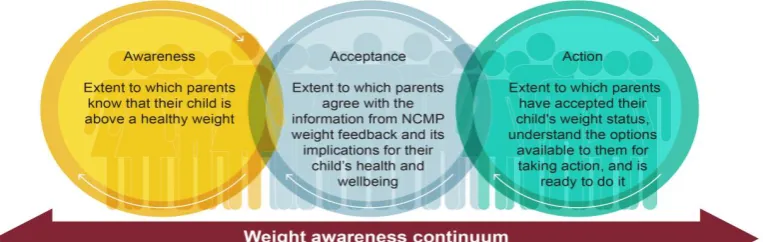
Weight Awareness Continuum: Awareness, Acceptance, Action
[image:12.595.82.464.529.650.2]How a parent responds to NCMP feedback will be shaped by their understanding of their child’s weight. Parents’ understanding can be thought about as a continuum with three distinct phases but the possibility to move back and forth between each one depending on the particular concern raised (Figure 2). In order to respond to NCMP feedback by taking steps to live a healthier lifestyle, parents will need to be aware that their child is above a healthy weight range, understand and accept that this may have implications for their child’s wellbeing now and as they grow up, and have a range of options to take appropriate action.
13
A parent’s beliefs and culture will influence how they respond to NCMP feedback. Parents use a range of different information when making judgements about their child’s health. Many parents believe that a child’s weight is not an accurate indication of their health or wellbeing and use other indicators when making judgements about their child’s health such as: 5, 7, 13, 14
• the perceived healthiness of their diet for example fruit and vegetables intake • their physical activity levels by the amount of sport they play
• their psychological state for example by the degree to which their child is happy or free from worry
Parents’ beliefs about their child’s weight may be influenced by their culture. For example, parents from cultures where weight is an indicator of wealth is more likely to view overweight children as healthy and believe they will outgrow their weight.15 A parents’ understanding of their child’s weight is dynamic and will evolve as the child develops, and in response to feedback from health professionals, peers, and exposure to the media. For these reasons, parents can be expected to move back and forth across the Weight Awareness Continuum over time. Parents may also exhibit different stages of awareness, acceptance and action for different aspects of their child’s weight, behaviour and health. For example, a parent may accept that their child is overweight but may not be aware or accept that their child needs to make changes to their diet.5
Supporting families and children with complex needs
For the most part, the timing of NCMP feedback is dictated by the delivery plans of local authorities rather than the needs of individual families. This can mean that some parents may receive feedback about their child’s weight during periods of stress and complexity for a family. Whilst it is unlikely there will ever be an optimal time to give information on a childs weight status to parents, practitioners can be sensitive to the the needs of individual families, assess the degree to which parents are receptive in the moment of the conversation, and use their judgement to defer conversations, or to signpost on to other professionals.
Conversations should aim to move parents along the Weight Awareness Continuum. For example, clarifying misunderstandings of how a child’s weight is categorised might move a parent from awareness towards acceptance. Similarly, empathising with a parent’s distress and providing reassurance that they are not to blame for their child’s weight could help a parent move from acceptance towards action.
Practitioners should be aware that parents may use similar phrases that have widely different meanings about their understanding of a child’s weight. For example, a parent who expresses concern that their child’s weight is due to ‘puppy fat’ may have a
15
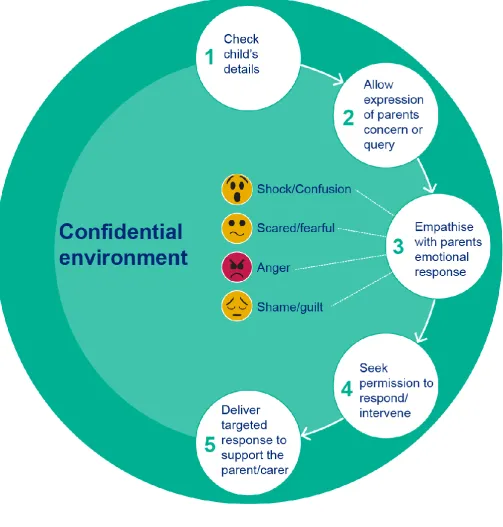
Figure 3: NCMP conversation framework: in practice
Summary
This guide has been developed with clinical experts, school nurses, their teams and other professionals who deliver the NCMP to learn useful ways to respond to parents in challenging discussions they have with them about their child’s weight feedback. This is part of a series of resources being developed to have supportive conversations
17
Resources for further learning and
information
Change Talk: Childhood Obesity app
https://play.google.com/store/apps/details?id=com.kognito.aap&hl=en_GB
https://itunes.apple.com/us/app/change-talk-childhood-obesity/id821851796?mt=8
Childhood obesity: applying All Our Health
https://www.gov.uk/government/publications/childhood-obesity-applying-all-our-health/childhood-obesity-applying-all-our-health
Child weight management: short conversations with families
https://www.gov.uk/government/publications/child-weight-management-short-conversations-with-patients
Health Education England e-learning modules for healthcare professionals working with children aged 5-12 years.
Growth and Nutrition: https://www.minded.org.uk/course/view.php?id=187 (assessing normal and abnormal growth, puberty and essential nutrition)
Understanding and tackling obesity:
https://www.minded.org.uk/course/view.php?id=251 (childhood obesity and childhood eating behaviours)
Health Education England obesity e-learning modules for practitioners in the NHS and local authorities working in weight management (managing obesity: supporting
behaviour change, guiding and enabling behaviour change) http://www.e-lfh.org.uk/programmes/obesity/
Making Every Contact Count resources (tools to aid implementation and support individuals when considering MECC activity)
https://www.gov.uk/government/publications/making-every-contact-count-mecc-practical-resources
http://learning.wm.hee.nhs.uk/mecc http://makingeverycontactcount.org.uk/
messaging
https://www.gov.uk/government/publications/healthier-weight-promotion-consistent- messaging/promoting-a-healthier-weight-for-children-young-people-and-families-consistent-messaging
Public Health Childhood Obesity Impact Pathway
https://www.rsph.org.uk/our-work/policy/wider-public-health-workforce/measuring-public-health-impact/childhood-obesity.html
19
Appendix 1: Creating the conditions for
supportive conversations about weight
Use your general communication skills
In many ways, talking about weight is no different from talking about any other aspect of a child’s health or wellbeing. Use of person-centred communication and motivational interviewing principles during weight-related conversations will help to create a positive and supportive relationship. Expressing empathy (for example, I can see this is
difficult), rolling with resistance (for example, it sounds like you don’t agree with the feedback) and supporting self-efficacy (for example, it sounds like you are doing a lot to support your child to be healthy already)16. This will help set the seeds for
conversations that move parents along the weight awareness continuum.
Listen first, advise later
If parents have contacted a practitioner to have a conversation it is likely that they are upset, angry or confused in some way. In such circumstances it is generally helpful to give parents the opportunity to express their concerns about their child’s NCMP feedback, or the process before offering any advice or clarification. Listening first will help practitioners to communicate to the parent that they are genuinely interested in their experience and want to help and support. Offering help or advice before a parent has had chance to express their concerns may lead to an unhelpful stand-off which is unlikely to move parents along the weight awareness continuum.
Ask-Provide-Ask (also known as ‘Elicit–Provide–Elicit’)
16The Ask-Provide-Ask framework is a useful approach for structuring conversations with parents. It is a strength-based approach to building mutually respectful conversations between practitioners and parents that allow each to share their respective expertise in the spirit of collaboration. At the broadest level the stages of the A-P-A framework are: • ask the parent about their understanding or experience of the issue
• provide information tailored to the needs expressed by the parent • ask the parent for their reflections on the information given
Ask • Tell me about your concerns about the letter
• Is there anything in particular that is worrying you?
• It sounds like you are quite angry about this – can you tell me a bit more about why you feel this way?
Provide • Would it be helpful if I explained more about (x)?
• What information could I give you, would reassure you?
• Can I explain (x) to you and see whether that changes anything?
Ask • Does that information help address your concerns?
• Does that knowledge change anything for you? • What is your take on that information?
• Is there anything else that I could provide for you?
The seeds of a supportive conversation about the school height and weight checks are sown in the way that the programme is set up and communicated to parents of children due to take part. Measurement days that are embedded as a part of a whole school approach help to establish a positive approach to the programme. There are several NCMP resources that have been developed to help achieve this for school nurses, teachers and headteachers. These include presentations for school assemblies and parents’ evenings, lesson plans for reception and year 6 teachers (Our Healthy Year), and specimen letters for informing parents (NCMP Operational guidance) about the programme.
Creating a positive view of the NCMP in earlier stages of parental engagement will reduce parental anxieties and make subsequent conversations much easier. It is important that parents receive a consistent approach and tone throughout their contact with the programme. Strong emotional responses from parents (as described in the section on Understanding parents’ reactions to the NCMP feedback) may be caused by failure to present a positive and reassuring message at earlier stages of programme delivery.
Taking calls from parents: the foundations
23
Phase General principles Considerations for NCMP feedback
conversations
Preparation
Understand the perspective of the parent and child that you are going to talk to and what they need to know
• What kind of call is it?
o Proactive follow-up for
children with severe obesity o Returning a call from a
parent who has received a feedback letter
• Have they received information about their child’s weight? • What emotions might they be
experiencing that caused them to get in touch
• What might be the emotional reaction to the news?
Ensure that you have the right information to hand
• Child’s name and parents contact details
• Date of measurements • Weight category
• Has a feedback letter been sent?
Rehearse delivering the news mentally, and practice with peers to get feedback about your knowledge and skills
• Refer to practitioners’ strategies
Ensure the environment is conducive to talking about weight (e.g. privacy and time)
• Only take calls in environment that
is confidential and ensure you have enough time to take the call. • Does the parent have enough time
to take the call?
Communication Explore what the parent already
knows
• Allow expression of parents concern or query
feelings that parents express • What stage might they be at;
awareness, acceptance, action? • Have they received information
about their child’s weight?
Give information honestly, but with sensitivity
• Seek permission to respond using the ask-provide-ask model
• Refer to practitioners’ strategies
Use simple language and avoid medical jargon where possible
• Check understanding of the measurements, explain what BMI means and child BMI category in simple non-technical language Respond appropriately to verbal
or non-verbal communications • Refer to practitioner strategies
Planning Give time for families to process
the news and its implications
• Allow thinking time
• Don’t expect parents to turn their thinking around in one phone call
Follow-up
Provide written information, a summary of your conversation, or an opportunity for a follow-up call
• Offer time for follow-up
conversations if this is practical • Signpost parents to information
that is aligned to their position on the weight awareness continuum
Give details of services and support organisations that may be able to help the family
• Ensure you have information about local child weight management services if available
• Have ‘Your Child’s Weight’
(Change4Life/NCMP information) to refer to)
25
activity for children and families to share
• Promoting a healthier weight for children, young people and
1 Walker, O, Strong, M, Atchinson, R, et al. 2007. A qualitative study of primary care clinicians' views of treating childhood obesity. BMC Family Practice20078:50
https://doi.org/10.1186/1471-2296-8-50
2 Strategies to Overcome and Prevent (STOP) Obesity Alliance. WHY WEIGHT? A Guide to Discussing Obesity & Health With Your Patients. 2014. Accessed September 2018
http://stopobesityalliance.org/wp-content/themes/stopobesityalliance/pdfs/STOP-Provider-Discussion-Tool.pdf
3 Bradbury, D., Chisholm, A., Watson, P. M., et al. 2018. Barriers and facilitators to health care professionals discussing child weight with parents: A meta-synthesis of qualitative studies. British journal of health psychology.
4 Thorstensson, S., Larsson, M., Blomgren, C., et al. 2018. To break the weight gain-A qualitative study on the experience of school nurses working with overweight children in elementary school. Journal of clinical nursing 27(1).
5 Gillison, F., Beck, F. and Lewitt, J. (2014) Exploring the basis for parents' negative reactions
to being informed that their child is overweight. Public Health Nutrition, 17 (5). pp. 987-997. 6 Falconer, C., Skow, A., Black, J., et al. 2012. Does BMI feedback change parental
perceptions about The health risk associated with their child's BMI? Obesity Facts 5 240.
7 Gainsbury, A. & Dowling, S. 2018. 'A little bit offended and slightly patronised': parents'
experiences of National Child Measurement Programme feedback. Public health nutrition 1-9. 8 Falconer, C. L., Park, M. H., Croker, H., et al. 2014. The benefits and harms of providing parents with weight feedback as part of the national child measurement programme: a prospective cohort study. BMC public health 14 549.
9 Park, M. H., Falconer, C. L., Croker, H., et al. 2014. Predictors of health-related behaviour change in parents of overweight children in England. Preventive medicine 62 20-24.
www.ncbi.nlm.nih.gov/pmc/articles/PMC3995088/
10 Viner, R, Roche, E, Maguire, S, and Nicholls, D. 2010. Childhood protection and obesity: framework for practice. BMJ 341. https://www.bmj.com/content/341/bmj.c3074.full
11 Kovacs, B. E., Gillison, F. B., & Barnett, J. C. (2018). Is children’s weight a public health or a private family issue? A qualitative analysis of online discussion about National Child
Measurement Programme feedback in England. BMC Public Health, 18(1), 1295. https://doi.org/10.1186/s12889-018-6214-y
12 Nnyanzi, L. A., Summerbell, C. D., Ells, L., & Shucksmith, J. (2016). Parental response to a letter reporting child overweight measured as part of a routine national programme in England: results from interviews with parents. https://doi.org/10.1186/s12889-016-3481-3
27
13 Syrad, H., Falconer, C., Cooke, L., et al. 2015. Health and happiness is more important than
weight': a qualitative investigation of the views of parents receiving written feedback on their child's weight as part of the National Child Measurement Programme. Journal of human nutrition and dietetics: the official journal of the British Dietetic Association 28(1) 47-55
14 Gillison, F. et.al., 2016. Can it be harmful for parents to talk to their child about their weight?
A meta-analysis. Preventative Medicine. 2016;93:135-146
15 Trigwell, J., Watson, P., Murphy, R., Stratton, G., & Cable, N. (2014). Ethnic differences in parental attitudes and beliefs about being overweight in childhood. Health Education Journal, 73(2), 179–191. https://doi.org/10.1177/0017896912471035
16 Rollick and Miller. Motivational Interviewing. Third Edition. Helping People Change. 2013 17 Family-Centered Care and the Pediatrician’s Role. 2003. Pediatrics, volume 112 / issue 3. American Academy of Pediatrics
18 Royal College of Nursing, 2013. Breaking bad news: supporting parents when they are told of their child’s diagnosis. RCN guidance for nurses, midwives and health visitors.