for carbon emissions trading
Developing REDD+ governance through
a multi-stage, multi-level and
multi-stakeholder approach
IGES Discussion
Paper
for carbon emissions trading
Developing REDD+ governance through
a multi-stage, multi-level and
multi-stakeholder approach
IGES Discussion
Paper
Institute for Global Environmental Strategies (IGES)
2108-11 Kamiyamaguchi, Hayama, Kanagawa 240-0115 Japan Phone: +81-46-855-3830 • Facsimile: +81-46-855-3809
Copyright © 2013 by Institute for Global Environmental Strategies (IGES), Japan.
All rights reserved. Inquiries regarding this publication copyright should be addressed to IGES in writing. No parts of this publication may be reproduced or transmitted in any form or by any means, electronic or mechanical, including photocopying, recording, or any infor-mation storage and retrieval system, without the prior permission in writing from IGES.
Although every effort is made to ensure objectivity and balance, the publication of research results or translation does not imply IGES endorsement or acquiescence with its conclusions or the endorsement of IGES financers. IGES maintains a position of neutrality at all times on issues concerning public policy. Hence conclusions that are reached in IGES publications should be understood to be those of the authors and not attributed to staff-members, offic-ers, directors, trustees, fundoffic-ers, or to IGES itself.
Authors: Federico López-Casero, Tim Cadman and Tek Maraseni
Note: Comments are welcomed and should be sent to [email protected]
Cover photos (© Federico López-Casero):
Climate change is a global and cross-sectoral issue. Yet despite the many dimensions of cli-mate change that are tackled at the global policy level, there continues to be no integrating approach to governance. The problem is made more difficult by the institutional framework at the global level, which is often compartmentalized. Concerns about institutional effective-ness have been voiced at numerous negotiations. Parties to the United Nations Framework Convention on Climate Change (UNFCCC) adopted in the Cancún Agreements (Decision 1/ CP.16) at the 16th Conference of Parties in 2010 social and environmental safeguards on REDD+ that “should be promoted and supported,” including “transparent and effective na-tional forest governance structures.”
Improving governance requires a systematic approach that identifies areas to be addressed, devises and implements suitable responses, monitors results, and continuously adapts and learns. This can be achieved through a common framework or standard for measuring quality of governance, which can be applied independently of the different roles for social, environ-mental, economic and governmental stakeholders and donor agencies.
The Institute for Global Environmental Strategies (IGES) has collaborated with Griffith Univer-sity and the UniverUniver-sity of Southern Queensland (USQ) on action research in Nepal, with the purpose of developing standards for the quality of governance of programmes and projects related to the sustainable management of forests and to reducing GHG emissions via policy instruments and market mechanisms such as REDD+.
This report presents the preliminary results of the action research in Nepal, a country that has been a pioneer in community-based forest management. I would like to congratulate the authors for succeeding in bringing together this report. I anticipate that it will be useful to the various stakeholders that participate in the design of REDD+ at the project level, as well as in the preparation process of national REDD+ readiness.
Hideyuki Mori
IGES President
Acknowledgements
The authors are grateful to a number of people who kindly contributed to or shared infor-mation for this report, including Mr Prem Neupane (Friends of Nature, Nepal), Mr Shiva Pandey (University of Southern Queensland, Australia), Mr Ramesh Dhakal, as well as a range of interview partners from government and civil society in Nepal, the participants in the Multistakeholder Forum Workshop in December 2011, and, particularly, all Communi-ty Forest User Groups (CFUG), who participated in the local workshops in Nepal, including Laxmi CFUG, Ludhi Damgade CFUG, Baghpani CFUG, Sheetalupakha CFUG, Jana Pragati CFUG, Nibuwatar CFUG, Chelibeti CFUG, Kankali CFUG and Dudhkoshi CFUG.
The authors would also like to thank Dr Henry Scheyvens at IGES for kindly providing his thoughts on an earlier draft of the report and reviewing the final draft.
Acronyms
ANSAB Asia Network for Sustainable Agriculture and Bioresources
CCBA Climate, Community and Biodiversity Alliance
CFUG Community Forest User Group
CO2 Carbon dioxide
FAO United Nations Food and Agriculture Organisation
FCPF Forest Carbon Partnership Facility
FMS Forest management system
G8 Group of Eight
GHG Greenhouse gas/ gases
IGES Institute for Global Environmental Strategies
ITTO International Tropical Timber Organisation
MoV Means of verification
MRV Measurement, reporting and verification
NGOs Non-governmental organisations
PC&I Principles, criteria and indicators
PGAs Participatory governance assessments
REDD+ Reducing Emissions from Deforestation and Forest Degradation and con-servation, sustainable management of forests and enhancement of forest carbon stocks in developing countries
REDD+ SES REDD+ Social and Environmental Standards
SEPC Social and Environmental Principles and Criteria
SMF Sustainable management of forests
TIAR Transparency, inclusiveness, accountability and resources
UNFCCC United Nations Framework Convention on Climate Change
UN-REDD United Nations Collaborative Programme on Reducing Emissions from Deforestation and Forest Degradation in Developing Countries
USD United States dollar
USQ University of Southern Queensland
Governance is an important concept for addressing social problems and opportunities but needs to be properly understood. Governance refers to the whole of public and private interactions to solve problems and to create opportunities in modern society and can be defined as the dynamic interplay between civil society, business and the public sector.
For the emergence of a global carbon market it is necessary to develop common govern-ance and regulatory structures. Ensuring good governgovern-ance is particularly important for the development of a financial mechanism for REDD+. Transparent and effective national forest governance is needed to encourage investments in REDD+, to ensure that REDD+ delivers real and long-term emissions reductions, to promote accountability and transpar-ency, to develop credible monitoring and reporting on REDD+ safeguards and to change behaviour and solve the problems underlying deforestation and forest degradation.
Parties to the United Nations Framework Convention on Climate Change (UNFCCC) have recognised the importance of good governance for REDD+. “Transparent and effective national forest governance structures” is one of the social and environmental safeguards adopted in the Cancún Agreements in 2010. However, development, operationalisation, and institutionalisation of a forest governance definition may need to be country-driven and respond to specific country conditions, priorities, requirements and opportunities.
Despite specificities of national forest governance definitions and monitoring systems, any governance system as a viable system shares some key elements. Quality of govern-ance can be assessed through a normative hierarchical framework of principles, criteria and indicators (PC&I) for evaluating quality of governance in the arena of sustainable de-velopment. Such a comprehensive analytical framework also provides the basis for the development of a standard that can guide governments in ensuring the required support and promotion of transparent and effective national forest governance structures.
REDD+ can benefit from independent standards of good governance that can be applied for certification of governance within proposed REDD+ activities. Such standards would provide markets with better quality assurance, i.e. that the proposed REDD+ activities can be implemented and that the projected climate benefits are credible. Independent good governance standards would provide consistency in the evaluation of governance across REDD+ projects and policies that are under development. The success of REDD+ will de-pend on governance arrangements that are broadly representative of interests (i.e. inclu-sive), verifiably responsible (i.e. transparent and accountable), effective in terms of
sion-making processes and capable of implementing programs that deliver emission re-ductions at scale.
Existing REDD+ programmes, policies, procedures and standards include some strong lan-guage and requirements on “meaningful” stakeholder participation, but these are coun-ter-balanced elsewhere by language that does not mandate consultation. The degree to which civil society and other non-state actors, such as indigenous people, are able to par-ticipate meaningfully is complex and varies between countries. While some initiatives in-clude “participatory governance assessments” (PGAs), which are currently being trialled, existing standards have not been developed through genuine multi-stakeholder process-es, in the sense of stakeholders providing the contents of the standards as active partici-pants throughout all stages of the process. Due to their highly generic character, existing standards also lack the details for their operationalisation in a local and national context. Locally-specific quality-of-governance standards have the advantage that they make it easier for all participants to determine what they require for REDD+ policies and projects before they are developed.
IGES, Griffith University and the University of Southern Queensland launched the Action Research Project to Develop a National Quality-of-governance Standard for REDD+ and the Forest Sector in Nepal, which is presented in this discussion paper. Rather than mak-ing the stakeholders the subject of “participatory” governance assessments, the Project has tested a unique approach to develop a voluntary standard specifically for REDD+ quality-of-governance through a multi-stakeholder, multi-level and multi-stage process. The action research has facilitated a genuine multi-stakeholder process in the context of the existing community forest management regime of Nepal as the initial target country. Participating stakeholders have elaborated broadly accepted generic principles, criteria and indicators of good governance into a standard that makes sense to them. The multi-stakeholder, multi-level and multi-tier approach has ensured that all major stakeholder groups have had the opportunity to identify what they felt is needed to ensure good gov-ernance. Particular emphasis was placed on facilitating the involvement of marginalised groups who seldom have the opportunity to participate in such processes. The approach creates governance standards that are likely to have a high degree of local ownership and relevance.
The process of developing a voluntary national quality-of-governance standard in Nepal through online surveys, key informant interviews and multi-stakeholder forums and field consultation, has provided an innovative and field-tested approach to standards develop-ment. The active involvement and participation of a diverse range of stakeholders
participation, and resulted in productive deliberation around a whole series of core gov-ernance challenges including inclusiveness, equality, transparency, accountability, deci-sion-making and implementation.
Table of contents
Foreword v
Acknowledgements vi
Acronyms vii
Executive Summary viii
List of Figures and Tables xii
1. Introduction 1
2. Why does governance matter for emissions trading and in REDD+?
2
3. Objectives, research questions and methodology 4 4. Evaluating governance quality using a hierarchical
frame-work of principles, criteria and indicators
6
5. Why a standards approach? 8
6. But don’t we have standards already? 8
7. Action Research Project to Develop a National Quality-of-governance Standard for REDD+ and the Forest Sector in Nepal
10
8. Preliminary conclusions 15
References 17
Appendix: Voluntary forest sector and REDD+ governance standard (Draft 1 March 2012)
List of Figures and Tables
Figure 1: Methodology for drafting and testing a govern-ance standard for REDD+ and the forest sector in
5
Figure 2: PC&I within the normative institutional model of governance
7
Table 1: Best practice normative framework of principles, criteria and indicators (PC&I) for evaluating govern-ance quality
8
Figure 3: Location of the studied CFUGs in Chitwan District 14
1. Introduction
The use of the term “governance” in public management has moved away from being synonymous with “government” (or the way the government was ruling) to newer inter-pretations. In part, this reflects a movement in decision and policy-making arenas away from the formal frameworks of the state, towards mixed public and private networks (Zouwen, v.d. 2006). In this sense “governance” can be defined as the “dynamic interplay between civil society, business and public sector” (Ruggie 2003). Governance thus refers to the whole of pub-lic and private interactions to solve societal problems and to create societal opportuni-ties. This includes, the formulation and appli-cation of principles that guide these interac-tions (Kooiman et al. 2005: 17).
Today’s problems and opportunities in socie-ty require a multi-stakeholder approach that goes beyond the government’s sole respon-sibility for governance. This new approach needs to address the increasing complexity arising from multi-actor, multi-level (local, national, and international) and multi-meaning nature of governance: different stakeholders may have different values, in-terests and views (van Bodegom et al. 2008). Therefore, multi-stakeholder processes and social learning are required for governance to effectively steer and improve societal situ-ations.
The term “governance” is to a large extent non-normative, as the concept does not re-fer to any particular type of governance sys-tem. The terms “good governance” and “poor” or “weak” governance, in contrast,
are normative and are about quality. All gov-ernance theorists identify a range of govern-ance attributes, which deliver “good” gov-ernance: e.g. transparency, accountability, interest representation, inclusiveness, re-sources, etc. These attributes can be located in a hierarchical framework as outlined in the paper.
This discussion paper focuses on the need for good governance in carbon emissions trading and how the development of stand-ards through multi-stage, multi-level and multi-stakeholder processes can contribute to ensuring good governance in carbon poli-cy or project. A governance standard, which is developed through a multi-stakeholder process at different levels (local, national and international) and in several stages, pro-vides legitimacy to the emissions trading scheme. Current efforts to ensure better governance of emissions trading are a good start, but they need far greater levels of stakeholder involvement. Emissions trading schemes, including REDD+ arrangements, are open to abuse in the absence of exter-nally verifiable standards that are endorsed by all the key stakeholders.
presenting the development of a draft vol-untary national quality-of-governance standard for REDD+ through action research in Nepal.
A draft version of the standard for consulta-tion in English is provided in the appendix of this paper. A draft version in Nepali is availa-ble at: https://www.dropbox.com/s/ dnfr6xn5gg1r5mi/
ConsultationDraft_Nepali.pdf
2. Why does governance matter for
emissions trading and in REDD+?
Emissions trading is a market-based ap-proach used to control pollution by provid-ing economic incentives for achievprovid-ing reduc-tions in the emissions of pollutants (Stavins 2001). Carbon trading, which refers to the trading of emissions of six major greenhouse gases – among them carbon dioxide (CO2) –
is a market-based instrument aimed at miti-gating climate change (Perdan et. al 2011: 6040). While trading schemes differ in size, scopes and designs, and are either voluntary or mandatory, they all share a common premise: emission reductions should occur where the cost of reduction is the lowest, thus lowering the overall cost of combating climate change (ibid.)
Compared with conventional approaches to pollution mitigation, emissions trading sys-tems place even higher demands on their institutional and regulatory architecture (Greenspan 2006: 29). At a systemic level, carbon markets are highly sensitive to
uncer-tainties or changes in the regulatory frame-work (Mehling 2009:11). With the growing number of carbon projects in voluntary mar-kets it has become clear that a variety of types and combinations of governance mechanisms, structures and stakeholders working across spatial and temporal scales are required for markets to function effec-tively and result in emissions reductions (Ingram 2008: 8). Good governance plays a key role in managing the risks of carbon markets for sellers and buyers.
For the emergence of a global carbon mar-ket it is necessary to develop common gov-ernance and regulatory structures. If emis-sions trading systems are integrated interna-tionally by engaging in a common system, domestic regulators cede some degree of control over their system (Jaffe and Stavins 2007: 18-20). Changes in the operation or features of emissions trading in one jurisdic-tion will have consequences for the price discovery and market operation in all other jurisdictions (Flachsland et al. 2009: 1643). Arrangements for the creation of interna-tional markets must therefore include mech-anisms to ensure the sustained compatibility of joint systems over time (Mehling 2009: 11). Although emissions trading primarily relies on market forces, it also depends on strong governance in the definition of miti-gation objectives and their enforcement (Hahn and Hester 1989: 111).
stocks in developing countries (REDD+). The concept of REDD+ is still evolving, but Parties to the United Nations Framework Conven-tion on Climate Change (UNFCCC) have agreed that REDD+ will be part of the future global climate framework. While negotiators are still to agree on the funding arrange-ments for REDD+ activities, most countries appear to be of the view that carbon mar-kets will make an important contribution to REDD+.
REDD+ thus seeks to at least partly correct the market failure underlying deforestation (i.e. the failure of markets to value most for-est ecosystems services) by putting a value on the role that forests play in stabilising cli-mates. REDD+ aims to deliver performance-based payments to forest owners and man-agers in developing countries who protect and/or enhance forest carbon stocks. How-ever, millions of people live in and next to forests worldwide, and their involvement in REDD+ development, implementation and governance is key to its success.
Governance in the forest sector or “forest governance” refers to legislative and institu-tional arrangements for policy and planning, implementation, monitoring and improve-ment in the forest sector, i.e. the norms, processes, instruments, people and organi-sations that regulate and oversee how peo-ple interact with forests (Kishor et al 2012). Good forest governance enables progress to be made toward the sustainable and equita-ble development and use of forests services and goods (Broekhoven et al. 2012). Trans-parent and effective national forest govern-ance is needed to:
Encourage investments in REDD+
Ensure REDD+ delivers real, long-term net emissions reductions, without com-promising rights and proper process
Promote responsibility (accountability & transparency)
Develop credible monitoring and re-porting on REDD+ safeguards (safety measures)
Change behaviour and solve the prob-lems underlying deforestation and for-est degradation.
Poor forest governance, on the other hand, is associated with:
Weak coordination across sectors and levels of government (WRI 2009)
Low levels of transparency, accountabil-ity, participation, fairness and effective-ness
Capture of benefits by elites
Badly designed property rights
Conflict over forest resources
Unplanned forest conversion (WRI 2009)
Denial of access to forests and forest resources = poverty and vulnerability (Menzies 2007)
Restricted market access
Market and government revenue losses of an estimated USD 10-15 billion per year globally (ITTO 2010)
Financial mismanagement
Corruption, particularly that related to the allocation of forest-use rights
Poor governance in the forest sector is one key underlying factor or driver of deforesta-tion. Weak governance structures often con-tribute to situations where poverty, corrup-tion and conflict are more prevalent (Broekhoven et al. 2012). Poor accountability and transparency increase the risk of corrup-tion, which is a threat to the effectiveness of any carbon policy or project. Where key in-terests are not represented in decision-making information that is critical to sustain-able resource management is lost and the lack of ownership can reinforce existing un-sustainable practices/behaviour. Where agreements on emissions trading and carbon policies or projects are poorly implemented, opportunities for lasting solutions to curbing emissions are reduced.
Thus tackling poor governance in the forest sector is a prerequisite for achieving invest-ment in long-term forest manageinvest-ment or any broader environment or development aims. This has been recognised by interna-tional organisations and processes, such as the United Nations Food and Agriculture Or-ganisation (FAO) and World Bank, which jointly funded an initiative to develop indica-tors for good forest governance (FAO et al 2011), the United Nations Forum of Forests (UNFF 2007), the International Tropical Tim-ber Organisation (ITTO 2010) and the G8 (UK Government 2005).
The UNFCCC has also recognised the im-portance of good forest governance for REDD+. In the Cancún Agreements (Decision 1/CP.16) the 16th Conference of Parties (COP 16) to the UNFCCC adopted in 2010 social and environmental safeguards on REDD+
that “should be promoted and supported.” “Transparent and effective national forest governance structures” is one of them (Appendix I, 2.(b)).
However, the UNFCCC does not provide any definition of governance. Therefore, the de-velopment, operationalisation, and institu-tionalisation of a forest governance defini-tion may need to be country-driven and re-spond to specific country conditions, priori-ties, requirements and opportunities. A gov-ernance standard can guide governments in ensuring the required support and promo-tion of transparent and effective napromo-tional forest governance structures.
3. Objectives, research questions and
methodology
The objective of this paper is to outline and discuss the testing of a process to develop a quality-of-governance standard that can pro-mote good governance in the development and implementation of REDD+, or indeed any carbon policies and projects. The key fea-tures of this standard’s development process are that it is multi-stage, multi-level and mul-ti-stakeholder.
The main research questions are: (1) How can we ensure consistent and comprehen-sive governance in REDD+ development and implementation? (2) In lieu of an agreed definition of good governance, could com-mon principles be used and elaborated to reflect national circumstances?
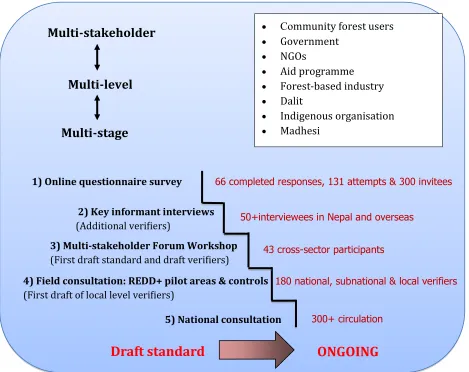
development project has been action re-search involving key forest sector and REDD+ stakeholders in a selected developing coun-try. The study has combined a multi-stakeholder approach with a bottom-up mul-ti-level and multi-stage process (Figure 1).
The multi-stakeholder approach ensures the representation and involvement of all key sectors of forestry and REDD+ in the stand-ard development. The key stakeholders typi-cally include government, forest user groups, other civil society organisations, minorities and international aid programmes. These
stakeholders are engaged throughout the five stages of the project:
Online questionnaire survey
Key informant interviews
Multi-stakeholder Forum Workshop
Field consultations in REDD+ pilot areas and controls
National consultation.
[image:17.612.73.542.63.435.2]The stages, which will be presented in the outline of the case study, can be summarised as follows: The first stage consists of an online questionnaire survey involving as Figure 1: Methodology for drafting and testing a governance standard for REDD+ and the forest sector in Nepal
1) Online questionnaire survey
2) Key informant interviews
(Additional verifiers)
4) Field consultation: REDD+ pilot areas & controls
(First draft of local level verifiers) Multi-stakeholder
Multi-stage
Community forest users Government
NGOs
Aid programme Forest-based industry Dalit
Indigenous organisation Madhesi
Multi-level
66 completed responses, 131 attempts & 300 invitees
50+interviewees in Nepal and overseas
43 cross-sector participants
180 national, subnational & local verifiers
300+ circulation
3) Multi-stakeholder Forum Workshop
(First draft standard and draft verifiers)
5) National consultation
many representatives of the various sectors as possible. The purpose of the online survey is twofold: 1. to create a stakeholder data-base and 2. to have participants assess the quality of governance of the forest sector and/or REDD+ based on a 1-5 scale and through qualitative statements. In the sec-ond stage, key informants are recruited from the participants of the questionnaire survey, and from sectors that are underrepresented in the online survey, such as forest users without internet access. In the third stage a Multi-stakeholder Forum Workshop invites participants to elaborate the first draft of the quality-of-governance standard. The fourth stage involves a series of field trials that aim to test and refine the draft standard for a particular forest management regime before a generic standard can be developed. Finally, the standard content that has been devel-oped throughout the process is circulated to all stakeholders for further refinement. This will then form the basis for any formal stand-ards development that may ensue.
4. Evaluating governance quality
us-ing a hierarchical framework of
principles, criteria and indicators
Quality of governance can be assessed through a normative hierarchical framework of principles, criteria and indicators (PC&I) for evaluating governance in the arena of sustainable development. Such a framework was developed by Cadman (2009, following Lammerts van Beuren and Blom 1997). De-spite specificities of national forest govern-ance definitions and monitoring systems, any governance system as a viable system
shares some key elements.
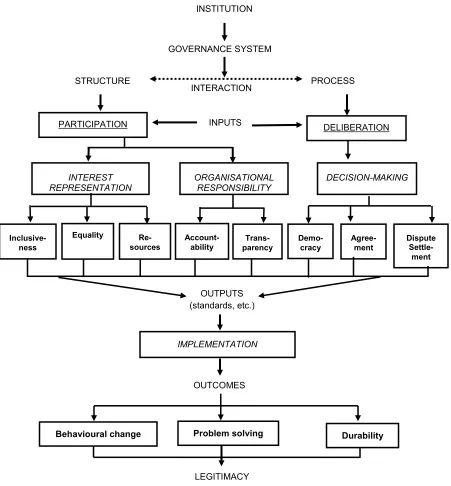
Two key principles of governance can be dis-tinguished (Figure 2): Participation (“governance as structure”) and deliberation (“governance as process”) (Pierre and Peters 2000, Cadman 2009). The meaning of these two principles can be elaborated by four cri-teria: interest representation, organisational responsibility, decision-making and imple-mentation.
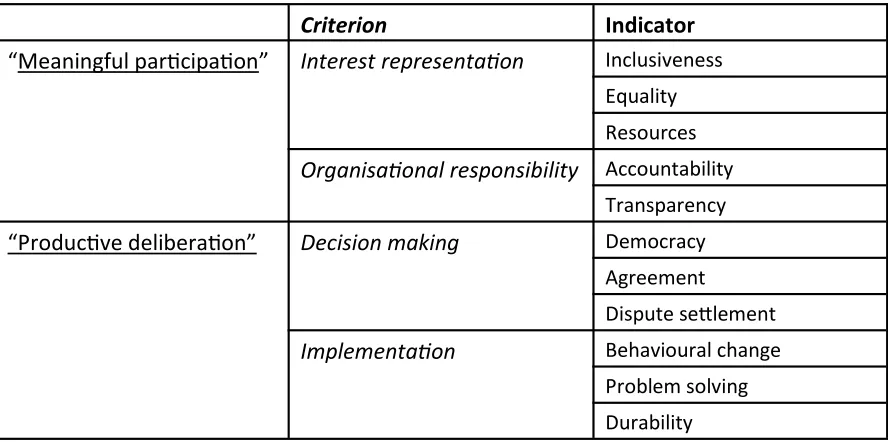
Principles and criteria are not usually capa-ble of being measured directly, but are for-mulated to determine the degree of compli-ance. They are consequently linked to indica-tors, which are hierarchically lower, and which represent quantitative or qualitative parameters. Cadman (2011) distinguishes 11 indicators to examine the degree to which they are achieved in a given institutional pol-icy context (Table 1). The placement of these attributes within the framework allows for a top-down analysis of principles via criteria and subsequently to indicators. In order to develop standards suitable for evaluating forest management under REDD+, the pro-ject expanded on this existing research to develop actual verifiers to assist in the evalu-ation at the forest management unit level.
dia-logue in which they feel ownership, multi-stakeholder processes have gained recogni-tion as valid mechanisms to develop and im-plement social and environmental responsi-ble management practices towards sustaina-ble development. From the Rio Declaration (UNCED 1992) through the Millennium
De-velopment Goals (UN 2000) to the World Summit on Sustainable Development (WSSD) Plan of Implementation (UN 2002), multi-stakeholder processes and partnerships in-volving the State, the business sector, social and environmental NGOs and other civil soci-ety actors became a common call in
interna-INSTITUTION
PARTICIPATION DELIBERATION
INTEREST
REPRESENTATION ORGANISATIONALRESPONSIBILITY DECISION-MAKING
IMPLEMENTATION
Durability
STRUCTURE PROCESS
INTERACTION
INPUTS
LEGITIMACY
Inclusive-ness
Equality Re-sources
Account- ability
Trans-parency
Demo- cracy
Agree- ment
Dispute Settle-
ment
OUTPUTS (standards, etc.)
OUTCOMES GOVERNANCE SYSTEM
[image:19.612.87.538.218.704.2]Behavioural change Problem solving
tional environmental policy to forge sustain-able development (Vallejo et al. 2004).
5. Why a standards approach?
Improving governance requires a systematic approach that identifies areas to be ad-dressed, devises and implements suitable responses, monitors results, and continuous-ly adapts and learns. This can be achieved through a common standard for measuring quality of governance, which can be applied independently of the different roles for so-cial, environmental, economic, and govern-mental stakeholders and donor agencies.
REDD+ would benefit from independent standards of good governance that can be applied for certification of governance with-in proposed REDD+ activities. Such standards would provide markets with better quality assurance, i.e. that the proposed REDD+ ac-tivities can be implemented and that the projected climate benefits are credible.
In-dependent good governance standards would provide consistency in the evaluation of governance across REDD+ projects and policies that are under development.
Ultimately, the success of REDD+ and of cbon markets will depend on governance ar-rangements that are broadly representative of interests (i.e. inclusive), verifiably respon-sible (i.e. transparent and accountable), effective in terms of decision-making cesses and capable of implementing pro-grams that deliver emission reductions at scale.
6. But don't we have standards
al-ready?
The need for a comprehensive analytical framework or standard to diagnose, assess and monitor forest governance in countries is widely recognised among those dealing with forest governance, particularly at the international level and by nongovernmental
Criterion Indicator
“Meaningful participation” Interestrepresentation Inclusiveness Equality Resources Organisational responsibility Accountability
Transparency
“Productive deliberation” Decision making Democracy Agreement
Dispute settlement Implementation Behavioural change
[image:20.612.80.524.528.749.2]Problem solving Durability
organisations. This has motivated a number of initiatives to develop such standards. This is positive, but also creates risks of duplica-tion of efforts, contradictory outcomes and confusing messages for the countries and organisations that apply these standards.
A number of social and environmental stand-ards for REDD+ are under development. These include:
Guidance on Strategic Environmental and Social Assessment including the Environ-mental and Social Framework, an initia-tive by the Forest Carbon Partnership Facility (FCPF) and World Bank
Social and Environmental Principles and Criteria (SEPC) facilitated by UN-REDD
Revised Draft Guidelines for the use of REDD+ Social and Environmental Stand-ards (REDD+ SES) facilitated by the Cli-mate, Community & Biodiversity Alliance (CCBA) and CARE International.
The effort that these initiatives have put into the development of criteria to ensure certain elements of good governance should be acknowledged. However, definitions in use are inconsistent and incomplete, and the im-plementation of current ‘standards’ may un-dermine safeguards to protect rights as well as policy/project effectiveness. Inconsisten-cies include acknowledgement of different governance definitions in different docu-ments. For example:
“Accessibility, people’s participation, trans-parency, accountability, rule of law, predicta-bility, justice and sustainability” (CCBA/CARE 2010, p. 9)
“Equity, fairness, consensus, coordination, efficiency, transparency, accountability,
effectiveness, responsiveness, participation, the rule of law, and many others” (UN-REDD 2012, Glossary, p. 9)
Existing REDD+ programmes, policies, proce-dures and standards include some strong language and requirements, but these are counter-balanced elsewhere by language that does not mandate consultation. The de-gree to which civil society and other non-state actors, such as indigenous people, are able to participate meaningfully is complex. They have a seat at the table in various high level venues (such as the UN-REDD Policy Board). Here, decisions must be reached by consensus, and in this sense it could be ar-gued that non-state actors are equal to state interests. To determine whether this is to-kenistic or genuine requires an examination of consultation at the country level. Here, participation ranges from the meaningful as UN-REDD found to be the case in Cambodia (UN-REDD 2011a: 7) to the problematic as in Papua New Guinea (UN-REDD 2011b: 17).
There have been two global level policy re-sponses to such problems. One was the agreement on the social and environmental “safeguards” at COP 16 in Cancún, which in-cluded the requirement for “the full and effective participation of relevant stakehold-ers, in particular indigenous peoples and lo-cal communities” (UNFCCC Decision 1/CP.16 Appendix I, 2.(c)), as a mechanism to avoid negative impacts arising from REDD+ (i.e. perverse outcomes). This has led to require-ments for stakeholder consultation (FCPF and UN-REDD 2012: 12). Another response has been the rise of “participatory govern-ance assessments” (PGAs), a number of which are currently being trialled, and which aim at undertaking consultations to identify the costs and benefits of REDD+ to stake-holders, and develop safeguards in response (UN-REDD 2011c). At present, it can only be concluded that “full and effective participa-tion” of non-state interests in UN-REDD is contested terrain: despite some positive signs, there are also negative counter-indicators.
The poor and marginalised groups, especially women and minority groups, do not have the resources to attend meetings, often in capital cities, or overseas, nor do they have the capacity to air their concerns through such formal arenas. This means that key ele-ments may be missing from standards that are developed through processes that do not ensure sufficient representation of these groups. Stakeholder-driven governance, and related bottom-up standards development, by contrast, provide all interests with an op-portunity to have their say in how REDD+ policies and projects are designed and im-plemented – from the beginning.
While providing a basis for integrating social and environmental concerns in REDD+, these standards will also require adaption and “translation” from generic principles to op-erational statements that can be implement-ed in a given political, cultural, socio-economic and ecological national context, as a comparative study conducted for the Tan-zania Forest Conservation Group revealed (Campese 2011: 13). The principal reason for the gap between the content and applicabil-ity of these standards is that they have been developed largely within UN-REDD and FCPF; some stakeholders assisted, but very large numbers of key interests have been uninten-tionally excluded from these processes. This also applies to the comparatively more de-tailed REDD+ SES, which can include country specific indicators drafted by stakeholders (ibid). But indicators do not go down to a scale sufficient for evaluation at the most relevant level – the forest, and forest com-munities on the ground.
Site and context specific verifiers are re-quired to evaluate REDD+ governance quali-ty at the local, sub-national and national lev-els. Locally-specific quality-of-governance standards have the advantage that they make it easier for all participants to deter-mine what they require for REDD+ policies and projects before they are developed.
7. Action Research Project to Develop
a National Quality-of-governance
Standard for REDD+ and the Forest
Sector in Nepal
develop-ing a national quality-of-governance stand-ard for REDD+ and the forest sector through a stakeholder, level and multi-stage process. The standard is intended to provide guidance on processes to strengthen forest sector and REDD+ governance, which will not only contribute to emissions reduc-tions through better management and more sustainable forest use, but also provides the foundation for transparent data gathering, analysis and management essential to estab-lish a credible national measurement, re-porting and verification (MRV) system for forest carbon.
The specific objectives of the action research are to:
Investigate the strengths, weaknesses and gaps in governance systems of sus-tainable management of forests (SMF) and REDD+ by collaborating with existing institutions and stakeholders in the for-est sector at all levels;
Actively involve existing institutions and stakeholders in formulating specific gov-ernance standards, following internation-al best practice and participatory deci-sion-making by means of a pilot study in a relevant developing country (Nepal);
Analyse the process and outcomes of the research, and determine the feasibility of applying such standards across the SMF and REDD+ policy arena, at the national, regional and global levels.
a) Why in Nepal?
The research project is located in Nepal for the following reasons:
Nepal has about three decades of suc-cessful experience of Participatory Forest Management Systems (Community FMS, Leasehold FMS, Collaborative FMS, Reli-gious FMS and Bufferzone FMS). These systems have been widely able to reduce the deforestation rate and – to a lesser degree – forest degradation. They have institutionalised multi-stakeholder mech-anisms, which the action research could start from and build upon.
The country’s REDD+ strategy is aligned with the National Development Strategy.
Piloting on different aspects of REDD is underway which provide good lessons for readiness.
The research team has a well-established connection with the Nepalese Govern-ment and other stakeholders, which has not only prepared the ground for pro-gressing in the development of the standard but also raises the likelihood of adoption of the standard.
The Project followed the multi-stakeholder, multi-level and multi-tier approach to stand-ards development outlined earlier. It has progressed through the following five stages:
b) Stage One: Online survey (July - Sep-tember 2011)
man-agement and REDD+. Key stakeholders were recruited from the environmental, social and economic sectors, and included state (i.e. governmental) and state (i.e. non-governmental, and other) interests in the forest sector.
The views of stakeholders were first collect-ed by use of the online survey tool Survey-Monkey (www.surveymonkey.com). Inter-ested parties were contacted by email, tele-phone, Skype, social media and through face -to-face meetings. In order to gain the maxi-mum number of survey participants, the sur-vey was conducted anonymously. The ques-tionnaire asked participants to provide a rating for their perceptions regarding the governance quality of forest management in Nepal, using the framework of principles, criteria and indicators (PC&I) developed by Cadman (2011). Opportunities for substan-tive comment were also provided and the comments received were used to develop verifiers to evaluate (measure) governance quality in the field.
The online survey contacted approximately 350 individuals directly; others were con-tacted indirectly through participants cruited into the survey. Of the initial 131 re-spondents who commenced the survey, 66 individuals fully completed the survey, a re-sponse rate of approximately 19%.
c) Stage Two: Interview survey
(September - November 2011)
In-depth interviews with key informants from all sectors related to forest governance in Nepal were conducted. Four researchers conducted a total of 52 interviews.
Thirty-eight of these were face-to-face interviews conducted in Nepal, while the other key in-formants were interviewed in other coun-tries either directly or via Skype (recorded sessions). All informants were directly relat-ed to forestry sectors in Nepal. Interviews were anonymous.
d) Stage Three: Multi-stakeholder Forum Workshop: Development of verifiers (November 2011 – February 2012)
The draft content for the governance stand-ard was developed through a national stake-holder workshop co-organised by the Asia Network for Sustainable Agriculture and Bio-resources (ANSAB), IGES and USQ, and con-vened in Kathmandu from 13-14 December 2011. The workshop gathered 43 partici-pants who discussed the verifiers identified through the online survey. These represent-ed very diverse stakeholders (Figure 1), in-cluding marginalised groups, namely forest users, Dalits (designation for a group of peo-ple traditionally regarded as “untouchable”), indigenous people and women, who all par-ticipated actively.
development.
These highly positive outcomes exceeded expectations. Given the presence of diverse stakeholders – from marginalised groups to high-ranking government authorities and donors – the Multi-stakeholder Forum was thought to be very sensitive to run. There was a huge chance for the conversation to derail. However, the facilitator of the work-shop, with a good reputation in both govern-ment and non-governgovern-mental sectors, suc-cessfully involved participants in a fruitful discussion. On one occasion, a single word was discussed for over 20 minutes. Partici-pants took the development of the draft standard seriously, as if they assumed the standard would be implemented at a future point.
e) Stage Four: Ground-testing of verifiers: Field consultation (September-November 2012)
To refine the standard, researchers selected a total of 16 out of the 180 verifiers that par-ticipants at the Multi-stakeholder Forum workshop had agreed on. Four verifiers with the strongest relation to the local level were selected for each of the TIAR, the four indi-cators that participants at the workshop ranked the highest.
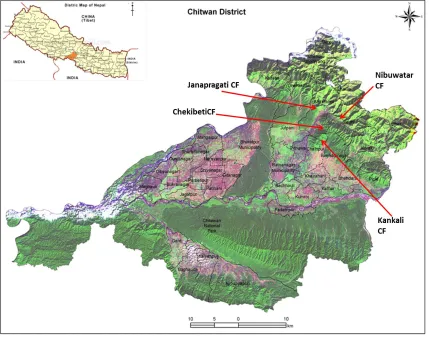
These 16 verifiers were tested in the REDD+ pilot project areas of Chitwan and Gorkha districts. While Chitwan district is in the low-lands (known as “Terai”) of Central Nepal, Gorkha is located to its northwest in the hill area. The objective of the field testing was to develop means of verification (MoVs) for the selected 16 verifiers.
Prior and during the field surveys, a series of discussions were held with the staff from District Forest Offices (DFO) and the Federa-tion of Community Forestry User Groups (FECOFUN), which are the key REDD+ stake-holders in both districts. These discussions were helpful in identifying issues and devel-oping four selection criteria. According to the four criteria four CFUGs were selected from each district for half-day workshops. In each district, this included the CFUGs which (1) received the highest payment from the REDD+ carbon fund; (2) received the lowest payment from REDD+ carbon fund; (3) was led by indigenous people; and (4) was led by women. In the case of Gorkha district, re-searchers were able to include all four types of CFUGs, whereas in Chitwan the CFUG which received the lowest payment could not provide the time. Therefore, another CFUG was selected, which had also received relatively lower (fourth lowest out of the 16 CFUGs) payment and was also actively in-volved in project implementation.
In addition, in order to know the perception of CFUGs outside the REDD+ pilot area, three workshops were organised with Dudhkoshi CFUG (Chitwan), Rajdevi CFUG and Jalbire CFUG (both Gorkha).
In the second field survey in Gorkha district four REDD+ pilot CFUGs were visited (Figure 4): Laxmi (comprising and led only by female members), Ludhi Damgade (received the highest payment from the carbon fund), Baghpani (led by indigenous people), and Sheetalupakha (received the lowest pay-ment from the carbon fund) were selected for the study.
Although the sample size looks small, they can be considered representative of the CFUGs in a given district for three reasons: (1) most of the community forests in the REDD+ piloting areas of the districts show homogeneity in climatic, topographic and edaphic conditions, and vegetation types; (2) the culture, value and norms and the social
settings in the areas are similar; and (3) the lifestyle and livelihoods, including the way of thinking towards the forests, are also similar.
A half day workshop with each CFUG was conducted. All the participants in each work-shop were asked to discuss and provide 1-3 unanimous means of verification for each verifier. The workshops ensured active par-ticipation of women, Dalits and the poorest and other marginalised communities in the development of the standard under the Pro-ject.
[image:26.612.90.519.384.721.2]The results provided by the field testing in Chitwan and Gorkha districts comprised more than 280 MoVs of the selected verifi-ers. Preliminary consultation with local
stakeholders found that that the testing ade-quately incorporated local perceptions re-garding the developed verifiers. The MoVs can be used for evaluating both the effec-tiveness of REDD+ (quantitatively) and the governance quality in the community forest-ry regime in Nepal. The research team plans to expand the scope of the field testing in 2013 to a control group of CFUGs in a third district outside the REDD+ pilot area.
f) Stage Five: National stakeholder con-sultation (September-December 2012)
The standard content developed throughout the process has been circulated to all partici-pating stakeholders to receive comments for further refinement. This consultation will form the basis for any formal standards
de-velopment that may ensue. An informal ad-visory group, which was formed at the work-shop, has taken up the task of overseeing the development of the draft standard.
8. Preliminary conclusions
Governance is an important concept for ad-dressing social problems and opportunities but needs to be properly understood. Gov-ernance refers to the whole of public and private interactions to solve problems and to create opportunities in modern society and can be defined as the dynamic interplay be-tween civil society, business and public sec-tor.
For the emergence of a global carbon mar-ket it is necessary to develop common
[image:27.612.88.530.416.724.2]ernance and regulatory structures. Ensuring good governance is particularly important for the development of a financial mecha-nism for REDD+. Transparent and effective national forest governance is needed to en-courage investments in REDD+, to ensure that REDD+ delivers real and long-term emissions reductions, to promote accounta-bility and transparency, to develop credible monitoring and reporting on REDD+ safe-guards and to change behaviour and solve the problems underlying deforestation and forest degradation.
Quality of governance can be assessed through a normative hierarchical framework of principles, criteria and indicators (PC&I). The need for a comprehensive analytical framework or standard to assess, monitor and report on forest governance in REDD+ countries is increasingly recognised at the international level, including the UNFCCC.
Several initiatives have developed govern-ance standards for REDD+ but they were not developed through genuine multi-stakeholder processes, in the sense of stake-holders providing the contents of the stand-ards as active participants throughout all stages of the process. Due to their highly generic character, they also lack the details for their operationalisation in local and na-tional contexts. Moreover, multiple stand-ards could cause confusion, while inadequa-cies could result in harm, rather than create good.
IGES, Griffith University and USQ thus launched the Action Research Project to De-velop a National Quality-of-governance Standard for REDD+ and the Forest Sector in Nepal. Rather than making the stakeholders
the subject of “participatory” governance assessments, the Project has tested a unique approach to develop a voluntary standard specifically for quality of govern-ance in REDD+ and the forest sector. The multi-stakeholder, multi-level and multi-tier approach has ensured that all major stake-holder groups have had the opportunity to identify what they felt is needed to ensure good governance. Participating stakeholders have elaborated broadly accepted generic principles, criteria and indicators of good governance into a standard that makes sense to them. Particular emphasis has been placed on facilitating the involvement of marginalised groups who seldom have the opportunity to participate in such processes. The approach creates governance standards that are likely to have a high degree of local ownership and relevance.
The process of developing a voluntary na-tional quality-of-governance standard in Ne-pal through online surveys, key informant interviews and multi-stakeholder forums, has provided an innovative and field-tested approach to standards development. The active involvement and participation of a diverse range of stakeholders demonstrated that many key groups and individuals were able to experience the value of developing such a standard in a collaborative environ-ment, which fostered meaningful participa-tion, and resulted in productive deliberation around a whole series of core governance challenges including inclusiveness, equality, transparency, accountability, decision-making and implementation.
management regime specific standards” need to be developed first, i.e. prior to ge-neric standards. Specific standards have the advantage that they make it easier for all participants to determine what they require in a given local or national context before policies and projects are developed.
The national draft quality-of-governance standard developed under the Project is in-tended to provide guidance on processes to strengthen forest sector and REDD+ govern-ance in Nepal. It aims to contribute to emis-sions reductions through better manage-ment and more sustainable forest use, but also provides the foundation for transpar-ent data gathering, analysis and manage-ment essential to credible national forest sector MRV.
The standard is based on verifiers that were developed at the national level and tested at the local level, and thus cannot be used in other countries. The framework and methodology used, however, can be applied for the development of governance stand-ards anywhere in the world.
Broekhoven, G., H. Savenije and S. V. Scheliha (eds.). 2012. Moving forward with forest governance. Tropenbos Internation-al. Wageningen.
Cadman, T. 2011. Quality and legitimacy of global governance. Case lessons from for-estry. International Political Economy Series. Palgrave Macmillan.
Campese, J. 2011. Integrating REDD+ Social and Environmental Safeguards and Stand-ards in Tanzania. TFGC Technical Report 32. Available at: http://www.tfcg.org/pdf/ REDD%20Standards%20Review% 20FINAL.pdf
FAO (Food and Agriculture Organisation of the United Nations) and PROFOR. 2011. Framework for assessing and monitoring forest governance. Available from: http://
www.fao.org/climatechange/27526-0cc61ecc084048c7a9425f64942df70a8.pdf
FAO. 2012. Strengthening Effective Forest Governance Monitoring Practice. An ap-proach for integrating forest governance into national forest-related monitoring sys-tems. Forestry Policy and Institutions Work-ing Paper. 29
Stakeholder Engagement in REDD+ Readi-ness With a Focus on the Participation of Indigenous Peoples and Other Forest-Dependent Communities (20 April 2012): Available at: http://
www.forestcarbonpartnership.org/sites/ forestcarbonpartnership.org/files/ Documents/PDF/July2012/Guidelines on Stakeholder Engagement April 20, 2012 (revision of March 25th version) (1).pdf
Flachsland, C., R. Marschinski, and O. Edenhofer. 2009. Global Trading versus Linking. Architectures for International Emissions Trading. Energy Policy 37, pp. 1637-1647.
Hahn, R. and G. Hester. 1989. Where did all the markets go? An analysis of EPA’s Emis-sions Trading Program, Yale Journal of Reg-ulation 6, p. 109-153.
Ingram, J. C., Wilkie, D. 2008. Governance of the Global Carbon Market: Does Scale Matter? WCS Working Paper series. In Red-ford, K. and Grippo, C. (eds.), WCS Working Paper 36, Protected Areas, Governance and Scale.
ITTO (International Tropical Timber Organi-sation). 2010. Tropical Forest Update. 19/1. Getting a lock on governance. Yokohama.
Jaffe, J. and R. N. Stavins. 2007. Linking Tradable Permit Systems for Greenhouse Gas Emissions: Opportunities, Implications, and Challenges. Report prepared for the International Emissions Trading Association (IETA). Referenced in: Mehling. 2009.
Kooiman, J.,M. Bavinck, S. Jentoft and R. Pullin (eds.) (2005): Fish for life.
Amster-dam: Amsterdam University Press.
Kishor, N. and K. Rosenbaum. 2012. As-sessing and monitoring forest governance. A user’s guide to a diagnostic tool. Program on Forests (PROFOR). Washington DC.
Lammerts van Bueren, E.M and Bloom, E.M. 1997. Hierarchical Framework for the For-mulation of Sustainable Forest Manage-ment Standards. Tropenbos Foundation, Wageningen.
Lang, C. 2003. “COONAPIP, Panama’s Indig-enous Peoples Coordinating Body, With-draws from UN-REDD” (6 March 2013). Available from: http://www.redd- monitor.org/2013/03/06/coonapip- panamas-indigenous-peoples-coordinating-body-withdraws-from-un-redd/? utm_source=feedburner&utm_medium=em ail&utm_campaign=Feed%3A+Redd-monitor+%28REDD-Monitor%29
Mehling, M. 2009. Global Carbon Market Institutions. An assessment of governance challenges and functions in the carbon mar-ket.
Menzies. N. 2007. Our Forest, Your Ecosys-tem, Their Timber. Communities, Conserva-tion, and the State in Community-Based Forest Management. Columbia University Press.
Perdan, S. and A. Azapagic. 2011. Carbon trading: Current schemes and future devel-opments. Energy policy 39, pp. 6040-6054. Elsevier.
Taming Globalisation: Frontiers of Govern-ance, ed. David Held and Matthias Koenig-Archibugi (Cambridge: Polity Press, 2003), pp. 93–129, at p. 93.
Stavins, R. N. (November 2001). “Experience with Market-Based Environ-mental Policy Instruments.” Discussion Pa-per 01-58 (Washington, D.C.: Resources for the Future). Retrieved 2010-05-20.
Suchman, M. C. 1995. “Managing Legitima-cy: Strategic and Institutional Approaches”, Academy of Management Journal, Vol. 20, No. 3, pp. 571 - 610
Van Bodegom, A. J., D. Klaver, F. v. Schou-broeck and O. v. d. Valk. 2008. FLEGT be-yond T. Exploring the meaning of
‘Governance’ concepts for the FLEGT pro-cess. Wageningen.
Vallejo, N. and Pierre Hauselmann. 2004. Governance and multi-stakeholder process-es. IISD. Available from: http://
www.iisd.org/pdf/2004/sci_governance.pdf
UK Government. 2005. G8 Gleneagles Plan of Action. Climate Change, Glean Energy and Sustainable Development. Available from: https://www.gov.uk/government/ uploads/system/uploads/attachment_data/ file/48584/gleneagles-planofaction.pdf
UNFF (United Nations Forum on Forests). 2007. Report of the seventh session (24 February 2006 and 16 to 27 April 2007). Economic and Social Council Official Rec-ords, 2007, Supplement No. 22.
UN-REDD. 2011a. National Programme Sub-mission Form – Cambodia (March 2011).
Available from: http://www.unredd.net/ index.php?
op-tion=com_docman&task=doc_download&gi d=5784&Itemid=53
UN-REDD. 2011b. 2011 Annual Report Pa-pua New Guinea Programme (31 December 2011) [draft] http://www.unredd.net/ index.php?
op-tion=com_docman&task=doc_download&gi d=8085&Itemid=53
UN-REDD. 2011c. “REDD+ Participatory Governance Assessments Piloted in Indone-sia and Nigeria”, Programme Newsletter 20: July 2011. Available from: http://www.un-redd.org/Newsletter20/
ParticipatoryGovernanceAssessments/ tabid/54365/Default.aspx
WRI (World Resources Institute). 2009.The Governance of Forests Initiative. Available from: http://www.wri.org/project/ governance-of-forests-initiative
This document consists of public consultation material related to the development of an infor-mal, draft, voluntary governance standard for the forest sector in Nepal, focusing on REDD+. The document is the result of a consultation process of Nepalese stakeholders in the forest sec-tor. Professional assistance to prepare this draft was sought from One World Standards.
Principles, Criteria & Indicators
Principle 1: Meaningful participation
Criterion 1.1: Interest representation Indicator 1 Inclusiveness
All stakeholders (including community representatives) are effectively represented in the design and implementation of REDD+ programmes
Indicator 2: Equality
REDD+ programmes treat all stakeholders equally.
Indicator 3: Resources
a) Capacity building: There are sufficient human, technical and financial resources available to implement REDD+ programmes effectively
b) Benefit sharing: The benefits of REDD+ programmes are shared equitably amongst poor stakeholders and other actors
c) Other
Criterion 1.2 Organisational responsibility Indicator 4: Accountability
REDD+ policies and programmes are accountable to stakeholders at the international, national
Appendix:
Draft National Quality-of-governance Standard for REDD+ and the Forest Sector
and local levels
Indicator 5: Transparency
REDD+ policies and programmes are transparent at the international, national and local lev-els
Principle 2: Productive deliberation
Criterion 2.1: Decision-making Indicator 6: Democracy
Democratic mechanisms are developed by REDD+ for Carbon pricing and finance which rec-ognise poor disadvantaged and rural communities
Indicator 7: Agreement
Equitable and effective mechanisms for reaching agreement are in place at all levels of REDD+
Indicator 8: Dispute settlement
Equitable and effective mechanisms are in place for resolving local disputes and grievances
Indicator 9: Behavioural change
REDD+ policy processes are designed to address underlying issues relating to forest policy and management
Criterion 2.2 Implementation Indicator 10: Problem solving
The REDD+ programme resolves key issues in order to address community needs
Indicator 11: Durability
Durability of the REDD+ programme is supported through:
a) Establishment and maintenance of an enabling environment
List of Indicators with associated verifiers
N = national; SN = Sub-national; L = local
2011-12
1. Inclusiveness
1. Evidence exists of continual improvement in stakeholder representation. (National, Sub-National, Local)
2. Consultation of key stakeholders is inclusive of all interests, and occurs across the interest base. (N, SN, L)
3. Evidence exists that decisions are made inclusively. (N, SN, L)
4. All stakeholder interests are included in REDD+ structures and decision-making processes. (N, SN, L)
5. Forest-related laws and by-laws make provisions for the inclusion of stakeholders in forest manage-ment and planning. (N)
6. Forest dependent communities are included in forest management and planning. (N, SN, L)
7. Different interest groups participate in forest management and planning and are represented within institutions and programmes at all levels, on the basis of gender, caste, class, ethnicity, ethnic origin, income, and geographical location. (N, SN, L)
8. Government and donors are also included. (N, SN)
9. Academics and youth are also included. (N, SN, L)
10. Inclusiveness is demonstrated in qualitative (representation of sectors) as well as quantitative (numerical) terms. (N, SN, L)
11. Diverse stakeholders are included in forums at all levels. (N, SN, L)
12. The roles and responsibilities of different stakeholder groups are clarified and consulted with other stakeholders. (N, SN, L)
13. Forest management and planning is inclusive of affected populations. (L)
14. Appropriate venues for participation are developed relevant to the sectors included (source indica-tors).
15. All affected interests are included in decision-making and implementation relating to forest man-agement and planning. (N, SN, L)
17. REDD+ community forest management projects demonstrate principles of sustainable forest man-agement and include community representatives. (SN, L)
18. Arrangements in place to include distant users. (N, SN, L)
19. Inclusiveness of Dalit, Indigenous, Women, Madhesi is ensured starting from project proposal prep-aration phase. (SN, L)
20. Assurance of rights of all stakeholders including Dalit, indigenous, women, Madhesi, and poor. (N, SN, L)
21. Evidence for clear roles and responsibilities of all stakeholders exists. (N, SN, L)
22. Leadership on issues should be taken by concerned stakeholders: evidence exists that Dalit,
wom-en, ethnic, indigenous, Madhesi, poor’s and government agencies are informed. (L) AND/OR
[Leadership for the issue should be taken by related stakeholders themselves: proof of knowingness exists among all stakeholders including Dalit, women, ethnic, indigenous, Madhesi, and poor’s. (L)]
23. Evidence exists that all stakeholders including Dalit, women, ethnic, indigenous, Madhesi and poor are capacitated and empowered. (N, SN, L)
24. Proof of involvement of formal instittutions (District Development Committee, Village Development
Committee etc,) and informal institutions (clubs, women groups, Dalit groups, cooperatives etc) during
project implementation. (L)
2. Equality
The benefits from REDD+ mechanisms and programmes are shared equally [equitably] amongst poor stakeholders and other actors
1. Funds allocated to support livelihoods and creating incentives for sustainable management of forests are shared distributed equitably. (L)
2. Evidence exists of the equal treatment of all stakeholders. (N, SN, L)
3. REDD+ treats the diverse voices and interests in society equitably. (SN, L)
4. Equality amongst stakeholder is proportionate to the degree of interest and level of contribution. (S, SN, L)
5. Benefits derived from forest management are distributed equitably, on the basis of the rights held, the degree of interest, and forgone use of forest products. (L)
6. Forest management and planning and benefit distribution prioritizes addresses the needs of the poor. (L)
7. Evidence exists that right and access to resources of all stakeholders including Dalit women,
indige-nous, Madhesi and poor’s are ensured equitably. (L)
3. Resources (benefit sharing, capacity building)
1. Funds are available from national and international public and private sources to build capacity of stakeholders in forest management and planning and REDD+, including the poor, under-privileged, tech-nical and research communities, civil society and government. (N, SN, L)
2. Stakeholders are educated and informed of their rights and responsibilities under REDD+. (N, SN, L)
3. Forest management and planning is allocated sufficient numbers of trained field professionals and technical experts to function effectively. (SN, L)
4. Funds are allocated to enhancing social capital. (N, SN, L)
5. Benefit sharing targets poor and under privileged communities. (L)
6. Benefit sharing is proportionate to the degree to which interests are either directly of indirectly affect-ed. (N, SN, L)
7. The development of cost- and benefit sharing arrangements occurs with the participation of all stake-holders. (SN, L)
8. Capacity building to enhance participation targets the poor and under-resourced. (L)
9. Opportunities are provided for diverse interests to share their knowledge with other stakeholders. (N, SN, L)
10. Resources are allocated to address concerns raised by ethnic communities, women, and Madhesi.
(N, SN, L)
11. Stakeholders associated with forest management and planning and REDD+ are provided with the necessary training and infrastructure to fulfill their roles. (N, SN, L)
12. Resources are allocated to address concerns raised by Dalits. (N, SN, L)
13. Proof of acceptance of Paris declaration. (L)
14. Evidence exists that technologies are updated as per international standards. (N, SN, L)
15. Benefit is shared among all stakeholders including Dalit, women, ethnic, indigenous, Madhesi, and poor. (N, SN, L)
16. Poor and marginalized people should be provided monetary benefits not less than their daily wages while participating in different project related activities. (L)
17. Enabling environment exists for research on current issues.
18. Provisions of Pre- starter fund is in place at a low interest rate. (N, SN, L)
19. REDD+ project proposal should include at least 1000 hectare and this threshold should be placed in national REDD+ policy. (N, SN, L)