Vol. 3. No. 2. March 2013 Issue. Pp. 127 – 140
Strategic Trisector Collaboration in Disaster Response
Eric Kong*
The cause-related marketing concept has typically focused on how businesses are related to nonprofits with a cause. Public-private partnerships have normally stressed business and government collaboration in obtaining intended goals. Nonprofit and government partnerships have been the main trend for resolving social issues since the 1980s. A voluminous literature has focused on the three concepts separately. That is, research has been conducted to investigate how a commercial organization and nonprofit work together, and how a public sector organization and business corporation collaborate with each other. Relatively little research has primarily examined trisector collaborations for solving social problems, in particular after disasters. This paper argues that disaster recovery can be achieved more effectively if the three sectors collaborate simultaneously. A trisector collaboration framework is suggested and the Japanese tourism industry after 2011 earthquake and tsunami will be used as a case to illustrate how the framework may assist in achieving social objectives more effectively. The paper contributes to the existing literature by extending the research on trisector collaborations for disaster recovery. Limitations and future research directions will be discussed in the paper.
Field of Research: Management
1. Introduction
The concept of cause-related marketing has typically focused on how business corporations might relate to nonprofits. Chaney and Dolli (2000) define cause-related marketing as a marketing strategy whereby the firm makes a contribution, financial or otherwise, to charitable nonprofit organizations contingent upon the customer engaging in a revenue providing exchange that satisfies business and individual objectives. This involves associating a charity’s logo with a brand, product or service to encourage sales of the product as well as raising funds for the charity. The public-private partnerships model has emerged rapidly in the last few decades (Makin 2003; Wright 2000; Singh & Prakash 2010). Public-private partnerships have normally stressed business and government collaboration in obtaining intended goals. Public-private partnerships allow profit-making Public-private companies to build, own and operate public projects on behalf of the public sector (Nisar 2007). The partnerships often appear in contractual basis with specifically designed performance criteria. Nonprofit and government partnerships have been the main trend for resolving social issues since the 1980s.
A voluminous literature has focused on the three concepts separately. That is, research has been conducted to investigate how a business enterprise and nonprofit organization partner for solving social problems, and how a public sector agency and private commercial corporation collaborate for dealing with social issues. Very limited research has primarily examined trisector collaborations for solving social problems,
128
particularly in the view that the approach may assist in the recovery of disasters. The present exploratory study is on the goals of, inputs to, and impact of trisector collaborations. The research question addressed is ‘What benefits do business corporations, nonprofits and the government gain for trisector collaborations?’ This
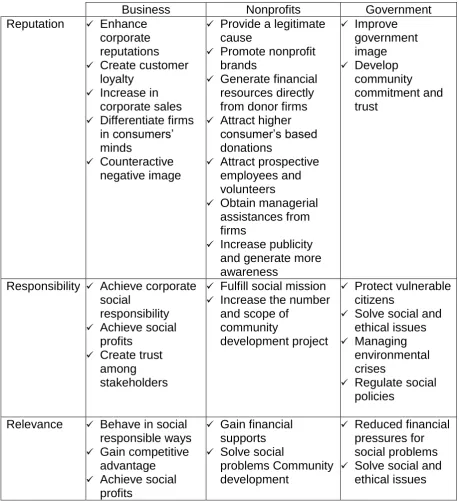
paper aims to extend the existing literature by offering a better understanding of trisector collaborations among businesses, nonprofits and the government, in particular in disaster responses. The collaborations are analyzed from the perspectives of reputation, responsibility and relevance of the involved parties.
The paper argues that disaster recovery may be achieved more effectively if the three sectors collaborate simultaneously. A strategic trisector collaboration conceptual framework which helps to strengthen this multidisciplinary field is proposed in the paper. The benefits of the collaborations are studied from the notion of natural disaster recovery. After reviewing the literature, the Japanese tourism industry after 2011 earthquake and tsunami will be used as a case study to illustrate how the framework may assist in achieving social objectives more effectively. The paper contributes to the existing literature by extending the research on trisector collaborations after disasters.
The paper firstly reviews the literature and offers a comprehensive study of the benefits of trisector collaborations to the involved parties. This is then followed by a proposal of a trisector collaboration framework. A short case study of Japanese tourism program after 2011 earthquake and tsunami will be used to illustrate how the trisector collaboration framework may benefit all parties involved. Limitations and future research directions will be discussed in the paper.
2. Literature Review
129
stands for something beyond profits (Andreasen & Kotler 2003). Thus, business firms often find themselves more likely to achieve better performance if they are able to enter into partnership with charities with a similar agenda and embrace a cause makes good business sense (Lafferty, Goldsmith & Hult 2004).
Both government agencies and business corporations are increasingly being called upon to interact with the charitable sector to achieve mutual objectives (Sagawa & Segal 2000). Through public-private partnership contracts, the government, as the funding provider, achieves value for money for projects delivered by private companies which are often perceived to be able to offer expertise knowledge, skills, systems and networks for specific projects. Private companies, on the other hand, gain financial rewards if they meet the performance criteria as set in the public-private partnership contracts. It is important to note that public-public-private partnerships are not limited to business oriented projects. Indeed, public-private partnership projects can also aim for solving social problems. Today, social services such as employment services, services for homeless youths and healthcare are delivered through public-private partnership contracts (Carney & Ramia 2002; English 2005; Kong 2008).
[image:3.595.69.520.565.806.2]The approach that the government contracts out its social services to nonprofits has been the main trend since the 1980s as it has been perceived to be an effective way of delivering services to people in need (Alford, O’Neil, McGuire, Considine, Muetzelfeldt & Ernst 1994; Bevir, Rhodes & Weller, 2003). There is also a voluminous literature on the subject of government-nonprofit partnerships (Brinkerhoff 1999; Brinkerhoff 2002; Gazley 2010; Krishna 2003; Osborne, Jenei, Fabian & Kuti 2005; Smillie & Helmich 1999). There is a similarity between public-private partnerships and government-nonprofit partnerships as the government is the funding provider for both partnerships. However, private companies may see achieving corporate social responsibility as an approach to attain competitive advantage (Porter & Kramer 2006) while social dimension is often the raison d’être of nonprofits’ existence (Ryan 1999; Kong 2008; Kong & Ramia 2010). Figure 1 briefly shows the concepts of cause-related marketing, public-private partnerships and government-nonprofit partnerships.
Figure 1: Concepts of Cause-Related Marketing, Public-Private Partnerships and Government-Nonprofit Partnerships
Nonprofits Business
Achieving corporate social responsibility
Fulfilling social objectives Cause-Related Marking
Government Business
Attaining corporate social responsibility
Solving social problems
Public-Private Partnerships
Nonprofits Government
Solving social problems
Government-Nonprofit Partnerships
130
As can be seen from Figure 1 above, the three concepts have a common key motive. That is to make a difference by tackling social issues in the society. The paper argues that the three sectors will likely achieve more in terms of solving social and ethical issues if they form a strategic trisector collaboration focusing on social solutions as their key component in their collaboration. Selsky and Parker (2005) urge that more research on trisector collaborations is needed in order to strengthen the conceptual underpinnings of this particular type of collaborations. The paper argues that the current concepts of cause-related marketing, public-private partnerships and government-nonprofit partnerships are important in their own stand but may be insufficient in particular in disaster responses.
A disaster is a sudden, calamitous event bringing great damage, loss, and destruction and devastation to life and property (Baade, Baumann & Matheson 2007; Shaluf, Ahmadun & Said 2003). A disaster can be natural as well as manmade. It is often an unplanned event emerging from the internal or external environment of an organization, region, or country which can disrupt operations, threaten people physically and mentally, and endanger the viability of entities no longer able to cope with the situation using normal managerial procedures (Fink 1986; Kash & Darling 1998). The damage caused by disasters can be immeasurable and varies with the geographical location, climate and the type of the earth surface/degree of vulnerability. This influences the mental, socio-economic, political and cultural state of the affected area. The massive floods in Queensland, Australia in the early 2011, earthquakes in Montserrat, San Francisco, Italy and Turkey, and the tsunami in late 2004 in Thailand are examples of natural disasters that become tourism crises. Disasters often have negative consequences. The damages significantly reduce the number of tourists visiting a tourist area and it usually takes a number of years to recover. At the same time, such events may also offer opportunities to introduce new products, management programs, new markets, and new changes. Knowing how to handle disasters distinguishes an organization from being successful as opposed to failing (Okumus & Karamustafa 2005).
3. Benefits of Trisector Collaborations through Reputation,
Responsibility and Relevance
131
infrastructure development. Among the reasons for the growing interest in inter-organizational collaboration is the belief that it may lead to the pooling of knowledge, skills, expertise, capital and other resources, greater coordination of relevant policies, increased acceptance of the resulting policies, and more effective implementation (Pretty 1995).
On the other hand, business firms often find themselves more likely to achieve better performance if they are able to enter into partnership with nonprofits with a similar agenda (Lafferty, Goldsmith & Hult 2004; Porter & Kramer 2006). Embracing a cause makes good business sense. With today’s increasingly hard-to-please consumers, marketing managers recognize that partnering with nonprofits can be a powerful marketing tool to gain a competitive edge through a positive corporate reputation. All other things being equal, many consumers would rather do business with a company that stands for something beyond profits (Andreasen & Kotler 2003).
[image:6.595.70.530.107.609.2]
132 Table 1: Potential Benefits of Trisector Collaborations through Reputation,
Responsibility and Relevance
Business Nonprofits Government
Reputation Enhance
corporate reputations
Create customer
loyalty Increase in
corporate sales Differentiate firms
in consumers’ minds
Counteractive negative image
Provide a legitimate cause
Promote nonprofit brands
Generate financial resources directly from donor firms Attract higher
consumer’s based donations
Attract prospective employees and volunteers
Obtain managerial
assistances from firms
Increase publicity and generate more awareness Improve government image Develop community commitment and trust
Responsibility Achieve corporate social
responsibility Achieve social
profits Create trust
among stakeholders
Fulfill social mission
Increase the number
and scope of community
development project
Protect vulnerable citizens
Solve social and ethical issues
Managing
environmental crises
Regulate social policies
Relevance Behave in social
responsible ways Gain competitive
advantage Achieve social
profits
Gain financial supports Solve social
problems Community development
Reduced financial pressures for social problems Solve social and
ethical issues
133
collaborations should be emphasized which will likely maximize the outcomes for all parties involved. Figure 2 below depicts the relationships between business, nonprofits and the government.
4. Methodology
As the study of trisector collaborations, particularly in the view of disaster recovery, is relatively limited for the current investigation, a critical analysis of the relevant literature and supplemented by a case study analysis is adopted. The paper has firstly critically reviewed the literature and then used a case study approach and applied the trisector collaboration conceptual framework in a real case of tourism industry in Japan after 2011 earthquake and tsunami. This approach helps to provide a cogent and comprehensive perspective on the theoretical and practical aspects of the conceptual framework as a strategic management method in cross-sector collaboration. It also helps to illustrate if the framework may be theoretically applied in disaster response in the tourism industry in Japan. A case study approach, supplemented by a literature-based analysis, helps to increase the level of clarity and precision of a concept, which is a necessity if we are to understand the constitutive use of the trisector collaborations in disaster response. Although this is a theoretical approach, the findings are believed to be very important to both practitioners and researchers as they provide new insights on the concept and creates more calls for future research.
5. Developing Strategic Trisector Collaborations: A Case Study of
Tourism Industry in Japan after 2011 Earthquake and Tsunami
[image:7.595.161.441.165.409.2]On March 11, 2011, a magnitude 9.0 earthquake, with an epicenter located about 230 miles northeast of Tokyo, jolted a wide swath of Honshu, Japan’s largest island. The earthquake generated a tsunami that pounded Honshu’s northeastern coast,
Figure 2: Strategic Trisector Collaboration between Businesses, Nonprofits and the Government
Government
Business Firms Nonprofits Address
societal issues
Fulfil business and philanthropy
Achieve commercial
and social objectives Community
development Strategic
collaboration
Strategic collaboration
134
causing widespread destruction in Miyagi, Iwate, Ibaraki, and Fukushima prefectures. It was estimated that over 15,188 people died in the disaster, with 8,742 missing and likely to be included in the final death toll. It appears that the tsunami, rather than the earthquake, caused nearly all the deaths. Entire towns were washed away. Over 432,047 homes and 27,019 other buildings, as well as 3,700 roads were damaged or
destroyed (Source: Japan National Police Agency,
http://www.npa.go.jp/archive/keibi/biki/higaijokyo_e.pdf).
The earthquake and tsunami that occurred in Japan followed by the nuclear crisis, created a large negative impact on the economy of Japan as a whole as well as its tourism industry. Physical damage has been estimated to be from $195 billion to as much as $305 billion (Nanto et al. 2011). Today, restrictions to public access remain in some of the affected areas and those were once famous tourist areas. The President of the Japan National Tourism Organization, Tadatoshi Mamiya, wrote on the organization’s website: ‘The devastating disaster has had an enormous impact on Japan’s inbound tourism. While many areas in Japan remained unaffected by the disaster, they are also suffering from the sudden decrease in international visitors. We are deeply concerned that this will not only affect Japan’s tourism industry directly, but also will have a very negative impact on our industry partners around the world’ (Source: http://www.uia.be/message-japan). Besides extending well wishes for the people of Japan, many Japanese Tourism partners wonder how the natural disaster may have affected the tourism industry in the country (Nanto et al. 2011). That is why the global tourism community is still watching and calculating the impact of the recent earthquake, tsunami, and nuclear reactor issues that have devastated parts of Japan and how it will affect the rest of the world.
In the wake of disasters of earthquake and tsunami, many businesses have stepped up for their corporate social responsibility to provide help to the affected areas. For example, Microsoft has activated their disaster response protocol and they continue to collaborate with their customers, partners, local government, inter-government and nonprofit agencies to develop solutions that can help. The organization has made a commitment of $2 million, which includes $250,000 in cash as well as in-kind contributions. It is, however, important to note that communities require more than just spare cash but long-term commitment and financial support to resolving social problems (Jamali & Keshishian 2009; Kanter 1999), particularly in times of global economic crisis (Kong 2010). Corporate social responsibility may not be able to provide long-term solutions to disasters and crises like the one in Japan.
135
natural disaster in relation to the tourism industry in Japan. The framework helps to illustrate how the government, businesses and nonprofit organizations can work collaboratively in response to the 2011 earthquake and tsunami in Japan.
As can be seen from the above framework, the Japan National Tourism Organization (JNTO), acts as the government agency, is involved in a broad range of activities promoting travel to Japan through various activities overseas as well as tourism-promoting activities in Japan. Thus, JNTO acts as an independent administrative institution on behalf of the government of Japan. Its key responsibilities may include:
1. Organize activities and events to attract tourists back to the affected areas or other areas in Japan
2. Measure to revive and promote culture in tourism
3. Ensure that the rebuilding efforts conform to the principles of sustainable development
4. Promote sustainable tourism in the affected areas and other areas in Japan
An Earthquake and Tsunami Volunteer Tourism Centre can be operated and run by a nonprofit organization. The Centre’s key responsibilities may include:
1. Restore the affected areas to regain its strength
2. Secure the involvement and safety of volunteers to make the physical restoration happen
3. Secure funding through collaboration
Similar successful tsunami volunteer centre has been set up in the other part of the world in response to natural disasters. For instance, the Tsunami Volunteer Centre (TVC), based in Khao Lak, Thailand, was founded in January 2005 after the Indian Ocean Tsunami. The Centre provides the framework for service-minded,
results-Figure 3: A TrisectorCollaboration Framework for Tourism Industry in Japan
1. Organize activities and events to attract tourists back to the affected areas or other areas in Japan 2. Measure to revive and promote
culture in tourism
3. Ensure that the rebuilding efforts conform to the principles of sustainable development
4. Promote sustainable tourism in the affected areas and other areas in Japan
1. Generate sales through travel packages sold 2. Promote responsible tourism
Japan National Tourism Organization (Government Agency)
Registered Tour Operator (For-Profit Private Firm)
1. Restore the affected areas to regain its strength
2. Secure the involvement and safety of volunteers to make the physical restoration happen
3. Secure funding through collaboration Address
societal issues
Fulfil business and philanthropy
Achieve commercial
and social objectives Community
Development
Earthquake and Tsunami Volunteer Tourism Centre
136
oriented volunteers to contribute on life-changing levels. In the first nine months after the Indian Ocean Tsunami alone, more than 3,500 volunteers from 51 countries joined our team, with confirmed arrivals well into the following year. TVC is a Thai-led NGO funded almost entirely by private donation and is not affiliated with any religions. Its only aim is to assist in the restoration of tsunami-affected communities through empowerment. The Centre serves strictly as a ‘partner organization’ in that projects undertaken by the Centre are driven exclusively by community needs and are executed in full partnership with village members. Such example can be borrowed and applied in Japan.
Finally, a registered tour operator, as a private business organization, can be set up and this operator can generate income through the sales of travel packages in the earthquake and tsunami affected surrounding areas or other non-affected areas. Also, it can help to promote responsible tourism in Japan.
The paper argues that a trisector collaboration framework involving the government, businesses and nonprofits can provide a more sustainable and effective solution to the tourism industry in Japan after the 2011 earthquake and tsunami. As already made clear in the paper, research has been conducted in relation to cross-sector partnerships mainly focus on investigating how a commercial organization and nonprofit work together or how a public sector organization and business corporation collaborate with each other. Very limited research has primarily examined trisector collaborations for solving social problems, in particular after disasters. This paper acts as the first step to examine a trisector collaboration involving the three mentioned parties. The Japanese tourism industry after 2011 earthquake and tsunami was used as a case to illustrate how the framework might assist in achieving social objectives more effectively. The paper argues that disaster recovery can be achieved more effectively if the three sectors collaborate simultaneously. A suggested trisector collaboration framework provides new insights to practitioners and researchers and creates more calls for future research. This helps to answer the research question that ‘What benefits do business corporations, nonprofits and the government gain for trisector collaborations?’. The potential benefits of the proposed
framework were illustrated in Table 1. The paper contributes to the existing literature by extending the research on trisector collaborations for disaster recovery.
6. Limitations and Future Research Directions
137
and sustainable tourism. In addition, there are still areas in the affected regions which are affected by nuclear radiation. Careful considerations must be carried out before any tourism program is implemented for the safety of the volunteers. It is important to ensure volunteers are well informed about the conditions and situations in the affected areas. More importantly, they must be informed that their involvements to other unaffected areas can still contribute greatly to the affected areas and affected residents in the areas.
Since the study of trisector collaboration in relation to disaster recovery remains a relatively new research stream, qualitative methods provide the best avenue of exploration of a new field. The use of case studies offers an excellent research methodology to investigate with qualitative or a combination of research methodologies. This would further provide the opportunity to examine the effect of trisector collaboration among business, nonprofits and the government. The paper suggests that qualitative research methods, particularly in case study method, can be used in future research.
7. Conclusion
A voluminous literature has focused on the concepts of cause-related marketing, public-private partnership and nonprofit-government partnerships separately. Relatively little research has primarily examined trisector collaborations for solving social problems after disasters. The paper argues that a trisector collaboration framework involving the government, businesses and nonprofits can provide a more sustainable and effective solution to disaster recovery. The paper has used the case of the 2011 earthquake and tsunami in Japan as a case to validate if the proposed framework is applicable. Due to the complexity of the tourism industry and the needs for disaster management after the 2011 earthquake and tsunami in Japan, a formal relationship between business-nonprofit-government is proposed in the paper. In this strategic collaboration arrangement, business serves as major source of fund. For business, the potential benefits of partnering include enhanced company image, increased sales volumes and higher brand recognition, while charity benefits through a new source of contributions and increased public awareness of the organization. Working jointly with business and charity will enable the government to respond to the local community’s needs after the disaster—to restore the affected areas from the damage in a faster pace and to put the tourism business back to the affected areas or surrounding areas. The paper contributes to the existing literature by extending the research on trisector collaborations for disaster recovery and creates calls for further research.
References
Alford, J, O'Neil, D, McGuire, L, Considine, M, Muetzelfeldt, M, & Ernst, J 1994, ‘The contract state’, in J Alford & D O'Neil (eds.), The contract state: Public management and the Kennett government, Centre for Applied Social Research, Deakin University, Melbourne, pp.1-21.
138
Baade, RA, Baumann, R & Matheson, V 2007, ‘Estimating the economic impact of natural and social disasters, with an application to hurricane Katrina’, Urban Studies, vol. 44, no. 11, pp. 2061-2076.
Bennett, R & Gabriel H 2000, ‘Charity affiliation as a determinant of product purchase decisions’, Journal of Product and Brand Management, vol. 9, no. 4, pp. 255-270.
Bevir, M, Rhodes, RAW, & Weller, P 2003, ‘Traditions of governance: Interpreting the changing role of the public sector’, Public Administration, vol. 81, no. 1, pp.1-17. Brinkerhoff, DW 1999, ‘Exploring state-civil society collaboration: Policy partnerships
in developing countries’, Nonprofit and Voluntary Sector Quarterly, vol. 28, no. 4, pp.59-86.
Brinkerhoff, JM 2002, ‘Government-Nonprofit partnership: A defining framework’,
Public Administration and Development, vol. 22, no. 1, pp.19-30.
Brock, C 2008, ‘Financial crisis hits charities’, available at:
www.mortgageloan.com/financialcrisis-hits-charities-2621 (accessed 5 January 2012).
Bryson, JM, Gibbons, MJ & Shaye, G 2001, ‘Enterprise schemes for nonprofit survival, growth, and effectiveness’, Nonprofit Management and Leadership,
vol. 11, no. 3, pp. 271-288.
Carney, T & Ramia, G 2002, From rights to management: Contract, new public management and employment services, Kluwer, The Hague.
Chaney, I & Dolli, N 2000, ‘Cause-related marketing in New Zealand’, International Journal of Nonprofit and Voluntary Sector Marketing, vol. 6, no. 2, pp. 156-163. Chetkovich, C & Frumkin, P 2003, ‘Balancing margin and mission nonprofit
competition in charitable versus fee-based programs’, Administration and Society, vol. 35, no. 5, pp. 564-596.
English, LM 2005, ‘Using public-private partnerships to achieve value for money in the delivery of healthcare in Australia’, International Journal of Public Policy, vol. 1, no. 1/2, pp. 91-121.
Fink, S 1986, Crises management: Planning for the inevitable, American Management Association, New York.
Gazley, B 2010, ‘Linking collaborative capacity to performance measurement in government-non-profit partnerships’, Nonprofit and Voluntary Sector Quarterly, vol. 39, no. 4, pp. 653-673.
Guo, B 2006, ‘Charity for profit? Exploring factors associated with the commercialisation of human service nonprofits’, Nonprofit and Voluntary Sector Quarterly, vol. 35, no. 1, pp. 123-138.
Guo, C & Acar, M 2005, ‘Understanding collaboration among nonprofit organizations: Combining resource dependency, institutional, and network perspectives’,
Nonprofit and Voluntary Sector Quarterly, vol. 34, no. 3, pp. 340-361.
Hill, RP 2002, ‘Service provision through public-private partnerships: An ethnography of service delivery to homeless teenagers’, Journal of Service Research, vol. 4, no. 4, pp. 278-289.
Husted, BW & Allen, DB 2007, ‘Strategic corporate social responsibility and value creation among large firms lessons from the Spanish experience’, Long Range Planning, vol. 40, no. 6, pp. 594-610.
139
Huxham, C & Vangen, S 2005, Managing to collaborate: The theory and practice of collaborative advantage, Routledge, London.
Jamali, D & Keshishian, T 2009, ‘Uneasy alliances: Lessons learned from partnerships between businesses and NGOs in the context of CSR’, Journal of Business Ethics, vol. 84, no. 2, pp. 277-295.
Kanter, RM 1999, ‘From spare change to real change: The social sector as beta site for business innovation’, Harvard Business Review, vol. 77, no. 3, pp. 122-132. Kash, T & Darling, J 1998, ‘Crises management: Prevention, diagnosis and
intervention’, Leadership and Organization Development Journal, vol. 19, no. 4, pp. 179-186.
Kong, E 2008, ‘The development of strategic management in the non-profit context: Intellectual capital in social service non-profit organizations’, International Journal of Management Reviews, vol. 10, no. 3, pp. 281-299.
Kong, E 2010, ‘Innovation processes in social enterprises: An IC perspective’,
Journal of Intellectual Capital, vol. 11, no. 2, pp. 158-178.
Kong, E & Ramia, G 2010, ‘A qualitative analysis of intellectual capital in social service non-profit organizations: A theory-practice divide’, Journal of Management and Organization, vol. 16, no. 5, pp. 656-676.
Kotler, P, Haider D & Rein, I 1993, Marketing places: Attracting investment, industry and tourism to cities, States and Nations, Free Press, New York.
Krishna, A 2003, ‘Partnerships between local governments and community-based organizations: Exploring the scope for synergy’, Public Administration and Development, vol. 23, no. 4, pp. 361-371.
Lafferty BA, Goldsmith RE & Hult, TM 2004, ‘Cause-brand alliances, cause-related marketing, branding, causes, attitudes’, Psychology and Marketing, vol. 21, no. 7, pp. 509-531.
Lee, MDP 2008, ‘A review of the theories of corporate social responsibility: Its evolutionary path and the road ahead’, International Journal of Management Reviews, vol. 10, no. 1, pp. 53-73.
Lichtenstein DR, Drumwright ME & Braig BM 2004, ‘The effect of corporate social responsibility on customer donations to corporate-supported nonprofits’, Journal of Marketing, vol. 68, no. 4, pp. 16-32.
Makin, T 2003, ‘The changing public-private infrastructure mix: Economy-wide implications’, Australian Journal of Public Administration, vol. 62, no. 3, pp. 32-39.
Matten, D & Moon, J 2008, ‘"Implicit" and "Explicit" CSR: A conceptual framework for a comparative understanding of corporate social responsibility’, Academy of Management Review, vol. 33, no. 2, pp. 404-424.
Mulroy, EA 2003, ‘Community as a factor in implementing inter-organizational partnerships: Issues, constraints and adaptations’, Nonprofit Management and Leadership, vol. 14, no. 1, pp. 47-66.
Nanto, DK, Cooper, WH, Donnelly, JM & Johnson, R 2011, Japan’s 2011 Earthquake
and Tsunami: Economic Effects and Implications for the United States, Congressional Research Service for Congress, 7-5700, R41702, pp.1-21, viewed 4 November 2012, <http://www.fas.org/sgp/crs/row/R41702.pdf>.
Nisar, TM 2007, ‘Risk management in public-private partnership contracts’, Public Organization Review, vol. 7, no. 1, pp. 1-19.
140
Osborne, SP, Jenei, G, Fabian, G & Kuti, É 2005, ‘Government/nonprofit partnerships, public services delivery, and civil society in the transitional nations of Eastern Europe: Lessons from the Hungarian experience’, International Journal of Public Administration, vol. 28, no. 9/10, pp.767-786.
Parker, S 2000, ‘Collaboration on tourism policy making: Environmental and commercial sustainability on Bonaire, NA’, in B Bramwell & B Lane (eds.),
Tourism collaboration and partnerships: Politics, practice and sustainability, Channel View, Clevedon, pp. 78-97.
Porter, ME & Kramer, MR 2006, ‘Strategy and society: The link between competitive advantage and corporate social responsibility’, Harvard Business Review, vol. 84, no. 12, pp.78-92.
Pretty, J 1995, ‘The many interpretations of participation’, In Focus, vol. 6, pp. 4-5. Ryan, WP 1999, ‘The new landscape for nonprofits’, Harvard Business Review, vol.
77, no. 1, pp.127-136.
Sagawa, S & Segal, E 2000, Common interest, common good: Creating value through business and social sector partnerships, Harvard Business School Press, Boston.
Sakarya, S, Bodur, M, Yildirim-Öktem, Ö & Selekler-Göksen, N 2012, ‘Social alliances: Business and social enterprise collaboration for social transformation’,
Journal of Business Research, vol. 65, no. 12, pp. 1710-1720.
Salamon, LM 1999, ‘The nonprofit sector at a crossroads: The case of America’,
Voluntas: International Journal of Voluntary and Nonprofit Organizations, vol. 10, no. 1, pp. 5-23.
Selsky, JW & Parker, B 2005, ‘Cross-sector partnerships to address social issues: Challenges to theory and practice’, Journal of Management, vol. 31, no. 6, pp. 849-873.
Shaluf, IM, Ahmadun, Fl-r & Said, AM 2003, ‘A review of disaster and crisis’, Disaster Prevention and Management, vol. 12, no. 1, pp. 24-32.
Singh, A & Prakash, G 2010, ‘Public-private partnerships in health services delivery: A network organizations perspective’, Public Management Review, vol. 12, no. 6, pp. 829-856.
Smillie, I & Helmich, H (eds.) 1999, Stakeholders: Government-NGO partnerships for international development, Earthscan Publications Limited, London.
Sönmez, S 1998, ‘Tourism, terrorism and political stability’, Annals of Tourism Research, vol. 25, no. 2, pp. 416-456.
Wright, V 2000, ‘Blurring the public-private divide’, in BG Peters & DJ Savoie (eds.),
Governance in the twenty-first century: Revitalising the public service, Canadian Centre for Management Development, McGill-Queen's University Press, Montreal and Kingston, Canada, pp. 155-177.