
Error management, the speaker-bias, and lie-rarchy in the evolution of deception avoidance
217
0
0
Full text
(2) Error Management, The Speaker-Bias, and Lie-rarchy in the Evolution of Deception Avoidance. Michael Larson. Dissertation submitted in fulfilment of the requirements for a Doctor of Philosophy Degree with James Cook University June 2012.
(3) DECEPTION AVOIDANCE. ii Contents. Contents ..................................................................................................................... ii List of Tables ............................................................................................................. vi List of Figures .......................................................................................................... vii Abstract ................................................................................................................... viii CHAPTER 1................................................................................................................1 INTRODUCTION ......................................................................................................1 Evolved Mental Mechanisms ....................................................................................1 Natural Selection as the Primary Mechanism of Evolutionary Change.......................1 Sexual Selection........................................................................................................3 Indicators of Genetic or Inclusive Fitness ..................................................................3 Parental Investment Theory .......................................................................................4 Mental Traits as Fitness Indicators ............................................................................5 Mating Strategies and Moral Mental Fitness Indicators .............................................6 The Evolution of Deception ......................................................................................8 Deceptive and Manipulative Personality Traits ..........................................................9 Environments Conducive for the Employment of Deception ...................................11 Manipulators in the Mating Context ........................................................................ 12 Solving the Adaptive Problem of Deception ............................................................ 14 Perceptions of Deception and Status ........................................................................ 16 Error Management Theory ...................................................................................... 18 An Error Management Theory of Deception Detection ............................................ 19 Proposed Studies: Aims and Hypotheses ................................................................. 20 CHAPTER 2.............................................................................................................. 22 STUDY 1: DECEPTION AVOIDANCE: AN ERROR MANAGEMENT APPROACH TO THE TRUTH-BIAS .....................................................................22 Deception-Detection in Humans .............................................................................. 22 Non-verbal and Cognitive Factors Associated with Deception and Detection .......... 22 The Effect of Continuous Scales versus Dichotomous Measures on Detection Accuracy ........................................................................................................... 24 An Error Management Approach to Mating Deception ............................................ 25 Perceptual Error Types and Cognitive Biases .......................................................... 27 Factors Influencing Avoidance Behaviours ............................................................. 29 Aims and Hypotheses of Study 1 ............................................................................. 31 CHAPTER 3.............................................................................................................. 35 STUDY 1: METHOD AND RESULTS .................................................................... 35 Study 1: Method ........................................................................................................ 35 Participants ............................................................................................................. 35 Materials ................................................................................................................. 36 Demographic measures. ..................................................................................... 36 Word-priming task. ............................................................................................ 36 Design and Procedure ............................................................................................. 37 Study 1: Results......................................................................................................... 38 General Analyses and Descriptive Statistics ............................................................ 38 The Effect of Message Content on Perceptions of Deception ...................................39.
(4) DECEPTION AVOIDANCE The Effect of the Participant’s Sex on Perceptions of Deception ............................. 39 The Effect of the Participant’s Relationship Status on Perceptions of Deception .....40 The Effect of Priming High and Low Mate Value on Perceptions of Deception ....... 41 CHAPTER 4.............................................................................................................. 43 STUDY 1: DISCUSSION.......................................................................................... 43 The Influence of an Individual’s Sex and Relationship Status on Perceptions of Veracity ............................................................................................................. 43 The Effects of Priming Mate Value on Perceptions of Veracity ............................... 46 The Effects of Message Content on Perceptions of Veracity .................................... 47 Abandoning the Truth-bias ...................................................................................... 48 Summary and Significance of Study 1 .....................................................................50 CHAPTER 5.............................................................................................................. 53 STUDY 2: THE SPEAKER-BIAS: THE INFLUENCE OF A SPEAKER’S SEX AND ATTRACTIVENESS ON PERCEPTIONS OF DECEPTION...................... 53 The Prevalence of Lying ......................................................................................... 53 Methods for Detecting Deception ............................................................................ 53 Pre-Detection Avoidance of Deception ...................................................................55 Sex Differences between Receivers ......................................................................... 56 Sex Differences between Speakers .......................................................................... 57 Evidence for the Speaker-bias in Male and Female Receivers ................................. 59 Deception Avoidance Replaces Deception Detection .............................................. 61 Attractiveness and Interpersonal Deception ............................................................. 65 Attractive versus Unattractive Speakers ..................................................................66 Additional Factors Influencing Perceptions of Veracity and Generation of a ‘Lie Index’ ................................................................................................................ 68 Aims and Hypotheses of Study 2 ............................................................................. 72 CHAPTER 6.............................................................................................................. 77 STUDY 2: METHOD AND RESULTS .................................................................... 77 Study 2: Method ........................................................................................................ 77 Participants ............................................................................................................. 77 Materials ................................................................................................................. 78 Demographic measures. ..................................................................................... 78 Vignettes. ........................................................................................................... 78 Photos. ............................................................................................................... 79 Male photos pre-ratings. ..................................................................................... 80 Female photos pre-ratings. ................................................................................. 80 Lie Index. ........................................................................................................... 80 Procedure ................................................................................................................ 81 Study 2: Results......................................................................................................... 81 General Analyses and Descriptive Statistics ............................................................ 81 The Effects of a Speaker’s Sex on Perceptions of Veracity ......................................82 The Effects of Attractiveness on Perceptions of Veracity ........................................ 84 Lie Index................................................................................................................. 86 Comparison of Preferred Mating Traits on the Lie Index ......................................... 88 CHAPTER 7.............................................................................................................. 91 STUDY 2: DISCUSSION.......................................................................................... 91. iii.
(5) DECEPTION AVOIDANCE The Relationship between a Speaker’s Sex and Perceptions of Veracity .................. 91 The Relationship between a Speaker’s Attractiveness and Perceptions of Veracity ..97 Implications of Sex and Attractiveness on Deception Detection ............................ 106 Summary and Significance of Study 2 ................................................................... 108 CHAPTER 8............................................................................................................ 110 STUDY 3: THE LIE-RARCHY: AN EXAMINATION OF PREFERENCES IN AVOIDING DECEPTION, TRADE-OFFS, AND THE HIERARCHY OF LIE AVOIDANCE BEHAVIOURS ............................................................................... 110 Differences in Mating Preferences and Strategies .................................................. 110 Compromising Strategies ...................................................................................... 111 Negotiating Minimum Selection Standards ........................................................... 112 Compromise and Mate Value ................................................................................ 113 Altering Self-Perceived Mate Value in Men .......................................................... 114 Altering Self-Perceived Mate Value in Women ..................................................... 116 Conflicting Sexual Strategies and Strategic Interference Theory ............................ 117 Sex Differences in Emotional Reactions to Intersexual Deception ......................... 118 Deception Regarding Preferred Traits ................................................................... 119 Essential Deception Avoidance ............................................................................. 121 Hierarchical Model of Deception Avoidance ......................................................... 122 Top Tiers of Deception Avoidance ........................................................................ 123 Lower Two Tiers of Deception Avoidance ............................................................ 125 Aims and Hypotheses of Study 3 ........................................................................... 126 CHAPTER 9............................................................................................................ 130 STUDY 3: METHOD AND RESULTS .................................................................. 130 Study 3: Method ...................................................................................................... 130 Participants ........................................................................................................... 130 Materials and Procedures ...................................................................................... 131 Study 3: Results....................................................................................................... 132 Low Budget Allocations: Determining Avoidance Priorities ................................. 132 Tier I findings and comparisons. ...................................................................... 133 Tier II findings and comparisons. ..................................................................... 134 Tier III findings and comparisons. .................................................................... 135 Differences in Allocations between Low and High Budgets .................................. 137 Men’s Trade-offs .................................................................................................. 138 Women’s Trade-offs ............................................................................................. 139 CHAPTER 10 .......................................................................................................... 140 STUDY 3: DISCUSSION........................................................................................ 140 Preferences to Avoid Deception ............................................................................ 140 Patterns within Low Budget Allocations for Tier I ................................................ 141 Sex Differences in Tier I Allocations .................................................................... 142 Patterns within Low Budget Allocations for Tier II ............................................... 143 Sex Differences in Tier II Allocations ................................................................... 144 Patterns within Low Budget Allocations for Tier III .............................................. 146 Men’s ratings of attractiveness. ........................................................................ 146 Women’s ratings of financial resources. ........................................................... 147 Intelligence. ..................................................................................................... 149 Tier IV Allocations ............................................................................................... 150. iv.
(6) DECEPTION AVOIDANCE Trade-Offs in Avoidance Preferences .................................................................... 153 Men’s Trade-offs .................................................................................................. 153 Women’s Trade-offs ............................................................................................. 155 Hierarchies within Hierarchies .............................................................................. 157 Summary and Significance of Study 3 ................................................................... 158 CHAPTER 11 .......................................................................................................... 160 GENERAL DISCUSSION ...................................................................................... 160 Fluctuations in Sensitivity to the Truth-bias .......................................................... 164 Suspicion and the Deception-Threshold ................................................................ 167 A General Cognitive Model of Deception Avoidance ............................................ 170 Final Summary of Studies Conducted ................................................................... 173 References ............................................................................................................... 175 Appendices .............................................................................................................. 194 Appendix A: Study 1 Ethical Approval ................................................................. 194 Appendix B: Study 1 Information Sheet ................................................................ 195 Appendix C: Study 1 Informed Consent Form ....................................................... 196 Appendix D: Study 1 Methodology ....................................................................... 197 Appendix E: Study 2 Ethical Approval .................................................................. 198 Appendix F: Study 2 Information Sheet ................................................................ 199 Appendix G: Study 2 Informed Consent Form ...................................................... 200 Appendix H: Study 2 Photos ................................................................................. 201 Appendix I: Study 2 Sample Methodology ............................................................ 202 Appendix J: Study 3 Ethical Approval................................................................... 203 Appendix K: Study 3 Information Sheet ................................................................ 204 Appendix L: Study 3 Informed Consent Form ....................................................... 205 Appendix M: Study 3 Sample Methodology .......................................................... 206 Study 3 Methodology: High Token Budget (30 tokens). ................................... 206 Study 3 Methodology: Low Token Budget (10 tokens). .................................... 207. v.
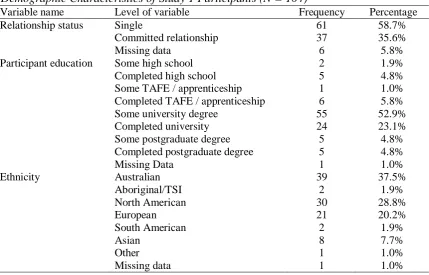
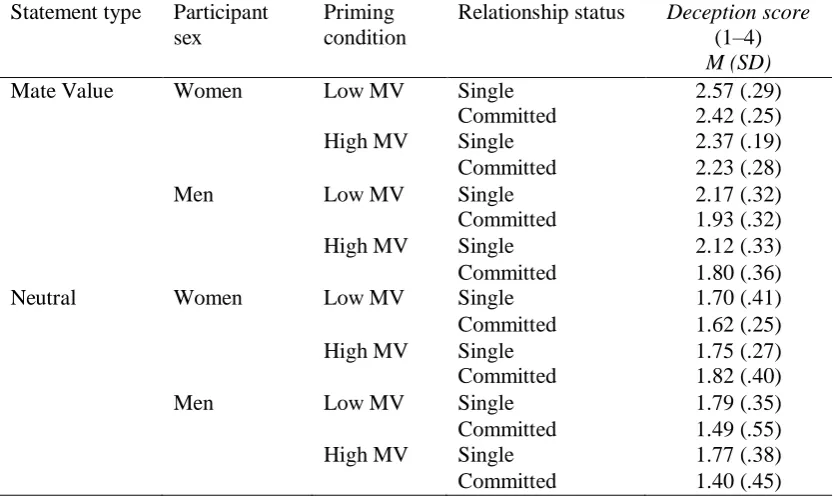
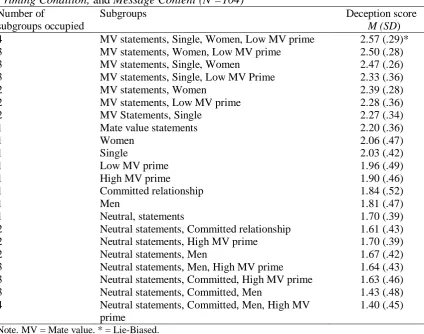
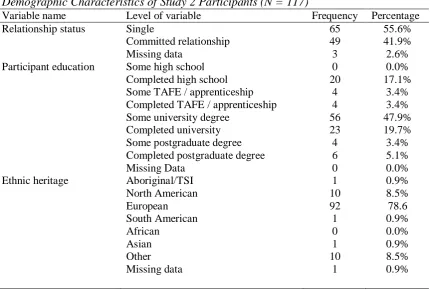
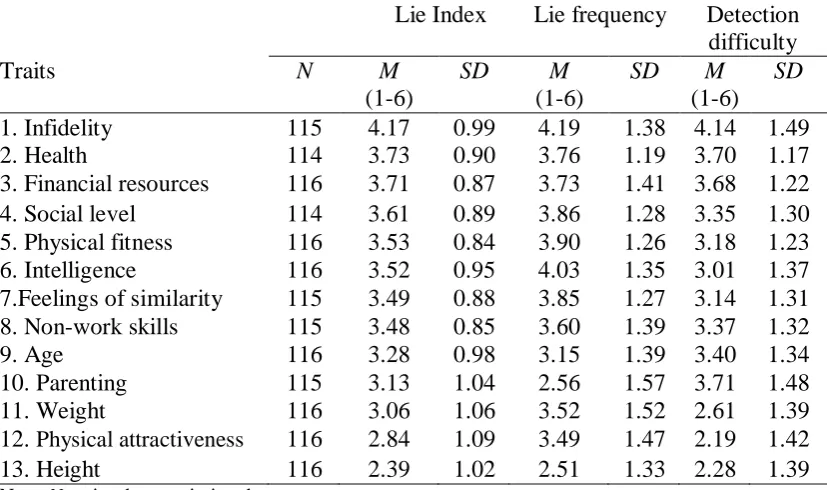
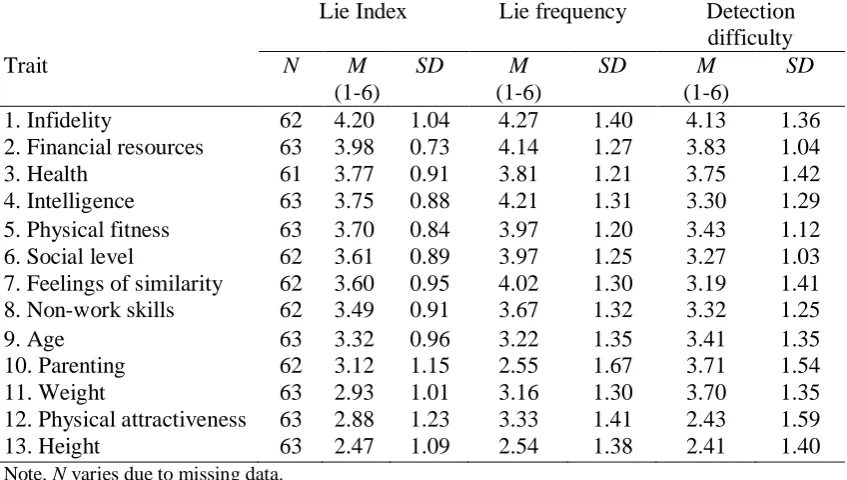
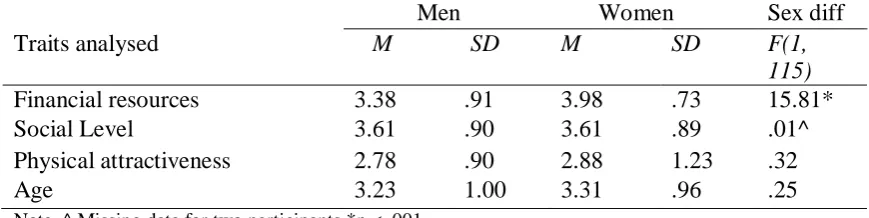
(7) DECEPTION AVOIDANCE. vi List of Tables. Table 3.1 Demographic Characteristics of Study 1 Participants (N = 104) ................... 35 Table 3.2 Average (M ± SD) Deception Scores for Mate Value and Neutral Statements as a Function of Participant Sex, Priming Condition, Relationship Status, and Statement Type (N = 104) .......................................................................... 38 Table 4.1 Perceived Deception (M ± SD) According to Participants' Sex, Relationship Status, Priming Condition, and Message Content (N =104)......................... 50 Table 6.1 Demographic Characteristics of Study 2 Participants (N = 117) ................... 77 Table 6.2 Summary of the Average (M ± SD) Likelihood with which Men and Women, and Attractive and Unattractive Individuals were Judged to be the Speaker Following Honest and Deceptive Communications (N = 117) ..................... 82 Table 6.3 The Means (± SD) for Ratings of the Frequency of Lies, Detection Difficulty, and Lie Index Scores for all Participants ..................................................... 87 Table 6.4 The Means (± SD) for Ratings of Frequency of Lies, Detection Difficulty, and Lie Index Scores for Male Participants ................................................. 87 Table 6.5 The Means (± SD) for Ratings of Frequency of Lies, Detection Difficulty, and Lie Index Scores for Female Participants ............................................. 88 Table 6.6 Sex Differences in Lie Index Ratings for Financial Resources, Social Level, Physical Attractiveness, and Age (N = 116) ................................................ 89 Table 6.7 Sex Differences in the Comparison of Lie Index Ratings for Financial Resources and Social Level versus Physical Attractiveness and Age (N = 113) ............................................................................................................ 90 Table 9.1 Demographic Characteristics of Study 3 Participants (N = 145) ................ 130 Table 9.2 Mean Percentage of Tokens Allocated to all Traits for Low and High Budget Restrictions (N = 145) .............................................................................. 133 Table 9.3 Comparison of Preferences to Avoid Deception Regarding the Tier I trait (Health) versus all other Traits in Tier II-IV in the Low Budget Condition (N = 145)....................................................................................................... 133 Table 9.4 Comparison of Preferences to Avoid Deception Regarding the Tier II trait (Infidelity) versus all other Traits in Tier III-IV in the Low Budget Condition (N = 145).................................................................................................. 134 Table 9.5 Preferences to Avoid Deception about Attractiveness, Resources, and Intelligence (Tier III) Compared to Tier IV Traits (N = 145)..................... 136.
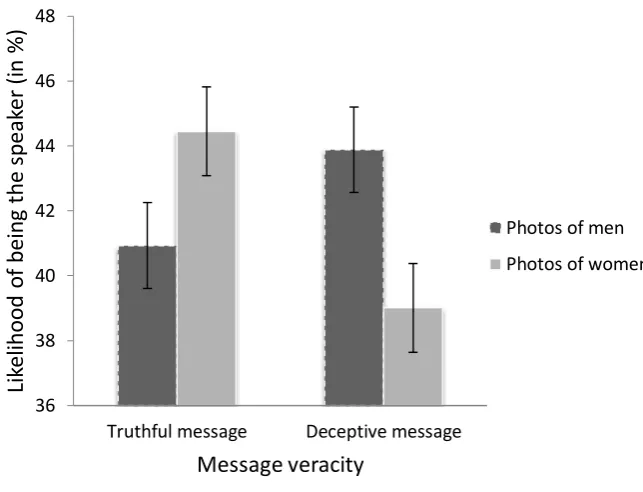
(8) DECEPTION AVOIDANCE. vii. List of Figures Figure 6.1. The mean likelihood (± SE) that men and women were the anonymous character in vignettes where truthful or deceptive messages were communicated. .......................................................................................... 84 Figure 8.1. The proposed hierarchy of preferences to avoid lies or 'Lie-rarchy' ......... 126 Figure 9.1. Proportion (± SE) of tokens allocated to each tier across high and low budget conditions for all participants (N = 145). ...................................... 138 Figure 11.1 Predicted error types above and below the deception-threshold. ............ 166.
(9) DECEPTION AVOIDANCE. viii Abstract. Decades of research have yet to provide a comprehensive theory explaining how, without adequate detection skills, humans circumvent costly deception. This series of studies proposed that biased perceptions of deception evolved to avoid costly deception without having to accurately detect it, per se. Based on evolutionary and error management models, three research studies were conducted to test the proposal that cost-benefit analyses and mental shortcuts produce biased perceptions of deception. In particular, the studies explored the role of the receiver of a message, characteristics of the speaker, and the cost associated with the message in the over- or under-perception of deception. Study 1 explored if the receiver’s characteristics (sex and relationship status), the content of the message, and priming mate value influenced perceptions of veracity. A sample of university students and individuals from the wider community (N = 104) completed a word-priming task where they reordered a series of short scrambled sentences containing words related to high or low mate value. Following priming, participants judged the veracity of messages considered to carry higher or lower reproductive costs. The findings indicated that if costs were minimal individuals maximised the frequency of Type II errors (false-negative) resulting in greater perceptions of honesty. However, the process typically producing truth-biased perceptions began to generate amplified perceptions of deception as costs increased. These findings are consistent with an error management approach, indicating that individuals maximised the number of Type I errors (false-positive) as costs increased. Study 2 explored perceptual biases that may arise based on the characteristics of the speaker. This study proposed a speaker-bias in deception detection; specifically, that initial perceptions of truthfulness vary as a function of a speaker’s sex and.
(10) DECEPTION AVOIDANCE attractiveness. Participants (N = 117) viewed a series of written vignettes involving an anonymous ‘speaker’ revealing biographical details to a ‘receiver’ character. After each vignette, participants were informed as to the truthfulness of the message (either truthful or a lie) and asked to indicate the anonymous speaker character from a series of photos of individuals varying in sex and facial attractiveness. As expected, participants rated female speakers as a more likely source of truthful statements and male speakers as a more likely source of potential deception. It was also found that photos of attractive individuals were selected more frequently during honest conditions. Study 3 resulted in the construction of a hierarchy of lies based on participants' preferences to avoid different types of deception. This study also allowed participants to make choices among various forms of deception simultaneously to directly investigate the fundamental trade-offs between preferences to avoid different types of deception. Each participant was given a list of ten traits an individual might lie about to secure a new partner. Participants (N = 147) were provided with a high (30 tokens) and low (10 tokens) 'budget'. Participants allocated as many or as few of the tokens as they wished across the traits to indicate their preference not to be deceived regarding each trait. Based on theoretical notions, the ten traits were categorised into one of four tiers a priori. As expected, traits categorised into the higher tiers produced higher avoidance preferences, while traits in lower traits produced lower avoidance preferences. Further, the preference to avoid higher tier traits was most evident when greater restrictions were placed on the participant’s selection process. However, as budget restrictions were lifted, trade-offs were found to occur, indicating an increased distribution of resources to lower tiers. Taken together, the findings from the three studies conducted provide a foundation for a new cognitive model of deception avoidance that may have greater explanatory power than earlier models.. ix.
(11) DECEPTION AVOIDANCE. 1 CHAPTER 1 INTRODUCTION. Evolved Mental Mechanisms That human mental and behavioural mechanisms may be the result of natural selection is a premise that has both interested researchers and caused considerable debate for over a century. Evolutionary psychology is the most recent discipline to examine the evolutionary roots of mental processes. The evolved psychology of human courtship has been a particular focus for much of the study of evolutionary psychology (for a review see Miller, 2000; Buss, 2007). An array of different topics has been explored, including mate selection and attraction (Buss, 1989a; Singh, 1993), and mate retention and poaching (Fisher, 1992; Schmitt & Buss, 2001). Another major area of research focus of the discipline concerns the detection of cheaters and the violation of social contracts (Barkow, Cosmides, & Tooby, 1992). Of particular relevance to the current research is the human ability to circumvent deception. A series of three studies was undertaken to investigate the interface of these two research areas by examining the role of deception detection within the context of human mate selection. Natural Selection as the Primary Mechanism of Evolutionary Change Darwin (1859) observed that in a natural setting, survival is not without competition. Darwin declared competition to be the driving force behind evolutionary change. Darwin recognised all environments can only sustain a limited number of individuals; thus, not all individuals will survive. The struggle to obtain limited resources crucial to survival results in competition between individuals. Darwin also noted that some individuals, as a consequence of the variation within species, have an elevated chance of survival. He proposed that over evolutionary time, those who were.
(12) DECEPTION AVOIDANCE better adapted would flourish, while the others would decrease in numbers. Darwin referred to this phenomenon as ‘natural selection’. Darwin (1859), and more recently Mayr (2001), describe natural selection as having two vital elements. The first component is the production of variation. Genetic recombination via sexual reproduction produces variations in traits (e.g., great variety in the number of different phenotypes expressed) upon which natural selection acts. Every offspring produced via sexual reproduction contains a slightly different set of genes. This wide variety in traits provides a species with an enhanced probability of survival should the environment undergo changes, as a result, decreasing the likelihood of mass extinction (Mayr, 2001). The second crucial factor in natural selection is that survival and reproduction are non-random events. The phenotypes providing some individuals with superior adaptation to their environment are not randomly selected. Phenotypic variation in traits, such as advanced camouflage, provides some individuals with an increased chance for survival. Over an extended timeline, those individuals containing the genetic material for traits that assist in survival will increase in frequency within a population. Some traits leading to a greater survival rate are heritable so that offspring are born with the same advantages as their parents (Miller, 2000). A distinction is made between a trait being “inherited” and a trait being “heritable”. Within sexual reproducing species, all traits that are dictated by genes are inherited. However, traits that have phenotypic variation between individuals in a population are heritable. For example, traits that do not vary genetically or are constant in all humans (e.g., having two eyes or two legs) are considered inherited, but they have zero heritability (Miller, 2000). Only traits with heritability greater than zero can be subject to natural selection.. 2.
(13) DECEPTION AVOIDANCE Sexual Selection Darwin (1859) detailed the process of natural selection to assist in the explanation of how organisms change over time. However, he later documented interesting observations of significant differences existing between the male and female members of a species. He noted that although males and females (within the same species) are well adapted to their environment, the process of natural selection alone could not explain differentiation of their traits. He observed that in species that reproduce sexually, males typically had more sexual ornamentation than females. Darwin suggested that the divergence of traits based on an individual’s sex was the product of a separate type of selection, he called ‘sexual selection’. Sexual selection describes how individuals not only compete to survive, but also to reproduce. Darwin (1871) reported sexual selection as “the advantage which certain individuals have over others of the same sex and species solely in respect of reproduction” (p. 243). Characteristics arising exclusively from the advantages they provide though their capability to attract members of the opposite sex are called secondary sexual characteristics (Darwin, 1859). Darwin (1859) argued that the presence of secondary sexual characteristics is evidence for sexual selection, yet he failed to clarify why specific traits were more likely to be preferred. Indicators of Genetic or Inclusive Fitness At the present time, fitness refers to an individual’s ability to successfully pass on copies of their genes to the next generation. Hamilton (1964) defined inclusive fitness as the sum of direct (genes passed on through offspring) and indirect (genes passed on through genetic relatives) fitness. Individuals replicating their own genes (via sexual reproduction) and/or aiding relatives high in genetic relatedness may achieve higher levels of inclusive fitness. Fisher (1915) suggested that secondary sexual. 3.
(14) DECEPTION AVOIDANCE characteristics are indicators of genetic fitness, which he referred to as ‘fitness indicators’. Traits signifying greater genetic fitness should be preferred by females during the process of selecting a mate. The overt expression of fitness indictors in males demonstrates a low level of genetic mutations (few errors in genetic copying), high ability to fight off parasites and pathogens and the ability to accrue sufficient resources to maintain the trait (Fisher, 1915). These selected traits will gradually become more exaggerated as they consistently and directly convey the genetic and/or general health of the male. Females who prefer these traits will produce offspring having the best chance of surviving into the next generation and who have the same mating preferences. As a result, these offspring will subsequently have a greater probability of producing offspring of their own. Parental Investment Theory Fisher (1915) described why males with specific traits are more likely to be selected by potential mates. However, Trivers (1972) clarified why females tend to be the selectors, and thus, why it is ‘female mate choice’ not ‘male mate choice’ that drives sexual selection. Trivers explained that the sex that provides the greater degree of parental investment (predominantly females) is typically the choosier sex. Parental investment is defined as “any investment by the parent in an individual offspring that increases the offspring’s chance of surviving, and hence reproducing, at the cost of the parent’s ability to invest in other offspring” (Trivers, 1972, p. 139). At a minimum, human female investment includes a nine-month gestation period, and a period of lactation followed by years of dependent care. In humans, however, copulation is the minimal parental investment a male may provide. Compared to the investment by females in sexually reproducing species, this represents considerably less time, energy, and resources. Males can supply as little investment as a single episode of. 4.
(15) DECEPTION AVOIDANCE insemination; therefore, a male has the ability to withdraw from a relationship to pursue additional mates. Trivers argues that because females make the greater minimal investment they should be more selective than males in relation to mate choice. Males (the lower investing sex) have the ability to mate with a higher frequency of mates than do females (the higher investing sex), and thus, have the capacity to produce more offspring (Bateman, 1948). Subsequently, a male’s overall reproductive success is linked to the number of copulations resulting in offspring. In contrast, the reproductive success of females is not derived from the quantity of mates she acquires, but the quality of the mates she selects. As a consequence of this disparity in parental investment, more males than females will end their lives without successfully reproducing. Therefore, males will engage in intra-sexual competition as a means of displaying their genetic worth (fitness indicators) to females. Mental Traits as Fitness Indicators While numerous physical traits are considered indicators of fitness, mental traits may also serve this function. The human brain is a rather intricate organ, for which many genes are required to ensure optimal development and performance (Miller, 2000). According to Miller (2000), mental fitness indicators reveal the complexity of a person’s brain. Those individuals who have a large number of deleterious genetic mutations are less likely to express sexually attractive mental abilities. Miller argues that genetic mutations represent one of the greatest reasons for variation in fitness. The brain is exceptionally susceptible to mutations, and is dictated by numerous genes. Therefore, it serves as a valuable fitness indicator for members of the opposite sex. Because personality traits, such as loyalty, empathy, forgiveness, kindness and honesty, are all especially beneficial in a successful human sexual relationship, sexual selection has defined many moral values as sexually attractive (Miller, 2007). Traits. 5.
(16) DECEPTION AVOIDANCE that correlate with an individual’s parental or genetic quality (or combination of both) have an increased propensity of being sexually selected (Kokko, Brooks, McNamara, & Houston, 2002). If a man has a plethora of mutations, he will fail to consistently perform the diversity of mental activities women desire. As previously stated, higher genetic quality indicates that an individual is lower than average in deleterious genetic mutations (Miller, 2000; Ridley, 2001). Genetic mutations resulting in social anxiety, language or speech impairments, schizophrenia, autism and mental retardation (BaronCohen, 2002; Keller & Miller, 2006; Shaner, Miller, & Mintz, 2004) impair the formation and functioning of an advanced theory of mind. Theory of mind (for a review see Baron-Cohen, 1995) involves the capability to ‘read other’s minds’ and is an imperative ability in order to successfully navigate human social exchanges and acquire mates. Conversely, indicators of being a good parent are marked by phenotypic traits that favour the survival of offspring including activities such as feeding, mediating sibling rivalries, grooming, predator protection, and safely teaching life skills to offspring (Kokko, 1998). Good parent indicators, such as conscientiousness and patience, differ from those indicating good genes. Good parent indicators signal that an individual is prepared and likely to collaborate in a mutually advantageous relationship strategy that will extend across the repeated interactions involved in cooperatively raising offspring. Mating Strategies and Moral Mental Fitness Indicators Men and women employ a number of different mating strategies, including long-term and short-term strategies (Buss, 2007). These strategies are commonly referred to as quality versus quantity strategies, respectively (Hirsch & Paul, 1996). According to Hirsch and Paul (1996), those employing a long-term (quality) strategy. 6.
(17) DECEPTION AVOIDANCE should display a different set of moral codes than those who are engaging in short-term (quantity) strategies. Long-term relationships necessitate continuing repeated reciprocity and persistent investment in offspring by both parties. Due to the nature of long-term relationships, those individuals engaging in this strategy are often perceived as more honest and moral. Women who select long-term mating prefer men with mental fitness indicators, such as kindness, empathy, niceness, and honesty (Urbaniak & Kilmann, 2003). These traits promote successful long-term strategies and are difficult to misrepresent over an extended period, and thus, are desired in potential partners. In contrast, short-term (quantity) strategies potentially involve minimal parental investment from the male. For women engaging in short-term mating strategies, mental fitness indicators such as riskiness and prosocial heroism (voluntary behaviors intended to benefit another) are perceived as attractive (Urbaniak & Kilmann, 2003). Zahavi (1975) explained that beyond the obvious motivation to bluff and falsify, costly traits (e.g. riskiness and prosocial heroism) are difficult to counterfeit. The honest display of costly traits indicates to potential mates that the signaller’s genetics are of high quality and can endure ‘handicapping’ activities that less competent individuals would fail to perform. In turn, individuals displaying these traits are selected as they indicate ‘good genes’ that will be passed on to offspring. Not all individuals possess the traits desired by the opposite sex. Thus, some individuals elect to utilise deceptive tactics to compensate for their less than satisfactory characteristics. DePaulo and Kashy (1998) found that more people lie when engaging in short-term relationships when compared to long-term committed relationships. Such individuals deceptively alter their perceived attractiveness to the opposite sex in order to gain a strategic advantage (Miller, 2007). This tactic may. 7.
(18) DECEPTION AVOIDANCE especially apply to short-term mating strategies due to the decreased time available for the detection of the lie. As relationships extend over time, opportunities to discover any deception employed increase. However, regardless of the duration of the relationship, those who could deceive others will be more successful than equivalent individuals who do not (Linton & Wiener, 2001; Miller, 2000). Social status, age, health, and fertility are all characteristics that would be advantageous to enhance for gaining an amplified individual advantage in mating. Deception may be used to draw more potential reproductive partners or gain access to a high quantity and quality of parental investment (Zahavi & Zahavi, 1997). Many benefits result from the successful execution of deception in the mating market. Consequently, men and women have evolved to be rather competent in their capacity to manipulate and deceive others (DePaulo et al., 2003). The Evolution of Deception “To get the better of by trickery; to beguile or betray into mischief or sin; to mislead” are all included in the definition of the English word “deceive” (Oxford English Dictionary, 1989). Richard Dawkins (1989) explained the evolution of manipulation and deceit the following way: “If there is just one selfish rebel, prepared to exploit the altruism of the rest, then he, by definition, is more likely than they to survive and have children. Each of these children will tend to inherit his selfish traits and after several generations of this natural selection, the ‘altruistic group’ will be overrun by selfish individuals” (p. 7–8). Dawkins and Krebs (1970) suggested that individuals may manipulate the behaviour or exploit another’s mental apparatus and behavioural machinery for their own benefit. Individuals proficiently employing deceptive and manipulative tactics would potentially increase their ability to survive and reproduce, therefore, having an evolutionary advantage over those who did not.. 8.
(19) DECEPTION AVOIDANCE Many benefits may be acquired through manipulation and deception, not only in acquiring survival resources (e.g., food and shelter) but also reproductive resources (e.g., mates and parental care). Males may especially engage in deceit for the purposes of increasing their advantage in mating. For example, if a male was consciously or unconsciously aware that females find male fitness indicators, such as social status and resource acquisition, attractive (see, Buss, 1994, for a review) then he could misrepresent himself in any of these qualities. Ultimately, a number of the initial false behaviours that were designed to trick others could become internalised into some people's everyday strategies of mating and become an integral part of their personality (McHoskey, 2001). Deceptive and Manipulative Personality Traits The renaissance political writer Niccolò Machiavelli, author of The Prince (1998, originally published in 1532), detailed manipulative and deceptive personality traits. Machiavelli, as a manipulator himself, believed the ends justified the means and any tactic to achieve one's goals was a method worth utilising. Those individuals who are highly likely to manipulate and deceive have been found to be distinctly different in a number of ways from those who are less likely. Machiavellians are often more dominant and non-nurturing individuals who tend to have low scores on measures of empathy and agreeableness (Barnett & Thompson, 1985; Wastell & Booth, 2003; Watson, Biderman, & Sawrie, 1994), but high scores on measures of conscientiousness (Jakobwitz & Egan, 2006; Lee & Ashton, 2005; Paulhus & Williams, 2002). Mudrack (1990) argued that manipulative individuals have an external locus of control. Such views of the world result in decreased motivation for intrinsic goals, such as community building and the welfare of others, and instead focus on more on selfinterested external incentives, such as personal success (McHoskey, 1999).. 9.
(20) DECEPTION AVOIDANCE Machiavellians are very cunning and influential in their tactics. They employ scheming communication strategies that incorporate both emotional appeal and deceit (Grams & Rogers, 1990). Additionally, manipulation of others includes not only deceiving others to perform desired behaviours, but suppressing counterproductive negative actions as well. When attempting to manipulate, charm is the most frequent tactic used, while coercion and the silent treatment are used habitually to terminate unwanted behaviour within an interaction (Buss et al., 1987). Deceptive machiavellians are described as highly flexible in both communication and personality. Machiavellians are highly adaptive to various situations and opportunistic when engaged in those situations (Martin, Anderson, & Thweatt, 1998). Wood (1989) concluded that machiavellians are mentally malleable, but theorised that they operate under a moderately concrete cognitive apparatus that consistently drives them to achieve personal gratification safely, but by any means required. Machiavellians also have few internal conflicts or ethical dilemmas in regards to the deception of others in order to benefit themselves (Paulhus & Martin, 1987). Machiavellians have been found to disassociate their internal self-value from their selfish behaviour (Bogart et al., 1970). Flexible moral frameworks and deceptive behaviours do not exclusively occur in adult humans. Braginsky (1970) observed that even children can be manipulative. Children enacting deceptive behaviours have better control over the impressions they make on others when compared to other children. Further, non-human primate behaviours have been observed to parallel the actions of manipulative humans (Humphrey, 1976). Non-human primates have also evolved the brain capacity to become aware of other’s awareness. Primates have the ability to recognise that other individuals have goals, aims, and desires that may conflict or compete with their own and use this awareness to their advantage (Humphrey, 1976).. 10.
(21) DECEPTION AVOIDANCE Environments Conducive for the Employment of Deception Numerous environmental circumstances influence the probability of successful deception (Geis & Christie, 1970). One major factor that increases the success of deceivers is the degree of improvisation available, which is associated with the nature of social structure in the environment. Machiavellians thrive in unstructured environments that have low corresponding social rules and few norms restricting particular behaviours (Schultz, 1993; Sparks, 1994). Further, Geis and Christie (1970) observed that an additional factor that prompts success for machiavellians is face-toface interactions. These situations allow individuals to copiously scrutinise and gauge faint nonverbal cues of the listener, allowing for increasingly precise behaviour calibration. While some individuals may become morally and emotionally involved in some situations, machiavellians have the ability to restrict their overt display of those behaviours. Manipulative individuals are able to express a composed moral detachment during deceptive situations. This disconnection with emotions allows for additional time and ability to analyse and plan their next manoeuvre. Yet, during all these tactics and disassociations, they manage to remain visually covert in their attempts to deceive. Manipulative behaviours would ultimately fail should they become too obvious. While often finding success at being discrete, machiavellians are frequently reported as both persuasive and charming (Geis & Christie, 1970). Peterson (1995) suggested there are six different categories of lies. Omission involves individuals remaining silent about things that would otherwise incriminate them. Distorted lies are those when people change some of the facts in their story. Halftruths occur when people leave out half of the problematic details. Blatant lies involve an individual fabricating an entire story. White lies are when an individual tells a minor. 11.
(22) DECEPTION AVOIDANCE lie to another in an attempt to make them feel better. Finally, failed lies arise when someone tells a lie that later becomes a truth, coincidentally. While there are only six ways to tell a lie, there are many different things an individual could lie about in order to appear more desirable or increase similarity with a prospective date. When attempting to secure a date with a member of the opposite sex, people have been known to lie about various features including course grades, career skills (Rowatt, Cunningham, & Druen, 1999), cheating on their partner (Saxe, 1991; Stebleton & Rothenberger, 1993), number of previous partners (Cochran & Mays, 1990; Desiderato & Crawford, 1995), condom-use history (Desiderato & Crawford, 1995), financial status, attractiveness and commitment (Benz, Anderson, & Miller, 2005). These are just a few of the possible types of lies people can engage in to increase desirability. However, like variations in a potential partner’s mate value, not all these lies pose the same level of reproductive and survival costs if a missed detection occurs. An individual’s mate value is defined as his or her ability to appeal to the opposite sex (see Surbey & Brice, 2007). Males varying in mate value pose differing levels of reproductive costs. Additionally, the implementation of different types of lies may also inflict different reproductive costs if the females are successfully deceived in the mating interaction. Manipulators in the Mating Context Several fundamental differences have been observed between manipulators and non-manipulators in relation to acquiring a mate. It has been found that men are more likely to be machiavellian compared to women, largely engaging in deceptive acts that promote self-interest (Christie & Geis, 1970). Machiavellians tend to lie more often than other individuals (Znakov, 1995). Further, machiavellians will engage in risky. 12.
(23) DECEPTION AVOIDANCE behaviour with others if they perceive their accomplices are resourceful and capable (Bogart et al., 1970). Men employ different mating strategies depending on whether the goal of their relationship is long or short-term (Buss, 2007). A successful strategy of men is to mate with as many females as possible, and deceit is one potentially successful tactic to lure extra mates. McHoskey (2001) observed machiavellians had more sexual partners in the previous year than other individuals. Additionally, manipulative men reported a higher likelihood of employing force (coercive sexual deceit) to gain sex if they were assured they could get away with it or that there would be no penalty (Boeringer, 1996). The Expectation-Discordance Model of relationship deception (Druen, Cunningham, Barbee, & Yankeelov, 1998) suggests that when an individual is intermingling with another and deems it difficult or unfeasible to meet the standards and expectations of the other by means of honest communication, they may resort to acts of deception. Forty-six per cent of men and 36% of women reported that they had lied at least once to prompt a date with an attractive member of the opposite sex (Rowatt et al., 1999). These individuals lied to attract a date when they believed other more honest methods would lead them to failure (Druen et al., 1998). When engaged in success-oriented self-enhancing lies, people tend to use lies that make them appear more similar to an attractive potential mate than they actually are. Attractive and unattractive individuals are told different types of lies (DePaulo, Tang, & Stone, 1987). Due to this, people who are more attractive are more efficient at avoiding lies told to attractive people and others who are less attractive are more capable in avoiding lies told to unattractive persons.. 13.
(24) DECEPTION AVOIDANCE In summary, machiavellians are more often men, they tend to have relatively more sexual partners, they are self-promoting, and they lie often. If mating with a deceptive machiavellian reduced an individual’s fitness, then those individuals possessing mechanisms to circumvent deception would gain a distinctive advantage. Individuals who failed to avoid deception from machiavellians in this context would suffer reproductive costs, such as raising children alone, loss of resources, or producing offspring of inferior genetic quality (Johnson et al., 2004). Solving the Adaptive Problem of Deception The Pleistocene is referred to as the environment of evolutionary adaptedness (EEA) for early humans (Tooby & Cosmides, 1990). The EEA is defined as the historical era in which persistent selection pressures shaped particular adaptations. The EEA also encompasses those physical and social environmental circumstances that were crucial for optimal functioning and development of the adaptation. The Pleistocene extended from approximately 1.8 million to 11,000 years ago, during which time virtually all of human’s multifaceted, multi-gene adaptations were shaped. During this period, all individuals were confronted with adaptive problems. Adaptive problems refer to the continuous tribulations over an organism’s evolutionary history that required an adaptive solution to successfully survive and reproduce. Conceptually, deception itself may have evolved as an adaptive solution to the problem of increasing genetic fitness. Nonetheless, as frequencies of deception increased, this previous adaptive solution now serves as an adaptive problem for others. During the Pleistocene epoch, deception simultaneously existed as both a problem and solution. For our ancestors who were victimised by deception, methods of detection should have been favoured. However, researchers have found that overall human accuracy in deceit detection is just slightly above chance (Bond & DePaulo, 2006;. 14.
(25) DECEPTION AVOIDANCE Kraut, 1980). Such findings do not strongly support the existence of an evolved mechanism that consistently and successfully detects deceit. On the contrary, deception detection may only be triggered under specific conditions. People appear to utilise many physical cues when they are judging whether they are being deceived (Malone, DePaulo, Adams, & Cooper, 2000). However, behavioural indications of deception are seldom exclusively expressed in the presence of a lie. Instead appropriate behavioural cues are appraised by the likelihood of occurrence when an individual is lying, compared to when an individual is telling the truth (Zuckerman et al., 1981). Cues to deception include shifts in posture, avoidance of eye contact and fidgeting (DePaulo et al., 2003). Vrij, Edward, and Bull (2001) reported that deceivers had extended pauses when answering questions when compared to nondeceivers. Deceivers have also been reported to express a higher frequency of hesitations during speech in general. Those individuals who shift their focus to nonverbal factors more than verbal cues experience greater success at detecting deception (Ekman, O’Sullivan, Friesen, & Scherer, 1991). Additionally, individuals who achieve successful detection in one situation are also more likely to detect deception in other contexts (Ekman & O’Sullivan, 1991; Frank & Ekman, 1997). This body of research supports the view that individuals may intrinsically vary in terms of their capability to accurately detect deception, however, still fail to achieve reasonably high levels of accuracy. Malone and colleagues (2000) observed that the majority of their participants had similar ideas about what cues to look for when assessing deception. While the knowledge of what cues to attend did not change among the participants, their accuracy in detecting deception still varied greatly. Therefore, conscious knowledge of which cues correlate with deceptive behaviours cannot be the keystone in deception detection. 15.
(26) DECEPTION AVOIDANCE accuracy. Forrest, Feldman, and Tyler (2004) proposed that while awareness of accurate detection cues is important to success, additional factors are required. These researchers proposed the existence of a mechanism that, following activation, can attain increased levels of detection accuracy. Since methodologies failed to activate this deceit-detection mechanism in many studies, the participants were virtually left guessing and, consequently, scored around chance (Bond & DePaulo, 2006; Kraut, 1980). Forrest and colleagues (2004) theorised that humans naturally operate with this detection mechanism switched off and only correctly identify selfish deceit by others when the specific mechanism is activated. It was concluded that this mechanism can be switched on by providing external cues of possible deception. Based on this perspective, the current series of studies examined if external cues indicating deception with heavy potential reproductive costs served to amend an individual's perceptions of honesty and increase one's ability to circumvent deception. Perceptions of Deception and Status Dominance theory refers to the idea that social dominance hierarchies operate by a set of implicit social norms that govern both behaviour and rights to resources, given one’s rank. Social hierarchies are highly tied to males’ reproductive success and the loss of social dominance can be very costly to a male’s survival and reproductive success. Cummins (1996) expanded dominance theory by hypothesising that male deception detection would be a function of social dominance within the group. Due to continuous competition, higher ranking (or dominant) individuals are required to avoid deceit from competitors if they wish to maintain access to their resources. At the same time, it would be beneficial for low-ranking individuals to become deceitful and manipulate their way to the top to gain access to sexual assets (such as mating rights and parental care). Reproductive success refers to the number of offspring produced by. 16.
(27) DECEPTION AVOIDANCE an individual. In many species, reproductive success is positively correlated with the level of social dominance. Those high on the social hierarchy are less likely to be victims of predation and starvation (Cheney & Seyfarth, 1990). In addition, increasing both the level of social dominance and time spent in that role are positively related with greater reproductive success. Low-ranking individuals have much to gain in reproductive success by violating social norms and cheating behind the back of a highranking male. In some primates, males will move a potential mate away from the dominant male and silence her calls to him in order to avoid detection, while copulating with her (de Waal, 1998). Therefore, for high-ranking individuals, it is advantageous to be able to avoid such acts of deception, in order to maintain access to sexual resources. Cummins (1999) found that status has a significant effect on the probability of an individual detecting deceit. However, when it came to detecting truth, status did not seem to matter. When human participants were placed in high-ranking positions, they were three times more likely to detect deceit than those placed in low-ranking situations (Cummins, 1999). In order to prime participants for deceit detection, researchers manipulated the mental state of being of higher status by placing participants in a high status group (dormitory resident assistant checking on students). Cummins observed that after participants were placed in the high-ranking groups and later switched to a low-ranking group (dormitory student checking on resident assistants), they still maintained increased detections of deception, as if they were still in the high-ranking group. Low-status groups only correctly identified deception after first being primed in the high status group in the first phase of the study. In summary, Cummins’ (1999) findings provide insight into the process of avoiding lies, rather than detecting truth. When it came to measures of truth finding, participants were all equally low in accuracy. Individuals in positions of higher status. 17.
(28) DECEPTION AVOIDANCE may sustain more costs if tricked than someone of a lower position who fails to detect the same lie. When asymmetries arise between the costs of failing to identify a deceitful act and falsely identifying a deceitful act, then evolved decision-making adaptations may make systematic errors. This process is referred to as error management (Haselton & Buss, 2000). The proposed studies employ an error management approach and are based on the proposition that systematic errors are produced following a cost-benefit analysis of deception. In cases of potentially costly deception, individuals are expected to over-perceive deception to assist in avoiding deceitful acts. Error Management Theory When individuals are potentially being lied to, but they do not have the means to prove a statement’s veracity, they are left in a situation of uncertainty in which they must make a decision. Additionally, evaluations of communications may provide cues to deception and cues to honesty simultaneously, producing a situation of ambiguity. During these situations, an individual is left with the option of producing one of two types of errors: false positives (false alarms, Type I errors), assuming someone is lying when they are telling the truth, and false negatives (missed detections, Type II errors), assuming someone is telling the truth when they are actually lying (Green & Swets, 1966). When this dichotomous decision of errors is made, as the probability of one error decreases, it unavoidably increases the probability of the other error occurring. While these two errors cannot be simultaneously avoided, they rarely carry the same level of costs. We might expect that under these conditions, human judgement and decision-making apparatuses would have evolved a bias towards the less costly error, even if this results in more errors overall. Error management theory has been applied to two common errors in cross-sex mind reading: men over-perceiving the sexual intent of women and women under-. 18.
(29) DECEPTION AVOIDANCE emphasising commitment from men (Haselton & Buss, 2000). Abbey (1982) found that men consistently think women are more interested in having a sexual relationship than do women. Over evolutionary history, one of the greatest restrictions on a male’s ability to replicate was his ability to acquire a fertile mate (Symons, 1979). Men who err on the side of falsely perceiving sexual intent in females (False positive, Type I errors) paid low costs, such as lost time or energy, when compared to those who falsely perceived a lack of sexual intent from women (false negative, Type II error). The latter men would have paid a much higher cost by potentially missing a reproductive opportunity (Dawkins, 1989). Conversely, women have a commitment scepticism bias that leads them to under-emphasize a male’s level of commitment. For women, failing to perceive commitment that does exist (false negative, Type II error) would be associated with a much lower cost than falsely perceiving a male’s commitment when little commitment exists (false positive, Type I; Haselton & Buss, 2000). An Error Management Theory of Deception Detection As previously mentioned, many researchers have found that the level of accurate overall human deceit detection is just slightly above chance (DePaulo et al., 1999; Kraut, 1980). However, many studies do not fully incorporate the possibility that biased perceptions of deception may be influencing the outcome of veracity decisions. It is suggested that the costs associated with deception are likely to increase the level of deception perceived. In review, when attempting to avoid lies consistently, humans are left with two possible errors as described by error management theory: false alarms and missed detections. When reproductive costs are involved, missed detections of deception can be highly costly. Johnson and colleagues (2004) theorised that there should be a difference in reproductive costs for women who are in committed relationships compared to single females. They tested this assumption and found single. 19.
(30) DECEPTION AVOIDANCE females were superior at positively identifying deception in males exaggerating biographical information that women typically find desirable in a mate. Conversely, women in committed relationships identified significantly more true biographical statements made by men. This difference is suggested to result from asymmetrical costs to single women. DePaulo and Kashy (1998) found that people are more likely to lie in casual relationships than those with whom they share close relationships. Single women, because they are still in the mate selection phase, have higher reproductive costs if they mate or pair bond with an individual of poor quality or parenting abilities. Females in committed relationships do not suffer these costs because they are not actively seeking a mate, thus they are not expected to increase their perceptions of deception. Therefore, it is suspected that the single women in Forrest and colleagues’ (2004) study were making the least costly error (Type I, false alarm) by over-emphasising possible deceit. In addition, high-ranking individuals would suffer fitness loses from any reduction in their status resulting from deception. As a result, high status individuals in Cummins's (1999) study may have also produced the least costly error and generated increased perceptions of deception compared to those who faced lower costs. The current series of studies explored if differences in reproductive costs produce different perceptions of deception and how these perceptions affect accuracy rates. Proposed Studies: Aims and Hypotheses The current series of studies aimed to elucidate some of the underlining factors that drive perceptions of deception. I suggest that perceptions of deception produced from internal and external factors strongly affect the outcome of a veracity judgement. The general goal of the current research program was to create a perceptual model of deception avoidance. It was expected that indications of costly deception would. 20.
(31) DECEPTION AVOIDANCE stimulate amendments to the perceptual errors and biases typically guiding human behaviour. Three studies were designed to explore the perceptions of deception related to three aspects of potential deceptive communications. Study 1 examined the influence that asymmetries in reproductive costs had on a receiver’s perceptions of deception. Study 2 explored the influence that a speaker’s sex and level of attractiveness had on receivers' perceptions of veracity. Finally, Study 3 aimed to create a hierarchical model to explain the difference in perceptions of deception across individual traits.. 21.
(32) DECEPTION AVOIDANCE CHAPTER 2 STUDY 1: DECEPTION AVOIDANCE: AN ERROR MANAGEMENT APPROACH TO THE TRUTH-BIAS. Deception-Detection in Humans Various theories exist in relation to the human ability to detect deception accurately. Although decades of research have suggested that members of our species are capable of detecting deception, accuracy is typically low, for example, 57% in one early report (Kraut, 1980) and 54%, more recently (Bond & DePaulo, 2006; Li, 2011). Ninety per cent of published results reveal accuracy rates do not differ by more than 10% (Levine, Shaw, & Shulman, 2010b). Many studies have focused on the detection of deception cues through what Ekman and Friesen (1969) call ‘leakage’. According to their theory, deception is correlated with emotional states that are leaked through nonverbal cues that cannot be completely managed by the conscious mind. For example, feelings of fear of detection, guilt and other emotions may be produced by the act of lying and may be leaked. Zuckerman, DePaulo, and Rosenthal (1981) advanced leakage theory with their four-factor theory. They proposed that emotion, arousal, cognitive effort, and over-control of behaviour are four factors that differ when individuals are telling the truth and when they are lying. However, a series of metaanalyses have cast doubt on both this theory and our ability to detect deception accurately via nonverbal cues (Aamodt & Custer, 2006; Bond & DePaulo, 2006; DePaulo et al., 2003; Frank & Feeley, 2003; Sporer & Schwandt, 2006, 2007). Non-verbal and Cognitive Factors Associated with Deception and Detection Although there has been little evidence to support the proposal that specific cues are consistently leaked while a lie is taking place (DePaulo et al., 2003; Sporer & Schwandt, 2006, 2007), it is still believed that leakage is due to the cognitively demanding nature of lying. Some researchers have suggested that in order to detect. 22.
(33) DECEPTION AVOIDANCE deception accurately, the cognitive load during the formation or execution of the lie must be raised (DePaulo et al., 2003; Zuckerman et al., 1981). However, due to the increasing need to control behaviour and cognitive demand, liars have been found to reduce their cognitive load when lying by staring at information-poor aspects of the environment, such as floors or ceilings (Doherty-Sneddon, Bruce, Bonner, Longbotham, & Doyle, 2002; Doherty-Sneddon & Phelps, 2005; Glenberg, Schroeder, & Robertson, 1998). Liars have also been found to decrease blinking, and hand and foot movement to allow more cognition to be allotted towards behaviour maintenance during lies (Mann, Vrij, & Bull, 2002; Vrij & Mann, 2003; Sporer & Schwandt, 2007). Yet, conflicting evidence has found that movement of hands and feet tends to increase when individuals lie (Vrij, Mann, Leal, & Fisher, 2010). While the cognitive load and nonverbal leakage model has not received consistent support, considerable evidence suggests that cognitively based lie detection is moderated by what is known as the veracity effect (Levine, Park, & McCornack, 1999). Gilbert, Krull, and Malone (1990) suggested that incoming information is, by default, perceived as truthful. Therefore, the veracity effect refers to the consistent finding that truthful messages are more accurately identified and that people persistently err more when identifying lies. The veracity effect has been demonstrated with individuals who were or were not primed to be suspicious, relational partners and strangers, and with individual's who were both familiar and unfamiliar with the content of the message (Levine et al., 1999). These findings have led researchers to conclude that the veracity of the message being judged is one of the most influential factors for accurate detection. Previous research has also suggested that it is difficult to enhance overall accuracy past the typical rate of just above chance. For example, whether lies are. 23.
(34) DECEPTION AVOIDANCE sanctioned (participants are instructed to lie) or unsanctioned (participants lied without instruction) does not meaningfully change deception detection ability (Feeley & deTurck, 1998). Confidence in accuracy was expected to correlate with actual accuracy, however, confidence (72.9%) was not revealed to be an accurate predictor of deception detection accuracy (57.2%; Depaulo, Charlton, Cooper, Lindsay, & Muhlenbruck, 1997). Due to the consistency of the veracity effect and the resulting difficulty in detecting deception, researchers have manipulated base rates of lies in order to attain elevated levels of detection accuracy. Instead of employing the standard base rate of 50% truthful messages and 50% deceitful messages, one study altered the base rate to three levels (25%, 50% and 75% truthful messages; Levine et al., 1999). Results showed that the lower the base rate of truthful messages, the higher the error rate in detecting lies. The important insight resulting from manipulating base rates is that increasing the frequency of lies encountered lowered the overall accuracy of detection. The Effect of Continuous Scales versus Dichotomous Measures on Detection Accuracy While most research methodologies produce similar accuracy scores, researchers have modified the way in which truths and lies are scored. Two common types of scales are dichotomous and continuous scales (Levine, Shaw, & Shulman, 2010b). Many researchers assume that deception detection is operationally defined as either right or wrong. In accordance with this assumption, the appropriate measure should be dichotomous in nature. Other studies employ continuous scales because deceptive intent, perceptions of lie severity, and judgemental certainty are suggested to vary along a continuum (Levine, 2001; Levine, Asada, & Lindsey, 2003). However, the utilisation of different scale types has been found to be somewhat arbitrary (Bond & DePaulo, 2006). Bond and DePaulo’s (2006) meta-analysis found both scale types to be. 24.
(35) DECEPTION AVOIDANCE comparable to each other. In addition, many researchers measure detection accuracy as an average score of correct detection of both truths and lies combined. However, when isolating the analysis to only the accuracy rate for deceptive messages, rates have been found to be below chance (Bond & DePaulo, 2006; Kraut, 1980; Li, 2011). In review, findings have indicated that individuals can more accurately identify truthful statements as truthful, but this does little to assist individuals in evading the consequences or costs of being deceived. Deception arises in many different aspects of social interactions. People reported using deception in 14% of emails, 37% of phone calls, and 27% of face-to-face interactions (Hancock, 2007). Research has revealed that individuals lie in some way on average about twice a day (DePaulo, Kashy, Kirkendol, Wyer, & Epstein, 1996). While consistent findings exist for the frequency of lies, participants in the laboratory rarely accurately detect deception. One researcher suggested that there could be “more deeply-rooted cognitive processes” for deception detection (McCornack, 1997, p. 103). In an extension of this line of thinking, I propose that deeply-rooted cognitive processes are integrated into behaviours aimed at circumventing the consequences or costs of potential lies, as opposed to accurately detecting deception per se. The current study examined perceptions of deception in light of the costs involved in lies implemented during the mate selection phase of human courtship. An Error Management Approach to Mating Deception According to error management theory, errors that produce asymmetrical costs will result in a bias towards the less costly error (Haselton & Buss, 2000). Following a cost-benefit analysis, this bias often results in maximising the error that produces the most beneficial outcome. In review, men have been found to over-perceive sexual intent from women. Men who err on the side of falsely perceiving sexual intent in. 25.
Figure
+7

Related documents