Report
Using Evidence in the
Classroom: What Works
and Why?
Using Evidence in the Classroom:
What Works and Why?
Julie Nelson
Clare O’Beirne
Published in January 2014
By the National Foundation for Educational Research, The Mere, Upton Park, Slough, Berkshire SL1 2DQ
© 2014 National Foundation for Educational Research Registered Charity No. 313392
ISBN 978-1-910008-07-2
How to cite this publication:
Contents
Acknowledgements
iv
Executive Summary
v
1
Introduction
1
1.1 Methodology 2
1.2 Context 3
2
Systemic Issues and Solutions
6
3
Best practice in knowledge production and transformation
12
3.1 What enables effective production and transformation of evidence? 12 3.2 Approaches to knowledge production and transformation 14
4
Best practice in knowledge engagement and use
17
4.1 What enables effective school use of externally produced evidence? 17
4.2 Approaches in knowledge use 20
5
The role of teacher-led research and enquiry
24
5.1 Purposes, methods and enablers in teacher-led research and enquiry 24
5.2 Approaches in teacher-led research and enquiry 28
6
Topics for attention and action
35
6.1 Systemic issues and solutions 36
6.2 The process of knowledge production, transformation and use 37
6.3 The role of teacher-led research and enquiry 38
6.4 The evidence base – what works and why? 39
References
40
Appendix A
Glossary of Terms
45
Appendix B
Search strategy
47
Appendix C
Screening and synthesis strategy
49
Acknowledgements
We would like to extend our thanks to Dr Jonathan Sharples of the Education
Endowment Foundation and Dr Caroline Kenny of the EPPI Centre at the Institute of Education for acting as expert advisers to this review. Their advice regarding the overall focus of the review, guidance on decisions about review parameters and key sources of literature, and comments on various iterations of this final review have been invaluable. We are indebted to them both for the support that they have offered.
Executive Summary
Background
This summary presents findings from a rapid evidence review written and published by the National Foundation for Educational Research (NFER). Our review
synthesises what is currently known about effective approaches to school and
teacher engagement with evidence and highlights challenges and areas for attention. The report moves beyond the evidence identified through the review itself by
suggesting actions needed to deal with some of the issues and challenges identified.
This review is published at a time when many organisations (including government), academics and teachers are seeking to develop strategies that will enable the teaching profession to make best use of evidence about what works in improving educational outcomes and the reasons for this. This is partly in response to
increasing levels of school autonomy, which create both increased responsibility and accountability for headteachers and governors, alongside the potential for increased opportunity to shape practice.
The debate about the need for an evidence-informed teaching profession is not new. David Hargreaves’ seminal lecture to the Teacher Training Agency (Hargreaves, 1996) is regarded by many as the speech that sowed the seeds for the ‘evidence into education’ movement (in contemporary parlance, often referred to as knowledge mobilisation). More recently, the debate has been reinvigorated following the impact of Ben Goldacre’s paper: Building Evidence into Education (Goldacre, 2013).
Goldacre argues that the education profession is still far from evidence based, despite the range of programmes developed during the 1990s and 2000s designed to mobilise knowledge within the profession.
Key findings
Systemic issues and solutions
When commentators talk about knowledge mobilisation (KMb), they refer to a process by which evidence is produced by research organisations, transformed into accessible and usable outputs through a process of collaboration and/or mediation, and implemented by teachers in order to develop their teaching practice and enhance learner outcomes.
independent of, or connected to evidence produced by research organisations); and the place of these developments within the debate about an evidence-informed teaching profession.
The ‘case’ for teachers engaging with evidence is that teaching practice and learner outcomes can potentially be enhanced by effective identification and application of the evidence around the most effective approaches to teaching and learning. Our review underlines that:
• KMb is not a linear process; it requires social and behavioural change on the part of researchers and teachers.
• Evidence needs to be transformed for use in practice, rather than simply summarised. This can happen through effective interaction and collaboration between teaching professionals and researchers, and/or via intermediary organisations.
• There is no current system to support evidence transformation, nor is there an identifiable group of organisations or individuals with responsibility for mediation. Responsibility is dispersed and where transformation occurs, it is piecemeal.
• The development of an infrastructure supporting KMb across England and Wales would enable a more systematic approach. In addition, a body for the teaching profession, leading on teaching and learning and on the use of evidence in education, could help to enhance the impetus for knowledge production and use within the profession.
The review firstly considers issues related to teacher engagement with evidence produced and transformed by researchers and then goes on to discuss teacher involvement in their own research and enquiry. In terms of teacher engagement with
evidence we consider firstly best practice in knowledge production and
transformation and secondly best practice in knowledge engagement and use.
Best practice in knowledge production and transformation
• A centralised knowledge base providing clear and trusted summaries of effective practice approaches (established through robust and accurate research) could help to improve teacher use of, and confidence in, evidence.
• The evidence needs to be contextualised for practice and presented in clear, accessible formats, using media which is accessible and includes practical guidelines for implementation, rather than simply being produced in its raw form.
• Intermediaries can be used to translate evidence into tools for implementation in the classroom. Collaboration between teachers and researchers can also lead to a better understanding and use of evidence.
Best practice in knowledge engagement and use
• Teachers’ belief in evidence and its value is important if the vision of an
evidence-informed teaching profession is to become a reality. Belief needs to be driven by the profession, although researchers can assist by improving the quality and accessibility of evidence.
• A clear voice for the teaching profession on the use of evidence to promote professional independence is required. Professional associations, amongst others, have a role in helping to facilitate this.
• A focus on the role of evidence should be strengthened amongst initial teacher training and CPD providers and providers of school leadership training. This could further be strengthened through a reflection on teachers’ professional standards. Teachers should also be equipped with strategies for critically appraising and using evidence.
• There is a need for much more evidence on the relative benefits of different models of research engagement and use.
The role of teacher-led research and enquiry
• Teacher-led research or enquiry is not a homogenous activity. It serves different purposes and uses a variety of methods. At its most effective, the methods used are closely linked to, and fit for, purpose. It can be conceived to inform a national knowledge base, to support school self evaluation or improvement or to support individual-level professional development, for example.
• The methods adopted, and the factors that enable their success, are different according to the purpose of the research.
• The distinction between engaging in and with research can be overstated. Teachers undertaking research are often more disposed to engage with external evidence to support their enquiry than those who are not. The two processes are not mutually exclusive, and in the best examples, they complement each other.
• There can be an overemphasis on the development of teacher research skill as an end in its own right rather than as a means to an end (improved professional practice or better learner outcomes). Schools, collaborative networks, training providers and professional associations have a role to play here in defining the purpose of teacher-led research and enquiry and supporting best practice.
Conclusions
Teacher representation bodies such as the National Association of Head Teachers (NAHT), Association of School and College Leaders (ASCL) and the National
College for Teaching and Leadership (NCTL), and Teaching School Alliances, need to continue to nurture the impetus for an evidence-informed teaching profession. Education will not become evidence informed if calls emanate solely from the research community or from central government.
Schools, collaborative networks, training providers and professional
associations have a key role to play in brokering key messages. These include that the distinction between teachers engaging in and with research can be overstated, and that an overemphasis on the development of teacher research skill as an end in its own right is less helpful than teacher research as a means to an end.
Research organisations and intermediary bodies need to transform (rather than simply produce, synthesise or summarise) evidence for practice. It is important that, within this process, the importance of social interaction is not overlooked.
Finally, funding organisations need to commission evaluations of different approaches to KMb. There is a need for: better descriptions of varied approaches; evaluations of the relative benefits of different approaches; and impact assessments of the relationship between KMb approaches, professional practice development and learner outcomes.
Methodology
The review is based upon UK literature published since 2010 and is underpinned by a systematic process for searching, screening, appraisal and synthesis. We have endeavoured to select the most methodologically sound studies for analysis. However, the research base on evidence use within the teaching profession is incredibly scant and as a result some of the approaches discussed are based upon observations or small-scale qualitative research, rather than upon trials or rigorous quantitative measurement. The review team adopted a three-stage process to filtering the search results.
• Screening – all identified items (426) were ‘screened’ for relevance (on the basis of information provided in abstracts) using a detailed coding frame. Thirty ‘key items’ were identified as a result.
• Appraisal – using a detailed appraisal template for each selected item, the review team read and summarised each key item under a number of key headings related to research design, study findings, and relevance.
• Synthesis – the reviewed data was analysed in order to draw out emerging themes and key messages.
1
Introduction
This rapid evidence review is written and published by the National Foundation for
Educational Research (NFER). NFER is an independent charity working to provide evidence that improves education and learning, and as a result, the lives of learners.
The review has been undertaken to underpin the Teacher Development strand of the NFER Research Programme.1
The review is published at a time when many organisations (including government), academics and teachers are seeking to develop strategies that will enable the teaching profession to make best use of evidence about what works in improving educational
outcomes and why. This is partly in response to increasing levels of school autonomy, which create both increased responsibility and accountability for headteachers and governors, alongside the potential for increased opportunity to shape practice. Campbell and Levin (2012) comment that the increasingly decentralised school system in England presents both opportunities and challenges:
This Programme focuses on topics that NFER believes to be important, or undeveloped, and where we feel that our research skills and depth of subject expertise can offer valuable insights and contribute to improving the education and wellbeing of learners. The Programme is jointly funded by NFER in collaboration with partners who have a strong interest in its topics and share our values and objectives. Projects and activities within the Teacher Development strand of the Research Programme seek to identify how excellence in teaching and learning can be promoted and effectively spread to secure the best possible outcomes for young people. Part of the strand’s remit is to better understand the factors that enable the effective use of evidence by schools and teachers in developing professional practice and improving outcomes for learners.
On the one hand, increased school autonomy may provide new impetus for schools to seek out and embed evidence-based practice in order to increase attainment and efficiency ... On the other hand, the autonomy of individual schools may make it harder to bring research to bear on practice systemically and at scale [...] Put bluntly, mobilising knowledge in 20,000 individual schools is not an easy task.
(Campbell and Levin, 2012, p. 9)
Our review synthesises what is currently known about effective approaches to school and teacher engagement with evidence and highlights ‘weak spots’ or areas for attention. The specific foci of the review are to:
• draw together recent contributions (2010 onwards) to the debate about approaches to developing an evidence base within schools and the teaching profession in England and Wales;
• identify factors that enable effective use of evidence within schools and the teaching profession;
1
This strand was previously known as Developing the Education Workforce. Other strands are: From
• discuss ways in which evidence is being used in practice;
• consider evaluations of the effectiveness of different approaches to evidence use in terms of impacts on teacher engagement or classroom practice, and pupil outcomes;
• identify areas for attention and propose solutions.
We have not included literature relating to evidence use within other professions, or other countries’ education systems within the systematic searches undertaken for this review. It is generally accepted though that evidence is more effectively (although not perfectly) used within professions such as medicine and healthcare, and that there are interesting examples of evidence use within the teaching profession in countries such as the USA and Canada. We will be exploring opportunities to consider the lessons that can be learned from these, as they relate to the education system in England and Wales, over the coming months.
1.1
Methodology
The review is underpinned by a systematic process for item searching, screening, appraisal and synthesis. This process is important and underlines the fact that the review has
identified relevant evidence in an unbiased and transparent way. Through our screening processes we have endeavoured to select the most methodologically sound studies for analysis (Appendix D shows how item robustness was determined). However, the research base relating to tried and tested methods of developing evidence use within the teaching profession is incredibly scant (there are no randomised controlled trial (RCT) studies, for example) and hence we have had to adopt a ‘best available evidence’ approach to item selection. This means that some of the approaches discussed are based upon observations or small-scale qualitative research, rather than upon trials or rigorous quantitative
measurement, a key finding in its own right.
Details of the systematic search that was undertaken for this review are provided in
Appendix B. Following the search, the review team adopted a three-stage process to filtering the search results. This process is outlined in detail in Appendix C, but in brief, it consisted of the following:
• Screening – all identified items (426) were ‘screened’ for relevance (on the basis of information provided in abstracts) using a detailed coding frame. Thirty ‘key items’ were identified as a result.
• Appraisal – using a detailed appraisal template for each selected item, the review team read and summarised each key item under a number of key headings related to research design, study findings, and relevance.
• Synthesis – the reviewed data was analysed in order to draw out emerging themes and key messages. The synthesis was guided by the review foci outlined in Section 1.
The review was greatly assisted by the support of our expert advisers, Dr Jonathan Sharples of the Education Endowment Foundation, and Dr Caroline Kenny of the EPPI Centre at the Institute of Education who supported the work at all stages. They provided suggestions of potential literature (in addition to NFER’s own search results),2
2
Suggestions were subjected to our screening criteria – see Appendix C.
item selections, and helped to steer the content and focus of this report, based on a presentation of headline findings in September 2013 and a draft final review in October 2013.
1.2
Context
The debate about the need for an evidence-informed teaching profession is not new. David Hargreaves’ seminal lecture to the Teacher Training Agency (Hargreaves, 1996) is regarded by many as the speech that sowed the seeds for the ‘evidence into education’ movement. Hargreaves was highly critical then of the fact that the evidence base in education was incredibly weak, despite huge annual spending on educational research within and among academic institutions.
For a teacher to cite research in a staffroom conversation about a pupil would almost certainly indicate that he or she was studying for a part-time higher degree in education or rehearsing for an Ofsted inspection - and would be regarded by most colleagues as showing off.
(Hargreaves, 1996, p. 5)
1.2.1
Historical developments
Hargreaves’ paper was quickly succeeded by a number of studies that explored the issue further, often drawing comparisons with other professions such as medicine and social care, where the evidence base was then, as now, regarded as much more established (see, for example, Hargreaves, 1998; Davies et al., 2000; Thomas and Pring, 2004; Nutley et al., 2007). And it wasn’t solely the academic community that was discussing the need for better use of evidence. The Tooley Report to Ofsted (Tooley and Darby, 1998) articulated the importance of education policy being firmly grounded in social scientific results, while the government’s white paper, Modernising Government (GB. Parliament. HoC, 1999)
emphasised the importance of evidence in developing public services. In 2002, the Treasury Spending Review (GB. Parliament. HoC, 2002) concluded that the relationship between research, policy and practice needed to be improved.
There then followed a series of programmes and resources developed to improve the quality of educational research, its accessibility and usability, and ultimately, its impact on teaching practice (Bevins et al., 2011; Borg, 2010; Gough, 2013; Haslam, 2011; Hulme, 2013; Saunders, 2010).
evidence-based resource banks developed for teachers. Additionally, NFER hosted CERUK plus, a government-funded database of current education research topics, which was free to search. The educational evidence portal (eep) was developed as a joint venture by a group of organisations, including NFER, who aimed to make research evidence more widely available through a searchable portal.
There was also some government funding and support for schools taking part in their own research or enquiry. The then Department for Education and Skills (DfES) funded its Best Practice Research Scholarships, while the Teacher Training Agency (TTA) ran its School-based Research Consortia and the then National College for School Leadership (NCSL) hosted Network Learning Communities. Funding for all of these initiatives ceased at various points between 2006 and 2012.
However, the National Teacher Research Panel (NTRP), an independent group of teachers and headteachers with research expertise who support and encourage other teachers to engage in and with research, remains active and is supported by the Centre for the Use of Research and Evidence in Education (CUREE).3 The Collaborative Action Research Network (CARN), founded in 1976 is also still active. This is a network of teacher action researchers, which has grown to become international (and incorporating more professions) over the years. It is hosted by Manchester Metropolitan University’s Education and Social Research Institute.4
1.2.2
Current debates
So we know that the debate about evidence-informed practice is not new. We also know that there has been an array of multi-million pound programmes, collaborations and resources over recent years, all of which have aimed to improve the flow and take up of evidence for practice. But how successful have these been? And why is it that we are still discussing how best to improve the evidence base in education after all of these efforts? Gough (2013) suggests that many of the outlined initiatives failed to work as well as anticipated because their systems were too new and, critically, because they lacked central coordination. He also makes the following point, which we return to in Section 2:
Most of the initiatives were in terms of the ‘push’ of production of research, rather than changing the organisational and individual professional drivers on the use of research.
(Gough, 2013, pp. 74–75)
The debate about evidence-informed practice has been reinvigorated recently following the impact of Ben Goldacre’s paper: Building Evidence into Education (Goldacre, 2013). Goldacre argues that the education profession is still far from evidence based, despite the range of programmes developed during the 1990s and 2000s to mobilise knowledge within the profession. He draws parallels with the medical profession (where, since the 1970s, there has been a tradition of professional engagement with external evidence, and related evidence-informed clinical decision making). He also favours an approach where RCTs are a key basis of a research-based education profession. Goldacre’s views are currently highly influential, which is reflected in the fact that the Department for Education (DfE)
3
4
commissioned him, alongside another external expert, to consider the role of research, analysis and data across the DfE, English schools and children’s services (DfE, 2013).
Goldacre’s vision is for systemic change. He envisages Education Trials Units working with networks of research-engaged schools to undertake rigorous research to find out ‘what works’ in various aspects of educational practice. He sees this information being fed effectively to schools and teachers; and he sees teachers actively critiquing the findings, putting them into practice and monitoring and evaluating the results in their individual settings. He also favours scope within the system for teachers to raise questions and make suggestions about topics that they would like to see researched, thereby having direct influence on the future research agenda.
The processes behind such a vision are, of course, by no means straightforward. If they were, it is likely that David Hargreaves’ call of 1996 would have led to substantial
developments by now. Goldacre’s vision requires seismic cultural and system change if it is to become reality.
2
Systemic Issues and Solutions
It is unreasonable and even undesirable to expect individual teachers or principals to be the key consumers of research findings – practice needs to be changed at the system level.
(Levin, 2013, p. 18)
Summary of key issues and solutions:
• Producing and adapting evidence for practice is not a linear process – it requires social and behavioural change on the part of researchers and teachers.
• Evidence needs to be transformed (not simply summarised) for use in teaching practice. This can happen through effective collaboration between teachers and researchers (social interaction), and/or by ‘mediation’ via intermediaries (linkage).
• There is no current system to support evidence transformation. Nor is there an easily identifiable group of organisations or individuals with responsibility for mediation. Responsibility is dispersed and where transformation occurs it tends to be piecemeal.
• The development of an infrastructure supporting KMb across England and Wales would enable a more systematic approach to evidence use in schools. Government may be in a position to facilitate the initial development of such an infrastructure, but a range of other organisations are well placed to operationalise the various elements.
• Proposals for, and debates about, a Royal College of Teaching should consider the potential of such a body to champion and coordinate the use of evidence in education among the teaching profession.
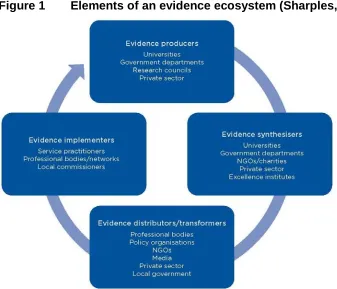
In a recent paper: Evidence for the Frontline, Jonathan Sharples (2013) presents the
components of what he terms a ‘knowledge mobilisation (KMb) ecosystem’. Put simply, KMb is the process by which evidence is produced by research organisations, transformed into accessible and usable outputs through a process of collaboration and/or mediation, and implemented by teachers in order to better their teaching practice and enhance learner outcomes. His ecosystem is illustrated in Figure 1.
In the interests of ease and clarity, we use the term KMb throughout this review when describing the use of evidence in educational practice. However, we recognise that it ascribes primacy to evidence produced by research organisations and also describes a research community-driven sense of the importance of the use of evidence in education. In Section 5 of the review we consider equally important additional issues related to: schools’ own demand for evidence (and factors that both facilitate and inhibit this); the role of
For a full description of the term KMb, and a range of other descriptions of research engagement that are used throughout the review, see the glossary at Appendix A.
Returning for now to the issue of how evidence produced by research organisations can best be adapted and made available for practice, Sharples’ ecosystem demonstrates that KMb is not a linear process in which academic institutions produce research about ‘what works’, with teachers implementing the findings in their classrooms. Rather, KMb requires social and behavioural change (Levin and Campbell, 2012). Knowledge needs to mobilised
[image:15.595.74.411.255.544.2]so that it becomes accessible, relevant and usable. And this does not happen solely by research institutions providing research findings in formats that they believe will be accessible for schools (although this is a useful step in the process).
Figure 1
Elements of an evidence ecosystem (Sharples, 2013, p. 9)
The critical component of this ecosystem is the transformative process whereby research evidence (produced, synthesised and presented in accessible formats for teachers) is transformed into useful guidelines for implementation. Such guidelines need to incorporate factors like management considerations, costs and training requirements. In other words, if we genuinely want schools to access and use the best available external evidence, then that evidence must be transformed (not simply summarised) for use in everyday practice. Good quality evidence syntheses provide an essential knowledge base to underpin school-level implementations, but they rarely provide the specific detail that teaching professionals need if they are to be encouraged to consider the implications for their practice seriously. School decision makers and teachers need guidelines about how to put research into action.
Researchers’ natural comfort zone is research (and sometimes synthesis) production, while teachers’ professional expertise lies in pedagogy and classroom management. Are
researchers sufficiently well placed to ‘reach forward’ to practice in order to transfer their knowledge, and do teachers have the skills to ‘reach backwards’ to research? (Sharples, 2013). Is there space for a useful meeting in the middle? Read et al. (2013) believe that this middle ground is important territory:
Research knowledge is mobilised effectively when organisational leaders, practitioners, policy makers and researchers from different institutions and contexts learn together using research to inform thinking and professional practice.
(Read et al., p. 25)
This suggests that there needs to be better interaction and collaboration between
researchers and teaching professionals if knowledge is to be mobilised effectively. Others believe that there needs to be additional involvement from intermediary organisations with understanding both of research and teachers’ needs. Campbell and Levin’s description of evidence use (2012) highlights a process similar to Sharples’ ‘ecosystem’ (research
production, transformation and use), but focuses specifically on ‘mediation’ as the focal point for the transformation process.
Campbell and Levin describe potential mediators as charities, professional associations, unions, academy chains, local authorities (LAs) and the media, amongst others. They
describe their role as being to locate useful research and make it freely available to schools; understand the implications of research for practice and be able to explain these to
teachers and other stakeholders; share messages, ensuring that these travel between schools and across the education system; and act on research findings, ensuring that schools are supported to embed research in their practice. They do not mention the potential role of such mediators in taking messages and questions from schools and teachers to researchers however.
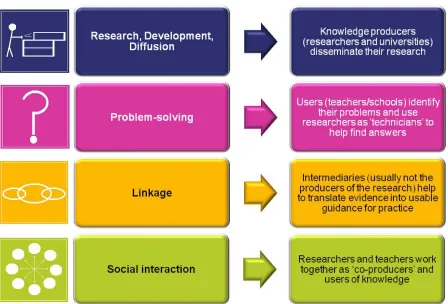
Becheikh et al. (2009) propose four models of research production and use, but divide the process of mediation (described by Campbell and Levin, 2012) into two components – ‘linkage’ and ‘social interaction.’ These models provide a helpful framework for categorising the variety of approaches to KMb that we have identified through this review. We therefore use them (and their related symbols) to describe the approaches to KMb discussed
Figure 2
Models of evidence transformation (adapted from Becheikh et al.,
2009)
In the social interaction model, the transformation process is aided, not just by
intermediaries, but also by close collaboration between teachers and researchers. Becheikh
et al. (2009) comment:
The social interaction framework offers a dynamic perspective to study knowledge transfer. It puts an equivalent emphasis on both researchers and knowledge users. It also stresses the importance and the critical role of linkage mechanisms to ensure an efficient knowledge transfer between the two communities.
(Becheikh et al., p. 6)
In practice there is no coherent system in place in England to support evidence
transformation. Nor is there an easily identifiable group of organisations or individuals with responsibility for mediation. While many commentators outline the principles of an effective KMb process, we cannot yet claim that such a system is firmly embedded (although there have been positive developments over recent years (see pages 10–11). Fenwick and Farrell (2011) ask: ‘Where does responsibility lie for engaging non-researchers in knowledge production and use, [and] configuring research findings in formats and forums that are truly accessible and attractive to users?’ (p. 4)
The reality is that responsibility is currently dispersed and that transformation, where it occurs, tends to be piecemeal. This is compounded by the increasingly decentralised nature of the English school system (CUREE, 2011; Levin, 2013; Sharples, 2013).
processes in place for fostering and managing change. Best and Holmes note that system thinking highlights:
The need to ensure readiness and sufficient capacity… distributed, collaborative leadership…[and] the critical role of strategic communications to catalyse, coordinate and support change […] before launching major knowledge to action [KMb] initiatives.
(Best and Holmes, 2010, pp. 154–155)
Commentators point out that a ‘KMb ‘system’ (such as that proposed by Sharples, 2013; Campbell and Levin, 2012; Becheikh et al., 2009) is unlikely to come to fruition without a coordinated set of actions, including the development of some form of supporting
infrastructure and a focus on cultural change. But how likely, within the current autonomous, decentralised education system is it that central or local government will wish, or have the capacity, to take responsibility for such coordination? Sharples’ (2013) opinion is that:
Although governments do not need to provide any of the individual functions involved in supporting research use, they do have a major role in managing the overall system and ensuring that the necessary agents and infrastructure are in place.
(Sharples, 2013, p. 8)
If we return for a moment to Figure 1, it is relatively easy to locate the ‘weak spots’ in the process, or the components that are most likely to require support or infrastructural development if knowledge is to be effectively mobilised. Evidence production is fairly abundant (although there are criticisms about quality and consistency – see Figure 3, page 13). Evidence syntheses are also commonplace, being undertaken by a variety of
organisations, from universities and research institutes, to specialist review centres such as the Evidence for Policy and Practice Information and Coordinating Centre (the
EPPI-Centre)5, and the Campbell Collaboration (C2)6 (Dagenais et al., 2012; Sharples, 2013). The Education Endowment Foundation (EEF)’s Pupil Premium Toolkit7 is a ‘what works’ output, based on a large amount of synthesised data that is accessed by many schools. The various outputs from the Institute for Effective Education (IEE) at York University, such as ‘Better’ and ‘Best Evidence in Brief’ are also a useful source of information for schools and policymakers – providing the latest evidence on educational interventions.8 At NFER, we also produce ‘In the News’, ‘Education in the News’ and ‘On the Web’ – current bulletins on news, policy and research in education.9 We also produce a ‘news and policy digest’ for primary practitioners in collaboration with Oxford University Press.10
However, there is no direct equivalent in education to the clearing houses or excellence institutes that are a feature of the medical and social care professions (such as the National Institute for Health and Care Excellence (NICE)11 and the Social Care Institute for
Excellence (SCIE)).12
5
Some authors argue that this would be a useful development for the education profession (CUREE, 2011; Dagenais et al., 2012; Levin, 2013; Sharples, 2013). It
would not only support the consistent production of evidence syntheses, but could potentially ensure that there was a central organisation with responsibility for coordinating the collation of synthesised evidence and transforming it into useable formats for the teaching
profession.
Although The EEF13 (one of six Cabinet Office ‘what works centres’) is funded to provide robust, comprehensive evidence to guide decision making on educational spending (HM Government, 2013) and is a major funder and producer of evidence, there is, as yet, no one organisation coordinating or undertaking the above activities on a systematic basis. The EEF is moving into the area of transforming evidence for practice, backed by an Economic and Social Research Council (ESRC) grant.14
There are a number of organisations that potentially have the skill and capacity to play a part in a coordinated ecosystem. These include CUREE (a centre of expertise in evidence-based practice in all sectors of education);
This raises the prospect of better understanding about how best to transform evidence for practice and how to assist the process of
implementation in schools. But there is still much more work to be done if schools are to be effectively supported to put evidence into practice effectively .
15
the Coalition for Evidence-based Education (CEBE) (an alliance of researchers, policymakers and practitioners who are interested in improving the exchange and use of evidence across the education system),16 the Alliance for Useful Evidence (a network of individuals from across government, universities, charities, business and LAs that champions the use of evidence in social policy and practice),17 multiple
university education departments (including the Institute of Education), and ourselves at NFER (an educational charity that aims to improve education and learning, and hence the lives of learners, by providing independent evidence).18
The issue remains, however, that there is a need for coordinated change, led at a whole-system level. Some see a role here for an education institute for excellence (or similar body) at some point in the future, or for a professional representation body such as the proposed Royal College of Teaching (if this was developed with a remit for encouraging and
supporting the use of evidence within the profession, as has been suggested might be the case in oral evidence submitted to the Education Select Committee (GB. Parliament. HoC. Education Select Committee, 2013, p. 34)). Without such leadership, it is likely that our approach to KMb within the teaching profession in England will remain piecemeal.
13
14
15
16
17
18
3
Best practice in knowledge production and
transformation
So far we have discussed the context of current debates about KMb, and have considered fundamental questions about the systemic changes that are needed. We now consider the factors that can challenge and support progress in knowledge production and transformation (Section 3.1) and look at some models of knowledge production and transformation and their relative effectiveness (Section 3.2).
Summary of key enablers and implications:
• A high quality, trusted knowledge base providing clear summaries of effective interventions (established through robust and accurate research) could help to improve teacher use of, and confidence in, evidence.
• Evidence needs to be contextualised for practice and presented in clear, accessible formats, using accessible media, with practical guidelines for implementation, not simply produced in its raw form.
• Intermediaries can help translate evidence into tools for implementation in the classroom. Additionally, collaboration between teachers and researchers can lead to better understanding of, and implementation of, evidence.
• There are very few descriptions of different approaches to knowledge production and transformation and even fewer evaluations of their relative effectiveness. We need to understand more about the best approaches to transforming knowledge to ensure that evidence of effective educational practices is communicated to and through schools in the best ways possible.
3.1
What enables effective production and transformation
of evidence?
There are a number of challenges to the effective production and transformation of evidence by universities and research organisations. These relate to three key steps in the knowledge production and implementation process:
1. Generating high quality, timely and relevant research.
2. Adapting research findings for practice.
3. Supporting implementation of findings into practice.
Figure 3
Challenges and enablers in evidence production and transformation
Challenges – evidence is…
Enablers
1. Poor quality
Research sometimes fails to build on previous knowledge and is too small scale or poor quality to be replicable (Gough, 2013; Levin, 2013).
Schools are left to access and use findings from individual studies of variable quality, making it challenging for them to gain a complete picture of research on any given topic (Gough, 2013).
Centralised knowledge base - A publicly-available knowledge base offering clear evidence of effective interventions, including those which improve outcomes for learners could help school access and use evidence (CUREE, 2011; Goldacre, 2013).
Focus on robustness - Educational trials units can help to support good-quality research to ascertain ‘what works’ (Goldacre, 2013). Process evaluations can help understanding of how, why and in what conditions different approaches are effective. Interventions which involve practitioners in research also help facilitate the quality of the evidence base
2. Insufficiently contextualised/inaccessible Research is not always contextualised for everyday practice (Sharples, 2013; Bannister et al., 2011; Borg, 2010; Procter, 2012; Levin, 2013; CUREE, 2011; Gray, 2013). Researchers ‘struggle to develop their findings into something that can be easily applied in schools’ (Haslam, 2011).
Research can also appear inaccessible due to academic language and extensive detail (Borg, 2010; Geest, 2010; Levin, 2013; Procter, 2012).
Will - Researchers need to be willing to incorporate the expertise and experience of teachers. This can help enrich their research (Edwards, 2011).
Content - Researchers need to provide clear evidence about what works, in what contexts and at what costs. Messages should be accessible and timely; objective; easy to
understand and implement; and relevant to professional practice. There is a need for: ‘user specific outputs, clearly written, de-jargonised’ (Parsons and Burkey, 2011, p. 19).
Medium - Researchers need to understand practitioner needs and respect their stance (Sharples, 2013; Bannister et al., 2011; Dagenais et al., 2012; Parsons and Burkey, 2011; Gough, 2013; Weston, 2013). Evidence needs to be presented through accessible media rather than in obscure journals. Research summaries or digests are more likely to be accessible and useable than research reports or journal articles (Borg, 2010).
3. Insufficiently supportive of implementation
Researchers can lack skills or interest, or feel there is insufficient credit, for engaging with non-academics (Bannister et al., 2011; Campbell and Levin, 2012). ‘Research engagement which is unsupported and leads to abortive projects or flawed interpretation of findings can do more harm than good’(Wilkins, 2012, p. 68).
Intermediaries (also known as knowledge brokers) can help translate evidence into useful tools and can work with teachers and researchers to facilitate engagement (Sharples, 2013; Bannister et al., 2011; CUREE, 2011; Nutley, 2013).19
Collaboration between researchers and practitioners through networks and partnerships can lead to a deeper understanding and sense of ownership of evidence by practitioners and a greater understanding of what needs to be done to implement key findings (Edwards, 2011; Sharples, 2013; Goldacre, 2013; Haslam, 2010; Dagenais et al., 2012; Nutley, 2013).
3.2
Approaches to knowledge production and
transformation
There are surprisingly few examples in the literature of approaches to the production of evidence by research organisations and its transformation for practice. Taking Becheikh et al.’s models (2009) as a basis for investigating different types of approach (see Figure 2), it is possible to identify a small number of specific approaches.
3.2.1
Research, Development, Diffusion
The Teaching and Learning Research Programme (TLRP) was essentially a very large-scale example of a ‘science push’ approach, where the focus was upon better production and dissemination of evidence by researchers and universities. The programme did provide funding for groups of schools to conduct their own research, and attempted to build collaborations between schools and researchers. However, its central focus was encouraging better links between universities, academics and researchers in order to strengthen the evidence base for practice (Parsons and Burkey, 2011; Pollard, 2011). So what impact did this £40 million programme have on teachers’ engagement with evidence?
Box 1 – The impact of TLRP
Practitioner communities directly involved in TLRP had high levels of awareness of the programme, particularly welcoming its dissemination of quality materials supported by seminars, e-mail networking and peer support networks. However, there was very little
wider awareness of TLRP among the teaching profession as a whole. Where schools were involved in TLRP inputs, their awareness and appreciation of the programme and its outputs was high. In contrast, where schools were only in receipt of TLRP outputs, awareness of the programme, and its offer, was very low. This does not necessarily mean that teachers did not appreciate, or use the materials. Rather, they lacked familiarity with TLRP’s specific branding. In some cases, TLRP materials were adapted or augmented for use in CPD activities, without TLRP-specific acknowledgement. Parsons and Burkey (2011) comment: ‘It is extremely difficult, if not impossible, to ascribe cause and effect to any programme in the context of such peer-to-peer development of practice’(p. 33).
So what can we learn from the experience of TLRP? Parsons and Burkey (2011) identify the following points:
• Facilitation and brokerage by researchers or intermediaries helping teachers to understand research findings are essential. This is an approach that may not come readily to some academic research teams.
• Serious consideration needs to be given to the time taken to demonstrate impact on practice. A case is made for ‘legacy resources’ to ensure that achievements are not lost when funding comes to an end (as was the case for TLRP).
that impact can be achieved without the production of outputs, they do not, in themselves constitute impact’(pp. 36–37).
So what does the literature tell us about approaches to developing relationships, in order to influence the use of evidence in practice?20
3.2.2
Linkage
There are a few indications of approaches to effective linkages between producers and users of evidence, and just one specific example, which is outlined below.
Box 2 – Linkage through a ‘feedback loop’
In her review of approaches to KMb, Edwards (2011) provides an example in which researchers worked closely with partner schools to tailor a research project. The schools were not involved in the research production themselves; rather they acted as participants, with the researchers attempting to conduct effective research that would help inform their practice. The mechanism for knowledge exchange was described as a ‘feedback loop’. Researchers regularly presented emerging findings to participants and requested
feedback and comment in order to inform the next stages of the research. In this example, the line between researchers and participants was firmly drawn, but practitioners had a key role to play in ‘fine tuning’ the research and ensuring the relevance of its results and outputs to their practice. There is no evaluation of the effectiveness of this approach however.
3.2.3
Social interaction
The social interaction model is often presented as the ideal approach to mediating the process of evidence transformation (Becheikh et al., 2009; Levin, 2013; Read et al., 2013; Saunders, 2010). Certainly evidence from evaluations of TLRP shows that researchers, and the evidence that they produced, had more impact on pedagogical practice where mediation took place, and where there was an attempt at building research/teacher collaborations, than when the primary approach was the research diffusion model (Parsons and Burkey, 2011; Pollard, 2011). There are few published or evaluated examples of the social interaction model in practice, although we know that some developments are underway. The University of East Anglia’s School: University Partnership Programme is an interesting, large-scale illustration of this approach, for example.21
20
There are no examples of Becheikh et al. (2009)’s ‘problem solving’ model that are relevant to this section. Problem solving is essentially a knowledge ‘use’ model and is discussed in Section 4.2.2.
21
Box 3 – Researcher-teacher interaction
Saunders (2010) provides one example of a researcher working with a small group of teachers on a face-to-face basis to help them use the outcomes of his research review on the teaching of sustainable development. Both parties had to overcome a variety of challenges including: accessing and working with ‘academic language’; deciding how best to apply sometimes inconclusive findings to practice; and researcher willingness to ‘yield’ ownership of the work. Saunders comments:
This is an intense, messy and tough process which must be understood in terms of professional development – adult pedagogy – and resourced accordingly.
(p. 20)
Levin (2013) notes that social interactions such as those outlined above can be aided and assisted by intermediaries.
One passing reference is made to an example in which teachers were supported by external facilitators to engage in enquiry-led processes. The enquiry was designed to build teachers’ and school leaders’ pedagogical knowledge. However, precise details of the approach are not provided. Nor are details of the supporting organisation (CUREE, 2011). Levin’s vision for knowledge transformation assisted by intermediaries remains a laudable aspiration nonetheless.
Three points emerge from this analysis of methods and approaches in knowledge production by researchers:
1. There are very few published examples of different strategies and approaches to producing and transforming knowledge for practice. It would be helpful, over time, for there to be more documentation and analysis of the strategies that are being used to mobilise knowledge within the teaching profession.
2. There is little evaluation of the effectiveness of different approaches in mobilising knowledge, although we know from the evaluation of TLRP that this extensive
programme was not wholly effective in developing a knowledge-informed teaching profession. Evidence from this experience supports the views of commentators such as Sharples (2013) and Levin (2013) that an evidence ‘ecosystem’ must encompass more than the dissemination of good quality research by universities and other research organisations. Ideally, however, we still need evaluations that consider the relative
benefits, or conditions for effectiveness, of different types of approach (such as Becheikh
et al.’s, 2009, models) in order to achieve some degree of comparative understanding.
3. There is no evidence whatsoever about the ultimate impact of different
4
Best practice in knowledge engagement
and use
We now move on from issues of knowledge production and transformation to consider a variety of factors and approaches that can enable effective engagement with, and use of, external evidence by schools. We firstly consider factors that can challenge and support progress in knowledge use (Section 4.1) and then explore some models of knowledge use and their relative effectiveness (Section 4.2).
Key enablers and implications:
• Teachers – particularly school leaders – need to believe in and value evidence if the vision of an evidence-informed teaching profession is to become reality. This belief needs to be driven by the profession, not by the research community (although
researchers can do much to improve the quality and accessibility of evidence to further the cause).
• There needs to be a clear voice for the teaching profession on the use of evidence to promote professional independence. A variety of professional associations have a role to play here.
• ITT and CPD providers, as well as providers of school leadership training and those responsible for school standards should strengthen their focus on the role of evidence. They should equip teachers – particularly school leaders - with strategies for critically appraising and using it.
• There are very few descriptions of different approaches to knowledge use and no evaluations of the comparative advantages of one approach over another. There is a need for much more evidence of the relative impacts of different models.
4.1
What enables effective school use of externally
produced evidence?
There are two key challenges to effective engagement with, and use of, external evidence by schools and teachers. These relate to:
1. teachers’ beliefs, values and priorities;
2. a series of practical challenges (including access, time/capacity, and skills).
The diagram below provides more detail of the nature of these challenges and outlines factors that have the potential to overcome them. As we found in our discussion of
Figure 4
Challenges and enablers in teacher use of external evidence
Challenges
Enablers
Values, beliefs and priorities
External evidence is sometimes regarded as an‘imposition on the professional autonomy of teachers’(Levin, 2013, p. 20).
Teachers’ views about the value of research can range from apathy on the one hand to cynicism on the other. Sometimes there is a lack of confidence in research and its currency (Dagenais et al., 2012). Teachers lack receptivity to research findings where these conflict with their professional judgement (Levin, 2013; Campbell and Levin, 2012). Evidence use is often not viewed as high priority, or is perceived to be of low relevance (Bannister et al., 2011; Fenwick and Farrell, 2011; Borg, 2010; Wilkins, 2012; Levin, 2013; Edwards, 2011).
Winning hearts and minds. There needs to be….
Serious effort to demonstrate to teachers the value of evidence. There is unlikely to be effective KMb without a professional will to use
evidence to drive up standards.
Teacher desire for professional autonomy to overcome the orthodoxy of government dictating on matters of pedagogy (Levin, 2013). A clear voice for the teaching profession on matters of evidence-informed practice, the value of evidence and strategies for using it. More focus on the value and role of evidence in ITT and CPD courses (Cochran-Smith and Lytle, 1993; Sharples, 2013; Goldacre, 2013; Wilkins, 2012; Geest, 2010) and in leadership training (Sharples, 2013; Levin, 2013; CUREE, 2011).
Practical challenges
‘Information overload’ - difficulty accessing or finding research; and problems knowing what evidence to draw on (Sharples, 2013; Bannister et al., 2011; Levin, 2013).
Time or capacity shortage. Many teachers find the task of sifting through research to find what is relevant both daunting and time consuming (Haslam, 2010).
A lack of teacher skill in interpreting or acting upon research findings (Levin, 2013; CUREE, 2011).
Practical solutions
Improved access to high quality evidence so that location is not a time consuming, burdensome activity for teachers.22
School leaders promote the value of evidence and provide appropriate resources. Effective leaders use evidence to inform decision making and prioritise professional development and organisational learning (CUREE, 2011; Campbell and Levin, 2012; Dagenais et al., 2012).
School partnerships can create opportunities for peer to peer learning (Enthoven and de Bruijn, 2010). They are strongest when they engage with evidence (GB. Parliament. HoC. Education Committee, 2013) Better ITT and CPD can support teachers to develop the skills to interpret and act on evidence (Dagenais et al., 2012). Teacher engagement needs a culture of self and collective scrutiny and evaluation (CUREE, 2011).
22
The points above about ‘winning the hearts and minds’ of the teaching profession will not be easy to achieve. We know that teachers’ opinions and values about research are the most important predictor of their evidence use (Sharples, 2013; Dagenais et al., 2012; Weston, 2013; Levin, 2013; CUREE, 2011
)
. This suggests that those involved in knowledge production and transformation need to work hard to develop confidence in their outputs among teachers, and to develop systems that will enable schools to have quick, easy access to high quality evidence on the themes that they are interested in.Teachers also need to be convinced that having a sound evidence base for pedagogical practice is a good lever for professional independence. The profession needs to believe that evidence use can ‘increase professional skills and discretion’ (Levin, 2013, p. 8). This is the situation in medicine, where the idea of governments interfering with clinical decision making now seems inappropriate:
Evidence-based practice isn’t about telling teachers what to do: in fact quite the opposite. This is about empowering teachers, and setting the profession free from governments, ministers and civil servants who are overly keen on sending out edicts, insisting that their new idea is the best in town. Nobody in government would tell a doctor what to prescribe
… I think teachers could one day be in the same position.
(Goldacre, 2013, p. 7)
But how might this be achieved?
• First, there needs to be a clear voice for the teaching profession on the importance of evidence-informed practice in supporting high quality teaching and learning, and in shaping the priorities for future research. The Association of School and College Leaders (ASCL), the National Association of Head Teachers (NAHT) and other unions fulfil this role to some extent, at present, alongside the National College for Teaching and Leadership (NCTL) and Teaching School Alliances. However, it is unclear whether issues around the value of evidence and its use are high enough up the agenda. Proposals for a Royal College of Teaching have the potential to mark a change in this regard (GB. Parliament. HoC. Education Select Committee, 2013, p. 34).
• Second, there should be more focus on the value and role of evidence in ITT and CPD, helping teachers to become ‘critical consumers’ of research. Cochran-Smith and Lytle (1993) suggest that ITT programmes should ‘introduce teachers to procedures for formal inquiry that can be used to improve and inform their work on an ongoing basis’ (p. 8). Integrating research into CPD can also be an effective approach for increasing a sense of the value of evidence (Sharples, 2013; Goldacre, 2013; Wilkins, 2012; Geest, 2010).
• Third, attention needs to be paid to courses at the other end of the professional
spectrum such as the National Professional Qualification for Headship (NPQH) and other leadership training. Research shows us that where there is leadership support for the value of evidence; there is better teacher engagement and better delivery and
implementation of interventions (Sharples, 2013; Levin, 2013; CUREE, 2011).
4.2
Approaches in knowledge use
The literature identifies a number of concepts and theories about the best means of teachers engaging with external evidence. However, we have found very few concrete examples of such approaches to evidence use in practice. We have again used Becheikh et al.’s (2009) models of evidence transformation to describe the few examples of teachers engaging with external evidence that we have found.
4.2.1
Research, Development, Diffusion
In this first example, teachers were involved in accessing, using and interpreting externally-produced research to inform their professional development or
teaching practice. This is an example of a relatively ‘passive’ model of teacher engagement. Evidence was identified, accessed and presented by a third party – in this case a course tutor.
Box 4 – Research-involved CPD programmes
The ‘researching effective CPD in maths education (RECME) project’ was a large-scale research project funded by the National Centre for Excellence in the Teaching of Mathematics (NCETM). The project identified 23 ‘research-involved’ CPD
initiatives, explored the nature of research engagement within these and identified three categories of external research use. These were:
• Reading research literature (pre-selected by course leaders), discussing and interpreting the findings
• Using resources that had been developed as a consequence of research (for example pedagogies and didactics) in everyday practice
• Indirectly using research knowledge (conveyed by course leaders) to inform teaching practice - an example of an implicit use of evidence.
The teachers involved in research-involved CPD programmes reported that they prompted deep thinking; a desire to conduct further research into their own practice; and self-critique. One questionnaire respondent commented:
I feel much more motivated by CPD that is underpinned by research as I know that people have really tried things out with children rather than made something up and hoped for the best! […] It makes me feel that I can justify my interest in the approach to those above me in the line management structure.
(Geest, 2010, pp. 68–69)
While this CPD approach had positive effects on teacher engagement, there is no evidence of the ultimate impact that it had on teachers’ professional practice, or upon pupil outcomes.
illuminates the UK-based evidence appraised for this review. In this example, however, three different models of evidence use have been trialled and evaluated for effectiveness. This is more than has been attempted in the UK. It is worth noting that the evaluation is based on a relatively small-scale self-completion questionnaire, however, rather than upon a rigorous trial.
Box 5 – Models and effectiveness of knowledge use in Canada
Three interventions were introduced into Canadian schools to improve school leaders’ use of external evidence in developing their professional practice. These were:
1. Sharing high quality research reports and executive summaries on school improvement via a website.
2. Creating ‘study groups’ of six to ten school leaders to meet to discuss research (reports and executive summaries with the help of guiding questions) on school improvement. This is similar to the ‘journal club’ system that operates in
medicine.
3. Creating opportunities for schools to conduct their own research, supported by a defined methodology and survey instrument.
Overall the three models were found to have only modest success. Just three of nine participating districts were able to move the interventions to any level of action. This was due to a range of well understood barriers related to time, capacity and priority. The findings from the analysis confirm that success varies widely across practice contexts. Not only is it difficult to implement interventions such as these, but even when implemented, they often have limited impact (Levin et al., 2011).
One constraint of this research is that there is no comparative analysis of the relative effectiveness of the three different models, so we do not know which has the potential to have greatest impact on schools’ knowledge use. This was inevitable given the small-scale nature of the study and the fact that only three districts fully engaged with it. A wider-scale trial seeking to explore the relative benefits of different types of approach to KMb (for
example, dissemination-based versus interaction-based models) would be both valuable and timely.
4.2.2
Problem solving
One of Becheikh et al.’s (2009) models of evidence transformation is the ‘problem solving’ approach (where teachers identify their problems and use researchers as ‘technicians’ to help solve these). Edwards (2011) identifies two examples of teacher research engagement that come close to this model. These appear to be theoretical rather than practice examples however:
• Models of co-research for conceptual development – researchers and practitioners work together to find a shared language to describe and evaluate the things that are taking place in practice. This means that researchers have to adapt their ways of
working, and understand teaching practice (and its language) before discussing research approaches.
In reality, both approaches are less to do with a ‘use’ of external evidence by teachers, and more to do with a co-creation of evidence by teachers and researchers. We have been unable to find any concrete descriptions or evaluated examples of the problem solving approach within the literature. However, we do know that a number of organisations are currently developing programmes aimed at helping teachers resolve challenges and
problems through the use of evidence. None of these programmes have yet been evaluated, but they indicate an increasing focus among research teams on supporting, and responding to the needs of, schools.23
4.2.3
Linkage
The premise of the linkage model is that mechanisms are put in place (such as information sources, or people in the form of intermediaries) to assist the flow of evidence between producers and users, and its interpretation and use within schools.
Linkage agents receive the knowledge produced and disseminated by researchers. Then, they adopt and adapt this knowledge to practitioners’ conditions and context before disseminating it to knowledge practitioners.
(Becheikh et al., 2009, p. 10)
Linkage agents, or ‘intermediaries’, need to have multiple skills. They need to be able to read and interpret research (including understanding methodology and having a broad overview of the literature). They also need to understand teaching practice and pedagogy, having a track record within both academia and practice and have an ability to translate complex materials into meaningful materials. Part of their role is also to help practitioners become competent in interpreting research findings (Cooper, 2010). Levin (2013) considers the roles of 40 intermediary organisations in Canada and notes that they fulfil eight main functions: facilitating linkages; increasing awareness of research findings; improving the accessibility of research formats; increasing engagement with research; influencing policy; building system capacity to use research; and offering implementation support.
As noted in Section 2, we do not yet have a systemic approach to intermediary support for evidence transformation in England. This is not to say that this does not happen on a piecemeal basis, but this review has been unable to find many specific examples of it in practice, although in the RECME project example described in Box 4, the CPD course leaders fulfilled this mediation role to a certain extent.
23
4.2.4
Social interaction
CUREE’s review into practitioner use of research (CUREE, 2011) concludes that researchers have an important role to play in supporting teachers to contextualise their learning from external evidence. This is important both in examples of teacher engagement with and in research. In their review, they found examples of researchers supporting teacher training, providing ongoing feedback, and working collaboratively with teachers and schools to help them interpret external evidence for use in their own environments, to implement these and to monitor impact on pupils. The benefits of this approach are illustrated in the following example.
Box 6 – Why interaction may aid better interpretation of evidence
In the Adult-Child Interaction (ACI) action-research project, early-years practitioners drew on research or theory ‘that might illuminate, explain or justify the project’s emerging findings’(Fisher and Wood, 2012, p. 118). However, the authors of this report note that ‘practitioners often modify new knowledge to fit with their existing beliefs’(p. 127). This illustrates two points:
• First, teacher engagement in research is likely to strengthen professional skills of enquiry meaning that teachers will be more critical when engaging with external evidence and may be less willing to accept it at ‘face value’ – essentially
becoming more active and less passive (Saunders, 2010).
• Second, this makes a case for the benefits of a linkage or social interaction model over a ‘science push’ approach. Good understanding and use of external evidence is more likely to happen where there are collaborative discussions about interpretation, than where interaction with evidence is unsupported leading to ‘flawed interpretations’(Wilkins, 2012, p. 68).
With the exception of these, and the examples provided in Section 3.2.3 and 3.3.3, we have not found any other examples (as distinct from theoretical outlines) of effective practice in social interaction for evidence use within schools. This leads us to reiterate the points that we have made in previous sections of this review that far greater understanding and evaluation is needed of:
• different approaches to knowledge transformation and use within schools • the comparative advantages of one type of approach over another.
5
The role of teacher-led research and
enquiry
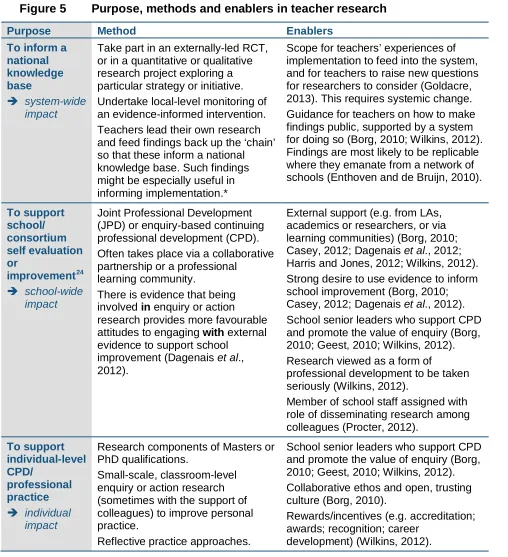
The discussion so far (and indeed most of the literature on KMb) focuses on the best methods that research organisations can adopt when producing and transforming evidence and that teachers can adopt when using it. But we need to recognise that teachers are not just ‘users’ of research – they can be producers of research too (CUREE, 2011; Saunders, 2010). In this section, we consider the role and impact of teacher-led research and enquiry (teachers engaging in rather than with research). Section 5.1 discusses purposes, methods and enablers, while Section 5.2 looks at some approaches and their effectiveness.
Key findings and implications:
• Teacher-led research or enquiry is not a homogenous activity. It serves different purposes and uses a variety of methods. At its most effective, the methods used are closely linked to, and fit for, purpose.
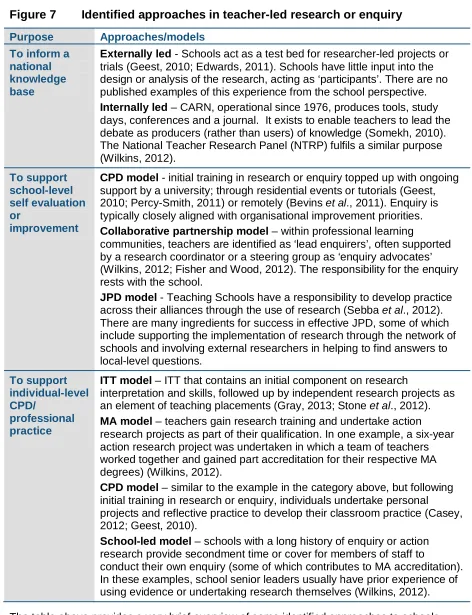
• It can be conceived and established for different reasons: to inform a national knowledge base; to support school self evaluation or improvement; or to support individual-level professional development, for example.
• The methods adopted, and the factors that enable their success, are different according to the purpose of the research. Research o