Immunodeficiency Virus SIVsm Envelope Panel in the Assessment of
Neutralizing Antibody Breadth Elicited in Rhesus Macaques by
Multimodal Vaccines Expressing the SIVmac239 Envelope
Katie M. Kilgore,aMegan K. Murphy,a*Samantha L. Burton,aKatherine S. Wetzel,eS. Abigail Smith,aPeng Xiao,aSharmila Reddy,a Nicholas Francella,eDonald L. Sodora,fGuido Silvestri,a,b,cKelly S. Cole,gFrancois Villinger,a,b,cJames E. Robinson,h
Bali Pulendran,a,b,cEric Hunter,a,b,cRonald G. Collman,eRama R. Amara,a,b,dCynthia A. Derdeyna,b,c
Yerkes National Primate Research Center,a
Emory Vaccine Center,b
Department of Pathology and Laboratory Medicine,c
and Division of Microbiology and Immunology,d
Emory University, Atlanta, Georgia, USAd
; Department of Medicine, University of Pennsylvania Perelman School of Medicine, Philadelphia, Pennsylvania, USAe
; Seattle Biomedical Research Institute, Seattle, Washington, USAf
; Department of Immunology, Center for Vaccine Research, University of Pittsburgh, Pittsburgh, Pennsylvania, USAg
; Department of Pediatrics, Tulane University Medical School, New Orleans, Louisiana, USAh
ABSTRACT
Antibodies that can neutralize diverse viral strains are likely to be an important component of a protective human
immunodefi-ciency virus type 1 (HIV-1) vaccine. To this end, preclinical simian immunodefiimmunodefi-ciency virus (SIV)-based nonhuman primate
im-munization regimens have been designed to evaluate and enhance antibody-mediated protection. However, these trials often
rely on a limited selection of SIV strains with extreme neutralization phenotypes to assess vaccine-elicited antibody activity. To
mirror the viral panels used to assess HIV-1 antibody breadth, we created and characterized a novel panel of 14 genetically and
phenotypically diverse SIVsm envelope (Env) glycoproteins. To assess the utility of this panel, we characterized the neutralizing
activity elicited by four SIVmac239 envelope-expressing DNA/modified vaccinia virus Ankara vector- and protein-based
vacci-nation regimens that included the immunomodulatory adjuvants granulocyte-macrophage colony-stimulating factor, Toll-like
receptor (TLR) ligands, and CD40 ligand. The SIVsm Env panel exhibited a spectrum of neutralization sensitivity to SIV-infected
plasma pools and monoclonal antibodies, allowing categorization into three tiers. Pooled sera from 91 rhesus macaques
immu-nized in the four trials consistently neutralized only the highly sensitive tier 1a SIVsm Envs, regardless of the immunization
regi-men. The inability of vaccine-mediated antibodies to neutralize the moderately resistant tier 1b and tier 2 SIVsm Envs defined
here suggests that those antibodies were directed toward epitopes that are not accessible on most SIVsm Envs. To achieve a
broader and more effective neutralization profile in preclinical vaccine studies that is relevant to known features of HIV-1
neu-tralization, more emphasis should be placed on optimizing the Env immunogen, as the neutralization profile achieved by the
addition of adjuvants does not appear to supersede the neutralizing antibody profile determined by the immunogen.
IMPORTANCE
Many in the HIV/AIDS vaccine field believe that the ability to elicit broadly neutralizing antibodies capable of blocking
geneti-cally diverse HIV-1 variants is a critical component of a protective vaccine. Various SIV-based nonhuman primate vaccine
stud-ies have investigated ways to improve antibody-mediated protection against a heterologous SIV challenge, including
administer-ing adjuvants that might stimulate a greater neutralization breadth. Usadminister-ing a novel SIV neutralization panel and samples from
four rhesus macaque vaccine trials designed for cross comparison, we show that different regimens expressing the same SIV
en-velope immunogen consistently elicit antibodies that neutralize only the very sensitive tier 1a SIV variants. The results argue
that the neutralizing antibody profile elicited by a vaccine is primarily determined by the envelope immunogen and is not
sub-stantially broadened by including adjuvants, resulting in the conclusion that the envelope immunogen itself should be the
pri-mary consideration in efforts to elicit antibodies with greater neutralization breadth.
T
he goal of preclinical human immunodeficiency virus (HIV)/
simian immunodeficiency virus (SIV) vaccine studies
per-formed in nonhuman primates is to generate protective immunity
through safe and effective immunization regimens that can
sub-sequently be administered to human populations to decrease their
risk for acquiring HIV type 1 (HIV-1). In the last decade, a
signif-icant portion of the HIV vaccine effort has focused on optimizing
vaccine regimens to elicit protection in the rhesus macaque
model, using immunogens and challenge viruses selected from a
small subset of SIVs of the sooty mangabey lineage (SIVsm) (
1
).
Recently, the field has shifted toward testing novel adjuvants and
delivery modes in various combinations for their ability to
en-hance immune responses (
2
), particularly those targeting the
in-duction of broadly neutralizing antibodies against the envelope
(Env) glycoproteins (
3–5
). However, limited data are available
regarding how immunomodulatory adjuvants and vaccine
deliv-ery modes compare in their ability to alter the neutralizing
anti-body profile elicited against a particular Env immunogen. It is
difficult to compare antibody responses across vaccine trials if the
Env immunogen is not the same and the timing of immunizations
is not synchronized. Moreover, reagents with which to assess the
breadth of neutralizing antibodies against SIV are limited. While
the properties of the HIV-1 Env that are necessary to induce
po-tent, broadly cross-neutralizing antibodies are under intense
on November 7, 2019 by guest
http://jvi.asm.org/
vestigation, it is unknown whether the findings can be modeled
with preclinical SIV vaccine studies.
The SIVmac239 strain has been included in multiple
preclini-cal vaccines, despite the fact that the SIVmac239 Env is unusually
resistant to neutralizing antibodies (
6–9
). This paradox may have
stemmed from the fact that cell-mediated immune responses
against SIVmac239 (and the highly related strain SIVmac251) and
the major histocompatibility alleles that mediate them in rhesus
macaques have been well characterized (
10–15
). Letvin et al.
dem-onstrated that an SIVmac239 Env-containing vaccine did not
me-diate protection against intrarectal challenge with the closely
re-lated, neutralization-resistant viral quasispecies SIVmac251 but
the same vaccine provided protection against heterologous
intrar-ectal SIVsmE660 challenge (
16
). SIVsmE660 is a viral quasispecies
that mainly consists of neutralization-sensitive tier 1 Env variants
and a minor population of resistant variants (
17
,
18
). SIVsmE660
exhibits phenotypic variability not only in neutralization
sensitiv-ity but also in pathogenicsensitiv-ity and sensitivsensitiv-ity to TRIM5
␣
-mediated
restriction (
17–20
). Because SIVsmE660 is largely susceptible to
neutralization and its Env is substantially genetically distant from
the SIVmac239 Env, this virus has become the most widely used
heterologous challenge virus following SIVmac239
immuniza-tion. Thus, even though the SIVmac239 Env has been included in
multiple preclinical vaccine regimens, some of which elicited
pro-tective immunity, it has not been formally determined whether
this Env immunogen elicited antibodies that neutralize genetically
and phenotypically diverse SIV isolates. Furthermore, it is
un-known whether different modes of vaccination, different
adju-vants, or distinct forms of Env alter SIVmac239-induced
neutral-izing antibody specificities.
In the recent past, protection against intrarectal SIVsmE660
challenge has been achieved using varied regimens and is often
linked with antibody activity (
16
,
18
,
21–24
). However, the
assess-ment of neutralizing antibody activity in these trials has relied on
a limited set of SIV Envs derived from just three strains,
SIVmac239, SIVmac251, and SIVsmE660, with the first two being
highly related (
18
,
21
,
22
,
24–29
). Furthermore, these Envs tend to
reflect those selected for extreme neutralization sensitivity (tier
1a) or resistance (tier 3), with limited inclusion of other
geneti-cally diverse Envs or those that have a more moderate and perhaps
representative neutralization phenotype. Contrary to this limited
approach, the assessment of neutralizing antibody activity against
HIV-1 in plasma samples from infected and vaccinated
individu-als is generally based on multiclade panels of genetically diverse
HIV-1 Envs that include Envs of tiers 1 to 3 (
30–32
). The
persis-tent use of SIV Env clones selected for their unusually high or low
sensitivity to neutralization to assess the quality of vaccine-elicited
antibodies and their contribution to protection may provide
mis-leading results. Strong evidence suggests that to protect against
HIV-1, vaccine-elicited neutralizing antibodies need to target
epitopes that are vulnerable on the majority of genetically diverse
HIV-1 isolates and that have moderate (tier 2) to high (tier 3)
levels of neutralization resistance. Furthermore, broadly
neutral-izing antibodies against HIV-1 often require certain germ lines
and high levels of somatic hypermutation (
33
), and these types of
neutralizing antibodies have not been documented in a
nonhu-man primate model, in part because the tools for such an
assess-ment are lacking (
34–37
).
In 2011, Lai et al. reported that granulocyte-macrophage
col-ony-stimulating factor (GM-CSF)-adjuvanted SIVmac239-based
vaccination (the M11 trial) in rhesus macaques using the DNA/
modified vaccinia virus Ankara (MVA) vaccine modality
en-hanced protection against repeated, low-dose intrarectal
chal-lenge with SIVsmE660 (
22
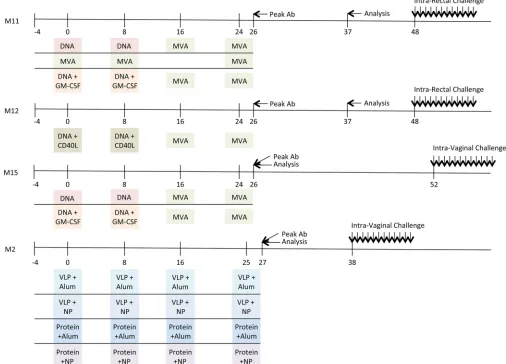
). A schematic of the timelines of the
M11 trial and the trials discussed below is shown in
Fig. 1
. A
recently published follow-up study (the M12 trial) sought to
re-capitulate the results obtained with the GM-CSF adjuvant and
compare them to the results obtained with a novel CD40 ligand
(CD40L) adjuvant using the same vaccination schedule (
21
). The
CD40L adjuvant also conferred protection against repeated,
low-dose intrarectal challenge with SIVsmE660 (
21
). Building on these
findings, the Emory Consortium for AIDS Vaccine Research in
Non-Human Primate Models sought to assess the reported
pro-tection in the context of vaginal transmission, which is highly
relevant to the global HIV pandemic. Two additional trials (the
M2 and M15 trials) were designed and carried out using the same
vaccination schedule and repeated, low-dose SIVsmE660
chal-lenge as the M11 and M12 trials for the direct purpose of cross
comparison. The M15 trial sought to interrogate the efficacy of the
GM-CSF adjuvant in the vaginal challenge model, while the M2
trial was designed to compare novel means of delivery of the Env
protein or virus-like particles (VLPs) with Toll-like receptor
(TLR) ligand adjuvants in the context of poly(lactic-coglycolic
acid) nanoparticles (NPs) also in a vaginal challenge model. These
four trials were purposefully designed and carried out at the
Ye-rkes National Primate Research Center using parallel sampling
timelines, comparable SIVmac239 immunogens and SIVsmE660
challenge stocks, and uniform methods. This resulted in an
un-precedented opportunity to examine and compare samples from a
large number of individual rhesus macaques in a vaccination/
challenge trial dynamic.
Our interest was to investigate whether these four trials elicited
similar neutralizing antibody profiles and if there was evidence for
a breadth of neutralization against diverse SIV variants. To mirror
the approach widely used for analysis of the breadth of antibody
activity against HIV-1, we developed a panel of genetically diverse
SIV Envs from the sooty mangabey lineage (SIVsm) that includes
4 widely used reference Envs and 10 novel Envs not previously
used for this purpose. We show that, like HIV-1 Envs, the SIVsm
Envs displayed a spectrum of neutralization sensitivity, with most
Received28 April 2014Accepted3 September 2014
Accepted manuscript posted online27 May 2015
CitationKilgore KM, Murphy MK, Burton SL, Wetzel KS, Smith SA, Xiao P, Reddy S, Francella N, Sodora DL, Silvestri G, Cole KS, Villinger F, Robinson JE, Pulendran B, Hunter E, Collman RG, Amara RR, Derdeyn CA. 2015. Characterization and implementation of a diverse simian immunodeficiency virus SIVsm envelope panel in the assessment of neutralizing antibody breadth elicited in rhesus macaques by multimodal vaccines expressing the SIVmac239 envelope. J Virol 89:8130 – 8151.doi:10.1128/JVI.01221-14.
Editor:W. I. Sundquist
Address correspondence to Cynthia A. Derdeyn, [email protected].
*Present address: Megan K. Murphy, Malaria Branch, Division of Parasitic Diseases and Malaria, Centers for Disease Control and Prevention, Atlanta, Georgia, USA.
K.M.K. and M.K.M. are co-first authors.
Supplemental material for this article may be found athttp://dx.doi.org/10.1128 /JVI.01221-14.
Copyright © 2015, American Society for Microbiology. All Rights Reserved.
doi:10.1128/JVI.01221-14
on November 7, 2019 by guest
http://jvi.asm.org/
of the SIVsm Envs falling within a tier 2 or 3 neutralization
phe-notype. Extreme tier 1a neutralization sensitivity was associated
with greater antibody access to epitopes in the V3 domain, CD4
binding site (CD4bs), and CD4-induced (CD4i) structures.
How-ever, tier 1a neutralization sensitivity was also associated with
CD4-independent entry, a phenomenon rarely observed with
HIV-1 Envs. Utilizing samples from the four vaccine trials, we
analyzed the ability of distinct forms of SIVmac239 Env, delivered
via different modes of vaccination and with novel cytokine and
immunostimulatory adjuvants, to elicit antibodies that neutralize
this panel of SIVsm isolates. Pooled serum samples from 91 rhesus
macaques immunized in four nonhuman primate trials using
SIVmac239-derived Env immunogens allowed specific analysis of
the effects of different vaccine regimens. This analysis revealed
that the SIVmac239 Env does not elicit antibodies capable of
po-tently neutralizing even moderately sensitive (tier 1b and 2),
ge-netically diverse SIVsm Envs on a consistent basis, regardless of
the vaccine delivery mode, adjuvant, or form of Env. To our
knowledge, this study represents the first to systematically
com-pare neutralization profiles across four coordinated
state-of-the-art preclinical vaccine regimens using a panel of diverse SIVsm
Envs that exhibit a spectrum of neutralization resistance.
MATERIALS AND METHODS
Ethics statement.The Emory University Institutional Animal Care and Use Committee (IACUC; AWA number A3180-01) approved these stud-ies of nonhuman primates under protocol YER-2000936-061014GA. This study was conducted in strict accordance with United States Department of Agriculture regulations and the recommendations in theGuide for the Care and Use of Laboratory Animalsof the National Research Council (38). SIV-infected animals were housed in standard nonhuman primate cages, received standard primate feed, as well as fresh fruit and enrichment daily, and had continuous access to water. Animals had continuous access to enrichment resources, including objects for perching and other ma-nipulanda. Animal welfare was monitored daily. Appropriate procedures were performed to ensure that potential distress, pain, or discomfort was alleviated. The sedative ketamine (10 mg/kg of body weight) or tiletamine and zolazepam (Telazol; 4 mg/kg) was administered before blood draws. Euthanasia using pentobarbital (100 mg/kg) was performed while the FIG 1Diagrammatic timeline of nonhuman primate vaccine trials. The immunization schedule for each vaccine trial (M11, M12, M15, and M2) is plotted along a timeline (in weeks). The agents used for priming and boosting for each trial are indicated in colored boxes, highlighting the similarities and differences between trials. The time points where the peak levels of antibody (Ab) binding to SIVsmE660- and SIVmac239-derived gp140 proteins were observed are indicated by an arrow and “Peak Ab.” The time points at which samples were analyzed for neutralizing activity here are indicated by an arrow and “Analysis.” Additional information is provided inTable 5and Table S1 in the supplemental material.
on November 7, 2019 by guest
http://jvi.asm.org/
[image:3.585.37.543.71.435.2]animals were under anesthesia and only when deemed clinically necessary by veterinary medical staff and according to IACUC endpoint guidelines.
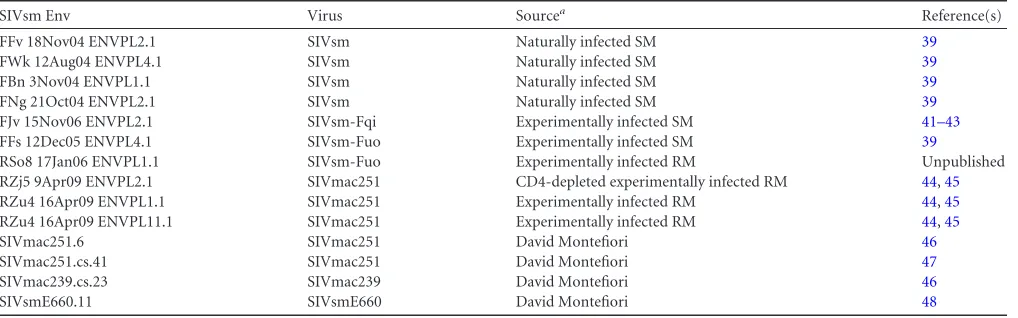
Origin of the SIVsm Env clones.Allenvgenes used in this study were previously cloned through various studies of SIVsm or SIVmac infection. The following Envs were generated in the C. A. Derdeyn lab: pcDNA3.1-based plasmids carryingrev-envgene cassettes from four naturally SIVsm-infected sooty mangabeys in the Yerkes colony, sooty mangabeys FFv, FWk, FBn, and FNg (39–41); experimentally SIVsm-infected sooty mang-abeys FFs (39) and FJv (42,43); an experimentally SIVsm-infected rhesus macaque, rhesus macaque RSo8 (unpublished data); and two SIVmac251-infected rhesus macaques, rhesus macaques RZj5 and RZu4 (44,45). pcDNA3.1-based plasmids carryingrev-envgene expression cassettes for SIVmac251.6 (46), SIVmac251.cs.41 (47), SIVmac239.cs.23 (46), and SIVsmE660.11 (48) were generously provided to us by David Montefiori. A summary of the SIVsm Env clones is provided inTable 1. The nucleo-tide sequence of all SIVsmenvgenes was determined in either the C. A. Derdeyn or David Montefiori lab, and Geneious R6 (v6.1.4) software was used to create amino acid alignments and nucleotide phylogenetic trees. The FigTree (v1.4.0) program, downloaded fromhttp://tree.bio.ed.ac .uk/, was used to annotate the phylogenetic tree.
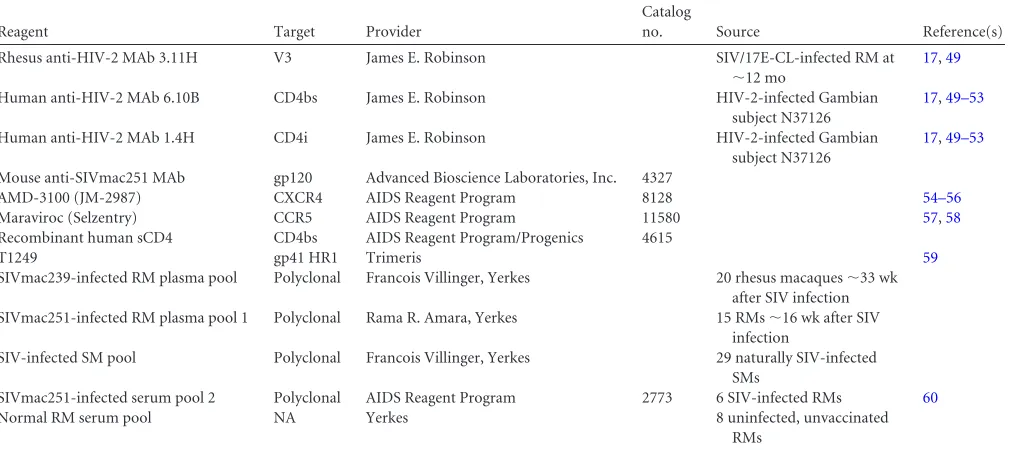
MAbs, inhibitors, and plasma/serum pools.Monoclonal antibodies (MAbs) 3.11H, 6.10B, and 1.4H were kindly provided by James E. Robin-son. MAb 3.11H targets a linear epitope in the SIVsm Env V3 domain and was derived from an SIV/17E-CL-infected rhesus macaque at approxi-mately 12 months postinfection (17,49). MAbs 6.10B and 1.4H were derived from HIV-2 infected subject N37126 in the Gambia and target overlapping epitopes in the HIV-2 and SIV Envs, defined as the CD4 binding site and a soluble CD4 (sCD4)-enhanced epitope, respectively (17,49–53). A neutralizing mouse monoclonal antibody against SIVmac251 gp120 was obtained from Advanced Bioscience Laboratories, Inc. (catalog no. 4327). AMD-3100 (bicyclam JM-2987) inhibits entry via CXCR4 and was obtained through the NIH AIDS Reagent Program, Division of AIDS, National Institute of Allergy and Infectious Diseases (NIAID), National Institutes of Health (NIH) (54–56). Maraviroc (Selzentry) inhibits entry via CCR5 and was obtained through the NIH AIDS Reagent Program, Division of AIDS, NIAID, NIH (57,58). Recombinant human sCD4 was obtained through the NIH AIDS Reagent Program, Division of AIDS, NIAID, NIH. T1249 inhibits the entry process by blocking gp41-mediated fusion and was a kind gift from Trimeris (59). Three polyclonal plasma pools were generated from previously SIV-infected monkeys at the Yerkes National Primate Research Center, using stored samples from the labora-tories of Francois Villinger and Rama R. Amara. The RM239 pool was generated from 20 SIVmac239-infected rhesus macaque plasma samples collected at⬃33 weeks postinfection; the RM251-1 pool was generated from 15 SIVmac251-infected rhesus macaque plasma samples collected at
⬃16 weeks postinfection; the SM pool was generated from 29 naturally
SIVsm-infected sooty mangabeys. The RM251-2 (SIVmac251) antiserum pool was obtained through the NIH AIDS Reagent Program, Division of AIDS, NIAID, NIH (60). A pool of sera from 8 uninfected, unvaccinated, healthy rhesus macaques at Yerkes was generated to serve as a negative control. A summary of these reagents is provided inTable 2.
Neutralization and inhibition assays.Each SIVsm Env pseudovirus was generated by transfecting the Env-expressing plasmid DNA alongside the HIV-1 SG3⌬Env proviral backbone DNA into 293T cells, using the Fugene HD reagent, as recommended by the manufacturer (Promega). Pseudovirus stocks were collected from the 293T cell supernatants at 48 to 72 h after transfection, clarified by centrifugation, divided into small vol-umes, and frozen at⫺80°C. Fivefold serial dilutions of heat-inactivated plasma or serum samples, entry inhibitors, or monoclonal antibodies were assayed for their inhibitory potential against the Env pseudoviruses using the Tzm-bl indicator cell line, with luciferase as the readout, as described previously (39,61–67). Briefly, Tzm-bl cells were plated and cultured overnight in flat-bottomed 96-well plates. Pseudovirus (2,000 IU per well) in Dulbecco modified Eagle medium (DMEM) with⬃3.5% fetal bovine serum (FBS; HyClone), 40g/ml DEAE-dextran was incubated with serial dilutions of plasma, inhibitor, or monoclonal antibody and subsequently added to the plated Tzm-bl cells. At 48 h postinfection, the cells were lysed and luciferase activity was measured using a BioTek Syn-ergy HT multimode microplate reader with Gen 5 (v2.0) software. The average background luminescence from a series of uninfected wells was subtracted from the luminescence for each experimental well, and infec-tivity curves were generated using GraphPad Prism (v6.0d) software, where values from the experimental wells were compared against the value from a well containing virus only with no test reagent. The 50% inhibitory concentrations were determined using the growth function in the software Microsoft Excel for Mac 2011 (v14.0.2). Tests with each Env-reagent combination were performed at least twice independently in du-plicate wells within each individual experiment. Statistical analyses were performed using GraphPad Prism (v6.0d) software. For comparisons and rankings across multiple groups, a nonparametric Kruskal-Wallis test was performed with Dunn’s correction by comparison against a reference group.
CD4 independence assay.The CD4 independence assay was per-formed in the R. G. Collman laboratory. Pseudotyped virions were gen-erated by cotransfecting human 293T cells with the pNL4-3Luc E-R⫹ backbone alongside plasmids carrying the SIVsmenvgenes, as described previously (44,45). Pseudotypes lacking Env (made by cotransfecting the pNL4-3Luc E-R⫹ [where E-R⫹ is ENV⫺ VPR⫹] backbone with pcDNA3.1) served as a negative control, and pseudotypes containing ve-sicular stomatitis virus glycoprotein G served as a positive control. Trans-fections were performed using the Fugene 6 reagent, as recommended by the manufacturer (Promega), and the cells were washed at 24 h posttrans-TABLE 1Description of SIVsm Env panel
SIVsm Env Virus Sourcea Reference(s)
FFv 18Nov04 ENVPL2.1 SIVsm Naturally infected SM 39
FWk 12Aug04 ENVPL4.1 SIVsm Naturally infected SM 39
FBn 3Nov04 ENVPL1.1 SIVsm Naturally infected SM 39
FNg 21Oct04 ENVPL2.1 SIVsm Naturally infected SM 39
FJv 15Nov06 ENVPL2.1 SIVsm-Fqi Experimentally infected SM 41–43
FFs 12Dec05 ENVPL4.1 SIVsm-Fuo Experimentally infected SM 39
RSo8 17Jan06 ENVPL1.1 SIVsm-Fuo Experimentally infected RM Unpublished
RZj5 9Apr09 ENVPL2.1 SIVmac251 CD4-depleted experimentally infected RM 44,45
RZu4 16Apr09 ENVPL1.1 SIVmac251 Experimentally infected RM 44,45
RZu4 16Apr09 ENVPL11.1 SIVmac251 Experimentally infected RM 44,45
SIVmac251.6 SIVmac251 David Montefiori 46
SIVmac251.cs.41 SIVmac251 David Montefiori 47
SIVmac239.cs.23 SIVmac239 David Montefiori 46
SIVsmE660.11 SIVsmE660 David Montefiori 48
aSM, sooty mangabey; RM, rhesus macaque.
on November 7, 2019 by guest
http://jvi.asm.org/
[image:4.585.41.550.77.236.2]fection. Supernatants were collected at 72 h posttransfection and stored at
⫺80°C in 5% sucrose. Human 293T cells were maintained in DMEM supplemented with 10% FBS, 1%L-glutamine, and 1% penicillin-strep-tomycin. For measurement of CD4-independent entry, human 293T cells were transfected with 1g of plasmid pcDNA3.1 expressing rhesus ma-caque CD4 and 1g of plasmid pcDNA3.1 expressing rhesus macaque CCR5 (CD4 plus CCR5), 1g of empty pcDNA3.1 and 1g of plasmid pcDNA3.1 expressing rhesus macaque CCR5 (CCR5 only), or 2g of the empty pcDNA3.1 plasmid (negative control) using the Fugene 6 reagent as recommended the manufacturer (Promega). At 24 h posttransfection, the cells were washed and replated at 2⫻104cells per well. At 48 h posttransfection, the cells were spinoculated (by centrifugation at 1,200⫻
gfor 2 h at 25°C) with 20l of the Env pseudotype virus. Pseudotype viruses were treated with DNase prior to infection, and infections were performed in triplicate. At 72 h postinfection, cells were lysed with 0.5% Triton X-100 in phosphate-buffered saline, and the luciferase content was read on a luminometer using a luciferase assay system (Promega).
Samples from nonhuman primate vaccine trials.Serum samples were obtained from 91 monkeys immunized during four SIV vaccine trials (designated trials M2, M11, M12, and M15) previously carried out at the Yerkes National Primate Research Center. All trials utilized SIVmac239 immunogens and a repeated, low-dose SIVsmE660 mucosal challenge in rhesus macaques. Immunized and control animals in the M11 and M12 trials were challenged 12 times intrarectally, while animals in the M2 and M15 trials were challenged 12 times intravaginally. The M11 trial was conducted by Rama R. Amara and consisted of three vaccine groups: DNA primes and MVA boosts (DDMM), DNA primes with GM-CSF adjuvant and MVA boosts (DgDgMM), and three MVA immunizations (MMM) (22). In the M11 trial, two serum pools were generated from samples collected from animals at a prechallenge time point that was 13 weeks after the second MVA boost (week 37): one pool of samples from 14 vaccinated animals that became infected and one pool of samples from 9 vaccinated animals that did not become infected. An additional arm, designated trial M12, was later included and consisted of a DNA prime with CD40L ad-juvant followed by an MVA boost (DM/CD40L). In trial M12, pools of sera were also collected from 8 infected and 4 uninfected vaccinated mon-keys at week 37. Trial M2 was led by Bali Pulendran and consisted of three gp140 protein or VLP immunizations delivered with alum (protein plus alum or VLPs plus alum) or nanoparticle (monophosphoryl lipid A and
resiquimod; protein plus NPs or VLPs plus NPs) adjuvants. In trial M2, serum pools were generated with samples collected at week 27, which was a prechallenge time point 2 weeks after the last immunization that corre-sponded with observed peak antibody levels. Serum pools were created with samples from 22 infected and 15 uninfected vaccinated animals. Trial M15 was conducted by Rama R. Amara and was similar to the M11 trial in that the vaccination arms were a DNA prime with or without the GM-CSF adjuvant with two MVA boosts. In trial M15, serum pools were generated with samples from 12 infected and 7 uninfected vaccinated animals col-lected at the prechallenge week 26 time point that corresponded with observed peak antibody levels. The time points chosen for collection of samples for analysis in each trial were based on availability and may not represent the most optimal time point for measurement of neutralizing antibody activity.
RESULTS
Characteristics of SIVsm Env panel.
SIV-based vaccine efforts
have been hampered by the limited number of well-defined,
ge-netically distinct SIVmac/SIVsm variants available for
neutraliza-tion studies. To represent diversity among SIVsm-derived viruses,
14 SIVsm Envs were selected to create a neutralization breadth
panel (
Table 1
). Four Envs were obtained from David Montefiori
to serve as previously characterized, widely used reference Envs
(the SIVsmE660.11 [E660.11], SIVmac251.6, SIVmac251.cs.41,
and SIVmac239.cs.23 Envs). Four Envs were obtained from
natu-rally infected sooty mangabeys in the Yerkes colony and represent
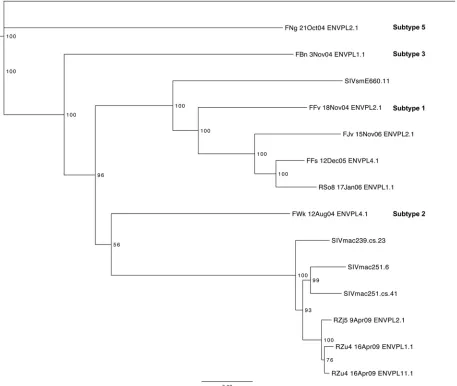
subtypes 1, 2, 3, and 5 of SIVsm (FFv 18Nov04 ENVPL2.1, FWk
12Aug04 ENVPL4.1, FBn 3Nov04 ENVPL1.1, and FNg 21Oct04
ENVPL2.1, respectively [referred to as the FFv, FWk, FBn, and
FNg Envs, respectively]) (
68
,
69
) (
Fig. 2
). Two Envs from sooty
mangabeys (FFs 12Dec05 ENVPL4.1 and FJv 15Nov06 ENVPL2.1
[the FFs and FJv Envs, respectively]) and four from rhesus
ma-caques (RSo8 17Jan06 ENVPL1.1, RZu4 16Apr09 ENVPL1.1,
RZu4 16Apr09 ENVPL11.1, and RZj5 9Apr09 ENVPL2.1 [the
RSo8, RZu4-1.1, RZu4-11.1, and RZj5 Envs, respectively])
exper-imentally infected with SIVsm or SIVmac251 were also included.
Two of the 14 Envs, the FJv Env and RZj5 Env, had unusual
phe-TABLE 2Description of reagents used to characterize the SIVsm Env panela
Reagent Target Provider
Catalog
no. Source Reference(s)
Rhesus anti-HIV-2 MAb 3.11H V3 James E. Robinson SIV/17E-CL-infected RM at
⬃12 mo
17,49
Human anti-HIV-2 MAb 6.10B CD4bs James E. Robinson HIV-2-infected Gambian
subject N37126
17,49–53
Human anti-HIV-2 MAb 1.4H CD4i James E. Robinson HIV-2-infected Gambian
subject N37126
17,49–53
Mouse anti-SIVmac251 MAb gp120 Advanced Bioscience Laboratories, Inc. 4327
AMD-3100 (JM-2987) CXCR4 AIDS Reagent Program 8128 54–56
Maraviroc (Selzentry) CCR5 AIDS Reagent Program 11580 57,58
Recombinant human sCD4 CD4bs AIDS Reagent Program/Progenics 4615
T1249 gp41 HR1 Trimeris 59
SIVmac239-infected RM plasma pool Polyclonal Francois Villinger, Yerkes 20 rhesus macaques⬃33 wk after SIV infection SIVmac251-infected RM plasma pool 1 Polyclonal Rama R. Amara, Yerkes 15 RMs⬃16 wk after SIV
infection
SIV-infected SM pool Polyclonal Francois Villinger, Yerkes 29 naturally SIV-infected
SMs
SIVmac251-infected serum pool 2 Polyclonal AIDS Reagent Program 2773 6 SIV-infected RMs 60
Normal RM serum pool NA Yerkes 8 uninfected, unvaccinated
RMs aSM, sooty mangabey; RM, rhesus macaque; NA, not available.
on November 7, 2019 by guest
http://jvi.asm.org/
[image:5.585.42.551.79.304.2]notypes and were included on the basis of the premise that they
might expose different neutralization targets. The FJv Env was
recovered from an experimentally SIVsm-infected sooty
mang-abey that experienced a CD4 T-cell decline and utilizes CXCR4
(
42
,
43
); the RZj5 Env was recovered from an SIVmac251-infected
rhesus macaque that was treated with a CD4-depleting
monoclo-nal antibody prior to infection and efficiently utilizes CCR5 for
entry in the absence of CD4 (i.e., it is CD4 independent) (
44
,
45
).
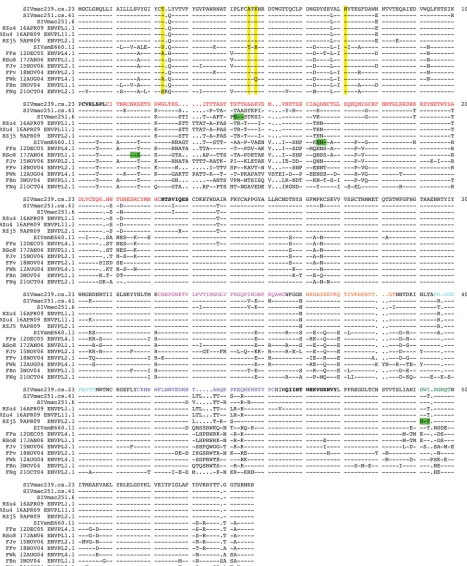
An amino acid alignment of the gp120 sequences for those
Envs included in the panel is shown in
Fig. 3
, with the SIVmac239.
cs.23 sequence being used as the reference. The pairwise percent
identity of the Env gp160 sequences at the amino acid level ranged
from 78 to 99% (data not shown). The SIVsm Env sequences
contained a median of 27 putative N-linked glycosylation motifs
(PNLGs) in gp160, ranging from 23 in FJv to 29 in FBn. Of these 27
sites, 14 were conserved in all Envs. The V1V2 domain contained
a median of 7 PNLGs (range, 5 to 10), while V4 contained 0
PNLGs or 1 PNLG. Interestingly, the RSo8 and E660.11 Envs each
lacked a highly conserved PNLG at the N-terminal (N115) or
C-terminal (N164) region of the V1 domain, respectively
(number-ing is accord(number-ing to the sequence for SIVmac239.cs.23 in
Fig. 3
). In
addition, the RZj5 Env contained the addition of a unique PNLG
adjacent to the CD4 binding pocket (D491N in
Fig. 3
; D470N in
the previous study [
45
]) that confers CD4 independence. The
re-gion immediately C terminal to V3 was devoid of PNLGs in all 14
Envs, meaning that no equivalent to the N332 PNLG site targeted
by broadly neutralizing antibodies in HIV-1 Envs was present in
the SIVsm Envs.
Although coreceptor utilization for some of the Envs had been
defined previously, we characterized the coreceptor utilization for
all Envs using entry inhibitors in the Tzm-bl cell assay. As
ex-pected, all of the SIVsm Envs except for the CXCR4-tropic FJv Env
were resistant to the CXCR4-specific inhibitor AMD-3100 and
sensitive to the CCR5-specific inhibitor maraviroc (data not
shown). These experiments established that all of the Envs except
FJv utilize CCR5 for entry into the human Tzm-bl cell line. In
FIG 2Phylogenetic tree of the SIVsm Env neutralization breadth panel. A neighbor-joining phylogenetic tree was created from completeenvnucleotide sequences using the Jukes-Cantor approach in Geneious R6 (v6.1.4) software and annotated in the FigTree (v1.4.0) program. A reference HIV-2envsequence (GenBank accession numberZ48731) was used as the outgroup. The horizontal bar at the bottom shows the scale of the genetic distance, and bootstrap values are indicated at each node. The subtypes of sequences from naturally SIV-infected sooty mangabeys FNg, FBn, FFv, and FWk are indicated in bold text.
on November 7, 2019 by guest
http://jvi.asm.org/
[image:6.585.42.499.70.456.2]FIG 3Amino acid sequence alignment of the SIVsm Env panel. An amino acid alignment of the Env gp120-coding sequence was generated using the SeqPublish tool, available from the Los Alamos National Laboratory HIV Database (http://www.hiv.lanl.gov/content/sequence/SeqPublish/seqpublish.html). The sequence of SIVmac239.cs.23 is shown as the reference sequence, and dashes indicate conserved residues, while dots indicate deleted residues. Yellow highlighting, the positions of the four amino acid residues (positions 23, 45, 47, and 70) described in reference18, with A45 and K47 being described to be major determinants of SIVsmE660 neutralization resistance in that reference; green highlighting, atypical PNLG sites that are associated with the tier 1 Envs. Functional gp120 domains are indicated by colored text as follows: red, V1V2; magenta,V3; orange,␣2 helix; purple, V4; green,V5; bold text, bridging sheet residues, as described previously (72); cyan, the CD4 binding loop.
on November 7, 2019 by guest
http://jvi.asm.org/
[image:7.585.57.524.63.629.2]addition, pooled serum from uninfected, unvaccinated, healthy
rhesus macaques had no inhibitory activity against any Envs in the
panel (data not shown).
Neutralization by pooled SIV-infected plasma or serum
re-veals tiers of neutralization sensitivity.
To define the general
neutralization phenotype of each Env in the panel, we utilized four
pools of plasma or serum from SIV-infected monkeys and four
previously described anti-SIV or anti-HIV-2 neutralizing
mono-clonal antibodies (MAbs) (
Fig. 4
). More information on each
re-agent is listed in
Table 2
, and the neutralization curves for each
Env are shown in Fig. S1 in the supplemental material. The
neu-tralization data for all plasma/serum pools and MAbs tested
against each Env pseudovirus were compiled for analysis by
plot-ting the residual viral infectivity observed at the highest
concen-tration, an approach similar to that used previously (
17
,
30
) (
Fig.
4
). Note that 50% inhibitory concentrations (IC
50) were not
cal-culated and used for this analysis because many of the
neutraliza-tion curves did not cross 50% infectivity (see Fig. S1 in the
sup-plemental material). The polyclonal antibody pools consisted of
plasma collected from (i) 20 SIVmac239-infected rhesus macaques
at approximately 33 weeks postinfection (pool RM239), (ii) 15
SIVmac251-infected rhesus macaques at approximately 16 weeks
postinfection (pool RM251-1), (iii) 29 naturally infected sooty
mangabeys in the Yerkes colony (pool SM), and (iv) 6
SIV-mac251-infected rhesus macaques from the NIH AIDS Reagent
Program (pool RM251-2). The four MAbs were obtained from
various sources. MAb 3.11H was recovered from a rhesus
ma-caque infected with SIV/17E-CL, and it recognizes a linear epitope
corresponding to the N-terminal half of the SIV V3 domain (
17
,
49
). MAb 6.10B was recovered from an HIV-2-infected human
subject, and it recognizes an epitope that overlaps the CD4
bind-ing site (
17
,
50
,
51
). MAb 1.4H was isolated from the same
HIV-2-infected subject from whom MAB 6.10B was isolated, and it
competes with MAb 6.10B for binding to gp120 (
50
,
51
).
How-ever, MAb 1.4H binding to soluble gp120 is enhanced by the
ad-dition of sCD4, indicating an epitope that is better exposed or
stabilized by CD4 binding. Unlike MAb 3.11H, MAbs 6.10B and
1.4H recognize conformational epitopes (
51
). Finally, the
anti-mac251 gp120 MAb is a mouse antibody for which the
gp120-based epitope has not been defined.
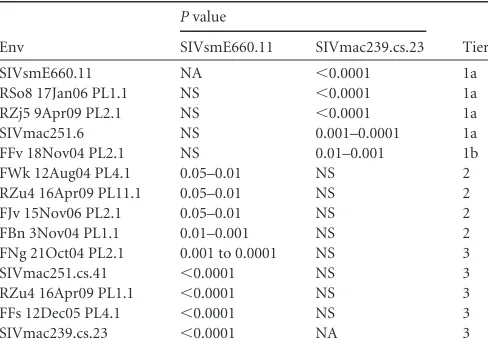
A Kruskal-Wallis test was applied to the data in
Fig. 4
to
cate-gorize the Envs into neutralization tiers, as has been done for
HIV-1, first by comparing the neutralization of each Env to that of
the highly neutralization-sensitive SIVsmE660.11 Env and then to
that of the SIVmac239 Env.
Table 3
demonstrates that the
neutral-ization of Envs RSo8, RZj5, SIVmac251.6, and FFv was not
statis-tically significantly different from that of the E660.11 Env, and
these were therefore designated tier 1. For the remaining Envs,
those whose neutralization differed from that of the E660.11 Env
with a
P
-value range of 0.05 and 0.001 were designated tier 2, while
those whose neutralization differed from that of the E660.11 Env
with a
P
value of
⬍
0.001 were designated tier 3. For further depth
into the tiers, the neutralization of Envs was compared in the same
way against that of the SIVmac239 Env, a tier 3 Env at the
neutral-ization-resistant end of the spectrum. The neutralization of all of
the Envs defined as tier 2 or 3 on the basis of the comparison of
their neutralization with that of the E660.11 Env was not
statisti-cally different from that of the SIVmac239 Env, and the
neutral-ization of those defined as tier 1 Envs did show statistically
signif-icant differences. However, using the a threshold
P
value of
⬍
0.001, as described above, the tier 1 Envs could be further
sub-divided into tiers 1a and 1b. In addition, the individual
[image:8.585.40.285.63.237.2]neutral-FIG 4Inhibition of the SIVsm Env panel by SIV-infected plasma or serum pools and monoclonal antibodies. Eight different reagents were serially diluted 5-fold and tested for their neutralizing capacity against pseudoviruses express-ing each SIVsm Env from the panel usexpress-ing the Tzm-bl cell assay, with luciferase activity being the readout. The reagents used were pools of plasma from ex-perimentally SIVmac239-infected (pool RM239) and SIVmac251-infected (pool RM251-1) rhesus macaques, a pool of sera from a different set of exper-imentally SIVmac251-infected rhesus macaques (pool RM251-2), a pool of plasma from naturally SIV-infected sooty mangabeys (pool SM), an MAb from an SIV-infected rhesus macaque that targets V3 (MAb 3.11H), two MAbs from an HIV-2-infected patient that target the CD4bs (MAb 6.10B) and a CD4i epitope (MAb 1.4H), and an MAb from an immunized mouse that targets an undefined epitope on gp120 (anti-mac251 gp120). More details on each reagent are provided inTable 2, and the full neutralization graphs are presented in Fig. S1 in the supplemental material. The data on the vertical axis are expressed as the amount of residual infectivity at the highest concentration of reagent tested (1:100-diluted plasma or serum; 10g/ml of monoclonal antibody). Residual infectivity of 100% represents no inhibition, while 0% residual infectivity represents complete inhibition. Each Env pseudovirus and reagent-serum combination was tested in duplicate wells in at least two inde-pendent experiments. The horizontal bars represent the median for all re-agents tested against each of the Env pseudoviruses, which are arranged from the most sensitive to the least sensitive from left to right.
TABLE 3Results of Kruskal-Wallis test to determine neutralization tiersa
Env
Pvalue
Tier SIVsmE660.11 SIVmac239.cs.23
SIVsmE660.11 NA ⬍0.0001 1a
RSo8 17Jan06 PL1.1 NS ⬍0.0001 1a
RZj5 9Apr09 PL2.1 NS ⬍0.0001 1a
SIVmac251.6 NS 0.001–0.0001 1a
FFv 18Nov04 PL2.1 NS 0.01–0.001 1b
FWk 12Aug04 PL4.1 0.05–0.01 NS 2
RZu4 16Apr09 PL11.1 0.05–0.01 NS 2
FJv 15Nov06 PL2.1 0.05–0.01 NS 2
FBn 3Nov04 PL1.1 0.01–0.001 NS 2
FNg 21Oct04 PL2.1 0.001 to 0.0001 NS 3
SIVmac251.cs.41 ⬍0.0001 NS 3
RZu4 16Apr09 PL1.1 ⬍0.0001 NS 3
FFs 12Dec05 PL4.1 ⬍0.0001 NS 3
SIVmac239.cs.23 ⬍0.0001 NA 3
aNA, not applicable; NS, not significant.
on November 7, 2019 by guest
http://jvi.asm.org/
[image:8.585.299.543.86.259.2]ization curves supported the finding that the Env defined as tier 1b
(FFv Env) was in most cases less sensitive to neutralization than
the other tier 1 Envs (
Fig. 4
; see also Fig. S1 in the supplemental
material). In conclusion, of the 14 Envs, 4 were designated tier 1a,
1 was designated tier 1b, 4 were designated tier 2, and 5 were
designated tier 3 (
Table 3
). Like HIV-1, the majority of the SIVsm
Envs displayed moderate to high resistance against heterologous
neutralization (
30
,
31
). Each neutralization tier included a diverse
collection of SIVsm Envs, and the tiers did not segregate by
phy-logeny or SIVsm subtype (
Fig. 2
). As an example, the highly
sup-ported phylogenetic cluster in
Fig. 2
(bottom of the tree)
contain-ing the SIVmac251-derived Envs RZj5, RZu4-11.1, and RZu4-1.1
contained a tier 1a, a tier 2, and a tier 3 Env, respectively. Thus,
similar to the findings for HIV-1, the neutralization sensitivity of
the SIVsm Envs could not be easily predicted by phylogenetic
lineage.
The tier 1a Envs SIVsmE660.11 and SIVmac251.6 have been
widely used to assess vaccine-elicited antibody responses due to
their extreme neutralization sensitivity. The remaining two tier 1a
Envs were novel, representing an Env with CD4 independence and
an Env from a nonnatural experimental sooty mangabey
infec-tion. The tier 1b Env FFv was recovered from a sooty mangabey
naturally infected with SIVsm subtype 1. Inspection of the amino
acid sequences in
Fig. 3
revealed that the tier 1a Envs tended to
have alterations in or near PNLG sites that were conserved in the
other Envs. The RSo8 and E660.11 Envs each lacked a highly
con-served PNLG site in V1, and the RSo8 Env also had an extended
cytoplasmic tail resulting from a frameshift (
Fig. 3
). The RZj5 Env
contained an unusual PNLG site adjacent to the CD4 binding
pocket (D491N in
Fig. 3
; D470N in the previous report [
45
]) that
confers CD4 independence. Finally, SIVmac251.6 also contained
a unique PNLG site in the internal region of V1, at position 142 in
Fig. 3
, that was not present in the other Envs. Therefore, these
genetically and phenotypically diverse tier 1a Envs tend to have at
least one atypical feature that may enhance their overall
neutral-ization sensitivity. All of the tier 2 Envs were novel and included a
CXCR4-tropic Env from an experimental sooty mangabey
infec-tion, natural SIVsm Envs belonging to subtypes 2 and 3, and an
SIVmac251-derived Env. For tier 3, the SIVmac239.cs.23 and
SIVmac251.cs.41 Envs were the prototypes, but the remaining tier
3 Envs included one derived from SIVmac251, one from an
exper-imental sooty mangabey infection, and one from a natural SIVsm
subtype 5 infection.
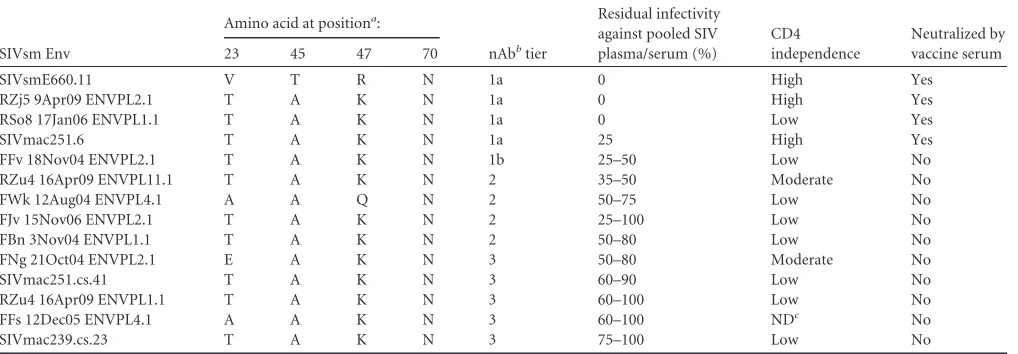
Others have recently reported that two amino acids, 45A and
47K, in the C1 region of gp120 underlie the neutralization
resis-tance phenotype exhibited by some SIVsmE660 Env variants (
18
).
We therefore examined the amino acid sequences of our Env panel
for these signature residues.
Table 4
demonstrates that while Env
E660.11 possessed the neutralization-sensitive-signature residues
at these positions, 45T and 47R, the other three tier 1 Envs
con-tained the 45A and 47K signature of resistance. In fact, E660.11
was the only Env in our panel that contained 45T and 47R.
Fur-thermore, the other SIVsm Envs displayed a wide spectrum of
neutralization sensitivity to heterologous and autologous plasma,
even though they contained 45A/47K or 47Q, in one case (
Fig. 4
;
see also Fig. S1 in the supplemental material). Given the diversity
of the SIVsm Envs analyzed here, it seems likely that this
2-amino-acid signature confers neutralization resistance mainly in the
con-text of some SIVsmE660 variants, while other determinants are
also operative across more genetically diverse SIVsm Envs.
The pattern of neutralization by MAbs shown in
Fig. 4
pro-vided insight into the underlying vulnerability of the tier 1a Envs.
Tier 1a Envs were potently inhibited by MAb 3.11H, suggesting
that the V3 epitope recognized by this antibody is well exposed.
The tier 1b and 2 Envs were moderately sensitive to MAb 3.11H,
while the tier 3 Envs were poorly neutralized by MAb 3.11H at 10
g/ml (
Fig. 4
). Sequence conservation of the linear V3 epitope did
not correlate with neutralization in relation to the RZj5,
RZu4-11.1, and RZu4-1.1 Envs. All three Envs were derived from
SIVmac251 and have identical V3 domains (
Fig. 3
), yet they
dis-played high, moderate, and low sensitivity to MAb 3.11H
neutral-ization, respectively (
Fig. 4
; see also Fig. S1 in the supplemental
material). Furthermore, MAb 3.11H binds to soluble gp120 from
SIVmac239 and SIVmac251 in enzyme-linked immunosorbent
as-says (ELISAs) (
49
) but did not mediate their neutralization (
Fig. 4
;
see also Fig. S1 in the supplemental material). These findings
ar-TABLE 4Amino acid signatures associated with neutralization phenotype in SIVsmE660
SIVsm Env
Amino acid at positiona:
nAbbtier
Residual infectivity against pooled SIV plasma/serum (%)
CD4 independence
Neutralized by vaccine serum
23 45 47 70
SIVsmE660.11 V T R N 1a 0 High Yes
RZj5 9Apr09 ENVPL2.1 T A K N 1a 0 High Yes
RSo8 17Jan06 ENVPL1.1 T A K N 1a 0 Low Yes
SIVmac251.6 T A K N 1a 25 High Yes
FFv 18Nov04 ENVPL2.1 T A K N 1b 25–50 Low No
RZu4 16Apr09 ENVPL11.1 T A K N 2 35–50 Moderate No
FWk 12Aug04 ENVPL4.1 A A Q N 2 50–75 Low No
FJv 15Nov06 ENVPL2.1 T A K N 2 25–100 Low No
FBn 3Nov04 ENVPL1.1 T A K N 2 50–80 Low No
FNg 21Oct04 ENVPL2.1 E A K N 3 50–80 Moderate No
SIVmac251.cs.41 T A K N 3 60–90 Low No
RZu4 16Apr09 ENVPL1.1 T A K N 3 60–100 Low No
FFs 12Dec05 ENVPL4.1 A A K N 3 60–100 NDc No
SIVmac239.cs.23 T A K N 3 75–100 Low No
aAmino acid residues are numbered according to the numbering for the SIVmac239 reference strain.
b
nAb, neutralizing antibody. cND, not determined.
on November 7, 2019 by guest
http://jvi.asm.org/
[image:9.585.41.550.78.255.2]gue that access to the V3 epitope on the Env trimer likely differs
among the Envs and serves as the main determinant of
neutraliza-tion by MAb 3.11H. The 6.10B and 1.4H MAbs showed a
neutral-ization profile similar to that of MAb 3.11H (
Fig. 4
). Like MAb
3.11H, MAbs 6.10B and 1.4H also bind to soluble SIVmac239
gp120 but are unable to neutralize this pseudovirus (
51
). The tier
2 and 3 Envs were consistently more resistant to neutralization by
the four MAbs (
Fig. 4
; see also Fig. S1 in the supplemental
mate-rial). Overall, these results demonstrate that, like HIV-1 Envs, tier
1a SIV Envs tend to expose the V3, CD4bs, and CD4i structures
involved in receptor binding (
30
), whereas these targets are much
less accessible on the majority of SIVsm Envs.
The data shown in
Fig. 4
and Fig. S1 in the supplemental
ma-terial serve to further emphasize the question of whether or not
antibodies capable of neutralizing tier 3 SIVsm Envs exist. This
highlights a dilemma that broadly neutralizing antibodies
analo-gous to VRC01, PG9/16, PGT128, etc., have not been identified
for SIVsm and that cohorts of elite neutralizer SIV-infected
ma-caques have not been described. The data presented here
substan-tiate the idea that if this type of broadly neutralizing SIV antibody
exists, it is not a major constituent of the polyclonal antibody
population in most SIVmac-infected macaques or
SIVsm-in-fected sooty mangabeys. In the absence of this type of reagent, we
examined whether autologous plasma from six sooty mangabeys
could neutralize the corresponding tier 2 or 3 SIVsm Envs (
39
).
The SIVsm Envs displayed a spectrum of sensitivity to autologous
neutralization by 1:20-diluted plasma collected 6 to 12 months
later ranging from very sensitive (FFv and FJv Envs) to highly
resistant (FBn and FFs Envs) (
Fig. 5
). Most HIV-1 Envs, including
contemporaneous escape variants, can be neutralized by
autolo-gous antibodies circulating at later time points (
61
,
62
,
65
,
67
,
70
,
71
). These limited results highlight the need to better define the
relevance of the SIVsm neutralization tiers to features of HIV-1
neutralization.
CD4 independence tracks with tier 1 neutralization
sensitiv-ity.
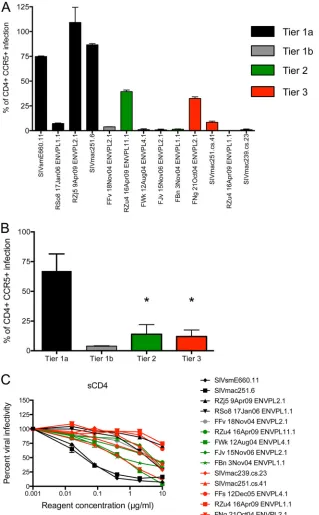
Because one of the tier 1a Envs, RZj5, was previously
deter-mined to be CD4 independent, we tested the Envs in our panel for
their ability to utilize rhesus CCR5 in the absence of rhesus CD4,
using an assay described previously (
45
). Env FFs was not
evalu-ated due to its low pseudovirus infectivity in the CCR5
⫹CD4
⫹cells used in this assay. Four Envs in addition to RZj5 utilized
CCR5 in the absence of CD4 with moderate to high efficiency.
SIVmac251.6 and E660.11, both tier 1a Envs commonly used to
assess vaccine-elicited antibody responses, mediated
CD4-inde-pendent infection at roughly 70 to 80% of the level of CCR5
⫹CD4
⫹entry (
Fig. 6A
). Additionally, one tier 2 Env and one tier 3
Env mediated infection at 25 to 30% of the level of CCR5
⫹CD4
⫹entry. As a group, tier 1a Envs were significantly more CD4
inde-pendent than the tier 2 or tier 3 Envs, although this comparison is
based on a relatively small number of SIVsm Envs (
Fig. 6B
;
Kruskal-Wallis test,
P
⫽
0.01 to 0.05 for both comparisons).
How-ever, none of the Envs displaying CD4 independence contained
the D470N determinant of CD4 independence that was defined
for RZj5 (D491N in
Fig. 3
) (
45
). Interestingly, the RZu4-11.1 and
-1.1 Envs were isolated from the same SIVmac251-infected
plasma sample, yet RZu4-11.1 was more neutralization sensitive
and used CCR5 more efficiently in the absence of CD4 than the
closely related Env RZu4-1.1 (
Fig. 4
and
6A
). These Envs differ by
only 2 amino acids in gp120 and 5 amino acids in the gp41
cyto-plasmic tail. It follows that multiple pathways must exist for
neu-tralization sensitivity and for developing the ability to utilize
CCR5 in the absence of CD4. The latter property seems to be
much more conducive to SIVsm Envs than HIV-1 Envs, where
CD4 independence is rare (
72
,
73
). Consequently, CD4
indepen-dence may be a previously unappreciated property of some SIVsm
Env variants, such as E660.11, that could influence neutralization
sensitivity, transmission, and pathogenesis and should therefore
be evaluated when selecting a neutralization panel or a challenge
virus.
We also evaluated susceptibility to inhibition by human sCD4,
which can be an indicator of such properties as CD4 contact
res-idue exposure, affinity for the CD4 receptor, CD4-induced
forma-tion of the bridging sheet, and Env stability (
74
,
75
). Most of the
SIVsm Envs had intermediate sensitivity to sCD4 inhibition (
Fig.
6C
). However, the Envs that were most potently inhibited by
sCD4, E660.11 and SIVmac251.6, also had tier 1a antibody
neu-tralization sensitivity (
Fig. 6C
). In contrast, the tier 1a Env RZj5
was highly resistant to sCD4-mediated inhibition (
Fig. 6C
).
Inter-estingly, sCD4 sensitivity was not linked with neutralization by
CD4bs MAb 6.10B (
Fig. 4
; see also Fig. S1 in the supplemental
material), as has been described for some CD4bs MAbs against
HIV-1 (
74
,
75
). Thus, sCD4 sensitivity was not predictive of CD4
independence or neutralization sensitivity.
Evaluation of vaccination trials with the characterized Env
panel: vaccination with SIVmac239 does not consistently elicit
tier 2/3 neutralizing activity across immunization regimens.
To
evaluate vaccine-induced neutralizing antibody activity during
four nonhuman primate SIVmac239 vaccine trials (trials M2,
M15, M11, and M12;
Fig. 1
and
Table 5
) during the
postimmuni-zation, prechallenge phase, we utilized the SIVsm Env panel. We
FIG 5Neutralization susceptibility of SIVsm Envs to autologous sooty abey plasma. Six Envs cloned from experimentally SIV-infected sooty mang-abeys (FJv, FFs) or naturally SIV-infected sooty mangmang-abeys (FFv, FWk, FBn, FNg) were assessed for neutralization by a sample of autologous plasma col-lected 0.5 to 4 years later using the Tzm-bl cell assay (39). The percentage of residual infectivity against 1:20-diluted plasma is shown on the vertical axis. Residual infectivity of 100% represents no inhibition, while 0% residual infec-tivity represents complete inhibition. Each bar is color coded according to the neutralization tier of the Env pseudoviruses. Each Env pseudovirus-plasma combination was tested in duplicate wells in at least two independent experi-ments. The standard error of the mean is shown for each Env pseudovirus.
on November 7, 2019 by guest
http://jvi.asm.org/
[image:10.585.40.286.61.268.2]FIG 6CD4 independence and inhibition of the SIVsm Env panel by soluble CD4. (A) The level of CCR5⫹CD4⫺infection mediated by each Env pseudovirus relative to the level of CD4⫹CCR5⫹-mediated entry (100%). Env FFs was not included due to low infectivity in the assay. 293T cells were transiently transfected with plasmids expressing rhesus CD4 and CCR5 or CD4 only, and infection was quantitated using luciferase activity as the readout (provided by the pNL4-3Luc E-R⫹backbone). Each experiment was performed in duplicate wells at least twice independently, and the standard error of the mean is shown for each Env pseudovirus. Each bar is color coded according to the neutralization tier of the Env pseudovirus. (B) The level of CD4-independent entry from panel A across the tiers using a Kruskal-Wallis comparison, tier 1a Envs as the control group, and Dunn’s correction for multiple comparisons. The FJv Env was excluded from the statistical analysis because it utilizes CXCR4 for CD4-dependent entry. The results for each of the tier 2 and tier 3 Env pseudoviruses were significantly different from those for the tier 1a Env pseudoviruses (*,P⫽0.01 to 0.05). (C) Inhibition by human sCD4 in the Tzm-bl cell assay with luciferase activity as the readout. sCD4 was serially diluted 5-fold, and the concentration is presented on thexaxis on a log10scale. The percent viral infectivity relative to that in the absence of sCD4 (100%) is shown on theyaxis. Each Env pseudovirus and reagent-serum combination was tested in duplicate wells in at least two independent experiments, and the standard error of the mean is shown on the graphs in panels A and B.
on November 7, 2019 by guest
http://jvi.asm.org/
[image:11.585.135.454.67.582.2]obtained serum samples from 91 immunized monkeys from the
trials described above (
Fig. 1
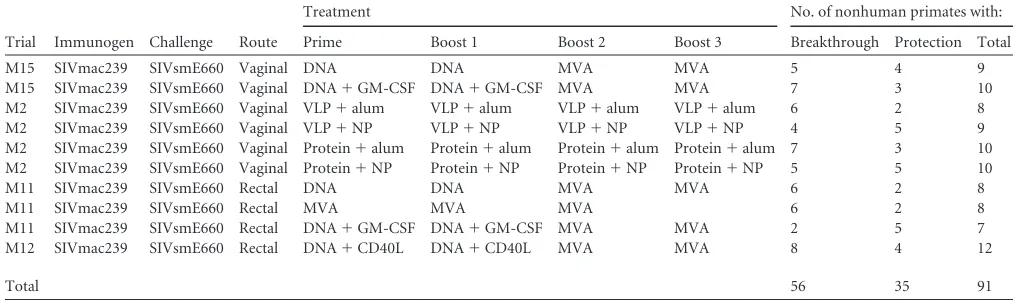
). The M11 trial consisted of three
groups of animals that received two DNA primes with or without
the cytokine GM-CSF adjuvant, followed by two MVA boosts
(DDMM or DgDgMM), or three MVA immunizations (MMM)
(
22
,
29
). Trial M12 was a vaccine arm that was added onto trial
M11, in which animals received two DNA primes adjuvanted with
CD40L, followed by two MVA boosts (DM/CD40L) (
21
). All of
the vaccine arms in trials M11 and M12 were associated with
sig-nificant protection against intrarectal SIVsmE660 challenge. The
M15 trial was designed essentially to determine whether the
en-hanced, antibody-associated protection afforded by the GM-CSF
adjuvant in M11 was reproducible against an intravaginal
SIVsmE660 challenge and consisted of two DNA primes
adju-vanted with or without GM-CSF, followed by two MVA boosts
(DDMM or DgDgMM). The M2 trial was performed in parallel
with the M15 trial and consisted of four groups of animals that
received three immunizations of SIVmac239 Gag and Env gp140
proteins or virus-like particles adjuvanted with either alum or
nanoparticles designed to enhance Toll-like receptor (TLR)
sig-naling (protein plus alum, protein plus NPs, VLPs plus alum,
VLPs plus NPs) (
76
). Even though the vaccine groups had fewer
infected animals than the control groups, the M2 and M15 trials
did not achieve a significant level of protection against
intravagi-nal SIVsmE660 challenge. A detailed list describing the serum
samples obtained from each trial and vaccine group is provided in
Table S1 in the supplemental material.
Because of the large number of assays (more than 25,000 wells)
required to analyze the neutralization of the panel of 14 Envs by a
serum dilution series from each animal, we opted to create eight
serum pools consisting of samples from animals that remained
uninfected (protected) or became infected after 12 mucosal
chal-lenges in each of the four trials. Seaman et al. demonstrated that
plasma pools from HIV-1-infected human subjects had
neutral-ization titers that were highly correlated with the average for the
individual constituents (
30
). Ultimately, we reasoned that if tier 2
or 3 neutralizing activity was present in the majority of animals
within a trial, then neutralization of the tier 2 and 3 Envs should be
observed using the pooled serum. We found a similarly high
cor-relation between the average for the individual serum samples for
trials M2, M11, and M15 and the neutralization values obtained
with the corresponding pools against the tier 1a Env
SIVsmE660.11 (data not shown). Neutralizing activity against the
SIVsm Env panel was evaluated for the serum pools to determine
whether there were any qualitative differences in neutralization
capacity or evidence for breadth against diverse SIV isolates. In
this way, we could probe for breadth or differences in
neutraliza-tion profiles that, if present, could be pursued in a targeted
man-ner using the serum samples from individual animals.
Overall, the vaccines elicited neutralizing activity
predomi-nantly against the sensitive tier 1a Envs (
Fig. 7A
,
C
,
E
, and
G
). Even
the moderately sensitive tier 1b FFv was highly resistant to
neu-tralization by the pools of serum from immunized animals. In the
M2 and M15 trials, serum samples were collected at the time point
of the peak for antibodies that bind to SIVmac239 and SIVsmE660
gp140 proteins in ELISAs (data not shown), which was 2 weeks
after the last immunization (
Fig. 1
). However, in the M11 and
M12 trials, serum samples were collected later, at 13 weeks after
the last immunization (
Fig. 1
). Nevertheless, comparing the
neu-tralization data from the M11 with those from the M15 trial in
Fig.
7C
and
G
, the potency of tier 1a neutralization was similar, even
though the samples in the M11 trial were collected 9 weeks after
the samples in the M15 trial (
Fig. 1
). It is important to note that the
samples from trials M2, M11, and M12 that were analyzed were
collected at the same time point in the context of the challenge (11
weeks prior to challenge;
Fig. 1
). Some studies suggest that by
analyzing samples collected at a later time point in trials M11 and
M12, one could increase the chances of detecting a greater breadth
or differences in the neutralization profile (
77
,
78
). As such, the
analysis of samples from two different postimmunization time
points could have provided a broader picture of the neutralization
activity in these vaccinated animals, had it been present.
[image:12.585.38.555.79.229.2]To determine whether neutralization of Envs in the different
tiers by pools of serum from immunized animals differed
statisti-cally within each trial, the data were subjected to analysis using the
Kruskal-Wallis test, comparing tier 1b, 2, and 3 Envs against tier
1a Envs. For all four trials, neutralization of the tier 2 and 3 Envs
was statistically significantly different from that of the tier 1a Envs
TABLE 5Summary of nonhuman primate SIV immunization regimensa
Trial Immunogen Challenge Route
Treatment No. of nonhuman primates with:
Prime Boost 1 Boost 2 Boost 3 Breakthrough Protection Total
M15 SIVmac239 SIVsmE660 Vaginal DNA DNA MVA MVA 5 4 9
M15 SIVmac239 SIVsmE660 Vaginal DNA⫹GM-CSF DNA⫹GM-CSF MVA MVA 7 3 10
M2 SIVmac239 SIVsmE660 Vaginal VLP⫹alum VLP⫹alum VLP⫹alum VLP⫹alum 6 2 8
M2 SIVmac239 SIVsmE660 Vaginal VLP⫹NP VLP⫹NP VLP⫹NP VLP⫹NP 4 5 9
M2 SIVmac239 SIVsmE660 Vaginal Protein⫹alum Protein⫹alum Protein⫹alum Protein⫹alum 7 3 10
M2 SIVmac239 SIVsmE660 Vaginal Protein⫹NP Protein⫹NP Protein⫹NP Protein⫹NP 5 5 10
M11 SIVmac239 SIVsmE660 Rectal DNA DNA MVA MVA 6 2 8
M11 SIVmac239 SIVsmE660 Rectal MVA MVA MVA 6 2 8
M11 SIVmac239 SIVsmE660 Rectal DNA⫹GM-CSF DNA⫹GM-CSF MVA MVA 2 5 7
M12 SIVmac239 SIVsmE660 Rectal DNA⫹CD40L DNA⫹CD40L MVA MVA 8 4 12
Total 56 35 91
a
DNA, expresses SIVmac239 Gag, PR, Env, Tat, and Rev; MVA, modified vaccinia virus Ankara vector expressing SIVmac239 Gag, Pol, and Env with a truncated gp41; GM-CSF, granulocyte-macrophage colony-stimulating factor adjuvant expressed by a DNA plasmid; VLP, virus-like particles containing SIVmac230 Gag p55 and Env gp160; protein, SIVmac239 Env gp140 plus SIVmac239 Gag p55; NP, poly(lactic-coglycolic acid) nanoparticles with monophosphoryl lipid A and resiquimod (R848); CD40L, CD40 ligand adjuvant expressed by a DNA plasmid.
on November 7, 2019 by guest
http://jvi.asm.org/
FIG 7Neutralization of the SIVsm Env panel by serum pools created from vaccinated monkeys. Serum pools were created from rhesus macaques immunized in the M2, M11, M12, and M15 trials (details about the animals from which serum was collected are provided in Table S1 in the supplemental material). Serum pools were serially diluted 5-fold and used to inhibit Env pseudovirus infection using the Tzm-bl cell assay, with luciferase activity being the readout. (A, C, E, and G) The reciprocal serum dilution is presented on thexaxis on a log10scale, and the percent viral infectivity relative to that in the absence of test serum (100%) is shown on theyaxis. The Env pseudoviruses are grouped according to neutralization tier, which is indicated in the key. Each panel presents the results for pooled serum from vaccinated animals in trials M2 (A;n⫽37 monkeys), M11 (C;n⫽23 monkeys), M12 (E;n⫽12 monkeys), and M15 (G;n⫽19 monkeys). (B, D, F, and H) Percent residual infectivity against 1:100-diluted serum presented as a bar graph for each group of tiered Env pseudoviruses. A Kruskal-Wallis test was used to compare tiers 1b, 2, and 3 against tier 1a, with Dunn’s correction used for multiple comparisons. *,P⫽0.05 to 0.01; **,P⫽0.01 to 0.001; ***,P⫽0.001 to 0.0001; ****,P⬍0.0001.
on November 7, 2019 by guest
[image:13.585.42.461.33.630.2](
Fig. 7B
,
D
,
F
, and
H
;
P
⬍
0.001). Neutralization of the tier 1b Env
was also statistically significantly different from that of the tier 1a
Envs in 3 of the 4 cases (
Fig. 7B
,
D
, and
F
;
P
⬍
0.05). However, the
M15 trial appeared to have elicited moderately more potent
neu-tralization activity against the tier 1b Env, possibly distinguishing
it from the tier 2 and 3 Envs in that case (
Fig. 7G
and
H
). We next
asked whether there were any qualitative differences between the
pools of serum from vaccinated animals that became infected
(breakthrough) or remained protected after the 12 SIVsmE660
challenges within each trial. For this analysis, the Envs were again
grouped by tier and by whether the serum pool was from
break-through or protected animals (
Fig. 8A
to
D
). For all four trials, the
neutralization curves for the pools of serum from breakthrough
and protected animals were indistinguishable, suggesting that the
neutralizing activity elicited by the SIVmac239 Env immunogen
was not a major contributor to protection against SIVsmE660
challenge.
To more directly investigate the ability of adjuvants to alter the
antibody profile and enhance neutralization breadth, we analyzed
pools of serum collected at the time point at which the antibody
titer peaked for the individual vaccine groups in the M2 and M15
trials (
Fig. 1
). Four new serum pools (protein plus alum, protein
plus NPs, VLPs plus alum, VLPs plus NPs) were created for trial
M2 and two new serum pools (DDMM and DgDgMM) were
cre-ated for trial M15 on the basis of the individual immunization
regimens. The neutralization activity of the serum pools against
six SIVsm Envs that represented the spectrum of the three
neu-tralization tiers was evaluated (
Fig. 4
and
Table 3
).
Figure 9A
dem-onstrates that delivery of the SIVmac239 gp140 protein or VLP
immunogen with the NP adjuvant produced a moderate increase
in neutralization of the tier 1a E660.11 Env compared to that
achieved with alum (
Fig. 9A
). However, the GM-CSF adjuvant did
not augment the neutralization capacity against E660.11 elicited
by the DDMM regimen alone (
Fig. 9A
). None of the adjuvants
produced a measurable increase in neutralization capacity against
the tier 1b, 2, and 3 Envs (
Fig. 9B
to
F
). Adjuvants may therefore
increase the titers of specific antibodies that neutralize tier 1a
SIVsm Envs in some contexts, but they do not consistently alter
antibody specificities such that tier 1b, 2, and 3 SIVsm Envs are
more effectively neutralized.
It is possible that the development of broader neutralizing
ac-tivity within one or more of the trials was not detected because we
analyzed pooled serum or samples from only a single time point in
each trial. It is therefore conceivable that individual animals
within the trials could have possessed vaccine-induced
neutraliza-tion activity against the tier 1b, 2, or 3 Envs; however, as discussed
above, the results obtained with serum and plasma pools generally
show good concordance with those obtained with the individual
constituents, unless there are marked synergy or inhibitory effects.
Even if tier 2 or 3 neutralizing activity was present in some of the
individual serum samples, it arguably did not constitute the major
antibody response induced by the vaccines and adjuvants.
Fur-thermore, this analysis did not reveal any evidence for major
dif-ferences in the antibody profiles driven by GM-CSF, CD40L, or
nanoparticles. In contrast, the neutralizing antibody responses
were remarkably consistent across trials and vaccine groups, given
FIG 8Inhibition of the SIVsm Env panel by pools of serum from vaccinated monkeys organized by infection status after 12 challenges. Pools of serum from immunized rhesus macaques that became infected after 12 challenges with SIVsmE660 (breakthrough) or did not become infected (protected) were created for each trial. Details about the animals from which serum was collected are provided in Table S1 in the supplemental material. Serum pools were serially diluted 5-fold and used to inhibit pseudovirus infection using the Tzm-bl cell assay, with luciferase activity being the readout. The reciprocal dilution is presented on the
xaxis on a log10scale, and the percent viral infectivity relative to that in the absence of test plasma/serum (100%) is shown on theyaxis. The Env pseudoviruses were grouped according to tier, which is indicated in the legend. Closed symbols and solid lines, vaccinated animals that experienced breakthrough infections; open symbols and dashed lines, vaccinated animals that were protected after 12 challenges. Each Env pseudovirus and serum combination was tested in duplicate wells in at least two independent experiments. The standard error of the mean is shown for each point on the graph.
on November 7, 2019 by guest
http://jvi.asm.org/
[image:14.585.75.509.67.317.2]the various forms of Env and immunomodulatory adjuvants that
were included. The aforementioned caveats notwithstanding, the
data argue that vaccines expressing the SIVmac239 Env mainly
elicit antibodies capable of neutralizing tier 1a Envs, regardless of
the vaccination regimen or adjuvant. While this finding may have
been implied by previous studies, to our knowledge it has not been
shown directly. The results therefore strongly emphasize the
im-portance of the Env immunogen when the goal is to broaden the
neutralizing antibody response.
DISCUSSION
Vaccine-elicited antibodies against HIV-1 and SIV.
The goal of
all SIV-based vaccine studies performed in nonhuman primates is
to develop and test immunization regimens that can subsequently
be administered to human populations to protect against
acquisi-tion of HIV-1. Evidence based on currently licensed vaccines and
a small number of phase IIb and III HIV vaccine trials strongly
suggests that an HIV vaccine will need to elicit an effective
anti-body response, which will probably include neutralizing
antibod-ies, to protect against acquisition (
2
,
79
,
80
). The burden of
cur-rent nonhuman primate SIV-based vaccine studies is therefore to
model and dissect the requirements of antibody-mediated
protec-tion; however, success will be contingent on the model accurately
reproducing the induction of antibodies against HIV-1 Env
im-munogens and mechanisms of protection against HIV-1
infec-tion. For neutralizing antibodies, this is complicated by the
inher-ent immune evasion tactics and vast diversity of the HIV-1 Envs
(
33
). Thus, the genetically diverse SIVsm Env panel developed and
used here, in combination with sera from immunized macaques
from four coordinated preclinical trials, provided a unique
oppor-tunity to better understand what type of neutralizing antibodies
against SIVmac239 Env are elicited across various immunization