UNIVERSffi TEKNIKAL MALAYSIA MELAKA
Simulation Study of Motor Controller via Voice
Command
Thesis submitted in accordance with the requirements of the Universiti Teknikal Malaysia Melaka for the Degree of Bachelor of Engineering Manufacturing (Robotic and Automation)
By
AHMAD FAUZI BIN AHMAD KAMAR
Faculty of Manufacturing Engineering April2007
UTeM Library (Pind.l/2005)
UNIVERSITI TEKNIKAL KEBANGSAAN MALAYSIA
JUDUL: SIMULATION STUDY OF MOTOR CONTROLLER VlA VOICE COMMAND
SESI PENGAJIAN: 2/2006-2007
Saya
AHMAD FAUZI BIN AHMAD KAMAR
mengaku membenarkan tesis (PSM/Sarjana/Doktor Falsafah) ini disimpan di Perpustakaan Universiti Teknikal Malaysia Melaka (UTeM) dengan syarat-syarat kegunaan seperti berikut:
1. Tesis adalah hak milik Universiti Teknikal Malaysia Melaka.
2. Perpustakaan Universiti Teknikal Malaysia Melaka dibenarkan membuat salinan untuk tujuan pengajian sahaja.
3.
Perpustakaan dibenarkan membuat salinan tesis ini sebagai bahan pertukaran antara institusi pengajian tinggi.4.
**Sila tandakan (..J)D
SUUTD
TERHADII)
TIDAK TERHAD(Mengandungi maklumat yang berdarjah keselamatan atau kepentingan Malaysia yang termaktub di dalam AKTA RAHSIA RASMI19n)
(Mengandungi maklumat TERHAD yang telah ditentukan oleh organisasi/badan di mana penyelidi dijalankan)
(TAND
~
PENUUS)•
(TANDATANGAN PENYELIA) SAt.ISl 0. ~A.) Alamat Tetap:
No. 40, Jalan Tenaga 12, Taman Tenaga,
43000 Kajang, Selangor Darul Ehsan
Tarikh: 16/05/2007
Pensyara~ Cop Rasmi: Fa~u"' KetUruteradn P~~a:i!~
Unr•ersttJ TeKntllal ,..a·eys a Me•a•E\ Karung Berltunc• 1200. Ayar K€1911
75450 Melakl
APPROVAL
This thesis submitted to the senate ofUTeM and has been accepted as partial fulfillment of the requirements for the degree of Bachelor of Manufacturing Engineering
(Robotic and Automation). The members ofthe supervisory committee are as follow:
M~§!Wwt~D ftensyarlh
Fakulll Kejuruteraan ~!a" Unlversiti Teknikal Malaysia Melaka t<arung !Munci 1200. Ayer Keroh
75450 MelaQ
Co-Supervisor
DECLARATION
I hereby, declare this thesis entitled "Simulation Study on Motor Controller via Voice
Command" is the results
of my own research except as cited in the reference .
Signature
...
/)~
... .
Author's Name
..
..
..
~.
.
.
...
.
....
~.
.
.
.
..
...
B /WM~ 'tP.~.
...
.
...
.
..
Date 0 • • • • • • • • • • • • • • • • • • • •0& /VW.{ •• • • • • • • •:n:; 07 • •••• • •• •• • • • • • •• • •
ABSTRACT
Every human in this world need a safer home to make sure their lives not in the danger.
That's why more application is been applying to the house to make sure a better home.
Some of the application that add to make sure the house safer is automated window that
will shut when raining is coming. For the door, voice recognition can be added to make
sure nobody than the speaker can enter the room.
Voice recognition is a method to make a system recognize the speaker identity. Such
systems extract features from speech, model them and use them to recognize the person
from his/her voice. Voice recognition is system that recognizing who is speaking and
speech recognition is a system to recognizing what is being said. Generally these two
terms are frequently confused and voice recognition is used as a synonym for speech
recognition instead. The main contribute of this project is to recognize the speaker voice
and activate the motor that represent any application that can be apply. Matlab
(Mathematics Laboratory) will be use to recognize and analyze the people's voice and if
the voice wave match the sample in the template, the control circuit, PIC microcontroller
circuit, will activate the motor. This project has great potential since everybody need a
comfortable house.
This project is start by researching the simple voice recognition that available in open
source. After getting the system that suitable with the project, learning session will be
start before building and testing the system. In the same time, the PIC motor controller
also will be build. The PIC system is not a very difficult to build as the information is
easy to get in internet, book and journal. But for the for the voice recognition it is a little
bit hard to create the system although there is some application or past studies about it.
The objective of the project is to show the simulation the motor movement via voice
command. But in the end, only the PIC motor controller and voice recognition is been
complete. The serial connection between PIC and voice recognition system is been unable to comply because of some problem that cannot be avoided.
This system is start form transferring a human voice which in an analog into the computer to change it into a digital. The wave is been receive by the microphone and
than it will transmit it to the Matlab. The wave will be go through some signal processing where the wave will be change from analog signal it into a digital signal.
After the signal is been process, the wave that been recorded will be train in Matlab by using Neural Network. This step is to create a template that will be use for the testing the
system afterwards. The PIC motor controller is being use to represent any application
that can be used for this system.
This project indeed is a very interesting and challenging project in many aspects based
on the stated objectives and presented information. Although facing some problem, but
I'm manage to fmish this project. The system can make a different between the two
words that been recorded, process and train inside the Matlab. The PIC motor controller
is also working very well.
II
ACKNOWLEDGEMENT
Firstly, the author would like to thank supervisor, Mr. Samsi bin Md. Said for his trust to
carry out this project as an undergraduate student. His guidance and advices are essential
in helping to complete this project.
The author would also like to express the deepest thank to beloved parent and all my
family members for their unconditional love, concern, and moral supports.
The author also want to express a special thank you to Miss K.hairiah bt Y azid and Miss
Nuraira from Malaysian Institute of Nuclear Technology (MINT) for their cooperation
and willingness to tech me about the software that will be use in this project.
Finally, the author would like to thanks all buddies and member of 4 BMF A for their
endless spiritual support and encouragement. Without their help, this project may not be
completed
lll
DEDICATION
Specially dedicated to My Father, Ahmad Kamar Roslan, My Mother, Subayah bt Masron, and to all my siblings who are concern, understanding and supporting.
Thanks for everything.
IV
TABLE OF CONTENTS
Abstract
Acknowledgement
Dedication
Table of Contents List of Figure List ofTable
1 GENERAL INTRODUCTION
1.1 1.2 1.3 1.4 Introduction Objectives Problem Statement Scopes
2 LITERATURE REVIEW
2.1. Introduction
2.2. Voice Recognition I Speech Recognition 2.3. Past studies on Voice Recognition 2.4. Past Studies on Speech Recognition
2.5. Analog And Digital Signal
2.6. PIC architecture
2.7. Interfacing both Computer and PIC
2.8. Discussion
3 METHODOLOGY
v
©
Universiti Teknikal Malaysia Melaka3.1 3.2 3.3 3.4 3.5 4 4.1. 4.2. 4.3. Introduction
Project Design
Project Methodology
Project Tool
Project Planning
BUILDING THE SYSTEM
Introduction
Project procedure
Building The Motor Controller System
5 RESULT ANALYSIS AND DISCUSSION
5 .I . Introduction
5.2. Result From The Voice Recognition System
5.3. Result From The Motor Controlling System
5.4. Discussion From The Result
6 SUGGESTION AND CONCLUSION FOR FUTURE WORK
6.1 6.2 6.3 4 5 Introduction
List of suggestion
Conclusion
Reference
Appendix
VI
©
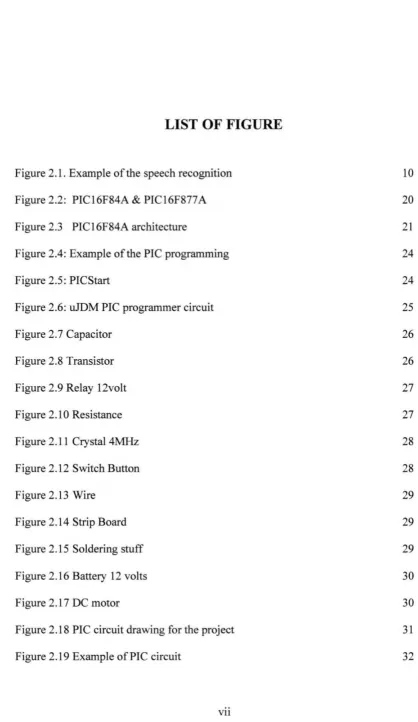
Universiti Teknikal Malaysia MelakaLIST OF FIGURE
Figure 2.1. Example of the speech recognition
Figure 2.2: PIC16F84A & PIC16F877A
Figure 2.3 PIC16F84A architecture
Figure 2.4: Example of the PIC programming
Figure 2.5: PICStart
Figure 2.6: uJDM PIC programmer circuit
Figure 2. 7 Capacitor
Figure 2.8 Transistor
Figure 2.9 Relay 12volt
Figure 2.10 Resistance
Figure 2.11 Crystal 4MHz
Figure 2.12 Switch Button
Figure 2.13 Wire
Figure 2.14 Strip Board
Figure 2.15 Soldering stuff
Figure 2.16 Battery 12 volts
Figure 2.17 DC motor
Figure 2.18 PIC circuit drawing for the project
Figure 2.19 Example of PIC circuit
Vll
©
Universiti Teknikal Malaysia MelakaFigure 2.20Example ofRS232 connector 35
Figure 3.1 System Flow for the motor controller system 37
Figure 3.2 Flow chart for project design 43
Figure 4.1 A single line wave graph for word Jalan1 46
Figure 4.2 Display of program writing for target 48
Figure 4.3 Display of program writing for input 49
Figure 4.4 Display of network data manager 50
Figure 4.5 Display of networks input and target attachment option 50
Figure 4.6 Display of setting the network and layers 51
Figure 4.7 Display of networks that been created 52
Figure 4.8 Log-sigmoid transfer functions 52
Figure 4.9 Display of networks parameters 53
Figure 4.10 Display of graph during the training session 53
Figure 4.11 Display of network data manager after the training session is 54
complete
Figure 4.12 Display of network/data manager when saving it
Figure 4.14 Diagram ofuJDM board
Figure 4.15 Diagram ofRS 232 head
Figure 4.16 Diagram of PIC motor controlJer circuit
Figure 4.17 Diagram of PIC motor controller circuit Figure 4.17 5 volts voltage regulator
Figure 5.1 Overall flow chart for voice recognition system Figure 5.2 A digital signal of word Jalanl
Vlll
©
Universiti Teknikal Malaysia Melaka54
56
57
Figure 5.3 A Digital signal after been process and have been divided into 63 25 blocks
Figure 5.4 A different Zerocrossdata graph between the word JaJan (a) 64
and Stop (b).
Figure 5.2 Result from the training 65
Figure 5.2 Display of the answer 66
Figure 5.4 A different Zerocrossdata graph between the word Bahan (a) 69 and Tahan (b).
lX
LIST OF TABLE
Table 3.1 Gannt Chart for PSM 1
Table 3 .2 Gannt Chart for PSM 2
X
©
Universiti Teknikal Malaysia Melaka46
CHAPTER!
GENERAL INTRODUCTION
1.1. Introduction
Every people in thjs world will always need a safety home. Home need to be safe
because it is the place that human needs protec6on from danger or bad weather. Stone
age human live in the cave because they need a safety from beast and bad weather like
rain. But the caves are not so safety because it doesn't have the safety aspect like a door.
When human want a buy a house, they will do inspection to all safety aspect like how
well the wall, is the door work correctly or even the toilet they will check.
That's the basic safety factor that human will be inspec6on when they want to buy a
house. To make sure there are more safety in the house, more application need to add to
the house for example automated light to make sure the house will be bright even tough
the owner are not home at night. Thls applica6on is famous nowadays and they is some
automated is already been bwld in this world.
Thls application is add sensor to its applica6on like the automated curtain. When the
Light is on, the curtain will be close because the sun is already set. Now to make an
upgrade to the automated house application, there is need some new application. To
open and close every curtain in the house, in case the house is big, it's to tiring. So there is some upgrade to it by using the remote control or timer to close and open it. Besides
the remote application, one of the other applications can be adding is voice command.
By using this application, the human or the speaker can sit and make the curtain close
and open by using its voice.
1.2. Problem Statement
To make sure the house is safer place to live, voice command is the one of the best way
to make any system safer. Speaker verification is usually used in applications which
require secure access. The systems operate with the user's knowledge and typically
require their cooperation. Speaker identification systems are more likely to operate
covertly without the user's knowledge. This can for example be used to route users to the
correct mailbox, identify talkers in a discussion, alert speech recognition systems of
speaker changes, check if a user is already enrolled in a system, etc. Now the system that
uses voice command can be safer because when come to voice, every person in this world have a different voice. One solution to the crime and illegal immigration problem
facing South Africa is the use of biometrics techniques and technology. Biometrics is
methods for recognizing a user based on unique physiological and/or behavioral
characteristics of the user [6].
1.3. Objectives
The objectives of this project must be clear and achieve to produce a successful system.
The objectives are:
I. Make the voice command system can identify and make a different between two
words.
The main target of this project is to make sure this system can make a different between
two words that been recorded as a template. This template will be use to identify which
word that the speaker said.
2
II. Build a PIC motor controller
In this project, the movement of the motor will be control with the PIC microcontroller.
This motor movement will represent any application that can be applied using the voice
command system.
ill. Connect the voice command system to control motor movement
When all the system is been build successful than it will be connect with using the serial
connection.
1.4. Scopes
The scopes should be identified and planned appropriately. The scope is:
I. Research the latest technology in voice command system
Necessary data on the current voice command and PIC microcontroller system for any
application was collected by conducting case studies, analyzing journal, book and past
researches, visiting local research institute and searching from internet sources which are
related to the voice command and PIC microcontroller. From the research survey and
data collection, it helps the author to find few important facts which will determine the
successful ofbuilding this system.
II. Building and Simulation.
In this project, the software used is MATLAB and MPLab. MATLAB is used to design
the necessary voice command system while the MPLab will be use to programming the
PIC.
3
ill. Building the circuit.
So many researches also must be doing on this section. The electronic part also needs
some concentration to build it so the circuit than will be build can work properly.
4
2.1. Introduction
CHAPTER2
LITERATURE REVIEW
Technology is the main attraction nowadays. The world now are been surround by
technology. For example telephone, computers, automation industry and many more. If
the technology can be apply to the bigger application like the automation industry,
smaller application also must have some technology on it. For example automated house
where all the application in the house can be control like closing and opening the door or
gate.
One of the technologies in automated house is automated light. The house light will be
on in curtain time and that is already been set earlier. There are also some other
technology for the household like automated rice cooker, automated gate, or even
automated sprinkle.
2.2. Voice Recognition I Speech Recognition
2.2.1. Definition
Voice or speech recognition is the ability of a machine or program to receive and
interpret dictation, or to understand and carry out spoken commands. For use with
5
computers, analog audio must be converted into digital signals. This requires
analog-to-digital conversion. For a computer to decipher the signal, it must have a digital database,
or vocabulary, of words or syllables, and a speedy means of comparing this data with signals. The speech patterns are stored on the hard drive and loaded into memory when the program is run. A comparator checks these stored patterns against the output of the
AID converter.
Speech recognition (in many contexts also known as 'automatic speech recognition',
computer speech recognition or erroneously as Voice Recognition) is the process of converting a speech signal to a sequence of words, by means of an algorithm implemented as a computer program. Speech recognition applications that have emerged
over the last years include voice dialing (e.g., Call home), call routing (e.g., I would like to make a collect call), simple data entry (e.g., entering a credit card number), and preparation of structured documents (e.g., a radiology report). Voice Verification or speaker recognition is a related process that attempts to identify the person speaking, as
opposed to what is being said [8].
Note that strictly speaking there is a difference between voice recognition (recognizing
who is speaking) and speech recognition (recognizing what is being said). Generally these two terms are frequently confused and voice recognition is used as a synonym for speech recognition instead. [1]
2.2.2. Voice Recognition
Voice recognition technologies can roughly be categorized as follows from the
viewpoint of telecommunications applications.
6
• Word recognition
Word recognition is the technology to recognize and identify a spoken isolated word
among a vocabulary of words. The number of words in the Vocabulary may be small
(e.g. up to 10) or very large (e.g. a few thousands).
• Word spotting
Word spotting is the technology to recognize and identify a target word in a
continuously spoken phrase. The number of words in the vocabulary may be very small.
It is necessary to ignore any words which are not registered in the vocabulary. In this
sense, rejection of non-registered words is also important.
• Continuous speech recognition
Continuous speech recognition is the technology to recognize all or multiple words
uttered in the form of phrases or sentences. The key technology here is how to integrate
the linguistic constraints into the recognition algorithm.
• Speaker recognition
Speaker recognition is the technology to verify that the speaker uttering some words is
the same as the one pre-registered (speaker verification), or to identify who among a set
of pre-registered persons is the one (speaker identification). Among these technologies,
word recognition and word spotting are widely used for practical application [12]
Speaker verification by asking the speaker to utter a pre-registered word can he used for
some applications, as well. Continuous speech recognition is emerging as a candidate for
user-friendly interface; however its applications are still limited.
7
One solution to the crime and illegal immigration problem facing South Africa is the use of biometrics techniques and technology. Biometrics is methods for recognizing a user based on unique physiological and/or behavioral characteristics of the user [6]. There are two applications in voice recognition which is voice verification and voice
identification. If the speaker claims to be of a certain identity and the voice is used to
verify this claim this is called speaker verification or voice authentication. On the other hand, speaker identification is the task of determining an unknown speaker's identity. In
a sense speaker verification is a 1:1 match where one speaker's voice is matched to one template (and possibly a general world template) whereas speaker identification is a 1: N match where the voice is matched to N templates.
Speaker verification is usually used in applications which require secure access. The
systems operate with the user's knowledge and typically require their cooperation.
Speaker identification systems are more likely to operate covertly without the user's
knowledge. There are two phase to complete the voice recognition, enrollment and test.
During enrollment the speaker's voice is recorded and typically a number of features are
derived to form a voice print, template, or model. In the test phase (also called
verification or identification phase) the speaker's voice is matched to the templates or
models. Voice recognition systems employ three styles of spoken input: text-dependent,
text-prompted and text-independent. This relates to the spoken text used during
enrollment versus test.
If the text must be the same for enrollment and test this is called text-dependent
recognition. It can be divided further into two cases: The highest accuracies can be
achieved if the text to be spoken is fixed. This has the advantage that the system
designer can devise a text which emphasizes speaker differences. However, since the
text is always the same such systems are vulnerable to Impostors. Furthermore, it is not very user friendly if all users have to remember some complex text and in addition it makes the system language dependent.
8
Another type of text-dependent system uses pass phrases. The user is free to pick a
phrase during enrollment but must use the same phrase during test. Most speaker
verification applications use this type of text-dependent input. It has the advantage that
an impostor must know the pass phrase, which adds a level of security. However, such systems are still vulnerable to tape recorder attacks. To counter this, many systems allow
the specification of several pass phrases. Typically, these are answers to questions.
During test the system randomly asks the user one of the questions and the user must
provide the correct answer. However, the number of different questions is usually rather limited and thus a patient attacker could still attempt a tape recorder attack.
In text-prompted systems the speaker is asked to speak a prompted text. In principle this
could be any kind of text This however complicates the recognition process quite a bit.
On the one hand the system knows the text that is being spoken. On the other hand the system must somehow know how this randomly selected text should sound if spoken by a particular speaker. This involves a much more elaborate model than in text-dependent
systems where the text is always the same. The typical implementation makes use of digits. During enrollment the speaker is asked to speak a few digit sequences which are
carefully selected such that all digits occur equally often. For every digit one speaker-specific model is trained. This has the advantage that only ten such models must be
trained. During test a random digit sequence is selected and the corresponding digit models are concatenated into one model per speaker. Since speakers typically do not change languages frequently, such systems can be made language-independent quite
easily.
Text-independent systems are most often used for speaker identification as they require very little if any cooperation by the speaker. In this case the text during enrollment and test is different. In fact, the enrollment may happen without the user's knowledge. Some
recorded piece of speech may suffice. Since text-independent systems have no
knowledge of the text being spoken only general speaker-specific properties of the
9
speaker's voice can be used. This does limit the accuracy of the recognition. On the other hand, this approach is also completely language independent.
2.2.3. Technology in Voice Recognition
The vanous technologies used to process and store voiceprints include frequency
estimation, Hidden Markov models, pattern matching algorithms, neural networks, matrix representation and decision trees. Some systems also use "anti-speaker" techniques, such as cohort models, and world models [5].
Ambient noise levels can impede both collections of the initial and subsequent voice
samples. Noise reduction algorithms can be employed to improve accuracies. Performance degradation can result from changes in behavioral attributes of the voice and from enrollment using one telephone and verification on another telephone. Voice changes due to aging also need to be addressed by recognition systems. Some systems adapt the speaker models after each successful verification to capture such long-term
changes in the voice.
Many comparues market speaker recognition engmes, often as part of large voice processing, control and switching systems. Capture of the biometric is seen as non
-invasive. The technology needs little additional hardware by using existing microphones and voice transmission technology allowing recognition over long distances via ordinary
telephones (wired or wireless).
2.2.4. Speech Recognition
The ability to communicate with a robot through speech is the ultimate user interface.
Speech is one of the human attributes that sets us apart from the rest of the animal kingdom and is considered proof of higher intelligence. When a robot obtains the ability to recognize words, it is well on its way to becoming a true humanoid. Speech
10