Contents lists available atScienceDirect
Algal Research
journal homepage:www.elsevier.com/locate/algal
Review article
Ulvan: A systematic review of extraction, composition and function
Joel T. Kidgell
a,⁎, Marie Magnusson
b, Rocky de Nys
a, Christopher R.K. Glasson
baMACRO–The Centre for Macroalgal Resources and Biotechnology, College of Science and Engineering, James Cook University, Townsville, Australia bSchool of Science, University of Waikato, Tauranga, New Zealand
A R T I C L E I N F O
Keywords: Biotechnology Green algae Bioactivity
Sulfated polysaccharides Seaweed
A B S T R A C T
Species of green macroalgae (Chlorophyta) of the genusUlvaare edible seaweeds with a range of health
pro-moting bioactive components.Ulvais high in dietaryfibre which promotes gastrointestinal health and is linked
to a reduction in the incidence of chronic diseases. The fundamental active constituent ofUlvais the solublefibre
ulvan, a gelling sulfated polysaccharide with biological activities including immunomodulating, antiviral, an-tioxidant, antihyperlipidemic and anticancer. Ulvan also has the capacity to modulate cellular signalling
pro-cesses in both plant and animal systems leading to beneficial effects on productivity and health. Consequently,
ulvan is of significant interest as a constituent in human health, agricultural, and biomaterial products. This
comprehensive systematic review investigates and recommends acid extraction, ultrafiltration, sugar constituent
and molecular weight analysis for the extraction, purification, and characterisation of ulvan, respectively. The
biological activities of ulvans are then critically reviewed.
1. Introduction
Species of green seaweed from the genusUlva have high growth rates and productivities across diverse geo-climatic conditions, with highly exploitable biochemical profiles [1–4]. As a consequence, spe-cies of Ulvacan result in the formation of problematic “green tides” [5–9]. Therefore, they are well suited for cultivation, in particular for use in the bioremediation of nutrient rich wastewater from intensive land-based aquaculture [10–12]. Importantly, cultivation, as opposed to natural harvesting, can produce a high-quality monoculture ofUlva biomass, which can then generate high-quality bioproducts of con-sistent composition. One of the major bioproducts of interest fromUlva is the sulfated polysaccharide known as ulvan.
Ulvan is a cell wall polysaccharide that contributes from 9 to 36% dry weight of the biomass ofUlvaand is mainly composed of sulfated rhamnose, uronic acids (glucuronic acid and iduronic acid) and xylose [13–21]. Species of Ulva have three other cell wall polysaccharides (cellulose, xyloglucan, and glucuronan), which with ulvan collectively account for up to 45% of the dry weight biomass [22]. Like ulvan, xyloglucan and glucuronan are also soluble polysaccharides but are only relatively minor constituents of the cell wall polysaccharides [14,23–25]. Interestingly, of the four cell wall polysaccharides present within Ulva, ulvan is the only one to contain both rhamnose and iduronic acid [16]. Rhamnose is of interest for its effect on biosynthetic pathways in the dermis [26–28] and on plant immunity [29–31].
Uronic acids (glucuronic and iduronic acids) and their sulfate esters are important constituents in mammalian glycosaminoglycans (GAGs) (e.g., heparin, heparan sulphate, and dermatan sulfate). Like GAGs, ulvan has a repeating disaccharide structure predominantly comprised of an uronic acid linked to a sulfated neutral sugar and is, therefore, a candidate for the modulation of processes and functions carried out by mammalian polysaccharides [16,32,33]. In this regard, ulvan has po-tential applications in biomaterial science (wound dressings, tissue engineering, biofilm prevention, and excipients), nutraceuticals (anti-viral, antioxidant, antihyperlipidemic, anticancer and im-munostimulatory), functional foods and agriculture, as outlined in re-views by Venkatesanet al.[34], Cunha and Grenha [35], Alveset al. [36], Lahaye and Robic [13], and Wijesekaraet al.[37]. The biological activities of polysaccharides, including ulvan, are directly related to their chemical structure. It is, therefore, important to understand how extraction, isolation and purification procedures affect the chemical structure of the extracted polysaccharide, and as a consequence its biological activity.
This review evaluates research on ulvan with a focus on extraction and purification methods,and its biological activity and potential ap-plications. In preparing this comprehensive, systematic review, a meta-analysis was conducted on publications identified from the search string“(Ulvan* OR ((sulfate* OR sulphate*) AND polysaccharide* AND (Ulva OR Enteromorpha)))” through Scopus and Web of Science on 13th of December 2017 (see supplementary material for methods and
https://doi.org/10.1016/j.algal.2019.101422
Received 27 September 2018; Received in revised form 15 January 2019; Accepted 16 January 2019
⁎Corresponding author.
E-mail address:[email protected](J.T. Kidgell).
Available online 29 March 2019
2211-9264/ © 2019 The Authors. Published by Elsevier B.V. This is an open access article under the CC BY-NC-ND license (http://creativecommons.org/licenses/BY-NC-ND/4.0/).
full access to metadata). This analysis provides a summary of the che-mical structures of ulvans from different sources and the methods used to assess them, as well as providing the biological activity of ulvan, and, where possible, their relative efficacies and mechanisms of action. As a consequence, the review is divided into two major sections.Section 2 describes in detail the chemistry of ulvan, providing an overview of its physicochemical properties, extraction and purification techniques and recommended characterisation for biological activity studies.Section 3 then provides an overview of the biological activities of ulvans with a focus on the mechanistic and structural features involved. Note that in line with current nomenclature conventionEnteromorphais referred to asUlvathroughout the review [38].
2. Chemistry of ulvans
2.1. Chemical structure of ulvans
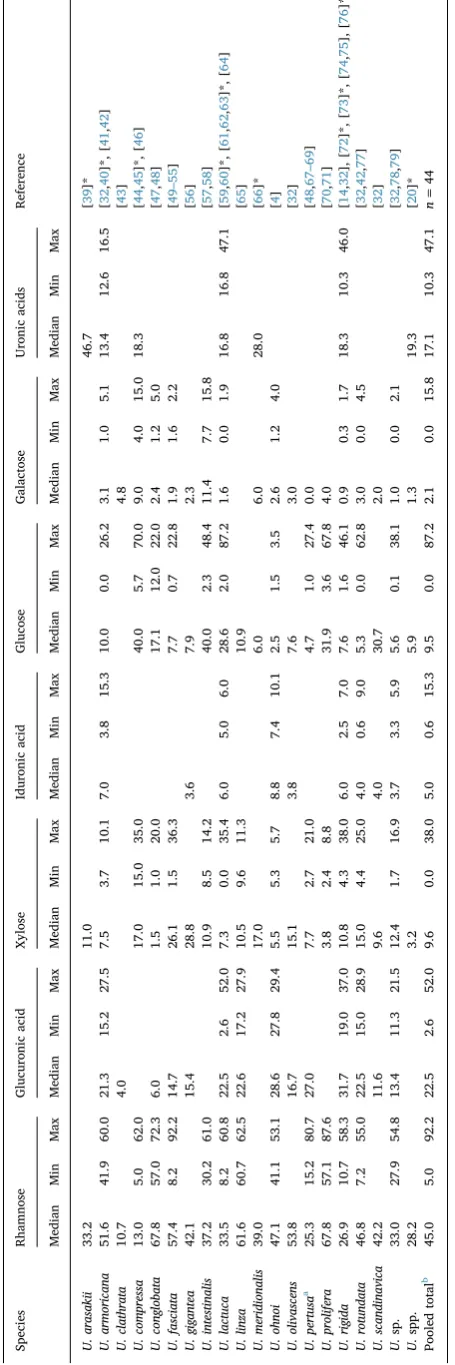
The macromolecular properties (e.g., conformation) of poly-saccharides are influenced by their primary structure, which is de-termined by their sugar constituents and the order in which they occur, their glycosidic linkages, degree of branching, molecular weights, and the presence of functional groups, such as sulfate esters, methyl ethers, amides and amines. These structural features then determine the phy-sicochemical properties and the biological activities of the poly-saccharide. In this regard, ulvans are polyanionic hetero-polysaccharides with sugar compositions that are predominantly rhamnose (45.0 mol%), glucuronic acid (22.5 mol%), iduronic acid (5.0 mol%), and xylose (9.6 mol%) (Median values, seeTable 1). There is, however, a broad range in the composition of ulvan sugars reported for rhamnose (5.0–92.2 mol%), glucuronic acid (2.6–52.0 mol%), iduronic acid (0.6–15.3 mol%) and xylose (0.0–38.0 mol%) (Table 1; Fig. S2). The composition of ulvan depends on the source species, eco-physiology, and processing procedures used to prepare both biomass and ulvan (seeTable 1). Compositional variation due to eco-physiolo-gical factors can then be magnified by different extraction and analy-tical techniques. Other monosaccharides are often reported in compo-sitional data (e.g., glucose, galactose, arabinose, and mannose), however, their presence as a component of/or contaminant of ulvan is unclear.
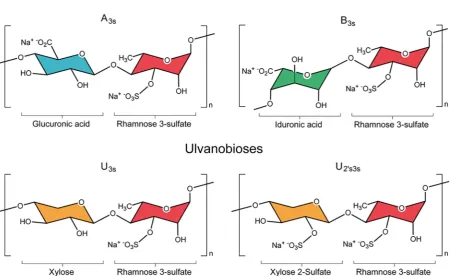
The ulvan backbone is most commonly made up ofα- andβ -(1,4)-linked monosaccharides (rhamnose, xylose, glucuronic acid and iduronic acid) with characteristic repeating disaccharide units. [13,80–82]. The two major disaccharide repeating units are aldo-biuronic acids, referred to as ulvanoaldo-biuronic acid (types A and B); minor disaccharide aldobioses, referred to as ulvanobioses (type U), are also found in ulvan (Fig. 1). Type A and B are far more common than U [13]. Ulvanobiuronic acid type A3s, one of the most common dis-accharide units, consists of β-D-glucuronic acid (1,4)-linked to α -L-rhamnose 3-sulfate, while in type B3sα-L-iduronic acid (a C-5 epimer of glucuronic acid) is (1,4)-linked to α-L-rhamnose 3-sulfate [13,80,81,83]. Ulvanobiose U3sconsists ofβ-D-xylose (1,4)-linked toα -L-rhamnose 3-sulfate, while type U2′s,3sconsists ofβ-D-xylose 2-sulfate (1,4)-linked toα-L-rhamnose 3-sulfate [13,81]. While (1,4)-glycosidic linkages are the predominant bonds, (1,2)- and (1,3)-glycosidic linkages also occur [24,81]. In this regard, minor branching has been associated with glucuronic acid (1,2)-linked to the rhamnose residue of the ulva-nobiuronic acid type A3s[13,24]. However, there are indications that greater diversity in the structure of ulvan is likely [57,84]. For struc-tural comparisons, a useful list of fully characterised ulvan oligo-saccharides can be found in [13,24].
The conformation of ulvan in solutions is in part determined by composition and has been described using both molecular modelling and empirical evidence. Predictions of the conformation of ulvan using molecular modelling are impeded by the limited knowledge of the se-quencing of the polysaccharide backbone, beyond the presence of its repeating disaccharide units, and the few longer oligosaccharides
described [13,24,81,84,85]. However, theoretical calculations have determined that domains with repetitive sequences of any of the major disaccharide units (e.g., chains of A3sor B3s) can adopt secondary he-lical structures [41]. In practice the conformation of ulvan in solution is pH dependent and is also influenced by the presence of counter-ions. Due to the relative hydrophobicity of rhamnose and its overall effect on the solubility of ulvan in neutral and low pH aqueous solutions, ulvan folds into a condensed bead-like conformation [86]. In the presence of salts (e.g., NaCl) these beads aggregate. The bead conformation of ulvan reduces its intermolecular interactions resulting in the low viscosity of its solutions, as well as influencing gel strength and activity. In contrast, in high pH solutions (~13) ulvan has a more open conformation in-creasing the intermolecular interactions that give higher viscosities and greater gel strengths. The influence of pH over the solution properties of ulvans is a convenient mechanism by which tofine-tune its rheology to suit specific applications. Further discussion of gelling properties can be found in Lahaye and Robic [13].
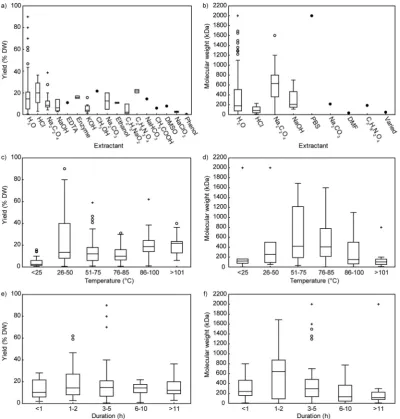
While the mole ratio of constituent sugars in ulvan from a particular source and batch are defined, the molecular structure can be altered through depolymerisation and removal or addition of functional groups (e.g., sulfate esters). In this regard, molecular weights (1 - > 2000 kDa, Fig. 2b, d, f) and degree of sulfation (2.3–40%, Fig. S3) of ulvan extracts vary widely and have a large influence on physicochemical properties and biological activities. These structural features are also relatively easily manipulated and provide convenient methods for the investiga-tion of structure-funcinvestiga-tion relainvestiga-tionships. Depolymerisainvestiga-tion can be achieved through chemical [28,71,87–89] and enzymatic hydrolysis with ulvan lyases [23,77,90,91]. The degree of sulfation can be altered by addition of sulfate esters [49,92,93] or removal of sulfate esters by solvolysis of the ulvan pyridinium salt [55,72,94,95] or through base hydrolysis [91]. Charge can be altered through manipulation of the degree of sulfation and by derivatisation of the carboxylic acids groups (e.g., esterification and amide formation) [96,97]. Both the charge and the mole ratio of constituent sugars can be varied by reduction of glucuronic acid and iduronic acid to glucose and idose, respectively [94]. Indeed, covalent cross-linking groups can also be added to en-hance gel formation and gel strength [98,99].
2.2. Extraction of ulvan
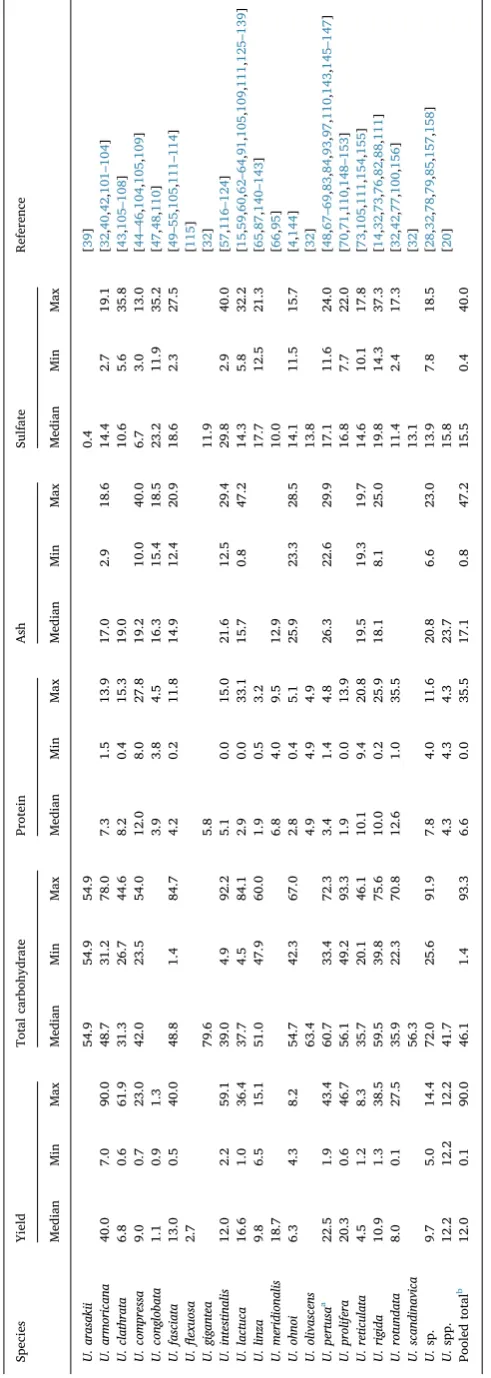
The quantitative yield and the quality of ulvan can vary sig-nificantly depending on the applied extraction and purification pro-cesses, the source of the biomass (species (Table 2), source as wild or cultivated, location) [36], storage of collected biomass, and pre-ex-traction processing [100]. In this regard, extraction conditions vary widely in the literature, as does the yield and quality of ulvan produced (Table 2, Fig. S3). The choice of extraction conditions is generally based around the physicochemical properties of the ulvan molecule and its specific interactions with other components of the plant cell wall [77]. Less consideration is given to the capacity for the extraction conditions to degrade ulvan or co-extract impurities such as proteins, other poly-saccharides (starch, cellulose, xyloglucan, and glucuronan), and to a lesser extent lipids and pigments. Depending on the intended applica-tion of the ulvan extract, co-extracapplica-tion of impurities can lead to more intensive down-stream purification procedures. We use three criteria to determine optimal conditions for the extraction of ulvan: 1. High yield; 2. High selectivity; and 3. Low degradation (i.e. ulvan is extracted without extensive hydrolysis). To address these criteria, we review the physicochemical properties of the predominant macromolecules in Ulva, and then review the literature and provide recommendations on the best practices for the extraction of ulvan, focusing on applications. The extraction yield of ulvan is affected by the properties of the biomass and its pre-treatment, extraction temperature, extractants, extractant to biomass ratio, biomass particle size, and duration of ex-traction (Fig. 2a-f). The physicochemical properties of ulvan that
aqueous conditions and its stabilisation in the plant cell wall, pre-dominantly through its interaction with divalent cations (e.g., Ca2+), borate, hydrogen bonding, and entanglement [77]. The solubility of ulvan and its intermolecular interaction are pH dependent [86]. Ex-traction solutions at pH > pKa of both uronic acids (~3.28) and sulfate esters (~2.0) promote a high charge density on ulvan and theoretically an increase in its solubility. Conversely, extraction solutions at pH < pKa of both uronic acids and sulfate esters theoretically reduce its so-lubility. In practice, the bead-like conformation of ulvan leads to for-mation of aggregates at neutral to acid pH, and these aggregates dis-perse at pH < pKa of the uronic acids allowing for greater solubility of ulvan [77]. The solubility of glucuronan, a homopolysaccharide con-sisting of repeating (1,4)-linked glucuronic acids, is also pH dependent with expected enhancement in its solubility above the pKa of glu-curonic acid. In this regard, both glucuronan and xyloglucan are more soluble in alkaline solutions. The solubility of water soluble protein is also pH dependent. Extraction solutions with pH equal to the isoelectric point (pI) of the protein result in its reduced aqueous solubility. In this regard, the pI for aqueous and alkaline soluble proteins from macro-algae is generally between pH 3–4 [159]. However, lower pI values for soluble proteins from Ulva(pI = 2.25) occur [160]. Given these phy-sicochemical properties of macromolecules inUlva, an informed deci-sion of extraction conditions can be made to enhance the efficiency and selectivity of ulvan extraction, while limiting degradation.
Extraction yield can vary significantly between populations ofUlva due to eco-physiological variation (light, temperature) [42], and, therefore, comparisons of extraction yields should be evaluated on a single harvest of biomass. In terms of biomass ptreatment, the re-duction of salt in the biomass by warm water extraction enhances the extraction efficiency of ulvan [4]. The mechanism here is twofold, the reduction of salt reduces the aggregation properties of ulvan, and os-motic shock increases the exposure of cell wall components to the
extractant. Other pre-treatments, such as pigment and lipid removal, have no effect on either extraction efficiency or the quality of ulvan extracted and for this reason are considered unnecessary, unless they are targeted products. Finally, to increase the interaction of extractant and biomass cell wall, and, therefore, enhance extraction efficiency, biomass is dried andfinely milled.
The solubility of ulvan in aqueous solutions is enhanced by ex-traction at high temperatures (80–90 °C). The temperature is usually capped below the boiling point of water for convenience and to prevent higher temperatures promoting degradation (e.g., depolymerisation and desulfation) [161]. However, high temperature extractions in water generally have low extraction yields due to the interactions of ulvan with other cell wall components [77]. As a result, extractants, such as chelators and acids, are used to overcome the structural integrity of the plant cell wall, thus, enhancing the extraction efficiency of ulvan. Chelators, such as oxalates and EDTA, remove divalent cations (e.g., Ca2+) that promote the cross-linking of ulvan in the cell wall. Extrac-tions using chelators are generally conducted at or near neutral pH and at high temperatures (80–90 °C). Reported yields vary widely (see Fig. 2), but the extraction efficiency (and selectivity) is improved when the pH is adjusted to 4.5 [77]. In this regard, extractions in strong acid (e.g., HCl; Fig. 2) generally produce higher extraction yields [4,77,162]. Mechanistically, extractions at pH below the pKaof glu-curonic acids disperse ulvan aggregates, facilitating its extraction. No-tably, high temperatures (80–90 °C) are still required to facilitate high extraction efficiencies at low pH, however, isolation methods influence yields (seeSection 2.4). Extraction pH also plays a significant role in the selectivity of ulvan over other macromolecules, as discussed above.
[image:4.595.74.527.69.345.2]The physicochemical properties of the macromolecular constituents ofUlvasupport extraction pH as an important factor in the selectivity of the extraction process for ulvan. At pH below the pKa of uronic acids (~3.28) the extraction of ulvan is enhanced (see rationale above), and
Fig. 1.Nomenclature and structure of the major repeating disaccharide units that comprise ulvan. Ulvanobiuronic acid A3scontains glucuronic acid (blue) attached
to rhamnose 3-sulfate (red), while the similar B3salso contains rhamnose 3-sulfate but has iduronic acid (green) in the place of glucuronic acid. Ulvanobioses are
comprised of rhamnose 3-sulfate attached to xylose (orange). Xylose can contain a sulfate group, as seen in U2′s,3s. (For interpretation of the references to colour in
the solubilities of other macromolecules, such as glucuronan, xy-loglucan, and soluble protein, are minimised [4,77,133,162]. For ex-ample, HCl extracts of freshU. ohnoihad superior selectivity for ulvan (306–333μg rhamnose/mg extract) over protein (4–7μg protein/mg extract), when compared with sodium oxalated extracts (114–162μg rhamnose/mg extract and 41–59μg protein/mg extract) [4]. The se-lectivity for ulvan over other polysaccharides can also be inferred by comparing the molar ratios between rhamnose (an ulvan specific monosaccharide), and uronic acids or xylose (both of which are con-stituents of multiple polysaccharides) of extracts obtained using dif-ferent extractants [4,77]. For example, ulvan extracted fromUlva ohnoi had a molar ratio of 1:0.71 for rhamnose to uronic acids when HCl was used as the extractant, and 1:0.88 when oxalate was used as the ex-tractant, demonstrating increased co-extraction of glucuronan in the latter [4]. Similarly, the mole ratio of rhamnose to uronic acids for ulvan extracted from Ulva rotundata with 0.05 M HCl (pH 1.3) was 1:0.83 compared to 1:0.99 when extracted with 0.02 M ammonium oxalate (adjusted to pH 4.6) [77]. These latter studies indicate a quantitative measure of selectivity can be provided using pH, resulting
in a more accurate composition of the ulvan attained. It is, however, important to note that while selectivity for ulvan over other macro-molecules was enhanced at low pH, significant degradation of its structure also occurred.
[image:5.595.98.499.55.475.2]Degradation of the structure of ulvan during the extraction proce-dure may reduce or enhance its functionality depending on the in-tended application. For this review, we focus on the versatility of the ulvan extract, and as ulvan can be readily degraded after its extraction using chemical and enzymatic approaches (see above), an ulvan sample with minimal degradation is considered the most versatile product. There are two structural features that are most susceptible to de-gradation during the extraction of ulvan; its degree of polymerisation and degree of sulfation. In this regard, depolymerisation of the poly-saccharide is more facile than desulfation of the polypoly-saccharide under the range of extraction conditions used to extract ulvan. Extraction parameters that influence the degree of depolymerisation include pH, temperature, and duration (Fig. 2d, f). In this regard, high temperature (80–90 °C) extractions at low pH (~1.3–1.5) lead to significantly higher levels of depolymerisation than extractions at higher pH (with or
Fig. 2.Box plots of the median and variability in ulvan yield (a,c,e) and average molecular weight (b,d,f) resulting from extractant applied (a,b), temperature (c,d)
and duration (e,f) of the extraction procedure. Yield is presented as % of dry weight; average molecular weight in kDa. “PBS”= Phosphate buffered saline;
“DMF”= anhydrousN,N-dimethylformamide;“Varied”= multiple extractants. Boxes represent the interquartile range (IQR) with the mean as a line within the box;
whiskers represent the limits of non-outlier data; open circles are outliers, calculated by ± 1.5*IQR; crosses are extreme values, calculated by ± 3*IQR; closed circles
without an added extractant) [4,77,125,133]. However, small changes in pH, temperature, and duration all have a significant effect on the degree of depolymerisation [77,125,133,161]. For example, ulvan was extracted from U. lactuca using a factorial experimental design that varied temperature (80 °C or 90 °C), pH (pH 1.5 or 2), and time (1−3h) [133]. The harshest extraction condition (90 °C at pH 1.5 for 3 h) re-sulted in higher yield at the cost of significantly greater depolymer-isation than the milder extraction (80 °C at pH 2 for 1 h). Furthermore, at pH 1.5 for 1 and 2 h, significantly higher depolymerisation occurred for extractions conducted at 90 °C than at 80 °C, but a higher yield was also obtained. The same temperature dependence was present for 2 and 3 h extractions at pH 2.
The combination of extraction temperature, solvent pH and ex-traction duration interact to influence extraction yield and quality (e.g., purity and molecular integrity). Higher extraction temperatures enable greater solubilisation of ulvan (Fig. 2c), low pH improves the selectivity for ulvan, and increased extraction duration can increase ulvan yield. However, compromises must be made to protect the integrity of the ulvan structure. For example, while high temperature results in higher yields, a combination of high temperature, low pH and long extraction duration lead to significant depolymerisation (Fig. 2d, f). However, small adjustments in pH have a large influence on depolymerisation, while small changes in temperature do not. Therefore, using the data available in the literature the following extraction conditions are re-commended based on the criteria listed above: 1. High extraction yield; 2. High selectivity; and 3. Low degradation:
•
Temperature: 80–90 °C•
pH range: 2–4.5•
Duration: 1–3 h2.3. Isolation and purification
Methods for the isolation and purification of ulvan vary significantly and are linked to both the availability of resources and the focus of the study. Here we regard isolation as the separation of the extract from residual biomass and the removal of solvent, and purification as the separation of ulvan from other solutes (e.g., salts and other macro-molecules). In practice, these steps are not mutually exclusive. It is also important to note that isolation and purification methods influence the physicochemical properties and biological activities of ulvan. We briefly review commonly used methods for the isolation and purifi ca-tion of ulvan that yield two desirable outcomes: 1. High recovery, and 2. Pure product. Methods for the isolation and purification, both che-mical and enzymatic, of polysaccharides have been comprehensively reviewed [163]; our focus is to briefly review commonly used isolation and purification methods for ulvan, and comment on their eff ective-ness.
Following the extraction of ulvan, the extract is separated from the residual biomass byfiltration and/or centrifugation prior to the isola-tion of ulvan by precipitaisola-tion, evaporaisola-tion, or concentraisola-tion by
ultra-filtration followed by lyophilisation. For industry, spray drying is an-other efficient process [38]. Precipitation of ulvan with ethanol is by far the most common isolation method used in the laboratory. Typically, addition of ethanol (e.g. 70–96%) to a concentrated extract is adequate to precipitate ulvan, while ethanol-soluble compounds, such as pig-ments and metabolites, remain in solution [164]. Although ethanol precipitation is a convenient method, it is limited by the low solubility of salts and higher solubility of low molecular weight ulvan in ethanol-water mixtures. Precipitation methods are also particularly difficult to replicate and in the absence of dialysis or ultrafiltration can lead to high levels of salt in the ulvan extracts [59,133]. Consequently, precipitation can lead to incorrect interpretations of yields, physicochemical prop-erties, and biological activities. Efficient desalting of ulvan extracts can be achieved by dialysis, ultrafiltration, or even chromatography.
Dialysis and ultrafiltration allow for the reduction (removal) of
excess salts and small molecules contaminating ulvan extracts. Dialysis is highly effective in the removal of excess salt from analytical samples and for other applications that require very low residual ash. Ultrafiltration is generally employed as a two-step process; concentra-tion (volume reducconcentra-tion) followed by diafiltration (washing or buffer exchange). Both dialysis tubing and membranefilters for ultrafiltration are available with a variety of pore sizes (or molecular weight cut-off (MWCO)). The range of MWCO's used for ulvan generally fall between 3.6 and 12 kDa [92,111]. For dialysis, pore size selection is based around the retention of ulvan, however, for ultrafiltration pore size selection is based on both the retention of ulvan and the rate of permeateflow (which decreases as pore size decreases). The latter ex-tends the time associated with the ultrafiltration processes. The balance between ulvan retention and time efficiency is optimised at ~10 kDa MWCO [4,100,125].
Given the high level of impurities in many ulvan extracts, it is surprising that chromatographic techniques are not applied more widely for purification prior to characterising the physicochemical properties and biological activities of ulvan. In this regard, the poly-anionic and polydisperse nature of ulvan lends itself to anion-exchange chromatography (AEC) and size-exclusion chromatography (SEC), re-spectively. AEC is effective for the removal of proteins and neutral polysaccharide impurities from ulvan samples. Both weak anion-ex-changers (e.g., diethylaminoethyl (DEAE) or tertiary amine functiona-lised media) [25,111] and strong anion-exchangers (e.g., quaternary (Q) amine functionalised media) [77] have been successfully employed to purify ulvan. SEC is widely used as an analytical technique for de-termining molecular weights and molecular weight distributions (see Section 2.4), however, it has wider applications. For example, SEC can be used to fractionate oligosaccharides and polysaccharides for the elucidation of fine structure [23], and to generate size classes for structure-function relationships [29,165]. With regards to the former, SEC has been used to fractionate ulvan oligosaccharides for fine structure analysis using NMR techniques [81]. A large range of size exclusion media is available targeting different molecular size ranges. Media commonly used for purification of ulvan samples are Sepharose CL-6B [29], Sephacryl S-400/HR [165], Sephacryl S-1000 [166], and Sephadex G-200 [46].
In summary, ideally the choice of extraction techniques will limit the co-extraction of macromolecular impurities (seeSection 2.2) and reduce the necessity for intensive purification techniques. However, due to salt content (introduced by extractants and inherent in marine species) and similarities in the physical properties of ulvan and con-taminating polysaccharides and proteins, purification is necessary. In general, salt is the most significant impurity and is most effectively removed by dialysis or ultrafiltration techniques. Depending on the extraction process employed, protein may also need to be actively re-moved, either by chemical or enzymatic approaches [36,163], or using chromatographic techniques. The latter is more reproducible and al-lows for highly purified fractions of ulvan. In practice, a strategic se-lection of extraction procedures, and isolation and purification proce-dures should be made based on the available resources. For example, in a resource limited situation one might select a more selective acid ex-traction, concentrate by evaporation, purify using dialysis, and isolate by precipitation. In a resource rich situation, a selective acid extraction is ideal, although a less selective extraction process can be tolerated, with concentration and diafiltration with ultrafiltration. Subsequent purification by anion-exchange chromatography, and lyophilisation or spray drying to isolate the purified ulvan can be applied.
2.4. Characterisation
sugars, a variable degree of sulfation and substitution patterns, and complex macromolecular properties (e.g., aggregation). The presence of contaminating polysaccharides further complicates structural elucida-tion of a particular polysaccharide. Therefore, it is important to start with as pure a sample as possible, and even then full structural eluci-dation is challenging - ‘Structural characterisation’ is a more fitting term. Adequate structural characterisation of an ulvan sample is es-sential for interpreting its physicochemical properties and biological activities. To achieve this a measurement of composition (e.g., total carbohydrate content, protein content and ash) and the identifying structural features of ulvan (e.g., sugar composition, glycosidic lin-kages, degree of sulfation) are required. Comprehensive reviews of the techniques used to elucidate the chemical structure and macro-molecular properties of bioactive polysaccharides are provided else-where [167–169]. In this review we focus on the methods used to characterise ulvan and propose the minimum analysis and character-isation required to progress beyond bioprospecting.
The analysis of the chemical structure of ulvan is fundamentally based on the quantitative determination of the major constituent monosaccharides (rhamnose, xylose, glucuronic acid and iduronic acid) and degree of sulfation. The latter is most commonly carried out using a turbidimetric assay [170] but can be measured using ion chromato-graphy, high performance liquid chromatography (HPLC) coupled with conductivity [20], elemental analysis, or Fourier transform infrared spectroscopy (FTIR) [171]. Constituent monosaccharides are pre-dominantly quantified using chromatography techniques, in particular gas chromatography (GC) [20,47,49,59,72], HPLC [70,95], and high-performance anion-exchange chromatography (HPAEC) [4,32]. De-pending on the chromatographic technique employed the sample is subjected to pre-treatments. Primarily, accurate quantification of con-stituent monosaccharides requires complete hydrolysis of ulvan. How-ever, due to the resistance of the aldobiuronic glycosidic linkage to hydrolysis [16,17,172], and the susceptibility of rhamnose, glucuronic acid, iduronic acid and xylose to degradation in concentrated strong acids (e.g., Saeman hydrolysis) [173,174], traditional acid hydrolysis methods, such as with trifluoroacetic acid (TFA), are both ineffective and degradative. A traditional acid hydrolysis will not cleave all of the aldobiuronic linkages and as a result the neutral and uronic acid re-sidues involved in these linkages will not be detected. As ulvan is predominately comprised of repeating aldobiuronic acid disaccharides, a traditional acid hydrolysis will inaccurately characterise ulvan. However, hydrolysis of ulvan using traditional methods is ubiquitous in the literature. A two-step hydrolysis in methanolic HCl followed by aqueous trifluoroacetic acid is an effective alternative to reduce the hydrolysis-induced damage to constituent monosaccharides [4,175]. A chemo-enzymatic degradation involving hydrolysis with a mild acid followed byβ-D-glucuronidase cleavage of aldobiuronic acid is also an effective solution [13,16]. Both HPLC [70,87,95] and HPAEC [4,32] methods are used to quantify the monosaccharides in the hydrolysis samples without further derivatisation. HPLC methods generally pro-vide less resolution than HPAEC methods [176], but both allow the assessment of the effectiveness of the hydrolysis method employed [175]. HPAEC-PAD (pulsed amperometric detection) of methanolic-HCl/TFA hydrolysates also has the major advantage of separating and quantifying acidic and neutral sugars (and amino sugars) in a single run, without further derivatisation [175]. GC analysis requires that the constituent sugars be converted to volatile derivatives, such as alditol acetates [20,49,72,83] and trimethylsilyl (TMS) ethers [59]. For the former, reduction of monosaccharide C1-aldehyde is conducted prior to the preparation of alditol acetate. In general, C6-carboxylic acids are not reduced under the conditions employed to reduce aldehydes and, therefore, are not converted to alditol acetates. However, GC–MS ana-lysis of alditol acetates, prepared from ulvan hydrolysates that included the pre-hydrolysis reduction of C6-carboxylic acids with sodium bor-odeuteride (NaBD4) to generate 6,6′-dideuterio-sugars, allows for the determination of the total uronic acid content [169]. Studies that do not
include this conversion generally measure uronic acid content using colourimetric assays [177,178]. Alternatively, TMS ethers of sugars can be prepared using reagents such as N,O
-bis(trimethylsilyl)tri-fluoroacetamide, allowing for the quantification of both neutral and acidic sugars [59]. However, TMS derivatisation of un-reduced sugar residues can yield several peaks in the GC chromatogram corresponding to different pyranose anomers, which complicates interpretation. A solution to this problem is to follow the preparation of alditol acetate derivatives with reduction to the alditol prior to preparation of the TMS derivative. For sample preparation, HPAEC methods (e.g., HPAEC-PAD) provide the simplest and most comprehensive route for sugar con-stituent analysis; however, excellent results can also be obtained using either GC or HPLC methods.
While sugar constituents are important in determining the physi-cochemical properties and biological activities of a polysaccharide, glycosidic linkages and functional group substitution patterns, and sugar sequence are arguably more important. Glycosidic linkage (me-thylation) analysis is generally conducted using GC–MS methods [25,168,179] and provides information on the linkage positions and substitution patterns of constituent sugars. Briefly, methylation analysis involves the preparation of partially methylated alditol acetates fol-lowed by quantitative analysis using GC–MS. To achieve this eff ec-tively, the uronic acid components of ulvan are reduced prior to the methylation step [168,169]. Determination of glycosidic linkages and sugar sequence can then be achieved using 2D NMR techniques on hydrolysed ulvan fragments (disaccharides and oligosaccharides) [24,167,180–182]. In many cases,1H and13C resonances characteristic of ulvan structures (e.g., repeat disaccharide units) can be assigned by comparison with published data [4,49,77,84,128,183,184]. In addition, the anomeric configuration and position of substituents (e.g., sulfate groups) can be inferred by location of both 1H and 13C resonances [167,181].
The physicochemical properties and biological activities of poly-saccharides are also fundamentally linked to molecular weight. Therefore, a measure of average molecular weight (MW) and molecular weight distribution (MWD) is integral to the characterisation of poly-saccharides. In this regard, size exclusion chromatographic (SEC) methods are the most commonly employed as they allow a measure of both MW and MWDs. Firstly, as a minimum requirement for the de-termination of average MW and MWD's, SEC is coupled to a con-centration dependent (CD) detector, most commonly refractive index and UV. For ulvan, calibration of these setups is usually achieved with narrow polydispersity polymer standards (e.g., dextrans [28,68,69,88,133,145], pullulans [59,161,185] and polyethylene oxides [61]). However, due to difference in the macromolecular prop-erties, commonly used calibration standards are unlikely to yield ac-curate results, and acac-curate measurements of ulvan (and other complex polymers) MW and MWDs require online molecular weight detectors (e.g., multiangle laser light scattering (MALLS) and viscosity (VISC)) [4,57,61,86,128]. Both SEC-MALLS and SEC-VISC also allow analysis of macromolecular properties, such as aggregation behaviour [86,186]. Comprehensive reviews on the theory and variety of detection methods in SEC analysis are provided by [186,187].
chemical colorimetric methods for quantitative measurements of neu-tral sugars (e.g., rhamnose and xylose) are hampered by interference. In this regard, highly specific enzymatic assays for monosaccharides ty-pically present in ulvan including rhamnose [190], xylose [191] and uronic acids [192] are available. However, to gain an understanding of composition multiple characterisation assays are necessary resulting in little time savings. In this regard, a truly high-throughput method would require only a single measurement on an un-degraded sample with minimal preparation.
Chemometric methods coupled with spectral analysis, such as IR, Raman, NIR, and NMR, are effective for the rapid (single measurement) compositional analysis of polysaccharides [171,193]. For example, FT-IR spectra in the range of 1770–600 cm−1 coupled with the multi-variate analysis method of partial least squares (PLS) analysis was used to develop calibrated FT-IR-PLS-models that allowed the sulfate content and the content of the major monosaccharides in ulvan hydrolysates to be determined [171]. The key ulvan spectral features used for the de-velopment of FT-IR-PLS-models were the uronic acid carboxylic groups (1650–1600 cm-1 (vasym C]O); 1425–1400 cm−1 (vsym C]O)) [171,183], sulfate ester groups (1260–1215 cm−1 (vasy S]O); 850–835 cm−1and 795–785 cm−1(C-O-S)) [25,83,183], and the gly-cosidic linkage between the two major sugars, rhamnose and glucuronic acid (1055–1030 cm-1 (C-O-C)) [171]. While, the broader application of the FT-IR-PLS-models for ulvans is untested, this analytical approach represents a rapid characterisation method for ulvan.
Ulvan has a broad range of biological activities; however, the characterisation of ulvan is often of low resolution leading to un-certainty in the origin of the activities tested. At the research level total characterisation methods are essential in understanding structure-ac-tivity relationships. The minimum characterisation data recommended is sugar constituent analysis (preferably suitable for the detection of neutral and acidic sugars), molecular weight analysis, and measures of contaminants, such as protein and ash. To obtain further insight into structure-activity relationships, glycosidic linkage analysis should also be conducted. In the next section we review the biological activities of ulvans and comment on the structural attributes that influence its
ef-ficacy.
3. Biological activities of ulvans
3.1. Overview
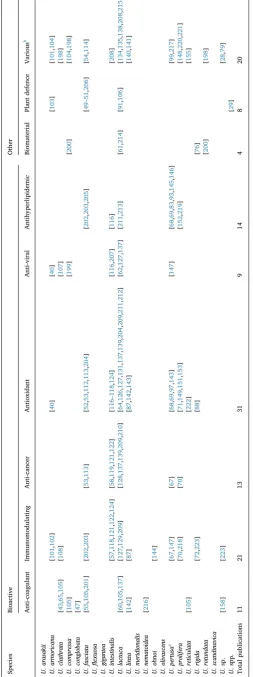
Ulvan has demonstrated significant biological activities in both animal and plant systems in in vitro and in vivo studies (Table 3). In animals, sulfated polysaccharides, such as free glycosaminoglycans (GAGs) and proteoglycans (protein linked GAGs), are intricately in-volved in a broad range of biological processes and have significant structural similarities with ulvan [194,195]. Therefore, the capacity of ulvan to mimic GAGs is a logical link. Sulfated polysaccharides are absent in terrestrial plants and the rationale for the biological activity of ulvans towards plants is less clear; however, ulvan has structural si-milarities with plant rhamnogalacturonans [196] and rhamnolipids from phytopathogenic bacteria [197], providing an insight to its ac-tivity. Importantly, the structural features of ulvan (e.g., molecular weight, degree of sulfation, sulfation pattern, constituent sugars, lin-kages, isomers, and degree of branching) influence its bioactivity. Therefore, ulvan obtained from different species ofUlva, and species from different environments, display significantly varied bioactivity profiles. We review the biological activities attributed specifically to ulvan, focusing on activities with potential biomedical applications and the developing body of technologies in plant physiology, horticulture, and agriculture.
3.2. Cytotoxicity
Cytotoxicity of supplements, nutraceuticals, therapeutic agents or
adjuvants, and biomedical materials is a critical consideration for product development, including a natural product such as ulvan. In this regard, the cytotoxicity of ulvan has been investigated by dosing a range of macrophage cell lines (e.g., RAW 264.7, J774A.1, and peri-toneal) [57,67,70,124], gut cells (e.g., IPEC-1) [101,102,224],fi bro-blast cells (e.g., mouse C3H [L929]) [225], Vero cells [207], Swiss mice and Wistar rats [129]. Ulvan is largely non-toxic, with ulvan fractions from U. pertusa [57,67], U. intestinalis [122,124], U. armoricana [101,102],U. lactuca[129,225,226],U. clathrata[107],U. compressa [199] and U. prolifera [70,227] having > 50% cell viability for cell cultures dosed with≥500μg/ml of sample.
3.3. Immunomodulating activity
Molecules that influence the immune system are known as im-munomodulators and often act by influencing inflammation. The
in-flammatory effects of ulvan have been investigated in vitro using macrophage cell types (e.g., RAW 264.7, mouse peritoneal [122], J77A.1 [124] andfish head kidney [223]), tissues (e.g., intestinal epi-thelial cells [101,102]), and in vivo using animal models (e.g., Wistar rats [209], mice [147,218], and chickens [228]). Inflammation is de-pendent on cytokine production and is largely the result of the activa-tion of NF-kB (a protein complex that controls transcripactiva-tion) by pa-thogen-associated molecular patterns (PAMPs) on toll-like receptors (TLRs) [102,229,230]. Lipopolysaccharides (LPS) on the cell wall of gram-negative bacteria are potent activators of TLRs and are the most commonly employed PAMP class in immunomodulation studies. Acti-vated NF-kB induces transcription of genes coding for cytokines, thus, initiating an inflammatory response [229]. Evaluation of the influence of ulvan on inflammation has been conducted using a number of probes, including signalling molecules (e.g., cytokines; TNF-α, IL1, IL2, IL6, IL10, IL12, CXCL1, CXCL12, CXCL14 and CCL22), active metabo-lites (e.g., PGE2, NO, HOCl), immunoglobulins (e.g., IgM, ICAM and VCAM-1), enzymes (e.g., COX-2, iNOS-2, HO-1 and MPO) and tran-scription related molecules (e.g., NF-kB, mRNA) [57,67,70,72,101,122,124,144,218,227]. A pro-inflammatory response is initiated by immune cells (e.g., macrophages) through the release of cytokines (e.g., IL-1, IL-2 IL-6, IL-18, IL-12, prostaglandin E2 (PGE2), and tumour necrosis factor alpha ([TNF]-α)) [231]. Anti-inflammatory cytokines, such as IL-4, IL-10, IL-11, and IL-13, can inhibit the release of pro-inflammatory cytokines to prevent damage from excessive macro-phage activation. This simplistic representation of the roles of immune cells and cytokines is useful but cytokine activity is complicated, in-volving multiple effects and interacting pathways [231].
Macrophage cells (e.g., RAW 264.7, mouse peritoneal, J77A.1, and
from U. ohnoi also stimulated head kidney macrophages fromSolea senegalensis(solefish) [144]. Overall, ulvans induce a pro-inflammatory response in animal macrophages with potential for application in an-imal and human supplements as non-specific immunostimulants.
The effect of ulvan on the immune response has also been in-vestigated in fish [74,144], porcine (pig) intestinal epithelial cells [101,102], rats [129,209], mice [122,129,218,232] and chickens [228]. Despite the range of organisms assessed and extraction techni-ques applied, ulvan is consistently reported to increase mRNA expres-sion [74,101,102] and promote the release of immunomodulating cy-tokines or enzymes [144,209,218]. For example, a porcine intestinal epithelial (IPEC-1) cell line treated with purified low molecular weight (4.4 kDa) ulvan (5–500μg/ml) fromU. armoricanaincreased the mRNA and the protein expression of cytokines (e.g., CCL20, IL-8 and TNF-α) [102]. In mechanistic studies conducted by incubating human em-bryonic kidney (HEK) 293 cells with ulvan (500μg/ml), ulvan primarily stimulated TLR4, with a subsequent increase in Akt phosphorylation, which activates NF-kB leading to the production of inflammatory cy-tokines. A similar response was recorded for LPS-treated (100 ng/ml) cells. Increased production of NF-kB was also reported in thymus and spleens of mice (Kunming) treated with ulvan fromU. prolifera[218]. These mechanistic insights are an important consideration in the de-velopment of new supplement (nutraceutical or therapeutic) products for animal and human use.
The immunomodulating activity and potency of ulvan varies sig-nificantly between studies of the same species, and between different species. While there is evidence that this variability is due to structural features, some is related to sample purity. In this regard, a significant increase in the potency of the immunomodulatory activity of ulvan from U. intestinalis occurs following purification of a crude extract [57,122,124]. However, the structural features of ulvan (e.g., molecular weight and sulfation) also influence potency. For example, the mole-cular weight of purified ulvan extracted fromU. pertusais an important determinant for RAW 264.7 macrophage activation, with higher mo-lecular weight fractions (1450 kDa and 1690 kDa) leading to > 2-fold increase in macrophage activation compared to a lower molecular weight fraction (365 kDa) [67]. An even more pronounced decrease in head kidney macrophages stimulation was measured for low molecular weight (5.92 kDa) ulvan from U. ohnoi over high molecular weight ulvan (698 kDa) [144]. However, a study with ulvan fromU. intestinalis gave contradictory results with a lower molecular weight sample (28.7 kDa) having significantly higher immunomodulatory activity than a higher molecular weight sample (87.2 kDa). This highlights the im-portance of the interaction of the structural features of ulvan, such as the molecular weight and degree of sulfation, in determining bioac-tivity [57]. Although molecular weight is considered a major factor affecting immunomodulatory activity, there is also an effect of the degree of sulfation between the high (24.5%w/w) and low (6.25% w/ w) molecular weight samples [57]. The level of sulfation is often po-sitively correlated with activity in ulvan and related sulfated poly-saccharides (e.g.,λ-carrageenan and fucoidan). For example, de-sulfa-tion (partial sulfate ester removal) of ulvan fromU. rigidaresulted in an ~50% reduction in its immunomodulatory effect on RAW 264.7 mac-rophages [72] and Turbot peritoneal leucocytes [74], when compared to native ulvan. So far, the studies that have investigated the influence of the structural features of ulvan on its effect on inflammation show that structure-activity correlations are species specific and further stu-dies investigating the structure-activity relationships of ulvans across species are required to elucidate the key structural features driving activity. The latter informs the selection of species for cultivation ex-traction procedures and post-exex-traction modifications, with a focus of enhancing activity as a non-specific immunomodulatory agent.
3.4. Antioxidant activity
Reactive oxygen species (ROS) and reactive nitrogen species (RNS)
are constantly formed in vivo in living tissue by aerobic biogenesis or by oxidative enzymes (e.g., in response to foreign organisms) [233,234]. These highly reactive species attack all major classes of biomolecules, including lipids, DNA, proteins, and sugars. Oxidative stress has been implicated in a host of disorders including inflammatory diseases, neurodegenerative diseases, cancer, cardiovascular diseases, and aging processes. The body has several endogenous enzymatic an-tioxidant systems to overcome excessive ROS/RNS-mediated damage, including superoxide dismutase (SOD), catalase (CAT), glutathione peroxidase (GSH-Px), glutathione reductase and glucose-6-dehy-drogenase, and non-enzymatic antioxidants including glutathione, uric acid, lipoic acid, NADPH, coenzyme Q, albumin, and bilirubin [235]. There are also exogenous antioxidants, including vitamins C and E, carotenoids, phenolic compounds, and trace elements (e.g., zinc and selenium) that play an essential role as antioxidants in living organisms. Food-based protein and polysaccharides also contribute to the anti-oxidant capacity of organisms, by acting as exogenous antianti-oxidants and enhancing endogenous antioxidants [236]. In this regard, the anti-oxidant capacity of ulvan is mediated by radical scavenging and sub-sequent inhibition of lipid peroxidation, and the enhancement of anti-oxidant enzyme (e.g., SOD, CAT and GSH-Px) activities.
rats relative to native ulvan [238]. Tentatively, ulvans with high sulfate content and lower molecular weights are most effective at ameliorating oxidative stress in vivo.
The mechanistic rationale for thesefindings is generally due to ra-dical scavenging activity [69,135,139,238]. However, the capacity for exogenous antioxidants to significantly contribute to radical scavenging in vivo and, therefore, act as an antioxidant endogenously, has been questioned [236]. Furthermore, it was suggested that food-derived antioxidants, like ulvan, act by influencing signalling pathways that lead to the expression of the enzymes involved in the antioxidant de-fence system. Notably, phytochemicals, including ulvan [68,238], porphyrin [240], and fucoidan [241], have demonstrated their capacity to regulate antioxidant enzyme expression [242]. Ulvan is most likely to enhance antioxidant enzyme activity by activating the transcription enzymes (e.g., Nrf2, NF-kB, AP-1, AP-2, Sp1 and C/EBP) involved in the expression of antioxidant enzymes [236,243]. For example, ulvan from U. armoricanastimulates the TLR4 receptor in vitro, which results in the activation of NF-kB and the subsequent upregulation of TNF-α[102], a cytokine that modulates the expression of SOD [243]. However, further research on the mechanism(s) by which ulvan influences the expression of antioxidant enzymes is required to identify the signalling pathway(s) involved. In summary, the capacity of ulvans to boost the endogenous antioxidant system protects the body against toxic oxidation products that cause disease, such as chronic inflammation and cancer.
3.5. Anticancer
The development of cancer is a multistep process initiated by en-dogenous and exogenous factors, which often lead to oxidative attack on DNA, resulting in mutations that disrupt the normal regulatory pathways between cell proliferation, differentiation, and apoptosis [244]. There are a growing number of studies showing that ulvan acts as an anti-proliferation agent and promotes apoptosis in cancerous cells. Ulvan from U. lactuca [94,128,137,139,210], U. intestinalis [58,119,122,245],U. pertusa[67],U. prolifera[70], U. tubulosa[246] and U. fasciata [53,113] all demonstrate anticancer activities for a range of cancer models with murine sarcoma cancer cell line S180 [122], human cancer cell lines (e.g., HepG2 (hepatocellular carcinoma) [94,119,128,137,210], MCF7 (human breast cancer) [128,246], HeLa (cervical cancer) [128], AGS (human gastric carcinoma) [67,70], MKN45 (human gastric cancer) [113], HT-29 (human colon carcinoma) [94,210], HCT-116 (human colon carcinoma), Caco-2 (human colon carcinoma) [94,210], DLD1 (human colon carcinoma) [53,70,113]) and some cancers in animal models (e.g., rats [58,139,209], mice [122]). However, no clinical human trials have yet been conducted.
The anticancer activity of ulvan from different sources is highly variable. For example, ulvan fromU. lactucahas significant cytotoxic activity against a number of human cancer cell lines including HepG2 (hepatocellular carcinoma), MCF7 (breast cancer), and HeLa (cervical cancer) [128]. Ulvan at a concentration of 100μg/ml reduced the in vitro cell viability of all three cancer cell lines to 0%. Although a me-chanism of action was not proposed, similar studies of anti-tumour ef-fects of ulvan on HepG2 and MCF-7 cell-lines noted the increased ex-pression of the pro-apoptotic tumour suppressor p53, and reduced expression of anti-apoptotic protein Bcl-2, supporting the conclusion that ulvan promotes programmed cell death (apoptosis) [119,209,210]. The antiproliferation activity of ulvan fromU. lactucaalso reduces le-vels of proliferating cell nuclear antigen (PCNA) in rat hepatocytes which is indicative of the reduced DNA replication associated with lower proliferation [139]. It is also important to note that many studies have registered only very low to moderate cytotoxic activity relative to traditional chemotherapy drugs [58,67,70,113,122]. For example, ulvan from U. prolifera only had low anticancer activity on human gastric carcinoma (AGS) and human colon cancer (DLD-1) cell lines, with dose dependent inhibition of AGS cell proliferation of 10–26% with concentrations of 200–1000μg/ml [70]. These results do not
necessarily preclude the relevance of ulvan in anticancer therapies. For example, ulvan from U. intestinalis also had no cytotoxic effects on sarcoma 180 tumour cells in vitro at 50–800μg/ml, but reduced sar-coma 180 tumour weight in vivo by 61–71% in mice dosed with 100–400 mg/kg [122]. In combination with the latter, important im-mune organs (e.g., thymus and spleen) were enlarged in ulvan treated mice, supporting the suggestion that the antitumour activity of this polysaccharide originates from its immunomodulatory activity. In summary, the anticancer activity of ulvan appears to operate through one or more of a number of pathways, including the promotion of cancer cell apoptosis, reduction in cancer cell proliferation, and sti-mulation the innate immune response. Furthermore, the pathways af-fected are dependent on the source and/or structure of the ulvan.
There are preliminary results suggesting that both molecular weight and degree of sulfation influence the anticancer activity of ulvan [53,58,70,94]. However, at this point there are no conclusive inter-pretations that can be made with respect to the effect of the structure of ulvan on its anticancer activity. The generally low anti-proliferation activity of ulvan means that ulvan is unlikely to replace established chemotherapy drugs but mightfind application as a co-treatment, due to its broad-spectrum chemopreventative activities (e.g., im-munomodulatory, antioxidant, and anticancer) [209,247]. There are also interesting potential applications for ulvan in cancer therapy. For example, as nanoparticle drug delivery systems for hydrophobic anti-tumour drugs [248], selenium enriched polysaccharide-protein com-plexes for cancer treatment [249], and pH responsive polysaccharide nanosystems that inhibit angiogenesis [250]. However, before ulvan canfind applications as a co-treatment or adjunct in anticancer tech-nologies, there is a need to ascertain the bioavailability of ulvan and whether ulvan influences the efficacy of traditional chemotherapy drugs in combination therapies.
3.6. Anticoagulant activity
The coagulation cascade is activated by two pathways, the intrinsic and extrinsic pathway, both culminating in the production of thrombin through afinal, common pathway [229]. Briefly, this process involves the progressive activation and amplification of serine proteases (e.g., XIII, XII, XI, IX, X and VII) and glycoproteins, collectively termed
“factors”, present within the blood. The intrinsic activation pathway is initiated when factor XII is activated by contact with an anionic surface, while activation of the extrinsic pathway occurs when factor XIII binds with tissue factor (a transmembrane receptor) released from damaged cells. Both intrinsic and extrinsic pathways lead to the activation of factor X, mobilising the common pathway and catalysing the conver-sion of prothrombin to thrombin, and subsequently solublefibrinogen to insolublefibrin that facilitates a clot. Anticoagulant compounds can inhibit all three of the above-mentioned pathways. For example, ulvan generally inhibits coagulation through the intrinsic and/or common pathways [47,60,65,93,142,180,201,216,251], while heparin can in-hibit intrinsic, extrinsic, and common pathways. Mechanistic details regarding the anticoagulant activity of ulvans, and other potential an-ticoagulants, are commonly elucidated using three tests, the activated partial thromboplastin time (aPTT), thrombin time (TT) and pro-thrombin time (PT), which determine if inhibition acts on the intrinsic and/or common pathways, common pathway, and extrinsic pathway, respectively.
while oversulfation of the hydrolysed sample (SO3−= 34.4%) led to a further 20% increase in aPTT. While similar structuactivity re-lationships occur for TT, there is minimal PT activity reported. How-ever, data from a study aiming to optimise the enzymatic extraction of ulvan from U. proliferawith the intent to optimise anticoagulant ac-tivity demonstrated an interaction between degree of sulfation and molecular weight [251]. Namely, increasing sulfation led to high an-ticoagulant activity until a molecular weight threshold (< 200 kDa) was reached, after which there was a complete loss of activity [251]. In summary, the anticoagulant activity of ulvan is dependent on degree of sulfation and molecular weight [43,47,65,142,251], with a higher de-gree of sulfation enhancing anticoagulant activity. The relationship between molecular weight and anticoagulant activity remains unclear, and this may also be dependent on the source of the ulvan.
The potency of the anticoagulant activity of ulvan is dependent on species and ecophysiological factors, which directly affect the structure of ulvan [47,65]. The anticoagulant activities for ulvan isolated from different biomass sources are between ~2–40 times less active than heparin. For example, one of the better performers was a highly sul-fated ulvan fraction (SO3−= 35.2%) isolated fromU. conglobata[47]. This sample at 2μg/ml yielded a 2.5-fold increase in aPTT compared to a 6.2-fold increase in aPTT for 2μg/ml of heparin. While the latter highlights the potential of ulvan as an anticoagulant, the overall effi -cacy of ulvan relative to commercial drugs, like heparin, is less than these previous results indicate, as it only acts on two of the three coa-gulation pathways. This does not diminish the relevance of the antic-oagulant activity of ulvan or its capacity to be used in the preparation of anticoagulants. For example, ulvan acts on the intrinsic pathway, which activates multiple pro-inflammatory, pro-coagulant, and im-munomodulating pathways [252].
3.7. Antihyperlipidemic
The human body has a sophisticated lipoprotein transport system that utilises triglyceride (TG) rich very low-density lipoprotein-choles-terol (VLDL) to shuttle fatty acids to adipocytes and muscle, resulting in cholesterol rich low-density lipoprotein-cholesterol (LDL-C) that dis-tributes cholesterol for steroidogenesis and cell membranes [253]. Ex-cess cholesterol is transported back to the liver by high-density lipo-protein-cholesterol (HDL-C) for recycling or conversion to bile acids (BA) followed by its removal from the body. Imbalances in the lipo-protein transport system are linked to metabolic syndrome. Patients with metabolic syndrome are often hyperlipidaemic, a condition char-acterised by abnormally high blood levels of lipid(s) and lipoprotein(s), which can lead to cardiovascular diseases, such as coronary artery disease and atherosclerosis. Importantly, the consumption of macro-algae and the associated sulfated polysaccharides, including ulvan, has demonstrated antihyperlipidemic activity in vivo [254–256].
To measure the antihyperlipidemic activity of foods and supple-ments, such as sulfated polysaccharides, the serum total cholesterol (TC), TG, HDL-C and LDL-C of hyperlipidemic rat and mice models are commonly assessed [83,93,145,146,202,211,257]. Using these para-meters ulvan fromU. pertusa [68,69,83,93,145,146,238,257,258],U. fasciata[116,202,203,205],U. lactuca[211,213],U. prolifera[152,219] andMonostroma nitidum[259] have significant antihyperlipidemic ac-tivity, reducing or maintaining low levels of TC, TG, LDL-C, and in-creasing or maintaining a high level of HDL-C. Both molecular weight and degree of sulfation influence this activity. For example, Wistar rats fed a high starch feed supplemented with native ulvan (151.6 kDa) from U. pertusa had significant reductions in serum TC (45%) and LDL-C (54%), with no significant effect on TG and HDL-C compared to control rats fed the same high starch diet [145]. However, rats fed high starch diets with low molecular weight ulvan (28.2 kDa) showed no effect on either TC or LDL-C but significantly reduced TG (78%) and raised HDL-C (61%) relative to control fed rats, the mechanisms of which are dis-cussed below [68]. There is some early evidence that a higher degree of
sulfation may enhance the antihyperlipidemic activity [257]. For ex-ample, the serum TC of female rats treated with native ulvan (SO3−= 22.5%) at 250 mg/kg was reduced by 28%, while treatment with oversulfated ulvan (SO3−= 40.6%) reduced serum TC by 44% relative to the hyperlipidemic control group [257]. Derivatisation of native ulvan (e.g., acetylation) also influences antihyperlipidemic ac-tivity [146]. However, interactions between the degree of substitution and molecular weight are unclear and need to be understood to opti-mise structures that affect higher antihyperlipidemic activity.
The effect of molecular weight on the parameters used to assess antihyperlipidemic activity supports the conclusion that several me-chanisms are operating in parallel. It has been proposed that reduction in serum TC and LDL-C in ulvan supplemented hyperlipidemic rats results in LDL-C conversion to bile acid in the liver followed by ex-cretion [145]. This is further supported by an increase in faecal bile acid concentrations in ulvan supplemented hyperlipidemic rats. In contrast, supplementation of hyperlipidemic rats with lower molecular weight ulvan (28.2 kDa) had no effect on either TC or LDL-C but had elevated faecal bile acids and reduced TG and raised HDL-C relative to control fed rats [145], suggesting that other mechanisms, such as the upregulation of the synthesis of cholesterol in the liver, are also im-portant. Treatment of lipid-loaded hepatocytes with an ulvan-like polysaccharide from Monostroma nitidumresulted in lower lipid con-centrations accompanied with downregulation of the cholesterol synthesis gene for 3-hydroxy-3-methyl-glutaryl-CoA (HMG-CoA) re-ductase, upregulation of the cholesterol catabolism gene for choles-terol-7-α-hydroxylase (CYP7A1), and LDL uptake gene for LDL-receptor [259]. To corroborate these results, reduced serum TC concentrations measured in ulvan (U. prolifera) treated rats downregulated HMG-CoA reductase and the cholesterol regulating transcription factor sterol regulatory element binding protein 2 (SREBP-2) [219]. In a later study, reduced serum TG concentrations measured in ulvan treated rats were accompanied by downregulation of acetyl-CoA carboxylase (ACC) and its regulating transcription factor, SREBP-1c (regulates fatty acid synthesis) [260]. In theory, structurally different ulvan fractions may influence the regulatory genes (SREBP-1c and SREBP-2) to varying degrees, helping to explain the contradictory results obtained by Pengzhanet al.[145]. Evidence for another alternative or additional mechanism suggests that antioxidant effects may contribute to the an-tihyperlipidemic effects of polysaccharides [261,262]. In this me-chanism, molecules with high antioxidant capacity (or those that can upregulate the endogenous antioxidant system) limit lipid oxidation by ROS, which leads to the accumulation of cholesterol due to changes in its biosynthesis and metabolism. In summary, the antihyperlipidemic activity of ulvan appears to operate by multiple mechanisms in parallel, the balance of which depends on the structural features of ulvan. This provides opportunity to optimise antihyperlipidemic supplements for more targeted applications.
3.8. Anti-viral
vivo models using mice [127,147].
The antiviral effects of native ulvans against viral targets (measured as 50% Inhibitory Concentration (IC50), the concentration of ulvan re-quired to inhibit viral yield by 50%) are mixed ranging from weak (IC50> 150μg/ml [62,199]) to significant (IC50= 0.1–30μg/ml [107,127,207]). There are some interesting results supporting the use of ulvan in antiviral therapies. Ulvan fromU. clathratais an effective anti-viral for NDV, a fatal virus found in chickens causing large an-thropogenic food losses [107]. Treatment with ulvan provided a con-centration-dependent inhibition of NDV entry into Vero cells with an IC50of 0.1μg/ml. The activity was related to inhibition of an entry protein known as NDV fusion protein F. Although ulvan fromU. pertusa had only moderate antiviral activity (40% inhibition at 100μg/ml) against AIV-H9N2, it had a beneficial effect in a test relevant to im-munisation [147], where AIV-H9N2 vaccination combined with ulvan treatment (50 mg/kg) led to an ~100% increase in antibody titre re-lative to the vaccination alone. This effect was attributed to the en-hancement of the humoral immune response, due to the im-munomodulatory effects of ulvan.
Variations in the antiviral activity of ulvan from different sources indicate a significant effect of structure; however, there are only a limited number of studies that probe the antiviral activity of ulvan and, consequently, the understanding of its structure-activity relationships is limited. However, the required structural features of ulvan are essen-tially similar to other sulfated polysaccharide antivirals, where activity is optimised by a high degree of sulfation and high molecular weight [264,267]. In this regard, treatment of HSV infected Hep-2 cells with a highly sulfated (SO3−= 22%) ulvan fraction from U. compressa re-sulted in 100% HSV inhibition at 100μg/ml and had an IC50of 28.2μg/ ml, compared to 153μg/ml for native ulvan (SO3−= 6%) [199]. Fur-thermore, ulvan with higher molecular weights (34 kDa) had 2–5 times the antiviral activity of low molecular weight ulvan (< 5 kDa). How-ever, further studies are required to verify the generality of these re-sults. In summary, the investigation of ulvan as an antiviral is in its infancy and at this point ulvan has variable antiviral activity against specific targets, with promise as an immunostimulant co-treatment for vaccinations.
3.9. Plant defence
More recently ulvans have been found to also influence the signal-ling pathways involved in plant immunity. The effect that ulvans have on plant immunity has been investigated in vitro with cell cultures (e.g., wheat and rice) [50] and in vivo with various non-cropping (e.g., thale cress) and cropping (e.g., apples, beans, wheat and barley) plant species [29,49–51,91,268–272]. Ulvan fromU. fasciata[49–51,268,271,272], U. lactuca [91,269] and U. armoricana [29,270] all enhance the in-ducible defences of plants, a phenomenon known as “priming”. In-ducible plant defences operate by the initial recognition of microbe/ pathogen-associated molecular patterns (MAMPs/PAMPs), or elicitors, by plant cell membrane bound pattern-recognition receptors (PRRs), known as MAMP/PAMP-triggered immunity (MTI/PTI). Plants also have resistance (R) genes that encode cytoplasmic receptors that re-cognise pathogen effector molecules designed to suppress PTI, known as effector-triggered immunity (ETI) [273,274]. Plant immune re-sponses downstream of MTI/PTI and ETI include the production of pathogenesis-related proteins that hydrolyse pathogen cell wall con-stituents, plant cell wall fortification through synthesis of lignin and callose, and the production of antimicrobial secondary metabolites [275,276]. An additional response unique to ETI is the hypersensitive response (HR), which is instigated by a pulse in the production of re-active oxygen species (ROS), triggering localised cell death at the site of infection. MTI/PTI and ETI also trigger systemic acquired resistance (SAR), where the defence alert is transferred from the site of pathogen ingress to distal plant tissues leading to an alert (or primed) state that is more responsive to subsequent pathogen attacks [277]. These plant
immune responses are orchestrated by a complex balance of phyto-hormones (e.g., salicylic acid, jasmonic acid, ethylene and abscisic acid, cytokinins, auxins, brassinosteroids, and gibberellins) dependent on the identity of the pathogen and its trophic lifestyle (i.e., biotrophic vs. necrotrophic) [274]. Therefore, a great deal of information can be found by studying how the balance of molecules involved in the plant immune response are affected by treatment with potential priming agents, such as ulvan.
The effect of ulvan treatment on plant immunity has been in-vestigated using pathogen and plant base measures including pathogen growth and development, plant health measures, such as growth, spotting and wilting, and molecular probes/profiles, such as hormones, proteins, and DNA. Ulvan from U. fasciata inhibits a key stage (ap-pressoria differentiation) in the pathogenic cycle of the anthracnose causing fungi Colletotrichum gloeosporioides [268]. Consistent with a priming effect in vivo, tests on ulvan pre-treatment on apple leaves reduced disease severity by as much as 50% over control plants. Similar results were obtained when ulvan (fromU. fasciata) treatedArabidopsis thaliana(thale cress) was inoculated with eitherAlternaria brassicicola (black spot fungi) or Colletotrichum higginsianum(anthracnose fungi) [49]. Interestingly, the degree of sulfation did not influence patho-genesis. However in another study, desulfation of ulvan fromU. lactuca significantly reduced its capacity to induce the production of the de-fence enzyme, phenylalanine ammonia-lyase (PAL) [91]. In this study, a > 2-fold increase in the activity of PAL occurred when tomato plants were treated with ulvan oligomers relative to native ulvan [91]. In-creased PAL activity was accompanied by an increase in salicylic acid. Therefore, in this case induction of SAR appears to be salicylic acid dependent. However, a study using transcriptomics combined with hormone profiling and enzyme activity measurements found that ulvan fromU. armoricanainduced plant immunity via the jasmonic acid sig-nalling pathway inMedicago truncatula(Fabaceae),Nicotianae tabacum (Solanaceae), and Arabidopsis thaliana (Brassicaceae) [29]. Salicylic acid concentrations were unaffected by ulvan treatment, while jas-monic acid concentrations increased relative to control plants. Fur-thermore, the mode of action of ulvan was verified by its capacity to induce the expression of jasmonic acid-dependent genes (e.g., PDF1.2 defensin and lipoxygenase NtLOX1 promoter), while failing to induce the expression of salicylic acid-dependent genes (e.g., PR1a and PR5). Regardless of the signalling pathways responsible, ulvan demonstrates significant activity as a bio-elicitor and capacity to act as a priming agent enhancing both plant health and productivity.
According to the current understanding of plant immunity the ca-pacity of ulvan to elicit plant defences requires that it isfirst recognised by the plant (either directly or indirectly), probably during primary signalling events (e.g., PTI or ETI). Therefore, the assumption that ulvan has analogous structural features to existing MAMPs/PAMPs is a logical conclusion and molecules that have structural similarities with ulvan such as plant rhamnogalacturonan I and rhamnolipids from phytopathogenic bacteria [196,197] also trigger defence responses. Typically, these latter examples contain rhamnose and uronic acids (but not sulfate esters), and these moieties may be important for ulvans activity. Notably, the presence of rhamnose (in ulvan) was required to induce immune defence responses in tomato plants, while glucuronic acid (in glucuronan) had no effect [91]. In terms of molecular weight, tomato plants treated with ulvan oligomers had up to twice the PAL activity than control plants. Conclusions regarding the degree of sul-fation remain unclear, with one report indicative of a positive corre-lation and another indicative of no effect. Clearly the optimisation of ulvan products for use as bio-elicitors is in its infancy; however, its capacity to elicit plant immune responses is promising for reducing agricultural reliance on traditional pesticide treatments.
4. Conclusion