Reception date: 14 June 2017 • Acceptance date: 17 October 2017
The ecology of the open practitioner: a conceptual framework
for open research
Adrian Stagg
University of Southern Queensland (Australia) [email protected]
Abstract
Open Educational Practices (OEP) have gained traction internationally over the last fifteen years, with individuals, institutions, and governments increasingly interested in the affordances of openness. Whilst initiatives, policies, and support mechanisms are evident, there is an ever-present danger of localised contexts being unintentionally unrecognised, which has a negative effect on mainstreaming the practice sustainably. This paper presents a conceptual framework for open research based on Bronfenbrenner’s’ Ecology of Human Development (1979) and asserts that it is through an understanding of complex influences and contexts of practice that strategic and operational processes to enable open education are manifested. It presents the framework through the lens of an emerging research project examining the experience of OEP in four Australian universities which will apply the framework as a guide for not only survey and interview question design, but also data analysis with the aim to inform broader policy development locally and nationally.
Keywords: open educational resources; open educational practice; theory of ecological development; higher education; academic development; affordance theory
Introduction
The term Open Educational Resources (OER) has been researched for fifteen years. Over that time the Cape Town Declaration and the Paris Declaration have reached an international audience, operationalised by global progress in institutional and national policy, legislation, funding initiatives, research projects, conferences, symposia, and communities of practice. Despite this, awareness and capacity-building remain two of the seemingly indefatigable barriers to widespread engagement with Open Educational Practice (OEP).
The position of OEP has been at the nexus of educational change as it relates to teaching practice, teaching resources, and the role of the student and teacher in an open and connected learning environment. As student and teacher context and prior experience is accepted as an integral part of constructivist, and connectivist pedagogies, so too should this inform the sustainable, embedded transformation that open education promises.
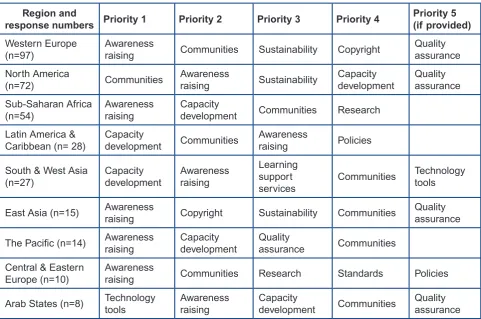
Table 1: Identified priorities by geographic region. Adapted from D’Antoni (2008, pp. 24–25)
Region and
response numbers Priority 1 Priority 2 Priority 3 Priority 4
Priority 5 (if provided) Western Europe
(n=97)
Awareness
raising Communities Sustainability Copyright
Quality assurance North America
(n=72) Communities
Awareness
raising Sustainability
Capacity development
Quality assurance Sub-Saharan Africa
(n=54)
Awareness raising
Capacity
development Communities Research Latin America &
Caribbean (n= 28)
Capacity
development Communities
Awareness
raising Policies
South & West Asia (n=27)
Capacity development
Awareness raising
Learning support services
Communities Technology tools
East Asia (n=15) Awareness raising Copyright Sustainability Communities Quality assurance
The Pacific (n=14) Awareness raising Capacity development Quality assurance Communities
Central & Eastern Europe (n=10)
Awareness
raising Communities Research Standards Policies
Arab States (n=8) Technology tools Awareness raising Capacity development Communities Quality assurance
Note that only priorities that were identified by at least 50% of respondents were included in this table.
Open educational practice: a question of context
Whilst the promise of OER has been equity of access to education, to reduce the associated costs of education, broader participation and opportunities, and opportunities to raise the quality of education internationally, the priorities for OEP differ by geographic region. The results of an international community of practice across nine geographic areas (D’Antoni, 2008) highlighted the perceived priorities for resource investment to support OEP (Table 1). Whilst there are some areas of common concern, very few of the priorities are listed in consistent order. This is unsurprising when one considers that each geographic region has differences in culture, education, infrastructure, access, and equity of education.
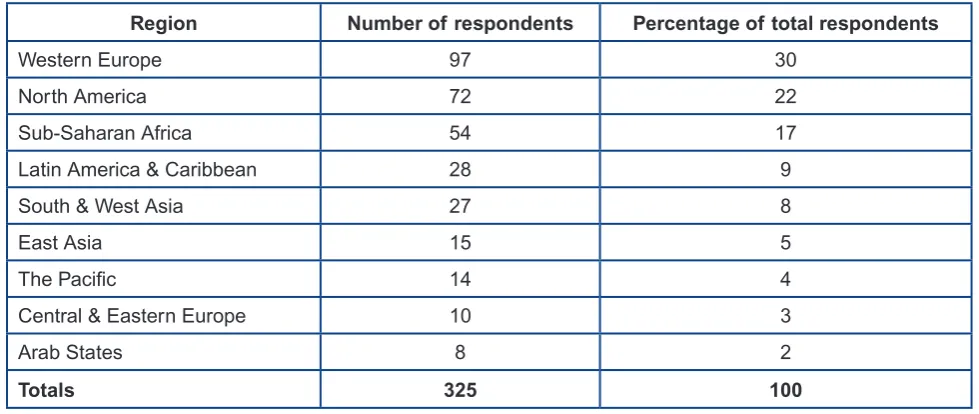
Western Europe account for 52% of respondents, whilst others are represented significantly lower such as Arab States (2%), The Pacific (4%), and East Asia (5%). The contextual differences between each region make the aggregated data problematic for international strategies, but when viewed by region, an actionable list becomes more apparent.
Table 2: Response by location as a percentage of overall responses (D’Antoni, 2008).
Region Number of respondents Percentage of total respondents
Western Europe 97 30
North America 72 22
Sub-Saharan Africa 54 17
Latin America & Caribbean 28 9
South & West Asia 27 8
East Asia 15 5
The Pacific 14 4
Central & Eastern Europe 10 3
Arab States 8 2
Totals 325 100
In order to gain traction globally, open education resources, and OEP need to focus on enabling reuse and repurposing for localisation of education. Creative Commons and Public Domain licensing remain key levers for this process, but providing resources in non-proprietary formats (rather than assuming access to software) is an essential part of a sustainable movement. It is this reliance of proprietary formats that have hampered reuse in Sub-Saharan Africa (Muganda, Samzugi & Mallinson, 2016) for example, and a criticism of MOOCs (Godwin-Jones, 2014) which had previously promised to reach new learners. The considerations that drive repurpose-enabled resource and learning design only arise from a combination of awareness raising and regard for the context of other practitioners. Discounting the role of context in open education, however, implicitly empowers a very different, marginalising agenda.
Almost a decade has passed since the publication of these research findings, but more recent work reinforces geographic differences in open education adoption. Latin America still focuses on capacity development and policy implementation as government policy making education mandatory and free does not have universal traction, and expenditure on education does not show marked increases (Toledo, Botero & Guzman, 2014). The capacity of teachers to improve the quality of education, especially in Argentina, Chile, Columbia, and Uruguay, remains a priority for action, as does the development of models for creation and dissemination of OER (Toledo et al., 2014), and general awareness-raising (Torres, 2013). Brazil’s government has actively invested in open education, open science, and open government initiatives (Pena, 2015) in response to citizen expectations for transparency, accountability and affordability.
outcomes) has acted as a mechanism for partnerships such as the Open University UK (Mtebe & Raisomo, 2014), and the active participation of OER Africa (2016) in the higher education environment. Recent research conducted in Turkey (Islim & Cagiltay, 2016; Islim, Koybasi & Cagiltay, 2016) mirrors the findings for Eastern Europe; again showing that awareness-raising (this time focused on students), and perceptions of quality and standards were particularly salient. In direct contrast though, Turkish Faculty responded that the greatest priority for action was the protection of their intellectual property rights, and establishing incentives for (re)use of OER (Kursun, Cagiltay & Can, 2014).
Across these regions, it can be reasonably argued that similarity remains in articulated priorities, despite nearly ten years of OER research and practice. This demonstrates that local context is still critical to understanding OER and OEP; that is, a universal approach is neither appropriate nor beneficial for increasing the traction and acceptance of open education globally. The affordances of openness, therefore, are interpreted locally, and the practitioner environment mediates the ability of the individual to fulsomely engage with OER and OEP.
The role of context
The term ‘affordances’ is used interchangeably with ‘opportunities’ in higher education; most often when describing educational technology. Open Educational Resources (OER) are no different.
Tracing the term back to Gibson’s (1977) work is useful as it reinforces the need to reconsider language, or at least, purposefully understand and consistently use language meaningfully. Gibson’s lens was ecological physics, stating ‘the affordances of the environment are what it offers animals, what it provides or furnishes, for good or ill (1977, p. 68). That is, the ‘combination of properties’ (p. 67) found in an environment or component of that environment are judged by the inhabitants of the environment, who ultimately ascribe worth or value. As each species of animal occupies an environment niche, pre-existing conditions first need to be evident to support the species to occupy the niche. The pre-existing conditions, therefore, enable the affordances, and also shape ease of use of these affordances.
In the same way, pre-existing conditions need to exist in an educational environment (and the levels will be explored using Bronfenbrenner’s work as a lens in the next section) for the affordances of OEP to be judged as ‘worthy’ or valuable’ by practitioners. The extent to which an affordance is evident, or perceived as such, is entirely dependent on environment inhabited by the practitioner. For example, the pre-existing condition of reliable, stable Internet access enables global sharing of resources. The Creative Commons licence is another pre-existing condition.
When this ‘combination of properties’ (Gibson, 1977, p. 67) is realised, the affordances of OEP, namely accessing existing resources to save time and build on the work of others, and sharing local content, become apparent. If one has access to Creative Commons licensing, but an unreliable (or inaccessible) Internet connection, the affordances are interpreted differently –and the resulting action– is likewise different. Obviously, the above example is simplistic in its failure to recognise awareness levels, individual alignment with open philosophies, technical proficiency, pedagogical and licensing support, platforms to enable sharing, and even the presence of policies that support (or act as a barrier to) sharing.
difficult. This manifests as a commercial reality for entities that rely on closed or controlled access to proprietary sources of information –such as privatisation of research outcomes, and textbook publishing models– thus positioning free culture and open education as counter-movements to business interests.
All of these ‘conditions’ form part of a larger contextualised ecology of practice – thus leading to Bronfenbrenner’s work.
Why Bronfenbrenner?
Engagement with Bronfenbrenner’s’ ecology of human development and its application to OEP is predicated on value propositions of education requiring articulation prior to an exploration of the framework.
Firstly, if we accept the integral role of context in not only OEP, but in education globally, it is accompanied by a commitment to the notion that each educator and learner applies their own experiences, assumptions, knowledge, and values to an educational encounter. Paolo Freire’s pedagogy of the oppressed (1997) notionally rejects education as ‘banking’ – that is, that students are ‘empty accounts’ that are enriched only when the teacher makes a ‘deposit’ (of knowledge). Freire argued that accepting the banking metaphor was tantamount to ‘dehumanising’ the learner by actively discounting and devaluing their existing knowledge and experience in favour of prevailing information (which he linked to education as a tool of the oppressor). Constructivist and connectivist pedagogies explicitly build upon this position by actively applying student-centred learning design.
Secondly is the somewhat problematic nature of semantics in the open education discourse. ‘Adoption’ of open practice has become part of the vernacular to describe the process whereby a practitioner accepts (‘adopts’) OEP; with an implied outcome of transforming practice to include openness. A more realistic description would be ‘engagement’; wherein a practitioner explores OEP through the lens of their own context. The outcome of engagement is conceptual and practical alignment between aspects of OEP and the practitioners teaching approach, mediated by influencing contextual factors.
It is possible to repurpose a definition of student engagement and propose that a higher education practice is
‘the time and effort that practitioners put into their teaching practice, that leads to experiences and outcomes that constitute success, and the ways an institution allocates resources and organises professional learning opportunities and support services to induce staff to participate in, and benefit from such activities’ (adapted from Garrison & Vaughan, 2013, p. 27).
The way in which practitioners are engaged with OEP, and how the institutional factors influence this will be discussed further in this paper.
whether the local environment permits open practice); discrete parts of the environment (such as the interaction between government proprieties and educational funding); and even between the practitioner and aspects of the environment (such as how national research agendas can be linked to government funding, and how these two agendas then influence the publishing behaviour of an academic).
Whilst the ecology is equally as valid for describing the student experience this paper will focus on the practitioner only. The inter-relationship of practitioner and ecology is expressed at four distinct levels:
• Microsystem. These are the inter-relationships present in an individuals’ most immediate environment - including peer relationships and the personal working space – that impact on a persons’ development.
• Mesosystems occur when two or more microsystems interact and an individual is able to correlate these systems. This could be in terms of expectations of others in the setting, or behavioural norms between settings. Whilst the conceptual bridging can often provide an in-dividual with a sense of shared role across the microsystems, conflict can occur when an individual perceives that two entirely different roles from two distinct microsystems are now present in a single mesosystem – leading to a crisis of role identity.
• Exosystems are the larger forces that have an (often) indirect influence over the individual. Institutional policy, expectations for graduate outcomes, requirements of professional accred-iting bodies, and changes to work environment or structure are all examples of exosystems encountered by academic staff.
• Macrosystem are the highest tier of the ecology, representing culture, socio-economic status, typology of country (such as developing, developed, industrialised, and semi-industrialised). The macrosystem is a societal construct of shared values, history, and identity, and can be altered or reconstructed through generational change.
Each level has inter-dependencies and inter-relationships that influence an individual’s practice, assumptions, values, and ability to conceptualise change and development. In an educational setting, all four levels of the ecology informs the practitioners approach to teaching and learning, and frames their response to enhancing, transforming, or challenging their own practice. For OEP researchers, the ecology becomes a map of influencing factors providing a macro- and micro-view of an institution and how OEP may distinctly manifest (or develop) under those conditions, and how perceived role aligns with openness.
What is development?
(Siemens, 2013) is an example of student-centred learning and teaching which presents a catalyst for re-positioning the teacher – often from creator-of-content, to curator-of-content, and guide. In part, connectivism was a response not only to the digitisation of resources, but also the availability of OER.
When a practitioner experiences examples of open practice, this alone can be a catalyst for change in role, as Bronfenbrenner states that ‘active engagement in, or even mere exposure to, what others are doing often inspires the person to undertake similar activities on her own’ (1979, p. 6). The success of these endeavours is contingent on the presence of supportive networks or processes that both present in the meso-, and exo-systems within the ecology and, are valued by the culture or subculture. Thus, the role of mediating artefacts (Conole, 2009), or those people and resources that can explicitly articulate, contextualise, and support open practice (whether as library guides, websites, access to learning designers, membership in a network), becomes integral to successful change and development.
Development is influenced by the ability to correlate a range of settings and apply these settings to one’s own environment. Sperber and Wilsons’ (1995) relevance theory asserts that individuals always try to seek relevance in any setting (and thus establish value), and that they will usually expend as little energy as possible (a path of least resistance) to assimilate relevant knowledge into practice. Recognition of the epistemological, contextual, and situational value of change is part of the evolving nature of teaching experience; with relevance as a driving force for individual change in teaching practice. Thus, any type of professional learning support for open education needs to be purposefully and deliberately aligned with the micro-, meso-, and exo-systems of the ecology to maximise relevance, although there is space in this model to acknowledge that macro-systems will influence priorities and desired outcomes for professional learning. Traction for OEP is therefore established through relevance-making, and value proposition. The latter can be reasonably argued as part of relevance-making, but assumes different guises at each level of the ecology, that is, institutional policy-makers may ascribe a different value on openness at the strategic level than practitioners seeking the operational value of openness. When viewed through the lens of professional learning, this applies ‘contextual positioning’ (Amundsen & Wilson, 2012, p. 109-110) to development initiatives. This positioning chooses to focus on activities that will lead to ‘improving or enhancing an instructor’s individual teaching practice versus activities that engage faculty in teaching enhancement as a socially situated practice’ (p. 109), and that support is identified and implemented for individual use.
Bronfenbrenner describes development as ‘a lasting change in the way in which a person perceives and deals with his environment’ (1979, p. 3; gendered language retained from the original text). Mindful of this definition, support, relevance-making, and value all become part of a sustainable change in practice – which is not possible without an understanding of context, or the ability to create aspirational realities.
Reshaping reality: OEP as aspirational reality
individual reality, but as part of a communal whole. The lifeworld is therefore influenced by, and able to influence, broader reality. A concurrent, cyclical development process is thus possible as the individual undertakes internal development (such as capacity- and knowledge-building that may alter values and priorities) that allows greater agency for external development within the achievable reality. That is, new realities are more achievable as a result of internal development processes.
The role of individual and communal realities is an important touchstone for OEP as it is not just the individual’s ability to conceive changes to their reality (and the means by which to achieve them), but also the positioning of openness. It could be argued that if openness is presented as a too radically ideological reality, it dis-incentivises engagement. Presenting OEP in combative terms (i.e. ‘the battle for open’) or as a ‘disruptive’ idea that will lead to the destruction of traditional education systems may be counter-productive to gaining traction in higher education.
A more strategic approach for OEP to gain a significant foothold in higher education is one designed around achievable, local aspirational realities, coupled with opportunities for professional learning and support – all of which requires contextual understanding for success implementation.
Ecology, development, and reality: applying Bronfenbrenner an OEP research
project
Thus far, this paper has established –based on context– the need for a deeper understanding of open education practitioners (both emerging, and established) environments of practice and the manner in which these environments act as enablers and barriers to OEP. The ecology of development has been leveraged as a mechanism for articulating and exploring contextual influences on practice, as well as the role of constructed and mediated realities in development. This approach privileges the role of contextual focus for strategic and operational initiatives related to OEP and provides a lens for communicating the value of openness in higher education, and will be enacted (as described below) by the author as part of emerging research.
The role of the conceptual framework is to organise the aspects of inquiry contained within the research project as a way of representing them to an end-user, or reader (Antonenko, 2015). It provides purposeful articulation of the phenomena to be observed, and in whom they will be observed. Additionally, it seeks to represent (often visually) theory that demonstrates alignment between the phenomena to be researched, and the methods employed to do so (Ravitch & Riggan, 2012), as a foundation for empirical research.
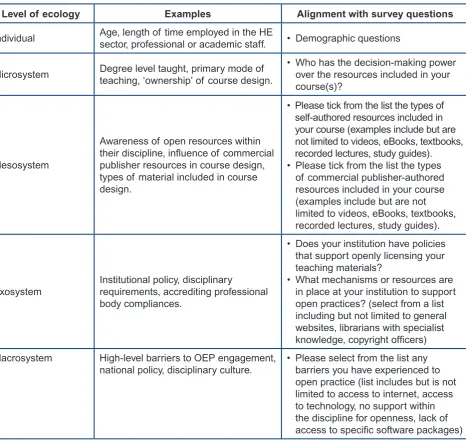
Table 3 provides a sample representation of the data sources within a proposed survey that are linked to the levels of ecology. Each level provides a conceptual ‘boundary’ for data, but these are porous boundaries due to the relational nature of the influencing factors. When applied to the author’s emerging research on the Australian higher education (HE) experience of OEP, an analysis of the influences on engagement with OEP is sought to establish ‘institutional identities in openness’ across four case study sites.
The case study method will be used as it supports the investigation of a phenomenon in context (Yin, 2014), rather than seeking an artificial divide between context and activity. It is applied when the researcher approaches continuing phenomena situated in complex circumstances and to examine the behaviour of groups within a particular structure (Yin, 2014). The method therefore directly supports studying and comprehending the complexity of contextual open practice. Whilst previous studies (Bossu, Bull & Brown, 2015) have examined the Australian OEP environment, this was undertaken at the ‘exosystem’ and ‘macrosystem’ levels only. This study uniquely contributes to an understanding of OEP by examining the impact and inter-relationship between all systems in the ecology in order to propose processes for guiding OEP initiatives that recognise and operate alongside local practices.
[image:9.595.69.536.112.552.2]Analysis of the survey indexed against the ecology levels is anticipated to illuminate areas for further investigation through semi-structured interviews with practitioners, referred to by Gillham (2000) as ‘the most important form of interviewing in case study research (p. 85). As the research
Table 3: Examples of ecological influences in higher education contexts
Level of ecology Examples Alignment with survey questions
Individual Age, length of time employed in the HE sector, professional or academic staff. • Demographic questions
Microsystem Degree level taught, primary mode of teaching, ‘ownership’ of course design.
• Who has the decision-making power over the resources included in your course(s)?
Mesosystem
Awareness of open resources within their discipline, influence of commercial publisher resources in course design, types of material included in course design.
• Please tick from the list the types of self-authored resources included in your course (examples include but are not limited to videos, eBooks, textbooks, recorded lectures, study guides). • Please tick from the list the types
of commercial publisher-authored resources included in your course (examples include but are not limited to videos, eBooks, textbooks, recorded lectures, study guides).
Exosystem
Institutional policy, disciplinary
requirements, accrediting professional body compliances.
• Does your institution have policies that support openly licensing your teaching materials?
• What mechanisms or resources are in place at your institution to support open practices? (select from a list including but not limited to general websites, librarians with specialist knowledge, copyright officers) Macrosystem High-level barriers to OEP engagement,
national policy, disciplinary culture.
is positioned to inform change and improve engagement with OEP, the ‘methodology of friendship’ (Fontana & Frey, 2008, p. 117) is intentionally aligned with the desired outcomes. Arising from Kong, Mahoney and Plummers’ (2001) work, the methodology of friendship assumes that the neutrality of the interview as data collection is compromised by complex contextual factors; thus the interviewer takes ‘an ethical stance in favour of the individual or group being studied. The interviewer becomes an advocate and partner in the study, hoping to be able to use the results to advocate social policies’ and change in practice (Fontana & Frey, 2008, p. 117). As openness contains an ideological component, and the author is dispositionally empathetic to openness, this method pragmatically frames the interview component for this research. The research design intentionally embraces the idea that ‘the more methods we use to study [practitioners], the better our chances will be to gain some understanding of how they construct their lives and the stories they tell us about them[selves]’ (Fontana & Frey, 2008, p. 152).
It is this deeper emerging narrative of OEP that is sought by engaging with, and implementing this framework.
Future directions
This conceptual paper forms the model for emerging mixed methods research of the Australian higher education experience of OEP. The conceptual model informs and is interwoven in the mixed methods approach for this research, with explicit links to all questions in the initial survey and the semi-structured interviews that form the secondary data collection phase. A case study approach has been selected for four Australian institutions to provide a deep understanding of individual cases as a basis for a broader meta-analysis. Over the course of this research, the conceptual model will be tested, refined, and re-presented as part of the overall research outcomes. It is suggested that such an approach is transferable across the sector (and to other geographic regions) as it is inherently disposed to revision and repurposing based on context.
Conclusion
Context is the foundation for understanding teaching and learning practice, and the influences on practitioners are evident at varying levels of a complex ecology. In order to gain momentum, OEP must be positioned in such a manner as to offer a value proposition to practitioners, whilst incentivising change of practice. Successful implementation of any OEP strategy requires a fulsome understanding of this ecology to present achievable aspirational reality shifts for the sector, institutions, faculties, and individual staff, whilst concurrently operationalising support mechanisms to purposefully engage practitioners in professional development related to OEP.
Presenting OEP as a direct threat, challenge or radical reconceptualization of teaching role is counter-productive, but institutions should instead seek approaches that are consistent with incremental change aligned with institutional and individual values in education.
References
Amundsen, C. & Wilson, M. (2012). Are we asking the right questions? A conceptual review of the educational development literature in higher education. Review of educational research, 82(1), 90–126. https://doi.org/10.3102/0034654312438409
Bossu, C., Bull, D., & Brown, M. (2015). Enabling Open Education: A Feasibility Protocol for Austral-ian Higher Education. In C. Bonk, M. Lee, T. Reeves & T. Reynolds (Eds.), MOOCs and Open Education Around the World. Routledge
Bronfenbrenner, U. (1979). The ecology of human development: experiments by nature and design. Cambridge: Harvard University Press.
Conole, G. (2009). The role of mediating artefacts in learning design. In Handbook of research on learning design and learning objects: issues, applications, and technologies (pp. 187-207). IGI Global.
D’Antoni, S. (2008). Open educational resources: the way forward. Deliberations of an international community of interest. UNESCO. Retrieved from https://oerknowledgecloud.org/sites/oerknowl-edgecloud.org/files/Antoni_OERTheWayForward_2008_eng_0.pdf
Fontana, A., & Frey, J. (2008). The interview: from neutral stance to political involvement. In N. Den-zin, & Y. Lincoln (Eds.). Collecting and interpreting qualitative materials, 3rd ed. (pp. 115-160).
Thousand Oaks: Sage.
Freire, P. (1997). Pedagogy of the oppressed, revised ed. London: Penguin. Gadamer, H. (1989). Truth and method, 2nd revised ed. London: Continuum.
Garrison, R. & Vaughan, N. (2013). Institutional change and leadership associated with blended learning innovation: two case studies. The Internet and Higher Education, 18, 24-28. https://doi. org/10.1016/j.iheduc.2012.09.001
Gibson, J. (1977). The theory of affordances. In R. Shaw, & J. Bransford, Perceiving, acting and knowing: toward an ecological psychology (pp. 67-82). United Kingdom: Lawrence Erlbaum. Gillham, B. (2000). Case study research. London: Continuum.
Godwin-Jones, R. (2014). Global reach and local practice: the promise of MOOCs. Language learning and technology, 18(3), 5-15. Retrieved from http://llt.msu.edu/issues/october2014/emerging.pdf Islim, O.; & Cagiltay, K. (2016). The impact of OER on instructional effectiveness: a case study.
Eurasia journal of mathematics, science & technology education, 12(3), 559-567. https://doi. org/10.12973/iser.2016.2003a
Islim, O.; Koybasi, N.; & Cagiltay, K. (2016). Use of Open Educational Resources: how, why, and why not? International journal of teaching and learning in higher education, 28(2), 230-240. Retrieved from http://www.isetl.org/ijtlhe/pdf/IJTLHE2245.pdf
Kong, T., Mahoney, D., & Plummer, K. (2001). Queering the interview. In J. Gubrium, & J. Holstein (Eds.). Handbook of interview research (pp. 239-258). Thousand Oaks: Sage.
Kursun, E.; Cagiltay, K.; & Can, G. (2014). An investigation of faculty perspectives on barriers, incen-tives, and benefits of the OER movement in Turkey. International review of research in open and distributed learning, 15(6), 14-32. http://dx.doi.org/10.19173/irrodl.v15i6.1914
Mtebe, J. & Raisomo, R. (2014). Challenges and instructors’ intention to adopt and use open edu-cational resources in higher education. International review of research in open and distributed learning, 15(1). http://dx.doi.org/10.19173/irrodl.v15i1.1687
Muganda, C.; Samzugi, A.; & Mallinson, B. (2016). Analytical insights on the position, challenges, and potential for promoting OER in ODeL institutions in Africa. International review of research in open and distributed learning, 17(4), 36-49. http://dx.doi.org/10.19173/irrodl.v17i4.2465
OER Africa (2016). Who we are. Retrieved from: http://www.oerafrica.org/about-us/who-we-are Pena, K. (2015). Comparative analysis of public policies in open access models in Latin America.
Brazil and Argentina cases. International Journal of Educational Technology in Higher Educa-tion, 12(1), 15-24. https://doi.org/10.7238/rusc.v12i1.1947
Ravitch, S. M., & Riggan, M. (2012). Reason and rigor: How conceptual frameworks guide research. Thousand Oaks, CA: Sage Publications.
Sperber, D. & Wilson, D. (1995). Relevance: communication and cognition (2nd ed). Oxford: Blackwell.
Toledo, A.; Botero, C.; & Guzman, L. (2014). Public expenditure in education in Latin America. Rec-ommendations to serve the purposes of the Paris Open Educational Resources Declaration. Open Praxis, 6(2), 103-113. http://dx.doi.org/10.5944/openpraxis.6.2.119
Torres, N. (2013). Embracing openness: the challenges of OER in Latin American education. Open Praxis, 5(1), 81-89. http://dx.doi.org/10.5944/openpraxis.5.1.33
Weller, M. (2011). A pedagogy of abundance. Spanish Journal of Pedagogy, 249, 223–236. Yin, R. (2014). Case study research: design and methods, 5th ed. Los Angeles: Sage.