14 May 1980
I . .J. ~ English Edition
European Communities
EUROPEAN PARLIAMENT
Working Documents
1980- 1981
DOCUMENT 1-150/80
f
I~
t
~~:
' '
fu
~L ; • , it c'R
RDP£1JV , -" ""
!ieport
./'"FO"nnAf
"
nm
-1-1C0~~~1r.),::1-HJ"lJ
··~.,,,1W
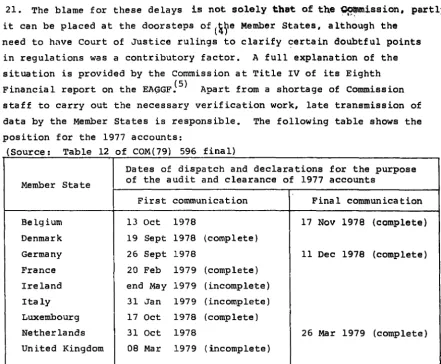
ON
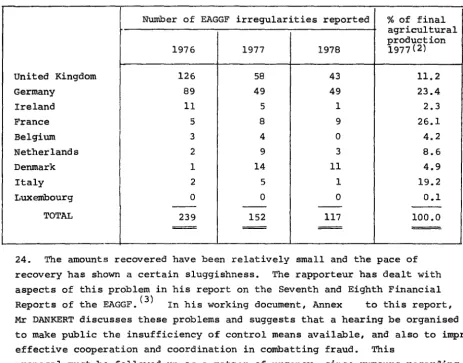
'"'·r
'ASH!NGTo
..}._ffVtf,£
N"
n
,rodrawn up on behalf of the Committee on Buagetary Control
on/
I. · the accounts of the European ParUament and the discharge in
respect of the 1978 financial year
II.
the discharge to be granted to the Commission on the
implementation of the budget of the European Communities for the
1978 financial year and the report of the Court of Auditors
(Doc. 1-567 /79)
III.
the discharge to be granted to the Commission of the European
Communities in respect of the utilization of the appropriations of
the fourth European Development Fund in the 1978 fmancial year
(Doc. 1-138/80)
IV. the comments accompanying the decisions granting a discharge on
the implementation of the budget of the European Communities
for the 1978 rmancial year (Article 85 of the Financial Regulation
of 21 December 1977)
V. the discharge to be granted to the Commission of the European
Communities in respect of the activities of the fii'St, second and third
European Development Funds for the 1978 financial year
Rapporteur: Mr R.C. BATTERSBY
on 10 December 1979 the President of the European Parliament transmitted. to the committee on Budgetary Control the report of the Court of Auditors in respect of the 1978 financial year (Doc. 1-567/79).
on 4 september 1979, the Committee on Budgetary Control appointed Mr BATTERSBY rapporteur for the discharge to be granted in respect of the
1978 financial year.
By letter of 14 February 1980 the Committee on Development and cooperation was authorized to deliver an opimion an Doc l-567/79.
The Committee on Budgetary Control considered the revenue and expenditure accounts of the Community, the report of the Court of Auditors and the special reports of its draftsmen on the various policy sectors of the Community at its meetings on 26/27 November 1979, 17/18 December 1979, 23/24 January 1980, 31 January/1 February 1980, 20/21 February 1980, 17/18 ~arch 1980,
31 March/1 April 1980, 21/22 April 1980 and 29/30 April 1980.
At its meeting on 29 April 1980, the Committee unanimously adopted Part IV - comments accomp~mying the decisions granting a discharge on the implementation of the budget and of the amending and supplementary budgets of the European Conm1unity for the 1978 financial year.
Present at time of voting: Mr Aigner, Chairman; Mrs Boserup, Vice-Chairman; Mr Price, Vice-Chairman; Mr Battersby, rapporteur;
Mr Balfe (deputizing for Mrs Fuillet), Mr Irmer, Mr Edward Kellett-Bowman, Mr Key, Mr Simonnet and Mr John Mark Taylor.
At its meeting on 30 April 1980 the Committee on Budgetary Control unanimously adopted Parts I, II and III; it adopted Part V by 11 votes in favour with 1 against.
Present at time of voting: Mr Aigner, Chairman; Mrs Boserup,
Vice-Chairman; Mr Battersby, rapporteur; Mr Alber, Mr Gabert, Mr Gallagher (deputizing for Mr O'Leary), Mr Irmer, Mr Edward Kellett-Bowman, Mr Key, Mr Langes (deputizing for Mr Notenboom) , Mr Simonnet and Mr Wawrzik
(deputizing for Mr Pflimlin).
The opinion of the Committee on Development and Cooperation is attached.
C 0 N T E N T S
A. I. PROPOSED DECISION
on the accounts of the European Parliament and the discharge
in respect of the 1978 financial year •.•..•...••••••.•• 5
II. PROPOSED DECISION
on the discharge to be granted to the Commission on the
implementation of the budget of the European Communities for
the 1978 financial year and the report of the Court of
Auditors . . . • . . . • . . • . • · •.• 6
III. PROPOSED DECISION
on the discharge to be granted to the Commission of the
European Communities in respect of the implementation of
the activit i.es of the fourth European Development Fund in
the 1978 financial year . . . . . . . . • . . . . . • • • • • . • • • 9
IV. MOTION FOR A RESOLUTION
containing the comments accompanying the decisions granting
a discharge on the implementation of the budget of the
European Communities for the 1978 financial year . . . • . . . 10
V. PROPOSED DECISION
on the discharge to be granted to the Commission of the
European Communities in respect of the activities of the
first, second and third European Development Funds for the
1978 financial year . . . • . • . • • • . . 19
B. EXPLANATORY STATEMENT . . . • . . . • • . . 20
ANNEXES:Working documents on the various Community policy sectors
I Management of revenue: draftsman Mr GABERT •...•..•.••..••. 47
II Personnel, administration and operational outlay:
draftsman Mr PRICE . . . • . . . • . . . • . . . • . . • 59
III Research, investment and energy: draftsman ~r COLLA .••..•.. 73
IV Title 3 excluding energy and research:
draftsman Mr NOTENBOOfJ, . . . • • . • . . . • . • . . . • . . • • . . • • • 99
v
European Social Fund: draftsman Mr WETTIG • . . . • . . • . • . . • . . 107 VI European Regional Development Fund: draftsman Mr GOUTHIER •. 123VII
VIII
IX
EAGGF Guarantee Section: draftsman Mr DANKERT
EAGGF Guidance Section:
Development aid policy:
draftsman Mr FILIPPI
draftsman Mr IRMER
133
155
159
X Expenditure of Parliament, the Council, the Court of Justice and the Court of Auditors: draftsman Mr SIMONNET ..•••••• 183 XI Decentralised agencies, autonomous organisations and
satellite bodies: draftsman Mr Edward KELLETT-BOWMAN 197
A
I
The Committee on Budgetary Control hereby submits to the European Parliament ·the following proposed decision:
PROPOSED DECISION
on the accounts of the European Parliament and the discharge in respect of the 1978 financial year
The European Parliament,
- having regard to the interim report of the Committee on Budgets (Doc 102/79)
- having regard to its resolution of 25 April 1979 (1)
- having regard to the revenue and expenditure accounts and the statements of assets and liabilities of the Communities for the accountancy procedures in respect of the 1978 budget and to the report of the court of Auditors for the accounts for the 1978 financial year (Doc 1-567/79}
- having regard to the report of ·the Committee on Budgetary Control
(Doc. 1-150/80),
l. Fixes the accounts of the European Parliament as at 31 December 1978
at a final figure of 93,001,844.08 EUA including expenditure
commitments incurred during that financial year of 78,468,862.14 EUA actually spent and of 14,532,981.94 EUA still to be paid out at the end of that financial year.
2.
Grants a discharge to its President and
Secretary-General, pursuant to Rule 50 a (3) of its Rules of
Procedure, in respect of the 1978 financial year.
(l) OJ No C 127 of 21. 5.1979,
p. 38
I I
The Committee on Budgetary Control hereby~ubmits to the European Parliament the following proposed decision•
PROPOSED DECISION
on the discharge to be granted to the Commission in respect of the implementation of the budget of the European Communities for the 1978 financial year and the supplementary and amending budgets and tm report of the Court of Auditors.
The European Parliament,
- having regard to the Treaty establishing the ECSC and in particular Article 78g thereof,
- having regard to the Treaty establishing the EEC and in particular Article 206b thereof,
- having regard to the Treaey establishing the EAEC and in particular Article 180b ehereof,
- having regaid to the revenue and expenditure accounts and the financial statements for the accountancy procedure~ in respect of the budget for the 1978 financial year,
- having regard to the report of the Court of Auditors on the accounts for the 1978 financial year and the answers of the Institutions to the report (Doc 1-567/79),
- having r~a rd to the Council recommendation on the granting of a discharge to the Commission in respect of the implementation of the budget and of
1.
the amending and supplementary budgets for the 1978 financial year (Doc. 1-77/80)
- having regard to the report of the Committee on Budgetary
Control, the annexed working documents on the ~arious Community policy sectors, and the opinion of the Committee on Development and Cooperation (Doc. 1-150/80),
Notes that
(a) Estimates of revenue for the 1978 financial EUZ\
year totalled 12,362,651,592.00
Made up as follows EUA
O'..m resources 6,896,000,000.00
Contributions provided for 5,341,382,366.00 in Decision of 21 April 1970
Other 12 5, 272.226.00
(b) Estimates of expenditure for the 1978 financial year
totalled 12,362,654,592.00
I
i
/
2. Notes that
The surplus of the 1978 financial year to be carried forward(!) . amounted to
Comprised as follows:
EUA
Revenue collected in respect
of 1978 12,181,666,326.45
Payments made against appropriations
for 1978 10,733,847,301.50
Appropriations for 1978 carried
forward 1,527,721,076.53
Net amolmt resulting from
cancellations of appropriations carried forward from pievious
financ.ia 1 years 166,591,492.06
Deficit arising on conversion of the balance sheet at 31 December
1977 into EUA on 1 January 1978 45,060,802.09 0
0
o.
3. Grants a discharge to the Commission in respect of the following amounts shown in the revenue and expenditure accounts
(a) Revenue
Entitlements established for the 1978 financial year
- Entitlements collected at 31
December 1978 broken down as follows: 1. Amounts collected from the
entitlements for the financial year Broken down as follows:
own resources
Contributions under the Decision of 21.4.1970
Other
2. Amounts collected from entitlements carried forward from the preceding
6,674,219,710.84 5,340,296,846.66 167,149,768.95 EUA 41,618,638.39 12,188,984,757.72 11,884,191,574.11 12,181,666,326.45
financial year 297,474,752.34)
1
Made up as follows:
Own resources 16,991,387.60
Contributions provided for under the
Decision of 21.4.1970 (364,466,139.94)
Other 50,000,000.00
In accordance with Article 15 of Regulation
289.1/77
OJ L 336, 27.12.1977, page
s.
(b) Expenditure (payments shown in the accounts for the financial year)
EUA
10,733,847,301.50
4.
Draws attention to its resolution embodying the comments accompanying the decision granting a discharge and requests the Institutions to report o~ the measures taken following those comments in accordance with Article 85 of the Financial Regul~tion:II!
The committee on Budgetary Control hereby submits to the European Parliament the following proposed decision:
PROPOSED DECISION
on the discharge to be granted to the Commission of the European Communities in respect
of
the utiliz~t.ionof
the
appropriati.cms ·D'f'·t'fle'-'feU!rth
~European
Development Fund for the 1978 financial year
The European Parliament
- having regard to the Treaty establishin~ the European Economic Comraunity and in particular Article 206b thereof,
- having regard tc the ACP-EEC Convention of Lorn~.
- having regard to the internal agreement on the financing and administration of Community aida
- having regard to the revenue and expenditure account, the balance sh~et
and the report on the activities of the fourth European Developmen~ ~undO)oc~-~
- having regard to the report of the Court of Auditors on the accounts for
the 1978 financial year and the answers· of the Institutions tQ the r~~ort
(Doc.l-5£7/79),
-having regard to the report of the Committee on Budgetary Control
·and
the·
Opinion of the Committee on Development and Cooperation
(Doc.l-150~~1.
Grants a discharge to the Commission in respect of the following amounts shown in the revenue and expenditure accounts for the 1978 financial year:- revenue: amounting to 147,300,535.89 EUA
- expenditure (payments): amounting to 319,791,308.98 EUA
2. Instructs its President to communicate this decision to the commission of the European Communities, to forward it to the other Institutions and to arrange for its publication in the Official Journal (L series).
- 9 - PE 64. l 23
/fin.
IV
The Committee on Budgetary Control hereby submits to the European Parliament the following motion for a resolution together with explanatory statement:
MOTION FOR A RESOLUTION
containing the comments accompanying the decisions granting a discharge on the implementation of the budget of the European Communities for the 1978 financial year
The European Parliament
1. Calls upon all the institutions to take the necessary measures to comply with the following comments and asks them to submit a written report OI. these measures, pursuant to the provisions of Article 85,
third paragraph, of the Financial Regulation;
2. Believes that it is necessary to ensure continuity in the matter of the follow-up to the comments set out in the present resolution and will consider a report in the matter at its November part session;
3. Notes the comments which accompanied the Council's recommendation in regard to the 1978 discharqe and welcomes the evidence of
a more positive attitude by the other arm of the budgetary authority towards its responsibility in regard to the control of the Community budget;
4. Deplores the fact that, once again, most of Parliament's amendments to the payments appropriations were implemented in a totally
inadequate way and finds this virtual non-implementation unacceptable;
5. Finds that the reasons for this failure are twofold: fi:rs tly, there was a lack of political courage on the part of the Commission in not
6. Lays special emphasis on the view, stated by Parliament on numerous occasions, that the programme or management committees may have only an advisory role, which must not impede the Commission in the exercise of its decision-making powers; points out in particular that,in regard to the implementation of the budget,the Commission is answerable to the budgetary authority alone;
7. Demands that, henceforth, the Commission acts in a far more positive way in regard to the amendments effected by Parliament to the budget;
B. Observes that transfers within and between chapters during the course of the financial year have the effect of grossly distorting the budget as adopted;
9. Considers that the levels of carry overs from one financial year to another drastically distort the accounts, take from transparency and clarity, and frustrate the intentions of Parliament as reflected in the annual budget, as adopted;
As regards the general accounts
10. Notes that, on the basis of the report of the Court of Auditors, the general acco•mts are in an unsatisfactory state and asks the Commission to report to Parliament on proposals for across-the-board improvements in the transparency, management and presentation of the budget;
As regards agricultural stocks
11. Is disturbed (a) at the high level of stocks of certain commodities carried at significant cost to the Community budget, (b) at the lack of clarity as to the precise ownership of these stocks, and (c) that the amounts of the stocks had not always been physically verified;
12. Considers that it is essential that a comprehensive study be made of all aspects of these stocks with a view to establishing the full
financial facts and implications and requests that a report be made to Parliament in the matter before the end of 1980;
Revenue
13. Asks its Committee on Budgetary Control to investigate whether the present rules and implementation procedure can guarantee the fair and uniform collection of revenue, particularly in view of the recent ruling of the Court of Justice in regard to the Rotterdam-Roubaix-Como case no. 267/78;
14. Urges the Council to act as soon as possible on the Commission's proposals for strengthening its powers in the fields of information, control and the collection of amounts due;
15. Suggests that the number of professionally qualified staff responsible for the control of Community revenue as well as for the management of Community expenditure should be increased;
16. Asks the Commission to inform it, as soon as possible, of the results of investigations into matters relating to the uniform application of Community rules on the assessment of customs value and the effects of the new system which enters into force in the second half of 1980;
Administrative expenditure and staff
17. Recommends that the institutions should consider jointly the most appropriate permanent structure to ensure a continuing review of their management methods and staff deployment (the Commission
participating simply to make some of the expertise of their existing department available to the other institutions) ;
18. Asks the Commission to submit a report on the action it has taken on the proposals for reform of the Commission of the European Communities and its services (report of Mr Spierenburg) ;
19. Urges the Commission, in the interests of greater clarity and budgetary transparency, (a) to give effect to the main recommendations of the Court of Auditors in its report on the 1978 financial year in regard to transport; (b) to ensure that the contract for supply is open to competitive tender at least once every three years; and (c) that the report called for in Doc. 1-537/79 be made available as soon as possible; notes that a precise procedure for the use of air-taxis is now in
operation following the discussions between the Commission, the Parliament and the Court of Auditors;
20. Observes that the provisions of the Financial Regulation applying to the settling of advances on staff mission exoenses are often not being respected and urges that adjustments to salaries should be made promptly in future cases;
22. Commends the Commission's recent endeavours to coordinate the mission activities of its directorates-general and urges that (a) representation at meetings outside the normal work places of the Community be kept 'to
the minimum level that is consistent with the efficient discharge of the Commission's role and (b) a single official on mission should act on behalf of more than one directorate-general where this is practicable and expects the other ins_tj..tutions _to fQ].low the Cq_mmis_l'li_on_' s P1='acti r;e_:
23. Considers that the authorization of missions outside the nQ~mat ~ork ~la9es of ~he Communitv should be followed up, wher~ ~pp~OP-riat~, by a
report enabling a check on the results achieved and a sharing of the information gained with other relevant officials;
24. Deplores the absence of up-to-date standardized implementing rules for the Financial Regulation because this makes control harder to operate and could give rise to variations between the systems operated in the different institutions of the Community and urges that this matter be set right bv the end of 1980;
25. Urges that the opportunity be taken when the Financial Regulation is next amended to find practical solutions to the end-of-year accounting problems which have arisen;
26. Calls on its Committee on Budgetary Control to look at the procedures and arrangements for making grants to societies and associations benefiting from Community financial assistance;
27. Recommends that, where possible, the information offices of the Commission and the Parliament should be housed in the same building so that they can share common facilities such as a library, publications stores, conference room and telex equipment;
28. Calls upon the Commission to put forward draft amendments to the implementing provisions of the Staff Regulations to reinforce the exceptional nature of the payment of family allowances for adult
dependants and that, in the meantime, it should confine its discretionary power in the grant of this allowance to genuinely exceptional cases;
29. Calls upon the other institutions to work with the Commission in preparing similarly amended implementing provisions and to follow the same policy, in the meantime, in the award of the allowance;
30. Asks the Committee on Budgetary Control to review the situation regarding the payment of the allowance for arduous working conditions to officials in the field of nuclear science at a later date and urges the Commission to exercise strict control over the payment of this allowance at all its Research Centres;
Research, investment, energy and industrial policy
31. Notes a considerable degree of underspending, which, in the case of energy in particular, may be attributed to the delays in the adoption of regulations by the Council,and to the nature of some of the regulations, under which the Council must approve each individual project:
32. Calls for strengthening of internal control and stricter rules concerning:
- the JRC as regards inventory checks, stock accounts and the calculation of charges for contracts for research or the supply of services,
- Indirect Action as regards the percentage participation in and advances paid on cost-sharing research contracts:
33. Considers that in regard to research i t is necessary to establish closer links between Direct and Indirect Action, improve the administrative coordination of research as a whole, concentrate Indirect Action on specific themes, rationalize the advisory system and further improve evaluation of research:
34. Takes the v~ew that, as regards energy and research: greater budgetary discipline is called for: increased budgetary and accounting transparency
is required: the possibility should be investigated of simplifying the procedures for the conclusion of contracts;
35. Will consider an ad hoc report on the budgetary accounting and control aspects of the JRC on the basis of a report prepared by its Committee on Budgetary Control;
36. Condemns the low level of utilization of the appropriations earmarked for industrial policy, technological research and training programmes;
European Social Fund
37. Regrets that, despite the increase in unemployment, the Commission has been hindered in implementing the Social Fund by the slowness of the Member States to submit applications for assistance and requests the Council to take the necessary steps to ensure that the national authorities in the States concerned improve the situation; Aid to disaster victims in the Community
39. Emphasizes the need for the recipients of payments, when they accept the aid, to submit to checks by the Commission or by the Court of Auditors and to hold themselves accountable for the use of such aid:
European Regional Development Fund
40. Stresses the importance of speeding up the flow of payments so that Fund aid can be more effective and deplores the fact that delays have occurred and calls on the Council to take the necessary corrective measures:
41. Expresses its dissatisfaction at the delays and inefficiencies on the part of Member States in transmitting to the Commission the statistical data needed to gauge the impact of Fund expenditure:
42. Asks that the Court of Auditors should carry out more on-the-spot control visits and should inform the European Parliament of the results:
43. Asks, also, that the Court of Auditors should check that funded projects form part of a systematic development plan:
44. Draws attention to the principle of additionality and insists that contributions from the Fund should complement, rather than replace, national expenditure on regional development: and asks that an
assessment be made by the Commission as to how far the principle is, in fact, being observed;
45. Whilst appreciating the difficulties, deplores the inexactitude of estimation of agricultural expenditure;
46. Believes, furthermore, that there is need for greater coordination between the agricultural price review and the budgetary estimating procedure so as to ensure more accurate estimates of agricultural appropriations;
47. Urges the Commission to prevent overlapping between different items in titles 6 and 7 and to desist from creating random financial reserves which delay measures likely to restrain the growth of agricultural spending;
48. considers that the Member States should endeavour to adhere to the deadlines laid down for the transmission of justifying documents and asks the Commission to report regularly to the Parliament in this matter;
49. Points to the risks of possible speculation in the agricultural sector and insists that the Commission takes all possible measures to close off opportunities for market manipulation;
50. Demands that the budgetary authority be informed before any decision is taken concerning the sale of substantial amounts of agricultural products subsidised by refunds likely to lead to an exceeding of the budgetary cover;
51. Underlines the problems confronting the auditing authorities in the combat against fraud and irregularities and instructs the Committee on Budgetary Control to organize a meeting to which should be invited representatives from the national audit bodies, national administrations and the Court of Auditors to study these difficulties and to suggest remedies;
EDF, Stabex and food aid
52. Observes that the fact that the EDF is not yet budgetized presents many technical disadvantages and is, politically, abnormal and unacceptable and calls once again for its budgetization;
53. Will consider a separate report on the functioning, effectiveness, mechanisms and control procedures for STABEX;
54. Considers that the problems concerning the implementation of food aid raised by the Court of Auditors should be solved as a matter of urgency, particularly the lack of transparency; affirms that, as regards food aid, priority should be given to humanitarian and development aspects over agricultural policy aspects and awaits (a) the report which is being drawn up by the Court of Auditors and (b) the report of the Committee on Development and Cooperation on this subject in order to be able to pro-nounce on the matter, as early as possible, in a well-informed manner;
Decentralized agencies, autonomous organizations and satellite bodies
56. Accepts that the complicated role of the EC entails, of necessity, the setting up of a number of specialized agencies and the granting of a degree of autonomy to certain administrative units but considers that a close watch should be kept on such bodies and the justification for their continued existence should be reviewed from time to time;
57. Considers that the financial regulations governing such bodies should be standardized as far as possible and discharge for them should be a matter for Parliament;
58. Believes that cost-effectiveness yardsticks should be applied to these bodies and their management standards should be examined with a view to ensuring that best value is obtained for the Community outlay involved;
59. Expresses a formal reserve in respect of the discharge for the European Schools and will consider the issues further in the light of a report from the Committee on Budgetary Control;
Borrowing and lending
60. Attaches a special priority to the need to have the borrowing and lending policies of the Community brought fully within the framework of the
budgetary procedures and is of the opinion that the present system of budgetization, as used in the 1978 budget, provides a totally inadequate basis for control by the political bodies of the Community over the Commission's management policy and points out that only a part of the Community's borrowing and lending activities are actually entered in the budget;
61. Notes that, although the Community enjoys an excellent reputation as a borrower on the world market, Parliament considers that it has had too
little information to fully assess the management aspect of the 1978 budget in this context, and expresses its wish to receive much more adequate information in respect of future financial years;
62. Stresses that the sharing of responsibility for management and imple-mentation of overall Community policy in this sphere makes a coordination of policy decisions highly important;
63. Calls on the Committee on Budgetary Control to exercise effective control not only over the borrowing and lending operations managed by the Commission but also over the activities managed by the EIB using Community funds, as regards both the policy pursued and the economic results achieved;
64. Asks the Commission of the EC to present a detailed report, if necessary on a confidential basis1on borrowing and lending activities in a manner which will satisfy the requirements of the specialized committees of
Parliament:
65. Proposes that greater use should be made of interest rebates to ensure that inves·:ments correspond more effectively to political objectives:
66. Asks it Committee on Budgetary Control to draft a report on a system of centralized political responsibility for borrowing and lending activities:
67. Requests the Court of Auditors to comment on borrowing and lending operations in its next annual report;
As regards Institutions other than the Commission
68. Stresses the need for respect by all the Institutions of the Community for the provisions of the financial regulation in regard to the post of financial controller:
v
The Committee on Budgetary Control hereby submits to the European Parliament the following proposed decision:
PROPOSED DECISION
on the discharge to be granted to the Commission of the European Communities in respect of the activities of the first, second and third European Development Funds for the 1978 financial year
The European Parliament,
- having regard to the report of the Court of Auditors on the accounts for the 1978 financial year and the answers of the Institutions to the report (Doc. 1-567/79),
- having regard to the report of the Committee on Budgetary Control and the opinion of the Committee on Development and Cooperation
(Doc. 1-150/80),
- considering that the Treaty of 22 July 1975, which, notably, conferred on Parliament the power of discharge in respect of the implementation of the annual budget applied to the accounts for the 1978 financial year, including of course the financial
operations of that year in regard to the activities of the first, second and third European Development Funds:
1. Grants a discharge to the Commission in respect of the financial management of the first, second and third EDFs during the 1978 financi.al year;
2. Instructs its President to communicate this decision to the Commission of the EC, to forward it to the other institutions and to arrange for its publication in the Official Journal
(L series).
B
EXPLANATORY STATEMENT
Introduction
1. Two acts of the European Parliament have great political signiiicance. These are, firstly, the adoption of the general budget of the EC which
sets out the annual expenditure and revenue programmes of the Community and in which Parliament enacts its fiscal policy; and,secondly, the
political closing of the accounts - "the discharge" - by which Parliament puts its seal of approval on the budget as implemented. Specialised work in relation to the first is assigned to the Committee on Budgets.
Last July, the Eurcpean Parliament established the Committee on Budgetary Control to look after control and auditing matters. The two Committees
are linked. Although both are completely independent, they have a very close
~orking relationship.
2. During the course of the financial year, the Committee on Budgetary Control follows closely the pace of the implementation of the budget. Apart from dealing with ad hoc matters and following up specific issues noted in the course of the study of the accounts for earlier years, the Committee considers the quarter~y reports which are specifically provided for at Article 29 of the Financial Regulation as well as transfers.
3. The present report on the 1978 accounts is very much a team effort. The principal rapporteur was assisted by twelve colleagues who prepared working documents on different aspects of the 1978 budget and its
implementation. These working documents, which are annexed to the report, have simplified considerably the task of the rapporteur; they have als9
identified areas where reforms are needed and, by their positive and constructive approach, will make it possible for the reader to have a better comprehension of the complicated Community budget.
4. In the following paragraphs, the rapporteur describes the significance of the discharge - refusal of which would be tantamount to a vote of censure of the commission, the special political importance attaching to amendments, certain shortcomings in the accounts of the Community, the reaction of
the executive to the comments on the 1976 accounts (as the 1977 accounts were granted discharge in November 1979 only, it is too early to expect a considered reaction from the Commission), and makes a series of observations on specific points that he considered warranted special attention.
5. In examining the implementation of the budget, the Committee on
European Parliament amendments is checked, the Committee does not find fault with unaerspenaing on certain lines of lesser political significance. A special watch is kept for extravagance, irregularities ana infringements
of proper procedures. Above all, emphasis is placed on ensuring that worthwhile use is made of taxpayers' funds.
Significance of the discharge
6. Article 17 of the Treaty of 22 July 1975, which amended the Treaty establishing the European Communities, provided for the addition of an article 206b cs follows:
"The Assembly, acting on a reconunenaation from the Council which shall act by a qualified majority, shall give a discharge to the Commission in respect of the implementation of the budget. To this end, the Council ana the Assembly in turn shall examine the accounts ana the financial statement referred to in Article 205 ana the annual report by the Court of Auditors together with the replies of the institutions under audit to the observations of the Court of Auditors."
7. This new article, which was ratified by all the Member States, strengthened the role of Parliament considerably by giving it the last say in determining whether or not the annual budget of the Community was implemented satisfactorily from the political viewpoint and whether the Commission had carried out its duties fully.
8. This alteration in financial procedures reflected a significant shift within the budgetary authority in regard to control over the use of Community funds. Previously, the grant of discharge was a responsibility which was shared between Council and the Parliament to be exercised jointly. Since
1975, the Council has furnished an annual recommendation and the final decision has been made by Parliament.
Special importance attaching to the implementation of amendments
9. Because Parliament's main powers are in the budgetary sphere, it is quite appropriate that it should be empowered to pronounce definitively on the implementation of the budget. Parliament can amend the budget substantially during the course of its adoption. Such amendments require heavy majorities and political support extending across several groups. Once voted, however, their dir6ct implementation lies with Institutions other than Parliament itself. If such amendments are not implemented, then a serious situation exists. The political will of Parliament is thwarted. And this has, in fact, been the case. Year after year, Parliament has amended the draft
general budget of the European Communities; these amendments nave been accepted by the council and the Commission has been charged with the task of carrying out its responsibilities under Article 205 of the EEC Treaty which states that
"The Commission shall implement the budget, in accordance with the provisions of the regulations made pursuant to Article 209, on
its own responsibility and within the limits of the appropriations".
Year after year, when the outturn is examined, it is discovered that the overwhelming majority of the amendments voted by Parliament has not been implemented. The results for 1978 implementation are set out in Annex XIII
to this text.
Amendments to the 1978 budget
10. Of the 52 amendments at table 1 of the annex referred to in the
preceding paragraph - which provided for payments being made in the course of the 1978 financial year, less than one-third was implemented to a reasonably satisfactory extent. The following table gives fuller details of the degree of implementation:
Percentage of payment appropriations provided in the amendments that was actually used in the financial year
1978
non implemented
0 - 10 10 - 25 25 - 50 51 - 75 75 - 90 90 - 100
Number of amendments 34 5 1 7 2 2 1 52
Total of appropz;.iations invol~ed mEUA 476.3 7.3 19.0 75.8 8.0 0.3 0.1 586.9
11. This, clearly, is unacceptable. The Commission has explained that some of the appropriations for payment not used in the budget year are carried over into the following year. However, Parliament's wish has been to have the money used during the budget year for which it was voted - and not in ensuing years. Of course, the under-utilisation is not confined
The Commission's argument that it has eventually used a proportion of the funds in ensuing years is not really relevant.
Criticism by the Court of Auditors
12. The Court of Auditors, which assists Parliament in its control work, makes the following critical observations(!) concerning delays in spending voted funds:
"The und~r-utilisation of payments appropriations on the present scale is a very serious matter since it calls into question both the basis on which the budgetary estimates were drawn up and the soundness of the financial management ••••• The principal objective in introducing differentiation i.e. separate appropriations for commitment and payment was to enable the amount of payment
appropriations entered into the budget for the year in question to Qe reduced to the absolute minimum necessary to meet commitments
falling due for payment in that year without restricting the
Commission's ability to commit expenditure up to the predetermined level. Experience has shown that this objective has not been attained: the situation as regards under-utilisation of payment appropriations is just as serious as it was under the former regime of non-differentiated appropriations."
Moreover, the introduction of the system of differentiated appropriations enormously complicated the presentation of the budget and the accounts
-apparently to little purpose.
13. However, in fairness to the Commission, it must be pointed out that the ECA recognises that part of the blame lies with Member States who are slow in submitting satisfactory claims for payments. The Council is also partly at fault because of the cumbersome and slow-moving legislative procedures it follows.
The Commission's explanations
14. In its report(2) on the financial situation of the Communities at
31 December 1978, the Commission provides detailed explanations in regard to the implementation of the 1978 general budget. This text describes - from the Commission's viewpoint- the difficulties and delays that hampered the execution of the budget. In far too many cases,the difficulties and delays cited are hardy annuals, as the annexes to this report show. As well as this formal explanation, the rapporteur received detailed notes on individual amendments. The rapporteur noted with interest the suggestion of the rapporteur for the 1979 budget and the Chairman of the Committee on Budgetary Control
concerning a revamped 'magic formula'. This is referred to later in the report(3).
1
2 3
Para 1.6 of the ECA report on the 1978 financial year. Doc 153/79
See paras 55-58 below
Carry overs
15. A significant feature of the implementation of the general budget of the EC is the existence of arrangements for the carry over of unused appropriations from one financial year to another. This possibility is provided for in the financial regulation and is quite in order providing that (i) it does not lead to excessive delays in implementing the annual budget and (ii) recourse is not made to it on such a scale as to distort
the budget. Given the nature of the Community budget, the complexity of the legislative procedure and the need to operate through the services of the Member States, the flexibility, which judicious use of the carry over mechanism would give, is useful. However, the rapporteur considers that the size of the sums carried over and the readiness with which persistent recourse is had to this technique, obscure budgetary transparency and frustrate the wishes of the budgetary authority.
( 1)
The following table shows the sums involved for the years 1973-1978.
1 2 3
Carry overs total payments 1 as %of 2 m.u.a. m.u.a.
1973 1,330.1 4,004.6 33.2 1974 1,980.3 4,516.4 43.8 1975 2,322.9 6,411.2 36.2 1976 2,123.8 7,287.6 29.1 1977 2,787.4 8,704.9 32.0
MEUA MEUA
1978 2,007.0 11,973.1 16.8
These large movements of funds between financial years have the effect of substantially altering the character of the budget as adopted, and go far beyond the limits of acceptable flexibility.
16. The following table shows the fate of total budget carry overs, given as a percentage, in the financial years 1973-1978.
Carried over from Carried over from Carried over to previous year and previous year and subsequent years utilised cancelled at end
of first year of ' carry over
1973 35.4 43.4 21.2
1974 54.3 32.1 13.6
1975 60.6 38.1 1.3
1976 48.5 37.7 13.8
1977 53.0 32.1 14.9
Thus, whilst a substantial part of sums carried over are used in the ensuing year, there is still approximately one-third which is carried forward again. This disturbs the budgetary arithmetic of later years.
Transfers
17. The financial regulation provides, at Article 21, for a transfer mechanism. Where non-compulsory expenditure is concerned, the provision for Parliamentary control is broadly satisfactory, the last word residing with Parliament. In the case of trnnsfers in the EAGGF, Guarantee Section, Parliamentary control is non-existent. Under Article 101 of the financial regulation, the
Commission submits proposals to the Council for transfers of appropriations from one EAGGF chapter to another, the Council acting by a qualified majority within three weeks. If it does not act within that period, the transfers
are deemed to have been approved. The Council informs Parliament of such transfers.
18. Parliament has pointed out in the past that the volume of such transfers runs counter to the desiderata of budgetary transparency and clarity. As stated by the ECA at page 12 of the report on the 1978 financial year
"The size of these transfers and the fact that all of the budgetary headings are quite radically affected by them tend to detract in
large measure from the value of the initial decision of the budgetary authority."
Following are the figures for 1978(l) Transfers within chapters
Transfers between chapters
TOTAL
18
13
31
EUA
1,665,424,800.12 1,147,384,902.37 2,812,809,702.49
It is evident that these uncontrolled movements of funds, which gravely
distort the budget as adopted, cannot be tolerated. Therefore, amendments to the financial regulation must be considered during the course of this year's review-Jai so as to provide for closer Parliamentary control over these movemen~of funds.
(1)
(2)
Source: Table 13, Doc 1-567/79
Provided for at Article 107 of the financial regulation
Closure of EAGGF accounts for earlier years
19. In the past, Parliament has expressed its concern at the long delays in closing the EAGGF accounts for earlier years. As pointed out by Mr DANKERT in his working document at Annex to this report, delays in the closure of accounts weaken the significance of the granting of a discharge, thus compromising Parliament's budgetary control powers.
20. For some years, the delays were of an unacceptable length. The final closing of the accounts for 1967/68 to 1970 took place after delays
extending from eight to eleven years(l). The accounts for 1971-73 have just been closed and those for 1974 and 1975 are likely to be closed this year. (2) The accounts for the financial years 1976 and 1977 are likely to be closed early in 1981. (3)
21. The blame for these delays is not solely that of the ~ission, partly, it can be placed at the doorsteps of (~?e Member States, although the
need to h~ve court of Justice rulings to clarify certain doubtful points in regulations was a contributory factor. A full explanation of the situation is provided by the Commission at Title IV of its Eighth Financial report on the EAGGF}5) Apart from a shortage of Commission staff to carry out the necessary verification work, late transmission of data by the Member States is responsible. The following table shows the position for the 1977 accounts:
(Source: Table 12 of COM(79) 596 final)
Dates of dispatch and declarations for the purpose Member State of the audit and clearance of 1977 accounts
First communication Final communication Belgium 13 Oct 1978 17 Nov 1978 (complete) Denmark 19 Sept 1978 (complete)
Germany 26 Sept 1978 11 Dec 1978 (complete) France 20 Feb 1979 (complete)
Ireland end May 1979 (incomplete) Italy 31 Jan 1979 (incomplete) Luxembourg 17 Oct 1978 (complete)
Netherlands 31 Oct 1978 26 Mar 1979 (complete) United Kingdom 08 Mar 1979 (incomplete)
Member States were asked to have submitted their accounts by 10 October 1978: the table reveals that only one Member State met the deadline. The Committee on Budgetary Control will continue to insist on further improvements and greater expedition in the closure of EAGGF accounts.
(1)
Doc 1-567/79, para 2.24 {2)
Doc II II II
[image:26.569.94.535.307.671.2]Frauds, irregularities and loopholes
22. In his working document prepared in the context of the 1977 discharge, Mr SHAW drew attention to the deplorable fact that certain Member States appeared to have failed to pursue effectively the detection of irregularities involving Community funds. (l) The number of cases reported varies significantly from one Member State to another. Given that certain irregularities arise
because of the incorrect application of highly complicated Community regulations and procedures - and not necessarily always from deliberate fraudulent practices - the rapporteur finds the situation particularly regrettable as it exposes the Community to avoidable criticism.
23. The following table shows that three Member States account for the preponderant share of notified irregularities, whilst other major States
~ith sizeable agricultural sectors have reported significantly fewer cases.
Number of EAGGF irregularities reported
%
of final agricultural production 1976 1977 1978 1977(2)United Kingdom 126 58 43 11.2
Germany 89 49 49 23.4
Ireland 11 5 1 2.3
France 5 8 9 26.1
Belgium 3 4 0 4.2
Netherlands 2 9 3 8.6
Denmark 1 14 11 4.9
Italy 2 5 1 19.2
Luxembourg 0 0 0 0.1
- -
- -- -
---TOTAL 239 152 117 100.0
=
- -
= =24. The amounts recovered have been relatively small and the pace of recovery has shown a certain sluggishness. The rapporteur has dealt with aspects of this problem in his report on the Seventh and Eighth Financial Reports of the EAGGF. (3) In his working document, Annex to this report, Mr DANKERT discusses these problems and suggests that a hearing be organised to make public the insufficiency of control means available, and also to improve effective cooperation and coordination in combatting fraud. This
proposal must be followed up as a matter of urgency, since rumours regarding the scale of irregularity perpetrated accompanied by the incapacity on the part of the Comr .. unity to detect such irregularity is damaging to the image of the Community as a whole.
( 1)
(2)
(3)
Doc 1/463/79, para 63
Basic Statistics of the Community 1979. PE 62.221
-
27-Table 41 - Agricultural Accounts
[image:27.573.56.520.289.652.2]Comments on certain key areas
Hydrocarbons and uranium prospecting
25. Under Chapter 32, a sum of 80 million EU~ in commitment appropriations was entered in the budget in respect of actions adopted for the'hydrocarbon sector and for uranium prospecting. In the event, it appPars that only 17
per cent of these appropriations was used. Because of the great urgency which attarhes to endeavours to overcome Europe's energy problems, this slow rate of development is unacceptable.
¥ailure to use funds in relation to techn~~~gy
26. A special feature of the 1978 bud~t was the effort madP. to encourage small and medium sized firms to improve their innovatory c~pacity and to weather the economic difficulties arising from the rP-cession of recent years. Appropriate amendments were made to the budget by Parliament. 15 million EUA were provided at item 3751 and 2 million EUAwere entered (in Chapter 100)
for Article 390. As regards reorganisation and redevelopment operations in connection with crises in certain industrial sectors, the Commission put
forward a proposal for a regulation on 31 October 1978, which was far too late for any effective action to be taken in 1978, and carryover procedures had to he used. As regards research projects in the field of technology and industry, the Commission did send a proposal to the Council. The Council, however,
asked for a more thorough study to be made and, to save the appropriations, the Commission transferred them from Chapter 100 with a request for carryover. In both of these budgetary lines, therefore, nothing concrete came of
Parliament's initiative in 1978.
Inadequacy of the Social Fund
27. An examination of the results of Social Fund actions in 1978 reveals that
270 million EUA of "less urgent" applications were dropped in order to bring
down the level of demands to the level of appropriations ~v~il~ble after urgent priorities had been granted. A further: sum of 259 miJlion EUA was dropped because the applications in question were "not allm'lable, ineligible, or not urgent. The Fund's total allocation (570 million EUA for chapter 50
and 51) was therefore exceeded by 529 million EUA (270 + 259 million EUA) i.e. by almost 100 per cent." (l) It is to be regretted f.urther that
administrative difficulties prevented certain Member States from benefiting fnlly from the Social Fund. (2) The overall sit11ntion is deplorable, as
c~n be seen from Annex to this report.
1
'
Decentralised agencies, autonomous organisations and satellite bodies
28. OVer recent years, Parliament has devoted increasing attention{l) to the problems relating to agencies or departments that are either geographically or legally decentralised, satellite bodies and sections of the Commission that enjoy varying degrees of administrative autonomy. Parliament was particularly concerned about the exercise of political control over the activities of these and over the use made by them of the funds allocated to them in the budget.
29. In Annex I to his report, Mr KELLETT-BOWMAN has listed these various bodies and sections, and has summarised in detail the criteria that should be applied when judging them from the political audit viewpoint. He has also provided a helpful and informative series of conclusions which were endorsed unanimously by the committee on Budgetary Control.
30. Each of the major satellites will have to be examined by the Committee in order to confirm that the criteria listed at paragraph 12 of Mr
KELLETT-BOWMAN's annexed paper have been complied with. This work has already
begun~
a report{ 2) on the Foundation for the Improvement of Living and Working Conditions, containing many positive recommendations, has been adopted by the Committee. Reports on the Centre for the Development of Vocational Training and on the Community Data-Processing Centre are in hand.31. The Committee considers that the grant of discharge for satellites is a matter for the Parliament. Where regulations provide otherwise, such provisions are in conflict with the Treaty of 22 July 1975 and they should be amended accordingly.
Deferral of discharge for the European Schools
32. The Committee on Budgetary Control took careful note of the comments made by the Court of Auditors concerning the European Schools. {3) It would appear that the school authorities have not carried out their
accounting responsibilities in a manner befitting senior public officials. Therefore, the committee expressed a reserve in regard to the discharge
for the European schools and will consider the issue further later. The ECA references in Doc. 1-567/79 to errors and defects are quite clear and point to the urgent need for detailed investigation.
{ 1)
(2)
{3)
See, for example, Doc 1-458/79, pages 118-119
Doc 400/78, pages 133-136
Doc 150/78, pages 45-56
Doc 341/77, pages 70-76
Doc 1-726/79
Doc 1-567/79, paras 10.11 - 10.14
Entertainment and representation allowances and expenses of members of the Commission and their mission expenses
33. Early in 1979, responding to public opinion, the Control Sub-Committee of the Committee on Budgets ~ which was the predecessor of the Committee on Budgetary Control - took initiatives which led to the Court of Auditors being asked to furnish a special report(l) on items 1003, 1300 and 2400 of the commission's part of the Community budget.
34. The Committee on Budgetary Control considered the report of the Community auditors at five meetings - including a public meeting held on 4 October 1979. This was the first public hearing to be organised by the directly-elected Parliament. The President of the Commission, Mr. Tugendhat -the Member of -the Commission responsible for budgetary matters, and two
members of the Court of Auditors, assisted the Committee in its work.
35. The Committee found that claims for reimbursement were completed cursorily, that there was an absence of certain rules, that there had been breaches of annuality, that there was need for more rigorous control of
the use of air-taxis, that adequate justifications were not always furnished, and that the systematic recourse to the transfer mechanism in the case of items 2401 and 2400 diminished budgetary clarity and transparency.
36. The Committee noted, however, that the bulk of the amounts at issue had been spent correctly and in accordance with normally acceptable accounting
standards. Moreover, the Committee appreciated the fact that the Commission had speedily adopted new procedures which tightened the internal control
arrangements. The Committee's report(2) was adopted by Parliament at the December part-session. Paragraph 4 of the relevant resolution stated that the making of the necessary repayments, in cases when the operative rules were not respected and where the Court of Auditors was not satisfied that the relevant criteria had been complied with, would be verified in the context of the 1978 discharge report.
37, In accordance with this mandate, the rapporteur consulted the Court of Auditors, checked the records and was assured by the Court that the required repayments had been made. In the rapporteur's opinion1discharge, therefore, may be given for the relevant appropriations for 1977 and 1978. Nevertheless, he considers that such slack accounting by the Commission is regrettable and welcomes the fact that the various Institutions are now tightening up and
harmonizing their regulations relating to allowances and expenses.
1 2
The three main funds
38. At paragraph 9 above, the rapporteur stressed the importance of implementing Parliament's amendments in regard to payments appropriations in the year for which they were voted - and not thirteen months or more after they were voted. The budget is an annual exercise and any action -or failure to act - which diminishes its impact on the financial year diminishes also the power of Parliament. In paragraph 10, the rapporteur has shown underspending on the 1978 amendments. Now, the rapporteur wishes
to describe the situation in regard to the overall implementation of the budget.
39. The major spheres of EC activity are agriculture, social, and regional policy. These together amounted to 10,210,851 million EUA and accounted for 82.6% of the payment appropriations in the 1978 budget. Sectors 4 and 5 also are politically important and are given in the table below. Payments made out of these main sectors and the carryovers show a deplorable
management situation. This can be seen from the following table(l):
1. 2. 3. 4. 5. The Sector Agriculture Social Regional
Research, energy, industry, transport Development
cooperation
Appropriations million EUA
9,126,744 559,107 525,000 267,380 380,563 10,858,793
impact of the figures for agriculture
Percentage of appropriations Conunitment 96.3 45.0 32.7 41.6 36.6 86.9 Appropriations to be carried
over 3.7 54.5 67.3 55.7 62.6 12.9
40. The first impressio'n given by the total figures for this table - 86.9% of payments committed - could be favourable. However, the situation is
distorted by the figures for the agricultural sector. (2) In this sector, the accounts were totally distorted by the volume of transfers between chapters and within chapters. This has already been described at paragraph 18 of the report. In the words of the Court of Auditors, this factor quite radically affected all the budgetary headings: The rapporteur reiterates his view that this situation is quite intolerable and reflects a major weakness in the estimating process. To remove this weakness may entail making certain
alterations to the existing budgetary procedure.
1
2
Source: Bulletin of the EC, No 5/79, table 10.
For the Guarantee part, the appropriations are fully utilised because they are advanced to the intervention agencies: see also para 2.4 of the ECA report for 1978.
Use of intervention payments (other than those for agriculture)
41. The following table shows the extent to which intervention appropriations - other than those for agriculture - listed in the table in paragraph 39, were used in 1978:
( 1)
Intervention Appropriations in the initial 1978 budget
(million EUA) 1,732,050
(2) Payments made in 1978
(million EUA)
695,770
(3)
To be carried over to 1979
(million EUA)
1,074,911
Thu~ only about 40% of the payment appropriations voted in the 1978 budget for the regional, social, research, energy, industry, transport and development cooperation sectors were actually spent in 1978.
Stil~ it was possible to spend over 96% of the agriculture intervention
appropriations, leaving only 4% of the payment appropriations for agriculture to be carried over. On the other hand some 60% of the payment appropriations set aside for the other key intervention areas were carried over unused.
42. In inflationary conditions, the impact and the value of funds are lessened if they are used later than in the year for which they were allocated. Ooport-unities, moreover, are lost and if procrastination - ~nn not ~ction -becomes an acceoted feature of budqet implementation - the image of the Community will suffer.
43. The considerations set out in the preceding paragraph apply to most financial years. However, in the case of the 1978 budget, Parliament made a special effort to convince the Council of the need to take positive steps in spheres 2,3,4 and 5 listed in paragraph 39. At the December 1977 part-session, Parliament noted that the political dialogue on the 1978 budget "reflected the evolution of budgetary and economic policy thinking during the second" half of 1977 which enabled the Council to begin to appreciate the view of Parliament that a more expansive policy was essential to the well-being of the Community as a whole."(!) As a result of this shift in attitudes within both partners in the budgetary authority, a very considerable increase
in non-compulsory amendments to the budget 1978 was effected. This
expression of political will wa~ nevertheless, substantially thwarted by the Commission's failure to implement those amendments.
1
44. The Commission has put forward explanations which, taken individually, could be accepted as a plausible justification for not spending the
appropriations available on a given line. However, the cumulative effect is very negative and represents an indictment of the overall management of payment appropriations in 1978.
The EAGGF
45. Looking at the EAGGF, one is aware of three major imbalances in the Community budget:
- the imbalance w1thin the budget between expenditure on the EAGGF and other expenditure;
- the imbalance within the EAGGF guarantee sector between expenditure on dairy products and meat surpluses and the rest of agriculture; and
the imbalance in implementation, i.e. appropriations can be spent readily in the EAGGF sector whilst there is tardy implementation in other
sectors of the budget.
46. Mr Dankert's working docurnent1 is a clear summary of the problems in the guarantee sector of the EAGGF and renders superfluous the need to go
into several issues in this part of the report. Moreover, his own report2
3
on the 1977 and 1978 financial reports of the Commission on the EAGGF raises a number of important issues. In paragraphs 19 - 24 above he also goes into the issues of the closure of old accounts and the scandals of frauds and irregularities.
Associating his own findings in the separate report cited above with Mr DANKERT's conclusions, the rapporteur considers that the formal
observations on the EAGGF, set out in accordance with Article 85 of the Financial Regulation, are amply justified,
The ERDF
47. Mr GOUTHIER's working docurnent4 summarises the situation in regard to the Regional Fund. Of the 608 million EUA available in 1978, only
one-1 2 3
4
Annex
PE 62/221/rev
COM (78) 633 final and COM (79) 596 final Annex