This is a repository copy of The gaming involvement and informal learning framework
.
White Rose Research Online URL for this paper:
http://eprints.whiterose.ac.uk/130588/
Version: Accepted Version
Article:
Iacovides, Ioanna orcid.org/0000-0001-9674-8440, McAndrew, Patrick, Scanlon, Eileen et
al. (1 more author) (2014) The gaming involvement and informal learning framework.
Simulation & Gaming. pp. 611-626. ISSN 1046-8781
https://doi.org/10.1177/1046878114554191
[email protected] https://eprints.whiterose.ac.uk/ Reuse
Items deposited in White Rose Research Online are protected by copyright, with all rights reserved unless indicated otherwise. They may be downloaded and/or printed for private study, or other acts as permitted by national copyright laws. The publisher or other rights holders may allow further reproduction and re-use of the full text version. This is indicated by the licence information on the White Rose Research Online record for the item.
Takedown
If you consider content in White Rose Research Online to be in breach of UK law, please notify us by
This is an Accepted Manuscript of an article published online before print by SAGE in Simulation & Gaming on December 17th, 2014, http://sag.sagepub.com/content/early/2014/11/20/1046878114554191
(doi: 10.1177/1046878114554191)
The Gaming Involvement and Informal Learning framework
Ioanna Iacovides¹, Patrick McAndrew², Eileen Scanlon² and James Aczel²
¹University College London
²The Open University
Abstract
This article presents a model of how gaming involvement and informal learning come together in practice. Based on a series of interviews, case studies and a wider survey, the Gaming
Involvement and Informal Learning (GIIL) framework indicates how involvement with a variety of gaming practices can lead to a range of different learning experiences. The framework is able to account for both how and what people learn from gaming while also highlighting the influence of player identity. Further, the iterative relationship between identity, involvement and learning is emphasised: the more strongly someone identifies themselves as a gamer, the greater their micro and macro-level involvement and the more likely they are to learn from their gaming experiences. The implications of the findings are discussed with regard to informal and formal learning.
In combination with the rising appeal of digital games, there has been an increasing amount of academic interest in games and learning and how games may be used for educational purposes (e.g. Gee, 2004; Lomas et al., 2013). However, it is not always clear whether games used within educational contexts are successful in terms of achieving specific learning outcomes. For
instance, O’Neil, Wainess and Baker (2005) found little evidence concerning the effectiveness of games in a review of the literature. In contrast, a more recent review by Connolly, Boyle and MacArthur (2012) noted the diversity of outcomes associated with playing games (ranging from knowledge acquisition to increased motivation), although it did focus primarily on empirical evidence for positive impacts. This mixed evidence “may indicate that learning through
immersive worlds involves a more complex understanding of learning, one that is not so easy to tie to specified learning outcomes” (de Freitas, 2006, p. 18). Further, researchers including Squire (2008), Oliver and Carr (2009) and Connolly and colleagues (2012) highlight the need for a more rigorous examination of how players engage with games and what they learn during play. This article aims to address these issues by presenting the Gaming Involvement and Informal Learning (GIIL) framework, which is based on research that was carried out in order to examine the relationships between motivation, engagement and informal learning within the context of digital games.
Gaming and informal learning
In research on games and learning a useful distinction can be made between formal and
informal learning. This distinction usually relates to the context in which the learning takes place rather than whether the game being used has been explicitly designed for educational
purposes. For instance, a commercially available game being used within a classroom
environment would still be considered an example of formal learning. There have been several attempts to classify informal learning (e.g. Sefton-Green, 2003). Vavoula, Sharples, Scanlon, Lonsdale and Jones (2005) present a typology that defines formal and informal learning in terms of control over the processes and goals of learning, and with respect to intentionality. They suggest that most studies of informal learning have focused on deliberate informal learning by the learner, for example, when visiting museums, and highlight the need for more studies
With respect to how people learn from games that they play during their leisure time, Gee (2004; 2007) argues that when people play games they are actively engaged in the process of learning a new literacy. Through gaming, players learn to participate in “semiotic domains” made up of words, pictures, and anything else that is used to communicate meaning. These domains are associated with specific “affinity groups” of players who contribute knowledge, skills, tools and resources to the domain. These could be described as communities of practice (Lave & Wenger, 1991; Wenger, 1998) where players can gain resources from fellow members to help them solve problems. Gee (2004) uses the term “critical learning” to refer to the learning that takes place when players start to consider “the domain at a ‘meta’ level as a complex system of interrelated parts” (p. 23). Echoing the research of Lave and Wenger, he also argues that critical learning involves not just a change in practice “but in identity” (Gee, 2004, p. 190). This critical learning seems to occur from experimenting with different identities, as well as from being able to reflect upon the relationship between old and new identities.
However, Oliver and Carr (2009) point out that while Gee gives us some idea of the general relevance of games to learning, there remains a lack of “detailed accounts of what is actually learnt when people play” (p. 444). Squire (2008) also suggests a need for more “rigorous research into what players do with games (particularly those that don’t claim explicit status as educational), and a better understanding of the thinking that is involved in playing them.” (p.1). The authors argue that the area would benefit from further empirical research to substantiate Gee’s semiotic analysis, and further, Connolly and colleagues (2012) indicate a need for more research in the area of game-based learning, particularly in relation to qualitative studies of engagement.
The relationships between motivation, engagement and learning?
cooperation). However, despite the inclusion of these interpersonal motivators, researchers have argued that there is too narrow a focus on game structure, without sufficient attention being paid to the social dynamics that occur in and around the context within which games are played (Egenfeldt-Nielsen, Smith & Tosca, 2008). Habgood, Ainsworth and Benford (2005) also suggest that Malone’s claim that intrinsic fantasies are “more instructional than extrinsic
fantasies” (Malone, 1981, p. 361) is unfounded since he did not measure learning outcomes. Thus the link between engagement and learning was not made particularly clear.
The Input-Process-Outcome Model, presented by Garris, Ahlers and Driskell (2002), does attempt to consider the relationship between engagement and learning, by linking the game features that support learning to the processes by which learners are engaged, and to desired learning outcomes. After reviewing the literature, they provide a list of game features, including: fantasy, rules/goals, sensory stimuli, challenge, mystery, and control. The authors describe how these game characteristics, in combination with instructional content, should trigger an iterative game cycle of user judgments, system feedback and user behaviour that, through instructional support, can lead to desired learning outcomes.
Garris and colleagues (2002) suggest that although they have pointed to factors that initiate engagement, researchers need to explore how a game can sustain this process over a longer period. The model was developed in order to account for instances of formal learning; thus it says little about informal learning. Further, the model treats games very much as a vehicle for delivering content and as such, ignores the possible impact that context and activities external to game-play could have with respect to player motivation, engagement and learning.
Looking beyond the game
One model that does consider external activities is the Player Involvement Model (Calleja, 2011) – earlier termed the Digital Game Experience Model (Calleja, 2007). In particular, Calleja (2011) distinguishes between “micro-involvement”; which concerns the “moment-by-moment
engagement of gameplay” (p. 40) and “macro-involvement”; which concerns “off-line
outside of the moment of game play (e.g. discussing a game with friends) might affect longer term motivations.
Additionally, the concept of “gaming capital” is a useful for considering the activity that occurs around game-play. Consalvo (2007) developed this concept from Bourdieu’s (1984) notion of “cultural capital” in order to:
“ …capture how being a member of game culture is about more than playing games or even playing them well. It’s being knowledgeable about game releases and secrets, and passing that information on to others. It’s having opinions about which game magazines are better and the best sites for walkthroughs on the Internet.” (p. 18).
Consalvo (2007) discusses the ways in which “paratexts” help players to acquire gaming capital. Paratexts are external resources that can “surround, shape, support, and provide context or texts” (p.182). If games are the main texts, then examples of paratexts include walkthroughs, reviews, YouTube videos, blogs, and magazines that relate to games. Players can thus
increase their knowledge about games and game-play practices by consulting these resources. The concept of gaming capital and paratexts is useful for considering involvement and informal learning in relation to community membership. To use Gee’s terminology, gaming capital may explain why players choose to participate in different affinity groups and semiotic domains.
Focusing on motivation, engagement and learning in combination addresses a neglected focus in game-based learning research, particularly in relation to informal learning and looking beyond specific game features. The main contribution of this article is the presentation of a framework which addresses the question: how do motivation, engagement and informal learning relate to each other within the context of digital gameplay? Following Calleja (2007; 2011), motivation and engagement were reconceptualised as forms of macro and micro-involvement respectively. The section below provides an overview of each of the three studies that were designed to investigate different aspects of this overarching question. Full details of methods and analyses are reported in Iacovides (2012).
Overview of the studies
people to play games, what sustains their engagement, and what they think they learn from their involvement. The resulting set of learning categories and themes drew attention to learning on game, skill and personal levels, which arose from micro-level gameplay and macro-level interaction with wider communities and resources. The method and initial learning categories are presented in Iacovides, Aczel, Scanlon and Woods (2011a).
The second investigation consisted of eight case studies that examined how involvement and learning come together in practice on a micro and macro-level. Nine participants (age range: 23–59 years; 5 male, 4 female) took part. In seven cases, each study consisted of a single participant who was asked to come into the lab on three occasions and to keep a gaming diary over a three-week period. The other case study consisted of two participants (a married couple). After the three weeks, a final interview based on the diary entries was conducted (at the end, participants were given the opportunity to ask any questions about the study and paid for their participation). In order to analyse the video and diary data, a method for categorising game-play breakdowns and breakthroughs (relating to action, understanding and involvement) was
developed. The method is reported in Iacovides, Aczel, Scanlon, and Woods (2013) and preliminary findings in Iacovides, Aczel, Scanlon, and Woods (2011b).
The findings of the second study suggested a relationship between macro-involvement and player identity, which was further investigated by a final survey study, as reported in Iacovides, Aczel, Scanlon and Woods (2012). This study was carried out in order to locate the previous findings within a wider context. Out of the 232 respondents (age: 18–65 years; 125 male, 106 female, 1 other), 13.4% said they would not describe themselves as a gamer, 21.6% described themselves as casual gamers, 50.9% as moderate gamers and 14.2% as hardcore gamers. Qualitative and quantitative analysis established a link between identity, involvement, and learning; the more strongly someone identifies as a gamer, the more likely they are to learn from their involvement in gaming practice.
Findings
Informal learning categories
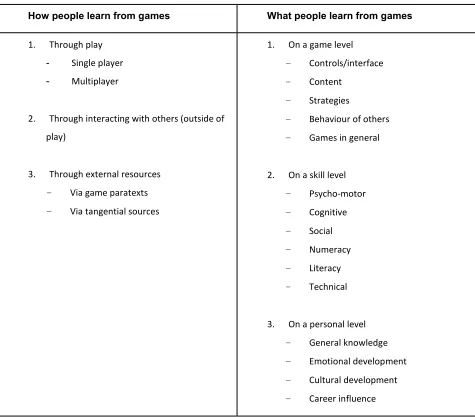
The first interview study led to the development of an initial set of categories that were applied and iteratively refined in subsequent studies. The final learning categories presented in Table 1 represent the range of learning experienced by players.
Regarding how people learn from games, there were three distinct ways of doing so. The first, learning through play, relates to learning that occurs during instances of micro-involvement. We can see this as a form of learning through doing, for example:
“I try to see what different buttons do, and then when I can do things, I try to explore. I think I try the extremes of action to find out about the parameters of action, if that makes any sense”, Simon (M, 36; Study 1).
Participants would sometimes mention learning from specific episodes of play while other times the link was implied. For instance, Rosie (F, 31; Study 1), noted:
“I guess learning about how to progress to the next level is also ‘new’ knowledge that you discover as you go. So I can think of a lot of general examples of serendipity: ‘oh you need to move that so a door opens’ (from some puzzle game on the PC that I can't remember the name of)”.
In contrast, a casual gamer (Study 3) suggested they had learnt the following from playing games in general:
“Besides hand/eye coordination, which is always a plus, there's a wide range of games that refer to history, geography, and general knowledge.”
Further, learning would occur during single-player or multiplayer episodes e.g. one hardcore player (Study 3) stated: “my social skills have developed because of online gaming”.
Table 1: Informal learning categories
How people learn from games What people learn from games
1. Through play
- Single player
- Multiplayer
2. Through interacting with others (outside of
play)
3. Through external resources
– Via game paratexts
– Via tangential sources
1. On a game level
– Controls/interface
– Content
– Strategies
– Behaviour of others
– Games in general
2. On a skill level
– Psycho-motor
– Cognitive
– Social
– Numeracy
– Literacy
– Technical
3. On a personal level
– General knowledge
– Emotional development
– Cultural development
– Career influence
The second category, learning with others relates to learning through interaction with people on a macro-level. This could occur with respect to asking advice or discussing strategy, for
example:
Other examples, from Study 2, come from Linda (F, 59) speaking to her work colleagues about FARMVILLE to discuss the “merits of new features and how to use it”, and Matt (M, 24) who would discuss DEFCON tactics with his housemates. Another example of macro-involvement with others concerns the off-line organisation involved in MMORPGs (Massively Multiplayer Online Role-Playing Games. For example:
“I have actively been building communities in games by leading guilds and alliances of guilds for the past 6 years, so my collaborative, interpersonal, conflict resolution, and diplomacy skills have definitely improved.” (Moderate, study 3).
The third category, learning through external resources, was further subdivided into: via game paratexts and via tangential sources. Learning via game paratexts refers to occasions when a player mentioned consulting a gaming resource such as the manual or an internet walkthrough. Paratexts such as walkthroughs were often seen as a last resort when stuck since “It can take all of the decision making out of the process of playing the game and that sort of ruins the point” Henry (M, 38; Study 1). Further examples of paratextual activities from Study 2 include using a feed reader to keep up to date on gaming news and developments (Alex; M, 41) and checking iPhone game reviews in the Apple App Store (Natasha; F, 31). There is some potential overlap here with the previous category, as guilds and forums technically involve interacting with other people but they can also be viewed as gaming paratexts. In practice, players would not always distinguish between what they learnt from playing with others and what they learnt from
interacting with paratexts, so these categories were not mutually exclusive. For example, the quote above from a moderate MMORPG gamer (Study 3) relates to how playing the game with others, and having to organise guild members outside of play, led to an improvement in a range of skills.
The second sub-category is learning via tangential sources, which referred to instances where playing a game had got the player so interested in a subject they encountered during play that they decide to consult an external resource, such as a Wikipedia article or a book, to find out more. For instance, Sam (F, 46; Study 1) talked about how:
learnt a lot about the Crusades and the Templars. BLADESTORM is nice to get to know more about the A Hundred Years War and so on”.
Although they are both external resources, tangential resources are different from paratexts as they are not produced in relation to a specific game or genre. If we are to consider the game to be the main “text”, paratexts are supplementary to it, while tangential resources are more incidental.
With respect to what people learn from games, a useful separation is to consider learning on game, skill and personal levels. Game level learning was mentioned in five contexts. First, in relation to game controls, for example Steve (M, 51; Study 1) outlines his approach to a new game: “Quickly check the main controls and go for it”. Second, in terms of game content, for example following the narrative of the game or understanding the spatial layout (e.g. tracks in a racing game). Third, participants also mentioned game level learning with respect to
understanding game mechanics. References to game strategies were also included as they indicated how players learnt how to be successful within certain games, for example:
“game tactics - keep your back to the wall, use the element of surprise, face groups of enemies in narrow spaces where possible so that they can only come at [you] one or two at a time” Peter (M, 27; Study 1).
Learning about the behaviour of others within the game world related to developing an understanding of the strategies other characters within the game adopted, whether these characters were controlled by the AI (Artificial Intelligence) of the game or by other human players. The category also contained references to learning about games in general, for
instance, in terms of finding out about new games through paratexts e.g. “I checked IGN for new releases – I also checked out the forums for the TOTAL WAR games to see about new releases etc.” Nick (M, 29; Study 2).
references to problem solving and how games can be seen as a way to keep the brain active, e.g. “I enjoy playing strategy/puzzle games and definitely think those build strong problem solving skills and help develop strategies for thinking out a problem or finding new approaches to solving it”, non-gamer (Study 3). In Study 2, Matt (M, 24) playing DEFCON with his
housemates is also an example of developing social skills. However, social skills are not just about collaboration, e.g.
“playing video games somewhat helped me to build several skills such as teamwork and cooperation, friendship, or competitiveness; this last skill, however, must be learnt in the "healthy" way: learn to accept a victory or a defeat fairly, respect your player no matter their skill or state, and most of all, have fun” (moderate gamer, Study 3)
The survey responses (Study 3) also contained references to literacy and numeracy skills, e.g. “I think my sense of geometry and physics have improved” (moderate gamer), “foreign
languages” (casual gamer); and technical skills, e.g. “I believe that gaming experience has made me better at learning and using computer-based systems in my work life” (moderate gamer).
The final category relates to learning on a personal level. This category was concerned with learning that was likely to transfer beyond the game and skill levels. General knowledge
contained references to learning about general facts and procedures in the real world, e.g. “I've learned some stuff about History (e.g. from RED DEAD REDEMPTION) even as a former History teacher and interesting things about physics, etc.” (casual gamer; Study 3). Emotional development related to changing as a person, e.g.
“you could take an RPG (say FINAL FANTASY 7) [where] the main character starts as a bit of a loner and as he opens up more you gain more friends and the plot gets richer. Now from this, you could gather that if you want to experience more of your own life and make it richer then you have to open up more and be ready to embrace change”, Marco (M, 28; Study 1).
Additionally, there were also several references to how games helped people develop persistence within and outside of the game world, for example Justin (M, 32; Study 2)
the value of hard work!”. Not all references were positive however. For instance, when
discussing issues such as excessive gameplay, one hardcore player (Study 3) suggested that some
“negative issues are: 1. Using the game as an exit to consume or "bend" time or until a "shift" happens in my RL [Real life] 2. Substituting the lack in RL action with in-game activity 3. Occupying myself by having a feeling of achievement while in a "static" phase of RL”.
Meanwhile, cultural development encapsulated references to the way in which games had broadened people’s horizons and introduced them to different cultures, and to a view of games as a type of art form, e.g. “DRAGON SPIRIT (Arcade) proved to me that a game can be far more than just a craft. Through art and music, a game can become a work of art in itself. At least equal to that of film” (moderate gamer, Study 3). Finally, career influence contained any references to how games had influenced player career interests and development, e.g. a moderate gamer (Study 3) explained how “as a young kid, I spent time writing games,
understanding logic, learned a lot of programming as a result of getting an Atari 400 and a ZX Spectrum, and that's shaped my entire life (I now work in IT).”
The Gaming Involvement and Informal Learning framework
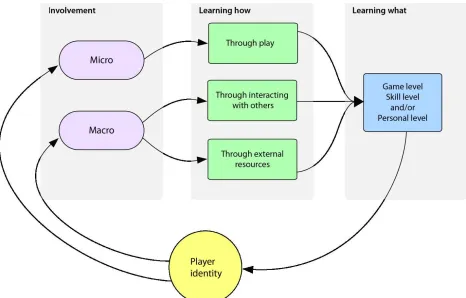
The categories were based on the interview, observational, diary and survey findings from all of the studies. Figure 1 combines these categories (and their associated subcategories) into a visual representation of the relationships found between micro-involvement, macro-involvement and learning in the form of the Gaming Involvement and Informal Learning (GIIL) framework. The framework also considers the role of player identity in relation to how people identify as players (as opposed to how they identify with in-game avatars). The GIIL framework is explained below before two examples are presented to illustrate how the previous learning categories relate to involvement on a micro and macro-level and to the issue of player identity.
Figure 1: Gaming Involvement and Informal Learning framework
With respect to micro-level involvement, learning occurs through play, whether this is single-player or multi-single-player. Learning through macro-level involvement occurs via engaging in game-related activities, in the form of interacting with others outside of play or using external
In order to illustrate the relationships presented in the GIIL framework, the following examples from the case-studies are presented. These refer to levels of both micro and
macro-involvement. Amy (F, 28) states “I wouldn’t consider myself a gamer” as she does not see gaming as a priority. Although she enjoys playing games occasionally, she primarily plays on one console (the Nintendo Wii). During the three week study she reported playing two games on four different days (outside of the lab sessions). She did not interact with any external resources during this time. While she mentioned playing games with friends in the past, she explained that this happens less often since moving in with her boyfriend who is “not even a little bit” interested in games. Further, in terms of learning she mentioned the game level, with respect to figuring out the differences between manual and automatic steering on MARIO KART, and the personal level, in terms of thinking about her own need for active and passive forms of relaxation. In contrast, Justin (M, 32), refers to himself as having been a “PC gamer” although he now spends more time on consoles. He mentions playing eight games on 19 days (outside of the lab
sessions) and consulted external resources on six occasions. He also noted, “there’s been less playing with other people” than usual as “that’s just how it’s worked out” during the study. With respect to learning, Justin discussed learning on three levels. First, a game level by finding out about new games by looking at trailers and figuring out strategies in FINAL FANTASY XIII. Second, a skill level in terms of exercising “lateral thinking” to solve puzzles. Third, a personal level by developing general knowledge of ancient Greek mythology through tangential sources after playing GOD OF WAR III. These examples illustrate how micro and macro-involvement are able to contribute to learning and player identity, since higher levels of involvement were seen to relate to a greater variety of learning and a stronger sense of identity.
Discussion
The main purpose of this article was to present the final set of learning categories and the Gaming Involvement and Informal Learning (GIIL) framework to address the question: how do motivation, engagement and informal learning relate to each other within the context of digital games? The framework was produced after triangulating the results from three studies in order to describe the main relationships found within the research.
about a game to overcome a problem, or used a tangential source to find out more about information encountered during play. Although the vast majority of examples of learning provided were positive, not everyone viewed learning on a game level as being particularly valuable. It was also rare that participants would refer to activities such as keeping up-to-date on gaming news as explicit forms of learning. These findings suggest that while intentionality is something to consider with respect to informal learning, it is important to also ask whether (1) people aware of what they are learning and (2) if they value what is being learnt.
While previous literature does suggest the importance of identity with respect to learning (Gee, 2004; 2007), it does so in relation to how players identify with their avatars or characters. The findings from the studies did not indicate that players spent a lot of time reflecting on the relationship between their real and virtual identities (something Gee describes as a potential source of learning), but the GIIL framework does highlight the importance of considering learning in relation to how people identify as players. The literature on communities of practice has a primary focus “on learning as social participation” where participation refers to “a more encompassing process of being active participants in the practices of social communities and constructing identities in relation to these communities” (Wenger, 1998, p.4). While Gee does mention the work of Lave and Wenger (1991) he pays little attention to the how a player develops an identity as a gamer. The GIIL framework highlights the importance of this gamer identity in relation to increasing participation in a variety of gaming practices and what players learn as a result. However, readers should note that much of the research conducted relied on reported instances of learning and did not include any formal assessments.
The GIIL framework may also be useful for discussing other research carried out in the area of game-based learning. For instance, in two case studies where students who had previously struggled with meeting the National Literacy benchmarks standards in English (within Australia), were able to meet them after playing games, producing paratexts based on them (such as game reviews) and even used Powerpoint to design their own games (Walsh, 2010; Walsh &
outcomes (improved literacy in this case). Learning occurred through play (i.e. playing the games first), through others (i.e. discussing game experiences in the classroom or on a wiki) and through external resources (i.e. creating paratexts). In this case, the teachers were interested in improving general literacy skills but they were able to do so by tapping into “the intensity of the students’ passion for digital games” (p. 31). Arguably however, this approach was effective because the students were already involved with games on both a micro and macro-level. The GIIL framework suggests that it may not have been as successful if the students involved had not been gamers who were able to take advantage of existing interests, skills and knowledge.
Thus the influence of gaming identity with respect to the use of games in formal educational contexts is something that requires further investigation. However the GIIL framework also raises some important issues regarding the use of games for educational purposes. First, learning results from both micro and macro-level involvement i.e. not just as a result of game-play. Other potentially valuable activities include promoting discussions of game-play within the classroom, using games as a way to stimulate interest in tangential topics, and/or asking students to create their own paratexts. Secondly, it is important to consider students in terms of what kinds of players they are. As Walsh and Apperley (2012) exemplify, it is possible to establish links between the learning that results from gaming involvement and formal
educational outcomes, by recognising the value of player experience and openly acknowledging expertise. This approach may be less appropriate for those who do not strongly identify as gamers since it may leave them at a disadvantage. The GIIL framework is focused on informal learning and so has not been demonstrated to transfer to games designed explicitly for the purposes of education. The way in which it describes the relationship between motivation, engagement and learning indicates potential to explain similar elements in more formal learning. The issues raised do not mean that games will not be successful in formal education rather that care needs to be taken when considering game-based learning approaches within this context.
Acknowledgements
Declaration of Conflicting Interests
The authors declared no conflicts of interest with respect to the authorship and/or publication of this article.
Funding
References
Bourdieu, P. (1984). Distinction: A social critique of the judgement of taste. Cambridge, MA: Harvard University Press.
Calleja, G. (2007). Digital Game Involvement: A Conceptual Model. Games and Culture, 2, 236– 260.
Calleja, G. (2011). “In-Game: From Immersion to Incorporation, MIT Press, USA.
Connolly, T.M., Boyle, E. A., MacArthur, E., Hainey, T. and Boyle, J.M. (2012). "A systematic literature review of the empirical evidence on computer games and serious games", Computers and Education, 59, 661 – 686.
Consalvo, M. (2007). Cheating: Gaining advantage in videogames. Cambridge, MA: The MIT Press.
de Freitas, S. (2006). Learning in immersive worlds. London: Joint Information Systems Committee. Retrieved Jan 21st, 2012, from:
http://www.jisc.ac.uk/media/documents/programmes/elearninginnovation/gamingreport_v3.pdf Egenfeldt-Nielsen, S., Smith, J. H., & Tosca, S. P. (2008). Understanding video games: the essential introduction. New York and London: Routledge.
Garris, R., Ahlers, R., & Driskell, J. E. (2002). Games, motivation, and learning: A research and practice model. Simulation & Gaming, 33, (4), 441–467.
Gee, J. P. (2004). What video games have to teach us about literacy and learning. New York: Palgrave Macmillan.
Gee, J. P. (2007). Good video games+good learning: Collected essays on video games, learning, and literacy. New York: Peter Lang Publishers.
Habgood, M. P. J., Ainsworth, S., & Benford, S. (2005). Endogenous fantasy and learning in digital games. Simulation & Gaming, 36, (4), 483–498.
Iacovides, I. (2009). Exploring the link between player involvement and learning within digital games. In Proceedings of the 23rd Conference on Human Computer Interaction, pp.29-34, Cambridge, UK.
Iacovides, I. (2012). Digital games: motivation, engagement and informal learning. Unpublished doctoral thesis, The Open University.
Iacovides, I., Aczel, J.C., Scanlon, E., and Woods, W.I.S. (2011b). What Can Breakdowns and Breakthroughs Tell Us about Learning and Involvement Experienced during Game-Play? Proceedings of the 5th European Conference on Games Based Learning, pp 275–281, Athens, Greece.
Iacovides, I., Aczel, J.C., Scanlon, E & Woods, W.I.S (2012). Investigating the relationships between informal learning and player involvement in digital games. Learning, Media and Technology, 37, (3), 321-327.
Iacovides, I., Aczel, J.C., Scanlon, E., and Woods, W.I.S. (2013). Making Sense of Game-play: How can we Examine Learning and Involvement? Transaction of the Digital Games Research Association (ToDiGRA), 1, (1).
Lave, J., & Wenger, E. (1991). Situated learning: Legitimate peripheral participation. Cambridge: Cambridge University Press.
Lomas, D., Patel, K., Forlizzi, J.L. & Koedinger, K.R. (2013) Optimizing challenge in an educational game using large-scale design experiments. In Proceedings of the SIGCHI Conference on Human Factors in Computing Systems, pp 89-98, Paris, France.
Malone, T. W. (1981). Toward a theory of intrinsically motivating instruction. Cognitive Science, 5, (4), 333–369.
Malone, T. W., & Lepper, M. R. (1987). Making learning fun: A taxonomy of intrinsic motivations for learning. Aptitude, learning, and instruction, III: Conative and affective process analysis, pp. 223-253. Hillsdale, NJ: Lawrence Erlbaum Associates.
O’Neil, H. F., Wainess, R., & Baker, E. L. (2005). Classification of learning outcomes: Evidence from the computer games literature. The Curriculum Journal, 16, (4), 455–474.
Oliver, M., & Carr, D. (2009). Learning in virtual worlds: Using communities of practice to explain how people learn from play. British Journal of Educational Technology, 40, (3), 444–457.
Przybylski, A. K., Rigby, C. S., & Ryan, R. M. (2010). A Motivational Model of Video Game Engagement. Review of General Psychology, 14, 154-166.
Sefton-Green, J. (2003). Informal learning: substance or style? Teaching Education, 14, (1), 37– 51.
Squire, K. (2008). Open-ended video games: A model for developing learning for the interactive age. In K. Salen (Ed.) The ecology of games: Connecting youth, games, and learning (pp. 167– 198). Cambridge, MA: The MIT Press.
Deliverable D33.2.2, Mobile Learning in Informal Science Settings. Retrieved Jan 21st, 2012, from:
http://telearn.archives-ouvertes.fr/docs/00/19/01/75/PDF/Vavoula-Kaleidoscope-2005.pdf Walsh, Christopher and Apperley, Thomas (2012). Using gaming paratexts in the literacy classroom. In Proceedings of GLS 8.0: Games + Learning + Society Conference, pp. 322-329, Madison, WI.
Walsh, C. (2010). Systems-based literacy practices: Digital games research, gameplay and design. The Australian Journal of Language and Literacy, 33, (1), 24-40.
Wenger, E. (1998). Communities of practice: Learning, meaning, and identity. New York: Cambridge University Press.
Yee, N. (2007). Motivations for play in online games. CyberPsychology & Behavior, 9, (6), 772– 775.
Bios
Ioanna (Jo) Iacovides is a Post-doctoral researcher in Human-Computer Interaction at the UCL Interaction Centre, University College London. Her research focuses on investigating informal and formal learning within the context of digital games and technology. Contact:
[email protected]; http://www.ucl.ac.uk/uclic/people/j-iacovides.
Patrick McAndrew is Professor of Open Education and Director of the Institute of Educational Technology, The Open University. His research interests include approaches to learning design and the impact of openness on learning. Contact: [email protected];
http://iet.open.ac.uk/people/p.mcandrew.
Eileen Scanlon is Regius Professor of Open Education in the Institute of Educational
Technology, The Open University where she is Associate Director (Research and Innovation). Her research interests include informal learning with technology, science communication and engagement, and mobile learning. Contact: [email protected];
http://iet.open.ac.uk/people/e.scanlon.