White Rose Research Online URL for this paper: http://eprints.whiterose.ac.uk/85905/
Version: Accepted Version Article:
Del Missier, F, Mäntylä, T, Hansson, P et al. (3 more authors) (2013) The multifold relationship between memory and decision making: An individual-differences study. Journal of Experimental Psychology: Learning Memory and Cognition, 39 (5). pp. 1344-1364. ISSN 0022-1015
https://doi.org/10.1037/a0032379
© 2013 American Psychological Association. This is an author produced version of a paper published in Journal of Experimental Psychology: Learning, Memory, and Cognition. This article may not exactly replicate the final version published in the APA journal. It is not the copy of record. Uploaded in accordance with the publisher's self-archiving policy.
[email protected] https://eprints.whiterose.ac.uk/
Reuse
Unless indicated otherwise, fulltext items are protected by copyright with all rights reserved. The copyright exception in section 29 of the Copyright, Designs and Patents Act 1988 allows the making of a single copy solely for the purpose of non-commercial research or private study within the limits of fair dealing. The publisher or other rights-holder may allow further reproduction and re-use of this version - refer to the White Rose Research Online record for this item. Where records identify the publisher as the copyright holder, users can verify any specific terms of use on the publisher’s website.
Takedown
If you consider content in White Rose Research Online to be in breach of UK law, please notify us by
The Multifold Relationship Between Memory and Decision Making: An Individual-differences
Study
Fabio Del Missier,1
Timo Mäntylä,2, 3, 4 Patrik Hansson,3
Wändi Bruine de Bruin,5, 6 Andrew M. Parker,7 and
Lars-Göran Nilsson 2, 4
1 Department of Life Sciences – Psychology Unit, University of Trieste, Italy
2 Department of Psychology, University of Stockholm, Sweden 3 Department of Psychology, University of Umeå, Sweden
4 Stockholm Brain Institute
5 Centre for Decision Research, Leeds University Business School, UK
6 Carnegie Mellon University, Department of Engineering and Public Policy, USA
7 RAND Corporation, Pittsburgh, USA
Author Note
This research was supported by a Riksbankens Jubileumsfond research grant awarded to Timo
Mäntylä by Sveriges Riksbanken for the project Aging and decision-making competence. It was also supported by a Wenner Gren grant awarded to Fabio Del Missier for the project Decision-making
abilities across the adult life span: A psychological, genetic, and neuroscientific investigation.
Wandi Bruine de Bruin’s time was funded by the US National Institute on Aging [P01 AG026571].
Correspondence concerning this article should be addressed to Fabio Del Missier
Abstract
Several judgment and decision-making tasks are assumed to involve memory functions, but
significant knowledge gaps on the memory processes underlying these tasks remain. In a study on 568 adults between 25 to 80 years, hypotheses were tested on the specific relationships between individual differences in working memory, episodic memory, and semantic memory, respectively,
and six main components of decision-making competence. In line with the hypotheses, working memory was positively related with the more cognitively-demanding tasks (Resistance to Framing,
Applying Decision Rules, and Under/Overconfidence), whereas episodic memory was positively associated with a more experience-based judgment task (Recognizing Social Norms). Furthermore, semantic memory was positively related with two more knowledge-based decision-making tasks
(Consistency in Risk Perception and Resistance to Sunk Costs). Finally, the age-related decline observed in some of the decision-making tasks was (partially or totally) mediated by the age-related
decline in working memory or episodic memory. These findings are discussed in relation to the functional roles fulfilled by different memory processes in judgment and decision-making tasks.
The Multifold Relationship Between Memory and Decision Making: An Individual-differences
Study
Among the more promising research developments in the field of judgment and decision making is the attempt to ground judgment and decision-making processes in findings and models
derived from memory research, tracing complex cognitive tasks back to their basic cognitive roots to improve the understanding of how individuals perform these tasks. Indeed, memory can play an
important role in several aspects of judgment and decision-making tasks (for reviews see, e.g., Alba, Hutchinson & Lynch, 1991; Dougherty, Gronlund & Gettys, 2003; Tomlinson, Marewski &
Dougherty, 2011; Weber, Goldstein & Barlas, 1995), and the age-related decline observed in some
aspects of memory functioning (Park, 2000; Park et al., 1996, 2002; Salthouse, 2004) can mediate part of the age-related changes in decision-making abilities. However, the investigation of the role of
memory functions in decision making has been scattered and nonsystematic, leaving various knowledge gaps about which memory functions underly specific decision-making tasks open. The study presented in this paper aims to fill some of these gaps through a systematic analysis of the
relationships between individual differences in memory processes and individual differences in various aspects of decision-making competence, guided by a functional view of memory processes in
decision making.
In the next section, the theoretical background of the research will be presented, followed by the specific hypotheses of the study, which refer to the contribution of different memory processes to
six main components of decision making, measured by the Adult Decision-Making Competence battery (Bruine de Bruin, Parker & Fischhoff, 2007). Next, the methodological aspects of the
research and the rationale of its four-step data analysis procedure will be described, followed by the results of structural equation modeling for each of these steps. Finally, the discussion will focus on the implications of the results for the functional roles fulfilled by different memory processes in
judgment and decision-making tasks.
Working Memory, Executive Control, and Decision Making.
Existing empirical evidence suggests that working memory processes support judgment and decision-making tasks requiring extensive processing and thoughtful evaluation of information about options, while the same processes seem less relevant to tasks that can be successfully completed by
using less demanding strategies. Dual-task studies showed that participants tend to rely on simpler judgment and evaluation strategies or emotion-based choice processes under high concurrent
cognitive load (e.g., De Neys, 2006; De Neys & Verschueren, 2006, Hinson, Jameson & Whitney, 2003; Hinson & Whitney, 2006; Shiv & Fedorikhin, 1999), with working-memory resources being necessary to articulate a preference or judgment based on a more thoughtful consideration of the
options and associated information (e.g., Evans, 2008; Stanovich & West, 2008). Moreover, individual-difference studies observed that participants with greater working memory capacity
provide less subadditive probability judgments (Dougherty & Hunter, 2003) and that participants with better performance in executive functioning tests obtain better results in cognitively-demanding judgment and decision-making tasks (Del Missier, Mäntylä & Bruine de Bruin 2010, 2012; Parker &
Fischhoff, 2005). Additionally, studies on individual differences highlighted age-related declines only in cognitively-taxing judgment and decision-making tasks that are more closely associated with
fluid intelligence measures (Bruine de Bruin, Parker & Fischhoff, 2007, 2012; Mäntylä, Del Missier, et al., 2012).
Working memory processes seem to be much less involved when the decision task can be
carried out by using simple and effortless strategies (see also Evans, 2008, 2009; Glöckner &
Witteman, 2010; Hogarth, 2005; Stanovich, 2009), by relying on acquired experience and knowledge
(e.g., Bruine de Bruin et al., 2012; Fisk & Rogers, 2000; Hess et al., 2005; Meyer & Pollard, 2004;
Peters, Hess, Auman & Västfjäll, 2007; Stanovich & West, 2008) or on emotion related processes
observed in less cognitively-demanding decision tasks or when experience and knowledge can exert a
significant positive role (see Bruine de Bruin et al., 2012; Mather, 2006; Peters et al., 2007).
Following previous investigations, in the present study we expect to observe selective positive relations between individual differences in working memory and performance in the three more
cognitively demanding A-DMC tasks (Resistance to Framing, Applying Decision Rules,
Under/Overconfidence). The task-specific instantiations of this hypothesis will be articulated below.
Long-term Declarative Memory and Decision Making
Although only a limited number of studies have investigated the relationship between
declarative long-term memory processes and judgment and decision-making task, existing evidence
seems to support the idea that episodic memory processes and memory sampling/assessment of past experiences may underlie performance in some decision tasks, while the correct accomplishment of
other decision tasks may depend on the availability and accessibility of appropriate semantic knowledge.1
In particular, a series of studies have been successful in corroborating, by simulation or
empirical research, the hypothesis that judgments and decisions are, in some circumstances, expressed on the basis of memory sampling or cued recall processes (e.g., Fiedler & Juslin, 2006;
Lange, Thomas & Davelaar, 2012; Stewart, Chater & Brown, 2006; Thomas, Dougherty, Sprenger & Harbison, 2008), and that judgments of frequency rely on strategies supported by different types of long-term memory processes and representations (Brown, 1995, 1997, 2002; Haberstroh, 2008). As
we will explain in the next section, we hypothesize that episodic memory processes are selectively involved in performing the Recognizing Social Norms tasks of the A-DMC battery, which relies on
judgments of frequency based on accumulated experience.
Studies on the role of knowledge in decision making have posited, and in some cases showed, that knowledge is helpful to avoid economic and probabilistic biases (e.g., Fennema & Perkins, 2008;
1
Larrick, Morgan, & Nisbett, 1990; Stanovich & West, 2008). Moreover, some investigations
highlighted the positive association between self-protective HIV/AIDS knowledge and successful self-reported self-protective behavior in HIV/AIDS prevention (Bruine de Bruin, Downs, Fischhoff & Palmgren, 2007) and between financial knowledge and financial behaviors (Bruine de Bruin et al.,
2010; Parker, Bruine de Bruin, Yoong, & Willis, 2012), although the positive role of knowledge and expertise in decision making continues to be debated and the results seem to vary with the domain
and the task (e.g., Shanteau, 1992; Shanteau & Stewart, 1992).2 Relying on these results and on more task-specific considerations (see the next section), we hypothesize that performance in two A-DMC tasks requiring background semantic knowledge (Consistency in Risk Perception, Resistance to Sunk
Costs) are related to individual differences in semantic memory.
A Study on the Memory-Decision Making Relationship: Aims and Hypotheses
As the preceding review makes clear, a number of studies have examined the role of memory in decision making. However, these studies employed diverse research paradigms and tasks and
generally relied on a rather narrow and task-specific theoretical perspective. Although the results
have been promising and some regularities emerged, an integrated and comprehensive functional account of the memory-decision making relationships is still missing and it is still unclear which
memory processes are relevant for several important kinds of decision-making tasks. Moreover, until recently, a severe limitation to individual-difference studies has been by unavailability of valid and reliable instruments for measuring individual differences in decision-making competence (Bruine de
Bruin et al., 2007; Bruine de Bruin, Del Missier & Levin, 2012; Del Missier et al., 2012). Fortunately, the recent development and validation of new instruments, like the Adult
Decision-Making Competence battery (henceforth A-DMC; Bruine de Bruin et al., 2007), helped to overcome this limitation (see also Finucane & Guillon, 2010).
2 In some cases, performance may even suffer if acquired knowledge supports a biased response, as shown by the
The study presented in this paper aimed to fill the abovementioned knowledge gaps through a
systematic investigation of the relationships between individual differences in memory processes and individual differences in various important aspects of decision-making competence. The research has been carried out within the Betula project (Nilsson et al., 1997; 2004; Rönnlund & Nilsson, 2006;
http://w3.psychology.su.se/betula/en/), a 25-year longitudinal research project on aging and memory that has been recently extended to include the study of decision-making competence (Mäntylä, del
Missier et al., 2012). In particular, the present study examined the relationships between individual differences in semantic, episodic, and working memory on one side, and six important aspects of decision-making competence on the other side. Individual and age-related differences in memory
have been assessed with multiple tasks previously employed in the Betula project, while the six aspects of decision-making competence, measured through A-DMC battery, involved the ability to
resist framing effects, the correct application of decision rules, calibration of confidence in
knowledge, the ability to recognize social norms, the ability to resist sunk costs, and consistency in risk perception. A description of these A-DMC tasks is provided in the method section and the whole
battery is available on-line (http://sds.hss.cmu.edu/risk/ADMC.htm).
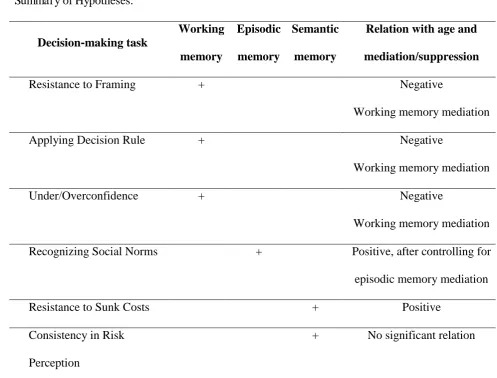
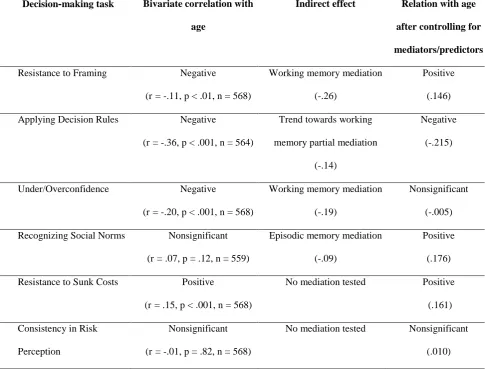
Here we describe our specific hypotheses about the involvement of different memory
processes in each aspect of decision-making competence (see also Table 1) and summarize task-specific pre-existing empirical support. Our task-specific hypotheses stem from the general idea that diverse memory processes may functionally support decision making in different ways. Generalizing
from existing evidence, we assume that working memory will support those decision-making tasks in which a successful performance requires more extensive processing and manipulation of information.
Semantic memory should instead play a more important role in decision tasks that require
background knowledge, whereas episodic memory is expected to support performance in decision tasks that are based on the evaluation of past experiences. Hence, the present study tested the general
Resistance to Framing. This A DMC task measures the individual’s ability to resist
normatively irrelevant variations in how the decision problem is presented. For example, a medical
treatment should be evaluated as similarly attractive whether it is described as 95% effective or 5% ineffective, and relative preferences between a sure thing and a risky option should be independent of
whether the options are framed as gains or losses. The task includes attribute framing problems and risky-choiceframing problems (Levin, Gaeth, Schreiber & Lauriola, 2002; Levin, Schneider & Gaeth, 1998), which are presented in positive/negative or gain/loss versions, respectively (see the
materials section for further details). Various theoretical accounts of framing effects exist (for reviews see Gonzalez, Dana, Koshino, & Just, 2005; Keren, 2011; Kühberger, 1997), but several
explanations share the idea that the ability to resist framing effects involves blocking an intuitive and relatively rough evaluation of the options, affected by the superficial appearance and valence of the problem description, and expressing a more thorough evaluation of the objective features of the
options (see e.g., De Martino, Kumaran, Seymour & Dolan, 2006; Kahneman & Frederick, 2007; Levin & Gaeth, 1988; Levin et al., 1998; McElroy & Seta 2003). As the previous summary of the
literature makes clear, these cognitive operations require working memory and executive control resources. In line with this view, previous A-DMC studies have shown that Resistance to Framing is
positively related with a general composite measure of executive control in a sample of adolescents (Parker & Fischhoff, 2005) and with the updating/inhibition dimension of executive control beyond fluid intelligence (Del Missier et al., 2012). Bruine de Bruin et al. (2012) showed that the observed
age-related decline in Resistance to Framing can be mediated by a correspondent decline in fluid intelligence. The hypothesis for the present study is that individual differences in Resistance to Framing will be positively related with individual differences in tests of working memory
performance. Moreover, a negative correlation is expected between Resistance to Framing and age, which should be at least partially mediated by a corresponding age-related decline in working
Applying Decision Rules. Research on decision-making strategies has shown that individuals
use different choice heuristics in different circumstances (Bettman, Luce, & Payne, 1998; Payne & Bettman, 2004). The ability in the application of decision strategies is essential in multiattribute choice, where multiple options vary along multiple attributes, and where the accurate application of
different rules offers adaptive advantages (Payne, Bettman & Johnson, 1993). The Applying Decision
Rules task in the A DMC battery assesses the ability to correctly apply various decision rules. The application of decision strategies is assumed to depend on working memory if these strategies require
computations, comparisons, and aggregation of values (e.g., Payne et al., 1993). Moreover the application of decision rules may also require inhibiting information that is irrelevant or no longer
relevant (Del Missier et al., 2010). Past work on A-DMC has shown that performance in the
Applying Decision Rules task is positively related with measures of inhibition and working memory updating (Del Missier et al., 2010, 2012). Additionally, Applying Decision Rules was the only
significant predictor of ADHD status in a study that employed other tasks involving decision making, like the Balloon Analogue Risk Task and the Iowa Gambling Task (Mäntylä, Still, Gullberg & Del
Missier, 2012). Performance in this task was also negatively related with age (Bruine de Bruin et al., 2007; Mäntylä, Del Missier et al., 2012), with this relation being possibly mediated by fluid
intelligence (Bruine de Bruin et al., 2012), which declines with age. Thus, we expect that Applying Decision Rules will be positively related with individual differences in working memory and
negatively related with age, and that the negative relation with age will be at least partially mediated
by a corresponding age-related decline in working memory.
Under/Overconfidence. The Under/Overconfidence A DMC task measures calibration in judgments of confidence, which is a critical metacognitive ability to effective decision making.
Overconfidence can lead to inappropriate risky behavior, while underconfidence can lead to inappropriate hesitation and inaction (for brief reviews see e.g., McGraw, Mellers & Ritov, 2004; Parker et al., 2012). In particular, the Under/Overconfidence task presents true/false factual
to express their degree of confidence in each answer on a scale ranging from 50% (= just guessing) to
100% (= absolutely sure). The performance score is 1 minus the absolute value of the difference between (mean) confidence and knowledge (percent correct) across all items. The overconfidence often observed in this type of task has been explained in various ways (see Griffin & Brenner, 2004).
According to a prominent explanation, people show a tendency to focus on the reasons confirming (rather than disconfirming) the answers they gave (Koriat, Lichtenstein, & Fischhoff, 1980). Thus,
the ability to ‘defocus’ attention and take into account disconfirming evidence should promote less
overconfident judgments (cf. Brenner, Koehler, & Tversky, 1996; Hoch, 1985; Koriat et al., 1980). This process is assumed to be cognitively-intensive and, according to some scholars and previous
results, it may involve working memory (Dougherty & Hunter, 2003; Mäntylä, Del Missier et al., 2012; Sprenger & Dougherty, 2006; Stanovich, 2009). However, individual-differences studies on
the Under/Overconfidence task have provided varying results, possibly due to differences in predictors and samples. Adolescents' performance on this task was positively associated with a general measure of executive functioning (Parker & Fischhoff, 2005), while this positive correlation
was found only for some measures of executive functioning in young adults (Del Missier et al., 2012). Moreover, Bruin de Bruine et al. (2007) did not find a significant correlation between
performance in Under/Overconfidence and age, whereas Mäntylä, Del Missier et al. (2012) observed a significant negative correlation. The hypothesis for the present study, grounded in the
abovementioned account of the Under/Overconfidence A DMC task, is that performance will be
positively related with working memory measures and negatively related with age. Moreover, the negative correlation with age will be at least partially mediated by a corresponding age-related decline in working memory.
Recognizing Social Norms. This ADMC task measures the accuracy of perceived social norms, by comparing the actual social norms of a group of peers with the social norms estimated by the
social norms is important for effective real-word decision making and the perception of social norms
is assumed to play a role in decision related phenomena (Parker & Fischhoff, 2005). Previous studies
have shown that performance on this task is not related to measures of executive functioning (Del Missier et al., 2012; Parker & Fischhoff, 2005) and that it is not negatively related to age (Bruine de
Bruin et al., 2007, Mäntylä, Del Missier et al., 2012). Performance in the Recognizing Social Norms task, as in other frequency-estimation tasks, may require appropriate factual background about the behaviors that have to be judged (for similar arguments, see Bruine de Bruin et al., 2012), perhaps in
the form of accumulated memory traces of social behaviors or generic impressions derived from the accumulation of memory traces (Brown 1995, 1997, 2002). Knowledge that something is more or
less unacceptable from a moral viewpoint is not the central issue in this task. Similarly, working memory resources may not be fundamental in a frequency-related task that may not require explicit retrieval of instances, due to the recurrence and similarity of the stored information (i.e., social
behaviors of given types; cf. Brown, 2002). Hence, the hypothesis of the current study is that performance in this A-DMC task will not be related with individual differences in working memory
or semantic memory, but positively related with individual differences in episodic memory, which capture the ability to encode events or episodes. A better ability to encode instances of inappropriate
behaviors will allow participants to estimate more accurately the relative frequency of these behaviors at a later time (for the role of perceived experience on social norms see e.g., Cialdini, Kallgren & Reno, 1991), through non-enumeration and non-numerical strategies (see e.g., Brown
1995, 1997, 2002; Conrad, Brown, & Cashman, 1998; Haberstroh, 2008), and, consequently, to estimate more accurately the related social norms. An additional hypothesis is that, after the negative indirect influence of age through the decline of episodic memory is controlled for, age will have a
direct positive influence on the ability to estimate social norms due to age-related changes in social skills and competence, because older adults may have better social skills (Hess et al., 2005; Peters et
Resistance to Sunk Costs. This A DMC task measures the capacity to discontinue failing commitments despite having invested unrecoverable financial and time costs. Decision makers are
often unable to ignore unrecoverable or “sunk” costs and therefore continue failing commitments into the future (Arkes & Blumer, 1985). This has been explained by assuming that decision makers do not
want to waste time or money already invested in a course of action (cf. Baron, 2008; Hastie & Dawes, 2001), and thus they go on with the existing course of action even if taking a new one would be the better choice, although various other explanations have been proposed (see Strough, Karns &
Schlosnagle, 2011). Researchers have hypothesized that knowledge of the principle that
unrecoverable costs need to be ignored can help in avoiding sunk costs (e.g., Bruine de Bruin et al.,
2012; Fennema & Perkins. 2008; Larrick et al., 1990), while previous experiences with sunk costs do not necessarily immunize individuals who have not acquired a sufficient awareness of the principle. Additionally, performance on Resistance to Sunk Costs was not found to be significantly related to
executive functioning (Del Missier et al., 2012; Parker & Fischhoff, 2005). Thus, the hypothesis for the present study is that performance in Resistance to Sunk Costs will be positively related to
individual differences in semantic memory. Given that the Betula dataset currently does not include direct measures of task-specific knowledge, performance in semantic memory tests will be used as a
proxy.3 Previous studies also observed a positive correlation between age and the capacity to resist sunk costs (Bruine de Bruin et al., 2012; Mäntylä, Del Missier et al., 2012; Strough, Mehta, McFall & Schuller, 2008), explaining this finding with older adults’ greater tendency to avoid focusing on
painful unrecoverable past costs in the attempt of maintaining a positive emotional state (Strough et al., 2008; Strough, Karns et al., 2011; Strough, Schlosnagle & DiDonato, 2011). In line with previous studies, a positive correlation between age and Resistance to Sunk Costs is expected.
Consistency in Risk Perception. Congruency of individual’s probabilistic judgments with basic probability principles is an essential prerequisite of proper risk assessment. The A-DMC Consistency
in Risk Perception task asks participants to judge the probability of various events (e.g., getting into a
3 As pointed out in the discussion section, further studies could include measures of task-specific knowledge in order to
car accident while driving; driving accident free) happening in different time frames (in the next year, in the next 5 years) in order to evaluate the consistency of these judgments (see the materials
section for a more detailed description). This task seems to require cognitive flexibility, given that performance is positively related to individual differences on the shifting facet of executive
functioning, but does not seem to strongly involve working memory updating (Del Missier et al., 2010, 2012). In addition, research on this task did not observe significant age-related changes (Bruine de Bruin et al., 2007; Mäntylä, Del Missier et al., 2012). The hypothesis for the present study is that
performance in this task will not be related to working memory and that it will be related to semantic memory, because knowledge of probability rules supports performance in probability-based tasks
(see e.g., Stanovich & West, 2008; Reyna & Brainerd, 2008). Episodic memory is not expected to play a significant positive role, because a good performance in this task is essentially based on
‘rational’ probabilistic assessments of consistency, constrained by knowledge of probability
principles, and not on sampling of event-related episodic experiences. As with the Resistance to Sunk Costs task, in the absence of specific measures of knowledge, the degree of general knowledge as
measured by semantic memory tests will be used as a proxy. In line with previous studies, a
correlation between age and Consistency in Risk Perception is not expected (considering also that a
connection between age and acquisition of the principles of probability is not very likely in adulthood: cf. Stanovich & West, 2008).
The Betula Study on Memory and Decision Making
In order to test the just-stated hypotheses (Table 1), a sample of participants in the Betula Prospective Cohort Study (Nilsson et al., 1997; 2004) completed the Swedish version of the A-DMC battery, together with multiple tests of working memory, semantic memory, and episodic memory.
Method
Participants and Procedure. Participants belonged to the fifth test wave of the Betula Study.
sampling strategy. At the recruitment stage, participants were screened for dementia, sensory
impairments, mental retardation, and a native tongue other than Swedish (for further details concerning sampling, recruitment, and inclusion criteria see Nilsson et al., 1997). Participants underwent an extensive health assessment at the first test occasion. One week later 1047
participants completed a battery of cognitive tests including episodic, semantic, and working memory. The two sessions lasted for about two hours each.
These participants received also the Swedish version of the A-DMC questionnaire and were asked to complete it at home and then to return it by postal mail. The A-DMC questionnaire presents detailed written instructions before each task and provides examples showing how to
complete the items of the more complex tasks. Participants were asked to complete the A-DMC battery alone and without external aids, closely following the pre-specified order of the tasks (see
Materials for more details).
Five hundred and seventy eight participants (55%) returned the questionnaire with at least 80% of all items completed. The remaining participants were considered to have dropped out
(45%).4 The final sample included 568 adults (26% in the 25-55 age range, 51% in the range 56-70, and 22% in the range 71-80) balanced for gender (49% males and 51% females).5
Materials. Decision-making Measures. Decision-making competence was assessed by using
the Swedish-language version of the A-DMC battery, which underwent previous back-translation and validation, and showed psychometric properties similar to those of the original instrument
(Mäntylä, Del Missier, et al., 2012). As with the original A-DMC (Bruine de Bruine et al., 2007), the Swedish version consists of six decision tasks: Resistance to Framing, Applying Decision Rules,
Under/Overconfidence, Recognizing Social Norms, Resistance Sunk Cost, and Consistency in Risk Perception. The A-DMC tasks were administered in the original fixed order: (1) positive-item
4 No significant attrition effect was observed for years of education (t(1013) = 1.41, p = .16). The dropouts were 43%
males and 57% females, percentages that were only slightly different from the returnees’ ones (albeit the difference was
marginally significant: p = .053). A slight difference was observed also for age: returnees were, on average, two years older than dropouts (t(1045) = 2.5, p = .01; 63 vs. 61 years).
5
versions of Resistance to Framing, (2) Recognizing Social Norms questions to assess social norms,
(3) Under/overconfidence, (4) Applying Decision Rules, (5) Consistency in Risk Perception, (6) Resistance to Sunk Costs, (7) negative-item versions of Resistance to Framing, and (8) Recognizing
Social Norms questions asking for estimates of other people’s social norms. This order maximized
the distance between related tasks (i.e., Resistance to Framing and Recognizing Social Norms). Resistance to Framing. This task includes seven risky-choice framing problems and seven
attribute framing problems. Each risky-choice problem is presented pairs of formally equivalent gains and losses, and asks to evaluate a sure-thing option vs. a risky choice. For example, a risky-choice framing problem describes a pesticide threatening the lives of 1,200 endangered animals.
The gain version poses a choice between (A) saving 600 endangered animals for sure and (B) a 75% chance that 800 animals will be saved, and a 25% chance that no animals will be saved. The
corresponding loss version presents a choice between (A) losing 600 animals for sure and (B) a 75% chance that 400 animals will be lost, and a 25% chance that 1,200 animals will be lost (Schneider, 1992). Responses are given on a 6-point scale (1=definitely would choose A;
6=definitely would choose B), intentionally omitting a midpoint to force the expression of a preference between the two options. Each attribute framing problem asks participants to rate
positive and negative descriptions of normatively equivalent options. For example, participants rated on a 6-point scale (1=very low; 6-very high) the quality of ground beef, described as 80% lean in the positive version and as 20% fat in the negative version (Levin & Gaeth, 1988). The positive
frames and negative frames appear in separate sets with different item orders and are separated by other A-DMC tasks. Performance is measured by the mean absolute difference between ratings for
the loss and the gain versions across items.
Applying Decision Rules. In this task, participants are presented with 10 different multi-attribute decision problems involving choices between fictitious DVD players with different
Payne et al., 1993) from a table showing numeric ratings of features. Each rule is presented by
providing participants with a short written description of the procedure or criteria to be applied in the specific problem. Scores represent the proportion of responses across items that reflect
normatively correct answers that would have been obtained from an errorless application of the
prescribed decision rules.
Under/Overconfidence. This task presents 34 true/false statements about various general
topics. Participants are asked to indicate whether each statement is true or false and to assess their confidence in their answer on a scale ranging from 50% (just guessing) to 100% (absolutely sure). Under/Overconfidence equals one minus the absolute difference between mean confidence and
percentage correct across items (so that higher scores reflect better performance).
Recognizing Social Norms. Participants first judge whether “it is sometimes OK” to engage in
each of 16 undesirable behaviors (e.g., to steal under certain circumstances). Later in the test
battery, participants estimate how many “out of 100 people your age” would endorse each behavior.
The former set of responses is used to compute the percentage of participants who endorsed each
behavior (the actual social norms), the latter is used to assess the participant’s perception of social norms. For each participant, performance is measured by the rank-order correlation (from -1 to 1)
between the percentage of endorsements (actual social norms) and the estimated percentage of endorsements (perceived social norms) across the 16 behaviors.
Resistance to Sunk Costs. This tasks comprises 10 problems describing a situation in which
someone could go on with a prior course of action that is failing (thus honoring sunk costs) or move to a new course of action. For each problem, participants are asked to provide a 1-6 rating to
indicate their relative preference for the “sunk cost” option (=1) vs. the normatively correct option
to discontinue the investment (=6). Performance is measured by the average of the ratings across the 10 items, with higher ratings expressing greater resistance to sunk costs.
expressed by ticking a graduated ruler ranging from 0% (no chance) to 100% (certain). Consistency
is then evaluated by assessing the congruency of pairs of judgments with three principles: (i) the judged probabilities of the same event in different time frames should be consistent (e.g., the probability of getting in a car accident could not be greater in 1 years’ timethan in 5 years’ time),
(ii) the judged probability of a subset event cannot exceed that of its superset event (e.g., the
probability ‘‘of dying in a terrorist attack during the next year’’ cannot be greater than the
probability of dying ‘‘from any cause—crime, illness, accident, and so on—during the next year’’),
and (iii) the judged probabilities of complementary events should add up to 100% (e.g., probability
of moving ‘‘your permanent address to another state some time during the next year’’ and
probability of keeping ‘‘your permanent address in the same state during the next year’’).
Performance is assessed by the proportion of consistency checks (on a total of 20) successfully
passed by participants’ probabilistic judgments.
Memory Tests. The memory tests used in the present study were part of the larger cognitive
test battery of the Betula project and they always appeared in the same fixed order throughout all
test occasions. The order of the tests was as follows: vocabulary, recall of sentences, cued recall of nouns, word fluency, recognition of nouns, general knowledge, n-back, and reading span (with
other tests interspaced). The order was fixed because counterbalancing was not achievable, considering the large number of tests and the forecasted loss of participants across Betula waves due to death, dementia, or other kinds of illness.
Working Memory: Reading Span. The Reading Span test evaluates working memory capacity through a computerized verbal span task, jointly tapping storage and processing functions
(Daneman & Carpenter, 1980). The version of the task used in the present study involves multiple trials requiring the participant to decide whether a sentence displayed on a computer screen is semantically congruent or not and to memorize a sequence of single words presented in between
successive increase in storage demands from two to five items (i.e., number of words to be
memorized in a trial). The performance scores of serial recall at the end of each trial provide the basis for the evaluation of working memory capacity, which consists in the proportion of words recalled in correct serial order across the four different trials and levels.
Working Memory: N-back. The ability to update working memory contents is assessed by a computerized version of the n-back paradigm (e.g., Owen, McMillan, Laird, Laird & Bullmore,
2005). In the Betula T5 version of this test, forty single words are displayed sequentially on a computer screen and the participants are required to maintain the two most recent words and their temporal order in working memory to indicate whether the current word is the same as the one
presented two items earlier or not. If the participant thinks that the current word matches the “2
-back” word actively held in working memory she/he has to respond by pressing a “yes” key,
otherwise she/he should press a “no” key. The test phase is preceded by two rounds of 15 practice items. Good performance on the 2-back task depends on continuous updating of the contents of working memory and efficient removal or suppression of no-longer relevant memory
representations. The proportion of correct responses is used as the performance score.
Episodic Memory: Recall of Sentences. In this test (Rönnlund & Nilsson, 2006; Nilsson et al.,
1997), participants are presented with two lists of 16 verb-noun sentences, each denoting a simple action (e.g., lift the book). For one list, participants are requested to enact each sentence, using the specified object. The other list is studied without enactment. A free recall test of the sentences
follows after each list. The mean value of correctly recalled sentences (including the correct verb and noun) from the two lists is used as the dependent variable.
Episodic Memory: Cued Recall of Nouns. This task is a category cued recall of nouns from the list of previously-presented words (Rönnlund & Nilsson, 2006; Nilsson et al., 1997). The nouns of the two study lists of the Recall of sentences task belong to eight semantic categories (e.g., fruits,
remember the nouns. The mean number of nouns recalled from the enacted and non-enacted list is
the measure used in the analyses.
Episodic Memory: Recognition of Nouns. Thirty minutes after the free recall test, the
participants are presented with 32 nouns. Of these, 8 are from the enacted study list and 8 from the
non-enacted study list, and the remaining 16 are non-studied words (8 distracters per list, two for each category). Participants have to indicate, (by saying “Yes” or “No”), the items they recognize.
The mean number of hits minus false alarms for each list is used as the dependent variable.
Semantic Memory: Letter Fluency. Participants generated as many words with an initial letter A as possible in one minute. The total number of correctly-generated words is used as performance
score (Rönnlund & Nilsson, 2006; Nilsson et al., 1997).
Semantic Memory: General Knowledge. This test consist of 26 general knowledge questions
(e.g., “What is the capital city of Ethiopia?”), with four possible answers out of which the correct one has to be chosen (Rönnlund & Nilsson, 2006). The performance score for this task is the number of correct answers.
Semantic Memory: Vocabulary. The vocabulary test is a 30-item multiple-choice synonym test (SRB; Dureman, 1960). Participants’ task is to select a synonym of the target word from among
five alternatives. Seven minutes are allotted for test completion. The total number of correctly identified synonyms is the performance score (Rönnlund & Nilsson, 2006; Nilsson et al., 1997).
Results
The results will be presented in four steps, following the corresponding stages of data analysis. In the first step, a structural equation model of memory variables has been estimated. This represents a measurement model of memory functions that has been used in all subsequent stages. In the second
stage, structural models have been estimated in order to test the specific hypotheses on the relationship between individual differences in memory functions and different facets of
memory functioning has been assessed, by relying again on the measurement model estimated in the
first stage. In the fourth and final stage, the models estimated in stages two and three have been combined, thus assessing simultaneously the effects of memory on decision making and the effects of age on both memory and decision making, in order to understand whether memory variables mediate
the effects of age on different aspects of decision making. The approach of separating measurement models (stage 1) from structural models (stages 2 to 4) is often followed in structural equation
modeling, because it assures that a structural model is estimated only when a valid underlying
measurement model exists (Hair, Black, Babin, & Anderson, 2009; Kline, 1998; Miyake et al., 2000). All the models presented in this paper have been estimated with the maximum likelihood technique
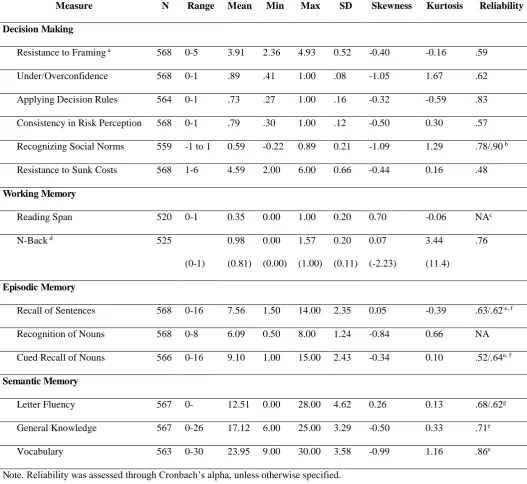
starting from the correlation matrix and using the SEPATH module of the STATISTICA 10 package (StatSoft Inc., 2011).6 Descriptive statistics and reliabilities for the variables used in the study are
reported in Table 2, and they are in line with previous A-DMC studies (Bruine de Bruin et al., 2007, 2012; Del Missier et al., 2010, 2012).
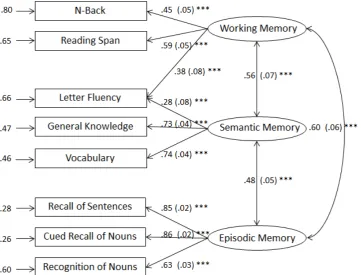
Stage 1: Measurement Model of Memory Variables. A candidate measurement model with
three latent variables (working memory, episodic memory, and semantic memory) was estimated from manifest indicators (i.e., measured variables). This model relies on traditional distinctions
between working memory and long-term memory, and between episodic and semantic memory (e.g., Baddeley, 2003; Nyberg & Tulving, 1996; Tulving, 1972, 1987, 2002), and on previous Betula studies that supported these distinctions (Nyberg, 1994; Nyberg et al., 2003). In the present study,
however, a strong stance on the structural separation between different memory systems is not taken, and it is just assumed that processes underlying active maintenance and updating of information in
6 All the models tested in this study have been tested also with the Asymptotically Distribution Free (Gramian)
the short term and different processes that underlie retention and recall of information in the long
term can be (at least partially) functionally differentiated. Moreover, considering the multiple interrelations and interdependencies existing between processes involved in working memory, episodic memory, and semantic memory (e.g., Kane & Engle, 2000; Tulving, 1995, 2002; Unsworth
& Engle, 2007), positive correlations between these latent variables were expected. Indeed, it has been postulated that working memory can support retrieval in episodic memory tasks (e.g., Kane &
Engle, 2000; Unsworth & Engle, 2007), and that close relationships exist between semantic and episodic memory (e.g., Tulving, 1995, but see also Graham, Simons, Pratt, Patterson & Hodges, 2000). Furthermore, semantic memory can support working memory and episodic memory when
verbal material has to be processed, for instance when verbal tasks are used to measure individual differences in working memory or episodic memory (as in the present study).
The candidate three-factor correlated model was compared with theoretically-grounded potential alternatives (see e.g., Baddeley, Eysenck & Anderson, 2009; Miyake & Shah, 1999): (a) a one-factor model in which all the memory indicators reflect a single latent variable (unitary memory
model); (b) two-factor models with working memory and long-term memory as the two latent variables (correlated or uncorrelated); (c) a three-factor uncorrelated model in which working
memory, semantic memory and episodic memory are considered as fully independent constructs. Following common practice, models were evaluated through multiple indices of fit: standardized root mean squared residual (SRMR), Akaike's information criterion (AIC),7 Bentler's comparative fit
index (CFI), adjusted population gamma index (APGI), the root mean square error of approximation (RMSEA), and the 2/df ratio.8 Moreover, the significance of estimated coefficients and the residuals
were examined, and the fit of nested models was compared using the 2 difference test. Reference
7 AIC in STATISTICA 10 is computed with a formula that takes into account the maximum likelihood discrepancy
function for a model (Fml), the number of free parameters (v), and the sample size (n): AIC = Fml + (2v/n+1). This formula makes the AIC more stable across differing sample sizes.
8 The probability of the 2 statistic is not reported, given that with big sample sizes even good fitting models can show a
thresholds for good fitting models are as follows: SRMR (< .08), AIC (the lower, the better), CFI (>
.90), APGI (> .95), RMSEA (< .06), and 2/df (< 3).
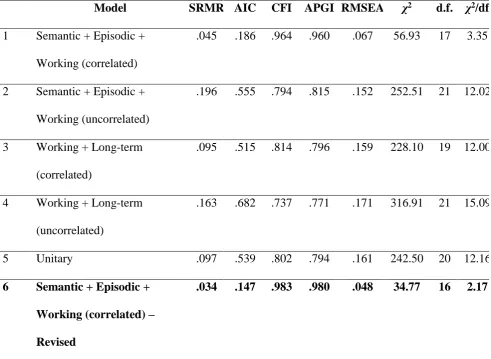
As can be seen in Table 3, the three-factor correlated model (1) had an acceptable to good fit according to all the indices. The three-factor uncorrelated model (2) was unacceptable according to
almost all the indices and significantly worse than the correlated model ( 2 difference test: p < .0001). The two-factor models and the unitary model (3, 4, and 5) showed unsatisfying fit. Thus, only the
candidate three-factor correlated model seems to provide an adequate fit to the data. However, after an examination of the residuals, a working memory letter fluency link was added to this model in
view of a potential increment in fit and, even more importantly, considering that the letter-fluency
tasks is known to require working memory resources (e.g., Rende, Ramsberger & Miyake, 2000). This revised model (6), showed an improvement in fit vs. the candidate model ( 2 difference test: p <
.0001) and improvements to good fit on all the indices. To conclude, the revised three-factor
correlated model is a good measurement model for memory variables, and this model was used as a basis in the following steps of data analysis (see Figure 1 for a representation including standardized
coefficients, standard errors, and significance tests). 9
Stage 2: Relationships Between Memory and Decision Making. In this step, the
previously-specified hypotheses (Table 1, first four columns) were tested by specifying corresponding structural models. Following a consolidated approach (see e.g., Del Missier et al., 2012; Friedman & Miyake, 2004; Miyake et al., 2000), a candidate structural model was specified for each decision-making task
by adding the hypothesized relationships between memory latent variables and the target task.10
Then, the candidate model was always compared with two baseline models: a no path model that
9 In order to test the stability of the memory model endorsed in the first stage of data analysis, we compared its
coefficients with the corresponding coefficients of the six structural models endorsed in the second stage of data analysis (Table 4). Marked differences in coefficients (factor loadings of the individual memory tasks and/or correlations among the memory latent variables) could indicate model misspecification or unstability (Friedman & Miyake, 2004; Miyake et al., 2000). The mean absolute difference in parameter values was very small (.009) and the average correlation between parameter values very high (.99). No marked changes in parameter values or significance levels were detected.
10 In order to specify directed paths between correlated memory latent variables and manifest decision-making
assumed complete independence between memory variables and decision-making competence, and a
full path model assuming that each memory variable contributes significantly to performance in the
target decision-making task (thus assessing the relationships between each memory variable and the decision-making task). To fully support the hypothesis, the candidate model should have a
significantly better fit than the no path model, without showing a significantly worse fit than the full
path model. Only when a model presented a satisfying level of fit, the significance of estimated structural coefficients was taken in account in the process of hypothesis testing. Table 4 presents the
modeling results for all the tasks.
The candidate model for Resistance to Framing (working memory) showed good measures of
fit, it had a better fit than the no path model ( 2 difference test, p < .0001), and it was not worse than
the full path model ( 2 difference test, p = 1.00). Only the working memory coefficient was
significant in the full path model. The results fully support the hypothesis that Resistance to Framing
is positively and selectively related with individual differences in working memory.
The candidate model for Applying Decision Rules (working memory) presented good fit indices, and it was better than the no path model ( 2 difference test, p < .0001). However, the model
was worse than the full-path model ( 2 difference test: p < .05). A model assuming a positive relationship between performance in Applying Decision Rules and both working memory and
semantic memory (Table 4) showed a better fit than the no path model ( 2 difference test, p < .0001) and was not worse than the full-path model ( 2 difference test, p = .40). Additionally, this revised
model had a better fit than the candidate working memory model ( 2 difference test, p < .05). Finally, the working memory and semantic memory coefficients, but not the episodic memory coefficient,
were significant in the full path model. The results are consistent with the hypothesis that Applying
semantic memory in the complex comprehension processes required by the task (see the Discussion
section).
The fit of the candidate model for Under/Overconfidence (working memory) was good, the
model had a significantly better fit than the no path model ( 2 difference test, p < .0001), and it was
not worse than the full path model ( 2 difference test, p = .79). Only the working memory coefficient
was significant in the full path model. These results fully support the hypothesis that performance in
Under/Overconfidence is selectively related to working memory.
The candidate model for Recognizing Social Norms (episodic memory) showed good indices
of fit, it had a significantly better fit than the no path model ( 2 difference test, p < .01), and it was
not worse than the full path model ( 2 difference test, p = .25). Only the episodic memory coefficient
was marginally significant in the full path model. These results agree with the hypothesis that performance in Recognizing Social Norms is positively and selectively related with individual
differences in episodic memory.
The fit of the candidate model (semantic memory) for Resistance to Sunk Costs was fully
acceptable, and this model had a better fit than the no path model fit ( 2 difference test, p < .001).
Albeit the candidate model was slightly worse than the full path model ( 2 difference test, p < .05), the only better-fitting alternative included an additional negative relation between Resistance to Sunk Costs and working memory (Table 4). However, this alternative model was both theoretically
and statistically unconvincing: the lack of a theoretical justification for the negative effect of working memory on Resistance to Sunk Costs (no existing theoretical account supports such a relationship)
and additional model fitting results11 favored the semantic memory model. All the estimated models
11 Considering that bivariate correlations between working memory measures and Resistance to Sunk Costs were
support the hypothesis that performance in Resistance to Sunk Cost is positively associated with
individual differences in semantic memory.
The candidate model (semantic memory) for Consistency in Risk Perception showed good
measures of fit, it had a significantly better fit than the no path model ( 2 difference test, p < .001),
and it was not worse than the full path model ( 2 difference test, p = .11). Only the semantic memory
coefficient was significant in the full path model. The results fully support the hypothesis that
performance in Consistency in Risk Perception is selectively related to semantic memory.
The results of the second stage of data analysis supported all the hypotheses. Although better
performance in memory tasks was always associated with better performance in decision-making tasks, the results display a selective network of relations between memory variables and decision
making (see Table 1). A single unpredicted finding emerged, in the form of a positive relation between semantic memory and Applying Decision Rules.
Stage 3: The Influence of Age on Memory Variables. As a preliminary step for testing the
predictions regarding the influence of age on decision making, it was necessary to estimate a model specifying the relations between age and memory variables. Starting from the literature on memory in
cognitive aging (e.g., Park, 2000; Park et al., 1996, 2002; Salthouse, 2004) and previous Betula studies (Nilsson, 2003; Nilsson et al., 1997, 2004; Nyberg, 1994; Nyberg et al., 2003; Ronnlund,
Nyberg, Backman & Nilsson, 2005), the candidate model assumed that working memory and episodic memory decline with age, while semantic memory was expected to be unaffected by aging. The measurement model estimated in stage 1 was used as a basis, and specific relations between the
‘age’ manifest variable and the memory latent variables were added. This model was compared with
a no path model (assuming no relation between age and memory variables) and with a full path model (assuming that age influences all the memory variables). Ideally, the candidate model should
The candidate model showed good measures of fit. In addition, the candidate model had a
significantly better fit than the no path model ( 2 difference test, p < .0001) and it was not worse than
the full path model ( 2 difference test, p = .65). The coefficients of the ageworking memory and
age episodic memory relationships were negative and significant, as expected. This model, which
is consistent with previous studies and showed a good fit to the data, was used in the last stage of data
analysis as a basis for mediation testing.12
Stage 4: Mediation Models. Does Memory Mediate the Effects of Age on Decision
Making? The goal of the fourth and last stage of data analysis was to understand whether age-related
memory declines mediate (or partially mediate) some of the observed negative relationships between age and performance in decision-making tasks. Furthermore, given that a previous study on the same
tasks observed suppression effects after controlling for the effect of cognitive variables (Bruine de Bruin et al., 2012), potential suppression effects in relation to memory variables were also examined.
Bivariate correlations (Table 7, first column) showed the expected significant negative relationships between age and performance in three decision-making tasks: Resistance to Framing, Applying Decision Rules, and Under/Overconfidence. The hypothesis for these three more
cognitively-demanding tasks is that the decline in working memory will mediate (or partially mediate) the negative influence of age on decision making (Table 1, last column). No significant
correlations between age and performance were observed for Recognizing Social Norms and Consistency in Risk Perception, while a significant positive correlation was apparent between age and Resistance to Sunk Costs. The hypothesis for Recognizing Social Norms is that the episodic
memory decline could contribute to the age-related performance decrease. As previously stated, controlling for it could expose a significant suppression effect (i.e., age could be positively related to
12 We compared the coefficients of the memory models endorsed in the first and third stage of data analysis, to further
Recognizing Social Norms after controlling for the age-related negative influence of episodic
memory). A relationship between age and Consistency in Risk Perception is not expected after controlling for the positive influence of semantic memory. Finally, considering that a positive relationship between age and ignoring sunk costs has been repeatedly observed and linked to
age-related changes in emotion regulation, we expect a positive correlation between age and Resistance to Sunk Costs even after controlling for individual differences in semantic memory.
Each model tested in the fourth stage of data analysis was specified by combining three components: (1) the stage-three memory model, embodying the negative effects of age through working memory and episodic memory (i.e., the ageworking memory and ageepisodic memory
relationships), (2) the structural links between memory variables and the target decision-making task highlighted in the second stage of data analysis, and (3) a link between age and the target
decision-making task, to allow testing the previously specified hypotheses on the relationships between age, memory, and the decision-making task (Table 1, last column).13 Thus, each model estimated in the fourth stage was built on the three previous modeling stages and it was fully consistent with
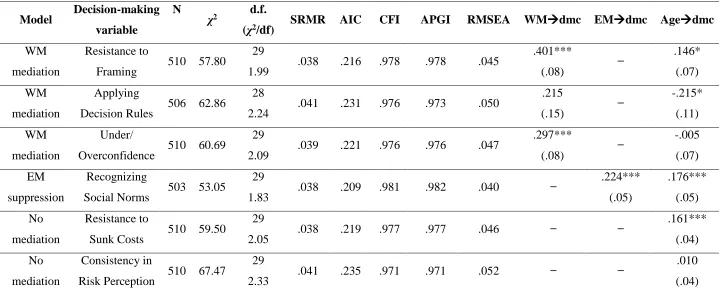
previously estimated models. SEM results for each model are reported in Table 6.14
The candidate model for Resistance to Framing assumes that the age-related decline in
working memory mediates (at least partially) the effect of age on performance. Thus, the candidate model comprises an age Resistance to Framing link and a working memory Resistance to
Framing link. As shown in Table 6, this model has good measures of fit, the relation between age and
13 For instance, in the case of Applying Decision Rules, the following links were added to the model developed in the
third stage of data analysis: Semantic Memory Applying Decision Rules and Working Memory Applying Decision Rules (from stage two); Age Applying Decision Rules (to test the working memory mediation hypothesis). This allowed a test of the mediation hypothesis, maintaining at the same time the age memory relationships detected in third stage of data analysis and incorporating the structural relationships emerged in the second stage.
14 In order to assess the stability of the memory+age model endorsed in the third stage of data analysis, we compared its
Resistance to Framing is positive and significant as well as the relation between working memory
and Resistance to Framing, while the relation between age and working memory is negative (-.642, SE = .05, p < .001) as in the stage-three model. The indirect negative effect of age on resistance to Framing (through working memory) is -.26 (95% CI between -0.37 and -0.15),15 which is significant
according to a one-tailed Sobel test (-4.67, p <.0001). Confidence intervals computed with the bias corrected percentile bootstrapping method on 1000 samples provide converging results (95% CI
between -.38 and -.16).16 The results show that individual differences in working memory completely mediate the negative effect of age on Resistance to Framing. Moreover, they expose a significant suppression effect: When the negative influence of age on Resistance to Framing through the
working memory decline is controlled for, the relation between age and Resistance to Framing is positive, highlighting a positive influence of age.
The candidate model for Applying Decision Rules assumes that the age-related decline in working memory mediates (at least partially) the effect of age on performance. Thus, the candidate model comprises an age Applying Decision Rules link and a working memory Applying
Decision Rules link. The results show that candidate model presents good measures of fit (Table 6). The relation between age and Applying Decision Rules is significant and negative, the one between
working memory and Applying Decision Rules is positive, but marginally significant only in a one-tailed test (p = .08), while the relation between age and working memory is significant and negative (-.647, SE = .05, p < .001). The indirect negative effect of age on Applying Decision Rules (through
working memory) is -.14 (95% CI between -0.33 and 0.05), which is marginally significant according to a one-tailed Sobel test (-1.46, p =.07). However, bootstrapping confidence intervals
computed with the bias corrected percentile method on 1000 samples do not allow rejecting the hypothesis that the indirect effect is zero in the population (95% CI between -.80 and .69). The
15 All CIs for coefficients of the mediation models were computed with the Baron–Kenny equation, but conclusions did
not change when using the equation proposed by MacKinnon, Warsi, and Dwyer (1995; see also Shrout & Bolger, 2002).
16 Boostrapped CIs were always computed by using the AMOS 20 package (Arbuckle, 2011), after missing data
results show a trend compatible with the view that individual differences in working memory may
partially mediate the negative effect of age on Applying Decision Rules, but statistical tests reach only marginal significance and confidence intervals do not allow rejecting the hypothesis that the indirect effect could be zero in the population. In any case, the existing trend would suggest partial
mediation, indicating that the negative influence of age on Applying Decision Rules cannot be completely traced back to an age-related decline in working memory.
The candidate model for Under/Overconfidence assumes that the age-related decline in working memory mediates (at least partially) the negative effect of age on task performance. Thus, the candidate model comprises an age Under/Overconfidence link and a working memory
Under/Overconfidence link. The results indicate that the model fit is good (Table 6), the relation between age and Under/Overconfidence is nonsignificant and very close to zero, and the relationship
between working memory and Under/Overconfidence is positive and significant. The relation
between age and working memory is negative (-.652, SE = .05, p < .001). The indirect negative effect of age on Under/Overconfidence (through working memory) is .19 (95% CI between 0.30 and
-0.09), which is significant according to a one-tailed Sobel test (-3.57, p < .001). Confidence intervals computed with the bias corrected percentile bootstrapping method on 1000 samples corroborate the
hypothesis that working memory mediates the negative effect of age on Under/Overconfidence (95% CI between -.34 and -.12).
The candidate model for Recognizing Social Norms assumes that the age-related decline in
episodic memory negatively affects task performance. Additionally, considering that the bivariate correlation between age and Recognizing Social Norms is close to zero, a suppression effect may
emerge after controlling for the negative effect of age through episodic memory. To test for these hypotheses, the candidate model comprises an age Recognizing Social Norms link and an episodic
memory Recognizing Social Norms link. This model exposes good measures of fit (Table 6), and
episodic memory is confirmed (-.397, SE= .04, p < .001). The indirect negative effect of age on
Recognizing Social Norms is -.09 (95% CI between -0.13 and -0.05), which is significant according to a one-tailed Sobel test (-4.08, p < .0001). These results were corroborated by confidence intervals computed with the bias-corrected percentile bootstrapping method on 1000 samples (95% CI
between -.15 and -.06). In summary, the results support the hypothesis that that age has a negative influence on the performance in Recognizing Social Norms through its negative impact on episodic
memory. However, after controlling for this negative indirect effect, a positive influence of age on Recognizing Social Norms emerges, highlighting a suppression effect.
The candidate model for Resistance to Sunk Costs assumes that age is positively related with
performance and that neither working memory nor episodic memory mediates this positive relationship. Table 6 shows that this model has a good fit to the data, and the result confirm the
positive relationships between age and Resistance to Sunk Costs, and between semantic memory and Resistance to Sunk Costs (.206, SE = .05, p < .001).
Considering the results of the second and third stage of data analysis, the candidate model for Consistency in Risk Perception is a no mediation model, with the inclusion of a Semantic Memory
Consistency in Risk Perception link. The results presented in Table 6 show that this model achieves a good level of fit, confirming the nonsignificant ageConsistency in Risk Perception link (p = .813) and the significant Semantic Memory Consistency in Risk Perception link (.184, SE = .05, p <
.001). Table 7 summarizes the results of the fourth stage of data analysis.
Discussion
The main goal of the present study was to test specific hypotheses on the relationships
between memory and important components of decision-making competence. These hypotheses were generated by coupling the general idea that diverse memory processes may functionally support decision-making performance in different ways with existing accounts of various judgment and
of each, and individual differences in six tasks of the A-DMC battery. The data were collected in the
context of the Betula Prospective Cohort Study (Nilsson et al., 1997; 2004), and data analysis was carried out in four stages. First, a measurement model of memory variables was estimated, finding that a three-factor correlated model (working, semantic, episodic memory) provides the best fit to the
data. This model agrees with traditional distinctions between working memory, episodic memory, and semantic memory (e.g., Baddeley, 2003; Tulving, 1972, 1987, 2002).
Building on this model, the relationships between memory latent variables and performance in each A-DMC task were examined. A general conclusion is that better performance in memory tests was always associated with a better performance in decision-making tests, thus underlining the
functional role of memory processes for effective decision making. More interestingly, the results showed selective relations between memory and decision making as measured by the A-DMC tasks.
In particular, the results showed that working memory is positively related with Resistance to Framing, Applying Decision Rules, and Under/Overconfidence. This agrees with the view that these cognitively demanding decision tasks require active processing of relevant information (e.g., Bruine
de Bruin et al., 2012; Del Missier et al., 2012). The results on the framing task are consistent with research showing that resistance to framing is related to individual differences in cognitive ability in
within-subjects designs (e.g., Bruine de Bruin et al., 2007, Stanovich & West, 2008), it is associated to prefrontal activity (De Martino et al., 2006) and benefits from a more analytic approach to the problems (McElroy & Seta, 2003). Working memory resources seem to be required for the correct
accomplishment of this task, probably because it implies a cognitively-demanding analysis and thorough processing of the problem information (in spite of surface changes across the frame
versions) and the ability to inhibit impulsive responses based on a superficial and perhaps emotional appraisal of the options (De Martino, 2006; Del Missier et al., 2012; Kahneman & Frederick, 2007). After the age-related decline in working memory has been controlled for, a positive effect of age on