This is a repository copy of The (Everyday) Image as One of Many: What Happens in the
Interstice?.
White Rose Research Online URL for this paper:
http://eprints.whiterose.ac.uk/89185/
Version: Accepted Version
Article:
Thoma, A (2014) The (Everyday) Image as One of Many: What Happens in the Interstice?
International Journal of the Image, 5 (1). 1 - 10. ISSN 2154-8560
[email protected] https://eprints.whiterose.ac.uk/
Reuse
Unless indicated otherwise, fulltext items are protected by copyright with all rights reserved. The copyright exception in section 29 of the Copyright, Designs and Patents Act 1988 allows the making of a single copy solely for the purpose of non-commercial research or private study within the limits of fair dealing. The publisher or other rights-holder may allow further reproduction and re-use of this version - refer to the White Rose Research Online record for this item. Where records identify the publisher as the copyright holder, users can verify any specific terms of use on the publisher’s website.
Takedown
If you consider content in White Rose Research Online to be in breach of UK law, please notify us by
The (Everyday) Image as One of Many: What
Happens in the Interstice?
Andrea Thoma, University of Leeds, UK
Abstract: This paper will consider how explorations of time and movement in a contemporary art context have capitalised on
the gap as the territory where we can shape our access to images. The author’s engagement with place through everyday
images has led to a series of art projects involving photography and video. The discussion will examine how these works capitalise the space in-between images to reflect on time. Reference will be made to David Claerbout’s work, in particular
The Algiers’ Sections of a Happy Moment, as it uses multiple photographic takes to endlessly prolong a moment. Mel
Bochner regarded Eadweard Muybridge’s photographs as ‘serialization of time through the systematic subtraction of
duration from event’. Within these ideas of the image and its relation to the lived moment as posited by Briony Fer, the discussion will allude to Bergsonian duration where ‘actual present’ and ‘virtual past’ coincide, with particular focus on Gilles Deleuze’s ideas of cinematic time. Within the temporal implications of the still image, Roland Barthes’s ‘photographic moment’ will be contrasted with Vilém Flusser’s ideas of thephotographic image as a ‘possibility of visualisation’.
Keywords: Visual Arts Practices, Photography, Moving Images
What counts is on the contrary the interstice between images, between two images: a spacing which means that each image is plucked from the void and falls
back into it (…) a method which cinema must ponder at the same time as it uses it. (Deleuze, 1989, p.173)
hese well-known reflections by Gilles Deleuze in relation to Jean-Luc Godard’s filmmaking can be taken into a wider arena of relations between filmic and photographic images. This article will explore how contemporary art works have capitalised on the gap as the territory where we can shape our access to images.
Relations between time and space have been at the forefront of a wide range of contemporary art practices – a particularly challenging and rewarding terrain has been the exploration of the dynamics between still and moving images, both in an Art and Film context. Within the extensive theoretical debate of these issues one could mention David Green’s (2006) remarks on the
‘temporalities of the image’, George Baker’s (2008) discussion of ‘photography in the expanded
field’, John Rajchman’s (2008) appraisal of the cinematic in art and also Mieke Bal’s (2000) analysis of so-called ‘non-moving’ images and their implications of time/movement. This article will refer to some of these concepts whilst examining how the interstice between images has been instrumental in providing a space from where to reconsider our (contemporary) processing of images.
Within my practice, I engage with place through everyday images and sound, which has led to a series of art projects involving photography, video and also painting. The discussion will focus on my lens-based work and how it uses the space in-between images to reflect on time. An exploration of David Claerbout’s filmic photo-collage work, in particular The Algiers’ Sections of a Happy Moment (2008) where multiple photographic takes expand a moment in time, will contribute to the argument.
My concerns with time and the image draw from Henri Bergson’s theory of duration and Gilles Deleuze’s ideas of cinematic time. When considering the gap between images, Eadweard
Muybridge’s photographs are worth recalling — they examine movement through still images taken by several cameras but seem to have left out ‘a sense of duration’ as it would be experienced in a lived moment. Mel Bochner saw them as ‘serialization of time through the systematic subtraction of duration from event’, (Fer, 2004, p.71) which explains their somewhat stilted artificiality pointing to limitations (and possibilities) within the still image.
How do we construct duration?
In his theorising of cinematic duration, Deleuze (1989) closely maps Bergson’s philosophy of time,
which relies on the view that the experience of the present as ‘actuality’ implies or coexists with the past as recollection, as memory, as ‘virtuality’. Deleuze reiterates Bergson’s observation of the
actual moment that coincides with its virtual past, meaning that the present moment needs to be coupled with its past dimension, for the actual present to move on towards the future. He refers to
Bergson’s crystal-image as it oscillates between different temporalities:
What constitutes the crystal-image is the most fundamental operation of time: since the past is constituted not after the present that it was but at the same time, time has to split itself in two at each moment as present and past, which differ from each other in nature, or, what amounts to the same thing, it has to split the present in two heterogeneous directions, one which is launched towards the future while the other falls into the past. Time has to split at the same time as it sets itself out or unrolls itself: it splits in two dissymmetrical jets, one of which makes all the present pass on, while the other preserves all the past. Time consists of this split, and it this, it is time, that we see in the crystal. (Deleuze, 1989, p.79)
The coming together of presence and absence (e.g. of image/sound) is an essential aspect of my practice, which I will return to when appraising my video work Ocean.
When reflecting on the image in cinema and photography, Deleuze adapts Bergson’s ideas of movement. Ronald Bogue explains: “What Bergson does not say, and perhaps does not fully realize, Deleuze observes, is that photography and cinema make possible a new means of understanding privileged moments, one that relies not on idealizing poses but on the very discovery of the instant quelconque.” (Bogue, 2003, p.23)
By examining different scenarios, this article will consider how Deleuze’s instant quelconque can be differentiated or spatialized through the gap between images
What is the ‘advantage’, or specific potential, of the still image when considering time?
Further to concerns with movement, there are temporal implications of the still image, as seen in
Roland Barthes’s ‘photographic moment’:
What the Photograph reproduces to infinity has only occurred once: the
Photograph mechanically repeats what could never be repeated existentially (…) It is as if the Photograph always carries its referent with itself, both affected by the amorous or funereal immobility, at the heart of the moving world: they are glued
together (…) (Barthes, 2003, p.20)
From Barthes’s photograph as index of a past moment and its relation to the idea of death,
photography’s link to its referent has been particularly challenged since the era of digital
photography. Vilém Flusser (2002) in contrast, understands the photographic image as a ‘possibility
of visualisation’. His concept of a photograph as computation from a multitude of possible pixels is
very much at the antipode of Barthes’s testimony of things gone. Flusser stresses that in ‘synthetic’
and even analogue photographs the ‘calculation of dot elements (such as molecules in silver
compounds)’ and ‘the computation of these elements into images’ are apparent:“(…) In speaking
about photographs, we should not say imagination, but rather visualization (…) [it] is the power to concretize an image from possibilities. Photographs are posthistorical, because they concretize
rather than abstract.” (Flusser, 2002, p.129)
For Lázló Moholy-Nagy, photography enables an augmented ‘power of sight in terms of time and space’. He distinguishes between ‘eight varieties of photographic vision’. (2003, p. 93) Velocity and slowness are here of particular interest; Moholy-Nagy considers ‘rapid seeing’ as a ‘fixation of
movements in the shortest possible time’ and in contrast ‘slow seeing’ as a process which is
In some of my photographs a sense of prolonged duration is achieved through long exposure times allowing for slight camera movements to become visible. In contrast, the insertion of still images in video works like Ocean allows for the brevity of a photographic instant as disruption of
the ‘moving footage’.
The temporal complexities emerging from relations between still and moving images have been an opportunity to rethink both photographic and filmic time. David Green (2006) explains Raymond
Bellour’s analysis of the insertion of photography within the narrative flow of classical cinema:
At this point in which ‘the film seems to freeze, to suspend itself’, the viewer is
made aware of two kinds of temporality, that which belongs to the film and the intrinsic forward movement of the narrative, and that which is the time of viewing the film and which carries the phenomenological force of the here and now. Thus paradoxically it is the photograph caught on film that directs our attention to the present — even as it functions within the narrative of the film in accordance with its predominant cultural forms to symbolize the past. (Green, 2006, p.18)
The photograph here makes us aware of the present of our viewing, however, as will be argued when analysing Ocean, the inserted photograph also seems like a memory image — like the past of the present that we observe within the moving images.
David Claerbout
Claerbout’s collage of moving video footage within still images has confirmed some of my own
endeavours. Valérie Da Costa suggests that by animating parts of a still image, as in Kindergarten Antonio Sant’Elia, 1932 (1998),1 he ‘perturbs the Barthesian punctum’ allowing for ‘time’s
substance’ to ‘become simultaneously fluid and solid’ within the same pictorial context. (2007, p.40)
His film The Algiers’ Sections of a Happy Moment (2008) depicting a scene on a rooftop used as a football pitch, overlooking the sea, offers a compelling reflection on how photographic duration
can be altered through filmic intervention. The presentation of ‘one photographic moment’ in a
stream of photographic stills as multiple takes of the same scene, invites us to view this moment again and again. Here Bergson’s duration of ‘qualitative succession’ (in relation to events in time) seems extended through multiple takes of the same scene into a space of ‘quantitative simultaneity’ (Bergson, 1910, pp.226-228): “What is duration within us? A qualitative multiplicity, with no
likeness to number (…) a pure heterogeneity within which there are no distinct qualities (…) What
duration is there existing outside us? The present only, or if we prefer the expression, simultaneity.” (Bergson, 1910, pp. 226-227)
Claerbout undoes the closure or fixity of the photographic still by creating an artefact that seems to endlessly prolong ‘this moment’ in space allowing us to revisit the scene through a multitude of images. In fact, he relies on images taken simultaneously by several cameras edited as 29 minutes video projection of 180 digitally processed images. (Balsom, 2013, p.85) For Erika
Balsom, Claerbout’s undertaking is quite different from the narrative sequences of stills found in works by James Coleman or Chris Marker:
Rather, in its panoptic comprehensiveness, The Algiers’ Sections of a Happy Moment seeks to exhaust every corner of the visible. It provides a radically unhuman way of seeing that happens to coincide with a deep human desire: the
re-materialisation of the past in all its detail […] But for all that is offered by the work, the decisiveness of the moment between man and bird is lost twice over. Its exceptional status gradually fades (…) before being undone entirely by the
realisation that this moment never did — never could — exist as it is presented here. (Balsom, 2013, p.86)
The pool of photographs thus generated could be examined in relation to Flusser’s idea of photography as computation, as potential of visualisation — Claerbout sets here something up that
certainly challenges Barthes’s photographic instant through offering an array of visual takes which
seem to stretch photographic time-space dimensions through filmic means. Combining still images and sound, he seeks to expand the photographic scene in a ‘slideshow’ of different viewpoints
creating a ‘prolonged moment’, which is compounded by the contemplative, lingering temporality of the sound. However, once we become aware of the artifice (the 180 cameras remain invisible) Henri Cartier-Bresson’s ‘decisive moment’ is gone. (Balsom, 2013, p.86)
Within the (fictitious) multi-dimensionality of the depicted space, journeying between images
—Chris Marker’s La Jetée (1962) comes to mind (even if there are clear differences as we have seen above), where the main protagonist is sent back in time, holding onto an image fixed in his mind, that he needs to find in the past. With Claerbout, there is no voice-over, only sound and still photographs mapping the terrain of visual memory.
Marker’s renowned film is an artefact where one is acutely aware of the scope of editing and the space between images — consisting of (mostly) still images and sound and/or voice-over where
a narrative/filmic dimension is created in the viewer’s mind. Repetition, changing view-points, zooming and pace of editing — all these shape the gap, which in fact provides the space (and time)
for the imaginary to conjure up a (ficticious) ‘lived experience’ where the impact of the
photographic images is met with the experience of (virtual and at one point actual) movement.2 Both Marker and Claerbout exploit how we are conditioned to watch films. In the works mentioned above, this mode of cinematic perception operates a two-fold movement: a present
moving towards the future (through sound and editing) combined with photography’s indexicality
of a moment that occurred in the past.
Jane Harbord observes in her close reading of La Jetée how Marker employs a ‘double-tense structure’ (2009, p.87): “In his presentation of a time of event and a time of telling, Marker evokes cinema as a recording device, with the concomitant knowledge that this present (of telling) has
already passed.” (Harbord, 2009, p.87)
From a Deleuzian (1989) perception of filmic time, one could observe how in La Jetée3 but
equally in Claerbout’s piece, actual present (as movement/sound/voice-over)4 is juxtaposed with recollection images (still images), which seem to conjure up the past (as recollection or virtuality)
thus creating multiple ‘time-images’.
The gap as a means to reflect on duration as multiplicity
Briony Fer equates the syncope with a ‘temporary absence’, a disturbance within the flow of time,
like ‘the irregularity of the heartbeat’ or a ‘cerebral eclipse’. (2000, p.75) The gap or syncope is an essential element within my practice; as a structural component it contributes to the spatial and temporal orchestration of audio/visual data — it also facilitates a dynamic of absence and presence, thus involving memory and recollection. At times, this means an interruption of a visual mode
2 Timothy Corrigan explores the ‘forgotten image between two shots’ in relation to the ‘essayistic’; he posits that Marker’s photo-essays ‘open a space (…) in which thinking might pitch its tent’. La Jetée similarly combines the photographic and the filmic but, in addition involves ‘identification, narrative and desire’. (Corrigan, 2008, p.54)
3 Corrigan wonders about ‘the curious paradox’ that Deleuze did not mention Marker’s films in his two landmark books on cinema. (2008, p.57)
through the insertion of another type of image, or it may refer to the gap or seam between the end and restart within looped video works.
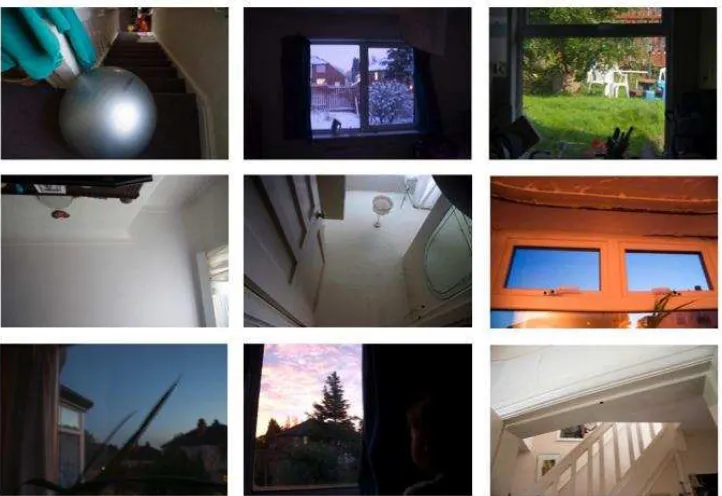
Figure 1: Stills from The Making of Place to Enable Memory Source: Thoma 2005
Figure 2: Stills from Journeys Across the Home Source: Thoma 2010
[image:6.516.93.454.333.581.2]home, The Making of Place to Enable Memory (2005)5 or Journeys Across the Home (2010), a collaboration with Deborah Gardner, involve slideshows of photographs taken within my house or its vicinity (in Journeys Across the Home these are combined with Gardner’s images).
As much as they show photographic moments, I see these images as possibilities of visualisation rather than examples of a particular moment in time. However, when seen in
juxtaposition — as filmic collage of home as place of dwelling — some of the images are recurring, with a slightly different emphasis relating to the time of year, the camera angle or light conditions. From trees that have disappeared, to a change in wall render, or simply different takes of the same corner, ceiling or window at various times of the day or year — the gap, or the time and space between these images, is what ultimately makes them meaningful. The individual images are observations of place-situations, but when juxtaposed in a filmic context the interstice between them (be it ever so short) becomes a place from where to imagine what might have happened in-between these photographic events — duration as lived moment.
The gap between different visual signifiers and a modulation of movement/stillness comes to play in the juxtapositions within my ongoing project Thought Dwellings (Thoma, 2011) — for instance, between the video piece Ocean (2011), the painting White Lines/Blue/Orange/Pink (2010-11) and the photographs White Snow Night (2011) and also Trainjourney/White (2010). The space between these images is conditioned by a triangulation of painting, photography and video where an oscillation between abstraction and figuration and/or between still and moving images allows for a differentiated perception of time-space relations.
Figures 3 to 5: Views of Thought Dwellings in Situ (Ocean with White Lines/Blue/Orange/Pink, White Lines/Blue/Orange/Pink with White Snow Night, Ocean with Trainjourney/White)
Source: Thoma 2013
Ocean — Reflections on the Editing Process
The looped video piece Ocean addresses some of the above by examining how moving images
might ‘fill’ the gap between photographs, or vice versa, how within video footage, still images can be inserted to reflect on a juxtaposition of ‘actual’ present and ‘virtual’ past as described in Deleuze’s ‘Time-Image’ (1989).
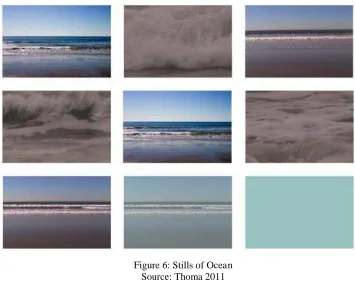
Ocean starts with a recollection image — a still image of the ocean as seen from a beach. However, it is animated by the sound of waves. Then the still gives way to close-up video footage of the breakers, which then change into long distant footage of ‘moving
waves’, returning to the close up images of the surf. Unexpectedly, the still image reappears,
like a memory, a recollection, causing a distancing not so much in space but in time — as if one became, while watching the present, aware of its past. Then the close-up footage takes over again with no time to reflect on the past — this is movement as action. And again the still image appears, as distancing factor, as a means to create an awareness of the
juxtaposition of ‘virtual’ and ‘actual’ time.
Figure 6: Stills of Ocean Source: Thoma 2011 During the editing process I queried how to use the still image:
(…) How can the still images make sense? Perhaps their duration needs to be extended. What kind of transition should be between images? Should images blend, or should I use jump cuts and/or cross fading? Jump cuts seem to reinforce a sense of embodiment within the close-up shots, like a sudden being-in-place, engulfed by the roaring, rushing, whooshing sounds of the water.
When would the sound need to be phased out, dipping into silence? The gap between beginning and end of the video is marked by a cut of image and sound —in this case ‘seam’ might be a more suitable term, for there is continuity within the roaring. However, the ‘new
beginning’ of the loop is apparent, every time. Here circularity is imperfect, not seamless but
acknowledging absence by means of abstraction; when the figurative footage fades into abstract light-blue void, one ‘steps outside’, as if moving one’s eyes from the spectacle to only see the void of the blue sky — moving from action to contemplation.
The piece should have different tempi — rather than defined by linearity, these should overlap,
possibly through sound, thus creating ‘counter-currents’ in order to amplify the notion of multiplicity within the movement of the ocean.
The editing of Ocean is concerned with multiple time flows, relations between still and moving images, and also distance and proximity as the viewer engages with the movement of the sea.
Andrey Tarkovsky’s (2005) concept of ‘sculpting time’ informed my editing: “Assembly, editing, disturbs the passage of time, interrupts it and simultaneously gives it something new, The distortion of time can be a means of giving it rhythmical expression. Sculpting in time!” (Tarkovsky, 2005, p. 121)
abstract void is lined with the ‘invisible’ (Merleau-Ponty and Lefort, 1968)6 whilst the sound continues.
The piece needs to be looped, almost as tautology of the rolling waves, the swelling of sound and its release in the swishing noise of the ocean spray. However, the emphasis here is not on
homogenous time, but on the juxtaposition of multiple time flows echoing Bergson’s concept of duration. Deleuze comments on how for Bergson ‘planes of consciousness’ follow one another (1988, p. 66): “Recollection can only be said to be actualized when it has become image. It is then,
in fact, that it enters not only into ‘coalescence’, but into a kind of circuit with the present, the recollection-image referring back to the perception image and vice versa.” (Deleuze, 1988, p. 66)
Ocean instrumentalises the gap to engage with time as multiplicity of duration. It is the gap between moving footage and still image, also the gap between figurative, indexical images and their
absence when they dissolve into ‘blue void’; lastly, the gap between audio-visual ‘images’ and the
short fading into silence, a ‘minute’ interference, before it all starts again.
By considering a variety of case scenarios and exploring how their images might be read in
view of different theoretical positions, the discussion has drawn from Bergson’s philosophy of time, Deleuze’s interpretation of the former in relation to cinema, in particular his ‘time-image’,
furthermore, photographic implications of time, indexicality and visualisation, considerations of movement and stasis relating to still and/or moving images, from Muybridge’s photographic studies
of movement, Marker’s filmic photo-roman, Claerbout’s ‘animated’ photographs or filmic slideshows to appraisals of my own practice, with particular focus on the video piece Ocean.
These different positions reflect on how we might think time and space of the image, but more importantly how duration can be comprehended as multiplicity within the juxtaposition of different time flows relating to absence and presence of diverse visual signifiers.
This article has considered the scope of the interstice between (everyday) images exploring how this gap, this in-between images — present in its absence — enables us to engage with duration as
‘lived experience’.
References
Baker, George. 2008. “Photography's Expanded Field.” Beckman, Karen and Ma, Jean. (Ed.) Stillmoving: Between Cinema and Photography. Durham and London: Duke University Press.
Bal, Mieke. 2000. “Sticky Images: The Foreshortening of Time in an Art of Duration.” Bailey Gill, Carolyn. (Ed.) Time and the Image. Manchester and New York: Manchester University Press.
Balsom, Erika. 2013. “David Claerbout's Indecisive Moments.” Afterall, 32: 84-93. Barthes, Roland. 1993. Camera Lucida : Reflections on Photography. London: Vintage. Bergson, Henri. 1910. Time and Free Will : An Essay on the Immediate Data of Consciousness.
London: Allen & Unwin.
Bogue, Ronald. 2003. Deleuze on Cinema, New York and London: Routledge.
Corrigan, Timothy. 2008. "’The Forgotten Image Between Two Shots’: Photos, Photograms and the Essayistic.” Beckman, Karen and Ma, Jean. (Ed.) Stillmoving: Between Cinema and Photography. Durham and London: Duke University Press.
Da Costa, Valérie. 2007. “David Claerbout: un temps pluriel.” Art Press, 337: 36-40. Deleuze, Gilles. 1988. Bergsonism. New York: Zone.
Deleuze, Gilles. 1989. Cinema 2: The Time Image. London: Athlone.
Fer, Briony. 2000. “Some Translucent Substance, or the Trouble with Time.” Bailey Gill, Carolyn. (Ed.) Time and the Image. Manchester and New York: Manchester University Press. Fer, Briony. 2004. The Infinite Line : Re-making Art after Modernism. New Haven, Conn., and
London: Yale University Press.
Flusser, Vilém. 2002. “Photography and History.” Ströhl, Andreas. (Ed.) Vilém Flusser: Writings. Minneapolis: University of Minnesota Press.
Green, David. 2006. “Marking Time: Photography, Film and Temporalities of the Image.” Green, David and Lowry, Joanna. (Ed.) Stillness and Time: Photography and the Moving Image. Brighton: Photoforum and Photoworks.
Harbord, Jane. 2009. Chris Marker: La Jetée. London: Afterall Books.
Merleau-Ponty, Maurice and Lefort, Claude. (1968) The Visible and the Invisible : Followed by Working Notes. Evanston: Northwestern University Press.
Moholy-Nagy, Lázló. 2003. “A New Instrument of Vision.” Wells, Liz. (Ed.) The Photography Reader. London: Routledge.
Orlow, Uriel. 2007. “Photography as Cinema: La Jetée and the Redemptive Powers of the Image.” Campany, David. (Ed.) The Cinematic. London and Cambridge, Mass.: Whitechapel and MIT Press.
Rajchman, John. 2008. “Deleuze's Time, or How the Cinematic Changes Our Idea of Art.” Leighton, Tanya. (Ed.) Art And The Moving Image. London: Tate Publishing.
Tarkovsky, Andrey. 2005. Sculpting in Time : Reflections on the Cinema. Austin: University of Texas Press.
Thoma, Andrea. 2006 “The Making of ‘Place’ to Enable Memory.” Journal of Visual Arts Practice, 5: 83-93.