This is a repository copy of
Interface refactoring in performance-constrained web services
.
White Rose Research Online URL for this paper:
http://eprints.whiterose.ac.uk/74891/
Proceedings Paper:
Webster, D, Townend, P and Xu, J (2012) Interface refactoring in performance-constrained
web services. In: Proceedings - 2012 15th IEEE International Symposium on
Object/Component/Service-Oriented Real-Time Distributed Computing, ISORC 2012. 2012
IEEE 15th International Symposium on Object/Component/Service-Oriented Real-Time
Distributed Computing (ISORC), 11 - 13 April 2012, Kingkey Palace Hotel, Shenzhen,
China. Institute of Electrical & Electronic Engineers , 111 - 118 . ISBN 978-0-7695-4643-8
https://doi.org/10.1109/ISORC.2012.23
[email protected] https://eprints.whiterose.ac.uk/ Reuse
See Attached
Takedown
If you consider content in White Rose Research Online to be in breach of UK law, please notify us by
Interface Refactoring in performance-constrained Web Services
David Webster, Paul Townend, Jie Xu
School of Computing, University of Leeds
Leeds, UK
{D.E.Webster, P.M.Townend, J.Xu}@leeds.ac.uk
Abstract— This paper presents the development of REF-WS an approach to enable a Web Service provider to reliably evolve their service through the application of refactoring transformations. REF-WS is intended to aid service providers, particularly in a reliability and performance constrained domain as it permits upgraded 'non-backwards compatible'
services to be deployed into a performance constrained network where existing consumers depend on an older version of the service interface. In order for this to be successful, the refactoring and message mediation needs to occur without affecting functional compatibility with the services' consumers, and must operate within the performance overhead expected of the original service, introducing as little latency as possible. Furthermore, compared to a manually programmed solution, the presented approach enables the service developer to apply and parameterize refactorings with a level of confidence that they will not produce an invalid or 'corrupt' transformation of messages. This is achieved through the use of preconditions for the defined refactorings.
Keywords- Web Services, Refactoring, Reliable Evolution
I. INTRODUCTION
Software evolution is a fundamental part of software engineering and its need to be addressed has been well understood for many years [1]. Activities involved in software evolution range from the repair of defects to the addition of new functionality to a system.
Modern computing systems are moving towards a Software as a Service (SaaS) paradigm, which can be characterized as a separation of the possession and ownership of software from its use [2]. One of the motivations for using Software as a System (SaaS) is for software developers to be able to respond to the industrial needs of evolving software in contrast to traditional software maintenance processes. Such processes are viewed as too slow to meet these rapidly evolving needs [3]. Whilst this separation has its benefits, the downside of this arrangement is a loss of control over the service software from the consumer’s perspective compared to locally running software.
In the environment of an open marketplace for services it is common for a service provider to offer the provision of service to consumers without knowing specific details about them, for example a contact address. This is in contrast to a consumer contracting a service provider to provide a bespoke service specifically for that consumer. A fundamental challenge to evolving a service (and its interface) in this setting, therefore, is that the service
provider may not know the contact details or otherwise be practically able to contact each consumer of their service to notify them of changes to their interface or specification [4]. Depending on the agility of the consumer software's maintainer (in its response to update the software in order to comply with the new service interface) and the speed of the change to the service's interface there is a risk of a delay between this change and the adaptation and redeployment of the consumer software. This is problematic when the consumer assumes that the service interface will remain functionally static leading to what Jones et al [5] describes as an 'abnormal event' that leads to a 'fault'. In addition to just purely functional changes to the service, consumers may be dependent on QoS characteristics of the service, for instance the real-time performance and latencies.
A research challenge that this paper aims to address, therefore, is in resolving the conflict between a service provider that needs to evolve its interface to accommodate new requirements and the assumption from a set of service consumers who either assume that the service interface will remain unchanged [5-7] or is unable to adapt due to constraints such as development agility.
The scope of our work is demonstrated by the upgrade to an exemplar workflow that dynamically integrates sensors from an ubiquitous sensor network for the purpose of region surveillance, constrained by run-time QoS (latency) requirements. This is presented through a graphical mapping interface for the human decision maker that defines the desired response time. Within the scale of the exemplar, the performance overhead of executing the refactoring transformations has been demonstrated to be significant.
A. Refactoring for Evolution
'Refactoring' [8, 9] is a commonly used engineering practice in software evolution and is viewed as a prerequisite to adding new functionality or features to software systems. Often this is performed to ease the effort required to extend the software by improving its design first before adding new features. Survey work conducted by Dig [10] concluded that of API changes that break compatibility with existing applications, over 80% of these changes are refactorings.
B. The Challenge of Applying Refactoring to Web Services
Object-Oriented Programming (OOP) domain and w by OOP software development tools, th refactoring has yet to be explored in th domain. A resolution to this problem, howe trivial case of recoding existing OOP refac warrants deeper analysis of the models refactored in Web Services compared to O addition to evaluating the performance o proposed solution. In this paper we introdu to solve this problem, titled REF-WS.
The outline of the remainder of this pap Section II outlines the motivating scenar extension to a sensor integration scenari previous work. Section III details the mod inherent with refactoring Web Services OMG's MOF as a point of reference. Secti approach for refactoring the service inte model in addition to our assumptions and s details the implementation of this approach. VI concludes the work and outlines scope fo
II. MOTIVATING SCENAR
In this section an exemplar is presented t the evolution of the interface to a Web Se sensor integration scenario. This exemplar and extends the scope of our previous publi on a software demonstrator conducted fo NECTISE programme [11].
In the demonstrator system a work dynamically integrate simulated sensors fro network for the purpose of region surveilla moving Point of Interest (POI). This is pre time-sensitive graphical mapping interface decision maker. The desired response ti defined by the mapping interface gove completion time of the workflow. The imp in order to satisfy the desired response time workflow needs to be able to contact the a retrieve their responses in the presence of la aggregate these responses within the p constraint. If a sensor fails to respond duri time then that particular request thread from terminated and the collection of returned re aggregated and returned to the map client. F
[image:3.612.322.546.388.700.2]an overview of the sensor integration workfl In this paper we extend that work by upgrade on the sensors which requires a compatible change to the service interfa Version 1 of the sensors provide the coordi detected POI. In the upgraded sensors (Ver
Figure 1: Sensor Integration Wo
widely supported he technique of he Web Services ever, is not just a ctoring tools and that need to be OOP. This is in verheads of any uce our approach
per is as follows. rio based on an io based on our delling challenges
and utilizes the on IV details our rface's structural scope. Section V
Finally, Section or future work.
RIO
that demonstrates ervice based on a r is informed by ished work based or the completed
kflow is run to om an ubiquitous ance for a rapidly esented through a e for the human ime for the user erns the overall pact of this is that
e for the user the available sensors, atencies and then pre-defined time
[image:3.612.76.275.623.701.2]ing the requested m the workflow is esponses are then
Figure 1 provides low.
y performing an a non-backwards ace to be made.
inates of a single rsion 2), this POI
information is augmented with the g itself in addition to the time that requires a structural change to the difference between the interfaces ca
Figure 2.
The approach presented in this p developer to refactor Version 1 of stages until a point where it is decl on a collection of primitive refactor constrain this work's scope, not refactorings are detailed in this pape does provide a realistic use-case to refactorings that are discussed and a of this paper.
The QoS requirement of the informs the performance evaluat solution. Whilst from the pers developer the overall refactoring wil than at run-time. From the service other than tolerating a downtime du the upgraded service, the refactored within the QoS constraints defined b of the sensor service. As a result of approach requires that latency overh
Figure 3 illustrates the ov introduced to enable the transforma 1 request and response messages version of the service consumes an these as follows:
TQoS < Trequest + Tlo
Where TQoS is the response tim
rkflow
Figure 2: Version 1 and V the Sensor Interface
Figure 3: Timing constraints
geo-location of the sensor it detected the POI and e service interface. The an be shown illustrated in
paper, permits the service the interface in multiple lared as Version 2, based rings. Due to the need to t all possible primitive er, however, the exemplar
o drive the scope of the analyzed in the remainder
e exemplar furthermore tion for the refactoring spective of the service ll be at design-time rather e consumer’s perspective, ue to the redeployment of d service needs to operate by the original consumers f this the evaluation of our heads be considered. verhead times that are
tion between the Version to those that the new nd produces. We define
ogic + Tresponse
me defined by the service
Version 2 of Schema
consumer; Trequest is the time taken for the t
the Version 1 request message into a V message; Tlogic is the time taken for the serv
and Tresponse is the time for the time
transformation of the Version 2 response Version 1 response message.
III. MODELLING
In this section the uniqueness of the models is investigated compared to the mor structural models that are used in refacto fundamental differences between the two w simple use of OOP refactoring tools fo refactoring. These differences are summar of:
• System boundaries • Meta-modeling layers
A. System Boundaries
A fundamental difference between th Web Services and the refactoring that is typ OOP languages is in the system boundary o being refactored. Refactoring approaches that the refactoring system has access to interface code that is being refactored and that calls this interface. If this is not th interface becomes what Fowler [8] nam
[image:4.612.65.293.423.704.2]interface'. Despite refactoring often taki internals of software components, many change the software interface and break the the change. This change to a publish
Figure 4: Overview of MOF la
Figure 5: Web Services applied to M
transformation of Version 2 request
vice logic to run; taken for the message into a
e Web Services re common OOP oring. There are which prevent the
or Web Service rized as in terms
he refactoring of pically applied to of the model/code typically assume o all the method the all the code he case then this mes a 'published
ing place in the refactorings do encapsulation of hed interface is
problematic if the software develope all client code that consumes the in the Web Services domain. In the sc language such as Java this would b provided by a software library.
B. Web Services and Meta-Modelli
At a technical level Web Servi following group of specifications: W SOAP. Web Services Definition L XML-based machine-processable language for describing the operatio exchanged between a client and serv XML Schema is a formal langu validate the structure of XML docu the WSDL document's message SOAP (initially standing for Simple protocol specification defines an protocol for the exchange of information across web peers, typi environment [13].
To illustrate the comparison betw typically the target of refactoring) models that are used to develop an the OMG's MetaObject Facility (M framework for reference here. The Model-Driven Engineering by defin framework for defining system mod models. These four layers are as fol
• Meta-meta-model (M3)
language for defining
meta-• Meta-model (M2) : Define
describing the structure an UML is an example of a me
• Model (M1) : Defines the
we want to describe.
• Instance data (M0) : D
system information applied
Figure 4 provides an overview application of different language me To use the WSDL document in to be interpreted by a middleware s then exposes a Web Service endp receives SOAP messages based on and XML types defined in the WS Schema document.
In reference to Section III.A, u purely to OOP source code; apply Services will require the managem changes made to the WSDL docume propagate through the middleware a message sent and received from
Figure 5 illustrates the linking betw and documents associated with th Service against the MOF layers.
In summary, applying the tech Web Services is not just a 1:1 ma model, such as Java. Instead we
ayers
MOF layers
er does not have access to nterface as is the case in cenario of a programming be comparable to the API
ing
ces are composed of the WSDL, XML Schema and Language (WSDL) is an e interface definition ons and messages that are vice provider [12]. uage used to describe and
uments, and is applied to definitions. Finally, the e Object Access Protocol)
n XML-based stateless structured and typed ically in a Web Services
ween the OOP model (as and the combination of d deploy a Web Service, MOF) [14] is used as a e MOF forms a basis for ning a layered meta-data dels and associated meta-llows:
: Defines an abstract data.
es the languages used for nd semantics of models. eta-model.
model of the system that
Describes the real-world to the M1 model.
w of these layers and the eta-models.
n a Web Service, it needs system. This middleware point and generates and
the operations, messages DL and associated XML
unlike refactoring applied ying refactoring to Web ment of how refactoring ent and its SOAP binding and into the HTTP/SOAP m the service consumer.
ween the various schemas e deployment of a Web
hnique of refactoring to apping to an OOP
meta-model for defining structural elements of messages, WSDL for the operations in addition to the unique parts of WSDL and the SOAP binding, for example the PortType, Binding and Service definition. Of these standards, the XML Schema is the closest to the OOP model in terms of feature overlap, therefore, in this paper we can initially take advantage of this similarity and exploit existing refactoring theory.
IV. APPROACH AND ANALYSIS
In this section our approach to refactoring Web Services (titled 'REF-WS') is introduced and detailed. Based on the refactorings defined by Opdyke [9] in Figure 6, we have plotted the applicability the primitive refactorings against the WSDL and XML Schema models. In order to constrain this initial work’s scope we focus on addressing refactorings applied to the XML Schema (message structure) part of the Web Service first. As a consequence of this decision, the changes to the operation definitions in the WSDL document and their effects on the middleware are not addressed in this initial work at the current time.
Within the scope of this work, the following assumptions are made:
• Services evolve their functionality whilst building on
existing functionality. In this assumption, as services extend their functionality the logic of the previous functionality is not changed substantially. Therefore, functionality of Vn+1 is a superset of Vn
whereby services are refactored then evolved.
• Mismatch between interfaces only occurs at the
structural level. Protocol mismatches are outside the scope of this work.
• Services are invoked in request/response mode.
• Messages do not contain binary sections, for
example raw image data.
A. Refactoring Transformation Definition
The REF-WS approach proposed in this paper defines refactoring transformations based on two layers relative to the MOF framework. The primitive refactoring transformations themselves apply to the M1 ‘Model’ level which affect messages created by the Web Services middleware at the M0 'Message' level. As applied to the motivating scenario exemplar in Section 2, the three primitive refactoring transformations applied to perform the desired refactoring are as follows:
• Create new ComplexType. • Create new Element. • Move Element.
These primitive refactoring transformations when applied to the service interface schema can be applied individually to iteratively transform the Version 1 of the service interface schema illustrated in Figure 8. to what is eventually declared to be Version 2. As the transformations are applied in sequence their application can each be checked against their defined preconditions, as is in keeping with the theory of Opdyke’s original refactorings. We, therefore, define the preconditions for the refactoring transformations required to implement the exemplar transformation of Figure 8 in
Figure 9.
B. Layered Transformations
Due to the Web Service provider's lack of control beyond the service interface boundary; after refactoring there is still a mismatch present between messages sent to and from the service implementing the old interface schema and the service that implements the new refactored schema. This can be contrasted with OOP source code refactoring, where access to code on both sides of the class interface boundary is assumed.
[image:5.612.56.298.477.694.2]In order to resolve this message mismatch these messages must be transformed. In our approach the specification of this M0 message transformation is derived from the M1 level refactoring that has been applied to the service interface schema. This linkage can be shown diagrammatically in Figure 7 which illustrates a high-level model for describing the linkage between the messages, schemas and refactoring transformations.
Figure 6: Applicability of Opdyke’s primitive refactorings
[image:5.612.323.545.587.700.2]Refactoring Parame
newComplexType
sourceComplexT targetComplexT newElementName
sourceComplexT targetComplexT sourceElementN
Figur
[image:6.612.56.562.557.683.2]Version 1
Figure 8: Overview of refactoring the
eters Pre-conditions
eName complexType complexTypes
~hasName( newComplexTypeName, complexTy TypeName
TypeName e
! isComplexType(s) hasName(s, sourceCo ! isComplexType(t) hasName(t, targe ! ~hasElement(s, newElementName)
TypeName TypeName Name
! isComplexType(s) hasName(s, sourceCo ! isComplexType(t) hasName(t, targe ! hasElement(s, sourceElementName) ! ~hasElement(t, sourceElementName)
re 9: Primitive refactorings and pre-conditions
Version 2
sensor interface structural schema from Version 1 to Versio
ype.name) omplexTypeName) etComplexTypeName
omplexTypeName) etComplexTypeName
V. IMPLEMENTATION
For the implementation of our approach we have leveraged the Atlas Transformation Language (ATL) associated with the Eclipse project. ATL permits elements in a meta-model to be matched using ‘match rules’ defined against the source model. A ‘target pattern’ is optionally defined for the rule and is used to generate elements of the target model. In order to refine the ‘match rules’ part of the transformation, the OMG’s Object Constraint Language (OCL) can be applied; this restricts the elements of the source model that the transformation is applied to.
A. Model-level Transformations
Each of our low level refactorings is implemented in a separate ATL rule respectively. The refactorings that apply to the M1 level are defined against the M2 meta-model. It is crucial to stress at this point that this means that the refactoring transformations are applicable to any XML types schema defined by the XML Schema meta-model, rather than on a specific service’s interface. To achieve this generality the names of specific ComplexTypes and Elements are defined by parameters passed to the transformation rules. The scalability of the approach is driven by the definition of primitive refactoring transformations that can be reused and recombined into large refactoring transformations to suit the service developer.
After defining the refactoring rules in ATL the models and meta-models need to be defined in ECore. ECore is the Eclipse equivalent of the OMG’s MOF and implements comparable concepts in the M2 meta-model. We take advantage of the Eclipse Modelling suite’s included ability to import models defined in XML Schema and convert them to an ECore representation bi-directionally using an ECore ‘generator model’. The principal mappings between XML Schema and ECore are as follows: ComplexType å EClass
and Element å EReference.
In addition to these two mappings an additional EClass must be defined. The WS-I Basic Profile standard rule R2204 [15] defines, "A document-literal binding in a description must refer, in each of its soapbind:body element(s), only to wsdl:part element(s) that have been defined using the element attribute". As a consequence of this requirement, a ‘DocumentRoot’ EClass needs to be created in order to contain this orphan element/EReference.
The refactoring rules that we define in ATL are then repeatedly applied in the desired sequence to the ECore model of the service interface. The rules are defined in ATL’s ‘refining mode’ to the service interface model representation of ATL. This permits both the source and target models to be instantiations of the same meta-model.
In our approach we map our preconditions for the refactoring to the OCL part of the matched rules. Figure 10
shows the implementation for the MoveElementReference refactoring in ATL. The ‘from’ part of the matched rule implements the validity checks for the transformation.
B. Instance-level Transformations
In order to define the M0 instance (message) level transformation for the specific service interface, the
transformation needs to be derived from the M1 model-level refactoring transformations automatically and without user intervention. To enable this linkage between the two transformation levels we define a meta-model named SUDO. This is a simple model-based representation of an M0 instance level transformation that can easily allow the generation of a textual representation of the ATL transformation. As per the tail part of Figure 10, the M0 level message transformation is derived from the rule’s input parameter information and defined against our SUDO meta-model. A simple Java-based script has been developed that will read in the SUDO model and output a usable ATL file.
C. Performance Overview
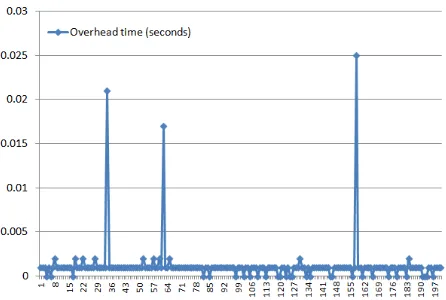
In order to assess the execution performance of the M0 message transformation, a series of 200 serial executions of the the refactoring transformations required to perform the exemplar's composite refactoring were performed. The aim of this test was to determine the overhead of executing the transformation in addition to the time that the Web Service middleware would take handle the service request (Tlogic).
The experimental setup for each test run was kept identical, hence, we did not expect to see a large degree of variation in
-- @nsURI MM=http://www.eclipse.org/emf/2002/Ecore -- @path MMSUDO=/ISORC2012/metamodels/SUDO.ecore module MoveElementReference;
create OUT : MM, SUDO : MMSUDO refining IN : MM, parameters : PARAMS;
rule MoveElementReference { from
targetClass : MM!EClass, sourceClass : MM!EClass, sourceReference : MM!EReference (
sourceClass.name =
thisModule.getParameter('sourceClassName')
--'PointType'
and targetClass.name =
thisModule.getParameter('targetClassName') --'DocumentRoot'
and sourceReference.name =
thisModule.getParameter('sourceReference') --'coord'
and not targetClass.eStructuralFeatures ->exists(ref|ref.name =
thisModule.getParameter('sourceReference' )
to
package : MM!EClass (
eStructuralFeatures <- sourceReference ),
--Populate the instance level transform scriptRoot : MMSUDO!Script
(
rule <- matchRule ),
matchRule : MMSUDO!Rule (
sourceModelMatch <-
thisModule.getParameter('sourceClassName'), moveElement <- moveElementRule
),
moveElementRule : MMSUDO!MoveElement (
element <-
thisModule.getParameter('sourceReference'), target <-
thisModule.getParameter('targetClassName') )
[image:7.612.313.559.332.690.2]}
the performance results. The test system was a dual-core 3GHz Intel Core 2 Duo CPU with 6GB RAM running Windows 7. Following our test of the Tresponse overheads, we
have observed that the majority of executions of the message transformation introduced less than a millisecond of overhead and fall well within our TQoS threshold of 2 seconds
[image:8.612.67.290.277.427.2]for the user interface response time threshold. The results, however, indicate three peaks in the overhead message transformation time; however, given the identical experimental setup, we put this down to competing processes on the operating system. The results demonstrate that for the low-level refactoring tasks, such as those presented against the exemplar, this performance overhead can be managed and falls well within the QoS threshold of the map client.
Figure 11 shows the resultant graph of the tests. Based on this, however, further work needs to be conducted to assess the performance overhead when larger chains of refactorings are used in addition to larger message payloads.
VI. EXISTING WORK
Existing work that can inform a solution to the Web Service evolution problem can be divided into two areas. These can be described as:
1. Mapping between schemas of functionally similar equivalent services [16-19]
2. Refactoring OOP code [10, 20-23].
Work conducted under the (1) category, is motivated by the scenario of multiple heterogeneous service interfaces being used in services that provide similar functionality from a consumer's perspective. The approaches, therefore, aim to revolve the interface mismatch associated with this heterogeneity through mappings.
A characteristic for approaches in (1) is that the mapping is performed 'after-the-fact' with respect to the creation of the new/alternate service interface. A benefit of this is that the mappings are able to take advantage of 'a posteriori'
knowledge for example instance data for each schema. The downside of this approach is the lack of provenance engineering knowledge of how the service interface evolved when considering evolved services rather than heterogeneous services from differing providers. As a result, the mappings
are non-deterministic given differing interfaces and need to be evaluated on their accuracy.
The mechanism behind the majority of these approaches involves referencing the service interface elements to a common ontology through a combination of 'lifting' and 'lowering' mappings. Whilst this work aims to semi-automate mappings between schemas, the set of mappings supported by these approaches are limited and do not define a clear methodology for defining new mappings. Approaches to mapping are generally limited to moving elements between schemas with the more advanced work being able to semi-automate string splitting and concatenation in addition to other more advanced operations, for example, key-value mapping and default value insertion. The main limitations of existing work are primarily that they do not provide a clear methodology on how to deal with more complex mappings, for instance mappings involving numerical transformation. Secondly is the major assumption in relying that a high-level domain model (often expressed as an ontology) has been created for the document types that the schemas substantiate. In the case of [18] this is captured through electronic questionnaires.
The approaches associated with category (2) aim to reduce the disruption to software library consumers associated with the upgrading of OOP software libraries. These are motivated as a response to the cost and error-prone nature of manually developing mediation components between OOP software interfaces [23] and aim to provide a repeatable and deterministic engineering approach. These approaches involve the recording of human directed and piecemeal code refactoring in order to generate a mediator to translate calls for the old code into to calls to the new code. A limitation with this work is that the techniques documented are presented against a specific programming language, for instance, Java.
VII. CONCLUSIONS AND FUTURE WORK
In this paper we have presented an approach to enable Web Service developers for the first time to evolve their service interfaces in a reproducible and safe manner through refactoring. We have also conducted an initial evaluation of the execution time overhead of the message transformation produced from this refactoring when applied to an exemplar.
A. Conclusions
The approach permits upgraded 'non-backwards compatible' services to be deployed into a network where existing consumers depend on an older version of the service interface. The solution that we have provided has been motivated by the difference in the models inherent to Web Services compared to the more commonly used OOP model used in traditional refactoring. A major contribution of our work, therefore, is the original application of refactoring in the previously unexplored Web Services domain.
The scope of this work has been defined through the use of an exemplar and has supported the definition of a small reusable set of low-level refactorings that can be parameterized for application to particular service interface instances. The definition of a set of pre-conditions, in
keeping with Opdyke's original work (that defined the research field of refactoring) enables the service developer to apply and parameterize Web Service refactorings with a level of confidence that these will not produce an invalid or 'corrupt' transformation on the message and can be performed in a reproducible manner.
Performance evaluation for the approach is based on the user's expected QoS of response time with latency constraints driven from the user interface in the use-case. A challenge addressed here is that significant time overheads for the message transformation would limit the approach's use in a production environment; however, within the scale of the exemplar the performance overhead of executing the transformation has been demonstrated not to be significant. This does leave scope, however, to conduct further testing with the transformation of larger SOAP messages.
B. Future Work
As this paper represents our initial work in addressing the service refactoring problem, there are a number of limitations to its scope that have been documented along the way. Primarily is the decision to limit the applied refactoring in the exemplar to just the XML Schema defined part of the service interface and omitting the ability to perform changes to the operation names in the WSDL document. The motivation behind this decision is so that we could address the part of the interface which most closely resembles the ClassåAssociation relationship that exists in OOP systems, for instance Java, before broadening the scope of our work and building on established refactoring theory.
Other than the basic pre-conditions described here, we intend to expand on these and apply tool-supported model checking to assure the correctness of more complex refactorings. This will be more useful when one aims to determine whether the correctness of low-level refactorings still holds true when composed into higher level refactorings.
In this paper we have developed refactorings that apply at the M1 model layer; however, there is scope for developing refactorings that apply at the M0 (message) layer. Examples of these include unit conversion and geospatial coordinate transformations. To be able to evaluate these would require the development of an evaluation framework to guarantee that information capacity has been preserved over the transformations and that fidelity has not been lost in the richness of the information.
ACKNOWLEDGMENT
The work reported in this paper has been supported in part by the NECTISE programme jointly funded by BAE Systems and the U.K. EPSRC Grant EP/D505461/1, the UK EPSRC WRG platform project (No. EP/F057644/1), the National Basic Research Program of China (973) (No. 2011CB302602), the UK TSB STRAPP project (No. 1926-19253), and the Major Program of the National Natural Science Foundation of China (No. 90818028).
REFERENCES
[1] M. M. Lehman, "Laws of Software Evolution Revisited," in Proceedings of the 5th European Workshop on Software Process Technology, 1996.
[2] M. Turner, Budgen, D., Brereton, P., "Turning Software into a Service," IEEE Computer Society, vol. 36, 2003.
[3] K. Bennett and N. Gold, "Achieving ultra rapid evolution using service-based software," in Proceedings of the 4th International Workshop on Principles of Software Evolution, 2001,.
[4] G. Canfora and M. D. Penta. (2006) Testing Services and Service-Centric Systems: Challenges and Opportunities. IT Professional. 10-17.
[5] C. Jones, et al., "A Structured Approach to Handling On-Line Interface Upgrades," in 26th Annual International Computer Software and Applications Conference, Oxford, England, 2002. [6] K. Sycara, et al., "Dynamic discovery and coordination of
agent-based semantic Web services," Internet Computing, IEEE, vol. 8, pp. 66-73, 2004.
[7] L. Baresi, et al., "Toward Open-World Software: Issue and Challenges," IEEE Computer, vol. 39, IEEE Computer Society, 2006.
[8] M. Fowler, et al., Refactoring: Improving the Design of Existing Code: Addison-Wesley Professional, 1999.
[9] W. Opdyke, "Refactoring Object-Oriented Frameworks," 1992. [10] D. Dig and R. Johnson, "The Role of Refactorings in API
Evolution," in 21st IEEE International Conference on Software Maintenance (ICSM'05), Budapest, Hungary, 2005.
[11] D. Webster, et al., "Migrating Legacy Assets through SOA to Realize Network Enabled Capability," in New Directions in Web Data Management 1, A. Vakali and L. C. Jain, Eds., First ed: Springer, 2011.
[12] D. Booth, et al., "Web Services Architecture," W3C, 2004. [13] W3C, "SOAP Version 1.2 Part 0: Primer (Second Edition),"
http://www.w3.org/TR/soap12-part0/, 2007.
[14] Object Management Group (OMG) "Meta Object Facility (MOF) Core Specification. Version 2.4.1," 2011.
[15] WSI Web Services-Interoperability Organization, "Basic Profile Version 1.1," 2006.
[16] T. De Giorgio, et al., "SAWSDL for Self-adaptive Service Composition," in On the Move to Meaningful Internet Systems: OTM 2009 Workshops. vol. 5872: Springer Berlin / Heidelberg, 2009, pp. 907-916.
[17] L. Cavallaro and E. Di Nitto, "An approach to adapt service requests to actual service interfaces," presented at the Proceedings of the 2008 international workshop on Software engineering for adaptive and self-managing systems, New York, NY, USA, 2008.
[18] C. Drumm, et al., "Quickmig: automatic schema matching for data migration projects," presented at the Proceedings of the sixteenth ACM conference on Conference on information and knowledge management, Lisbon, Portugal, 2007.
[19] F. Scharffe, et al., "Ontology mediation patterns library v2. Deliverable D4.3.2," SEKT project (IST-2003-506826), 2005. [20] J. Henkel and A. Diwan, "CatchUp!: capturing and replaying
refactorings to support API evolution," presented at the Proceedings of the 27th international conference on Software engineering, St. Louis, MO, USA, 2005.
[21] S. Roock and A. Havenstein, "Refactoring Tags for automatic refactoring of framework dependent applications," presented at the Proc. Int'l Conf. eXtreme Programming and Flexible Processes in Software Engineering (XP), 2002.
[22] M. Blaha and W. Premerlani, "A catalog of object model transformations," in Reverse Engineering, 1996., Proceedings of the Third Working Conference on, 1996, pp. 87-96.