CENTRE FOR EUROPEAN POLICY STUDIES
CEPS
W
ORKINGD
OCUMENTN
O.
196
N
OVEMBER2003
B
ETTER
S
AFE THAN
S
ORRY
A
PPLYING THE
P
RECAUTIONARY
P
RINCIPLE
TO
I
SSUES OF
I
NTERNATIONAL
S
ECURITY
M
ARC
H
OUBEN
CEPS Working Documents are published to give an indication of the work within CEPS’ various research programmes and to stimulate reactions from other experts in the field. Unless otherwise indicated, the views expressed are attributable only to the author in a personal capacity and not to any institution with which he is associated.
ISBN92-9079- 453-4
B
S
S
A
PPLYING THE
P
RECAUTIONARY
P
RINCIPLE
TO
I
SSUES OF
I
NTERNATIONAL
S
ECURITY
CEPS
W
ORKINGD
OCUMENTN
O.
196
M
ARCH
OUBEN*A
BSTRACTThe strategic condition of the world is characterised by the fact that pre-emptive military action may be necessary. This condition is based on the realisation that legitimate national governments have lost their monopoly on the use of force while determined individuals and groups of individuals can lay their hands on weapons with which they can inflict huge, even irreversible damage to entire societies. Assuming that pre -emptive military action is here to stay and we should be determined not to let it escape democratic control. This paper seeks the procedures and checks that should be in place if pre-emptive military action is to be firmly embedded in democratic practices and institutions. To that end, it reviews the application of the precautionary principle in the environmental and food safety domains and assesses whether the procedural checks and practices used there can also have their utility in the international security domain.
*
B
ETTER
S
AFE THAN
S
ORRY
A
PPLYING THE
P
RECAUTIONARY
P
RINCIPLE
TO
I
SSUES OF
I
NTERNATIONAL
S
ECURITY
CEPS
W
ORKINGD
OCUMENTN
O.
196
M
ARCH
OUBENIntroduction
The apparent problems of the administrations or President George W. Bush and Prime Minister Tony Blair to provide evidence legitimising the war in Iraq may erode public confidence in the role of the executive, one of the most important democratic institutions. When viewed in this light, the fallout from the war in Iraq may be as grave as the war itself. Yet, a strategic condition has developed in which pre-emptive military action may be necessary. This condition is based on the fact that legitimate national governments have de facto lost their ‘monopoly on the use of force ’. Today, determined individuals or groups can lay their hands on weapons with which they can inflict huge, even irreversible damage to entire societies. The purpose of this paper is not to engage in the debate about whether pre-emptive military action in itself is justified – we accept that in some cases pre-pre-emptive military action is justified. Rather, we look at the procedures and checks that should be in place if pre -emptive military action is to be firmly embedded in democratic practices and institutions. To that end, we review the application of the precautionary principle used in the environmental and food safety domains and assess whether the procedural checks and practices applied there can also have their utility in the international security domain.
At first sight, this approach may seem implausible or unfeasible to some; nevertheless, we believe that it is supported by a number of good reasons. The application of the precautionary principle has become common ground in the European Union in recent yearsand is used in an increasing number of policy domains. A previous CEPS publication on the impact of the precautionary principle on international trade relations concludes that “precaution is here to stay” and urges that “[given] the nature of international economic interdependence (globa lisation) and the linkages that exist between environmental and food safety issues, there is a pressing need to develop more extensive criteria for the application of precaution or the precautionary principle” (Woolcock, 2002, pp. 26-27). Other literature asserts that the precautionary pr inciple provides the basis for “acting in advance of scientific proof of harm to address uncertain but potentially significant risks ” (Jorden and O’Riordan, cited in Woolcock, 2002, p. 6). The precautionary principle may offer some interesting insights, because the food-safety domain and the security domain share an important similarity: the risks within these policy domains are uncertain to the point of being unknown. In both domains , risks and threats may constitute a danger to people and – if no action is taken or these threats are left unchecked – the danger may grow. This may result in a situation in which inaction may be a problematic, irresponsible policy option.
principle and the concept of pre-emptive military action. By comparing the two ‘practices’ , we hope to shed light on the issues mentioned above and provide some arguments that will answer the questions raised. The scope of this paper is limited, so it concludes with an agenda for further research.
The concept and practice of the precautionary principle
The precautionary principle is a key intellectual concept in the field of environmental studies. The European Commission has made it a key principle in its food safety programme. The precautionary principle is not really new. The essence of the principle is captured in common-sense aphorisms such as ‘an ounce of prevention is worth a pound of cure’, ‘better safe than sorry’ or ‘look before you leap’. Consider the following quote from a recent Communication from the European Commission:
The Commission considers that the Community, like other WTO members, has the right to establish the level of protection – particularly of the environment, human, animal and plant health – that it deems appropriate. Applying the precautionary principle is a key tenet of its policy, and the choices it makes to this end will continue to affect the views it defends internationally, on how this principle should be applied (European Commission, 2000).
The precautionary principle or precautionary approach appears in various descriptions in treaties since the middle of the 1980s. The European Commission strives to protect the environment and human, animal or plant health. Accordingly, the Community has consistently endeavoured to achieve a high level of protection in these areas. Although the precautionary principle is not explicitly mentioned in the treaties except in the environmental field, its scope is far wider. It covers those specific circumstances where scientific evidence is insufficient, inconclusive or uncertain and there are indications through preliminary, objective scientific evaluation that there are reasonable grounds for concern that the potentially dangerous effects on the environment or human, animal or plant health may be inconsistent with the chosen level of protection (European Commission, 2000, p. 10). The precautionary principle can be applied (invoked) when an activity raises the threat of harm to human health or the environment. It is now an established practice that precautionary measures should be taken even if some of the inherent cause and effect relationships are not fully established scientifically (see Table 1). In this context, the proponent of an activity, rather than the public, should bear the bur den of proof.
Table 1. The ‘precautionary principle’ in some international treaties and agreements
The Montreal Protocol on Substances that deplete the Ozone Layer, 1987
“Parties to this protocol…determined to protect the ozone layer by taking precautionary measures
to control equitably total global emissions of substances that deplete it…”
The Third North Sea Conference, 1990
“The participants…will continue to apply the precautionary principle, that is to take action to avoid the potentially damaging impacts of substances that are persistent, toxic and liable to bio accumulate even where there is no scientific evidence to prove a causal link between emissions and effects.”
The Rio Declaration on Environment and Development, 1992
The Framework Convention on Climate Change, 1992
“The Parties should take precautionary measures to anticipate, prevent or minimise the causes of climate change and mitigate its adverse effects. Where ther e are no threats of serious or irreversible damage, lack of full scientific certainty should not be used as a reason for postponing such measures, taking into account that policies and measures to deal with climate change should be cost-effective so as to ensure global benefits at the lowest possible cost.”
The Treaty on European Union (Maastricht Treaty), 1992
“Community policy on the environment…shall be based on the precautionary principle and on the principles that preventive actions should be taken, that the environmental damage should as a priority be rectified at the source and that the polluter should pay.”
The Cartagena Protocol on Biosafety, 2000
“In accordance with the precautionary approach the objective of this Protocol is to contribute to ensuring an adequate level of protection in the field of the safe transfer, handling and use of living modified organisms resulting from modern biotechnology that may have adverse effects on the conservation and sustainable use of biological diversity, taking also into account risks to human health and specifically focus ing on transboundary movements.”
The Stockholm Convention on Persistent Organic Pollutants (POPs) 2001
Precaution, including transparency and public participation, is operationalised throughout the treaty, with explicit references in the preamble, the objective and the provisions for adding POPs and determination of best available technologies. The objective states: “Mindful of the Precautionary Approach as set forth in Principle 15 of the Rio Declaration on Environment and Development, the objective of this Convention is to protect human health and the environment from persistent organic pollutants”.
Source: European Environmental Agency ( EEA ), 2002.
The crucial question is when to invoke the precautionary principle. In the European Union, the European Commission – as guarantor of the treaties – can invoke the precautionary principle. The decision to do so should be based on formally established criteria in order to be transparent. The practice of precautionary action consists of four essential elements:
1. People have a duty to take anticipatory action to prevent harm. If there is a reasonable suspicion that something bad is going to happen, they have an obligation to try to stop it.
2. The burden of proving of the harmlessness of a new technology, process, activity or chemical lies with the proponents, not with the general public.
3. Before using a new technology, process or chemical, or starting a new activity, people have an obligation to examine ‘a full range of alternatives’ including the alternative of doing nothing.
4. Decisions applying the precautionary pr inciple must be ‘open, informed and democratic’ and ‘must include affected parties’.
linked to the factors triggering the recourse to the precautionary principle; and, if the decision to act is affirmative, the second aspect is how to act, i.e. the measures resulting from the application of the precautionary principle. These two elements are discussed in the sections that follow.
Box 1. Risk, uncertainty and ignorance
The precautionary principle is seen principally as a way to deal with a lack of scientific certainty. A basic foundation for our conclusions concerns the nature of scientific certainty itself. There is an urgent need for a more complete and systematic basis for thinking about the different ways in which scientific uncertainty may pervade regulatory appraisal. First, there is the familiar condition of risk, as formally defined in probability theory. This is where all possible outcomes are known in advance and where their relative likelihood can be adequately expressed as probabilities. Where this condition prevails, risk assessment is a valid technique that can save lives, prevent damage to the environment and provide a robust basis for decision-making. Still, the judgements over what is defined as at risk, and over the right balance to strike in decision-making, are necessarily laden with subjective assumptions and values.
Under the conditions of uncertainty, as formally defined, the adequate empirical or theoretical basis for assigning probabilities to outcomes does not exist. This may be because of the novelty of the activities concerned or because of the complexity or variability in their contexts. Either way, conventional risk assessment is too narrow in scope to be adequate for application under conditions of uncertainty. Although techniques such as safety factors, scenario or sensitivity analysis can be useful, they do not provide an adequate way to assess the impacts of different options. Here, more than ever, judgements about the right balance to strike in decision-making are laden with subjective assumptions and values. Often, decision-making is faced with the continual prospect of surprise – when some of the possibilities themselves remain unknown. This is the condition formally known as ignorance. Even more than uncertainty, this underscores the need for a healthy humility over the sufficiency of the available scientific knowledge and, crucially, for an institutional capacity for open reflection on the quality and utility of available bodies of knowledge. Once it is acknowledged that the likelihood of certain outcomes may not be fully quantifiable or that certain other possibilities may remain entirely unaddressed, then uncertainty and ignorance, rather than mere risk characterise the situation. The adoption of robust, transparent and accountable approaches towards the various aspects of risk, uncertainty and ignorance can be identified as one crucial means of regaining public confidence in regulatory decision-making.
Source: EEA (2002) with amendments by the author.
Triggers for a decision to invoke the precautionary principle
a risk assessment; and scientific uncertainty.1 The appropriate response in a given situation is thus the result of a political decision, a function of the risk level that is ‘acceptable’ to the society on which the risk is imposed (European Commission, 2000, p. 16). The European Commission is convinced that measures based on the precautionary principle should comply with the basic principles for all other legislation. Where action is deemed necessary, measures based on the precautionary principle should be, inter alia:
• proportional to the chosen level of protection. The measure envisaged must make it possible to achieve the appropriate level of protection. Measures based on the precautionary principle must not be disproportionate to the desired level of protection nor aim at a zero-level of risk.
• non-discriminatory in their application. The principle of non-discrimination means that comparable situations should not be treated differently nor should different situations all be treated in the same way, unless there are objective grounds for doing so.
• consistent with the measures already adopted in similar circumstances or using similar approaches.
• based on an examination of the potential benefits and costs of action or lack of action. A comparison must be made between the most likely positive or negative consequences of the envisaged action w ith the consequences of inaction in terms of the overall cost to the Community, both in the long and short term. The measures envisaged must produce an overall advantage as regards to reducing risks to an acceptable level. Examination of the pros and cons cannot be reduced to an economic cost-benefit analysis. It is wider in scope and includes non-economic considerations.
• subject to review, in the light of new scientific data.
• capable of assigning responsibility for producing the scientific evidence necessary for a more comprehensive risk assessment (European Commission, 2000, p. 4).
The European Union Commissioner for Health, Mr. David Byrne, noted in an explanatory speech in 2000 on the precautionary principle in the food safety domain that,
The Commission’s interest in this principle arises from its role as a risk manager. It had identified that the precautionary principle was evolving in different policy areas in such a manner that the principle itself was becoming misunderstood, leading to potential intentional or unintentional abuse…F or the precautionary principle to be relevant, two preconditions have to be in place. The first precondition is that the potentially dangerous effects deriving from a phenomenon, product or process have been identified; the second precondition is that scientific evaluation does not allow the risk to be determined with sufficient certainty (Byrne, 2002).
But, as the commissioner made clear, the European Union is not seeking to create a risk-free society: “The European Commission does not believe that the precautionary principle is a substitute or excuse for seeking zero risk. Zero risk is rarely found, and in the vast majority of cases we are in the field of managing and controlling risk” (Byrne, 2002). A salient aspect of the risk management process by the European Commission is that the burden of proof has been inverted – it is not the Commission that has to prove the possible negative effects of a
1 A risk assessment usually consists of four elements: hazard identification, hazard characterisation, appraisal of
food additive but it is the actor intending to bring it on the market who has to prove the absence of negative effects.
An inverse burden of proof
Community rules and those of many non-member countries enshrine the principle of prior approval before placing certain products, such as drugs, pesticides or food additives on the market. This is one way of applying the precautionary principle, by shifting responsibility for producing scientific evidence. This applies in particular to those substances deemed a priori hazardous or those that are potentially hazardous at a certain level of absorption. In this case the legislator, by way of precaution, has clearly reversed the burden of proof by requiring that the substances be deemed hazardous until proven otherwise. Hence , it is up to the business community to carry out the scientific work needed to evaluate the risk. As long as the human health risk cannot be evaluated with sufficient certainty, the legislator is not legally entitled to authorise use of the substance, unless exceptionally for test purposes. Measures based on the precautionary principle may assign responsibility for producing the scientific evidence necessary for a comprehensive risk evaluation. The decision-making procedure should be transparent and should involve all interested parties as early as possible and to the greatest reasonable extent. Not only has the burden of proof switched sides, the nature of the proof required has also changed in this application.
This concludes the brief overview of the precautionary principle. Further information and more detailed accounts are referenced in the bibliography. The next section of the paper considers the concept of pre-emptive military action, its key notions and concepts.
A new strategic condition
With the successful conclusion of the war in Iraq, a new , great, strategic debate has begun in earnest. After the debate over ‘humanitarian’ intervention in the 1990s, this decade will see a debate on the meaning and the practice of pre -emptive military action. In early 2002, President Bush ordered his national security team to rewrite the national security strategy so that it would justify initiating pre-emptive military campaigns against groups or nations that the President believes pose a threat of a future attack against America or its allies. This left many uncomfortable with the idea of President Bush giving himself carte blanche to make any military intervention he thinks necessary, without seeking outside approval. President Bush gave evidence of his position in a speech at the graduation exercise of West Point, the US top military institution, where he stated that he was not prepared to wait “too long” for a threat to materialise:
We cannot defend America and our friends by hoping for the best. We cannot put our faith in the word of tyrants, who solemnly sign non-proliferation treaties, and then systemically break them. If we wait for threats to fully materialize, we will have waited too long. The only path to safety is the path of action…Our security will require all Americans to be forward-looking and resolute, to be ready for pre-emptive action when necessary to defend our liberty and to defend our lives (President Bush, s peech at West Point Militar y Academy, 2002).
preventively, that is, without formally being identified as a suspect. The attacks on America have made the new strategic condition very clear, which is the vulnerability of our societies coupled with the fact that determined individuals can obtain weapons with which they can inflict significant, irreversible or even existential damage to entire societies. It is the realisation of the vulnerability of our open and high-tech democracies and the scale of potential damage that can be inflicted upon them that forces governments on both sides of the Atlantic to re-think their options and responsibilities, along with how their actions must be embedded in existing beliefs, conventions and principles.
Pre -emption, prevention and anticipation
Michael Walzer develops the concept of ‘anticipation’ in international law in Just and Unjust Wars (1977). According to Walzer’s account, “Both individuals and states can rightfully defend themselves against violence that is imminent but not actual; they can fire the first shots if they know themselves about to be attacked. This is a right recognised in domestic law and also in the legalist paradigm for international society. In most legal accounts, however, it is severely restricted. Indeed, once one has stated the restrictions, it is no longer clear whether the right has any substance at all” (Walzer, 1977, p. 74). Walzer sketches a spectrum of anticipation: at one end, pre-emption is a reflex action, a raising of one’s arms at the very last minute, in a necessary manner; at the other end it is preventive war, an attack that responds to a distant danger, in a manner that exercises foresight and free choice. Preventive war presupposes some standard against which danger is to be measured. This standard does not exist, except in the ‘mind’s eye ’. In the words of Francis Bacon, “A just fear of an imminent danger, though no blow be given, is a lawful cause of war”. Surely, in some instances it is simply stupid to wait for any other to inflict harm. In some cases, one has no other option than to protect oneself, when one can ‘see it coming’.
With the proliferation of weapons of mass destruction (nuclear, biological or chemical) the chance that such a weapon will be used against innocent citizens has increased. Today the possible threats to our societies have risen to such a level that one wonders whether it is still acceptable. A threat results from someone ’s ability inflict harm and his/her intention to do so. The situation in which a country possesses the means to inflict enormous or even irreversible damage to national or regional stability, and whose intentions are unclear , is a huge problem. On the one hand we can sincerely ask whether we can afford to run the risk not to act, but on the other hand ‘if the intention is unknown’, military action cannot be justified. This makes the intelligence appreciation of the intention of a possible opponent increasingly important. At the same time there is an enormous risk of a politicisation of the intelligence appreciation. The reasons why the intention to harm must be ‘manifest’ is pointe d out in the next section.
Hans Boutellier, a Dutch criminologist, comes to a similar conclusio n in a recently published study, “P erhaps the most essential insight of the reaction to terror is the desire we may feel to understand the evil, but that we can hardly allow ourselves to do so. We cannot excuse it because the consequences are simply too great. It is this idea which is characteristic of the moral consciousness under post -modern conditions” (Boutellier, 2002, p. 13).
A historical precedent: the Six Day War
attacking first because of the dramatic events of the previous weeks. The Egyptians believed that the founding of Israel in 1948 had been unjust, that the state had no rightful existence and hence, that it could be attacked at any time. In a major speech on 29 May, President Gamal Abdel Nasser of Egypt announced that if war came , the Egyptian goal would be nothing less than the destruction of Israel. On 30 May, King Hussein of Jordan flew to Cairo to sign a treaty placing the Jordanian army under Egypt’s command in event of war, thus associating himself with the Egyptian purpose. Syria had already agreed to such an arrangement and several days later Iraq joined the alliance. The Israelis struck on the day after the Iraqi announcement. There was a basic asymmetry in the structure of the opposing forces: the Egyptians could deploy their large army of long-term regulars on the Israeli border and keep it there indefinitely; the Israelis could only counter their deployment by mobilising reserve formations, though reservists could not be kept in uniform for very long. Egypt could therefore stay in a defensive position while Israel would have to attack unless the crisis was defused diplomatically.
The initial Israeli response was not as similarly determined as that of Egypt but, for domestic political reasons having to do in part with the democratic character of the state, was hesitant and confused. Israel’s leaders sought a political resolution to the cris is, which they did not have the political strength or support to effect. Meanwhile, an intense fear spread throughout the country. Based on this example , Walzer (1997) establishes his precautionary axiom to international security wherein:
States may use military force in the face of threats of war, whenever failure to do so would seriously risk their territorial integrity or political independence…Under such circumstances it can fairly be said that they have been forced to fight and that they are the victims of aggression. Since there are no police upon whom they can call, the moment at which states are forced to fight probably comes sooner than it would for individuals in a settled domestic society. But if we imagine an unstable society, like the ‘wild West’ of American fiction, the analogy can be restated: a state under threat is like an individual hunted by an enemy who has announced his intention of killing or injuring him. Surely such a person may surprise his hunter, if he is able to do so…The line between legitimate and illegitimate first strike is not going to be drawn at the point of imminent attack but at the point of sufficient threat (Walzer, 1977, pp. 81-85).
An asymmetry in the structure of forces sets a time limit on diplomatic efforts that would have no relevance to conflicts involving other sorts of states and armies. There are threats with which no nation can be expected to tolerate. And that acknowledgement is an important part of our understanding of aggression (Walzer, 1977, p. 85).
Preconditions for pre -emptive military action
In an article for The New York Times (17 June 2002), David Sanger develops four standards to which he intends to hold the US president accountable in case of a pre-emptive military strike (paraphrased) :
1) The less the immediate and direct the threat is against America, the weaker the case is for pre-emptive military action. The administration must make it clear that force will be a last resort, not its principal anti-proliferation tool.
2) Whether the United States strikes first or retaliates, Congressional leaders of both parties should be consulted and listened to before military action is taken. Ideally, the president should ask for a vote of support from Congress. America’s allies should also be consulted before any offensive military action.
3) The government must be prepared to justify any offensive attack on another country after it occurs. Both the nation and the world expect this, and they will judge the administration’s actions on the quality of the proof it can assemble to show that something deadly was about to happen without immediate intervention.
4) It is difficult to think of any circumstance under which the United States could be justified in using any kind of nuclear weapon in a pre-emptive strike. While the administration may find it strategically important not to acknowledge that fact, nuclear weapons should never be regarded as just another bigger, more effective bomb.
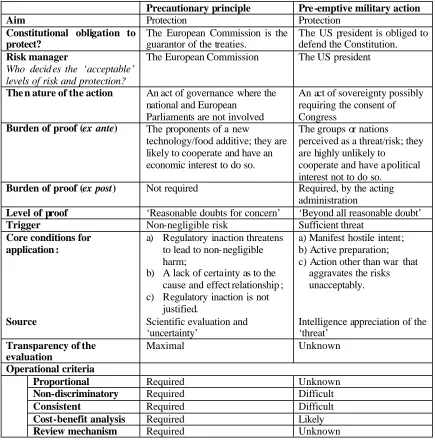
Pre-emptive military action is problematic because the means have to be reconciled with the ends. Protecting democracy is an ultimate political concern and responsibility, but the way it is done is equally important. There are a number of legitimate concerns that can be voiced from a democratic perspective, including the transparency of the decision-making process, the justification of the decision/action taken and the issue of the executive being accountable to the electorate. With regard to the precautionary principle , these concerns are met by a developed and detailed procedure that prescribes the application of the principle. As a matter of fact, the procedural aspect constitutes an essential characteristic of the legitimate use of the principle. Are these concerns relevant in the case of pre-emptive military action? We assert that they are, but there are a number of caveats that will be elaborated below. One issue is the element of surprise. This is clearly an important consideration in any military strike and this consideration could explain why no information is given before a pre-emptive military strike actually takes place. The issue is then whether the absence of information ex ante makes the obligation to give clear and unambiguous evidence ex post even more important, an obligation that should be respected at all times. If an administration conducts a pre-emptive strike, such a strik e can only become legitimate on the basis of the evidence provided by the actor. T he following sections highlight some of the similarities as well as some of the fundamental differences between the two policy practices of the precautionary principle and pr e-emptive military action.
Precaution and pre -emption: similarities
three core conditions are met: a) a manifest intention to harm; b) an active preparation; and, c) any course of action other than using force aggravates the risks disproportionately. The application of the precautionary principle and the concept of pre-emptive military action follow a similar pattern and result in a situation in which inaction is the problematic, even irresponsible course of action.
Some observers would claim that the risks operative in the security domain are of a fundamentally different nature and scope than those in the environmental domain. Countering that line of thinking, one should consider the similarities between ‘bio-terror’, which is clearly in the security realm, and ‘bio-error’, which is not in the security domain. It is easily conceivable that the fallout from both examples may be of the same apocalyptic scale. The spectrum of risks, threats and consequences for society are roughly the same for both policy domains. But there are fundamental differences too.
Precaution and pre -emption: fundamental differences
1) The nature of the (re-)action. The fundamental difference between the decision to invoke the precautionary principle and pre-emptive military action lies in the nature of the act. Invoking the precautionary principle is a regulatory act of governance. Resorting to pre-emptive military action is an act of sovereignty. The power to invoke the precautionary principle on behalf of the European Union is delegated to the European Commission, a non-elected body empowered to invoke such a principle. It also acts as Europe’s prime risk manager, deciding on the acceptability of certain risk levels. With regard to pre-emptive military action, we speak of a military intervention against individuals or a regime in a non-member, sovereign country. Such an act constitutes , in international law (if not qualified), an act of aggression. In the US, only the president, as an elected official responsible to the people, can decide whether or not to strike pre-emptively, with or without the consent of Congress.
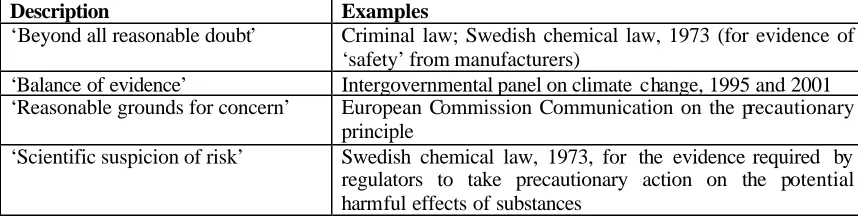
Table 2. Different levels of proof for different purposes: some illustrations
Description Examples
‘Beyond all reasonable doubt’ Criminal law; Swedish chemical law, 1973 (for evidence of ‘safety’ from manufacturers)
‘Balance of evidence’ Intergovernmental panel on climate change, 1995 and 2001 ‘Reasonable grounds for concern’ European Commission Communication on the precautionary
principle
‘Scientific suspicion of risk’ Swedish chemical law, 1973, for the evidence required by regulators to take precautionary action on the potential harmful effects of substances
Source: EEA, 2002.
3)The burden of proof. A key characteristic of the precautionary principle is that the burden of proof is inverted. The party proposing to introduce a food additive into the market is required to give evidence of risk levels. These parties are generally willing to comply and cooperate with the European Commission because they have an economic interest to do so. The European Commission has to be convinced of the absence of risk, as it represents a ‘community of consumers’. In the case of pre-emptive military action, the burden of proof is with the actor contemplating the pre-emptive strike. The actor intending to strike must make it clear that the other party poses a sufficient threat, thus legitimising the action. The actor contemplating such pre-emptive action can ask the other party to give evidence of their intentions and capabilities, but these are often hard to verify, since “prudent rulers assume malign intentions” as Walzer noted. Nor can one expect the other party to be cooperative.2 Thus the burden of proof is with the actor engaging in the pre-emptive strike.
4) Ex ante versus ex post justification. In the application of the precautionary principle , the justification for invoking it is always given ex ante. Information is shared with all the parties involved and the decision is not only explained, but the scientific evidence is presented, as is the weighing of the options. In the case of pre -emptive military action, the justification is likely to be given after the action has been executed. This is related to a point elaborated below: the element of surprise. When acting in a pre-emptive mode, surprise is considered to have a tactical advantage. There is no legal requirement obliging sovereign states to present evidence. But, as the previously quoted Sanger asserts, “The nation and the world…will judge the administration’s actions on the quality of the proof it can assemble to show that something deadly was about to happen without immediate intervention” (Sanger, 2002). Counter-intuitive as it may seem, the operational value of ex ante justification is perhaps even greater. It contributes to the legitimacy of the action and, if applied consistently, may have a deterring effect.
The trade-off between ‘transparency’ and ‘surprise’
In the calculus of strategy, the transparency of a decision and the surprise that the decision is likely to generate are thought to be zero-sum related: the more open one is about ones intentions and possible decision, the less likely one is to surprise the opponent. By being transparent, one gives away an important tactical advantage. Although the element of surprise is an established principle of war, the Six Day War and the Iraq war have show n that the
2
operational value of surprise is limited. Again, this may seem counter-intuitive, but the operational value of transparency is greater than one would expect. The operational/tactical value of transparency has both a direct and an indirect aspect. The direct aspect is its communicative value. As in deterrence, transparency – here understood as the disclosure of information coupled with the effective communication of an intention – can make a potential opponent or target of a pre-emptive military strike change his mind. The indirect aspect of transparency hinges on the obligation that the legitimacy of the operation must be established. In the case of the precautionary principle, this follows as a consequence from a correctly applied doctrine or procedure. We believe that this is operative in the case of pre-emptive military action too, wherein disclosing information to the public will convince it of the need to act and bolster support for pre-emptive action, rally international support and attract offers of assistance. A key question that arises is whether the element of surprise justifies the postponement of proof. Being fully transparent about one ’s intention to act may induce the required change of policy on the other side, without recourse to armed force.
‘Maintaining’ versus ‘restoring’ the status quo
[image:14.612.96.514.458.523.2]Underlying both the precautionary principle and the practice of pre-emptive military action is the assumption of a status quo that carries an acceptable level of risk. In the case of the precautionary principle, when there is a threat that will increase the risk level, action is required. The precautionary principle is a sort of barrier that can be raised or a gate that can be closed in order to maintain the current level of risk in the status quo. This is different from the international security domain, where the risk level may increase factually (see Table 3) . The risk level is also increased if a third party threatens harm. It is then up to the sovereign state to decide and act upon that information. In the international domain it is not possible to close any gates or raise any barriers beforehand. If a changed risk level is considered to be unacceptable, then action is required to redress the balance of risk and to restore the status quo.
Table 3. Maintaining versus restoring the status quo
Risk level Action Status quo
Precautionary principle
May change in the future (potentiality)
Precautionary principle invoked
Maintained
Pre -emptive action Has changed
(factually or perceived)
Pre-emptive military action Restored
The precautionary principle and issues of international security
risk and therefore we create a margin of safety in which the other party has to come up with evidence to prove that we need not worry.
In the instance of a pre-emptive military strike, however, the stakes are potentially higher. It may well be that a state is dealing with another state, groups or individuals that pose a very significant, even irreversible or existential threat to its society and citizens. The idea that the opponent potentially possesses the capability to inflict irreversible damage and that their intent is unknown, immediately creates a very awkward situation. The element of surprise is often cited as crucial. In the example of Iraq, the element of surprise wascompletely lost – and it can be questioned whether this element was indeed that important. Perhaps, for long-term viability and survivability, it is better to give the proof ex ante. This has a deterring effect and may invite the party involved to cooperate. Whether ‘sufficient threat’ still requires a UN Security Council mandate is a critical question.Self-defence is a legitimate act by any sovereign state and requires no prior consent from the UN Security Council. Walzer used a spectrum to illustrate the different variations in which pre-emptive strikes originate : on the one extreme is an action that is a last moment reflex and on the other extreme is an action that is one of a nticipated self -defence. In principle , sovereign states have the right to defend themselves; thus, the establishment of ‘sufficient threat’ is a sovereign decision. No UN-mandate is therefore legally required prior to the action. Nevertheless, when a party has made the effort to obtain a UN Security Council mandate, the legitimacy of the action increases significantly.
The key threshold for both the application of the precautionary principle and the doctrine for a emptive military strike is the legitimacy of the action. It is safe to state that neither pre-emptive military action nor the use of the precautionary principle inherently ‘possesses’ legitimacy. Legitimacy is always ‘established’ through a correct application, from which legitimacy follows as a consequence. However pedantic this may sound to legal experts, there is a certain value to making a distinction between acts that possess legitimacy and acts that must be made legitimate by the way in which they are carried out. The application of the precautionary principle is ‘made’ legitimate by presenting elaborate facts before the principle is invoked and by making the information available to all parties concerned (transparency). Invoking the precautionary principle per se is not legitimate. In the scenario of a pre-emptive strike, a single actor establishes the legitimacy of pre -emptive military action at one point or another. He or she perceives the triggering condition of ‘sufficient threat’ to have been met, which is a subjective condition (‘in the mind’s eye ’ as Walzer says). A pre -emptive military strike is never a priori legal or legitimate. The demands on an actor engaging in a pre-emptive strike must be severe. The actor must ex post ‘make’ his action legitimate by providing convincing evidence – beyond all reasonable doubt – after he has carried out the pre-emptive action. If he fails to do so, or fails to meet the acceptable level of proof, his act must be condemned as illegitimate and illegal by a representative international body, e.g. the UN Security Council.
very hard, perhaps even impossible to do. Risk may be in the eye of the beholder – ‘if something is perceived to be real, it is real in its consequences’ – thus if it is ‘sufficient’, it may provoke a reaction. Second, the predicament of our time is that states and individuals have the means to inflict such a level of harm that it may result in irreversible damage or instability to the international system. The situation in which one knows that another party possesses the means to inflict such damage but their intention is unknown, is problematic . Such a situation may be perceived to constitute so much threat that no other option is available except to take responsibility for self-protection and act pre-emptively. In that scenario, we witness a divergence between the ‘unknown intention’ and the ‘manifest intention’. Whether a truly unknown intention conforms to the requirement of the highest level of proof is an interesting question.
Table 4. Overview of some of the differences and similarities between the precautionary principle and pre-emptive military action
Precautionary principle Pre -emptive military action Aim Protection Protection
Constitutional obligation to protect?
The European Commission is the guarantor of the treaties.
The US president is obliged to defend the Constitution.
Risk manager
Who decid es the ‘acceptable’ levels of risk and protection?
The European Commission The US president
The n ature of the action An act of governance where the national and European
Parliaments are not involved
An act of sovereignty possibly requiring the consent of Congress
Burden of proof (ex ante) The proponents of a new
technology/food additive; they are likely to cooperate and have an economic interest to do so.
The groups or nations
perceived as a threat/risk; they are highly unlikely to
cooperate and have a political interest not to do so.
Burden of proof (ex post) Not required Required, by the acting administration
Level of proof ‘Reasonable doubts for concern’ ‘Beyond all reasonable doubt’
Trigger Non-negligible risk Sufficient threat
Core conditions for application :
a) Regulatory inaction threatens to lead to non- negligible harm;
b) A lack of certainty as to the cause and effect relationship ; c) Regulatory inaction is not
justified.
a) Manifest hostile intent; b) Active preparation; c) Action other than war that
aggravates the risks unacceptably.
Source Scientific evaluation and ‘uncertainty’
Intelligence appreciation of the ‘threat’
Transparency of the evaluation
Maximal Unknown
Operational criteria
Proportional Required Unknown
Non-discriminatory Required Difficult
Consistent Required Difficult
Cost-benefit analysis Required Likely
[image:16.612.93.528.260.700.2]Is ‘double’ accountability for pre -emptive military action required?
The supply of evidence before pre-emptive action commences has the strategic advantage of its deterrent effect and may invite the other party involved to cooperate. A pre-emptive military strike is a surprise attack on a country that will surprise not only the targeted country but may also surprise the allies of the actor. The information that triggers the action is highly classified and is only revealed after the action is completed to a limited number of friends, behind closed doors. The core of this action is the targeted application of force aimed at neutralising or destroying an opponent. A number of strict preconditions apply to the justification of this action:
1) Evidence supporting the need for precautionary intervention should be made public before the action is executed, as well as the decision that the threat posed is considered to constitute an unacceptable level of risk for the society and citizens involved. Although this is an executivedecision, the consent of the national parliament should be sought.
2) The intention to execute a precautionary intervention should be clearly and unambiguously communicated to the target country, including a timeline and additional demands.
3) After the precautionary intervention is executed, a ‘double’ accountability is enforced, both to the parliament at home and to the international community at large, e.g. the Security Council of the United Nations. Legitimacy must be established, since it follows as a logical consequence from the proper application of the principle and the doctrine.
Pre-emptive military action can only be justified in those instances where an actor can supply convincing evidence for his/her action, before or after the action has taken place. This is a very important obligation because the issue of democratic accountability must be articulated and answered in each and every case. The point to be addressed here is whether this obligation changes if the information is supplied before or after the action. The obligation to open up the books after an action has been executed may be even more important than when the information is supplied beforehand. The difference is in the number of stakeholders directly and indirectly affected. If the information is only supplied after the action has taken place, one could then conceive of a requirement that we could call ‘double’ accountability: an obligation to account to the public at home (e.g. a national parliament) and a second obligation to account to the international community at large (e.g. the UN).
Is this a necessary, realistic and/or desirable demand? We argue that it is. It may well be the case that conducting a pre-emptive military attack without supplying adequate evidence of the threat is as shocking to the rule of international law (and indeed international stability) as genocide is. If the information – and the proof legitimising the action – can be made available only ex post facto (which is a realistic scenario), then double accountability is called for. If the information is made available before the action commences, this obligation is less clear. But in that situation the UN Security Council is likely to be involved and either will or will not support the action.
An agenda for further research
This paper has aimed at assessing whether the precautionary principle can be applied to questions of international security. So far , we have answered this question only in an indirect way. The conclusion now seems to be that the precautionary principle, as the European Union applies it in environmental and food safety regulations, cannot be applied to issues of international security. But, as previously stated, it is useful as a benchmark and an analogy. The comparison between the use of the precautionary principle and the use of pre-emptive military action has been very instructive because it enables us to see more clearly the democratic demands that must be met before, dur ing and after the action. If one takes into account only the operational requirements, it is likely that the legitimacy of the action will be questionable. The surprising results are that the spectrum of risks in the environmental and food safety domain is of the same scale as those in the security domain. But precautionary action is an act of governance initiated by a bureaucracy, whereas pre-emptive military action is an act of sovereignty initiated by a democratically elected head of state. As stated in the introduction, the scope of this paper is limited, so it is confined to giving an overview of the issue and pointing out some of the key aspects. T he issue addressed in this paper merits a full, book-length inquiry. The key questions in the debate concerning ‘precautionary military measures’ include:
• How does one determine whether and to what extent ‘sufficient threat’ exists? • Assuming this is possible , what precautionary action is justified?
• How should the thresholds for risk and the costs of inaction be determined – and who should make these decisions?
• How does risk management relate to or meet the demands of good governance?
As an afterthought, this outline of a research agenda on precautionary military measures may lead to some questions on precautionary action. Is it, for instance, ever possible or even desirable to leave risk management to a bureaucracy (e.g. the European Commission)? Shouldn’t it be a principle of good governance that the decision on the acceptability of risks and threats be and remain a political act, taken only by those actors who are accountable, either directly to the electorate or to a democratically elected assembly of representatives?
R
EFERENCESBaker, James A. III (2002), “The right way to change Iraq’s regime”, The I nternational Herald Tribune, 26 August.
Bauman, Zygmunt (2002), Society under Siege, Cambridge: Polity Press.
Boutellier, Hans (2002), De veiligheidsutopie. Hedendaags onbehagen en verlangen rond misdaad en straf, Den Haag: Boom Juridische uitgevers.
Bush, President George W. (2002), Remarks by US President Bush at the 2002 graduation ceremony of the US military academy West Point, 1 June (retrieved from
http://www.whitehouse.gov/news/releases/2002/06/ print/20020601- 3.html).
Byrne, David (2000), Address by Commissioner David Byrne on the Precautionary Principle in the domain of human health and food safety, 9 November (retrieved from
http://www.europa.eu.int/comm/dgs/health_consumer/library/speeches/speech66en.html).
Codex Alimentarius, (retrieved from http://www.codexalimentarius.net).
European Commission (1999), White Paper on General Principles of Food Law in the European Union, COM(19 99) 719 final, Brussels.
European Commission (2000), Communication on the Precautionary Principle, COM(2000)1, Brussels.
European Environment Agency (2002), Late lessons from early warnings: The precautionary principle 1896-2000, Environmental Issue Report, No. 22, Earthscan Publications.
International Commission on Intervention and State Sovereignty (2001), The Responsibility to Protect, December, International Development Research Centre, Canada.
Jonas, Hans (1984), The Imperative of Responsibility, Chicago: University of Chicago Press. Kourilsky, Philippe and Geneviève Viney (1999), Le Principe de Précaution, Rapport au Premier
Ministre, La Documentation Française, Editions Odile Jacob.
Majone, Giandomenico (2002), “What Price Safety? The Precautionary Principle and its Policy Implications”, Journal of Common Market Studies, Volume 40(1), pp. 89- 109.
The New York Times, “When to Strike First”, editorial, 17 June 2002.
O’Riordan, Timothy, James Cameron and Andrew Jordon (eds) (2001), Reinterpreting the Precautionary Principle, London: Cameron May.
Priest, Dana (2002), “Iran Reactor may Test First-Strike Doctrine ”, The International Herald Tribune, 30 July.
Sanger, David (2002), “Bush to Formalize a Defense Policy of Hitting First”, The New York Times, 17 June.
Wallace, Helen and William Wallace (2000), Policy-Making in the European Union (Fourth Edition), Oxford: Oxford University Press.
Walzer, Michael (1977), Just and Unjust Wars. A Moral Argument with Historical Illustrations, New York: Basic Books.
Woolcock, Stephen (2002), The Precautionary Principle in the European Union & Its Impact on International Trade Relations, report from the CEPS team on horizontal studies , CEPS, Brussels.
EUROPEAN POLICY STUDIES
A
BOUT
CEPS
ounded in 1983, the Centre for European Policy Studies is an independent policy research institute dedicated to producing sound policy research leading to constructive solutions to the challenges facing Europe today. Funding is obtained from membership fees, contributions from official institutions (European Commission, other international and multilateral institutions, and national bodies), foundation grants, project research, conferences fees and publication sales.
GOALS
• To achieve high standards of academic excellence and maintain unqualified independence.
• To provide a forum for discussion among all stakeholders in the European policy process.
• To build collaborative networks of researchers, policy-makers and business across the whole of Europe.
• To disseminate our findings and views through a regular flow of publications and public events. ASSETS AND ACHIEVEMENTS
• Complete independence to set its own priorities and freedom from any outside influence.
• Authoritative research by an international staff with a demonstrated capability to analyse policy questions and anticipate trends well before they become topics of general public discussion.
• Formation of seven different research networks, comprising some 140 research institutes from throughout Europe and beyond, to complement and consolidate our research expertise and to greatly extend our reach in a wide range of areas from agricultural and security policy to climate change, JHA and economic analysis.
• An extensive network of external collaborators, including some 35 senior associates with extensive working experience in EU affairs.
PROGRAMME STRUCTURE
CEPS is a place where creative and authoritative specialists reflect and comment on the problems and opportunities facing Europe today. This is evidenced by the depth and originality of its publications and the talent and prescience of its expanding research staff. The CEPS research programme is organised under two major headings:
Economic Policy Macroeconomic Policy
European Network of Economic Policy Research Institutes (ENEPRI)
Financial Markets, Company Law & Taxation European Credit Research Institute (ECRI) Trade Developments & Policy
Energy, Environment & Climate Change Agricultural Policy
Politics, Institutions and Security The Future of Europe
Justice and Home Affairs The Wider Europe
South East Europe Caucasus & Black Sea
EU-Russian/Ukraine Relations Mediterranean & Middle East CEPS-IISS European Security Forum
In addition to these two sets of research programmes, the Centre organises a variety of activities within the CEPS Policy Forum. These include CEPS task forces, lunchtime membership meetings, network meetings abroad, board-level briefings for CEPS corporate members, conferences, training seminars, major annual events (e.g. the CEPS International Advisory Council) and internet and media relations.
Place du Congrès 1 ▪ B-1000 Brussels ▪ Tel: (32.2) 229.39.11 ▪ Fax: (32.2) 219.41.51 ▪ http://www.ceps.be