doi: 10.20964/110343
Int. J. Electrochem. Sci., 11 (2016) 3269 - 3284
International Journal of
ELECTROCHEMICAL
SCIENCE
www.electrochemsci.org
Effect of adding Lanthanum (La
3+) on surface performance of
Ni-P electroless plating coatings on RB400 support anchor
rod steel
Ruizhen Xie1, Hongyan Zhang1, Jiaojuan Zou1, Naiming Lin1,2,*, Yong Ma1, Zhenxia Wang1, Wei Tian1,3* , Xiaofei Yao4, Pengju Han5, Zhihua Wang2, Bin Tang1
1
Research Institute of Surface Engineering, Taiyuan University of Technology, Taiyuan, 030024, P. R. China
2
Shanxi Key Laboratory of Material Strength & Structure Impact, Taiyuan University of Technology, Taiyuan, 030024, P. R. China
3
China United Northwest Institute for Engineering & Research, Xi`an, 710082, P. R. China 4
School of Materials and Chemical Engineering, Xi`an Technological University, Xi`an, 710032, P R China
5
Department of Civil Engineering, Taiyuan University of Technology, Taiyuan, 030024, P. R. China *
E-mail: [email protected], [email protected]
Received: 6 January 2016 / Accepted: 2 March 2016 / Published: 1April 2016
Anchor rod, a common support material in engineering which is often used in civil engineering structures, such as roadway, mines, underground tunnels and rock slope supporting and so on. Owing to the complex service environment and condition, the anchor rod is susceptible to wear and corrosion. In order to improve the wear and corrosion resistance of anchor rod and increase the service lifetime during operation, Ni-P coatings have been prepared on RB400 anchor rod steel via electroless plating. Rare earth element of Lanthanum (La3+) with various concentrations have been added into the electroless plating solution. The surface morphologies, phase constitutions and cross-sectional composition distributions of phosphorus contents in the coatings were characterized by scanning electron microscope (SEM), X-ray diffraction (XRD) and glow discharge optical emission spectroscope (GDOES). Tribological performance and corrosion resistance of the obtained Ni-P coatings were investigated by reciprocating wear testing machine and electrochemical workstation. The results showed that the La3+ which played an important role on refining and modifying grain, had significantly influences the properties of Ni-P coatings. In terms of wear resistance, 0.25 g/L is the optimum supplementation, but the effect of La3+ on the wear resistance is not significant. While the La-coatings with outstanding corrosion resistance exhibit the highest corrosion potential, lowest corrosion current density and maximum resistance value between solution and substrate when the supplementation is 0.50 g/L.
1. INTRODUCTION
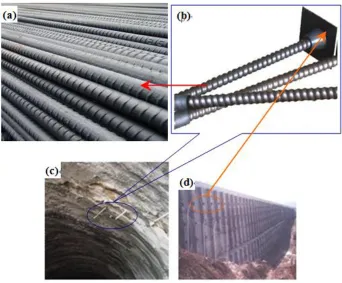
Anchor rod, a common support material in engineering, is often used in civil engineering structures, such as roadway, mines, underground tunnels and rock slope supporting and so on (see Figure 1). Due to the concealment of underground support engineering[1], the quality of anchor rod plays a vital role in the construction and security. The deterioration of anchor rod occurs in the complex geological and water quality environment and the wear and corrosion is the common failure mode in this situation. It is well known that the failure of engineering materials is mainly determined by the surface properties of the material rather than by its bulk properties. Amongst the surface engineering technologies, electroless plating is an effective method to provide protection and strengthen its performance for variety metal materials[2-4]. Meanwhile it has no special requirements for substrate geometries. Electroless plating is a process that the reduction and constant deposition of metal ions is achieved in liquid solution containing a reducing agent without impressed current.
Malecki, firstly proposed the mechanism of the electroless plating, provided the experience rate equation of plating bath on the basis of exploration to the kinetics processes of the reaction[5]. Up to now, the studies of Ni-P electroless plating on steels have made great progress, especially on different types of steels under various special service environment and the addition of different materials possessing special properties (nanomaterials, rare metals and rare earth elements, etc.). Owing to the largest reserve of rare earth for china, the research and development of rare-earth topics is of great significance. Published work has showed that the supplement of rare earth elements in the conventional binary plating solution can significantly improve the properties of the Ni-P coating[6, 7]. For the electroless plating Ni-P proceeded on Q235 carbon steel in the acid plating bath, appropriate addition of La3+ had improved the stability of plating bath, the deposition rate and the corrosion resistance of the coating and reduced the plating temperature simultaneously[8, 9]. Ternary Ni-Ce-P coatings on the low-carbon steel plated in an alkaline citrate-bath system presented better corrosion resistance than binary Ni-P plating coatings during the continuous salt spray tests[10]. It was found that adding Cen+ (n=3, 4) ions could promote the deposition of phosphorus and reduce the coating porosity. Beside the Ni-P/nano-CeO2 composite coatings on the low carbon steel under acidic condition exhibit the excellent corrosion resistance[11]. While other studies also indicated that excessive addition of rare earth elements (La, Pr and Nd) has negative effects on the deposition rate and corrosion resistance [12, 13].
Figure 1. Commonly used engineering anchor rod 2. EXPERIMENTAL PROCEDURE
Owing to the less experiments and analysis even the presence of some opposite results about La (atomic radius, 0.1877 nm), La3+ is chosen as the additional element. And the effect of La3+ on the wear resistance and corrosion resistance and the action mechanisms of La3+ are studied basing on the basic electroless plating solution and the practical anchor rod material. La3+ was added in the form of rare earth salt (La(NO3)3) to guarantee uniform dispersion of the solution. Before plating ultrasonic dispersion of the mixed solution (prepared rare earth-nitrate solution + original plating solution) is conducted to insure the uniform and stable of the solution. It is worth noting that the modification of rare earth to the morphology of coating is valid only in a certain extent, so the choice of appropriate addition of it is crucial. The characterization and analysis of the different La-add electroless plating coating is conducted.
2.1 Experimental materials and pre-treatment
[image:3.596.128.470.73.356.2]
Table 1. The chemical composition of RB400 steel
Element C Mn Si P S Fe
Wt.% 0.23 1.42 0.63 0.037 0.033 BAL.
Pre-treatment procedure is as follows:
1. Alkaline cleaning: samples were firstly immersed into the alkaline solution of 85 ℃ for 5 min to remove the oil. (the formula of the alkaline solution is as shown in Table 2 )
2. Acidic cleaning one: then the samples were washed by 20 vol. % HCl for 1-2 min under ambient temperature to dissolve the rust and the ion remaining on the surface of the samples.
3. Acidic cleaning two: finally the samples were activated by 5 vol. % H2SO4 for 1 min under ambient temperature to form numerous small activity centers, increase the surface activity and facilitate the next deposition process.
It is worth noting that the samples should be rinsed by deionized water after each step to exclude the effect of the previous step on the next step. All pre-treatment procedure is for laying the better foundation of the follow-up plating experiment.
Table 2 The formula of the alkaline solution
Ingredient Content(g/L)
sodium hydroxide(NaOH) 70 sodium carbonate(Na2CO3) 40 sodium phosphate(Na3PO4) 20 sodium silicate(Na2SiO3) 10
2.2 Electroless plating
Table 3. Electroless plating solution formula of adding rare earth experiment
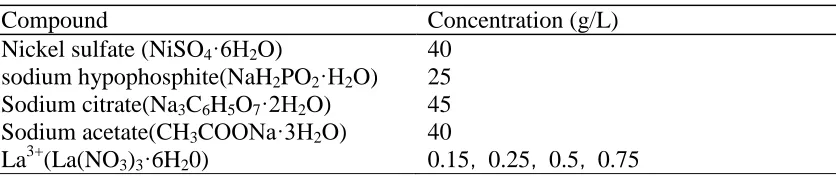
Compound Concentration (g/L)
Nickel sulfate (NiSO4·6H2O) 40 sodium hypophosphite(NaH2PO2·H2O) 25 Sodium citrate(Na3C6H5O7·2H2O) 45 Sodium acetate(CH3COONa·3H2O) 40
La3+(La(NO3)3·6H20) 0.15,0.25,0.5,0.75
2.3 Characterizations and testing
Surface morphologies and phase constitutions of the coatings were characterized by scanning electron microscope (SEM) and X-ray diffraction (XRD).The phosphorus contents of the coatings changing with the depth from the surface was characterized through the glow discharge optical emission spectrometry (GDOES). The microhardness values of the samples were characterized by the HVS-1000A microhardness tester under the load of 50 g with a loading time of 20 s. The corrosion resistance of the coatings with 1 cm2 effective area in 5 wt. % NaCl solution was tested by three electrode system on electrochemical workstation. Electrochemical measurements of polarization curves (under the potential sweep voltage of -0.5 V~+1.5 V vs. open circuit potentials (OCPs) with a scanning rate of 1 mv/s) and electrochemical impedance spectroscopy (EIS) were conducted Tribological behaviors of the coatings were tested on the MFT-R4000 reciprocating wear tester against high carbon chrome steel balls (Φ 5 mm) under the condition of load 5 N for 30 min. Tribological characteristics of the tested samples were defined by comparing the friction coefficients and mass losses. The specimens were thoroughly cleaned with acetone in an ultrasonic bath before and after each test. An analytical balance with an accuracy of 0.01 mg was employed to weigh the original and worn samples.
3. RESULTS AND DISCUSSION
3.1 Microstructural characterizations
Figure 2. Surface morphology of Ni-P coating with magnification of 5000×
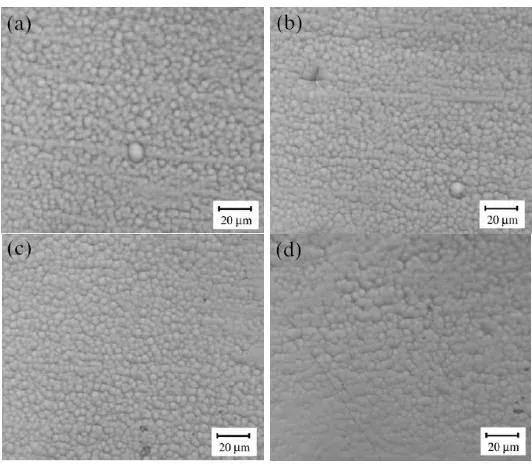
Figure 3. The surface topography of electroless Ni-P plating under different concentration of La3+ (magnification of 1000×): (a) 0.15 g/L(b)0.25 g/L(c)0.50 g/L(d)0.75 g/L
[image:6.596.165.431.309.541.2]
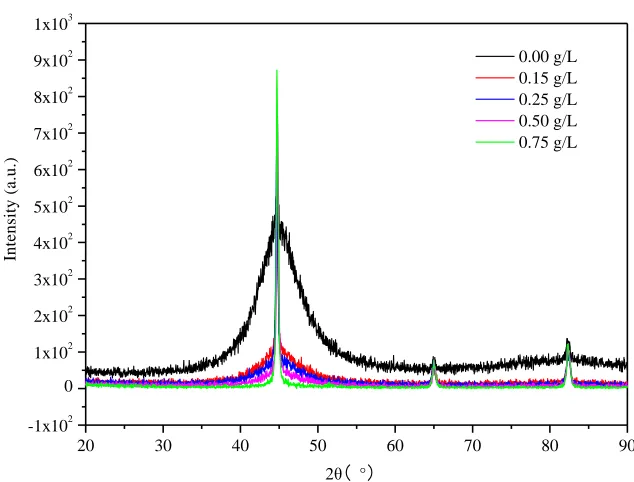
modified the crystal grain[15]. In addition, compared with the XRD patterns of conventional binary coating, the XRD pattern of the coating containing different concentration of La3+ have fewer small peak, which maybe is caused by the adsorption of different concentration of La3+ at the growing point on the corresponding crystal face and the coverage of the previously displayed crystal face. It is difficult that the La ions are reduced to the form of metal, so there is no the La in the XRD patterns.
During the electroless nickel, the reduction of nickel ions need the electron provided by oxidation process of hypophosphite, while the special electron shell structure of rare earth elements may provide the vacant orbital for the transportation of the free electron. So the rare earth elements can accelerate the velocity of the electrons and increase the deposition process of metal ions. On the one hand, rare earth elements with strong adsorption capacity can be preferentially adsorbed at the surface defect on the substrate. Then the surface energy is reduced, the nucleation rate and grain density of coating will be increased. The deposition rate and compactness of the coating are increased simultaneously. On the other hand, see from the electrochemical point, the transformation of the electron shell structure (at the interface) caused by the rare earth nitrates hinder the diffusion between the interfaces. So the difficulty of the deposition of Ni atoms is increased and the effect of rare earth ions on the deposition rate is weakened. Besides rare earth ions can precipitate easily in the form of gum hydroxide and a large amount of metal ions will precipitate in the form of a complex compound during the change of pH value in the plating solution. That is to say the reduction deposition of the metal ions is slowed down and the surface quality of the coating is deteriorated. In view of the above, the amount of rare earth elements should not be excessive, otherwise the opposite effect will be acquired.
20 30 40 50 60 70 80 90
-1x10² 0 1x10² 2x10² 3x10² 4x10² 5x10² 6x10² 7x10² 8x10² 9x10² 1x10³
0.00 g/L 0.15 g/L 0.25 g/L 0.50 g/L 0.75 g/L
In
te
n
si
ty
(
a
.u
.)
2θ( °)
[image:7.596.127.444.476.717.2]
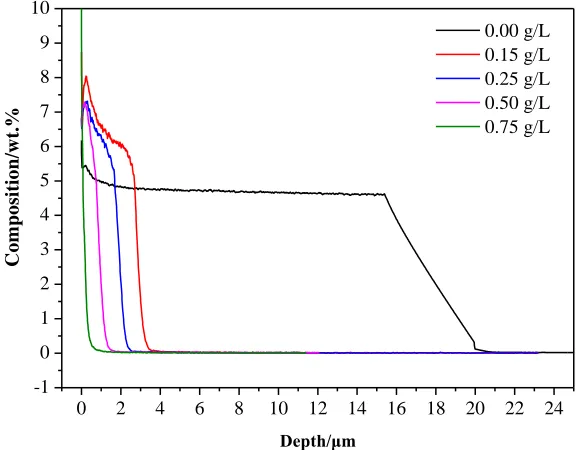
The depth of P-containing coating reflects the thickness of the alloy layer. As show in the Figure 5, the phosphorus content of the coatings are substantially same(7%), the thickness and the deposition rate of the coatings are different under different concentration of La (0.15 g/L, 0.25 g/L, 0.5 g/L). The thickness of the coating decrease with the amount increase of La. That is to say, the increase of the rare earth elements (La) has poor effect on the deposition rate. While for the coating quality, rare earth element improve mainly the deposition state compared with the binary plating coating. The phosphorus (P) content of the coating stays the same, which indicate that the component of the coating is consistent with the binary plating coating to some extent. Due to the conclusiveness of the structure and morphology of general materials to the performance of them, less addition amount of rare earth element (La) can optimize further the structure and morphology of the coating and make a contribution to the improvement of the coating properties correspondingly.
0 2 4 6 8 10 12 14 16 18 20 22 24
-1 0 1 2 3 4 5 6 7 8 9 10
0.00 g/L 0.15 g/L 0.25 g/L 0.50 g/L 0.75 g/L
C
o
m
p
o
si
ti
o
n
/w
t.
%
Depth/μm
Figure 5. The P composition in Ni-P coatings under different concentration of La3+:0.00 g/L, 0.15 g/L, 0.25 g/L, 0.50 g/L, 0.75 g/L
3.2 Surface hardness
[image:8.596.146.436.301.526.2]
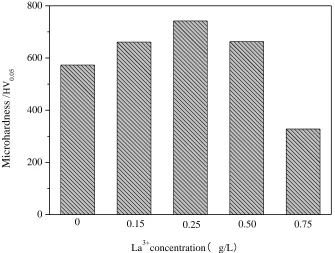
increases to a certain value, the hardness values decrease significantly, which indicate that the rare indeed improved the hardness of coating but the addition amount of it should be controlled strictly.
According to Hall-Pech theory[16], the hardness of the coating will increase with refining of the crystal grain. Based on the dislocation accumulation theory of nanocrystals and polycrystalline, the relationship between yield stress (hardness) and grain size can be expressed as:
σ=σ0+KH·dn (1)
σ— macroscopic yield stress; σ0—the lattice friction for the transfer of single dislocation; KH—a constant; d—the average grain diameter; n—the index of the average grain size, usually -1/2. However, this relationship is limit. First, the intensity will not grow indefinitely beyond theory. Secondly, any relaxation process on the grain boundaries may lead to the reduction of hardness, so the inverse HP phenomenon will appears at a critical grain size. Thirdly, HP theory base on the dislocation accumulation theory, so it is invalid for the ultrafine particles that may not produce a plurality of dislocation accumulation. And the displacement of the free grain boundaries may produce micro-cracks[17]. It also explains the phenomenon the most fine-grained Ni-P-La coatings under 0.5 g/L La3+ show the lower hardness.
0 200 400 600 800
La3+concentration( g/L)
M
ic
ro
h
a
rd
n
e
ss
/
HV
0
.0
5
0.15 0.25 0.50 0.75
[image:9.596.129.464.341.594.2]0
Figure 6. The microhardness bar chart of Ni-P coating under different concentration of La3+:0.15 g/L, 0.25 g/L, 0.50 g/L, 0.75 g/L
3.3 Tribological behaviors
0 5 10 15 20 25 30
0.2 0.4 0.6 0.8 1.0 F ri c ti o n c o e ff ic ie n t Time /min 0.25 g/L 0.15 g/L
0.75 g/L 0.50 g/L
0.00 0.05 0.10 0.15 0.20 0.25 0.30 0.35 0.40 0.45 0.75 0.50 0.25 0.15 Q u al it y r ed u ct io n /m g
c(La3+) /gL-1
[image:10.596.93.522.90.280.2](a) (b)
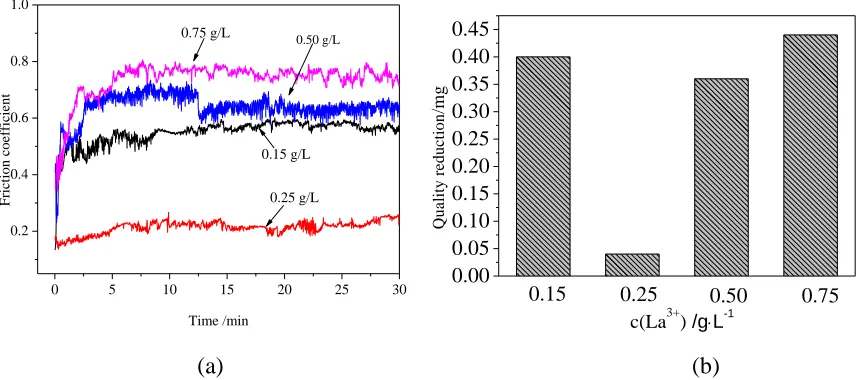
Figure 7. The friction coefficient curve (a) and mass loss bar chart (b) of Ni-P coating under different concentration of La3+ (0.15 g/L, 0.25 g/L, 0.50 g/L, 0.75 g/L)and a load of 5 N
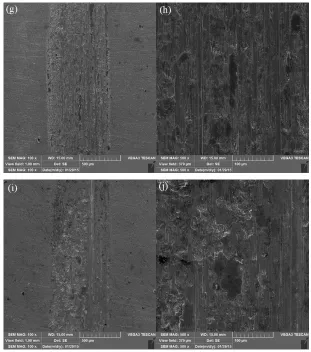
When the concentration of La3+ is 0.25 g / L, the coating surface is bright and smooth and the friction coefficient is significantly lower, the wear scar is shallower and the degree of wear is slighter than other coatings. In the wear test process, there is not sharp noise for those coatings which is also different from other coatings.
Figure 7a shows that the total friction coefficient increase continually with the increase of the concentration of La3+. After a short running-in stage, wear process go into the stable wear stage. When the concentration of La3+ is 0.25 g / L, average friction coefficient of Ni-P-La alloy coatings is the minimum. And Figure 7b shows that the quality reduction of the coatings is also the minimum. Compared with the average friction coefficient (0.467) of Ni-P coatings under 5 N, La3+ do not significantly affect the average friction coefficient alloy coatings. Overall the coatings exhibit good wear resistance.
Figure 8. SEM images of wore surface morphologies on Ni-P coatings under different concentration of La3+ and a load of 5 N (left: 100X; right: 500X) (a, b) 0.00 g/L; (c, d) 0.15 g/L; (e, f) 0.25 g/L; (g, h)0.50 g/L; (i, j)0.75 g/L
3.4 Corrosion resistance
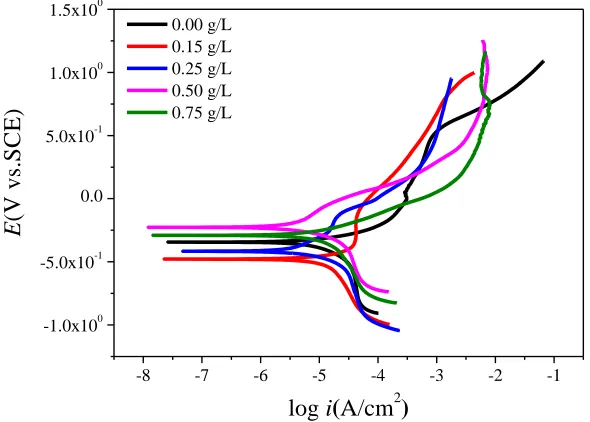
The polarization curves (Figure 9) of different coatings under the condition of 5 wt.% NaCl and ambient temperature show that the corrosion potential shift positively, the corrosion current density decrease and the corrosion resistance of the coating improve with the increase of La content when the content of La3+ is less than 0.50 g / L(Table 4). When the content of La3+ is 0.15 g/L, a certain passivation area emerges in the anode branch and the coatings exhibit a good corrosion resistance. When the content of La3+ is 0.50 g/L, the corrosion potential of the coating achieve to the highest, the corrosion current density is the minimum and the overall corrosion resistance of the coating is the optimum. Conversely, when the content of La3+ is increased to 0.75 g/L, the corrosion potential shift negatively in a greater degree and the current density will also increase accordingly. Besides Tafel slopes βa and βc also inversely impact the corrosion current density and the result is consistent with the above results.
accordingly[20, 21]. The coatings formed under appropriate addition of La indicated the following characteristics: 1) The cell structure of them is compact and smooth; 2) the potential difference between the central raised portion and the edge portion is small; 3) the fluctuation of the components is smaller than that of the traditional coatings with coarse cell particles; 4) the distribution of the phosphorus content in micro area is also uniform. The tendency of electrochemical corrosion is reduced and the corrosion resistance is improved and enhanced[15, 20].
-8 -7 -6 -5 -4 -3 -2 -1
-1.0x100 -5.0x10⁻¹ 0.0 5.0x10⁻¹ 1.0x100 1.5x100
0.00 g/L 0.15 g/L 0.25 g/L 0.50 g/L 0.75 g/L
E
(V
v
s.
S
C
E
)
log i(A/cm2)
[image:13.596.130.425.196.407.2]Figure 9. Polarization curves of Ni-P-La coatings deposited in different La-added plating solution (0.00 g/L, 0.15 g/L, 0.25 g/L, 0.50 g/L, 0.75 g/L) in 5 wt.% NaCl
Table 4. The date of electrochemical polarization curves of Ni-P-La coatings deposited in different La-added plating solution(0.00 g/L, 0.15 g/L, 0.25 g/L, 0.50 g/L, 0.75 g/L) in 5 wt.% NaCl
Samples Ecorr (V vs.SCE) Icorr (μA/cm2) βa (V/decade) βc (V/decade)
Ni-P coating -0.393 6.026 0.058 0.127
0.15 g/L -0.478 4.335 0.065 0.145
0.25 g/L -0.417 2.741 0.114 0.146
0.50 g/L -0.227 0.843 0.171 0.168
0.75 g/L -0.290 6.516 0.106 0.074
[image:13.596.43.552.511.640.2]
0 20000 40000 60000 80000 100000 120000
0 5000 10000 15000 20000 25000 30000 35000 40000
Z"
(Ω
c
m
2 )
Z'(Ω cm2)
[image:14.596.125.453.90.321.2]0.15g/L La3+ 0.25g/L La3+ 0.50g/L La3+ 0.75g/L La3+
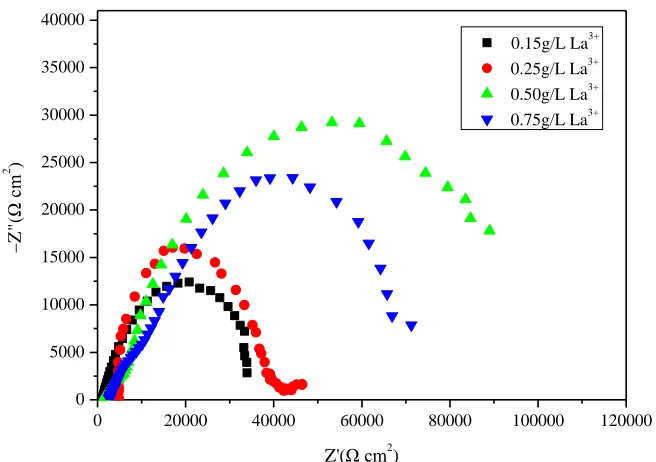
Figure 10. Electrochemical Nyquist plot of Ni-P-La coatings deposited in different La-added plating solution (0.15 g/L, 0.25 g/L, 0.50 g/L, 0.75 g/L) in 5 wt.% NaCl
The corrosion behavior of the coatings is further compared and analyzed through the fitting of equivalent circuit model (Figure 11). The equivalent circuit includes five components: R1—the resistance of solution; Q—the capacitance of the interface of coating/solution; R2—the resistance of the interface of coating/solution; C—electric double-layer capacitance of the interface of coating/substrate; R3—the charge transfer resistance of the interface of coating/substrate. Among them the Q is a constant phase element (CPE) used to describe the deviation between C and the ideal capacitance[21].
Figure 11. Equivalent electrical circuit model used to analyze the EIS date of Ni-P coatings under different adding content of rare earth
[image:14.596.173.421.542.667.2][image:15.596.46.551.240.347.2]
degree of the deviation between C and the ideal capacitance. The value of n is smaller, the deviation is bigger. Besides, the value of R1 and Q change slightly, which reflect the nature of the solution environment and the coating itself are consistent. While the charge transfer resistance of two interface (R2+R3) is different. When the addition amount of La is 0.50 g/L, the resistance value between the solution and the substrate is maximum. In another words, the corrosion resistance of the coating is the optimal. This result is consistent with the analysis of the polarization curves.
Table 5. The impedance date of plated Ni-P coating under different addition amount of La: 0.15 g/L, 0.25 g/L, 0.50 g/L, 0.75 g/L)
Samples Rs(Ω·cm2) Q1(F/cm2) R1(Ω·cm2) Q2(F/cm2) R2(Ω·cm2) Rct(Ω·cm2)
Ni-P-0.15 g/L 94.33 1.36E-4 4505 3.45E-4 3764 8269
Ni-P-0.25 g/L 93.64 1.10E-4 6248 2.93E-4 4367 10615
Ni-P-0.50 g/L 92.17 2.11E-4 7719 1.41 E-4 6348 14067
Ni-P-0.75 g/L 97.97 3.87E-4 9572 4.05 E-4 1722 11294
4. CONCLUSIONS
This work shows that La has positively affect the modification of the Ni-P coatings on the anchor rod material (RB400). According to the experiment we can draw the following conclusions:
1) The effect of La3+ on the surface morphology of the Ni-P plating coating is significant. The surface cellular particles of the coating are refined and the arrangement of them is more compact. When the addition amount of La3+ is 0.50 g / L, the coating surface is very smooth and the compact degree of cellular particles is the best.
2) The FWHM of the peaks for the coatings containing La has been narrowed and show significant features of microcrystalline diffraction and the XRD pattern of the coatings containing La present fewer small peak.
3) La3+ indeed improved the hardness of coating but the addition amount of it should be controlled strictly. The hardness values of the Ni-P alloy coatings are higher when the concentration of La3+ concentration is in the range of 0.15-0.5 g/L.
4) The total friction coefficient increase continually with the increase of content of the La3+. When the concentration of La3+ is 0.25 g/L, average friction coefficient of Ni-P-La alloy coatings is the lowest, the wear scar is the shallowest and the degree of wear is the slightest. While compared with that of Ni-P coatings, La3+ do not significantly affect the average friction coefficient of alloy coatings.
However, the action mechanism of La about the corrosion resistance is not yet clear and it will be the object of study in the future.
ACKNOWLEDGEMENTS
This work was supported by the National Natural Science Foundation of China (No. 51501125), the China Postdoctoral Science Foundation (No.2012M520604), the Natural Science Foundation for Young Scientists of Shanxi Province (No.2013021013-2, No.2014011036-1 No.2014011015-7) the Science and Technology Programs for Research and Development of Shaanxi Province (No. 2013KJXX-08).
References
1. N.M. Lin, H.Y. Zhang, J.J. Zou, P.J. Han, Y. Ma and B. Tang. Int. J. Electrochem. Sci., 10 (2015) 356-372.
2. O.Elendu, M.Ojewumi, Y.D. Yeboah and E.E. Kalu. Int. J. Electrochem. Sci., 10 (2015) 10792-10805.
3. C.O. Osifuye, A.P.I. Popoola, C.A. Loto and D.T. Oloruntoba. Int. J. Electrochem. Sci., 9 (2014) 6074-6087.
4. R.X. Sun, Zhao, G. Yu,Z.H. Xie, B.N. Hu, J. Zhang, X.M. He and X.Y. Zhang. Int. J. Electrochem. Sci., 10 (2015) 7893-7904.
5. A. Małecki and A. Micek-Ilnicka. Surf. Coat. Technol., 123 (2000) 72-77. 6. J.H. Wang, X.M. Fei, G.D. Long and W. Li. Mater. Prot., 36 (2003) 31-33. 7. J.Z. Li, Y.W. Tian, Y. Li and X. Wang. J. Rare Earths, 28 (2010) 769-773.
8. H. Ashassi-Sorkhabi, M. Moradi-Haghighi and M.G. Hosseini. Surf. Coat. Technol., 202 (2008) 1615-1620.
9. Y. Zhu, L. You and T.T. Song. Plat. Finish., 30 (2011) 20-22.
10. J.N. Balaraju and M. Chembath. Appl. Surf. Sci., 258 (2012) 9692-9700. 11. H.M. Jin, S.H. Jiang and L.N. Zhang. J. Rare Earths, 27 (2009) 109-113. 12. X.W. Zhou, Y.F. Shen and H.M. Jin. Funct. Mater., 42 (2011) 305-309. 13. Z.H. Ren and L.P. Tian. China Surf. Eng., 25 (2012) 79-83.
14. B. Szczygieł, A. Turkiewicz and J. Serafińczuk. Surf. Coat. Technol., 202 (2008) 1904-1910. 15. H. Sun, H.F. Ma, X.F. Guo, L.M. Feng, Y. Wang and Y.X. Cai. J. Chin. Soc. Rare Earths, 32
(2014) 228-233.
16. Z.X. Zou, J.Z. Xiang and S.Y. Xu. Trans. Mater. Heat Treat., 35(2014) 137-141.
17. D. Wang, Y.F. Cheng, H.M. Jin, J.Q. Zhang and J.Q. Gao. J. Rare Earths, 31 (2013) 209-214. 18. Y.H. Ma, Q.H. Zhang and Y.Z Li. J. Electrochem. Soc., 159 (2012) D119-D123.
19. F. Mo, Y. Feng, Y.M. Chen, Y.Q. Wang, G. Qian, Y.K. Dou and X.B. Zhang. J. Rare Earths, 33 (2015) 327-333.
20. L.Jiang, J. B. Lu, S.S. Pan, Y.D. Yu,G.Y. Wei and H.L. Ge. Int. J. Electrochem. Sci., 7 (2012) 2188-2200.
21. A.S. Hamdy and H.M. Hussien. Int. J. Electrochem. Sci., 8 (2013) 11386-11402.