Int. J. Electrochem. Sci., 11 (2016) 1601 - 1610
International Journal of
ELECTROCHEMICAL
SCIENCE
www.electrochemsci.org
Short Communication
Removal of Cr(VI) by Electrocoagulation Using Vertical and
Horizontal Rough Cylinder Anodes
A. M. Khalaf*, A. A. Mubarak, S. A. Nosier
Chemical Engineering Department, Faculty of Engineering, Alexandria University, Alexandria, Egypt *
E-mail: [email protected]
Received: 24 September 2015 / Accepted: 6 December 2015 / Published: 1 January 2016
The removal of Cr(VI) from model wastewater by electrocoagulation cells with both vertical and horizontal iron electrodes was investigated at the laboratory scale. The variables studied were the anode surface roughness, applied current density, initial Cr(VI) concentration, and the anode rotation speed. The removal efficiency increased with increasing current density and surface roughness and decreased with increasing initial chromium concentration; by contrast, no significant effects of anode rotational speed were observed, although vigorous solution stirring adversely affected Cr(VI) removal. The performance of the vertical anode design was observed to be superior to that of horizontal parallel electrodes.
Keywords: Chromium removal; Electrocoagulation; Rough cylinder; Wastewater
1. INTRODUCTION
Metal environmental contaminants are definitely harmful because they are nonbiodegradable and can accumulate in living tissues. Hexavalent chromium is well known for its toxicity, and it can be absorbed by living organisms. The continued accumulation of chromium in the human body causes health disorders [1-4]. The pollution of water by heavy metals can result from several industrial activities such as metal finishing, textile manufacturing, cement production, chromate production, electroplating, leather tanning, pesticide application (wood preservative), etc. [2-6]. Massive quantities of chromium can be released into the aquatic environment either through factory effluents or through contingent leakage, improper storage procedures or incorrect disposal of chromium-containing wastes [7].
times greater than that of Cr(III) [9]. These processes include adsorption techniques [10-13], membrane filtration [14-16], ion exchange [17-19], and acidic reduction of Cr(VI) to Cr(III) at pH values below 3. The commonly used agents for Cr(VI) reduction are NaHSO3, FeS, FeSO4, and SO2, followed by the chemical precipitation of Cr(III) as Cr(OH)3 using lime, sodium hydroxide or magnesium hydroxide [20,21]. The main negative effect of these processes is that chemical coagulation may result in secondary pollution caused by the large quantities of added chemical substances. In comparison with chemical metal precipitation methods, the use of electrocoagulation techniques for the treatment of several industrial effluents is recommended because, in this particular application, the liquid is not heavily loaded with anions and does not undergo changes in salt content. Furthermore, electrocoagulation processes involve simple equipment and a short retention time and are easy to operate, which contributes to low operating costs in industrial applications [22,23]. Electrocoagulation is a process dependent on the creation of metallic hydroxide flocs in wastewater via the electrodissolution of soluble anodes, which are usually composed of iron or aluminum. The generation of metallic cations occurs at the anode because of electrochemical oxidation of the iron or aluminum, whereas H2 is typically formed at the cathode [24]. Electrocoagulation processes involve the collaboration of many chemical and physical phenomena, such as discharge, anodic oxidation, cathodic reduction, coagulation, electrophoretic migration, and adsorption [25].
The present work aims to examine the efficiency of electrocoagulation cells with both vertical and horizontal rough iron cylinder electrodes in removing hexavalent chromium from synthetic wastewater. The influence of anode surface roughness, current density, initial Cr(VI) concentration, and rotation speed of the anode on the removal efficiency was explored to determine the optimum operating conditions. Although the removal of chromium using the electrocoagulation technique has been previously reported by different authors, few of these investigators sought to improve the rate of Cr(VI) reduction by using a rotating rough-surfaced electrode, which is simple in design and provides a large surface area per unit volume of the cell.
2. EXPERIMENTAL TECHNIQUES
2.1. Setup
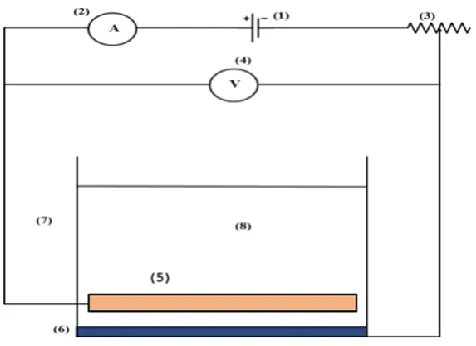
electrical circuit consisted of a direct current (dc) power supply (40 V, 20 A) with a built-in voltage regulator. A multirange ammeter was connected in series with the cell to measure its current, whereas a voltmeter was connected in parallel to measure the cell voltage.
[image:3.596.107.498.153.335.2]
Figure 1. Experimental setup for the vertical anodes.
Figure 2. Experimental setup for the horizontal anodes.
The cell anode was a smooth-surfaced steel cylinder of 10 cm active height and 2.5 cm diameter that was placed parallel to the bottom of the Plexiglas cylinder with a gap distance of approximately 2 cm. The cathode was a steel sheet of 1 mm thickness lining the bottom wall of the vessel.
1. D.C power supply. 2. Ammeter.
3. Variable resistance. 4. Voltmeter.
5. horizontal iron cylinder (anode).
[image:3.596.93.331.439.612.2]
2.2. Procedure
A stock solution of K2Cr2O7 was prepared using analytical-grade chemicals and distilled water. Experimental solutions of the desired concentrations were produced by successive dilution with distilled water. The initial pH of the solution was adjusted using an HCl and/or NaOH solution. Before
each run, the electrodes were etched in a dilute HCl solution (15% w/v) for a few minutes to remove any
residual grease or surface oxides and were then washed with distilled water before being placed in their final location in the cell and connected to the power supply. During each run, 2000 mL of potassium dichromate solution at various initial concentrations ranging from 500 to 1500 ppm were added to the cell, along with sodium chloride at a constant concentration of 3.5 wt%. A current density ranging from 5 to 40
mA cm−2 was used. Ten milliliter aliquots of the solution were drawn at 5 min intervals and were
divided into two separate equal-volume samples. Both samples were analyzed by back titration against
a standard ferrous ammonium sulfate solution and standard potassium dichromate solution using diphenyl
amine barium salt as an indicator. Both titration results are reported as one average result [26]. The experiment time was 30 min, and the temperature was maintained at 25 ± 1 °C. The percentage of Cr(VI) removed at the end of each experiment was calculated from the following equation:
1) where Co is the initial Cr(VI) concentration and C is the Cr(VI) concentration at the end of the experiment. The cell potential was measured, and the cell power consumption was calculated in each experiment to evaluate the cell’s performance and its economic viability under the disparate operating conditions.
3. RESULTS AND DISCUSSION
A wide range of coagulant species and hydroxides are formed by the anodic dissolution of iron during the electrolysis process, which can destabilize suspended particles, causing their coagulation, or precipitate and adsorb dissolved contaminants [27]. The following reactions occur at the anode:
Fe(s) → Fe(aq)2+ +2e− (2)
Fe(s) → Fe(aq)3+ +3e− (3)
2 H2O → 4 H+(aq) +O2(g) +4e− (4)
Whether iron is released as Fe3+ or as Fe2+ from Fe electrodes during electrocoagulation remains unclear. A substantial number of researchers have assumed that Fe is dissolved as Fe2+; however, a definitive confirmation is still lacking [27-31].
By contrast, the cathode reactions are:
2 H2O + 2 e− → H2(g) + 2 OH− (5)
Cr2O72- + 6 e− + 7 H2O → 2 Cr3+ + 14 OH− (6)
Furthermore, various reactions occur in the bulk solution. The Fe2+ formed at the anode reduces Cr(VI) to Cr(III) according to the following reaction:
Cr2O72− + 6 Fe2+ + 7 H2O → 2 Cr3+ + 6 Fe3+ + 14 OH− (7) Further oxidation of Fe2+ to Fe3+ occurs because of the oxygen formed at the anode:
The anodically formed Fe3+ combines with the cathodically formed OH- to produce insoluble Fe(OH)3. Depending on the pH of the bulk solution, various ionic species such as Fe(OH)2+, Feaq3+, and Fe(OH)4− may also exist in the aqueous medium. Pollutants can be removed from the solution via suspended solid iron hydroxide through coprecipitation, sorption, or electrostatic attraction followed by coagulation [32].
3.1. Effect of anode rotational speed on the removal efficiency of Cr(VI) 3.1. Effect of anode rotational speed on the efficiency of Cr(VI) removal
The pollutant removal rate in electrochemical processes is controlled by various parameters such as the initial pollutant concentration, type of electrode material, intensity of the applied current, and the orientation of the electrodes, among other variables.
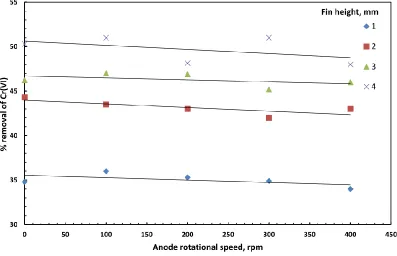
To investigate the effect of stirring on the removal rate, various experiments were performed that demonstrated that the removal rate remained nearly constant as the rotational speed of the anode was varied, as illustrated in Fig. 3. This finding supports the assumption that the electrocoagulation process is controlled by the chemical dissolution step of the iron anode. Nevertheless, vigorous stirring of the solution reduced Cr(VI) removal because it dispersed the coagulated Cr(VI) and Fe(OH)3.
[image:5.596.96.493.447.703.2]The present finding is consistent with the previous work of different authors. Toktman et al. [33] reported that increasing rotation speed from 100 rpm up to 400 rpm decreased the removal efficiency from 99.7 to 98.4 respectively.
3.2. Effect of initial Cr(VI) concentration
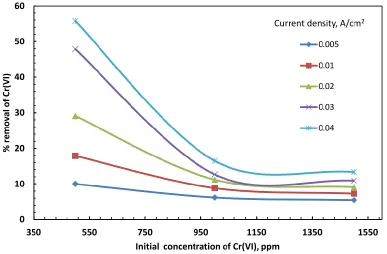
To study the effect of the initial Cr(VI) concentration on the Cr(VI) removal rate, many experiments were performed with the initial ion concentrations ranging from 500 to 1500 ppm. The results indicated that increases in the initial Cr(VI) concentration tended to reduce the rate of removal. Fig. 4 clarifies the effect of the initial Cr(VI) concentration on the percentage of Cr(VI) ions removed at different current densities. The following relationships were noted for the main factors:
(i) At a constant current density, the same amount of iron ions enter the solution. Consequently, the amount of Fe(OH)3 coagulant formed is limited and is insufficient to treat the large amounts of Cr(VI) and Cr(III) ions present in the bulk solution.
(ii) Increasing the initial concentration of Cr(VI) in the bulk solution chemically passivates the anode by increasing the amount of chromium absorbed onto the anode surface. Similar phenomena have been reported elsewhere [34,35].
Figure 4. Effect of the initial Cr(VI) concentration on the removal of chromium ions at different current densities (NaCl conc. = 3.5 wt%; pH = 2.5; smooth anode).
3.3. Effect of anode orientation (vertical vs. horizontal)
[image:6.596.99.486.305.559.2][image:7.596.95.492.122.393.2]
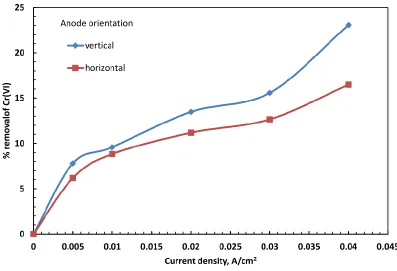
amount of Fe+2 and Fe+3 ions generated from anodic dissolution of the anode is less than that obtained using the vertical orientation, where the current distribution is more uniform.
Figure 5. Effect of current density on the percentage of Cr(VI) removed using vertical and horizontal anode orientations (initial concentration of Cr(VI)= 1000 ppm; smooth anode; NaCl conc. = 3.5 wt%; pH = 2.5).
3.4. Effect of anode surface roughness
Figure 6. Effect of anode roughness on the percentage of Cr(VI) removed at different initial concentrations of Cr(VI) ions (NaCl conc. = 3.5 wt%; pH = 2.5; current density = 0.03 A cm−2).
3.5. Effect of current density
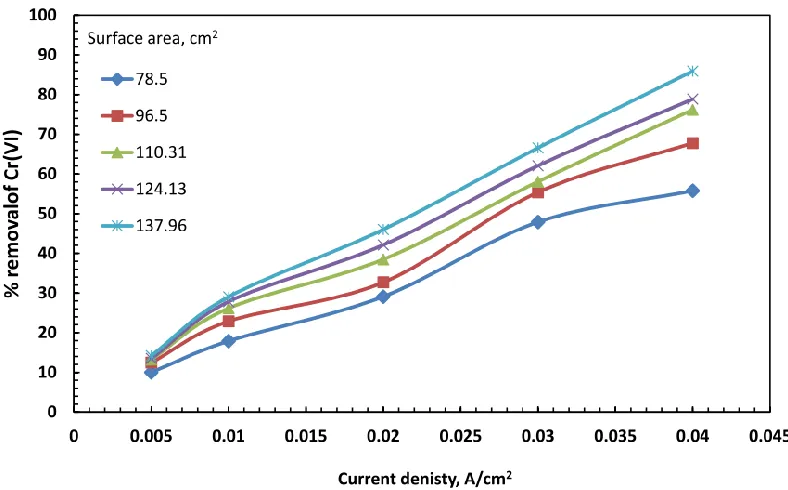
Figure 7. Effect of current density on the percentage of Cr(VI) removed at different surface areas (initial concentration of Cr(VI) = 500 ppm; NaCl conc. = 3.5 wt%; pH = 2.5).
[image:8.596.141.458.74.273.2] [image:8.596.96.490.378.623.2]
(9)
where i is the current intensity, t is the time of electrolysis, M is the molecular weight of iron or hydroxide ion (g mol−1), Z is the number of electrons transferred in the reaction and F is Faraday’s constant (96,486 C mol−1). Moreover, in addition to increasing production of coagulant, higher current densities also increase the production of fin-sized bubbles and bubble flux, thereby resulting in an enhancement in electroflocculation. Fig. 7 shows the effect of current density on the percentage of Cr(VI) removed at different anode surface areas.
4. CONCLUSIONS
Electrocoagulation is an efficient Cr(VI) removal method that reduces the Cr(VI) concentration to a permissible value. However, traditional electrocoagulation methods provide considerable ion removal but also present economic challenges related to the production of large amounts of sludge and the addition of chemicals.
The present study has revealed the following:
i. The performance of a cell with vertically oriented electrodes is superior to that of a cell with horizontal electrodes with respect to removal of Cr(VI) ions by electrocoagulation. ii. The efficiency of Cr(VI) removal by electrocoagulation is not improved by mechanical
stirring within the range of rotational speeds investigated in this study.
iii. Increasing the fin height of the anode increases the anode’s active surface area per unit volume of the cell and increases the removal efficiency of Cr(VI).
iv. The efficiency of Cr(VI) removal improves with increasing current density and decreases with increasing initial concentration of chromium.
v. The electrical energy consumption ranged from 0.099 to 10.4 kWh m−3, depending on the operating conditions.
References
1. S. Babel and T. A. Kurniawan, J. Hazard. Mater., B97 (2003) 219. 2. V. K. Gupta, M. Gupta and S. Sharma, Water Res., 35 (2001) 1125. 3. I. Heidmann and W. Calmano, Sep. Purif. Technol., 61 (2007) 15. 4. M. Kiilunen, Ann. Occup. Hyg., 38 (1994) 171.
5. M. Ajmal, R. A. K. Rao and B. A. Siddiqui, Water Res., 30 (1996) 1478. 6. C. Namasivayam and R. T. Yamuna, Chemosphere, 30 (1995) 561. 7. J. A. Zazo, J. S. Paull and P. R. Jaffe, Environ. Pollut., 156 (2008) 29.
8. ATSDR, U.S. Department of Health and Human Services, Public Health Service (2008). 9. M. Costa, Appl. Pharmacol., 188 (2003) 1.
10. R. A. Hashem, R. A. Akasha, A. Ghith and D. A. Hussein, Energy Edu. Sci. Technol., 19 (2007) 69.
11. K. Ravikumar, B. Deebika and K. Balu, J. Hazard. Mater., 122 (2005) 75.
14. G. Pugazhenthi, S. Sachan, N. Kishore and A. Kumar, J. Membr. Sci., 254 (2005) 229. 15. M. K. Aroua, F. M. Zuki and N. M. Sulaiman, J. Hazard. Mater., 147 (2007) 752. 16. M. Muthukrishnan and B. K. Guha, Desalination, 219 (2008) 171.
17. B. Volesky, Sorption and Biosorption, Montreal-St. Lambert, Quebec, Canada. BV Sorbex Inc. (2003).
18. D. Park, Y. S. Yun, J. H. Jo and J. M. Park, Ind. Eng. Chem. Res., 45 (2006) 5059. 19. N. Ahalya, T. V. Ramachandra and R. D. Kanamadi, Res. J. Chem. Environ., 7 (2003) 71. 20. Y. Hisamatsu and Y. Kitajima, J. Metal Finish. Soc. Japan, 19 (1968) 466.
21. Control and Treatment Technology for the Metal Finishing Industry, US, EPA (1980). 22. N. Adhoum, L. Monser, N. Bellakhal and J.E. Belgaied, J. Hazard. Mater., 112 (2004) 207. 23. N. Meunier, P. Drogui, C. Montan´e, R. Hausler, G. Mercier and J.-F. Blais, J. Hazard. Mater.,
B137 (2006) 581.
24. M.G. Arroyo, V. Pérez-Herranz, M.T. Montanés, J. García-Antón and J. L. Guinón, J. Hazard. Mater., 169 (2009) 1127.
25. H. Cheng, Sep. Purif. Technol., 52 (2006) 191.
26. A. I. Vogel, A Text-Book of Quantitative Inorganic Analysis, 3rd ed., Longman, London (1975). 27. J.Q. Jiang, N. Graham, C. Andre, G.H. Kelsall and N. Brandon, Water Res., 36 (2002) 4064. 28. P. K. Holt, G. W. Barton and C. A. Mitchell, Water Sci. Technol., 50 (2004) 177.
29. A. K. Golder, A. N. Samanta and S. Ray, Sep. Purif. Technol., 53 (2007) 33.
30. C. Barrera-Diaz, M. Palomar-Pardave, M. Romero-Romo and S. Martinez, J. Appl. Electrochem., 33 (2003) 61.
31. W.A. Pretorius, W. G. Johannes and G. G. Lempert, Water SA, 17 (1991) 133.
32. M. Y. A. Mollah, P. Morkovsky, J. A. G. Gomes, M. Kesmez, J. Parga and D. L. Cocke, J. Hazard. Mater., 114 (2004) 199.
33. T. Shahriari, G. Nabin Bidhendi, N. Mehrdadi and A. Torabian, J. Civil Eng., 18 (2014) 949. 34. A. Ozer, H. S. Altundogan, M. Erdem and F. Tumen, Environ. Pollut., 97 (1997) 107.
35. A. H. El-Shazly, A. A. Mubarak and A. H. Konsowa, Desalination, 185 (2005) 307.