Katsuto Tanaka
A thesis submitted to the
Australian National University
fo r the degree of
Doctor of Philosophy,
D E C L A R A T I O N
Except where otherwise acknowledged the work described here is ray own.
A C K N O W L E D G E M E N T S
I am deeply grateful to Professor E.J. Hannan for his guidance and help, especially for his enthusiasm throughout the writing of this
thesis. I am also indebted to Professor R.D. Terrell for his continuing
interest in my work. I would also like to extend my appreciation to
Professor M. Hatanaka and Dr M.A. Cameron for helpful discussions about several issues which arose in writing this thesis.
I am grateful to all concerned for providing me with such nice study conditions as at the Australian National University.
I would like to thank my parents for supporting me and encouraging
my study in spite of their hard conditions. This thesis is dedicated
to the. memory of my father who died during my stay in Australia.
I thank Mrs H. Patrikka for her excellent typing.
Finally, I would like to thank my high school classmate and wife, Yoshiko, who has always been a source of encouragement for more than
A B S T R A C T
This thesis is concerned with the analysis of some aspects of time
varying parameter models. In Chapter 1 we introduce a model upon which
we mainly concentrate ourselves in this thesis. The model, often referred
to as a state space system, is such that the observable process is made up additively of two unobservable variables, signal - a known linear transformation of a state vector generated by an autoregressive process -
and white noise. Although it is well known that the optimal estimate of
the state vector can be obtained at each time by a Kalman filter, this is possible only when a finite number of parameters involved in the model are all known.
Chapters 2 and 3 consider the identification and estimation of these
parameters for this model. We extensively discuss the case where the
observable process is stationary, which will become important when con
sidering seasonal adjustment procedures in Chapter 4. The laws of large
numbers and the central limit theorems are proved for the estimators suggested.
The role of the time varying parameter model under consideration is twofold; on one hand it is an extension of the usual linear regression model and on the other hand it is regarded as a signal plus noise model.
Chapter 4 emphasizes the latter interpretation and we apply the estima tion procedure discussed in Chapter 3 to a changing seasonal plus noise model while Chapter 5 considers hypothesis testing for the constancy of the coefficient parameters in usual linear regression models with the time varying parameter model as an alternative.
The last two chapters deal with possible extensions of previous
chapters. In Chapter 6 the Kalman filter is adapted to general time series
Page
DECLARATION ( i i )
ACKNOWLEDGEMENTS ( i i i )
ABSTRACT ( i v )
CHAPTER 1. TIME VARYING PARAMETER MODELS
1.1 I n t r o d u c t i o n 1
1.2 Summary o f Kalman F i l t e r i n g and Smoothing 4 1. 3 Recursi on f o r L i n e a r Regression Models 12
CHAPTER 2 . THE IDENTIFICATION PROBLEM IN TIME VARYING
PARAMETER MODELS
2.1 I n t r o d u c t i o n 21
2. 2 I d e n t i f i a b i 1i t y f o r S t a t i o n a r y Cases 24 2. 3 I d e n t i f i a b i 1i t y f o r N o n - S t a t i o n a r y Cases
when T i s F i n i t e 35
2. 4 A s y m p t o t i c I d e n t i f i a b i 1i t y 41
CHAPTER 3. THE ESTIMATION THEORY OF TIME VARYING PARAMETER
MODELS
3.1 I n t r o d u c t i o n 49
3. 2 A s y m p t o t i c P r o p e r t i e s o f t he MLE 51 3. 3 A s y m p t o t i c P r o p e r t i e s o f S p e c t r a l E s t i m a t o r s 58
3. 4 Some S i m u l a t i o n s 68
CHAPTER 4 . THE ESTIMATION OF A CHANGING SEASONAL PATTERN
4.1 I n t r o d u c t i o n 72
4 . 2 E s t i m a t i o n Procedures 75
4 . 3 E m p i r i c a l R e s ul t s 82
4 . 4 Concluding Remarks 93
Appendix t o Chapter 4
CHAPTER 5. TESTING THE CONSTANCY OF REGRESSION RELATIONSHIPS
OVER TIME
5.1 I n t r o d u c t i o n 96
5.2 The BDE Test s 97
5. 3 Tests Based on V a r i a b l e Parameter Regression 102 5. 4 Test s Based on a D e c i s i o n T h e o r e t i c Approach 109 Appendix t o S e c t i o n 4
CHAPTER 6. THE RECURSIVE ESTIMATION OF TIME SERIES MODELS
6.1 I n t r o d u c t i o n 119
6. 2 Three Recursi ons f o r Time S e r i e s Models 121
6. 3 Some S i m u l a t i o n R e s u l t s 130
7.1 I n t r o d u c t i o n 140
7.2 Formulation o f Tr an si en ts 142
7.3 E st im at i on Procedures in the Frequency Domain 147
7.4 Some Si mul ati ons and Empir ical Study 154
1.1
I n t r o d u c t i o n
It has usually been the case with econometric models that the model
parameters have been assumed to be constant over time. In some instances,
however, the validity of this assumption is open to question. Time
varying parameter models can, thus, be regarded as a natural extension
of these classical econometric models. As to a simplest econometric
model, i.e., a linear regression model, its version might be of the form:
where (i)
(ii) (iii)
(iv)
These assumptions will be imposed throughout the thesis unless
otherwise stated. The model (1.1) is also called a state space system,
which has ßt as a state variable, and has frequently been used in
engineering in connection with the analysis of a system. For the model
(1.1) to cover the usual case we allow Z = E(ete^.) to be non-negative
definite. In this thesis we assume that Z is of the form:
xt6t + u t
F ß t- i + E t
(
1
.
1
)
(t = 1,2,...){yt } is a sequence of scalar observations while {xt } Is
a sequence of kxl known and non-stochastic vectors;
{ßt } is a sequence of kxl random vectors starting with
the {ug } (lxl) and {e^.} (kxl) sequences are independent
2
of each other for all s,t and u^. ^ i.i.d. (0,a ), > 0 and e ^ i.i.d. (0,1), Z > 0;
En °12 Z
°21 °22
where
En
is a k^xk^ positive definite ^2X^2 null matrix, etc. and k = ^l+ ^ 2 ’ k(
1
.
2
)
C> 2 2 is the
model (1.1) lacks the so-called controllability condition whose defini tion is introduced in Section 2. If this is the case, we also assume that F takes the form:
Fn
°12
i—
1
<N
O
(1.3)where F^^ is a
kl xkl and I. is the
k 2
k 2xk2
matrix having the property (iv) described above identity matrix. Then it is seen that the
sub-(2') (1) ’ (2) ’ ' (2)
vector ßj; ' (k2*l) of ß = (ߣ ' , ß^ ; ) is equal to ß^ ' for all t (t = 1,2,...). It should be emphasized here that the non-negative definiteness of E does not necessarily lead to (1.2) and (1.3) in
general. Nonetheless we assume these to relate the model (1.1) with the usual regression model. The initial vector ßQ is drawn, independently of u t and e , from some a priori distribution. If the distribution is degenerate, ßQ reduces to an unknown constant.
Although the model (1.1) can, of course, be extended to the case where y is also a vector, we shall not pursue that generalization here because it increases the complexity of the problems which we shall deal with. On the other hand the model (1.1) itself may be generalized in some ways. For example,
(1) u t and e are serially correlated or correlated with each other;
(2) ß is generated by a more general process.
with the estimation of 3 . While some other classes of time varying parameter models than (1.1) have been suggested, such as random coef ficient models (Hildreth and Houck (1968)) or the Cooley-Prescott model
(Cooley and Prescott (1973)), attention will be paid to the model (1.1) throughout this thesis and by time varying parameter models we shall mean the model (1.1).
By the way, our model may be interpreted as a signal plus noise model as in Kalman (1960) where the signal is a linear transformation of
the unknown vector $ generated by a first-order autoregressive process. Namely we can rewrite the model (1.1) as
= s t + s^ = x f 3
t t t
et = F3t- + e t •
(1.4)
This interpretation of the model enables us to apply it to the problem of unobservable variables in economics. For example s may be taken as a seasonal in some economic time series. Then we can extract the seasonal by estimating 3^ so that the seasonally adjusted series can be obtained. In fact this will be a main topic in Chapter 4 and some generalization will be given in Chapter 7.
Now given the data up to time T our main concern is to estimate 3 for all t. If E = 0, i.e., 3t = 3Q for all t, this problem reduces to that in the usual case whether the distribution of ß is
o non-degenerate or not. However, if E _> 0 and E =j= 0, the estimation
2
n e c e s s a r y t o e s t i m a t e a Z, and F b e f o r e o b t a i n i n g t h e e s t i m a t o r o f
3^. I n C h a p t e r 2 we d i s c u s s t h e c o n d i t i o n s f o r t h e s e p a r a m e t e r s t o be
i d e n t i f i a b l e and t h e e s t i m a t i o n t h e o r y i s p u r s u e d i n C h a p t e r 3.
1 . 2 Summary
of
Kal manFi l t e r i n g
a n dSmoothing
I n t h i s s e c t i o n we a r e c o n c e r n e d w i t h t h e e s t i m a t i o n o f 3t f o r
t h e model ( 1 . 1 ) d e s c r i b e d i n S e c t i o n 1. L e t 3 ( t [s ) be t h e b e s t l i n e a r
u n b i a s e d e s t i m a t e o f 3 t o b t a i n e d f rom y ^ , . . . , y . I t h a s b e e n shown
i n Kalman ( 19 60) t h a t t h e p r e d i c t e d e s t i m a t e ß ( t | t - l ) and t h e f i l t e r e d
e s t i m a t e $ ( t [ t ) c an be c omput ed r e c u r s i v e l y t h r o u g h t h e f o l l o w i n g
f o r m u l a e :
ß ( t 1t - l ) = F 3 ( t - l | t - l ) ( 2 . 1 )
g ( t l t ) = 3 ( t | t - l ) + K^_u(t | t - l ) , ( t = 1 , 2 , . . . ) ( 2 . 2 )
wh e r e i s c a l l e d t h e Kalman g a i n an d u ( t | t - l ) t h e i n n o v a t i o n
p r o c e s s . T h e s e a r e d e f i n e d a s f o l l o w s :
Kt = P ( t | t - l ) x t / 0 2 ( t | t - l )
y ( t | t - l ) = V a r ( u ( t I t - l ) ) = + x ^ P ( t I t - l ) x t
u ( t | t - l ) « y t - x j . ß ( t | t - l )
P ( c j t - l ) = E ( g ( t | t - 1 ) - ßt ) ( ß ( t | t - l ) - ßt ) ’ .
He re P ( t | t - 1 ) c a n a l s o b e c omput ed r e c u r s i v e l y v i a
P C t I t - l ) = F P ( t - l I t - l ) F ' + Z ( 2 . 3 )
P ( t I t ) = E ( 3 ( t I t ) - 3t ) ( 3 ( t | t ) - 3t ) '
= ( I k - Kt x J . ) P ( t | t - l ) . ( 2 . 4 )
I n o r d e r t o s t a r t t h e a b o v e r e c u r s i o n s t h e i n i t i a l v a l u e s 3 ( 0 | 0 )
6(0 I 0) = E(ßo )
P (0 j 0) = E(ßo - E(ßo ))(ßo - E(ßo ))’ .
(2.5)
The recursions are also based on the assumption that the parameters
2
o , Z, and F are known together with E(S ) and Cov(B ). We also
u o o
assume that Cov(B ) > 0 since if not, the distribution of $ becomes
o o
(
2)
degenerate and consequently the case occurs that the 3fc (t = 1,2,...) are completely known if £ _> 0.
To discuss some properties of the Kalman filter three definitions are introduced. These are due to Jazwinski (1970).
D e f i n i t i o n
2,1 (uniform, complete observability)The model (1.1) in Section 1 is said to be uniformly completely observable (UCO) if there exist a positive integer T-^ and positive constants c^, such that
ClIk - 0 ( T ’ T_Tl) 1 for a11 T > Ti (2.6) where
0 (T, T-T ) = E F ,t: T x x'F11 T .
t=T-T^ t t
The observability matrix 0(T, T-T^) reduces to the sum of squares matrix when E = 0. In general the matrix comes from expressing y^
in terms of 3^ (T > t ) , i.e., from
x tßt + u t
x'F^ "^ß - x' I FS h + u t ßT X t 1 et-s+T t •
s=t
D e f i n i t i o n
2.2 (uniform, complete controllability)The model (1.1) in Section 1 is said to be uniformly completely controllable (UCC) if there exist a positive integer T 2 and positive constants c~, c, such that
3 4
c3Ik 1 C(T, t"t2) 1 c4Ik for a11 T > T 2 (
2
.8
) whereT-l
T-t-1 T-t-1 C (T, T-T2 ) = Z F Z F'
t=T-T2
The controllability matrix C(T, T-T2) is t^ie covariance matrix of T
2
ß - F ß since
2
T 2 ™ T-t-1
ßT ■ F 6t-t + 1 F S + i
T T x 2 t=T-T t+1
(2.9)
and thus
Cov(ß - F ß ) = Cov
2
T-l
' % T-t-1
Z F e
t=T-T„ t+1
C(T, T-T2) . (2.10)
D e f
in i t i o n
2.3 (uniform, asymptotic stability)The linear system with inputs v fc and outputs defined by
zt= Vt-i + vt
(t =
is said to be uniformly asymptotically stable (UAS) if there exist positive constants c^, c^ such that
- c fit
||$(t)|| = IIG G , ... GJI < c,-e for all t (2.11) t t-l 1 — b
filter equation in the following way. Equation (2.2) can be rewritten as
ß(t|t) = d k " Ktx£)Fß(t-l| t-1) + K tyt . (2.2)'
Therefore in future we take $(t) to be the matrix
4(t) ■ " Kt-s+lxU s + l )F • (2'12) s=l
Under the UCO and UCC conditions it has been shown in Jazwinski (1970) that
(a) P (111) is uniformly bounded from both above and below for all t > max(T^, T2);
- c 6 t
(b) 3(t [ t) is uniformly asymptotically stable, i.e., ||$(t)|| _1 c^e for all t and some positive constants c^,c^;
_ — c q b _
(c) IIP (t I t)-P (111) II <_ c^e for all t where P(t|t) is the solution of (2.4) starting with any P (010) >_ 0 and c.., cQ are positive constants.
These results should be distinguished from those of the constant parameter case. Under some suitable conditions on x it is shown in this case that
(a) ' P (tIt) converges to 0 and tP(t|t) converges to a positive definite matrix as t ->
(b) ! ll$(t)ll 0 as t -* °°;
(c) ’ II P (11 t) - P (111)II 0 as t
The result (a)1 is well known in econometrics since in the constant para meter case the matrix P(t|t) reduces to the covariance matrix of the OLS estimate. The result (c) ' is an immediate consequence of (b)' and
to the null matrix. That 8(t|t) is not UAS can be best seen by con sidering the simplest case where k = 1 and x = 1 for all t.
So far attention has been paid to two extreme cases, E > 0 and E = 0. The reality may lie between these cases and take the form (1.2) in Section 1. In this case, putting P_^(t|t) = E ( ß ^ ^ (t | t)-ߣ"^)
( 8 ^ ^ (t 11)-8^1*’^)' (i = 1,2), it has been shown in B.D.O. Anderson (1971) that (b)' and thus (c) ' hold and that P ^ ( t | t ) satisfies (a). On the
(2)
other hand P2 2 (t |t) satisfies (a)' so that ß v ; (t|t) is a consistent
estimate of ß ^ ^ = ^ o ^ ’ This last has been shown in Hatanaka (1978). - ^ e
The Kalman filter can be extended to more general cases mentioned in Section 1. Jazwinski (1970) deals with some cases where the disturb ances u and e are serially correlated or correlated with each other. The recursions for these cases can also be obtained under the assumption that the model parameters are all known though the computa tional burden increases. If the state vector ß is generated by a more general process, for example, an autoregressive process of order p,
then defining
ßt = ^ Y t - j + £t
F, F 0 . . . F
1 2 P
i—
i
o 0
k
> 0 . .
*° Ik ° ( e ; , 0 V . .,0')’
.,0')' p + r
(2.13)
* t 6 t + u t
Fh - 1 + £t
( 2 . 1 4 )
H e r e ß i s t h e k p x l v e c t o r , F t h e k p xkp m a t r i x , e t c . , w h i c h a l s o
i n c r e a s e s t h e c o m p u t a t i o n a l b u r d e n . I n b o t h c a s e s t h e r e may be some
p o s s i b i l i t y t h a t t h e Kalman f i l t e r d o e s n o t wo r k w e l l b e c a u s e o f t h e
way i n w h i c h t h e s t a t e v e c t o r i s a u g m e n t e d . We s h a l l n o t p u r s u e t h e
m a t t e r f u r t h e r .
R e t u r n i n g t o t h e Kalman f i l t e r e q u a t i o n s ( 2 . 1 ) , ( 2 . 2 ) we d e s c r i b e
some o t h e r p r o p e r t i e s .
(1) The i n n o v a t i o n p r o c e s s u ( t | t - l ) i s u n c o r r e l a t e d . I f b o t h u^_
an d e a r e G a u s s i a n , t h e n i t i s i n d e p e n d e n t . M o r e o v e r t h e p r o c e s s
u ( t | t ) = y t - x ^ . ß ( t j t ) i s a l s o u n c o r r e l a t e d and h a s v a r i a n c e
A 2 2 2
o / o ( t I t —1) w h i c h i s l e s s t h a n a and t h u s
o
( t I t —1 ) .u u 1 u u 1
( 2) The Kalman f i l t e r e q u a t i o n s ( 2 . 1 ) and ( 2 . 2 ) w i l l n o t b e a l t e r e d
i f we a p p l y t r a n s f o r m a t i o n s
and
P ( t 11-1) P ( t 11-1) / <j2
P ( t 11) -> P ( t I t ) / o 2
Z + Z / o 2u
o 2 ( t | t - i ) -> a 2 ( t | t - l ) / o 2 .
( 3) The Kalman f i l t e r e q u a t i o n ( 2 . 2 ) c a n b e e x p r e s s e d by an ’ o f f - l i n e '
f or m:
3 ( t 1 1 ) = P ( 1 1 1 ) ( P - 1 ( t I t - l ) ß ( t | t - l ) + x t y t / a 2 ) . ( 2 . 2 ) "
Then i t i s shown t h a t u n d e r t h e n o r m a l i t y a s s u m p t i o n on u^_ and
e
t h ee s t i m a t e ß ( t | t ) i n ( 2 . 2 ) " i s t h e p o s t e r i o r mean f o r ß^ g i v e n t h e d a t a
y 1 , . . . , y t_ and i s t h e Ba ye s e s t i m a t e u n d e r s q u a r e d e r r o r l o s s (Duncan
The estimates 3(t [t—1) and 3(111) which we have so far discussed are both based on the data prior or up to time t. On the other hand if we are given the whole data estimates 3(t|s) (t < s) may be meaningful. Especially 3(t|T) is called the smoothed estimate of 8t and it has been shown in the literature (Meditch (1967), for example) that 3(tIT) satisfies
3 (tIT) = 3 (t11) + J t (3(t+11T) - $(t+111)) (t = T - l ,T - 2 ,...,1) (2.15)
where
J = P(t|t)F'P_ 1 (t+l|t) .
It should be noted here that the computation of 3(t|T) requires the estimates 3(t+l|t) and 3(t|t) together with P(t|t) and the inverse of P(t+l|t). We prove that (2.15) is equivalent to the computationally simpler recursion (Mehra (1969), J. Math. Anal, and Appl. 3 1-8):
3(tIT) = 3(tIt) + P(t|t)F’A(t) (t = T-l,T-2,...,1) (2.15)'
where
A(t) = (Ik - K t+1xJ.+ 1 ) 'F* A(t+1) + xt+1u(t+l|t)/o^(t+l|t)
X (T) = 0 .
Proof. It is not hard to see that
J t (e(t+i|i) - e(t+i|t>)
T-l ,
E s=t '
s
n
j=t j .
j Ks+iu (s+1ls)
where K is the Kalman gain. On the other hand, by virtue of (2.4), we have
h - V i xt+i = p (t+i|t+i)p
1
(t+i|t)
A(t) = P 1 (t+l|t)P(t+l|t+l)F'A(t+l) + x t+1u(t+l|t)/o^(t+l|t)
f
T1
T s-1n A s A(T) + E
n
a
.
( s=t+l3
s=t+l j-t+i 3P 1 (t+l|t) E T-l
11 KS+1U(S+1IS)
s=t v j = t+l
3
where we put A^_ = P ^ (t | t-l)P(11 t)F' , b^_ = x^uCt | t-l)/o^(t | t-l) ,
s-1 s
II A. = I. for s = t+1 , and II J . = I. for s = t. Then
j-t+i 3 k j-t+i 3 k
B (tIT) = B(tIt) + P (tIt)F 'A(t)
T-l = B(t 11) + J E s=t
s
n
j
.
j=t+i
3
(s+lIs)
T-l
= 3(tIt) + E s=t
s
n j
j - t ;K uCs+ils)
which completes the proof.
Some properties of B (t|T) follow.
(1) The covariance matrix P (t|T) = E(B(t|T)-Bt)(B(t|T)-$ ) 1 of smoothed error can also be computed recursively via
P(tIT) = P(tIt) + J t (P(t+l|T) - P(t+l|t))J’
though this is not used in the computation of B (t|T).
(2) The process u(t|T) = y t~x^3(t|T) is not uncorrelated. In u(t|T) is the moving average of uncorrelated sequences u(s|s-l)
(s = t,t+1,...,T):
T-l u(t I T) = (l-x^.Kt)u(t I t-l)-x^. E
s=t s
n
J. Jj=t
Ks+lu(s+
1
ls)
the
(2.16)
fact
(3) When E i s n o n - n e g a t i v e d e f i n i t e and t a k e s t h e f o rm ( 1 . 2 ) i n
(2)
S e c t i o n 1 , t h e s m o o t h e d e s t i m a t e 3 V 7 ( t | T ) i s c o n s t a n t f o r a l l t and I
(2)
i s e q u a l t o 3^ ^ ( T | T ) . F o r , f o l l o w i n g S a n t (19 77 ) we c o n s i d e r
J t = P(tIt)F’ FP(tIt)F ' +
F11 °12
°21
\
+
f z 0 0
11 12
1—
1
C
N
o
°22 r
A B
0 0
21 22
-1
-1
, s a y
so t h a t J t i s o f t h e u p p e r t r i a n g u l a r f or m
C D
°21
s a y ,
Now i t i s e a s i l y s e e n f r o m ( 2 . 1 5 ) t h a t 3 ^ ^ ( t | T ) = 3 ^ ^ ( T |t) f o r a l l
t . M o re o v e r i t c a n a l s o b e shown by s i m i l a r a r g u m e n t s t h a t
P2 2 ( t | T ) = P2 2 (t|t) a s s h o u l d b e .
( 4) The s m o o t h i n g e q u a t i o n ( 2 . 1 5 ) o r ( 2 . 1 5 ) ' o b t a i n e d a b ov e may be
r e g a r d e d a s t h e b a c k w a r d r e c u r s i o n o f t h e Kalman f i l t e r ( 2 . 2 ) . The
l a t t e r s t a r t s w i t h 3(0 j0) and i f t h i s e s t i m a t e i s p o o r , t h e f i l t e r e d
e s t i m a t e s w i l l b e u n r e l i a b l e a t t h e b e g i n n i n g o f r e c u r s i o n s . R un ni ng
t h e s m o o t h i n g e q u a t i o n w i l l i m p r o v e t h e s e e s t i m a t e s .
1.3 Recursion for Linear Regression Models
I n t h i s s e c t i o n we e x p l o r e some o t h e r p r o p e r t i e s o f t h e Kalman
f i l t e r c a l l i n g a t t e n t i o n t o t h e u s u a l l i n e a r r e g r e s s i o n model
y t = Xt 3 + u t ’ ( t = > ( 3 . 1 )
an unknown constant.
Let 3 (t >_ k) be the ordinary least-squares (OLS) estimate of 3 obtained from observations y^,...,yt . Then Plackett (1950) has shown that
-1
3, lAl = 3 + P . ' J (I + X ,P #. nX ) (y -X' 3 .) (3.2) (t-l)+n t-1 t-1 n n n t-1 n' v/t,n n t-1
where X
t that
n = (xt>...,xt+n_ :L),
yt>n - (yt,...,y
t+n-1) ’ whileT
.
x x , s s s=lis assumed to be non-singular for t > k. Noting
P_ -X = P , _P
]
P J t-1 n t+n-1 t+n-1 t-1 n-1
P , .(P . + X X ' ) P J t+n-1 t-1 n n t-1 n P.. ,X (I + X ’J> J )
t+n-1 n v n n t-1 n
(3.2) can also be written as
(t-l)+n ®t-l + P (t-l)+nXn (yt,n X n h - 1 ) (3.2)'
and ^(t-l)+n Can comPute<^ v i-a
P, , % = P - P .X (I + X'P .X ) 1X ’P ,
(t-l)+n t-1 t-1 n v n n t-1 n' n t-1 (3.3)
The above algorithm can be adapted to the case where n observations come in at each time, but it involves inversion of an n><n matrix so it may be useful provided n is small and less than k. Especially if n = 1, we have
K - i
+
V i v < t | t - i ) / ( i + * ; p t _ i * t )3t_1 + P tx tu(t|t-1)
where u(tlt-l) = y - x ’3. and 1
J
t t t-1V i - pt-ixtx;pt-i/(i+x;pt-ixt)
(3.4)
Now it is seen that 3 corresponds to both 3(t|t) and B(t+l|t) while au^ t is equivalent to both P(t|t) and P(t+l|t) in the Kalman
filter. However, it should be noted here that the present recursion always starts with 3 at t = k. As in the Kalman filter the innova tion process u(t|t-l) is serially uncorrelated with mean 0 and
2
variance o (l+x!P x ). If we have a sample of size T and define
u t t-1 t ^
U<R) = u(t 11-1) / (1 + , (t = k + 1 .... T) (3.6)
(R)
then (u^ '} (t = k+l,...,T) forms an uncorrelated sequence of T - k
2
random variables with mean 0 and variance o . Moreover it is shown u
(R) (R) (R) '
that the vector u v = (u^+ ^ ,...,u^ ) belongs to the class of linear unbiased residual vectors with a scalar covariance matrix (LUS). A
k)xl vector v belongs to LUS if and only if
(i) V = Cy where y = ( y 2 . - - - . y - j ) ' ;
(ii) E(v) = 0 ;
(iii) E(vv')
= °uIT-k •
That u (R) £ LUS is seen by noting
u(t|t-l) = y t - xj.3t_1 t-1 - x'P 1 Z x y
t t-1 , sJs
s=l and thus defining
Xk+lPkX k /ak+l
' V
t
- Ä -
i
^
t
1/a
k+1
0
l/ar
(3.7)
:t =
,t = ( 1 + ■
In general the matrix C can be determined in the following way.
First of all consider an orthogonal transformation Q(TxT) such that
where w and v are kxl, (T-k)xl vectors respectively while R is
a kxk upper triangular matrix with X,j,X = R'R. Then if C is defined
to be the matrix composed of the last T-k rows of Q, it really holds that
(
(1)
c c
1
= iT _ k ;
(2) CXT = 0 ;
(3) v = Cy = Cu where u = (u^,...,u^)’ .
Moreover it also holds that
- -1
(4) 3T = R w ;
(5) (y-XT §T) ’(y-XT 3T) = v ’v
and thus v E LUS. These are due to Golub (1965). Incidentally it is
2
shown from (5) that the sum of squares of OLS residuals divided by o^ has a chi-square distribution with T-k degrees of freedom if u is
normally distributed. Because of the non-uniqueness of LUS vectors
Theil (1971) suggested squared error loss
L(v) = (v - u (2))'(v - u (2)) (3.8)
(
2
)
where u is the vector composed of the last T-k elements of u.
(b)
He then determines the so-called BLUS vector u v which attains the
minimum of E(L(v)) in (3.8) within the class LUS. Then it is shown
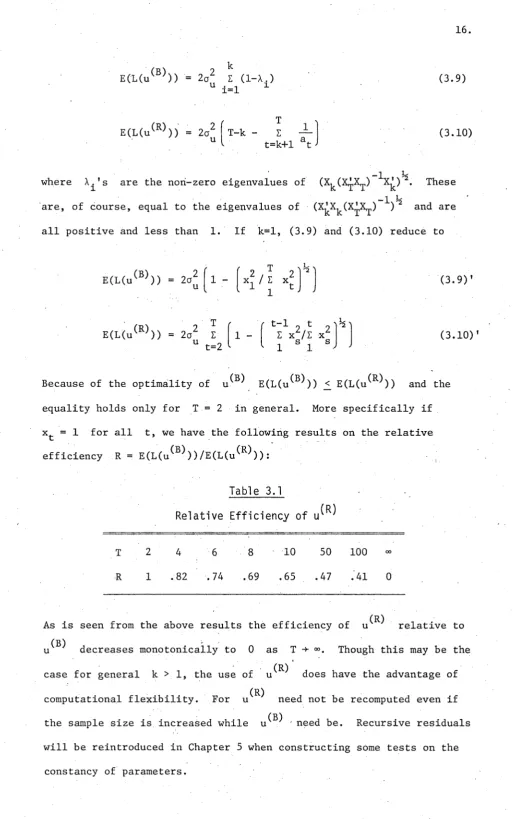
E(L(
u(B)))
2a
E
(1-Ä.)U . 1 1
1=1
(3.9)
E(L(
u(R)))
2q T-k -\
f t=k+l t(3.10)
- 1 i-'
where X ^ ?s are the non-zero eigenvalues of (X^(X^X^,) X^) 2. These
-1 h
are, of course, equal to the eigenvalues of (X^X^(X^X^) ) and are all positive and less than 1. If k=l, (3.9) and (3.10) reduce to
E(L(
u(B)))
2o‘ 1 - x / E x 2 /l
2 ^ 1(3.9)’
E(L(
u(R)))
2a'T Z t=2
r
t-i t 9 1h '
1 - E x ‘/E
x 2
( 1 S 1
S > >
(3.10)’
Because of the optimality of u^B ^ E(L(u^B^)) <_ E(L(u^B ^)) and the equality holds only for T = 2 in general. More specifically if x = 1 for all t, we have the following results on the relative
efficiency R = E(L(u^B^))/E(L(u^R ^ ) ) :
Table 3.1
Relative Efficiency of u ^
T 2 4 6 8 10 50 100
R 1 .82 .74 .69 .65 .47 .41 0
relative to (R)
As is seen from the above results the efficiency of u
u
decreases monotonically to 0 as T -* °°. Though this may be the(R)
case for general k > 1, the use of u
(R)
does have the advantage of computational flexibility. For u
[image:22.553.30.544.0.820.2]So far recursive estimation has been restricted to the one
developed by. Plackett (1950), which is the equation (3.4) governed by
the additional equation (3.5). Here we disregard the equation (3.5)
and consider a recursion of the form
h = h - l + h t (yt ' ’ (t = ) (3.11)
where h^ is a kxl known vector and the recursion starts with an
arbitrarily fixed vector 3 . The study of the asymptotic behaviour of
this recursion is difficult for k > 1. Here we consider only the case
for k = 1. The following lemma seems to be useful for the study of
convergence.
LEMMA 3.1.
The sequence {a^} starting with arbitrarily fixed a^:a t = k ta t-l + £t ’ (t = ) (3.12)
converges to 0 as t if
(i) k fc is bounded for all t and there exists tQ such that
t
11 k s = a t 1 0 ; s=t
o
00
(ii) ' E £ < 00 .
t=l
P r o o f .
Iterating (3.12) back to 0 we getf t
1 tf
1n k a + E n k.
i s
v s=l ; ° S = 1 ^ i=s+l
3
^f
1
1 o f1
)= n kT) a + E n k.
r—
1
II
W c
Cß II ^ i=s+l
3 >
£ 4- a
s t
t E s=t
£ /a
s s
t
Now it is seen that the first two terms converge to 0 since IT k -* 0
I S
s—1
and £g is bounded. On the other hand by virtue of (i) b fc = 1/a^
t t
a E i / a = E b £ /t> -> 0 as t -> 00 because of (ii) and
t s s ^ s s t
s=t s=t
o o
K r o n e c k e r ’s lemma (Gihman and Skorohod (1974), p.71).
The above lemma also holds if a and £ fc are random variables.
For that case by convergence should be meant the almost sure (a.s.)
convergence. As to the convergence of the recursion (3.11) for k = 1
we have
Theorem
3 . 1 . The recursive solution ß in (3.11) converges a.s. to8 as t if
(i)
(ii)
k = 1 - trx^ is bounded for all t and there exists t
t t t o
t
such that II k = a. 1 0 ;
. s t
s=t
o 00
E h 2 < * .
t=l Ü
P r o o f .
From(3.11)
we easily geta
t V t - l + V t
where c*t = ß - ß and the recursion starts with arbitrarily fixed a Q .
Then we can get the conclusion by virtue of the above lemma if
00
E h u < 00 (a.s.). This is really ensured since {h^u^} (t = 1,2,...)
t=l 1
is a sequence of independent random variables with
OO OO
2 2
E Var(h^u^) = a E h < 00 by (ii) so that Kolmogorov's theorem
t=i 1 u t=i c
(Gihman and Skorohod (1974), p.67) applies.
Theorem 3 . 2 .
Under the same conditions as stated in Theorem3.1 ß
converges in mean square (m.s.) to ß as t 00.
2 2
(1) If h = x / E x and E x -* °°, then the conditions (i) and
t t , s . s
s=l s=l
(ii) in Theorem 3.1 are necessarily satisfied. For 0 < 1-h xt _< 1 for all t _> 2, which implies (i) and (ii) is ensured by the fact that
Vi
t=l
E x s=l S
for a > 1 if E x s=l *
(3.13)
In this case Theorem 3.1 gives an alternative proof for the theorem due to Anderson and Taylor (1976).
(2) Two sets of conditions which seem more plausible but stronger than
the conditions in Theorem 3.1 are
(i)'
(ii)T
(i) holds;
■ t = x t /
t E x
i s s=l
(a > and E x -> °° ; i s
s=l and
(i)"
h t “ xt
/
r t ? \a
t
(h < a < 1) and E x 00 ; E x.
s=l s—1
(ii)" h tx t + 0 .
That (ii)1 -> (ii) is obvious from (3.13). On the other hand from the inequality
t
n
(1 - h X ) < exp o os=l
t
- E h x for . 0 < h x < 1 , — s s —
it is seen that the condition (i) is satisfied if diverges to 00
and h txt i 0* The former is implied by (i)" and the latter is just the condition (ii)". On the other hand (ii) holds because of (i)".
2, 2, \ \ h
(3) If lim Ext/t remains bounded and | x^. | <_ t for t > t , then
we can put h t = x^/t. It is easily checked that this satisfies the
Finally we mention some possible applications of the Kalman filter
or Plackett’s algorithm. These are:
(i) detection of the parameter change over time;
(ii) detection of the parameter change over the frequency bands;
(iii) estimation of the coefficient parameters for time series
models.
C H A P T E R 2
T HE I D E N T I F I C A T I O N P R O B L E M IN T IM E V A R Y I N G P A R A M E T E R M OD EL S
2.1
I n t r o d u c t i o n
In Chapter 1 we discussed how to estimate Bt in the time varying parameter model:
y t = + u
Bt = Fßt_ 1 + et , (t = 1 .... T)
(1.1)
assuming that the parameters o = Var(ut), E = Cov(et), and F are all known. In practical situations they are either unknown or known only approximately. Then it is necessary to estimate these parameters. However, and here the situation is different from the usual linear regression model, it is not obvious that these parameters are estimable or identifiable. Let 0 be the set of possible parameters 0 which is
£
a set of K-dimensional Euclidean space R and 0q the true parameter value in 0. Also let £(0) be the likelihood function based on a sample of size T. Then by the identifiability of 0q ^ 0 we mean that
£(0) = £(0q) (a.s.) =► 0 = 0q (1.2)
where the measure is taken with respect to the true distribution. This definition of identifiability is concerned with all 0 in 0 and we shall speak of global identification in this case. On the other hand if (1.2) holds in some open neighbourhood of 0q , 0q is said to be locally identifiable. As is clear from the definition, a knowledge of the distribution of the sample is needed. Throughout this chapter we deal explicitly with the case where the distribution is normal.
However, the above criteria for identifiability are usually
I
*(e„)
I(6|0O ) = I £(0o )log w dyr ..dyT = 0 - 0 - 6q (1.3)
where we assume that the integral is meaningful. 1 ( 0 16Q) is called
Kullback’s information integral. It is noted that 1 ( 0 |0 ) is always
non-negative and that identifiability is concerned with finding a unique solution to the minimum of 1 ( 0 | 0q ) , that is, 1 ( 0 |0 ) = 0. Notice also that 1(0 100 ) = E{log £(0q ) “ log £(0)} and thus we may say that the
parameter 0q is identified if and only if E{log £(0)} attains a
unique maximum at 0 = 0 . The function 1 ( 0 |0Q ) can be used as a
criterion for discriminating £(0 ) against £(0). The so-called
Akaike’s information criterion (AIC) (see Akaike (1973)) was derived
using this property of I (0|0q ). In any case following the criterion
(1.3) it is easily shown that the parameter 3 in the usual, normal
linear regression model is globally identifiable if = (x-^,...x^)
is of full rank as expected.
On the other hand as far as local identification is concerned, it has been shown in Rothenberg (1971) that, under some regularity condi
tions, the local identifiability of 0q is equivalent to the positive
definiteness of the information matrix:
W
E
- E' a
2 log £(0)30 30’
0=0
(1.4)
Note that 11^(0^) = (3^1(0|0 )/3630’)q_q under the regularity
condi-o
tions and that H,j,(0o ) depends only on the true parameter 0q . Bowden
(1973) points out that the condition (1.4) can be derived as a simple
corollary to (1.3). In terms of the information matrix Rothenberg
(1971) also considers global identification. His result is that every
parameter 0 in 0 is globally identifiable if £(0) belongs to the
Following this criterion we get the same identifiability condition as above for the parameter 3 in the normal linear regression model since
HT (ß) = Xptj/o^.
So far we have restricted ourselves to the case where the sample
size T is finite. In connection with inference problems the case where
T
-> °° is also important. The identif iability for that case we call’asymptotic identifiability', the definition of which is given by I
lim(L(0)/dT) = lim(L(0 )/d ) (a.s.) =► 0 = 6 (1.5)
T-K» T-x» ° °
where L(0) = log £/(0) and d^ is a positive number such that d^ °°
as T -* 00. The criterion similar to (1.3) is
lim(I(0 I 0 )/d ) = 0 =* 0 = 0 . (1.6)
T-x» o i o
As noted below (1.3) 0^ is asymptotically, globally identifiable if
and only if lim(E(L(0))/d~) attains a unique maximum at 0 = 0 .
T-x» °
Considering again the parameter 3 in the normal linear regression
model it is asymptotically, globally identifiable if X^X^/d^ Q > 0.
In this case the normalizing factor dT is usually taken as T. Moreover asymptotic, local identifiability can be checked by
lim(H (8 )/dT) = H(0 ) > 0 .
(1.7)
T-*»The identification problem in time varying parameter models was
initially considered in Cooley and Wall (1978). Using a more general
Here we consider the identification problem independently of their work since our model is different and we are mainly concerned with asymptotic identifiability.
In Section 2 we consider the case where y^_ is stationary with an
absolutely continuous spectrum. Although this may be very special, this
case becomes important when constructing stationary signal plus noise
models in Chapter 4. In Section 3 a general case is considered for
finite T where the matrix F is assumed to be the identity matrix.
Asymptotic identification is considered in Section 4 using the same model
as in Section 3. Only some partial results are given to this problem
since it is not easy to give a complete answer as far as the author's present knowledge is concerned.
2.2 I dentifiabi1ity for Stationary Cases
In this section we deal with the asymptotic identifiability of the
true parameter 0q assuming that y fc is stationary in the wide sense
with the autocovariance function y(r) = Cov(y ,y + ) (r = 0, + l,...).
It is necessary that E (31) = 0 for all t since E(yt) = x^.E(ßt);
otherwise E(yt) is not constant for all t. Then it is known that
there exists a uniquely defined non-decreasing function F(u)) ( -it <_ w <_ it) with F(-tt) = 0, F (tt) = y(0), and continuous on the right ( -it' < w < tt) such that
Y(r)
r-n
iroo
e dF (to)
J -TT
(r = 0 , + 1,...) (2.1)
where the integral is a Lebesgue-Stieltj es integral and F(m) is called
F(ü>) = F 1 (o)) + F 2 (üj) + F 3(oj) (2.2)
where F^Coo) is absolutely continuous, F 2 (w) is a step function con
taining at most a countable number of finite jumps, and F 3(m) is con
tinuous and may be increasing although dF3 (to)/dw = 0 (a.e.). In
practice F^Coo) may be disregarded. In the subsequent discussions we
assume that F(w) itself is absolutely continuous so that dF(m) = f(w)dw.
The function f(w) is called the spectral density or simply the spectrum
of y . A sufficient condition for F(w) to be absolutely continuous
is that y(r) is absolutely summable, that is
oo
E Iy(r) I < oo . (2.3)
£• = — OO
This assumption seems reasonable with the present model (1.1) since
y(r) is expected to decrease exponentially with r. Thus (2.3) is also
assumed and then we have
OO
f (to) = -rt E y(r)e-lra’ (2.4)
— — CO
which is continuous under the assumption (2.3). Note that .f(w) is
always non-negative and even. To express the dependence of f(w) on
the parameter 0 we change its notation to f(o),0).
We have so far assumed that y fc is a zero-mean stationary process
with an absolutely summable autocovariance sequence (y(r); r=0,+l,. ..}.
As explained in Section 1 we also assume that y is Gaussian. Since
we are concerned here with asymptotic identification, the sample size
T is assumed to be quite large. Under such a circumstance, as pointed
out in Walker (1964), if f(w,0) is continuous and positive for all co
in [ —7T,7T] , the log-likelihood L(0) for any 0 in 0 can be
fU
L(0) = ■ tlog 2nf(m.0) + 7 ^ ) - ) d<0 (a.s.) (2.5)
• — TT
where I(oo)
T 2
5 y e
I
/ (2
ttT) .
t=l
To give an asymptotic, global
identifiability theorem we also require the process to be ergodic (see
Hannan (1970, p.201) both for the definition and for the justification
of this assumption). Of course y becomes ergodic in the present case
if u t and e are both Gaussian. Under the ergodicity assumption
Hannan and Robinson (1973) have shown that if g(w) is a continuous
function of oo with period 2t t, then
r TT
lim g (a)) I (oo) do) =
T-*x> J -u
The proof of this statement will be given in Chapter 3 when we prove
central limit theorems for spectral estimators. By virtue of this
result L(0) in (2.5) can further be written as
g(ui)f (a), 0o )do) (a.s.) (2.6)
“ IT
lim(-2L(0)/T) T-*»
(log 2Trf(o),0) +
f (a),0Q )
f (oo, 0) doo \ (a.s.). (2.7)
It is also known that if f(o),0) is positive and continuous for all w
in [ — it,tt] , y t has a unique one-sided moving average representation:
and thus
yt a,(0)e
3=o
2
E a . (0) < « , aQ (0) = 1
j=o J
f (a»,0) o
2(6)
2tt E a.(0)eljw
j = o J
(
2
.8
)Here a sequence of independently distributed normal variables
2
The major reference here is Hannan (1970, p.159).
T h e o r e m
2.1. Assume that y is Gaussian and that the spectrum f (oo, 0) is continuous and positive for all to in [ — tt ,tt] . Then the parameter 0q is asymptotically, globally identifiable if and only iff (to, 0) = f (to, 0q) (a.e.) => e = 0q
.
P r o o f .
All that is needed is to prove that (2.7) attains a uniqueminimum at 0 = 0 if and only if the condition described in the theorem
o
2
holds. Since a (0) is the prediction variance of a stationary process
with the spectrum (2.8), it holds that
log o (0)
JL_
2tt
J
-l o g 2ttf ( t o , 0 ) dm (2.9)
Note that the integral in (2.9) is well defined because f(io,0) is
continuous and positive for all oo in [ —tt ,tt] . On the other hand we
have
o
2(8)
f (u>,90 )
f(u,0)
dw
(2.10)since the right hand side is the variance of a process with the spectrum
f (to, 0q ) / (2iTf (to, 0)) (see the formula (2.1)) and this is not smaller than
2 2
its prediction variance o (0 )/a (0) (see the formula (2.8)). The
equality holds if and only if
f(to,0 ) o 2 (0 )
’ o _ o'
f(“’9) ” a2(0)
(2.11)
[TT f ( u ) » e ) ~ (0 )
—
{log2
ttf (o), 6)
+ - F 7— ^r-} doü
> log o (0)+ — ---
(2.12)
2,1 J-n £(“ ’0) ~ o2(0)
w ith equality if and only if (2.11) holds. Moreover, using the
inequality log x + c / x 1 + log c (c > 0) with equality only when
x = c, we have
?
a2(e )
,
log a (6) + ■ i 1 + log a (6 ) . (2.13)
a (0) °
The equality holds if and only if o2 (e) a (0O ). Therefore
min
0 2*
{log 2irf(a),0) +
J - n
f (w,0Q )
f (a>,0) } doo 1 + log a (0q ) (2.14)
2 2
and the minimum is attained if and only if both (2.11) and a (0) = a (0Q )
hold. Since f(oo,0) can be expressed as in (2.8), we must have the
condition described in the theorem, which completes the proof.
Because of this result we can check the asymptotic, global
identifiability of the parameter 0q in terms of the spectral density.
The parameter 0q will be asymptotically, globally identifiable if
there exist no other 0 in 0 which give rise to f(w,0) = f(o),0Q )
(a.e.). It may be noted that the uniqueness of f(w,0) at 0 = 0q
is a conventional identifiability criterion adopted in time series
analysis. Since there exists a one-to-one correspondence between the
spectrum and the autocovariance sequence, we may say that 0^ is
identifiable if the latter is uniquely determined. For illustration we
consider some simple models to see if the parameters in those models are
(i) Case I
Consider the simplest model
yt = et + ut
(2.15) ß t = P ß t _ 1 + e t > P + °> i PI < 1
2 2
where all variables are scalar. Put 0 = (a , o , p)'.
u e Then we have
r 2
p
°e
2
y(r) = - - - + 5 a
' , 2 or u
1 - P
f (u),0) 2tt
1 - pe
e . 2
— ;-- ~ + o
leu I 2 u
Now it is almost obvious that f(co,0) is unique at 0 = 0^ (see Hannan
(1970), p.171). The assumption that p 0 and |p| < 1 is
indispen-2 2
sable. If p = 0, y t itself is white noise and f(oo,0) = (a + g u)/2tt
2 2
so that we cannot determine ö£ and a uniquely. On the other hand
if Ip j >_ 1, y is not stationary any more and thus p must be less
than 1 in modulus. This may also be justified in terms of f(w,0)
since there always exists
9
=
(V G
e
^p2
’ 1/,p^
'
such that f(w,0) = f(u),0Q ).
(ii) Case II
Consider another special model (1.1) with
x^ = (cos X,t, sin X,t,...,cos X t, sin X t ) '
t 1 1 s ’ s ; 2sxl
F = diag(p1 ,p1 ,...,ps ,ps ) ; 2sx2s (2.16)
w h e r e A_. =j= A^ (mod 2ir) a n d if A^ = nir (n; integer), sin A_.t w i l l
be s u p p r e s s e d f r o m the m o d e l t ogether w i t h c o r r e s p o n d i n g e l e m e n t s in F
and E. This m o d e l seems u s e f u l if the d a t a c o n t a i n s p e r i o d i c i t i e s
2tt/A_. (j = l,...,s). E s p e c i a l l y if the d a t a is monthly, w e m a y put
\
= 2ttj /12 (j = 1,...,6). The A ’ s are ca l l e d s e a s o n a l f r e q u e n c i e sand w e s hall d e a l w i t h this case m o r e c l o s e l y in C h a p t e r 4. Put
2 2 2
9 = (ou ,a1,...,ög, p1,...,p)'. N o w w e h a v e
y(r) s
Z
j=l 1-P
i 2
, cos A .r + 6 a
: j or u (2.17)
so that, f o l l o w i n g the d e f i n i t i o n of f(m,0) in (2.4), it is not h ard
to d e r i v e
f (a), 0 )
1-p . e J
i(o)-A^) 2 +
1-p . e J
i(m+Aj)
+ 2 ^ ‘ ( 2 '18)To i d e n t i f y the p a r a m e t e r 0q it is m o r e c o n v e n i e n t in the p r e s e n t
case to use
y(r)
than f(oj,0). It is s e e n f r o m (2.17) that w e canr 2 2
o b s e r v e p 'a./(1-p.) for e a c h j and r > 0 so that p.'s can be
J J J J
2 2
i d e n t i f i e d first and thus a . 's can a l s o be identified. F i n a l l y a
J u
can be d e t e r m i n e d p u t t i n g r = 0.
(iii) Case III
This i l l u s t r a t e s a c ase w h e r e the p a r a m e t e r 0q is n ot identifiable.
C o n s i d e r a t i m e - i n v a r i a n t s y s t e m
y t = h'et + ut
3 = F3 _ + e
pt p t-l t
(2.19)
y(r) h ’ Z FJ ZF
j=°
j + |r
h + 6 o 2
or u
f(U ,9) = i h'( I k - F e lü))
-1
2 (Ik - F e 1U)) *
-1
h +
2tt
where A is the complex conjugate transpose of a matrix A. From a
different point of view Mehra (1970) has shown that Z cannot be
identified if the number of unknown parameters in Z is greater than k
even if F is known; otherwise there is a possibility that Z can be
identified. Thus if Z is positive definite and there exists no a priori
restriction on Z, Z is not identifiable. As an illustration consider a
simple case where F = pl^. Then it is seen that h ’Z^h = h ’Z2h does
2
not necessarily imply Z^ = Z2 . Note that in this simple case and
p are identifiable.
The following case deals with a somewhat different situation. So
far we have discussed the case where y is Gaussian and stationary.
The process y^ becomes Gaussian if u and e are both Gaussian
since x._ is assumed to be non-stochastic. However if x^. is
stochastic, the distribution of y t is far from Gaussian though y
may be still stationary. Then the above theorem cannot be applied
directly to this case. Therefore it should be understood that the
identification result described below is the one based on a knowledge of
the spectrum of y fc or its autocovariance sequence and has no relation
to our identifiability criterion.
(iv) Case IV
In this case we assume that x^ is stochastic and consider a simple
model
X t3t + U t
Pßt-1 + £t ’ + < 1
where all variables are scalar. Let us assume that is mutually
independent of u^ and and is stationary with an absolutely con
tinuous spectrum fx (u)) • Then we have
r 2
p °e 2
y(r) = Cov(x.,x. ) ---- + 6 o
' v t t+r ^ 2 or u
1-p
f (a), 0 ) fx (a.-A)fg (A)dA + ± o 2u
2
2
where 0 = (a , o , p)', f (w) is the spectrum of ß , and we have
U £ p t
assumed that Cov(x .x,. ) and thus f (w) are known. If x t is
t t+r x t
white noise, then the parameter 0^ cannot be identified as is easily
seen. On the other hand if Cov(x ,x^. ) is not zero for at least
t t+r
I r I 2 2
two r(> 0), then p 1 ‘a /(1-p ) is observable for these r. Hence p
e
2 . 2 ...
is identified and thus a is also identified. Hence a is identified,
e u
For example if x follows an autoregressive process
2 2
say with mean 0 and variance o f (1-a ), we have
axt-i + v
r 2 r 2
a 1 1 a p 1 ' a _
/ ^ v e , P 2
y (r) = ---- 5— ----— + 6 a
2 . 2 or u
1-c 1-p'
f (a), 0)
2 2
0 0 nt
v e 1
/ 2 J I i(ü)-X) 12 I
4tt j -it 1-ae 1-pe
. ■> , 1 2
— — r- dA + — O
lX 1 2 2tt u
2 2 o a
v e ,1-a p2 2
2 2.
1-ape (1-a )(1-p )
1 2
+ -y— P
2tt u
and thus 0 is identifiable if a and o are known. As explained
o v
before we need some care when we deal with this case in connection with
estimation problems since y t is far from Gaussian even if the other
random variables are Gaussian.
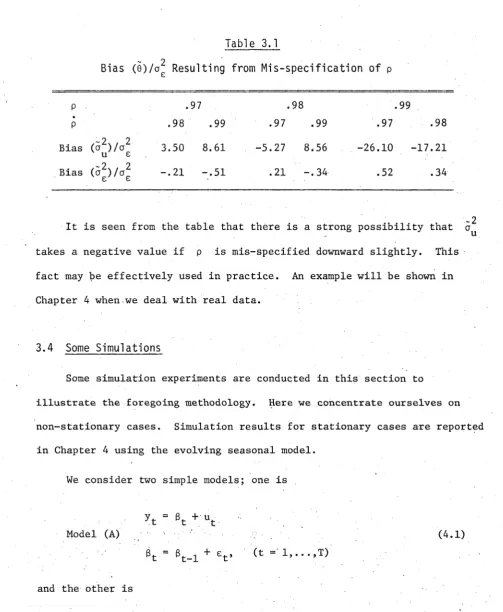
not consider local identifiability defined in (1.7). Nonetheless it is
of some interest to see under what conditions (1.7) holds. To do this
we assume that f(oo,0) is twice continuously differentiable with
respect to 0 and that the resulting derivatives are also continuous
in a). Now it is seen from (2.7) that
9L(0) m T If7T 1 9f (o),0) f (a), 0q ) 9f(co,0)
' dto (a
Q J C D 1 1 4 > | =3 1
1 =i f (u),6) 90 f 2 (u,0) 90
92L(0) ip 'TT 1 9f (ü j, 0) 9 f( w, 0) r o f ( w ' , 0 )° i
9090' 4tt
' - 7 T . f 2 ( u , e ) 90 90' l " f (cu, e ) J
a2f (co,9) f f(t0’9o ) 1
3 0 3 0 ’ l f 2 (M ,e) " f(“ >0)
dm (a.s.) .
Therefore we have
lim T-x»
1 3 2l ( 0o> ] 1
r
i9 f (oo ,0 )
o 9 f (a) ,0 )o T 3 0 9 0 ’ 4 t t
o C D 3 ■ w ' C N J c w t=
1 90 30'
doo (a.s.). (2.21)
We note that the matrix integral on the right hand side of (2.21) is
necessarily positive definite if the parameter 0q is asymptotically,
globally identifiable and some regularity conditions are satisfied. For
if 0q is asymptotically, globally identifiable, 0q gives a unique
maximum of lim E(L(0)/T). Therefore, under some regularity conditions,
T-x»
it must hold that
lim E
T-x»
1 3L <0O> 1
T 30 o
lim E
T-x»
JL T
92L(0 ) >> _____ o_
9090' < 0 .
On the other hand we want to find a necessary and sufficient con
us consider
where x is a K><1 constant vector and x =j= 0. Then it is seen that
we must find a condition that
x' --- I dm > 0 for any x
9f (to, 0 ) a ^
00 j + o •
Since the components of 9f(co,0 )/90 are rational polynomials of to so
that x'9f(to,0 )/30 is also a rational polynomial, the above inequality
holds if and only if the components of 3f(to,0Q )/90 are, as functions
of to, linearly independent (a.e.) with respect to Lebesgue measure.
This is summarized in
T h e o r e m 2 . 2 .
Assume that y is Gaussian with an absolutely continuousspectrum f(to,0) which is positive for all to in [ -i t,it] . Also assume
that f (to, 0) , 9f(to,0)/30, and 92f (to, 0) / 90 90 ’ are continuous in to and
0. Then a necessary and sufficient condition for the parameter 0^ to
be asymptotically, locally identifiable is that the components of
9f(to,0 )/90 are, as functions of to, linearly independent (a.e.) with
respect to Lebesgue measure.
In general it is not easy to check if the above identiflability
condition is satisfied or not. This is mainly because F is unknown.
Let us assume that F is known. Then the unknown parameter 0 is
2
composed of and E. Moreover the spectrum f(to,0) becomes linear
in 0 and can be expressed as
f(m,0) 9f (to,0)
(
2.
22)
_, . 1 ^ ✓ v -irw f (w ’0) = 2tt e y (r )e
r=-oo and
y(r) = x' £ (FJ E F ,J)F'Sc + 6 q
t . t+r or u
J = o
Hence global and local identiflability conditions are equivalent in the present case as is easily seen.
2 . 3
I d e n t i f i a b i 1 i t y f o r N o n - S t a t i o n a r y C a s e s W h e n T is F i n i t e
Throughout the present and next sections we consider local
identification for non-stationary cases. In this section the case where
the sample size T is finite and fixed is discussed. To reduce the
complexity of the problem we assume that the matrix F in (1.1) i s 'the
identity matrix of kxk. We start by describing the likelihood function
based on a sample of size T. To do this we assume that the initial
value 30 is also an unknown parameter to be identified. Now expressing
y in (1.1) in terms of 3 we have
t o
x'$ + x ’ Z e + u
t o t s t
s=l
(t = 1,...,T) (3.1)
or equivalently
where
y = X3 + v
y (yi> • • • ,yT) j x (x^,... ,x,j,) ,
and
X
f N
e.
Ul I
1 1 1
0
x 2 X 2 e2 u 2
•
•
+ •
X T XT * * * XT £T j tu,