May/2004
The
EDITED BY THE INSTITUTE FOR PROSPECTIVE TECHNOLOGICAL STUDIES (IPTS) AND ISSUED IN COOPERATION WITH THE EUROPEAN S&T OBSERVATORY NETWORK
r)
Editorial
~
Norbert Kroo
CX)
.,--
~
u.J
u.J
(.)Strategic Vision for Regional Development
and European Integration: An Innovation
Area in Central and South-East Eu~ope
G.
Fay!, I. Bilik, I. Hronszky,
T.
Kemeny, E. Nagy,
J.
Pakucs,
G.
Pethes, and
J.
Veress
Lessons from Targeted Socio-economic
Research for the Formulation and
Evaluation of European Science
and Technology Policy Options
Nikas Kastrinos and Ken Guy
IPTS REPORT
-11
Learning Networks as a Policy Instrument:
_ 1an example from a Network of Regions
of Excellence
Tomas Botello and Jean Noel Durvy
r
1
r
,;
Biodiversity Information and Policy-making
X
. ~)
in the light of Costa Rica's Experience
_Jy
21
Erick Mata and Rodrigo Gamez
Meeting the Lisbon Obiectives for the
Information Society: How ICT Foresight
can contribute
Ramon Compono, Corina Pascu, Paul Desruelle
and Jean-Claude Burge/man
•
EUROPEAN COMMISSION DIRECTORATE-OENERAL
The IPTS Report
ABOUT THE
IPTS
REPORT
T
for Prospective Technological Studies (!FIS) of the Joint Research Centre ORC) of the European
he !FIS Report is produced on a monthly basis ( except January and August)) by the !nstz'tute
Commission. 'The !FIS formally collaborates in the production of the !FIS Report with the European
Science and Technology Observatory (ESTO)J
a group of prestigious European institutions, of which
Ithe !FIS is also a member. In addition to articles produced in-house, the IPIS Report also receives
contributions from other colleagues within the JRC, as well as from experts and specialists outside the
Commission.
'The !FIS Report is published in four languages. All editing and reviewing takes place in Eng1ish and
translated versions are produced in French, German and Spanish. It publishes articles i~ deems
''Prospectively relevant" in a number of areas, including iriformation and communicatiorzs
tech-nologies, regional developmen
0
innovation and technology policy) skills and training,
biotech-nology and the life sciences, methods and foresight, etc.
'The focus of the !FIS Report is on articles that explore issues that are either not yet on the
policy-makers agenda (but are likely to be there at some point in the future) or are underappreciated
Iaspects of issues that have already come to policy-makers' notice. Quality assurance is provided
through our multi-stage drafting and redrafting process, based on a series of interactive
consul-tations with outside experts.
In addition to the limited-circulation print run of the !FIS Report) all current and past articles
jare available on-line from the !FIS website at http:llwwwjrc.eslhome!report!report
_mam.html.
We also produce and distribute an electronic newsletter to inform readers whenever a new issue
of the
JJYJSReport is published (to subscribe, visit the subscriptions section of the !FIS Report website)
or send an email to [email protected] with the words
''subscribe !FIS-
REPORT" in the body
of the message).
The IPTS Report
~UL 12 2004
PREFACE
European Co:rnrn1ssion
Dsl@f~t.ion
Dear readers,
Library
2300 :U:
Street,
NVI
W ~ , D C
a008?
After more than eight years of putting together this journal, we have been told that there is a plan to shut down the IPTS REPORT, for reasons that are not entirely clear-cut ( if cost is the issue, we have made
numerous drastic cost-cutting suggestions; indeed the re-launching, cost-cutting process that began recently, was interrupted by the new shutting-down plan).
Whatever the outcome of future deliberations, we are grateful for your support over the years, those of you receiving our -6000 subscriber copies, and those responsible for the nearly 80000 monthly hits on
our WWW version. Thanks to your careful reading and your suggestions, we have been able to make improvements along the way and establish a journal whose reputation has continuously grown over the years. It has attracted contributions and praise from President Prodi, from ministers and members of
parliament, from Nobel prize winners and members of Academies of Science - who have abided by our demanding multi-draft editorial process, for no compensation other than to contribute to this journal.
The IPTS REPORT has received kudos from policymakers and scientists. It has been used as a platform
by influential scientists and academies of science, and has been placed in academic courses' reading lists. On the other hand, its usefulness has been praised by policymakers, it has been quoted by Commissioner
Busquin - to whose services the IPTS belongs - and was even distributed to member-state delegations in the June 2003 EU summit, vindicating our unrelenting pursuit, often against the odds, of analytical rigour as well as of a policy-oriented emphasis.
The above are strong indicators of our success in reaching our target policymaking audience, as well
as the scientific community which often advises policymakers. Beyond this however, we also launched over the years, reader surveys, the last of which was handled by external evaluators, and was completed early last year. In terms of reader appreciation and according to the external evaluation (here "target group"
refers to policymaking circles):
The readers classify themselves professionally as "in policy advice (60%), involved in policy
making/implementation (30%) or in academic research (10%)".
"Target group customers
amongst questionnaire respondents were very appreciative of the Report anddo not seem to want it to change much."
"The ratings suggest a high level of appreciation by all customer groups in the
utility and relevance
of the Report. The target group [ ... ] believe more strongly than others that it is policy relevant and givegreater support to the emphasis on S& T related developments and impacts."
The IPTS Report
Also from the aforementioned external evaluators' survey:
• 94% found it easy to identify relevant articles and extract pertinent information.
• 82% (85% among the target group) rated the value of time spent reading the report as "High" or "Very
high".
• The approximate readership is 3.9 persons per copy among the respondents. • Nearly one half (44%) keep the copies themselves; 30% place them in a library.
• There was strong support for the present frequency of publication.
Most interestingly, and setting to rest any potential concerns about meeting the cost of publication, the
external evaluators' survey found that close to 30% of the readers would accept considerable subscription
fees, and the readers indicate fees varying from less than a hundred to a thousand Euros per year or more,
with average values of -400Euros/year. Let us note here that we have been told in the past that charging
for the /PTS REPORT, though apparently feasible in the light of demand, would not be administratively
practical.
Finally the external evaluators benchmarked it within a field of broadly similar journals chosen by the
evaluators. The IPTS REPORT ranked first or second in almost all attributes (thought-provoking, concise,
easy-to-understand, multi-disciplinary perspective, techno-economic balance).
Particularly important for the character of the journal and its target audience, is that it ranked first in
being 'analytical in a non-academic manner'. This is exactly what we set out to achieve: offer analytical,
policy-oriented articles, not merely descriptive, project-presentation informatic;m, in a rigorous but not
academic manner; respecting the readers' intelligence without demanding that they be already aware of
all the terms, formulas and acronyms, experts usually take for granted.
Once again, thank you for your support over the years.
Dimitris Kyriakou, Executive Editor, The IPTS REPORT e-mai I:
[email protected]
THE IPTS REPORT
MAY 2004
EDITED BY THE INSTITUTE FOR PROSPECTIVE TECHNOLOGICAL STUDIES (IPTSl
And iss.ued in Cooperation with the European S&T Observatory Network
PUBLISHED BY THE EUROPEAN COMMISSION Joint Research Centre
ISSN: 1025-9384 Catalogue Number LF-AA-04-084-EN-C
LEGAL DEPOSIT: SE-1937-95
IPTS DIRECTOR Peter Kind
IPTS REPORT EDITOR Dimitris Kyriakou
ASSISTANT & WEB EDITOR Duncar:i Gilson
EDITORIAL BOARD B. Clements, G. Fahrenkrog, D. Gilson. M. Gonzalez. H. Hernandez, D. Kyriakou,
I. Maghiros, P. S0rup, A. Soria'
PRODUCTION CINDOC-CSIC/BGS
PRINT Graesal
TRANSLATION CINDOC-CSIC/BGS
LEGAL NOTICES
The views expressed in this publication do not necessarily reflect those of the
European Commission. © ESC-EEC-EAEC Brussels-Luxembourg, 2004 Reproduction for non-commercial purposes is authorised provided the editor is informed in
advance and the source is properly acknowledged. The EC accepts no liability for any consequences of
the use made of the information published here.
E•MAIL NEWSLETTER
The IPTS Report editorial team produce an e-mail
rlewsletter giving advance notice of the contents
of new issues with links through to the web version of the articles. To subscribe to the IPTS.Report
e-mail newsletter. visit our website and click on the link, or send an e-mail to
[email protected] with the words
·subscribe IPTS-REPORT" in the body of the message.
PRINT SUBSCRIPTIONS To modify an existing subscription please send an
e-mail to lptsreport-admln®Jrc.es giving full
details of the changes that ne~d to be made. Due to overwhelming demand not all print subscription requests can be accepted; please send the relevant details by e-mail or fax (+34 95 448 82 93) if you
wish to be included on the distribution list.
The IPTS Report
C
0
N
T
E
N
T
s
2 Editorial
Regional Development
3 Strategic Vision for Regional Development and European Integration: An Innovation Area in Central and south-East Europe
The creation of an "innovation area" in central and south-east Europe will help the countries concerned catch up with their stronger partners in the European Union in terms of competitiveness.
Innovation and Technology Policy
10 Lessons from Targeted socio-economic Research for the Formulation and Evaluation of European Science and Technology Policy Options
In the last few years a substantial body of socio-economic research has been accumulated at EU level in the area of evaluation of science and technology policy options. Policy-makers can exploit the opportunity to draw lessons from targeted socio-economic research to better
understand innovation systems, and develop and assess relevant policy options.
Innovation and Technology Policy
17 Learning Networks as a Policy Instrument: an example from a Network of Regions of Excellence
The creation of innovative firms depends to a large extent on local or regional environments that favour innovation. Learning networks can play an important role in acquiring and
transferring the tacit knowledge involved in creating such an environment.
Environment
23 Biodiversity Information and Policy-making in the light of Costa Rica's Experience
Biodiversity information can be crucial in building awareness among policy-makers and the public. Providing this information in a policy-relevant way can play a key role.
Information Technology
27 Meeting the Lisbon Objectives for the Information society: How ICT Foresight can contribute
Understanding the drivers and challenges influencing the pathways towards meeting the Lisbon 2010 objectives with information and communications technologies is a complex exercise. Using an appropriate combination of foresight tools and methods can help close
this gap.
We are plea$ed to a,nnounce that readers can now obtai'n advance notice of the articles ·
appearing in future editions of The IPTS REPORT by e-mail. To subscribe to our e~mail newsletter ,
visit o,ur web~it~ at www.j~c.es/~ome/report or send an e-mail to [email protected] with the words "subscribe !PTS-REPORT" in the bo?y of the message.
2
The IPTS Report
EDITORIAL
Prof. Dr. Norbert Kro6, Secretary-General, Hungarian Academy of Sciences,
Member of the European Research Advisory Board - EURAB
0
n the l51 of May 2004 Hungary - together with nine other countries - returns to Europe where it belongs. My dream to be part of this family goes back to 1972 when I started to work for the European idea in the European Physical Society, an organisation in which I had the privilege of serving as President in the first half of the nineties.Our membership of the EU has been preceded by more than 10 years of long and sometimes difficult development, which I am sure will continue after accession.
The same is true of research and development. Our international cooperation in this area has always been strong and could not be blocked by the oppressive political system. But after 1990 these contacts could be institutionalised. We joined CERN, EMBO, ESRF, and ESA in different forms, and on the basis of a special agreement participated already in the Fourth Framework Programme (FP4). In FPS we were already partners with practically full rights, not to mention FP6. We are also participating in the European fusion research programme, including JET and ITER.
The most important thing the 1 st of May wi 11 bring for us is a solid perspective. Our R&D policy will be closely linked to that of the Union where the Lisbon and Barcelona objectives should be the main guidelines. In a family everybody should see what she or he could offer the others. That is why this is an issue we wi 11 concentrate on as a member of the European family. I believe that our drive for excellence, based on our scientific traditions, on a special style in problem solving determined by language and social environment is an asset for Europe too. So is our research capacity in spite of its continuing funding limitations. The possibilities offered by the Structural Funds may ease these financial problems by contributing to the development of the research infrastructure in the new member countries.
We hope to strengthen our contribution to the activities of European research institutions, understanding that membership of them involves an element of European solidarity too. We want to be partners in addressing the Europe-wide structural issues related to R&D, in parallel with bridging the still existing gap, which is rooted in our history over the last 60 years.
European science is part of our culture; the emphasis on raising competitiveness should not be applied on the scientific base in a waythat would demolish this base. ~he European Research Area vision is the proper framework for that, by overcoming gradually our weakness. We should offer the young talents favourable conditions (such as the EURYI research grants) and exciting tasks· based on a well-balanced research infrastructure and a cooperation-based competitive environment (for instance, through the emergence of a European Research Council). This could give an appropriate focus on basic research that has acquired increasing significance. However, exploring appropriate pathways towards applications and market-oriented development are also vital elements of our future activity. The European Research Advisory Board, with both academic and industrial membership, is a good forum to advice the Commission on these and other issues.
I feel honoured to participate in this venture and I am sure that the environment of the new m~mber countries and their scientists in these efforts will bear benefits for all of us.
Finally, let me thank the Commission for its highly efficient way to provide timely information to the scientific community. This journal, "The: IPTS REPORT" has proved to be an irreplaceable asset in this context. It is a true Commi_ssion success story. We are looking forward to being able to count on this journal as a platform for policy-relevant analysis in an even more direct and hands-on way after accession.
.
Strategic Vision for Regional Development
and European Integration:
An
Innovation
Area in Central and South-East Europe
G. Fayl, I. Bilik, I. Hronszky, T. Kemeny,
E.
Nagy, J. Pakucs, G. Pethes. and J. VeressIssue: According to available competitiveness indicators, many of the candidate
countries will trail behind the rest of the EU when they join the EU on May 1st 2004.
Relevance: The creation of an "innovation area" in central and south-east Europe will
help the countries concerned catch up with their stronger partners in the 1:uropean
Union. An "innovation area" of this kind could be the outcome of a pro-active,
trans-national education & science & technology & innovation cooper~tion strategy involving
the regions of the new EU Member states. Whenever possible, the broadest European
participation should be sought.
Innovation • a driver of regional
development and European integration1
T
he conclusions of the Lisbon Summit2 (March 2000) are currently one of theEU's main policy-drivers. The summit set
the objective of Europe becoming 11 the
most competitive and dynamic knowledge-based
economy in the world by 2010". This challenging
goal the can only be achieved if the enlarged
EU is willing and able to take urgent action to
significantly increase its innovation potential
(see Box 1 ). The Commission's President, Romano
Prodi .stated recently: "Member States do not seem
to realise that 2010 is around the corner. Four
years after Lisbon it is clear that we are going to
miss our mid-term targets. [ ... ] Europe deserves
better" (EurActiv, 2004).
It is generally recognised that innovation is a
precondition for economic growth. Innovation
means creative development in terms of both
production methods and organisation. It leads to
enhanced productivity, and quality, and hence
to more competitive products. Hence, innovation
is a measure of competitiveness. A key feature of
dynamic, sustained innovation is that it often
leads to more and better job opportunities.
Thus, it has the potential to improve living and
working conditions and ensure the economic
basis for high-quality public services. All these are
significant contributing factors to ensuring a stable
and prosperous society.
When looking for complementary measures to
improve the innovation potential of the EU, the
following should be kept in mind. Firstly, regional
The views expressed here are the authors
'
and do not necessarily reflect those of the European
Commission.
The IPTS Report
The goals of the Lisbon
summit can only be
achieved if the enlarged
EU is able to take
urgent act'ion to
significantly increase
its innovation potential
The IPTS Report
Enlargement of
the EU should be
corisidered as an
important opportunity
to increase Europe's role
in the process of
globalisation
Trans-border regional
cooperation activities
can achieve synergies
of expertise that might
otheruxise not be
realised
economies play an important role in the wider to new opportunities. The process needs to be
dynamics of innovation and economic growth. promoted both through individual institutions
Moreover, the current trend towards globalisation in the different countries as well as through
necessitates new forms of cooperation, even
between previously competing groups, in order to
acquire and maintain competitive advantage at
the global level. In this context, the enlargement
of the EU should be considered as an important
opportunity to increase Europe's role in the
process of globalisation.
Direct cooperation between regions, regardless
of national borders, offers the EU, and Europe as a
whole, a novel and challenging possibility for more
active participation in the globalisation process in
a way that enhances its competitiveness. Regions
with high potential for knowledge
creation offer particularly attractive opportunities
for such initiatives. These regions need to be home
to good quality universities and/or public and
private research centres. And these need to possess
adequate complementarities in terms of human
resources and research infrastructures. Moreover,
appropriate micro- and small/medium size
enterprises should be present in these regions or
adequately close links exist to them.
Integrating Europe's innovation potential within
a "European Innovation Area" will open the door
developing trans-border regional areas cooperating
with each other and the rest of the EU and Europe.
In this way trans-border regional cooperation
activities can achieve synergies of expertise that
might otherwise not be realised.
Regional innovation systems based on open
learning networks are potentially more flexible
and dynamic than systems that confine learning
and transfer of experience to individual companies
or institutions. Regional learning networks can
enable information flows, mutual learning and
economies of scale (O'Doherty, Arnold, 2003).
More and more attention is now being paid to
the regions' own policies as a complement to the
nation state's own regional policy, so regional
authorities need to be brought into the process of
economic and social cohesion (Horvath, 2002).
However, this is not an automatic process and
cannot be done without transferring certain
responsibilities to the regions. Decentralisation
would minimise unnecessary "red tape''., and
ideally avoid it altogether.
Optimal conditions should be created for
cooperation at regional level to take place on a
The 1atest analysis of the progress towards the Lisbon strategy shows that full, implementation of,
this process could increase GDP by 0.5-0.75 percentage points over the next 5 to 10 years (European
Commission, 2004).
The
analysis highlights the need for an energetic implementation of reform in the different spheres thrQugh integrated strategies. The Member States are urged to seize the opportur,ities provided by the economic recovery and the coming enlargement, and to take urgent actions in three key areas:• Improving investments in knowledge and networks, byJmplementing the EU's "Growth lnitiati~e" and giving greater priority to the level and quality of investments in research, education and
training.
• Strengthening the competitiveness of European enterprises, by applying better regulation
-particularly for the industrial sector - and by adopting both the proposal for the "Framework
Directive on Services" an_d the proposal
tor
the "Environmental Technologies Action Plan". • Finally, promoting active ageing by encouraging olde~ workers to remain in the work force andthrough a modernisation of educational systems for lifelong learning, of work organisation, and
of 'prevention and health care systems. ·
Box 2. Initiative to energise innovation potential
Early 2003, a group of experts suggested the establishment of an "innovation area" in central and south-east Europe. The experts came from various parts of civil society and they joined the initiative in a personal capacity. The group met several times in _order to formulate their strategy and an action plan for the initiative. ·
The fundamental paradigm of this initiative is that full use 9f the innovation potential of the countries involved will help them to become strong partners in the European Union. This innovation potential in central and south-east Europe has existed throughout history, but has been under utilised because national borders have hindered cooperation, sometimes to the ~xtreme.
The basic instrument of the initiative is active, voluntary cross-border regional level networking between universities, research centres and enterprises (above all, micro- and small-sized ones). Networks will be open to all relevant actors that interested both within and beyond national borders.
Moreover, attention will be paid to' initiatives with similar aims. This includes relevant parts of the "Central European Initiative" that is an integrated, government-level framework of dialogue, coordination and cooperation among its member countries in the political, economic, cultural and parliamentary fields. (CEI, 2004)
The intended·outcome of this pro-active trans-national educatiori & science & technology & innovation co-operation strategy is the creation of an "innovation area". This will emphasise trans-border regional co-operation among the new EU Member States (i.e. Czech Republic, Hungary, Poland, Slovenia and the Slovak Republic) and, whenever possible, be extended to regions in the Applicant Countries and other parts of Southeast Europe. Moreover, whenever possible, appropriate partners should be invited from regions in Austria, Bavaria, Greece and ·Italy. Networking with centres of excellence in Russia, Ukraine and Belarus might be useful. _
This is an outline of an independent, non-partisan initiative. On the occasion of the first World Science Forum (Budapest, 10 Nov. 2003), the Hungarian Prime Minister Peter Medgyessy, expressed the need and his support for the initiative and urged for steps to make in this direction.
voluntary basis. To be most efficient, research Brno / Komarno, just to give a few of the possible
centres and (in most cases micro- and small size) examples.
enterprises, including incubators, should cooperate
directly, regardless of national borders (see Box 2). It is significant that these countries have a long
Whenever possible, the participants should
take full advantage of the support mechanisms
offered through the EU framework for cooperation
between regions across national borders. These
measures include relevant parts of the RTD
Framework Programme, in addition to the
Structural Funds (the main instrument to promote
social and spatial cohesion within the EU).
With adequate public and private economic
support, and sustained political endorsement,
enhanced cooperation could evolve between
regions in central and south-east Europe that
fulfil the "complementarities" criteria alluded to
above. For example, illustrative examples along
tradition in good, sometimes excellent, higher
education and basic research. This tradition offers
an outstanding opportunity to contribute to the
achievement of the Lisbon- and European
Research Area objectives. However, to date, the
potentials of these resources have been somewhat
underutilised. National borders have hindered
cooperation, sometimes to the extreme. Another
shortcoming is that most of these countries lack
experience in efficiently translating promising
research results into practical and marketable
applications. More experienced countries and
regions should offer much needed advice and
support in this respect.
the Hungarian border could include: (i) Miskolc / Trans-border regional cooperation of the kind
Kosice / Krakow; (ii) Debrecen / Cluj / Oradea; suggested above could eventually lead to voluntary
(iii) Szeged I Arad / Timisoara / Beograd / Novi resource pooling and the coordination of research
Sad; (iv) Pees / Zagreb / Ljubljana / Koper / activities in fields of common interest. A current
Maribor; (v) Gyor / Sopron / Vienna / Bratislava / example of this development is the "Bonus"
The IPTS Report
Many countries in
central and
south-eastern Europe lack
experience in efficiently
translating promising
research results into
practical and
marketable
applications
The IPTS Report
&x 3. consortium supporting implementation of the strategic vision
:rile
following actions are required in order to start making an "innovation area" in central andsouth-811
Europe a reality: 1Create a compendium of the existing joint projects in the areas of education, science, technology and innovation that reach beyond individual national borders in central and south-east Europe. Identify areas suitable for cooperation in central and south-east Europe and not yet included ip
the compendium.
I
Identify suitable cooperatio.n- and financing partners in central and south-east Europe, and whenever useful, beyond it.
Organise an international conference to promote the vision and bring together the various players in a fertile environment.
• Throughout the process, full consideration should be given to the support mechanisms offered by relevant EU initiatives. ·
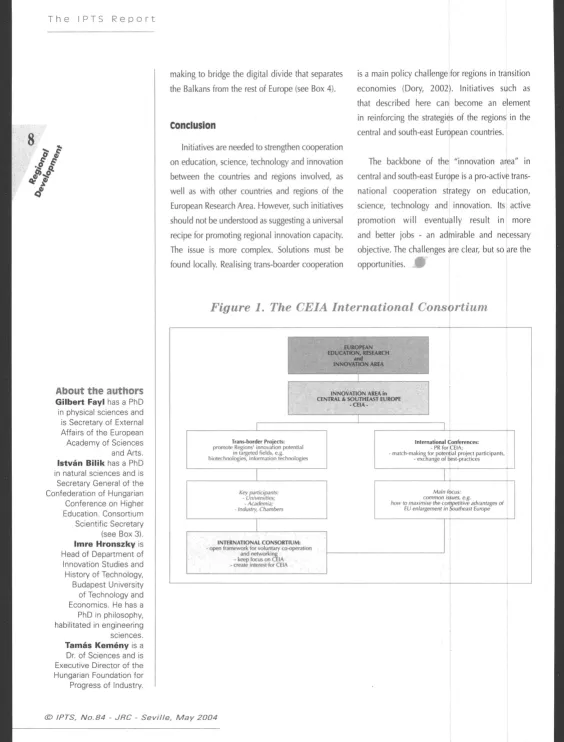
To this end, an international consortium has been set up with participation of higher education, public a(ld private research, and industry - see illustration. The consortium should help•to create optimal conditions for voluntary co-operation at reijional level. It provides an open framework for such co-operation through networking, regardless of national borders (including those df the "Schengen" area). Being a fully open structure, the consortium will help to generate interest for an "innovatioh area" in central and south-east Europe and to maintain focus on it. The latter could include 1
formulating strategies for lobbying public authorities and civil society bodies_.
The international conference mentioned above is scheduled for November 2004 and is currently ~eing prepared.
The consortium is open to any interested, relevant public/private person and organisation that share the objective of this independent, non-political initiative.
Relevant bodies will be encouraged to support the consortium. This includes the "Central- and Eastern European Network", a platform for informal dialogue among the Presidents of n,ational Academies of Science from the countries in Central and Eastern Europe3. 1
project, where organisations from eight countries
around the Baltic Sea have decided to work
together in the area of marine research (CORDIS-1,
2004). The countries involved comprise are four EU
Member States (Denmark, Finland, Germany and
Sweden) and four Accession Countries (Estonia,
Latvia, Lithuania and Poland).
The importance of an "innovation area"
in central and south-east Europe
Regional level cooperation between the new
Member States and Applicant Countries in central
and south-east Europe will be beneficial for all the
parties concerned. As these countries face similar
structural challenges during the current process of
transformation and development towards market
economies, they would be able to learn from each
other's experience. Moreover, most of them need
to gain more hands-on experience in relation to
maximising results of knowledge production for
wealth creation.
There are also several crucial economic
reasons for the development of an "innovation
area" in central and south-east Europe.
To perform optimally, tbe regions' economies
need greater market-access. Goods and services
from the new Member States wi 11 have to cotnpete
head-on with existing goods and services already
complying with EU standards and regulations. The
consumers' measurement criteria will include
price, quality, knowledge content and after-sales
service.
The main market development potential in
Europe for the foreseeable future will be in both
central and south-east Europe. EU and overseas
companies are already aggressively targeting
these markets as can be, witnessed by I their
marketing efforts.
Trans-border, regional cooperation in central
and south-east Europe could lead to an "innovation
area" and thereby boost progress towards creating
Policy approaches to promoting
a knowledge-based economy and society in thisregional innovation
part of Europe. Obvious proximity considerations
resulting from such a regional "innovation area" Against the background described above,
would further enhance the potential of these the options available to the public authorities to
countries to produce usable innovations. It would promote regional innovation could include the
also help to integrate these countries more closely following:
with the "European Innovation Area" as a whole. • At EU level: promoting the establishment
It is reasonable to suppose that in the medium
to long term it will be high knowledge-content,
rather than low labour costs, that will attract
further foreign investments to central and
south-east Europe.
Furthermore, the establishment of an
"innovation area" in central and south-east Europe
would promote direct non-political dialogue in the
region. We could also hope that growing
trans-border cooperation will moderate nationalistic
tendencies present in certain segments of society in
some of these countries. Together with rising living
standards, it could therefore help promote regional
stabilisation and full integration with the EU.
However, the full benefit of such an
"innovation area" will only be achieved if
cooperation is completely open and does not
exclude potential partners from beyond these
countries' regions. Following on from this, the
current initiative (see Box 3) is not an alternative
to broader EU-level cooperation.
g
the dilflal divide in the Balkans
and further development of regional
research infrastructures (including electronic
networks, comprehensive databases and large
installations) and their integration into the
mainstream of European research.
• At national level: encouraging the development
of innovation potential in targeted fields
(biotechnologies, information technologies,
energy, drinking water, etc.). This would ensure
an efficient combination of the advantages
offered by higher education, basic research,
and technology development, transfer and
application. The latter would require the
presence of relevant industries or close links
to them.
• Moreover, for less-developed regions: supporting
the development of physical infrastructures
(highways, railways, telecommunications, etc.).
High-quality infrastructures are key contributors
to mushrooming business activity, networking
and generating new poles of development.
An encouraging development in the context
of less-developed regions is the effort the EU is
-of
EU funds, the pan-European high-speed research network, GEANT, has recentlyd.ed:
to
~8alkan
countries with the completion of the "South Eastern European ResearchNetworking"
(SEEREN) project. This project has-provided more than just technical'cl(ling t~e digital divide that still separates the Balkans from the rest of Europe was ~ of the project. To this end, the project c<;>nsortium has been activejn encouraging
to
\fork
together with researchers from Southeast Europe.deslAlbania,
Bosnia and Herzegovina, Bulgaria, Greece, the Former Yugoslavma;
Romania,
and Serbia and Montenegro. It improves online aq:ess forab
,
ng
full participation and integration of the Balkan research community in theA~.
~ = s connection to North America and Japan, while further links to the Latin
·
nean
regions will be operational shortly. (CORDIS-2, 2004).The IPTS Report
The establishment of an
"innovation area" in
central and south-east
Europe could also
promote direct
dialogue in the
region
The IPTS Report
About the authors
Gilbert Fayl has a PhD
in physical sciences and is Secretary of External Affairs of the European
Academy of Sciences and Arts. lstviin Bilik has a PhD in natural sciences and is
Secretary General of the Confederation of Hungarian Conference on Higher Education. Consortium Scientific Secretary (see Box 3). lmre Hronszky is
Head of Department of Innovation Studies and
History of Technology,
Budapest University of Technology and
Economics. He has a
PhD in philosophy,
habilitated in engineering sciences. Tamas Kemeny is a Dr. of Sciences and is
Executive Director of the
Hungarian Foundation for
Progress of Industry.
making to bridge the digital divide that separates
the Balkans from the rest of Europe (see Box 4).
conclusion
Initiatives are needed to strengthen cooperation
on education, science, technology and innovation
between the countries and regions involved, as
well as with other countries and regions of the
European Research Area. However, such initiatives
should not be understood as suggesting a universal
recipe for promoting regional innovation capacity.
The issue is more complex. Solutions must be
found locally. Realising trans-boarder cooperation
is a main policy challenge for regions in transition
economies (Dory, 2002). Initiatives such as
that described here can become an element
in reinforcing the strategies of the regions' in the
central and south-east European countries.
The backbone of the "innovation area" in
central and south-east Europe is a pro-active
trans-nationa
I
cooperation strategy on education,science, technology and innovation. Its active
promotion will eventually result in more
and better jobs - an admirable and ne,essary
objective. The challenges are clear, but so are the
opportunities.
I
Figure 1. The CEJA International Consortium
.EUROPEAN mucATION, RESEARCH
and I
INNOVATION AREA
I
I '
.
INNOVATION AREA in CENTRAL & SOUTHEAST EUROPE
i,
-CEIA-I
I
Trans-border Projects: International Conferences:
promote Regions' innovation potential -PR for CEIA;
in targeted fields, e.g. -match-making for potential project participants,
biotechnologies, information technologies - exchange of best-practices
I
Key participants: Main focus:
-Universities; common issues, e.g. ,
-Academia; how to maximise the competitive advantages of
-Industry, Chambers EU enlargement in Southeast Europe I
I
INTERNATIONAL CONSORTIUM: '
-open framework for voluntary co~operation I
and networkin\ -keep focus on C IA - create interest for CEIA ·
[image:12.613.22.586.19.761.2]Keywords
European integration, innovation, knowledge creation, regional development, trans-border regional
cooperation
Notes
1. This article represents the views of its authors and not necessarily those of their respective
organisations.
2.
http://europa.eu.int/comm/lisbon_strategy/index_en.html
3. The Central- and Eastern European Network (CEN) is a platform for informal dialogue among the
Presidents of national Academies of Science from the countries in Central-and Eastern Europe. The
Presidents participate in their personal capacity and do not represent their Academies as such. The
initiative for the CEN was taken in 2003 by the European Academy of Sciences and Arts, and supported
by the City of Vienna, in connection with the forthcoming enlargement of the EU.
References
• CEI, About the Central European Initiative,
http://www.ceinet.org/view/01/01_00.htm,
2004. • CORDIS-1, Commission funding initiates unprecedented Baltic collaboration, 15 January 2004.• CORDIS-2, GEANT network extended to Balkans, 12 January 2004.
• Dory, T. The Role of Innovation Strategies in Regional Development from Accession Countries' Point
of View, The IPTS Report (66) 2002.
• EurActiv, Commission criticises Member States for lagging behind Lisbon agenda,
http://www.euractiv.com/,
21 January 2004.• European Commission, Report from the Commission to the Spring European Council, Delivering
Lisbon, Reforms for the Enlarged Union, COM (2004) 29 final, 21 January 2004.
• Horvath, Gy., Regional science as a new factor in the European cohesion policy, The Parliament
Magazine, 25 November 2002, pp. 16-17.
• O'Doherty, D., Arnold, E., Understanding Innovation: the need for a systematic approach, The IPTS
Report (71) 2003.
contact
Gilbert Fayl, European Academy of Sciences and Arts
e-ma i I:
[email protected]
The IPTS Report
About the authors
Eva Nagy has a PhD in applied linguistics and is Managing Director at the Institute for World Economics of the Hungarian Academy of Sciences. Janos Pakucs has a PhD in engineering and is Managing Director of Olajterv Contracting and Engineering Co.; President of the Hungarian Association for Innovation. Gyorgy Pethes is Vice-President of the European Academy of Sciences and Arts. He has a D.V.M. and PhD. in physiological sciences. Jozsef Veress is a Senior Advisor at the Office of National Development Plan and European Funds, Prime Ministers Office.
The IPTS Report
The core contribution of
the TSER programme
was to thoroughly
investigat
e
, refine,
adapt and apply the
concept of innovation
systems to European
problems, 1
.
vith the
concept subsequently
playing a major role in
defining EU policy
agendas on research,
industry and enterprise
Lessons from Targeted Socio-economic
Research for the Formulation and
Evaluation of European Science and
Technology Policy Options
Nikas Kastrinos, European Commission and Ken Guy, Wise Guys, Ltd.
Issue: In the last few years a substantial body of socio-economic research has been
accumulated at EU level In the area of evaluation Of science and technology pol1rv
options through programmes such as the European commission's Targeted
socio-Economic Research ffSERl programme.
Relevance: Policy can exploit the opportunity to draw lessons from targeted socfo·
economic research to better understand innovation systems, and develop and ass
1
ssrelevant policy options. This is a key element of the utility of socio-economic research
programmes such as, notably, the European commission's TSER programme. I
Introduction
T
he Targeted Socio-Economic Research(TSER) programme of the European
Community invested about €50 million
in research in the area of the Evaluation
of Science and Technology Options in Europe.
Research projects, thematic networks and
accompanying measures spanned the period
1995-2002 and brought together more than 400
research teams from all over Europe to address
issues pertinent to the design and implementation
of European RTD policy.
This articlel does not aim to evaluate the TSER
programme and cannot pretend to do justice to
the breadth and depth of research carried out
I
within it. Rather, it aims to reflect some of the
main insights and findings of the research and to
point out the main lessons for the assessment
of EU RTD policy options. It has benefited 1
from
the period that elapsed since the research was
performed, and from the policy debates and
developments that have taken place in the
meantime.
The core contribution of the research was
to elaborate the concept of innovation systems.
This was thoroughly investigated, refined, ad~pted
and applied to European 'problems, with the
concept subsequently playing a major role in
defining policy agendas in EU research, industry
and enterprise policy, culminating in the str~tegy
set out by the European Council in Lisbon in
The views expressed here are the authors
'
and do not necessarily reflect those of the European
Commission.
20002. Needless to say, the concept of innovation between the 'actors' and 'institutions' within a
systems predates the TSER programme3. However, system. Interactions between different policies:
through the TSER programme the community of
researchers associated with innovation systems has
been enlarged and its knowledge base has become
deeper and more substantial.
We argue that, as this knowledge base evolves,
research findings gain in credibility and new sets of
'stylised facts' are created, along with increasingly
accepted implications for policy. A review of these
Institutional frameworks set up to promote one set
of goals (e.g. rules and regulations designed
to promote or ensure perfect competition) can
be antithetical to innovation (which relies on
interaction and, to a certain extent, collaboration).
Public procurement regulations designed to
maximise competition, itself a very important goal,
for example, can be inimical to the formation of
the close user-supplier relationships needed for
stylised facts and their policy implications is thus innovation to be successful.
The IPTS Report
particularly apt at a time when attempts are being
The
TSERprogramme
made to reconfigure the European Research
Area. These consolidated research findings and
conclusions aid our understanding of the role of
European research policy and its interactions with
other policies and actors, thus helping to define
policies in line with the objectives of the Lisbon
declaration.
The rest of the article is organised in thematic
sections which summarise, in an epigrammatic
fashion, the main 'stylised facts' that emerge from
projects spanning:
• Innovation system concepts, performance and
policy
• Regional innovation systems
• Public research systems
• Innovation systems and enlargement
• Innovation systems, globalisation and ICTs
• European welfare versus market-based models:
the peculiarities of the EU's knowledge society
The innovation deficit of EU economies:· The
EU economy is weaker than the economies of
Japan and the USA in those industrial sectors in
which growth, employment creation, R&D,
product innovation and dynamism tend to be the
greatest. EU industry has become locked into
technological trajectories that prioritise process
innovation over product innovation, with the
consequence that innovation tends to be labour
saving rather than job creating and growth as a
whole has a lower employment intensity than in
Japan and the USA.
Innovation at the firm level: Attempts to lower
costs, enhance quality and improve skills are the
key drivers of innovation (technological and
organisational) within firms. The most important
barriers to innovation relate to scarcity of funding,
the cost of researchers, lack of management time
and low workforce skills and know-how. All these
barriers are more pronounced in less favoured
The final section draws implications for the regions.
assessment of European science and technology
policy options. Access to capital: Restricted access to capital is
Innovation System concepts,
Performance and Policy
The key feature of the innovation systems
approach is its emphasis on the interaction
an important constraint on new high-tech firm
formation in the EU. Even when capital is available
in the EU, the predominant form in which it is
available (credit-based financing) often favours
incremental process innovation, whereas
equity-based financing, which is often used to finance
has enlarged the
community of
researchers associated
with innovation
systems and its
knowledge base has
become deeper and
more substantial
EU industry has become
locked into technological
trajectories that
prioritise process
innovation over product
innovation, with the
consequence that
innovation tends to be
labour saving rather
than job creating
The IPTS Report
Europe continues to
be characterised by
fragmentation of policy
between the different
levels of government
and the continuing
diversity of systems
of innovation, with
national governments
still playing a prime
role in policy-making
new ventures and new product development, is
more common in the USA than it is in the EU.
Coordination between European and national
policies: Europe has been characterised by
a continuing fragmentation of policy between
the different levels of government and the
continuing diversity of systems of innovation, with
national governments still playing a prime role in
policy-making, and European policy being
marginal in most science and technology-related areas. The European Commission has already
done much to stimulate R&D and encourage
collaboration and networking, and has had a
catalytic role in effecting policy changes at a national level via 'soft coordination' approaches
rather than via more coercive tactics. The most
important need has been for more coordination
and 'joined-up' strategic approaches to
policy-making at national and regional levels rather than at a Community level.
Regional Innovation Systems
The role of regional governance: Strong
regional governance is a necessary but insufficient condition for the existence of a regional innovation
system, while strong central governance is
correlated with the existence of weak regional
innovation systems. Firms referring decisions to
head offices outside of a region are not found to
hinder initiatives promoting innovation at a regional level.
The role of universities in regional innovation
systems: There is a much deeper engagement of
universities in their regions than is evident in the conventional literature on innovation activities,
though this involvement is heterogeneous across
regions. This embeddedness stems not only from
the research activities of universities and their
links with industry, but also from their role in the
provision of education, their contribution to the
© IPTS, No_84 - JRC -Seville, May 2004
local cultural environment and their involvement
in regional governance structures.
Regional learning capacity: The development of
a regional collective learning capability involves
spin-offs from large firms and universities (the-most
important process); formal and informal inter-firm
collaboration and networking; and the mobility
of key research, scientific, professional and
management staff within regional labour markets.
I
The importance of RTD networks: Regional
and European-wide RTD linkages and networks are important in the evolution and competitiveness
of regional clusters of innovative high-technology
SMEs in the EU. Large firms and universities play an increasingly important role within regional
clusters, often as a source of spin-offs and qualified
personnel for high-tech SMEs.
Innovation partnerships in less Favoured
Regions: Firms within a region rarely consider
local universities to be an important source of information about innovation, though they are
sought out as partners when problems have to be
solved. Typically, large firm links with universities and other actors within the public innovation
infrastructure (research institutes, technology
transfer organisations, training establishments etc.)
are much more pronounced than SME links.
However, academic links with industry tend to take the form of contract research and consultancy
rather than involvement in licensing and spin-offs.
Public Research Systems
There are a number of challenges associated
with policy developments in this sphere across many European countries:
• the preoccupation witli industrial relevance
has the potential to divert resources away from
more basic research;
resources away from research which has a
broader social relevance, e.g. research oriented
towards the resolution of health and social
welfare issues;
• the blurring of missions resulting from multiple
types of institution competing for the same
scarce resources has the potential to lead to
'square pegs filling round holes', with some
universities, for example, particularly ill-suited
to servicing the needs of local SMEs;
• changes in the working conditions of staff,
an increased focus on shorter-term applied
research and less autonomy in the choice of
the first stages of the transition process;
• the high R&D potential of many countries
was undermined by low investment in this
early phase and the S& T infrastructure was
downgraded;
• the reintegration of science and technology
systems into the industrial and economic
mainstream has been progressing at different
rates in different groups of countries (relatively
faster in Poland, Czech Republic, Hungary,
Estonia and Slovenia than in the remaining
Central and Eastern European countries).
research tracks can also deter potential new
Policy needs common to all countries include:
recruits from following a career in science. • reshaping the role and position of industrial
R&D institutes within individual economic
The appropriate response is:
environments;• to create mechanisms capable of • involving public-private partnerships in the
counterbalancing these adverse effects;
• to raise additional finance, e.g. through the
constitution of a variety of new public-private
partnerships, which would allow universities
to undertake a healthy mix of curiosity-oriented
basic research, industrially-relevant work and
other socially-desirable research.
Innovation Systems and Enlargement
Industrial systems in transition:
the economicand industrial restructuring has taken place since
the end of the Cold War has involved the opening
up of domestic markets, new inflows of foreign
investment, and the abandonment of vertically
integrated production in many sectors. Economic
growth in the early restructuring phase was then
linked to different forms of firm-based learning in
novel economic environments and wholesale
changes in the structure of resource allocation.
creation of domestic science and technology
infrastructures (with the 'customers' of
scientific and technological services shaping
their focus and delivery by contributing to the
costs of these services);
• the stimulation of both supply and demand for
vocational training;
• the strengthening of regional approaches to the
development of sound innovation systems.
European welfare versus market based
models: the peculiarities of the EU's
knowledge society
The socio-economic contexts of Continental
European 'welfare systems' are clearly different
from a group of 'market based systems' (UK,
Australia, Canada, Japan and the US) along a
number of dimensions. In particular, Continental
European countries possess similar labour market
and social protection characteristics; egalitarian
Disintegration
and
re-integration
of
income distributions; roles for government servicesinnovation systems:
• the links between the science base and industry,
where these had existed, were neglected during
in GDP; shares of industry in economic activity;
high proportions of national R&D in 'classical'
industrial sectors such as automobiles, chemistry
The IPTS Report
Regional and European
-wide RTD linkages and
networks are important
in the evolution and
competitiveness of
regional clusters of
innovative high
-technology SMEs
in the EU
The IPTS Re port
The first and foremost
implicat'ion of the
foregoing for the
assessment of
programmes such as the
European Commissions
research Framework
Programme (FP), is
that assessment should
be carried out in terms
of the role of such
programmes within the
various innovation
systems that exist
and equipment goods; and scientific specialisation should be carried out in terms of the role of such
in physics and chemistry. programmes within the various innovation systems
Over time and since the mid-eighties the
division grew more emphatic, with a greater
divergence between the two groupings along
dimensions such as the equality (or inequality) of
income distributions. In para I lei, there was
increasing convergence within the EU grouping in
terms of egalitarian income distributions and the
robustness of employment and welfare protection.
that exist at different sectoral, regional, n~tional
and international levels within Europe. As just one
component of such systems, the FP in particular
can influence their overall dynamics, but it cannot
be considered as either the only, or the even the
main, determinant of overall system change.
Assessments that primarily focus on attempts to
establish the scale of causally related impacts are
thus misguided. Rather, priority has to be given to
evaluations which concentrate firstly on the
There were no overt differences between the appropriateness of the programme in different
two groupings over this period, however, in terms
of productivity and employment performance,
and both groupings were characterised by higher
education enrolment, increased public and
private R&D and S& T activity, and a larger share of business services, biotechnology and ICTs in
economic activity.
European integration facilitated the
harmonisation of social protection and labour
legislation and thus aided the process of
convergence and improvement within the EU.
Integration also allowed the EU to keep abreast in
terms of the social and regulatory changes needed
to stay on the path to knowledge-based societies.
Socially protective labour conditions can attract
highly skilled workers and researchers, and
income equality can give rise to a large demand
for high quality goods and services. Both thus
form an opportunity to develop a European
knowledge-based society.
Implications for policy assessment
A perspective for assessing the past
The first and foremost implication of the
foregoing for the assessment of programmes
such as the European Commission1
s research
Framework Programme (FP), is that assessment
innovation contexts; secondly on the efficiency and
effectiveness of the bureaucratic procedures used
to implement the programme; and only thirdly on
the downstream impacts of individual projects.
In the first instance, assessments need to
consider whether the right strategic choices were
made in the design and formulation of the
programme. Since RTD is but one among many
factors affecting the functioning of innovation
systems, it is important to assess the extent to
which the themes and instruments chosen were
sufficient to mobilise appropriate parts of the
targeted innovation systems.
Secondly, assessments need to consider
whether the tactical choices and administrative
arrangements for implementing the programme
(the calls, the rules of participation, the eligibility
and evaluation criteria) were appropriate, and
whether they faci I itated or prevented good
interfacing between programme participant's and
with other important actors in the relevant
innovation systems.
Thirdly, the assessment still needs to deal with
the direct and indirect impacts of projects, but with
a focus on identifying the various ways in which impacts occur and the factors influencing them
(e.g. endogenous factors such as the technical and