This is a repository copy of Sharp uncertainty relations for number and angle. White Rose Research Online URL for this paper:
http://eprints.whiterose.ac.uk/129361/ Version: Accepted Version
Article:
Busch, Paul orcid.org/0000-0002-2559-9721, Kiukas, Jukka and Werner, Reinhard F (2018) Sharp uncertainty relations for number and angle. Journal of Mathematical Physics. 042102. ISSN 0022-2488
https://doi.org/10.1063/1.5030101
[email protected] https://eprints.whiterose.ac.uk/ Reuse
Items deposited in White Rose Research Online are protected by copyright, with all rights reserved unless indicated otherwise. They may be downloaded and/or printed for private study, or other acts as permitted by national copyright laws. The publisher or other rights holders may allow further reproduction and re-use of the full text version. This is indicated by the licence information on the White Rose Research Online record for the item.
Takedown
If you consider content in White Rose Research Online to be in breach of UK law, please notify us by
Sharp uncertainty relations for number and angle
Paul Busch,1,a) Jukka Kiukas,2,b) and R.F. Werner3,c)
1)Department of Mathematics, University of York, York,
United Kingdom
2)Department of Mathematics, Aberystwyth University, SY23 3BZ Aberystwyth,
United Kingdom
3)Institut f¨ur Theoretische Physik, Leibniz Universit¨at, Hannover,
Germany
We study uncertainty relations for pairs of conjugate variables like number and angle,
of which one takes integer values and the other takes values on the unit circle. The
translation symmetry of the problem in either variable implies that measurement
un-certainty and preparation unun-certainty coincide quantitatively, and the bounds depend
only on the choice of two metrics used to quantify the difference of number and angle
outputs, respectively. For each type of observable we discuss two natural choices of
metric, and discuss the resulting optimal bounds with both numerical and analytic
methods. We also develop some simple and explicit (albeit not sharp) lower bounds,
using an apparently new method for obtaining certified lower bounds to ground state
problems.
a)Electronic mail: [email protected]
b)Electronic mail: [email protected]
c)Electronic mail: [email protected]
I. INTRODUCTION
The study of uncertainty relations has experienced a major boost in recent years. As more
and more experiments reach quantum limited accuracy, sharp quantitative uncertainty and
error bounds become more relevant. It has also become evident that the subject of quantum
uncertainty cannot be reduced to the classic standard uncertainty relation that was first
made rigorous by Kennard1, Robertson2 and others and is now found in every textbook.
The purpose of this paper is to present a new case study that exemplifies the three main
directions of generalization currently being pursued. The example at hand is given by the
number-angle pair of observables, where by “number” we understand an observable whose
spectrum is the set of all integers.
The first extension of the uncertainty principle concerns the set of scenarios to which
quantitative uncertainty relations apply. The Kennard relation is a “preparation uncertainty
relation”, i.e., a quantitative expression of the observation that there is no state preparation
for which the distributions of two observables under consideration are both sharp. This
relation can be tested, in principle, by separate runs of precise measurements of the two
observables, performed on ensembles of systems in the same state. In contrast to this,
one may consider attempted joint measurements of noncommuting observables, as already
intuitively envisaged by Heisenberg3; one finds that such joint measurements are constrained
by “measurement uncertainty relations”4–6 which describe the unavoidable error bounds.
The number-angle pair also highlights the need to consider uncertainty measures other
than standard deviations. The second direction of generalization to be considered is thus
in the concrete mathematical expressions measuring the “sharpness” of distributions, or the
error of an approximate measurement. We will consider two alternative types of uncertainty
measures and associated error measures for each of the two observables concerned.
Finally, the third direction of generalization concerns the forms of preparation and
mea-surement uncertainty relations that are applicable to arbitrary pairs of observables. The
Robertson relation involving the expectations of the commutator in the lower bound fails
to provide preparation uncertainty relation in the above sense because the only
state-independent lower bound one can get from it is zero. Nevertheless, non-trivial
state-independent bounds usually do exist. Uncertainty is really a ubiquitous phenomenon, joint
Accordingly, the problem of establishing tight uncertainty relations for pairs of observables
amounts to the task of establishing their (preparation or measurement)uncertainty regions,
defined as the set of pairs of uncertainty values in all states (for preparation uncertainty)
and the set of pairs of error values in all possible joint measurements (for measurement
uncertainty), respectively.
It is a pleasing property of the case at hand—number and angle—that an essentially
complete treatment can be given. This is due to the phase space symmetry which implies,
exactly as for standard position and momentum7, that “metric distance” and “calibration
distance” for the error assessment of observables satisfy the same relations and also that
they are quantitatively the same as corresponding preparation uncertainty relations. In this
paper we deduce the ensuing measurement uncertainty relations for number and angle.
Our paper is organized according to the methods employed. In Section II we review the
conceptualization of the preparation uncertainty measures and associated error measures
to be used throughout the paper. This is followed by an overview of our main results
(Section III). In Section IV we show how the phase space symmetry can be exploited to find
optimal joint measurements among the covariant phase space observables. Here we show the
identity of preparation uncertainty regions and measurement uncertainty (or error) regions
in the case at hand, introducing calibration uncertainty regions as a mediating construct.
The lower boundary of the uncertainty regions is characterized as a ground state problem.
Numerical estimates of the optimal tradeoff curves are shown in Section V. Next, Sections
VI and VII give determinations of the exact ground states and lower boundaries for the
various combinations of deviation measures, and we show how existing uncertainty relations
for number and phase can be reproduced or strengthened using our systematic approach.
We conclude with an outlook in Section VIII.
II. CONCEPTUAL UNCERTAINTY BASICS
A. Number and angle observables
The complementarity between number and angle appears in physics in various guises.
Essentially, this is for any parameter with a natural periodicity. Geometric angles are one
important case is quantum optical phase, which is complementary to an harmonic oscillator
Hamiltonian. At least for preparation uncertainty this is no difficulty, since a relation valid
for all states also holds for states supported on the subspace of positive integers. One does
get additional or sharper relations from building in this constraint, however. A further
important field of applications is quasi-momentum with values in the Brillouin-Zone for
a lattice system (of which we only consider the one-dimensional case here). This is also
related to form factors arising in the discussion of diffraction patterns and fringe contrast
from periodic gratings8.
The literature on angle-angular momentum uncertainty is almost exclusively concerned
with the preparation scenario, although the lack of an error disturbance relation has been
noted9. In the preparation case a major obstacle was the Kennard and Robertson2 relation
and their role as a model how uncertainty relations should be set up. There is nothing
wrong with an observable with outcomes on a circle. But much work was wasted on the
question of how to represent “angle” measurements by a selfadjoint operator10,11. Additional
unnecessary confusion in the case of semibounded number and quantum optical phase was
generated by the ignorance or lack of acceptance of generalized (“POVM”) observables. On
the positive side, an influential paper by Judge12 produced a relation (for the arc metric),
and conjectured an improvement, which was proved shortly afterwards13. In this context
the role of ground state problems for finding optimal bounds, which is also the basis of our
methods, seems to have appeared for the first time14. The appearance of the chordal metric
grew out of the approach of avoiding the “angle” problem, replacingθby the two selfadjoint
operators cosθ and sinθ.
B. Measures of uncertainty and error
Both in preparation and in measurement uncertainty we have to assess the difference
of probability distributions: For preparation uncertainty it is the difference from a sharp
distribution concentrated on a single point. This is also the basis of calibration error
assess-ment. For metric error we also need to express the distance of two general distributions.
We want to express the distance between distributions on the same scale as the distance of
points. For example, in the case of position and momentum errors, for all error measures
satisfied by the choice of standard deviation for these measures.
So let us assume that the outcomes of some observable (represented by a POVM, a positive
operator valued measure) lie in a space X with metric d. For real valued quantities like a
single component of position or momentum this usually meansX =Rand d(x, y) =|x−y|.
We now extend the distance function on the points to a distance between a probability
measureµ onX and a point x∈X. It will just the be the mean distance fromx:
dα(µ, x) =
Z
µ(dy)d(y, x)α
1
α
. (1)
Here the exponent α ∈ [1,∞) gives some extra flexibility as to how large deviations are
weighted relative to small ones. Theαthroot ensures that the result is still in the same units
asd, and also that for a point measureµconcentrated on a pointywe havedα(µ, x) = d(y, x)
for all α. It is also true for all α that dα(µ, x) = 0 happens only for the point measure at
x. We will later mostly choose α= 2 and drop the index α; in this case d2(µ, x) is the root
mean square distance from x for points distributed according to µ.
With this measure of deviation of a distribution µ from the point we can introduce the
generalized standard deviation,
dα(µ,∗) = min
x∈X dα(µ, x). (2)
Note that for α = 2, X = R and d(x, y) = |x−y| this recovers exactly the usual standard
deviation, with the minimum being attained at the mean of µ. The symbol ∗ is just a
reminder of the minimization, and emphasizes that dα(µ,∗) is just the distance of µ from
the set of point measures.
For this interpretation to make sense we must also let the second argument of dα be a
general probability distribution ν, resulting in a metric on the set of probability measures.
The canonical definition here is the transport distance15
dα(µ, ν) = inf γ
Z
γ(dx dy)d(x, y)α µγν 1
α
, (3)
where “µγν” is a shorthand for γ, the variable in this infimum, being a “coupling” of µ
and ν, i.e., it is a measure on X×X withµandν as its marginal distributions. One should
think of γ as a plan for converting the distribution µ into ν, maybe for some substance
rather than for probability. The cost of transferring a mass unit from x to y is supposed
The marginal property means that the initial distribution is µ and the final one ν. Then
dα(µ, ν)α is the optimized cost. When the final distribution is a point measure, there is not
much to plan, and we recover (1). Therefore there is little danger of confusion in using the
same symbol for the metrics of points and of probability measures.
Now we can use these notions of spread and distance for expressing uncertainties related
to observables A, B with outcome spaces X and Y, each with a suitably chosen metric
and error exponent. Let us denote by ρA the probability measure of outcomes in X upon
measuringA on systems prepared according toρ. To express preparation uncertainty, let us
consider the set PU of generalized variance pairs
PU=n dα(ρA,∗)α, dβ(ρB,∗)β ρa state
o
. (4)
A preparation uncertainty relation is some inequality saying that the uncertainty region does
not extend to the origin: the two deviations cannot both be simultaneously small. If this set
is known, we consider it as the most comprehensive expression of preparation uncertainty.
Its description by inequalities for products or weighted sums or whatever other expression
is a matter of mathematical convenience, and we will, of course, develop appropriate
ex-pressions. A lower bound for the product is useful onlyfor position and momentum and its
mathematical equivalents. In this case the dilatation invariance (q, p)7→(λq, λ−1q) forces the
uncertainty region to be bounded by an exact hyperbola. But if one of the observables
con-sidered can take discrete values, the set will reach an axis, making every state-independent
lower bound on the product trivial.
We should note that the set (4) is in general not convex, and can have holes (for examples,
see16). However, in order to express lower bounds, the essence of uncertainty, it makes no
difference if we fill in these holes, and include with every point also those for which both
coordinates are larger or the same. The resulting set, the ‘monotone hull’ PU+ of PU, is bounded below by the graph of a non-increasing function, the tradeoff curve(see Fig. 1 for
examples). It still need not be convex in general, but we will see that convexity holds in the
examples we study.
Formeasurement uncertainty we again consider two observables (POVMs)A, B with the
same outcomes, metrics and error exponents. Now the question is: can A, B be measured
jointly? The claim is, usually, that no matter how we try there will be an error in our
X×Y. Then A′ must exhibit some errors relative to A, i.e., some output distributions ρ
A′
must be different from ρA. We define as the error of A′ with respect to A the quantity
dα(A′, A) = sup ρ
dα(ρA′, ρA). (5)
Note that we are using here a worst case quantity with respect to the input state. This
is what we should do for a figure of merit for a measuring instrument. If a manufacturer
claims that his deviceA′ will produce distributions ε-close to those ofAfor any input state,
he is saying that dα(A′, A) ≤ε. Making such a claim for just a single state is as useless as
advertising a clock which measures “the time 12:00” very precisely (but maybe no other).
Now we can look at the uncertainty region
MU=n dα(A′, A)α, dβ(B′, B)β A′B′
o
, (6)
where the notation A′B′ indicates that A′ and B′ are jointly measurable (that is, they
are margins of some POVM that serves as a joint observable). All general remarks made
about the preparation uncertainty region PU also hold for MU.
The supremum in (5) is rather demanding experimentally. Good practice for testing the
quality of a measuring device is calibration, i.e., testing it on states with known properties,
and seeing whether the device reproduces these properties. In our case this means testing
the device A′ on statesρ whose A-distribution is sharply concentrated around some x, and
looking at the spread of theA′-distribution around the same x. We define as the calibration
error of A′ with respect to A the quantity
∆cα(A′, A) = lim
ε→0sup n
dα(ρA′, x)
dα(ρA, x)≤ε
o
. (7)
Here the limit exists because the set (and hence the sup) is decreasing as ε → 0. This
definition only makes sense if there actually are sufficiently many sharp states for A, so we
will use this definition only when the reference observable A is projection valued. Since the
calibration states in this definition are also contained in the supremum (5), it is clear that
∆c
α(A′, A)≤dα(A′, A), so the set CU of calibration error pairs will generally be larger than
MU.
III. SETTING AND OVERVIEW OF RESULTS
We now consider systems with Hilbert space H = L2(T, dθ), where T denotes the unit
in group theory. We use it here to emphasize the group structure (of multiplying phases
or adding angles mod 2π) but also to avoid a fixed coordinatization such as T ∼= [−π, π),
which would misleadingly assign a special role to the cut point ±π. We will refer to T
as our “position space”. The corresponding “momentum” space is Z, and changing to the
momentum representation inℓ2(Z) is done by the unitary operator of expanding in a Fourier
series. With {en}n∈Z denoting the Fourier basis, this means that
(Fψ)(n) = hen|ψi= 1 √
2π
Z
dθ einθψ(θ). (8)
We have two natural projection valued observables, the angle (=position, phase) observable
Θ taking values onT, and the number (=angular momentum observable)N with values inZ.
That is, iff :T→Cis some function of the angle variable,f(Θ) denotes the multiplication
operator (f(Θ)ψ)(θ) =f(θ)ψ(θ), and similarlyg(N) denotes the multiplication by a function
g(n) in the momentum representation. The outcome proability densities of these observables
on an input state ρ are denoted by ρΘ and ρN, respectively. Thus,
Z
dθ ρΘ(θ)f(θ) = trρf(Θ), (9) X
n
ρN(n)g(n) =
X
n
hen|ρ|eni g(n). (10)
Then the basic claim of preparation uncertainty is thatρΘ andρN cannot be simultaneously
sharp, and the basic claim of measurement uncertainty is that there is is no observable with
pairs of outcomes (θ, n) for which the marginal distributions found on input stateρare close
toρΘ and ρN.
In order to apply the ideas of the previous section, we need to choose a metric in each of
these spaces. For discrete values (X =Z) we can naturally take the standard distance or a
discrete metric:
dstd(n, m) =|n−m| or
ddis(n, m) = 1−δnm. (11)
Similarly, there are two natural choices for angles, depending on whether the basis for the
comparison is how far we have to rotate to go from θ to θ′ (“arc distance”) or else the
distance of phase factors exp(iθ) and exp(iθ′) in the plane (“chordal distance”):
darc(θ, θ′) = min
n∈Z |θ−θ
′−2πn| or
dcho(θ, θ′) =
eiθ−eiθ′= 2
sinθ−θ
The variances based on these bounded metrics will have an upper bound. Since the minimum
in (2) makesdα(µ,∗)α a concave function ofµ, so that we find, by averaging over translates,
that the equidistribution has the maximal variance for all translation invariant metrics and
all exponents. Both metrics, or rather their quadratic (α= 2) variances have been discussed
before. The darc-variance was used by L´evy17 and Judge12, the dcho-variance seems to have
appeared first in von Mises18. In fact, the quadratic chordal variance can also be written as
dcho,2(µ,∗)2 = inf
α
Z
µ(dθ)eiθ−eiα2
= 21−sup α Re e
−iα
Z
µ(dθ)eiθ
= 21−heiθiµ
, (13)
which is von Mises’ “circular variance”. For a review of these choices see Ref. 19. The only
property needed in our approach is that the metric should not break the rotation invariance,
i.e., it should be a function of the difference of angles. We will therefore use every metric
d also as a single variable function, i.e., d(x) = d(x,0) and d(x, y) = d(x−y). Functions
which do not come from a metric have been considered in Ref. 20.
Then we have the following result.
Proposition 1. For all error exponents and choices of translation invariant metric the
three uncertainty regions PU+ =MU+=CU+ coincide. They are depicted for α =β = 2 in
Figure 1. Every point on one of the tradeoff curves belongs to a unique pure state (resp. a
unique extremal phase space covariant joint measurement).
The proof of this Proposition is based entirely on the corresponding proof for standard
position and momentum7. We will sketch the main steps in the next section, and also show
how the computation of the tradeoff curve can be reduced to solving ground state problems
for certain Hamiltonians. The detailed features of these diagrams are then developed in the
subsequent sections, sorted by the methods employed. The tradeoff curves in Figure 1 for
the generalized variances, denoted simply ∆2(N),∆2(Θ), are determined numerically (see
Section V). Since the algorithms employed provide optimal bounds, the figures are correct
within pixel accuracy (which can be easily pushed to high accuracy). In fact, the problem
is very stable, in the sense that near minimal uncertainty implies that the state (or joint
observable) is close to the minimizing one. The bounds for this are in terms of the spectral
FIG. 1. The uncertainty regions for the four pairs of metrics given by (11) and (12). Each region
represents at the same time preparation and measurement uncertainty (for metric or calibration
error criterion). For the standard metric on Z the position-momentum bound is shown for
com-parison as a blue line. ∆2std(N) is an unbounded quantity. For the others the maximal interval is
displayed.
However, the only case in which the exact tradeoff curves can be described in closed form
is (see Section VI B)
∆dis(N)≥1−
1 2
q
∆2
cho(Θ) 4−∆2cho(Θ)
, (14)
even though, in all cases, the optimizing states can be expressed explicitly in terms of
standard special functions (see Section VI). Therefore simple and explicit lower bounds
are of interest. A problem here is that computing the variances for some particular state
always produces a point inside the shaded area, i.e., an upper bound to the lower bound
develop a procedure proving lower bounds, and thus correct (if suboptimal) uncertainty
relations.
IV. PHASE SPACE SYMMETRY AND REDUCTION TO A GROUND
STATE PROBLEM
In this section we briefly sketch the arguments leading to the equality of preparation
und measurement uncertainty regions. The full proof is directly parallel to the one given in
Ref. 7 for position and momentum. The basic reference for phase space quantum mechanics
is Ref. 21. The theory there is developed for phase spaces of the formRn×Rn, but all results
we need here immediately carry over to the general caseX×X, whereb Xis a locally compact
abelian group and Xb is its dual, in our case X = T and Xb = Z. A systematic extension
of Ref. 21 to the general case, including the finer points, is in preparation in collaboration
with Jussi Schultz.
A. Covariant phase space observables
The phase space in our setting is the group Ω =T×Z. We join the position translations
and the momentum translations to phase space translations, which are represented by the
displacement orWeyl operators
(W(n, θ)ψ)(x) = e−12nθe−inxψ(x−θ). (15)
These operators commute up to a phase, so that the operatorsTω(A) = W(ω)∗AW(Ω), i.e.,
the action of the Weyl operators on bounded operators A∈ B(H), is a representation of the
abelian group Ω. A crucial property is the square integrability of the matrix elements of the
Weyl operators, which we will use in the form that for any two trace class operators ρ, σ on
H the formula
Z
dωtr ρ Tω(σ)
= trρ trσ, (16)
where Rdω = PnR2dθπ. Hence, when both ρ and σ are density operators the integrand in
this equation is a probability density on Ω. In summary21:
phase space Ω, via
Fσ(A) =
Z
ω∈A
dω Tω(σ). (17)
Hereσ figures as the operator valued Radon-Nikodym density with respect todω of Fσ at the
origin, and by translation also at arbitrary points. The observables obtained in this way are
precisely the covariant ones, i.e., those satisfying the equation Tω(F(A)) =F(A−ω).
For the discussion of uncertainties we need the margins of such observables. One can
guess their form from a fruitful classical analogy21, by which the integrand in (16) can be
read as a convolution of ρ and σ. For classical probability densities on a cartesian product
it is easily checked that the margin of the convolution is the convolution of the margins.
The same is true for operators, only that the margins of a density operator are the classical
distributionsρΘ andρN described above. Ifpis a probability density on phase space we will
also denote by pΘ and pN the respective margins on T and Z. In particular, for the output distribution of the covariant observableFσ, i.e.,p(θ, n) = trρW(θ, n)∗σW(θ, n), One checks
readily checks the marginal relations
pN =ρN ∗σN, (18)
pΘ =ρΘ∗σΘ, (19)
where “∗” means the convolution of probability densities on Z and T. Since this is the
operation associated with the sum of independent random variables we arrive at the following
principle:
Corollary 1. Both margins of a covariant phase space measurement Fσ can be simulated
by first making the corresponding ideal measurement on the input state, and then adding
some independent noise, which is also independent of the input state. The distribution of
this noise is the corresponding margin of the density operator σ.
This principle is responsible for the remarkable equality of the preparation uncertainty
region PU+ and the measurement uncertainty regions MU+ and CU+. Indeed the added noise is what distinguishes the margins of an attempted joint measurement from an ideal
measurement, and this has precisely the distribution relevant for preparation uncertainty
B. MU and CU: Reduction to the covariant case
While this principle explains quite well what happens in the case of covariant observables
Fσ, Proposition 1 makes no covariance assumption. The key for reducing the general case
is the observation that our quality criteria in terms of d(Θ′,Θ) do not single out a point in
phase space. Thus, letM(ε1, ε2) be the set of observables whose angle margin FT isε1-close
to the ideal observable, d(FT,Θ) ≤ ε1, and whose number margin satisfies d(FZ, N) ≤ ε2;
then this set is closed under phase space shifts, i.e., is unchanged when we replace F byF′
where
F′(A) =T
ω(F(A+ω)) (20)
Note that the fixed points of all these transformations are precisely the covariant observables.
The second point to note is that the set M(ε1, ε2) is convex, because the worst case error
of an average in a convex combination is smaller than the average of the worst case errors.
It is also a compact set in a suitable weak topology. This is in contrast to the set of all
observables: Since there are arbitrarily large shifts in Z, we can shift an observable to
infinity such that the probabilities for all fixed finite regions go to zero. The weak limit
of such observables would be zero or, in an alternative formulation, would acquire some
weight on points at infinity (a compactification of Z). For such a sequence, however, the
errors would also diverge. It is shown in Ref. 7 that this suffices to ensure the compactness of
M(ε1, ε2). Then the Markov-Kakutani Fixed Point Theorem (Ref. 22, Thm. V.10.6) ensures
that M(ε1, ε2) contains a common fixed point of all the transformations (20).
In summary:
Proposition 3. For every joint observable F on the phase space Ωthere is a covariant one
for which the errors are at least as good.
Therefore for determining MU+ we can just assume the observable in question to be covariant, implying the very simple form of the margins described above. The argument for
CU+ is the same.
C. The post-processing Lemma: CU+ =MU+
We have noted that, in general, ∆c
of observable pairs where the inequality is strict. There is a general result, Ref. 16, Lemma 8,
however, which implies equality. The condition is thatA′ arises fromAby classical, possibly
stochastic post-processing. That is, we can simulateA′ by first measuringA, and then adding
noise or, in other words, generating a random output by a process which may depend on the
measured A-value. The noise is described then by a transition probability kernel P(x, dy)
for turning the measured value xinto somewhere in the setdy⊂X. P is thus a description
of the noise, and its relevant size is given by the formula
∆cα(A′, A) =d
α(A′, A) =
ess A - supx∈X
Z
P(x, dy) d(x, y)α
1/α
. (21)
Here the A-essential supremum of a measurable function is the supremum of allλ such that
the level set{x|f(x)≥λ}has non-zero measure with respect toA. This is needed to ensure
that P(x, dy) enters this formula only for values x that can actually occur as outputs ofA.
D. The covariant case: CU+ =MU+ =PU+
In the case at hand, the noise is independent of x, i.e., P is translation invariant and so
is the metric. Therefore, the integral in (21) is simply independent of x. Moreover, we know
the distribution of the noise on each margin to be the respective margin of σ, so that the
integral is just the α-power deviation of the margin from zero. So we get, for any choice of
exponents and translation invariant metrics on T and Z:
∆cα(Θ′,Θ) = d
α(Θ′,Θ) =dα(σΘ,0), (22)
and similarly forN. Note that the last term here is not the variancedα(σΘ,∗), because the
minimization over x in (2) is missing. Indeed, if σΘ just had zero variance, i.e, it were a
point measure at some point x6= 0, we would get a constant shift of size d(x) between the
distributionsρΘ′ andρΘ, and this would be the errors on the left hand side. So for a fixed σ
we can only say that the terms in (22) are ≥dα(σΘ,∗). On the other hand, we are looking
foroptimal σ and these will be obtained by shifting σ in such a way that (22) is minimized.
Hence, as far as uncertainty diagrams are concerned, we can replace the last term by the
E. Minimizing the variances
We now describe the general method to find the tradeoff curve. The idea is to fix some
negative slope −t in the diagram, and ask for the lowest straight line with that slope
inter-secting PU+. That is, we look at the optimal lower bound c() such that
y+tx≥c(t) for all (x, y)∈PU. (23)
Now both coordinates x= dα(σΘ,0)α and y =dβ(σN,0)β are linear functions of σ, so that
the left hand side of (23) is just the σ-expectation of some operator, namely
y+tx= tr(σH(t))
H(t) = dZ(N)β +tdT(Θ)α. (24)
HeredT and dZ are the metrics chosen for these spaces, and we used the notation of writing
f(Θ) for the multiplication operator byf(θ), and its Fourier transformed counterpart, and
also the convention that d(x) = d(x,0) for a translation invariant metric. The optimal
constant c(t) is thus the lowest expectation infH = inf tr(σH), i.e., its ground state energy.
Note that for standard position and momentum phase space and α = β = 2 we get here
H = P2 +tQ2, a harmonic oscillator, and the well-known connection between its ground
state and minimum uncertainty.
We will look into these ground state problems later and for now note some general
features.
(i) The variable t is positive because we are looking for lower bounds on x and y only.
This corresponds in part to taking the monotone closure, and is the reason why we
replacePU+ byPU in (23).
(ii) The best bound on PU obtained in this way is achieved by optimizing over t, i.e.,
y≥sup
t {−tx+c(t)},
the Legendre transform ofc. This is automatically convex. In other words, the method
(iii) There may be points on the tradeoff curve for the convex hull which do not really
correspond to a realizable pair of uncertainties. However, if we take the collection of
(t-dependent) ground states, and their variance pairs trace out a continuous curve, we
[image:17.612.211.399.190.366.2]know that the tradeoff curves are the same and the set PU+ is actually convex and fully characterized by the ground state method.
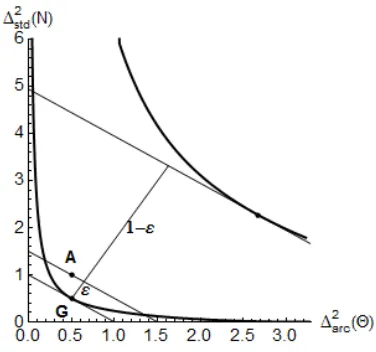
FIG. 2. Applying the estimate (25) in an uncertainty diagram. The lower curve is the tradeoff
curve obtained from the ground state problem. The upper curve is formed by the uncertainty pairs
of the respective first excited states. Suppose the uncertainty pairA has been found. We want to
show that the corresponding state must be close to the minimal uncertainty state corresponding
the point G. Drawing the tangent to the tradeoff curve atG and the parallel tangent to the upper
curve we find from the diagram that the fidelity of the given state to Gmust be at least 1−ε.
When the ground state problem for H(t) has a gap, it is known that any state with
expectations close to the ground state energy must actually be close to the ground state.
More precisely, suppose that H has a unique ground state vector, Hψ = E0ψ, and that
the next largest eigenvalue is E1 > E0. Then H ≥ E11I − (E1 −E0)|ψihψ|. Now let
E0 <hφ, Hφi=Eφ < E1 for some unit vector φ. Then by taking the φ-expectation of the
operator inequality, we get
|hφ, ψi|2 ≥ E1−Eφ E1−E0
. (25)
In particular, when Eφ ≈ E0, φ must be close in norm to ψ. We can directly apply this
principle to the above ground state problems. The basic geometry is described in Fig. 2.
explicitly that the minimizers for different choices of metrics are sometimes quite close to
each other, or that some simple ansatz for the minimizer is quantitatively good.
V. NUMERICS IN TRUNCATED FOURIER BASIS
Here we only consider the case dZ=dstd because for the discrete metric onZ the ground state problem has an elementary explicit solution (see Section VI B). The numerical
treat-ment is easiest in the Fourier basis, or rather in the even eigenspace of the number operator
N, for |N| ≤ Nmax. The matrix elements of the relevant Hamiltonians for basis vectors in
this range can be written down as simple explicit expressions. From these the numerical
version of the Hamiltonian is determined as floating point matrix of the desired precision,
for which the ground state and first excited state are determined by standard algorithms.
All these steps were carried out in Mathematica. The criterion for the choice of Nmax was
that the highest-n components of the eigenvectors found should be negligible at the target
accuracy. The target accuracy was mostly 5 digits with computations done in machine
pre-cision withNmax= 80, but was chosen larger for getting a reliable estimate of the separation
of the different state families.
All computations must be considered elementary and highly efficient, even at high
accu-racy. None of the diagrams in this paper takes computation time longer than a keystroke. It
is therefore hardly of numerical advantage to implement the analytic solutions of Section VI,
not in computation time and even less in programming and verification time.
Perhaps the only surprise in this problem is that for the two different metricsdarcanddcho
the minimizing state families are so close. Since Vcho ≤Varc, the ground state problems for
Hchoand Harc are related. Perturbatively one sees that the ground state energies are indeed
similar, up to the expectation of t(Varc(θ)−Vcho(θ)). The stability statement at the end of
Section IV E then implies that the corresponding ground states are also similar. However,
direct comparison gives a norm bound, which is rather better than these arguments indicate:
||ψarc(t)−ψcho(t)|| ≤0.145 (26)
for all t, corresponding to a fidelity ≥ .98. This still does not quite reflect the similarity
of these two state families: When we allow the t-arguments to differ, we get a much better
and an analogously defined Ωcho. For sets in Hilbert space we use the Hausdorff metric, so
that dH(Ω1,Ω2) < ε means that for every point in one set there is an ε-close one in the
other. Then one easily gets
dH Ωarc,Ωcho
≤.028 (27)
Consequently, there is really only one diagram representing the family of minimal
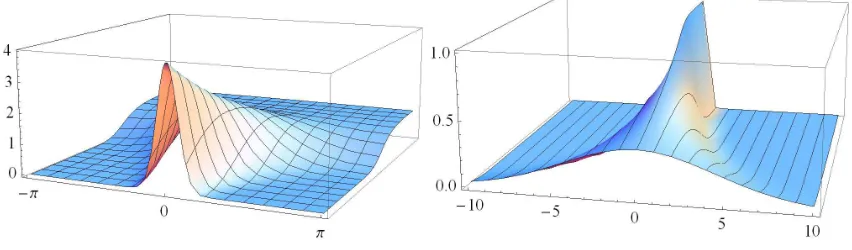
[image:19.612.92.518.215.340.2]uncer-tainty states, which we show in Fig. 3.
FIG. 3. Minimum uncertainty wave functions (left) and Fourier coefficients (right) for the case
(dcho, dstd) as a function of the family parametertfrom (24), plotted as the depth dimension. Note
that the surface in the diagram on the right is only an aid for better 3D visualization — only the
embedded lines have real significance.
VI. EXACT GROUND STATES
A. Schr¨odinger operator case
With dZ = dstd and β = 2, the ground state problem becomes an instance of the
Schr¨odinger operator eigenvalue problem. In fact, writing V = dαZ(Θ), the optimal
con-stantc(t) for a given t is the smallest value of λ such that the differential equation
−ψ′′(θ) +tV(θ)ψ(θ) = λψ(θ) (28)
has a solution on [−π, π] satisfying the boundary conditions ψ(−π) = ψ(π) = ψ′(−π) =
ψ(π) = 0. By the general theory, we know that the (unique) solution ψ =ψα has no zeros,
can be chosen to depend smoothly on t (by perturbation theory), and can be chosen to be
Hence, we are in fact looking for an even solution ψ of (28) with ψ′(π) = 0. At t = 0
this vector is just ψα(θ) = 1/ √
2π, i.e. a constant. For the two choices darc and dcho, the
solutionsψα are known special functions; we now proceed to describe them in some detail.
1. VZ(θ) =darc(θ)2 =θ2
The general even solution of (28) is given by a hypergeometric function23:
ψ(θ) = N−1e−12 √
t θ2
1F1
1 4
1− √λ t ;1 2; √ tθ2 , (29)
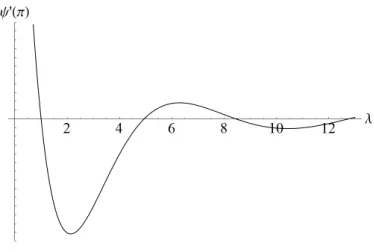
where N is the normalisation factor. The boundary condition ψ′(π) = 0 now picks out
the eigenvalues λ for every t (see Fig. 4), of which the smallest is the desired constant
c(t). The condition can be expressed by using the standard differentiation formulas for the
hypergeometric functions:
1−√λ t
1F1
1 + 1 4
1− √λ t
;3 2;π
2√t
= 1F1
1 4
1− √λ t
;1 2;π
2√t
However, as far as we could see, the theory of hypergeometric functions seems to offer little
help for solving it, or for evaluating the normalization constantN or the Fourier coefficients.
Perhaps an elementary expression for c(t) is too much to hope for, since already in much
simpler problems, e.g., a particle in a box, where the pertinent transcendental equations
[image:20.612.212.399.530.656.2]involve only trigonometric and linear functions, no “explicit” solution can be given either.
FIG. 4. The derivative ψ′(π) after (29), for t = 1, as a function of the eigenvalue parameter λ.
2. V(θ) =dcho(θ)2 = 2(1−cosθ)
In the case of dcho (distance through the circle), the equation (28) is just the Mathieu
equation up to scaling θ 7→ θ/2. The even periodic solutions correspond to −4(2t−λ) =
ar(−4t), where the ar(q),r= 0,1, . . . are called Mathieu characteristic values23. Our ground
state eigenvalues are therefore
c(t) = 2t+at/4,
where we have used the shorthandat= a0(−4t). Since a0 is implemented in e.g.
Mathemat-ica, we can easily determine the values numerically. The corresponding solutions are given
by
ψt(θ) = 1 Nce0
at;−4t; θ 2
where ce0 denotes the lowest order first kind solution of the ordinary Mathieu equation, and
N is again the normalisation factor. We note that the Fourier coefficients ψbt are explicit
functions of at and t, determined by the recurrence relations. Up to second order, we have
ψt(θ) = 1 N
1− at
4tcosθ+
(at−4)at 16t2 + 8t
cos 2θ+O(cos 3θ)
The relevance of the Mathieu functions in the context of circular uncertainty relations has
been noted e.g. in Ref. 24.
B. Discrete metric case
With dZ =ddis, we have the eigenvalue equation
I− |φ0ihφ0|+tVψ =λψ, (30)
withV as in the previous section, andφ0(θ) = 1/
√
2π the constant function. This allows us
to solve for ψ:
ψt(θ) =
A
1−λ+tV(θ) , (31)
where A > 0 is the normalization constant. Inserting this into (30) gives the consistency
condition
1 2π
Z π
−π
dθ
1−λ+tV(θ) = 1. (32)
However, we can also proceed more directly by using just the functional form (31), which
we can further simplify to the one-parameter family ψ(θ) = A/(µ+V(θ)), with a single
parameter µ. We then have to solve three integrals:
I1(µ) = Z π
−π dθ µ+V(θ)
I2(µ) = Z π
−π
dθ
µ+V(θ)2 =− dI1(µ)
dµ
I3(µ) = Z π
−π
dθ V(θ)
µ+V(θ)2 =I1(µ)−µI2(µ).
Then the pair of variances
∆dis(N) = 1−
I1(µ)2
2πI2(µ)
(33)
∆2(Θ) = I3(µ)
I2(µ)
(34)
lies on the tradeoff curve. One can check that this is consistent with the Legendre transform
picture, i.e., condition (32) in the form
I1
1−c(t) t
= 2πt (35)
and its derivative and the parameter identification µ= (1−c)/t.
Now for the arc metric we have V(θ) = θ2 and
I1(µ) =
2
√µarctan √π µ
. (36)
Trying to eliminate µ from (33) leads to a transcendental equation, so one cannot give a
closed inequality involving just the variances.
For the chord metric we have V(θ) = 2(1−cosθ) and
I1(µ) =
2π
p
µ(µ+ 4). (37)
In this case one can easily eliminateµ from (33), and the tradeoff is explicitly described by
equation (14).
VII. ANALYTIC LOWER BOUNDS
In this section we establish a variational method for proving uncertainty relations by
ground state problem are well-known. Basically they amount to choosing some good trial
state, and evaluating the energy expectation: This will be an upper bound on the ground
state energy, and it will be a good one if we have guessed well. However, it is notoriously
difficult to find lower bounds on the ground state energy. The idea for finding such bounds
is via the following Lemma:
Lemma 1. Let V be a 2π-periodic real valued potential, and H the Schr¨odinger operator
Hψ = −ψ′′+V ψ with ground state energy E
0(H). Consider a twice differentiable periodic
function φ, which is everywhere >0. Then the ground state energy of H is larger or equal
to
Eφ= min θ
V(θ)−φ′′(θ) φ(θ)
. (38)
Proof. Let
e
V(x) = φ′′(x)/φ(x) +E
φ (39)
and He the Schr¨odinger operator with this potential. Then φ is an eigenfunction ofHe with
eigenvalue Eφ, and since it was assumed to be positive, it has no nodes and must hence be
the ground state eigenfunction. On the other hand, because Eφ ≤V(x)−(Ve(x)−Eφ), we
have Ve ≤ V and hence He ≤ H. By the Rayleigh-Ritz variational principle25 this implies
the ordering of the ground state energies, i.e., Ee =E0(H)e ≤E0(H).
Finding aφwhich gives a good bound is usually more demanding than finding a goodL2
-approximant for the ground state, because of the highly discontinuous expression φ′′/φ and
the infimum being taken over the whole interval. In particular, the approximate eigenvectors
obtained by other methods may perform poorly, even give negative lower bounds on a
manifestly positive operator.
The positivity ofφ may be ensured by settingφ(θ) = expf(θ); then one has to minimize
V −(f′′+ (f′)2)).
We now consider the combinations of metrics (dstd, darc) and (dstd, dcho), also comparing
the results with existing uncertainty relations found in the literature. This demonstrates how
our systematic approach relates to many existing (seemingly ad hoc) uncertainty relations.
One remark should be made concerning the comparison with the literature: The
uncer-tainty measure used for the number operator is practically always taken to be the usual
is taken only over the set of integers. In general we have
∆std(N)2 ≥ X
n∈Z
(n−tr(ρN))2ρN(n),
where the right-hand side is the usual standard deviation, which takes a distribution on the
integers as a distribution on the reals, which is supported by the integers. Due to the above
inequality any uncertainty tradeoff involving the usual standard deviation also implies the
same relation for ∆std(N).
A. Case (dstd, darc)
The literature on this case begins with the observation that the standard uncertainty
relation does not hold and needs to be modified; Judge12,26showed in 1963 that the following
tradeoff relation
∆std(N)∆arc(Θ)≥c 1−(3/π2)∆arc(Θ)2 (40)
holds with c = 0.16, and conjectured the same with c = 1/2. The conjecture was quickly
proved in Ref. 13 using the Lagrange multiplier method where ∆dis(N) is minimised under
the constraint of fixed ∆arc(Θ)2, and in Ref. 14 and 27 by showing that the admissible pairs
(∆std(N)2,∆arc(Θ)2) lie above the tangent lines of the curve determined by the equality in
(40). Both methods are essentially equivalent to our approach, and explicitly involve the
same eigenvalue problem. In Ref. 27 the bound leading to (40) with the optimal constant
was obtained using special properties of the confluent hypergeometric function.
We first show how the above Lemma can easily be applied to derive (40) with the optimal
constantc= 1/2. An essentially identical procedure works also in other cases below. The
po-tential isV(θ) = θ2, and we have label the uncertainty pairs as (x, y) = (∆
arc(Θ)2,∆std(N)2).
As the simplest ansatz we take f(θ) = logφ(θ) even, hence a polynomial in θ2, which take
as quadratic. The boundary condition f′(π) = 0 then leaves the one-parameter family
f(θ) = −a 2θ
21
− θ
2
2π2
, (41)
where a ∈ R is to be optimised later. The bound given by the Lemma on the uncertainty
pair (x, y) is then
y+tx≥E0 ≥Eφ= inf θ
n
tθ2−f′′(θ)−f′(θ)2o
=a+ inf θ
n
t−a2− 3a π2
θ2+ 2a
2
π2 θ 4
− a
2
This inequality is valid for any a > 0 and t > 0. We choose t so that the linear term in ξ
vanishes, i.e., t =a2+ 3aπ−2. The remaining polynomial is then positive because of θ ≤π,
and hence takes its minimum at ξ = 0. Therefore,
y+
a2+ 3a π2
x≥a. (42)
The optimal value here is a = (π2 −3x)/(2π2x). Note that this is alwas positive, because
the equidistribution has the largest variance, namely x=π2/3. Substituting the optimal a
in (42) we get exactly (40).
B. Case (dstd, dcho)
We first recall from (13) that |heiθi
ρΘ|= 1−∆cho(Θ)
2/2. Hence, the von Mises “circular
variance” is associated with the sine and cosine operators sin Θ and cos Θ, introduced by
Carruthers, Nieto, Louisell, Susskind, Glogower, and others to study the “quantum phase
problem”19,28,29. The idea was to replace the singular commutator [N,Θ] by the well-defined
relations
[N,sin Θ] =icos Θ, [N,cos Θ] =−isin Θ. (43)
Combining the usual Robertson type inequalities associated with these commutators, they
obtained (Ref. 29, eq. (4.11)) the tradeoff relation
∆std(N)∆cho(Θ)≥
1− 1
2∆cho(Θ) 2
21−14∆cho(Θ)21
/2, (44)
expressed here in quantities relevant for our discussion. It was shown by Jackiw30 that
there are no states for which this inequality is saturated, i.e., this bound is not sharp. It is
interesting to note that by replacing the square root term with its trivial upper bound 1, we
get
∆std(N)∆cho(Θ) ≥
1− 12∆cho(Θ)2
2 , (45)
which is just the version of Judge’s bound (40) for this metric. Other lower bounds were
studied relatively recently24 by using approximations of the Mathieu functions associated
with the exact tradeoff curve.
We first show how (45) can be obtained using Lemma 1 by applying the same procedure as
inequality for the first commutator in (43), that is, we takef(θ) =acosθ. Then the resulting
variational expression is a function of the variable cosθ, and hence of the potential V:
y+tx≥inf V
n
a− t−a 2−a
2V +a2
4V
2o (46)
Again it is a good choice to take t so that the first order term in V vanishes, so that the
remaining infimum is attained at V = 0. This gives t =a/2 +a2 and
y≥a− a 2+a
2x= (2−x)2
16x . (47)
where at the last equality we have substituted the optimal valuea = (2−x)/(4x). On taking
the square root this is (45).
In order to obtain analytic bounds better than the Carruthers-Nieto tradeoff (44), we
apply our method with a trial function which is second order in cosθ: We take f(θ) =
acosθ+b(cosθ)2. The expression to be minimized overθcan still be written as a polynomial
in the potential, and numerical inspection suggests once again that it is a good idea to choose
the parameters t and b so that coefficients of V and V2 vanish. This gives linear equations
fort and b, and the resulting polynomial has its unique minimum, namely a, atV = 0. The
analogue of (47) is then
y+a(8a
2+ 5a+ 2)
8a+ 4 x≥a. (48)
Optimizing a now leads to a third order algebraic equation for which the Cardano solution
gives a useless expression in terms of roots. If one just wants the tradeoff curve, the solution
is actually not necessary. Defining the coefficient ofxas a function g(a), so thaty+g(a)x≥
y. Optimality requires xg′(a) = 1, so we get the tradeoff curve in parametrized form
a7→(1/g′(a), a−g(a)/g′(a)).
VIII. OUTLOOK
The methods employed in this paper for obtaining preparation uncertainty bounds can
be applied to a large variety of similar problems. However, the derivation of measurement
uncertainty bounds relied entirely on the theorem that phase space symmetry makes the
two coincide. It is therefore no surprise that the case of positive number and phase seems
much harder to tackle, and the exact uncertainty region is yet to be determined although
for obtaining sharp bounds for measurement uncertainty so far have not been found, and
it would be highly desirable to find such methods. A possible substitute might be a proof
of the conjecture that measurement uncertainty is always larger than preparation
uncer-tainty. Although this inequality must be strict in general, in that way the easily computed
preparation uncertainty bounds would automatically be valid (but usually suboptimal)
mea-surement uncertainty bounds. However, the only evidence for supporting such a conjecture
is the comparison of cases where either kind of uncertainty vanishes, so such a result is
perhaps too much to hope for.
ACKNOWLEDGEMENTS
We thank Joe Renes for suggesting also the discrete metric on Z, and Rainer Hempel for
helpful communications concerning the variational principle in Section VII.
RFW acknowledges funding by the DFG through the research training group RTG 1991.
JK acknowledges funding from the EPSRC projects EP/J009776/1 and EP/M01634X/1.
REFERENCES
1E. Kennard, “Zur Quantenmechanik einfacher Bewegungstypen,” Zeitschr. Phys.44, 326–
352 (1927).
2H. Robertson, “The uncertainty principle,” Phys. Rev. 34, 163–164 (1929).
3W. Heisenberg, “ ¨Uber den anschaulichen Inhalt der quantentheoretischen Kinematik und
Mechanik,” Zeitschr. Phys. 43, 172–198 (1927).
4R. Werner, “The uncertainty relation for joint measurement of position and momentum,”
Quant. Inform. Comput. 4, 546–562 (2004), quant-ph/0405184.
5P. Busch and D. Pearson, “Universal joint-measurement uncertainty relation for error
bars,” Journal of Mathematical Physics 48, 082103 (2007).
6P. Busch, P. Lahti, and R. Werner, “Proof of Heisenberg’s error-disturbance relation,”
Phys. Rev. Lett. 111, 160405 (2013).
7P. Busch, P. Lahti, and R. Werner, “Measurement uncertainty relations,” J. Math. Phys.
8J. Biniok, P. Busch, and J. Kiukas, “Uncertainty in the context of multislit interferometry,”
Phys. Rev. A 90, 022115 (2014).
9S. Tanimura, “Complementarity and the nature of uncertainty relations in Einstein–Bohr
recoiling slit experiment,” Quanta 4, 1 (2015).
10D. Judge and J. Lewis, “On the commutator [L
z, ϕ],” Phys. Lett. 5, 190 (1963).
11K. Kraus, “Remark on the uncertainty between angle and angular momentum,” Zeitschrift
f¨ur Physik 188, 374 (1965).
12D. Judge, “On the uncertainty relation for L
z and ϕ,” Phys. Lett. 5, 189 (1963).
13A. Evett and H. Mahmoud, “Uncertainty relation for angle variables,” Nuovo Cimento38,
295 (1965).
14L. Schotsmans and P. V. Leuven, “Numerical evaluation of the uncertainty relation for
angular variables,” Nuovo Cimento 39, 776 (1965).
15C. Villani, Optimal Transport: Old and New (Springer, 2009).
16L. Dammeier, R. Schwonnek, and R. Werner, “Uncertainty relations for angular
momen-tum,” New J. Phys. 17, 093046 (2015).
17P. L´evy, “L’ addition des variables al´eatoires d´efinies sur une circonf´erence,” Bull. Soc.
Math. France 67, 1–41 (1939).
18R. von Mises, “ ¨Uber die ‘Ganzzahligkeit’ der Atomgewichte und verwandte Fragen,” Phys.
Z. 19, 490 (1918).
19E. Breitenberger, “Uncertainty measures and uncertainty relations for angle observables,”
Found. Phys. 15, 353 (1985).
20M. B. M.A. Alonso, “Mapping-based width measures and uncertainty relations for periodic
functions,” Signal Processing 84, 2425 (2004).
21R. Werner, “Quantum harmonic analysis on phase space,” J. Math. Phys.25, 1404 (1984).
22N. Dunford and J. Schwartz, Linear Operators, Part I: General theory (Wiley, 1957).
23M. Abramowitz and I. Stegun, Handbook of Mathematical Functions (Dover Publications,
1965).
24J. ˇReh´aˇcek, Z. Bouchal, R. ˇCelechovsk´y, Z. Hradil, and L. S´anchez-Soto, “Experimental
test of uncertainty relations for quantum mechanics on a circle,” Phys. Rev. A77, 032110
(2008).
25M. Reed and B. Simon, Methods of Modern Mathematical Physics, Vol. IV: Analysis of
26D. Judge, “On the uncertainty relation for angle variables,” Nuovo Cimento31, 332 (1964).
27M. Bouten, N. Maene, and P. V. Leuven, “On an uncertainty relation for angular
vari-ables,” Nuovo Cimento 37, 1119 (1965).
28M. Nieto, “Quantum phase and quantum phase operators: some physics and some history,”
Physica Scripta T48, 5 (1993).
29M. N. P. Carruthers, “Phase and angle variables in quantum mechanics,” Rev. Mod. Phys.
40, 411 (1968).
30R. Jackiw, “Minimum uncertainty product, number-phase uncertainty product, and
co-herent states,” J. Math. Phys. 9, 339 (1968).
31P. Lahti, J.-P. Pellonp¨a¨a, and J. Schultz, “Number and phase: complementarity and
joint measurement uncertainties,” Journal of Physics A: Mathematical and Theoretical