This is a repository copy of
Referenced compressed sensing for accurate and fast
spatio-temporal signal reconstruction
.
White Rose Research Online URL for this paper:
http://eprints.whiterose.ac.uk/149000/
Version: Published Version
Article:
Hotrakool, W. and Abhayaratne, C. orcid.org/0000-0002-2799-7395 (2019) Referenced
compressed sensing for accurate and fast spatio-temporal signal reconstruction. Journal of
Electronic Imaging, 28 (4). 043010. ISSN 1017-9909
https://doi.org/10.1117/1.jei.28.4.043010
Copyright 2019 Society of Photo Optical Instrumentation Engineers (SPIE). One print or
electronic copy may be made for personal use only. Systematic reproduction and
distribution, duplication of any material in this publication for a fee or for commercial
purposes, or modification of the contents of the publication are prohibited.
[email protected] https://eprints.whiterose.ac.uk/
Reuse
Items deposited in White Rose Research Online are protected by copyright, with all rights reserved unless indicated otherwise. They may be downloaded and/or printed for private study, or other acts as permitted by national copyright laws. The publisher or other rights holders may allow further reproduction and re-use of the full text version. This is indicated by the licence information on the White Rose Research Online record for the item.
Takedown
If you consider content in White Rose Research Online to be in breach of UK law, please notify us by
Referenced compressed sensing for
accurate and fast spatio-temporal
signal reconstruction
Wattanit Hotrakool
Charith Abhayaratne
Referenced compressed sensing for accurate and
fast spatio-temporal signal reconstruction
Wattanit Hotrakool and Charith Abhayaratne*
The University of Sheffield, Department of Electronic and Electrical Engineering, Sheffield, United Kingdom
Abstract. We address two challenges of applying compressed sensing in a practical application, namely, its poor reconstruction quality and its high computational complexity. Since most signals are not fully sparse in practice, the reconstructed signals from conventional reconstruction methods often suffer from reconstruction artifacts due to the distortion of small coefficients. To improve the reconstruction quality, we introduce referenced compressed sensing (RefCS), a reconstruction method that exploits the spatial and/or temporal redundancy between a pair of signals. We show that using a correlated reference—an arbitrary signal close to the
com-pressed signal—there exists the bound of reconstruction error that depends on the distance between the
refer-ence and the signal. By exploiting the correlated referrefer-ence, RefCS can improve the reconstruction quality by up to 90% in terms of peak signal-to-noise ratio. Moreover, it is possible to reduce the computational complexity of the proposed RefCS using the least squares method. The least squares reconstruction results can be obtained with quality comparable to that of iterative algorithms by employing the correlated reference. Using the least squares method improves the reconstruction time by a factor in the range of 9 to5.4×104 according to our
experiments.©2019 SPIE and IS&T[DOI:10.1117/1.JEI.28.4.043010]
Keywords: compressed sensing; sparse reconstruction; correlated reference; the least squares.
Paper 190050 received Jan. 28, 2019; accepted for publication Jun. 19, 2019; published online Jul. 12, 2019.
1 Introduction
Compressed sensing (CS) is a signal acquisition paradigm that allows acquisition of full-length signals from under-sampled measurements. Since it was introduced by Candès et al.1 and Donoho,2 compressed sensing has become of
interest in many fields of research. The main promise of compressed sensing is the ability to perform sub-Nyquist sampling by exploiting the sparsity of compressible signals. In compressed sensing, the essential information to recon-struct a sparse signal is contained in a small set of significant elements, whereas the other elements are zero or have very small magnitudes. The aim of compressed sensing is to acquire these significant elements directly using a fewer number of measurements than those stated by the Shannon/ Nyquist theorem.3
Compressed sensing consists of two major operations: the sensing operationSand the reconstruction operationR. Letu∈Rn be ann-dimensional nonsparse signal that can be represented as an n-dimensional sparse signal, x∈Rn,
via x¼Ψu transformation using a sparse dictionary Ψ. The sensing operationSðxÞacquires the compressive mea-surementsy∈Rm, wherem≪n, as follows:
EQ-TARGET;temp:intralink-;e001;63;211
y¼Φx; (1)
where Φ∈Rm×n is the incoherent under-sampling matrix.
Generally,SðxÞis a linear equation. The incoherence ofΦ
to the signalx—more specifically the incoherence between
Φ and Ψ—is guaranteed by many properties including the null space property4and the restricted isometry property,5,6 to name a few. As shown by Kim and Shevlyakov,7random sampling matrices are largely incoherent to every dictionary
Ψ, thus the random matrices are a widely used sampling operator.
The counterpart of the sensing operation is the reconstruc-tion operareconstruc-tionRðyÞ. The reconstruction operation recovers a full-length signal x^∈Rn from the measurements y.
Because Eq. (1) is under-determined, the reconstruction can-not be done linearly. Instead, the reconstruction operation is an optimization problem aims to minimize a specific objec-tive function. Conventionally, the CS reconstruction is done by minimizing thel1-norm objective function, i.e.,
EQ-TARGET;temp:intralink-;e002;326;346
min
^
x kx^k1 subject to Φx^¼y: (2)
This reconstruction method is commonly known as the l1-norm minimization (l1-min for short). It is shown by
Donoho2that when the sparsity of a signal is promoted by
minimizing thel1-norm objective function, the reconstructed
signal can be obtained accurately with high probability. Finally, the original signal is reconstructed using the inverse transformationu^¼Ψ−1x.^
Conventionally, compressed sensing reconstructs a full-length signal from highly under-sampled measurements by solving the l1-norm minimization problem. However, this
has a couple of limitations. First, thel1-norm minimization
problem has to be solved using iterative optimization algo-rithms, which have high computational complexity. This complexity makes the time required for full-length signal reconstruction is too large to be desirable in most practical applications. The problem worsens with the increase of the signal length, preventing compressed sensing to be appli-cable to most data-intensive, next-generation content. Second, the reconstructed signalx^ obtained by minimizing the signal sparsity using thel1-norm minimization tends to lose small
*Address all correspondence to Charith Abhayaratne, E-mail:c.abhayaratne@
sheffield.ac.uk 1017-9909/2019/$28.00 © 2019 SPIE and IS&T
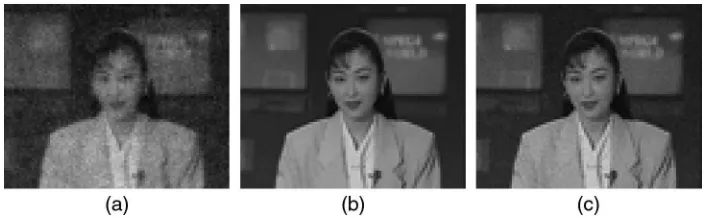
magnitude components in the sparse signal representation domainx. As most of these smaller magnitude components are highly likely to be in high frequencies according to transform coefficients’characteristics, the final reconstructed signalu^ may be distorted with losing details, thus resulting in noise-like reconstruction artifacts in the reconstructed signal. Figure1(a)shows such artifacts, which are clearly visible in a video sequence reconstructed using thel1-norm
minimiza-tion. This poses a challenge in many real-world applications, such as medical imaging, in which the high-frequency details are important and cannot be discarded.
This paper has two major contributions. The first contri-bution is the proposal of an approach for reconstruction in Sec. 3 in order to improve the CS reconstruction quality of the full-length signal by exploiting the redundancy between the signal x and a correlated reference r. Thus herein we call the proposed method referenced compressed sensing (RefCS). In this paper, we propose the theoretical foundations of RefCS and demonstrate it experimentally on how to exploit intersample redundancy for improving reconstruction quality. Let x∈Rn, be a sparse n-dimen-sional signal, which is acquired using compressive measure-mentsy∈Rm, wherem≪nandy¼Φx, whereΦ∈Rm×n
is the incoherent under-sampling matrix. Suppose there is an a prioricorrelated reference signalrclose toxin the sense that δ, the distance betweenr and x, i.e., δ¼ kr−xk2, is
very small. RefCS proposes that the reconstructed signal
^
x is the solution of
EQ-TARGET;temp:intralink-;e003;63;293
min
^ x k^
x−rk1 subject to Φx^ ¼y (3)
and it obeys the constraint
EQ-TARGET;temp:intralink-;e004;63;247
kx^−xk2≤2δ: (4)
There is no other assumption about the relationship between randx apart from the distance. Exploiting the redundancy between r and x leads to a much higher reconstruction quality [Fig. 1(b)]. Using the correlated reference r, the reconstructed data using the proposed RefCS are shown to have higher peak signal-to-noise ratio (PSNR) values than the those for the traditional l1-norm minimization
recon-struction. In this work, the performance of RefCS is demon-strated in three different applications: multiscale image reconstruction, video reconstruction, and functional mag-netic resonance imaging (fMRI) data with PSNR improve-ments of 5.43%, 40%, and 90%, respectively, as shown in Sec.5. For video reconstruction, unless motion compensated, it is usually difficult to find a highly correlated reference from
the previously decoded data. As shown in Sec.5, the perfor-mance improvement for sequences with high-motion content is not as high as for those with less motion content.
The second contribution of this paper is a solution for the issue of high-reconstruction complexity of compressed sensing as presented in Sec.4. We show that it is possible to reconstruct the full-length signal using thel2-norm
objec-tive function with the least squares method by incorporating the correlated referencer. ProvidedΦis a full rank matrix, the reconstructed signalx^ can be obtained as
EQ-TARGET;temp:intralink-;e005;326;492^
x¼rþΦTðΦΦTÞ−1ðy−
ΦrÞ: (5)
Thus hereinafter, we call the proposed solution in Sec. 4 referenced CS with the least squares (RefCSLS). The recon-structed data from RefCSLS approach have resulted in qual-ity comparable to that of regular RefCS reconstruction that usesl1-norm [Fig.1(c)], but with low computational times.
As shown in Sec.5, it yields PSNR improvements of 5.83% in multiscale image reconstruction, 18% in video reconstruc-tion, and 89% in fMRI data with great reductions of compu-tational time compared to the iterative algorithms used in l1-norm minimization.
The remainder of this paper is organized as follows: the related work is discussed in Sec.2. The proposed RefCS is introduced in Sec.3, followed by the low-complexity variant RefCSLS in Sec.4. The experimental results, including all three example application scenarios, are presented in Sec.5 followed by concluding remarks in Sec.6.
2 Related Work
A prioriside-information regarding the structure of signals has been explored within the CS sensing and reconstruction operations in the literature. The main motivation of CS reconstruction methods employing side-information is the fact that the characteristics and structure of a signal are shared between its neighbors. This observation can be seen clearly in applications, such as, in magnetic resonance imag-ing (MRI),8,9 sensor network,10 multiview imaging,11 and surveillance camera,12 etc. Since Miosso et al.13 showed that the use of side information can reduce the number of measurements required, various side-information types have been studied and incorporated into the CS reconstruction operation.14 Examples include sparsity patterns (including these variants: sparse support estimation,15model-based CS,16
and Kalman-filtered CS17), upper and lower bounds,18 and joint/group reconstruction.11
Video data contain a high level of temporal redundancy between frames that can be employed as side information.
[image:4.630.138.490.59.168.2]The interframe redundancy is at the heart of video compres-sion techniques. It is also exploited in distributed video coding (DVC) to achieve coding gains.19–21
DVC views con-secutive frames as a corrupted version of a key frame and uses the key frame as the base for reconstructing the cor-rupted frame. Previous works in the literature show improve-ments in distributed compressive video sensing (DCVS) over the traditional CS reconstruction.22–24There also presents the
attempt to incorporate the intraframe redundancy (which is the spatial redundancy) into the reconstruction method.25 The generalized version of DCVS leads to the development of a more dynamic approach to video sequence reconstruc-tion, known as temporal compressed sensing (TCS).26–29
TCS reconstructs a signal by maximizing the sparsity as well as exploiting the redundancy between two consecutive reconstructed frames in a spatio-temporal signal. In other words, TCS solves the following problem:
EQ-TARGET;temp:intralink-;e006;63;565
min
^ x ðk
^
xtk1þ kΨ−1x^t−Ψ−1x^t−1k1Þ subject toΦx^t¼y; (6)
corresponding to the two consecutive frames ut and ut−1,
where xt¼Ψut and xt−1¼Ψut−1, respectively. Unlike DCVS, TCS does not restrict the use of a key frame as a base for reconstruction. Instead, the most recent recon-structed frame is used directly as a base for the next frame. The concept of reconstruction based on redundancy is applicable not only to video sequence reconstruction30
but also to many similar applications, such as block-based image processing31and phase-based remote sensing.32These
involve measurements of a large signal as a collection of several smaller subsignals, i.e., each individual block in the image processing, each frame in the video reconstruction, and each phase-component in remote sensing. These smaller subsignals have a high degree of redundancy and are highly correlated to each other, which is exploited in the reconstruc-tion or processing stage.
In all above work, interpixel redundancy has been exploited by considering special application scenarios to improve the quality of the reconstructed data. In the pro-posed RefCS, a generalized and application-independent approach to exploit interpixel redundancy by means of a correlated reference is formulated. The early findings of our work were reported in two conference publications.33,34
In this work, we propose the mathematical formulation of RefCS and its extension into the least square reconstruction (RefCSLS), analyze the effect of the correlated reference and sampling rate on reconstruction errors, and experimentally evaluate the proposed method considering three example application scenarios: image, video, and fMRI data recon-struction. More detailed analysis, experimental evaluation, and other applications of our work can be found in the PhD thesis of the first author.35
3 Referenced Compressed Sensing
3.1 Proposed Reconstruction Operation
A large signal, such as, an image or a video sequence can be viewed as a collectionC consisting of several smaller sub-signals. Concretely, a subsignal xt∈Rn; t¼1;2; : : : ; k is
a member of the collection Cx, where n is the length of
each signalxtandkis the total number ofxtinCx. In RefCS,
the correlated referenceris not required to be from the same
collection as x, i.e., the condition r∈Cx is not required.
In RefCS, a correlated referenceris an arbitrary signal close tox, as defined in Definition 3.1.
Definition 3.1. For any signalx∈Rn, a correlated refer-encerofx is a signal such thatr∈Rn and
EQ-TARGET;temp:intralink-;e007;326;691
kr−xk2≤ϵ; (7)
for a small0<ϵ≪kxk2.
The reference distanceδ¼ kr−xk2has a very important
role in RefCS. Though the correlated referenceris arbitrary, it is possible to find an orthogonal projection of ron the feasible setX^Φ;y given by the constraints of Eq. (1).
Proposition 1. Given a sensing matrix Φ∈Rm×n, a
compressive measurementy∈Rm,y¼Φx, and a correlated
referencer∈Rn, an orthogonal projectionx^
P fromronto
the feasible subspaceX^Φ;y ¼ f^xjy¼Fxgsatisfies
EQ-TARGET;temp:intralink-;e008;326;543
sup
^ xP
kx^P−xk2≤δ: (8)
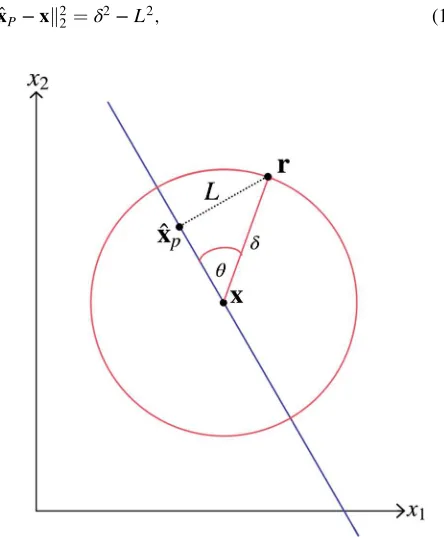
Proof. Consider the case ofx∈R2in Fig.2. Let a
refer-ence r be a member of a set of references R, such that R¼ fr∶kr−xk2≤δg. Also, define an orthogonal
projec-tionx^P, which is the projection of the referencer∈Ronto the feasible subspaceX^Φ;y. ▯
LetL¼ k^xP−rk2 be the length of the projection. One
finds that
EQ-TARGET;temp:intralink-;e009;326;417
L≤δsinθ; (9)
whereθis the angle betweenr−xand xP−x. Because of the relationship
EQ-TARGET;temp:intralink-;e010;326;364
kx^P−xk2
2¼δ2−L2; (10)
[image:5.630.333.555.465.734.2]we can see that kx^P−xk2 is maximized when L¼0,
i.e.,θ¼0. This implies that, for anyr∈R,
EQ-TARGET;temp:intralink-;e011;63;730
sup
^ xP
kx^P−xk2 ≤δ: (11)
In the proposed RefCS, instead of using the orthogonal projection as in Proposition 1, the solution x^1 can be obtained using the l1-norm minimization. In this case, the
sparsity ofx^1 is promoted.
Proposition 2 Given a sensing matrixΦ∈Rm×n, a
com-pressive measurements y∈Rm, y¼Φx, and a correlated
reference r∈Rn, a least l
1-norm reconstruction x^1, which
is the solution of
EQ-TARGET;temp:intralink-;e012;63;596
min
^ x k^
x−rk1 subject to Φx^ ¼y; (12)
satisfies
EQ-TARGET;temp:intralink-;e013;63;549
kx^1−xk2≤2δ: (13)
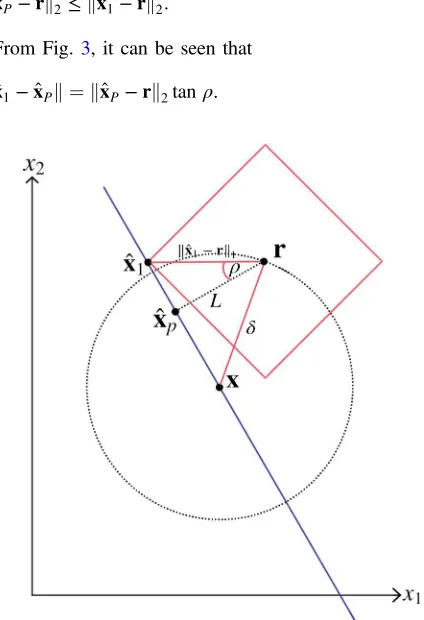
Proof. Consider the case of x∈R2 in Fig. 3. Let a referencerbe a member of a set of referencesRsuch that, R¼ frjkr−xk2≤δg. The least l1-norm solution x^1 is a
point on the feasible subspaceX^Φ;y¼ fx^jy¼Fxg, such that,
the norm kx^1−rk is minimized. Define the angle between
the vectorsx^1−randx^P−rasρ. Bothx^1andx^Pare on the
feasible subspaceX^Φ;y, becausex^Pis an orthogonal projec-tion, it is clear that
EQ-TARGET;temp:intralink-;e014;63;418
kx^P−rk2≤kx^1−rk2: (14)
From Fig.3, it can be seen that
EQ-TARGET;temp:intralink-;e015;63;376
kx^1−x^Pk ¼ k^xP−rk2tan ρ: (15)
From Proposition 1, we know thatkx^P−rk2≤δ. Also from
Fig. 3, it can be seen that ρ≤π
4 for x^1 to be the smallest
l1-norm solution, thus
EQ-TARGET;temp:intralink-;e016;326;718
kx^1−x^Pk2≤δ: (16)
This implies that
EQ-TARGET;temp:intralink-;e017;326;677
sup
^ x1
k^x1−xk2¼ kx^1−x^Pk2þ kx^P−rk2; (17)
EQ-TARGET;temp:intralink-;e018;326;630¼2δ: (18)
Both Proposition 1 and Proposition 2 show that the error of RefCS depends on the distanceδbetween the referencer and the signalx.
3.2 Relationship Between Correlated Reference, Sampling Rate, and Reconstruction Error
As shown in Proposition 2, the performance of RefCS is governed by the reference distance δ¼ kr−xk2 between
the correlated reference rand the signal x. The goal is to minimize the reconstruction errorEð^x;xÞ ¼ k^x−xk2.
First, let us consider the relationship between the distance
δand Eð^x;xÞ. To study this relationship, the Monte Carlo method is employed to a pool of signalP¼ fx∶x∈R256g
containing 1000 linearly independent random vectors. Each vectorxi∈Phas the number of nonzero elements fixed to
50, each element has the value between 0 and 255. A set of 50 randomly chosen vectorsPI⊂Pis used as
input signals. The sensing operationS and reconstruction operationR, using RefCS, are applied to each signalx∈PI
repeatedly, each time using a different reference vector r∈P;r∈= PI. Figure4shows the scatter plot of each
recon-structed signal betweenδ againstEð^x;xÞ, along with their linear regression trend. Figure 4 clearly shows that the smaller reference distanceδindeed leads to the lower recon-struction error in general. Moreover, it can be seen that the reconstruction error is far lower than the limit imposed by Proposition 2. The reference distanceδin this experiment is unusually high compared to typical setting because vectors in each signal-reference pair (x,r) are independent of each
Fig. 3Geometric example of Proposition 2, wherex∈Rn.
[image:6.630.72.284.423.733.2] [image:6.630.325.562.539.727.2]other and share no redundancy. This is intentional in order to study the case where the reference is completely arbitrary. This scenario is of course not optimal, but, despite this extremity, the relationship between the reference distance and the reconstruction error is clear.
The next step is to study the relationship of the sampling ratesto the reconstruction errorEð^x;xÞ, given the references with fixed distance. Again, Monte Carlo method is employed onto the same pool of random vectors P. This time, the sensing operationSand the reconstruction operationRare applied to each vectorx∈Prepeatedly, each time using a different sampling rates, where10%≤s≤90%. The refer-enceris created by adding random noise tox. Specifically, for eachx, we create a reference signal
EQ-TARGET;temp:intralink-;e019;63;598
r¼xþkn; (19)
where nis a uniform white noise such that,
EQ-TARGET;temp:intralink-;e020;63;560
kr−xk2¼kkxk2: (20)
In this experiment, three values of k are chosen to create references at three distances:δL¼0.25kxk2,δM¼0.5kxk2,
and δH¼0.75kxk2.
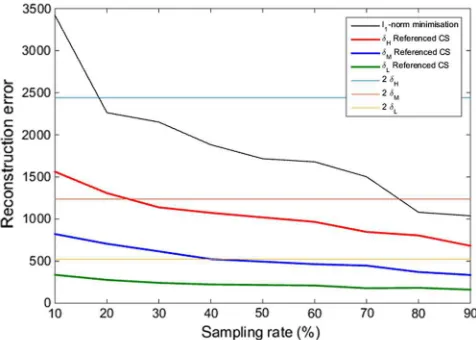
Figure 5 shows the average plot between the sampling ratesand the errorEð^x;xÞ. As one would expect, the error goes up as the sampling rate decreases. However, the error also reduces as the distance δ decreases. Given the same sampling rate, it is clear that the results obtained using the smallerδhave a much lower error. In addition, the difference between the reconstruction error of low- and high-sampling rate is narrower with the smallerδ. LetEsdenote the
recon-struction error at the sampling rates. As shown in Fig.5, the error difference is E10–escaped;E90¼880.18 when using
the references withδH. On the other hand, the error
differ-ence reduces to 175.58 when reconstructed using the refer-ences with δL. In order words, the effect of the sampling rate to the reconstruction error is smaller when the reference distance is small.
Figure5 also shows lines indicating the value twice the reference distance, i.e., 2δ, showing the limit imposed by Proposition 2. It shows that the RefCS results strictly obey Proposition 2.
4 Reduction of Reconstruction Complexity: Referenced Compressed Sensing with the Least Squares
One of the major issues that prevents a practical deployment of compressed sensing is the high computational complexity of iterative reconstruction operation. High complexity makes the reconstruction of large data a time-consuming task. Here we propose a method that greatly reduces the complexity of CS reconstruction by relaxing the objective function of RefCS from l1-norm to l2-norm, thus allowing the
recon-struction to be done using the least squares approximation. This claim might come as a surprise as thel2-norm
objec-tive is known to not promote the signal sparsity. However, one of the main promises of RefCS is the fact that it moves away from the notion of sparsity. Recall the same symbols from Sec.3. As shown in Proposition 2, the reconstruction error Eðx;^ xÞ depends only on the distance δ¼ kr−xk2
between the referencerand the signal x. This proposition is valid for anylp-norm,0<p≤ ∞. As the sparsity is no
longer needed to be maximized, it is desirable to relax the optimization problem back to use the l2-norm objective
function to take advantage of its lower complexity. Here we assert that the least squares method should per-form reasonably well with the incorporation of the correlated reference since it is bounded by Proposition 2. As such, we propose to use the least squares method to solve for the solution of the relaxed RefCS, referred to as RefCS with the least squares (RefCSLS), following the Proposition 3.
Proposition 3. Given r∈Rn, a correlated reference of a signal x∈Rn, the reconstructed signal x^∈Rn can be
obtained from the compressive measurements y∈Rm,
wherey¼Φxand providedΦis full rank matrix, as follows:
EQ-TARGET;temp:intralink-;e021;326;391^
x¼rþΦTðΦΦTÞ−1ðy−
ΦrÞ (21)
Proof. Following Eq. (12), we define a RefCSl2-norm
minimization problem as
EQ-TARGET;temp:intralink-;e022;326;338
min
x kx^−rk2 subject toΦx^¼y: (22)
Define a Lagrangian function as
EQ-TARGET;temp:intralink-;e023;326;294
Lðx^Þ ¼ kx^−rk2
2þλTðΦx^−yÞ; (23)
whereλis the Lagrange multipliers for the constraint set in a diagonal matrix in Rm and T represents the transpose.
Setting the derivative ofLð^xÞwith respect tox^ to zero:
EQ-TARGET;temp:intralink-;e024;326;229
∂
∂^xLð^xÞ ¼2^x−2rþλ
TΦ¼0; (24)
and considering the fact that Φ∈Rm×n, we can rewrite
Eq. (24) as
EQ-TARGET;temp:intralink-;e025;326;168
2^x−2rþΦTλ¼0; (25)
to obtain the condition
EQ-TARGET;temp:intralink-;e026;326;128^
x¼r−1 2Φ
Tλ: (26)
To solve for the Lagrange multipliersλ, substitute Eq. (26) intoy¼Φx^ to obtain
Fig. 5. Relationship between the sampling rates, the reference dis-tanceδ, and the reconstruction errorEðx^;xÞof RefCS.
[image:7.630.64.302.554.724.2]EQ-TARGET;temp:intralink-;e027;63;752
y¼Φr−1 2ΦΦ
Tλ: (27)
From Eq. (27), we get
EQ-TARGET;temp:intralink-;e028;63;709
ΦΦTλ¼−2ðy−ΦrÞ; (28)
and, finally,
EQ-TARGET;temp:intralink-;e029;63;668
λ¼−2ðΦΦTÞ−1ðy−ΦrÞ: (29)
With the assumption ofΦ as full rank, the matrix ΦΦT is positive-definite and thus invertible. Substitute Eq. (29) back into Eq. (26) to obtain the expression in Eq. (21), i.e.,
EQ-TARGET;temp:intralink-;e030;326;719^
x¼rþΦTðΦΦTÞ−1ðy−ΦrÞ: (30)
▯
Therefore, with the least square minimization approach, the reconstruction process reduces to the expression in Eq. (21). The experiments in terms of three case studies and
[image:8.630.62.568.146.709.2]discussion of the reconstruction quality and running times of RefCSLS method are presented in Sec.5.
5 Experimental Results
In this section, three case studies where RefCS and RefCSLS can be employed are presented. They are multiresolution image reconstruction, video sequence reconstruction, and fMRI data reconstruction. Throughout these experiments, the infeasible-point subgradient algorithm,36which is one of
the most efficient reconstruction methods available,37is used as the optimization algorithm for both thel1-norm
minimi-zation and the regular RefCS.
5.1 Image Reconstruction
This section demonstrates the performance of the proposed RefCS and RefCSLS in a proof-of-concept scenario of multiscale image reconstruction. Let an imageI consisting of n pixels be measured compressively using the sensing operation S. As discussed, the images reconstructed using l1-norm minimization method have a significant amount of
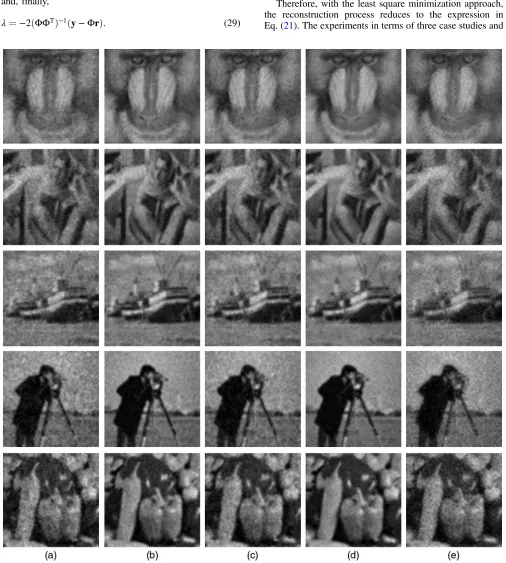
reconstruction artifacts, as shown in column (b) of Fig.6. In the image reconstruction scenario, the reference signal can come from a previously reconstructed neighboring group of pixels in a line considering line by line acquisition or from a previously acquired ultralow resolution version of the image. For this case study, the latter is considered for demonstrating the performance of proposed RefCS and RefCSLS. Suppose there is an ultralow resolution sensor that can capture a small reference image R, where the size of R is much smaller than I. Instead of measuring the entirety ofmsamples compressively asy, the samples in this scenario contain two vectors: the reference imageRand the random sampley(while keeping the total amount of samples at m). In this scenario, RefCS can employ the reference vectorr, where ris the sparse representation of the super-resolution version of R, i.e., given thatx¼ΨI,
EQ-TARGET;temp:intralink-;e031;63;127
y¼ΦΨI; (31)
and the reference vectorris
EQ-TARGET;temp:intralink-;e032;63;85
r¼ΨSðRÞ; (32)
where SðRÞ is the super-resolution operation. The recon-struction operation R is employed to reconstruct the imageI^by
EQ-TARGET;temp:intralink-;e033;326;493^
x¼Rðy;rÞ; (33)
EQ-TARGET;temp:intralink-;e034;326;452
^
I¼Ψ−1x:^ (34)
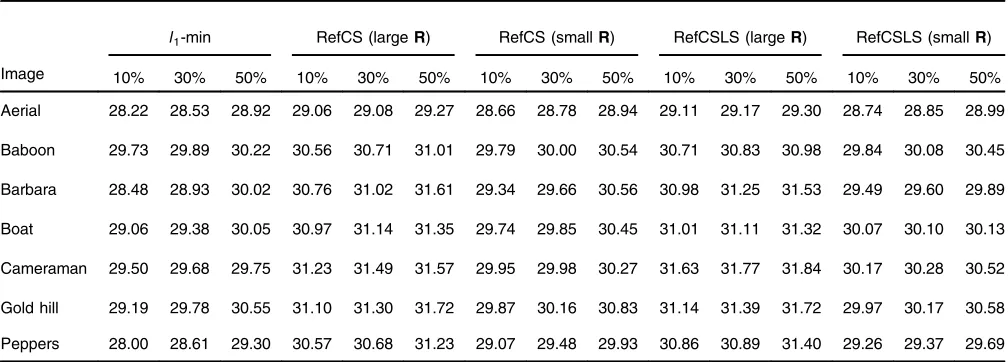
Figure6shows the reconstructed images using the RefCS and the RefCSLS usingR. In columns of Figs.6(b)and6(d), the total samplesm¼0.5nconsist of0.25nfrom the low-resolution reference imageRand0.25nfrom the compres-sive measurementsy, where as in columns of Figs.6(c)and 6(e), the samples m¼0.5n consist of 0.0625n from the reference imageRand 0.4375nfromy. It is clear in these examples that by employing the low-resolution reference, the reconstruction artifacts are reduced greatly. In this figure, the reconstructed images are far noisier compared to those in Fig.6(b). However, Table1 shows that both the recon-structed images in Figs.6(b)and6(c)have higher PSNR than the images obtained using the conventionall1-norm
[image:9.630.63.567.85.266.2]minimi-zation. When using a large reference imageR(0.25n), the RefCS and RefCSLS results show the average improvement
Table 2 Average reconstruction time per image (s) of each recon-struction method.
Image l1-min RefCS RefCSLS
Aerial 11.63 11.58 1.22
Baboon 12.00 11.91 1.35
Barbara 11.88 11.83 1.23
Boat 11.69 11.79 1.24
Cameraman 11.92 12.24 1.26
Gold hill 12.13 11.99 1.27
Peppers 11.61 11.73 1.28
Table 1 Average PSNR in decibels of reconstructed multiscale images using the proposed reconstruction methods at the sampling rate of 10%, 30%, and 50%. The reference imageRis at 25% and 6.25% of the original image.
Image
l1-min RefCS (largeR) RefCS (smallR) RefCSLS (largeR) RefCSLS (smallR)
10% 30% 50% 10% 30% 50% 10% 30% 50% 10% 30% 50% 10% 30% 50%
Aerial 28.22 28.53 28.92 29.06 29.08 29.27 28.66 28.78 28.94 29.11 29.17 29.30 28.74 28.85 28.99
Baboon 29.73 29.89 30.22 30.56 30.71 31.01 29.79 30.00 30.54 30.71 30.83 30.98 29.84 30.08 30.45
Barbara 28.48 28.93 30.02 30.76 31.02 31.61 29.34 29.66 30.56 30.98 31.25 31.53 29.49 29.60 29.89
Boat 29.06 29.38 30.05 30.97 31.14 31.35 29.74 29.85 30.45 31.01 31.11 31.32 30.07 30.10 30.13
Cameraman 29.50 29.68 29.75 31.23 31.49 31.57 29.95 29.98 30.27 31.63 31.77 31.84 30.17 30.28 30.52
Gold hill 29.19 29.78 30.55 31.10 31.30 31.72 29.87 30.16 30.83 31.14 31.39 31.72 29.97 30.17 30.58
Peppers 28.00 28.61 29.30 30.57 30.68 31.23 29.07 29.48 29.93 30.86 30.89 31.40 29.26 29.37 29.69
[image:9.630.308.567.589.748.2]of 5.43% and 5.83%, respectively, compared to thel1-norm
minimization. When using a smallR(0.0625n), the improve-ments are 1.71% and 1.76%, respectively. The reason that the RefCSLS results have better PSNR than the results of the regular RefCS, in this experiment, is because the lower reconstruction accuracy of RefCSLS—which results in blur-ring instead of the reconstruction artifacts—acts as a low-pass filter for the images that filter out the artifacts. While this outcome is not particularly desirable, Table2shows that RefCSLS, despite yielding the results comparable in recon-struction quality, is faster than both l1-norm minimization
and RefCS by a factor of 9.35 on average.
5.2 Video Sequence Reconstruction
In this section, we explore the use of RefCS and RefCSLS in a case study of video sequence reconstruction. Consider a video sequence V as a collection of frames. Each frame It ∈V,t¼1;2; : : :, is a frame ofVat timet. Each frame is compressively sampled using the sensing operation
EQ-TARGET;temp:intralink-;e035;326;683
yt ¼ΦΨIt: (35)
The reconstruction operation R is employed to recon-struct the full frameI^t, obtained by
[image:10.630.113.513.212.723.2]EQ-TARGET;temp:intralink-;e036;63;752^
xt¼Rðyt;rtÞ; (36)
EQ-TARGET;temp:intralink-;e037;63;719
^
It ¼Ψ−1x^t: (37)
In this experiment,r¼x^t−1, withr0being a vector of all zero with the same length asxis considered. The reconstruc-tion operareconstruc-tion is done using the convenreconstruc-tionall1-norm
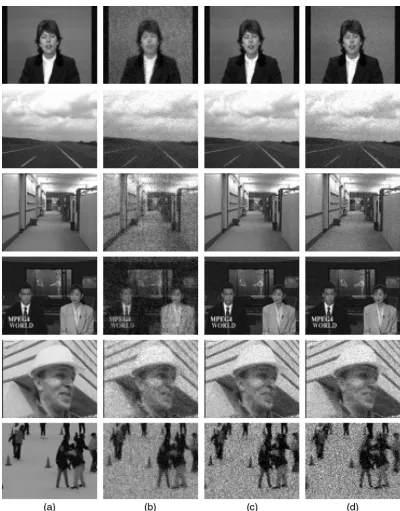
min-imization and the proposed methods: RefCS and RefCSLS. The example sequences used in this experiment are a set of 14 test video sequences. A few examples are displayed in Fig.7(a). These sequences can be grouped into three catego-ries based on the amount of activity they contain. These categories are low-, medium-, and high-activity sequences. Figure 7(b) shows the examples of the sequences recon-structed using the l1-norm minimization, whereas Fig.7(c)
shows the sequences reconstructed using RefCS. The improvement of visual quality is obvious in the RefCS results compared to the results of conventional l1-norm
method. In particular, the RefCS results show the reduction of the noise-like reconstruction artifacts, which can be noticed easily in thel1-norm minimization results. Figure7(d)shows
the examples reconstructed using RefCSLS. Even though RefCSLS does not promote the sparsity of the reconstruction
results and using a much less complex reconstruction method, it can be seen that the results of RefCSLS have the visual quality comparable to that of the regular RefCS results. These proposed methods clearly outperform the conventional l1-norm minimization method in terms of visual quality.
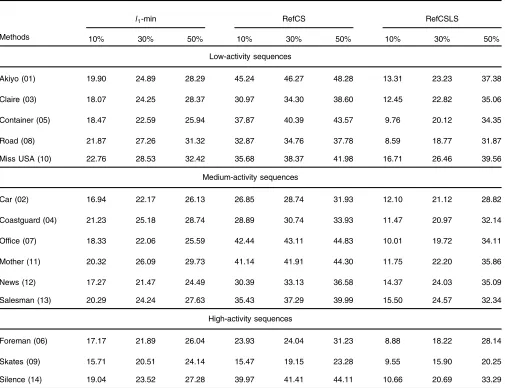
Table3shows the objective comparison of the reconstruc-tion quality of each reconstrucreconstruc-tion method using PSNR. Table 3 shows that the RefCS results have at least 40% higher in PSNR than the L1-norm minimization. The use
of the correlated reference contributes to the suppression of reconstruction artifacts Table 3 also shows the PSNR of the RefCSLS reconstructed video sequences. It shows that the quality of the RefCSLS reconstructed video sequences varies much greater than other methods. At the low sampling rate (such as 10%), the results of RefCSLS have poor PSNR compared to the conventionall1-norm minimization.
However, after the sampling rate increases beyond the cross-over rate—empirically found to be 34% in this experiment— the quality of the RefCSLS reconstructed video outperforms that of the l1-norm minimization reconstruction rapidly.
[image:11.630.64.569.362.750.2]At the sampling rate of 50%, the results from RefCSLS have on average 18% higher PSNR than the results of the l1-norm minimization.
Table 3 Average PSNR in decibels of reconstructed sequences using the proposed reconstruction methods at the sampling rate of 10%, 30%, and 50%.
Methods
l1-min RefCS RefCSLS
10% 30% 50% 10% 30% 50% 10% 30% 50%
Low-activity sequences
Akiyo (01) 19.90 24.89 28.29 45.24 46.27 48.28 13.31 23.23 37.38
Claire (03) 18.07 24.25 28.37 30.97 34.30 38.60 12.45 22.82 35.06
Container (05) 18.47 22.59 25.94 37.87 40.39 43.57 9.76 20.12 34.35
Road (08) 21.87 27.26 31.32 32.87 34.76 37.78 8.59 18.77 31.87
Miss USA (10) 22.76 28.53 32.42 35.68 38.37 41.98 16.71 26.46 39.56
Medium-activity sequences
Car (02) 16.94 22.17 26.13 26.85 28.74 31.93 12.10 21.12 28.82
Coastguard (04) 21.23 25.18 28.74 28.89 30.74 33.93 11.47 20.97 32.14
Office (07) 18.33 22.06 25.59 42.44 43.11 44.83 10.01 19.72 34.11
Mother (11) 20.32 26.09 29.73 41.14 41.91 44.30 11.75 22.20 35.86
News (12) 17.27 21.47 24.49 30.39 33.13 36.58 14.37 24.03 35.09
Salesman (13) 20.29 24.24 27.63 35.43 37.29 39.99 15.50 24.57 32.34
High-activity sequences
Foreman (06) 17.17 21.89 26.04 23.93 24.04 31.23 8.88 18.22 28.14
Skates (09) 15.71 20.51 24.14 15.47 19.15 23.28 9.55 15.90 20.25
Silence (14) 19.04 23.52 27.28 39.97 41.41 44.11 10.66 20.69 33.29
It can be noticed in Table 3 that the performance of RefCS is inversely proportional to the amount of activity in the sequences. The reason for this is the larger reference distanceδin the high-activity sequences that consist of lots of movements. The amount of activity does not affect the performance of the l1-norm minimization, though, as each
frame is reconstructed independently from each other. As the reconstruction error of RefCS is bounded by Proposition 2, RefCS is guaranteed to outperform thel1-norm minimization
when the reference distanceδis closer to the signal than the l1-norm solution by a factor of two. A sequence containing
lots of movement could lead to a reference that is too distant to the signal, thus, reducing the performance of RefCS. Also since the reconstructed preceding frame is used as the reference, the errors are propagated to successive frame reconstructions leading to more artifacts in later frames. One can avoid this by introducing anl1-norm
minimization-based reconstructed frame for every group of frames in a similar manner to introducing an intraframe in conventional video coding algorithms.
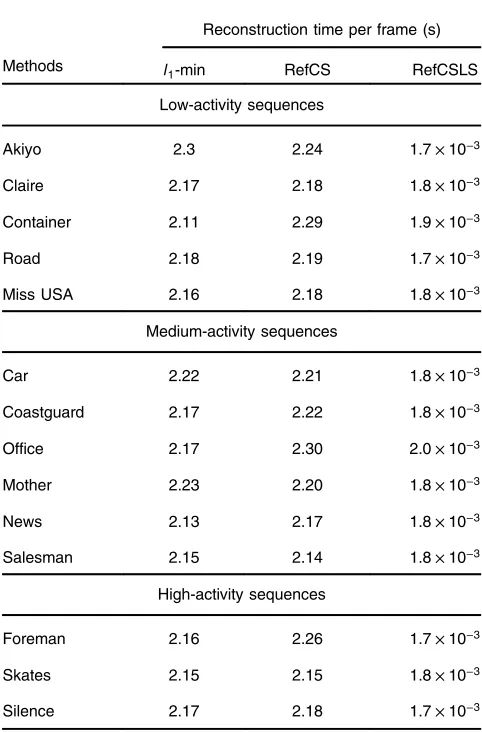
Finally, Table4shows the average reconstruction time per frame for each sequence using each method. As discussed in Sec.4, because RefCSLS does not use an iterative algorithm, it results in a shorter reconstruction time by the factor of at least 1200 compared to that of RefCS and l1-min.
5.3 Functional Magnetic Resonance Imaging Data Reconstruction
In this section, we explore another case study of RefCS and RefCSLS in fMRI data reconstruction. Unlike conventional MRI, fMRI requires a series of several three-dimensional tomographic volumes in order to extract the region of brain activity of a subject. The use of compressed sensing in fMRI offers the benefit of a better trade-off between the image qual-ity and the acquisition time, i.e., higher resolution data can be obtained as fast as the current high-speed low-resolution scan. The spatio-temporal nature of fMRI data fits perfectly with the proposed paradigm. The aim of this section is to reconstruct a series S consisting of full three-dimensional volumes. Each volumeVt ∈S,t¼1;2; : : :, is to be recon-structed from its compressive measurements yt ¼SðxtÞ, where xt is the complete K-space of Vt. Suppose that the sensing operationSðxtÞ ¼Φxtis built into the scanning pro-cedure, the reconstructed volumeV^t can be obtained from
EQ-TARGET;temp:intralink-;e038;326;551^
Vt¼Ψ−1x^
t; (38)
where
EQ-TARGET;temp:intralink-;e039;326;512^
xt ¼Rðyt;rÞ; (39)
r¼x^t−1, and Ψ−1 is the inverse Fourier transform.
To demonstrate this, a set of fMRI data is reconstructed from the simulated compressive measurements of their K-space. The fMRI data used in this experiment are from the following datasets:
1. attention to visual motion dataset38(DS1), 2. auditory fMRI dataset38(DS2),
3. mixed-gambles task fMRI dataset (obtained from the OpenfMRI database with accession number ds00000539) (DS3), and
4. visual object recognition dataset (obtained from the OpenfMRI database with accession number ds00010540) (DS4).
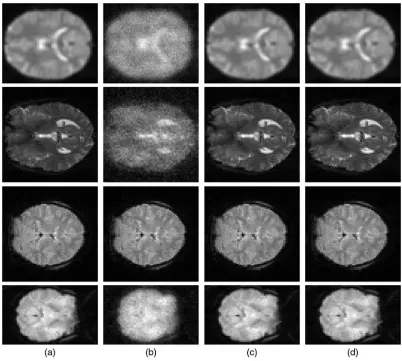
Each data point is reconstructed from the compressive measurements of 10%, 30%, and 50%. Figure 8(a)shows the example slices from each dataset.
First, Figs. 8(b)–8(d)present the examples slices of the
reconstructed data employing different reconstruction meth-ods for the purpose of subjective evaluation of the visual quality. It is clear that, at the sampling rate of 50%, both RefCS [Fig.8(c)] and RefCSLS [Fig.8(d)] outperform the conventionall1-norm minimization method. Even though the
l1-norm minimization fails to reconstruct the small details,
particularly in the DS2 and DS4, these details, however, are clearly preserved using the proposed methods.
To evaluate the visual quality objectively, Table5 shows the average PSNR of the reconstructed fMRI data. Table5 confirms the observation made in the subjective evaluation that the RefCS outperforms the conventionall1-norm
[image:12.630.62.303.386.752.2]minimi-zation, resulting in 90% higher PSNR on average. More inter-esting results are the reconstructed data using RefCSLS. Table5shows that the performance of RefCSLS in recon-structing fMRI data is comparable to the regular RefCS, despite having much less computational complexity. In con-trast to the results of video reconstruction, shown in Sec.5.2, here the performance of RefCSLS does not drop below that
Table 4 Average reconstruction time per frame (s) of each recon-struction method.
Methods
Reconstruction time per frame (s)
l1-min RefCS RefCSLS
Low-activity sequences
Akiyo 2.3 2.24 1.7×10⁻³
Claire 2.17 2.18 1.8×10⁻³
Container 2.11 2.29 1.9×10⁻³
Road 2.18 2.19 1.7×10⁻³
Miss USA 2.16 2.18 1.8×10⁻³
Medium-activity sequences
Car 2.22 2.21 1.8×10⁻³
Coastguard 2.17 2.22 1.8×10⁻³
Office 2.17 2.30 2.0×10⁻³
Mother 2.23 2.20 1.8×10⁻³
News 2.13 2.17 1.8×10⁻³
Salesman 2.15 2.14 1.8×10⁻³
High-activity sequences
Foreman 2.16 2.26 1.7×10⁻³
Skates 2.15 2.15 1.8×10⁻³
of thel1-norm minimization at low sampling rate. The reason
for this dramatic improvement lies in the characteristic of the fMRI data. Unlike in natural video sequences, the difference between two consecutive volumes is largely due to the changes of the intensity of each voxel rather than movements. This
results in a much smaller reference distanceδin fMRI data, thus, improving the performance of the proposed methods dra-matically. On average, the data reconstructed using RefCSLS results in 89% higher PSNR, and the reconstruction time is shortened by the factor of5.4×104, as shown in Table6. Fig. 8 Examples of the reconstructed data using different reconstruction methods from the compressive
[image:13.630.113.515.58.419.2]measurements with the sampling rate of 50%: (a) original lossless data, (b)l1-norm minimization, (c) RefCS, and (d) RefCSLS.
Table 5 Average PSNR of data reconstructed using different recon-struction methods.
Method
Sampling
rate (%) DS1 DS2 DS3 DS4
l1-min 10 24.97 16.22 26.35 21.79
30 25.56 24.94 34.86 26.03
50 32.87 25.24 36.17 30.21
RefCS 10 56.35 41.19 50.86 44.69
30 60.14 42.85 52.25 46.11
50 65.23 44.78 54.63 48.01
RefCSLS 10 56.05 41.27 51.03 44.92
30 57.60 42.86 52.60 46.48
[image:13.630.318.565.556.750.2]50 59.59 44.84 53.75 48.45
Table 6 Average reconstruction time per volume (s) using different reconstruction methods.
Method
Sampling
rate (%) DS1 DS2 DS3 DS4
l1-min 10 218.91 374.28 206.66 194.34
30 391.42 602.31 380.46 310.78
50 641.68 874.00 662.47 513.71
RefCS 10 214.32 373.63 208.13 194.93
30 383.95 579.32 385.86 310.87
50 636.43 872.67 660.37 496.87
RefCSLS 10 0.41 0.53 0.35 0.27
30 0.92 1.22 0.77 0.72
50 1.21 1.71 1.15 1.08
[image:13.630.62.307.558.751.2]6 Conclusions
In this paper, we have presented a framework for using a reference signal for compressed sensing reconstruction. The proposed algorithm, RefCS, improves the reconstruction quality of the compressed sensed signals by exploiting the spatial- or temporal-redundancy of the correlated reference. We have shown that RefCS outperforms the conventional l1-norm minimization method in terms of PSNR in three
different scenarios, i.e., the multiscale image reconstruction, video sequence reconstruction, and fMRI data reconstruc-tion. By exploiting the correlated reference, RefCS can improve the reconstruction quality by up to 90% in terms of PSNR in the experiments. For video sequences, the proposed method is more efficient when the amount of motion is low, as there is no motion compensation is utilized in the proposed paradigm.
We also demonstrated that by using a correlated reference it was possible to reconstruct the signals using the least squares method. The results using RefCSLS are comparable to those from the regular RefCS in terms of PSNR, while being able to obtain the results much faster than the conven-tional iterative reconstruction algorithms, for example, improving the reconstruction time by a factor ranging from 9 to5.4×104in our experiments. With the proposed
meth-ods, this paper has successfully addressed two challenges of applying compressed sensing in a practical application, namely, its poor reconstruction quality and its high computa-tional complexity.
References
1. E. J. Candès, J. Romberg, and T. Tao,“Robust uncertainty principles: exact signal reconstruction from highly incomplete frequency informa-tion,”IEEE Trans. Inf. Theory52, 489–509 (2006).
2. D. L. Donoho,“Compressed sensing,”IEEE Trans. Inf. Theory52, 1289–1306 (2006).
3. E. J. Candès and M. B. Wakin, “An introduction to compressive sampling,”IEEE Signal Process. Mag.25, 21–30 (2008).
4. A. Cohen, W. Dahmen, and R. DeVore,“Compressed sensing and best k-term approximation,”J. Am. Math. Soc.22(1), 211–231 (2009). 5. E. J. Candès and J. Romberg,“Sparsity and incoherence in compressive
sampling,”Inverse Prob.23, 969–985 (2007).
6. E. Candès,“The restricted isometry property and its implications for compressed sensing,”C. R. Math.346, 589–592 (2008).
7. K. Kim and G. Shevlyakov,“Why Gaussianity?”IEEE Signal Process. Mag.25, 102–113 (2008).
8. M. Lustig et al.,“Compressed sensing MRI,”IEEE Signal Process. Mag.25, 72–82 (2008).
9. J. P. Haldar, D. Hernando, and Z. P. Liang,“Compressed-sensing MRI with random encoding,” IEEE Trans. Med. Imaging 30, 893–903 (2011).
10. H. Hu and Z. Yang,“Spatial correlation-based distributed compressed sensing in wireless sensor networks,”inProc. 2010 6th Int. Conf. Wirel. Commun. Networking Mob. Comput. (WiCOM), IEEE, 1–4 (2010). 11. V. Thirumalai and P. Frossard, “Joint reconstruction of multi-view
compressed images,”IEEE Trans. Image Process.22(5), 1969–1981 (2012).
12. G. Warnell, D. Reddy, and R. Chellappa,“Adaptive rate compressive sensing for background subtraction,” inProc. 2012 IEEE Int. Conf. Acoust. Speech and Signal Process. (ICASSP), pp. 1477–1480 (2012). 13. C. Miosso, R. von Borries, and J. Pierluissi,“Compressive sensing with prior information requirements and probabilities of reconstruction in l1-minimization,”IEEE Trans. Signal Process.61(9), 2150–2164 (2013). 14. J. F. C. Mota, N. Deligiannis, and M. R. D. Rodrigues,“Compressed sensing with side information: geometrical interpretation and perfor-mance bounds,”inIEEE Global Conf. Signal Inf. Process. (GlobalSIP), pp. 512–516 (2014).
15. J. Scarlett, J. S. Evans, and S. Dey,“Compressed sensing with prior information: information-Theoretic limits and practical decoders,”
IEEE Trans. Signal Process.61, 427–439 (2013).
16. R. Baraniuk et al.,“Model-based compressive sensing,”IEEE Trans. Inf. Theory56(4), 1982–2001 (2010).
17. N. Vaswani,“Kalman filtered compressed sensing,”inProc. 15th IEEE Int. Conf. Image Process. (ICIP), pp. 893–896 (2008).
18. D. Jones, R. Schlick, and R. Marcia,“Compressive video recovery with upper and lower bound constraints,” inProc. 2012 IEEE Int. Conf. Acoust. Speech Signal Process. (ICASSP), pp. 3325–3328 (2012). 19. X. Zhu, L. Zhang, and Y. Liu,“Scalable distributed video coding using
compressed sensing in wavelet domain,”inProc. 18th IEEE Int. Conf. Image Process. (ICIP), pp. 2677–2680 (2011).
20. L. Kang and C. Lu,“Distributed compressive video sensing,”inProc. 2009 IEEE Int. Conf. Acoust. Speech and Signal Process. (ICASSP), pp. 1169–1172 (2009).
21. V. Stankovic, L. Stankovic, and S. Cheng,“Compressive video sam-pling,”inProc. Eur. Signal Process. Conf. (EUSIPCO), pp. 2–6 (2008). 22. C. Ma et al.,“Distributed compressive video sensing based on smoothed l0 norm with partially known support,”inProc. 2011 IEEE Int. Conf. Multimedia and Expo, pp. 1–6 (2011).
23. L. Liu et al.,“An improved distributed compressive video sensing based on adaptive sparse basis,”inProc. 2011 First Int. Conf. Robot, Vision and Signal Process., pp. 137–140 (2011).
24. H. Yin et al.,“Efficient multiple frame images recovery based on distributed compressed sensing,”inProc. 2014 World Autom. Congress (WAC), pp. 834–840 (2014).
25. S. Kurihara and H. Kikuchi,“An improvement of key frame processing by an integration of compressive sensing and intra prediction of H.264/ AVC,”inProc. 2014 IEEE Region 10 Symp., pp. 584–587 (2014). 26. X. Yuan et al.,“Adaptive temporal compressive sensing for video,”
inProc. 2013 IEEE Int. Conf. Image Process., pp. 14–18 (2013). 27. J. Yang et al., “Video compressive sensing using Gaussian mixture
models,”IEEE Trans. Image Process.23, 4863–4878 (2014). 28. L. Weizman, Y. C. Eldar, and D. Ben Bashat,“Compressed sensing for
longitudinal MRI: an adaptive-weighted approach,”Med. Phys.42(9), 5195–5208 (2015).
29. L. Weizman et al., “Exploiting similarity in adjacent slices for compressed sensing MRI,”inProc. 2014 36th Ann. Int. Conf. IEEE Eng. Med. Biol. Soc. (EMBC), pp. 1549–1552 (2014).
30. J. Park and M. Wakin,“A multiscale framework for compressive sensing of video,”inProc. 2009 Picture Coding Symp., pp. 1–4 (2009). 31. Z. Gao, C. Xiong, and C. Zhou,“Random permutations based block
compressive sensing for image compression applications,” in 18th IEEE Int. Conf. Image Process. (ICIP), pp. 293–296 (2011). 32. N. Onhon and M. Cetin,“A sparsity-driven approach for joint SAR
imaging and phase error correction,” IEEE Trans. Image Process.
21(4), 2075–2088 (2012).
33. W. Hotrakool and C. Abhayaratne,“Fast compressed sensing recon-struction using the least squares and signal correlation,” in IET Intell. Signal Process. Conf. (ISP 2013), pp. 1–6 (2013).
34. W. Hotrakool and C. Abhayaratne, “Running Gaussian reference-based reconstruction for video compressed sensing,”inIEEE Int. Conf. Acoust., Speech Signal Process. (ICASSP), pp. 2001–2005 (2014). 35. W. Hotrakool,“Compressed sensing for functional magnetic resonance
imaging data,”PhD thesis, University of Sheffield, United Kingdom (2018)http://etheses.whiterose.ac.uk/id/eprint/15704.
36. D. A. Lorenz, M. E. Pfetsch, and A. M. Tillmann,“An infeasible-point subgradient method using adaptive approximate projections,”Comput. Optim. Appl.57(2), 271–306 (2013).
37. D. A. Lorenz, M. E. Pfetsch, and A. M. Tillmann,“Solving basis pur-suit: heuristic optimality check and solver comparison,”ACM Trans. Math. Software41, 1–29 (2015).
38. C. Buchel and K. J. Friston,“Modulation of connectivity in visual pathways by attention: cortical interactions evaluated with structural equation modelling and fMRI,”Cereb. Cortex7(8), 768–778 (1997). 39. S. M. Tom et al.,“The neural basis of loss aversion in decision-making
under risk,”Science315(5811), 515–518 (2007).
40. A. J. O’toole et al.,“Partially distributed representations of objects and faces in ventral temporal cortex,”J. Cognit. Neurosci.17(4), 580–590 (2005).
Wattanit Hotrakoolreceived his MS degree in computer vision engi-neering and PhD in electronics and electrical engiengi-neering from the University of Sheffield, United Kingdom, in 2011 and 2016, respec-tively. He was a postdoctoral research associate at the University of Sheffield in 2017. His main research interests include the analysis of medical image data, sparse signal reconstruction, object recognition, and machine learning.